RESEARCH / Institutional investment and market data
Nasdaq eVestment alternatives: manager intelligence, target data and workflow
Compare eVestment, Preqin, Morningstar Direct, PitchBook and CorpDev.Ai by manager data, acquisition use case, licence cost, evidence quality and workflow.
Research as of
Website edition edited
Published by CorpDev.Ai, which is one of the vendors assessed. This analysis distinguishes vendor claims, external evidence and analyst judgments. Prices and capabilities reflect the source dates in the article; the website edition is an editorial adaptation, not a new verification of every claim.
An asset-manager acquisition needs a different evidence base
For an acquirer of asset-management businesses, strategy-level performance, institutional demand and manager positioning can matter more than the breadth of a generic company database. That is the specific situation in which eVestment deserves attention. For an industrial or technology acquirer, much of the same information can be commercially irrelevant despite its depth.
The distinction is between understanding an investment manager's competitive position and underwriting the company being acquired. Manager intelligence can frame the opportunity, but it does not by itself establish the target's earnings quality, client retention, ownership economics or integration requirements. Those remain separate diligence questions.
Evaluate the platform against a real acquisition thesis: which strategies and manager characteristics would change the shortlist, and which evidence would alter the investment committee's view? Price only the coverage and access needed to answer those questions. A cheaper broad database is not necessarily a substitute, and a rich specialist database is not automatically the right foundation for the wider deal stack.
Executive Summary
Most buyer's guides that place eVestment next to "alternatives" make a category error, and a corporate development professional who inherits that error will buy the wrong tool. Nasdaq eVestment is an institutional investment-management intelligence platform: it tells you which asset managers run which strategies, how they perform against peers, what institutional allocators pay in fees, and which consultants are running which mandate searches [1][13]. It is not a company database, not a transaction database, and not an M&A workflow tool. Nasdaq's own product materials make no claim to corporate-development or deal-sourcing functionality [1].
That distinction produces the central conclusion of this guide. If your M&A remit is the asset and wealth management sector — acquiring boutiques, GPs, wealth platforms or OCIO businesses — eVestment is a strong candidate as a diligence and market-mapping layer, and its true competitors are Preqin, Morningstar Direct, With Intelligence and MSCI/Burgiss. If your remit is anything else, eVestment is simply not on the shortlist, and the relevant comparison is between company/transaction terminals (PitchBook, S&P Capital IQ Pro), AI-first target-discovery tools (Grata/SourceScrub, Inven, Cyndx) and AI-native end-to-end platforms such as CorpDev.Ai, with deal CRMs (DealCloud, Affinity, Midaxo) as the workflow layer.
$137.7T
Firm AUM represented on eVestment (Mar 2026)
61,543
Completed mandate-search profiles tracked
~$30k
Median PitchBook annual contract (buyer data)
$12k
CorpDev.Ai AI Pro list price per year
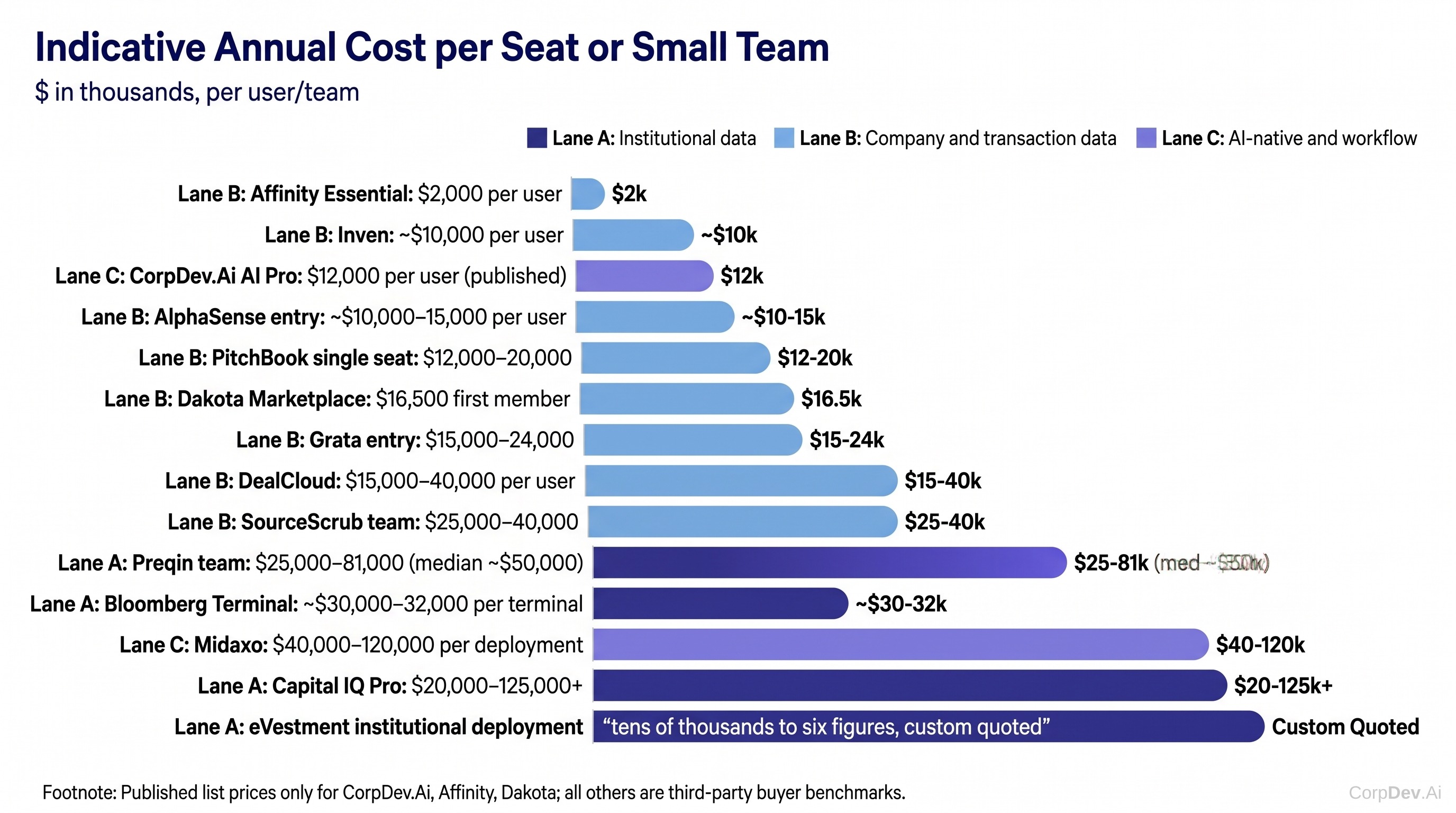
The guide's second conclusion concerns cost structure, not features. The institutional data incumbents (eVestment, Preqin, Capital IQ, Bloomberg, AlphaSense) price by module and named seat with no public rate card and typically land in the mid-five to low-six figures per year for a working team [15][18][38][52]. A new class of AI-native tools — CorpDev.Ai at a published $12,000 per seat per year, Inven at roughly $10,000 per seat, Affinity from $2,000 per seat — has decoupled analysis and deliverable production from proprietary data ownership [31][44][50]. The intelligent buying strategy in 2026 is therefore rarely "eVestment or X"; it is one authoritative data source for your sector plus one AI layer that turns it into decisions, chosen so that the two do not duplicate each other's licence fees.
| Job | Candidate vendors | When it matters |
|---|---|---|
| Managers, strategies and allocators | Nasdaq eVestment, Preqin (BlackRock), Morningstar Direct, With Intelligence, MSCI Burgiss, MercerInsight | Particularly relevant to asset-manager acquisitions and fund/allocator evaluation; separate from finding operating-company targets. |
| Companies, transactions and targets | PitchBook, Capital IQ Pro, Grata + Sourcescrub, Inven, AlphaSense; historical CYNDX | Company discovery, ownership, transactions and outside-in research. |
| Research outputs and the deal process | CorpDev.Ai, Midaxo, DealCloud, Affinity, 4Degrees | Turn information into pipeline records, decisions, deliverables and governed workflows; specialist scope differs. |
A typical corporate-development stack needs suitable data and a way to execute the work. eVestment is most directly relevant when the mandate concerns managers, wealth platforms or allocator questions; it is not a general acquisition-target database. CYNDX is historical context: its official site announces wind-down and dissolution, checked 14 September 2026, without an announcement date. It is not an active purchasing recommendation. CYNDX official site.
None of the institutional vendors in this guide publish a rate card. Every price attributed to eVestment, Preqin, PitchBook, Capital IQ, AlphaSense, Grata, DealCloud or Midaxo is drawn from third-party buyer-benchmark sites and vendor-comparison pages, not from the vendor. Only CorpDev.Ai, Affinity and Dakota Marketplace publish list prices. Treat all others as budgeting ranges to be replaced by a written quote.
1. What eVestment Actually Is (and Is Not)
eVestment launched in 2000 as a manager-reported database for institutional consultants and was acquired by Nasdaq for $705 million in October 2017 [72][73][74]; it now sits inside Nasdaq's Capital Access Platforms segment alongside index and data businesses [1][71]. Its economic engine is a two-sided network: asset managers submit strategy-level performance, holdings, fees and organisational data because consultants and asset owners screen from it; consultants and allocators use it because the managers are all there. Nasdaq reports 2,614 traditional managers and 2,190 hedge funds, 30,000+ long-only and alternative funds, $137.7 trillion in firm AUM represented and $71.3 trillion in institutional AUM represented as of its March 2026 coverage page [7][13].
1.1 Product modules
| Module | What it does | Who buys it | Relevance to an M&A team |
|---|---|---|---|
| Analytics | Peer-universe comparison of strategies on performance, risk, active share, portfolio characteristics, team and ownership [2] | Asset managers, consultants, asset owners | Core diligence tool for an asset-management target: validates the track record the seller shows you against 700+ peer universes |
| Market Lens | Allocator intent: open and completed mandate searches, consultant sentiment, flows, fee intelligence [3] | Asset managers' distribution teams | Reveals a target's real pipeline and consultant "buy-list" status — the revenue-quality evidence no CIM provides |
| Omni | Database-marketing service that keeps a manager's profile consistent across the consultant databases [4] | Asset managers | Low relevance; useful post-merger to rationalise combined product data |
| Private Markets / TopQ+ | GP and fund track-record analytics, cash-flow analysis, benchmarking, DD workflow; 16,231 GP and 89,909 fund profiles [5][12] | LPs, consultants, GPs | Core tool for diligencing a private-markets GP acquisition or GP-stake |
| Holdings Analysis / Risk Plus | Holdings-based exposure, overlap and risk analytics [7] | Consultants, asset owners | Useful to test product overlap in a manager-to-manager merger |
| Data licensing & API | Feeds of rosters, ratings, recommendations and mandates for internal systems [1][67] | Large managers, data teams | Enables a systematic screening model of the manager universe |
1.2 What makes the data valuable — and where it is weak
The distinctive asset is the consultant layer. Nasdaq's coverage page reports 61,543 completed mandate-search profiles, 3,607 open searches, 5,092 potential or unannounced allocator signals, 238 consultants, 27,637 manager ratings and 88,172 consultant-authored documents [13]. The cited coverage is a distinguishing feature; this review does not establish that no competing vendor has comparable activity data. For an acquirer of an asset manager, that is a potentially valuable external indicator of whether a target's AUM is growing because of durable consultant support or because of a two-year performance streak that is about to mean-revert.
The weakness is inherent to the model: the data is manager-reported. Nasdaq states plainly that flow calculations are bottom-up from reported strategies and that reporting managers do not always provide data on every strategy [13]. Represented AUM is not audited AUM. In diligence, eVestment figures must be reconciled against Form ADV, fund financial statements, administrator records and the management company's own revenue reports. Used that way — as a relative-ranking and trend-detection tool rather than a source of truth — it is highly effective.
1.3 Commercial model
Nasdaq publishes no price list; every module is sold through an enterprise sales process and priced on modules, seats, asset-class scope, geography and data rights [1]. The only public price signal is a TrustRadius listing of roughly $99–$140 per user per month, whose scope could not be established and should not be extrapolated to an institutional deployment [9]. Realistic budgeting for a small team with Analytics plus Market Lens is in the tens of thousands of dollars per year; adding TopQ+, API access or multi-team licensing pushes contracts into six figures. Nasdaq does not disclose eVestment revenue separately — it is folded into the Capital Access Platforms segment ($2.137 billion in FY2025), whose Q4 2025 workflow-and-insights line was $129 million [68][71]. That opacity matters for a buyer negotiating a multi-year deal: there is no public benchmark of what others pay.
It contains no list of companies for sale, no confidential seller mandates, no transaction tombstones outside fund commitments, no operating-company financials and no contact intelligence for corporates. A corporate development team outside financial services that licenses eVestment expecting a sourcing tool will use it once and let the licence lapse.
2. The Buyer's Real Question: Which Job Are You Hiring Software For?
Corporate development, strategy and M&A teams hire software for three distinct jobs, and the vendors in this guide cluster tightly around them. Confusing the jobs is the most common and most expensive procurement mistake because each job has a different economic driver: proprietary data is expensive and defensible, AI analysis is cheap and improving fast, and workflow is sticky but commoditised.
Question: Which players exist, how do they perform, where is demand moving?
Economics: Value lies in proprietary or contributed data that cannot be scraped. Priced by module and seat. High switching cost once analysts build universes.
Vendors: eVestment, Preqin, Morningstar Direct, PitchBook, Capital IQ, AlphaSense
Question: Which specific companies fit our thesis, and are they worth pursuing?
Economics: Value lies in coverage of the long tail (founder-owned, lower-middle-market) and in the quality of AI-generated screening and profiles. Pricing is converging downward.
Vendors: Grata/SourceScrub, Inven, Cyndx, CorpDev.Ai, PitchBook
Question: Where is every deal, who owns the next step, what did we decide and why?
Economics: Value lies in adoption and integration with email and calendar. Priced per seat. Strong lock-in via historical data.
Vendors: DealCloud, Affinity, 4Degrees, Midaxo, CorpDev.Ai
eVestment is a pure Job 1 tool for a single sector. That is its strength — depth no generalist can match — and its limitation. The four archetypes below show how the job mix changes with the buyer, and therefore how relevant eVestment is:
| Buyer archetype | Job 1 need | Job 2 need | Job 3 need | Is eVestment relevant? |
|---|---|---|---|---|
| Asset/wealth manager, insurer or bank acquiring investment managers | Very high — manager universes, flows, consultant ratings | Moderate — universe is small and known | Moderate | Yes — primary data layer; pair with Preqin or PitchBook for GP/private-markets targets |
| Financial-sponsor or GP-stakes investor | High — GP track records and fundraising | High — sponsor deal flow | High | Partly — TopQ+ competes with Preqin and MSCI/Burgiss; PitchBook still needed for deals |
| Industrial, tech or healthcare corporate acquirer | Moderate — sector maps and comps | Very high — long-tail private targets | High | No — buy Lane B and Lane C tools |
| Strategy / corporate strategy team with occasional M&A | High — market sizing and competitor intelligence | Low–moderate | Low | No — AlphaSense, Capital IQ or an AI research platform fits better |
The practical implication is that only the first two archetypes should read the Lane A comparison in section 3.1 as a purchasing decision. The other two should read it as context and go directly to sections 3.2 and 3.3.
| Job | Relevant products | Economic and scope questions |
|---|---|---|
| Know the market | eVestment for asset-management strategies; Preqin for private markets; Morningstar Direct for public funds; Capital IQ for financials/comps; AlphaSense for documents/transcripts | Proprietary data can be expensive and difficult to replicate. Buy the exact coverage and usage rights the mandate requires. |
| Find and evaluate targets | PitchBook, Grata + Sourcescrub, Inven, CorpDev.Ai; historical CYNDX | AI discovery and screening may reduce labour, but “prices falling fast” is a hypothesis to test against quotes and review effort. |
| Run the process | DealCloud, Affinity, 4Degrees, Midaxo, CorpDev.Ai | Adoption, integration and seat structure can dominate switching cost; compare actual governance needs. |
CorpDev.Ai spans target evaluation and workflow through its research and pipeline features. That overlap may simplify the stack, but does not establish equivalent depth across licensed data, relationships and PMI. CYNDX is historical context: its official site announces wind-down and dissolution, checked 14 September 2026, without an announcement date. It is not an active purchasing recommendation. CYNDX official site.
3. The Alternatives Landscape
The vendors below are grouped into the three lanes introduced in the Executive Summary. Only Lane A contains genuine substitutes for eVestment; Lanes B and C contain the tools a buyer outside the asset-management sector is really choosing between when the word "eVestment" appears on a shortlist. Pricing throughout is indicative and sourced in the appendix.
3.1 Lane A — Institutional Manager and Fund Intelligence (eVestment's home turf)
These are the only products a buyer should evaluate as substitutes for eVestment. Even here, substitution is imperfect: each vendor's coverage centre of gravity is different, and large institutions typically run two or three of them rather than one [17].
| Vendor | Coverage centre of gravity | Where it beats eVestment | Where eVestment wins | Indicative annual cost |
|---|---|---|---|---|
| Preqin (BlackRock) | Alternatives: 48,000 firms, 135,000+ funds, 20,000+ investors; 68,822 PE funds with 9,284 carrying performance [56][57] | Breadth across PE, VC, private credit, real assets and hedge funds; fund terms, dry powder, LP commitments, portfolio companies. Preqin's benchmarks are even licensed into eVestment's own private-markets product [14] | Traditional long-only managers, consultant search activity, institutional fee benchmarking | Custom; buyer data clusters around $25k–$81k with a ~$50k median [15][16] |
| Morningstar Direct | ~1.4 million registered investment offerings: mutual funds, ETFs, SMAs, model portfolios [62][63] | Retail and intermediary product economics, share-class analysis, holdings-based attribution; partly filings-based rather than self-reported [64] | Institutional separate-account universes, mandate searches, private markets. G2 users (4.1/5, 426 reviews) cite slow performance and a steep learning curve [22][23][25] | Custom, sold module by module; users describe cost as prohibitive for multi-module deployments [22] |
| With Intelligence | Hedge funds, allocators, fund launches, investor contacts, editorial intelligence | Qualitative and news-driven allocator intelligence for capital-raising; useful when the target is a hedge fund or alternatives boutique | Standardised quantitative universes and consultant ratings; thin public review base | Custom; no dependable public price |
| MSCI Private Capital (Burgiss) | LP-contributed private-capital cash flows and performance | Cash-flow-based benchmarking, exposure and attribution for private-capital portfolios; the analytical gold standard for GP track-record validation | Manager discovery, traditional assets, fundraising and contact intelligence | Custom enterprise |
| MercerInsight | Mercer's manager research and ratings database | Qualitative manager ratings backed by a consultant's due-diligence process; note that Mercer's platform itself draws on eVestment data and analytics [17] | Self-service breadth across managers Mercer does not rate; independence from a consulting relationship | Custom; usually bundled with a Mercer relationship |
Verdict for the asset-management acquirer. eVestment remains the default core licence because its consultant-search and institutional fee data are unique. Preqin is the necessary complement when targets include GPs or alternatives boutiques; Morningstar Direct is the complement when the target's economics sit in mutual funds, ETFs or wealth channels. MSCI/Burgiss earns its place only if the acquirer routinely validates private-capital track records at cash-flow level. MercerInsight and Cambridge Associates are advisory-led research services rather than software substitutes and belong in the advisor budget, not the tooling budget.
Preqin benchmarks are inside eVestment TopQ+, eVestment data is inside MercerInsight and available through a FactSet integration [14][17]. Before signing two contracts, map which datasets you would be paying for twice, and confirm that each licence permits use in M&A diligence, sharing with advisers, and survival through a change of control — none of these are standard in institutional data agreements.
3.2 Lane B — Company, Transaction and Target Intelligence
For every acquirer outside financial services, this lane is where the real eVestment "alternative" decision sits: which source of company and transaction intelligence should anchor the stack? The 2026 market splits into two incumbent terminals and a fast-consolidating group of AI-first discovery tools.
The incumbent terminals. PitchBook covers nearly 6 million companies, 2.7 million investments, 570,000 investors and 147,000 funds, and remains the best single source for sponsor ownership, funding history, deal comps and exit data [60]. G2 rates it 4.5/5 across 257 reviews; the recurring complaints are price and stale records on smaller private companies [20]. Buyer-benchmark data puts a single seat at $12,000–$20,000 and typical team contracts at $20,000–$70,000, with a ~$30,000 median [18][19]. S&P Capital IQ Pro is the stronger choice when the work is valuation-heavy: standardised financials, estimates, ownership and transaction comps on a public-company-grade data foundation, priced at roughly $20,000–$125,000+ depending on seats and modules [38]. AlphaSense is the third incumbent for qualitative intelligence — filings, transcripts, broker research and expert-call libraries with generative search — at roughly $10,000–$15,000 per seat and $100,000–$150,000 for enterprise deployments [52].
The AI-first discovery tools. These compete on long-tail coverage of founder-owned and lower-middle-market companies that the terminals index poorly, and on natural-language search.
| Vendor | Distinctive capability | Caveat for the buyer | Indicative annual cost |
|---|---|---|---|
| Grata (Datasite) | Agentic semantic search that refines intent and finds similar companies; strong on niche private companies [35][36] | Now owned by Datasite, which has also acquired SourceScrub — confirm which product and bundle you are actually quoted [49] | Entry ~$15k–$24k; larger deployments materially higher [34] |
| SourceScrub (Datasite) | Conference-exhibitor and event-driven signals that surface companies before they appear in financial databases [37] | Same ownership caveat; roadmap likely to converge with Grata | ~$25k–$40k for a lower-middle-market team; $100k+ for large programmes [37] |
| Inven | AI company search that produces client-ready long-lists, one-pagers and overview slides; claims 1,000+ firms [51] | Deliverable quality depends on public web data; less transaction depth than PitchBook | ~$10k per user; mid-five-figure firm licences [38][50] |
| Cyndx | Matching engine across companies, investors and acquirers (Finder, Acquirer, Raiser) [40] | Strongest for capital-raising matching; thinner as a diligence data source | ~$30k–$75k [38][39] |
Verdict. A corporate acquirer with a defined sector thesis will get more sourcing value per dollar from one AI-first discovery tool than from a second terminal seat. PitchBook or Capital IQ remains necessary for ownership, comps and transaction history — but a team of three rarely needs more than one or two seats of it if the discovery and profiling work moves to a lower-cost layer.
Datasite now owns both Grata and SourceScrub [49]. Consolidation typically means bundle pricing, roadmap convergence and renewal uplift. Buyers signing multi-year discovery-tool contracts in 2026 should insist on price caps at renewal and data-export rights that survive product retirement.
3.3 Lane C — AI-Native M&A Research and Deal Workflow
The third lane is where the most change is happening and where an objective guide must be most careful, because the newest vendors — including CorpDev.Ai, which commissioned this comparison — have the least independent track record.
Deal CRMs and lifecycle platforms. DealCloud (Intapp) is the enterprise standard for large, process-heavy investment organisations: a configurable data model, granular permissions and reporting, priced at roughly $15,000–$40,000+ per user per year [43]. Affinity is the relationship-intelligence CRM: it captures email and calendar activity automatically, publishes list prices of $2,000–$2,700 per user per year, and from its Scale tier exposes an MCP server that lets Claude, Gemini or Copilot read the CRM [44][45]. 4Degrees offers a similar relationship-graph approach at mid-market pricing without a public rate card [46]. Midaxo is the only one of the four built specifically for corporate development: a single system spanning pipeline, diligence, integration and synergy tracking, priced at an estimated $40,000–$120,000 per year [37][41][42]. All four embed AI as summaries, search and automation on top of a workflow product — the AI is a feature, not the product.
CorpDev.Ai — an objective assessment. CorpDev.Ai inverts that model: it is an AI analyst first and a workflow tool second. The platform combines an agentic research analyst that writes market maps, target screens, company profiles, investment memos and presentations; a document editor with Word, PowerPoint and Excel export; a pipeline Kanban with a "zero-entry" CRM that enriches companies from connected Microsoft 365 or Google Workspace mail and calendar; an AI-native data room for diligence documents; and target monitoring with news and management-change alerts [31][33]. Its data layer is deliberately non-proprietary — Apollo firmographics for roughly 70 million companies, Google Maps, LinkedIn, web search, filings and press releases — and its models are routed across Anthropic, OpenAI, Perplexity and Google [33].
Price transparency. $1,000 per month for AI Pro, $3,000 per month for a three-seat team, both invoiced annually — a published list price in a category where almost no one publishes one [31].
Deliverable production. Its primary output is a draft memo, map or deck rather than a data screen; Inven and other AI tools also offer deliverable features — the work a two-person corporate development team otherwise buys from consultants or does at night.
Breadth across the lifecycle. Strategy, sourcing, screening, pipeline, diligence data room and integration planning in one workspace, with open Markdown/JSON storage and REST/MCP interfaces that reduce lock-in [33].
Free trial and self-service onboarding for in-house teams at $1B+ companies, versus months-long enterprise sales cycles elsewhere [31].
No proprietary dataset. CorpDev.Ai does not own a manager database (eVestment), a fund database (Preqin) or a curated transaction database (PitchBook). Its company coverage rests on Apollo and web research; ownership, funding and deal comps are shallower than a terminal's and must be verified.
Vendor maturity. A young company with limited independent review coverage on G2 or Gartner Peer Insights. Reference calls and a paid pilot matter more than for incumbents.
AI output requires review. The vendor itself recommends human review for critical decisions [31]; a buyer should budget analyst time to validate cited figures, using the appendix’s stated source limitations as a starting point.
Enterprise features are gated. Financial modelling, SSO and unlimited seats sit in the custom-quoted Enterprise tier, so the headline $12,000 is a single-seat price [31].
Verdict. CorpDev.Ai is not an eVestment substitute and does not claim to be; it is the analysis-and-workflow layer that sits on top of whichever data source a team already trusts. The buying question it poses is different: whether a corporate development team should spend $12,000–$36,000 on an AI layer that produces deliverables, or an equivalent amount on additional terminal seats and consultant hours. For teams outside financial services with one or two PitchBook or Capital IQ seats already in place, the former is increasingly the rational choice. For asset-management acquirers, it is an addition to eVestment, not an alternative.
Read diagram description
Bar chart of indicative annual cost per seat or per small team, ordered from lowest to highest, with a label on each bar. Bars: Affinity Essential $2,000 per user; Inven ~$10,000 per user; CorpDev.Ai AI Pro $12,000 per user (published); AlphaSense entry ~$10,000–15,000 per user; PitchBook single seat $12,000–20,000; Dakota Marketplace $16,500 first member; Grata entry $15,000–24,000; DealCloud $15,000–40,000 per user; SourceScrub team $25,000–40,000; Preqin team $25,000–81,000 (median ~$50,000); Bloomberg Terminal ~$30,000–32,000 per terminal; Midaxo $40,000–120,000 per deployment; Capital IQ Pro $20,000–125,000+; eVestment institutional deployment "tens of thousands to six figures, custom quoted". Categories: Lane A institutional data, Lane B company and transaction data, Lane C AI-native and workflow. Basis: "Published list prices only for CorpDev.Ai, Affinity, Dakota; all others are third-party buyer benchmarks."
4. Head-to-Head Comparison
The matrix below scores the twelve most-shortlisted platforms on the seven criteria that decide value for a corporate development, strategy or M&A buyer. Scores run from 1 (weak or absent) to 5 (best in class) and reflect the evidence in section 3 and the cited vendor and review material; they are analyst judgements, not vendor claims, and the Basis column of the appendix records how each was formed.
| Platform | Lane | Asset-mgr & fund data | Private-company & deal data | AI research & deliverables | Deal workflow / CRM | Price transparency | Ease of procurement | Independent review depth |
|---|---|---|---|---|---|---|---|---|
| Nasdaq eVestment | A | 5 | 1 | 2 | 1 | 1 | 2 | 2 |
| Preqin (BlackRock) | A | 4 | 3 | 2 | 1 | 1 | 2 | 2 |
| Morningstar Direct | A | 3 | 1 | 2 | 1 | 1 | 2 | 5 |
| PitchBook | B | 3 | 5 | 3 | 2 | 2 | 3 | 5 |
| S&P Capital IQ Pro | B | 2 | 4 | 3 | 1 | 1 | 2 | 4 |
| AlphaSense | B | 1 | 2 | 4 | 1 | 1 | 2 | 4 |
| Grata / SourceScrub (Datasite) | B | 1 | 4 | 3 | 2 | 2 | 3 | 3 |
| Inven | B | 1 | 3 | 4 | 1 | 2 | 4 | 2 |
| CorpDev.Ai | C | 1 | 3 | 5 | 4 | 5 | 5 | 1 |
| Midaxo | C | 1 | 1 | 2 | 5 | 1 | 2 | 3 |
| DealCloud (Intapp) | C | 1 | 2 | 2 | 5 | 1 | 1 | 4 |
| Affinity | C | 1 | 2 | 3 | 4 | 5 | 4 | 4 |
Three patterns stand out. First, no platform scores above 3 in both data columns — the vendor that owns institutional manager data does not own deal data, and vice versa — which is why a one-vendor stack does not exist. Second, price transparency and procurement ease are inversely correlated with proprietary data depth: the two platforms scoring 5 on a data axis all score 1–2 on transparency. Third, independent review depth is lowest exactly where AI capability is highest: CorpDev.Ai and Inven have the thinnest G2 and Gartner Peer Insights footprints, while Morningstar Direct and PitchBook have hundreds of reviews each [20][25]. A buyer of an AI-native tool is trading verified peer evidence for speed and price and should compensate with a structured pilot.
4.1 eVestment versus its closest substitutes on the dimensions that matter to an acquirer
| Diligence question about an asset-management target | eVestment | Preqin | Morningstar Direct | PitchBook |
|---|---|---|---|---|
| Is the flagship strategy's track record real relative to peers? | Best — 700+ peer universes, manager-reported but standardised [7] | Good for private funds only | Good for registered funds only | Weak |
| Is institutional AUM growing on durable demand? | Best — 61,543 completed and 3,607 open searches, consultant ratings [13] | Consultant profiles but no search-volume database [57] | Flows for registered products only | Not covered |
| Are fees at, above or below market? | Best — institutional fee benchmarking and consultant fee studies [55] | Best for private-fund terms (hurdles, gates, carry) [58] | Best for expense ratios and share classes | Partial |
| Who are the LPs / clients and how concentrated? | Client rosters via API [67] | Strong LP database and commitments [56] | Weak | Strong LP and fund-commitment data [60] |
| Who has bought or invested in comparable managers? | Not covered | Partial (GP-stakes funds) | Not covered | Best — deal and exit history [60] |
The table makes the complementarity concrete: an acquirer of a $10 billion multi-boutique manager needs eVestment for the first three rows and PitchBook or Preqin for the last two. Dropping eVestment in favour of Preqin saves a licence and loses a valuable external source of consultant-support evidence, one factor to investigate when assessing post-acquisition AUM-retention risk.
5. Total Cost of Ownership
Licence fees are the visible cost; the larger costs are seats that go unused, analyst hours spent reconciling three databases, and renewal uplifts on contracts with no published benchmark. The three-year scenarios below model a three-person corporate development team and use the mid-point of the third-party price ranges cited in section 3, with published list prices where they exist. They are budgeting estimates and the Basis column states each input.
| Stack | Year 1 | Year 2 | Year 3 |
|---|---|---|---|
| Asset-mgr acquirer: eVestment + Preqin + 1 PitchBook seat | 175 | 184 | 193 |
| Corporate acquirer, incumbent stack: 2 Capital IQ seats + Grata + DealCloud (3 users) | 200 | 210 | 221 |
| Corporate acquirer, hybrid stack: 1 PitchBook seat + CorpDev.Ai Team + Affinity (3 users) | 72 | 75.6 | 79.4 |
| Lean strategy team: AlphaSense (1 seat) + CorpDev.Ai Pro | 24.5 | 25.7 | 27.0 |
| Stack | Inputs (Year 1) | Basis |
|---|---|---|
| Asset-manager acquirer | eVestment Analytics + Market Lens ~$95k; Preqin ~$50k; PitchBook 1 seat ~$30k | eVestment scenario assumption of $95k; the open-ended range has no mathematical midpoint [1][9]; Preqin median [15][16]; PitchBook median contract [19] |
| Corporate acquirer, incumbent | Capital IQ 2 seats ~$72k; Grata ~$20k; DealCloud 3 users ~$108k | Capital IQ range mid-point of low band [38]; Grata entry [34]; DealCloud scenario assumption of ~$36k/user, toward the upper end of the cited range [43] |
| Corporate acquirer, hybrid | PitchBook 1 seat ~$30k; CorpDev.Ai AI Pro Team $36k; Affinity Essential 3 × $2k = $6k | PitchBook median [19]; CorpDev.Ai published list [31]; Affinity published list [44] |
| Lean strategy team | AlphaSense 1 seat ~$12.5k; CorpDev.Ai AI Pro $12k | AlphaSense entry mid-point [52]; CorpDev.Ai published list [31] |
All scenarios assume a 5% annual uplift as a sensitivity input; it is not a verified typical renewal rate or a contractual cap. The comparison is deliberately not like-for-like — the incumbent stack buys deeper ownership and transaction data than the hybrid stack — and the point is not that the cheaper stack is "better". The point is that the ~$130,000 annual difference between the two corporate-acquirer stacks funds roughly 400–650 hours of a mid-level M&A consultant, or an additional in-house analyst — a real trade-off a CorpDev head can put to a CFO.
5.1 The hidden costs the licence does not show
- Seat utilisation. Terminal seats are named-user and expensive; in a three-person team one seat is typically used daily and two are used for a fortnight per quarter. Track log-ins before renewal.
- Reconciliation time. eVestment represented AUM, Preqin fund AUM and Form ADV regulatory AUM never agree [13]; every asset-management diligence budgets analyst days to bridge them.
- Data-rights friction. Institutional data licences typically restrict redistribution and may not cover sharing with advisers or use in a change-of-control transaction; obtaining written consent costs weeks in a live process.
- AI validation. AI-native tools shift cost from data licences to review time. Use 10–20% of drafting-time savings as an initial verification-budget assumption, then replace it with measured review time, and demand that the tool cite every figure so that verification is a click rather than a search.
Because none of the incumbents publish prices, the spread between what two similar buyers pay is wide — buyer-benchmark data shows Preqin contracts from $25,000 to $81,000 for comparable scope [15][16]. Run at least two vendors to a written three-year proposal with identical test universes, export limits and user counts, and share the lower quote. The published prices of the AI-native tools are a useful anchor in that negotiation even if you do not buy them.
6. Decision Framework: Which Stack for Which Team
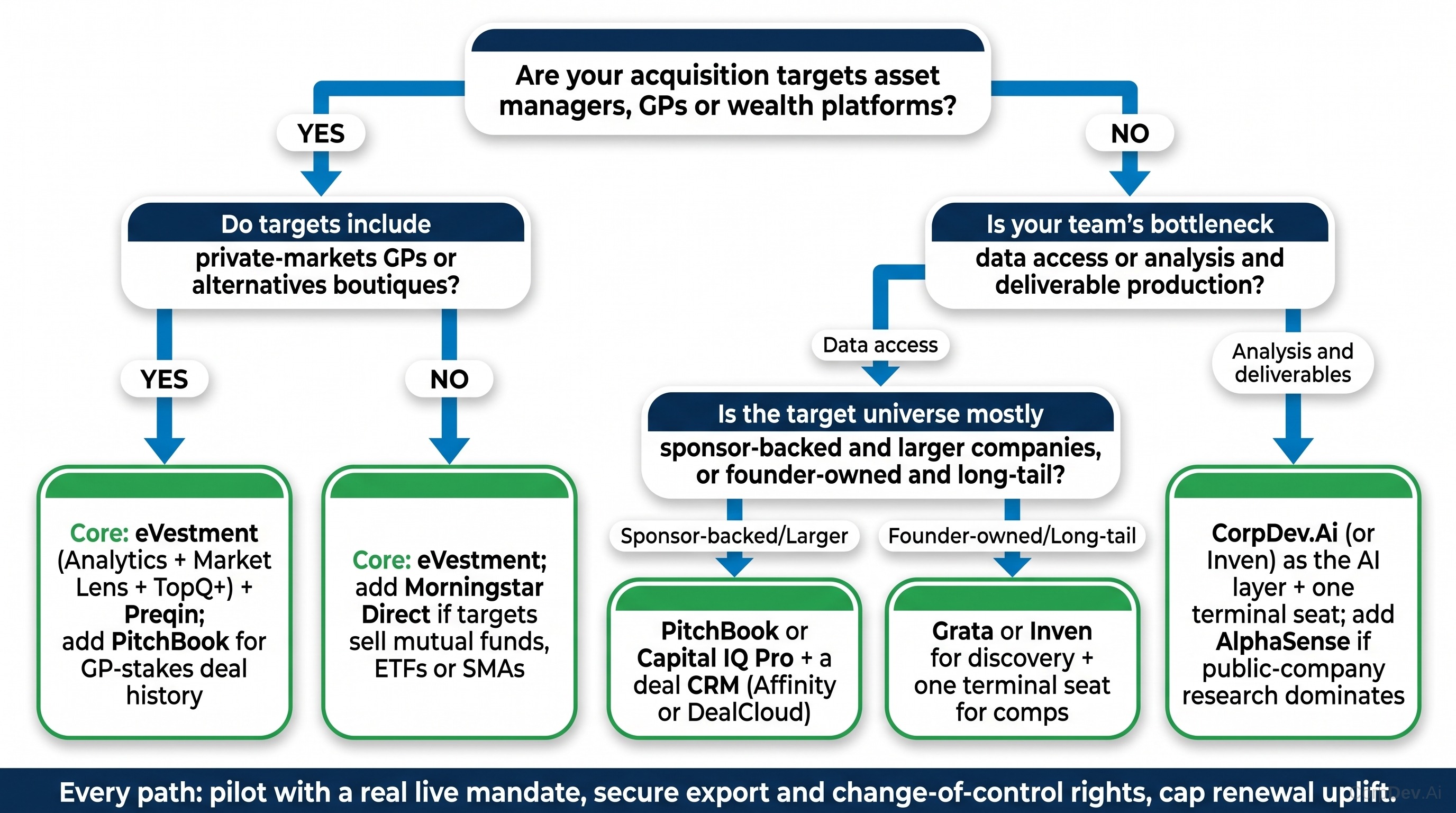
The recommendations below follow from the job analysis in section 2, the lane comparison in section 3 and the cost scenarios in section 5. Each is a starting stack, not a ceiling; the principle in every case is one authoritative data source for the sector in question plus one layer that converts it into decisions and runs the process.
Read diagram description
Decision tree. Root node: "Are your acquisition targets asset managers, GPs or wealth platforms?" Branch YES leads to node "Do targets include private-markets GPs or alternatives boutiques?" — YES leads to leaf "Core: eVestment (Analytics + Market Lens + TopQ+) + Preqin; add PitchBook for GP-stakes deal history"; NO leads to leaf "Core: eVestment; add Morningstar Direct if targets sell mutual funds, ETFs or SMAs". Branch NO leads to node "Is your team's bottleneck data access or analysis and deliverable production?" — "Data access" leads to node "Is the target universe mostly sponsor-backed and larger companies, or founder-owned and long-tail?" with leaves "PitchBook or Capital IQ Pro + a deal CRM (Affinity or DealCloud)" and "Grata or Inven for discovery + one terminal seat for comps". "Analysis and deliverables" leads to leaf "CorpDev.Ai (or Inven) as the AI layer + one terminal seat; add AlphaSense if public-company research dominates". For all paths: "Every path: pilot with a real live mandate, secure export and change-of-control rights, cap renewal uplift."
6.1 Recommended stacks by archetype
| Archetype | Core data layer | Discovery layer | Analysis & workflow layer | Indicative Year-1 licence |
|---|---|---|---|---|
| Asset/wealth manager or insurer acquiring investment managers | eVestment Analytics + Market Lens; Preqin if GP targets | Not needed — universe is enumerable in eVestment | Existing CRM; CorpDev.Ai or Inven optional for memo and market-map production | ~$150k–$200k |
| GP-stakes or financial-sponsor investor in asset managers | eVestment TopQ+ or MSCI/Burgiss; Preqin | PitchBook (deal and LP data) | DealCloud or Affinity | ~$200k+ |
| Industrial, tech or healthcare corporate acquirer (team of 1–5) | 1–2 PitchBook or Capital IQ seats | Grata/Inven, or CorpDev.Ai semantic search if long-tail coverage via Apollo suffices | CorpDev.Ai Team for deliverables and pipeline, or Affinity/Midaxo if process rigour dominates | ~$70k–$120k |
| Corporate strategy team with occasional M&A | AlphaSense or Capital IQ (1 seat) | Not needed | CorpDev.Ai Pro for market maps, competitor research and board decks | ~$25k–$40k |
| Boutique advisor or search fund | PitchBook (1 seat) or none | Inven or CorpDev.Ai | Affinity Essential | ~$15k–$45k |
6.2 When eVestment is the wrong answer even for a financial-services buyer
Three situations recur. A wealth-management roll-up acquiring RIAs and advisory practices needs Form ADV-derived RIA databases and CRM-style contact intelligence, which eVestment does not provide; PitchBook and specialist RIA databases serve that job. A bank buying a fund administrator, fintech or wealth-tech platform is buying a software or services company, not a manager, and belongs in Lane B. And a corporate acquiring a single, already-identified manager in a bilateral process can commission a consultant to pull the eVestment universe once rather than licence the platform for three years.
6.3 When CorpDev.Ai is the wrong answer
Objectivity requires the mirror image. CorpDev.Ai should not be the only tool for a buyer whose deals turn on sponsor ownership history, precise transaction comps or fund-level LP data — those live in PitchBook, Capital IQ and Preqin, and no web-research layer replaces them. It is also the wrong fit for an organisation that needs a heavily configured, permissioned enterprise CRM across dozens of users on day one; DealCloud exists for that. Where it fits is as the analysis and production layer for lean teams, and as the workflow system for teams whose pipeline has previously lived in spreadsheets and inboxes.
7. Procurement Checklist and Red Flags
Every vendor in this guide will offer a demo on its own curated examples. The only evaluation that predicts value is a pilot on a live mandate your team is actually working, with the same brief given to each shortlisted tool. The checklist below is written to be copied into a procurement plan.
7.1 Pilot design
- Define one live use case per lane (e.g. "map the European specialty-insurance MGA market and shortlist 30 targets", or "validate Target X's flagship strategy against its peer universe") and give the identical brief to every vendor.
- Fix a test universe of 25 companies or managers you already know well and score each tool on coverage, accuracy of financials/AUM, ownership data and freshness against your own knowledge.
- Require every AI-generated figure to carry a clickable source; spot-check 20 figures per tool and record the error rate.
- Measure analyst hours to first usable deliverable, not feature counts.
- Involve the people who will use the tool weekly — a head of corporate development approving a terminal that only an analyst opens is the classic utilisation failure.
7.2 Contract terms to secure before signature
| Term | Why it matters | What to ask for |
|---|---|---|
| Renewal uplift cap | No public rate card means uplift is discretionary; consolidation (Datasite–Grata–SourceScrub, BlackRock–Preqin) increases the risk [49][75] | Cap at CPI or a fixed percentage for at least two renewals |
| Diligence and adviser use | Institutional data licences commonly restrict redistribution; sharing a screen with counsel or a banker may be a breach | Explicit right to use data in M&A diligence and to share with named advisers under NDA |
| Change-of-control and assignment | Access may terminate on acquisition of your company or the target | Survival of licence through change of control; right to assign to the combined entity |
| Export and post-termination rights | Universes and pipelines built over three years are the real switching cost | Bulk export in open formats; right to retain downloaded data after termination |
| Named vs concurrent seats | Named seats can be underused; measure utilisation rather than assuming an idle percentage | Concurrent or floating seats, or a low-cost read-only tier |
| AI training and confidentiality | AI-native tools ingest your pipeline, email and data room | Contractual commitment that customer data is not used for model training and is logically segregated; SOC 2 Type II evidence [31] |
| Termination for convenience | Tooling needs change with M&A strategy | Annual opt-out or, for monthly-priced tools, no minimum term |
7.3 Red flags
- A vendor that will not run your test universe and insists on its own demo data — coverage is thinner than the pitch.
- Represented AUM, "companies covered" or "funds tracked" presented as comparable across vendors; the denominators differ fundamentally [13][60][62].
- An AI tool that produces figures without inline citations, or whose citations resolve to aggregator sites rather than primary sources.
- A quote that bundles modules you did not ask for as the price of a discount on the one you did — common in institutional data where the bundle inflates the renewal base.
- Any claim that a single platform covers manager data, deal data and workflow at best-in-class depth; the scoring matrix in section 4 shows none does.
Buy the data layer first and pilot the AI or workflow layer against it. AI-native tools are most valuable when they can read the data you already trust — via export, API or MCP connectors — and a pilot run before that data is in place will understate their value.
Key Facts & Sources
The load-bearing figures in this guide, each with its source, as-of date and basis. Figures marked "third-party benchmark" are not vendor-published and should be replaced with a written quote before any budgeting decision.
| Figure | Value | Source | As of | Basis |
|---|---|---|---|---|
| Nasdaq acquisition of eVestment | $705 million, completed 23 Oct 2017 | Nasdaq IR releases [72][73] | Oct 2017 | Vendor-published |
| eVestment firm AUM represented | $137.674 trillion | Nasdaq eVestment coverage page [13] | 31 Mar 2026 | Vendor-published, manager-reported |
| eVestment institutional AUM represented | $71.348 trillion | Nasdaq eVestment coverage page [13] | 31 Mar 2026 | Vendor-published, manager-reported |
| eVestment managers covered | 2,614 traditional; 2,190 hedge funds | Nasdaq eVestment coverage page [13] | 31 Mar 2026 | Vendor-published |
| eVestment consultant-search data | 61,543 completed searches; 3,607 open; 238 consultants; 27,637 ratings | Nasdaq eVestment coverage page [13] | 31 Mar 2026 | Vendor-published |
| eVestment private-markets coverage | 16,231 GP profiles; 89,909 fund profiles | Nasdaq data-coverage page [12] | 31 Mar 2026 | Vendor-published |
| Nasdaq Capital Access Platforms revenue | $2.137 billion FY2025; $621 million Q2 2026 | Nasdaq 10-K and Q2 2026 release [68][69] | Jul 2026 | Company filing; eVestment not disclosed separately |
| Preqin coverage | 48,000 firms; 135,000+ funds; 20,000+ investors | Preqin data page [56] | 2026 | Vendor-published |
| BlackRock acquisition of Preqin | £2.55 billion (~$3.2 billion), closed 3 Mar 2025 | Preqin release; SEC 8-K [75][76] | Mar 2025 | Company filing |
| PitchBook coverage | ~6 million companies; 2.7 million investments; 570,000 investors | PitchBook press release [60] | May 2025 | Vendor-published |
| PitchBook pricing | $12k–$20k single seat; ~$30k median contract | Investables.ai; CostBench [18][19] | Jun–Aug 2026 | Third-party benchmark |
| Preqin pricing | $25k–$81k; ~$50k median | Investables.ai; Vendr [15][16] | May–Aug 2026 | Third-party benchmark |
| Capital IQ Pro pricing | $20k–$125k+ | Inven article [38] | Aug 2026 | Third-party benchmark |
| AlphaSense pricing | $10k–$15k per seat; $100k–$150k enterprise | Investables.ai [52] | Aug 2026 | Third-party benchmark |
| Grata / SourceScrub pricing | $15k–$24k entry / $25k–$40k team | CT Acquisitions [34][37] | Jun 2026 | Third-party benchmark |
| DealCloud pricing | ~$15k–$40k+ per user | Pipeline Road comparison [43] | Feb 2026 | Third-party benchmark |
| Midaxo pricing | ~$40k–$120k per deployment | CT Acquisitions [37] | Jun 2026 | Third-party benchmark |
| CorpDev.Ai pricing | $1,000/month AI Pro; $3,000/month AI Pro Team (3 seats), invoiced annually | corpdev.ai/pricing [31] | Sep 2026 | Vendor-published list price |
| Affinity pricing | $2,000 / $2,300 / $2,700 per user per year | affinity.co pricing page [44] | 2026 | Vendor-published list price |
| Dakota Marketplace pricing | $16,500 first member + $1,000 per additional | Dakota blog [29] | Jul 2026 | Vendor-published |
| G2 ratings | PitchBook 4.5/5 (257 reviews); Morningstar Direct 4.1/5 (426); Bloomberg 4.4/5 (69); FactSet ~4.2/5 (~62) | G2 comparison pages [20][22][25][27] | 2026 | Public review aggregator |
| Datasite acquisitions of Grata and SourceScrub | Announced 3 Jun 2025 and 8 Aug 2025; prices undisclosed | Datasite releases [77][49] | Aug 2025 | Vendor-published |
| Capability scores (section 4) | 1–5 per platform per criterion | Analyst judgement | Sep 2026 | Derived from sections 1–3 evidence; data-axis scores follow disclosed coverage, transparency scores follow presence of a published rate card, review-depth scores follow G2/Gartner review counts |
| Three-year TCO scenarios (section 5) | $25k–$200k Year 1 by stack | Derived | Sep 2026 | Scenario assumptions and published list prices per input, 5% annual uplift; inputs itemised in the section 5 basis table |
| eVestment institutional deployment cost | "Tens of thousands to six figures" | Derived from Nasdaq's quote-only model and TrustRadius light-edition listing [1][9] | Sep 2026 | Estimate — no vendor-published institutional price exists; the $95k used in the TCO model is a scenario assumption, not an observable midpoint |
The eVestment institutional licence (assumed ~$95,000 for Analytics plus Market Lens) and the DealCloud per-user cost (assumed ~$36,000) carry the widest uncertainty in the TCO model and together drive most of the difference between the incumbent and hybrid corporate-acquirer stacks. Obtain written three-year proposals for both before presenting the section 5 comparison to a CFO.
References
Numbering follows the original research. Access dates below record the original source registry; they do not imply that every source was rechecked for this website edition.
- Nasdaq eVestmentSource accessed 2026-09-11
- Solutions for Asset Managers | eVestment AnalyticsSource accessed 2026-09-11
- Nasdaq eVestment Institutional Fees Report | NasdaqSource accessed 2026-09-11
- Database Marketing for Asset Managers | eVestment OmniSource accessed 2026-09-11
- Nasdaq eVestment TopQ+Source accessed 2026-09-11
- Product Sheets - eVestmentSource accessed 2026-09-11
- eVestment Pricing 2025: Compare Plans and Costs - TrustRadiusSource accessed 2026-09-11
- Data CoverageSource accessed 2026-09-11
- Institutional Data Coverage - Nasdaq eVestmentSource accessed 2026-09-11
- Preqin Private Capital Fund Benchmarks Partnership - NasdaqSource accessed 2026-09-11
- Preqin Pricing 2026: Cost and Pro Price | Investables.aiSource accessed 2026-09-11
- Preqin Software Pricing & Plans 2026: See Your CostSource accessed 2026-09-11
- Investment Intelligence - Nasdaq eVestment PartnershipsSource accessed 2026-09-11
- PitchBook Cost 2026: Price Per User Per Year | Investables.aiSource accessed 2026-09-11
- PitchBook Pricing 2026: What Buyers Actually PaySource accessed 2026-09-11
- Morningstar Direct vs. PitchBook Comparison 2026 | G2Source accessed 2026-09-11
- FactSet Workstation vs. Morningstar Direct Comparison 2026 | G2Source accessed 2026-09-11
- Koyfin vs. Morningstar Direct Comparison 2026Source accessed 2026-09-11
- Morningstar Direct Reviews & Product DetailsSource accessed 2026-09-11
- Bloomberg Terminal vs FactSet Workstation ComparisonSource accessed 2026-09-11
- Top 10 International Investor Databases for Capital RaisersSource accessed 2026-09-11
- PricingSource accessed 2026-09-11
- CorpDev.Ai - Agentic AI for M&A and Corporate DevelopmentSource accessed 2026-09-11
- Best Market Intelligence Platforms for M&A (2026)Source accessed 2026-09-11
- Agentic Search | AI Search for Private Markets - GrataSource accessed 2026-09-11
- AI Deal Sourcing Platform | Grata AISource accessed 2026-09-11
- AI for M&A (2026): Complete Tool Landscape and Vendor ...Source accessed 2026-09-11
- What are the best deal sourcing platforms in 2026? | InvenSource accessed 2026-09-11
- Cyndx Pricing 2026: Enterprise Custom Quotes | CostBenchSource accessed 2026-09-11
- Best Platforms for Private Equity Deal Sourcing (2025 Review)Source accessed 2026-09-11
- M&A Intelligence Platform | Midaxo M&A SoftwareSource accessed 2026-09-11
- M&A Software & Intelligence Platform | MidaxoSource accessed 2026-09-11
- Fundraising CRM Comparison - Affinity vs DealCloudSource accessed 2026-09-11
- Affinity Pricing: Plans for Private Capital CRMSource accessed 2026-09-11
- Affinity: CRM for Private CapitalSource accessed 2026-09-11
- Pricing - 4DegreesSource accessed 2026-09-11
- Datasite to Acquire Sourcescrub, Expanding Private Market ...Source accessed 2026-09-11
- CorpDev.Ai vs Inven: Pricing & Features ComparisonSource accessed 2026-09-11
- Inven: Build a frontier M&A firmSource accessed 2026-09-11
- AlphaSense Pricing 2026: Cost Per Seat | Investables.aiSource accessed 2026-09-11
- Hedge Fund Analytics & Performance Data | Nasdaq eVestment™Source accessed 2026-09-11
- Preqin Data Solutions | BlackRockSource accessed 2026-09-11
- Private equity database for firms & investorsSource accessed 2026-09-11
- Hedge funds database for firms and investorsSource accessed 2026-09-11
- PitchBook Strengthens Leadership in Global Capital Market Data Coverage | PitchBookSource accessed 2026-09-11
- Broad Investment Data CoverageSource accessed 2026-09-11
- Morningstar Licensed DataSource accessed 2026-09-11
- For funds that issue public filings, which of Morningstar's ...Source accessed 2026-09-11
- Nasdaq eVestment API - Asset ManagersSource accessed 2026-09-11
- [10-K] NASDAQ, INC. Files Annual Report - NDAQ - Stock TitanSource accessed 2026-09-11
- Nasdaq Reports Second Quarter 2026 Results; $1.5 Billion in ...Source accessed 2026-09-11
- EarningsPressRelease 4Q25 - Investor RelationsSource accessed 2026-09-11
- Nasdaq to Acquire eVestment - Investor RelationsSource accessed 2026-09-11
- Nasdaq Completes Acquisition of eVestment | Nasdaq, Inc.Source accessed 2026-09-11
- Nasdaq eVestment Celebrates 25 Years of Shaping the ...Source accessed 2026-09-11
- BlackRock to Acquire Preqin, Leading Private Markets ...Source accessed 2026-09-11
- 8-KSource accessed 2026-09-11
- Datasite Acquires Leading Private Market Intelligence ...Source accessed 2026-09-11