RESEARCH / Company data
Crunchbase alternatives: private-company data, sourcing and M&A workflow
Compare Crunchbase, PitchBook, Capital IQ, Grata and contact-data platforms on company coverage, financial depth, export limits and a realistic M&A sourcing stack.
Research as of
Website edition edited
Published by CorpDev.Ai, which is one of the vendors assessed. This analysis distinguishes vendor claims, external evidence and analyst judgments. Prices and capabilities reflect the source dates in the article; the website edition is an editorial adaptation, not a new verification of every claim.
Match the database to the companies the strategy requires
Crunchbase can be an efficient discovery and monitoring layer when the target universe is well represented by venture activity, funding events and visible company signals. It becomes a weaker foundation when the strategy depends on private financials, detailed ownership or founder-owned businesses that rarely generate those events. The procurement mistake is to evaluate coverage in aggregate rather than against the acquisition thesis.
A low subscription price does not compensate for systematically missing the businesses the company should buy; an institutional terminal is equally hard to justify if the team only needs discovery and alerts. Separate those requirements from contact data, relationship management and financial diligence before comparing full-stack costs. Test each database on known targets, including unattractive and previously rejected companies, and record missing ownership, financial and contact fields. The decisive evidence is whether the product changes the investable universe or materially reduces the work of validating it. Preserve the resulting judgments in a persistent pipeline so that adding another data source enriches the acquisition process instead of restarting the same research.
1. Executive Summary
CorpDev.Ai publishes this comparison and is one of the vendors assessed. Its product claims and evidence gaps are evaluated alongside those of the other vendors. Pricing figures are list prices where vendors publish them and negotiated-contract ranges from third-party benchmarks where they do not; every load-bearing number is tabulated with its source and as-of date in Section 8.
Crunchbase remains the most recognisable name in private-company data, but for a corporate development, strategy or M&A team it is best understood as one inexpensive layer in a stack, not a platform decision. Its coverage is deep where venture capital flows — funded start-ups, investors, rounds, exits — and thin exactly where most corporate acquirers hunt: founder-owned, bootstrapped and lower-middle-market businesses with no funding history and no disclosed revenue [17][31]. In February 2025 the company itself declared "historical data dead" and relaunched as a predictive-intelligence engine [1], a strategically sound response to the commoditisation of static company facts by search engines and large language models, but one whose accuracy claims (vendor-reported, up to 95% precision on fundraising predictions) remain unverified by independent parties [1][20].
The alternatives divide cleanly into four archetypes, and the right purchase depends almost entirely on which job the team is hiring the tool to do:
- Institutional data terminals — PitchBook and S&P Capital IQ Pro — deliver the transaction comparables, private valuations and financial statements that Crunchbase does not, at roughly 10–30x the per-seat cost [32][35][36].
- Specialist origination engines — Grata, SourceScrub, Inven, Cyndx — are built to find the 16–33 million private companies that never raised venture money, which is where Crunchbase's blind spot is largest [56][64][68][73].
- Contact and outreach databases — Apollo.io and ZoomInfo — turn a target list into conversations; Crunchbase's own contact layer is small (approximately 18 million contacts) and sold as a paid add-on [5][119].
- AI-native M&A workspaces — CorpDev.Ai, and to a lesser degree the AI layers now appearing inside PitchBook, CB Insights and Crunchbase itself — collapse research, sourcing, pipeline and document production into a single environment, trading proprietary data depth for workflow breadth [79][80].
$588–$948
Crunchbase Pro, per seat per year (intro vs list)
$12K–$20K
PitchBook, single core seat per year
$15K–$50K
Capital IQ Pro, negotiated per-seat range
$12K
CorpDev.Ai AI Pro, per seat per year (annual)
The headline conclusions for a buyer:
- Buy Crunchbase Pro for what it is — a $600–$950 annual discovery and monitoring utility for the venture-backed universe — and do not expect it to substitute for a financial database, a sourcing engine or a CRM. Business (from $2,388 per seat per year) is worth the step-up only if the team needs CRM sync, higher export ceilings and the Predictions layer [4][116].
- If the acquisition programme targets founder-owned or industrial businesses, Crunchbase is the wrong primary tool regardless of price. Grata, SourceScrub or Inven will surface targets that do not exist in Crunchbase at all, because they index companies by what they do rather than by who funded them [88][56][74].
- If valuation, comps and board-grade financials are the recurring need, Capital IQ Pro or PitchBook is unavoidable — no cheaper alternative provides sourced precedent-transaction data or 16 million+ private companies with financials [38][34].
- Private-company revenue and EBITDA estimates on every platform are directional, not decision-grade. PitchBook's own test found only 39.7% of its estimated valuations within 15% of the verified figure [102]. Buy data to decide whom to investigate, never what a target is worth.
- The most important architectural decision is not which database to buy but which system is the pipeline of record. Teams that add a fourth data feed without a system of record accumulate duplicate targets and conflicting figures; the CRM or M&A workspace layer (DealCloud, Midaxo, Affinity, 4Degrees, CorpDev.Ai) is where the return on every other subscription is captured or lost [89][98][91][79].
| Vendor / group | Coverage and workflow role | Indicative annual price and basis |
|---|---|---|
| Crunchbase Pro | Lower-cost venture-backed discovery; limited full-deal workflow | $0.6–0.9K per user |
| CB Insights | Curated technology-company intelligence | $25–60K per firm |
| Dealroom | Technology and venture discovery, particularly Europe | €4–6K per seat equivalent |
| Tracxn | Private-company and emerging-market discovery | ~$6.6K single-user historical tier; current quote required |
| PitchBook | Funding, investors and transaction data | $12–20K per seat |
| S&P Capital IQ Pro | Private/public financials, comps and transactions | $15–50K per seat estimates |
| Grata | Founder-owned and broader private-company discovery | $15–24K cited examples; contract basis must be confirmed |
| Sourcescrub | Source-list and private-company discovery | $11–25K cited examples; contract basis must be confirmed |
| Inven | AI company discovery, including under-covered targets | ~$10K per user estimate |
| CYNDX — historical | Company matching and discovery | $30–75K per firm historical estimates |
| Apollo.io / ZoomInfo | Executive/contact-data layer, distinct from financial diligence | Apollo ~$0.6–1.4K per user; ZoomInfo ~$15–25K+ contract examples |
| DealCloud / Midaxo / Affinity / 4Degrees | Pipeline and relationship systems of record | Quotes or seat tiers vary; separate from discovery licences |
| CorpDev.Ai | AI workspace combining research, sourcing, CRM and documents | ~$12K per base seat annually |
Select the company population first, then the system of record. These amounts mix seat, firm and package pricing; the original cost-scaled positioning should not be read as a price ranking. CYNDX is historical context: its official site announces wind-down and dissolution, checked 14 September 2026, without an announcement date. It is not an active purchasing recommendation. CYNDX official site.
2. What a CorpDev / M&A Team Actually Needs From a Data Platform
Vendor comparisons usually start from feature lists. A better starting point is the sequence of jobs a corporate development team performs, because each job places a different demand on the data and the vendors differ sharply in which jobs they serve well. Five jobs recur across almost every corporate acquirer, from a two-person strategy team to a programmatic buyer running twenty concurrent processes.
| Job to be done | What the team is actually asking | Data property that matters most | Where Crunchbase stands |
|---|---|---|---|
| Market mapping | Who are all the players in segment X, how do they cluster, and where are the white spaces? | Coverage of the whole universe including unfunded companies; taxonomy that reflects what companies do, not who funded them | Strong for venture-dense segments (software, fintech, biotech); structurally weak for industrials, services and regional businesses [17][31] |
| Target sourcing | Which of those players fit our thesis, are the right size and might be willing to transact? | Ownership data, size proxies (headcount, revenue range), semantic search, similarity matching, signals of transactability | Good on funding-stage and investor filters; limited on ownership, revenue and lookalike search; 2,000-row monthly export cap on Pro constrains longlisting [4] |
| Screening and first-pass diligence | Is the revenue real, who owns it, what has it raised, what are the comps? | Verified financials, cap-table and ownership, precedent transactions, valuation multiples | Funding history is a strength; revenue, EBITDA, ownership and precedent-deal multiples are largely absent [31] |
| Outreach and relationship management | Who do we call, what is the warm path, and what have we already said to them? | Verified executive contacts, relationship graph, email/calendar capture, pipeline stages | Contact data is a paid add-on and small; CRM sync only on Business; no relationship intelligence [5][119] |
| Monitoring and reporting | What changed in our watchlist, and what do we tell the board? | Alerts, predictive signals, document and presentation output | Saved-search alerts are good; Predictions layer is Business-only and unvalidated; no document production [1][4] |
Three implications follow from this framework and shape every recommendation later in the document.
First, coverage is a question of population, not size. A database advertising 5 million companies (Crunchbase) [11], 60 million (Capital IQ) [38] or 33 million (Cyndx) [68] is telling the buyer about the population it indexes. Crunchbase's population is the funded start-up economy; its recent-coverage strengths — 4 million+ private companies, 343,000 investors and 812,000 funds [11][12] — are all measures of the venture ecosystem. A corporate acquirer whose targets are €20–200 million revenue, founder-owned, profitable and never venture-funded will find that most of them are either absent or represented by a stub profile. Grata's positioning around "founder-owned, non-sponsored" companies and SourceScrub's aggregation of conference and trade-association lists exist precisely to fill this gap [56][64].
Second, the value of any single figure decays with distance from a disclosure event. Funding rounds are announced, so Crunchbase, PitchBook and Dealroom capture them well. Revenue, EBITDA and ownership at private companies are not announced, so every vendor either omits them or models them. A revenue field on a private target should be read as an estimate with a wide error band unless the platform states its provenance; PitchBook's finding that only 39.67% of its estimated private valuations fell within 15% of the true figure is the most candid published evidence of how wide that band can be [102]. This applies to every platform in this report, and the buyer should ask each vendor how its private financials are sourced before paying for them.
Third, the system of record determines whether the data spend compounds or evaporates. The layered stack that has become standard in 2026 — a data terminal, a sourcing engine, a contact database, an AI research layer and a CRM or M&A workspace — only works if one layer holds the authoritative target record with field-level provenance, confidence and date [89][98]. Crunchbase is never that layer; the choice is between a configurable deal CRM (DealCloud, Midaxo, Affinity, 4Degrees) and an AI-native workspace that bundles the CRM with research and sourcing (CorpDev.Ai) [91][79].
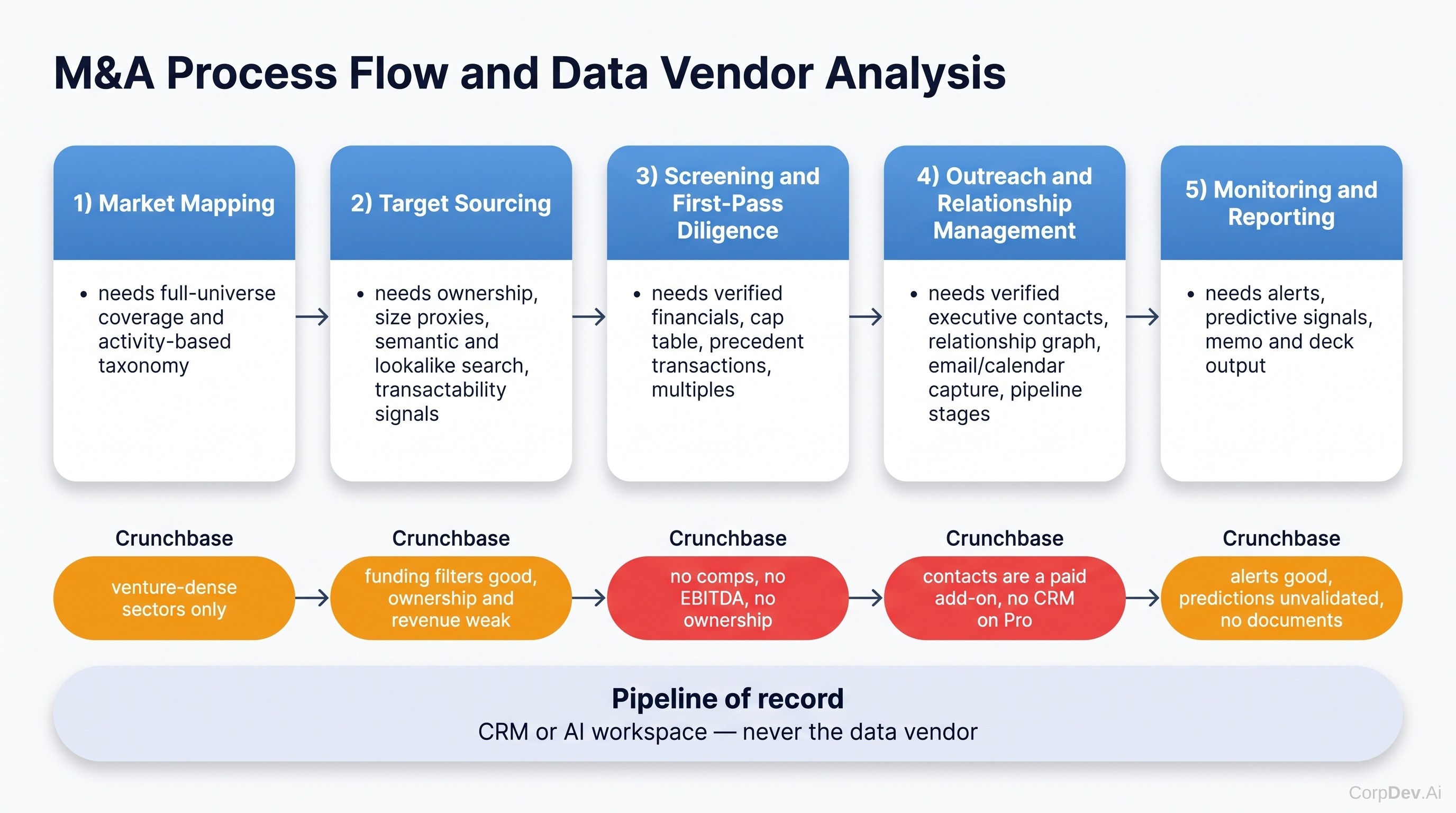
Read diagram description
Five-stage process flow: 1) Market Mapping — needs full-universe coverage and activity-based taxonomy; 2) Target Sourcing — needs ownership, size proxies, semantic and lookalike search, transactability signals; 3) Screening and First-Pass Diligence — needs verified financials, cap table, precedent transactions, multiples; 4) Outreach and Relationship Management — needs verified executive contacts, relationship graph, email/calendar capture, pipeline stages; 5) Monitoring and Reporting — needs alerts, predictive signals, memo and deck output. Crunchbase’s assessed fit by stage: stage 1 partial ("venture-dense sectors only"), stage 2 partial ("funding filters good, ownership and revenue weak"), stage 3 limited ("no comps, no EBITDA, no ownership"), stage 4 limited ("contacts are a paid add-on, no CRM on Pro"), stage 5 partial ("alerts good, predictions unvalidated, no documents"). Below the flow a relationship described as "Pipeline of record" spanning all five stages with the note "CRM or AI workspace — never the data vendor".
3. Crunchbase: Profile and Assessment
3.1 Business and strategic position
Crunchbase is a privately held San Francisco company that grew out of TechCrunch's start-up directory into the default public reference for venture funding data. It last raised a $50 million Series D in July 2022 led by Alignment Growth with OMERS Ventures, Mayfield and Emergence participating, bringing total disclosed funding to approximately $106.5 million [27][28]. In July 2023 it cut at least 49 of 241 employees, concentrated in go-to-market roles, as founder-led sales tooling revenue softened [26]. No further reductions have been reliably disclosed.
The defining strategic event is the February 2025 relaunch. CEO Jager McConnell declared "historical data dead" — the argument being that static company facts are now absorbed and redistributed by large language models, so a database whose value rested on recording those facts faced commoditisation — and repositioned the company as a predictions engine built on "39 billion live private-market signals", proprietary user-engagement data from 80 million+ monthly visitors and two decades of structured history [1][13]. The product now centres on Predictive Company Profiles, a Private Market Homepage, the Crunchbase Scout AI agent and Predictions and Insights covering funding, acquisition, IPO, growth and closure likelihood [1][18]. By March 2026 the company reported 455 million predictions generated and more than 16,000 confirmed by subsequent events; in June 2026 it launched Market Insights as an enterprise product and reported that enterprise demand was driving annual contract value growth; in July 2026 it shipped an MCP server so the data can be queried from Claude, ChatGPT, Gemini and Cursor; and on 10 September 2026 it announced distribution inside ChatGPT for Financial Services [21][30][14][25]. A December 2025 integration placed Crunchbase predictions inside J.P. Morgan's Fusion data platform [29].
For a buyer this pivot cuts both ways. The direction is correct: a data vendor that cannot be replaced by a chat prompt must sell foresight, signals and workflow rather than facts. But the accuracy figures — up to 95% precision and 99% recall on the fundraising model, "16,000 confirmed predictions" — are internal back-tests and vendor counts, not independent audits, and Crunchbase's own terms warn the AI "may contain mistakes" [1][20]. The predictions are lead-generation signals for prioritising outreach, and should be bought and evaluated as such.
Crunchbase's growth investments — predictions, Scout, MCP, ChatGPT distribution, Market Insights — are aimed at investors, banks, GTM teams and developers. None of the 2025–26 launches addresses the corporate acquirer's core gaps: ownership data, private financials, lower-middle-market coverage or pipeline management. A corp-dev team should assume those gaps persist through the contract term.
3.2 Pricing and packaging (as of September 2026)
Crunchbase's public pricing page currently lists two self-service tiers plus a custom API/MCP tier; an earlier "Starter" tier is no longer shown [4].
| Tier | Price | Included | Not included |
|---|---|---|---|
| Pro | $49/month billed annually (advertised as 38% off a $79 list price for the first year) or $99/month billed monthly; 7-day trial | Search across 4M+ private companies with full results; saved searches, lists, alerts and stages; 2,000 export rows per month; limited AI agent | Predictions and Insights; CRM integrations; team administration; full Scout agent [4][116] |
| Business | From $199/month per user billed annually; sales-quoted | Everything in Pro; 5,000 export rows per month; full Scout AI agent; Predictions and Insights; Salesforce and HubSpot integrations; team admin and consolidated billing; dedicated CSM | Enrichment add-ons priced separately; MCP access is an add-on [4][6] |
| API / MCP / Data Licensing | Custom quote based on use case, volume and fields licensed | Live company data at scale; prediction history and unpublished indicators; enrichment for internal tools; licensing for external products | No published price; Crunchbase states pricing is customised per customer [8][10] |
| Contact data add-on | 100 contacts $29/month, 250 for $59/month, 500 for $99/month | Executive contact unlocks | Contact universe is roughly 18 million across 400,000 organisations — a fraction of Apollo's or ZoomInfo's [119][5] |
Two pricing points matter more than they appear. The $49 annual rate is introductory: the list price is $79/month, so a buyer should budget $948 per seat for renewal rather than $588 [116]. And the export ceilings are binding for M&A use: a market map of a fragmented sector routinely runs to 3,000–10,000 companies, so Pro's 2,000 rows per month (and even Business's 5,000) forces either multi-month exports or an API conversation with sales [4].
3.3 Data coverage and quality
Crunchbase reported surpassing 5 million company profiles in June 2026, with 4 million+ private companies searchable in Pro, approximately 343,000 investors, 812,000+ funds and more than 30 million verified data updates per year [11][12]. Data comes from company and investor self-submission, venture-firm portfolio feeds, public web and government sources, data partners, analyst validation and aggregated engagement signals from its 80 million users [16]. The result is a database that is excellent at what it was built for and predictable in its weaknesses:
- Strong: funding rounds and investors, founder and executive bios at funded companies, acquisitions and IPOs once announced, US and Western European technology sectors, emerging-category detection, saved-search alerting [17][31].
- Weak: private revenue, EBITDA and operating metrics (a recurring G2 complaint is the absence of revenue data); ownership beyond the investor list; smaller, older, bootstrapped and non-US companies; contact depth; undisclosed or very recent transactions [31].
G2 rates Crunchbase 4.4/5 across 411 reviews, praising ease of use and funding intelligence while repeatedly citing stale or missing profiles outside core US coverage, sparse contacts, restrictive export limits, and price relative to occasional use [31].
3.4 Verdict for the corporate development buyer
- Your acquisition or partnership universe is venture-backed technology companies
- You need a cheap, fast first pass at a market map before committing to a terminal
- You want funding-event and investor alerts on a watchlist
- One or two people need it occasionally and the budget is under $1,000 per seat
- You already have a system of record and just need a discovery feed into it
- Targets are founder-owned, industrial, services or regional businesses with no funding history
- You need revenue, EBITDA, ownership or precedent-transaction multiples for screening
- Longlists exceed 2,000 companies and must be exported in one pass
- Executive contact data and outreach are part of the workflow
- The team needs pipeline management, relationship capture or memo production
The fair summary is that Crunchbase is the best value in its category for the job it was designed for, and that the job it was designed for is not most corporate acquirers' job. Its price makes it an easy addition to almost any stack; its coverage makes it a poor foundation for one.
4. The Alternatives
Each alternative below is assessed on the same five points — what it is, what it costs, why a corporate development team buys it, where it falls short, and how it compares directly with Crunchbase. The platforms are grouped loosely from institutional data terminals through venture-intelligence tools and specialist origination engines to the contact databases and the AI-native workspace, which is the order in which most teams encounter them as their programme matures.
4.1 PitchBook (Morningstar)
What it is. The institutional standard for private-capital data, owned by Morningstar. PitchBook reports approximately 6 million companies, 2.7 million investments, 570,000 investors, 147,000 funds and 4.4 million people, with more than 2.2 million financial records and roughly 291,000 deals in its detailed transaction dataset [34]. Its strength is the connective tissue of private markets — who invested in what, at what valuation, with which advisers, and what the exit looked like.
Price. Sales-led, annual-only contracts. Third-party benchmarks aggregating buyer-reported contracts place a single core seat at $12,000–$20,000 per year, five to ten seats at $35,000–$80,000, and enterprise deployments at $70,000–$125,000+, with incremental seats often around $7,000 [32][33].
Why a corp-dev team buys it. Precedent transactions, private valuations, investor and fund analytics, Excel plug-in and comparable-company workflows make it the closest thing to a one-stop private-markets terminal. For a team that regularly prepares board or investment-committee material, PitchBook's transaction comps alone can justify a seat.
Where it falls short. Coverage of bootstrapped and lower-middle-market companies remains thinner than the specialist sourcing tools; estimated financials require validation (PitchBook's own study found only 39.67% of estimated valuations within 15% of the true figure) [102]; and at 15–30x the cost of Crunchbase Pro it is difficult to justify for occasional users.
Versus Crunchbase. PitchBook is what Crunchbase would need to become to serve diligence. If a team can afford only one of the two and does any valuation work, PitchBook wins; if the need is discovery and alerts, Crunchbase may cover much of the discovery-and-alerting need at a much lower price; the retained utility depends on the target universe.
4.2 S&P Capital IQ Pro
What it is. S&P Global's flagship financial-analysis platform. It reports 60 million+ private companies (16 million+ with recent financials), 109,000+ public companies, approximately 1.2 million M&A transactions, 907,000 funding rounds, 340,000 equity offerings and 330,000 debt offerings, with full public-company financial statements, estimates, capital-structure and credit data [38][37].
Price. Quote-only and modular. Commonly cited per-seat benchmarks are $31,500–$33,375 per year on list, with negotiated contracts ranging from roughly $15,000 to $50,000 per seat and organisational agreements from about $15,000 to $215,000 per year depending on seats and content modules [35][36][37].
Why a corp-dev team buys it. It is the strongest platform in this comparison for the analytical half of M&A: trading and transaction comps, public-company screening, precedent multiples, credit and capital-structure analysis, and Excel-native model building. Teams that share infrastructure with treasury, IR or FP&A often already have seats.
Where it falls short. Private-company depth and freshness vary substantially by country and company size despite the headline count; important datasets (SNL, Visible Alpha, API) are priced separately; and it is a poor origination tool — screening 60 million companies by SIC code is not the same as finding the right 200 by what they do.
Versus Crunchbase. They barely overlap. Capital IQ is a financial-analysis terminal that happens to hold private-company records; Crunchbase is a discovery utility that happens to hold some financial signals. The relevant comparison for Capital IQ is PitchBook, and the usual outcome is Capital IQ for comps and public-company work, PitchBook for private-capital detail, and one or both paired with a sourcing engine.
4.3 CB Insights
What it is. A technology and emerging-market intelligence platform tracking approximately 12 million companies, known for its market maps, sector reports, competitor monitoring and predictive scoring (Mosaic) [41]. It is the vendor most often bought by strategy teams rather than deal teams.
Price. No public rate card. Third-party contract data places small one-to-three-seat deployments at $25,000–$60,000, five-to-ten seats at $60,000–$120,000 and enterprise or API packages at $120,000–$265,000+, with a reported median contract of approximately $46,984 per year [39][40].
Why a corp-dev team buys it. Thematic research — "map the industrial-AI landscape", "which start-ups are attacking our core product" — is CB Insights' home turf, and its analyst-written reports and market maps are frequently reused directly in board material. For a strategy function that needs to brief leadership on technology disruption quarterly, it can replace a meaningful amount of consultant spend.
Where it falls short. Coverage skews to venture-backed and visible companies, so it shares Crunchbase's blind spot on founder-owned businesses; it is expensive per seat; and it is sold as bundled packages that make it hard to buy a small footprint [42].
Versus Crunchbase. CB Insights is the premium, analyst-augmented version of the same venture-centric universe. Crunchbase gives raw data and alerts at a fraction of the price; CB Insights adds synthesis, taxonomy and reports. A team that already runs its own analysis rarely needs both.
4.4 Dealroom
What it is. An Amsterdam-based start-up and ecosystem intelligence platform with particular depth in European venture markets, accelerators and public-innovation dashboards. It is the platform of choice for many European governments and innovation agencies, which gives it strong local coverage that US-centric databases miss.
Price. Published and comparatively transparent: Premium at €12,600 per year and Premium Plus at €17,000 per year, each with a three-seat minimum (approximately €4,200–€5,700 per seat); enterprise and API pricing is custom, reported around €35,000–€50,000+. Premium includes 10,000 export credits per user, Premium Plus 30,000 plus CRM integration and business-email credits [43][44][45].
Why a corp-dev team buys it. European start-up coverage, investor mapping and generous export allowances make it a better discovery tool than Crunchbase for a corporate acquirer whose hunting ground is European technology. The three-seat package at €12,600 is roughly the cost of one PitchBook seat.
Where it falls short. The three-seat minimum is awkward for an individual; advanced search is less powerful than institutional terminals; it is not a contact database or a financial-diligence tool; and coverage outside Europe is a recurring limitation [46].
Versus Crunchbase. Dealroom is the most direct like-for-like alternative in this report. For European targets, Dealroom's coverage and export ceilings are superior; for US venture targets, Crunchbase remains stronger and much cheaper for a single seat.
4.5 Tracxn
What it is. A Bengaluru-based, publicly listed (BSE/NSE) private-market intelligence platform reporting 7.7 million+ companies, 723,000 funded companies, 1.8 million+ funding rounds and 226,000 acquisitions, organised through an unusually deep taxonomy of approximately 2,700 sectors and 56,000 nodes [49][50].
Price. Because Tracxn is listed, its pricing is unusually visible: company filings indicate approximately $6,600 per year for one user, $13,200 for three and $26,400 for seven, with custom enterprise packages; practitioner guides place realistic budgets at $6,000–$24,000 [47][48].
Why a corp-dev team buys it. The sector taxonomy is the best in the category for a team that needs to slice a market into fine-grained sub-segments and see every player in each, and its coverage of India and Asia is materially deeper than Crunchbase's or PitchBook's. It also carries cap-table and financials data for Indian companies drawn from statutory filings.
Where it falls short. Data completeness varies by geography and company age; the taxonomy's depth creates noise and a learning curve; and G2 reviewers note that analysts frequently need a second database to verify figures [51][52].
Versus Crunchbase. Tracxn is the stronger market-mapping tool and the stronger tool for Asia; Crunchbase is stronger for US funding detail and alerts. At $6,600 per seat Tracxn sits between Crunchbase Pro and PitchBook in price and, for a team whose primary job is segmenting markets, is often the better value of the three.
4.6 Grata
What it is. An AI-native private-company search engine, acquired by Datasite in 2025 and now combined with Datasite's May 2026 acquisition of Valu8 to give the combined business data on more than 20 million companies globally, with materially expanded European coverage [56][57]. Grata indexes companies from their websites and public footprint rather than from funding events, which is why it finds the businesses that Crunchbase does not.
Price. Sales-quoted. Marketplaces report a basic annual price of about $15,000; practitioner benchmarks place a single corp-dev seat at $15,000–$24,000, small teams at $20,000–$50,000 and larger deployments at $50,000–$100,000+ [53][54][55].
Why a corp-dev team buys it. Semantic search ("manufacturers of specialised optical components for semiconductor equipment") and similarity matching against a known target are the two capabilities corporate acquirers most often say they are missing, and Grata built its product around them [88]. Ownership flags (founder-owned, PE-backed, subsidiary), executive contacts and CRM push make it an origination workbench rather than a lookup tool. Datasite ownership signals a roadmap that links sourcing to the data-room and deal-execution stages.
Where it falls short. Coverage is strongest in the US, UK, France, Germany and Australia and thinner elsewhere; inferred financial fields need human review; and it is not a substitute for Capital IQ or PitchBook on comps and transaction history [59][60].
Versus Crunchbase. These tools index different populations. Grata's universe is roughly four to five times Crunchbase's and is weighted toward exactly the founder-owned mid-market that corporate acquirers target. For a team whose thesis is not venture-backed, Grata replaces Crunchbase; for a team whose thesis is, Crunchbase remains cheaper and better on funding detail.
4.7 SourceScrub
What it is. A sources-first private-company intelligence platform covering more than 16 million companies, built by aggregating conference attendee lists, trade-association directories, industry publications, award lists and other "bootstrapped-company" sources — more than 220,000 of them — and validating the output with a human-in-the-loop research team [64]. Its historical customer base is private-equity business-development teams; corporate development is a growing second market.
Price. Demo-led with no rate card. Estimates for a small or mid-market team run $20,000–$50,000 per year, roughly $11,000–$25,000 per seat, with enterprise programmes exceeding $100,000 [61][62][63].
Why a corp-dev team buys it. For fragmented, roll-up-style sectors — business services, healthcare services, industrial services, IT services — SourceScrub's conference and association data surfaces companies years before they appear in a funding database. Its "sources" model also tells the team where a company was found, which is useful for outreach context and for conference-driven origination.
Where it falls short. US and lower-middle-market skew; opaque pricing; overlap with Grata is significant, so most teams choose one; and it offers little for financial diligence, fund analytics or public-market work [65].
Versus Crunchbase. SourceScrub and Crunchbase are almost perfectly complementary in population and almost never substitutes. A corporate acquirer with a services or industrial thesis will find more relevant targets in one SourceScrub conference list than in a year of Crunchbase alerts; one with a software thesis will find SourceScrub slower and costlier than Crunchbase for the same names.
4.8 Apollo.io and ZoomInfo (contact-data platforms)
These two are not Crunchbase competitors in the strict sense — they are sales-intelligence databases — but they appear on almost every corporate-development shortlist because they solve the problem Crunchbase leaves open: reaching the people behind the company.
Apollo.io reports 73 million+ accounts and 275 million+ contacts, with a free tier and self-service plans at approximately $49 (Basic), $79 (Professional) and $119 (Organization) per user per month billed annually [106][107][108]. Its value to a corp-dev team is transparent pricing, a large firmographic universe, executive-contact lookup and built-in email sequencing; its limits are that revenue, ownership and strategic-fit fields need independent validation, and it carries no transaction data. Apollo is also the firmographic layer behind CorpDev.Ai's target sourcing, so a CorpDev.Ai subscriber gets much of Apollo's universe without a separate licence [80].
ZoomInfo is the enterprise contact-data standard, citing 104–122 million company records and 321–500 million professional profiles depending on the counting definition [112][113]. Pricing is negotiated: roughly $15,000–$25,000 per year for entry-level teams, $25,000–$40,000+ for larger packages and $50,000–$200,000+ for enterprise deployments with intent data and CRM enrichment [109][110][111]. It is the right choice for a large, systematic sourcing programme that needs governance, Salesforce synchronisation and phone-verified contacts; it is over-specified and over-priced for a two-person team.
Versus Crunchbase. Apollo's firmographic universe is roughly 15 times Crunchbase's and its contact database roughly 15 times Crunchbase's 18 million-contact add-on, at a comparable per-seat price [108][5]. What Apollo lacks — funding history, investor graph, acquisition records, predictive signals — is exactly what Crunchbase has. The two are a natural pairing for a lean team: Crunchbase to find and prioritise, Apollo to reach. ZoomInfo plays the same role at enterprise scale.
4.9 CorpDev.Ai
What it is. A Boston-based, AI-native workspace built specifically for corporate development, M&A, strategy, diligence and post-merger integration, founded and led by Kal Kilpi [79][82][83]. Rather than selling a proprietary database, it bundles an M&A-specialised AI research analyst, market mapping, target sourcing with AI fit scoring, a "zero-entry" pipeline CRM populated from connected email and calendar, an AI data room for diligence documents, valuation workbooks, digital twins for carve-outs and integration, and document and slide generation into a single environment [79]. Its research engine draws on a third-party firmographic database (Apollo, 70 million+ companies and 265 million+ contacts), Google Maps, SEC filings, 30 years of public financials, estimates, transcripts, news and web sources, with citations on every output [79][80].
Price. Published and transparent: AI Pro at $1,000 per month invoiced annually ($1,200 by card) for one user with 12,000 annual search credits; AI Pro Team at $3,000 per month invoiced annually ($3,600 by card) for three users with 36,000 credits, a dedicated CSM and admin controls; Enterprise on custom quote adding unlimited seats, SSO, a solutions architect, financial modelling and managed services [80]. That is $12,000 per seat per year on the annual plan — roughly the cost of a PitchBook seat and 12–20 times Crunchbase Pro.
Why a corp-dev team buys it. The proposition is workflow compression: a market map, a ranked target shortlist with fit scores, a company profile, an investment memo and a board deck are produced in one environment, with the pipeline record updated from email and calendar rather than by hand. For a small team that would otherwise buy a data feed, a CRM and an analyst's time separately, that consolidation is the case. The AI data room (marketed for rooms up to 50,000 pages) and digital-twin modules extend the same logic into diligence and integration, stages addressed in different ways by the workflow platforms also profiled in this report [79]. Microsoft 365 and Google Workspace integrations and Word, PowerPoint and Excel export mean outputs land in the formats boards actually read [81][80].
Where it falls short. Three limitations should be weighed honestly.
- Data is aggregated, not proprietary. CorpDev.Ai's firmographics come from Apollo and public sources; it does not hold PitchBook's transaction comps, Capital IQ's private financials or Crunchbase's investor graph. For valuation work a terminal is still required, and the platform's own FAQ recommends human review for critical decisions [80].
- The company is young and thinly documented. Third-party databases record no disclosed funding; public customer reviews are sparse (a single AppSource rating, directory listings without substantive reviews); and the vendor's claim of "hundreds of CorpDev professionals" is not backed by published case studies [84][85][86]. A buyer should ask for references and a security review — the vendor states SOC 2 Type II compliance [80] — before an enterprise commitment.
- Entry price is high for a single occasional user. At $12,000 per seat it competes on budget with PitchBook, and the case rests on replacing a CRM and analyst hours as well as a data subscription; a team that only needs lookups will not realise that saving.
Versus Crunchbase. They are not substitutes and the comparison is about where value sits. Crunchbase sells data and increasingly predictions; CorpDev.Ai sells the work done with data — the memo, the shortlist, the map, the pipeline. A team can plausibly run Crunchbase Pro inside a CorpDev.Ai workspace (the platform ingests CSV exports and can query Crunchbase via its MCP server) [80][14]. The choice a buyer actually faces is between CorpDev.Ai and a combination of a discovery database plus a deal CRM plus analyst time — and that is the calculation Section 6 makes.
Because CorpDev.Ai's data layer is third-party and its public track record is short, run a scoped pilot against a live thesis — one market map, one shortlist, one memo — and compare output quality and analyst hours saved against your current stack before signing an annual Team contract.
4.10 Other Notable Options
Several further platforms are worth knowing about, either because a team may already own them through another function or because they fill a specific niche.
| Platform | Category | Indicative cost | Role for a corp-dev team | Caution |
|---|---|---|---|---|
| Mergermarket (ION Analytics) | M&A transaction intelligence | Quote-only; from approximately $30,000 per year [124][125] | Rumoured and announced processes, mandates, advisers, 1.4 million+ company profiles, transaction multiples — the best tool for who may transact and when [124][126] | Not a company-discovery or contact database |
| Dealogic (ION) | Capital-markets and league-table data | Enterprise quote | Adviser relationships, deal flow, capital-markets context [100] | Built for banks; rarely central to corporate sourcing |
| AlphaSense | Research and market intelligence | Approximately $10,000–$20,000 per user per year; premium and expert-insight tiers $40,000+ [121][122][123] | Filings, transcripts, broker research and expert calls for pre-LOI diligence and thesis-building; dedicated M&A database and Deep Research [92][93] | Not a target list or contact source |
| FactSet / LSEG Workspace | Financial terminals | Enterprise quote | Public-company research, estimates, comps; LSEG holds 1.61 million+ announced M&A transactions [101] | Usually bought by finance or IR; corp-dev piggybacks |
| Inven | AI market mapping and sourcing | Approximately $10,000 per user per year list; custom quotes [67][72] | 28 million+ companies, 3 million+ transactions, semantic search by what companies do; private financials live in UK and Nordics [73][74][76] | Financial fields need verification; AI results include noise [77][78] |
| Cyndx | Global company/investor matching | Approximately $30,000–$75,000 per firm per year [66] | 33 million+ companies across 190+ countries and 75+ languages; Finder, Acquirer and Raiser modules [68] | Less established with US mid-market buyers; sales-led pricing [70] |
| DealCloud (Intapp) | Enterprise deal CRM | Enterprise quote | Highly configurable pipeline, relationship and reporting system of record [89] | Significant implementation and administration burden |
| Midaxo | End-to-end M&A platform | Enterprise quote | Connects pipeline, diligence, execution and integration in one workflow [98] | Less flexible as a general CRM |
| Affinity / 4Degrees | Relationship-intelligence CRM | Affinity publishes seat tiers; 4Degrees quoted | Automatic capture of email and calendar activity, warm-path discovery; 4Degrees exposes CRM context to ChatGPT and Claude via MCP [91] | Need a separate data source for discovery |
The pattern across these is instructive: the CRM and workflow tools (DealCloud, Midaxo, Affinity, 4Degrees) and the AI-native workspace (CorpDev.Ai) compete for the system-of-record role, while everything else competes for one of the data-feed roles. A buyer should decide the first question before spending on the second.
5. Head-to-Head Comparison
5.1 Capability matrix
The matrix below scores each platform on the five jobs from Section 2. Scores are qualitative judgments derived from the vendor claims, third-party benchmarks and user-review evidence cited in Sections 3 and 4; they are intended to rank relative fit, not to measure absolute quality.
| Platform | Market mapping | Target sourcing (incl. founder-owned) | Screening & diligence data | Contacts & outreach | Pipeline & workflow | Documents & AI synthesis |
|---|---|---|---|---|---|---|
| Crunchbase | Good — venture sectors | Limited | Limited | Add-on | Business tier only | Scout agent |
| PitchBook | Good | Moderate | Strong | Moderate | Limited | Emerging |
| Capital IQ Pro | Moderate | Moderate | Strongest | Limited | None | Emerging |
| CB Insights | Strongest | Limited | Limited | Limited | None | Good — reports |
| Dealroom | Good — Europe | Moderate | Limited | Limited | CRM sync | Limited |
| Tracxn | Strong — taxonomy | Moderate | Moderate — India | Limited | None | Limited |
| Grata | Good | Strongest | Moderate | Good | CRM push | Limited |
| SourceScrub | Moderate | Strong — LMM | Limited | Good | CRM push | Limited |
| Apollo.io | Firmographic only | Moderate | Limited | Strong | Sequences | None |
| ZoomInfo | Firmographic only | Moderate | Limited | Strongest | CRM enrichment | None |
| CorpDev.Ai | Strong — AI maps | Good — Apollo universe + fit scoring | Moderate — public data, no comps | Good — Apollo + email sync | Strong — zero-entry CRM | Strongest — memos, decks, data room |
5.2 Coverage and price in one view
| Platform | Companies indexed (vendor claim) | Indicative annual cost per seat (USD) | Pricing transparency |
|---|---|---|---|
| Crunchbase Pro | 5,000,000 | 588–948 | Published |
| Crunchbase Business | 5,000,000 | 2,388+ | Starting price published |
| Apollo.io | 73,000,000 | 588–1,428 | Published |
| Tracxn | 7,700,000 | 6,600 | Disclosed in filings |
| Dealroom Premium | Not disclosed | 4,500–6,000 | Published (3-seat min.) |
| Inven | 28,000,000 | 10,000 | List benchmark |
| CorpDev.Ai AI Pro | 70,000,000 | 12,000 | Published |
| PitchBook | 6,000,000 | 12,000–20,000 | Benchmark |
| Grata | 20,000,000 | 15,000–24,000 | Benchmark |
| SourceScrub | 16,000,000 | 11,000–25,000 | Benchmark |
| ZoomInfo | 122,000,000 | 15,000–25,000 | Benchmark (entry team) |
| AlphaSense | Content platform | 10,000–20,000 | Benchmark |
| Capital IQ Pro | 60,000,000 | 15,000–50,000 | Benchmark |
| CB Insights | 12,000,000 | 25,000–60,000 | Benchmark (1–3 seat firm) |
Basis: company counts are vendor claims as of 2025–26 and use different definitions (see Section 8); Dealroom per-seat cost converts the €12,600–€17,000 three-seat packages at roughly 1.07 USD/EUR; CB Insights and Cyndx figures in this chart represent firm-level small-deployment estimates and are not divided into comparable seat prices; do not compare their bars directly with per-seat entries. Benchmark ranges are third-party aggregations of negotiated contracts and will vary with seats, modules and term.
The chart makes the central trade-off visible: company count and price are almost uncorrelated. Apollo indexes 15 times more companies than Crunchbase at the same price; Capital IQ indexes 12 times more at 30 times the price; Grata indexes four times more at 20 times the price. What the buyer is paying for at the top of the range is not breadth but depth on the fields that matter to a deal — verified financials, ownership, transaction history — and, in the case of the workflow platforms, the labour the tool removes.
5.3 Fit by use case
| If the recurring job is… | First choice | Strong alternative | Crunchbase's role |
|---|---|---|---|
| Mapping venture-backed technology markets | CB Insights | Crunchbase Pro, Tracxn | Primary if budget is tight |
| Mapping European start-up ecosystems | Dealroom | Crunchbase, Tracxn | Secondary |
| Mapping Asian markets | Tracxn | Cyndx | Weak |
| Finding founder-owned mid-market targets | Grata | SourceScrub, Inven | Not applicable |
| Services and industrial roll-up sourcing | SourceScrub | Grata | Not applicable |
| Valuation, comps and board-grade financials | Capital IQ Pro | PitchBook | Not applicable |
| Private-capital and investor intelligence | PitchBook | Crunchbase Business | Cheap substitute for lookups |
| Executive contacts and outreach | Apollo.io (lean) / ZoomInfo (enterprise) | Grata, SourceScrub | Add-on only |
| Process and transactability intelligence | Mergermarket | AlphaSense | Predictions layer (unvalidated) |
| Running the whole workflow in one place with AI output | CorpDev.Ai | DealCloud or Midaxo plus a data feed | Feed into the workspace |
6. Total Cost of Ownership and Pricing Realities
Licence prices understate what a data platform costs and overstate the differences between vendors. Four realities should shape the budget conversation.
Introductory pricing and renewal. Crunchbase's $49 annual rate is explicitly a first-year discount from a $79 list price; the buyer should model $948 per seat at renewal, not $588 [116][4]. The same pattern appears across self-service tools (Apollo, Dealroom), whereas the sales-led vendors (PitchBook, Capital IQ, Grata, SourceScrub, CB Insights) tend to quote high and negotiate, with 20–40% between opening quote and signed contract commonly reported in buyer benchmarks [32][35][39].
Export and credit ceilings are the real capacity limit. Crunchbase caps exports at 2,000 rows per month on Pro and 5,000 on Business [4]; Dealroom sells export credits (10,000–30,000 per user) [44]; CorpDev.Ai meters "search credits" (12,000 per seat per year) [80]; Apollo and ZoomInfo meter contact reveals. A corp-dev team that builds a 4,000-company longlist quarterly will hit Crunchbase Pro's ceiling in the first week of the quarter and be routed to a sales conversation about the API. Ask every vendor for the effective annual row or credit allowance and price it per usable record.
Minimum seats and bundling. Dealroom requires three seats [43]; CB Insights and Cyndx sell firm-level packages [39][66]; PitchBook and Capital IQ price incremental seats well below the first [32][36]. A two-person team pays a structural penalty on these platforms that a ten-person team does not, which is why the effective cost per seat for a small team is often 1.5–2x the benchmark.
The unpriced costs: reconciliation, verification and system-of-record ownership. The largest hidden cost in a multi-vendor stack is analyst time reconciling conflicting revenue figures, deduplicating targets across feeds and maintaining the pipeline by hand. Corporate development budgets rarely isolate software spend — it is charged to strategy, finance or IT and often rides on enterprise licences [103][105] — which hides this labour cost from the purchase decision. It is also the cost the AI-native workspaces are designed to remove, and the honest way to compare them with a traditional stack is on total cost including labour rather than on licence fees alone.
6.1 Illustrative three-year cost of three archetype stacks
The scenarios below are derived from the benchmark ranges in Sections 3–5 and assume a three-person corporate development team; they are planning estimates, not quotes.
| Stack | Year 1 | Year 2 | Year 3 |
|---|---|---|---|
| Lean venture-focused (Crunchbase Pro x3 + Apollo Professional x3 + spreadsheet CRM) | 5 | 6 | 6 |
| Traditional institutional (PitchBook x3 + Grata x2 + Affinity Scale x3) | 61.9 | 63.4 | 65.0 |
| AI-native consolidated (CorpDev.Ai Team + Crunchbase Pro x3 for venture alerts) | 38 | 39 | 39 |
Basis of each line: Lean — Crunchbase Pro at $588 (year 1) then $948 per seat, Apollo Professional at $948 per seat, no CRM licence. Traditional — PitchBook three seats at approximately $35,000 (the low end of the 5–10-seat benchmark, since three seats sits between the single-seat and small-team ranges) [32], Grata two seats at $20,000 [53], Affinity Scale three seats at $2,300 each, or $6,900 annually, using the published tier described in the related Affinity comparison; a 2.5% annual uplift is assumed. This corrects the original $40,000 relationship-CRM assumption, which overstated the three-seat cost and incorrectly said Affinity does not publish prices [91]. AI-native — CorpDev.Ai AI Pro Team at $36,000 per year [80] plus Crunchbase Pro as above.
The scenarios exclude analyst labour, which is the variable the AI-native stack claims to reduce. If a team spends even 0.3 FTE of analyst time per year on manual pipeline upkeep, memo drafting and cross-vendor reconciliation, the labour cost (roughly $40,000–$60,000 in a US or Western European market) exceeds the licence difference between the lean and AI-native stacks. Whether the platform actually delivers that saving is the question a pilot must answer; the vendor's claim should not be taken on trust.
The scenarios also show why Crunchbase survives in every stack: at $600–$950 per seat it is a rounding error against a PitchBook, Grata or CorpDev.Ai contract, and it remains the cheapest source of funding-event alerts. The buying decision is rarely "Crunchbase or something else"; it is "what sits above Crunchbase", and the price gap between the lean and the institutional stacks is the price of verified financials, founder-owned coverage and a system of record.
7. Buyer's Decision Framework and Recommendations
7.1 Four questions that settle most decisions
- What population are we hunting in? If more than half of plausible targets have raised institutional venture capital, Crunchbase, CB Insights or Dealroom will see them. If most are founder-owned, family-owned or PE-backed without press coverage, only Grata, SourceScrub, Inven, Cyndx or a firmographic universe such as Apollo (and therefore CorpDev.Ai) will.
- How often do we need decision-grade financials and comps? Quarterly board material, fairness-style valuation or bid pricing requires Capital IQ Pro or PitchBook. Occasional sanity checks can be done with public filings and an AI research layer.
- Where will the pipeline of record live? Spreadsheet, general CRM, deal CRM (DealCloud, Midaxo, Affinity, 4Degrees) or AI workspace (CorpDev.Ai). Decide this before adding any data feed; every feed's value depends on it.
- Is analyst time or licence budget the scarcer resource? Teams long on budget and short on people should weight workflow platforms; teams with analyst capacity and a tight budget should weight cheap data feeds and do the synthesis themselves.
Choose the population, then the data depth and workflow
- Venture-backed technology: compare Crunchbase Pro for the US, Dealroom for Europe and Tracxn for Asia. Add CB Insights when technology strategy reports are a separate requirement.
- Founder-owned industrial or service companies: compare Sourcescrub for fragmented-service roll-ups and Grata or Inven for semantic niche discovery. CYNDX was a historical multilingual candidate; test currently available alternatives on the required languages.
- Recurring financial and valuation work: add Capital IQ Pro for public financials/comps or PitchBook for private-capital history. If this depth is not required, assess an AI research layer with public filings and verify its evidence.
- Pipeline system of record: compare DealCloud, Midaxo, Affinity and 4Degrees for configurable CRM/process requirements, or CorpDev.Ai for bundled CRM, research, sourcing and memos.
- Contact layer: consider Apollo for a lean deployment or ZoomInfo for enterprise requirements, unless the necessary contacts are already licensed within the chosen workspace.
Crunchbase primarily serves the venture-discovery path; the system-of-record choice determines how data becomes repeatable work. CYNDX is historical context: its official site announces wind-down and dissolution, checked 14 September 2026, without an announcement date. It is not an active purchasing recommendation. CYNDX official site.
7.2 Recommendations by team archetype
Profile: 1–3 people, software or technology acquisitions, budget under $25,000.
Buy: Crunchbase Pro (annual) for discovery and alerts; Apollo Professional for contacts and outreach; a disciplined CRM or an AI workspace pilot as the record.
Skip: PitchBook and Capital IQ until a live process requires comps — then obtain a quote for one seat and confirm the minimum contract term.
Crunchbase verdict: Core feed
Profile: 3–8 people, 5–20 live conversations, founder-owned or PE-backed targets in services, industrials or healthcare.
Buy: Grata or SourceScrub as the sourcing engine; PitchBook or Capital IQ for comps; a deal CRM (DealCloud, Midaxo, Affinity) or CorpDev.Ai as the system of record; Mergermarket if process timing matters.
Skip: Crunchbase as anything more than a $1,000 watchlist tool, and CB Insights unless strategy reporting is a separate mandate.
Crunchbase verdict: Peripheral
Profile: Large multinational; finance or IR already licenses Capital IQ, FactSet or LSEG; corp-dev shares seats.
Buy: Extend the existing terminal for comps; add Grata or SourceScrub for private-company origination; run DealCloud or Midaxo as the record; layer AlphaSense for diligence research and an AI workspace or enterprise LLM for synthesis.
Skip: Duplicate terminals. Negotiate Crunchbase Business only if the Predictions layer or Salesforce sync is specifically wanted.
Crunchbase verdict: Optional
7.3 Where CorpDev.Ai fits — an objective placement
CorpDev.Ai is the only platform in this comparison that attempts to be the system of record and the research layer and the sourcing engine and the document producer. That ambition is its strongest and weakest attribute at once. It is strongest for the lean and programmatic archetypes above, where the alternative is stitching four subscriptions together and paying an analyst to reconcile them; the $36,000 Team plan is near the $35,000 three-seat PitchBook planning assumption used above and may be lower or higher than an actual quote and includes the CRM and memo production those seats do not [80][32]. It is weakest as a replacement for a financial terminal — it does not hold transaction comps or private financials of its own — and its short public track record means an enterprise buyer should insist on references and a pilot [84][85]. The most defensible position for a 2026 buyer is to treat CorpDev.Ai as a candidate for the top of the stack, keep Crunchbase (or Dealroom, or Tracxn) as a cheap discovery feed into it, and add a terminal seat only when a live process demands decision-grade comps.
7.4 Negotiation and procurement notes
- Ask for the renewal price in writing on any introductory-rate product; Crunchbase's $49 becomes $79 [116].
- Price per usable record, not per seat. Convert export caps, credits and contact reveals into an annual record count and compare vendors on cost per record.
- Demand provenance for private financials. Ask each vendor what proportion of revenue and EBITDA fields on companies under $100 million revenue are reported versus modelled, and what the error band on modelled fields is. Refusal to answer is itself an answer.
- Ask about contract duration and incremental seats. PitchBook and Capital IQ terms may require annual commitments; ask whether a shorter project term or mid-contract seat addition is available, and budget the contracted duration rather than assuming six-month access.
- Pilot the workflow platforms on a live thesis with a defined output — one market map, one 200-company shortlist, one memo — and measure analyst hours against the current method before signing annually.
- Check the data-licensing terms on any platform whose output will be redistributed to a board or an adviser; Crunchbase and PitchBook both restrict redistribution and price it separately [9].
8. Key Facts & Sources
The load-bearing figures in this report, each with its source and as-of date. Vendor coverage counts use the vendor's own definitions and are not directly comparable across platforms; cost benchmarks are third-party aggregations of negotiated contracts unless marked as published list price.
| Figure | Value | Source and basis | As of |
|---|---|---|---|
| Crunchbase Pro price | $49/month billed annually (introductory, from $79 list) or $99/month monthly | Crunchbase pricing page (published); RevenueFlow analysis of introductory rate [4][116] | Sep 2026 |
| Crunchbase Business price | From $199/user/month billed annually | Crunchbase pricing page (published) [4] | Sep 2026 |
| Crunchbase export caps | 2,000 rows/month (Pro); 5,000 rows/month (Business) | Crunchbase pricing page FAQ [4] | Sep 2026 |
| Crunchbase contact add-on | 100/$29, 250/$59, 500/$99 per month | Crunchbase support article [119] | 2025 |
| Crunchbase company coverage | 5 million+ companies (Jun 2026); 4 million+ private companies searchable in Pro | Crunchbase product updates and Pro page (vendor claim) [11][12] | Jun 2026 |
| Crunchbase investors and funds | ~343,000 investors; 812,000+ funds | Crunchbase product updates (vendor claim) [11] | 2026 |
| Crunchbase relaunch | 19 Feb 2025; "up to 95% precision, 99% recall" on fundraising model (internal back-test) | Crunchbase press release [1] | Feb 2025 |
| Crunchbase predictions scale | 455 million generated; 16,000+ confirmed | Crunchbase guide (vendor claim) [21] | Mar 2026 |
| Crunchbase funding | $50M Series D led by Alignment Growth; ~$106.5M total | PR Newswire; Crunchbase News [27][28] | Jul 2022 |
| Crunchbase layoffs | ≥49 of 241 employees | Fortune [26] | Jul 2023 |
| Crunchbase G2 rating | 4.4/5 from 411 reviews | G2 [31] | 2026 |
| PitchBook coverage | ~6M companies, 2.7M investments, 570K investors, 147K funds, 4.4M people; 2.2M+ financial records | PitchBook press release (vendor claim) [34] | May 2025 |
| PitchBook price | $12K–$20K single seat; $35K–$80K for 5–10 seats; ~$7K incremental seat | Startup Yeti, Investables.ai buyer benchmarks [32][33] | Jul–Aug 2026 |
| PitchBook valuation-estimate accuracy | 39.67% of estimates within 15% of verified valuation | PitchBook blog (own study) [102] | undated |
| Capital IQ Pro coverage | 60M+ private (16M+ with financials), 109K+ public, ~1.2M M&A transactions | S&P Global product page (vendor claim) [38] | Jun 2026 |
| Capital IQ Pro price | $15K–$50K per seat negotiated; $31.5K–$33.4K list benchmark | Investables.ai, CostBench [35][36] | Jun–Aug 2026 |
| CB Insights coverage and price | ~12M companies; $25K–$60K small deployments; median contract ~$46,984 | CB Insights site; Prospeo; Investables.ai [41][39][40] | 2026 |
| Dealroom price | €12,600 (Premium) / €17,000 (Premium Plus) per year, 3-seat minimum | Dealroom pricing page (published) [43] | 2026 |
| Tracxn coverage and price | 7.7M+ companies, 1.8M+ rounds, 226K acquisitions; ~$6,600/user/year | Tracxn site (vendor claim); BSE filing [49][47] | 2026 |
| Grata coverage and price | 20M+ companies post-Valu8; ~$15K–$24K per seat | Datasite/Grata (vendor claim); Prospeo, Capterra [56][57][53][54] | May 2026 |
| SourceScrub coverage and price | 16M+ companies from 220K+ sources; ~$20K–$50K small team | G2 (vendor claim); Prospeo, CT Acquisitions [64][61][62] | 2026 |
| Apollo.io coverage and price | 73M+ accounts, 275M+ contacts; $49/$79/$119 per user/month annual | Apollo knowledge base and pricing page (published) [108][106] | 2026 |
| ZoomInfo coverage and price | 104–122M companies, 321–500M profiles; $15K–$25K entry team | ZoomInfo data page and press release; CRO Report [112][113][110] | 2026 |
| CorpDev.Ai price | AI Pro $1,000/month annual ($1,200 card); AI Pro Team $3,000/month annual for 3 seats; Enterprise custom | CorpDev.Ai pricing page (published) [80] | Sep 2026 |
| CorpDev.Ai data claims | 70M+ companies, 265M+ contacts (Apollo-sourced), 30 years of financials | CorpDev.Ai site and pricing page (vendor claim) [79][80] | Sep 2026 |
| CorpDev.Ai funding and reviews | No disclosed funding; 1 AppSource rating; no substantive public reviews | Tracxn profile; Microsoft AppSource; Slashdot [84][86][85] | Aug 2026 |
| Mergermarket | 1.4M+ company profiles; from ~$30K/year | Mergermarket site (vendor claim); Multiples.vc [124][125] | Jun–Aug 2026 |
| AlphaSense price | ~$10K–$20K per user/year; premium tiers $40K+ | Prospeo, Elevated Signal [122][123] | Mar 2026 |
| Inven and Cyndx | Inven 28M+ companies, ~$10K/user list; Cyndx 33M+ companies, ~$30K–$75K/firm | Inven site; CostBench; Cyndx site [73][67][66][68] | 2026 |
| Three-year stack scenarios (Section 6.1) | $5–6K, $61.9–65K, $38–39K per year | Derived from the benchmarks above; relationship-CRM figure uses Affinity Scale list pricing; annual escalation is an assumption | Sep 2026 |
Verification notes. Crunchbase and CorpDev.Ai pricing were read directly from the vendors' live pricing pages on 11 September 2026. Third-party price benchmarks (Investables.ai, Startup Yeti, CostBench, Prospeo, CT Acquisitions) aggregate self-reported buyer contracts and are not audited; where several benchmarks disagreed the range reported here spans them. No independent audit of any vendor's prediction accuracy or private-financials error rate was found; the PitchBook valuation study is the only vendor-published accuracy test located and is cited as illustrative rather than representative. The earlier claim, sometimes repeated online, that Crunchbase ended its Yahoo Finance distribution partnership was checked and not supported — the partnership was still referenced as active in 2026 [24][25].
References
Numbering follows the original research. Access dates below record the original source registry; they do not imply that every source was rechecked for this website edition.
- Crunchbase Declares Historical Data Dead—Relaunches as an AI ...Source accessed 2026-09-11
- Crunchbase Pricing 2026Source accessed 2026-09-11
- Crunchbase Review 2026: Key Insights and FeaturesSource accessed 2026-09-11
- Crunchbase Review (2026): Funding Data, Pricing, and Billing Complaints | Market Intelligence ToolsSource accessed 2026-09-11
- Using the API - Crunchbase DataSource accessed 2026-09-11
- Crunchbase Data LicensingSource accessed 2026-09-11
- Crunchbase API FAQSource accessed 2026-09-11
- Product Updates and Release NotesSource accessed 2026-09-11
- Crunchbase ProSource accessed 2026-09-11
- Crunchbase | Private Company Data & Predictive IntelligenceSource accessed 2026-09-11
- Crunchbase Launches MCP to Bring Private Market ...Source accessed 2026-09-11
- Where does Crunchbase get their data?Source accessed 2026-09-11
- Crunchbase Review: Powerful Business Intelligence for ...Source accessed 2026-09-11
- Crunchbase rebrands as a predictive AI company - R&D WorldSource accessed 2026-09-11
- Crunchbase Hits 5000+ Confirmed Predictions in 2025Source accessed 2026-09-11
- What Is Predictive Company Intelligence? - CrunchbaseSource accessed 2026-09-11
- Power of data partnerships for driving awareness and revenue ...Source accessed 2026-09-11
- Crunchbase Private Market Data is Available in ChatGPT for Financial ServicesSource accessed 2026-09-11
- Five months ago Crunchbase vowed to try and avoid ...Source accessed 2026-09-11
- Crunchbase secures $50M to help customers build ...Source accessed 2026-09-11
- From The Editor's Desk: An Insider's View Of Startup Fundraising In ...Source accessed 2026-09-11
- Crunchbase Predictive Intelligence Now Available in Fusion by J.P. ...Source accessed 2026-09-11
- Crunchbase Introduces Market Insights as Enterprise ...Source accessed 2026-09-11
- Crunchbase Pros and Cons | User Likes & DislikesSource accessed 2026-09-11
- PitchBook Pricing in 2026: What 100+ Buyers Pay | Startup YetiSource accessed 2026-09-11
- PitchBook Cost 2026: Price Per User Per Year | Investables.aiSource accessed 2026-09-11
- PitchBook Strengthens Leadership in Global Capital Market Data Coverage | PitchBookSource accessed 2026-09-11
- Capital IQ Cost 2026: S&P Capital IQ Price Per SeatSource accessed 2026-09-11
- S&P Capital IQ Pro Pricing 2026: What It CostsSource accessed 2026-09-11
- Capital IQ vs. PitchBook vs. ZoomInfo [July 2026]Source accessed 2026-09-11
- S&P Capital IQ Pro | S&P GlobalSource accessed 2026-09-11
- CB Insights Pricing, Reviews, Pros & Cons (2026)Source accessed 2026-09-11
- CB Insights Cost 2026: Pricing Per Year | Investables.aiSource accessed 2026-09-11
- CB InsightsSource accessed 2026-09-11
- CB Insights Review 2026: Pricing, Features & AlternativesSource accessed 2026-09-11
- Pricing | Dealroom.coSource accessed 2026-09-11
- Dealroom · Rating Snapshot: Score & Reviews (2026)Source accessed 2026-09-11
- What is Dealroom? VC Intelligence Guide & options (2026)Source accessed 2026-09-11
- Dealroom.co Review 2026: Pricing, Pros & ConsSource accessed 2026-09-11
- TRACXN TECHNOLOGIES LIMITEDSource accessed 2026-09-11
- Best Startup Databases Compared in 2026 - gitdealflow.comSource accessed 2026-09-11
- Technology & Data for Venture Capital, Corp Dev, Investment BanksSource accessed 2026-09-11
- OfferingsSource accessed 2026-09-11
- Tracxn Review: 8.5/10 — Free Plan Tested (2026)Source accessed 2026-09-11
- Tracxn Reviews 2026: Details, Pricing, & Features - G2Source accessed 2026-09-11
- Grata Pricing, Reviews, Pros and Cons (2026)Source accessed 2026-09-11
- Grata Pricing 2026Source accessed 2026-09-11
- Grata vs LeadsForge: Which Tool Fits in 2026?Source accessed 2026-09-11
- Discover private companies & source deals faster | Grata ...Source accessed 2026-09-11
- Datasite Acquires Valu8 to Further Accelerate Global, AI- ...Source accessed 2026-09-11
- Grata Review 2026: 8.6/10, Pricing & AlternativesSource accessed 2026-09-11
- Grata Review | Features & AlternativesSource accessed 2026-09-11
- SourceScrub Pricing, Reviews, Pros & Cons (2026)Source accessed 2026-09-11
- Best Market Intelligence Platforms for M&A (2026)Source accessed 2026-09-11
- AI for M&A (2026): Complete Tool Landscape and Vendor ...Source accessed 2026-09-11
- Sourcescrub Reviews 2026: Details, Pricing, & FeaturesSource accessed 2026-09-11
- SourceScrub — review, pricing & alternatives - PE StackSource accessed 2026-09-11
- Cyndx Pricing 2026: Enterprise Custom Quotes | CostBenchSource accessed 2026-09-11
- What are the best deal sourcing platforms in 2026? | InvenSource accessed 2026-09-11
- Cyndx Networks LLC — Purpose-Built AI for Investment ProfessionalsSource accessed 2026-09-11
- Cyndx — review, pricing & alternatives - PE StackSource accessed 2026-09-11
- CorpDev.Ai vs Inven: Pricing & Features ComparisonSource accessed 2026-09-11
- Inven for Principals & Partners | M&A Deal IntelligenceSource accessed 2026-09-11
- Data Foundation - InvenSource accessed 2026-09-11
- Inven's Post - LinkedInSource accessed 2026-09-11
- Commercial Due Diligence Software: How Teams Use InvenSource accessed 2026-09-11
- Ai OverviewSource accessed 2026-09-11
- CorpDev.Ai - Agentic AI for M&A and Corporate DevelopmentSource accessed 2026-09-11
- PricingSource accessed 2026-09-11
- CorpDev.Ai vs DealRoom Pipeline: Free Zero-Entry CRM vs Manual ...Source accessed 2026-09-11
- Kal Kilpi | LinkedInSource accessed 2026-09-11
- About UsSource accessed 2026-09-11
- CorpDev.ai - 2026 Company Profile & CompetitorsSource accessed 2026-09-11
- CorpDev.Ai Reviews - 2026 - SlashdotSource accessed 2026-09-11
- CorpDev.Ai for ExcelSource accessed 2026-09-11
- AI Deal Sourcing PlatformSource accessed 2026-09-11
- Corporate Development | Consulting - IntappSource accessed 2026-09-11
- DealcloudSource accessed 2026-09-11
- M&A Database - AlphaSenseSource accessed 2026-09-11
- Introducing Deep Research in AlphaSenseSource accessed 2026-09-11
- M&A Software & Intelligence Platform | MidaxoSource accessed 2026-09-11
- Dealogic: A trusted partner to top financial firms worldwideSource accessed 2026-09-11
- Mergers and AcquisitionsSource accessed 2026-09-11
- How accurate are estimated private company valuations? - PitchBookSource accessed 2026-09-11
- Correction: 2026 CIO SurveySource accessed 2026-09-11
- IT Spending Pulse: AI Agents and GenAI Reshape PrioritiesSource accessed 2026-09-11
- Apollo.io Pricing Plans | Sales Intelligence Platform PricingSource accessed 2026-09-11
- Apollo vs RocketReach: Features, Pricing & Best Use Cases (2026)Source accessed 2026-09-11
- How to Prospect in ApolloSource accessed 2026-09-11
- Pricing & Plans FAQsSource accessed 2026-09-11
- ZoomInfo Pricing in 2026: Plans, Costs, and the Fine PrintSource accessed 2026-09-11
- How Much Does ZoomInfo Cost? Plans, Pricing & Hidden Fees (2026)Source accessed 2026-09-11
- ZoomInfo Reaches 200M Contacts & 104M Company MilestoneSource accessed 2026-09-11
- Our DataSource accessed 2026-09-11
- Crunchbase Pricing: The Annual Rate Is IntroductorySource accessed 2026-09-11
- How much does contact data cost?Source accessed 2026-09-11
- PricingSource accessed 2026-09-11
- AlphaSense Pricing, Reviews, Pros & Cons (2026)Source accessed 2026-09-11
- AlphaSense Pricing & Alternative (2026) - Elevated SignalSource accessed 2026-09-11
- Mergermarket | Predictive M&A Intelligence for OriginationSource accessed 2026-09-11
- Best Financial Data Platforms Compared (2026)Source accessed 2026-09-11
- Originate & Strategize for Corporate DevelopmentSource accessed 2026-09-11