RESEARCH / Fund diligence and DDQs
DiligenceVault Alternatives: Fund DDQs vs M&A Diligence
Compare DiligenceVault with Dasseti, manager-data tools and corporate M&A platforms, including DDQ workflows, AI governance, pricing and ownership costs.
Research as of
Website edition edited
Published by CorpDev.Ai, which is one of the vendors assessed. This analysis distinguishes vendor claims, external evidence and analyst judgments. Prices and capabilities reflect the source dates in the article; the website edition is an editorial adaptation, not a new verification of every claim.
Identify whether diligence is a recurring data process or a transaction investigation
DiligenceVault’s central advantage arises when the same classes of information must be requested, compared and refreshed across investment managers or funds. Standardising questionnaires and preserving answers can create value over successive review cycles. Corporate acquisition diligence has a different centre of gravity: unfamiliar documents, transaction-specific questions and findings that must change valuation, contractual protection or integration plans.
The shared word “diligence” can therefore lead to a costly category mistake. A structured assessment platform may be appropriate for the investment function while leaving the acquisition team’s core investigation and execution work untouched. Conversely, a general M&A workspace may produce flexible analysis without the established questionnaire administration a fund-selection team needs.
Use the next recurring review and a recently closed acquisition as separate tests. Follow an updated answer through validation and comparison in the first; follow a material finding into a decision and accountable action in the second. Price the required room, data and workflow components around each configuration before treating one subscription as a complete diligence solution.
Executive Summary
The verdict in one sentence: DiligenceVault is a purpose-built platform with substantial documented functionality in its category — but its category is investment due diligence (allocators vetting fund managers), not transaction due diligence (acquirers vetting companies). A corporate development, strategy or M&A professional should buy DiligenceVault only if their remit genuinely includes selecting and monitoring external fund managers or answering institutional DDQs; for everything else — target sourcing, screening, deal diligence, investment memos and integration — the relevant alternatives are a different product class altogether, of which CorpDev.Ai, Midaxo and DealRoom are the leading purpose-built examples.
20,000+
Asset managers on the DiligenceVault network
$1,000–3,000/mo
Published entry price: DiligenceVault Spark and CorpDev.Ai alike
$25k–150k/yr
Typical enterprise CorpDev suite (Midaxo, DealCloud)
4 clusters
Distinct product classes a buyer must choose between
What this guide concludes
- DiligenceVault (founded 2014, Goldman Sachs Growth-backed, 250+ client teams, 20,000+ managers in its network) is a mature two-sided platform: Spark for allocators collecting DDQs and monitoring managers, Pulse for managers answering them, and DV Assist as a credit-metered AI layer that reached version 2.0 in July 2026 with agentic review workflows [1][3][5]. Published pricing starts at $1,000/month (Spark Digital) and $300/month (Pulse Core), with unlimited users on every plan [3].
- Its like-for-like rivals are Dasseti (closest specialist, 17,000+ managers in network), Nasdaq eVestment and Preqin (manager data and benchmarking), Dynamo and Backstop/ION (broader LP/GP operating platforms), and Canoe and Chronograph (post-investment fund data). Responsive and Loopio compete only on the manager-side response workflow [19][23][24][29][46][52].
- For a CorpDev buyer, the honest substitute set is different: CorpDev.Ai (AI-analyst-led research, sourcing, memos and an AI-native data room, $1,000–3,000/month published), Midaxo (governed end-to-end M&A lifecycle, ~$25k–150k/year), DealRoom (diligence-centric M&A OS from $1,250/month), Devensoft (integration-heavy), with DealCloud/Affinity for relationship-led origination, Grata/SourceScrub for target discovery and Datasite/Intralinks/Ansarada for transaction rooms [55][56][62][68][78].
- The single most useful lesson DiligenceVault teaches a CorpDev buyer is architectural: structured diligence data, a reusable institutional knowledge base, human-in-the-loop AI with audit trails, and pricing by scope rather than by seat. Demand the same four properties from whichever M&A platform you shortlist.
Read diagram description
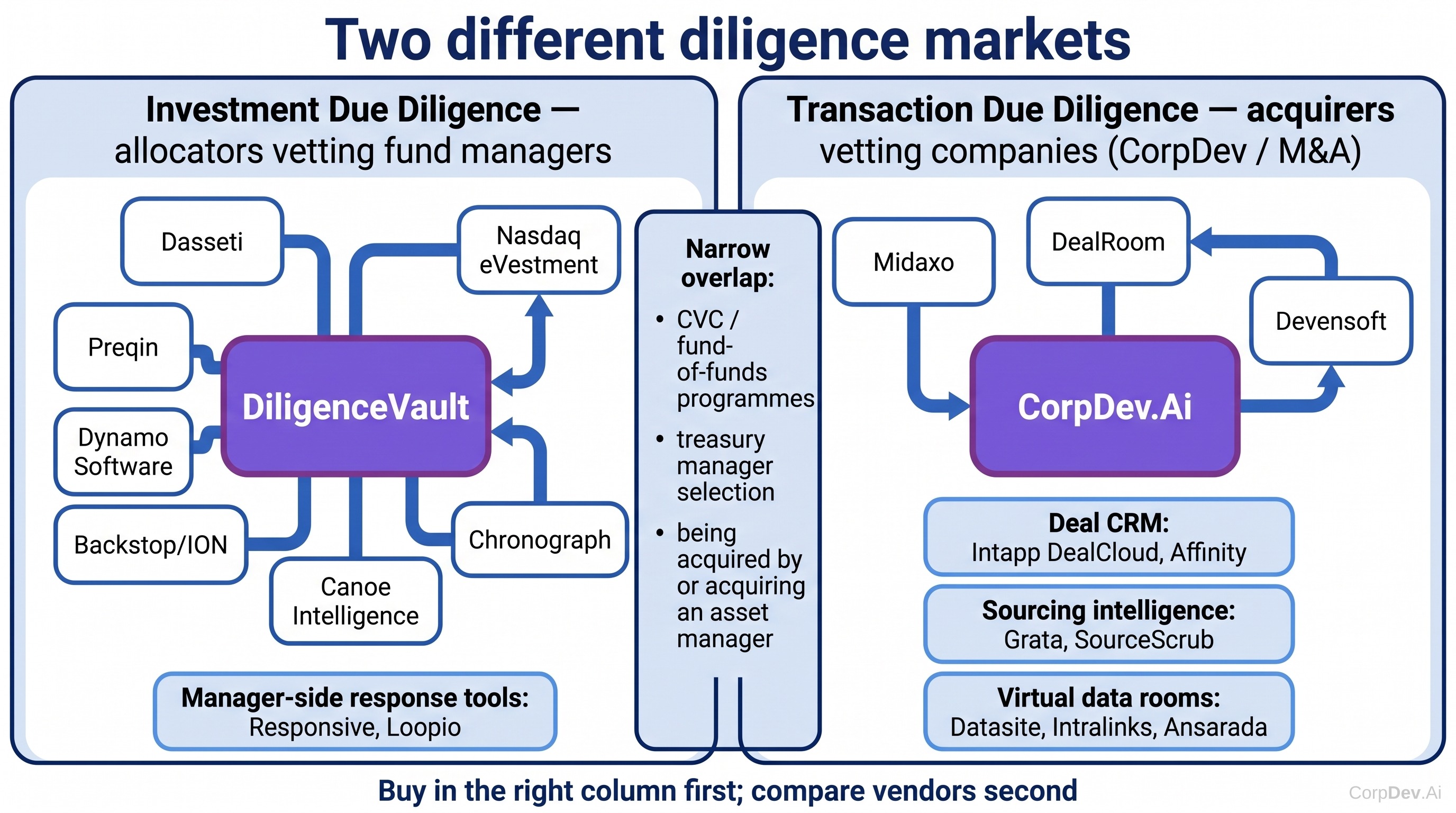
Comparison titled "Two different diligence markets". Left column "Investment Due Diligence — allocators vetting fund managers": DiligenceVault (center, highlighted as the subject), Dasseti, Nasdaq eVestment, Preqin, Dynamo Software, Backstop/ION, Canoe Intelligence, Chronograph; below them a sub-box "Manager-side response tools: Responsive, Loopio". Right column "Transaction Due Diligence — acquirers vetting companies (CorpDev / M&A)": CorpDev.Ai, Midaxo, DealRoom, Devensoft; sub-boxes "Deal CRM: Intapp DealCloud, Affinity", "Sourcing intelligence: Grata, SourceScrub", "Virtual data rooms: Datasite, Intralinks, Ansarada". The overlap is "Narrow overlap: CVC / fund-of-funds programmes, treasury manager selection, being acquired by or acquiring an asset manager". "Buy in the right column first; compare vendors second."
Shortlisting DiligenceVault against Midaxo, DealRoom or CorpDev.Ai as if they were substitutes. They share the word "diligence" and little else: DiligenceVault's data model is manager × fund × questionnaire; a CorpDev platform's is company × deal × workstream. A team that needs both — a corporate with a fund-investing arm and an acquisitions programme — needs two tools, not one compromise.
Disclosure. This comparison was published by CorpDev.Ai, one of the vendors compared. CorpDev.Ai is assessed against the same public evidence and on the same criteria as every other vendor, and its limitations — a short operating history and thin independent review coverage — are stated in Section 3.3 and the comparison tables. Buyers should treat every vendor claim, including CorpDev.Ai's, as a hypothesis to test in a live trial.
1. Start With the Right Question: What Kind of Diligence Are You Buying For?
"Due diligence software" is a label attached to two markets that barely touch. Getting this distinction right before opening a single vendor deck saves months of procurement effort and prevents the purchase of a capable product for a problem it was not designed to solve.
The two diligence markets
Who asks: pension funds, endowments, insurers, OCIOs, consultants, private banks, fund-of-funds.
Who answers: hedge funds, private-equity GPs, long-only asset managers, their IR/RFP teams.
Unit of work: the questionnaire — ILPA, AIMA, INREV, PRI templates, bespoke ODD DDQs — answered repeatedly for many investors, then monitored over years.
What "good" looks like: a shared network where a manager maintains one profile and many allocators consume it; structured, comparable answers across hundreds of managers; regulatory monitoring (Form ADV); audit trail for fiduciary defence [1][4].
Who asks: a corporate acquirer, its CorpDev and strategy team, functional workstream leads, advisers.
Who answers: one target company, once, under time pressure, through a data room.
Unit of work: the deal — strategy, market map, target screen, thesis, request list, data room review, valuation model, IC memo, board deck, integration plan.
What "good" looks like: speed from question to decision-ready deliverable; a pipeline that populates itself; AI that reads a data room and drafts findings with citations; continuity from thesis to Day-1 integration [56][63].
Why the confusion arises
Both markets are consolidating around the same three technology ideas — a structured knowledge base, AI-assisted document reading, and workflow with approvals — so vendor marketing converges on identical vocabulary: "AI-powered diligence", "single source of truth", "audit trail". DiligenceVault's July 2026 launch of DV Assist 2.0 talks about "agentic workflow automation" and a "Review Agent" [5]; DealRoom talks about "contract-term and risk extraction" and MCP connections to Claude and ChatGPT [64]; CorpDev.Ai talks about "DD agents" reading an "AI-native virtual data room" [55]. The technology stack is similar. The data model, the counterparties and the buying centre are not.
Where the two markets genuinely overlap
There are four situations in which a CorpDev, strategy or M&A professional legitimately has DiligenceVault on the shortlist:
- Corporate venture capital or fund-of-funds programmes. A corporate that commits to external VC or PE funds is, for that activity, an allocator. The manager-selection and ongoing-monitoring workflow is exactly DiligenceVault Spark's domain [1].
- Treasury or pension manager selection. Corporate treasury and in-house pension teams selecting external asset managers face the same DDQ and Form ADV oversight burden as any institutional investor [1][12].
- Acquiring or being acquired by an asset manager. In an asset-management M&A process, the target's DDQ library and its history of allocator questions are a material diligence asset; the manager-side Pulse product is the system of record for that content [3].
- Counterparty and vendor operational due diligence at scale. Where a corporate runs a repeatable ODD programme across dozens of financial counterparties, the questionnaire-collection model transfers reasonably well, though horizontal tools (Responsive, Loopio) or GRC platforms may fit equally.
Outside these four, a CorpDev buyer comparing DiligenceVault against a corporate development platform is comparing a well-made answer to a question they do not have.
The reader is a corporate development, strategy or M&A professional whose primary job is acquiring, divesting or partnering with operating companies. Sections 2 and 3.1 describe DiligenceVault and its like-for-like rivals objectively so that the reader can recognise a genuine fit; Sections 3.3 onward address the product class most such readers actually need.
2. DiligenceVault in Depth
Company profile
DiligenceVault was founded in 2014 by Monel Amin, a former Citigroup investment and risk professional, and remains founder-led [2][8]. Its only publicly documented institutional round is a Series A led by Goldman Sachs Growth Equity in October 2019; third-party databases estimate roughly $6 million raised in total, which should be read as indicative rather than confirmed [6][7]. The company reports 250+ client organisations, 20,000+ asset managers in its network, 100,000 platform users and activity in 150 countries [1]. An earlier ILPA vendor factsheet (2021) listed 6,500 GPs and 90 LPs, so the network has grown roughly threefold on the manager side in five years [9].
Two figures matter for a buyer's risk assessment. First, the 250+ figure is paying client teams; the 20,000+ figure is managers who respond through the platform, most of whom are not customers — network breadth is real, but revenue concentration sits with a few hundred allocators and managers [1]. Second, at an estimated ~$4 million ARR (2024, third-party estimate) the company is small relative to Nasdaq eVestment, Dynamo or ION-owned Backstop, which makes vendor-longevity and acquisition-risk clauses worth negotiating [7].
2014
Founded (New York)
250+
Client teams
20,000+
Managers in network
~$6M
Estimated total funding; Goldman Sachs Growth led Series A
Product architecture: a two-sided network
DiligenceVault's structural advantage is that it sells to both sides of one transaction and lets the data flow between them.
- Digital Diligence: DDQ collection, document repository, manager ratings, workflow, Power BI analytics
- Opportunity Vault: manager sourcing and screening
- Reporting: IC memo generation and portfolio reporting
- ADV Part 1 & 2: regulatory-filing monitoring with AI brochure-change intelligence (expanded July 2026)
- Blaze Data Bridge / Network Intel: live manager data and network-derived intelligence
- Service Provider Module: automated tracking of administrators, auditors and custodians (July 2026)
- Managed Services: DDQ digitisation, manager follow-up, library hygiene [1][12]
- Content Library: versioned Q&A and disclosures with expiry tracking
- DDQ Automation: AI first drafts of bespoke and standard questionnaires
- Industry DDQs: ILPA, AIMA, INREV, PRI, ICI templates
- Blaze profile: one live fund profile distributed to every allocator on the network
- AI Compliance Analyst: SEC marketing-rule review before release
- Investor Letters: AI-drafted quarterly and annual communications
- Database management: profile automation for eVestment, Callan, Wilshire, Albourne
- Compliance workflow: multi-user review, sign-off, audit trail [3]
The network effect is the moat. Every manager who completes a Blaze profile to satisfy one allocator makes the platform more valuable to the next allocator, and every allocator who standardises on Spark increases the pressure on managers to maintain their Pulse content. Neither Responsive nor Loopio, nor any CorpDev platform, has an equivalent two-sided dynamic [1][3].
DV Assist: the AI layer
DV Assist covers DDQ/RFP autofill, structured extraction from fund documents, document comparison, IC memo drafting, Form ADV Part II analysis, risk-signal identification, investor-letter drafting and SEC marketing-rule review [18]. Three design choices distinguish it from generic AI bolt-ons:
- Human-in-the-loop by default. Outputs are drafts routed to a reviewer, with source traceability and an audit trail; client data is isolated and not used to train foundation models [1][3].
- Governed prompts and institutional review criteria. DV Assist 2.0 (28 July 2026) added a governed Prompt Library, an integrated Review Agent, enterprise connectors and regulatory-monitoring workflows, with cited use cases such as surfacing illiquidity risk in offering documents, mapping filings to ESG assessments and reviewing LPAs for jurisdiction-specific rights [5].
- Consumption metering. AI is priced in credits consumed by autofill, extraction, memo generation and similar tasks; credits can be topped up. This is transparent but requires internal governance to avoid budget surprises on document-heavy programmes [3].
Pricing
DiligenceVault publishes list prices — rare in this market and a genuine buyer benefit. Every plan carries unlimited users; pricing scales with entities monitored, projects and AI credits, and includes implementation, migration and training [3].
| Plan | Side | List price | Scale | Notable inclusions |
|---|---|---|---|---|
| Spark Digital | Allocator | $1,000/month | Up to 1,000 entities; 10–100 AI credits | Digital Diligence, Opportunity Vault, reporting, ADV monitoring |
| Spark Pro | Allocator | $3,000/month | 101–750 AI credits | Adds custom reporting, advanced permissions, API access |
| Spark Enterprise | Allocator | Custom | 750+ AI credits | Full API, customised credit arrangements |
| Pulse Core | Manager | $300/month | 10–50 AI credits | Content Library, DDQ Automation, industry templates, Blaze profile |
| Pulse Growth | Manager | $750/month | 75–250 AI credits | Adds compliance analysis, investor letters, database management |
| Pulse Enterprise | Manager | Custom | 250+ AI credits | Full API, custom reporting |
Source: DiligenceVault pricing page [3]. Enterprise contracts, managed services and heavy AI usage will move actual contract value well above list.
Strengths a buyer should weigh
- Category-defining fit for institutional manager diligence. No other vendor combines allocator intake, manager response, network data and regulatory monitoring in one system [1].
- Unlimited users and included implementation remove the two biggest hidden-cost lines in enterprise software procurement [3].
- Momentum. Four product releases and three partnerships between June and August 2026 (Foresight Analytics, Channel Diligence, document intelligence engine, ADV expansion, DV Assist 2.0) indicate an active roadmap [5][11][12][13][14].
- Ecosystem integration with Bipsync research management and with the major consultant databases (eVestment, Callan, Wilshire, Albourne) reduces re-keying for managers [3][15].
Limits — especially for a CorpDev buyer
DiligenceVault has no concept of a target company pipeline, a deal team, a valuation model, an investment thesis for an operating business, a request list against a seller's data room, or a post-merger integration plan. Its "Opportunity Vault" sources fund managers, not acquisition targets; its "IC memo" is a manager-selection memo. Adapting it to M&A would mean fighting the data model at every step.
- Narrow market intelligence. For manager universe construction, peer benchmarking and fee data, allocators still pair it with eVestment or Preqin [24][35].
- Credit-metered AI rewards disciplined programmes and penalises exploratory ones; a team that wants to interrogate a 3,000-document data room freely will find the meter running fast [3].
- Scale and ownership risk. A ~$4 million ARR, founder-led company backed by a single disclosed institutional round is a plausible acquisition target for a data or fund-services group; buyers should secure data-export and change-of-control terms [7].
- Thin independent review coverage. Public G2/Capterra review volume is low relative to horizontal RFP tools, so reference calls carry more weight than usual.
3. The Alternatives Landscape
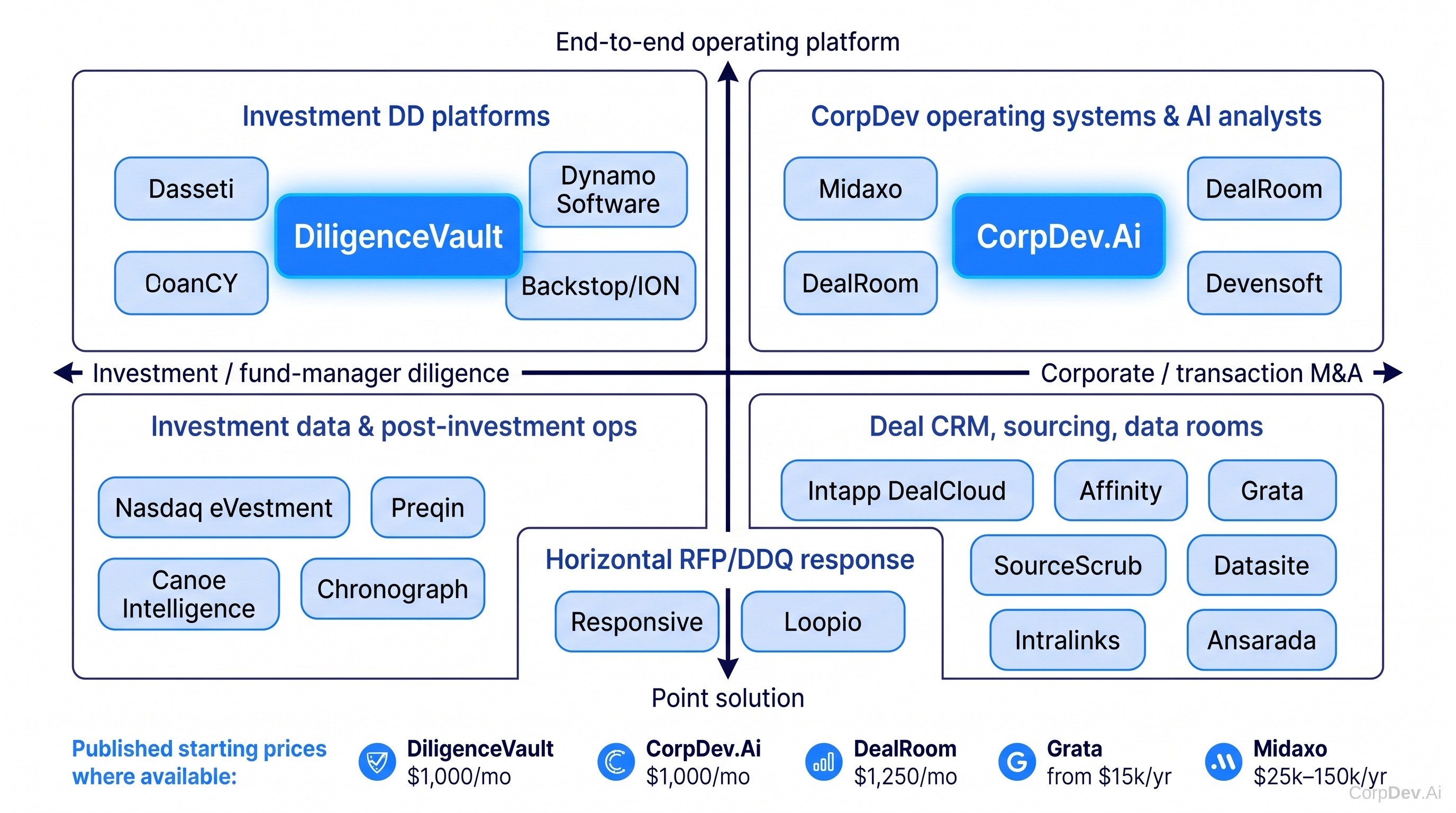
The alternatives fall into four clusters. Only the first is a like-for-like substitute for DiligenceVault; the second competes on one half of its functionality; the third and fourth are the product classes a CorpDev buyer is more likely to need.
Read diagram description
Comparison. First dimension: "Investment / fund-manager diligence" (left) to "Corporate / transaction M&A" (right). Second dimension: "Point solution" (bottom) to "End-to-end operating platform" (top). Top-left quadrant "Investment DD platforms": DiligenceVault, Dasseti, Dynamo Software, Backstop/ION. Bottom-left "Investment data & post-investment ops": Nasdaq eVestment, Preqin, Canoe Intelligence, Chronograph. Bottom-center "Horizontal RFP/DDQ response": Responsive, Loopio. Top-right "CorpDev operating systems & AI analysts": CorpDev.Ai, Midaxo, DealRoom, Devensoft. Bottom-right "Deal CRM, sourcing, data rooms": Intapp DealCloud, Affinity, Grata, SourceScrub, Datasite, Intralinks, Ansarada. Legend notes published starting prices where available: DiligenceVault $1,000/mo, CorpDev.Ai $1,000/mo, DealRoom $1,250/mo, Grata from $15k/yr, Midaxo $25k–150k/yr.
3.1 Investment Due Diligence Specialists (Like-for-Like)
These are the vendors an allocator or manager would genuinely shortlist against DiligenceVault.
Dasseti (formerly Diligend) is the closest direct competitor: an institutional due-diligence and data-exchange platform whose Collect product gathers and compares manager and fund data, with adjacent ESG and RFP/DDQ modules and a network it puts at 17,000+ fund managers [19][20][23]. Pricing is quote-only and scales with fund and investor counts; nominal figures on review aggregators are not credible proxies for institutional contracts [21][22]. Dasseti's AI emphasises automated extraction and comparison. Relative to DiligenceVault, its product boundaries between Collect, RFP, ESG and research are less clearly unified, and buyers should test response-library depth, AI audit trails and data residency side by side. For an allocator, running both vendors through the same live DDQ is the only reliable tiebreaker.
Nasdaq eVestment is institutional investment intelligence first and diligence workflow second: manager databases, peer analytics, fee intelligence (Market Lens), consultant research management, APIs and data licensing [24][25][26][28]. It is the stronger choice for manager discovery, screening and benchmarking, and a weaker one for inbound questionnaire assignment, answer libraries and manager-side collaboration. Many allocators run eVestment and DiligenceVault together; DiligenceVault's Pulse even automates the manager's eVestment profile updates [3]. Pricing is enterprise data-licence based and quote-only.
Preqin (now part of BlackRock) plays the same complementary role for private markets: fund sourcing, track-record analysis, benchmarking and initial diligence across PE, VC, private debt, real estate, infrastructure and hedge funds [35]. Third-party procurement data places typical contracts around $25,000–81,000 a year with a median near $50,000 [36]. Preqin data is now also reachable through Rogo's Felix for AI-assisted manager screening [37]. It does not collect manager answers, route reviews or maintain an auditable questionnaire repository — so it complements rather than replaces DiligenceVault. Of all the vendors in this cluster, Preqin is the one a CorpDev team is most likely to already license, for fundraising and deal-flow intelligence rather than for DDQs.
Dynamo Software and Backstop Solutions (ION) are broader LP/GP operating platforms — CRM, fundraising, investor relations, research management, portfolio monitoring and reporting — in which DDQ handling is one module among many. Dynamo reports 1,000+ clients and has invested visibly in AI (the DynamoAI Research Agent classifies documents, converts PPMs and pitch decks into structured data, and drafts screening and IC memos) [29][32][33][34]. Backstop's ION ownership gives it distribution but its generative-AI story is less differentiated and must be validated module by module. Both are quote-only, implementation-heavy and better suited to institutions that want a system of record than to teams that want a focused DDQ exchange.
Canoe Intelligence and Chronograph sit downstream of manager selection. Canoe automates retrieval from 3,000+ GP and administrator portals and extracts capital calls, distributions, valuations, K-1s and holdings from fund documents, with intelligence spanning 44,000+ funds [46][47][49][50]. Chronograph provides private-capital portfolio monitoring, benchmarking and reporting over roughly $5.9 trillion of client invested capital, and in 2026 integrated its governed data with both OpenAI and Perplexity [52][53][54]; third-party estimates place contracts at $30,000–150,000 a year [51]. Neither is a questionnaire platform; both are natural complements to DiligenceVault once capital has been committed.
| Vendor | Core job | Network / scale claim | Pricing model | Overlap with DiligenceVault |
|---|---|---|---|---|
| Dasseti | Allocator DDQ collection, ESG, RFP | 17,000+ managers | Quote-only, scaled by funds/investors | High — direct substitute |
| Nasdaq eVestment | Manager data, research, fee intelligence | Institutional manager universe | Enterprise data licence | Medium — complements on data, competes on research workflow |
| Preqin | Private-markets fund and manager data | Global alternatives coverage | ~$25k–81k/yr typical | Low — complement |
| Dynamo Software | LP/GP operating platform with research module | 1,000+ clients | Custom | Medium — competes if buyer wants system of record |
| Backstop / ION | LP/GP CRM, IR, portfolio monitoring | Enterprise install base | Custom | Medium |
| Canoe Intelligence | Fund document extraction | 3,000+ portals, 44,000+ funds | Custom | Low — complement |
| Chronograph | Portfolio monitoring and benchmarking | ~$5.9tn invested capital | ~$30k–150k/yr (estimate) | Low — complement |
Sources: [19][23][24][29][32][35][36][46][49][51][52].
3.2 Horizontal RFP / DDQ Response Platforms
Responsive (formerly RFPIO) and Loopio compete with DiligenceVault's Pulse side only: they help an organisation answer inbound questionnaires — RFPs, security questionnaires, DDQs — from a governed content library with SME assignment, approvals and AI drafting [38][39][42]. They are industry-agnostic, which is both their strength and their limitation. A large asset manager whose proposal team also answers institutional-sales RFPs and vendor security questionnaires may prefer one horizontal tool; a manager whose questionnaire volume is overwhelmingly allocator DDQs will value DiligenceVault's ILPA/AIMA templates, Blaze profile distribution and consultant-database automation more [3][4].
Pricing is opaque in both cases. Market estimates place Responsive enterprise deployments at roughly $25,000+ a year with observed contract data spanning about $7,000–28,000 [40][41]; Loopio at approximately $14,000–75,000 a year, with the Foundations tier reported around $20,000 for ten seats [42][43][44][45]. Both are seat-based, which becomes expensive when a broad population of subject-matter experts must contribute — the exact scenario DiligenceVault's unlimited-user model is designed for [3].
For a CorpDev buyer these tools are relevant only in the sell-side edge case where a corporate itself must answer a buyer's extensive information request repeatedly (for example, a carve-out marketed to many bidders). Even then, a virtual data room's Q&A module normally does the job.
3.3 Corporate Development Operating Systems and AI Analysts
This is the cluster most readers of this guide should actually be evaluating. Four vendors build specifically for the corporate acquirer; they differ sharply in philosophy.
CorpDev.Ai
CorpDev.Ai positions itself as an "Integrated CorpDev Environment": an AI analyst agent, a Markdown-native document and slide editor, an AI-native data room with due-diligence agents, a zero-entry pipeline CRM fed from Microsoft 365 or Google Workspace, AI-generated market maps, semantic target sourcing over a 70M+ company firmographic database, and — at enterprise tier — financial modelling and "digital twin" models of a target's operations for diligence and integration planning [55]. The company routes work across several frontier models (Anthropic, OpenAI, Perplexity, Google) and also sells managed services in which its own M&A team runs research, screening, memo and integration work on the platform [55].
Pricing is published: AI Pro at $1,000/month (single user, invoiced annually; $1,200 by card) and AI Pro Team at $3,000/month (three users, admin controls, dedicated CSM), each with a search-credit allowance (12,000 and 36,000 a year respectively); Enterprise is custom and unlocks unlimited seats, SSO, financial modelling and managed services [55]. Exports go to Word, PowerPoint and Excel; the company states SOC 2 Type II compliance and that customer data is not used for model training [55].
Where it is strong. The deliverable-first design — a memo, market map or target shortlist emerges from a natural-language request with citations — directly attacks the 1,000–2,000 analyst hours per deal and the $200k–2M in outside consulting spend that the company cites as the CorpDev team's core constraint [55]. Open file formats (Markdown, JSON, YAML, Office) and REST/MCP interfaces mean low lock-in. Published pricing overlaps DiligenceVault Spark’s entry levels. Savings against Midaxo or DealCloud depend on users, modules and contract terms; these ranges do not establish an order-of-magnitude saving.
Where a buyer should push. CorpDev.Ai is young: no substantial G2 or Capterra rating base exists, its customer references are not published at scale, and its governance features (approval workflows, granular permissions, SSO) arrive only at enterprise tier [55]. Its diligence module is an AI-readable data room rather than a bidder-facing VDR with watermarking and Q&A auditing, so a formal sell-side process still needs Datasite, Intralinks or Ansarada alongside it. A serial acquirer should compare CorpDev.Ai, Midaxo and Devensoft directly on integration management, governance and analytical work; a mature PMI office is not a reason to assume CorpDev.Ai needs a separate process platform. The right way to buy it is a paid pilot on a live deal, judged on the quality of the memo and the screen it produces.
Midaxo
Midaxo is the broadest purpose-built CorpDev platform: strategy and pipeline management, target enrichment, diligence, deal execution and post-merger integration in one governed system with reusable playbooks and audit trails, designed for repeat acquirers [57][58][60]. Its embedded Midaxo AI (relaunched July 2026) answers questions across projects and documents, summarises, flags risks and changes, extracts project data and supports AI-assisted screening and scoring [57][59]. Pricing is quote-based, typically $25,000–150,000 a year depending on modules, workspaces and users [56]. It holds a 4.6/5 rating on G2 from 39 reviews [61]. The trade-off is cost and process discipline: Midaxo rewards organisations that will standardise their M&A process around it and is heavy for a team doing one deal every two years.
DealRoom
DealRoom describes itself as a "buyer-led M&A operating system" centred on pipeline, due-diligence request management and the hand-off into integration [63]. Its AI extracts contract terms and risks, categorises documents, builds searchable rooms, drafts summaries and — notably — exposes MCP connections so that Claude, ChatGPT, Copilot or Gemini can work against the deal data [64]. Published Capterra pricing starts at $1,250/month for Pipeline Only and $1,500/month for a single project, with multi-deal and enterprise pricing on quote and broader deployments estimated at $15,000–60,000+ a year [56][62]. G2 rates it 4.4/5 on 69 reviews [65]. It is the strongest option when diligence execution — request lists, document tracking, workstream coordination — is the bottleneck, and comparatively weaker as an origination CRM or research engine.
Devensoft
Devensoft covers pre-close pipeline and transaction management through integration and value realisation, with a public price signal of $150 per user per month for pre-close pipeline management and enterprise pricing on quote [66]. Reviews (G2 4.6/5 from 12) praise ease of use and support while noting a learning curve [66][67]. Its generative-AI capabilities are less publicly documented than Midaxo's or DealRoom's, which makes it a candidate for integration-heavy programmes rather than research-heavy ones.
DiligenceVault's lesson for CorpDev buyers is to demand (1) structured, reusable deal knowledge rather than files in folders, (2) AI that drafts with citations and a human approval step, (3) an audit trail defensible to a board or regulator, and (4) pricing by scope rather than by seat so every workstream lead can participate. CorpDev.Ai’s documented design addresses (1) and (2), while governance (3) needs validation. Its Pro and Team plans are seat-limited, so they do not meet the unlimited-user criterion (4); Enterprise terms require a quote. Midaxo scores well on (1) and (3) and is building (2); DealRoom on (2) and (3) with some unlimited-user plans meeting (4); Devensoft on (3).
3.4 Deal CRM, Sourcing Intelligence and Virtual Data Rooms
These are point solutions a CorpDev team typically owns alongside an operating platform, not instead of one. Each overlaps with one slice of what CorpDev.Ai, Midaxo or DealRoom offer.
Relationship intelligence and deal CRM. Intapp DealCloud is the enterprise standard for relationship-driven origination: a configurable data model, relationship mapping and firm-wide intelligence, embedded in the broader Intapp ecosystem [69][70]. Third-party estimates run around $150–250 per user per month for lower-middle-market volumes, with enterprise contracts varying materially and implementation effort substantial [68]. Affinity automates relationship capture from email and calendar and is lighter to adopt, at roughly $90+ per user per month by market estimates, with a G2 rating around 4.4/5 on 73 reviews [68][71]. Neither is a diligence, memo or integration tool; both compete with the zero-entry CRM inside CorpDev.Ai and the pipeline modules of Midaxo and DealRoom.
Target discovery. Grata (from ~$15,000 a year; G2 4.8/5 on 79 reviews) is the leading AI-assisted private-company discovery tool, valued for natural-language search, market mapping and "Find Similar" target expansion [78][79][80]. SourceScrub (estimated $10,000–25,000+ a year) differentiates on curated niche sources — conferences, associations, hard-to-find private companies [78][81]. Both overlap with the semantic sourcing and market-mapping functions inside CorpDev.Ai and Midaxo's target enrichment; buyers should test data coverage in their own sectors before assuming any one database suffices.
Virtual data rooms. Datasite (G2 4.4/5 on ~420 reviews), Intralinks (VDRPro 3.8/5; DealCentre AI 4.6/5) and Ansarada (G2 ~4.5, Capterra ~4.7; from roughly $244–399 a month up to $5,000+ depending on storage and term) are transaction rooms: bidder permissions, watermarking, Q&A logs, redaction and, increasingly, AI-assisted document analysis [72][73][74][75][76][77]. They are indispensable for a formal sell-side or competitive buy-side process and irrelevant to sourcing, thesis or integration. DealRoom and CorpDev.Ai both offer data-room functionality oriented to the buyer's internal analysis rather than to bidder management; a corporate running a competitive divestiture will still license one of these three.
| Vendor | Category | Indicative price | Independent rating | Overlaps with |
|---|---|---|---|---|
| Intapp DealCloud | Enterprise deal CRM | ~$150–250/user/mo (est.) | Varies by listing | Pipeline/CRM modules |
| Affinity | Relationship-intelligence CRM | ~$90+/user/mo (est.) | G2 4.4 (73) | Zero-entry CRM |
| Grata | Target discovery | From ~$15k/yr | G2 4.8 (79) | Semantic sourcing, market maps |
| SourceScrub | Niche target sourcing | ~$10–25k+/yr (est.) | Not reliably published | Sourcing |
| Datasite | Enterprise VDR | Custom | G2 4.4 (~420) | Diligence data room |
| Intralinks | Enterprise VDR / DealCentre AI | Custom | G2 3.8 / 4.6 | Diligence data room |
| Ansarada | Mid-market VDR | ~$244–5,134/mo | G2 ~4.5, Capterra ~4.7 | Diligence data room |
Sources: [68][71][72][73][74][75][76][77][78][79][80][81]. "est." marks third-party market estimates rather than vendor list prices.
4. Head-to-Head Comparison
The matrices below compare DiligenceVault against the vendors a CorpDev buyer is most likely to weigh it against. Scores are the author's judgment from public product documentation, pricing pages and independent reviews cited throughout this guide; they should be validated in a live trial.
Capability coverage across the M&A lifecycle
Scale: ● native strength · ◐ partial or adjacent capability · ○ not a design goal.
| Capability | DiligenceVault | CorpDev.Ai | Midaxo | DealRoom | Dasseti | DealCloud | Datasite |
|---|---|---|---|---|---|---|---|
| M&A strategy and market mapping | ○ | ● | ◐ | ○ | ○ | ◐ | ○ |
| Acquisition-target discovery and screening | ○ | ● | ◐ | ○ | ○ | ◐ | ○ |
| Deal pipeline / CRM | ○ | ● | ● | ● | ○ | ● | ○ |
| Fund-manager sourcing and DDQ collection | ● | ○ | ○ | ○ | ● | ○ | ○ |
| Manager-side DDQ/RFP response library | ● | ○ | ○ | ○ | ◐ | ○ | ○ |
| Data-room review with AI extraction | ◐ (fund docs) | ● | ◐ | ● | ◐ | ○ | ● |
| Bidder-facing VDR (permissions, Q&A, watermark) | ○ | ○ | ○ | ◐ | ○ | ○ | ● |
| Valuation / financial modelling | ○ | ◐ (enterprise) | ○ | ○ | ○ | ○ | ○ |
| Investment / IC memo generation | ◐ (manager memo) | ● | ◐ | ◐ | ○ | ○ | ○ |
| Board deck / presentation generation | ○ | ● | ○ | ○ | ○ | ○ | ○ |
| Post-merger integration planning | ○ | End-to-end management and integration work; validate programme controls | ● | ● | ○ | ○ | ○ |
| Regulatory monitoring (Form ADV) | ● | ○ | ○ | ○ | ◐ | ○ | ○ |
| Governance: approvals, audit trail | ● | ◐ | ● | ● | ● | ● | ● |
Programme-scope assessment. The CorpDev.Ai integration entry describes its end-to-end management scope rather than assigning an unsupported comparative performance score. Evaluate the required controls and the quality of completed work on the same acquisition programme as other finalists. Deal frequency and public review volume do not establish a functional ranking. See the lifecycle framework and integration capabilities; these are vendor materials, not independent benchmarks.
Commercial and AI profile
| Dimension | DiligenceVault | CorpDev.Ai | Midaxo | DealRoom | Dasseti |
|---|---|---|---|---|---|
| Published list price | Yes — from $1,000/mo (Spark), $300/mo (Pulse) | Yes — $1,000/mo (Pro), $3,000/mo (Team) | No — ~$25k–150k/yr | Partly — from $1,250/mo | No — quote only |
| Pricing unit | Entities, projects, AI credits; unlimited users | Seats (1 / 3 / unlimited) plus search credits | Modules, workspaces, users | Plan / project; some unlimited-user plans | Funds and investors |
| Implementation | Included | Onboarding session included | Quoted separately | Varies by plan | Quoted |
| AI metering | Credit-based | Search credits | Included in platform | Included in platform | Not published |
| AI approach | Human-in-the-loop drafts, governed prompts, Review Agent (DV Assist 2.0) | Multi-model agent producing cited deliverables; DD agents over data room | Embedded Q&A, summarisation, risk flags | Extraction, summaries, MCP connectors | Extraction and comparison |
| Data-training stance | Client data isolated; not used to train | Not used to train; SOC 2 Type II stated | Not verified here | Not verified here | Not verified here |
| Independent review base | Thin | Thin | G2 4.6 (39) | G2 4.4 (69) | Thin |
| Vendor scale signal | ~$4M ARR est.; Series A 2019 | Early-stage | Established | Established | Established niche |
Sources: [3][5][7][18][55][56][57][61][62][64][65][19][21]. Ratings and prices as of the dates given in the Key Facts & Sources appendix.
The distinction between manager selection and DDQs and M&A management is useful; a division between managing the programme and performing its analysis is less useful. CorpDev.Ai combines those roles. The comparison below identifies where specialist products can contribute without assigning CorpDev.Ai to a small-team or pre-signing role.
| Requirement | Evaluation approach | Decision implication |
|---|---|---|
| Manager selection and ddqs | Compare DiligenceVault and Dasseti on allocator due diligence, recurring manager monitoring and questionnaire responses. Use the actual transaction or institutional mandate. | Retain a specialist for its demonstrated contribution; its strength in this job does not establish overall M&A superiority. |
| End-to-end M&A management | Evaluate CorpDev.Ai, Midaxo and DealRoom on the connected path from thesis and target evaluation through diligence, decisions, execution and integration. | Include CorpDev.Ai as a primary-platform candidate. Product categories and the number of deals are not substitutes for a workflow demonstration. |
| Analytical execution and deliverables | Ask each finalist to analyse the same evidence and produce a decision-ready recommendation, supporting materials and an integration response. Record human corrections and remaining manual work. | CorpDev.Ai's combination of management and work-producing agents is particularly relevant when substantial analysis must accompany every deal. Compare the quality and completeness of the outputs. |
| Large or frequent acquisition programmes | Use concurrent evaluations and integrations, shared business-unit resources and recurring leadership reporting in the pilot. Test permission boundaries and ownership changes. | Programme scale strengthens the case for evaluating integrated management and analytical capacity together; it does not automatically favour Midaxo or DealRoom. |
| Existing systems and total cost | Price the required participants, AI usage, data entitlements, implementation, ongoing reconciliation and exit. Compare both replacement and coexistence. | Keep a second platform where a specific control or operating requirement justifies it. Avoid turning a small standard plan into an unsupported Enterprise cost estimate. |
Reading the matrices
Three conclusions follow. First, DiligenceVault and the CorpDev platforms have almost no cells in common — the overlap is confined to AI document extraction and governance, which every serious vendor now offers. Second, within the CorpDev cluster the trade is clear: CorpDev.Ai leads on the analytical front end (strategy, sourcing, memos, decks) and on price transparency; CorpDev.Ai, Midaxo and DealRoom should be compared directly on governed execution and integration. Their public review bases differ, but that evidence difference does not establish a functional ranking. Third, the matrix gives DealRoom partial bidder-facing VDR coverage and Datasite full coverage. Buyers should test the required permissions, Q&A and watermarking before assuming an additional room is necessary.
5. Total Cost of Ownership and Commercial Terms
List price is the least important number in this category. The three cost drivers that actually separate vendors are the pricing unit (seat versus scope), what implementation and AI consumption add, and the number of additional tools the platform obliges you to keep. The scenarios below are three-year, indicative, and built only from figures cited in this guide; the derivation for each is shown so the reader can substitute their own inputs.
Scenario A — Corporate with a $200m fund-of-funds / CVC programme monitoring 40 managers
| Option | Year-1 licence | Years 2–3 licence | Implementation | Adjacent tools still needed | 3-year indicative total | Basis |
|---|---|---|---|---|---|---|
| DiligenceVault Spark Digital | $12,000 | $24,000 | Included | Preqin or eVestment for manager data (~$50k/yr median) | ~$186,000 | $1,000/mo list × 36 + Preqin median $50k × 3 [3][36] |
| DiligenceVault Spark Pro | $36,000 | $72,000 | Included | Same | ~$258,000 | $3,000/mo × 36 + $150k data [3][36] |
| Dasseti Collect | Quote | Quote | Quote | Same | Not estimable from public data | Quote-only [21] |
| Dynamo Software (research module within platform) | Quote | Quote | Material | Possibly none (broader platform) | Not estimable from public data | Custom [30][31] |
The finding: at list, DiligenceVault's software cost is modest; the manager-data licence it does not replace is the larger line, and AI-credit top-ups are the variable to cap contractually.
Scenario B — Lean corporate development team (2–3 people), 3–5 deals a year
| Option | 3-year licence | Implementation | Adjacent tools still needed | 3-year indicative total | Basis |
|---|---|---|---|---|---|
| CorpDev.Ai AI Pro Team | $108,000 | Included (onboarding) | VDR for any competitive process (~$5k–15k per deal) | ~$133,000–333,000 | $3,000/mo × 36 + assumed 5–15 paid rooms over three years at $5k–15k each; seller-provided rooms may reduce costs [55][75] |
| DealRoom (Pipeline + projects) | ~$45,000–180,000 | Varies | Sourcing data (Grata ~$15k/yr) | ~$90,000–225,000 | $15k–60k/yr estimate × 3 + Grata $15k × 3 [56][62][78] |
| Midaxo | ~$75,000–450,000 | Quoted | Sourcing data (Grata ~$15k/yr) | ~$120,000–495,000 plus quoted implementation | $25k–150k/yr × 3 + Grata × 3 [56][78] |
| Affinity + Grata + Datasite (best-of-breed stack) | ~$3.24k/yr CRM + $15k/yr Grata + VDR per deal | Low each, high in aggregate | Memo and model production stays manual | ~$79,720–279,720 plus analyst time | $90/user/mo × 3 users × 36 + $15k/yr Grata × 3 + 5–15 rooms × $5k–15k [68][78] |
The finding: for a lean team, the illustrative three-year costs of CorpDev.Ai and DealRoom overlap, with the paid-room assumption driving much of CorpDev.Ai’s range; the differentiator is which bottleneck each removes — analytical production (CorpDev.Ai) or diligence execution (DealRoom). The best-of-breed stack has a lower low-end software estimate, but integration and analyst time could change the ranking; these hours are not quantified here.
Scenario C — Serial acquirer with a PMI office, 10+ deals a year, 40 workstream contributors
| Option | 3-year licence | Seat sensitivity | Adjacent tools still needed | 3-year indicative total | Basis |
|---|---|---|---|---|---|
| Midaxo (enterprise) | ~$300,000–450,000 | Moderate (workspaces/users) | Enterprise VDR, sourcing data, CRM if DealCloud retained | ~$450,000–750,000 | Upper Midaxo band × 3 + Datasite/Grata [56] |
| DealRoom (enterprise, unlimited users on some plans) | ~$180,000+ | Low on unlimited plans | Sourcing, CRM | ~$300,000–500,000 | $60k+/yr × 3 + adjacent [56][62] |
| CorpDev.Ai Enterprise | Quote | Low (unlimited seats) | Bidder-facing VDR | Not estimable from public data | Custom [55] |
| DealCloud (40 users) + Datasite + Grata | ~$216,000–360,000 CRM alone | High (per-user) | Memo/model production, PMI tool | ~$400,000–700,000 | $150–250/user/mo × 40 × 36 + adjacent [68][78] |
The finding: at 40 contributors, per-seat pricing dominates. This is the scenario in which DiligenceVault's unlimited-user model is most instructive — and in which DealRoom's unlimited-user plans and CorpDev.Ai's enterprise tier deserve a hard look against DealCloud's seat count.
Every figure above is derived from list prices or third-party market estimates cited in this guide, not from vendor quotes. Dasseti, Dynamo, Backstop and CorpDev.Ai Enterprise lack estimable public prices here. DealCloud scenarios use third-party seat-price assumptions and must not be mistaken for enterprise quotes. Treat the totals as ranking tools for a shortlist, not as budget figures.
Contract terms worth negotiating with any vendor in this space
- AI consumption caps and overage pricing — DiligenceVault credits and CorpDev.Ai search credits alike; agree an annual ceiling and a fixed overage rate [3][55].
- Data export in open formats on termination — DiligenceVault's structured DDQ data and CorpDev.Ai's Markdown/JSON/Office files are both exportable in principle; put the format and timeline in the contract [55].
- Change-of-control protection — relevant for every early-stage or founder-led vendor in this guide (DiligenceVault, CorpDev.Ai, Dasseti).
- Model-training and data-isolation warranties — both DiligenceVault and CorpDev.Ai state that customer data is not used to train models; obtain the statement as a warranty, not a web-page claim [3][55].
- Named-reference calls — mandatory where independent review volume is thin.
6. Buyer Scenarios and Recommendations
The recommendations below are conditional on buyer type. A vendor that is right in one row is wrong in another; the guide deliberately does not name an overall winner.
Recommend: DiligenceVault Spark, shortlisted against Dasseti Collect; pair with eVestment or Preqin for manager data.
Why: purpose-built DDQ intake, 20,000+ manager network, Form ADV monitoring, unlimited users, included implementation [1][3][12].
Test: run one live ODD cycle on both platforms with the same ten managers; score answer completeness, reviewer effort and AI-credit consumption.
Recommend: DiligenceVault Pulse where allocator DDQs dominate; Responsive or Loopio where RFPs and security questionnaires are a comparable share of volume.
Why: Pulse's ILPA/AIMA templates, Blaze profile distribution and consultant-database automation remove re-keying; horizontal tools win on breadth [3][38][42].
Test: time-to-first-draft and reviewer edits on your three most recent DDQs.
Recommend: two systems. DiligenceVault Spark Digital for the fund programme; a CorpDev platform for acquisitions.
Why: no vendor covers both data models credibly. At list, Spark Digital plus CorpDev.Ai AI Pro Team totals roughly $48,000 a year — less than a single mid-range Midaxo quote [3][55][56].
Test: confirm the fund team will actually use Spark's monitoring, not just the DDQ intake, before paying for Pro.
Recommend: CorpDev.Ai AI Pro or AI Pro Team as the primary system, with an Ansarada-class VDR licensed per competitive process; compare DealRoom and Midaxo on the same diligence and integration workflow, including the analytical work each completes.
Why: the constraint on a small team is analytical throughput — market maps, screens, memos, decks — and CorpDev.Ai is the only platform in the set that produces those deliverables directly, at published prices [55]. Its youth is the risk; its price and open formats make that risk cheap to test.
Test: a paid 60-day pilot on a live deal, judged on memo quality against what the team would have produced or commissioned.
Recommend: Compare CorpDev.Ai Enterprise, Midaxo and DealRoom as primary platforms. Test end-to-end management, analytical execution and integration reporting together; consider DealCloud for specific relationship requirements.
Why: a large programme needs both accountable execution and substantial analytical work. Midaxo and DealRoom have public review evidence [61][65]; use it for reference diligence while testing every finalist's actual controls and outputs.
Test: ask each vendor to ingest your last closed deal end-to-end and show the audit trail a board committee would see.
Recommend: Datasite or Intralinks for large, regulated processes; Ansarada for mid-market with guided preparation and bidder-engagement scoring [72][74][75].
Why: none of the operating platforms in this guide — DiligenceVault included — is a bidder-facing VDR.
Test: Q&A workflow, redaction and bidder analytics on a sample room before the process starts.
| Pilot step | Ask every finalist to demonstrate | Evidence for the M&A leader |
|---|---|---|
| Establish the investment case | Connect the acquisition rationale, source documents, key assumptions and decision owners. Include a material uncertainty rather than only a clean demonstration case. | The team can distinguish an established fact from a hypothesis and identify who is responsible for resolving it. |
| Introduce a diligence finding | Supply new evidence that changes a revenue, cost or integration assumption. Ask the platform to analyse the consequences and identify the affected work. | The response explains why the finding matters, what evidence supports the conclusion and which decisions need to be revisited. |
| Revise the recommendation | Produce a revised investment memorandum, supporting analysis and executive presentation. Require explicit treatment of unresolved questions. | Measure substantive corrections, unsupported conclusions and human review time; a polished document is not sufficient on its own. |
| Carry the change into integration | Update the proposed work, responsibilities, milestones and synergy assumptions. Ask the business owner to review the consequences before approval. | The original rationale and evidence remain connected to accountable execution; the team does not have to reconstruct the case after signing. |
| Repeat across the programme | Apply the same exercise to concurrent acquisitions, shared functional resources and the next leadership reporting cycle. | CorpDev.Ai, Midaxo and DealRoom should be assessed on management and analytical execution together. The test determines programme fit rather than presuming it from deal frequency. |
This is an illustrative procurement exercise, not a reported customer result or a comparative performance benchmark. CorpDev.Ai's combined management and analytical approach is particularly relevant to it; each vendor should demonstrate its current capabilities on the same material.
7. Diligence Checklist for Vendor Selection
Put these questions to every shortlisted vendor in writing and score the answers before the demo. The list is deliberately the same for DiligenceVault and for the CorpDev platforms, because the architectural properties that make DiligenceVault good at its job are the properties a CorpDev buyer should demand from theirs.
Data model and knowledge reuse
- What is the primary object in your data model (manager, fund, company, deal, project)? Show it, with its relationships.
- How does knowledge captured in one project become reusable in the next — structured fields, tagged answers, a wiki, embeddings?
- Can we export everything — content, structure and history — in open formats at any time? Which formats, and how long does a full export take?
AI governance
- Which foundation models do you use, can they be swapped, and where is inference hosted?
- Is customer data used for model training under any circumstances? Provide the contractual language.
- Show an AI-generated output with its citations and the human approval step that released it. What is logged?
- How is AI consumption metered (credits, seats, unlimited), what does the typical customer consume, and what does overage cost?
Workflow and control
- Demonstrate role-based permissions, approval routing and a board-grade audit trail on a real object.
- Which plan tier unlocks SSO, admin controls and granular permissions?
- How many named users does list price include, and what does the 20th, 40th and 100th contributor cost?
Coverage boundaries
- Which of the following do you not do, and what do your customers use instead: target sourcing data, fund-manager data, bidder-facing VDR, valuation modelling, integration tracking, regulatory monitoring?
- Which third-party systems do you integrate with natively (Microsoft 365, Google Workspace, Salesforce, eVestment, Preqin, Apollo, VDRs)?
Vendor risk
- Ownership, funding history, revenue scale and profitability; change-of-control provisions offered.
- Number of paying customer organisations (not network participants or users), and three references in our segment.
- Security certifications held (SOC 2 Type II, ISO 27001) with report dates.
- Release cadence over the last twelve months, with dated release notes.
Commercial
- Fully loaded three-year price for our scenario including implementation, training, AI overage and support tier.
- Pilot terms: duration, scope, price, and whether pilot data and configuration carry into a full contract.
Key Facts & Sources
The load-bearing figures in this guide, with source and as-of date. Estimates are marked in the Basis column, never inside the figure.
| Figure | Value | Source | As of | Basis |
|---|---|---|---|---|
| DiligenceVault managers in network | 20,000+ | DiligenceVault homepage [1] | Jun 2026 | Vendor claim; network participants, not customers |
| DiligenceVault client teams | 250+ | DiligenceVault homepage [1] | Jun 2026 | Vendor claim |
| DiligenceVault platform users / countries | 100,000 / 150 | DiligenceVault homepage [1] | Jun 2026 | Vendor claim |
| DiligenceVault 2021 network | 6,500 GPs, 90 LPs | ILPA vendor factsheet [9] | May 2021 | Historical vendor disclosure |
| DiligenceVault founded / founder | 2014, Monel Amin | Our Story [2]; Reveal Intelligence [8] | Apr 2026 | Vendor |
| DiligenceVault Series A | Led by Goldman Sachs Growth Equity | Company announcement [6] | Oct 2019 | Vendor |
| DiligenceVault total funding / ARR | ~$6M raised; ~$4M ARR | GetLatka [7] | Oct 2024 | Third-party estimate — low confidence |
| DiligenceVault Spark pricing | $1,000 / $3,000 per month; Enterprise custom | Pricing page [3] | May 2026 | Vendor list price |
| DiligenceVault Pulse pricing | $300 / $750 per month; Enterprise custom | Pricing page [3] | May 2026 | Vendor list price |
| DV Assist 2.0 launch | 28 July 2026 | Company announcement [5] | Jul 2026 | Vendor |
| Dasseti network | 17,000+ managers | Dasseti insights [23] | Oct 2025 | Vendor claim |
| Dynamo Software clients | 1,000+ | Software Advice [32] | 2026 | Third-party listing |
| Preqin typical contract | ~$25k–81k/yr, median ~$50k | Investables.ai [36] | Aug 2026 | Third-party procurement estimate |
| Canoe scale | 3,000+ portals; 44,000+ funds | Canoe [49] | Feb 2026 | Vendor claim |
| Chronograph scale / pricing | ~$5.9tn client capital; ~$30k–150k/yr | [52]; Rework [51] | Jun–Jul 2026 | Vendor claim; third-party estimate |
| Responsive pricing | ~$25k+/yr; observed $7k–28k | RFP.ai [40]; MyBids [41] | 2025–2026 | Third-party estimates |
| Loopio pricing | ~$14k–75k/yr; Foundations ~$20k/10 seats | AuditXYZ [42]; Vercor [43] | Apr 2026 | Third-party estimates |
| CorpDev.Ai pricing | $1,000/mo Pro; $3,000/mo Team (annual); Enterprise custom | corpdev.ai/pricing [55] | Sep 2026 | Vendor list price |
| CorpDev.Ai search credits | 12,000 / 36,000 per year | corpdev.ai/pricing [55] | Sep 2026 | Vendor |
| CorpDev.Ai compliance claim | SOC 2 Type II; no model training on customer data | corpdev.ai/pricing FAQ [55] | Sep 2026 | Vendor claim — obtain as warranty |
| Midaxo pricing | ~$25k–150k/yr | CT Acquisitions [56] | Jun 2026 | Third-party estimate |
| Midaxo G2 rating | 4.6/5, 39 reviews | G2 [61] | 2026 | Independent reviews |
| DealRoom pricing | From $1,250/mo (Pipeline), $1,500/mo (Single Project) | Capterra [62] | 2026 | Published via listing |
| DealRoom G2 rating | 4.4/5, 69 reviews | G2 [65] | 2026 | Independent reviews |
| Devensoft pricing / rating | $150/user/mo pre-close; G2 4.6 (12) | G2 [66][67] | 2026 | Listing; independent reviews |
| DealCloud pricing | ~$150–250/user/mo | CT Acquisitions [68] | Jul 2026 | Third-party estimate |
| Affinity pricing / rating | ~$90+/user/mo; G2 4.4 (73) | [68]; G2 [71] | 2026 | Estimate; independent reviews |
| Grata pricing / rating | From ~$15k/yr; G2 4.8 (79) | Prospeo [78][79]; G2 [80] | 2026 | Third-party; independent reviews |
| SourceScrub pricing | ~$10k–25k+/yr | Prospeo [78] | 2026 | Third-party estimate |
| Datasite G2 rating | 4.4/5, ~420 reviews | G2 [72][73] | 2026 | Independent reviews |
| Intralinks G2 ratings | VDRPro 3.8 (31); DealCentre AI 4.6 (~85) | G2 [65][74] | 2026 | Independent reviews |
| Ansarada pricing / ratings | ~$244–5,134/mo; G2 ~4.5, Capterra ~4.7 | Peony [75]; Digify [76]; G2 [77] | May–Aug 2026 | Third-party; independent reviews |
| TCO scenario totals (Section 5) | Ranges as tabulated | Derived | Sep 2026 | Author derivation from the list prices and estimates above; not vendor quotes |
Method note. Vendor claims (network size, user counts) are reported as stated and labelled as such. Pricing for quote-only vendors is drawn from third-party procurement and comparison sources and is inherently less reliable than published list prices; where no credible figure exists the guide says so rather than estimating. Capability scores in Section 4 and fit ratings in Section 6 are the author's judgment from the cited product documentation and should be validated in a live trial.
References
Numbering follows the original research. Access dates below record the original source registry; they do not imply that every source was rechecked for this website edition.
- DiligenceVault: HomepageSource accessed 2026-09-11
- Our Story - DiligenceVaultSource accessed 2026-09-11
- Pricing - DiligenceVaultSource accessed 2026-09-11
- A digital diligence platform transforming the industry - DiligenceVaultSource accessed 2026-09-11
- DiligenceVault Launches DV Assist 2.0, Embedding ...Source accessed 2026-09-11
- DiligenceVault Receives Series A Funding Led by Goldman Sachs ...Source accessed 2026-09-11
- DiligenceVault Revenue 2024: $4M Est. ARR, $6M RaisedSource accessed 2026-09-11
- DiligenceVault – Reveal IntelligenceSource accessed 2026-09-11
- DiligenceVaultSource accessed 2026-09-11
- DiligenceVault Launches AI-Powered Document ...Source accessed 2026-09-11
- DiligenceVault Expands Form ADV Monitoring with AI-Powered ...Source accessed 2026-09-11
- Foresight Analytics partners with DiligenceVault to drive ...Source accessed 2026-09-11
- Channel Diligence Partners with DiligenceVault to ...Source accessed 2026-09-11
- DiligenceVault and Bipsync announce strategic partnershipSource accessed 2026-09-11
- AI at DiligenceVaultSource accessed 2026-09-11
- Dasseti: Due Diligence Software | ESG Data Exchange | RFP ...Source accessed 2026-09-11
- Due Diligence Software | Dasseti COLLECTSource accessed 2026-09-11
- Dasseti ESG Software Pricing, Alternatives & More 2026 | CapterraSource accessed 2026-09-11
- RFP Software for Asset Managers: 8 Tools Compared (2026)Source accessed 2026-09-11
- 17000 Reasons to Rethink Your Due Diligence WorkflowSource accessed 2026-09-11
- Nasdaq eVestment™ | Institutional Investment Intelligence ...Source accessed 2026-09-11
- Nasdaq eVestmentSource accessed 2026-09-11
- eVestment Research for Asset Owners and Consultants ...Source accessed 2026-09-11
- Nasdaq eVestment for Asset OwnersSource accessed 2026-09-11
- Research Management Software | DynamoSource accessed 2026-09-11
- Dynamo Software - The Family Office StackSource accessed 2026-09-11
- Dynamo Software: capabilities and pricing | AI FinTech IndexSource accessed 2026-09-11
- Dynamo Software Software Reviews, Demo & Pricing - 2026Source accessed 2026-09-11
- DynamO Pricing Reviews in 2026 - SourceForgeSource accessed 2026-09-11
- DynamoAI FinTech Agents - Dynamo SoftwareSource accessed 2026-09-11
- Fund Sourcing, Due Diligence, and Manager EvaluationSource accessed 2026-09-11
- Preqin Pricing 2026: Cost and Pro Price | Investables.aiSource accessed 2026-09-11
- Preqin Now Live in Felix by Rogo | RogoSource accessed 2026-09-11
- Responsive (formerly RFPIO) Pricing PlansSource accessed 2026-09-11
- Top 10 DDQ automation software in 2026Source accessed 2026-09-11
- RFP.ai vs Responsive (Formerly RFPIO) | The Modern ChoiceSource accessed 2026-09-11
- Top 5 AI RFP Response Tools in 2026: Features, Pricing, and ...Source accessed 2026-09-11
- Loopio Review 2026: Pricing, Features, and Verdict - AuditXYZSource accessed 2026-09-11
- Loopio Pricing Explained: What You'd Actually Pay - VercorSource accessed 2026-09-11
- Pricing & Plans for Loopio RFP Response SoftwareSource accessed 2026-09-11
- Loopio Review 2026: RFP Response Software, AI, Pricing ...Source accessed 2026-09-11
- Canoe Intelligence | Smarter Alts ManagementSource accessed 2026-09-11
- Solutions - CanoeSource accessed 2026-09-11
- Canoe IntelligenceSource accessed 2026-09-11
- AI that speaks alternatives. - Canoe IntelligenceSource accessed 2026-09-11
- Best AI Tools for Private Equity in 2026 - resources.rework.comSource accessed 2026-09-11
- Chronograph Raises $140M to Push Private-Capital Monitoring ...Source accessed 2026-09-11
- Chronograph and Perplexity Announce Integration of Private Capital ...Source accessed 2026-09-11
- Chronograph and OpenAI Announce Integration of Private ...Source accessed 2026-09-11
- PricingSource accessed 2026-09-11
- Best Post-Merger Integration Software in 2026Source accessed 2026-09-11
- Reintroducing Midaxo AI: built in the platform, built for the deal ...Source accessed 2026-09-11
- AI for M&A: Answers From Your Own Deal Data - MidaxoSource accessed 2026-09-11
- Meet Midaxo AI: your partner for smarter M&ASource accessed 2026-09-11
- M&A Pipeline Software - MidaxoSource accessed 2026-09-11
- Midaxo Reviews 2026: Details, Pricing, & FeaturesSource accessed 2026-09-11
- DealRoom Software Pricing, Alternatives & More 2026Source accessed 2026-09-11
- DealRoom | AI-Powered M&A Operating System for Buyer-Led ...Source accessed 2026-09-11
- Purpose-built AI for Buy-Side M&A - DealRoom.netSource accessed 2026-09-11
- DealRoom Pros and Cons | User Likes & DislikesSource accessed 2026-09-11
- Page 2 | Devensoft Reviews 2026: Details, Pricing, & Features | G2Source accessed 2026-09-11
- Devensoft Reviews 2026: Details, Pricing, & FeaturesSource accessed 2026-09-11
- Best M&A Software 2026: Category-by-Category GuideSource accessed 2026-09-11
- The AI-powered deal and relationship intelligence platform - IntappSource accessed 2026-09-11
- Corporate Development | Consulting - IntappSource accessed 2026-09-11
- DealRoom vs. Midaxo Comparison 2026 | G2Source accessed 2026-09-11
- Top 10 DealRoom Alternatives & Competitors in 2026 - G2Source accessed 2026-09-11
- Top 10 Datasite Diligence Alternatives & Competitors in 2026Source accessed 2026-09-11
- Top 10 MergerWare Alternatives & Competitors in 2026Source accessed 2026-09-11
- Best M&A Data Rooms in 2026 (10 Ranked for Deal Teams)Source accessed 2026-09-11
- Top 10 iDeals VDR Alternatives in 2026 - DigifySource accessed 2026-09-11
- Ansarada Reviews 2026: Details, Pricing, & Features - G2Source accessed 2026-09-11
- Grata vs SourceScrub: Honest Comparison (2026) - ProspeoSource accessed 2026-09-11
- Grata Pricing, Reviews, Pros and Cons (2026)Source accessed 2026-09-11
- Grata Reviews 2026: Details, Pricing, & FeaturesSource accessed 2026-09-11
- Sourcescrub Reviews 2026: Details, Pricing, & FeaturesSource accessed 2026-09-11