RESEARCH / Governance and legal operations
DiliTrust Alternatives: Governance, Data Rooms and M&A Tools
Compare DiliTrust, Diligent, board portals, VDRs and M&A platforms by governance needs, transaction workflows, AI evidence, pricing and buyer ownership.
Research as of
Website edition edited
Published by CorpDev.Ai, which is one of the vendors assessed. This analysis distinguishes vendor claims, external evidence and analyst judgments. Prices and capabilities reflect the source dates in the article; the website edition is an editorial adaptation, not a new verification of every claim.
Distinguish governing a decision from producing the acquisition analysis
DiliTrust’s relevance to M&A begins with the legal and governance record: who had access, which material was approved, and what obligations persist after the transaction. These requirements intersect with the deal process without making a board portal, entity-management system or legal suite the natural home for sourcing and investment analysis. The distinction determines both the buyer inside the company and the implementation that can succeed.
For an M&A VP, consolidation is valuable when it reduces uncertainty at the boundary between deal execution, legal ownership and formal approval. It is less valuable when a broad suite merely places adjacent applications under one commercial agreement. Acquired products and overlapping modules should be assessed through actual permissions, records and handoffs.
Ask the finalists to move a transaction from working analysis to approved board material and then to continuing entity or contract obligations. Establish which record is authoritative at each stage and how changes remain traceable. That demonstration clarifies where DiliTrust belongs alongside a transaction room or M&A workspace, and where another system would duplicate an existing control.
Executive Summary
Corporate development, strategy and M&A teams evaluating DiliTrust are usually not evaluating one market — they are evaluating three that the vendors themselves blur together. DiliTrust is, at its core, a legal-department and board-governance platform with a secure document-sharing module attached. The tools most often placed beside it on a shortlist — Diligent, Datasite, Intralinks, Midaxo, DealRoom, CorpDev.Ai — solve materially different jobs: running the board, executing a transaction data room, or running the corporate-development process from strategy to integration. Choosing well starts with naming which of those jobs is actually the one you are buying for.
€130M+
Sponsor capital committed to DiliTrust (Cathay, Eurazeo, Sagard NewGen)
~2,400
DiliTrust customers (third-party estimate)
$15–40K+
Typical annual cost, enterprise board portal
$12–36K
CorpDev.Ai published annual price (Pro / Team)
Key findings
- DiliTrust is a strong buy for the General Counsel, not for the Head of Corporate Development. Its five modules — Board Portal, Entity Management, Contract Lifecycle Management, Matter Management and Dataroom — are built around legal operations and governance, with an embedded AI assistant (Lini) and ISO 27001 / SOC 2 Type II certification [11][18]. Reviews are favourable (4.6/5 on Capterra, 4.3/5 on G2) but the recurring criticism is price, and none of its modules covers target sourcing, deal-pipeline management, valuation or integration planning [19][21].
- For governance and entity management, DiliTrust competes with Diligent, Nasdaq Boardvantage, OnBoard and Convene. Diligent remains the enterprise incumbent by scale — an estimated ~$582M ARR and 700,000+ board members and senior leaders on the platform — but it is also the most expensive and the heaviest to implement [32][33]. DiliTrust's differentiation is European data sovereignty, a unified legal suite and a lower-friction user experience; its weaknesses are a smaller ecosystem and less GRC depth [34].
- For transaction data rooms, DiliTrust's Dataroom is a secure document library, not a deal-grade VDR. Datasite, Intralinks, Ansarada, iDeals and Drooms offer bidder analytics, structured Q&A workflows, AI redaction and transaction pricing that a legal-governance suite does not replicate [56][60][64]. A CorpDev team running a sell-side or a complex buy-side diligence should budget for a dedicated VDR regardless of whether it owns DiliTrust.
- For the corporate-development process itself, the relevant field is Midaxo, DealRoom, Devensoft, Intapp DealCloud and CorpDev.Ai. Midaxo and DealRoom are mature process-management systems (pipeline, diligence trackers, integration workstreams) with quote-based pricing typically in the $35–80K range for Midaxo [82][83]. DealCloud is the enterprise system of record for PE and banks, priced from roughly $85K upward [101]. CorpDev.Ai is the AI-native entrant: an AI analyst that researches and writes deliverables, semantic target sourcing across 70M+ companies, a zero-entry CRM and an AI-readable data room, at published prices of $1,000–3,000 per month [117][118]. Its differentiator is analytical execution within end-to-end M&A management; its open question is enterprise traction, which it has not yet publicly evidenced with named customers.
- The practical answer for most CorpDev teams is a two-layer stack, not a single platform: a governance/legal system of record that the General Counsel owns (DiliTrust or Diligent), plus a corporate-development workbench the deal team owns (CorpDev.Ai, Midaxo or DealRoom), with a transaction VDR rented per deal. Buying DiliTrust to run M&A, or buying an M&A platform to run the board, is the most common and most expensive category error in this space.
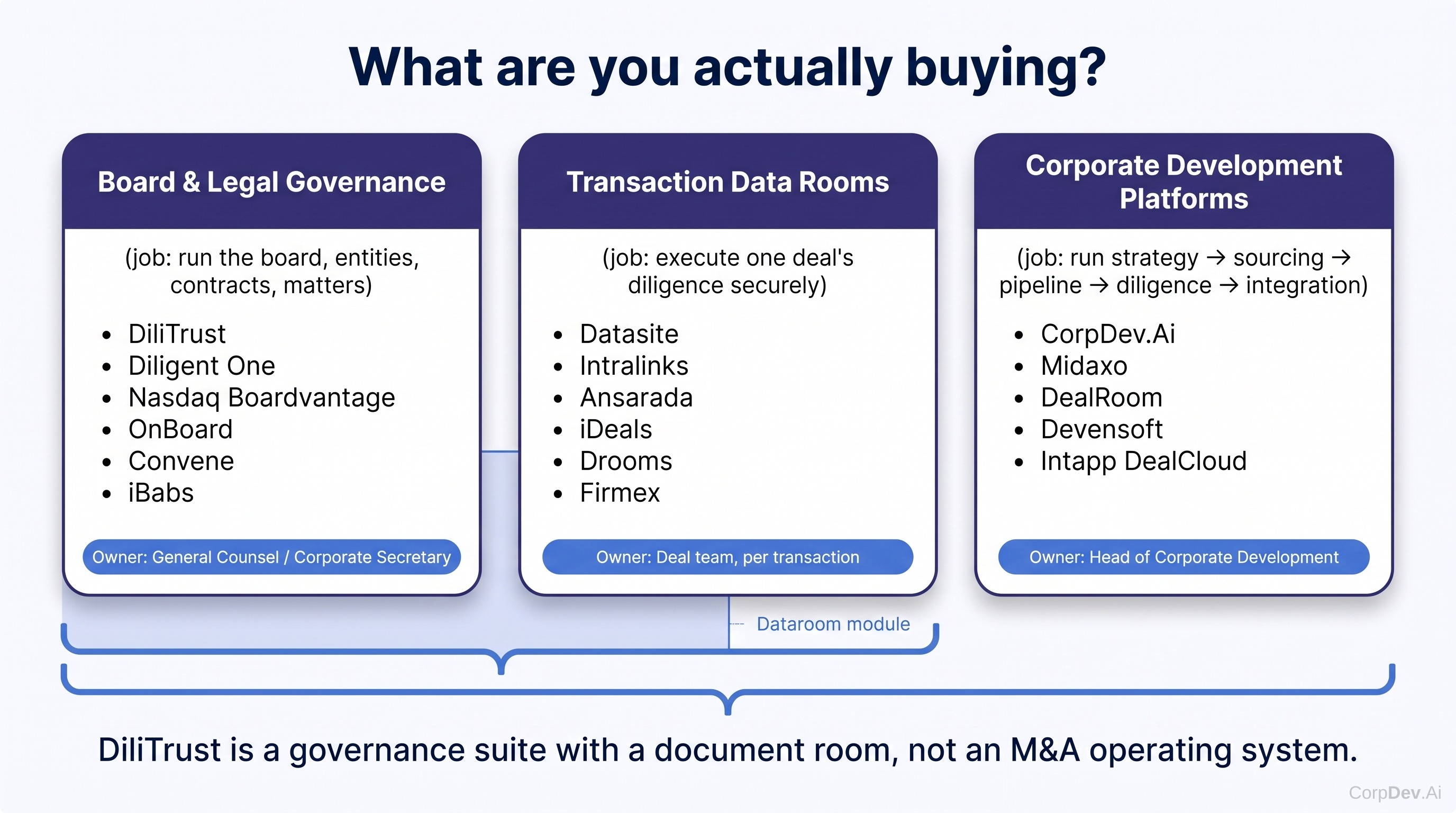
Read diagram description
Comparison titled "What are you actually buying?".
Column 1 "Board & Legal Governance" (job: run the board, entities, contracts, matters) lists DiliTrust, Diligent One, Nasdaq Boardvantage, OnBoard, Convene, iBabs; owner tag "General Counsel / Corporate Secretary".
Column 2 "Transaction Data Rooms" (job: execute one deal's diligence securely) lists Datasite, Intralinks, Ansarada, iDeals, Drooms, Firmex; owner tag "Deal team, per transaction".
Column 3 "Corporate Development Platforms" (job: run strategy → sourcing → pipeline → diligence → integration) lists CorpDev.Ai, Midaxo, DealRoom, Devensoft, Intapp DealCloud; owner tag "Head of Corporate Development". Beneath, a bracket showing DiliTrust's footprint spans all of column 1 and a limited part of column 2 ("Dataroom module") but none of column 3. "DiliTrust is a governance suite with a document room, not an M&A operating system."
1. Framing the Decision: What Are You Actually Buying?
Vendor websites in this space use overlapping vocabulary — "governance", "due diligence", "data room", "deal management", "AI" — to describe products that sit at different points of the corporate life-cycle and are bought by different executives. A CorpDev or strategy professional evaluating DiliTrust therefore needs to separate three distinct jobs-to-be-done before comparing feature lists.
Job 1 — Run the board and the legal function. Board packs, committee agendas, minutes, resolutions, director questionnaires, subsidiary and entity records, director mandates, contract repositories, litigation matters and outside-counsel spend. The buyer is the General Counsel or Corporate Secretary; the users are directors, in-house lawyers and paralegals. Success is measured in compliance, auditability and time saved in legal administration. This is DiliTrust's home ground, and Diligent's.
Job 2 — Execute a transaction securely. For the duration of one deal, a controlled environment where bidders or a buyer's advisers access thousands of documents, ask questions through a structured Q&A workflow, and leave an audit trail. The buyer is the deal lead or the sell-side banker; the users are dozens of external counterparties. Success is measured in process speed, information control and bidder engagement analytics. This is the domain of Datasite, Intralinks, Ansarada, iDeals and Drooms — and it is bought per project as often as by subscription.
Job 3 — Run corporate development as a repeatable program. Strategy formulation, market mapping, target sourcing and screening, pipeline and relationship management, business-case and investment-memo production, valuation, diligence coordination and post-merger integration. The buyer is the Head of Corporate Development or Strategy; the team is typically small — one to five people — and dependent on external advisers for analytical capacity. Success is measured in pipeline quality, decision speed and realized deal value. This is where Midaxo, DealRoom, Devensoft, DealCloud and CorpDev.Ai compete.
The reader is a CorpDev, strategy or M&A professional at a mid-to-large corporate, evaluating what the deal team itself should buy. Where the decision belongs to the General Counsel (board portal, CLM, entity management), this article describes the market so the CorpDev team can contribute intelligently to a shared decision, but does not attempt a full legal-operations vendor selection.
The three jobs intersect. A corporate-development team needs entity data (Job 1) when structuring a carve-out, needs a VDR (Job 2) when running diligence, and produces the board approval memo (Job 3) that is ultimately distributed through the board portal (Job 1). Vendors exploit these intersections to position upward — Diligent has launched a data room, DiliTrust markets its Dataroom module for due diligence, and DealRoom sells its diligence room as a VDR substitute [128]. The buyer's discipline is to weigh each product against the job it was built for, and to treat adjacent modules as conveniences rather than replacements.
2. Dilitrust: Profile and Assessment
Company Background
DiliTrust is a Paris-founded legal-technology company that has repositioned itself over the past five years from a board-portal and secure-document vendor into an "AI-native platform for legal" serving General Counsel, corporate secretaries and boards [11]. Its reference customers are predominantly large French and Southern European corporates — Accor, BNP Paribas, LVMH, Renault, Sodexo, Carrefour, Danone, Veolia, Lavazza, Webuild — with growing presence in DACH and North America through acquisitions [15].
Ownership has been reset around a sponsor consortium. In 2025–2026 Cathay Capital, Eurazeo and Sagard NewGen committed more than €130 million to become the company's core shareholders alongside management, with prior investor Calcium Capital exiting; Eurazeo's disclosed portion was €52 million [1][2][3]. The capital has underwritten an acquisitive strategy: doeLEGAL (US enterprise legal management, e-billing and matter management, 2024), Aster (meeting management, 2024/25) and PACTA (German contract lifecycle management, 2025), described by the company as its fourth major acquisition in two years [8][9][22][24].
Scale is only partially disclosed. The last company-reported revenue figure is close to €20 million for 2021; third-party databases estimate roughly $30 million currently, and headcount is estimated at 300–350 in 2025–2026 [3][4][7]. Apps Run The World puts the customer base at approximately 2,400 organizations and around 120,000 cloud subscribers — directional third-party figures rather than audited disclosures [6].
Category: Legal operations and corporate governance suite
Modules: Board Portal, Entity Management, Contract Lifecycle Management, Matter Management, Dataroom
AI: Lini — proprietary, embedded across modules; summarisation, clause extraction, contract risk review, minutes generation [18]
Security: ISO 27001, SOC 2 Type II; European hosting and "sovereign AI" positioning [15]
Buyer: General Counsel, Corporate Secretary, Board
Not a deal-sourcing tool: no target database, market mapping or screening
Not a pipeline/CRM: no deal stages, relationship capture or email/calendar sync for origination
Not a transaction VDR: Dataroom lacks bidder analytics, structured Q&A workflows and per-deal commercial terms
Not an analytical engine: no valuation, memo generation, synergy modelling or PMI planning
Not a research tool: AI operates on documents you upload, not on external market data
Product Assessment
Board Portal. The most mature module and the one reviewers praise most consistently — fast meeting set-up, reuse of prior agendas, drag-and-drop document ordering, reliable director access and automatic minutes [27][28]. For a CorpDev team the relevance is indirect: this is where the investment memo and board approval deck finally land, so integration with the team's authoring tools (Office export, PDF fidelity) matters more than portal features.
Entity Management. Centralised legal-entity records, ownership charts, mandates and compliance calendars [10]. This module is genuinely useful to a deal team during carve-outs, restructurings and post-close legal integration, where entity data is otherwise scattered across the company secretariat. It is a reason to want DiliTrust in the building — but a reason for the General Counsel to buy it, not the deal team.
Contract Lifecycle Management. Strengthened by PACTA, with AI clause extraction and risk flagging [12]. Relevant to CorpDev primarily for change-of-control and assignment-clause review on the acquirer's own contracts, and for building the target's contract inventory into the group repository post-close.
Matter Management. Litigation, arbitration and outside-counsel spend tracking, expanded through doeLEGAL [13][23]. Peripheral to M&A other than as a diligence input on the acquirer's own exposures.
Dataroom. Secure storage and controlled sharing with granular permissions and audit trails [10]. It is positioned as suitable for due diligence and it will serve a small, internal or bilateral process adequately. It does not offer the sell-side toolkit — bidder engagement scoring, staged disclosure, Q&A routing to subject-matter owners, AI redaction at scale, and per-project pricing — that the transaction VDR vendors compete on [56][60][64].
Commercial Terms and Reviews
DiliTrust does not publish enterprise pricing; procurement is quote-based and modular, and independent reviewers repeatedly characterise it as premium-priced, particularly for smaller organisations [19][20][21]. Every subscription includes 24/7 multilingual support, a dedicated account manager and unlimited user training, which partly explains the price point and matters for director adoption [15].
Review evidence is positive but thin: 4.6/5 from 67 Capterra reviews and 4.3/5 from 32 G2 reviews, with roughly 80% recommendation rate [19][21]. Recurring complaints concern latency when loading large documents, e-signature workflow friction, occasional notification failures and authentication friction on poor networks [27][28][30]. None of these are disqualifying; they are the ordinary rough edges of an enterprise SaaS product mid-way through consolidating four acquisitions onto one platform.
The company describes four major acquisitions in roughly two years; the named transactions above are doeLEGAL, Aster and PACTA. Because doeLEGAL is itself a US ELM business, it should not be counted again as a fourth named acquisition. Buyers should verify how fully the acquired products have been integrated. Buyers should ask which modules share a single data model and identity layer today, and which are still separate code bases with a common login. Roadmap commitments should be written into the contract.
Verdict for a CorpDev Buyer
DiliTrust is a credible, well-funded European alternative to Diligent for the governance and legal-operations job, with a defensible data-sovereignty story and a user experience reviewers prefer to the incumbent's. For the corporate-development job it is not a candidate: it does nothing upstream of a signed deal and little downstream beyond storing documents. The right question for a CorpDev professional is not "DiliTrust or a deal platform?" but "if the General Counsel is choosing DiliTrust or Diligent, what does that decision need to accommodate for the deal team?" — chiefly clean Office/PDF hand-off of board materials, entity data access for structuring, and an API or export path so the deal team's own system remains the source of truth for the pipeline.
3. The Alternatives
The alternatives fall into the three categories introduced above. Within each, the vendors are profiled with the same lens: what they are built for, what they cost, where their AI actually adds value, and where they fall short for a corporate-development buyer.
3.1 Board & Entity Governance Platforms
This is the category in which DiliTrust competes directly. The global board-portal market is estimated at roughly $3.3 billion in 2025, growing at about 12% a year, but the figure should be treated as directional because vendors define the category inconsistently [31]. The strategic divide is between governance platforms (Diligent One, and to a lesser degree DiliTrust and Nasdaq) that aim to be the enterprise system of record for governance, risk and compliance, and board-portal specialists (OnBoard, Convene, BoardEffect, iBabs, Govenda) that do meetings well and stop there.
| Vendor | Positioning | Indicative annual cost | Strengths | Limitations for a CorpDev buyer |
|---|---|---|---|---|
| Diligent One / Diligent Boards | Enterprise GRC platform; board portal is ~75% of ARR | $15–30K+ board portal; $30–250K+ with entities, risk, audit, ESG modules [34] | Largest installed base (700K+ directors and executives); ~$582M ARR; Forrester-recognised GRC leader; launched a Data Room in Nov 2025 with AI summaries [32][33][39][128] | Most expensive; implementation-heavy; UX regarded as dated versus newer entrants; quote-only pricing |
| DiliTrust | Unified legal & governance suite, European | Quote-based; premium-priced per reviewers [21] | Five integrated modules; Lini AI; ISO 27001 / SOC 2; European hosting; strong support included | Smaller ecosystem; less GRC depth than Diligent; suite still consolidating acquisitions |
| Nasdaq Boardvantage | Public-company and issuer governance | Quote-only; "one price, no upcharges"; est. $20–40K+ [34][40] | Nasdaq brand credibility; strong questionnaires, evaluations and issuer workflows | Enterprise-oriented; limited transparency; no legal-ops modules |
| OnBoard | Modern mid-market board portal | Est. $6–15K [34][41] | Best-in-class usability; AI Suite (May 2025) with AI Minutes, AI Book, AI Agenda; committees included [42] | Lighter on entity governance and GRC; not a legal suite |
| Convene (Azeus) | International, value-oriented, cloud or on-premise | Per-user; £195–240/user/yr on UK public frameworks; est. ~$400/user/yr [45][46] | Deployment flexibility; Convene AI on AWS Bedrock (v9.0, July 2025); strong outside the US | Less entity-level GRC; pricing varies by geography |
| iBabs (Euronext) | European public-sector and corporate meeting administration | Quote-based [50] | Clean meeting workflow; strong European footprint; Euronext ownership | Meeting-centric; limited AI and GRC breadth |
| BoardEffect, Govenda | Nonprofit, education and small-board specialists | $1.5–12K [34][44][48] | Low cost, fast implementation | Not relevant for large corporate governance |
How to read this category as a CorpDev professional. The deal team rarely owns this decision but is affected by it in three ways. First, the board portal determines how the investment memo and approval deck reach directors — so authoring-tool export fidelity and last-minute update handling matter. Second, entity management is a genuine diligence and integration input; Diligent Entities and DiliTrust Entity Management are the two credible enterprise options. Third, Diligent's Data Room launch signals that governance vendors will increasingly bundle a VDR-like capability [128]; it is adequate for board-level confidential distribution but has not yet displaced dedicated transaction VDRs on sell-side processes.
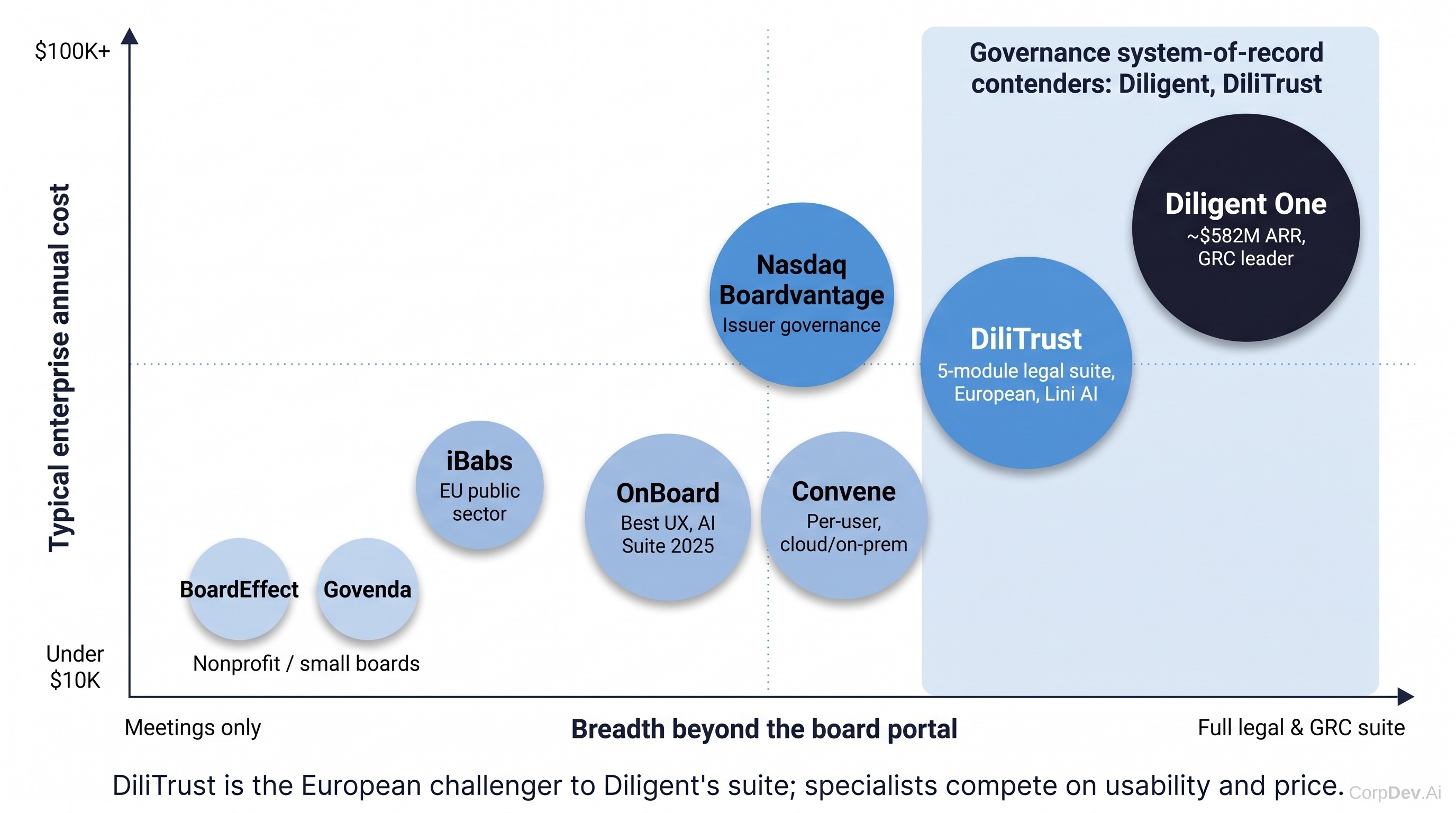
Read diagram description
Positioning comparison. First dimension: "Breadth beyond the board portal" from "Meetings only" to "Full legal & GRC suite". Second dimension: "Typical enterprise annual cost" from "Under $10K" to "$100K+". Vendor positions: Diligent One (top-right, label "~$582M ARR, GRC leader"); DiliTrust (upper-middle right, label "5-module legal suite, European, Lini AI"); Nasdaq Boardvantage (upper-middle, label "Issuer governance"); OnBoard (lower-middle, label "Best UX, AI Suite 2025"); Convene (lower-middle, label "Per-user, cloud/on-prem"); iBabs (lower-left, label "EU public sector"); BoardEffect and Govenda (bottom-left, label "Nonprofit / small boards"). band across the right side labelled "Governance system-of-record contenders: Diligent, DiliTrust". "DiliTrust is the European challenger to Diligent's suite; specialists compete on usability and price."
3.2 Virtual Data Rooms
Transaction VDRs are the category DiliTrust's Dataroom module is most often mistaken for. They are purpose-built for one deal at a time: secure hosting, staged disclosure, bidder tracking, structured Q&A and, increasingly, AI redaction and document analysis. Commercial models vary widely — per page, per project, storage tier or annual subscription — and the model matters as much as the headline price because document-heavy deals can produce large overages under page-based billing [55][61].
| Vendor | Pricing model | Indicative cost | AI capabilities | Best suited to |
|---|---|---|---|---|
| Datasite | Enterprise quote by project, volume or annual term | ~$10–100K+ per year; large deals higher [55] | Strongest all-round: AI redaction, indexing, summarisation, semantic search, translation, Q&A drafting [56][57][59] | Large and cross-border M&A, banker-run auctions, IPO preparation |
| Intralinks (SS&C) | Per-page, volume or annual enterprise | ~$15–150K+; a 50,000-page room ~$20–42K [55][61] | Redaction, search, document intelligence as enterprise add-ons [62][63] | Large-cap strategic M&A, regulated and capital-markets transactions |
| Ansarada | Published storage tiers; preparation free until live | $69/month (50 MB) to $5,134/month (20 GB) on 12-month terms [64][65] | AI redaction, bidder-engagement scoring, deal-readiness guidance [66][67] | Sell-side processes where bidder analytics matter; transparent budgeting |
| iDeals | Per-project or usage plans (Core / Premier / Enterprise) | ~$3–15K per year [55][68] | AI redaction, full-text search, classification [68] | Mid-market M&A and corporate development; fast set-up |
| Drooms | Tiered subscription with free Starter | From ~$55/month [70] | In-house AI document analysis, risk identification, Q&A assistant [72] | European and German data-governance-sensitive deals; real estate |
| Firmex | Single project or annual unlimited subscription | ~$150–625/month; ~$7.8K/yr recurring [74][75] | Limited AI; strong core VDR and support [77][78] | Advisers and lower-middle-market teams running several rooms a year |
| DealRoom | Platform subscription (pipeline + diligence + VDR) | ~$1,000–1,250/month entry; ~$25K/yr platform [80][81] | AI diligence organisation, request-list automation, document tagging | Buy-side teams that want diligence trackers and VDR in one tool |
How to read this category as a CorpDev professional. Two points matter more than vendor choice. First, buy-side and sell-side needs differ: on the buy side, what you need is a diligence tracker (request lists, findings, workstream status) that reads from the seller's room — DealRoom, Midaxo and CorpDev.Ai's AI Room address this; on the sell side you need the seller-grade VDR with bidder analytics — Datasite, Ansarada or Intralinks. Second, the emerging differentiator is not storage but AI comprehension of the room: Datasite, Drooms and Ansarada now summarise, redact and answer questions over the document set, and CorpDev.Ai's AI Room is built around converting the entire room into queryable, citable content for diligence agents [56][72][117]. A team that runs more than two or three diligences a year should test this capability head-to-head rather than assume parity.
The seller chooses the sell-side VDR; the buyer rarely gets a say. What the buyer controls is the analytical layer on top — how quickly the team can turn 20,000 pages into findings, red flags and a synergy view. That layer, not the VDR licence, is where the buy-side CorpDev team should concentrate its budget.
3.3 Corporate Development Deal-Flow & Pipeline Platforms
This is the category a CorpDev buyer should actually be shopping in, and the one DiliTrust does not enter. The market splits into process systems of record (Midaxo, DealRoom, Devensoft, Intapp DealCloud), relationship CRMs built for investors (Affinity, 4Degrees), sourcing databases (Grata and SourceScrub; Cyndx is a historical comparator after its announced wind-down) and, most recently, AI-native analytical platforms (CorpDev.Ai) that attempt to combine research, sourcing, pipeline and deliverable production in one environment.
| Vendor | Center of gravity | Indicative annual cost | AI capabilities | Strengths | Limitations |
|---|---|---|---|---|---|
| Midaxo | End-to-end M&A process management for corporates | Listed from ~$10K; typical $35–80K [82][83] | Workflow acceleration, deal summaries, target prioritisation, PMI assistance [84] | Purpose-built for CorpDev; strong pipeline, diligence and integration structure; 500+ M&A teams claimed; G2 ~4.6–4.7 [89][124] | Quote-based; heavy for occasional acquirers; little native research or sourcing data |
| DealRoom (M&A Science) | Diligence room plus pipeline and integration | ~$1,250/month single project; ~$25K platform [80][90] | Diligence organisation, summarisation, task extraction, playbooks | Accessible; strong request-list and project management; M&A methodology content | Project-centric; reporting requires configuration; no research or sourcing engine |
| Devensoft | Pipeline-to-integration for corporates | ~$150/user/month pipeline; enterprise custom [93][94] | AI summaries, extraction, analytics | Transparent entry pricing; program-level visibility | Small ecosystem; one 2026 comparison assigns ~3.2/5 [96], which should not be treated as an aggregate independent-user rating |
| Intapp DealCloud | Enterprise system of record for PE, IB and sophisticated CorpDev | ~$85K to $1.4M+ [101] | Intapp Assist: summaries, extraction, relationship intelligence, target recommendations [102] | Most configurable; deep origination and relationship workflows; enterprise integrations | Expensive, implementation-heavy; overbuilt for small corporate teams |
| Affinity / 4Degrees | Relationship-intelligence CRM for investors | Affinity $2,000–2,700/user/yr (~$20K minimum); 4Degrees ~$1,200–1,800/user/yr [97][107] | Automatic activity capture, relationship scoring, AI notes | Zero-effort relationship graph from email and calendar | Not built for diligence, approvals or integration |
| Grata / SourceScrub | Private-company sourcing data | Grata ~$15–100K; SourceScrub ~$20–60K [108][113] | Semantic search, similar-company discovery, founder-ownership signals | Excellent target discovery (Grata G2 4.9/5) [112] | Sourcing only; no pipeline, diligence or PMI |
| CorpDev.Ai | AI-native integrated CorpDev environment | Published: $1,000/month (Pro), $3,000/month (Team, 3 seats); Enterprise custom [118] | AI Analyst produces cited research, memos, market maps and decks; semantic sourcing across 70M+ companies; zero-entry CRM from email/calendar; AI Room converts data rooms to queryable content; digital-twin models; multi-model (Claude, GPT, Gemini, Perplexity) [117] | Broadest AI-first scope; transparent pricing; open formats (Markdown, JSON, Office) and REST/MCP access; optional managed services | Young company; no named customer logos or published case studies; brand recognition below incumbents; process-governance depth (approval gates, workstream RACI) less proven than Midaxo |
How to read this category as a CorpDev professional. The incumbents and the entrant are solving different bottlenecks. Midaxo, DealRoom and DealCloud were designed when the constraint on a CorpDev team was coordination — keeping fifty workstreams, hundreds of documents and a dozen stakeholders aligned. Their value is structure, and their AI features are layered onto that structure to speed up summaries and data entry. CorpDev.Ai was designed around a different constraint — analytical capacity — the 1,000–2,000 hours of research, modelling and writing per deal that a team of one to three people cannot supply and typically outsources at $200K–2M per transaction, figures the vendor cites from its own market framing [117]. Its proposition is that an AI analyst with M&A training, a research infrastructure and an authoring environment can produce the memo, the market map and the target screen directly, with the pipeline and CRM as by-products of that work.
The honest trade-off is maturity against leverage. Midaxo has a decade of enterprise deployments and 500+ teams to reference [124]; CorpDev.Ai publishes prices and architecture openly but has not yet published customers. A team whose pain is process discipline across many simultaneous deals should weight Midaxo or DealCloud; a team whose pain is producing decision-quality analysis fast with a thin bench should weight CorpDev.Ai and validate the output quality in a live trial on a real target.
The distinction between legal and board governance and M&A management is useful; a division between managing the programme and performing its analysis is less useful. CorpDev.Ai combines those roles. The comparison below identifies where specialist products can contribute without assigning CorpDev.Ai to a small-team or pre-signing role.
| Requirement | Evaluation approach | Decision implication |
|---|---|---|
| Legal and board governance | Compare DiliTrust and Diligent on entity records, board administration, legal workflows and formal approvals. Use the actual transaction or institutional mandate. | Retain a specialist for its demonstrated contribution; its strength in this job does not establish overall M&A superiority. |
| End-to-end M&A management | Evaluate CorpDev.Ai, Midaxo and DealRoom on the connected path from thesis and target evaluation through diligence, decisions, execution and integration. | Include CorpDev.Ai as a primary-platform candidate. Product categories and the number of deals are not substitutes for a workflow demonstration. |
| Analytical execution and deliverables | Ask each finalist to analyse the same evidence and produce a decision-ready recommendation, supporting materials and an integration response. Record human corrections and remaining manual work. | CorpDev.Ai's combination of management and work-producing agents is particularly relevant when substantial analysis must accompany every deal. Compare the quality and completeness of the outputs. |
| Large or frequent acquisition programmes | Use concurrent evaluations and integrations, shared business-unit resources and recurring leadership reporting in the pilot. Test permission boundaries and ownership changes. | Programme scale strengthens the case for evaluating integrated management and analytical capacity together; it does not automatically favour Midaxo or DealRoom. |
| Existing systems and total cost | Price the required participants, AI usage, data entitlements, implementation, ongoing reconciliation and exit. Compare both replacement and coexistence. | Keep a second platform where a specific control or operating requirement justifies it. Avoid turning a small standard plan into an unsupported Enterprise cost estimate. |
4. Head-to-Head Comparison
The matrix below scores the shortlisted vendors against the capabilities a corporate-development team actually exercises across a deal cycle. Scores are qualitative — Strong means the capability is core to the product and evidenced in independent reviews or published documentation; Partial means present but secondary or lightly evidenced; None means absent by design. Diligent is included as the governance incumbent, Datasite as the VDR benchmark, Midaxo as the incumbent CorpDev process system and CorpDev.Ai as the AI-native entrant.
Capability Matrix
| Capability | DiliTrust | Diligent One | Datasite | Midaxo | DealRoom | CorpDev.Ai |
|---|---|---|---|---|---|---|
| Board meetings, minutes, resolutions | Strong | Strong | None | None | None | None |
| Legal entity management | Strong | Strong | None | None | None | None |
| Contract lifecycle management | Strong | Partial | None | None | None | None |
| Strategy & market research | None | None | None | Partial | None | Strong |
| Target sourcing & screening | None | None | None | Partial | None | Strong |
| Deal pipeline / CRM | None | None | None | Strong | Strong | Strong |
| Relationship capture (email/calendar) | None | None | None | Partial | None | Strong |
| Investment memo & deck generation | None | None | None | None | None | Strong |
| Valuation & financial modelling | None | None | None | Partial | None | Partial |
| Sell-side transaction VDR | Partial | Partial | Strong | None | Partial | None |
| Buy-side diligence tracker | None | None | Partial | Strong | Strong | Partial |
| AI comprehension of data room | Partial | Partial | Strong | Partial | Partial | Strong |
| Post-merger integration planning | None | None | None | Strong | Strong | End-to-end management and integration work; validate programme controls |
| Open data formats / API access | Partial | Partial | Partial | Partial | Partial | Strong |
Sources: vendor documentation and independent reviews cited in Section 3 [11][56][80][89][117][128]. "Partial" for CorpDev.Ai on valuation reflects a live Excel workbook and modelling agent that is newer and less independently reviewed than its research and authoring capabilities.
Pricing and Deployment Models
| Dimension | DiliTrust | Diligent One | Datasite | Midaxo | CorpDev.Ai |
|---|---|---|---|---|---|
| Pricing transparency | Quote-only | Quote-only | Quote-only | Listed entry (~$10K), quote above | Published list prices |
| Commercial model | Modular subscription | Modular subscription | Per project / volume / annual | Annual subscription by seats and modules | Per-seat subscription; annual or monthly |
| Indicative annual cost | Premium, undisclosed [21] | $15–30K portal; $30–250K+ suite [34] | $10–100K+ [55] | $35–80K [83] | $12K (1 seat) – $36K (3 seats); Enterprise custom [118] |
| Time to value | Weeks to months (multi-module) | Months (enterprise GRC) | Days (per room) | Weeks (process configuration) | Days (self-serve, 5-minute setup claimed) [117] |
| Services included | 24/7 support, account manager, unlimited training [15] | Implementation typically separate | Deal-support team | Onboarding and CSM | Onboarding; optional managed M&A services |
The pricing asymmetry is instructive. DiliTrust, Diligent and Datasite are sold as enterprise procurements, where price discovery happens in a sales cycle and the buyer's leverage comes from competitive tension. Midaxo sits in between. CorpDev.Ai is the only vendor in the set that publishes a full price list, which makes it easy to trial but also means there is less room for negotiation on small deployments; the Enterprise tier is where custom terms apply.
AI: Marketing Versus Mechanism
Every vendor in this comparison now describes itself as AI-powered. The substance differs materially, and a buyer should classify each vendor's AI by what it operates on and what it produces.
- AI over the vendor's own documents — DiliTrust's Lini, Diligent One's assistants, OnBoard's AI Minutes and Convene AI summarise, extract clauses, draft minutes and answer questions about content already inside the platform [18][42][45]. Valuable for legal administration; irrelevant to sourcing or analysis.
- AI over a transaction data room — Datasite, Drooms and Ansarada redact, index, summarise and answer questions across a deal's document set [56][66][72]. CorpDev.Ai's AI Room performs the same function with vision-based ingestion and page-level citations, and adds multi-agent diligence on top [117]. This is the layer where independent benchmarking is most lacking and most needed.
- AI over process — Midaxo, DealRoom and Intapp Assist accelerate data entry, summarise deals, recommend next steps and draft communications inside a structured workflow [84][102].
- AI over the outside world — only CorpDev.Ai, and the sourcing specialists Grata and SourceScrub, apply AI to external market and company data: semantic target search, market mapping, competitor research and fully cited deliverables drawn from filings, news, company websites and databases [110][117]. This is the category that substitutes for external analyst hours rather than for administrative hours.
Time-savings and accuracy figures in this space — Drooms' "up to 50%" diligence acceleration, CorpDev.Ai's "100× faster, at 1% the cost", Diligent's "AI-powered GRC" — are vendor statements without independent validation [72][117]. The only reliable test is a structured pilot: the same target, the same data pack, the same brief, run through two or three shortlisted tools by your own team, with output judged by the person who would otherwise have written it.
Security, Residency and Governance
DiliTrust (ISO 27001, SOC 2 Type II, European hosting), Diligent and Datasite all carry the certifications large enterprises require, and DiliTrust's "sovereign AI" positioning is a genuine differentiator for European buyers whose legal departments will not permit US-hosted models to process board or contract data [15]. The CorpDev platforms are less uniformly documented. Midaxo and DealCloud have enterprise security programs; CorpDev.Ai describes isolated workspaces, enterprise security and a multi-model architecture routing work to Anthropic, OpenAI, Google and Perplexity models [117] — a buyer should obtain the data-processing terms for each underlying model provider, confirm whether customer data is used for training, and specify residency in the Enterprise contract. For any vendor whose AI reads a data room, the contractual questions are the same: where is the extracted text stored, who can query it, how is it deleted at deal end, and does the audit trail satisfy the seller's NDA.
| Vendor | Relevant lifecycle scope | Limit or qualification |
|---|---|---|
| DiliTrust | Dataroom module in diligence; board portal at approval | Does not constitute a complete M&A operating system. |
| Diligent One | Board approval and document workflows; entity-management role during integration | Entity governance is narrower than operational PMI and synergy tracking. |
| Datasite | Transaction diligence and disclosure | Suite sourcing, pipeline and AI extensions require separate entitlement evaluation. |
| Midaxo | Pipeline through diligence, approval and integration; partial sourcing | Purpose-built process/governance, with analysis features varying by product. |
| DealRoom | Pipeline, diligence and integration | Depth depends on package and implementation. |
| CorpDev.Ai | Strategy/maps, sourcing/screens, CRM, AI Room and memos/board materials | Valuation is lighter and Enterprise-dependent; integration includes programme work, milestones, synergy analysis and reporting; validate the required operating controls. |
Programme-scope assessment. The CorpDev.Ai integration entry describes its end-to-end management scope rather than assigning an unsupported comparative performance score. Evaluate the required controls and the quality of completed work on the same acquisition programme as other finalists. Deal frequency and public review volume do not establish a functional ranking. See the lifecycle framework and integration capabilities; these are vendor materials, not independent benchmarks.
Six stages frame the comparison: strategy/market map; sourcing/screening; pipeline/relationships; diligence/data room; valuation, memo and board approval; integration/value tracking. Governance suites intersect the deal at controlled records and board approval; lifecycle platforms manage more of the recurring process.
5. Buyer Scenarios: Which Tool Fits Which Team
The right answer depends on who is buying, how many deals the team runs, and where its time actually goes. Five scenarios cover most corporate situations.
Situation: A European or multinational group replacing a legacy board portal and consolidating entity and contract data.
Shortlist: DiliTrust, Diligent One, Nasdaq Boardvantage.
Lean: DiliTrust for European groups prioritising data sovereignty, a unified legal suite and included support; Diligent for groups that also want risk, audit and ESG in the same system and can absorb the cost and implementation load.
CorpDev's stake: Insist on clean Office/PDF hand-off from the deal team's authoring tools and on entity-data access for carve-outs and integration.
Situation: Divesting a business unit through a banker-run auction with 10–30 bidders.
Shortlist: Datasite, Intralinks, Ansarada.
Lean: Datasite for large cross-border processes; Ansarada where bidder analytics and transparent storage-tier pricing matter; Intralinks where the bank or counterparties mandate it.
Do not use: DiliTrust Dataroom or a governance-suite data room. They lack bidder tracking, staged disclosure and Q&A routing at auction scale.
Situation: 5–15 transactions a year, dedicated integration office, multiple parallel workstreams and a governance-heavy approval process.
Shortlist: CorpDev.Ai, Midaxo, Intapp DealCloud and DealRoom, assessed on the complete programme.
Evaluate: CorpDev.Ai, Midaxo and DealRoom for end-to-end M&A management. CorpDev.Ai combines the management process with analytical execution and deliverable production, a strong fit for large programmes. DealCloud merits evaluation for specific enterprise relationship requirements; add a data source or specialist tool where the pilot establishes a need.
Situation: One to four people covering strategy, market mapping, sourcing, business cases and board memos, historically buying analyst hours from consultants and bankers.
Shortlist: CorpDev.Ai, DealRoom, Midaxo.
Lean: CorpDev.Ai — the published $12–36K price is a fraction of one consulting engagement, and its output is the deliverable itself rather than a tracker of who is producing it [118]. Validate with a live pilot on a real target; confirm Enterprise-tier security terms before loading confidential data.
Situation: One or two deals over several years; no standing CorpDev function.
Shortlist: DealRoom single-project, iDeals or Firmex for the room, CorpDev.Ai Pro seat for analysis.
Lean: Rent, do not build. Per-project VDR plus a single AI analyst seat for the duration of the deal costs less than the first invoice from an adviser, and avoids a multi-year platform commitment the organisation will not maintain.
The Two-Layer Stack
Across scenarios A, C and D the recurring pattern is a two-layer architecture: a governance and legal system of record owned by the General Counsel (DiliTrust or Diligent), and a corporate-development workbench owned by the deal team (CorpDev.Ai, Midaxo or DealRoom), with a transaction VDR rented per deal on the sell side. The layers meet at two hand-offs — entity data flowing into structuring and integration, and the approved investment memo flowing into the board pack — and both hand-offs should be specified in the procurement of either system. Attempting to collapse the stack into a single vendor forces one function to work in a tool built for the other, and it is the CorpDev team, with less procurement weight than Legal, that usually ends up compromised.
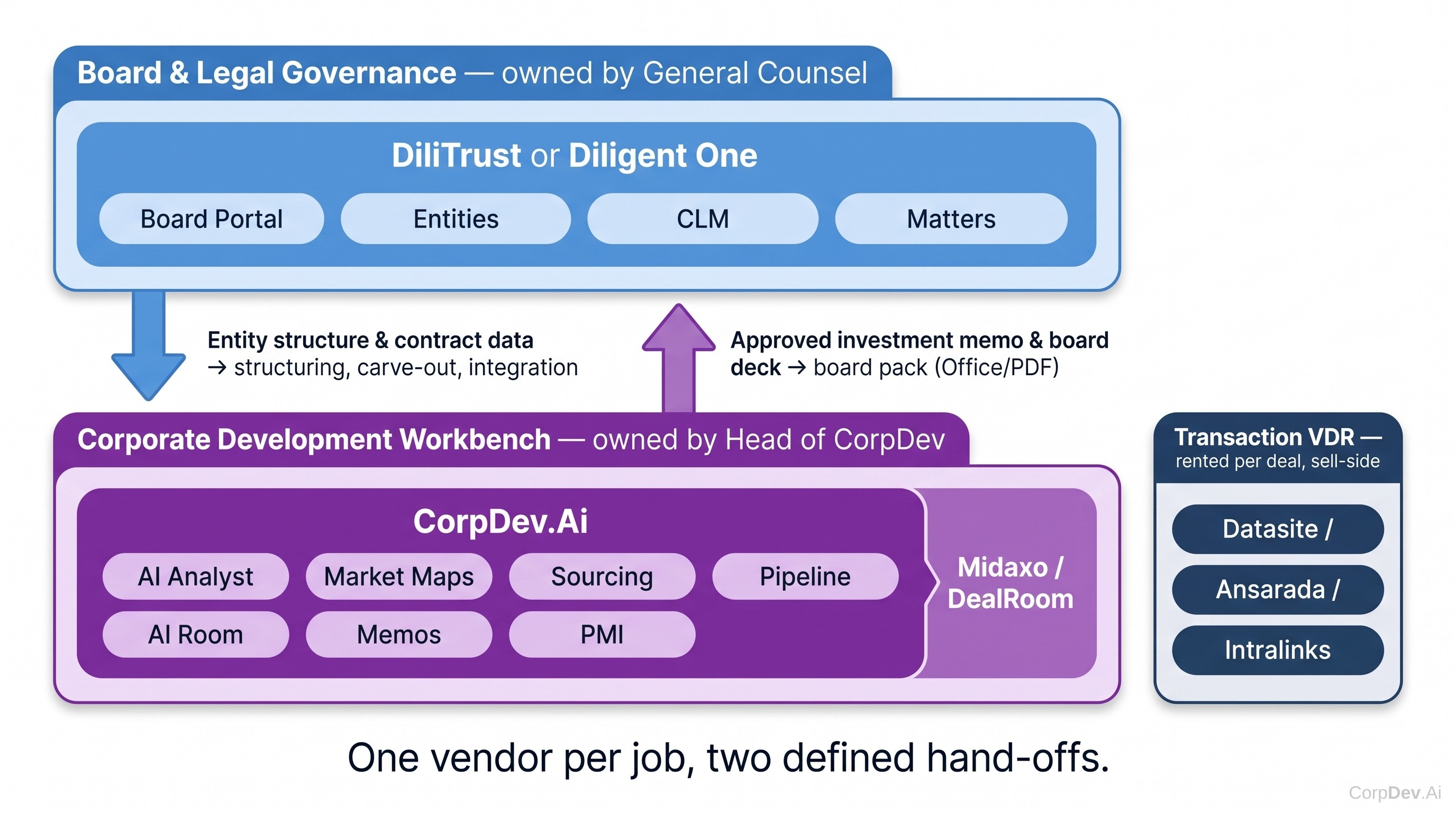
Read diagram description
Layered architecture diagram. Top layer labelled "Board & Legal Governance — owned by General Counsel" containing DiliTrust or Diligent One with sub-boxes Board Portal, Entities, CLM, Matters. Bottom layer labelled "Corporate Development Workbench — owned by Head of CorpDev" containing CorpDev.Ai (AI Analyst, Market Maps, Sourcing, Pipeline, AI Room, Memos, PMI) with Midaxo / DealRoom as alternatives. The transaction infrastructure is "Transaction VDR — rented per deal, sell-side" containing Datasite / Ansarada / Intralinks. Two handoffs connect the layers: "Approved investment memo & board deck → board pack (Office/PDF)" and "Entity structure & contract data → structuring, carve-out, integration". "One vendor per job, two defined hand-offs."
6. Evaluation Checklist and Procurement Advice
Feature demonstrations in this category are polished and largely interchangeable. The questions below are the ones that separate vendors in practice, grouped by the job being bought.
If the job is governance (DiliTrust, Diligent, Nasdaq)
- Which modules share one data model and one identity layer today, versus separate acquired code bases behind a common login? Ask for the architecture, not the roadmap.
- Where is data hosted, where do AI models run, and is any customer content used for model training? For European boards this is frequently the deciding criterion.
- What is the fully loaded three-year cost including implementation, migration of historical board records, additional entities and premium support? Quote-only vendors should be pushed to itemise.
- How do board materials arrive from the deal team's tools — native Office upload with version replacement, or PDF flattening that breaks late edits?
- Export rights at termination: can the entity register, contract repository and board archive be exported in open formats without professional-services fees?
If the job is a transaction VDR (Datasite, Intralinks, Ansarada, iDeals, Drooms)
- Which pricing model applies, and what are the page, storage and duration assumptions? Obtain overage terms in writing; a document-heavy room under per-page billing can double its budget [61].
- Does Q&A route questions to internal subject-matter owners with SLAs, and can answers be published selectively by bidder group?
- What does AI redaction actually cover — PII, named entities, custom patterns — and how is quality checked?
- Post-close: how long does the archive persist, in what format, and at what cost?
If the job is corporate development (CorpDev.Ai, Midaxo, DealRoom, DealCloud)
- Run a paid or free pilot on a live target, not a vendor demo. Give each shortlisted tool the same brief — market map, target screen of 50 companies, one-page profile, a first-draft investment thesis — and have the person who would otherwise write it grade the output for accuracy, citation quality and how much editing it needs.
- Test zero-entry claims by connecting a real mailbox and calendar for two weeks and checking what the pipeline captured, what it enriched correctly and what it hallucinated.
- For AI over data rooms, load a prior deal's actual data pack and ask the questions your diligence team asked at the time; compare the answers and their citations to what the team found manually [117].
- Confirm data ownership and portability: can pipeline, company records and deliverables be exported in open formats (Markdown, Excel, PowerPoint, JSON) at any time? Platforms that store work in proprietary structures create switching costs that outlast the contract.
- For process systems, check approval gates, RACI on workstreams, audit trail on decisions and integration with the ERP or finance systems used for synergy tracking.
- Ask each vendor for three reference customers of similar size and deal cadence. An established vendor should produce them within days; a young vendor may not have them, in which case weight the pilot results more heavily and negotiate Enterprise-tier terms that reflect the reference gap.
- Confirm the security posture per model provider where the platform routes work to multiple foundation models — data-processing agreements, retention, and whether zero-data-retention endpoints are used.
The governance decision (Job 1) is typically on a five-to-seven-year cycle and led by Legal. The CorpDev platform decision (Job 3) can be made in weeks on a one-year term. Do not let the former hold the latter hostage: specify the two hand-offs (entity data out, board memo in) as requirements in the governance RFP, and let the deal team choose its own workbench on its own timetable.
Negotiation Notes
- DiliTrust and Diligent compete for the same European enterprise accounts; running them in parallel is the single most effective lever on price and included services. DiliTrust's bundled 24/7 support and unlimited training are worth pricing explicitly against Diligent's service line-items [15].
- Datasite and Intralinks discount for annual multi-room commitments; a corporate that expects two or more processes a year should price a subscription against per-project quotes.
- Midaxo and DealCloud are seat- and module-priced; scope the minimum viable module set for year one and negotiate expansion pricing upfront.
- CorpDev.Ai publishes list prices, so the negotiation is on the Enterprise tier — SSO, security terms, managed services, unlimited members — and on pilot terms. A published price also makes it a useful benchmark in negotiations with quote-only CorpDev vendors.
7. Conclusion
DiliTrust is a good product aimed at a different buyer than the one reading this article. As a European, sponsor-backed legal-governance suite with an embedded AI assistant, strong security credentials and a service model that includes support and training, it is a legitimate challenger to Diligent for the General Counsel's system of record, and a corporate-development team should welcome its presence in the building for the entity data and the board-pack channel it provides. It is not, and does not claim to be, a tool for finding targets, running a pipeline, writing an investment case or planning an integration.
For the corporate-development job the shortlist is Midaxo, DealRoom and DealCloud on the process side and CorpDev.Ai on the analytical side, with Grata or SourceScrub as sourcing supplements and a transaction VDR rented per deal. The choice between the process incumbents and the AI-native entrant turns on which constraint binds the team: coordination across many parallel deals favours Midaxo or DealCloud; analytical capacity on a thin bench favours CorpDev.Ai, whose published pricing and open architecture lower the cost of finding out, but whose enterprise track record is still being built and should be tested in a live pilot rather than assumed.
The most valuable thing a CorpDev professional can do in this procurement is refuse the false choice. Buy the governance platform for governance, rent the data room for the deal, and equip the deal team with the workbench built for its own work — then specify the two hand-offs between them so that the memo reaches the board and the entity data reaches the integration plan without anyone re-keying either.
Key Facts & Sources
The load-bearing figures in this article, with source and as-of date. Ranges attributed to independent comparison sites are market estimates, not vendor list prices, and should be re-quoted at procurement.
| Figure | Value | Basis / source | As of |
|---|---|---|---|
| DiliTrust sponsor investment | > €130M (Cathay Capital, Eurazeo, Sagard NewGen); Eurazeo portion €52M | Company and Eurazeo announcements [1][2][3] | Dec 2025 – Jul 2026 |
| DiliTrust last disclosed revenue | ~€20M turnover (2021); ~$31.5M third-party estimate | Company release; ZoomInfo estimate [3][4] | 2021 / 2024 |
| DiliTrust headcount | ~300–350 | Tracxn (352, Jun 2026); Apps Run The World [6][7] | 2025–2026 |
| DiliTrust customers | ~2,400 organisations; ~120,000 cloud subscribers | Apps Run The World, third-party estimate [6] | Jul 2025 |
| DiliTrust review scores | Capterra 4.6/5 (67 reviews); G2 4.3/5 (32 reviews) | Capterra, G2 [19][21] | Sep 2026 |
| DiliTrust acquisitions | doeLEGAL (2024), Aster (2024/25), PACTA (2025) | Company, Sagard, Cathay releases [8][9][22][24] | 2024–2025 |
| Diligent ARR | ~$582M | Bloor Research profile [33] | Oct 2024 |
| Diligent user base | 700,000+ board members and senior leaders | Reuters [32] | Nov 2024 |
| Board-portal market size | ~$3.29B (2025), ~12% CAGR | Research and Markets — directional only [31] | 2025 |
| Enterprise board portal cost | $15–30K+ (Diligent); $20–40K+ (Nasdaq); $6–15K (OnBoard) | Independent comparison estimates [34] | Mar 2026 |
| Datasite cost range | ~$10–100K+ per year | Independent VDR comparison [55] | Aug 2026 |
| Intralinks per-page example | 50,000-page room ≈ $20–42.5K | Independent VDR comparisons [55][61] | Apr–Aug 2026 |
| Ansarada pricing | $69/month (50 MB) to $5,134/month (20 GB), 12-month term | Vendor pricing page [64][65] | May 2026 |
| Midaxo cost | Listed from ~$10K/yr; typical $35–80K/yr | Software Advice listing; RFP.wiki buyer estimates [82][83] | Jul 2026 |
| Midaxo funding and traction | ~$21–23M raised incl. $16M Series B (2018); 500+ M&A teams claimed | PR Newswire, Tracxn, vendor site [85][88][124] | 2018 / 2026 |
| DealRoom cost | ~$1,250/month single project; ~$25K/yr platform | TrustRadius; independent comparison [80][90] | 2024–2026 |
| Intapp DealCloud cost | ~$85K to $1.4M+ per year | RFP.wiki contract benchmarks [101] | 2026 |
| Affinity pricing | $2,000–2,700/user/yr; ~$20K minimum | Vendor pricing page [97] | 2026 |
| CorpDev.Ai pricing | $1,000/month Pro (annual); $3,000/month Team, 3 seats; Enterprise custom | Vendor pricing page [118] | Sep 2026 |
| CorpDev.Ai data coverage | 70M+ companies; 265M+ contacts | Vendor site [117] | Sep 2026 |
| CorpDev.Ai deal-economics framing | 1,000–2,000 analyst hours and $200K–2M outside spend per deal; 70–75% of deals fail to create value | Vendor site, citing its own market framing — not independently verified here [117] | Sep 2026 |
| Diligent Data Room launch | November 2025 | Diligent newsroom [128] | Nov 2025 |
Notes on source quality. Company announcements and vendor pricing pages are treated as authoritative for their own facts. Third-party revenue, headcount and customer estimates (ZoomInfo, Tracxn, Apps Run The World) are directional. Independent comparison sites (appdeck, RFP.wiki, ctacquisitions, TrustRadius) provide the only public price benchmarks for quote-only vendors and are used for ranges, not point estimates. The board-portal market-size figure comes from a research aggregator and is included for scale only. CorpDev.Ai publishes this article and is one of the vendors compared; its profile relies on published materials and no customer references were available to verify traction claims, which is stated as a limitation in the body.
References
Numbering follows the original research. Access dates below record the original source registry; they do not imply that every source was rechecked for this website edition.
- Cathay Capital, Eurazeo and Sagard Newgen investing in ...Source accessed 2026-09-11
- ACCORD D’EXCLUSIVITÉ EN VUE D’UN INVESTISSEMENT AU CAPITAL DE DILITRUSTSource accessed 2026-09-11
- DiliTrust Continues to Grow with €130 Million InvestmentSource accessed 2026-09-11
- DiliTrust - Overview, News & Similar companies | ZoomInfo.comSource accessed 2026-09-11
- DiliTrust Named Top-Tier Software Vendor by APPS RUN THE ...Source accessed 2026-09-11
- DiliTrust - 2026 Company Profile & TeamSource accessed 2026-09-11
- DiliTrust Expands with Acquisition of doeLEGALSource accessed 2026-09-11
- DiliTrust Solidifies European Legaltech Leadership with ...Source accessed 2026-09-11
- AI-powered Corporate Governance Software and Legal ...Source accessed 2026-09-11
- DiliTrust Suite | The AI-Native Platform for LegalSource accessed 2026-09-11
- Contract Lifecycle Management Software for Legal Teams - DilitrustSource accessed 2026-09-11
- Legal Solutions That Adapt to Your IndustrySource accessed 2026-09-11
- Dilitrust: AI-powered Corporate Governance Software and Legal ...Source accessed 2026-09-11
- DiliTrust's AISource accessed 2026-09-11
- DiliTrust Reviews 2026: Details, Pricing, & FeaturesSource accessed 2026-09-11
- DiliTrust Software Pricing, Alternatives & More 2026Source accessed 2026-09-11
- DiliTrust Reviews 2026. Verified Reviews, Pros & ConsSource accessed 2026-09-11
- DiliTrust renforce son empreinte dans le secteur de la LegalTech avec l'acquisition de l'entreprise américaine doeLEGALSource accessed 2026-09-11
- DiliTrust Empowers In-House Legal Teams with Secure AI- ...Source accessed 2026-09-11
- DiliTrust & PACTA Join ForcesSource accessed 2026-09-11
- Avaliações de Software e Serviços Empresariais | G2Source accessed 2026-09-11
- DiliTrust - Avis, notes, prix et abonnementsSource accessed 2026-09-11
- DiliTrust Price, Features, Reviews & Ratings - Capterra IndiaSource accessed 2026-09-11
- Companies MentionedSource accessed 2026-09-11
- Private-equity owners of Diligent explore $7-billion sale of software ...Source accessed 2026-09-11
- Company profile for: Diligent on Bloor ResearchSource accessed 2026-09-11
- Best Board Portal Software 2026: 12 Compared + Real PricingSource accessed 2026-09-11
- Board management software solutions from DiligentSource accessed 2026-09-11
- Boardvantage Pricing | One Price, No Upcharges - NasdaqSource accessed 2026-09-11
- Board Portal Pricing ...Source accessed 2026-09-11
- Board & Committee Meetings | Board Portal SoftwareSource accessed 2026-09-11
- 10 best board management software tools for 2026 - Guideflow BlogSource accessed 2026-09-11
- Convene AI Information Page | Board Portal SoftwareSource accessed 2026-09-11
- Azeus ConveneSource accessed 2026-09-11
- PricingSource accessed 2026-09-11
- iBabs - Simple pricing, easy to use productsSource accessed 2026-09-11
- Best Virtual Data Rooms for M&A in 2026: The 10 VDRs Compared ...Source accessed 2026-09-11
- How To Utilize AI In M&A Data Rooms - DatasiteSource accessed 2026-09-11
- Sell-Side Data Rooms For Due Diligence - DatasiteSource accessed 2026-09-11
- Virtual Data Rooms For M&A Deal Preparation - DatasiteSource accessed 2026-09-11
- Top Virtual Data Rooms 2026: A Practitioner's ComparisonSource accessed 2026-09-11
- 9 Best Virtual Data Rooms for Investment Banking in 2026Source accessed 2026-09-11
- Virtual Data Rooms (VDR) | Intralinks VDRProSource accessed 2026-09-11
- AI Redaction Services & Software Document Tools | IntralinksSource accessed 2026-09-11
- Ansarada virtual data room pricing: plans, costs and ...Source accessed 2026-09-11
- Pricing PlansSource accessed 2026-09-11
- Ansarada - AI-Powered Virtual Data Rooms & Dealmaking ToolsSource accessed 2026-09-11
- M&A Advisory Software For Professional Deal Guidance - AnsaradaSource accessed 2026-09-11
- Plans - Ideals Virtual Data Room PricingSource accessed 2026-09-11
- Drooms Hub Pricing | Virtual Data Room PlansSource accessed 2026-09-11
- Drooms Hub | AI-Powered Virtual Data Room PlatformSource accessed 2026-09-11
- PricingSource accessed 2026-09-11
- 10 best virtual data room software tools for 2026 - guideflow.comSource accessed 2026-09-11
- I Compared 15 M&A Due Diligence Software Tools in 2026 ...Source accessed 2026-09-11
- Best Data Room For Startups - DataRoomPro.orgSource accessed 2026-09-11
- Best Virtual Data Room Service Providers of 2026 – ComparisonSource accessed 2026-09-11
- Dealroom Pricing: Costs, Comparisons & Value in 2026Source accessed 2026-09-11
- Midaxo Software Reviews, Demo & Pricing - 2026Source accessed 2026-09-11
- Midaxo - Reviews - End-to-End M&A Process SoftwareSource accessed 2026-09-11
- AI for M&A (2026): Complete Tool Landscape and Vendor ...Source accessed 2026-09-11
- Midaxo Raises $16 Million in Series B Funding to ...Source accessed 2026-09-11
- Midaxo - 2026 Company Profile, Team, Funding & CompetitorsSource accessed 2026-09-11
- Midaxo Reviews 2026: Details, Pricing, & FeaturesSource accessed 2026-09-11
- DealRoom Reviews & Ratings 2026 - TrustRadiusSource accessed 2026-09-11
- Devensoft Reviews & Ratings 2025Source accessed 2026-09-11
- Devensoft vs DealRoom M&A Platform (2026): Scores, Reviews & VerdictSource accessed 2026-09-11
- Devensoft · Rating Snapshot: Score & Reviews (2026)Source accessed 2026-09-11
- Affinity Pricing: Plans for Private Capital CRMSource accessed 2026-09-11
- Summit Partners vs Intapp Deal Cloud (2026) - RFP.wikiSource accessed 2026-09-11
- Intapp Assist for DealCloudSource accessed 2026-09-11
- 4Degrees CRM Review 2026: Is It Worth It for Small VC ...Source accessed 2026-09-11
- Grata Pricing, Reviews, Pros and Cons (2026)Source accessed 2026-09-11
- How Grata's AI & Data Science Engine Cultivates Investment-Grade ...Source accessed 2026-09-11
- Grata Reviews 2026: Details, Pricing, & Features - G2Source accessed 2026-09-11
- SourceScrub Pricing, Reviews, Pros & Cons (2026)Source accessed 2026-09-11
- CorpDev.Ai - Agentic AI for M&ASource accessed 2026-09-11
- PricingSource accessed 2026-09-11
- M&A Intelligence Platform | Midaxo M&A SoftwareSource accessed 2026-09-11
- Diligent Launches Virtual Data RoomSource accessed 2026-09-11