RESEARCH / Legal AI and contract review
eBrevia Alternatives: Contract Review, Legal AI and M&A Tools
Compare eBrevia with Kira, Luminance, Harvey, VDR AI and CorpDev.Ai on contract extraction, legal review, integrations, pricing and buyer scenarios.
Research as of
Website edition edited
Published by CorpDev.Ai, which is one of the vendors assessed. This analysis distinguishes vendor claims, external evidence and analyst judgments. Prices and capabilities reflect the source dates in the article; the website edition is an editorial adaptation, not a new verification of every claim.
Buy a repeatable legal evidence pipeline, not just faster extraction
eBrevia’s value depends on whether a team can turn a large contract population into a consistent, reviewable evidence set. Detecting a clause is an intermediate result. The acquisition decision may depend on its exceptions, counterparties, economic exposure and relationship to the rest of the agreement. A specialist extraction engine earns its place when the surrounding review process preserves that context and routes uncertain findings to the right expert.
This makes the ownership of the workflow as important as model capability. Counsel may already provide the specialist layer; a buyer may instead need cross-document commercial synthesis or better coordination of findings. Adding another legal AI licence without agreeing responsibilities and output formats can duplicate review while leaving the deal team to reconcile competing schedules.
Test known provisions and difficult exceptions from a completed transaction. Measure missed material terms, false-positive review time and the ability to reproduce each conclusion from the original agreement. Then follow accepted findings into the diligence report and transaction decisions. Those results establish whether eBrevia replaces manual review, complements an existing room assistant or duplicates counsel’s tooling.
Executive Summary
A corporate development, strategy or M&A professional asking "should I buy Ebrevia?" is usually asking the wrong question first. Ebrevia is a contract-intelligence engine: it reads large sets of agreements, extracts clauses, dates and obligations, compares provisions against a standard, and now answers natural-language questions over the corpus and redlines in Word [5][2][6]. It is excellent at that job. But it is one layer in a deal-technology stack that in 2026 has at least four distinct layers — the data room, the contract-review engine, the legal-grade generative AI workspace, and the corporate-development operating platform — and the vendors in each layer are converging on one another's territory. The right purchase depends on which layer is your actual bottleneck.
30–90%
Ebrevia's claimed review-time reduction (vendor)
86%
Corporate & PE leaders with GenAI in M&A workflows (Deloitte, 2025)
$15.5B
Harvey valuation, Sept 2026 — the capital pouring into legal AI
$12K–$300K+
Annual price range across the tools compared here
Five conclusions a buyer should take from this comparison:
Ebrevia is a strong, focused contract-review specialist that is now founder-owned and investing again. Co-founders Adam Nguyen and Jake Mundt reacquired the company from Donnelley Financial Solutions (DFIN) in December 2023 [1][4]; since then it has shipped Lens (generative Q&A across contract sets, March 2025), Connect (2,000+ system integrations, May 2025) and DraftPro with Enterprise Playbooks (June 2026) [2][8][7]. It retains its integration with DFIN's Venue data room and adds SharePoint, Box, iManage and Salesforce connectors [10]. For a legal team or a deal team reviewing hundreds of customer contracts, leases or supplier agreements, it belongs on the shortlist alongside Kira (Litera) and Luminance.
Ebrevia's weakest point is not the technology — it is evidence and transparency. It publishes no precision/recall methodology, its G2 footprint is seven reviews (4.6/5), and it lists no prices; third-party indicative figures range from roughly $10,000 per 1,000 documents to $1,000 per user per month, which use different billing units and cannot be directly compared without contract scope [5][14][11][12]. Every claim in its category should be tested in a proof of concept on your own contracts.
The category is being squeezed from both sides. Data rooms (Datasite, Intralinks, Ansarada) have embedded AI Q&A, summarisation, redaction and clause-flagging directly in the room [97][104][111], and legal-grade generative platforms (Harvey, Legora, CoCounsel) now integrate directly with data rooms and generate diligence reports rather than extraction grids [67][86][75]. Harvey's September 2026 raise at $15.5 billion and Legora's $5.55 billion Series D signal where capital expects the value to accrue [69][88]. A standalone extractor must justify itself against "good enough" AI already bundled in the room and "much broader" AI in the legal workspace.
CorpDev.Ai is not an Ebrevia substitute and should not be evaluated as one — it competes for a different budget line. CorpDev.Ai is an agentic research-and-deliverables platform for the corporate development function: market maps, target sourcing across 70M+ companies, company profiles, investment memos, a zero-entry pipeline CRM, and an AI-native data room with due-diligence agents [132][134]. It replaces analyst hours and consulting spend upstream and downstream of legal diligence, at published prices of $12,000–$36,000 per year. For clause-by-clause contract extraction it has no published benchmark and should not be bought for that purpose; for the 1,000–2,000 hours of strategic analysis per deal that no contract tool touches, Ebrevia is irrelevant. The honest framing is complementary, not competitive.
The defensible 2026 architecture for a corporate buyer is a three-layer stack, not a single tool. A data room with native AI for secure discovery and Q&A; a specialist contract engine (Ebrevia, Kira or Luminance) or a legal-AI workspace (Harvey, Legora) for legal extraction where volume justifies it; and a corporate-development platform (CorpDev.Ai, Midaxo, DealRoom) as the system of record for strategy, pipeline, diligence coordination and integration. Buyers with fewer than three or four deals a year should lean on the data room's bundled AI and their law firm's tooling rather than licensing a contract engine directly.
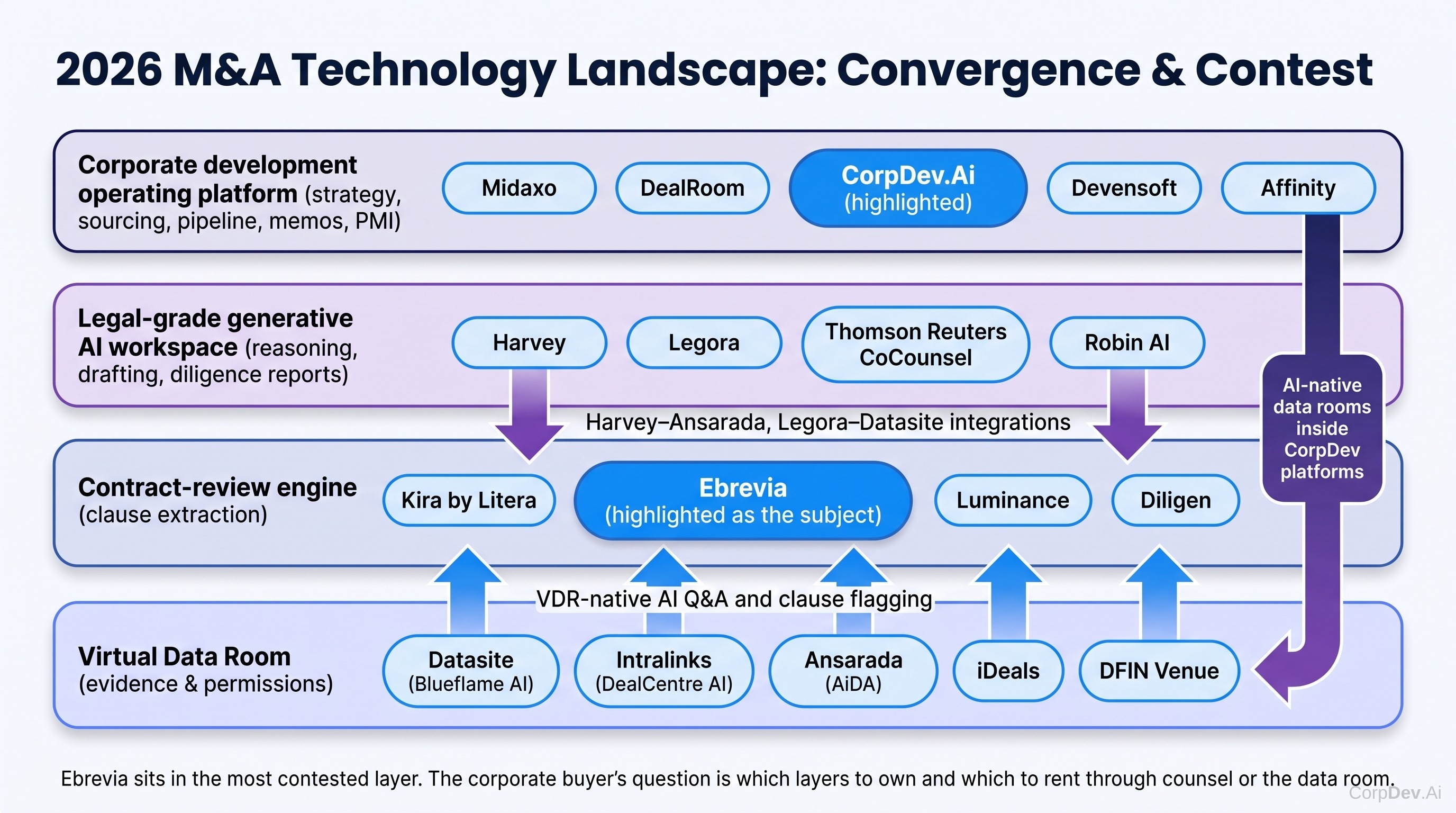
Read diagram description
A four-layer analysis of the 2026 M&A technology landscape, layers in dependency order: Layer 1 "Virtual Data Room (evidence & permissions)": Datasite (Blueflame AI), Intralinks (DealCentre AI), Ansarada (AiDA), iDeals, DFIN Venue. Layer 2 "Contract-review engine (clause extraction)": Ebrevia, Kira by Litera, Luminance, Diligen. Layer 3 "Legal-grade generative AI workspace (reasoning, drafting, diligence reports)": Harvey, Legora, Thomson Reuters CoCounsel, Robin AI. Layer 4 "Corporate development operating platform (strategy, sourcing, pipeline, memos, PMI)": CorpDev.Ai, Midaxo, DealRoom, Devensoft, Affinity. Convergence pressures: downward connections from Layer 3 into Layer 2 labelled "Harvey–Ansarada, Legora–Datasite integrations"; upward connections from Layer 1 into Layer 2 labelled "VDR-native AI Q&A and clause flagging"; a side arrow from Layer 4 down to Layer 1 labelled "AI-native data rooms inside CorpDev platforms". "Ebrevia sits in the most contested layer. The corporate buyer's question is which layers to own and which to rent through counsel or the data room."
Why This Comparison Matters: The Deal-Technology Stack in 2026
Three forces make 2026 an unusually consequential moment to choose deal tooling.
Adoption has crossed from experiment to expectation. Deloitte's survey of 1,000 senior corporate and private-equity leaders (H1 2025) found that 86% had integrated generative AI into their M&A workflows, 65% within the preceding year, and 83% had invested at least $1 million specifically for M&A teams; due diligence was one of the three leading use cases at 35% of adopters, alongside strategy/market assessment (40%) and target screening (35%) [198]. Bain's practitioner survey puts current GenAI use for M&A at 21%, up from 16% in 2023 — a more conservative measure of routine use [205]. Among M&A lawyers, Litera found 81% planned to use GenAI in their practice within one to two years and 91% expected AI document-review tools to become standard in most diligence processes [201][206]. The board question has shifted from "should we use AI in deals?" to "which tools, and who owns them?"
The vendor landscape is consolidating around platforms and capital. Gartner forecasts the global legal-technology market at $50 billion by 2027, with generative AI as the principal driver [195]. The earlier consolidation wave was strategic — Litera bought Kira in 2021, DFIN bought Ebrevia in 2018 for roughly $19.5 million plus up to $4 million contingent [211][193] — and it has partly unwound: DFIN sold Ebrevia back to its founders in Q4 2023 [213][1]. The current wave is capital-led: Harvey raised $550 million at $15.5 billion in September 2026, Legora $550 million at $5.55 billion in March 2026 (extended to $600 million at $5.6 billion in April), and Luminance $75 million in February 2025 [216][87][217][218]. These platforms are buying distribution and integrations that point tools cannot match; the pattern in every prior enterprise-software cycle is that standalone features get absorbed into platforms.
Buyer concerns have matured and are measurable. The leading barrier to AI investment among professionals is lack of demonstrable accuracy (50%), followed by lack of demonstrable security (42%) [208]; in M&A specifically, 67% cite data security and 65% data quality as leading concerns [198]. Thomson Reuters finds 96% of professionals require AI to safeguard confidential data, 94% require grounding in authoritative content and 90% require reasoning that can be explained [209]. Yet only 20% know their organisations are measuring GenAI return on investment [196]. A procurement process that tests accuracy on the buyer's own documents, checks security architecture, and defines an ROI metric up front is now the minimum standard — and it is the lens applied throughout this document.
What a corporate development buyer actually needs
The needs of an in-house corporate development or strategy team differ materially from those of the law firms that have historically been the core customers of contract-review AI:
A law firm runs diligence on dozens of deals a year and can amortise a six-figure licence across matters. A corporate team runs two to ten deals a year; contract volume is lumpy, and the tool sits idle between transactions. Per-document or per-project pricing matters more than seat pricing.
Legal contract review is typically outsourced to counsel. The in-house team's own hours go to strategy, market mapping, target screening, the business case, the investment memo, board materials and integration planning — an estimated 1,000–2,000 hours of analysis per deal that no contract engine addresses.
The corporate team needs continuity across deals: a pipeline, a knowledge base on markets and targets, and diligence findings that carry into integration. A tool that produces an extraction grid per matter and forgets it delivers less value to this buyer than to a firm billing by the matter.
This distinction drives the structure of the rest of the comparison. Ebrevia and its direct peers are assessed on the job they were built for; the corporate-development platforms are assessed on the job the in-house buyer actually has; and the buyer's guide brings the two together.
Ebrevia: What It Is and Where It Fits
Company and ownership
Ebrevia was founded in 2011 by Adam Nguyen (a former Paul, Weiss associate) and Jake Mundt (a Columbia NLP researcher) to cut the cost of M&A due-diligence document review, with technology developed in partnership with Columbia University [1]. DFIN acquired it in December 2018 for approximately $19.5 million in cash plus up to $4 million in contingent consideration and integrated it with the Venue data room [3]. In December 2023 the founders reacquired the company; DFIN's 2023 annual report records the disposition closing 1 December 2023, and its Q1 2026 investor presentation lists Ebrevia among businesses sold in Q4 2023 [4][213][1]. Ebrevia today is an independent, founder-led company with clients in the US, UK/Europe and Asia, naming Baker McKenzie, Norton Rose Fulbright, McDermott Will & Emery, Kroll, SAP, Intel, PwC, EY, KPMG and MUFG among its customers [1][6].
Several 2026 third-party directories still describe Ebrevia as DFIN-owned. It is not. The correct description for a vendor assessment is "formerly DFIN-owned (2018–2023); founder-controlled since December 2023; retains Venue integration." The buyer should ask directly about capitalisation, headcount and runway, since founder buy-backs are typically financed conservatively and the company has not disclosed external funding since the reacquisition.
The product suite
Contract Analyzer — the core engine. Extracts clauses, dates, parties, obligations, rights and restrictions across large contract sets using 700+ pre-trained fields plus custom-trained provisions; groups related documents; compares provisions side by side; links every result to source text; and exports structured summaries to Word, Excel or downstream systems [5]. Advertised outcome: 30–90% reduction in review time [5].
Ebrevia Lens (March 2025) — generative-AI natural-language Q&A across one document, a contract set or thousands of agreements, without training a model or providing example documents; answers are grounded in and linked to the documents [2]. This is Ebrevia's answer to the "ask the data room a question" capability that VDR vendors and legal-AI platforms now offer.
DraftPro (2025; Enterprise Playbooks June 2026) — a Microsoft Word add-in that checks agreements against a playbook, flags deviations, assesses risk and inserts preferred or fallback language; starter playbooks cover NDAs, MSAs and data-privacy agreements [7][6].
Ebrevia Connect (May 2025) — integration layer claiming support for 2,000+ business applications, including iManage, Salesforce, Microsoft Office, HighQ, SharePoint, Box and cloud storage, for moving documents in and extracted data out [8][20].
Legal Advisory — services for use-case selection, secure deployment architecture, pilot design and governance [6].
Deployment and security — cloud and on-premises options; SOC 1 and SOC 2 Type II; encryption in transit and at rest; SSO and role-based access [18][5][17]. Claimed support for 37 languages [6].
Data-room integration — native integration with DFIN Venue dating from the DFIN era, plus "other VDRs" via import [10][3]. Venue itself adds smart redaction, auto-indexing, AI summaries and translation across 130+ languages [123].
Where it is strong
Ebrevia's strengths cluster around structured, repeatable, high-volume review where the output must be auditable. The source-linked extraction grid, configurable fields, reviewer assignment and QA workflow are built for a team of reviewers working through a population of agreements against a defined template — exactly the change-of-control, assignment, exclusivity, termination and indemnity sweep that sits at the heart of buy-side legal diligence [9][5]. Customer testimony emphasises deadline compression ("the number of otherwise impossible deadlines we have been able to meet") and consistency across jurisdictions on international deals [6]. Its time-to-value proposition — train users in a day, configure playbooks in a week, scale in 30 days, without a CLM migration — is credible for a tool with a decade of production history [6]. And the Lens–Connect–DraftPro additions since 2024 show a founder-led company shipping at a pace that was not evident in the DFIN years.
Where a buyer should push
- No published precision/recall, F1 or benchmark-corpus methodology behind the 30–90% speed and "10–60% more accurate" claims; these derive from DFIN-era case studies [5][13]
- G2: 4.6/5 from seven reviews, several dating to 2021–2022; Capterra: zero reviews [14][12]
- Reviewers explicitly note accuracy "not 100%" and a UI that takes time to learn [14]
- No published pricing; enterprise quote only [5]
- Third-party indicative figures use incompatible units and dates: ~$10,000 per 1,000 documents / $62,000 per 10,000 (Lex Mundi, historical) versus $1,000 per user per month (Capterra directory) [11][12]
- Buyers must pin down document allowances, overage, module fees (Lens, DraftPro, Connect), model training and renewal escalators
Two structural questions matter more than either of those for the corporate buyer. First, who operates the tool? In most corporate transactions outside counsel runs the legal review; if the firm already licenses Kira, Luminance or Harvey, a corporate Ebrevia licence duplicates capability that is billed through fees anyway. The strongest corporate case for Ebrevia is a team that reviews contract populations outside of deals — leases, customer agreements, supplier repapering, post-close contract migration — and can keep the licence busy year-round. Second, how does Ebrevia's output flow into the deal? Its exports are strong, but it is not a diligence-management system: request lists, workstream tracking, findings-to-integration handoff and the investment memo all live elsewhere.
Ebrevia's economics improve sharply when a corporate legal or commercial team uses it for portfolio work between deals — lease abstraction, tariff or regulatory exposure sweeps via Lens, NDA redlining via DraftPro — and then turns the same licence on the target's contracts when a transaction arrives. A purely episodic deal-only buyer will struggle to justify an enterprise licence over the data room's bundled AI and counsel's tooling.
The Alternative Landscape
Category 1: AI Contract Review and Diligence Tools
These are Ebrevia's direct competitors: engines whose primary job is to read a population of agreements and return structured, source-linked findings.
Owner: Litera (Hg majority; Insight Partners minority) [28]
What it is: The market-reference extraction engine. Hybrid proprietary/GenAI model trained on 1M+ contracts; 1,400+ smart fields across 40+ legal areas; review grids and Smart Summaries [31][32]
Claims: "90%+ consistent accuracy" (vendor); a 2026 comparator test reported 94% vs 85% for lawyers — vendor-adjacent, not audited [31][35]
Integrations: Strongest VDR story in the category — direct Intralinks connector, plus iManage, NetDocuments, HighQ, Datasite [36][37]
Price: Quote-based; ~$45K–$200K+/yr, large firms $300K+ (third-party estimates) [29][30]
Reviews: ~4.3/5, 10 G2 reviews [39]
Owner: Independent; $75M Series C Feb 2025 led by Point72; ~$165M total raised [49][218]
What it is: Broad document triage, classification, anomaly detection, contract comparison and multilingual review; used in 50 countries [43]
Claims: No audited universal figure; third-party assessments place standard-clause extraction ~85–95%, weaker on bespoke agreements; proprietary 180,000-point benchmark claims +5% over general models [44][45]
Integrations: HighQ, Box, Dropbox, Intralinks, Ansarada, iManage, NetDocuments, SharePoint (verify native vs API) [46][48]
Price: Quote-based; ~$100K–$300K first-year for substantial deployments [41][42]
Reviews: ~4.6/5, ~32 G2 reviews [52]
Owner: Acquired by Kira in 2021; now inside Litera [54]
What it is: User-trainable clause recognition, 150+ common clauses, automated summaries; accessible for smaller teams [57][59]
Claims: No published independent benchmark
Integrations: NetDocuments, Box; iManage and VDR via API [57][58]
Price: Listed tiers ~$350–$1,600/month (~$4,200–$19,200/yr); M&A deployments ~$10K–$30K/yr (estimates) [55][56]
Reviews: Thin and low-confidence [60]
Strategic note: Overlaps Kira inside the same owner; roadmap priority is uncertain
How Ebrevia compares within this category. Ebrevia and Kira are the two mature, enterprise-grade extractors; Kira has the larger field library (1,400+ vs 700+), the deeper VDR connector set and the distribution of Litera's transaction-management suite, while Ebrevia has on-premises deployment, Word-based drafting (DraftPro) and an integration layer (Connect) that Kira lacks as a standalone [31][5][8]. Luminance is the better choice when the data room is heterogeneous — mixed document types, multiple languages, unknown unknowns — rather than a defined contract population. Diligen is the budget entry point but sits awkwardly inside Litera next to Kira. None of the four publishes an audited precision/recall study; all should be bake-off tested on the buyer's own agreements.
Every vendor in this category faces the same squeeze — data rooms bundling "good enough" AI Q&A and clause flagging below them, and $5–15 billion legal-AI platforms integrating directly with data rooms above them. Kira has Litera's platform as shelter; Luminance has fresh capital; Ebrevia, founder-owned since 2023, has neither at scale. A buyer signing a multi-year Ebrevia agreement should secure roadmap commitments, data-export rights and a change-of-control clause.
Category 2: Data-Room-Native AI
For a corporate buyer the most important alternative to licensing a contract engine is often not buying one — because the data room the seller or the buyer already pays for has embedded AI that may cover part of the use case; no measured 60–70% coverage benchmark is established here.
| Provider | AI capabilities relevant to buy-side review | Pricing model | G2 rating (reviews) |
|---|---|---|---|
| Datasite (Blueflame / Datasite Intelligence) | Semantic search over permitted content; natural-language Q&A with source citations; bulk processing of question lists; gap analysis; AI redaction across 120+ PII types incl. images [97][98] | Quote; historically per-page, est. ~$0.40–$0.60+/page [99][100] | 4.4 (423) [103] |
| SS&C Intralinks (DealCentre AI / Link) | Document summaries, key-clause and risk identification, AI redaction (80+ PII elements, 50+ languages), translation, Ask Link Q&A, Smart Q&A drafting [104][105][106] | Quote only [108] | 3.8 (31) [109] |
| Ansarada (AiDA) | Ask AiDA Q&A and summaries, AI-Sort classification, AI-Translate, AI-Redact, AI-Predict bidder engagement; unlimited prompts on Premium [111][112] | Published storage tiers: from $69/mo (50 MB) to $5,134/mo (20 GB) on 12-month terms; free to prepare [111][113] | 4.5 (238) [114] |
| iDeals | AI redaction, OCR/full-text search, Q&A management, DD checklists; less generative review depth publicly documented [116][117] | Transparent storage-based; Core / Premier / Enterprise [118] | 4.7 (861) [119] |
| DFIN Venue (+ Ebrevia) | Smart redaction, auto-indexing, AI summaries, translation 130+ languages; Ebrevia integration for structured extraction [123][3] | Quote only [124] | 4.5 (26) [126] |
The trade-off in one sentence: VDR-native AI knows the transaction workspace — permissions, folders, Q&A history, bidder behaviour — and is excellent at retrieval, summarisation, redaction and grounded Q&A; a standalone engine is better at legal classification — configurable provisions, exception review, agreement comparison, review grids and defensible structured output [97][5]. Datasite's Blueflame will answer "which customer contracts contain change-of-control provisions?" with citations; Ebrevia or Kira will produce the reviewed, QA'd, exportable schedule of every such provision with the deviation from standard flagged.
The strategic development to watch is that the convergence is now running in both directions. Ansarada integrated Harvey (April 2026) and Datasite integrated Legora (September 2026), so a deal team can run a full data-room analysis from inside the legal-AI workspace [67][86]; meanwhile Kira and Luminance pull directly from Intralinks, Datasite and Ansarada [36][46]. The data room is becoming the substrate that every AI layer plugs into, and DFIN's Venue–Ebrevia pairing — once a differentiator — is now one option among several.
On a buy-side deal the seller usually picks the room. Kira integrates natively with Intralinks and Datasite; Legora with Datasite; Harvey with Ansarada; Ebrevia with Venue. A corporate buyer standardising on one contract engine should confirm import paths from all five major rooms — bulk export-and-upload is always possible but breaks permissions, versioning and audit trail.
Category 3: Legal-Grade Generative AI Platforms
These platforms do not compete with Ebrevia on extraction grids; they compete on the whole legal workflow — reading the data room, reasoning across documents, drafting the diligence report, tracking issues and redlining the SPA — and they are being funded at a scale that will reshape the category.
Capital: $550M at $15.5B (Sept 2026), after $200M at $11B (Mar 2026) and $8B (Dec 2025) [69][70][215]
Diligence fit: Agentic document analysis, diligence-report generation, issue tracking, drafting; Legal Agent Bench extended to M&A diligence (Jul 2026); Ansarada integration (Apr 2026) [66][67]
Customers: Am Law / global firms, Big Four, PE, large corporate legal
Price: Enterprise; reports of ~$1,200/user/month and $50K–$100K+ for small deployments, six to seven figures firm-wide [62][63][64]
Caveat: Time-saving claims (50–70%) are workflow claims, not accuracy metrics; attorney verification required [65]
Capital: $550M Series D at $5.55B led by Accel (Mar 2026); extended to $600M / $5.6B (Apr 2026) [87][88][217]
Diligence fit: Collaborative workspace with tabular review, agentic workflows, Word integration; M&A product reviews thousands of data-room documents, flags red flags and missing documents; Datasite integration (Sept 2026) [84][86]
Customers: Large firms, expanding to US and corporate legal
Price: ~$3,000/user/yr with 10-seat minimum (~$30K entry); $5K–$8K/user/yr at scale (third-party) [82][83]
Owner: Thomson Reuters (Casetext acquired 2023 for $650M) [73]
Diligence fit: Tabular Analysis claims up to 63% review-time reduction across up to 10,000 documents; grounding in Westlaw / Practical Law; deep Microsoft 365, SharePoint, iManage, NetDocuments, HighQ integration [75][77][78]
Best for: Teams already inside the TR ecosystem; less specialised for clause-level extraction
Price: Bundled with Westlaw / enterprise TR contracts; ~$639/user/month reported for a solo research+AI bundle [74]
Owner: Independent; ~$44–50M raised (GV, Temasek); built on Anthropic Claude [93]
Diligence fit: Commercial contract review, NDA review, obligation intelligence; documented M&A use case but less VDR integration depth [94]
Best for: In-house legal and corp-dev teams with a continuous NDA / commercial-contract flow — the closest overlap with Ebrevia's DraftPro
Price: ~$5K–$80K/yr; AWS Marketplace illustrates ~$100K platform + $2,500/user (private offer) [38][91]
Reviews: ~4.6/5, 18 G2 reviews [92]
Implications for an Ebrevia buyer. For a corporate team, Harvey and Legora are generally more than the team can absorb: they are priced and designed for firms with dozens of lawyers, and their value comes from replacing associate hours across research, drafting and diligence simultaneously. The relevant question for the corporate buyer is instead: does our outside counsel already run one of these? If so, the legal review of the target's contracts will increasingly arrive as a Harvey- or Legora-generated report, and a corporate Ebrevia licence adds a second, partially redundant pass. If counsel does not, and the corporate team wants control of its own contract review, Ebrevia or Kira remain the more focused, more affordable purchase. Robin AI is the one platform in this group that competes directly for a corporate legal budget at Ebrevia's price point — on NDAs and commercial contracts rather than deal diligence.
Category 4: Corporate Development Workflow Platforms
This category answers a different question from the first three. Rather than "how do we read the target's contracts faster?", it asks "how does the corporate development function run — strategy, sourcing, screening, evaluation, approval and integration — and where does the work product live?" Ebrevia does none of this. These platforms do, to varying degrees, and several now include AI over the data room that overlaps with some retrieval and extraction work; the extent is unmeasured here.
This document was prepared on the CorpDev.Ai platform for CorpDev.Ai. CorpDev.Ai is therefore assessed here with the same evidentiary standard applied to every other vendor — published pricing, public product claims, and independent review evidence — and its limitations relative to the contract-review specialists are stated explicitly. Where a claim rests only on the vendor's own website, it is labelled as such.
Focus: Agentic AI analyst and deliverables workbench for the corporate development lifecycle — strategy, market mapping, target sourcing across 70M+ companies, company profiles and fit scoring, investment memos and board decks, zero-entry pipeline CRM (email/calendar sync), monitoring, an AI-native data room with due-diligence agents, digital-twin models of targets, and PMI planning [132][134]
AI: Multi-model orchestration (Anthropic, OpenAI, Perplexity, Google); every research output cited to source; MCP tool integrations to Google, Perplexity, Apollo, LinkedIn, SEC filings, earnings [132]
Price (published): AI Pro $1,000/mo billed annually ($12,000/yr, 1 user); AI Pro Team $3,000/mo ($36,000/yr, 3 users, dedicated CSM); Enterprise custom with SSO, unlimited seats, financial modelling and managed services [134]
Security: SOC 2 Type II, encryption at rest/in transit, no training on customer data (vendor statement) [134]
Ownership: Private, founder-led; no disclosed institutional funding [135]
Reviews: No meaningful public G2 review base [137]
Focus: End-to-end M&A platform — pipeline, diligence, project management, VDR, post-close integration and value tracking; 500+ teams [138][139]
AI: Midaxo AI answers questions over projects and documents with cited sources, summarises deals, flags risks, proposes field updates for approval (2026 releases) [140][141][142]
Price: Quote; entry ~$10K/yr, observed median ~$63K/yr, enterprise $120K+ (third-party) [143][144]
Ownership: Private; ~€16.5M raised 2016–2018 (Idinvest/Eurazeo, Tesi, EOC) [146][147]
Reviews: 4.6/5, ~36 G2 reviews; criticisms: bugs, dense setup, reporting/API limits [149]
Focus: Buyer-led M&A operating system — pipeline, diligence/data room, integration; strong on standardised diligence playbooks [150][151]
AI: Email red-flag capture, key-term extraction, AI document organisation, MCP connector to ChatGPT/Claude/Copilot (2026) [152][153][154]
Price: Deal-volume based, unlimited users; est. ~$12K Pipeline, ~$15K Diligence, ~$25K full platform/yr [156][157]
Reviews: 4.4/5, 91 G2 reviews — largest review base in category [161]
Focus: Enterprise acquisition and integration management — complex multi-workstream deals, divestitures, JVs [163][164]
AI: Less extensive publicly; emphasis on structured workflow, dashboards, Power BI [170]
Price: Pipeline $150/user/mo; end-to-end quote-only, five to six figures [166][167]
Reviews: 4.6/5, 12 G2 reviews [170]
Focus: Relationship-intelligence CRMs for deal sourcing — automatic activity capture, warm-path mapping, pipeline [172][181]
AI: Meeting notes, relationship scoring, AI chat, MCP servers [173][183]
Price: Affinity $2,000–$2,700/user/yr published; 4Degrees ~$4K–$8K/user/yr est. [172][181]
Reviews: Affinity 4.4/5 (~73); 4Degrees 4.5/5 (5) [180][189]
Note: Not diligence or PMI tools; relevant only if sourcing is the bottleneck
How CorpDev.Ai differs from Ebrevia — and from Midaxo and DealRoom. Against Ebrevia the difference is categorical: CorpDev.Ai's due-diligence agents read a data room via vision extraction and retrieval-augmented analysis and produce findings, memos and risk maps — but it publishes no clause-extraction field library, no review-grid workflow and no accuracy benchmark for legal provision extraction, and it should not be bought as a contract engine [132]. Its value lies in the work that surrounds legal diligence: the market and competitor research that frames the thesis, the sourcing and screening that produce the target, the investment memo and board deck that secure approval, and the integration blueprint that delivers the value — work the vendor positions as "consulting-quality, 100× faster, at 1% the cost" (vendor claim, unverified) [132]. Against Midaxo and DealRoom the difference is emphasis: those platforms are process-and-project systems of record with AI added; CorpDev.Ai combines end-to-end management with analytical execution. A team coordinating many workstreams should compare all three on lifecycle controls and the work actually completed: research, diligence conclusions, investment recommendations and integration deliverables. Large programmes make that combination especially relevant. Its published price ($12,000–$36,000 per year) is below the observed median for Midaxo (~$63,000) and comparable to DealRoom's estimated full platform (~$25,000) [134][144][156].
Evidence limits. CorpDev.Ai has no meaningful independent review base and no disclosed customer count, funding or headcount [137][135]. Buyers should request references, test the AI Room's extraction accuracy on their own financial tables and contracts, and treat the "70M+ companies" figure as a database-provider (Apollo) coverage number rather than a proprietary asset [134]. The same discipline applies to Midaxo's "500+ teams" and to every vendor in this document.
Head-to-Head Comparison
The matrix below scores each vendor on the dimensions a corporate development buyer should weigh. Scores are qualitative judgments (1 = weak/absent, 5 = category-leading) synthesised from the evidence cited in the preceding sections; they are not vendor-supplied and should be recalibrated against the buyer's own proof of concept.
| Vendor | Clause extraction & review grid | Natural-language Q&A over documents | Drafting / redlining | VDR integration breadth | Pipeline, sourcing & memo work | Diligence coordination & PMI | Pricing transparency | Independent review evidence |
|---|---|---|---|---|---|---|---|---|
| Ebrevia | 4 | 4 | 4 | 3 | 1 | 1 | 1 | 2 |
| Kira (Litera) | 5 | 3 | 2 | 5 | 1 | 2 | 1 | 2 |
| Luminance | 4 | 4 | 2 | 4 | 1 | 1 | 1 | 3 |
| Harvey | 3 | 5 | 5 | 3 | 1 | 2 | 1 | 1 |
| Legora | 3 | 5 | 4 | 3 | 1 | 2 | 2 | 2 |
| Datasite (Blueflame) | 2 | 4 | 1 | 5 | 1 | 3 | 2 | 5 |
| Intralinks (DealCentre AI) | 3 | 4 | 1 | 5 | 2 | 3 | 1 | 3 |
| CorpDev.Ai | 2 | 4 | 3 | 2 | 5 | End-to-end management and integration work; validate programme controls | 5 | 1 |
| Midaxo | 1 | 3 | 1 | 3 | 3 | 5 | 2 | 4 |
| DealRoom | 2 | 3 | 1 | 4 | 3 | 5 | 3 | 5 |
Programme-scope assessment. The CorpDev.Ai integration entry describes its end-to-end management scope rather than assigning an unsupported comparative performance score. Evaluate the required controls and the quality of completed work on the same acquisition programme as other finalists. Deal frequency and public review volume do not establish a functional ranking. See the lifecycle framework and integration capabilities; these are vendor materials, not independent benchmarks.
Reading the matrix. Three patterns stand out. First, no vendor scores highly on both the legal-extraction columns and the corporate-development columns — the market has not produced a single platform that does both well, which is why the three-layer architecture in the recommendation is not a compromise but the current state of the art. Second, pricing transparency is inversely correlated with legal depth: Ebrevia, Kira, Luminance and Harvey are all quote-only, while CorpDev.Ai, DealRoom and Ansarada publish prices — a corporate buyer with a fixed budget can plan around the latter and must negotiate the former. Third, independent review evidence is thin everywhere in the legal-AI layer: Ebrevia (7 reviews), Kira (10), Harvey (~2) and CorpDev.Ai (none) all fall far short of the data-room vendors (Datasite 423, iDeals 861) [14][39][72][137][103][119]. The buyer is, in effect, the reference customer for most of these tools.
Commercial comparison
| Vendor | Low | High |
|---|---|---|
| CorpDev.Ai (AI Pro → Team, published) | 12 | 36 |
| Diligen (est.) | 10 | 30 |
| DealRoom (est., full platform) | 12 | 25 |
| Robin AI (est.) | 5 | 80 |
| Midaxo (est., observed range) | 35 | 120 |
| Ebrevia (third-party indicative) | 10 | 62 |
| Kira / Litera (est.) | 45 | 300 |
| Luminance (est., first year) | 100 | 300 |
| Legora (est., 10–50 seats) | 30 | 400 |
| Harvey (est., small → firm-wide) | 50 | 500 |
Basis for the chart: CorpDev.Ai from its published price list [134]; Ebrevia from Lex Mundi's historical indicative figures of $10,000 per 1,000 documents and $62,000 per 10,000 [11]; all others from the third-party estimates cited in the category sections [29][41][55][62][82][91][144][156]. Every quote-only figure should be treated as a planning range with substantial, unquantified uncertainty. Note that the Ebrevia range excludes Lens, DraftPro, Connect and model-training fees, which are not publicly priced and could materially change the total.
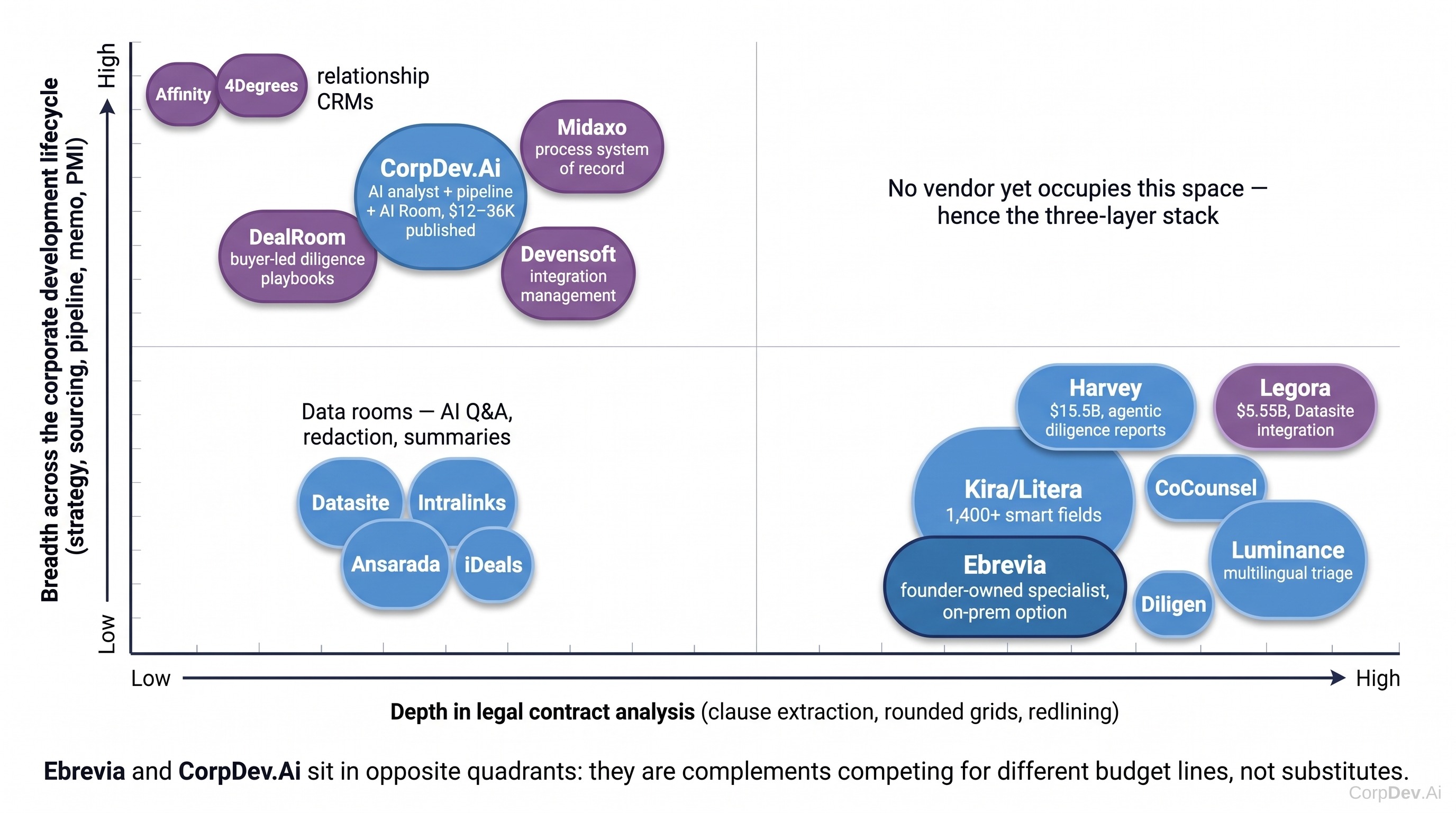
Read diagram description
Positioning comparison. First dimension: "Depth in legal contract analysis (clause extraction, review grids, redlining)" from low to high. Second dimension: "Breadth across the corporate development lifecycle (strategy, sourcing, pipeline, memo, PMI)" from low to high. Bottom-right quadrant (high legal depth, low corp-dev breadth): Ebrevia (labelled "founder-owned specialist, on-prem option"), Kira/Litera (specialist; "1,400+ smart fields"), Luminance ("multilingual triage"), Diligen. Right-middle, slightly higher (high legal depth, some workflow): Harvey ("$15.5B, agentic diligence reports"), Legora ("$5.55B, Datasite integration"), CoCounsel. Bottom-left (low on both, but a foundation layer): Datasite, Intralinks, Ansarada, iDeals labelled "Data rooms — AI Q&A, redaction, summaries". Top-left quadrant (high corp-dev breadth, low legal depth): CorpDev.Ai (mentioned; "AI analyst + pipeline + AI Room, $12–36K published"), Midaxo ("process system of record"), DealRoom ("buyer-led diligence playbooks"), Devensoft ("integration management"). Relationship-CRM category: Affinity, 4Degrees labelled "relationship CRMs". Top-right quadrant is empty and labelled "No vendor yet occupies this space — hence the three-layer stack". "Ebrevia and CorpDev.Ai sit in opposite quadrants: they are complements competing for different budget lines, not substitutes."
Buyer's Guide: Matching the Tool to Your Use Case
The single most useful question a corporate buyer can answer before any demo is: where do our hours and our risk actually sit? The profiles below map the answer to a purchase.
Bottleneck: Analytical capacity in a team of one to three; strategy, screening and memo work done in evenings or bought from advisers.
Do not buy: A contract engine. Your counsel already runs Kira, Harvey or Luminance and bills it through fees; a corporate Ebrevia licence would sit idle 300 days a year.
Consider: A corporate-development platform at the low end — CorpDev.Ai AI Pro ($12,000/yr) or DealRoom Pipeline (~$12,000/yr est.) — to hold the pipeline; evaluate CorpDev.Ai for research and memo production, since DealRoom Pipeline is not described here as an equivalent authoring tool. Rely on the data room's native AI (Datasite Blueflame, Ansarada AiDA) for your own Q&A over the target's documents.
Bottleneck: Consistency and speed across deals; legal wants control of first-pass contract review; integration handoff is lossy.
Consider a two-layer purchase: (1) a process system of record — Midaxo, DealRoom or CorpDev.Ai Team — for pipeline, diligence coordination and PMI; (2) a contract engine if in-house legal will operate it and can also use it for portfolio work between deals. Ebrevia is a strong candidate here if the team values on-premises deployment, Word-based playbook redlining and Connect's push into Salesforce/iManage; Kira if the priority is the deepest field library and native Intralinks/Datasite pulls.
Test before buying: a two-week bake-off of Ebrevia vs Kira on 200 of your own historical target contracts, scored on recall of change-of-control, assignment and exclusivity clauses.
Bottleneck: Everything at once — sourcing volume, diligence throughput, integration tracking, board reporting.
Consider the full three-layer stack: a standardised data room where you control it (Datasite or Intralinks); a legal-AI layer — either a contract engine (Kira or Ebrevia) operated by in-house legal or a Harvey/Legora enterprise licence shared with counsel; and a corporate-development platform (Midaxo or CorpDev.Ai Enterprise) as the system of record. Devensoft belongs on the list if integration management across many workstreams is the dominant pain.
Negotiate: roadmap commitments, data-export rights and change-of-control protections with every vendor in the contested middle layer.
Bottleneck: Leases, customer and supplier agreements, NDAs, repapering events (tariffs, regulation, rebrands) — not deals as such.
This is Ebrevia's best corporate use case. Contract Analyzer for portfolio abstraction, Lens for ad-hoc exposure sweeps ("which agreements reference tariff pass-through?"), DraftPro for NDA and MSA redlining against playbooks, Connect to push obligations into Salesforce or a dashboard. When a deal arrives, the same licence turns onto the target's contracts. Robin AI is the closest direct competitor for this profile at a similar price point; Kira is stronger on extraction but weaker on drafting.
The specialist legal review requirement determines which specialist capabilities belong in the evaluation. It does not determine which platform should own the full M&A programme. Compare the work the team must complete, the evidence and controls required, and the effort of maintaining multiple systems.
| Requirement | Evaluation approach | Decision implication |
|---|---|---|
| Specialist legal review | Compare eBrevia, Kira and Luminance on clause extraction, legal review workflows and qualified counsel oversight. Use the actual transaction or institutional mandate. | Retain a specialist for its demonstrated contribution; its strength in this job does not establish overall M&A superiority. |
| End-to-end M&A management | Evaluate CorpDev.Ai, Midaxo and DealRoom on the connected path from thesis and target evaluation through diligence, decisions, execution and integration. | Include CorpDev.Ai as a primary-platform candidate. Product categories and the number of deals are not substitutes for a workflow demonstration. |
| Analytical execution and deliverables | Ask each finalist to analyse the same evidence and produce a decision-ready recommendation, supporting materials and an integration response. Record human corrections and remaining manual work. | CorpDev.Ai's combination of management and work-producing agents is particularly relevant when substantial analysis must accompany every deal. Compare the quality and completeness of the outputs. |
| Large or frequent acquisition programmes | Use concurrent evaluations and integrations, shared business-unit resources and recurring leadership reporting in the pilot. Test permission boundaries and ownership changes. | Programme scale strengthens the case for evaluating integrated management and analytical capacity together; it does not automatically favour Midaxo or DealRoom. |
| Existing systems and total cost | Price the required participants, AI usage, data entitlements, implementation, ongoing reconciliation and exit. Compare both replacement and coexistence. | Keep a second platform where a specific control or operating requirement justifies it. Avoid turning a small standard plan into an unsupported Enterprise cost estimate. |
The proof-of-concept checklist
Whichever contract engine or legal-AI platform reaches the shortlist, the buyer should insist on a structured pilot rather than a demo. The following items convert vendor claims into evidence:
- Own-document bake-off. 150–300 historical target agreements in your actual languages and formats, including scanned and poorly formatted documents. Score clause-level recall and precision for the ten provisions that matter most to your deals (change of control, assignment, exclusivity, MFN, termination for convenience, non-compete, IP ownership, data protection, limitation of liability, governing law). Vendor-reported "90%+ accuracy" figures have no published methodology behind them at Ebrevia, Kira or Luminance [5][31][44].
- False-negative analysis. Count what the tool missed, not just what it found. A missed change-of-control clause is the costly error in diligence.
- Data-room import test. Pull directly from the room your sellers most often use; confirm permissions, versioning and amendment handling survive the transfer.
- Export quality. Does the output drop into your diligence report, disclosure schedule and integration tracker without reformatting?
- Security architecture. Deployment diagram, sub-processors, model-training policy on your data, retention/deletion, data residency, customer-managed keys. Ebrevia advertises on-premises; establish whether that means customer-hosted software or a vendor-operated private instance [17][10].
- Total price. Document allowance, overage rate, module fees, model training, implementation, support tier, renewal escalator, and exit/data-export terms.
- References. Two customers of your size and sector who have renewed at least once.
Total Cost of Ownership and Commercial Considerations
Licence price is the visible fraction of cost. For a corporate buyer the total over a three-year horizon is driven by four other components.
Utilisation. A quote-only enterprise contract engine at $60,000–$150,000 per year that is used on four deals delivers a cost per deal of $15,000–$37,500 before any internal time — a figure that must be compared honestly against the marginal cost of counsel's AI-assisted review, which is increasingly bundled into fixed-fee diligence quotes. The same logic favours per-document, per-project or storage-based pricing (Ebrevia's historical per-1,000-document model, DealRoom's per-deal pricing, Ansarada's storage tiers) over seat pricing for lumpy corporate volumes [11][156][111].
Implementation and configuration. Ebrevia's "train in a day, configure in a week" positioning is credible for the core extractor, but custom fields, playbooks, Connect field mappings and on-premises deployment each carry professional-services time that is not publicly priced [6][8]. Kira and Luminance deployments at law firms routinely include multi-week onboarding. Midaxo reviewers cite dense setup as a recurring criticism [149]. CorpDev.Ai and DealRoom, with published prices and self-service onboarding, carry lower implementation risk but also less configurability.
Human verification. Every vendor in the legal-AI layer — and every reputable independent commentator — states that outputs require qualified human review; Gartner explicitly cautions that GenAI is not yet suitable for unsupervised completion of legal tasks [195]. Budget reviewer time at 20–40% of the pre-AI baseline for a mature deployment; the 30–90% time-saving claims are upper bounds achieved on standardised contract populations [5].
Switching and lock-in. Contract engines accumulate trained custom fields and playbooks that do not transfer between vendors. Corporate-development platforms accumulate pipeline history, knowledge bases and templates. In both cases, insist on bulk export in open formats. CorpDev.Ai's stated architecture stores deliverables and knowledge in Markdown, JSON, YAML and Office formats and exposes REST/MCP interfaces — a claim worth verifying in the pilot, because it materially reduces exit cost if true [132].
| Scenario | Licence per deal | Implementation & services per deal | Internal verification time per deal |
|---|---|---|---|
| Ebrevia, 4 deals/yr, mid-range quote | 15 | 4 | 8 |
| Ebrevia, 4 deals/yr + year-round portfolio use | 6 | 2 | 8 |
| Kira via counsel (bundled in fees) | 0 | 0 | 3 |
| CorpDev.Ai Team, 4 deals/yr | 9 | 1 | 4 |
| Midaxo, 4 deals/yr, observed median | 16 | 5 | 4 |
Illustrative only. Ebrevia mid-range licence assumed at $60,000/yr (a scenario assumption near the upper end of the historical $10K–$62K Lex Mundi band; Lens/DraftPro charges are unquoted) [11]; portfolio-use scenario allocates 60% of the licence to non-deal work. Kira via counsel assumes the firm's tooling is bundled in a fixed-fee diligence quote, with residual internal review time. CorpDev.Ai Team at published $36,000/yr [134]. Midaxo at the observed median of ~$63,000/yr [144]. Implementation amortised over three years; internal time valued at a blended $200/hour. Replace with your own quotes before relying on the comparison.
Risks, Gaps and Open Questions
The following items form a compact RAID-O log for a buyer evaluating Ebrevia against the alternatives in this document.
Ebrevia is founder-owned since December 2023 with no disclosed external funding, competing against Litera-backed Kira, Point72-backed Luminance and $5–15 billion legal-AI platforms integrating directly with data rooms [1][28][49][69][88]. The risk is not failure — the company has a decade of production history and marquee clients — but slower roadmap velocity and eventual acquisition. Mitigate with a change-of-control clause, escrow or export guarantees, and one-to-two-year terms.
Every quote-only figure in this document is a planning estimate from review sites and comparison blogs with substantial, unquantified uncertainty. The two Ebrevia figures in circulation ($10,000 per 1,000 documents versus $1,000 per user per month) are not directly comparable without document allowances, user counts and term dates [11][12]. Only CorpDev.Ai, Affinity, Ansarada, Devensoft (Pipeline tier) and DealRoom (partially) publish prices [134][172][111][166][156].
On buy-side deals the corporate acquirer controls neither. If counsel runs Harvey or Legora and the seller uses Datasite or Ansarada, the AI-assisted legal review will arrive as an integrated report and a corporate contract engine becomes a second pass. Map your top three law firms' tooling and your last ten deals' data rooms before deciding.
Open questions this research could not resolve from public sources
- Ebrevia's current headcount, revenue scale and capitalisation since the 2023 buy-back.
- Whether Ebrevia's "on-premises" option means customer-hosted software or a vendor-operated private instance, and its pricing.
- Current module pricing for Lens, DraftPro and Connect.
- CorpDev.Ai's customer count, funding and any independent accuracy evidence for its AI Room extraction.
- Whether Litera intends to maintain Diligen as a distinct product alongside Kira.
Recommendation
For the corporate development, strategy or M&A professional deciding what to buy, the recommendation is to decide by layer, not by vendor.
Own the corporate-development layer first. It is where the in-house team's hours actually go, it compounds across deals, and it is the only layer with transparent pricing at published entry prices a lean team can assess against its procurement requirements. CorpDev.Ai ($12,000–$36,000 per year published) is a primary-platform candidate for management and analytical execution, including large programmes; compare Midaxo and DealRoom on the same workstreams, controls and decision deliverables [134][138][150]. Test CorpDev.Ai's AI Room extraction and citation quality on your own documents during the trial, and ask for references, since it has no independent review base.
Rent the legal-review layer through counsel unless you can keep it busy. Below roughly four deals a year, or where in-house legal will not operate the tool, do not license a contract engine; rely on counsel's Kira, Harvey, Legora or Luminance and on the data room's native AI. Above that threshold, or where a corporate legal team has continuous portfolio work, Ebrevia is a credible and well-priced choice — particularly for teams that value on-premises deployment, Word-based playbook redlining and Connect's push of contract data into Salesforce, iManage or dashboards [5][7][8]. Shortlist it against Kira; run a bake-off on your own contracts; buy on a one-to-two-year term with change-of-control and export protections.
Treat the data room as infrastructure, not as the AI decision. Standardise on Datasite or Intralinks where you control the room, use its bundled AI for Q&A and redaction, and confirm that whichever legal-AI tool you or your counsel use pulls from it natively [97][104][36][86].
Do not buy CorpDev.Ai as an Ebrevia substitute, or Ebrevia as a CorpDev.Ai substitute. They occupy opposite corners of the positioning map and compete for different budget lines. A team that needs both should budget for both; a team that can afford only one should buy for the layer where its own hours are — which, for almost every corporate development team, is not clause extraction.
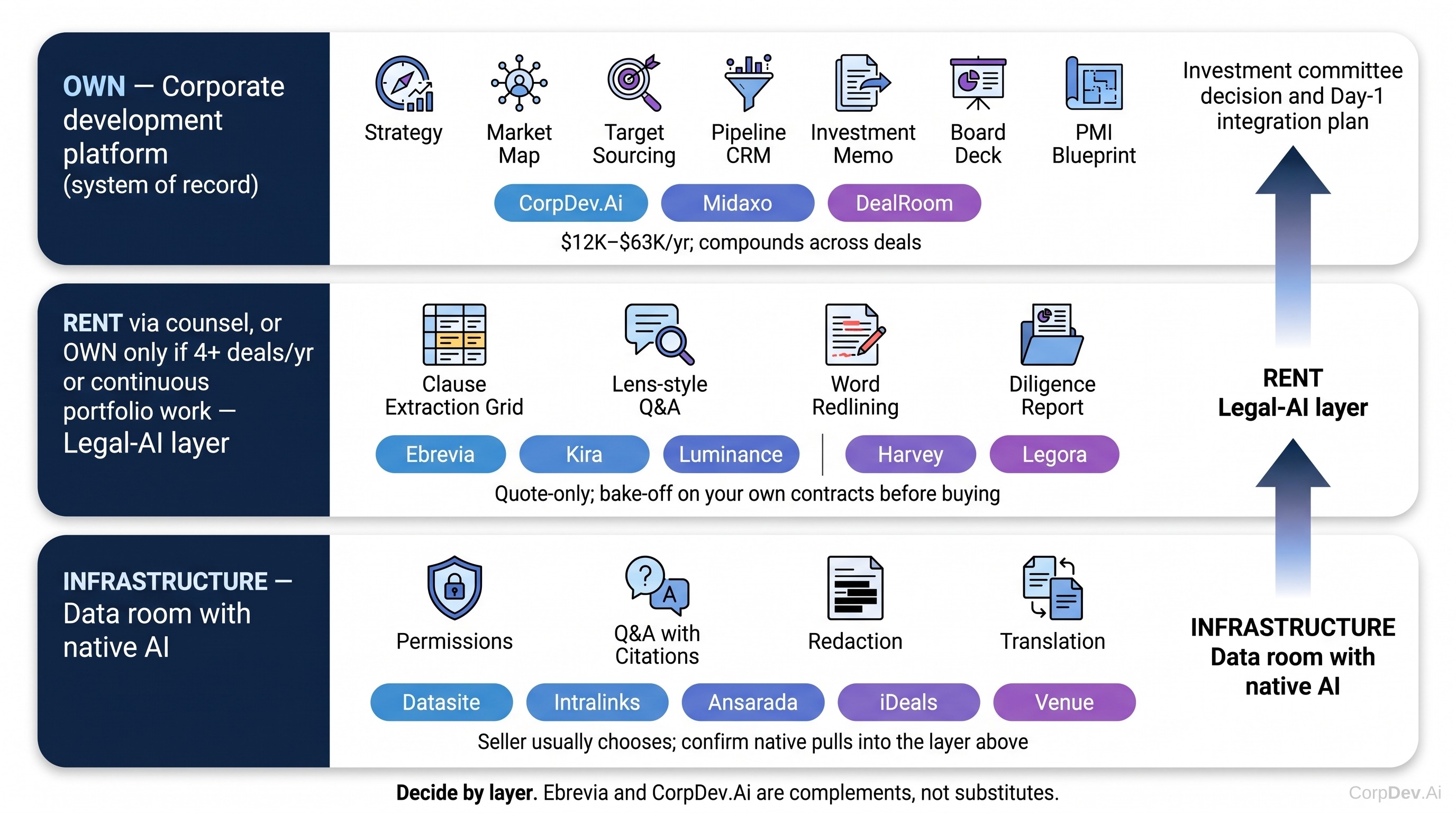
Read diagram description
Three stacked bands with an "own / rent / infrastructure" label on the left of each. Top band, labelled "OWN — Corporate development platform (system of record)": features: strategy, market map, target sourcing, pipeline CRM, investment memo, board deck, PMI blueprint; vendors "CorpDev.Ai · Midaxo · DealRoom"; note "$12K–$63K/yr; compounds across deals". Middle band, labelled "RENT via counsel, or OWN only if 4+ deals/yr or continuous portfolio work — Legal-AI layer": features: clause extraction grid, Lens-style Q&A, Word redlining, diligence report; vendors "Ebrevia · Kira · Luminance | Harvey · Legora"; note "Quote-only; bake-off on your own contracts before buying". Bottom band, labelled "INFRASTRUCTURE — Data room with native AI": features: permissions, Q&A with citations, redaction, translation; vendors "Datasite · Intralinks · Ansarada · iDeals · Venue"; note "Seller usually chooses; confirm native pulls into the layer above". Findings flow from data room → legal-AI layer → corp-dev platform → "Investment committee decision and Day-1 integration plan". "Decide by layer. Ebrevia and CorpDev.Ai are complements, not substitutes."
Key Facts & Sources
The load-bearing figures in this document, with their basis and as-of date. Figures marked "estimate" derive from third-party review sites or comparison blogs and carry substantial, unquantified uncertainty; figures marked "published" come from the vendor's own price list or press release; figures marked "derived" are this document's own calculations, with the method stated in the relevant section.
| Fact | Value | Basis | Source | As of |
|---|---|---|---|---|
| Ebrevia ownership | Founder-reacquired from DFIN, Dec 2023 | Vendor + DFIN filings | [1][4][213] | Sep 2026 |
| DFIN acquisition of Ebrevia | ~$19.5M cash + up to $4M contingent | DFIN press release | [3] | Dec 2018 |
| Ebrevia pre-trained fields | 700+ | Vendor claim | [5] | Sep 2026 |
| Ebrevia review-time reduction | 30–90% | Vendor claim, DFIN-era case studies | [5][13] | Sep 2026 |
| Ebrevia languages | 37 | Vendor claim | [6] | Sep 2026 |
| Ebrevia G2 rating | 4.6/5, 7 reviews | Review site | [14] | Sep 2026 |
| Ebrevia indicative pricing | $10K/1,000 docs; $62K/10,000 docs | Third-party, historical (estimate) | [11] | Undated |
| Kira smart fields | 1,400+ across 40+ legal areas | Vendor claim | [31] | Jan 2026 |
| Kira annual cost | ~$45K–$300K+ | Third-party estimate | [29][30] | 2026 |
| Luminance Series C | $75M, ~$165M total | Press release | [49][218] | Feb 2025 |
| Harvey valuation | $15.5B ($550M round) | Reuters / vendor | [69][216] | Sep 2026 |
| Harvey prior round | $200M at $11B | CNBC | [70] | Mar 2026 |
| Legora Series D | $550M at $5.55B; extended to $600M / $5.6B | Vendor / TechCrunch | [87][88][217] | Mar–Apr 2026 |
| Harvey–Ansarada integration | Announced | Vendor | [67] | Apr 2026 |
| Legora–Datasite integration | Announced | Vendor | [86] | Sep 2026 |
| CorpDev.Ai pricing | AI Pro $1,000/mo; Team $3,000/mo (annual billing) | Published price list | [134] | Sep 2026 |
| CorpDev.Ai company coverage | 70M+ companies | Vendor claim (Apollo-sourced) | [132][134] | Sep 2026 |
| Midaxo annual cost | ~$35K–$120K; median ~$63K | Third-party estimate | [143][144] | 2026 |
| Midaxo G2 rating | 4.6/5, ~36 reviews | Review site | [149] | Sep 2026 |
| DealRoom annual cost | ~$12K–$25K | Third-party estimate | [156][157] | 2026 |
| DealRoom G2 rating | 4.4/5, 91 reviews | Review site | [161] | Sep 2026 |
| Datasite G2 rating | 4.4/5, 423 reviews | Review site | [103] | Sep 2026 |
| iDeals G2 rating | 4.7/5, 861 reviews | Review site | [119] | Sep 2026 |
| Ansarada published pricing | $69/mo (50 MB) to $5,134/mo (20 GB), 12-month term | Published | [111][113] | May 2026 |
| Affinity published pricing | $2,000–$2,700/user/yr | Published | [172] | 2026 |
| GenAI integrated in M&A workflows | 86% of corporate & PE leaders | Deloitte survey, n=1,000 | [198] | Oct 2025 |
| GenAI used for due diligence | 35% of M&A adopters | Deloitte | [198] | Oct 2025 |
| Current GenAI use in M&A | 21% (from 16% in 2023) | Bain survey, n=300+ | [205] | Feb 2025 |
| Legal-tech market forecast | $50B by 2027 | Gartner | [195] | Apr 2024 |
| Top barrier to AI investment | Lack of demonstrable accuracy, 50% | Thomson Reuters | [208] | Apr 2025 |
| Cost-per-deal scenarios | See chart | Derived — method in TCO section | — | Sep 2026 |
| Capability matrix scores | 1–5 | Derived — analyst judgment from cited evidence | — | Sep 2026 |
References
Numbering follows the original research. Access dates below record the original source registry; they do not imply that every source was rechecked for this website edition.
- About USSource accessed 2026-09-11
- eBrevia Launches gen AI-driven Lens FeatureSource accessed 2026-09-11
- DFIN Elevates Artificial Intelligence Platform with Acquisition ...Source accessed 2026-09-11
- [PDF] DFIN 2023 Annual ReportSource accessed 2026-09-11
- eBrevia Contract Analyzer | AI-Powered Contract ReviewSource accessed 2026-09-11
- eBrevia: AI Contract Review, Drafting & Analysis SoftwareSource accessed 2026-09-11
- eBrevia Launches Enterprise Playbooks for AI Contract ...Source accessed 2026-09-11
- eBrevia Introduces eBrevia Connect to Support More Than 2000 ...Source accessed 2026-09-11
- M&A Due Diligence Contract Review | eBreviaSource accessed 2026-09-11
- Streamline Contract Management TodaySource accessed 2026-09-11
- eBrevia - AI Assisted Document Review Platform - Lex MundiSource accessed 2026-09-11
- eBrevia Software Pricing, Alternatives & More 2026 | CapterraSource accessed 2026-09-11
- dfin-case study-KROLL_v1_Low_Res1Source accessed 2026-09-11
- eBrevia Contract Analytics Reviews & Product DetailsSource accessed 2026-09-11
- Data Privacy | Ensure Compliance—Act NowSource accessed 2026-09-11
- Industry-Leading Security StandardsSource accessed 2026-09-11
- eBrevia Introduces eBrevia Connect to Support More Than ...Source accessed 2026-09-11
- Litera Microsystems makes 12th legaltech acquisition with contract ...Source accessed 2026-09-11
- Kira Systems vs ThoughtRiver (2026): Scores, Reviews & VerdictSource accessed 2026-09-11
- Terzo vs Kira Systems (2026): Scores, Reviews & Verdict - RFP.wikiSource accessed 2026-09-11
- Litera Expands Kira Capabilities, Unveiling the Next Generation of ...Source accessed 2026-09-11
- Litera Super-Charges AI Legacy with “Smart Summaries” for Kira to ...Source accessed 2026-09-11
- Best AI Contract Review Software in 2026 (9 Tools Compared)Source accessed 2026-09-11
- Integrate with Intralinks - LiteraSource accessed 2026-09-11
- How do I create an Intralinks integration? - Litera Customer CenterSource accessed 2026-09-11
- Best AI Contract Review Software for M&A in 2026Source accessed 2026-09-11
- Kira Systems - Reviews - Advanced Contract AnalyticsSource accessed 2026-09-11
- Luminance Legal AI Review: Pricing, Architecture & FitSource accessed 2026-09-11
- Luminance Review 2026: Features, Pricing & VerdictSource accessed 2026-09-11
- AI platform Luminance set to illuminate SaaS VDR software AnsaradaSource accessed 2026-09-11
- Luminance AI Contract Review: Evaluation for Legal TeamsSource accessed 2026-09-11
- Luminance Expands Legal AI Capabilities With Luna Crescent ...Source accessed 2026-09-11
- Luminance's artificial intelligence technology integrates ...Source accessed 2026-09-11
- AI Due Diligence Tools Compared: Kira, Luminance, eBrevia ...Source accessed 2026-09-11
- British legaltech Luminance secures $75M Series CSource accessed 2026-09-11
- Luminance Reviews, Pricing & Alternatives (2026) | ToolradarSource accessed 2026-09-11
- GenieAI vs Diligen: Pricing, Reviews & AI Features Compared ...Source accessed 2026-09-11
- Diligen: Pricing, Free Demo & FeaturesSource accessed 2026-09-11
- AI Due Diligence Tools for M&A in 2026: 10-Vendor Comparison ...Source accessed 2026-09-11
- Diligen | Automatic Contract AnalysisSource accessed 2026-09-11
- Diligen for Box | Machine Learning Powered Contract ...Source accessed 2026-09-11
- Diligen | Machine Learning Powered Contract AnalysisSource accessed 2026-09-11
- Diligen Review (2026) — Pricing, Features & AlternativesSource accessed 2026-09-11
- Harvey AI Review — What Law Firms Actually Get (and Pay) | AI ...Source accessed 2026-09-11
- Harvey AI CLM reviewSource accessed 2026-09-11
- Harvey AI Review 2026: Is This the Future of Legal AI for Big ...Source accessed 2026-09-11
- Harvey AI Review 2026: Honest Take + What It Really CostsSource accessed 2026-09-11
- Extending Legal Agent Bench to M&A Due DiligenceSource accessed 2026-09-11
- Harvey and Ansarada Partner to Deliver Secure, AI-Powered Deal ...Source accessed 2026-09-11
- Legal AI startup Harvey reaches $15.5 billion valuation in ...Source accessed 2026-09-11
- Legal AI startup Harvey raises $200 million at $11 billion ...Source accessed 2026-09-11
- Robin AI vs Harvey (2026): Which Is Better? - RFP.wikiSource accessed 2026-09-11
- Thomson Reuters Completes Acquisition of Casetext, IncSource accessed 2026-09-11
- Casetext Acquisition and Pricing: What Happened After Thomson ...Source accessed 2026-09-11
- AI for mergers and acquisitions - CoCounsel LegalSource accessed 2026-09-11
- Explore Features - CoCounsel Essentials | Thomson ReutersSource accessed 2026-09-11
- CoCounsel Legal - AI Legal AssistantSource accessed 2026-09-11
- Legora CLM review & user ratingsSource accessed 2026-09-11
- Legora - AI Legal Assistant Software - RFP.wikiSource accessed 2026-09-11
- AI solutions for transactional lawyersSource accessed 2026-09-11
- Datasite and Legora platforms integrate to accelerate AI-powered diligence across the deal lifecycle - LegoraSource accessed 2026-09-11
- Legora raises $550 million Series D to fuel US growthSource accessed 2026-09-11
- Legora reaches $5.55 billion valuation as AI legal tech boom endures | TechCrunchSource accessed 2026-09-11
- reviewsSource accessed 2026-09-11
- Legora Products | Read 20 Reviews on G2Source accessed 2026-09-11
- AWS Marketplace: Robin - Legal Intelligence PlatformSource accessed 2026-09-11
- Robin Reviews 2026: Details, Pricing, & Features - G2Source accessed 2026-09-11
- Robin AI Review (2026): The Complete Analysis of the AI ...Source accessed 2026-09-11
- Use Case: Using AI to accelerate M&A Due DiligenceSource accessed 2026-09-11
- Understand your deal faster - The Blueflame AI assistant ...Source accessed 2026-09-11
- What AI capabilities does Datasite offer across the deal lifecycle?Source accessed 2026-09-11
- Datasite · Rating Snapshot: Score & Reviews (2026) - RFP.wikiSource accessed 2026-09-11
- Datasite Reviews 2026 - PapermarkSource accessed 2026-09-11
- Datasite Diligence Reviews & Product DetailsSource accessed 2026-09-11
- Intralinks AI-Powered M&A Platform | DealCentre AISource accessed 2026-09-11
- Automated AI-Powered Due Diligence Platform - IntralinksSource accessed 2026-09-11
- Revolutionizing Dealmaking Using the Power of AI | IntralinksSource accessed 2026-09-11
- SS&C Intralinks VDRPro Pricing | Transparent ApproachSource accessed 2026-09-11
- Intralinks VDRPro Reviews 2026: Details, Pricing, & FeaturesSource accessed 2026-09-11
- Ansarada virtual data room pricing: plans, costs and ...Source accessed 2026-09-11
- Ansarada vs FirmRoom: which VDR is better for M&A and due ...Source accessed 2026-09-11
- Pricing PlansSource accessed 2026-09-11
- Ansarada Reviews 2026: Details, Pricing, & Features - G2Source accessed 2026-09-11
- Where AI meets high-stakes deal-making | Ideals Virtual Data RoomSource accessed 2026-09-11
- Virtual Data Room Features: The Complete Guide (2026) - IdealsSource accessed 2026-09-11
- Ideals: Virtual Data Room Software for Secure DealmakingSource accessed 2026-09-11
- Page 10 | Ideals Virtual Data Room Reviews 2026: Details, Pricing ...Source accessed 2026-09-11
- Active Intelligence | Donnelley Financial Solutions (DFIN)Source accessed 2026-09-11
- DFIN Venue vs. Datasite Diligence Comparison 2026 | G2Source accessed 2026-09-11
- DFIN Venue Reviews & Product Details - G2Source accessed 2026-09-11
- CorpDev.Ai - Agentic AI for M&A and Corporate DevelopmentSource accessed 2026-09-11
- PricingSource accessed 2026-09-11
- CorpDev.Ai Revenue, Funding & Valuation - ProspeoSource accessed 2026-09-11
- Top 10 CorpDev.Ai Alternatives & Competitors in 2026Source accessed 2026-09-11
- M&A Intelligence Platform | Midaxo M&A SoftwareSource accessed 2026-09-11
- M&A Software & Intelligence Platform - MidaxoSource accessed 2026-09-11
- AI for M&A: Answers From Your Own Deal Data - MidaxoSource accessed 2026-09-11
- Meet Midaxo AI: your partner for smarter M&ASource accessed 2026-09-11
- Under Your ControlSource accessed 2026-09-11
- Midaxo - Reviews - End-to-End M&A Process SoftwareSource accessed 2026-09-11
- Midaxo Software Pricing & Plans 2025: See Your CostSource accessed 2026-09-11
- Idinvest leads €12.9m series-B round for Midaxo | UnquoteSource accessed 2026-09-11
- Finnish Industry Investment Ltd and EOC Capital invest in the M&A digitizing expert MidaxoSource accessed 2026-09-11
- Midaxo Reviews 2026: Details, Pricing, & FeaturesSource accessed 2026-09-11
- M&A Operating System - DealRoom.netSource accessed 2026-09-11
- DealRoom | AI-Powered M&A Operating System for Buyer-Led ...Source accessed 2026-09-11
- Purpose-built AI for Buy-Side M&A - DealRoom.netSource accessed 2026-09-11
- Never Miss a Risk in Diligence: DealRoom Now Uses AI to Capture ...Source accessed 2026-09-11
- DealRoom Launches the Only MCP Built for Buyer-led M&A ...Source accessed 2026-09-11
- DealRoom Pricing: M&A Software Plans and CostsSource accessed 2026-09-11
- DealRoom AI: Complete ReviewSource accessed 2026-09-11
- DealRoom Reviews 2026: Details, Pricing, & FeaturesSource accessed 2026-09-11
- Compare Datasite Diligence vs. Devensoft - G2Source accessed 2026-09-11
- Top 10 StrategyBridgeAI Alternatives & Competitors in 2026Source accessed 2026-09-11
- Devensoft Pricing 2026Source accessed 2026-09-11
- Devensoft vs Datasite (2026): Comprehensive comparisonSource accessed 2026-09-11
- Devensoft Reviews 2026: Details, Pricing, & FeaturesSource accessed 2026-09-11
- Affinity Pricing: Plans for Private Capital CRMSource accessed 2026-09-11
- Artificial Intelligence for Private Capital - Affinity AISource accessed 2026-09-11
- Affinity Products | Read 73 Reviews on G2Source accessed 2026-09-11
- 4Degrees Pricing, Reviews, Pros & Cons (2026) - ProspeoSource accessed 2026-09-11
- 2026 Guide to CRM Costs in Private MarketsSource accessed 2026-09-11
- 4Degrees Products | Read 5 Reviews on G2Source accessed 2026-09-11
- Donnelley Financial To Acquire eBrevia For Legal AI Tech (NYSE:DFIN)Source accessed 2026-09-11
- Gartner Predicts the Global Legal Technology Market Will Reach ...Source accessed 2026-09-11
- 2025 Generative AI in Professional Services Report: GenAI adoption ...Source accessed 2026-09-11
- New Deloitte Survey: 86% of Corporate and Private Equity Leaders ...Source accessed 2026-09-11
- Majority of M&A engagements anticipated to be completed using AI-based technologiesSource accessed 2026-09-11
- Generative AI in M&A: You're Not Behind—YetSource accessed 2026-09-11
- Litera Technology in M&A ReportSource accessed 2026-09-11
- Navigating the concerns of AISource accessed 2026-09-11
- Future of Professionals Report 2026Source accessed 2026-09-11
- Global legaltech solution provider to acquire Canadian AI platform ...Source accessed 2026-09-11
- DFIN-Investor-Presentation-Q1-2026.pdfSource accessed 2026-09-11
- Legal AI startup Harvey confirms $8B valuationSource accessed 2026-09-11
- Harvey Raises $550M at a $15.5B Valuation to Help Legal ...Source accessed 2026-09-11
- Legora extends Series D with additional $50 million, welcomes Atlassian and NVentures as investors - LegoraSource accessed 2026-09-11
- Luminance Raises $75 Million in Series C Funding Round ...Source accessed 2026-09-11