RESEARCH / Legal AI and contract review
Luminance Alternatives: Legal AI, Diligence and M&A Platforms
Compare Luminance with Kira, Harvey, Legora, research AI and M&A platforms on legal review, workflow fit, pricing, evidence and in-house versus counsel use.
Research as of
Website edition edited
Published by CorpDev.Ai, which is one of the vendors assessed. This analysis distinguishes vendor claims, external evidence and analyst judgments. Prices and capabilities reflect the source dates in the article; the website edition is an editorial adaptation, not a new verification of every claim.
Decide who owns first-pass legal diligence and who receives the savings
Luminance belongs near the centre of the decision when an in-house legal team repeatedly reviews large contract populations and wants consistent extraction, house playbooks and institutional memory. For an M&A VP whose counsel already performs that work with specialist AI, a second licence may duplicate capacity without changing the acquisition timetable. The first commercial question is where the review is performed and how its efficiency is reflected in fees and deliverables.
Contract review also extends beyond signing. A group with recurring NDA negotiation or a substantial post-close harmonisation burden can have a stronger case than deal count alone suggests. Conversely, sourcing and investment-memo constraints may remain untouched by an excellent legal engine. These workloads should have separate owners and economic cases.
Benchmark known contracts, difficult exceptions and multilingual material with the legal reviewers who will accept the output. Track material omissions and correction time, then agree the handoff into the deal record. Compare complete software and service costs: a room-plus-workspace subtotal that excludes counsel cannot establish that the full alternative is cheaper than Luminance.
Executive Summary
Luminance is one of the most capable contract-intelligence engines a deal team can buy — and for most corporate development functions it is the wrong first purchase. That is the central finding of this comparison. Luminance solves a specific, expensive problem: reading thousands of contracts in a data room quickly, consistently and in many languages, and surfacing change-of-control, assignment, termination and indemnity risk before signing. It does this well, backed by a 1,000-plus customer base, a proprietary contract model launched in June 2026 and reported revenue that doubled in 2025 for the second consecutive year [8][82][97]. But legal document review is one workstream in a deal, and it is the workstream most corporate development teams already outsource to external counsel — who increasingly bring their own AI (Harvey, Legora, Kira) to the engagement.
1,000+
Luminance customers, 70 countries (company claim, 2026)
$150–500K
Estimated first-year Luminance TCO (third-party estimate)
$15.5B
Harvey valuation, Sep 2026 — the pace-setter in legal AI
7%
Legal teams that have scaled AI successfully (Axiom, 2026)
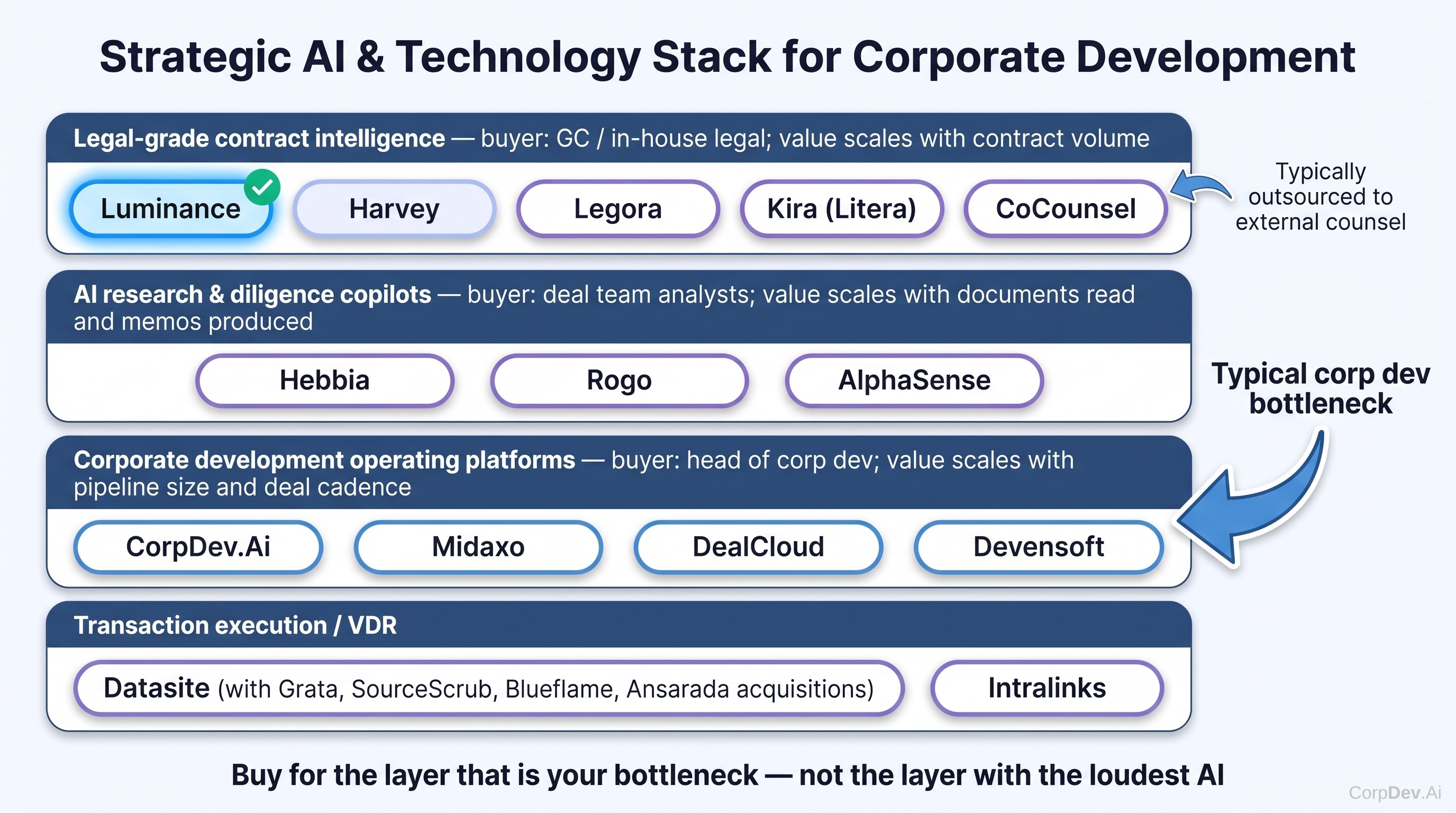
The buyer's question is therefore not "Luminance or a Luminance clone?" but "which layer of the deal stack is my bottleneck?" We frame the market as three layers, each with a different economic logic:
- Legal-grade contract intelligence — Luminance, Harvey, Legora, Kira (Litera), Thomson Reuters CoCounsel. Priced for law firms and large legal departments; value is proportional to contract volume. The right buyer is a General Counsel or a serial acquirer whose in-house legal team runs first-pass diligence itself.
- AI research and diligence copilots — Hebbia, Rogo, AlphaSense. Horizontal analysis engines that read anything (data rooms, filings, broker research) and produce cited matrices and memos. Strong for PE and banking; typically bolted onto an existing CRM and VDR.
- Corporate development operating platforms — CorpDev.Ai, Midaxo, DealCloud (Intapp), Devensoft, with Datasite's acquisitive push from the VDR side. These own the pipeline and the deal record, and increasingly embed AI for sourcing, screening, research and memo generation. The right buyer is a corp dev team of one to ten people that needs to originate, screen and analyse continuously, not just review contracts at signing.
Our verdict for a CorpDev / strategy / M&A professional:
- If you run first-pass legal diligence in-house on large data rooms several times a year, Luminance belongs on a shortlist with Kira/Litera and Legora — and should be benchmarked on your own contracts, not a vendor demo. Its edge is high-volume, multilingual, structured contract review; its weaknesses are opaque six-figure pricing, onboarding effort and a narrow fit outside contracts [18][19][20].
- If your legal work is outsourced, do not buy Luminance to give your lawyers a tool they already have. Ask counsel which AI they use and negotiate the efficiency into fees. Spend instead on the layer that is actually your bottleneck.
- For most corp dev teams that bottleneck is upstream — market mapping, target identification, screening, research and memo production — where a corporate development platform such as CorpDev.Ai (from $1,000 per user per month, published) or a research copilot such as Hebbia or AlphaSense will move more of the calendar than a contract-review engine [50].
- The realistic 2026 architecture is a stack, not a single product: a pipeline/CRM system of record, a VDR for execution, an AI research layer, and — only where volume justifies it — a legal contract-intelligence engine [62][63].
CorpDev.Ai publishes this comparison and is one of the vendors assessed. We have applied the same standards to CorpDev.Ai as to every other vendor — published prices are quoted verbatim, unverifiable claims are labelled as company claims, and its limitations are stated plainly — but readers should treat the CorpDev.Ai sections with the same scepticism they would apply to any vendor-adjacent analysis, and validate every finalist in a bake-off on their own deal materials.
Read diagram description
Three layers stacked vertically, each labelled with its buyer and economic logic. Top layer "Legal-grade contract intelligence — buyer: GC / in-house legal; value scales with contract volume" containing Luminance, Harvey, Legora, Kira (Litera), CoCounsel. Middle layer "AI research & diligence copilots — buyer: deal team analysts; value scales with documents read and memos produced" containing Hebbia, Rogo, AlphaSense. Bottom layer "Corporate development operating platforms — buyer: head of corp dev; value scales with pipeline size and deal cadence" containing CorpDev.Ai, Midaxo, DealCloud, Devensoft. A fourth thin band along the bottom labelled "Transaction execution / VDR" with Datasite (with Grata, SourceScrub, Blueflame, Ansarada acquisitions), Intralinks. An arrow on the right side labelled "Typical corp dev bottleneck" pointing at the bottom two layers; a smaller arrow labelled "Typically outsourced to external counsel" pointing at the top layer. "Buy for the layer that is your bottleneck — not the layer with the loudest AI."
Framing the Decision: What a CorpDev Buyer Is Actually Buying
Vendor websites in this market share a vocabulary — "AI for M&A", "due diligence", "agentic" — that obscures how differently the products are built and priced. Before comparing features, a buyer should be clear about four things.
Who inside the company is the user
Luminance, Harvey, Legora, Kira and CoCounsel are bought by and for lawyers. Their interfaces assume a legal user marking up clauses in Word, running playbooks, or producing a diligence report for a deal partner. Luminance's own performance claims — "90% time savings on contract review", "98% lower contract-management costs" — are legal-operations claims [8]. A corporate development professional will use these tools only if the company's legal function runs first-pass diligence in-house, or if the corp dev team itself is expected to triage a data room before counsel is engaged.
CorpDev.Ai, Midaxo, DealCloud and Devensoft are bought by and for the deal team. Their centre of gravity is the pipeline, the target list, the investment committee memo and the integration plan. Legal document review, where present, is one function among many rather than the product's reason to exist [50][52][53].
Hebbia, Rogo and AlphaSense sit in between: analyst-grade research engines that a deal team can point at a data room, a set of filings or a broker-research library, and that lawyers can equally use for exception lists. They rarely own the deal record [58][74].
Where the work happens in the deal lifecycle
Read diagram description
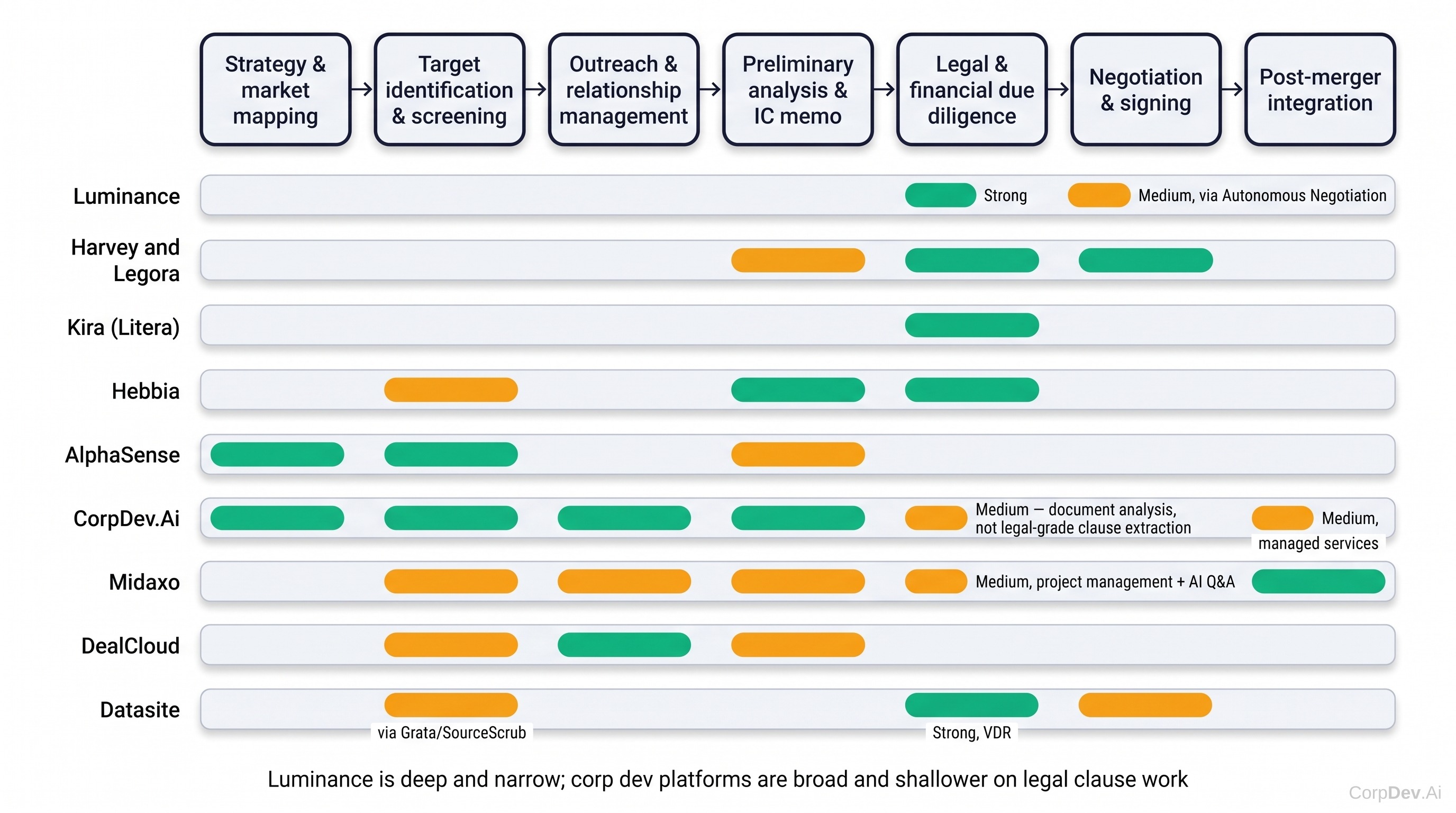
Deal lifecycle with seven phases: Strategy & market mapping → Target identification & screening → Outreach & relationship management → Preliminary analysis & IC memo → Legal & financial due diligence → Negotiation & signing → Post-merger integration. Beneath each phase, coverage bars for vendors: Luminance covers only "Legal & financial due diligence" (strong) and "Negotiation & signing" ( via Autonomous Negotiation). Harvey and Legora cover due diligence and negotiation strongly, preliminary analysis medium. Kira (Litera) covers due diligence only. Hebbia covers screening (medium), preliminary analysis (strong), due diligence (strong). AlphaSense covers strategy & market mapping (strong), screening (strong), preliminary analysis (medium). CorpDev.Ai covers strategy & market mapping (strong), target identification (strong), outreach/CRM (strong), preliminary analysis & memo (strong), due diligence (medium — document analysis, not legal-grade clause extraction), PMI ( managed services). Midaxo covers screening (medium), outreach (medium), preliminary analysis (medium), due diligence ( project management + AI Q&A), PMI (strong). DealCloud covers outreach/CRM (strong), screening (medium), preliminary analysis (medium). Datasite covers screening (medium via Grata/SourceScrub), due diligence (strong, VDR), negotiation (medium). "Luminance is deep and narrow; corp dev platforms are broad and shallower on legal clause work."
Luminance's footprint is concentrated in one phase — legal diligence — plus, since 2023, the negotiation of routine agreements through Autopilot / Autonomous Negotiation [4][93]. That is precisely the phase in which most companies rely most heavily on external counsel and the phase where the deal team's own time is least consumed by reading. The upstream phases — deciding where to hunt, building the long list, qualifying targets, producing the memo — consume the majority of a corporate development team's calendar and are where AI leverage is highest per dollar of licence.
How the vendor makes money
Pricing models are the clearest signal of who a product is for:
- Luminance, Harvey, Legora, Kira: enterprise contracts, negotiated, unpublished. Third-party estimates put Luminance's first-year total cost at roughly $150,000–$500,000 including implementation; Harvey at $1,000–$2,000 per user per month with 20–50 seat minimums; Legora around $3,000 per user per year with a 10-user minimum and average contracts near $280,000 [18][26][30][31]. These economics only work for organisations with dozens of legal users or very high contract volumes.
- CoCounsel: seat-based, from roughly $225 per user per month for the core tier to $400–$639 with Westlaw bundles — cheaper per seat but tied to the Thomson Reuters ecosystem [37][38].
- CorpDev.Ai: published list prices — AI Pro at $1,000 per month on annual billing ($1,200 monthly), AI Pro Team at $3,000 per month for three users, Enterprise on quote — with a free-trial route on the website [50]. This gives a single professional a published entry point; CoCounsel also has per-seat price anchors, while package entitlements and purchasing routes differ.
- Midaxo, Devensoft, DealCloud: subscription platforms typically estimated at $10,000–$40,000 a year for smaller teams, rising to $60,000–$200,000+ for enterprise deployments [63][73].
- Datasite, Intralinks, Ansarada: per-transaction or annual VDR pricing, roughly $15,000–$100,000+ per deal for Datasite and $5,000–$30,000 per project for Ansarada's mid-market work [63][64][71].
- Hebbia, Rogo, AlphaSense: custom enterprise subscriptions, commonly $30,000–$250,000+ a year depending on seats and data entitlements [63].
Whether the product is a system of record or an intelligence layer
A system of record (DealCloud, Midaxo, Devensoft, CorpDev.Ai's pipeline and CRM, Datasite as VDR) holds the authoritative version of the deal: which targets are live, what stage they are at, what was said to whom, what the committee approved. An intelligence layer (Luminance, Hebbia, Rogo, AlphaSense, Harvey) produces analysis that must be written back into that record. The distinction matters because it determines integration cost and how many contracts a buyer signs. The trend in 2026 is convergence from both directions — Datasite has spent heavily to bolt origination intelligence onto its VDR through the Grata, SourceScrub, Blueflame and Valu8 acquisitions and a $500 million CapVest commitment [66][67][68][69]; CorpDev.Ai and Midaxo are embedding AI analysis into the pipeline; Luminance is adding "institutional memory" so its analysis persists across matters [82]. No vendor yet covers the whole lifecycle at legal-grade depth.
This document assumes the reader is a corporate development, strategy or M&A professional inside an operating company or a small investment team — not a law-firm partner or a legal-operations lead. If the buyer is the General Counsel, the weighting shifts materially toward the legal-grade layer and Luminance's case strengthens.
Luminance in Depth
What it is
Luminance is a Cambridge-founded legal AI company, originally built around machine-learning document review for M&A due diligence and now positioned as a "Legal-Grade AI" platform for the whole contract lifecycle — drafting, negotiation, review, compliance, investigation and collaboration [8]. The product has evolved from separate modules into a unified, agent-based platform, but the legacy product names remain the clearest map of its capabilities:
| Capability | What it does | Relevance to a deal team |
|---|---|---|
| Diligence | Ingests a data room, clusters and classifies documents, extracts clauses, flags deviations from a model document or checklist, supports task allocation and produces a diligence report [1][24] | Core M&A use case — first-pass legal review at scale |
| Corporate | In-Word first-pass review, traffic-light risk marking, clause comparison, redrafting against approved language [3] | Post-close contract harmonisation; BAU legal |
| Autopilot / Autonomous Negotiation | Negotiates routine agreements (chiefly NDAs) end to end against a playbook; 2026 upgrade adds persistent negotiation history and non-lawyer usability, wider release planned spring 2026 [4][93] | NDA volume in an active outreach programme |
| Lumi | Natural-language legal assistant that is now the interface to the whole platform; carries context from negotiation into review; integrates LexisNexis Protégé content for US law (alliance announced April 2026) [94][96] | Q&A over the data room; legal research adjacent to a deal |
| Institutional memory (Jan 2026) | Retains negotiation history and decision logic across matters rather than treating each document in isolation; described by the company as its largest platform update in a decade [82][83] | Serial acquirers accumulate a house view of acceptable terms |
| Luna Crescent (Jun 2026) | Proprietary LLM built for contract intelligence; company claims contract Q&A up to 4x faster than general-purpose models [97][98] | Speed and cost on very large document sets |
Luminance's technical differentiation is a legal-specific model stack — it cites training on more than 150 million verified legal documents and a "mixture of experts" approach — rather than a general-purpose LLM wrapped in a legal interface [6][8]. It holds ISO 27001 and SOC 2 certification [8].
Commercial position
Series C: $75M, Feb 2025, led by Point72 Private Investments; Forestay, RPS, Schroders Capital, March Capital, National Grid Partners and Slaughter and May participating [10][12]
Total raised: ~$165M reported; databases disagree ($125M–$165M) [11][85]
Valuation: not disclosed; PitchBook figure of ~$400M cited by Forbes (Apr 2025) [9]
2026 round: none publicly announced as of Sep 2026 [84]
Customers: 1,000+ organisations in 70 countries (company claim); 700+ reported in 2024–25 [8][15][90]
Revenue: doubled in 2025 for the second consecutive year; North America +127%; first eight-figure enterprise deal (company claims) [82]
Statutory FY2024: £15.7M revenue, £13.1M loss (UK filings via secondary coverage) [89]
ARR estimates: $27.6M (GetLatka, 2024) to $60M (Sacra) — third-party, unverified [87][88]
CEO: Eleanor Lightbody; President: Daniel Head (Mar 2026); CTO: Greg Pelander (Mar 2026) [99][100][101]
Named customers: AMD, Hitachi, Rolls-Royce, Lamborghini, DHL, LG Chem, National Grid, BBC Studios, Liberty Mutual, Koch, TotalEnergies; Big Four; a quarter of the Global Top 100 law firms (company claims) [15][90]
2026 wins: Interfood (100-country contract estate); Customer Advisory Board with BBC Studios, Ingram Micro, Slaughter and May, Staples Canada, Imerys [91][92]
The commercial picture is one of a genuinely growing, well-funded specialist — but one that is now competing against rivals raising an order of magnitude more capital. Harvey closed $550 million at a $15.5 billion valuation in September 2026, having raised at $11 billion in March; Legora raised $550 million at $5.55 billion in March 2026, since extended to roughly $600 million at $5.6 billion [27][28][32][33]. Luminance's response has been to specialise harder — proprietary contract model, institutional memory, autonomous negotiation — rather than compete as a general legal assistant [82][97].
Pricing
Luminance publishes no price list, seat schedule or self-serve plan. Contracts are negotiated on users, business units, modules, document volume, deployment and integration requirements. Independent estimates put first-year total cost of ownership at approximately $150,000–$500,000 or more including licence, implementation and modules, with larger deployments starting in the low-to-mid six figures annually [18][19]. There is no meaningful free tier. Economically, the product is defensible only where contract volume is high and recurring.
Strengths and weaknesses for an M&A buyer
Where Luminance is genuinely strong
- Scale and multilinguality. Reviewing a 5,000-document, multi-jurisdiction data room is the use case the product was built for; a 2025 Swiss law-firm trial organised 700 multilingual documents in a single room [25].
- Structured, repeatable output. Clause extraction against a checklist, deviation flags against a model document, and a generated diligence report are exactly what a deal team needs to hand to counsel or an IC [24].
- Change-of-control, assignment, termination, exclusivity, indemnity and IP detection — the provisions that move price or kill deals [24].
- Enterprise trust. ISO 27001, SOC 2, a decade of law-firm deployments, and a customer advisory board of blue-chip GCs [8][92].
- Momentum. Doubling revenue, proprietary model, senior US hires — these are positive operating signals, although they do not eliminate financing, acquisition or continuity risk [82][97][99].
Where it falls short for a corp dev buyer
- Focused lifecycle coverage. No native sourcing database, deal pipeline, CRM or financial-modelling workflow is described here. Its contract capabilities extend beyond reading to drafting, negotiation, compliance and post-close harmonisation.
- Legal-user design. The interface and playbook logic assume a lawyer; a corp dev analyst will find the product oriented to a different job.
- Opaque, six-figure pricing with a steep onboarding curve; reviewers consistently cite cost and configuration effort [18][20][21].
- Still requires attorney validation, especially on unusual clauses — false positives on edge-case provisions are a recurring reviewer complaint [21][22][23].
- Thin independent review evidence. A 4.9/5 G2 score rests on sparse review volume; no Capterra presence [20].
- Overlap with counsel's tools. If your external lawyers run Harvey, Legora or Kira, you may be paying twice for the same review.
Three profiles justify the spend: (1) a serial acquirer whose in-house legal team runs first-pass diligence on multiple data rooms a year and wants a house playbook that compounds through institutional memory; (2) a company with a large legacy contract estate to harmonise post-close, where Corporate and Autopilot displace outside-counsel hours on BAU work; (3) a group running very high NDA volume through an active outreach programme, where Autonomous Negotiation removes a legal bottleneck from the sourcing funnel. Outside these profiles the licence is hard to justify against the alternatives below.
The Alternatives
Fourteen vendors appear in this section, grouped into the four layers introduced above. Each group closes with a reading of how it compares to Luminance specifically, because the question a buyer is asking is rarely "which of these is best" but "which of these does the job I was about to give Luminance — and at what cost."
Legal-Grade Contract Intelligence: Harvey, Legora, Kira (Litera), CoCounsel
These are Luminance's direct substitutes: tools a legal team uses to read, extract, compare and draft. They differ in breadth (general legal assistant versus structured extraction), in capital (Harvey and Legora are now among the best-funded software companies in Europe and the US) and in who they are sold to.
Position: broad legal AI platform with custom agents for diligence, playbook review, memo drafting and Q&A; the category's pace-setter [33]
Scale: $550M raised at $15.5B (Sep 2026) after $200M at $11B (Mar 2026); claims 100,000+ lawyers across 1,300 organisations [32][33][34]
Pricing: unpublished; market reports of $1,000–$2,000 per user per month with 20–50 seat minimums [30][31]
For a deal team: the strongest open-ended legal reasoning and drafting; legal-engineering support can build bespoke M&A workflows. Overkill if the need is clause extraction and a report. Outputs less deterministic than structured-extraction tools.
Position: collaborative legal-AI workspace for large document sets — review, research, drafting, tabular workflows; the closest modern analogue to Luminance for transaction work [26][105]
Scale: $550M Series D at $5.55B (Mar 2026), extended to ~$600M / $5.6B; customers include Cleary, White & Case, Linklaters, Goodwin, Deloitte [27][28][29]
Pricing: ~$3,000 per user per year, 10-user minimum; average contract reportedly ~$280,000 [26]
For a deal team: excellent shared diligence workspace and multi-document analysis; Datasite announced a Legora integration for AI-powered diligence inside the VDR in 2026 [62]. Young relative to Kira; packaging opaque.
Position: the established specialist for machine-assisted contract analysis and structured clause extraction; now part of Litera, not venture-backed
Pricing: custom quote by deployment, users and documents; no public rate card
For a deal team: the most mature clause taxonomy and the best auditability for repeatable diligence playbooks; the benchmark against which Luminance should be tested. Weaker than Harvey or Legora at open-ended reasoning and drafting; user experience is older; implementation is real work. Lowest vendor-continuity risk in the group.
Position: general legal assistant integrated with Westlaw and Practical Law
Pricing: seat-based — ~$225 per user per month for Core, $400–$639 with Westlaw bundles [37][38]
For a deal team: trusted content, strong research and summarisation, lowest switching friction if the company already pays Thomson Reuters. Not built for high-volume data-room extraction; producing structured diligence schedules requires configuration. Best understood as a lawyer's assistant, not a diligence engine.
Reading the group against Luminance. Kira is the like-for-like benchmark for structured extraction and the lowest-risk procurement choice. Legora is the like-for-like benchmark for the collaborative-workspace experience Luminance is now building toward, whose latest reported ~$600M round alone exceeds Luminance’s reported ~$165M cumulative funding; these are different funding measures, not a tenfold like-for-like comparison. Harvey is a different purchase — a firm-wide legal AI layer — that happens to be able to do diligence. CoCounsel is a seat-priced assistant for teams already inside the Thomson Reuters estate. Two vendors that appear in older comparison lists should be treated cautiously: Robin AI partially wound down in early 2026, with managed services sold to Scissero and engineering transferring to Microsoft, so standalone availability must be verified before it is shortlisted [47]; ThoughtRiver and Diligen remain viable but are better suited to front-door commercial-contract triage than to bespoke transaction diligence, and neither publishes 2026 pricing or funding that permits a confident comparison.
Most of the Global Top 100 law firms now run Harvey, Legora or Kira, and Luminance itself claims a quarter of them [90]. Before an operating company buys any legal-grade tool for diligence, it should ask its deal counsel which platform they use, whether its output can be shared in the buyer's format, and whether AI-assisted review is reflected in the fee estimate. The buyer may avoid a separate software licence, but counsel’s fees, access rights and agreed deliverable quality still determine the economic benefit.
AI Research & Diligence Copilots: Hebbia, Rogo, AlphaSense
This layer is horizontal by design: engines that read any corpus — data rooms, filings, broker research, transcripts, internal decks — and return cited answers, comparison matrices and draft memos. They were built for investment banks, private equity and asset managers, and they are the layer most likely to displace a deal team's own reading time rather than a lawyer's.
| Vendor | Core proposition | Best M&A jobs | Limits | Indicative economics |
|---|---|---|---|---|
| Hebbia | "Matrix" workspace running parallel queries across thousands of documents with source-linked cells; outputs to Excel, Word, PowerPoint [58][59] | Diligence matrices ("find every change-of-control clause"), exception lists, cross-document synthesis, commercial and financial diligence; used by Ropes & Gray, Seyfarth [35] | No native pipeline or CRM; users design their own templates and controls; less mature transaction clause taxonomy than Kira; enterprise-only pricing | ~$161M raised (a16z, Index, GV); custom pricing, estimated $30,000–$200,000+ a year [35][36][63] |
| Rogo | AI analyst for finance — company profiling, market research, meeting prep, memo and deck support with linked sources [61] | Fast first-pass company and sector research; accelerating long lists; IC pre-reads | Not a transaction CRM; pipeline handoff stays elsewhere; banking-centric rather than corp-dev-centric | Reported $160M Series D at ~$2B (2026), unverified; custom enterprise pricing [74] |
| AlphaSense | Market-intelligence search and monitoring across filings, broker research, expert-call transcripts and news, with generative summaries and alerts | Market landscaping, thematic screening, competitor monitoring, commercial diligence | Coverage depends on licensed-data packages; not a diligence engine for private-company contracts; no pipeline | Commonly $50,000–$250,000+ a year depending on seats and data [63] |
Reading the group against Luminance. Hebbia is the one that overlaps most: pointed at a data room it will build an exception matrix competitive with Luminance's Diligence report, and it will also read the financials, the customer list and the management presentation — which Luminance will not. Its weakness is the mirror image: no pre-built legal clause taxonomy, so the buyer must design and validate the diligence template, and no auditable playbook comparable to Kira's. For a corp dev team whose bottleneck is analysis and memo production rather than legal clause work, Hebbia or Rogo will typically return more hours per dollar than Luminance; for a legal team reviewing 5,000 leases, they will not.
None of these three owns the deal pipeline, target list or approval history. Their outputs — matrices, memos, alerts — have to be written back into a CRM or M&A platform to become part of the institutional record. Buyers should model that integration cost, and the number of contracts and admins involved, before treating a copilot as a complete answer [63].
Corporate Development Operating Platforms: CorpDev.Ai, Midaxo, DealCloud, Devensoft
This is the layer built for the reader of this document. Each vendor owns some version of the deal record — pipeline, targets, relationships, approvals — and each is embedding AI into it. They differ sharply in where the AI sits: CorpDev.Ai puts AI-native research, sourcing and document generation at the centre; Midaxo and Devensoft add AI to a process-management core; DealCloud adds AI to an enterprise relationship CRM.
CorpDev.Ai
CorpDev.Ai is an AI-native operating platform for corporate development that combines target sourcing, market mapping, company research, pipeline and CRM, document and source-file analysis, investment-memo and slide generation, and an Excel workbook agent in a single product [48][50]. Its published feature set spans a firmographic database (via Apollo), semantic and geographic search, AI fit scoring, deep company profiles with financial and funding data, news and management-change monitoring, a zero-entry CRM with Microsoft 365 and Google Workspace sync, an AI analyst that writes research reports and IC memos with source citations, a document editor with Word/PDF/PowerPoint/Excel export, and a data-room / source-files capability for AI analysis over uploaded documents [50]. The company states SOC 2 Type II compliance and that customer data is not used for model training [50].
$1,000/mo
AI Pro, single user, annual billing ($1,200 monthly) — published
$3,000/mo
AI Pro Team, 3 users, dedicated CSM — published
70M+
Companies screenable via managed services (company claim)
Strengths for a corp dev buyer. Its combination of published individual pricing, a trial route and lifecycle coverage beginning with strategy and market mapping is distinctive within this shortlist [50]. CoCounsel has per-seat pricing and other research tools also cover upstream work. For a lean team, the combination of origination, screening, CRM and memo generation in one licence replaces several tools that would otherwise be bought separately (a sourcing database, a CRM, a research copilot, a slide tool). Enterprise tier adds SSO, unlimited users, financial modelling, a solutions architect and managed services in which CorpDev.Ai runs sourcing, screening, memo and PMI-planning processes on the customer's behalf [50].
Limitations, stated plainly. CorpDev.Ai is not a legal-grade contract-intelligence engine. Its document analysis is a general AI-analyst capability over uploaded files, not Luminance's or Kira's trained clause taxonomy with deviation flags against a model document; a legal team reviewing thousands of contracts should not expect equivalence. It is not an enterprise VDR with bidder-side permissions and Q&A in the Datasite sense. It is a young vendor relative to DealCloud or Midaxo: the pricing page cites "hundreds of CorpDev professionals" but names no customers, and there is no independent review corpus comparable even to Luminance's thin one [50]. The AI runs on third-party frontier models (OpenAI, Anthropic, Google, Perplexity) with proprietary orchestration, which is a strength for capability and a dependency for continuity [50]. Buyers with highly configured enterprise CRM requirements may find DealCloud's process engine more mature.
CorpDev.Ai publishes this document and provided the research tooling used to prepare it. Every figure above is taken from its published pricing page as of September 2026 and every unverifiable claim is labelled. Treat this subsection as a well-sourced vendor profile, not an independent audit, and test the product on your own pipeline before relying on it.
Midaxo
Midaxo is an M&A lifecycle platform for repeat acquirers — pipeline, diligence project management, approvals, synergy tracking and post-merger integration [52]. Its 2026 AI update lets users ask questions across all documents in a project with cited source documents, and suggests structured field values (revenue, headcount, entities) for human approval — the mature "AI proposes, human approves" pattern [72]. It is stronger than CorpDev.Ai on stage-gate governance and PMI, weaker on origination and external market intelligence, and it does not attempt legal-grade clause extraction. Estimated pricing $10,000–$40,000 a year for smaller teams, $60,000–$200,000+ for enterprise [63][73].
DealCloud (Intapp)
DealCloud is the enterprise deal and relationship CRM for investment banking, private equity and large corp dev functions — configurable workflows, relationship intelligence, Microsoft plug-ins, reporting [53][54]. AI features assist extraction, search and summarisation, but the value is the structured deal and relationship data. It is the strongest system of record in the group for relationship-heavy sourcing and the most expensive to implement; commonly estimated at $30,000–$120,000 a year with large deployments materially higher [63]. It relies on the customer's own data rather than a proprietary target database, so it is usually paired with AlphaSense, Grata/SourceScrub or a similar sourcing layer.
Devensoft
Devensoft covers diligence, valuation, synergy and integration management and emphasises continuity from findings to integration actions. The cited comparative source attributes AI-assisted analysis and risk identification [63]; buyers should verify whether those functions are native, delivered through integrations or part of a roadmap before treating them as included. Best for corporate acquirers whose pain is post-close execution and governance rather than finding targets. Estimated $10,000–$40,000 a year for small teams, $50,000–$150,000+ enterprise [63][73].
Reading the group against Luminance. None of these four competes with Luminance on contract review depth, and Luminance competes with none of them on pipeline, sourcing or memo production. They are complements. The buying question is sequencing: a corp dev team without a system of record should establish one before adding a legal-grade engine, because the engine's output has nowhere to live otherwise.
Data Rooms with Embedded AI: Datasite, Intralinks, Ansarada
Virtual data rooms are where the documents Luminance reads actually live, and the VDR vendors have noticed. Datasite in particular is assembling an origination-to-execution stack by acquisition and now overlaps every other layer in this comparison.
| Vendor | Position | AI capabilities | 2025–26 strategic moves | Indicative pricing |
|---|---|---|---|---|
| Datasite | Enterprise VDR moving to full private-markets platform | AI classification, search, redaction, Q&A, workflow automation (Blueflame); Legora integration announced 2026 for AI diligence inside the room [56][62] | Acquired Grata (Jun 2025), Blueflame AI (Jul 2025), SourceScrub (Aug 2025), Valu8 (May 2026); $500M CapVest commitment; owns Ansarada [66][67][68][69] | ~$15,000–$100,000+ per transaction or $25,000–$150,000+ annually [63][64] |
| Intralinks (SS&C) | Large-enterprise VDR and transaction execution | Document search, automated analysis, redaction, diligence support; strongest on audit trails and permissions | Part of SS&C; no defining 2026 M&A | ~$15,000–$200,000+ per transaction for complex deals [63][70] |
| Ansarada | Mid-market and sell-side VDR, deal readiness, bidder management | Automated document organisation, AI Q&A, bidder scoring | Owned by Datasite; being folded into its stack | ~$5,000–$30,000 per project [71][63] |
Reading the group against Luminance. The VDR is the natural place for legal-grade AI to run, and Datasite's Legora integration signals that the data-room vendors intend to offer contract intelligence as a feature rather than leave it to a separate licence [62]. For a buyer already paying Datasite per transaction, the incremental cost of AI diligence inside the room may be far lower than a standalone Luminance contract — and the documents never leave the permissioned environment, which counsel and sellers prefer. On the origination side, Datasite's Grata and SourceScrub acquisitions make it a direct competitor to CorpDev.Ai's sourcing capability for large-enterprise buyers, albeit at enterprise price points and without CorpDev.Ai's self-serve entry [66][69].
If your company runs even two transactions a year through Datasite or Intralinks, ask the account team what AI diligence is included, what the Legora or Blueflame add-on costs per room, and whether outputs can be exported to your counsel's format. That conversation frequently removes the case for a standalone contract-review licence — or gives you a benchmark to negotiate one down.
Head-to-Head Comparison
The matrices below score each vendor on the jobs a corporate development professional actually needs done. Scores are our assessment from the evidence cited throughout this document (●●● strong / ●● adequate / ● weak or absent) and should be validated in a bake-off.
Capability matrix
| Job to be done | Luminance | Harvey | Legora | Kira (Litera) | CoCounsel | Hebbia | AlphaSense | CorpDev.Ai | Midaxo | DealCloud | Datasite |
|---|---|---|---|---|---|---|---|---|---|---|---|
| Market mapping & strategy | ● | ● | ● | ● | ● | ●● | ●●● | ●●● | ● | ● | ●● |
| Target identification & screening | ● | ● | ● | ● | ● | ●● | ●●● | ●●● | ●● | ●● | ●●● |
| Relationship / pipeline CRM | ● | ● | ● | ● | ● | ● | ● | ●●● | ●● | ●●● | ● |
| Company research & IC memo | ● | ●● | ●● | ● | ●● | ●●● | ●● | ●●● | ●● | ● | ● |
| Legal clause extraction at scale | ●●● | ●● | ●●● | ●●● | ●● | ●● | ● | ● | ● | ● | ●● |
| Cross-document diligence synthesis | ●● | ●●● | ●●● | ●● | ●● | ●●● | ● | ●● | ●● | ● | ●● |
| Contract negotiation / redlining | ●●● | ●●● | ●●● | ● | ●● | ● | ● | ● | ● | ● | ● |
| Financial modelling / Excel | ● | ● | ● | ● | ● | ●● | ● | ●● | ● | ● | ● |
| Transaction execution (VDR, Q&A) | ● | ● | ● | ● | ● | ● | ● | ● | ●● | ● | ●●● |
| Governance, approvals, PMI | ● | ● | ● | ● | ● | ● | ● | End-to-end management and integration work; validate programme controls | ●●● | ●●● | ●● |
| Institutional memory across deals | ●●● | ●● | ●● | ●● | ● | ●● | ● | ●● | ●● | ●●● | ●● |
Website-edition scope note — 14 September 2026. Datasite’s Blueflame product description includes research, IC memos, financial models and connected company intelligence. The original matrix’s weak research/model cells do not assess those separately licensed capabilities; buyers comparing the full suite should test and rescore them. No controlled performance comparison is claimed here.
CorpDev.Ai’s financial-modelling score reflects that the capability is Enterprise-tier only and unbenchmarked in independent reviews [50]; Datasite's screening score reflects Grata and SourceScrub, sold at enterprise price points [66][69].
Commercial matrix
| Vendor | Pricing transparency | Indicative cost (USD; annual unless noted) | Entry point | Funding / owner | Vendor-continuity risk |
|---|---|---|---|---|---|
| Luminance | Unpublished | 150,000–500,000 first-year TCO | Enterprise sales | ~$165M raised; $75M Series C Feb 2025 | Low–moderate |
| Harvey | Unpublished | 240,000–1,200,000 | 20–50 seat minimum | $550M at $15.5B (Sep 2026) | Low |
| Legora | Unpublished | 30,000–280,000 | 10-user minimum | ~$600M Series D at $5.6B | Low |
| Kira (Litera) | Unpublished | Custom | Enterprise sales | Owned by Litera | Very low |
| CoCounsel | Partially published | 2,700–7,700 per user | Per seat | Thomson Reuters | Very low |
| Hebbia | Unpublished | 30,000–200,000 | Enterprise sales | ~$161M raised | Low–moderate |
| AlphaSense | Unpublished | 50,000–250,000 | Enterprise sales | Large private rounds | Low |
| CorpDev.Ai | Published | 12,000 (1 user) – 36,000 (3 users); Enterprise custom | Self-serve, free trial | Private; undisclosed | Moderate (young vendor) |
| Midaxo | Unpublished | 10,000–200,000 | Sales-led | Private | Low–moderate |
| DealCloud | Unpublished | 30,000–120,000+ | Enterprise sales | Intapp (public) | Very low |
| Datasite | Unpublished | 25,000–150,000 or per deal | Per transaction | CapVest-backed; $500M commitment | Very low |
Programme-scope assessment. The CorpDev.Ai integration entry describes its end-to-end management scope rather than assigning an unsupported comparative performance score. Evaluate the required controls and the quality of completed work on the same acquisition programme as other finalists. Deal frequency and public review volume do not establish a functional ranking. See the lifecycle framework and integration capabilities; these are vendor materials, not independent benchmarks.
Harvey's annual figure is derived: $1,000–$2,000 per user per month × 20–50 seats × 12 months [30][31]. Legora's range runs from the reported 10-user minimum at ~$3,000 per user per year to the reported average contract [26]. CorpDev.Ai's figures are list prices on annual billing [50]. All other ranges are third-party procurement estimates, not quotes [18][63][73].
Read diagram description
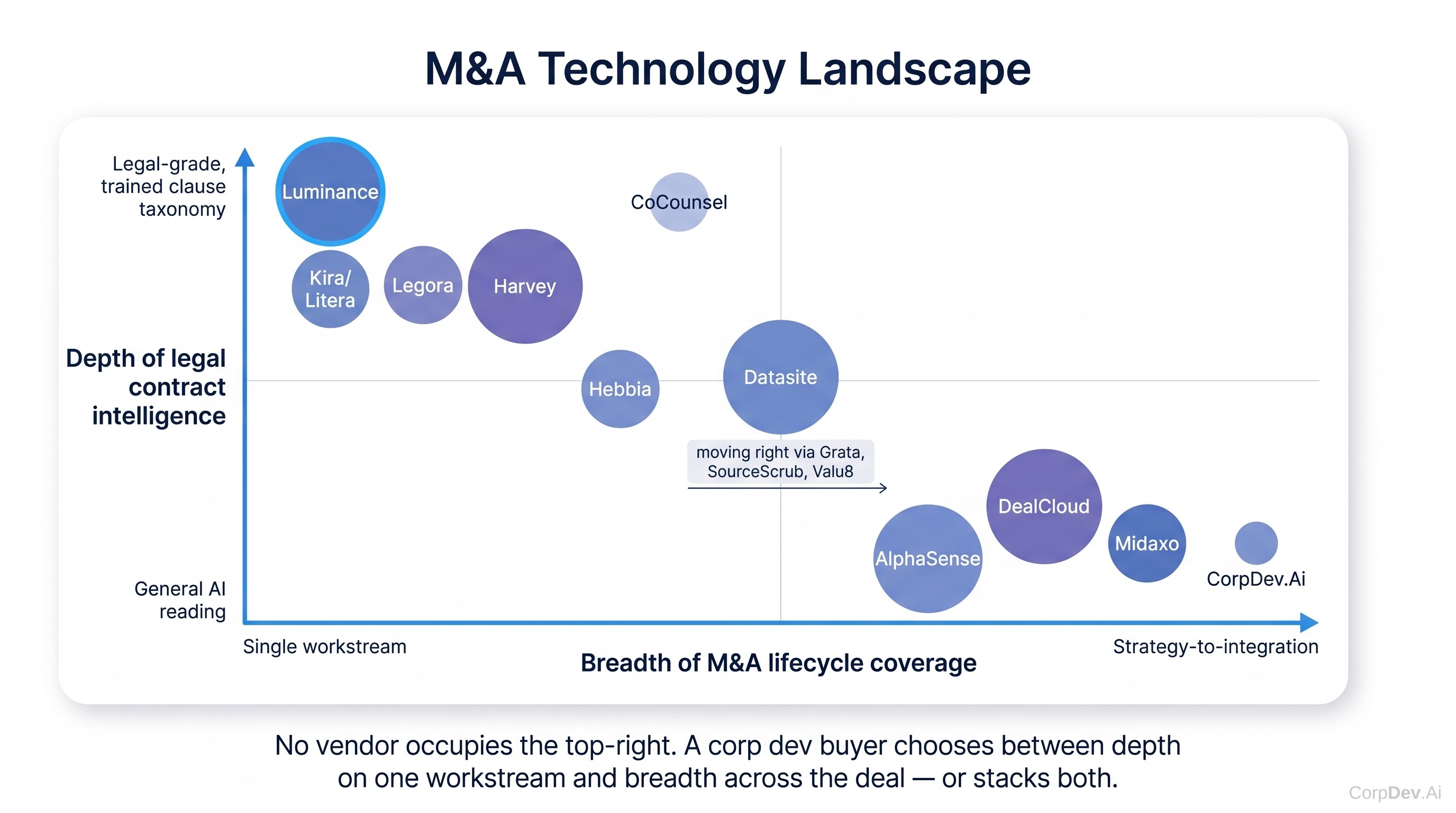
Positioning comparison. First dimension "Breadth of M&A lifecycle coverage" from "Single workstream" on the left to "Strategy-to-integration" for analytical platforms. Second dimension "Depth of legal contract intelligence" from "General AI reading" at the bottom to "Legal-grade, trained clause taxonomy" at the top. The comparison also lists approximate annual cost to a mid-size buyer. Top-left cluster (narrow, legal-grade): Luminance, Kira/Litera (medium), Legora ( slightly right), Harvey (slightly right of Legora). Upper-middle: CoCounsel. Middle: Hebbia ( centre-left, mid height), Datasite (centre, mid height, with a note "moving right via Grata, SourceScrub, Valu8"). Bottom-right cluster (broad, general AI): CorpDev.Ai (far right, low), Midaxo ( right), DealCloud ( right-centre, lowest), AlphaSense ( centre-right, low). "No vendor occupies the top-right. A corp dev buyer chooses between depth on one workstream and breadth across the deal — or stacks both."
Recommendations by Buyer Profile
The right answer depends on deal cadence, where legal work is done, and team size. Six profiles cover most corporate development functions.
Bottleneck: origination, screening, memos.
Buy: a corporate development platform — CorpDev.Ai on AI Pro or AI Pro Team is the lowest-friction entry at published prices; Midaxo if governance and PMI matter more than sourcing.
Do not buy: Luminance, Harvey or Legora. Ask counsel which AI they run and negotiate fees accordingly.
Add later: AlphaSense or Hebbia if research volume outgrows the platform's built-in analyst.
Bottleneck: data-room throughput and consistency of legal findings.
Shortlist: Luminance, Kira/Litera, Legora — bake off on your own historical data rooms. Luminance's institutional memory and multilingual strength are genuine differentiators here [82][25].
Pair with: a system of record (Midaxo, DealCloud or CorpDev.Ai) so findings persist, and check whether Datasite's Legora integration covers the need inside the VDR first [62].
Bottleneck: integration and adoption, not raw capability.
Buy: AI from incumbents first — Datasite's Blueflame and Legora add-ons, DealCloud's AI features — then fill gaps with a research copilot (Hebbia, AlphaSense).
Luminance: only if the legal function sponsors it and the volume case is proven; otherwise it becomes a fifth contract nobody owns.
Bottleneck: reading and synthesising data rooms, filings and models fast.
Buy: Hebbia (matrix-style diligence) or Rogo (research assistant), alongside the incumbent VDR.
Luminance: competitive for the legal slice of diligence, but Hebbia will also read the financials, customer schedules and management presentation.
Bottleneck: thousands of legacy contracts to normalise; ongoing BAU legal volume.
Buy: Luminance Corporate and Autopilot are a genuine fit, as the Interfood deployment illustrates [91]. Compare with Ironclad or Evisort/Workday if the need is lifecycle management rather than review [39][43].
Corp dev platforms: not relevant to this job.
Bottleneck: landscape research, segmentation, monitoring.
Buy: AlphaSense for licensed-content depth; CorpDev.Ai for AI-generated market maps, segmentation and target lists at a published $12K–$36K individual-to-three-user entry price; compare matched users and content entitlements [50].
Luminance: no role at this stage.
A team of three running two or three deals a year can assemble a complete AI-enabled stack — CorpDev.Ai AI Pro Team ($36,000 a year, published), a per-transaction Datasite or Ansarada room ($15,000–$30,000 per deal, estimated) and counsel who bring their own Harvey or Legora — with software spending of $66,000–$126,000 a year (platform plus two to three rooms), before counsel, implementation and other services. That software subtotal is below the cited $150,000 Luminance first-year TCO floor, but it does not establish that the complete stack costs less. The comparison is indicative and assumes third-party estimates hold; it is the calculation every buyer should run with real quotes [50][63][18].
How to Run the Bake-Off
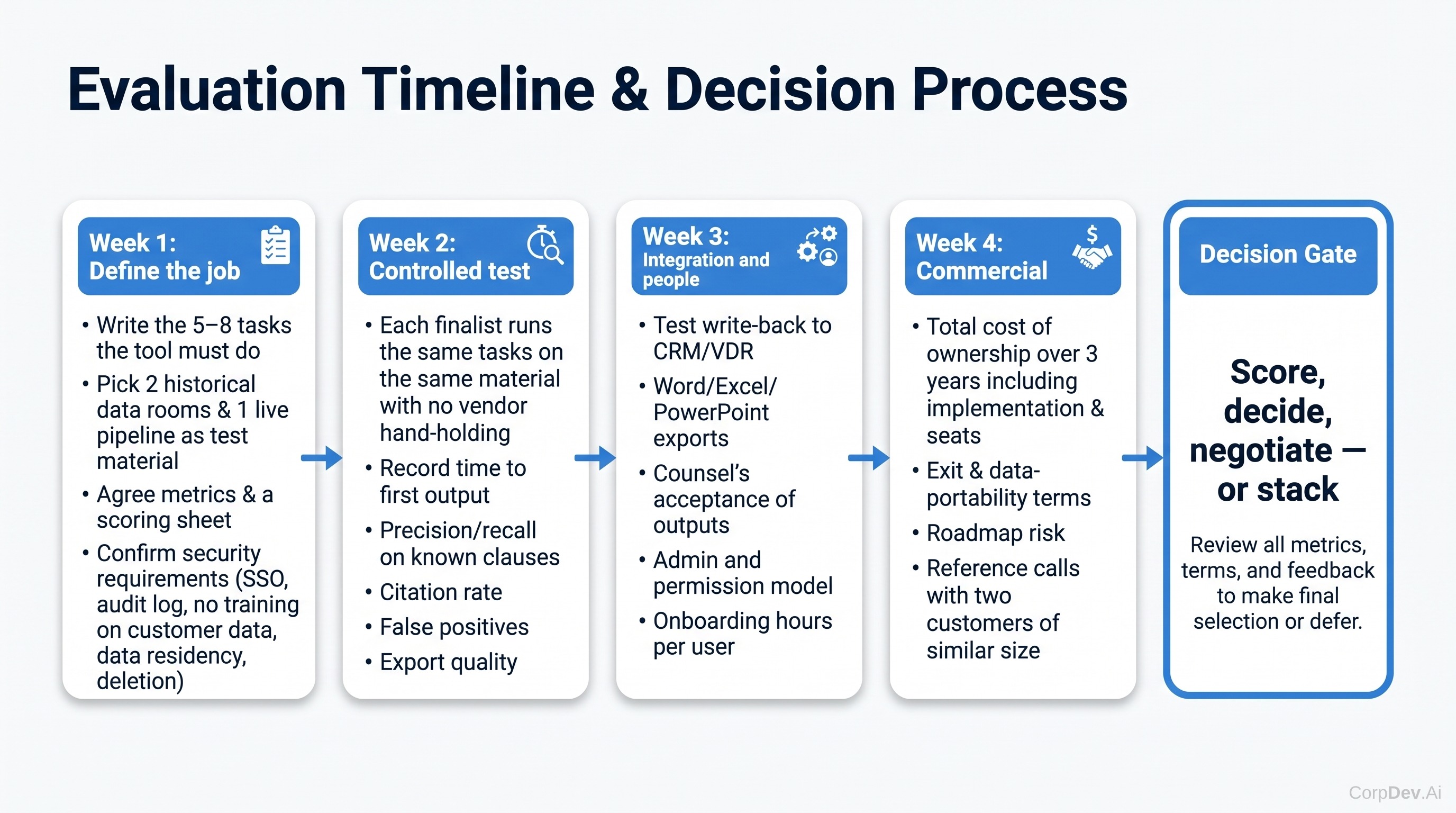
The survey evidence is unambiguous about the gap between AI enthusiasm and AI results: 87% of general counsel report generative-AI use in their teams, yet only 7% of legal teams say they have scaled it successfully and 83% cannot measure whether the spend is working [76][80]. Those surveys do not establish why adoption fails or prove that procurement discipline alone explains the gap. A structured four-week evaluation can test task fit, integration, user adoption and commercial viability before a larger commitment.
Read diagram description
Four-stage timeline.
Week 1 "Define the job": write the 5–8 tasks the tool must do, pick 2 historical data rooms and 1 live pipeline as test material, agree metrics and a scoring sheet, confirm security requirements (SSO, audit log, no training on customer data, data residency, deletion).
Week 2 "Controlled test": each finalist runs the same tasks on the same material with no vendor hand-holding; record time to first output, precision/recall on known clauses, citation rate, false positives, export quality.
Week 3 "Integration and people": test write-back to CRM/VDR, Word/Excel/PowerPoint exports, counsel's acceptance of outputs, admin and permission model, onboarding hours per user.
Week 4 "Commercial": total cost of ownership over 3 years including implementation and seats, exit and data-portability terms, roadmap risk, reference calls with two customers of similar size. A decision gate at the end labelled "Score, decide, negotiate — or stack".
Test material
Use your own documents, never the vendor's demo set. The minimum is two historical data rooms where you already know the answers — where the change-of-control clauses were, what counsel found, how long it took — plus one live pipeline segment for the platforms that claim sourcing and screening. Include purchase agreements, leases, employment and IP contracts, customer schedules and at least one non-English document set.
Metrics that discriminate between vendors
| Metric | Why it matters | Applies to |
|---|---|---|
| Precision and recall on a known clause set (change-of-control, assignment, termination, exclusivity, indemnity caps) | Separates trained legal taxonomies from general readers; the core Luminance-vs-Kira-vs-Hebbia question | Legal-grade and copilot vendors |
| Citation rate — share of findings linked to a specific document and page | Uncited output cannot be handed to counsel or an IC | All |
| False-positive burden — reviewer minutes spent dismissing incorrect flags | Reviewers cite this as Luminance's recurring cost [21][23] | Legal-grade vendors |
| Time to first usable IC pre-read from a fresh target name | The upstream productivity claim of corp dev platforms and copilots | CorpDev.Ai, Hebbia, Rogo, AlphaSense |
| Screening throughput — qualified targets per analyst-hour against a defined thesis | Origination claims are cheap to make and easy to test | CorpDev.Ai, Datasite (Grata/SourceScrub), AlphaSense |
| Write-back — can outputs land in the system of record with source links | Determines whether the tool builds institutional memory or a pile of PDFs | All intelligence layers |
| Onboarding hours to productive use per user | The hidden cost in six-figure enterprise deployments [18][20] | All |
| Three-year TCO including implementation, seats, credits and exit | Per-seat prices mislead; compare cost per completed workstream | All |
Red flags
- A vendor who will not run on your documents. Demo data is curated.
- Accuracy claims without a denominator. "90% time savings" means nothing without the baseline, document type and reviewer profile [8].
- No exportable audit trail. If the finding cannot be traced to a page, it will not survive counsel or the audit committee.
- Model-training terms that are silent on customer data. Every finalist should state in writing that customer data is not used for training; CorpDev.Ai and Luminance both do [50][8].
- Continuity risk. Check ownership and roadmap — Robin AI's partial wind-down in early 2026 is the cautionary case [47] — and, for young vendors including CorpDev.Ai, ask for data-portability terms up front.
- Pricing that only appears after the technical win. Insist on a written range in week one; vendors with published prices have removed this risk by design.
Luminance, Harvey, Legora and Kira are adopted or rejected by lawyers. A corp dev-led purchase needs committed legal users and an accountable legal sponsor; the General Counsel need not be a daily user. The 7% survey figure [80] does not identify lack of sponsorship as its cause. A deal-team platform has different daily users but can still require legal, security and procurement approval.
Key Facts & Sources
The load-bearing figures in this document, with source and as-of date. Figures marked "estimate" are third-party market estimates, not vendor disclosures; figures marked "company claim" are vendor statements not independently verified.
| Figure | Value | Basis | Source | As of |
|---|---|---|---|---|
| Luminance customers | 1,000+ organisations, 70 countries | Company claim | [8][90] | May 2026 |
| Luminance Series C | $75M, led by Point72 Private Investments | Reported | [10][12] | Feb 2025 |
| Luminance total funding | ~$165M (databases range $125M–$165M) | Reported, inconsistent | [11][85] | 2025–26 |
| Luminance valuation | ~$400M (PitchBook via Forbes); no disclosed Series C post-money | Reported | [9][14] | Apr 2025 |
| Luminance revenue growth | Doubled in 2025 (second consecutive year); North America +127% | Company claim | [82] | Jan 2026 |
| Luminance FY2024 statutory revenue | £15.7M revenue, £13.1M loss | UK filings via secondary coverage | [89] | FY2024 |
| Luminance ARR estimates | $27.6M (2024) to $60M | Third-party estimates | [87][88] | 2026 |
| Luminance first-year TCO | $150,000–$500,000+ | Third-party estimate | [18][19] | Jul 2026 |
| Luminance G2 rating | 4.9/5 on sparse review volume | Aggregator | [20] | 2026 |
| Luna Crescent launch | Proprietary contract LLM; up to 4x faster contract Q&A (company claim) | Reported | [97][98] | Jun 2026 |
| Harvey funding | $550M at $15.5B valuation; prior $200M at $11B | Reported (Reuters) | [32][33] | Sep 2026 |
| Harvey pricing | $1,000–$2,000 per user per month; 20–50 seat minimums | Market reports | [30][31] | Sep 2026 |
| Harvey scale | 100,000+ lawyers, 1,300 organisations | Company claim | [34] | Jun 2026 |
| Legora funding | $550M Series D at $5.55B; extended to ~$600M at $5.6B | Reported | [27][28] | Mar–Aug 2026 |
| Legora pricing | ~$3,000 per user per year, 10-user minimum; ~$280,000 average contract | Market report | [26] | Jul 2026 |
| CoCounsel pricing | ~$225 per user per month Core; $400–$639 with Westlaw bundles | Market reports | [37][38] | Jun 2026 |
| Hebbia funding | ~$161M raised (a16z, Index, GV) | Reported | [35][36] | May 2026 |
| Rogo funding | $160M Series D at ~$2B | Single report, unverified | [74] | May 2026 |
| CorpDev.Ai pricing | AI Pro $1,000/mo annual ($1,200 monthly); AI Pro Team $3,000/mo for 3 users; Enterprise custom | Published list price | [50] | Sep 2026 |
| CorpDev.Ai security | SOC 2 Type II; no training on customer data | Company claim | [50] | Sep 2026 |
| Datasite acquisitions | Grata (Jun 2025), Blueflame (Jul 2025), SourceScrub (Aug 2025), Valu8 (May 2026); $500M CapVest commitment | Company announcements | [66][67][68][69] | 2025–26 |
| Datasite pricing | $15,000–$100,000+ per transaction; $25,000–$150,000+ annually | Third-party estimate | [63][64] | Aug 2026 |
| Midaxo / Devensoft pricing | $10,000–$40,000 small teams; $60,000–$200,000+ enterprise | Third-party estimate | [63][73] | Jul 2026 |
| DealCloud pricing | $30,000–$120,000 annually, larger deployments higher | Third-party estimate | [63] | Jun 2026 |
| Robin AI status | Partial wind-down; managed services to Scissero, engineering to Microsoft | Reported | [47] | Early 2026 |
| GC generative-AI adoption | 87%, up from 44% | FTI Consulting / Relativity survey | [76] | Mar 2026 |
| Legal teams that scaled AI successfully | 7%; 83% cannot measure ROI | Axiom survey | [80] | Jun 2026 |
| Harvey annual cost range | $240,000–$1,200,000 | Derived: $1,000–$2,000 × 20–50 seats × 12 | [30][31] | Sep 2026 |
| Median-team stack estimate | ~$36,000 platform + $15,000–$30,000 per deal VDR vs. $150,000+ Luminance | Derived from rows above | [50][63][18] | Sep 2026 |
Method note. Vendor capability scores in the Head-to-Head matrix are the authors' qualitative assessment from the cited product documentation, third-party reviews and market coverage; they are not the result of a controlled test and should be replaced by the buyer's own bake-off scores. Where sources disagree (Luminance total funding, headcount, ARR), the disagreement is stated rather than resolved.
References
Numbering follows the original research. Access dates below record the original source registry; they do not imply that every source was rechecked for this website edition.
- Over 30 Luminance customers deploy both Diligence and DiscoverySource accessed 2026-09-11
- Leading Italian Law Firm, Portolano Cavallo, Becomes First to Adopt ...Source accessed 2026-09-11
- Luminance Showcases World's First Completely AI- ...Source accessed 2026-09-11
- Luminance Launches “Agent Lumi”, Automating Legal ...Source accessed 2026-09-11
- Luminance: Legal-Grade™ AISource accessed 2026-09-11
- Luminance | Company Overview & News - ForbesSource accessed 2026-09-11
- Legal tech startup Luminance, backed by the late Mike ...Source accessed 2026-09-11
- Luminance Raises $75 Million in Series CSource accessed 2026-09-11
- British legaltech Luminance secures $75M Series CSource accessed 2026-09-11
- Report: Luminance Business Breakdown & Founding StorySource accessed 2026-09-11
- Luminance Named to Forbes AI 50 List of Most Promising ...Source accessed 2026-09-11
- Luminance Legal AI Review: Pricing, Architecture & FitSource accessed 2026-09-11
- Luminance AI Contract Review: Evaluation for Legal TeamsSource accessed 2026-09-11
- Luminance: Details, Reviews, Pricing, & Features | CheckThat.aiSource accessed 2026-09-11
- Luminance AI Review — Best for Due Diligence? Honest Verdict ...Source accessed 2026-09-11
- Is Luminance Worth It? AI Business Review (2026)Source accessed 2026-09-11
- Spellbook vs Luminance (2026): Data‑driven comparisonSource accessed 2026-09-11
- M&A Due DiligenceSource accessed 2026-09-11
- Swiss firm Kellerhals Carrard adopts Luminance for M&A due ...Source accessed 2026-09-11
- Legora | rlegaltech.comSource accessed 2026-09-11
- Legora raises $550 million Series D to fuel US growthSource accessed 2026-09-11
- Legora revenue, valuation & funding | SacraSource accessed 2026-09-11
- Legora raises $550 million Series d to fuel US growthSource accessed 2026-09-11
- Harvey revenue, valuation & funding | SacraSource accessed 2026-09-11
- Harvey AI Pricing in 2026: What It Really Costs (and Cheaper ...Source accessed 2026-09-11
- Legal AI startup Harvey reaches $15.5 billion valuation in ...Source accessed 2026-09-11
- Harvey Raises at $11 Billion Valuation to Scale Agents ...Source accessed 2026-09-11
- Harvey: Revenue, Funding & Valuation (2026) - valueaddvc.comSource accessed 2026-09-11
- Hebbia | rlegaltech.comSource accessed 2026-09-11
- Hebbia revenue, valuation & funding | SacraSource accessed 2026-09-11
- CoCounsel — Pricing, Features & Score | Agentic IndexSource accessed 2026-09-11
- CoCounsel (Thomson Reuters) Pricing 2026: Plans, Configurator ...Source accessed 2026-09-11
- Ironclad Review 2026: An Honest Assessment for In-House ...Source accessed 2026-09-11
- Evisort After Workday Acquisition: 2026 Contract AI RoadmapSource accessed 2026-09-11
- 4. Unique ObservationsSource accessed 2026-09-11
- CorpDev.Ai for Excel - appsource.microsoft.comSource accessed 2026-09-11
- PricingSource accessed 2026-09-11
- M&A Software & Intelligence Platform | MidaxoSource accessed 2026-09-11
- A platform designed by industry experts - intapp.comSource accessed 2026-09-11
- One platform to power sourcing, strategy, and scaled value creationSource accessed 2026-09-11
- What AI capabilities does Datasite offer across the deal ...Source accessed 2026-09-11
- Investment Banking | HebbiaSource accessed 2026-09-11
- Hebbia | AI built for the rigor of financeSource accessed 2026-09-11
- Rogo scales AI-driven financial research with OpenAI o1Source accessed 2026-09-11
- Data Room & Dealmaking NewsSource accessed 2026-09-11
- Best Due Diligence Platforms for M&A in 2026: 12-Vendor Buyer's ...Source accessed 2026-09-11
- Best Virtual Data Rooms for M&A in 2026: The 10 VDRs Compared ...Source accessed 2026-09-11
- Datasite Acquires Valu8 to Further Accelerate Global, AI- ...Source accessed 2026-09-11
- Datasite Acquires Leading Agentic AI Company BlueflameSource accessed 2026-09-11
- Datasite Acquires Leading Private Market Intelligence ...Source accessed 2026-09-11
- Datasite to Acquire Sourcescrub, Expanding Private Market Intelligence SolutionsSource accessed 2026-09-11
- I Compared 15 M&A Due Diligence Software Tools in 2026 ...Source accessed 2026-09-11
- AI for M&A (2026): Complete Tool Landscape and Vendor ...Source accessed 2026-09-11
- Midaxo closes Q2 with new customers and a major AI updateSource accessed 2026-09-11
- Best M&A Software 2026: Category-by-Category GuideSource accessed 2026-09-11
- The AI analyst stack: Rogo, Hebbia, and Bridgetown converge on ...Source accessed 2026-09-11
- AI Adoption in Corporate Legal Departments DoublesSource accessed 2026-09-11
- Legal AI is Everywhere, Now Comes the Hard Part.Source accessed 2026-09-11
- Luminance Launches New Legal AI With Institutional Memory ...Source accessed 2026-09-11
- Legaltech Luminance unveils its biggest platform upgrade in a decadeSource accessed 2026-09-11
- ElevenLabs, Synthesia, Luminance : the British scale-ups on the rise ...Source accessed 2026-09-11
- Luminance Funding: $125.0M Raised, Investors & History (2026 ...Source accessed 2026-09-11
- Luminance Revenue 2024: $27.6M ARR - GetLatkaSource accessed 2026-09-11
- Luminance revenue, funding & growth rate - SacraSource accessed 2026-09-11
- Luminance Technologies secures £76.2k following major ...Source accessed 2026-09-11
- Luminance Awarded 2026 King's Award for Enterprise in ...Source accessed 2026-09-11
- Interfood Deploys Luminance to Centralize Global Contract ...Source accessed 2026-09-11
- Luminance Launches Customer Advisory Board to Bring ...Source accessed 2026-09-11
- Luminance upgrades world-first AI-powered contract ...Source accessed 2026-09-11
- The Next Frontier for Contract Work : Legal-Grade™ AI ... - LuminanceSource accessed 2026-09-11
- LexisNexis and Luminance Announce Strategic Alliance to Extend ...Source accessed 2026-09-11
- Luminance launches proprietary AI model designed specifically for ...Source accessed 2026-09-11
- Luminance Launches Proprietary LLM for Contract Work | Law.comSource accessed 2026-09-11
- Luminance Appoints Daniel Head as President to ...Source accessed 2026-09-11
- Eleanor Lightbody's Post - LinkedInSource accessed 2026-09-11
- All-In on Legal AI: The Rise of the AI-Powered Enterprise in 2025Source accessed 2026-09-11
- The Best Legal AI Agents for In-House Teams: Harvey vs ...Source accessed 2026-09-11