RESEARCH / Adviser intelligence and transaction data
MergerLinks Alternatives: M&A Adviser Data and Deal Software
Compare MergerLinks with financial terminals, sourcing platforms, CRMs and CorpDev.Ai on adviser track records, transaction data, workflow, pricing and evidence.
Research as of
Website edition edited
Published by CorpDev.Ai, which is one of the vendors assessed. This analysis distinguishes vendor claims, external evidence and analyst judgments. Prices and capabilities reflect the source dates in the article; the website edition is an editorial adaptation, not a new verification of every claim.
Use adviser activity as evidence for selection, not as a verdict on quality
MergerLinks changes the unit of adviser evaluation from the institution to the individuals who worked on qualifying transactions. That distinction matters when a recognised firm’s credentials do not reveal whether the proposed team has executed the relevant sector, geography or deal type. The platform can improve the evidence behind a shortlist and the questions asked during adviser selection.
Its rankings still measure attributed activity under defined inclusion rules. They do not establish execution quality, commercial judgment, fees or client satisfaction. Nor does a transaction record without the necessary operating financials substitute for valuation evidence. Treating MergerLinks as a cheaper general deal database would miss both its distinctive value and its limits.
Start with ten known transactions and inspect individual attribution, missing deals and the treatment of undisclosed values. Use the resulting shortlist to test the proposed team’s actual roles and obtain relevant references. For existing Datasite customers, request explicit bundling and continuity terms; potential integration with sourcing data is useful context, but an undisclosed roadmap should not be purchased as a committed capability.
Executive Summary
CorpDev.Ai publishes this comparison and is one of the products compared. Its analyst tooling supported the research and writing. We have applied the same evidentiary standard to every vendor — published pricing, coverage claims, verified customer evidence, and independent reviews — and we state plainly where CorpDev.Ai's evidence base is thinner than that of incumbents. Readers should weigh the CorpDev.Ai section with that in mind and validate it in a trial.
A consequential mistake buyers can make with MergerLinks is to evaluate it as a cheaper PitchBook or Capital IQ. It is not one. MergerLinks is a people-and-advisor intelligence layer for M&A: it links every qualifying transaction (global, £10M+ since 2015) to the individual bankers, lawyers, accountants and PR advisers who executed it, then ranks those people and firms in league tables and offers a matchmaking service that pairs principals with advisers [5][4]. Since August 2023 it has been a product unit of Datasite, the virtual-data-room group that has since bought Grata, Sourcescrub, BlueFlame AI and Valu8 to assemble an end-to-end deal platform [1][123][124][138]. That ownership matters more to a 2026 buyer than any single feature.
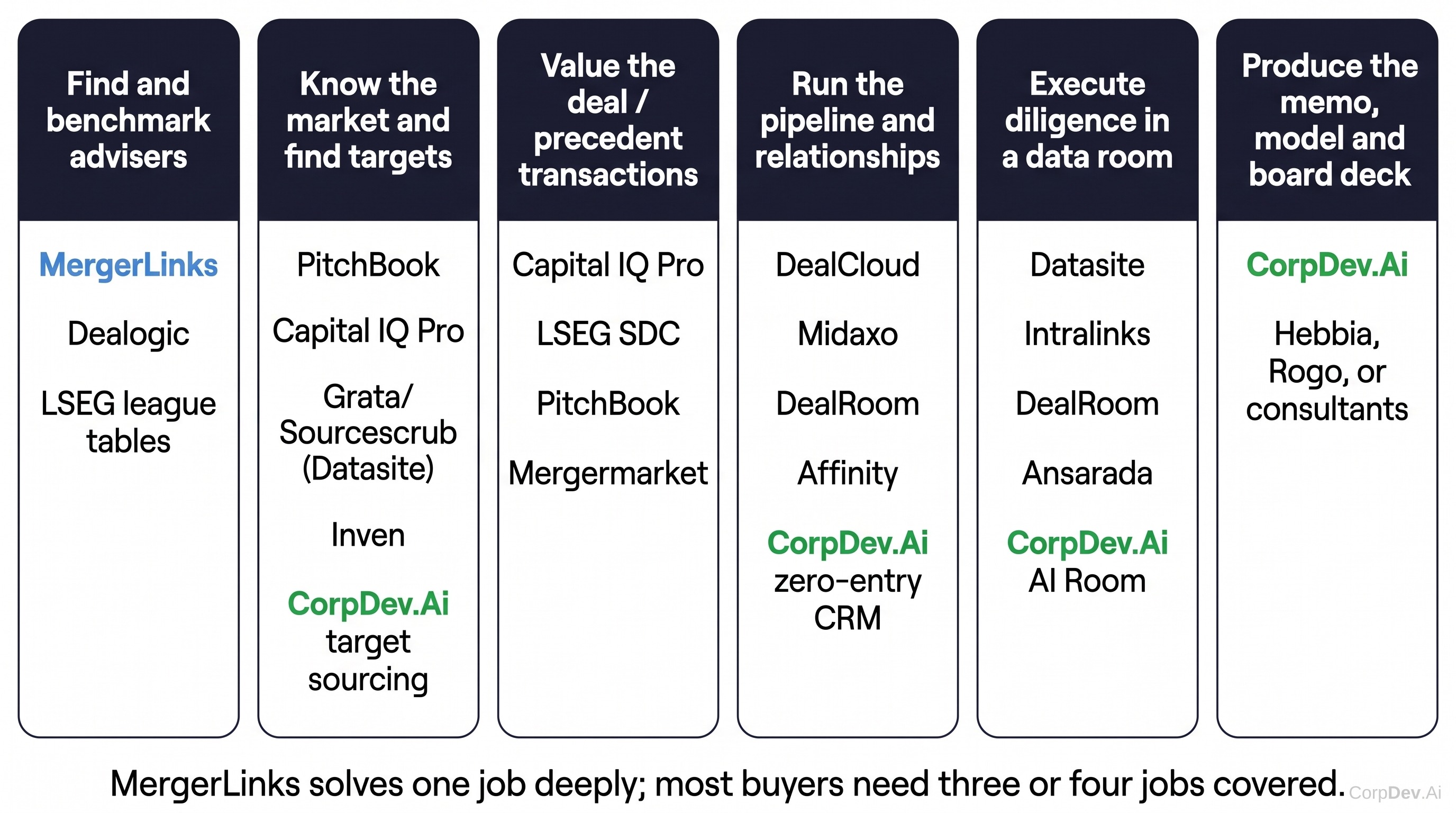
For a corporate development, strategy or M&A professional, the practical implication is that MergerLinks answers one question exceptionally well — who has actually done deals like mine, and how do I reach them — and does not attempt to answer the other five questions a corp dev team pays software for: what is the market and who are the targets; what did comparable deals trade at; how do I run the pipeline; how do I execute diligence; and how do I produce the board-grade memo, model and deck. Each of those jobs has a distinct set of vendors, and the alternatives split cleanly into four categories with very different price points and failure modes.
£10M+
MergerLinks deal-inclusion threshold, global, 2015 onward
356K+
Dealmakers ranked in MergerLinks FY2025 league tables
$12K–$60K
Typical per-seat range across data terminals
$12K–$36K
CorpDev.Ai published annual price (1 seat / 3 seats)
Our headline conclusions for a buyer:
- Buy MergerLinks when adviser selection or adviser benchmarking is the job. If you are a principal choosing a sell-side bank, checking counsel's real track record, or a boutique adviser that needs credentials and inbound leads, MergerLinks is the most direct tool available and its methodology is published [5]. Transaction profiles are free to registered users; paid tiers are quote-only [5][10].
- Do not buy MergerLinks as your deal database. Its £10M threshold, reliance on public attribution and absence of company financials mean it cannot substitute for S&P Capital IQ Pro, PitchBook or LSEG for precedent-transaction valuation or private-company screening [5][22][17][24].
- The category is consolidating around workflow, not data. Datasite’s four acquisitions from June 2025 to May 2026, PitchBook's Navigator, S&P's ChatIQ, LSEG's Deep Research agent and the AI-native entrants all point the same way: the terminal interface is being unbundled from the data, and the vendor that owns the deal workflow captures the budget [126][132][134][138].
- The realistic 2026 corp dev stack is two to three tools, not one. A structured data terminal for facts, an AI-native workspace or workflow platform for producing the work, and — for teams that run formal processes — a VDR. MergerLinks is an optional fourth layer for teams that engage advisers frequently.
- CorpDev.Ai is the most complete single-workspace answer for producing the deliverables, with published annual pricing of $12K for one user or $36K for three users, overlapping the terminal-seat estimates below, but it is a young vendor with no publicly verifiable customer references and no curated transaction database of its own; it should be bought as the workspace layer on top of a data source, not as a replacement for one [97][103].
Read diagram description
Map with six columns, each a "job to be done" for a corporate development team: (1) "Find and benchmark advisers" — answered by MergerLinks, Dealogic, LSEG league tables; (2) "Know the market and find targets" — answered by PitchBook, Capital IQ Pro, Grata/Sourcescrub (Datasite), Inven, CorpDev.Ai target sourcing; (3) "Value the deal / precedent transactions" — answered by Capital IQ Pro, LSEG SDC, PitchBook, Mergermarket; (4) "Run the pipeline and relationships" — answered by DealCloud, Midaxo, DealRoom, Affinity, CorpDev.Ai zero-entry CRM; (5) "Execute diligence in a data room" — answered by Datasite, Intralinks, DealRoom, Ansarada, CorpDev.Ai AI Room; (6) "Produce the memo, model and board deck" — answered by CorpDev.Ai, Hebbia, Rogo, or consultants. MergerLinks appears only in column 1. CorpDev.Ai appears in columns 2, 4, 5 and 6 but not in column 1 or 3. "MergerLinks solves one job deeply; most buyers need three or four jobs covered."
Who Is This Guide For, and How to Read It
This guide is written for the person who signs, or recommends, a software purchase for an in-house M&A function. Four buyer profiles recur, and the right answer differs materially for each:
Team: 1–5 people at a $1B+ company
Deals: 1–6 per year, often programmatic bolt-ons
Pain: thin team, high stakes, disconnected tools, consultants at $200K–$2M per deal
Budget reality: 71% of corp dev teams run fixed tech budgets under $250K across all M&A tool categories [139]
Team: strategy or transformation office
Deals: occasional; more market maps than transactions
Pain: needs sector intelligence and strategic-options work, not a deal CRM
Buys: research and deliverable tooling first, data terminal second
Team: 5–50 professionals
Deals: many mandates per year
Pain: credentials, league-table position, lead flow
Buys: MergerLinks or Mergermarket for visibility; a CRM; a VDR per mandate
Team: deal team plus operating partners
Deals: high volume of screens, few closes
Pain: proprietary sourcing and speed to conviction
Buys: PitchBook or Grata, DealCloud or Affinity, Datasite or Intralinks
The evaluation lens. Every product below is scored against the same six criteria, because vendors' own marketing deliberately blurs them:
- Data coverage and provenance — how many companies and transactions, how the data is gathered, and whether a figure can be traced to a primary source and defended to an investment committee.
- Workflow breadth — how many of the six corp dev jobs (advisers, market/targets, valuation, pipeline, diligence, deliverables) the product covers natively.
- AI capability — whether AI is a search box bolted on, or a working agent that produces cited output; and whether it is included or surcharged.
- Pricing transparency and access model — published list price versus quote-only; named seats versus pooled; export and API rights.
- Independent evidence — verified customer references and review volume, not vendor claims.
- Strategic durability — ownership, consolidation exposure, and whether the vendor is likely to be the same product in three years.
Where a figure is a market estimate rather than a published list price, we say so in the text and again in the Key Facts & Sources appendix. Nothing in the pricing tables should be quoted to a vendor as their list price without confirming it in a current proposal.
What MergerLinks Actually Is
Origins and ownership
MergerLinks Limited was founded in London by Bartosz Jaskula (founder-CEO tenure from 2017; company launch 2018) as a data platform "dedicated to M&A talent" — the explicit premise being that deals are done by people, and the person's track record is a more useful unit of analysis than the firm's [7][11][4]. Datasite completed its acquisition of MergerLinks on 23 August 2023 for an undisclosed sum, retaining the management team and running it as a strategic product unit [1][2]. Datasite's stated rationale was that MergerLinks adds deal intelligence, professional credentials and relationship data to a platform that previously started at the data-room stage [1].
That acquisition was the first move in what has become the most aggressive consolidation programme in the category. Datasite subsequently acquired Grata (June 2025, with a $500M investment commitment from its controlling shareholder), Sourcescrub (announced August 2025, from Francisco Partners), BlueFlame AI (July 2025) and Valu8 (May 2026) [123][124][122][138]. A buyer evaluating MergerLinks in September 2026 is therefore evaluating one tile in a mosaic that Datasite is still assembling; how MergerLinks' people data will be bundled with Grata/Sourcescrub's company data and the Datasite VDR has not been publicly detailed.
What the product does
Read diagram description
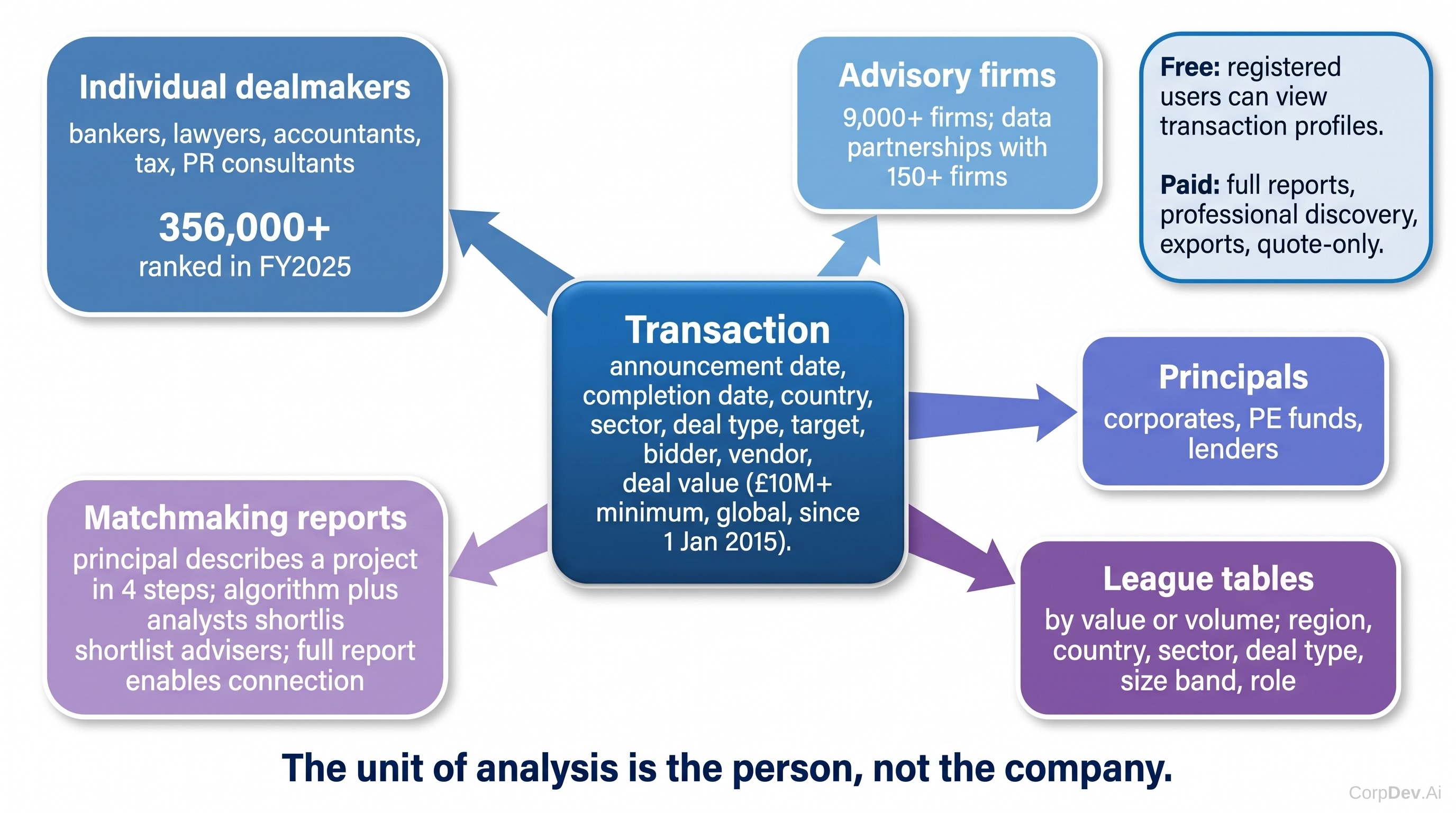
Hub-and-spoke diagram. Centre node: "Transaction" with fields announcement date, completion date, country, sector, deal type, target, bidder, vendor, deal value (£10M+ minimum, global, since 1 Jan 2015). Spokes to: "Individual dealmakers" (bankers, lawyers, accountants, tax, PR consultants — 356,000+ ranked in FY2025), "Advisory firms" (9,000+ firms; data partnerships with 150+ firms), "Principals" (corporates, PE funds, lenders), "League tables" (by value or volume; region, country, sector, deal type, size band, role), and "Matchmaking reports" (principal describes a project in 4 steps; algorithm plus analysts shortlist advisers; full report enables connection). "Free: registered users can view transaction profiles. Paid: full reports, professional discovery, exports, quote-only." "The unit of analysis is the person, not the company."
The platform has three functional layers, and a buyer should be clear about which one they are paying for:
1. Transaction database with adviser attribution. Searchable deal profiles carrying date, geography, sector, deal type, parties and value, filterable through the public search interface [3]. The inclusion rules are published: global coverage, announced from 1 January 2015 onward, minimum £10 million deal value, with turnover or asset tests applied where value is undisclosed [5]. The distinctive attribute is that each deal is attributed not only to advisory firms but to the named individuals on each side — financial, legal, accounting, tax and PR advisers — and increasingly to the principals' executives [4][5].
2. League tables and rankings. Rankings of individual bankers, lawyers and firms by cumulative deal value or transaction count, segmentable by region, country, sector, deal type, deal-size band and role [5]. The FY2025 tables covered EMEA, North America and APAC and drew on more than 356,000 dealmakers [6][8][9]. Firm rankings use a relative-market-share method blending value and volume; individual tables use cumulative value or count [5]. MergerLinks' tables are syndicated by publishers including Bloomberg, Financial News, The Banker and Legal Week, which is the source of most practitioners' familiarity with the brand (publisher list on mergerlinks.com, September 2026).
3. Matchmaking for principals. The current front page leads not with data but with a service: a principal (raising equity, borrowing, refinancing, selling, acquiring, investing or lending) describes a project in four steps, algorithms screen a talent pool the company describes as 120,000+ M&A experts, a free sample report is produced, and analysts "curate results for the final polish" before a full paid report enables direct connection (mergerlinks.com, September 2026) [4]. The advisor-facing proposition is the mirror image — "turn your experience into new business" — with advisers invited to become content partners and receive matched leads (mergerlinks.com/advisors, September 2026) [4].
Coverage, pricing and evidence
| Dimension | What is verifiable | What is not |
|---|---|---|
| Deal coverage | Global, £10M+, since 2015; published inclusion methodology [5] | Total transaction count; share of undisclosed-value deals carrying value credit |
| People coverage | 120,000+ experts (current site), 240,000+ professionals and 9,000+ firms (Datasite 2023), 356,000+ dealmakers (FY2025 tables) [4][2][6] | Which definition each figure uses; buyers should ask what each count includes |
| Data partnerships | "Data from 150+ market-leading firms" across finance, law, accounting and PR (mergerlinks.com, September 2026) | Which firms submit directly versus being captured from public sources |
| Pricing | Transaction profiles free to registered users [5]; onboarding wizard rather than a price list [10] | Any published seat, report or enterprise price; Datasite bundling terms |
| Customer evidence | Publisher syndication of league tables; adviser content partners | Verified product reviews from bankers, lawyers or corp dev users — Glassdoor shows only three employee reviews and there is no meaningful G2 or Capterra footprint [12] |
Strengths
- A genuinely different data model. Linking transactions to named individuals rather than to firms makes MergerLinks the only mainstream tool where "which partner actually ran the last five mid-cap packaging carve-outs in DACH" is a first-class query [4][5]. Dealogic and LSEG attribute to firms; PitchBook attributes to firms and lists people separately.
- Transparent methodology. The inclusion, ranking and league-table criteria are published in a single document [5] — unusual in a category where most vendors treat methodology as proprietary.
- Adviser benchmarking for pitches and panel reviews. For a corporate choosing among banks or law firms, or for an adviser defending its position on a panel, the tables are directly usable evidence.
- Free entry point. Registration and transaction-profile viewing cost nothing, which lets a buyer test coverage against known deals before any commercial conversation [5].
- Institutional parent. Datasite ownership provides greater operating backing than a standalone data start-up, while acquisition, product-retirement and continuity risks remain and creates the option value of integration with a VDR and sourcing suite [1].
Limitations a buyer must price in
The £10M threshold, the reliance on public attribution, and the absence of target financials mean MergerLinks alone cannot support a complete valuation-comps analysis: it can identify relevant deals and advisers, but additional financials and transaction terms are needed, screen private companies by revenue or EBITDA, or estimate a multiple. Teams that buy it expecting a "PitchBook-lite" will be disappointed within a week. Buy it for the people layer or not at all.
- No company financials, no ownership data, no valuation multiples. The deal record is who-did-what; there is no operating data on the target or buyer [3][5].
- Value credit depends on disclosure. Undisclosed-value deals receive volume credit but not value credit, which systematically favours large-cap public-market advisers in value tables and under-represents mid-market specialists [5].
- Rankings measure qualifying activity, not quality. A top position means high qualifying deal flow under MergerLinks' rules in a chosen period and segment; it is not evidence of execution quality, fee level or client satisfaction [5].
- Opaque paid pricing. No public price card exists; the commercial model appears to combine free profiles, paid matchmaking reports and negotiated data access, possibly bundled with Datasite [10]. This makes like-for-like budgeting against alternatives impossible without a sales conversation.
- Thin independent evidence. There is no substantial body of verified customer reviews assessing data accuracy, usability or ROI [12]. Buyers should run a coverage test against ten known transactions in their own sector and geography.
- Strategic uncertainty under Datasite. Datasite is integrating five acquisitions; product roadmaps, packaging and pricing for the intelligence units are in flux. A buyer should ask directly how MergerLinks will be bundled with Grata/Sourcescrub and on what timeline [123][124][138].
Who should buy it
MergerLinks is the right purchase for advisers who need credentials and lead flow, for corporates and sponsors choosing advisers on a recurring basis, and for business-development teams at law and accounting firms benchmarking competitors. It is a poor fit as the primary tool for a corp dev team whose main jobs are target screening, valuation and deliverable production — those buyers should read on.
The Alternatives Landscape
Category 1: Deal & Financial Data Terminals
These are the incumbents a corp dev team is most likely already paying for, and the products against which MergerLinks is most often — wrongly — compared. Their job is facts: company financials, ownership, transaction terms, estimates and formal league tables, with a defensible provenance trail. None of them is a workflow tool, and all of them are priced as if the buyer were an investment bank.
| Platform | Owner | Indicative annual price per seat (USD) | Private company coverage | Transaction coverage | Best for | Watch out for |
|---|---|---|---|---|---|---|
| S&P Capital IQ Pro | S&P Global | 15,000–30,000+ (quote-only) | 60M+ private companies, 16M+ with recent financials | 2M+ transactions incl. M&A, offerings, placements | Best all-round corp dev terminal: public + private, comps, screening, Excel | Headline private count vastly exceeds usable financial depth; premium modules and API lift price fast |
| PitchBook | Morningstar | 12,000–40,000+ (quote-only) | 5–6M companies, deepest on VC/PE-backed | 2.5–3M deals; ~478K corporate M&A | Private-market sourcing, sponsor ownership, valuations, fund data | Private financials often estimated; weaker for formal adviser league tables |
| LSEG Workspace / Deals Intelligence (SDC) | LSEG | 18,000–30,000 (quote-only; SDC separate) | 27M+ private companies, heterogeneous | 4M+ transactions, 225 countries, since 1970s | Historical precedent depth; formal M&A/ECM/DCM league tables | Feels like a markets terminal, not a corp dev app; packaging opaque |
| Mergermarket | ION Analytics | 15,000–30,000 (quote-only) | ~1.4M deal-relevant companies, 3,000 sponsors | Proprietary intelligence, not a census | Rumours, process intelligence, likely sellers 6–18 months out | Not a financials database; must be paired with a structured source |
| Dealogic | ION Analytics | 30,000–60,000+ (quote-only) | Limited for corp dev | Bank-grade, fee-attributed | Authoritative adviser league tables and fee analytics | Bank-centric; over-scoped and over-priced for most corporates |
| Bloomberg Terminal | Bloomberg | ~31,980 single; ~28,320 for 2+ seats | Moderate | Extensive but not a countable deal universe | Teams that also need real-time markets, treasury, IR | Most of the value is unrelated to M&A |
| FactSet | FactSet | 4,000–12,000 base; 30,000–50,000 fully loaded | Moderate | Module-dependent | Firms already standardised on FactSet | M&A private-company intelligence not best-in-class |
Sources for the table: S&P coverage [22][23]; PitchBook coverage and price [15][17][18][13][14]; LSEG coverage [24][25]; Mergermarket [32][34]; Dealogic [36][35]; Bloomberg [26][27][28]; FactSet [30]; price ranges are market estimates compiled in [31][35][21] and are not vendor list prices.
What a corp dev buyer should take from this. Capital IQ Pro is the default single terminal for a corporate acquirer because it balances public-company depth (which corporates need for their own comps and for listed targets) with a very large private universe [22]. PitchBook wins when the target universe is sponsor-backed or venture-backed, because its ownership and financing histories are unmatched [17][15]. LSEG's SDC and Dealogic are the only sources whose league tables are treated as authoritative by banks themselves — which is exactly the point of overlap with MergerLinks. The difference is that LSEG and Dealogic rank firms with fee attribution, while MergerLinks ranks people [25][36][5]. A corporate that engages advisers twice a year does not need Dealogic; one that needs to know which individual partner to call may find MergerLinks' free tier sufficient.
Every terminal in this category has spent 2025–2026 adding an AI layer: S&P's ChatIQ and Document Intelligence 2.0 with multi-document analysis and citation-based auditability [132]; LSEG's Workspace AI Search, Deep Research agent and MCP connector into Microsoft Copilot Studio [133][134][135]; PitchBook's Navigator with ChatGPT/MCP connectivity and LLM partnerships with Finster, Model ML and Farsight [126][127][129]. These are genuine improvements to search and summarisation, but they remain interfaces over the vendor's own data — they do not collectively amount to a native M&A system of record. Some now analyse uploaded documents and draft research, so memo, room-analysis and connector capabilities should be tested by product and licence rather than assumed absent. The strategic reading is that the terminals are positioning to become governed data suppliers to whatever agent layer the customer chooses [130][131].
Only Bloomberg publishes a de facto standard rate. Every other figure in the table above is a market estimate triangulated from procurement-benchmark sites and buyer reports in 2026 [14][21][26][31][35]. Actual quotes vary by multiples depending on firm type, seat count, modules, exports and API rights. Request identical configurations from each vendor before comparing.
Category 2: Deal-Flow and Advisor-Intelligence Platforms
This is the category MergerLinks most plausibly belongs to by lineage: platforms built to find — targets, buyers, investors or advisers — rather than to store facts or run process. The important 2026 fact is that its two strongest independent players, Grata and Sourcescrub, are now Datasite companies alongside MergerLinks, which means the "alternatives" to MergerLinks in this category are increasingly its sister products [123][124].
| Platform | Owner | Indicative annual price (USD) | Coverage | AI approach | Independent evidence (G2) | Primary buyer |
|---|---|---|---|---|---|---|
| Grata | Datasite (since Jun 2025) | 15,000–100,000, custom | 19M+ private companies | Agentic natural-language search, market maps | 4.9/5, 81 reviews | PE, corp dev, banks |
| Sourcescrub | Datasite (announced Aug 2025) | 10,000–25,000+, custom | 17M companies, ~290K source lists | List/source crawling, signal tracking | 4.5/5, ~56 reviews | PE, VC, corp dev, banks |
| Inven | Independent | 3,000–10,000 per user, custom | ~21M companies | AI-native search over unstructured descriptions | 4.7–4.8/5, ~88 reviews | Banks, PE, corp dev, advisory |
| Cyndx (historical; wind-down announced) | Independent at original research | Historical free tier; Raiser/Finder custom | Not disclosed | Discovery, buyer ID, cap tables, dynamic multiples | 4.6/5, 20 reviews | Banks, PE/VC, founders |
| Dealroom.co | Independent | €12,600–17,000 per year for packages starting at 3 seats (published [54]; website-edition check 14 Sep 2026) | 2M+ companies, 336K VC rounds | Hosted MCP server for AI assistants | 4.7/5, ~25 reviews | VC, ecosystems, corporate innovation |
| Tracxn | Independent | Free Lite; 4,400–15,000 paid | 8M+ companies, 3,000+ sectors | Tracxn AI Suite | Not reliably surfaced | VC, corp dev, tech research |
| Crunchbase | Independent | $348–$588 per user (published) | 4M+ companies | AI Search Builder (beta) | 4.4/5, ~410 reviews | Startup/VC, BD, light corp dev |
| MergerLinks | Datasite (since Aug 2023) | Free profiles; paid quote-only | Deals £10M+ since 2015; 120K–356K professionals | Matchmaking algorithms plus analyst curation | No meaningful product-review footprint | Advisers; principals choosing advisers |
Sources: Grata [37][38][39]; Sourcescrub [40][42][43]; Inven [49][51][52]; Cyndx [44][45][46]; Dealroom.co [53][54]; Tracxn [55][57][58]; Crunchbase [60][62][63]; MergerLinks [4][5][6][10][12].
Where MergerLinks sits. Grata, Sourcescrub and Inven answer "which companies fit my thesis" — they crawl company websites and structured sources to build a private-company universe far larger than any terminal's usable one, then let the user search it semantically [38][40][49]. MergerLinks answers "which people have done this deal before". These are complementary, not competing, and Datasite now owns three of the four. The reasonable expectation is that the people graph from MergerLinks will eventually be surfaced inside a merged Grata/Sourcescrub product; Datasite has said it intends to combine Sourcescrub with Grata but has not published a roadmap for MergerLinks specifically [124].
Website-edition update — 14 September 2026. Cyndx’s founder notice announces wind-down and dissolution. Its historical feature and review information is retained in the table for context; it should not be treated as an available new-purchase alternative.
Buyer guidance for this category.
- If the job is target sourcing for a corporate acquirer, Grata or Inven are the two to trial. Grata has the strongest review profile and the most advanced agentic search; Inven is materially cheaper per user and particularly strong on unstructured business-model descriptions [39][49][51]. Note that Grata's independence has ended and its pricing under Datasite is not yet settled.
- If the job is sell-side buyer identification, Cyndx historically offered buyer-identification and dynamic-multiples tooling, but its announced wind-down removes it from the active shortlist. MergerLinks’ corporate-acquirer search (e.g., "packaging strategic buyers" ranked by deal volume) is a free complement [45].
- If the job is VC/startup ecosystem tracking, Dealroom.co and Tracxn are the fit; neither is an M&A sourcing tool in the sense a corporate acquirer means.
- Crunchbase has a published self-serve entry price; Dealroom.co also publishes package prices at $588/user/year for Pro, and for an occasional user it is often enough [60]. Its data on founder-owned, non-venture companies is thin.
Grata, Sourcescrub and MergerLinks under one owner, backed by a $500M investment commitment, changes the buying calculus. A team that signs a multi-year Grata contract today is effectively signing with Datasite, and should negotiate explicit terms on product continuity, data portability and bundling with the Datasite VDR [123][124][138].
Category 3: Corporate Development Workflow Platforms
Where the terminals sell facts and the sourcing tools sell discovery, this category sells process: pipeline, diligence tracking, data rooms and post-merger integration. It is the category a corporate development lead is most likely to under-invest in, and where MergerLinks has no presence at all.
| Platform | Type | Indicative pricing (USD) | Pipeline | Diligence / VDR | Integration mgmt | AI | Independent evidence |
|---|---|---|---|---|---|---|---|
| Midaxo | End-to-end M&A platform | From ~10,000/yr; median observed ~51,875/yr | Strong, M&A-native | Yes | Yes — value realisation | AI-assisted, less itemised | G2 4.6/5, ~39 reviews |
| DealRoom (dealroom.net) | Pipeline + VDR + PMI | Diligence ~1,250–1,500/mo; Pipeline ~1,000/mo; full platform quote | Strong | Strong (VDR built in) | Yes | AI redaction, Q&A, summarisation | Software Advice 4.7/5; customers incl. Core & Main, CVC |
| Devensoft | End-to-end M&A platform | Pipeline $150/user/mo; enterprise custom | Strong | Yes | Yes | Present, thinly disclosed | G2 ~12 reviews |
| DealCloud (Intapp) | Enterprise deal CRM | ~85,000–1.43M/yr (benchmarks, not list) | Excellent, highly configurable | Workflow support | When configured | Deal and relationship intelligence | G2 4.2/5, 41 reviews |
| Affinity | Relationship CRM | $2,000–2,700/user/yr (published) | Strong for sourcing | Limited | Weak | Relationship graph, AI notetaker | Small review base |
| 4Degrees | Relationship CRM | ~$100–200/user/mo | Good | Limited | Limited | Relationship intelligence | G2 4.5/5, 5 reviews |
| Datasite | VDR + Acquire/Outreach/Prepare | ~$0.40–0.85/page; large deals five to six figures | Moderate | Excellent | Some | Strong: redaction, semantic search, Q&A drafting | G2 4.5/5, 260–399 reviews |
| Intralinks (SS&C) | VDR + DealCentre | ~$10K small; $50K–200K mid-market rooms | Moderate | Excellent | Limited | AI-assisted diligence | Recognised for security; criticised for cost |
Sources: Midaxo [67][68]; DealRoom [69][70][71][72]; Devensoft [73][74][75]; DealCloud [88][89][91]; Affinity [84][85][86]; 4Degrees [93][94][96]; Datasite [76][77][79][81]; Intralinks [82][83].
What matters for a corp dev buyer.
- Repeat acquirers with a PMI function should compare CorpDev.Ai, Midaxo and DealRoom as primary platforms. CorpDev.Ai combines end-to-end management with analytical execution; Midaxo and DealRoom provide established lifecycle workflows and have credible review volume [67][71]. DealRoom's inclusion of a VDR is a genuine cost saver for teams that would otherwise rent a Datasite or Intralinks room per deal at page-based pricing [69][76].
- DealCloud is an enterprise CRM that can serve corporate development, with a configurability and administration trade-off. Its configurability is real, but the benchmarks put deployments in the high five to seven figures and the implementation burden is repeatedly cited in reviews [88][91]. It is the right answer for a large PE firm or bank; it is rarely the right answer for a three-person corporate team.
- Affinity and 4Degrees are relationship CRMs that excel at automatically capturing email and meeting activity into a network graph. They are excellent for a sourcing-led PE or VC team, and materially cheaper than DealCloud, but they stop at the LOI [84][93].
- Datasite and Intralinks remain the reference VDRs for a formal process — the security, Q&A and analytics are mature and the AI redaction and summarisation are strong [79][83]. Their weakness is commercial: page-based billing that can surprise, and a core-room product that is transaction-focused; wider suites now include pre-deal sourcing and preparation [76][82].
- Every one of these tools has a manual-data-entry problem. Pipelines decay when nobody updates them. The relationship CRMs solve it for contacts; company enrichment also exists in several of these platforms, but completeness, source quality and review burden vary, which is the gap the AI-native entrants in Category 4 are attacking.
A team buying MergerLinks for adviser selection, Grata for sourcing and Datasite for the data room is already a three-product Datasite customer. Ask for a single commercial agreement. Datasite's stated strategy is exactly this bundle, and a buyer who negotiates it early may improve negotiating leverage compared with separate renewals; actual savings depend on the quote and commitments [122][123][124][138].
Category 4: AI-Native Corporate Development Workspaces
The newest category, and the one where the buyer's question changes from "which database" to "which system does the work". These products start from the deliverable — the memo, the market map, the diligence finding, the board deck — and pull data and documents into an AI agent that produces it. Most began as a specialist layer and are widening; CorpDev.Ai is the one that set out to cover the whole corp dev loop from the beginning [97].
| Product | Origin | What it does natively | Data layer | Published price | Verified customers |
|---|---|---|---|---|---|
| CorpDev.Ai | Founded 2023 (Kal Kilpi); AI-native corp dev platform | AI analyst producing cited memos, market maps, target screens, fit scores; zero-entry pipeline CRM from M365/Google mail and calendar; AI Room data room with vision extraction and page-level citations; digital twins for diligence and PMI; Markdown-native editor exporting DOCX/PPTX/XLSX/PDF; MCP and REST access | Apollo firmographics (70M+ companies, 265M+ contacts), Google, Perplexity, filings, transcripts, news, patents, hiring signals, web traffic; no proprietary curated transaction database | AI Pro $1,000/mo (1 user, invoiced annually); AI Pro Team $3,000/mo (3 users); Enterprise custom; 14-day trial | None publicly named; company cites "hundreds of CorpDev professionals" |
| Hebbia (Matrix) | Document-intelligence AI; acquired FlashDocs 2025 | Large-scale document review, diligence, research synthesis, memo and slide generation | Customer documents plus licensed content | Enterprise, unpublished | Orrick, Seyfarth (7M+ pages processed) |
| Rogo | Finance-specific AI analyst, founded 2022 | Cited research, pitch materials, deal screening, financial-data analysis, workflow agents | LSEG partnership: fundamentals, estimates, 1.5M+ M&A transactions | Enterprise, unpublished | Jefferies, Lazard, Moelis, Rothschild & Co, Nomura, Tiger Global, Truist, Baird |
| AlphaSense + Tegus | Market intelligence; Tegus acquired July 2024 (~$930M) | Filings, transcripts, expert calls, M&A screener with Deal Intelligence Agent | Proprietary expert-call library plus broker research and filings | Enterprise, unpublished | Large enterprise and investor base |
| PitchBook Navigator | AI layer over PitchBook, launched Nov 2025 | Natural-language search over companies, deals, trends; ChatGPT/MCP connectivity | PitchBook | Bundled with PitchBook subscription | PitchBook subscriber base |
| Datasite Intelligence | VDR plus BlueFlame, Grata, Sourcescrub, Valu8, MergerLinks | Agentic workflows across sourcing, diligence, execution | Combined Grata/Sourcescrub/Valu8/MergerLinks data | Enterprise, unpublished | Datasite customer base |
Sources: CorpDev.Ai [97][98][99][103][105]; Hebbia [107][108][110][111]; Rogo [112][113]; AlphaSense [114][115][116][117]; PitchBook Navigator [126][127][128]; Datasite [122][123][124][138].
CorpDev.Ai, assessed with the same lens
Because CorpDev.Ai publishes this guide and its analyst tooling supported the research, this section applies the six evaluation criteria explicitly and states the weaknesses first.
Independent evidence — weak. No customer is named on the public site, no G2 or Capterra review base exists, and the company's own claim of "hundreds of CorpDev professionals" is unverified [97][103]. A buyer should treat every capability claim below as something to prove in the 14-day trial, not as established.
Data coverage and provenance — different in kind, not comparable. CorpDev.Ai does not maintain a curated, human-verified transactions database of the Capital IQ or LSEG kind, and does not publish league tables. Its data layer is a research infrastructure: Apollo firmographics and contacts, live web and Perplexity search, filings, transcripts, news, patents and hiring data, assembled by agents into cited outputs [97]. That can produce different and potentially fresher coverage of private companies, but this research does not benchmark breadth, freshness or matched-scope cost against terminals, but it does not produce a defensible precedent-transaction multiple with adviser attribution. For valuation work a terminal is still required. Every output carries source citations, which is the correct provenance model for AI-generated research, but the buyer still has to check them.
Workflow breadth — broad within this comparison. On the published feature list, CorpDev.Ai covers four of the six corp dev jobs, plus a partial contact-search contribution to a fifth — market and targets, pipeline, diligence, deliverables, and (via Apollo people search rather than track-record data) a partial answer on advisers — leaving only precedent-transaction valuation to a terminal [97][103]. The zero-entry CRM, which populates and enriches pipeline cards from connected Microsoft 365 or Google Workspace mail and calendar, directly addresses the pipeline-decay problem that plagues Category 3 [97][98]. The AI Room applies vision extraction and page-level citation to uploaded PDF, XLSX, DOCX and PPTX, positioning it as a lightweight, AI-first data room rather than a Datasite replacement for a formal sell-side process [97].
AI capability — agentic and included. The AI analyst produces the deliverable rather than answering questions about data; models from Anthropic, OpenAI, Perplexity and Google are routed by task; the AI is included in the base price with usage metered as search credits (12,000 per year on AI Pro, 36,000 on AI Pro Team) [97][103]. This is the pricing model buyers in 2026 say they want — AI in the base licence, not a surcharge (see Where the Category Is Heading below).
Pricing transparency — a published entry point. Published prices, a published feature matrix, a free trial without a credit card, and cancel-anytime terms [103][104]. At $12,000 per year for one seat or $36,000 for three, the cost of the entire platform is in the range of a single Capital IQ or PitchBook seat [103][13][21].
Strategic durability — the open question. A three-year-old venture-stage vendor carries a different risk profile from S&P, LSEG or Datasite. CorpDev.Ai's mitigation is architectural: all content is stored as Markdown, JSON, YAML and Office files, exportable and reachable over REST and MCP, which the company presents as an explicit anti-lock-in commitment [97]. That is a credible mitigation for the data; it does not remove the risk that the vendor is acquired or repositioned. Its explicit target market is in-house corp dev at $1B+ companies, or teams admitted by invitation [97].
Run the same three tasks you would give a junior analyst: a market map of your sector, a ranked screen of fifty targets against your criteria, and an investment memo on one of them. Check twenty citations at random. Connect one mailbox and see whether the pipeline populates without manual entry. If those four tests pass, they provide evidence for the tested tasks and data, not validation of the entire platform; if they do not, the published price is irrelevant.
The rest of the category
Rogo and Hebbia are the enterprise-bank answers. Rogo's LSEG partnership gives it the governed transaction data CorpDev.Ai lacks, and its customer list — Jefferies, Lazard, Moelis, Rothschild — is the strongest in the category [112][113]. Hebbia is the choice for document-heavy diligence at scale, with law-firm adoption as its proof point [110][111]. Both are quote-only enterprise sales aimed at institutions, not at a three-person corporate team.
AlphaSense/Tegus is commercial-diligence infrastructure, not a corp dev workspace: unmatched for expert-call transcripts and broker research, with an M&A screener and Deal Intelligence Agent layered on [116][117]. It pairs well with any of the others.
PitchBook Navigator and the terminals' AI features are the incumbents' response, and they are good — but they answer questions about the vendor's data. They do not provide an equivalent end-to-end deal workspace by themselves; their research, document-analysis and drafting scope depends on the product and connectors [126][128].
| Layer | Terminal with AI interface | AI-native analytical workspace |
|---|---|---|
| Foundation | Curated proprietary data: Capital IQ, PitchBook, LSEG | Research infrastructure: 70M+ company claim, web, filings, transcripts, news, customer documents and mailbox |
| Access and price | Named-seat terminal; original estimates $12K–$60K per seat annually | CorpDev.Ai $12K individual or $36K three-user Team annually; Enterprise capabilities separately quoted |
| Intelligence and workflow | ChatIQ, Navigator and Deep Research: search, synthesis and product-dependent drafting | Analyst agents with citations, zero-entry pipeline and AI Room |
| Outputs | Analyst validates and assembles Word, Excel and PowerPoint materials; AI assistance depends on entitlements | Market map, target screen, memo, model and board-deck workflows with DOCX/PPTX/XLSX export; expert review remains necessary |
A workspace does not supply CorpDev.Ai with a proprietary precedent-transactions database. Curated deal data and adequate licence rights remain necessary where the valuation analysis depends on them. A combined architecture may therefore be appropriate; the two configurations have different users, data and governance scope rather than universally comparable prices.
Head-to-Head Comparison
The matrix below scores the eight products a corporate development team is most likely to shortlist against the six evaluation criteria set out earlier. Scores run 1 (weak) to 5 (best in class) and are our analytical judgement from the evidence cited in the category sections; they are not vendor-supplied and should be re-scored against your own weighting.
| Criterion | MergerLinks | Capital IQ Pro | PitchBook | Grata (Datasite) | Midaxo | DealRoom | DealCloud | CorpDev.Ai |
|---|---|---|---|---|---|---|---|---|
| Data coverage and provenance | 3 | 5 | 5 | 4 | 1 | 1 | 2 | 3 |
| Workflow breadth (of 6 corp dev jobs) | 1 | 2 | 2 | 1 | 4 | 4 | 3 | 5 |
| AI capability (agentic, included) | 2 | 3 | 3 | 4 | 2 | 3 | 3 | 5 |
| Pricing transparency and access model | 2 | 1 | 1 | 2 | 3 | 4 | 1 | 5 |
| Independent customer evidence | 1 | 5 | 5 | 4 | 4 | 4 | 3 | 1 |
| Strategic durability | 3 | 5 | 5 | 3 | 3 | 3 | 4 | 2 |
| Criterion | MergerLinks | Capital IQ Pro | CorpDev.Ai |
|---|---|---|---|
| Data provenance | 3 | 5 | 3 |
| Workflow breadth | 1 | 2 | 5 |
| AI capability | 2 | 3 | 5 |
| Price transparency | 2 | 1 | 5 |
| Customer evidence | 1 | 5 | 1 |
| Durability | 3 | 5 | 2 |
How to read the shapes. The incumbents (Capital IQ, PitchBook) are tall on data and evidence, short on workflow and price. The workflow platforms (Midaxo, DealRoom) are the mirror image. MergerLinks is narrow on every axis except its one specialism — people-level adviser data — which the criteria above do not isolate; a buyer for whom that specialism is the job should weight it explicitly. CorpDev.Ai scores highest on breadth, AI and price and lowest on independent evidence and durability, which is exactly the profile of a young platform that has published its capabilities and prices but not yet its customers. The honest conclusion is that no product dominates, and the scores explain why 2026 corp dev stacks are combinations.
The job-by-job view
| Corp dev job | Best answer | Credible alternative | MergerLinks' role |
|---|---|---|---|
| Find and benchmark advisers by real track record | MergerLinks (people level, free tier) | Dealogic or LSEG league tables (firm level, expensive) | Primary |
| Know the market and find targets | Grata / Inven (private sourcing) or CorpDev.Ai (AI market maps and screens) | PitchBook, Capital IQ screener | None |
| Value the deal on precedent transactions | Capital IQ Pro or LSEG SDC | PitchBook, Mergermarket for process context | None — no financials |
| Run the pipeline without manual entry | CorpDev.Ai (zero-entry from mail/calendar) | Affinity (relationship graph), Midaxo, DealCloud | None |
| Execute diligence in a data room | Datasite / Intralinks for formal processes; DealRoom for buyer-led | CorpDev.Ai AI Room for AI-first, lighter-weight diligence | None |
| Produce the memo, model and board deck | CorpDev.Ai (self-serve); Rogo / Hebbia (enterprise) | Consultants at $200K–$2M per deal | None |
Total Cost of Ownership and Pricing Reality
Published list prices are the exception in this market; only Bloomberg, Crunchbase, Affinity, Devensoft's pipeline tier, DealRoom's entry products and CorpDev.Ai publish a number [26][60][84][73][69][103]. Everyone else quotes, and the quote depends on firm type, seats, modules, exports, API rights and contract length. The consequence is that a like-for-like comparison has to be built by the buyer, and the most useful unit is the annual software cost for a defined three-person team, with implementation, usage and services added separately.
| Configuration | Low | High |
|---|---|---|
| CorpDev.Ai AI Pro Team (3 users, published) | 36 | 36 |
| Capital IQ Pro x3 | 45 | 90 |
| PitchBook x3 | 36 | 120 |
| Grata (team contract) | 15 | 100 |
| Midaxo (typical) | 30 | 75 |
| DealCloud (small deployment) | 85 | 300 |
| Bloomberg x3 | 84.96 | 95.94 |
| Datasite VDR (one mid-size deal) | 50 | 200 |
Basis: Bloomberg’s low end applies the cited multi-seat rate; the high end assumes three standalone-rate seats and is a conservative comparison, not a confirmed three-seat offer. CorpDev.Ai published price [103]; Capital IQ and PitchBook per-seat estimates [21][13][14]; Grata range (G2 and 2026 procurement estimates) [39]; Midaxo observed spend [67]; DealCloud benchmarks [88]; Bloomberg multi-seat rate [26]; Datasite and Intralinks per-page and per-room estimates [76][82]. The Datasite row is a per-deal cost, not a subscription, and recurs with each process. Ranges are estimates and are labelled as such in the Key Facts & Sources appendix.
The hidden costs that matter more than the headline.
- Named seats for occasional users. A corp dev team of three may need ten people — the CFO, business-unit heads, integration leads, outside counsel — to see a pipeline or a memo a few times a year. Terminals price every one of those as a full named seat; workflow platforms and CorpDev.Ai's Team plan price a small core and let deliverables be exported and shared [103]. Ask every vendor for read-only or pooled tiers.
- Export and AI-use rights. Many terminal licences permit viewing but restrict bulk export, Excel plug-in use beyond a quota, API calls, or feeding licensed data into an internal AI agent. As teams adopt Copilot-style agents, that clause becomes the most expensive line in the contract. LSEG's MCP connector and PitchBook's LLM partnerships are the incumbents' answer — at enterprise pricing [135][129].
- The consultant line. CorpDev.Ai cites $200K–$2M in consulting fees and 1,000–2,000 hours of strategic analysis per deal; these remain unverified vendor figures [97]. Evaluate substitution at the level of a defined engagement or workstream. Establish which work the team could complete internally with the tool, who would review it, and which external fee would actually disappear. Capacity released without a reduction in fees or headcount may still have value, but it should not be presented as a cash saving. The subscription earns its place through accepted output and a measured operating benefit.
- Per-page VDR billing. Datasite and Intralinks customers consistently cite page-based billing and uplift charges as the source of budget surprises [76][82]. A buyer-led team that runs three or four processes a year should compare the recurring VDR spend with DealRoom's flat subscription or CorpDev.Ai's included AI Room before renewing.
- MergerLinks' free tier is real, and the paid tier is unpriced. Register, test coverage against ten deals you know, and only then open a commercial conversation — and insist that the quote states exactly what the Datasite bundle does and does not include [5][10].
With 71% of corporate development teams operating fixed technology budgets under $250K across all M&A tool categories [139], a single enterprise terminal seat can consume a tenth of the whole budget, and a DealCloud deployment can consume all of it. The 2026 estimate of $50K–$250K for an actively acquiring five-person team's full stack is the envelope most buyers actually work within [140].
Decision Framework: Which Tool for Which Buyer
The framework below is deliberately opinionated. It assumes the buyer wants the fewest tools that cover the jobs they actually do, and that budget is finite.
The adviser intelligence requirement determines which specialist capabilities belong in the evaluation. It does not determine which platform should own the full M&A programme. Compare the work the team must complete, the evidence and controls required, and the effort of maintaining multiple systems.
| Requirement | Evaluation approach | Decision implication |
|---|---|---|
| Adviser intelligence | Compare MergerLinks and transaction-data providers on adviser credentials, deal attribution and relevant precedent transactions. Use the actual transaction or institutional mandate. | Retain a specialist for its demonstrated contribution; its strength in this job does not establish overall M&A superiority. |
| End-to-end M&A management | Evaluate CorpDev.Ai, Midaxo and DealRoom on the connected path from thesis and target evaluation through diligence, decisions, execution and integration. | Include CorpDev.Ai as a primary-platform candidate. Product categories and the number of deals are not substitutes for a workflow demonstration. |
| Analytical execution and deliverables | Ask each finalist to analyse the same evidence and produce a decision-ready recommendation, supporting materials and an integration response. Record human corrections and remaining manual work. | CorpDev.Ai's combination of management and work-producing agents is particularly relevant when substantial analysis must accompany every deal. Compare the quality and completeness of the outputs. |
| Large or frequent acquisition programmes | Use concurrent evaluations and integrations, shared business-unit resources and recurring leadership reporting in the pilot. Test permission boundaries and ownership changes. | Programme scale strengthens the case for evaluating integrated management and analytical capacity together; it does not automatically favour Midaxo or DealRoom. |
| Existing systems and total cost | Price the required participants, AI usage, data entitlements, implementation, ongoing reconciliation and exit. Compare both replacement and coexistence. | Keep a second platform where a specific control or operating requirement justifies it. Avoid turning a small standard plan into an unsupported Enterprise cost estimate. |
Recommended stacks by buyer profile
Core: one data terminal (Capital IQ Pro by default; PitchBook if targets are sponsor-backed) plus CorpDev.Ai as the workspace for market maps, screens, pipeline, memos and decks.
Per deal: a VDR when a formal process demands one; CorpDev.Ai's AI Room for internal buy-side diligence.
Optional: MergerLinks free tier when selecting advisers.
Indicative annual run-rate: $51K–$66K using one Capital IQ Pro seat plus the $36K CorpDev.Ai Team plan, or $48K–$76K using one PitchBook seat; only the terminal’s named user gets terminal access. Excludes VDRs, implementation and add-ons.
Core: CorpDev.Ai or AlphaSense/Tegus for sector research and strategic-options work; a terminal only if the team also does valuation.
Skip: deal CRMs and VDRs until a transaction is live.
Optional: Tracxn or Dealroom.co for emerging-technology ecosystem tracking.
Core: MergerLinks paid tier (credentials, league-table position, matched leads) plus Mergermarket for process intelligence; Capital IQ or PitchBook for the pitch book.
Process: Affinity or 4Degrees for relationship CRM; Datasite, Intralinks or Ansarada per mandate.
Emerging: Rogo or CorpDev.Ai for pitch and CIM production.
Core: PitchBook plus Grata (now Datasite) for sourcing; DealCloud or Affinity for pipeline.
Process: Datasite or Intralinks; Hebbia for document-heavy diligence at scale.
Watch: Datasite's bundle of Grata, Sourcescrub, MergerLinks and the VDR — negotiate it as one agreement.
Five questions to put to every vendor
- Show me ten deals I know. For any data product, test coverage, deal values and adviser attribution against transactions in your own sector and geography before discussing price.
- What exactly is a seat? Named, concurrent, read-only; what happens to a seat when a deal team member rolls off; what does an occasional user cost.
- What can I export, and can my own AI agents read it? Excel, API, bulk export, MCP or equivalent; whether licensed data may be used in an internal Copilot or agent.
- Where does my confidential data go? Whether uploaded documents, prompts and pipeline data train any model or leave the tenant; SOC 2 or equivalent evidence.
- Who owns you, and what changes next year? Especially for Datasite's units (MergerLinks, Grata, Sourcescrub, Valu8), ION's (Mergermarket, Dealogic) and any venture-stage AI vendor: product-continuity, data-portability and price-cap clauses belong in the contract.
Where the Category Is Heading
Three forces are reshaping the market a buyer is entering, and each changes what should be signed today.
1. The interface is being unbundled from the data. Every major terminal has spent 2025–2026 making its data reachable from outside its own screen: PitchBook through Navigator, ChatGPT/MCP connectivity and LLM partnerships [126][127][129]; Morningstar through Microsoft AI tools [130]; S&P through ChatIQ and Document Intelligence 2.0 [132]; LSEG through Workspace AI Search, a Deep Research agent and an MCP connector into Copilot Studio [133][134][135]. The stated logic is consistent: the value is the governed, entitled, traceable data, and the terminal UI is becoming optional [131][142]. For a buyer, this means the data terminal is turning into a supplier to whatever agent layer the team works in — and the contract should be negotiated for API and agent-use rights, not screen time.
2. Workflow adjacency is driving consolidation. Datasite’s upstream acquisitions span August 2023 to May 2026 — MergerLinks (2023), Grata and BlueFlame (mid-2025), Sourcescrub (August 2025), Valu8 (May 2026) — explicitly to own the deal from market map to closing [1][122][123][124][138]. ION has combined Dealogic and Mergermarket under ION Analytics [136]. Intapp is positioning DealCloud as more than a CRM [89]. AlphaSense bought Tegus for ~$930M [114][115]. Hebbia bought FlashDocs to move from document review into slide production [107]. The pattern is that every vendor is trying to own more of the six jobs, because the customer has said it does not want six subscriptions. The execution risk sits with the consolidators: acquisitions do not automatically produce one identifier, one search box, one permission model or one price.
3. AI is moving from search to production, and buyers expect it in the base price. Deloitte's 2025 survey of 1,000 corporate and PE leaders found 86% expecting or already reporting generative-AI use in M&A workflows [141]. The recurring buyer complaints in 2026 are commercial — opaque pricing, named-seat rigidity, export restrictions, AI surcharges and unclear AI data rights — rather than technical (see Total Cost of Ownership and Pricing Reality above). Vendors that include AI in the base licence, enforce entitlements at the data layer rather than the login layer, and fit inside Microsoft 365 may face less adoption friction than vendors charging a premium AI seat; the sources do not establish a growth-rate forecast.
Datasite acquires MergerLinks
First step in Datasite's move upstream from the data room into deal intelligence [1].
LSEG–Rogo partnership
AI-native analyst gains governed access to LSEG fundamentals and a 1.5M+ transaction M&A database [112].
Datasite acquires Valu8
Fifth intelligence acquisition; end-to-end sourcing-to-execution platform strategy confirmed [138].
LSEG Deep Research agent in Workspace
Terminal-native agent orchestrates multiple datasets into structured research output [134].
What this means for a purchase made in late 2026.
- Sign short. Two-year terms with price caps are preferable to three-year terms in a market where the product you buy may be repackaged by its acquirer within the contract.
- Buy the data for its API and agent rights, not for its screen.
- Buy the workspace for its export formats and its willingness to be replaced; open architecture is a genuine hedge.
- Consider the possibility that MergerLinks becomes part of a larger Datasite intelligence package, but the specific roadmap remains undisclosed. Request written continuity and bundling terms rather than price a forecast as a committed product plan.
Bottom Line
MergerLinks is a well-built, methodologically transparent answer to one question — which individuals and firms have actually executed deals like yours, and how to reach them — and it is free to test. It is not a deal database, not a sourcing tool, not a workflow platform and not an AI workspace, and buying it as any of those will disappoint. Its position within Datasite’s intelligence suite creates potential integration value, but the future packaging is not confirmed; buy the standalone for adviser selection and benchmarking, negotiate for the bundle if you already use Datasite or Grata, and do not build a corp dev stack around it.
For the corporate development or strategy professional deciding what to buy in 2026, the evidence supports a two-layer stack: one governed data terminal — Capital IQ Pro for most corporates, PitchBook where the target universe is sponsor-backed — bought for its data and its agent-access rights; and one AI-native workspace that produces the market maps, screens, pipeline, diligence findings and board materials from that data and your own. Add a VDR per formal process and MergerLinks' free tier when you next choose a bank or a law firm.
On CorpDev.Ai specifically, and stated with the disclosure at the top of this guide in mind: its published feature set spans several of the jobs assessed here, it is the only one in its category with published pricing and a no-card trial, and at $12K–$36K a year it costs what one terminal seat costs. It also has one of the thinnest independent product-evidence bases here, alongside MergerLinks, no proprietary transaction database, and the durability risk of a three-year-old vendor. The correct posture is neither enthusiasm nor dismissal: run the four-task trial described in Category 4, check the citations, connect one mailbox — and let the output decide.
Key Facts & Sources
The load-bearing figures in this guide, with their basis. "Published" means a vendor or primary-source document states the figure; "Estimate" means a 2026 market or procurement benchmark that is not a vendor list price.
| Figure | Value | Basis | Source | As of |
|---|---|---|---|---|
| MergerLinks acquisition by Datasite | Completed 23 Aug 2023; price undisclosed | Published (press release) | [1][2] | Aug 2023 |
| MergerLinks deal-inclusion threshold | £10M minimum, global, announced from 1 Jan 2015 | Published (methodology PDF) | [5] | 2023 methodology, current |
| MergerLinks professionals covered | 120,000+ (site); 240,000+ and 9,000+ firms (Datasite 2023); 356,000+ dealmakers (FY2025 tables) | Published, definitions differ | [4][2][6] | Mar 2026 |
| MergerLinks paid pricing | Not published; transaction profiles free to registered users | Published (free tier); unpublished (paid) | [5][10] | Sep 2026 |
| Datasite acquisitions of Grata, BlueFlame, Sourcescrub, Valu8 | Jun 2025; Jul 2025; Aug 2025 (announced); May 2026 | Published (press releases) | [123][122][124][138] | May 2026 |
| Datasite shareholder investment commitment | $500M | Published (press release) | [123] | Jun 2025 |
| S&P Capital IQ Pro private-company coverage | 60M+ private companies; 16M+ with recent financials; 2M+ transactions | Published (vendor) | [22][23] | Jun 2026 |
| PitchBook coverage | 5–6M companies; 2.5–3M deals; ~478K corporate M&A | Published (vendor pages) | [15][17][18] | 2025 |
| LSEG transaction coverage | 4M+ transactions, 225 countries, since 1970s; 27M+ private companies | Published (vendor) | [24][25] | Feb 2026 |
| Bloomberg Terminal price | ~$31,980 single seat; ~$28,320 per seat for 2+ | Estimate (widely reported de facto rate) | [26][27][28] | Aug 2026 |
| Capital IQ Pro per-seat price | ~$15,000–$30,000+ | Estimate | [20][21] | Jun 2026 |
| PitchBook per-seat price | ~$12,000–$40,000+ | Estimate | [13][14] | Aug 2026 |
| Dealogic per-seat price | ~$30,000–$60,000+ | Estimate | [35] | Jun 2026 |
| Grata coverage and G2 rating | 19M+ companies; 4.9/5 on 81 reviews | Published (vendor; G2) | [37][39] | 2026 |
| Inven coverage and price | ~21M companies; ~$3,000–$10,000 per user/yr | Published coverage; estimate price | [49][51] | Jun 2026 |
| Crunchbase Pro price | $49/user/month billed annually ($588/yr) | Published | [60] | Dec 2025 |
| Affinity price | $2,000–$2,700 per user/yr | Published | [84] | 2026 |
| Midaxo spend | From ~$10,000/yr; median observed ~$51,875/yr | Estimate | [67] | Jul 2026 |
| DealCloud deployment cost | ~$85,000–$1.43M/yr | Estimate (benchmarks) | [88] | 2026 |
| Datasite / Intralinks VDR pricing | ~$0.40–$0.85 per page; mid-market rooms $50K–$200K | Estimate | [76][82] | Aug 2026 |
| CorpDev.Ai pricing | AI Pro $1,000/mo invoiced annually (1 user); AI Pro Team $3,000/mo (3 users); Enterprise custom; 14-day trial | Published (pricing page) | [103][104] | Sep 2026 |
| CorpDev.Ai data layer | Apollo 70M+ companies, 265M+ contacts; no proprietary transaction database | Published (vendor); absence noted by us | [97][103] | Sep 2026 |
| CorpDev.Ai named customers | None publicly verifiable | Absence of evidence | [97] | Sep 2026 |
| Rogo named customers | Jefferies, Lazard, Moelis, Rothschild & Co, Nomura, Tiger Global, Truist, Baird | Published (reports) | [112][113] | Jun 2026 |
| AlphaSense–Tegus transaction | ~$930M, closed Jul 2024 | Published (press; Fortune) | [114][115] | Jul 2024 |
| Corp dev teams with fixed tech budget under $250K | 71% | Secondary compilation of 2024 PwC pulse survey | [139] | 2024 survey |
| Five-person corp dev team full-stack spend | ~$50K–$250K/yr | Estimate | [140] | Apr 2026 |
| GenAI use in M&A workflows | 86% of 1,000 corporate and PE leaders expect or report use | Published (Deloitte survey) | [141] | H1 2025 |
| Consulting fees and analysis hours per deal | $200K–$2M; 1,000–2,000 hours | Vendor claim (CorpDev.Ai), not independently verified | [97] | Sep 2026 |
Method note on the scoring matrix. Scores in the Head-to-Head Comparison are the authors' judgement applied consistently across the evidence above; they are not derived from a weighted formula and buyers should re-weight the criteria to their own use case. Review counts and ratings are as displayed on G2 and comparable sites at the time of research and change frequently.
References
Numbering follows the original research. Access dates below record the original source registry; they do not imply that every source was rechecked for this website edition.
- Datasite® Completes Acquisition of London-based MergerLinks™Source accessed 2026-09-12
- Datasite Completes Acquisition of MergerLinksSource accessed 2026-09-12
- Search CriteriaSource accessed 2026-09-12
- Advisors - MergerLinksSource accessed 2026-09-12
- MergerLinks Deal Inclusion, Ranking and League Table Criteria (2023)Source accessed 2026-09-12
- MergerLinks Announces Top 2025 Investment Bankers and M&ASource accessed 2026-09-12
- MergerLinks | F6SSource accessed 2026-09-12
- Top M&A Lawyers in North America FY 2025 - NewsSource accessed 2026-09-12
- Top M&A Lawyers in EMEA FY 2025 - NewsSource accessed 2026-09-12
- What is your plan?Source accessed 2026-09-12
- Bartosz J | LinkedInSource accessed 2026-09-12
- MergerLinks Reviews (3): Pros & Cons of Working At ...Source accessed 2026-09-12
- PitchBook’s Pricing - PitchBookSource accessed 2026-09-12
- PitchBook Cost 2026: Pricing Per User | Investables.aiSource accessed 2026-09-12
- PitchBook’s Data: Private & Public Market Data - PitchBookSource accessed 2026-09-12
- Public & Private Equity Deal Data - PitchBookSource accessed 2026-09-12
- Mergers & Acquisitions Data - PitchBookSource accessed 2026-09-12
- Capital IQ Review: Data & Analytics AI Tool | SmarterWay.AISource accessed 2026-09-12
- S&P Capital IQ Pro Pricing 2026: What It CostsSource accessed 2026-09-12
- S&P Capital IQ Pro | S&P GlobalSource accessed 2026-09-12
- Transactions Dataset - S&P Global MarketplaceSource accessed 2026-09-12
- Workspace for Investment BankersSource accessed 2026-09-12
- Mergers and Acquisitions - LSEGSource accessed 2026-09-12
- Bloomberg Terminal Pricing 2026: $31,980/year per seatSource accessed 2026-09-12
- Bloomberg terminal pricing in 2026: what a single seat costsSource accessed 2026-09-12
- Bloomberg Terminal cost: every published figure, its source, and ...Source accessed 2026-09-12
- FactSetSource accessed 2026-09-12
- Best Market Intelligence Platforms for M&A (2026) - CT AcquisitionsSource accessed 2026-09-12
- Mergermarket | Predictive M&A Intelligence for OriginationSource accessed 2026-09-12
- Intelligent Search - MergermarketSource accessed 2026-09-12
- Refinitiv vs Bloomberg vs FactSet vs Capital IQ - CT AcquisitionsSource accessed 2026-09-12
- Welcome to DealogicSource accessed 2026-09-12
- Get started - GrataSource accessed 2026-09-12
- Access the deepest, most dynamic view of the private ...Source accessed 2026-09-12
- Grata vs. Sourcescrub Comparison 2026 | G2Source accessed 2026-09-12
- Sourcescrub the Deal Sourcing Platform for AI Driven Investment Research & Deal OriginationSource accessed 2026-09-12
- Sourcescrub Reviews 2026: Details, Pricing, & Features - G2Source accessed 2026-09-12
- The G2 on SourcescrubSource accessed 2026-09-12
- Cyndx Pricing 2026Source accessed 2026-09-12
- Page 2 | Cyndx Reviews 2025: Details, Pricing, & FeaturesSource accessed 2026-09-12
- Cyndx Reviews 2026: Details, Pricing, & FeaturesSource accessed 2026-09-12
- CorpDev.Ai vs Inven: Pricing & Features ComparisonSource accessed 2026-09-12
- Inven Reviews: What Users Say About Inven’s Deal Sourcing ...Source accessed 2026-09-12
- Inven Reviews 2026: Details, Pricing, & Features | G2Source accessed 2026-09-12
- Dealroom vs Apollo.io: Which One Do You Actually Need? (2026)Source accessed 2026-09-12
- Pricing | Dealroom.coSource accessed 2026-09-12
- Best DealRoom Alternatives for 2026 (With Pricing) - ProspeoSource accessed 2026-09-12
- Companies Database - TracxnSource accessed 2026-09-12
- Tracxn AI Suite — AI-Powered Market Intelligence PlatformSource accessed 2026-09-12
- Crunchbase Pricing 2026Source accessed 2026-09-12
- AI Search BuilderSource accessed 2026-09-12
- Crunchbase Reviews 2026: Details, Pricing, & Features - G2Source accessed 2026-09-12
- Midaxo - Reviews - End-to-End M&A Process SoftwareSource accessed 2026-09-12
- DealCloud vs. Midaxo Comparison 2026 | G2Source accessed 2026-09-12
- DealRoom Review 2026: Pricing, Security, Verdict | Vault IndexSource accessed 2026-09-12
- DealRoom Software Reviews, Demo & Pricing - 2026Source accessed 2026-09-12
- DealRoom vs Midaxo: M&A Software Compared 2026Source accessed 2026-09-12
- DealRoom Reviews & Ratings 2026 - TrustRadiusSource accessed 2026-09-12
- Page 2 | Devensoft Reviews 2026: Details, Pricing, & Features | G2Source accessed 2026-09-12
- Devensoft · Rating Snapshot: Score & Reviews (2026)Source accessed 2026-09-12
- Devensoft Reviews 2026: Details, Pricing, & Features | G2Source accessed 2026-09-12
- Datasite Review 2026: The Per-Page Bill and 7 ...Source accessed 2026-09-12
- Datasite · Rating Snapshot: Score & Reviews (2026) - RFP.wikiSource accessed 2026-09-12
- Datasite Review - DataRoomPro.orgSource accessed 2026-09-12
- Datasite Diligence Reviews 2026: Details, Pricing, & Features | G2Source accessed 2026-09-12
- Intralinks Pricing in 2026: Per-Page Costs, the 10% Uplift & ...Source accessed 2026-09-12
- Intralinks · Enterprise Fit: Security & Scale (2026) - RFP.wikiSource accessed 2026-09-12
- Affinity Pricing: Plans for Private Capital CRMSource accessed 2026-09-12
- Affinity vs. Salesforce vs. ZoomInfo [June 2026]Source accessed 2026-09-12
- Affinity Software Reviews, Demo & Pricing - 2026Source accessed 2026-09-12
- Intapp Pricing, Reviews, Pros & Cons (2026)Source accessed 2026-09-12
- The AI-powered deal and relationship intelligence platformSource accessed 2026-09-12
- DealCloud Reviews 2026: Details, Pricing, & Features - G2Source accessed 2026-09-12
- Pricing - 4DegreesSource accessed 2026-09-12
- 4Degrees Pricing, Reviews, Pros & Cons (2026) - ProspeoSource accessed 2026-09-12
- 4Degrees Reviews 2026: Details, Pricing, & Features | G2Source accessed 2026-09-12
- CorpDev.Ai - Agentic AI for M&A and Corporate DevelopmentSource accessed 2026-09-12
- Integrations | CorpDev.Ai DocsSource accessed 2026-09-12
- CorpDev.Ai for Excel - appsource.microsoft.comSource accessed 2026-09-12
- Pricing - CorpDev.AiSource accessed 2026-09-12
- Request a Free Trial | CorpDev.AiSource accessed 2026-09-12
- Kal Kilpi | LinkedInSource accessed 2026-09-12
- Hebbia Acquires FlashDocs to Extend AI Workflow ...Source accessed 2026-09-12
- AI Due Diligence: How Teams Accelerate Deals - hebbia.comSource accessed 2026-09-12
- Seyfarth Leads Next Phase of Deal Execution and Diligence ...Source accessed 2026-09-12
- Orrick partners with Hebbia to reimagine corporate due ...Source accessed 2026-09-12
- LSEG and Rogo Announce Strategic PartnershipSource accessed 2026-09-12
- Report: Rogo Business Breakdown & Founding StorySource accessed 2026-09-12
- AlphaSense Completes Acquisition Of TegusSource accessed 2026-09-12
- AI research firm AlphaSense confirms its buy of rival Tegus ... - FortuneSource accessed 2026-09-12
- M&A Database - AlphaSenseSource accessed 2026-09-12
- Due Diligence for Modern Financial Professionals - AlphaSenseSource accessed 2026-09-12
- Datasite Acquires Leading Agentic AI Company BlueflameSource accessed 2026-09-12
- Datasite Acquires Leading Private Market Intelligence ...Source accessed 2026-09-12
- Datasite to Acquire Sourcescrub, Expanding Private Market ...Source accessed 2026-09-12
- PitchBook brings generative AI to private markets with ...Source accessed 2026-09-12
- PitchBook introduces AI tool Navigaton, integrates with ...Source accessed 2026-09-12
- PitchBook AI-powered insights for VC, PE & M&A - PitchBookSource accessed 2026-09-12
- PitchBook Expands Access to Private Market Intelligence Through New LLM Partnerships with Finster, Model ML, and Farsight AISource accessed 2026-09-12
- Morningstar Unleashes AI-Ready Investing Insights in ...Source accessed 2026-09-12
- Can you provide more information on how much ... - Morningstar, Inc.Source accessed 2026-09-12
- S&P Global Redefines Financial Insights with New AI-Powered Multi ...Source accessed 2026-09-12
- Activate financial intelligence with AI-powered capabilities in LSEG ...Source accessed 2026-09-12
- LSEG introduces Deep Research agent in WorkspaceSource accessed 2026-09-12
- LSEG and Microsoft transform access to AI-ready financial ...Source accessed 2026-09-12
- Dealogic parent preps to strip out costly private debtSource accessed 2026-09-12
- Datasite Acquires Valu8 to Further Accelerate Global, AI- ...Source accessed 2026-09-12
- Faq: M&a Modeling SoftwareSource accessed 2026-09-12
- Corporate Development Software: 32 Tools, Real Pricing ...Source accessed 2026-09-12
- Deloitte Survey: 86% of Corporate and Private Equity Leaders ...Source accessed 2026-09-12
- Trusted AI-Ready Financial Data for AI AgentsSource accessed 2026-09-12