RESEARCH / ESG and sustainability diligence
Novata alternatives: ESG data collection, reporting and deal diligence
Compare Novata, Position Green, KEY ESG, Workiva, carbon platforms and CorpDev.Ai on portfolio ESG data, benchmarks, disclosure controls and deal diligence.
Research as of
Website edition edited
Published by CorpDev.Ai, which is one of the vendors assessed. This analysis distinguishes vendor claims, external evidence and analyst judgments. Prices and capabilities reflect the source dates in the article; the website edition is an editorial adaptation, not a new verification of every claim.
Distinguish a diligence answer from an ongoing reporting obligation
The Novata decision turns on what happens after the investment committee has received its ESG assessment. A transaction may need a one-time review of environmental, workforce or governance risks. A portfolio may need recurring, comparable data collection with accountable respondents and a reporting history. These are related requirements, but they create different software economics.
An analytical tool can interpret available evidence quickly and still leave the organisation without a reliable process for collecting next year's data. A sustainability platform can standardise reporting and still leave deal-specific judgments about valuation, remediation costs and integration priorities unresolved. Buying either as a universal substitute risks shifting the work rather than removing it.
Use one target to trace a material issue from initial screening through evidence collection, investment conditions and post-close ownership. Decide which parts require structured recurring data and which require expert interpretation. That boundary identifies when Novata should be a durable portfolio capability, when it should support a particular diligence workstream, and when existing enterprise tools are sufficient.
Executive Summary
Novata is a purpose-built ESG data platform for private markets, and for the specific job of collecting standardised sustainability data from dozens or hundreds of portfolio companies, benchmarking it and reporting it to LPs and regulators, it remains the reference point against which every alternative is measured [2][10]. The buying decision in 2026, however, is no longer "which ESG platform?" It is "what job am I actually hiring software to do?" — and the honest answer for most corporate development, strategy and M&A professionals is that Novata solves one important but narrow job, while a meaningful part of what they need sits in a different category altogether.
This comparison therefore separates the market into two jobs that buyers routinely conflate. Job 1 — sustainability data infrastructure: collecting, validating, benchmarking and disclosing ESG and carbon data across a portfolio or enterprise. Novata, Position Green, KEY ESG, Holtara, Novisto and Workiva compete here, with Persefoni, Watershed and Sweep as carbon-first specialists and Clarity AI, Sustainalytics, RepRisk and Datamaran as outside-in data and risk layers [36][42][43]. Job 2 — deal intelligence and execution: market mapping, target screening, company research, diligence over data-room documents, and producing the memos, models and board materials a deal requires. CorpDev.Ai competes here, alongside Midaxo, DealCloud, Grata, AlphaSense, DealRoom and Datasite [19][20][99][100]. The principal overlap examined here is ESG due diligence on a live transaction — and that overlap is where a buyer must decide whether ESG is a data-collection workflow (Novata's ESG Due Diligence module) or one more diligence workstream that an AI analyst should run over the data room alongside financial, commercial and legal review (CorpDev.Ai's approach) [16][19][123].
400+
Novata clients (2026)
13,000+
Companies reporting on Novata
$30M
Novata Series B (Feb 2023)
500+
GPs and LPs in EDCI
The regulatory backdrop has shifted the economics of the purchase. The EU's Omnibus I, in force since 18 March 2026, cut CSRD scope to companies with more than 1,000 employees and more than €450 million turnover, and delayed wave-2 reporting by two years; the SEC proposed rescinding its climate disclosure rule on 29 May 2026; and SFDR 2.0 remains an unfinished proposal [53][54][55][65][57]. Compliance-only demand for ESG software has weakened as a result. What has not weakened is LP scrutiny — 83% of LPs in a 2026 Malk/SLR survey said they had declined to invest with a GP primarily over ESG concerns — and the formalisation of ESG diligence in transactions, where the cited survey reports 27% using formalised ESG diligence and a further 23% planning to add it within 12 months [68][74]. The durable case for any tool in this space is therefore its contribution to investment decisions, underwriting and value creation, not its ability to fill a regulatory template.
Our verdicts, in brief:
- Buy Novata if you are a GP, fund-of-funds or allocator whose primary pain is standardised portfolio-company ESG data collection, EDCI-aligned benchmarking and LP reporting across a large number of companies. Its private-markets benchmark depth (300+ metrics, ~49,000 benchmarks) and EDCI partner status are hard to replicate [82][73].
- Consider Position Green, KEY ESG or Holtara as the closest like-for-like substitutes, particularly for European portfolios with CSRD/SFDR exposure or where a services-led delivery model is preferred [43][44][45][46].
- Choose Workiva or Novisto where auditable, assurance-ready disclosure controls matter more than private-markets benchmarking — typically a listed or soon-to-list corporate rather than a fund [34][35][48].
- Choose Persefoni, Watershed or Sweep when carbon accounting — Scope 1–3, financed emissions, PCAF — is the dominant requirement; these are not full-spectrum ESG collection tools [37][40][49].
- Choose CorpDev.Ai if you are a corporate development or strategy team whose real job is finding, evaluating and closing deals, and ESG is one diligence lens among many. It is not a Novata substitute for portfolio data collection; it is an alternative answer to the question "how do I run ESG diligence on a target" — and a broader answer to everything around that question [19][20][25].
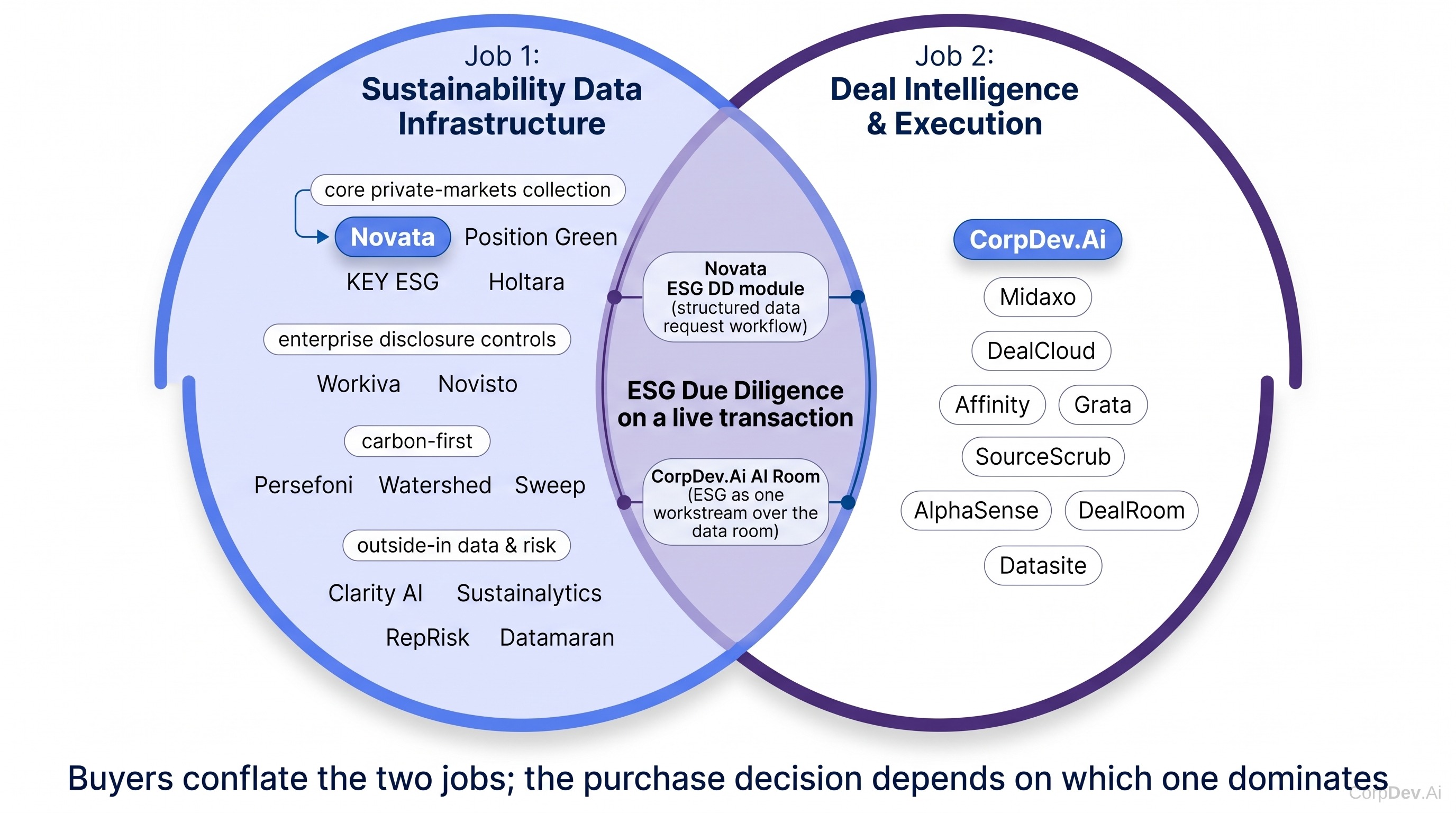
Read diagram description
Two jobs with a shared diligence use-case. The first job is "Job 1: Sustainability Data Infrastructure" containing vendor names in tiers: core private-markets collection — Novata, Position Green, KEY ESG, Holtara; enterprise disclosure controls — Workiva, Novisto; carbon-first — Persefoni, Watershed, Sweep; outside-in data & risk — Clarity AI, Sustainalytics, RepRisk, Datamaran. The second job is "Job 2: Deal Intelligence & Execution" containing: CorpDev.Ai, Midaxo, DealCloud, Affinity, Grata, SourceScrub, AlphaSense, DealRoom, Datasite. Their shared use-case is "ESG Due Diligence on a live transaction" with two approaches: "Novata ESG DD module (structured data request workflow)" and "CorpDev.Ai AI Room (ESG as one workstream over the data room)". "Buyers conflate the two jobs; the purchase decision depends on which one dominates."
What You Are Actually Buying: Two Jobs, Not One Category
Software procurement in this space goes wrong most often at the framing stage. A corporate development head is asked by the board to "get ESG diligence sorted", searches for ESG platforms, finds Novata at the top of every list, and ends up with a portfolio-monitoring system designed for private equity fund managers when what the team needed was a way to assess three targets a year. Conversely, a PE ESG lead who needs 60 portfolio companies to answer the same 40 EDCI metrics on time will find no AI research tool, however capable, replaces a governed collection workflow with validation rules and audit trails.
Job 1: Sustainability data infrastructure
The core of this job is repeatable, governed data collection from entities you do not control day to day. The buyer is typically a GP's sustainability or portfolio operations team, an LP or fund-of-funds, a bank's asset-servicing arm, or a large corporate's sustainability function. The workload is a recurring cycle: define metrics, issue requests, chase responses, validate submissions, calculate derived figures such as emissions, benchmark against peers, and produce LP, regulatory and board reports. Novata's own materials describe this cycle explicitly — guided requests, standardised definitions, validation, a shared repository and a 3,000+ metric library mapped to ISSB, SASB, GRI, CSRD and SFDR [9][11][13].
What distinguishes vendors within this job is depth of private-markets benchmarking, regulatory framework coverage, the burden placed on portfolio companies, assurance readiness, and whether delivery is self-serve software or services-led. These are not features an M&A platform offers, and no buyer should expect one to.
Job 2: Deal intelligence and execution
This job is episodic and decision-oriented: understand a market, find and rank targets, research a company deeply, run diligence across a data room, quantify synergies and valuation, and produce the investment memo and board deck that carry a decision. The buyer is an in-house corporate development or strategy team, a PE deal team, or an investment bank. CorpDev.Ai positions itself here as an "AI-native, end-to-end" platform combining a 70-million-company search universe, an AI analyst agent, a pipeline CRM, an AI data room with page-level citations, and document generation to Word, PowerPoint and Excel [19][20][21][24]. Its established competitors split into deal operating systems (Midaxo, DealRoom, Devensoft), relationship CRMs (DealCloud, Affinity), discovery and research tools (Grata, SourceScrub, AlphaSense) and virtual data rooms (Datasite, Ansarada) [99][100][113].
The overlap: ESG due diligence on a transaction
Novata launched its ESG Due Diligence solution on 23 April 2025, allowing deal teams to request, review and compare a target's sustainability data against portfolio and market benchmarks pre-investment, and then carry that baseline into post-close monitoring [16][123]. This is genuinely useful when the acquirer is a PE sponsor that will onboard the target onto Novata anyway; the diligence dataset becomes day-one portfolio data.
For a corporate acquirer, the calculus differs. ESG diligence on an acquisition is rarely a standardised questionnaire exercise. It is a review of permits, incidents, litigation, workforce data, supplier exposure, regulatory obligations and the credibility of the target's own sustainability claims — most of which arrives as unstructured documents in a data room and needs to be read alongside the financial and legal material. An AI diligence layer that ingests the full data room and answers questions with page-level citations addresses that need more directly than a metric-request workflow, and it does so for every other diligence workstream at the same time [19]. The trade-off is that the corporate acquirer gets no private-markets benchmark against which to judge the answers; for that, an outside-in reference such as RepRisk or Sustainalytics fills the gap better than Novata would [125][126].
This document treats CorpDev.Ai as an alternative for the deal-side ESG diligence use case and for the broader deal-intelligence job — not as a substitute for Novata's portfolio-wide ESG data collection and LP reporting. A buyer whose dominant need is recurring portfolio-company data collection should not read CorpDev.Ai as a like-for-like option, and a buyer whose dominant need is deal sourcing, research and diligence should not read Novata as one.
The 2026 Context That Should Change Your Calculus
The source research dated 11 September 2026 describes three regulatory developments affecting ESG software demand. The account below preserves that historical assessment; applicability, final legal text and national implementation must be established for the buyer before sizing a compliance contract.
CSRD scope has collapsed for most portfolio companies. The final Omnibus I legislation, adopted 26 February 2026 and in force from 18 March 2026, limits CSRD to EU companies exceeding both 1,000 employees and €450 million net turnover, with a €450 million EU-turnover threshold for non-EU groups [53][54]. Wave-2 companies, originally due to report in 2026 on FY2025 data, now generally report first in 2028 [55][56]. The typical mid-market PE portfolio company is no longer directly in scope. The value chain effect persists — in-scope customers, lenders and sponsors still ask — but the argument that a portfolio "must" buy a CSRD platform has largely gone.
SFDR 2.0 is still a proposal. The Commission's model would replace Article 8/9 with three voluntary categories (Sustainable, Transition, ESG Basics) with a 70% investment-alignment test; the Taxonomy-alignment threshold is contested between 15% and 20%; the Council adopted its mandate in June 2026 and trilogue is outstanding [57][58][59][60][61]. Software that hard-codes today's PAI and Article 8/9 logic will need rework. Buyers should require contractual commitments to update regulatory templates without additional charge.
The SEC climate rule faces a rescission proposal in the cited research. The 2024 rule was never effective; the SEC proposed full rescission on 29 May 2026 and comments closed on 3 August 2026, with final action pending [65][66][67]. Combined with state-level anti-ESG activity, US corporates face lower federal disclosure pressure and higher reputational sensitivity around ESG terminology. The market response has been repositioning toward "risk, resilience and value creation" language rather than abandonment — 73% of LPs in the 2026 Malk/SLR survey said US anti-ESG action had not changed their engagement with GPs [68].
What has not changed is that LPs and acquirers still want defensible data. The same survey found 83% of LPs had declined a GP over ESG concerns and 71% might reconsider GPs that do not integrate ESG into value creation [68][69]. The EU Taxonomy Delegated Act revision of 8 January 2026 introduced a 10% materiality threshold that simplifies reporting but keeps KPI calculation and evidence management relevant [62][63][64]. Deloitte found 27% of PE investors already treat ESG as a formalised, consistent diligence component and a further 23% planned to add it within 12 months [74].
A three-year Novata, Workiva or Novisto contract sized on 2024-era CSRD assumptions will be over-scoped for most private portfolios after Omnibus I. Size contracts on LP-reporting and diligence needs, not regulatory headcount, and negotiate downward flexibility on portfolio-company counts.
The implication for software selection is that compliance-template capability is now table stakes and a weak differentiator, while benchmark depth, diligence integration, data defensibility and low portfolio-company burden are where the value sits. This is the lens applied to each vendor below.
Novata: An Objective Profile
What it is
Novata was formed in 2021 by a consortium of the Ford Foundation, Hamilton Lane, S&P Global, Microsoft and Omidyar Network as a B Corp-certified public benefit corporation, and launched commercially in April 2022 [1][2]. It raised a $30 million Series B in February 2023 led by Hamilton Lane, with participation from S&P Global, Microsoft's Climate Innovation Fund and a group of GPs including Clearlake Capital, Hellman & Friedman, Kohlberg & Company, Lindsay Goldberg and The Vistria Group; an undisclosed follow-on in May 2024 brought in Motive Ventures (Apollo-affiliated) [4][3]. Northern Trust is both an investor and a distribution partner, making Novata available to its asset-servicing clients [96]. The company is led by co-CEOs Alex Friedman and Josh Green [92][2].
The platform has evolved from an ESG questionnaire tool into what Novata now calls a "carbon, risk and sustainability intelligence platform" [8]. Its modules span portfolio data collection (Sustainability Hub), a 3,000+ metric library, benchmarking (300+ metrics, ~49,000 benchmarks segmented by industry, geography, revenue and FTE), portfolio analytics and LP reporting, Carbon Navigator for Scope 1–3, financed emissions and SBTi, SFDR PAI automation, CSRD/ESRS workflows, EU Taxonomy, a Regulatory Navigator, Risk Atlas, supply-chain data collection, proxy data for gap-filling, ESG Due Diligence and advisory services [9][11][12][13][15][16][82].
Private-markets benchmark depth. No competitor publishes a comparable private-company benchmark set; the 1–16 precision score that tells users how tightly a benchmark matches their industry, size and region is an unusually transparent design choice [81][82].
EDCI alignment. As an official EDCI ESG Data Platform Partner, Novata makes the 500+ member initiative's metrics and insights native, which matters because EDCI has become the de facto data language of PE-LP reporting [71][73].
Institutional credibility. Backing from Hamilton Lane, S&P Global, Microsoft and a roster of GPs, plus Northern Trust distribution, gives buyers confidence in longevity and in acceptance by LPs [4][96].
Diligence-to-ownership continuity. The 2025 ESG DD module lets a sponsor's pre-deal dataset become day-one portfolio data, eliminating re-collection [16][123].
Satisfaction where measured. Capterra rates it 4.8/5 across 15 reviews with 5.0 for value for money; reference customers report a 100% survey response rate (Bonaccord) and 500+ companies benchmarked (Antler) [76][77][79].
It does not remove the collection burden. Validation rules and guardrails improve consistency, but portfolio companies still identify data owners, gather primary data and document it every cycle; Antler's 500-company deployment implies sustained engagement effort [79][80].
Benchmark sample sizes vary. AnaCap's responsible investment report cautions that average group sizes do not represent the true sample for every metric, and that universal benchmarks trade specificity for size [84]. Ask for the precision score distribution on the metrics you care about.
Thin independent review base. One G2 review and 15 on Capterra is too small a sample to generalise satisfaction to large multi-fund GPs [76][78].
Investor pricing is opaque. Only the company-side tiers are published; investor pricing is quote-based on portfolio size and modules, and no standard implementation timeline is disclosed [15].
Headcount signal. A third-party estimate puts 2025 headcount at ~168, down about 16% year on year; not an audited figure, and no layoff was announced, but worth a direct question in commercial diligence [89].
Compliance tailwind has weakened. A material share of the product roadmap (CSRD, SFDR, Taxonomy) addresses obligations that Omnibus I and the SFDR review have narrowed or unsettled [53][57].
Pricing
Novata publishes company-side pricing based on facilities and suppliers rather than seats: Manage at $20,000/year (up to 10 facilities, 100 suppliers), Grow at $50,000/year (50 facilities, 500 suppliers) and Lead at $100,000/year (unlimited) [15]. Investor pricing is customised on portfolio size, modules and advisory support, with Portfolio Reporting priced per company in the portfolio [15]. Buyers should expect a GP deployment covering several dozen portfolio companies to land well into six figures once carbon, SFDR and advisory are added, and should negotiate explicitly on data ownership, use of contributed data in aggregated benchmarks, post-termination portfolio-company access, renewal caps and audit rights — none of which are publicly standardised.
Novata's benchmark moat is built partly from client-contributed data. Before signing, establish in the MSA how your portfolio companies' submissions may be used in aggregated benchmarks, whether they can be excluded, and what happens to their access and history if you exit the contract.
The Alternatives
The alternatives fall into five groups. Groups A–C compete with Novata for aspects of Job 1; Group D supplies outside-in data and risk intelligence; Group E — CorpDev.Ai and its peers — addresses Job 2 and the deal-side overlap.
Group A: Direct substitutes for portfolio ESG data collection
Positioning: ESG management and reporting with strong private-markets and portfolio-monitoring workflows; European regulatory depth (CSRD, SFDR, EDCI) [43][44].
Best for: European GPs and asset managers who want a Novata-like collection workflow with heavier regulatory scaffolding.
Watch-outs: Smaller ecosystem and review footprint than Workiva; configuration and services often needed for complex global portfolios; pricing not published [43].
Positioning: Practical ESG data collection and framework mapping (SFDR, CSRD, IFRS, TCFD, EU Taxonomy, EDCI) aimed at SMEs, mid-market companies and PE/VC funds [46].
Best for: Smaller funds and portfolios that need standardised requests without enterprise-grade assurance infrastructure; repeatedly cited as the pragmatic Novata swap [44].
Watch-outs: Less reporting depth than Workiva or Novisto; smaller market presence; carbon depth below the specialists; independent review evidence limited [47].
Positioning: ESG reporting platform bundled with specialist sustainability, climate and impact services; owned by fund administrator Apex Group [45].
Best for: Private-capital managers who already use Apex fund services, or who prefer an expert team over self-serve software.
Watch-outs: Less of a standalone product; commercial experience depends on the Apex relationship; little public pricing or review data. Named a Verdantix 2026 Smart Innovator [36].
Group B: Enterprise disclosure and controls platforms
Workiva (NYSE: WK) is the broadest governance and reporting platform in the set, with workflow, permissions, evidence management, data lineage, XBRL and assurance support spanning financial, regulatory and ESG reporting. It carries a G2 rating of 4.5/5 across more than 2,100 reviews, by far the largest independent sample of any vendor here [34][35][36]. Third-party purchase data suggests an average spend of roughly $60,000 a year with a range of $36,000 to $156,000 before ESG modules and implementation [33]. It is the right answer for a listed corporate that needs controlled, auditable disclosure; it is a poor substitute for Novata in engaging hundreds of private portfolio companies, and its carbon capability typically requires integrations.
Novisto occupies similar ground with a stronger ESG-specific data model, disclosure mapping, audit trail and CSRD/ESRS support. G2 rates it 4.4/5 on 20 reviews, and Verdantix specifically names it in its analysis of ESG reporting tools for private equity [35][42][48]. It is enterprise-implementation heavy and historically less PE-specific than Novata, but it is the more credible choice where assurance readiness is the deciding criterion.
Group C: Carbon-first specialists
Persefoni is the strongest fit where financed emissions and PCAF methodology drive the requirement — banks, asset managers, insurers and PE firms with climate-led mandates. It offers a free Pro entry tier with enterprise pricing estimated at $50,000–$100,000+ a year; G2 rates it approximately 4.8/5 on 11 reviews, with ease of use scored below category average [33][37][38]. Watershed leads on Scope 1–3 data ingestion, supplier engagement, scenario modelling and reduction planning for large enterprises, at estimated deployments of $50,000–$250,000+; G2 rates it 4.5/5 on 25 reviews [33][39][40][41]. Notably, Novata and Watershed have a strategic partnership combining Novata's private-markets data management with Watershed's financed-emissions and net-zero capabilities, which signals that Novata itself treats deep carbon as adjacent rather than core [98]. Sweep offers a modern interface and collaborative supplier workflows for mid-market carbon programmes; its 4.8/5 G2 rating rests on only four reviews [49]. None of the three is a full-spectrum ESG collection tool; social, governance and LP-reporting questionnaires are not their strength.
Group D: Outside-in data, ratings and risk intelligence
These are complements, not replacements. Clarity AI and Morningstar Sustainalytics supply external ESG data, ratings, controversy research and SFDR analytics to institutional investors, priced as data subscriptions; both are useful as an independent reference against self-reported portfolio data but neither collects operational data from companies you own [36][43][50]. RepRisk provides adverse-media and stakeholder-based risk screening with Due Diligence Scores delivered via platform, API, Snowflake and Bloomberg — the standard "what do external sources say" check before an NDA is signed [125][126][127]. Datamaran, which raised a $33 million Series C from Morgan Stanley Expansion Capital in September 2024, maps a target's activities and geographies to more than 19,800 non-financial regulations across 190+ countries — the tool for regulatory-exposure diligence on cross-border acquisitions [51][129][130][131].
Greenomy, Reporting 21 and Proof round out the European field as EU-taxonomy-focused, services-led or niche offerings respectively; independent evidence on all three is thin, and any buyer shortlisting them should insist on a live workflow demonstration and reference calls rather than relying on published material [50].
Group E: CorpDev.Ai and the deal-intelligence alternatives
CorpDev.Ai, founded in 2023 and headquartered in Boston with a San Francisco hub, was founded by Kal Kilpi, previously founder of the M&A SaaS platform Midaxo [27][28][29]. Its platform combines a natural-language AI analyst agent (orchestrating Claude, GPT, Perplexity and Gemini models) for company profiles, market research, investment memos and presentations; a 70-million-company search universe with natural-language target description and AI fit scoring; automated market mapping; a Kanban pipeline with "zero-entry" CRM populated from Microsoft 365 and Google Workspace; an AI data room ("AI Room") that ingests PDF, XLSX, DOCX and PPTX with vision extraction, page-level citations and an audit trail; scenario and synergy modelling; and document generation to Word, PowerPoint, PDF, Excel and Markdown [19][20][21][22][24][25]. A "CorpDev Brain" knowledge layer stores strategy, analyses, emails, meetings and data-room material as a persistent, searchable base, and managed services are available for sourcing, memo production and PMI planning [19][20][26].
Pricing is published: AI Pro at $1,000/month annually ($1,200 monthly) for one user; AI Pro Team at $3,000/month annually ($3,600 monthly) for three users with collaboration and admin controls; Enterprise on custom quote with unlimited users, SSO, financial modelling and managed services [24]. The company states it is used by "hundreds of CorpDev professionals" and targets in-house teams at companies of roughly $1 billion revenue and above [19][24].
ESG diligence as one workstream, not a separate system. For an acquirer, the AI Room reads the target's permits, incident logs, workforce data, sustainability reports and supplier contracts alongside the financial and legal material, with page-level citations — the form ESG evidence actually takes in a corporate deal [19].
Outside-in target research. Company intelligence draws on filings, news, reviews, hiring signals and web data, which surfaces controversies and regulatory exposure at screening stage rather than after an NDA [23].
Deliverable production. The output of diligence is a memo and a board deck; producing them from the same evidence base removes a re-keying step that Novata's structured data export still leaves to the analyst [25].
Transparent, low entry price. At $12,000 a year, a single CorpDev.Ai seat is below Novata’s $20,000 Manage tier; its $36,000 three-seat Team plan is above Manage and below the $50,000 Grow tier. These are different scopes, not equivalent ESG licences [24][15].
No portfolio data-collection workflow. There is no metric library, no validation-rule engine for portfolio-company submissions, no SFDR PAI or CSRD template generation, no EDCI benchmark. A GP that needs 60 companies to report 40 metrics annually should not shortlist it for that job.
No private-markets ESG benchmark. Diligence answers can be extracted and reasoned over, but not compared against a peer distribution of private companies; RepRisk or Sustainalytics provide outside-in risk evidence, which is different from a peer distribution of private-company operating metrics.
Early-stage evidence base. Public materials name no customer logos, case studies or quantified outcomes, and no funding round is disclosed; the named enterprise experience (Verizon, Mercedes-Benz, McKinsey, HPE, Philips, Hitachi) is team history, not a customer roster [28]. Buyers should request references and run a scoped pilot.
Generalist by design. A team whose only need is ESG will find most of the platform surplus to requirements.
For a corporate development buyer weighing CorpDev.Ai against its own peer set rather than against Novata: Midaxo ($25,000–$150,000+ a year) and DealRoom ($15,000–$60,000+) are process-oriented deal operating systems to compare with CorpDev.Ai for serial acquisition programmes; DealCloud is the configurable enterprise relationship CRM on custom pricing; Affinity ($2,000–$2,700 per user) is the lighter relationship tool; Grata ($15,000–$45,000) and SourceScrub ($15,000–$40,000) are sourcing databases; AlphaSense ($12,000–$51,000 per seat) is premium research; Datasite (custom, roughly $68,000 average per transaction) and Ansarada (from ~$244/month) are virtual data rooms [99][100][105][109][113][121]. CorpDev.Ai's distinguishing claim against this field is breadth — research, sourcing, pipeline, data-room analysis and deliverable generation in one AI-native system at a published price — while the incumbents are deeper in their individual lanes and carry longer customer track records.
For a strategic acquirer doing a handful of deals a year, one configuration to test for ESG diligence is an AI diligence layer (CorpDev.Ai or a data-room AI) over the target's documents, a RepRisk or Sustainalytics screen for outside-in controversy, and Datamaran or counsel for cross-border regulatory exposure. Novata enters the picture only if the acquirer intends to run ongoing, standardised ESG reporting across a portfolio of owned businesses.
Head-to-Head Comparison
The matrix below scores each vendor on the criteria that actually differentiate in 2026. Scores are the author's assessment on a 1–5 scale synthesised from vendor materials, independent review data and analyst coverage cited throughout this document; they are judgements, not measured benchmarks, and the basis column in the Key Facts appendix records the evidence behind each vendor's profile.
| Vendor | Portfolio ESG data collection | Private-markets benchmarking | Carbon depth (Scope 1–3, PCAF) | Regulatory templates (CSRD/SFDR/Taxonomy) | Assurance & audit trail | Deal-side ESG diligence | Broader deal intelligence | Price transparency | Independent review depth |
|---|---|---|---|---|---|---|---|---|---|
| Novata | 5 | 5 | 4 | 5 | 3 | 4 | 1 | 3 | 2 |
| Position Green | 4 | 3 | 3 | 5 | 3 | 3 | 1 | 2 | 2 |
| KEY ESG | 4 | 2 | 2 | 4 | 2 | 3 | 1 | 2 | 1 |
| Holtara (Apex) | 4 | 3 | 3 | 4 | 3 | 3 | 1 | 1 | 1 |
| Workiva | 3 | 1 | 2 | 4 | 5 | 2 | 1 | 2 | 5 |
| Novisto | 3 | 2 | 2 | 5 | 5 | 2 | 1 | 2 | 3 |
| Persefoni | 2 | 2 | 5 | 3 | 4 | 2 | 1 | 3 | 2 |
| Watershed | 2 | 2 | 5 | 3 | 4 | 2 | 1 | 2 | 3 |
| Sweep | 2 | 1 | 4 | 3 | 3 | 2 | 1 | 2 | 1 |
| Clarity AI / Sustainalytics | 1 | 3 | 3 | 4 | 3 | 3 | 2 | 2 | 3 |
| RepRisk | 1 | 2 | 1 | 2 | 3 | 5 | 2 | 2 | 3 |
| Datamaran | 1 | 1 | 1 | 4 | 3 | 4 | 2 | 2 | 2 |
| CorpDev.Ai | 1 | 1 | 1 | 1 | 3 | 4 | 5 | 5 | 1 |
Three patterns stand out. First, Novata scores highest in the first two columns in this assessment; its governed collection and disclosed private-market benchmark depth are central strengths, although the scores are not independent comparative benchmarks. Second, the enterprise controls platforms and the carbon specialists each dominate one column and trail elsewhere, which is why they usually appear in a stack alongside a collection tool rather than instead of one. Third, CorpDev.Ai inverts Novata's profile — weakest exactly where Novata is strongest, strongest in broader deal intelligence and price transparency, where Novata scores lower, and competitive on deal-side diligence and pricing transparency. The two products are close to orthogonal, which is the single most useful fact for a buyer trying to decide between them: in most cases the question is not either/or but whether the second job justifies a second budget line.
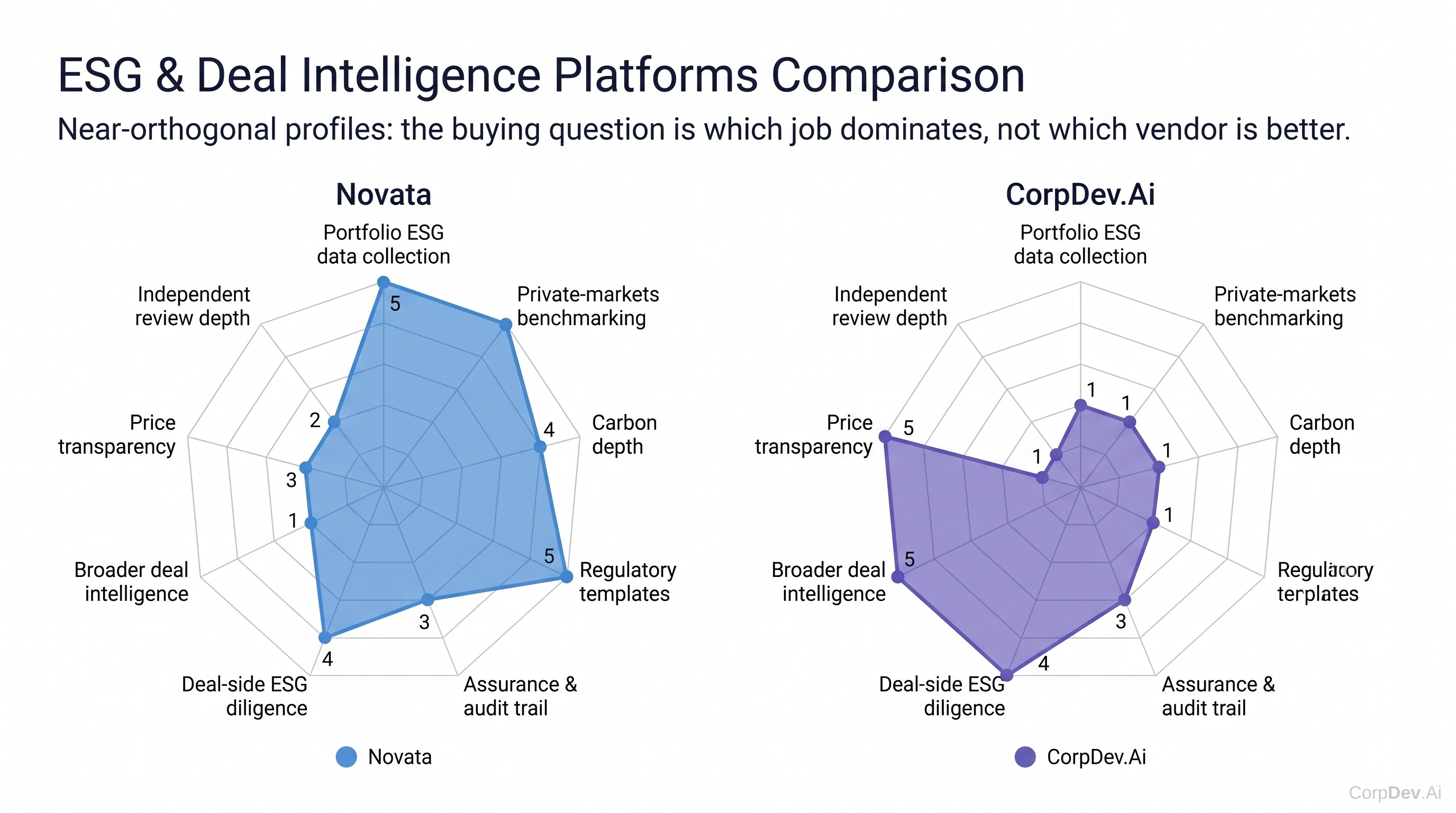
Read diagram description
Comparative scores with nine criteria, in this order: Portfolio ESG data collection, Private-markets benchmarking, Carbon depth, Regulatory templates, Assurance & audit trail, Deal-side ESG diligence, Broader deal intelligence, Price transparency, Independent review depth. Novata scores: 5,5,4,5,3,4,1,3,2. CorpDev.Ai scores: 1,1,1,1,3,4,5,5,1. The reported scores coincide on "Deal-side ESG diligence" (both 4) and "Assurance & audit trail" (both 3). "Near-orthogonal profiles: the buying question is which job dominates, not which vendor is better."
Decision Framework by Buyer Archetype
The right purchase depends far more on who you are than on any feature list. Four archetypes cover most readers of this document.
Dominant job: Recurring, standardised portfolio ESG data collection, EDCI benchmarking and LP reporting.
Primary choice: Novata. Its benchmark depth and EDCI partner status directly address LP comparability demands [73][82].
Alternatives worth an RFP: Position Green (European regulatory depth), Holtara (if already an Apex client), KEY ESG (smaller portfolios, tighter budgets) [43][44][45].
Add-ons: Persefoni or Watershed if financed emissions or SBTi targets are central; RepRisk for controversy monitoring [37][40][126].
Deal-side: Novata's ESG DD module makes sense here because the target becomes a portfolio company on the same platform [16].
Dominant job: Find, evaluate and close acquisitions; ESG is one diligence lens and a board-level risk question.
Primary choice: An AI deal-intelligence layer — CorpDev.Ai if breadth and published pricing are priorities; Midaxo or DealRoom if a process-heavy operating system for serial acquisition is the priority [19][24][99][100].
ESG diligence: Run it inside the data-room AI, backed by a RepRisk screen and Datamaran or counsel for regulatory exposure [125][129].
When Novata enters: Only if the corporate runs a portfolio of semi-autonomous businesses that must report sustainability data centrally — in which case Workiva or Novisto may fit the parent's disclosure controls better [34][48].
Dominant job: Auditable, assurance-ready disclosure integrated with financial reporting; CSRD if still in scope post-Omnibus.
Primary choice: Workiva or Novisto. Controls, lineage and XBRL outweigh private-markets benchmarking here [34][35][48].
Alternatives: Novata's company-side tiers ($20,000–$100,000) if the enterprise has many facilities and suppliers and prefers a usage-based model [15].
Add-ons: Watershed or Sweep for supplier-heavy Scope 3 programmes [40][49].
Caution: Confirm actual CSRD scope under the 1,000-employee / €450 million test before sizing any deployment [53].
Dominant job: Aggregate GP-reported data across managers, benchmark it and monitor consistency.
Primary choice: Novata, which was designed by and for this constituency (Hamilton Lane, Northern Trust) and aligns natively to EDCI [1][96][73].
Alternatives: Clarity AI or Sustainalytics as an outside-in overlay for manager-level analytics and SFDR product classification [36][50].
Watch: SFDR 2.0's eventual product categories will change the classification logic; require template updates at no cost [57].
The ESG measurement and reporting requirement determines which specialist capabilities belong in the evaluation. It does not determine which platform should own the full M&A programme. Compare the work the team must complete, the evidence and controls required, and the effort of maintaining multiple systems.
| Requirement | Evaluation approach | Decision implication |
|---|---|---|
| Esg measurement and reporting | Compare Novata and portfolio ESG platforms on recurring portfolio data collection, reporting definitions and assurance requirements. Use the actual transaction or institutional mandate. | Retain a specialist for its demonstrated contribution; its strength in this job does not establish overall M&A superiority. |
| End-to-end M&A management | Evaluate CorpDev.Ai, Midaxo and DealRoom on the connected path from thesis and target evaluation through diligence, decisions, execution and integration. | Include CorpDev.Ai as a primary-platform candidate. Product categories and the number of deals are not substitutes for a workflow demonstration. |
| Analytical execution and deliverables | Ask each finalist to analyse the same evidence and produce a decision-ready recommendation, supporting materials and an integration response. Record human corrections and remaining manual work. | CorpDev.Ai's combination of management and work-producing agents is particularly relevant when substantial analysis must accompany every deal. Compare the quality and completeness of the outputs. |
| Large or frequent acquisition programmes | Use concurrent evaluations and integrations, shared business-unit resources and recurring leadership reporting in the pilot. Test permission boundaries and ownership changes. | Programme scale strengthens the case for evaluating integrated management and analytical capacity together; it does not automatically favour Midaxo or DealRoom. |
| Existing systems and total cost | Price the required participants, AI usage, data entitlements, implementation, ongoing reconciliation and exit. Compare both replacement and coexistence. | Keep a second platform where a specific control or operating requirement justifies it. Avoid turning a small standard plan into an unsupported Enterprise cost estimate. |
Total Cost and Commercial Diligence
Published prices exist for only a minority of the vendors; the table consolidates what is public and what third-party purchase data suggests. Treat non-published ranges as budgeting estimates for RFP planning, not quotes.
| Vendor | Published pricing | Indicative annual range | Pricing basis |
|---|---|---|---|
| Novata (company tiers) | Yes | $20,000 – $100,000 | Facilities and suppliers, not seats [15] |
| Novata (investor) | No | Six figures for mid-size GP portfolios (estimate) | Portfolio company count, modules, advisory [15] |
| Position Green | No | Custom | Per organisation, portfolio or entity count [43] |
| KEY ESG | No | Custom; mid-market oriented | Entities, users, modules [46] |
| Holtara (Apex) | No | Custom; often bundled with Apex services | Managed service / advisory [45] |
| Workiva | No | $36,000 – $156,000 (avg. ~$60,000) before ESG modules | Enterprise licence [33] |
| Novisto | No | Enterprise custom | Subscription plus implementation [48] |
| Persefoni | Partial (free Pro tier) | $50,000 – $100,000+ enterprise | Enterprise licence [33][37] |
| Watershed | No | $50,000 – $250,000+ | Emissions scope and portfolio size [33][39] |
| Sweep | No | Tens to low hundreds of thousands | Custom [49] |
| RepRisk | No | Custom | Coverage, users, API/feed scope [127][128] |
| Datamaran | No | Enterprise custom | Annual licence plus implementation [51] |
| CorpDev.Ai | Yes | $12,000 (1 seat) – $36,000 (3 seats); Enterprise custom | Seats plus search credits [24] |
| Midaxo | Partial | $25,000 – $150,000+ | Modules, deal volume [99][100] |
| DealRoom | Partial | $15,000 – $95,000+ | Tier, deal volume [99][100] |
| AlphaSense | No | $12,000 – $51,000 per seat | Seats [100][120] |
Beyond the licence, four cost lines are routinely underestimated. Portfolio-company time is the largest hidden cost of any collection platform: every metric requested is answered by a finance or operations manager at a company that did not choose the software. Implementation and advisory are quote-based at Novata, Workiva, Novisto and the carbon specialists and can approach the first-year licence. Regulatory re-work is now a live risk given SFDR 2.0 and Omnibus I; contracts should oblige the vendor to update templates without charge. Exit costs — data export in usable form, portfolio-company access after termination, benchmark data rights — are rarely priced but determine switching leverage at renewal.
Procurement checklist
Use the following in any RFP for a Job 1 platform; the deal-intelligence equivalents follow for Job 2.
- Metric library mapped to EDCI, SFDR PAI, ESRS and GHG Protocol, with a single request de-duplicated across frameworks
- Benchmark precision disclosed per metric (sample size, industry / size / region match level)
- Portfolio-company effort per cycle quantified by the vendor from comparable deployments, with references who will confirm it
- Contractual template updates for SFDR 2.0 and Omnibus I at no additional cost
- Explicit MSA terms on contributed-data use in benchmarks, exclusion rights and post-termination access
- Downward flexibility on portfolio-company count at renewal
- Implementation plan with named milestones and a defined go-live date
- Capterra / G2 / analyst evidence supplemented by at least three reference calls with firms of similar portfolio size
For a deal-intelligence platform such as CorpDev.Ai, Midaxo or DealRoom, substitute: data-room ingestion limits and citation fidelity tested on a real past deal; company-universe coverage tested against a known target list in your sector; export quality of memos and models into your house templates; security posture (SSO, data residency, model-provider data handling) reviewed by IT; and reference customers at comparable revenue scale.
Recommended Configurations
Bringing the analysis together, three configurations cover the majority of buyers.
Configuration A — Private-markets sponsor. Novata as the system of record for portfolio ESG data and LP reporting; Novata ESG DD for transactions where the target will join the portfolio; RepRisk for pre-NDA controversy screening; Persefoni or Watershed only if climate commitments require PCAF-grade financed emissions. A CorpDev.Ai or AlphaSense seat for deal-team research is a separate, small budget line and does not displace any of the above.
Configuration B — Strategic corporate acquirer. CorpDev.Ai, compared directly with Midaxo and DealRoom for end-to-end M&A management, as the programme environment with ESG run as a workstream over the data room; RepRisk screen on every target; Datamaran or external counsel for cross-border regulatory exposure. No Novata licence unless the acquirer operates a reporting portfolio of owned businesses — and if it does, evaluate Workiva or Novisto for the parent's controls first.
Configuration C — Listed corporate with residual CSRD scope. Workiva or Novisto for assured disclosure; Watershed or Sweep for Scope 3 supplier programmes; Novata company-tier only where a usage-based model across many facilities is more economical than seat-based enterprise licensing.
Novata and CorpDev.Ai are not competitors for the same budget. Novata wins when the buyer's problem is governed data from companies it owns; CorpDev.Ai wins when the problem is decisions about companies it does not yet own. A CorpDev or strategy professional who owns both problems should expect to buy from both categories — and should resist any vendor's suggestion that one platform covers the other job.
Key Facts & Sources
The load-bearing figures in this document, with source and as-of date. Scores in the comparison matrix are author assessments synthesised from these sources and are labelled as such where they appear.
| Fact | Value | Source | As of |
|---|---|---|---|
| Novata clients | 400+ | Novata "Our Story" [2] | Aug 2026 |
| Companies actively reporting on Novata | 13,000+ | Novata "Our Story" [2] | Aug 2026 |
| Novata benchmarked metrics / benchmark data points | 300+ / ~49,000 | Novata benchmarks page [82] | Aug 2026 |
| Novata metric library | 3,000+ metrics | Novata PBC Report 2024 [9] | 2024 |
| Novata Series B | $30M, led by Hamilton Lane | Hamilton Lane release [4] | 28 Feb 2023 |
| Novata follow-on financing | Undisclosed; Motive Ventures new investor | BusinessWire [3] | 21 May 2024 |
| Novata company-tier pricing | $20k / $50k / $100k per year | Novata pricing page [15] | Aug 2026 |
| Novata ESG Due Diligence launch | 23 Apr 2025 | BusinessWire [16] | Apr 2025 |
| Novata Capterra rating | 4.8/5, 15 reviews | Capterra [76][77] | 2026 |
| Novata G2 rating | 4.0/5, 1 review | G2 [78] | 2026 |
| Novata estimated headcount | ~168 (2025), −16.4% YoY; third-party estimate | Revelio Labs [89] | Aug 2026 |
| EDCI membership | 500+ GPs and LPs; BCG administers | Novata podcast [71]; EDCI [72] | Oct 2025 / Jun 2026 |
| CSRD Omnibus I thresholds | >1,000 employees and >€450M turnover; in force 18 Mar 2026 | European Parliament [53][54] | Aug 2026 |
| CSRD wave-2 delay | Two years; first reporting generally 2028 | Deloitte [55]; Grant Thornton [56] | Jan 2026 |
| SEC climate rule | Rescission proposed 29 May 2026; comments closed 3 Aug 2026 | SEC [65][67] | Jun 2026 |
| SFDR 2.0 status | Proposal; Council mandate Jun 2026; trilogue pending | European Parliament [57]; MoFo [59] | Aug 2026 |
| LPs declining a GP over ESG concerns | 83% | Malk/SLR 2026 survey [68] | Apr 2026 |
| PE investors with formalised ESG diligence | 27% (plus 23% planning within 12 months) | Deloitte via ESG Today [74] | n.d. |
| Workiva G2 rating | 4.5/5, 2,147 reviews | G2 [34] | 2026 |
| Workiva indicative annual cost | ~$59,653 avg; $36,212–$155,760 | AI Business Geek [33] | Aug 2026 |
| Novisto G2 rating | 4.4/5, 20 reviews | G2 [48] | 2026 |
| Persefoni G2 rating | ~4.8/5, 11 reviews | G2 [37] | 2026 |
| Watershed G2 rating | 4.5/5, 25 reviews | G2 [41] | 2026 |
| Datamaran Series C | $33M, Morgan Stanley Expansion Capital | Datamaran [51] | 19 Sep 2024 |
| Datamaran regulatory database | 19,800+ regulations, 190+ countries | Datamaran [129][130] | 2026 |
| CorpDev.Ai pricing | AI Pro $1,000/mo annual; AI Pro Team $3,000/mo annual; Enterprise custom | CorpDev.Ai pricing [24] | 2026 |
| CorpDev.Ai company universe | 70M+ companies | CorpDev.Ai [20][21] | 2026 |
| CorpDev.Ai founding / HQ | 2023; Boston (SF hub); founder Kal Kilpi | LinkedIn [29]; About [28] | 2026 |
| Midaxo / DealRoom indicative cost | $25k–$150k+ / $15k–$95k+ | CT Acquisitions [99][100] | Jun 2026 |
Basis note on the comparison matrix: the 1–5 scores are the author's synthesis and are not vendor-published. Where independent review depth is scored 1–2, the underlying sample is fewer than roughly 20 public reviews and the vendor's other scores rely more heavily on vendor materials and analyst coverage; buyers should weight reference calls accordingly.
This document was commissioned by CorpDev.Ai and produced using its platform. Every claim about CorpDev.Ai is drawn from its published materials and is flagged where independent verification is absent; its weaknesses are stated with the same candour applied to Novata. Readers should nonetheless treat the CorpDev.Ai assessment with the scepticism they would apply to any vendor-adjacent analysis and validate it through a scoped pilot.
References
Numbering follows the original research. Access dates below record the original source registry; they do not imply that every source was rechecked for this website edition.
- Non-Profit & For-Profit Leaders Form Novata - Hamilton LaneSource accessed 2026-09-11
- Our Story | NovataSource accessed 2026-09-11
- Novata Announces New Investment to Expand Sustainability ...Source accessed 2026-09-11
- Novata Closes Series B Funding Round with $30 Million RaisedSource accessed 2026-09-11
- Novata | Carbon, Risk, and Sustainability Intelligence PlatformSource accessed 2026-09-11
- [PDF] Public Benefit Corporation Report 2024Source accessed 2026-09-11
- Sustainability Solutions for Private Market Investors | NovataSource accessed 2026-09-11
- Company Sustainability Reporting & Data Management - NovataSource accessed 2026-09-11
- Carbon Footprint Calculator | Measure Scope 1, 2, and 3 EmissionsSource accessed 2026-09-11
- Investor Sustainability Reporting & Data ManagementSource accessed 2026-09-11
- Build Your Solution | Pricing - NovataSource accessed 2026-09-11
- Novata Launches Tech-Enabled ESG Due Diligence ...Source accessed 2026-09-11
- CorpDev.Ai - Agentic AI for M&A and Corporate DevelopmentSource accessed 2026-09-11
- The Data Architecture Behind AI-Powered M&ASource accessed 2026-09-11
- AI Target Identification & Screening for M&A | CorpDev.AiSource accessed 2026-09-11
- AI Deal Sourcing Platform for M&ASource accessed 2026-09-11
- Deep Company Intelligence & Research for M&A - CorpDev.AiSource accessed 2026-09-11
- PricingSource accessed 2026-09-11
- AI Investment Memorandum Generator for M&ASource accessed 2026-09-11
- Managed Services - AI-Enabled M&A Services | CorpDev.AiSource accessed 2026-09-11
- Kal Kilpi | LinkedInSource accessed 2026-09-11
- About Us - CorpDev.AiSource accessed 2026-09-11
- CorpDev.AiSource accessed 2026-09-11
- AI ESG & Sustainability Reporting Software (2026)Source accessed 2026-09-11
- Workiva Reviews 2026: Details, Pricing, & FeaturesSource accessed 2026-09-11
- Novisto vs. Workiva Comparison 2026Source accessed 2026-09-11
- Smart Innovators: ESG & Sustainability Reporting Software ...Source accessed 2026-09-11
- Best Environmental, Social, and Governance (ESG) Reporting ... - G2Source accessed 2026-09-11
- Mejor Software de Reporte Ambiental, Social y de Gobernanza (ESG)Source accessed 2026-09-11
- Carbon Accounting & ESG Reporting Software - VibeReferenceSource accessed 2026-09-11
- Persefoni vs. Watershed Comparison 2026 - G2Source accessed 2026-09-11
- Watershed vs. Workiva Comparison 2026 | G2Source accessed 2026-09-11
- Strategic Focus: ESG Reporting Tools For Private Equity ...Source accessed 2026-09-11
- Evaluating ESG Reporting Tools for Private Equity and ...Source accessed 2026-09-11
- Novata Alternative: Is a Custom ESG Platform Worth It?Source accessed 2026-09-11
- Holtara – ESG & Sustainability | ESG Reporting PlatformSource accessed 2026-09-11
- KEY ESG: ESG software to streamline your ESG processSource accessed 2026-09-11
- Best Carbon Accounting Software: User Reviews from August 2026Source accessed 2026-09-11
- Novisto Reviews 2026: Details, Pricing, & FeaturesSource accessed 2026-09-11
- Top 10 Sweep Alternatives & Competitors in 2026 - G2Source accessed 2026-09-11
- 12 Best ESG Reporting Software Platforms Compared (2026)Source accessed 2026-09-11
- Datamaran Secures $33M Growth Financing from Morgan ...Source accessed 2026-09-11
- Omnibus I - simplification of the directives on corporate sustainability ...Source accessed 2026-09-11
- Carriages preview | Legislative Train ScheduleSource accessed 2026-09-11
- Omnibus Legislative Developments and Updates to ...Source accessed 2026-09-11
- Update on sustainability reporting in EuropeSource accessed 2026-09-11
- Revision of the Sustainable Finance Disclosure Regulation ...Source accessed 2026-09-11
- [PDF] LIMITE EN - DataSource accessed 2026-09-11
- Council Agrees Negotiating Mandate for SFDR 2.0 — Key ...Source accessed 2026-09-11
- SFDR 2.0 Update – European Parliament Adopts Its Draft ...Source accessed 2026-09-11
- EU SFDR 2.0 – Parliament draft published | Hogan Lovells - JDSupraSource accessed 2026-09-11
- Revised Delegated Act on EU Taxonomy enters into forceSource accessed 2026-09-11
- Taxonomy Reporting Following EU Omnibus Review | 02Source accessed 2026-09-11
- Revised Delegated Act on EU Taxonomy enters into forceSource accessed 2026-09-11
- SEC Proposes Rescission of Climate-Related Disclosure ...Source accessed 2026-09-11
- SEC Climate Rule Status Update: Litigation, Withdrawal and ...Source accessed 2026-09-11
- Rescission of Climate-Related Disclosure RulesSource accessed 2026-09-11
- Investors Are driving ESG Ambition, but Portfolio CompaniesSource accessed 2026-09-11
- Key ESG insights from private markets for 2026Source accessed 2026-09-11
- EP 40: How the EDCI Is Transforming Sustainability Data in ...Source accessed 2026-09-11
- About usSource accessed 2026-09-11
- EDCI's 2026 Guidance: What's New for Investors - NovataSource accessed 2026-09-11
- Private Equity Investors Far Ahead on Integrating ESG in M&A Dealmaking: Deloitte - ESG TodaySource accessed 2026-09-11
- Novata - Opiniones, precios y caracter�sticas - Capterra ChileSource accessed 2026-09-11
- Novata Software Pricing, Alternatives & More 2026Source accessed 2026-09-11
- Novata Pros y Contras: Principales Ventajas y DesventajasSource accessed 2026-09-11
- 12 Novata Customer Reviews & References | FeaturedCustomersSource accessed 2026-09-11
- Novata's Post - LinkedInSource accessed 2026-09-11
- How Your Best-fit Benchmark is DeterminedSource accessed 2026-09-11
- Sustainability Benchmarks & Proxy DataSource accessed 2026-09-11
- Responsible InvestmentSource accessed 2026-09-11
- Novata Number of Employees 2026Source accessed 2026-09-11
- Leadership, Advisors, and Board - NovataSource accessed 2026-09-11
- Northern Trust Announces a Partnership with Novata, Adding Private Markets Data and Benchmarking Capabilities to Whole Office StrategySource accessed 2026-09-11
- Watershed and Novata Announce Partnership to Provide ESG Data Solution for Private MarketsSource accessed 2026-09-11
- Best Post-Merger Integration Software in 2026Source accessed 2026-09-11
- Best Due Diligence Platforms for M&A in 2026: 12-Vendor Buyer's ...Source accessed 2026-09-11
- Affinity Pricing: Plans for Private Capital CRMSource accessed 2026-09-11
- How much does Datasite Diligence cost? | FAQSource accessed 2026-09-11
- AI for M&A (2026): Complete Tool Landscape and Vendor ...Source accessed 2026-09-11
- Best AI Tools for Investment Research 2026: Pricing & Buyer's ...Source accessed 2026-09-11
- Ansarada vs Midaxo (2026): Which Is Better? - RFP.wikiSource accessed 2026-09-11
- ESG Due Diligence For BusinessSource accessed 2026-09-11
- RepRisk Data available to Bloomberg customersSource accessed 2026-09-11
- RepRisk launches industry-first thematic Due Diligence ...Source accessed 2026-09-11
- RepRisk ESG Risk Platform - 7wDataSource accessed 2026-09-11
- RepRisk ESG Risk Platform vs EcoVadis (2026): Pros, Cons & PricingSource accessed 2026-09-11
- Datamaran: AI-Powered Governance PlatformSource accessed 2026-09-11
- Datamaran Suite: AI-Powered ESG Governance PlatformSource accessed 2026-09-11
- Datamaran Launches Regulatory Monitoring Solution to Help ...Source accessed 2026-09-11