RESEARCH / Private-market data and target sourcing
Tracxn alternatives: private-company coverage, financial depth and workflow
Compare Tracxn, PitchBook, Crunchbase, Dealroom and CorpDev.Ai on emerging-market coverage, curated financials, AI workflow, pricing and vendor economics.
Research as of
Website edition edited
Published by CorpDev.Ai, which is one of the vendors assessed. This analysis distinguishes vendor claims, external evidence and analyst judgments. Prices and capabilities reflect the source dates in the article; the website edition is an editorial adaptation, not a new verification of every claim.
Coverage quality is a mandate-specific question
Tracxn can be attractive where the acquisition mandate depends on an emerging technology category or a geography that broad financial terminals cover unevenly. Its taxonomy and curated company information should be evaluated against the team's actual thesis. A lower annual price is useful only if the data survives the screening and verification work that follows.
Construct a test universe that includes known attractive targets, plausible false positives and companies the team expects to be difficult to find. Compare category relevance, ownership and financing detail, freshness, and the amount of external research needed to resolve gaps. This makes coverage quality observable without relying on headline database counts.
Keep the investment case separate from the seat calculation. Historical published tiers provide a baseline, but current quotes and the number of active users determine the contract economics. The remaining workflow—prioritisation, outreach ownership, diligence and committee materials—still needs to be costed. A specialist database may be the right component without being the least expensive complete operating stack.
Tracxn’s FY2024–25 annual report, page 22 directly states standard annual tiers of $6,600 for one user, $13,200 for three and $26,400 for seven. These historical published amounts support the scenarios below. The current pricing page, checked 14 September 2026, directs commercial buyers to sales without listing dollar amounts; confirm current terms in a written quote.
1. Executive Summary
Tracxn is a competitively priced curated private-company database with a strong emerging-market proposition — but it is a database, not a corporate-development system, and its vendor economics are under strain. For a CorpDev, strategy or M&A professional the buying decision is rarely "Tracxn or PitchBook"; it is "which data source, paired with which workflow layer, gets my team from thesis to board paper fastest per dollar." This document answers that question across twelve platforms, including CorpDev.Ai.
US$3,771–6,600
Tracxn per-seat price — below the cited PitchBook range
−10%
Tracxn international revenue FY2026; India +14%
12 platforms
Compared across 4 categories and 5 criteria
3-year TCO
From US$21K (Crunchbase) to US$180K (Capital IQ) for a 3-seat team
| Buyer need | Candidates | Evidence and qualification |
|---|---|---|
| Emerging-market universe: India, SEA, MEA | Tracxn | Detailed taxonomy and early-stage coverage proposition; historical ~$3.8–6.6K/seat tiers. Test country/sector coverage; superiority is not established. |
| VC-backed technology and transaction comparables | PitchBook | Institutional private-capital context; ~$12–20K/seat examples. |
| Founder-owned, never-funded mid-market targets | Grata / Sourcescrub or CorpDev.Ai | Web-scale/semantic discovery approaches; validate recall and field accuracy. |
| Valuation and comps | Capital IQ Pro | 60M+ private-company and 16M-with-financials claims; data supports a qualified valuation process, not automatic fairness-grade output. |
| Recurring technology scouting / competitive intelligence | CB Insights | ChatCBI and agent workflows; ~$25–50K/year examples. |
| Lean team producing memos, maps and pipeline | CorpDev.Ai | AI workspace with published $12K/base-seat annual price; human review and appropriate data entitlements remain necessary. |
Tracxn’s original financial snapshot: FY2026 revenue ~₹84 crore (~$10M), flat; statutory loss ~₹7.9 crore; 2,289 customer accounts (+19%); share price ~45% below March 2025; cash ~₹89 crore. These dated figures are not a standalone solvency conclusion. A suitable data source plus a workflow layer may avoid overlapping subscriptions; determine which tasks each purchase displaces.
Key Findings
1. Tracxn wins on price and on emerging markets, and is honest about both. Published pricing of US$6,600 for one seat and US$13,200 for three [6] is below the cited PitchBook and Capital IQ seat ranges, with savings dependent on tier and seat count [42][71]. Its 55K+ business-model taxonomy is designed to speed thematic market mapping; this review contains no controlled test establishing faster performance than every rival [15], and reviewers consistently rate it the strongest source for India, Southeast Asia and other emerging markets [32][33]. For an acquirer with an Asian or African thesis, it warrants a sector- and country-specific coverage pilot.
2. Tracxn loses on transaction depth, US and Japan coverage, and workflow. Deal terms, fund and LP data, historical financial series and US private-company financials trail PitchBook and Capital IQ, and reviewers cite record-level errors that require verification [26][27][34]. Its CRM and AI Assistant are new and thin. It remains a database with a good UI.
3. The vendor has flat revenue and an overall statutory loss, while international revenue is shrinking. FY2026 revenue of ₹84.0 crore (~US$10 million) was flat year-on-year; the company posted a ₹7.9 crore statutory loss; international revenue fell 10% while India grew 14%; and the share price is ~45% below its March 2025 level [7][10][12][20]. Its ₹89 crore cash balance provides a liquidity cushion; this review is not a going-concern assessment [13], but product investment will follow growth — India and AI — and the vendor has every incentive to discount for new international logos.
4. For a corporate acquirer, the real gap is founder-owned discovery, and the funding-round databases do not fill it. Tracxn, PitchBook, Crunchbase and Dealroom were built around the funding round as the unit of record. Most corporate target universes are dominated by companies that never raised institutional money. Grata/SourceScrub (now Datasite-owned), Cyndx, Inven and CorpDev.Ai's semantic sourcing address that gap [76][84][104].
5. The category is converging on "trusted data + AI workflow," and the buyer should exploit the transition. PitchBook Navigator, ChatCBI, Crunchbase's predictive relaunch and Tracxn's own MCP server all push data into the buyer's AI stack [124][53][60][17]; Datasite's acquisitions of Grata and SourceScrub and BlackRock's of Preqin signal consolidation [78][82][135]. Sign for 12–24 months, not three years, and insist on MCP/API access in the contract.
6. CorpDev.Ai is the only end-to-end AI workspace in the set, and should be evaluated as a workflow layer rather than a database. It spans research, sourcing, pipeline CRM, an AI-native data room and memo/deck generation at a published US$12,000 per seat [108][110]. Its weaknesses are the mirror image of Tracxn's: no proprietary curated funding dataset, an early-stage vendor with no public review base, and credit-metered usage. For a lean in-house team, it can replace a database seat plus a CRM plus a consultant's first draft; for a venture-stage mandate it complements rather than replaces Tracxn or PitchBook.
Recommendation in One Paragraph
A CorpDev team with a global, primarily developed-market acquisition mandate should hold one financial-depth source (Capital IQ under appropriate Finance/CorpDev entitlements, or PitchBook if the thesis is venture-backed technology) and one discovery-and-workflow layer (CorpDev.Ai for an in-house team that must produce its own deliverables; Grata for a PE-style sourcing machine). Tracxn should be added — not substituted — when the mandate includes India or emerging Asia, where it is worth every dollar, and it is the right sole database for a budget-constrained team whose universe is venture-stage and global. Whatever the choice, run a two-week pilot against a list of 50 known targets, measure hit-rate and verification time, and negotiate the contract terms in Section 9.
2. How to Read This Comparison
Vendor comparisons in this category usually degenerate into a contest of database size. That is the wrong lens for a corporate-development buyer. A VC needs to know which seed-stage companies raised last week; a corporate acquirer needs to find the 40 founder-owned businesses in a niche that have never raised a round, understand their financials, and produce a board paper. Five questions decide whether a tool is worth its price for that job.
Not total companies, but coverage of your target universe: geography, company size, ownership type (VC-backed vs. founder-owned), and whether subsidiaries and carve-out candidates are visible.
Financials, ownership, deal terms and contacts — and how much verification each record needs before it enters a memo. A record you must re-check is a cost, not an asset.
Does the tool stop at a list, or does it carry the work into a pipeline, a diligence room, and a document your CFO will read? Time from query to decision-ready artefact is the real metric.
Can the data reach your own AI stack (MCP, API), your CRM and Excel? Is the AI layer explainable with citations, or a black box?
Published vs. negotiated pricing, seat minimums, export quotas, API surcharges, auto-renewal and price-escalator clauses. The list price is rarely the cost.
Two further points frame everything that follows. First, VC-use-case tools and CorpDev-use-case tools are different products wearing similar clothes. Tracxn, PitchBook, Crunchbase and Dealroom were built around the funding round as the unit of record; corporate acquisition universes are dominated by companies that never appear in a funding database. Second, the market is mid-transition. Databases are bolting on AI copilots; AI-native tools are bolting on data; the two biggest sourcing engines were acquired by a data-room vendor in 2025. A contract signed today should be short enough to re-evaluate in 12–24 months.
Where vendors publish prices (Tracxn, Crunchbase, Dealroom, PrivCo, Affinity, CorpDev.Ai) this document quotes the published figure as of September 2026. Where pricing is quote-only (PitchBook, CB Insights, Capital IQ, Mergermarket, Grata, Cyndx, DealCloud) it quotes third-party procurement benchmarks and marks them as estimates. Euro and rupee figures are converted at approximately US$1.08/€ and ₹85/US$.
3. Tracxn in Profile
Tracxn Technologies Limited is a Bengaluru-headquartered, NSE-listed (TRACXN) private-market intelligence platform. It is one of the very few vendors in this category with fully audited public financials, which makes it unusually transparent for a buyer to assess — and the picture those financials paint is directly relevant to a multi-year purchasing decision.
3.1 Business and Scale
7.7M+
Companies profiled
₹84.0 cr
FY2026 revenue (~US$10M)
2,289
Customer accounts (+19% YoY)
−₹7.9 cr
FY2026 statutory net loss
Tracxn positions itself as a top-five global provider by number of private companies profiled [1], with a database of 7.7M+ companies, 290K+ investors, 1.8M+ funding rounds and 226K+ acquisitions, organised into 3,000+ sector feeds and 55,400+ business-model taxonomies [3][15]. Coverage claims span 50+ geographies, with 6.7M+ private-company financial records across 20+ countries and more than 419,000 cap tables [8][10]. The company serves VC and PE funds, investment banks, corporate-development and M&A teams, universities, accelerators and government bodies [1].
The financial trajectory matters for a buyer because it signals both vendor stability and where product investment will flow. Revenue from operations was essentially flat at ₹83.97 crore in FY2026 versus ₹84.47 crore in FY2025 — roughly US$10 million at prevailing rates — and the company swung from a ₹4.9 crore profit to a ₹7.89 crore statutory loss [4][7][10]. Yet operating indicators moved in the opposite direction: customer accounts grew 19% to 2,289, active users grew 23% to 6,227 and headcount rose to 717 [7][8]. The divergence is explained by geography: Indian revenue rose ~14% to ₹38.2 crore while international revenue fell ~10% to ₹45.8 crore, taking the international share down from ~60% to ~55% [11][12]. Management attributed the weakness to private-market deal volumes near a ten-year low and to fund downsizing among VC/PE clients [21][12]. The stock fell 50% during FY2026 and, at ₹29 on 11 September 2026, remains ~45% below its March 2025 level [18][19][20].
Tracxn holds ~₹89 crore in cash reserves [13], which provides a liquidity cushion but does not alone establish going-concern status. Flat revenue, statutory losses and a shrinking international business may affect discounting and product priorities; an emphasis on India and AI is an inference, not a committed roadmap. Corporate buyers outside India should weigh this when negotiating term length and price protection.
3.2 Product Modules
Tracxn's original proposition was a structured database with an unusually deep sector taxonomy. Over FY2026 and into FY2027 it has layered on workflow and AI features at a rapid cadence [17]:
| Module | What it delivers | Relevance for CorpDev/M&A |
|---|---|---|
| Company database and taxonomy | 7.7M+ profiles, 3K+ feeds, 55K+ business models, editor ratings and Tracxn scores | Core market-mapping and long-list utility; strongest differentiator |
| Private-company financials | Income statements, balance sheets, ratios; 6.7M+ records across 20+ countries, heavily weighted to markets with statutory filing regimes (India, UK, parts of Europe) | Useful where filings exist; thin for US private companies |
| Cap tables and valuations | 419K+ cap tables, dilution, pre/post-money history; extended to six additional geographies in July 2025 | Valuable for minority-stake and CVC work, less so for control M&A |
| Funding and M&A transactions | 1.8M+ rounds, 226K+ acquisitions, deal values where disclosed | Adequate for precedent screening; deal-term depth trails PitchBook/Capital IQ |
| Live Deals | Curated active investment, secondary and (since January 2026) M&A opportunities; 1,000+ active | An inbound deal-flow channel, more relevant to funds than to strategics |
| Deal Flow CRM | Native pipeline, deals, contacts and custom workflows | New; light relative to purpose-built deal CRMs |
| Legal-entity intelligence | Regulatory filings, corporate structures, subsidiary maps (India-first), labour-filing employee counts | Distinctive for India diligence |
| AI layer | AI Search & Filter (Jan 2026), AI Assistant with list management and Excel export, MCP access for Claude, ChatGPT, Gemini and Cursor | Lets the buyer query Tracxn from their own AI tools rather than via the UI |
| Integrations | HubSpot, Affinity, Outlook, Pipedrive, Salesforce, Zoho, BigQuery, Google Sheets, browser extensions, API/SFTP | Broad for the price point |
| Analyst support | MyAnalyst tool — one free analyst query per user per month, more on a paid basis; 24×7 chat, email and WhatsApp | A genuine differentiator for lean teams |
3.3 Pricing Model
Tracxn is one of the few premium vendors that publishes seat pricing. Disclosed tiers are US$6,600 per year for one user, US$13,200 for three users (US$4,400 per seat) and US$26,400 for seven users (US$3,771 per seat), with enterprise packages negotiated separately [6]. Exports consume credits that can be topped up; API and bulk data-dump licences are priced separately as "Data Solutions" packs, with distinct internal-use and commercial-redistribution terms [15]. A free Lite tier exists but is heavily usage-limited, and simultaneous logins are policed, so seat-sharing is not a viable workaround [15]. User-reported Indian pricing of ₹3–5 lakh per year corresponds to the lower end of this range [36][37].
3.4 Strengths and Weaknesses for a CorpDev Buyer
Taxonomy depth. 55K+ business-model classifications can help thematic market mapping and adjacent-space discovery; the speed advantage over rival search approaches requires a controlled pilot.
Emerging-market coverage. Materially stronger than PitchBook, Crunchbase or Dealroom for India, Southeast Asia, the Middle East and Africa, including early-stage and stealth companies [32][33].
Price transparency and value. At US$3,800–6,600 per seat it is one-third to one-half the cost of PitchBook or Capital IQ, and the analyst-support desk adds effective capacity.
AI and MCP access. Among the first data vendors to expose its database through MCP to the buyer's own AI stack.
US and Japan depth. Reviewers consistently cite thinner US private-company financials and M&A detail and specifically request better Japanese coverage [26][34][35].
Record-level accuracy. Individual records — funding status, investor attribution, contact emails, historical financial series — need verification before they enter a memo [26][27].
Transaction-grade depth. Deal terms, multiples, fund and LP data trail PitchBook and Capital IQ; historical financials are described as sparse for longitudinal analysis [26].
Reports are templated. Sector reports are described as mechanical rather than insight-led; they are useful for orientation, not for a board paper [26].
Workflow is shallow. The CRM and document layer are new and thin; Tracxn remains a database with a UI, not an end-to-end deal environment.
4. The Alternative Landscape
"Alternatives to Tracxn" is a misleading frame if it implies a single like-for-like substitute. The tools a CorpDev, strategy or M&A professional actually evaluates fall into four distinct categories, and the honest comparison is category-first, vendor-second. Most teams of any size end up buying from two of the four.
| Category | Vendor / claimed coverage | Indicative price / primary role |
|---|---|---|
| Private-company data | Tracxn: 7.7M companies | Historical ~$3.8–6.6K/seat; emerging-market strength |
| Private-company data | PitchBook: 5M+ companies | ~$12–20K/seat; institutional VC/PE depth |
| Technology intelligence | CB Insights: 12M companies | ~$25–50K/year; market intelligence and agents |
| Discovery data | Crunchbase: 6M+ companies | $588–2,388/year; self-serve and predictive features |
| Ecosystem data | Dealroom: 3.2M companies | €12.6–17K/year, three-seat minimum; Europe-first |
| Private financials | PrivCo: 5M US private companies | ~$2.4–4.8K/year |
| Financial/M&A intelligence | Capital IQ Pro: 60M+ private companies, 16M with financials | ~$15–30K/seat; comps and financial depth |
| Editorial deal intelligence | Mergermarket / ION | ~$15–30K/seat example; pre-announcement signals |
| AI discovery | Grata + Sourcescrub: Datasite-owned; 21M-company claim | ~$15–100K/year; private-company sourcing |
| AI matching — historical | CYNDX: 31M-company claim | ~$30–60K/year historical estimate |
| AI discovery | Inven: 28M-company claim | ~$10K/user; discovery and research |
| Relationship CRM | Affinity | ~$2–2.3K/user/year in this source; relationship intelligence |
| Enterprise CRM | DealCloud | ~$50–250K+ annual contracts; governed records |
| Integrated AI workspace | CorpDev.Ai: research, sourcing, CRM, AI Room and memos | $12K single-user / $36K three-user annual base plans |
Databases are adding AI interfaces and AI tools are adding data. Datasite acquired Grata and Sourcescrub in 2025; BlackRock acquired Preqin in 2025. Counts and billing units are heterogeneous, so compare mandate-specific coverage and rights. CYNDX is historical context: its official site announces wind-down and dissolution, checked 14 September 2026, without an announcement date. It is not an active purchasing recommendation. CYNDX official site.
4.1 Category A — Private-Company Databases
These are Tracxn's direct competitors: broad company-and-funding databases sold by the seat, differentiated by geographic centre of gravity, data depth and price.
- PitchBook (Morningstar). The institutional standard for VC, PE and M&A transaction data — 5M+ companies, 3M+ investments, 560K+ investors and 140K+ funds [44]. Quote-only pricing generally lands at US$12,000–20,000 per named seat per year [42][43]; one procurement benchmark reports a median annual contract value of ~US$31,875 [131]. Its 2025–26 AI push (Navigator natural-language research, OpenAI/MCP connector, daily VC valuation estimates) keeps it as the reference dataset [124][125][48].
- CB Insights. Positioned as an enterprise strategic-intelligence layer rather than a lookup tool — 12M companies across 1,600 markets, ChatCBI and a June 2025 "AI agent workforce" for M&A, partnerships and competitive intelligence [51][121][53]. Enterprise-only pricing typically runs US$25,000–50,000+ per year, with a contract-data median near US$47,000 [49][50].
- Crunchbase. The accessible entry point: Pro at US$49/month billed annually (~US$588/year), Business from US$199/month (~US$2,388/year) with 5,000-row monthly exports [56][57]. In February 2025 it repositioned from historical database to predictive intelligence (funding, acquisition and growth likelihood scores) and in 2026 added an MCP connection and a ChatGPT integration [60][61][59].
- Dealroom.co. The European specialist — 3.2M+ companies with 1.7M+ startups and 830K+ rounds — with published Premium (€12,600/year) and Premium Plus (€17,000/year) plans, each with a three-seat minimum [63][64][65]. Strong for European ecosystem mapping and government innovation programmes.
- PrivCo. A US-centric database of 5M+ private companies with an explicit focus on bootstrapped, family-owned and lower-middle-market businesses that VC-oriented databases under-cover; List Builder at US$199/month, Power at US$399/month billed annually [66][68].
4.2 Category B — Institutional Financial and M&A Intelligence
- S&P Capital IQ Pro. The finance-team workhorse: 60M+ private companies (≈16M with recent financials), public-company fundamentals, estimates, transaction comparables and best-in-class Excel integration [72]. Reported seat pricing of US$15,000–30,000, with a list price near US$33,000 and negotiated seats spanning US$10,000 to more than US$50,000 [71]. Indispensable for valuation and comps; less effective for discovering obscure private targets.
- Mergermarket (ION Analytics). Journalist-sourced, forward-looking M&A intelligence — auctions, mandates and rumoured processes before they hit databases — with an archive of 2M+ articles [74][75]. Third-party estimates place it at US$15,000–30,000 per seat [73]. It is an intelligence feed, not a company directory.
4.3 Category C — AI-Native Sourcing Engines
These vendors start from web-scale crawling and semantic search rather than curated funding data, which is why they find the founder-owned, never-funded companies that dominate most corporate acquisition universes.
- Grata + SourceScrub (Datasite). Grata (21M+ companies, 10M+ executive contacts, "Agentic Search") was acquired by Datasite in June 2025 alongside a US$500M CapVest commitment; SourceScrub (17M listings from 290K+ conference and directory sources) followed in August 2025 and is being folded into Grata [76][78][82][84]. Contracts reportedly range from US$15,000 to US$100,000 per year [77]. The combination is now the most scaled sourcing asset in the market, with roadmap and packaging uncertainty as the integration proceeds.
- Cyndx. Graph-based matching across ~31M companies with Finder (targets), Acquirer (buyers) and Raiser (investors) modules; typically US$30,000–60,000 per year [87][88][89].
- Inven. Natural-language discovery across 28M+ companies with an emphasis on producing client-ready long-lists and market maps; directional pricing near US$10,000 per user per year [91][92].
4.4 Category D — Deal Workflow, CRM and AI Workspaces
- Affinity. Relationship-intelligence CRM (US$2,000–2,300 per user per year) that mines email and calendar to map warm paths; not a data source in its own right [94][95].
- DealCloud (Intapp). The institutional system of record for PE and banks — highly configurable, but US$50,000–250,000+ per year plus US$50,000–150,000 implementation, and four-to-six-month roll-outs [99][100][101].
- CorpDev.Ai. An AI-native, end-to-end corporate-development workspace combining an AI research analyst, semantic target sourcing across 70M+ companies, a zero-entry pipeline CRM, an AI-native data room with page-level citations, and board-ready document generation [102][104][107][108]. Published pricing of US$1,000/month (single user) and US$3,000/month (three users) invoiced annually, enterprise by quote [110]. It competes with Tracxn on the job — producing a market map, a target list or an investment memo — rather than on database size, and is profiled in detail in Section 6.
Every database is now adding an AI copilot and MCP access (PitchBook Navigator, ChatCBI, Crunchbase Scout, Tracxn AI Assistant), while every AI-native tool is adding data and workflow. The buyer's question in 2026 is no longer "which database?" but "which combination of trusted data and AI-driven workflow produces qualified targets and decision-ready documents per dollar?" That reframing favours buying one data source plus one workflow layer over stacking three overlapping databases.
5. Head-to-Head Comparison
The matrix below compares Tracxn against the alternatives a CorpDev buyer most commonly shortlists. Ratings are relative within this peer set and reflect published capabilities, user-review evidence and the vendor research summarised in Section 4. Pricing is annual, in US dollars, and marked "est." in the Basis column where it is a procurement benchmark rather than a published list price.
5.1 Comparison Matrix
| Platform | Category | Companies (M) | Geographic centre | Private financials depth | M&A / deal-term depth | Founder-owned discovery | AI / MCP layer | Workflow (CRM, docs, DD) | Annual price per seat (US$) | Basis |
|---|---|---|---|---|---|---|---|---|---|---|
| Tracxn | Database | 7.7 | India, emerging Asia; global breadth | Medium (filing markets) | Medium | Medium | Strong (AI Assistant, MCP) | Light | 3,771–6,600 | Published |
| PitchBook | Database | 5+ | US, Europe | Medium-high (VC-backed) | High | Low-medium | Strong (Navigator, MCP) | Light-medium | 12,000–20,000 | Est. |
| CB Insights | Database / intelligence | 12 | US, global tech | Medium | Medium | Medium | Strong (ChatCBI, agents) | Medium (agents, memos) | 25,000–50,000 (contract) | Est. |
| Crunchbase | Database | 6+ | US | Low | Low-medium | Low | Medium (predictive, MCP) | Light | 588–2,388 | Published |
| Dealroom | Database | 3.2 | Europe | Low-medium | Medium | Low | Medium (MCP on Plus) | Light | 4,536–6,120 (3-seat min.) | Published |
| PrivCo | Database | 5 | US | Medium-high (US private) | Medium | High (US) | Medium | Light | 2,388–4,788 | Published |
| S&P Capital IQ Pro | Financial intelligence | 60+ | Global | High | High | Medium | Medium | Light (Excel-centric) | 15,000–30,000 | Est. |
| Mergermarket / ION | M&A intelligence | n/a | Global | Low | High (process intel) | Low | Medium | Light | 15,000–30,000 | Est. |
| Grata + SourceScrub | AI sourcing | 21 | US, Europe | Low-medium | Low | High | Strong (Agentic Search) | Medium (Datasite link) | 15,000–100,000 (contract) | Est. |
| Cyndx | AI sourcing | 31 | Global | Low | Medium (buyer matching) | High | Strong | Light | 30,000–60,000 (contract) | Est. |
| Inven | AI sourcing | 28 | Nordics, Europe, US | Low | Low | High | Strong | Medium (deliverables) | ~10,000 | Est. |
| CorpDev.Ai | AI workspace | 70+ (via sources) | Global | Medium (public sources, filings) | Medium (public deals) | High (semantic, web-scale) | Strong (agentic, citations, MCP) | Strong (CRM, AI Room, memos, decks) | 12,000 (1 user) / 36,000 (3 users) | Published |
Notes on the matrix. Company counts are vendor claims and are not comparable across vendors: Tracxn and PitchBook count curated profiles; Grata, Cyndx and Inven count web-crawled entities; CorpDev.Ai's 70M+ figure refers to the firmographic universe reachable through its integrated research sources (Apollo and others) rather than a curated proprietary profile set [108][110]. Dealroom's per-seat figure divides the €12,600 and €17,000 three-seat plan prices by three [63]. CorpDev.Ai's price is per plan, not per seat: the three-user plan works out to US$12,000 per seat, identical to the single-user plan [110].
5.2 Where Each Wins the Category
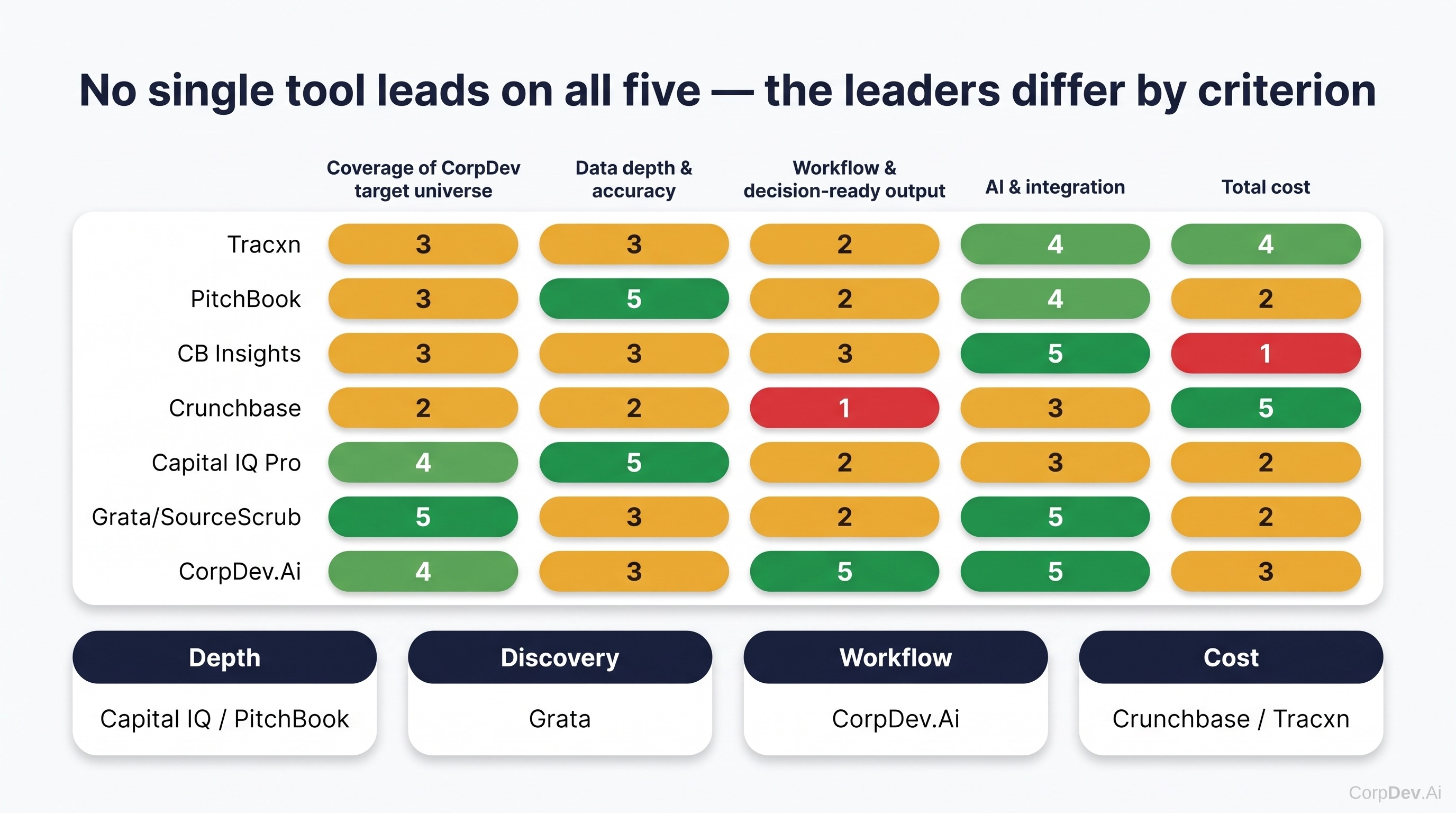
Read diagram description
Comparative ratings. Rows: Tracxn, PitchBook, CB Insights, Crunchbase, Capital IQ Pro, Grata/SourceScrub, CorpDev.Ai. Columns (five buyer criteria): "Coverage of CorpDev target universe", "Data depth & accuracy", "Workflow & decision-ready output", "AI & integration", "Total cost". Scores 1–5: Tracxn 3,3,2,4,4; PitchBook 3,5,2,4,2; CB Insights 3,3,3,5,1; Crunchbase 2,2,1,3,5; Capital IQ Pro 4,5,2,3,2; Grata/SourceScrub 5,3,2,5,2; CorpDev.Ai 4,3,5,5,3. Title: "No single tool leads on all five — the leaders differ by criterion". Criterion leaders: "Depth: Capital IQ / PitchBook", "Discovery: Grata", "Workflow: CorpDev.Ai", "Cost: Crunchbase / Tracxn".
- On price-per-curated-profile, Tracxn is the value leader among premium databases. A three-seat licence at US$13,200 falls within or below the cited US$12,000–20,000 single-seat PitchBook range and includes analyst support [6][42].
- On transaction and financial depth, PitchBook and Capital IQ remain unmatched. Precedent multiples, fund and LP data, and comparables that stand up in a fairness opinion are not what Tracxn, Crunchbase or the AI-native tools were built for [44][72].
- On discovering founder-owned companies — the bulk of most corporate target universes — the web-scale engines win. Grata/SourceScrub, Cyndx, Inven and CorpDev.Ai's semantic sourcing all surface companies that never appear in a funding database [76][84][104].
- On carrying the work to a decision, CorpDev.Ai is the only tool in the set that spans research, sourcing, pipeline, data-room analysis and memo generation in one environment [108][110]. CB Insights' agents and "Magic Modes" are the nearest database-side equivalent for memo drafting [128].
- On emerging-market coverage, Tracxn merits close consideration. For an acquirer with an India, Southeast Asia, Middle East or Africa thesis, test country-level completeness, freshness and false positives against known targets [32][33].
Every platform in this set — including the two most expensive — produces records that need checking before they reach a board paper. The differentiator is whether the tool shows you its sources. Tracxn shows curated fields without primary-source links on most records; PitchBook cites filings and press; Grata and Inven link to the company website; CorpDev.Ai and ChatCBI generate citations inline. Budget analyst time for verification with any tool that does not.
6. Platform Deep-Dives
Each profile below is written from the buyer's chair: what you actually get, what it costs, where it disappoints, and who should buy it. Tracxn's own profile is in Section 3.
6.1 PitchBook (Morningstar)
PitchBook is the institutional reference for private-capital data: 5M+ companies, 3M+ investments, 560K+ investors and 140K+ funds, with roughly 4.7M private companies carrying some financial data [44][45]. Its strength is the completeness and provenance of transaction records for VC- and PE-backed companies, backed by a large human research team and a mature Excel plug-in. The 2025–26 AI programme is the most ambitious of the incumbents: Navigator (natural-language research launched November 2025), an OpenAI/MCP connector that lets users query PitchBook inside ChatGPT, daily valuation estimates for 15,000+ VC-backed companies, and a machine-learning exit predictor [124][125][48][46]. Waters Technology named it Best Alternative Data Provider in 2026 [47].
Pricing is quote-only and typically lands at US$12,000–20,000 per named seat, with a median contract value around US$31,875 in one procurement dataset [42][131]. Multi-year terms with auto-renewal are standard, and seat licences are named and policed.
Weaknesses for CorpDev: founder-owned companies that never raised institutional capital are thinly covered; the workflow layer stops at lists, alerts and saved searches; and the price makes it hard to justify for a two-person team that runs three deals a year. Best for: corporate venture arms, acquirers of VC-backed technology companies, and any team that needs defensible comparables and investor intelligence.
6.2 CB Insights
CB Insights has moved furthest from "database" toward "intelligence layer." It claims 12M companies across 1,600 markets with double-verified profiles [51], and its product surface is now dominated by AI: ChatCBI for conversational research, a June 2025 "AI agent workforce" for M&A, partnerships, competitive intelligence and deal sourcing, "Magic Modes" that generate investment memos and Porter's Five Forces analyses, and API/MCP deployment into Microsoft 365 Copilot and Snowflake [53][121][128][122]. For corporate-strategy teams that run recurring technology-scouting and competitive-monitoring programmes, this is the strongest database-side option.
Pricing is enterprise-only and the most expensive in the database category: US$25,000–50,000+ per year, with a contract-data median near US$47,000 [49][50].
Weaknesses for CorpDev: it is a technology-market tool first — coverage of industrial, services and consumer targets is weaker; comparative reviews raise data-integrity questions; and the contract size assumes a corporate-strategy budget rather than a deal-team budget [39]. Best for: corporate strategy and innovation teams at large technology-adjacent companies with a standing competitive-intelligence mandate.
6.3 Crunchbase
Crunchbase is the low-cost, self-serve entry point: Pro at US$49/month billed annually and Business from US$199/month, with 2,000- and 5,000-row monthly export caps respectively [56][57]. Coverage is ~4M private companies on Pro and 6M+ in the broader dataset, plus ~18M contacts [58][59]. Its February 2025 relaunch as a predictive-intelligence engine — scoring likelihood of funding, acquisition, growth and distress — and 2026 MCP and ChatGPT integrations make it far more useful than its legacy reputation as a funding wiki suggests [60][61][59].
Weaknesses for CorpDev: deal terms, financials and ownership are shallow; international profiles are incomplete; and the export caps constrain any serious long-list work. Best for: individual professionals, early-stage screening, and as a cheap sanity-check layer alongside a premium tool. It is not a Tracxn replacement for a team with a real mandate.
6.4 Dealroom.co
Dealroom is the European specialist — 3.2M+ companies, 1.7M+ startups, 830K+ rounds — with deep relationships with governments and ecosystem bodies across Europe [64][65]. Published pricing is Premium at €12,600 per year and Premium Plus at €17,000 per year, both with a three-seat minimum (roughly US$4,500–6,100 per seat), the Plus tier adding 30,000 export credits per user and an MCP connection [63].
Weaknesses for CorpDev: thin outside Europe; light on private financials and founder-owned discovery; AI is less central than at competitors. Best for: European corporate venture and scouting teams, and as a Tracxn substitute where the thesis is European rather than Asian.
6.5 S&P Capital IQ Pro
Capital IQ Pro is the finance team's platform: 60M+ private companies (~16M with recent financials), full public-company fundamentals, estimates, precedent transactions and ownership, with the best Excel integration in the category [72]. For valuation, comps and board-quality financial analysis it is the standard against which others are measured.
Reported seat pricing is US$15,000–30,000, with a list price near US$33,375 and negotiated seats spanning US$10,000 to more than US$50,000 depending on modules and term [71].
Weaknesses for CorpDev: it is a validation tool, not a discovery tool — poor at surfacing obscure private targets; private-company depth varies sharply by country; training burden is substantial. Best for: the analyst who builds the model. Most corporate acquirers already hold Capital IQ or Bloomberg in Finance; the question is whether CorpDev needs its own seat or shared access.
6.6 Mergermarket (ION Analytics)
Mergermarket is a different animal: journalist-sourced intelligence on live and rumoured M&A processes, auctions and mandates, with a 2M+ article archive back to 2002 [74][75]. It tells you which assets are coming to market before the databases do. Estimated seat pricing is US$15,000–30,000 [73].
Weaknesses for CorpDev: it is not a company directory; coverage concentrates on material transactions; editorial intelligence is hard to operationalise in a CRM. Best for: acquirers competing in auction-heavy sectors and banks seeking mandates.
6.7 Grata + SourceScrub (Datasite)
The most consequential change in the sourcing market in 2025 was Datasite's acquisition of Grata (June 2025, alongside a US$500M CapVest investment commitment) and SourceScrub (August 2025, from Francisco Partners), with SourceScrub's 17M event- and directory-sourced listings being merged into Grata's 21M-company, 10M-contact platform [78][79][82][84][85]. Grata's Agentic Search interprets an acquisition thesis in plain language and reasons across adjacent categories — the closest any vendor has come to replacing Boolean filters [119][120]. Reported contracts range from US$15,000 to US$100,000 per year [77].
Weaknesses for CorpDev: pricing is opaque and has drifted upward; financials and ownership need separate validation; international coverage is less consistent than US; and the Datasite integration introduces packaging and roadmap uncertainty. Best for: PE and corporate buyers whose universe is lower-middle-market, founder-owned US and European companies — the segment Tracxn and PitchBook cover least well.
6.8 Cyndx and Inven
Cyndx applies graph matching across ~31M companies to answer three questions — which targets fit this thesis (Finder), which buyers would want this asset (Acquirer), and which investors would fund it (Raiser) — at an estimated US$30,000–60,000 per year [87][88][89]. Inven, a Nordic-origin AI research platform covering 28M+ companies, emphasises turning discovery into client-ready long-lists and market maps; directional pricing is around US$10,000 per user per year [91][92]. The historical offerings emphasise founder-owned discovery over deep financials. CYNDX’s official site now announces wind-down and dissolution (accessed 14 September 2026, no announcement date shown), so its profile is retained for historical context, not as an active purchasing recommendation. Validate Inven against a known target list before purchase.
6.9 CorpDev.Ai
This comparison was commissioned by CorpDev.Ai. It applies the same stated criteria to each vendor, while disclosing that commercial relationship.
CorpDev.Ai is not a database but an AI-native corporate-development workspace — an "Integrated CorpDev Environment" in its own terminology — that spans the full cycle from strategy and market mapping through sourcing, screening, pipeline, diligence, valuation, investment memo and post-merger integration [108]. Its architecture comprises an AI Analyst agent trained on M&A frameworks and citation discipline, a markdown-native document editor (the Workbook) with Word/PowerPoint/Excel export, a semantic sourcing engine and pipeline Kanban with zero-entry CRM that enriches companies from connected Microsoft 365 or Google Workspace email and calendar, an AI Room data room that ingests up to 50,000-page document sets with page-level citations, and digital-twin models for diligence and integration planning [102][104][107][108]. Rather than owning a curated funding dataset, it orchestrates research across public sources (SEC filings, annual reports, transcripts, press, patents, job postings, web traffic) and integrated third-party databases including Apollo (70M+ companies, 265M+ contacts), with frontier models from Anthropic, OpenAI, Perplexity and Google routed by task [108][110]. The company also operates a managed-services arm that runs sourcing, memo and PMI work on the platform for clients.
Pricing is published: AI Pro at US$1,000/month (single user, 12,000 search credits/year) and AI Pro Team at US$3,000/month (three users, 36,000 credits/year), both invoiced annually with a 20% premium for monthly card billing; Enterprise is quoted and adds SSO, unlimited users, financial modelling and managed services [110]. Pipeline and CRM are included in every plan. Trials are invitation-led, with in-house CorpDev teams at US$1B+ revenue companies automatically eligible [107].
Job-to-be-done coverage. It is the only tool in this set that starts from "produce the market map, the target list and the memo" rather than "here is a database" — the output is a cited document, not a CSV.
Founder-owned discovery. Semantic and geographic (Google Maps) search finds the never-funded companies that dominate corporate target universes, and scores them for fit [104].
Explainability. Inline citations and an auditable AI Room address the verification-cost problem that afflicts every database in Section 5.
Price and openness. US$12,000 per seat sits between Tracxn and PitchBook while replacing several tools; open formats (Markdown, JSON, .xlsx, .pptx) and REST/MCP interfaces limit lock-in [108][110].
No proprietary curated dataset. Funding-round history, cap tables, fund and LP data are drawn from public sources and partners, not a decade of human curation; for VC-style round-by-round intelligence, Tracxn or PitchBook remain deeper.
Vendor scale and track record. The cited profiles describe a company founded in 2023, with no disclosed institutional funding, a small team and claims of "hundreds" of users [111][112][113]. The unnamed hyperscaler case study at [115] concerns S&P Capital IQ Pro, not CorpDev.Ai, and is not evidence of a CorpDev.Ai customer. A named, independently corroborated CorpDev.Ai customer roster was not established in this review. No independent G2/Capterra review base exists yet. Buyers should diligence continuity, data-security attestations and roadmap as they would any early-stage vendor.
Credit-metered usage. Search credits are finite; heavy sourcing programmes need to model consumption before committing.
Vendor claims. Coverage, speed ("100× faster") and cost-saving figures are marketing claims and should be tested in a pilot on the buyer's own target list.
Best for: in-house corporate-development and strategy teams of one to ten people that need to produce decision-ready deliverables without a bench of analysts, and that value one integrated environment over best-of-breed data depth. It is a complement, not a substitute, for Capital IQ where a fairness-grade model is required, and for Tracxn or PitchBook where the mandate is venture-stage and round-level.
7. Total Cost of Ownership and Pricing Reality
List price is the smallest part of what a data platform costs a corporate-development team. The table below models three-year total cost of ownership for a representative three-person team, using published prices where available and selected procurement-benchmark scenarios where they are not. The Basis column flags which is which; hidden costs are itemised separately so the reader can adjust them.
7.1 Three-Year TCO — Three-Seat CorpDev Team
| Platform | Year 1 | 3-year total |
|---|---|---|
| Crunchbase Business | 7.2 | 21.5 |
| Tracxn Premium (3 seats) | 13.2 | 39.6 |
| Dealroom Premium (3-seat plan) | 13.6 | 40.8 |
| CorpDev.Ai AI Pro Team | 36.0 | 108.0 |
| Grata (mid-range contract) | 40.0 | 120.0 |
| PitchBook (3 seats, mid-range) | 45.0 | 135.0 |
| CB Insights (median contract) | 47.0 | 141.0 |
| S&P Capital IQ Pro (3 seats, mid-range) | 60.0 | 180.0 |
| Platform | Annual basis used | Basis | Source |
|---|---|---|---|
| Crunchbase Business | 3 × US$2,388 | Published | [56] |
| Tracxn Premium | US$13,200 three-user tier | Published | [6] |
| Dealroom Premium | €12,600 at US$1.08/€ | Published | [63] |
| CorpDev.Ai AI Pro Team | US$3,000 × 12, invoiced annually | Published | [110] |
| Grata | US$40K analyst-selected smaller-team scenario within US$15–100K range; not the arithmetic midpoint | Estimate | [77] |
| PitchBook | 3 × US$15,000 (selected scenario within US$12–20K; midpoint would be US$16K) | Estimate | [42] |
| CB Insights | Contract-data median US$46,984 | Estimate | [50] |
| S&P Capital IQ Pro | 3 × US$20,000 (selected scenario within US$15–30K; midpoint would be US$22.5K) | Estimate | [71] |
The model holds prices flat for three years. In practice, quote-only vendors typically embed annual escalators, so the three-year figures for PitchBook, CB Insights, Capital IQ and Grata exclude any future escalation; discounts or changed scope could also reduce them.
7.2 The Hidden Costs
Every platform produces records that must be checked before a memo. If one analyst spends two hours a week reconciling and verifying data at a fully loaded US$100 per hour, that is roughly US$10,000 per year per analyst — comparable to a Tracxn seat. Tools with inline source citations (PitchBook filings links, ChatCBI, CorpDev.Ai) reduce this; tools without them shift the cost to your team.
Tracxn exports consume credits and API access is a separately priced Data Solutions pack [15]; Crunchbase caps exports at 2,000–5,000 rows per month [56]; Dealroom allocates 10,000–30,000 export credits per user by tier [63]; CorpDev.Ai meters search credits (12,000–36,000 per year) [110]. A sourcing programme that builds 5,000-company long-lists will exhaust entry-tier quotas quickly.
Databases are quick to switch on but slow to master; Capital IQ and PitchBook carry a real training burden. Workflow systems are the reverse: DealCloud implementations run US$50–150K and four to six months [99][101]; Affinity claims under 60 days [97]; CorpDev.Ai includes onboarding in every plan [110]. Budget internal time, not just licence fees.
7.3 Contract Terms That Move the Price
Published pricing is the exception in this market — only Tracxn, Crunchbase, Dealroom, PrivCo, Affinity and CorpDev.Ai post rates. Everywhere else the following terms determine the real cost:
- Seat definition. Named-user licences with concurrent-login policing (Tracxn explicitly flags simultaneous logins [15]) mean a "shared" seat is a compliance risk, not a saving.
- Term and escalator. Three-year terms with 5–8% annual uplifts are common for quote-only vendors; a flat 12- or 24-month term is worth more than a headline discount in a converging market.
- Auto-renewal and notice. Notice periods vary by contract; identify and calendar the actual deadline at signing.
- Data rights. Confirm export, redistribution and AI-model-use rights in writing. Tracxn distinguishes internal-use from commercial-redistribution licences [15]; most vendors now restrict bulk extraction for training.
- MCP/API inclusion. With PitchBook, Crunchbase, CB Insights, Tracxn and Dealroom all exposing MCP endpoints [124][61][122][17][63], insist that AI-stack access is included in the base seat rather than sold as an add-on.
A vendor with flat revenue, a shrinking international book and a plan to nearly double its closing sales team from ~34 to ~60 by December 2026 [24] is a vendor that will discount and shorten terms to win a new logo outside India. Ask for the seven-user rate on a three-user licence, a 12-month term, and included export credits and MCP access.
8. Fit by Buyer Profile
The right answer depends less on the vendor than on the buyer. Six profiles cover most corporate-development, strategy and M&A situations.
| Buyer profile | Original team / budget example | Data and workflow candidates | Tracxn role and qualification |
|---|---|---|---|
| Large-cap CorpDev, global developed markets | 5–15 people; $150–500K/year | Capital IQ under appropriate Finance/CorpDev entitlements; PitchBook if technology/private-capital context matters; CorpDev.Ai or DealCloud for workflow | Additional candidate for an Asia/emerging-market mandate; no shared-credential assumption. |
| Mid-cap strategy and CorpDev | 1–4 people; $15–60K original planning budget | Tracxn or Crunchbase Business for data; CorpDev.Ai for research and workflow | Strong candidate for a venture-stage universe. The budget is not a fully priced stack. |
| Corporate venture arm | 2–6 people; $30–100K/year | PitchBook for US/EU or Tracxn for Asia/EM; Affinity for relationships | Priority emerging-market candidate, subject to coverage testing; no universal best-in-class claim. |
| PE / VC deal team | 5–20 people; $100K–1M/year | PitchBook + Grata/Sourcescrub; Affinity or DealCloud | Potential niche addition for emerging-market sourcing. |
| Boutique M&A adviser | 2–8 people; $20–80K original planning budget | Tracxn; Mergermarket if auction-heavy; CorpDev.Ai for CIMs, buyer lists and deliverables | Possible value-oriented data core; the budget may not fund all seats and data licences. |
| India / SEA / MEA acquirer | Any size; no all-in budget established | Tracxn plus CorpDev.Ai or Affinity | Shortlist for country-specific pilot; “default choice—no rival” was not supported. |
These are buyer profiles, not quotes for fully entitled stacks. At $12K per standard CorpDev user, eight users alone imply $96K/year before data subscriptions, usage and Enterprise requirements. Price the actual seats, data access and review workload.
8.1 Large-Cap Corporate Development (Global, Developed-Market Mandate)
Check whether Finance holds Capital IQ or Bloomberg and whether its licence permits CorpDev access; use properly entitled access or an additional named seat, not shared credentials. The genuine gap is discovery of founder-owned targets and the production of decision-ready materials at pace. A workflow layer — CorpDev.Ai for a team that authors its own memos and market maps, or DealCloud where the institution demands a heavyweight system of record — sits on top. PitchBook earns its seat only if the thesis is venture-backed technology. Tracxn's role: an additional, inexpensive seat if the mandate includes India or emerging Asia; otherwise not needed.
8.2 Mid-Cap Strategy and CorpDev Team (One to Four People)
This is the buyer for whom Tracxn's value proposition is strongest and the trade-off sharpest. At US$13,200 for three seats, Tracxn delivers a curated global database with analyst support at a price within or below the cited US$12,000–20,000 single-seat PitchBook range [6][42]. But a three-person team's binding constraint is not data access — it is the hours to turn data into a board paper. CorpDev.Ai's three-user plan at US$36,000 costs 2.7× Tracxn and combines firmographic research, CRM and first-draft deliverables; whether it replaces an existing data entitlement or outside work depends on the required coverage and quality [110]. Verdict: if the universe is venture-stage and the team has analyst capacity, Tracxn; if the universe is mid-market and the team must produce its own deliverables, CorpDev.Ai; if budget allows both, they are complementary.
8.3 Corporate Venture Capital
CVC lives on funding-round data, so the funding-round databases are the natural home. Geography decides the vendor: PitchBook for US and European venture, Tracxn for India, Southeast Asia, the Middle East and Africa, Dealroom for a Europe-only ecosystem mandate [44][32][64]. Affinity is the standard relationship CRM for the deal flow [94]. Tracxn's role: best-in-class for emerging-market CVC; a credible, cheaper alternative to PitchBook for global early-stage scanning where deal-term depth is not critical.
8.4 Private Equity and Venture Deal Teams
Institutional buyers with real budgets stack PitchBook for transaction and fund intelligence, Grata/SourceScrub for proprietary sourcing of founder-owned businesses, Mergermarket for process intelligence in auction-heavy sectors, and Affinity or DealCloud as the system of record [44][76][74][94][99]. Tracxn's role: a niche addition for emerging-market sourcing; not a core tool for a developed-market fund.
8.5 Boutique M&A Advisors
Advisors need breadth on a budget plus the ability to produce buyer lists and CIMs quickly. Tracxn is a strong value core, Mergermarket adds mandate intelligence where the sector is auction-driven, and CorpDev.Ai's sell-side workflows (CIM creation, buyer identification, buyer-specific positioning) address the deliverable bottleneck [108]. Tracxn's role: good-value primary database.
8.6 Acquirers With an India, Southeast Asia or Africa Thesis
Tracxn’s documented proposition is particularly relevant to these markets — early-stage and stealth coverage, Indian legal-entity structures, labour-filing employee counts, cap tables across expanding geographies [17][32][33]. Pair it with a workflow layer if a pilot confirms the relevant country and sector coverage. Tracxn’s role: a priority shortlist candidate.
Before any CorpDev purchase, inventory the group's existing licences. Capital IQ, Bloomberg, FactSet and Refinitiv seats in Treasury or Investor Relations frequently include private-company and M&A modules that CorpDev can access for the cost of an internal conversation.
9. Buying Checklist and Negotiation Levers
A two-week structured pilot beats any vendor demo. The checklist below is designed to be copied into the evaluation workbook and completed for each shortlisted vendor.
9.1 Pilot Design
- Build a truth set of 50 companies spanning the team's real target universe: 10 known VC-backed, 20 founder-owned never-funded, 10 subsidiaries or carve-out candidates, 10 in the weakest geography for the vendor.
- Measure hit-rate — how many of the 50 exist in the platform with a usable profile.
- Measure field completeness on the hits — revenue, employee count, ownership, latest transaction, named executive contact.
- Measure verification time — minutes per record to confirm the three most important fields against a primary source.
- Run one real deliverable — a market map or a target long-list for a live thesis — end-to-end, and time it from query to shareable artefact.
- Test the AI layer on the same thesis via the vendor's assistant and via MCP into your own AI tools; check that outputs carry sources.
9.2 Due-Diligence Questions for Each Vendor
| Area | Question | Why it matters |
|---|---|---|
| Coverage | What share of your profiles are companies that have never raised institutional capital? By region? | Corporate target universes are mostly founder-owned |
| Freshness | What is the median lag from a funding round, acquisition or executive change to the record update? | Stale records cause missed triggers |
| Accuracy | What is your record-correction SLA and how do users flag errors? | Reviewers cite errors on every platform [26] |
| Provenance | Does each field carry a primary-source link? | Determines your verification labour |
| Financials | For private companies in [your countries], what proportion have filed financials, and for how many years? | Longitudinal analysis is often impossible [26] |
| Exports | Exact row, credit and frequency limits per seat; cost of additional credits | Long-list work exhausts quotas |
| API / MCP | Included in seat or priced separately? Rate limits? | AI-stack access is now table stakes |
| Seats | Named vs. concurrent; policy on login from multiple devices | Tracxn polices simultaneous logins [15] |
| Data rights | May we store, redistribute internally, and use data in our own AI models? | Increasingly restricted |
| Security | SOC 2 Type II report, data residency, tenant isolation, model-training exclusion | Mandatory for enterprise procurement |
| Roadmap | Which features shipped in the last 12 months; which are committed for the next 12? | Separates marketing from delivery |
| Vendor health | Revenue trend, ownership, funding, customer count | Tracxn is public [7]; Grata/SourceScrub changed owners [78][82]; CorpDev.Ai is early-stage [113] |
| Support | Analyst-desk entitlements and response SLA | Tracxn includes one analyst query per user per month [15] |
| Exit | Data export on termination; notice period; auto-renewal terms | Avoid lock-in as the market consolidates |
9.3 Negotiation Levers
| Lever | How to use it |
|---|---|
| Term length | Offer a 12- or 24-month term in exchange for a flat price; refuse three-year escalators in a converging market |
| Tier arbitrage | On Tracxn, ask for the seven-user per-seat rate (US$3,771) on a three-user licence [6]; on Dealroom, negotiate the three-seat minimum down |
| Bundled quotas | Have export credits, API calls and analyst queries written into the base price, not sold as add-ons |
| Pilot-to-contract credit | Ask that paid pilot fees be credited against year-one licence |
| Competitive tension | Run PitchBook and Tracxn, or Grata and CorpDev.Ai, in parallel pilots and share hit-rate results with both |
| Fiscal-year timing | Tracxn's fiscal year ends 31 March and it reports quarterly; other vendors’ fiscal calendars and discount policies vary; confirm their actual sales-cycle timing rather than assuming calendar quarters or guaranteed discounts |
| Vendor incentives | Tracxn is building international sales capacity and reports customer-count growth to investors [24]; a new international logo is worth more to it than list price |
| Reference rights | Trade a named reference or case study for a discount, particularly with earlier-stage vendors |
The most common procurement failure in this category is stacking Tracxn, Crunchbase and PitchBook because each covers something the others miss, then using none of them well. Buy one data source that matches your geography and target type, one workflow layer that matches your team's deliverable burden, and revisit in 18 months.
10. Key Facts & Sources
The load-bearing figures in this document, with source and as-of date. Estimates are marked as such; the derivation of computed figures is shown.
| Figure | Value | Source | As of | Basis |
|---|---|---|---|---|
| Tracxn FY2026 revenue from operations | ₹83.97 crore (~US$10M at ₹85/US$) | [7][10] | May 2026 | Reported |
| Tracxn FY2025 revenue from operations | ₹84.47 crore | [4][5] | May 2025 | Reported |
| Tracxn FY2026 statutory net loss | ₹7.89 crore | [7][11] | May 2026 | Reported |
| Tracxn FY2025 PAT | ₹4.9 crore profit | [4][6] | May 2025 | Reported |
| Tracxn customer accounts / active users | 2,289 / 6,227 (+19% / +23% YoY) | [7][8] | Mar 2026 | Reported |
| Tracxn employees | 717 | [8][13] | Mar 2026 | Reported |
| Tracxn India vs. international revenue FY2026 | ₹38.2 cr (+14%) vs. ₹45.8 cr (−10%) | [11][12] | May 2026 | Reported |
| Tracxn cash reserves | ~₹89.2 crore | [13] | Jul 2026 | Reported |
| Tracxn share price | ₹52.44 (28 Mar 2025) → ₹25.99 (30 Mar 2026) → ₹29.00 (11 Sep 2026); −44.7% | [18][19][20] | 11 Sep 2026 | Reported; % computed |
| Tracxn coverage | 7.7M+ companies, 290K+ investors, 1.8M+ rounds, 226K+ acquisitions, 3K+ feeds, 55.4K+ business models | [15] | Sep 2026 | Vendor claim |
| Tracxn published pricing | US$6,600 (1 user) / US$13,200 (3) / US$26,400 (7) per year | [6] | 2025–26 | Published |
| PitchBook per-seat pricing | US$12,000–20,000; median ACV ~US$31,875 | [42][131] | Aug 2026 | Estimate |
| PitchBook coverage | 5M+ companies, 3M+ investments, 560K+ investors, 140K+ funds | [44] | 2026 | Vendor claim |
| CB Insights pricing | US$25,000–50,000+; median ~US$46,984 | [49][50] | 2026 | Estimate |
| CB Insights coverage | 12M companies, 1,600 markets | [51] | May 2026 | Vendor claim |
| Crunchbase pricing | Pro US$49/mo annual; Business from US$199/mo annual | [56][57] | Sep 2026 | Published |
| Dealroom pricing | Premium €12,600/yr; Premium Plus €17,000/yr; 3-seat minimum | [63] | 2026 | Published |
| PrivCo pricing | List Builder US$199/mo; Power US$399/mo annual | [66][67] | Sep 2026 | Published |
| S&P Capital IQ Pro pricing | US$15,000–30,000/seat; list ~US$33,375 | [71] | Aug 2026 | Estimate |
| S&P Capital IQ Pro coverage | 60M+ private companies, ~16M with recent financials | [72] | Jun 2026 | Vendor claim |
| Mergermarket pricing | US$15,000–30,000/seat | [73] | Jun 2026 | Estimate |
| Grata pricing / coverage | US$15,000–100,000/yr; 21M+ companies, 10M+ contacts | [76][77] | 2026 | Estimate / vendor claim |
| Datasite–Grata / Datasite–SourceScrub | Jun 2025 (with US$500M CapVest commitment) / Aug 2025 | [78][79][82][85] | 2025 | Reported |
| SourceScrub coverage | ~17M listings from 290K+ sources | [84] | Apr 2026 | Vendor claim |
| Cyndx pricing / coverage | US$30,000–60,000/yr; ~31M companies | [87][88][89] | Aug 2026 | Estimate / vendor claim |
| Inven pricing / coverage | ~US$10,000/user/yr; 28M+ companies | [91][92] | 2026 | Directional / vendor claim |
| Affinity pricing | US$2,000–2,300/user/yr | [94] | 2026 | Published |
| DealCloud pricing | US$50,000–250,000+/yr plus US$50,000–150,000 implementation | [99][100] | Feb 2026 | Estimate |
| CorpDev.Ai pricing | AI Pro US$1,000/mo (1 user, 12,000 credits/yr); AI Pro Team US$3,000/mo (3 users, 36,000 credits/yr); invoiced annually | [110] | Sep 2026 | Published |
| CorpDev.Ai coverage / founding / funding | 70M+ companies via research sources; founded May 2023; no disclosed institutional funding | [108][112][113] | Sep 2026 | Vendor claim / public databases |
| BlackRock–Preqin close | March 2025 | [135][136] | Mar 2025 | Reported |
| Private-markets data TAM | ~US$8B, ~12% CAGR to ~US$18B by 2030 | [133][134] | 2024 | BlackRock estimate |
| 3-year TCO, 3 seats | Crunchbase US$21.5K; Tracxn US$39.6K; Dealroom US$40.8K; CorpDev.Ai US$108K; Grata US$120K; PitchBook US$135K; CB Insights US$141K; Capital IQ US$180K | Section 7.1 | Sep 2026 | Computed: annual basis × 3, flat pricing |
| Verification labour | ~US$10,000/analyst/yr | Section 7.2 | — | Illustrative: 2 hrs/wk × 48 wks × US$100/hr loaded |
| FX assumptions | US$1.08/€; ₹85/US$ | — | Sep 2026 | Approximate |
References
Numbering follows the original research. Access dates below record the original source registry; they do not imply that every source was rechecked for this website edition.
- Investor Relations - TracxnSource accessed 2026-09-11
- Technology & Data for Venture Capital, Corp Dev, Investment BanksSource accessed 2026-09-11
- Annual Report FY 24-25 Tracxn | PDF | Corporate Finance - ScribdSource accessed 2026-09-11
- Tracxn Technologies LimitedSource accessed 2026-09-11
- Tracxn Technologies Ltd Management Discussions | India Infolinewww.indiainfoline.com › company › management-discussionsSource accessed 2026-09-11
- Tracxn narrows FY26 loss, eyes FY27 growth with AISource accessed 2026-09-11
- Tracxn Technologies completes dispatch of 14th AGM noticeSource accessed 2026-09-11
- Tracxn Technologies FY26 Results: Revenue slips 1.9% YoY to ₹84 croreSource accessed 2026-09-11
- Tracxn reports Rs 84 crore revenue from operations in FY26, posts Rs 7.9 crore net lossSource accessed 2026-09-11
- Tracxn Q4 FY26: India Accelerates While International RebuildsSource accessed 2026-09-11
- Tracxn Technologies Submits FY26 Annual ReportSource accessed 2026-09-11
- PricingSource accessed 2026-09-11
- Product Announcements - TracxnSource accessed 2026-09-11
- Tracxn Technologies Share Price, Historical Data ...Source accessed 2026-09-11
- Tracxn Technologies LtdSource accessed 2026-09-11
- Tracxn Technologies Limited (TRACXN.NS)Source accessed 2026-09-11
- Tracxn Technologies Ltd Q4 2026 Earnings Call TranscriptSource accessed 2026-09-11
- Tracxn Q1 FY27 presentation: data expansion accelerates, sales ...Source accessed 2026-09-11
- Tracxn Technologies Ltd Reviews & Provider Details - G2Source accessed 2026-09-11
- TracxnSource accessed 2026-09-11
- Tracxn: Startup and market intelligence for investors – SurferstackSource accessed 2026-09-11
- 9 Dealroom Alternatives in 2026 (Cheaper Picks) - Tomba BlogSource accessed 2026-09-11
- Tracxn vs Contify (2026): Pros, Cons & Pricing - RFP.wikiSource accessed 2026-09-11
- Crunchbase Alternatives for 2026: Best Startup & VC...Source accessed 2026-09-11
- The G2 on TracxnSource accessed 2026-09-11
- I've been watching what 200+ founders actually research on ... - RedditSource accessed 2026-09-11
- Compare PitchBook vs Tracxn 2026Source accessed 2026-09-11
- PitchBook Cost 2026: Price Per User Per Year | Investables.aiSource accessed 2026-09-11
- PitchBook’s Pricing - PitchBookSource accessed 2026-09-11
- PitchBook’s Data: Private & Public Market Data - PitchBookSource accessed 2026-09-11
- Company Financials Data: Public & Private - PitchBookSource accessed 2026-09-11
- PitchBook AI-powered insights for VC, PE & M&A - PitchBookSource accessed 2026-09-11
- PitchBook Named Best Alternative Data Provider in Waters Technology Rankings 2026Source accessed 2026-09-11
- PitchBook Introduces the First Daily Valuation Model for VC ...Source accessed 2026-09-11
- PricingSource accessed 2026-09-11
- CB Insights Pricing, Reviews, Pros & Cons (2026)Source accessed 2026-09-11
- DataSource accessed 2026-09-11
- ChatCBI - CB InsightsSource accessed 2026-09-11
- Crunchbase Pricing: The Annual Rate Is IntroductorySource accessed 2026-09-11
- Product PricingSource accessed 2026-09-11
- Crunchbase Pricing OverviewSource accessed 2026-09-11
- Crunchbase Private Market Data is Available in ChatGPT for Financial ServicesSource accessed 2026-09-11
- Crunchbase Declares Historical Data Dead—Relaunches as an AI ...Source accessed 2026-09-11
- Product Updates and Release NotesSource accessed 2026-09-11
- Pricing | Dealroom.coSource accessed 2026-09-11
- Discover new companies & source deals | Dealroom.coSource accessed 2026-09-11
- Dealroom Reviews 2026: Ratings, Reddit Sentiment + Honest ...Source accessed 2026-09-11
- Pricing - Plans & Free Trial - PrivCoSource accessed 2026-09-11
- PrivCo Pricing 2026: Plans & Cost - PulseSignalSource accessed 2026-09-11
- PrivCo | Fundamental data provider Profile | The LSE DirectorySource accessed 2026-09-11
- Capital IQ Cost 2026: S&P Capital IQ Price Per SeatSource accessed 2026-09-11
- S&P Capital IQ ProSource accessed 2026-09-11
- Best Market Intelligence Platforms for M&A (2026)Source accessed 2026-09-11
- Intelligent Search - MergermarketSource accessed 2026-09-11
- ION Analytics Intelligence API Offers News, Analysis InsightsSource accessed 2026-09-11
- Flexible Pricing Plans Suited For Any Use CaseSource accessed 2026-09-11
- Grata Pricing, Reviews, Pros and Cons (2026)Source accessed 2026-09-11
- Datasite Acquires Leading Private Market Intelligence ... - GrataSource accessed 2026-09-11
- Private Equity-Backed Datasite Acquires Private-Markets ...Source accessed 2026-09-11
- Datasite to Acquire Sourcescrub, Expanding Private Market ... - GrataSource accessed 2026-09-11
- Harmonic vs SourceScrub: A comparison for deal sourcingSource accessed 2026-09-11
- Datasite to Acquire Sourcescrub, Expanding Private Market ...Source accessed 2026-09-11
- Cyndx Pricing 2026: Enterprise Custom Quotes | CostBenchSource accessed 2026-09-11
- What are the best deal sourcing platforms in 2026? | InvenSource accessed 2026-09-11
- Best M&A Deal Management Software 2026: DealCloud, DatasiteSource accessed 2026-09-11
- CorpDev.Ai vs Inven: Pricing & Features ComparisonSource accessed 2026-09-11
- Inven overviewSource accessed 2026-09-11
- Affinity Pricing: Plans for Private Capital CRMSource accessed 2026-09-11
- CRM data enrichment tools for private capital dealmakersSource accessed 2026-09-11
- The CRM Built for Deal Teams - AffinitySource accessed 2026-09-11
- M&A Pipeline Management Software: Top Tools ComparedSource accessed 2026-09-11
- Deal Origination Software That Helps You Close (2026)Source accessed 2026-09-11
- DealcloudSource accessed 2026-09-11
- AI Analyst Agent for M&ASource accessed 2026-09-11
- AI Deal Sourcing Platform for M&A | CorpDev.AiSource accessed 2026-09-11
- Request a Free Trial | CorpDev.AiSource accessed 2026-09-11
- CorpDev.Ai - Agentic AI for M&A and Corporate DevelopmentSource accessed 2026-09-11
- PricingSource accessed 2026-09-11
- About UsSource accessed 2026-09-11
- Kal Kilpi - CEO @ CorpDev.Ai | Superhuman M&A | LinkedInSource accessed 2026-09-11
- CorpDev.ai - 2026 Company Profile & CompetitorsSource accessed 2026-09-11
- The ImpactSource accessed 2026-09-11
- Access the deepest, most dynamic view of the private ...Source accessed 2026-09-11
- A Year of Game-Changing Expansion: Grata's 2025 in ReviewSource accessed 2026-09-11
- CB Insights Unveils Industry's First AI Agent Workforce for M&A ...Source accessed 2026-09-11
- Team of AgentsSource accessed 2026-09-11
- PitchBook Launches New Generative AI Experiences with the Introduction of PitchBook Navigator and Upcoming Integration with OpenAISource accessed 2026-09-11
- PitchBook introduces AI tool Navigaton, integrates with ...Source accessed 2026-09-11
- Recent Product UpdatesSource accessed 2026-09-11
- Pitchbook Software Pricing & Plans 2026: See Your Cost - VendrSource accessed 2026-09-11
- Press Release: BlackRock to Acquire Preqin | Aladdin®Source accessed 2026-09-11
- BLK-Preqin Investor PresentationSource accessed 2026-09-11
- BlackRock Establishes Preeminent Private Markets, Technology ...Source accessed 2026-09-11
- BlackRock Establishes Preeminent Private Marketswww.blackrock.com › article › blackrock-completes-preqin-acquisitionSource accessed 2026-09-11