RESEARCH / Relationship CRM
4Degrees alternatives: relationship CRM, deal workflow and AI research
Compare 4Degrees with Affinity, DealCloud, Midaxo and AI research platforms, including relationship intelligence, pricing assumptions, governance and buyer fit.
Research as of
Website edition edited
Published by CorpDev.Ai, which is one of the vendors assessed. This analysis distinguishes vendor claims, external evidence and analyst judgments. Prices and capabilities reflect the source dates in the article; the website edition is an editorial adaptation, not a new verification of every claim.
Buy relationship intelligence where access changes the deal
The case for 4Degrees is strongest when a target is already known but reaching the right person is difficult. That is a different constraint from discovering attractive companies or deciding what to pay. A relationship graph can improve access and preserve institutional memory; it cannot establish strategic fit, resolve diligence findings or carry an integration programme. Treating those jobs as one CRM purchase risks leaving the analytical and execution workload intact.
The important economic comparison with Affinity is therefore the value of usable introductions and reliable activity capture, not the number of populated contact records. A cheaper deployment that misses the relationships relevant to the acquisition thesis can be expensive; a larger platform that requires scarce deal-team time to administer can be equally wasteful. Test both against a real target shortlist and the same connected inboxes. The evidence that should change the decision is whether either product uncovers credible access routes the team would otherwise miss, with acceptable permissions and sufficiently little manual maintenance.
This guide was produced on the CorpDev.AI platform, and CorpDev.AI is one of the vendors assessed. To keep the comparison honest, every vendor — including CorpDev.AI — is judged on the same evidence standard: published product pages, published pricing, independent review sites, and analyst commentary, all cited. Where a vendor's claim is unverified (customer counts, accuracy claims, "100× faster" marketing), it is labelled as such regardless of whose claim it is. Pricing is as of September 2026 and is indicative; every vendor here negotiates.
Executive Summary
The question "should we buy 4degrees?" is usually the wrong first question. 4degrees is a good product for one specific job — turning a firm's email and calendar exhaust into a relationship graph with a deal pipeline attached — and the more useful question for a corporate development or strategy team is whether that job is the one you are actually trying to hire software for. A corporate development team that relies on a relationship-intelligence CRM alone may discover that the CRM knows who they have met but cannot tell them who they should be meeting, can extract CIM fields but may not produce a complete investment analysis, market map or governed thesis-to-integration workflow. Conversely, teams that buy a full M&A operating system when all they needed was a shared, self-updating contact list end up paying enterprise money for features nobody opens.
The market has separated into three distinct archetypes that buyers routinely confuse because every vendor uses the words "deal", "pipeline" and "AI":
- Relationship-intelligence CRMs — 4degrees, Affinity, Dialllog, Attio. Start from the inbox. Their core asset is the firm's network; the deal pipeline is a view on top of it. Priced per seat, deployable in weeks.
- Enterprise deal and process platforms — DealCloud (Intapp), Midaxo, Devensoft, Navatar, Altvia. Start from the workflow. Configurable data models, stage-gates, diligence and integration modules, governance. Priced as enterprise contracts, deployed over months.
- AI-native analyst and sourcing platforms — CorpDev.AI and a cohort of newer entrants, plus data-first tools like Grata and Sourcescrub that supply the external company universe. Start from the work product: market maps, target screens, memos, diligence reads. The CRM is a by-product of the analysis rather than the other way round.
~$1.1M
4degrees total disclosed funding (vs. ~$120M for Affinity)
$2,000–2,700
Affinity published price per user per year — a transparent seat-price benchmark among the two primary relationship CRMs
$85K–$1.4M
Third-party estimate of a DealCloud annual contract range
10–30%
Faster deal cycles McKinsey attributes to well-applied AI in M&A
Headline conclusions for a corp dev / strategy / M&A buyer:
- 4degrees is the value pick within archetype 1. It does relationship intelligence and pipeline management competently, ships AI features (document extraction, an in-app assistant, an MCP connector) without metered AI fees, and reviewers consistently cite responsive support and a lower price than Affinity or DealCloud [1][15][20]. Its liabilities are structural rather than functional: a very small company (~$1.1M disclosed funding, founded 2017) [2][3], opaque quote-only pricing [10], a thin independent review base (five G2 reviews) [18], and a product whose centre of gravity is VC/PE rather than corporate M&A.
- Affinity is the safer version of the same bet — roughly the same product category with ~$120M of funding, 1,700+ customers, published pricing, deeper enrichment and a more mature AI stack — at a price that reviewers say climbs quickly with seat count [27][31][34]. If your reason for looking at 4degrees is relationship intelligence, benchmark it against Affinity first, not against DealCloud.
- DealCloud, Midaxo and Devensoft are not alternatives to 4degrees; they are alternatives to running M&A on a CRM at all. Evaluate them alongside CorpDev.Ai if you are a programmatic acquirer with stage-gates, cross-functional diligence and integration work. Compare analytical work completed as well as the process record. Budget for a 4–6 month implementation and a six-figure annual contract for DealCloud [40][41]; Midaxo and Devensoft land lower but still well above seat-priced CRMs [60][61][67].
- CorpDev.AI answers a different question — "who does the analytical work?" rather than "where do we log the contact?" Its proposition is an AI analyst that produces market maps, target screens, memos and diligence reads, with a zero-entry pipeline underneath. It is the most complete lifecycle scope of any tool here on paper and one of the vendors with published per-user pricing, specifically at the analyst tier ($1,000/user/month annually) [77], but it is a 2023-founded company with no publicly named customers, and its differentiating claims (DD-grade table accuracy, multi-model orchestration quality) are vendor-asserted rather than independently verified [74][79].
- Generic CRM (Salesforce/HubSpot) is the right answer more often than specialist vendors admit — specifically when a company already owns the licences and admins, deal volume is low, and the team simply needs a shared, governed target list. It becomes the wrong answer the moment someone tries to build diligence, VDR or integration workflows inside it [68][71].
| Category / primary constraint | Vendors | Starting point and commercial implications |
|---|---|---|
| Relationship-intelligence CRM | 4degrees, Affinity, Dialllog, Attio | Starts with inbox history and relationship context; typically weeks to deploy and per-seat pricing. |
| Enterprise deal and process platform | DealCloud (Intapp), Midaxo, Devensoft, Navatar, Altvia | Starts with repeatable workflows and governance; months to deploy and enterprise contracts are planning assumptions. |
| AI analyst and sourcing | CorpDev.AI, Grata, Sourcescrub; historical CYNDX | Starts with discovery, research and usable work products; per-user, platform or managed-service pricing depends on product. |
| Generalist CRM adapted for deals | Salesforce, HubSpot | Requires configuration for the team’s pipeline and controls; compare internal setup and adoption effort. |
Compare vendors within the category that addresses the constraint; combine categories where separate workloads justify them. CYNDX is historical context: its official site announces wind-down and dissolution, checked 14 September 2026, without an announcement date. It is not an active purchasing recommendation. CYNDX official site.
Who This Guide Is For — and How to Use It
This guide is written for the person who has to sign the purchase order and then live with the tool: a head of corporate development, a strategy director who owns inorganic growth, an in-house M&A lead, or the COO/CFO who sponsors them. It assumes you already know what a CRM is and are not interested in another feature checklist. It is deliberately less useful to venture and private-equity buyers, whose needs (LP management, fund-level permissions, portfolio monitoring) are where 4degrees and Affinity are strongest and where the corporate-buyer lens below would understate them.
Four buyer situations recur, and they lead to different answers:
Profile: 1–3 people, opportunistic acquirer, one or two deals a year, currently on Excel and Outlook.
Real need: Stop losing relationship history when people leave; a credible pipeline view for the CEO.
Read first: 4degrees, Affinity, HubSpot, CorpDev.AI (AI Pro).
Profile: 5–20 people plus functional leads, 4+ deals a year, formal IC and integration office.
Real need: Repeatable stage-gates, diligence workstreams, PMI tracking, executive reporting.
Read first: Midaxo, Devensoft, DealCloud.
Profile: Corp dev reports into strategy; the bottleneck is analysis (market maps, target screens, memos), not contact management.
Real need: Analytical throughput without hiring associates or paying consultants per deck.
Read first: CorpDev.AI, Grata/Sourcescrub paired with any CRM.
Profile: Large company, Salesforce estate, IT security review for every SaaS vendor, procurement wants one CRM.
Real need: Governance, SSO, audit, integration with the enterprise stack.
Read first: Salesforce/Navatar, DealCloud; 4degrees only via its Salesforce integration.
The evaluation framework used throughout scores each vendor on seven dimensions that matter to a corporate buyer specifically — as opposed to a fund: (1) relationship intelligence quality, (2) pipeline and workflow depth, (3) analytical and AI work product, (4) external target-universe data, (5) diligence-to-integration continuity, (6) governance and enterprise fit, and (7) total cost and time to value. No vendor scores well on all seven; the useful output is knowing which three you are actually paying for.
The Category: Deal CRM, Relationship Intelligence and AI-Native Corp Dev Platforms
How the market got here
Corporate development tooling has gone through three generations in roughly fifteen years. The first was generic CRM bent to purpose: Salesforce or Dynamics with a custom "Target" object, which worked as long as an admin maintained it and failed the moment the team's discipline lapsed. The second, from around 2014–2018, was relationship intelligence — Affinity (2014) and 4degrees (2017) both launched on the insight that the data a deal team needs already exists in its inboxes and calendars, and that a CRM which populates itself would finally get adopted [3][27]. In parallel, enterprise deal platforms — DealCloud (acquired by Intapp), Midaxo, Devensoft — built the opposite thing: a configurable process layer for firms whose problem was governance rather than data entry.
The third generation, visible from 2024 onward, is AI-native. McKinsey's 2026 M&A outlook describes target identification moving from a one-off exercise to "continuous, proactive opportunity sourcing", diligence moving earlier, and AI linking diligence findings directly to integration planning, and estimates that deal cycles are already 10–30% faster and M&A activities roughly 20% cheaper where AI is applied well [81]. Bain reports that nearly half of 2025 technology deals carried an AI component, up from about a quarter in 2024, and global M&A rose ~40% to roughly $4.9T in 2025 [93] — which is to say, more deals are happening and more of them require technical, fast-moving diligence.
Every incumbent has responded by bolting AI onto its existing centre of gravity. 4degrees added Document Intelligence (Feb 2026) and an MCP connector (Apr 2026) [7][8]; Affinity added Notetaker, AI Chat, "Ascend" and its own MCP server [31]; Intapp shipped "Intapp Assist" with relationship signals, summarisation and contextual outreach, and an MCP server for agent read access in 2026 [45][46][48]; Midaxo announced project-scoped document Q&A in August 2026 [53]. The AI-native entrants — CorpDev.AI among them — inverted the architecture: the agent does the analytical work and the CRM records fall out of it [74][91].
Because every vendor now advertises "AI", the differentiator has shifted from whether a tool has AI to what the AI is grounded in. Relationship-intelligence CRMs ground their AI in your internal communications graph. Enterprise platforms ground it in your configured process data. AI-native platforms ground it in the external world — filings, websites, data rooms, company databases — and in the deliverables you produce. A buyer should decide which grounding is most valuable to them before comparing AI feature lists, because the lists will look identical and the substance will not.
Market size — treat every number with care
There is no authoritative sizing for "corporate development software" as a category, and the figures that circulate come almost entirely from low-credibility aggregator reports. The most defensible framing is a bottom-up range: a tentative analyst-derived estimate places dedicated deal-CRM and M&A-workflow software around $2–3B globally, embedded inside far larger markets — AI-in-CRM (~$15B in 2026 per one estimate) and broad CRM software — that should not be used as proxies [82][86]. The commercial signal that matters more to a buyer is vendor scale: Intapp is a listed company; Affinity has ~$120M of venture funding; 4degrees has ~$1.1M disclosed; Midaxo claims 500+ customers and 5,000+ closed deals on the platform; CorpDev.AI discloses neither funding nor customers [2][27][47][54][74].
| Vendor | Disclosed funding (US$M) |
|---|---|
| Affinity | 120 |
| 4degrees | 1.1 |
Intapp (DealCloud's parent) is publicly listed and Midaxo, Devensoft and CorpDev.AI do not disclose comparable funding totals, so they are omitted from the chart rather than guessed at.
The three archetypes, and the trap between them
The single most common procurement error in this category is running a bake-off between vendors from different archetypes and then choosing on price. A 4degrees-vs-DealCloud comparison will always show 4degrees as "cheaper and faster to deploy" and DealCloud as "more configurable" — both true, both irrelevant, because the buyer has not decided whether they need a relationship graph or a process engine. The right sequence is: decide the archetype, then run the bake-off within it, then check whether a tool from an adjacent archetype should be paired with the winner (a relationship CRM plus Grata for the external universe; an enterprise platform plus an AI analyst for work product).
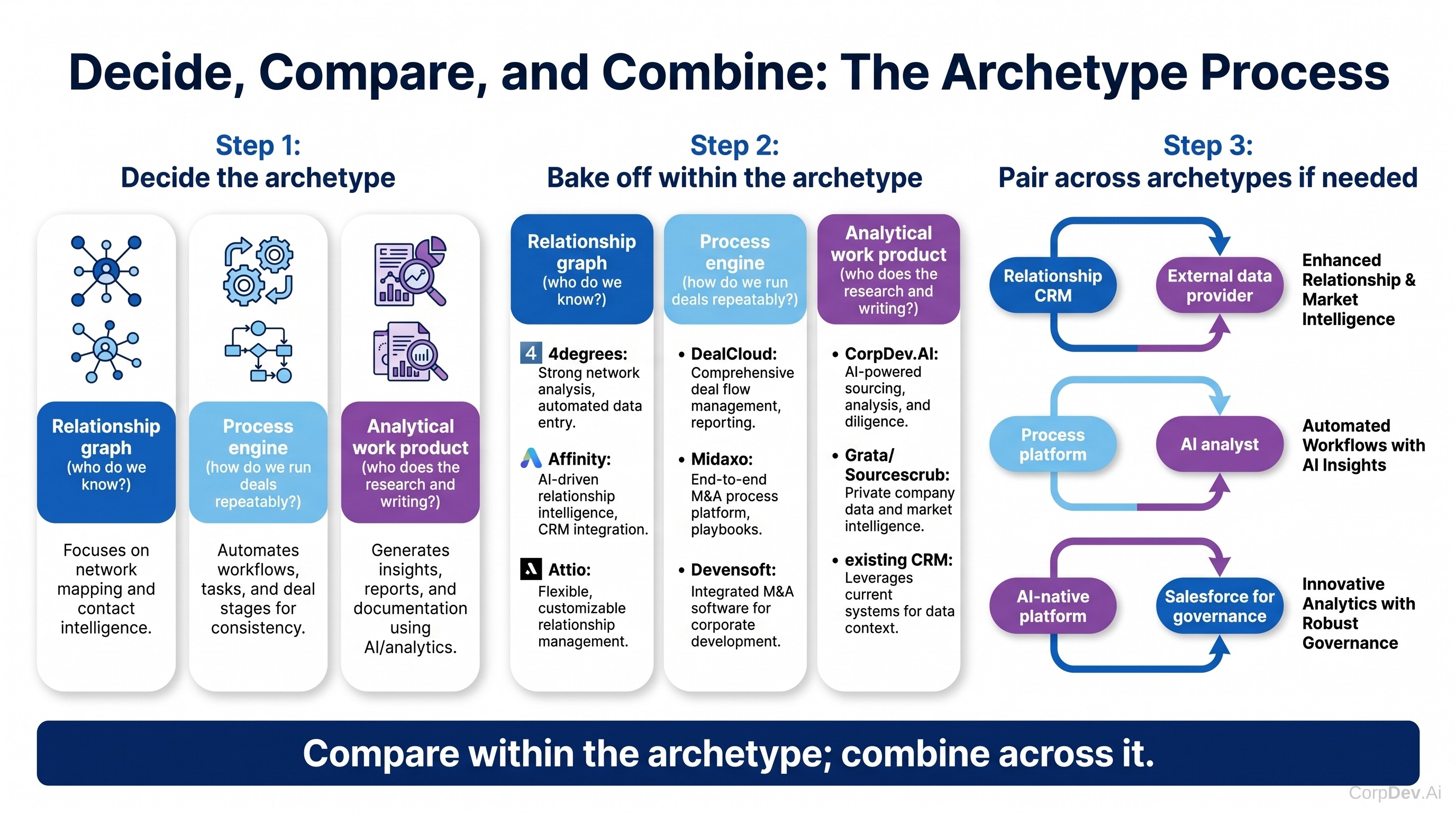
Read diagram description
Three-step process.
Step 1: "Decide the archetype": three alternatives — "Relationship graph (who do we know?)", "Process engine (how do we run deals repeatably?)", "Analytical work product (who does the research and writing?)".
Step 2 "Bake off within the archetype": three columns listing the vendors in each — 4degrees vs Affinity vs Attio; DealCloud vs Midaxo vs Devensoft; CorpDev.AI vs Grata/Sourcescrub plus existing CRM.
Step 3 "Pair across archetypes if needed": example pairings shown as connectors — "Relationship CRM + external data provider", "Process platform + AI analyst", "AI-native platform + Salesforce for governance". "Compare within the archetype; combine across it."
4degrees: Profile and Assessment
Background
4degrees is a Chicago-based relationship-intelligence CRM founded in 2017 by Ablorde Ashigbi (CEO) and David Vandegrift (CTO), both formerly investors at Pritzker Group Venture Capital [2][3]. The founding insight was the one every VC associate has — that the firm's collective network is its most valuable and least-managed asset — and the product was built to map that network from email and calendar activity and surface warm paths into companies, founders, LPs and co-investors [3][6]. Disclosed funding is modest: PitchBook and Caplight list roughly $1.1M, associated with Techstars and Harlem Capital, though at least one database claims more than $5M [2][3][5]. The company describes itself as "trusted by hundreds of teams in the private markets" and lists venture capital, private equity, investment banking/M&A advisory, corporate development/M&A, consulting and commercial real estate as target segments [1][10].
What the product does
The product is a per-seat SaaS CRM with the following core capabilities [1][6][9]:
- Relationship intelligence — syncs Gmail/Outlook and calendars, scores relationship strength from interaction patterns, and identifies which colleague has the warmest path to a target, adviser or executive.
- Deal pipeline — customisable stages, Kanban boards, filters, reminders, stale-deal alerts, tasks and dashboards; explicitly marketed for M&A stages "from origination through diligence, negotiation, close and integration tracking".
- Automated capture and enrichment — contact and company records are created or updated from interactions and enriched from third-party sources including Crunchbase, Clearbit and PitchBook.
- Signals — alerts on funding rounds, executive moves and press mentions for companies in the network.
- AI Document Intelligence (launched Feb 2026) — extracts company, transaction and financial data from CIMs, teasers and banker decks and proposes field-level CRM updates for human review [8].
- AI Assistant and MCP connector (Apr 2026) — natural-language querying of deals and relationships in-app and through Slack/Teams, and an MCP connection that lets ChatGPT or Claude read (and in supported configurations write) 4degrees data under user permissions [7][25].
- Integrations — Gmail/Outlook plugins, a Chrome extension that "x-rays" a company website for mutual connections, Zapier, and a Salesforce integration for firms that must keep Salesforce as the system of record [1].
- Onboarding — the vendor handles data migration from spreadsheets and legacy CRMs, integration setup and live training, with a dedicated customer-success manager [1].
Pricing
4degrees charges per user per month but publishes no list price; the pricing page routes every enquiry to a sales call [10]. Third-party estimates span an unhelpfully wide $100–$670 per user per month [13]. Two things are publicly stated and commercially meaningful: the company positions itself as more affordable than Affinity and DealCloud (a claim its customers echo in testimonials — "more affordable than other deal flow management tools" [10]), and it states that AI features are included in every subscription with no separate credits, usage charges or limits [15]. For a corporate buyer the practical planning assumption is a seat price somewhat below Affinity's published $2,000–$2,700 per user per year, confirmed only by quote.
Assessment for a corporate development buyer
Where 4degrees is genuinely strong
- Adoption economics. The zero-entry model works: reviewers consistently describe it as intuitive, and the product's value does not depend on associates filling in fields [20].
- Support and velocity. Customer support and the pace of feature releases are the two most repeated positives across G2 and Capterra — the upside of buying from a small, founder-led company [19][20].
- Unmetered AI. Including Document Intelligence and the assistant in the base subscription removes a cost variable that Affinity tiers and enterprise vendors monetise [15].
- Open to your AI stack. The MCP connector is a pragmatic acknowledgement that teams already use ChatGPT/Claude and would rather query the CRM from there than from a proprietary chat box [7].
- Price relative to Affinity — the most common reason firms choose it in the vendor's own comparison material and in reviews [10][20].
Where a corporate buyer should push back
- Centre of gravity is VC/PE. Workflows for LPs, co-investors and portfolio monitoring are first-class; corporate M&A concepts (strategic-fit scoring, IC approval gates, synergy tracking, integration workstreams) exist as customisable pipelines and dashboards rather than as purpose-built modules [1][16][17].
- Reporting and visualisation are the most-cited functional gaps; users wanted more robust analytics and the mobile app draws criticism [20].
- No external target universe. 4degrees tells you who you know; it does not find the 200 companies you have never heard of. Enrichment is of records you already have [1].
- No analytical work product. It does not write memos, build market maps or read a data room — the extraction feature turns a CIM into CRM fields, not into an analysis [8].
- Vendor scale risk. ~$1.1M of disclosed funding and five G2 reviews are thin foundations for a system of record a corporate will depend on for years [2][18]. Ask about revenue, headcount, profitability and escrow.
- Opaque pricing makes budgeting and procurement slower than it should be [10].
Relationship-intelligence CRMs commonly build their network context from connected email and calendar metadata; the permitted scope depends on configuration and consent. In a fund that is a feature; in a corporate it is a legal and HR question — works-council consent in Europe, information barriers between corp dev and the business units, and the optics of a tool that scores how well the CEO knows a competitor's CFO. For connected-mailbox features in 4degrees, Affinity and CorpDev.AI, establish the relevant permissions and review with Legal and IT before the pilot; this is not a claim that every deployment must ingest firm-wide communications.
Ideal 4degrees buyer: a lean corporate development team (or a strategy function that also does deals) whose pain is lost relationship context — bankers who called last year, executives met at conferences, targets that went quiet — and who want that fixed for the price of a few seats without an implementation project. It is a poor fit for a programmatic acquirer needing process governance, and it is not a substitute for analytical capacity.
The Alternatives
Each alternative below is assessed with the same seven-dimension lens and, critically, is placed in its archetype so it is compared against the right benchmark.
Affinity — the well-funded version of the 4degrees thesis
Archetype: Relationship-intelligence CRM. Affinity is 4degrees' most direct competitor and, for most buyers considering 4degrees, the mandatory second quote. It has raised roughly $120M (an $80M Series C led by Menlo Ventures), reported 1,700+ customers across 70 countries at that raise, and counts corporate names such as Fidelity, Nike, Qualcomm and Twilio alongside VC franchises like Kleiner Perkins and Bain Capital Ventures [27]. Among the two primary relationship CRMs assessed here, Affinity publishes seat tiers: Essential $2,000, Scale $2,300, Advanced $2,700 per user per year, plus a quoted Enterprise tier with fund-level permissions, SSO and unlimited API access [31].
Functionally it does what 4degrees does — relationship graph, automated capture, warm paths, pipelines — with three advantages a corporate buyer will notice: a deeper enrichment stack (PitchBook, Dealroom, Crunchbase, and the vendor says 40+ sources including Grata and Sourcescrub on higher tiers) [31][89]; a more mature AI layer (Notetaker for meetings, AI Chat, "Ascend", Company Growth Insights, and its own MCP server) [31]; and enterprise controls — SSO, export restrictions, IP allow-lists, data-retention settings — that pass corporate IT review more easily [31]. Standard onboarding is included and the vendor claims most firms are live within ~60 days [31]. G2 rates it ~4.4/5 on a materially larger review base than 4degrees [34].
The trade-offs are cost and rigidity. Reviewers say seat cost climbs quickly, that the AI features you actually want (Notetaker, Chat, MCP) sit in the $2,300+ tiers, and that reporting and integrations are less flexible than a configured enterprise CRM [34][36]. Like 4degrees, it is a VC/PE product first; corporate M&A workflows are configured, not native.
Verdict versus 4degrees: Affinity is the lower-risk, higher-cost choice within the same archetype. Choose Affinity if enterprise controls, enrichment depth and vendor durability matter more than price; choose 4degrees if you want the same core capability, unmetered AI and hands-on support at a lower seat cost and can accept a smaller vendor.
DealCloud (Intapp) — the enterprise process engine
Archetype: Enterprise deal and process platform. DealCloud is not a CRM in the sense 4degrees is; it is a configurable data model and workflow engine for deal-driven organisations, owned by publicly listed Intapp and sold predominantly to PE, investment banks, private credit and large corporate development groups [37][38]. Its strengths are precisely the things relationship CRMs lack: custom entities and fields, granular permissions, stage-gate approvals, firm-wide reporting, and an ecosystem of Microsoft and data-provider integrations [37]. Intapp Assist adds relationship signals, summarisation, narrative drafting, contextual outreach and — in 2026 — look-alike target identification and an MCP server for agent read access, all built on Azure OpenAI over the firm's own DealCloud data [45][46][47][48].
The cost of that power is well documented. There is no public seat price; third-party research puts annual contracts at roughly $85K–$1.43M (average ~$505K) with implementation at $50K–$500K+, and realistic deployment timelines of 4–6 months for a substantial rollout, longer for multi-office estates [40][41][42]. Reviewers praise its sophistication and flag the learning curve, administrative burden and a weaker mobile experience [38][43][44].
Verdict versus 4degrees: Not a like-for-like alternative. A corporate that needs DealCloud has outgrown the question of whether to buy 4degrees; a corporate that is seriously considering 4degrees almost certainly cannot justify DealCloud's cost or timeline. The one legitimate overlap is a large corporate M&A group choosing between DealCloud and "Salesforce plus 4degrees for relationship intelligence" — in which case the deciding factor is whether the process governance is worth the six-figure premium.
Midaxo — the M&A operating system for programmatic acquirers
Archetype: Enterprise deal and process platform, corporate-native. Where DealCloud grew up in PE and banking, Midaxo was built for the corporate acquirer and covers the lifecycle end-to-end: pipeline CRM with deal scoring, playbooks and stage-gates, a buy-side diligence workspace with request lists and document management, and post-merger integration tracking with synergy realisation [52]. The company says 500+ companies have used it to close 5,000+ deals worth over $1T, and its published case studies — Allstar Services, Fiduciary Services Group (moving from 1–2 to a targeted 4–6 acquisitions a year), Guardian Fire Protection, CareAbout Health, WellMed — are exactly the programmatic-acquirer profile [54][55][56][58][59]. It is ISO 27001-certified organisation-wide [50]. In 2026 it repositioned as an "M&A Intelligence Platform", announced new leadership and customer wins, and in August shipped project-scoped document AI (finding change-of-control clauses across a deal's documents, for example) and Excel bulk task editing [53][63].
Pricing is quote-based. Software Advice lists a $10K/year starting point; Vendr reports a median buyer spend of ~$63K/year; a 2026 market comparison estimates $25K–$150K+ depending on modules and users [60][61][62]. Its weaknesses are the mirror image of its strengths: it is more platform than an occasional acquirer needs, its value depends on designing playbooks and governance well, and it overlaps with Salesforce/SharePoint/Jira estates that IT may not want duplicated.
Verdict versus 4degrees: Different job. Midaxo's relationship intelligence is thin compared with 4degrees; 4degrees' diligence and integration capability is thin compared with Midaxo. A serial acquirer should evaluate CorpDev.Ai alongside Midaxo and Devensoft for end-to-end management. CorpDev.Ai adds analytical execution and deliverable production within that process. The need for a specialist relationship graph depends on origination requirements, not team size.
CorpDev.AI's co-founder and CEO, Kal Kilpi, is also a co-founder of Midaxo [79]. Readers should weigh the Midaxo assessment above with that connection in mind; it is written from Midaxo's public materials and third-party sources only.
Devensoft — lifecycle platform with a program-management bias
Archetype: Enterprise deal and process platform. Devensoft covers a similar span to Midaxo — pipeline, diligence, integration, plus divestitures, joint ventures and transformation programs — with a noticeably stronger emphasis on integration-management-office disciplines: RAID logs, workstreams, dependencies, NDA and regulatory workflows, synergy and ROI dashboards [51][64]. Its one published price anchor is useful: the Pipeline (pre-close) module is listed on G2 at $150 per user per month, while the end-to-end enterprise package is quoted [67]. Its publicly documented customer footprint (Cibes Lift Group is the clearest case study) and independent review base are smaller than Midaxo's, and buyers should verify current AI functionality, certifications and reference customers directly — the public material does not establish them equally well [65].
Verdict versus 4degrees: As with Midaxo, not the same category. Devensoft belongs on the shortlist of a corporate with a formal integration office, particularly one handling divestitures and JVs alongside acquisitions.
Salesforce and HubSpot — generic CRM adapted for deals
Archetype: Generic CRM. This option is under-rated by specialist vendors and over-rated by IT departments. Salesforce (Starter $25, Pro $100, Core $195, Advanced $395 per user per month on the current pricing page, with edition naming that varies by source) [68][69][70] gives a corporate that already runs it a governed, SSO-enabled target and relationship database with best-in-class reporting and ecosystem — at the cost of building the M&A data model, sharing rules and information barriers itself, and accepting that diligence, VDR and PMI will live elsewhere [68]. Navatar packages a banking/PE data model on top of Salesforce for firms who want that pre-built [89]. HubSpot (Starter ~$15–20, Professional ~$90–100, Enterprise ~$150 per seat per month, with seat minimums and onboarding fees at higher tiers) is the lowest-friction entry point for a small team that wants a shared target list with email sync and can tolerate sales-oriented terminology [71][72][73].
The honest case for generic CRM is threefold: the licences may be sunk cost; procurement and security review are already done; and for a team doing one or two deals a year, a well-kept Salesforce object with a stale-deal report is 80% of what 4degrees delivers. The honest case against is that neither product captures relationships automatically without add-ons, neither knows what a CIM is, and the moment someone builds a diligence tracker in custom objects, the firm has recreated the fragmented stack that specialist tools exist to replace.
Verdict versus 4degrees: If Salesforce is mandated, 4degrees' Salesforce integration lets you have both — relationship intelligence layered on the corporate system of record [1]. If nothing is mandated and deal volume is low, HubSpot Professional is a defensible cheaper answer that forgoes relationship scoring.
CorpDev.AI — the AI analyst as the product
Archetype: AI-native analyst and sourcing platform. CorpDev.AI, founded in 2023 by Kal Kilpi (previously founder of Vastuu Group and co-founder of Midaxo) and Atul Tiwary (formerly VP M&A at Barracuda Networks, VP Investment Banking at RBC and Senior Director of Corporate Development at Fortinet), operates from Boston and San Francisco [79][80]. Its architecture inverts the CRM model: the primary object is the AI Analyst Agent, which takes a natural-language brief and produces cited market maps, sector reports, target screens, company profiles, strategic-fit scorecards, investment memos and board decks inside a Visual Workbook editor; the pipeline Kanban and "zero-entry CRM" are populated from Microsoft 365 / Google Workspace email and calendar and from the analyses themselves [74][75][77][78]. Two further components distinguish it from everything else in this guide: an AI Room data room that applies vision extraction to PDF/XLSX/DOCX/PPTX and lets diligence agents answer questions with page-level citations and an audit trail, and Digital Twins — structured models of a target's plants, contracts, systems and P&L used for diligence, carve-out and Day-1/target-state integration planning [74][76]. Target sourcing runs semantic searches over a claimed 70M+ company database with automated fit scoring [76]. The company also sells managed services — its own M&A team running sourcing, screening, memo production and PMI planning on the platform [74][77].
Pricing is published for individual and team plans: AI Pro at $1,000/user/month billed annually ($1,200 monthly) with 1,000 monthly search credits; AI Pro Team at $3,000/month annually for three users; Enterprise (unlimited users, SSO, solutions architect, managed services) by quote [77]. The website notes the free trial is aimed at in-house corp dev at $1B+ companies or by invitation [74].
Where the proposition is strong
- Widest lifecycle scope on paper — strategy → market map → sourcing → screening → pipeline → diligence (AI Room) → memo → PMI (Digital Twins) in one data model [74][76].
- Targets analytical work beyond core CRM record keeping. Lean teams are constrained by analytical hours, not by contact storage; an agent that drafts the market map and the memo addresses that directly [75].
- External universe plus internal graph. Unlike 4degrees/Affinity it searches companies you do not know; unlike Grata/Sourcescrub it also ingests your email and calendar [76][78].
- Multi-model, open formats. Routes across Claude, GPT, Perplexity and Gemini; stores in Markdown/JSON/YAML with REST and MCP access — low lock-in if it delivers as described [74][75].
- Published pricing and a services option, which de-risks adoption for a team that lacks the people to drive a new tool [77].
Where a buyer must apply scrutiny
- No public customers, case studies or funding. "Hundreds of CorpDev professionals" is a vendor claim; nothing independently verifiable was found [74][77].
- Unverified performance claims. "100× faster at 1% the cost" and "DD-grade accuracy on financial tables" are marketing statements without published benchmarks or methodology [74][75].
- Youngest vendor in the guide (2023). Same durability questions as 4degrees, with less operating history [80].
- Relationship intelligence is a by-product, not the core. A buyer whose primary need is warm-path discovery should expect 4degrees or Affinity to be deeper there.
- Per-user price is high for a "CRM" — $12K/user/year — and only makes sense if evaluated as analyst capacity rather than as seat software [77].
- Credit-metered search introduces a usage variable the 4degrees model deliberately avoids [77][15].
Verdict versus 4degrees: These tools answer different questions and the honest comparison is on what you are buying. 4degrees sells a self-maintaining relationship graph for roughly the cost of a seat of Affinity or less. CorpDev.AI sells analytical throughput — the work an associate or a consultant would otherwise do — with a CRM attached. A lean, strategy-led team that would otherwise pay $200K+ per deal in advisory fees is the buyer for whom the CorpDev.AI price may be rational if a pilot demonstrates comparable work quality and real savings; a team that simply needs to stop losing contacts is not. The two are also more complementary than competitive: nothing prevents a corporate from running 4degrees or Affinity as the relationship layer and an AI analyst on top.
Other names worth knowing
- Attio — a modern, highly flexible general CRM with AI record classification; effectively "build your own deal CRM". Cheaper and more configurable than 4degrees, but nothing is pre-built for deals [90].
- Dialllog — relationship intelligence and deal-flow collaboration for VC/PE/advisory; a smaller direct competitor to 4degrees [90].
- Altvia — private-capital CRM with fund operations and LP portal; relevant to funds, rarely to corporates.
- Navatar — Salesforce-native banking/PE data model; the answer when Salesforce is mandated and the team wants deal objects pre-built [89].
- Grata / Sourcescrub / Cyndx — private-company discovery and market intelligence. Not CRMs; they supply the external universe that relationship CRMs lack and are routinely paired with Affinity or DealCloud. Affinity embeds Grata and Sourcescrub data on higher tiers [89][90].
- Datasite / Intralinks / Ansarada — virtual data rooms. Not in scope as CRM alternatives but relevant when evaluating CorpDev.AI's AI Room or Midaxo's diligence workspace as a partial VDR substitute.
Head-to-Head Comparison
Capability matrix
Scores are 1–5 judgements against a corporate development buyer's needs, derived from the cited product pages and reviews; a 2 is not a defect if the dimension is not what the vendor sells. Basis: vendor documentation and independent reviews cited in the profiles above; scores are the author's assessment.
| Dimension | 4degrees | Affinity | DealCloud | Midaxo | Devensoft | Salesforce / HubSpot | CorpDev.AI |
|---|---|---|---|---|---|---|---|
| Relationship intelligence | 4 | 5 | 4 | 2 | 2 | 1 | 3 |
| Pipeline & workflow depth | 3 | 3 | 5 | 5 | 5 | 3 | 3 |
| Analytical / AI work product | 2 | 3 | 3 | 2 | 1 | 1 | 5 |
| External target-universe data | 1 | 3 | 3 | 1 | 1 | 1 | 4 |
| Diligence-to-integration continuity | 2 | 1 | 4 | 5 | 5 | 1 | End-to-end management and integration work; validate programme controls |
| Governance & enterprise fit | 3 | 4 | 5 | 4 | 4 | 5 | 3 |
| Time to value (speed) | 5 | 5 | 1 | 3 | 3 | 4 | 4 |
Programme-scope assessment. The CorpDev.Ai integration entry describes its end-to-end management scope rather than assigning an unsupported comparative performance score. Evaluate the required controls and the quality of completed work on the same acquisition programme as other finalists. Deal frequency and public review volume do not establish a functional ranking. See the lifecycle framework and integration capabilities; these are vendor materials, not independent benchmarks.
Three patterns are worth drawing out. First, 4degrees and Affinity have identical shapes — strong on relationships and speed, weak on process and analysis — which confirms they should be compared with each other, not with the platforms. Second, DealCloud, Midaxo and Devensoft share a shape too, differing mainly on relationship intelligence (DealCloud stronger) and corporate-nativeness (Midaxo/Devensoft stronger). Third, CorpDev.AI's shape is inverted relative to 4degrees: its highest scores land exactly where 4degrees is weakest, and vice versa — an illustration of the analyst's assessment that they may be complements rather than substitutes, not independently measured performance.
The distinction between relationship intelligence and M&A management is useful; a division between managing the programme and performing its analysis is less useful. CorpDev.Ai combines those roles. The comparison below identifies where specialist products can contribute without assigning CorpDev.Ai to a small-team or pre-signing role.
| Requirement | Evaluation approach | Decision implication |
|---|---|---|
| Relationship intelligence | Compare 4Degrees and Affinity on warm introduction paths, relationship coverage and passive capture. Use the actual transaction or institutional mandate. | Retain a specialist for its demonstrated contribution; its strength in this job does not establish overall M&A superiority. |
| End-to-end M&A management | Evaluate CorpDev.Ai, Midaxo and DealRoom on the connected path from thesis and target evaluation through diligence, decisions, execution and integration. | Include CorpDev.Ai as a primary-platform candidate. Product categories and the number of deals are not substitutes for a workflow demonstration. |
| Analytical execution and deliverables | Ask each finalist to analyse the same evidence and produce a decision-ready recommendation, supporting materials and an integration response. Record human corrections and remaining manual work. | CorpDev.Ai's combination of management and work-producing agents is particularly relevant when substantial analysis must accompany every deal. Compare the quality and completeness of the outputs. |
| Large or frequent acquisition programmes | Use concurrent evaluations and integrations, shared business-unit resources and recurring leadership reporting in the pilot. Test permission boundaries and ownership changes. | Programme scale strengthens the case for evaluating integrated management and analytical capacity together; it does not automatically favour Midaxo or DealRoom. |
| Existing systems and total cost | Price the required participants, AI usage, data entitlements, implementation, ongoing reconciliation and exit. Compare both replacement and coexistence. | Keep a second platform where a specific control or operating requirement justifies it. Avoid turning a small standard plan into an unsupported Enterprise cost estimate. |
Pricing and total cost of ownership
Published or best-available pricing, normalised to an illustrative 5-user corporate development team, year one. Every figure is indicative; the Basis column states where each number comes from.
| Vendor | Pricing model | Illustrative year-1 cost, 5 users (US$) | Implementation / onboarding | Basis |
|---|---|---|---|---|
| 4degrees | Per user / month, quote only; AI included | ~7,000–12,000 (planning assumption) | Vendor-led migration and training included | No published price [10]; assumption: priced below Affinity per vendor positioning and reviews [10][20]. Third-party range $100–$670/user/month is too wide to be useful [13] |
| Affinity | Per user / year, published tiers | 10,000 (Essential) – 13,500 (Advanced) | Standard onboarding included; ~60 days to live | Published price list [31] |
| DealCloud | Enterprise contract, quote only | 85,000+ (low end); average ~505,000 | 50,000–500,000+; 4–6 months | Third-party contract research [40]; timelines [41][42] |
| Midaxo | Package, quote only | 10,000 (entry) – ~63,000 (median spend) | Vendor-led; modules drive cost | Software Advice start price [60]; Vendr median [61] |
| Devensoft | Per user / month (pipeline); enterprise quote | 9,000 (pipeline module only) | Enterprise modules quoted separately | G2 listed $150/user/month for pre-close module [67] |
| Salesforce (Pro) | Per user / month, published | 6,000 licence | Admin/dev build of M&A objects not included | Salesforce pricing page [68] |
| HubSpot (Professional) | Per seat / month, published; minimums | ~6,000 + ~1,500 onboarding | Minimal | Published tiers [71][72] |
| CorpDev.AI (AI Pro Team + 2 seats) | Per user / month, published; search credits metered | ~60,000 (Team plan $36,000 for 3 users + 2 × $12,000) | Team onboarding and CSM included | Published pricing [77]; 5-user configuration is the author's arithmetic |
The 4degrees figure is an inference from the vendor's own positioning ("more affordable than" Affinity and DealCloud) and reviewer statements; it is not a published price and should be replaced with a quote before any budgeting. The CorpDev.AI figure assumes a five-seat configuration that the published page does not list explicitly. DealCloud's average is a third-party estimate across all customer sizes, most of them larger than a five-person corp dev team.
The table makes the central economic point of this guide visible. On a per-seat basis, 4degrees, Affinity, Devensoft's pipeline module and the generic CRMs cluster in the same $1,200–$2,700 per user per year band; the real choice among them is capability, not cost. DealCloud is an order of magnitude more and is priced as a process transformation. CorpDev.AI at ~$12,000 per user per year is priced as labour substitution — roughly one-tenth of a junior associate's fully loaded cost — and is only rational when evaluated on that basis. A buyer who puts CorpDev.AI and 4degrees in the same "CRM" column and picks the cheaper one has not evaluated either.
| Vendor | Year-1 cost (US$K) |
|---|---|
| HubSpot Professional | 6-8 |
| Salesforce Pro | 6 |
| Devensoft (pipeline) | 9 |
| 4degrees (assumed) | 7-12 |
| Affinity | 10-13.5 |
| Midaxo | 10-63 |
| CorpDev.AI | 60 |
| DealCloud | 85-505 |
Fit by buyer persona
| Persona | Best fit | Credible alternative | Avoid |
|---|---|---|---|
| Lean team, opportunistic acquirer | 4degrees or Affinity | HubSpot Professional; CorpDev.AI AI Pro if analysis is the bottleneck | DealCloud, Devensoft enterprise |
| Programmatic acquirer with integration office | CorpDev.Ai, Midaxo or Devensoft | DealCloud (if PE-style governance and budget) | Relationship CRM as sole system |
| Strategy-led function short on analysts | CorpDev.AI | Grata/Sourcescrub + existing CRM; Affinity Advanced | Generic CRM alone |
| Enterprise standardiser on Salesforce | Salesforce + 4degrees integration, or Navatar | DealCloud | HubSpot, Attio |
| Corporate venture / minority investments arm | Affinity or 4degrees | Altvia | Midaxo, Devensoft |
Decision Framework: Which Tool for Which Buyer
The framework below converts the analysis into a sequence a buying team can actually run in a procurement cycle.
| Pilot step | Ask every finalist to demonstrate | Evidence for the M&A leader |
|---|---|---|
| Establish the investment case | Connect the acquisition rationale, source documents, key assumptions and decision owners. Include a material uncertainty rather than only a clean demonstration case. | The team can distinguish an established fact from a hypothesis and identify who is responsible for resolving it. |
| Introduce a diligence finding | Supply new evidence that changes a revenue, cost or integration assumption. Ask the platform to analyse the consequences and identify the affected work. | The response explains why the finding matters, what evidence supports the conclusion and which decisions need to be revisited. |
| Revise the recommendation | Produce a revised investment memorandum, supporting analysis and executive presentation. Require explicit treatment of unresolved questions. | Measure substantive corrections, unsupported conclusions and human review time; a polished document is not sufficient on its own. |
| Carry the change into integration | Update the proposed work, responsibilities, milestones and synergy assumptions. Ask the business owner to review the consequences before approval. | The original rationale and evidence remain connected to accountable execution; the team does not have to reconstruct the case after signing. |
| Repeat across the programme | Apply the same exercise to concurrent acquisitions, shared functional resources and the next leadership reporting cycle. | CorpDev.Ai, Midaxo and DealRoom should be assessed on management and analytical execution together. The test determines programme fit rather than presuming it from deal frequency. |
This is an illustrative procurement exercise, not a reported customer result or a comparative performance benchmark. CorpDev.Ai's combined management and analytical approach is particularly relevant to it; each vendor should demonstrate its current capabilities on the same material.
Step 1 — Name the binding constraint in one sentence. "We lose track of who we know" leads to archetype 1. "We cannot run four deals at once without dropping something" leads to archetype 2. "We spend $300K a year on bankers' and consultants' decks because we have no analysts" leads to archetype 3. Teams that cannot write this sentence should not buy anything yet; they should spend a quarter on Excel and a shared inbox and see which pain surfaces first.
Step 2 — Run the bake-off inside the archetype. For archetype 1 that means 4degrees against Affinity, with Attio as the low-cost outlier. The decisive tests are: (a) connect three real users' mailboxes and see whose relationship scores match the team's intuition; (b) upload a real CIM to each vendor's document-extraction feature and compare the proposed CRM fields; (c) ask each vendor for revenue, headcount and a customer reference in your industry — 4degrees' answers on the first two are the single biggest unknown in this guide [2][18].
Step 3 — Decide what to pair it with. Relationship CRMs need an external universe: budget for Grata, Sourcescrub or an AI-native analyst if outbound sourcing matters. Process platforms need analytical capacity: an associate, an adviser, or an AI analyst. AI-native platforms may need a governance layer if IT insists on Salesforce as system of record.
Step 4 — Contract for optionality. Given the vendor-scale profile of this category — two of the most interesting products come from companies with thin disclosed funding — insist on data export in open formats (both 4degrees and CorpDev.AI position themselves well here: CSV/Excel export and MCP access for 4degrees [1][7]; Markdown/JSON/YAML and REST/MCP for CorpDev.AI [74]), annual rather than multi-year terms for a first contract, and source-code or data escrow where the tool will become the system of record.
The highest-leverage configuration for a lean, strategy-led corporate development team in 2026 is not a single platform but a two-layer stack: a relationship-intelligence CRM (4degrees at the value end, Affinity at the durable end) as the system of record for people and pipeline, and an AI analyst (CorpDev.AI or equivalent) for market maps, target screens, memos and diligence reads. The illustrative combined cost for five users is below the higher end of the quoted third-party DealCloud implementation range, though not necessarily its lower end, and each layer does the job it was built for.
Due Diligence Questions to Ask Any Vendor
Ask every shortlisted vendor the same list and score the answers. The questions marked with the vendor name are where this guide found the public record thin.
Company durability
- Revenue, growth, headcount and profitability (or runway), in writing under NDA. (4degrees, CorpDev.AI: unverified publicly.)
- Three reference customers in corporate development — not funds — of a similar size, contactable directly. (4degrees's public customer stories are largely investment firms; CorpDev.AI names none [10][74].)
- Ownership, cap table concentration, and what happens to the contract and data on a change of control.
Data and AI
- Which third-party data sources enrich records, at what refresh cadence, and are they included or extra? (Affinity meters this by tier [31]; 4degrees includes AI but enrichment sources should be confirmed [1][15].)
- Where do email and calendar data reside, who can see whose, and can individual users exclude threads? Is any customer data used to train models?
- For AI document extraction and diligence Q&A: show accuracy on our CIM and our data-room sample, with citations to page level. (CorpDev.AI's "DD-grade accuracy" and 4degrees' Document Intelligence should both be tested, not taken from the website [8][74].)
- Is AI usage metered? What happens at the limit? (4degrees: unmetered [15]; CorpDev.AI: search credits [77]; Affinity: by tier [31].)
Fit and workflow
- Show a corporate M&A pipeline configured for IC stage-gates and integration tracking — not a VC deal-flow demo.
- How does the product handle information barriers between corp dev and business-unit users?
- What is exportable, in what format, and can we do it ourselves without a services ticket?
Commercials
- Written per-user price, minimums, onboarding fees, and price protection at renewal. (4degrees, DealCloud, Midaxo: quote-only [10][40][61].)
- Implementation scope, timeline and who does the migration — and what the vendor's customers actually experienced, not the target.
- Termination assistance and data return obligations.
Key Facts & Sources
Load-bearing figures used in this guide, with source and as-of date. All pricing is list or third-party estimate as of September 2026 and is subject to negotiation.
| Fact | Value | Source | As of |
|---|---|---|---|
| 4degrees founded / founders / HQ | 2017; Ablorde Ashigbi (CEO), David Vandegrift (CTO); Chicago | PitchBook profile; FinSMEs [2][3] | Jul 2025 / Jun 2020 |
| 4degrees disclosed funding | ~$1.1M (PitchBook, Caplight); one database claims >$5M | [2][5] | Jul 2025 |
| 4degrees pricing | Per user/month, quote only; AI included without usage fees | 4degrees pricing page; vendor blog [10][15] | Sep 2026 / Jul 2026 |
| 4degrees independent reviews | ~4.5/5 on 5 G2 reviews | G2 [18][19] | Sep 2026 |
| 4degrees AI launches | Document Intelligence Feb 2026; MCP connector Apr 2026 | Vendor blog [7][8] | Feb–Apr 2026 |
| Affinity funding / customers | ~$120M total; $80M Series C (Menlo); 1,700+ customers, 70 countries | Affinity press release [27] | At Series C |
| Affinity pricing | $2,000 / $2,300 / $2,700 per user/year; Enterprise quoted | Affinity pricing page [31] | Sep 2026 |
| Affinity onboarding | Most firms live in ~60 days | Affinity pricing page [31] | Sep 2026 |
| DealCloud contract range | ~$85K–$1.43M/yr, avg ~$505K; implementation $50K–$500K+ | Third-party pricing research [40] | 2026 |
| DealCloud implementation time | ~4–6 months typical; 6–12+ for complex | ZoomInfo comparison; SourceCo guide [41][42] | Jul / Apr 2026 |
| Midaxo scale | 500+ companies, 5,000+ deals, >$1T value (vendor claim) | Midaxo use-cases page [54] | 2023 page, still live |
| Midaxo pricing | $10K/yr start (Software Advice); ~$63K median spend (Vendr) | [60][61] | 2026 / May 2026 |
| Devensoft pipeline module | $150 per user/month (G2 listing); enterprise quoted | G2 [67] | Listed 2021, current page |
| Salesforce Sales pricing | Starter $25, Pro $100, Core $195, Advanced $395 per user/month | Salesforce pricing page [68] | Sep 2026 |
| HubSpot Sales Hub pricing | Starter ~$15–20; Professional ~$90–100 (+~$1,500 onboarding); Enterprise ~$150 (+~$3,500) | [71][72][73] | Aug 2026 |
| CorpDev.AI founded / founders | 2023; Kal Kilpi (CEO; ex-Midaxo co-founder), Atul Tiwary; Boston / San Francisco | About page; LinkedIn [79][80] | Sep 2026 |
| CorpDev.AI pricing | AI Pro $1,000/user/month annual ($1,200 monthly), 1,000 credits/month; Team $3,000/month annual for 3 users; Enterprise quoted | Pricing page [77] | Sep 2026 |
| CorpDev.AI customers / funding | None publicly named; "hundreds of CorpDev professionals" (vendor claim) | Homepage; pricing page [74][77] | Sep 2026 |
| McKinsey AI-in-M&A impact | 10–30% faster deal cycles; ~20% lower M&A activity cost | McKinsey 2026 M&A trends [81] | Feb 2026 |
| Bain 2025 M&A market | Global M&A ~$4.9T in 2025 (+40%); ~half of tech deals had an AI component | Bain press release [93] | 2026 |
| Category size | Dedicated deal-CRM / M&A workflow software ~$2–3B globally — derived range, low-credibility primary sources only | Author's derivation from [82][86]; see Market size section | Sep 2026 |
| 5-user TCO figures | See Pricing & TCO table; 4degrees and CorpDev.AI 5-seat figures are author's assumptions/arithmetic | Derived from [10][31][40][60][61][67][68][71][77] | Sep 2026 |
References
Numbering follows the original research. Access dates below record the original source registry; they do not imply that every source was rechecked for this website edition.
- 4Degrees | CRMSource accessed 2026-09-11
- 4Degrees 2025 Company Profile: Valuation, Funding & Investors | PitchBookSource accessed 2026-09-11
- 4Degrees Raises Funding from Harlem Capital - FinSMEsSource accessed 2026-09-11
- 4Degrees | Valuation, Funding Rounds & Stock PriceSource accessed 2026-09-11
- Relationship Intelligence CRM SoftwareSource accessed 2026-09-11
- Use ChatGPT and Claude With Your CRM DataSource accessed 2026-09-11
- Introducing AI Document Intelligence for Private Market ...Source accessed 2026-09-11
- Artificial Intelligence That Moves Deals Forward - 4DegreesSource accessed 2026-09-11
- Pricing - 4DegreesSource accessed 2026-09-11
- 4Degrees Pricing, Reviews, Pros & Cons (2026)Source accessed 2026-09-11
- Best Salesforce Alternatives for Private Equity Deal Teams in 2026Source accessed 2026-09-11
- The Venture Capital CRM Platform - 4DegreesSource accessed 2026-09-11
- Private Equity CRM SoftwareSource accessed 2026-09-11
- 4Degrees Products | Read 5 Reviews on G2Source accessed 2026-09-11
- 4Degrees Reviews 2026: Details, Pricing, & FeaturesSource accessed 2026-09-11
- 4DegreesSource accessed 2026-09-11
- Why This Is Not The Same As...Source accessed 2026-09-11
- Affinity Rings Up $80M In Series C Funding To Bring ...Source accessed 2026-09-11
- Affinity Pricing: Plans for Private Capital CRMSource accessed 2026-09-11
- Affinity Reviews 2026: Details, Pricing, & FeaturesSource accessed 2026-09-11
- AffinitySource accessed 2026-09-11
- The AI-powered deal and relationship intelligence platformSource accessed 2026-09-11
- DealCloud Reviews 2026: Details, Pricing, & FeaturesSource accessed 2026-09-11
- Intapp Pricing, Reviews, Pros & Cons (2026)Source accessed 2026-09-11
- DealCloud vs. Salesforce: Which CRM Wins? [2026]Source accessed 2026-09-11
- Corporate Development Software: 32 Tools, Real Pricing ...Source accessed 2026-09-11
- DealCloud Reviews 2026. Verified Reviews, Pros & Cons - CapterraSource accessed 2026-09-11
- DealCloud reviewsSource accessed 2026-09-11
- Intapp announces vertical AI capabilities designed to significantly enhance productivity for professionals – Company AnnouncementSource accessed 2026-09-11
- Intapp Product Updates HubSource accessed 2026-09-11
- Intapp IR Deck - August 2025Source accessed 2026-09-11
- Intapp Release Notes - July 2026 Latest UpdatesSource accessed 2026-09-11
- Midaxo Reviews - 2025Source accessed 2026-09-11
- M&A Platform — Pipeline, Diligence, Integration & MoreSource accessed 2026-09-11
- M&A Intelligence Platform | Midaxo M&A SoftwareSource accessed 2026-09-11
- Midaxo closes Q2 with new customers and a major AI updateSource accessed 2026-09-11
- Use Cases - MidaxoSource accessed 2026-09-11
- How Allstar Services saves time & closes more deals with a ...Source accessed 2026-09-11
- How FSG scaled its inorganic growth with MidaxoSource accessed 2026-09-11
- Guardian Fire Protection Services scales by simplifying their M&A ...Source accessed 2026-09-11
- CareAbout replaced - fragmented tools withSource accessed 2026-09-11
- Midaxo Software Reviews, Demo & Pricing - 2026Source accessed 2026-09-11
- Midaxo Software Pricing & Plans 2025: See Your CostSource accessed 2026-09-11
- Best Post-Merger Integration Software in 2026Source accessed 2026-09-11
- A positive start: Midaxo closes Q1 with new customers ...Source accessed 2026-09-11
- Devensoft | M&A Software for Deals, Due Diligence ...Source accessed 2026-09-11
- The ResultsSource accessed 2026-09-11
- Page 2 | Devensoft Reviews 2026: Details, Pricing, & Features | G2Source accessed 2026-09-11
- Sales PricingSource accessed 2026-09-11
- Salesforce Sales Cloud Pricing 2026: Real Tier CostsSource accessed 2026-09-11
- Salesforce Pricing 2026: The Complete Enterprise GuideSource accessed 2026-09-11
- HubSpot Sales Hub Pricing: Plans, Limits and What You'll ...Source accessed 2026-09-11
- HubSpot CRM Pricing Explained (2026) - CASRAISource accessed 2026-09-11
- HubSpot Pricing & Plans (2026): Cost, Comparisons, and ...Source accessed 2026-09-11
- CorpDev.Ai - Agentic AI for M&A and Corporate DevelopmentSource accessed 2026-09-11
- AI Analyst Agent for M&ASource accessed 2026-09-11
- The Data Architecture Behind AI-Powered M&ASource accessed 2026-09-11
- PricingSource accessed 2026-09-11
- Integrations | CorpDev.Ai DocsSource accessed 2026-09-11
- About Us - CorpDev.AiSource accessed 2026-09-11
- CorpDev.AiSource accessed 2026-09-11
- 2026 M&A trends: Navigating a rapidly rebounding marketSource accessed 2026-09-11
- Regional Market AnalysisSource accessed 2026-09-11
- AI in Customer Relationship Management (CRM) Market ...Source accessed 2026-09-11
- Affinity vs DealCloud: Which CRM is Right for You?Source accessed 2026-09-11
- Best VC Deal Flow Tools: Affinity vs DealCloud (2026)Source accessed 2026-09-11
- CorpDev.Ai - Agentic AI for M&ASource accessed 2026-09-11
- Global M&A poised to sustain momentum in 2026 after ...Source accessed 2026-09-11