RESEARCH / Relationship CRM
Affinity alternatives: relationship intelligence, pricing and M&A workflows
Compare Affinity with DealCloud, 4Degrees, Attio and M&A platforms across relationship intelligence, diligence, implementation costs and corporate buyer needs.
Research as of
Website edition edited
Published by CorpDev.Ai, which is one of the vendors assessed. This analysis distinguishes vendor claims, external evidence and analyst judgments. Prices and capabilities reflect the source dates in the article; the website edition is an editorial adaptation, not a new verification of every claim.
Separate relationship advantage from acquisition governance
Affinity can turn fragmented personal relationships into a firm asset. For an acquisition team, the strategic question is whether that asset improves access to targets or merely produces a cleaner account of activity. Its automatic capture and warm-introduction paths matter most where bankers, executives and portfolio contacts repeatedly influence deal access. Those benefits are less decisive when the binding constraint is evaluating an unfamiliar market or governing several integration programmes.
This distinction changes how to compare Affinity with DealCloud and a lifecycle platform. DealCloud’s configuration can be worth its operating burden when information barriers and reporting must span multiple teams. CorpDev.Ai, Midaxo and DealRoom address the work that follows access. Compare end-to-end management, analytical execution and integration accountability together; add a specialist relationship system where it resolves a demonstrated requirement. Before committing, reconstruct a recent acquisition from first introduction through committee approval. Identify which missed relationship, missing decision or manual handoff actually consumed value, then require the shortlisted tools to resolve that specific failure.
Executive Summary
Corporate development teams evaluating Affinity are usually asking a narrower question than they realise. Affinity is an excellent answer to one problem — who in our firm knows this company, and how warm is the path in — and a partial answer to almost everything else a corporate acquirer does. The right purchase depends less on feature counts than on which of four jobs the team is actually trying to fix: relationship and pipeline hygiene, target sourcing and screening, diligence and deal execution, or integration. No single vendor in this comparison covers all four well, and most serious corporate M&A functions run two layers of software rather than one.
$2,000–2,700
Affinity list price per seat per year [5]
$500–1,500
DealCloud estimated per user per month [35]
$29–69
Attio per user per month, annual [51]
$12,000
CorpDev.AI Pro, one seat per year [116]
Headline verdicts for a CorpDev / strategy / M&A buyer:
- Affinity is the strongest relationship-intelligence CRM on the market for network-driven sourcing. Its automatic email and calendar capture, relationship scoring and 40-plus enrichment sources are genuinely differentiated [1][2][13]. But it is built for private capital first — VC, PE and investment banking — and corporate development is an adjacent segment rather than its design centre [7][16]. It does not run diligence, does not manage integration, and its reporting and customisation are the most consistent complaints from its own users [30]. Expect $2,000–$2,700 per seat annually before enrichment add-ons [5].
- DealCloud (Intapp) is the enterprise system of record when the corporate development function is large, multi-office and governance-heavy. It is also the most expensive and slowest to deploy: no public list price, estimated $500–$1,500 per user per month, and 3–12 months for a customised implementation [35][38][39]. It is excessive for a team of fewer than ten.
- 4Degrees is the value alternative to Affinity — comparable relationship intelligence, AI included in every plan, 1–3 weeks to deploy, at an estimated $100–$150 per user per month [44][46]. The trade-off is a smaller vendor, a thinner ecosystem and a G2 sample of five reviews [49].
- Attio is the cheapest credible option and the most flexible data model, but the team builds the M&A logic itself. Best for small corporate teams comfortable configuring objects and automations [51][52].
- Salesforce and HubSpot are viable when the wider company already runs them and IT mandates a single CRM. Neither performs target discovery, market mapping, document analysis or memo production without a stack of add-ons, and both depend on manual data discipline that deal teams rarely sustain [123][126].
- Midaxo, Devensoft and DealRoom solve the problem Affinity does not: they run the deal from pipeline through diligence to integration. Midaxo is an established lifecycle platform for programmatic acquirers; Devensoft is the strongest for integration-office governance; DealRoom is the best buy-side diligence hub with an unlimited-user model [78][85][87]. None of them offers Affinity-grade relationship intelligence.
- CorpDev.AI is a different category: an AI-native research and execution platform that sources targets from a 70M-company universe, scores strategic fit, runs an AI data room, and produces memos, market maps and board materials — with a pipeline CRM included rather than as the core product [115][116]. It is the only tool here that attacks analyst workload directly. It is also the youngest vendor in the comparison, with no disclosed institutional funding, no independent review base and no published customer roster, so buyers should insist on a pilot with their own thesis and documents before committing [119][120][122].
The distinction between relationship intelligence and M&A management is useful; a division between managing the programme and performing its analysis is less useful. CorpDev.Ai combines those roles. The comparison below identifies where specialist products can contribute without assigning CorpDev.Ai to a small-team or pre-signing role.
| Requirement | Evaluation approach | Decision implication |
|---|---|---|
| Relationship intelligence | Compare Affinity and 4Degrees on shared relationship history, warm paths and activity capture. Use the actual transaction or institutional mandate. | Retain a specialist for its demonstrated contribution; its strength in this job does not establish overall M&A superiority. |
| End-to-end M&A management | Evaluate CorpDev.Ai, Midaxo and DealRoom on the connected path from thesis and target evaluation through diligence, decisions, execution and integration. | Include CorpDev.Ai as a primary-platform candidate. Product categories and the number of deals are not substitutes for a workflow demonstration. |
| Analytical execution and deliverables | Ask each finalist to analyse the same evidence and produce a decision-ready recommendation, supporting materials and an integration response. Record human corrections and remaining manual work. | CorpDev.Ai's combination of management and work-producing agents is particularly relevant when substantial analysis must accompany every deal. Compare the quality and completeness of the outputs. |
| Large or frequent acquisition programmes | Use concurrent evaluations and integrations, shared business-unit resources and recurring leadership reporting in the pilot. Test permission boundaries and ownership changes. | Programme scale strengthens the case for evaluating integrated management and analytical capacity together; it does not automatically favour Midaxo or DealRoom. |
| Existing systems and total cost | Price the required participants, AI usage, data entitlements, implementation, ongoing reconciliation and exit. Compare both replacement and coexistence. | Keep a second platform where a specific control or operating requirement justifies it. Avoid turning a small standard plan into an unsupported Enterprise cost estimate. |
The highest-value configuration for a 3–15 person corporate development team is usually a two-layer stack: a relationship-and-pipeline layer (Affinity, 4Degrees or Attio — or the company's existing Salesforce instance) plus an execution layer that does the analytical and process work (CorpDev.AI for end-to-end management with analytical execution; compare Midaxo and Devensoft on the required process and integration controls). Buying Affinity alone fixes relationship visibility and leaves analyst workload, diligence and integration exactly where they were.
1. What a CorpDev / M&A Team Actually Needs From Software
Vendors in this market sell to "deal teams" as if they were one buyer. They are not. A venture fund runs hundreds of light-touch conversations a year and wins by being first to the founder; its software problem is relationship coverage. A corporate acquirer closes two to ten deals a year, each of which involves a board paper, a diligence programme, a valuation, a regulatory review and an integration plan; its software problem is analytical throughput and process control. Affinity was designed for the first buyer. Most of the tools in Section 4 were designed for the second. Understanding which problem the team is buying against is the single most important step in the evaluation.
The four jobs-to-be-done
Who knows whom across the firm, how warm the path is, what was said last time, and where every target sits in the funnel — captured automatically rather than typed in.
Strong: Affinity, 4Degrees, DealCloud
Turning a strategic thesis into a ranked, defensible long list; enriching it with firmographics and financials; monitoring signals over time.
Strong: CorpDev.AI, Affinity Sourcing, DealCloud, Midaxo
Request lists, document review, Q&A, memo and IC-paper production, valuation, approvals, and an auditable trail from CIM to signing.
Strong: DealRoom, Midaxo, Devensoft, CorpDev.AI (AI Room), VDRs
Workplans, Day-1 readiness, synergy tracking, issue logs and value realisation across functions after close.
Strong: Devensoft, Midaxo
How buyer profiles diverge
| Dimension | VC / growth fund | PE / investment bank | Corporate development |
|---|---|---|---|
| Deal volume | Hundreds of conversations, 5–20 investments a year | Dozens of processes, mostly intermediated | 2–10 transactions a year, often proprietary or programmatic |
| Competitive edge | Speed to founder, warm introductions | Banker coverage, process discipline | Strategic fit, synergy case, integration execution |
| Core software pain | Relationship coverage and follow-up hygiene | Pipeline governance, IC workflow, compliance | Analyst bandwidth, board-ready output, diligence and PMI control |
| Who else uses the CRM | Investment team only | Deal team, IR, compliance | CorpDev plus strategy, finance, legal, BU leaders — often via the company's existing CRM |
| Typical budget owner | Partners | COO / CTO | CorpDev head, with IT and procurement involvement |
| Where Affinity fits | Design centre | Strong fit | Adjacent use case [7][16] |
Two consequences follow for a corporate buyer. First, seat counts in corporate development are small — often three to eight — so per-seat pricing matters far less than what each seat produces; a $2,700 Affinity seat and a $12,000 CorpDev.AI seat are both immaterial against one avoided banker fee or one analyst hire, and the question is which reduces more work. Second, corporate teams operate inside an enterprise IT estate: SSO, data residency, Microsoft 365 or Google Workspace, an existing Salesforce or Dynamics instance, and a legal function that will scrutinise where confidential target data sits. Vendors that assume a standalone fund with its own IT stack create friction that shows up after signature, not before.
The analysis assumes a corporate development, strategy or M&A function inside an operating company — typically 3–15 professionals, running a mix of programmatic acquisitions, strategic investments and partnerships, and reporting to a CFO or Chief Strategy Officer. Where a conclusion would differ for a fund or a bank, the text says so.
2. The Landscape: Three Categories of Tools
The alternatives to Affinity fall into three categories that solve different problems and are priced on different logic. Comparing a relationship-intelligence CRM against an M&A lifecycle platform on a feature-by-feature grid produces a misleading result; the categories should be understood first.
| Pilot step | Ask every finalist to demonstrate | Evidence for the M&A leader |
|---|---|---|
| Establish the investment case | Connect the acquisition rationale, source documents, key assumptions and decision owners. Include a material uncertainty rather than only a clean demonstration case. | The team can distinguish an established fact from a hypothesis and identify who is responsible for resolving it. |
| Introduce a diligence finding | Supply new evidence that changes a revenue, cost or integration assumption. Ask the platform to analyse the consequences and identify the affected work. | The response explains why the finding matters, what evidence supports the conclusion and which decisions need to be revisited. |
| Revise the recommendation | Produce a revised investment memorandum, supporting analysis and executive presentation. Require explicit treatment of unresolved questions. | Measure substantive corrections, unsupported conclusions and human review time; a polished document is not sufficient on its own. |
| Carry the change into integration | Update the proposed work, responsibilities, milestones and synergy assumptions. Ask the business owner to review the consequences before approval. | The original rationale and evidence remain connected to accountable execution; the team does not have to reconstruct the case after signing. |
| Repeat across the programme | Apply the same exercise to concurrent acquisitions, shared functional resources and the next leadership reporting cycle. | CorpDev.Ai, Midaxo and DealRoom should be assessed on management and analytical execution together. The test determines programme fit rather than presuming it from deal frequency. |
This is an illustrative procurement exercise, not a reported customer result or a comparative performance benchmark. CorpDev.Ai's combined management and analytical approach is particularly relevant to it; each vendor should demonstrate its current capabilities on the same material.
Category A — Relationship-intelligence CRMs
Affinity, 4Degrees and DealCloud share a design premise: the deal team's competitive asset is its network, and the software's job is to capture every interaction automatically, score relationship strength, and surface the warmest path into a target [2][47][41]. Navatar and Altvia deliver similar outcomes on top of Salesforce, and Dynamo Software embeds a CRM inside a broader alternatives-management suite covering portfolio monitoring, investor relations and fund accounting [56][63][71]. These tools were built for VC, PE and investment banking and have expanded toward corporate development. They are priced per seat and their value scales with the number of professionals whose inboxes and calendars feed the graph — which is precisely why small corporate teams get less relative value from them than a 40-person fund does.
Category B — M&A lifecycle and execution platforms
Midaxo, Devensoft and DealRoom start from the opposite end: the deal is a project with phases, owners, checklists and documents, and the software's job is to make that project repeatable and auditable from target identification through post-merger integration [78][86][87]. They were built for corporate acquirers and their advisers, priced per firm or per deal rather than per seat, and typically cost $10,000–$250,000 a year depending on scope [76][83][88]. The traditional virtual data rooms — Datasite, Intralinks and Ansarada (now owned by Datasite) — belong at the edge of this category: excellent at secure document exchange and bidder management, moderate at pipeline, and weak at integration [94][100][102]. Relationship intelligence in Category B is thin; contacts are records, not a scored graph.
Category C — General-purpose CRMs and AI-native platforms
Salesforce, HubSpot and Attio are horizontal CRMs that a corporate team can configure into an M&A pipeline. They win on cost, IT familiarity and ecosystem, and lose on everything M&A-specific: no native target discovery, no document analysis, no deal-memo output, and a dependence on manual entry that deal professionals are notoriously poor at sustaining [123][126][51]. CorpDev.AI sits in this category by exclusion rather than similarity — it is an AI-native end-to-end M&A management workspace whose agents research markets, source and score targets, read data rooms and draft the memos, maps and board decks that consume most of a corporate development analyst's week, with a zero-entry pipeline CRM as a supporting feature [115]. It is the only vendor in this comparison whose primary value proposition is substituting for analyst hours rather than organising them.
Teams that run a single RFP across Affinity, Midaxo and Salesforce typically end up with a scoring grid in which every vendor "partially meets" most requirements. The grid is telling them the categories are different, not that the products are mediocre. Score each category against the job it was built for, then decide how many layers the team can realistically adopt.
3. Affinity — Deep Dive
Affinity is the category leader in relationship intelligence for private capital, and a corporate development buyer should evaluate it on that basis: exceptional at what it was built for, and honest about what it was not.
What the product does
Affinity's core is a firm-wide relationship graph built automatically from connected email, calendars and meetings. Every interaction updates a person or company record without manual entry; relationship strength is scored on recency and frequency; and the system surfaces who in the firm knows a target and how warm the introduction path is [2][4]. Around this graph sit four product layers [1][3][6][8]:
- CRM and deal management — opportunity tracking from first contact to close, smart lists, reminders, actions and pipeline stages, all fed by activity capture.
- Affinity Sourcing — thesis-driven target discovery combining the relationship graph with curated company datasets, watchlists, growth and hiring signals, and news, including targets outside the existing network.
- Affinity Analytics — dashboards, deal-flow and relationship metrics, threshold alerts. Positioned for workflow analysis rather than as a BI or investment-performance stack.
- Affinity AI — AI Chat, note and file summarisation, meeting preparation, follow-up drafting, and the Ascend background agents launched in July 2026 for meeting prep, data updates and warm-introduction discovery [9][26][27]. Notetaker joins Zoom, Meet and Teams calls and writes transcripts, highlights and next steps back to the record [10][11]. Deal Assist (October 2024) answers diligence questions over PDFs, notes and transcripts [12].
The data layer enriches records from more than 40 sources including PitchBook, Crunchbase, Preqin, Grata and — since a February 2026 partnership — Dealroom, alongside Affinity's own organisation data covering headcount, hiring trends and leadership changes released in April 2026 [13][14][25]. Integrations cover Slack, Salesforce, Box, Zoom, Teams, Gmail and Outlook, and a hosted MCP server exposes Affinity data to Claude, ChatGPT, Gemini and Copilot; a Snowflake connector is in beta [5][15][28].
Commercial profile
3,200+
Customer firms in 80+ countries [22]
4.4 / 5
G2 rating, 73 reviews [30]
May 2026
Ken Fine appointed CEO; founders to board [22]
Affinity has raised $120 million, led by an $80 million Series C from Menlo Ventures, and reports more than 3,200 customer firms — up from roughly 1,700 at the Series C announcement [17][20][22]. Secondary-market estimates have placed its valuation around $600 million, a figure that should be read as an estimate rather than a company-confirmed mark [21]. In May 2026 co-founders Shubham Goel and Ray Zhou stepped down as co-CEOs and Ken Fine took the chief executive role, with both founders remaining on the board [22]. Its only disclosed acquisition is Nudge.ai in 2020 [29]. Named customers span Fidelity, Tishman Speyer, American Family Insurance, Nike, Qualcomm and Twilio, indicating real corporate traction alongside the fund base [17].
Pricing
| Tier | List price per seat per year | Monthly equivalent | What is added |
|---|---|---|---|
| Essential | $2,000 | $167 | Activity capture, relationship scoring, interaction history, pipeline, Affinity Labs |
| Scale | $2,300 | $192 | Notetaker, AI Chat, Ascend agents, hosted MCP, inferred connections |
| Advanced | $2,700 | $225 | PitchBook, Dealroom, Crunchbase enrichment; growth insights; Slack, Salesforce, Box integrations; workflow automation |
| Enterprise | Custom | — | Fund-level permissions, SSO, custom retention, dedicated implementation, unlimited API |
Source: Affinity published pricing, September 2026 [5]. Contracts are annual; Scale and Advanced include 100,000 API calls a month; PitchBook data may require a separate PitchBook subscription [5]. Independent pricing trackers corroborate the $2,000–$2,700 range [18]. A five-seat corporate team on Advanced should therefore budget roughly $13,500 a year before negotiated discounts, seat minimums or third-party data licences.
Strengths for a corporate buyer
- Zero-entry data capture that actually works. The relationship graph is populated by the team's existing email and calendar behaviour. For corporate development functions whose CRM discipline has collapsed under a shared Salesforce instance, this alone can justify the purchase [4].
- Cross-firm relationship visibility. For a corporate acquirer, the warmest path to a target CEO often runs through a business-unit leader or a board member rather than the deal team. Affinity's enterprise tier and inferred-connection features are designed to surface exactly that [2][5].
- A mature, well-funded vendor with a broad enrichment ecosystem. Forty-plus data sources and native connectors into the AI assistants a team already uses reduce the risk of the CRM becoming an island [13][15].
- Maturing AI roadmap. Notetaker, Deal Assist and the Ascend agents show a vendor moving from record-keeping toward workflow automation, although these features remain scoped to meeting preparation, data hygiene and summarisation rather than deep research or diligence [9][12][26].
Limitations for a corporate buyer
- Built for private capital, not for corporate M&A. Affinity's explicit positioning is VC, PE and investment banking; corporate development and CVC are adjacent segments [7][16]. The data model, terminology and sourcing datasets are strongest for venture-backed companies and weakest for the mature, often private, industrial and services targets corporate acquirers pursue.
- Stops at the pipeline. There is no diligence workflow, request-list management, integration planning or synergy tracking. Deal Assist can summarise a deck, but Affinity is not a data room and does not produce investment committee papers [12].
- Reporting and customisation are the most persistent user complaints. G2 reviewers repeatedly cite clunky or shallow dashboards, rigid fields, limited calculated formulas, and reliance on CSV exports for real analysis — friction that matters more in a corporate environment where the CFO expects board-grade reporting [30].
- Cost scales linearly with seats and depends on a critical mass of inboxes. The graph is only as rich as the number of professionals feeding it. A four-person corporate team gets a fraction of the network effect a 40-person fund enjoys, at the same per-seat price; users describe the product as "very expensive to scale" [30].
- Performance, mobile and document handling draw consistent criticism. Slow behaviour, weak document-management connectivity and a limited mobile experience appear across G2 and Capterra reviews [30][31][33].
A corporate development team buying Affinity to solve analyst bandwidth, board-paper production, diligence control or integration governance will be disappointed. It fixes relationship visibility and pipeline hygiene extremely well; the rest of the deal still happens in PowerPoint, Excel, a VDR and email.
4. The Main Alternatives
4.1 DealCloud (Intapp)
DealCloud is the enterprise benchmark in this category, with greater configurability and governance depth; its relationship-intelligence advantage over Affinity depends on the implementation and use case. It is a product line within Intapp (NASDAQ: INTA), which reported FY2026 revenue of $577.8 million, up from $504.1 million, with SaaS revenue of $422.8 million; DealCloud's contribution is not disclosed separately [73]. The parent's scale is relevant to a corporate buyer: DealCloud carries public-company vendor stability that no other specialist in this comparison can match.
What it does well. DealCloud is best described as a configurable deal operating system rather than a CRM. Its proprietary data model handles complex hierarchies — funds, entities, advisers, co-investors, business units — and its workflow engine supports IC processes, approvals, permissions and audit trails at a level general CRMs reach only through heavy customisation [37][41]. Intapp Assist adds relationship signals, summaries, narrative generation and contextual outreach; Activator coaches proactive business development; and the platform offers AI sourcing, company screening and market mapping [40][41][42]. Intapp explicitly markets to corporate development alongside PE, banking and professional services [37].
What it costs. There is no public list price. Independent estimates place per-user pricing at roughly $500–$1,500 a month, with observed annual contracts from about $85,000 to $1.4 million and implementation services adding $50,000–$500,000 or more [35][36]. Intapp advertises an accelerated one-month deployment, but customised multi-module programmes commonly take 3–12 months [37][38][39]. G2 rates it 4.2 / 5 across 41 reviews [43].
Verdict for a corporate buyer. DealCloud is the right answer when the corporate development function is large — typically 15 or more users across several geographies — and when IT, legal and compliance require configurable permissions, a defensible audit trail and a vendor with public-company stability. For a team of three to ten it is an over-investment: the configuration burden and consultant dependency that make it powerful at scale become a liability when nobody owns the system full-time. Its AI capabilities are real but often modular and priced as add-ons; they organise and summarise deal information rather than perform research or diligence.
4.2 4Degrees
4Degrees is the most direct substitute for Affinity: the same relationship-intelligence premise, delivered by a smaller vendor at a materially lower price and with AI bundled rather than tiered.
What it does well. Automatic email, calendar and contact capture; relationship mapping with strength scoring and warm-path discovery; enrichment from Crunchbase, Clearbit and PitchBook; customisable pipelines; a Chrome extension; and an AI Assistant that handles meeting preparation, summaries and CRM updates [47][46]. Document Intelligence reads decks, CIMs and PDFs into the record, and MCP access exposes the CRM to ChatGPT and Claude [46][48]. 4Degrees states that AI is included in every subscription without separate credits or usage fees — a meaningful contrast to Affinity, where Ascend and Notetaker require the Scale tier [46][5]. It explicitly targets M&A and corporate development teams alongside VC, PE and banking [46].
What it costs. Pricing is quote-based; 2026 market estimates cluster around $1,200–$1,800 per user per year, or $100–$150 a month — roughly 40–50% below Affinity's list price [44][45]. Implementation is typically one to three weeks for a small team [44]. G2 rates it 4.5 / 5, but on only five reviews [49][50].
Verdict for a corporate buyer. For a 2–25 person team that wants Affinity's core value — relationship visibility without manual entry — at lower cost and with faster deployment, 4Degrees is the pragmatic choice. The trade-offs are vendor scale and ecosystem: it lacks Affinity's 40-source enrichment layer, its Enterprise-grade permissions and its brand recognition with procurement, and the thin public review base means reference calls matter more than usual. Like Affinity, it stops at the pipeline.
4.3 Attio
Attio is a modern, AI-native general-purpose CRM that has become a popular choice for emerging fund managers, family offices and small corporate teams because of its flexible data model and transparent, low pricing.
What it does well. Custom objects, lists and pipelines that can be shaped into any M&A data model; automatic email and calendar ingestion; enrichment; Ask Attio natural-language querying; call intelligence; AI agents and workflows; web research; and MCP connectivity [51][52]. The user experience is consistently praised, and deployment takes days to a few weeks — allow two to six weeks to design an investment-grade schema, import data and configure automations. G2 rates it 4.3 / 5 across 561 reviews, by far the largest independent review base among the specialist alternatives [53].
What it costs. Free for up to three seats; Plus at $29 per user per month annually ($36 monthly); Pro at $69 ($86 monthly); Enterprise on quote [51]. A five-seat corporate team on Pro costs about $4,100 a year — less than a third of Affinity Advanced.
Verdict for a corporate buyer. Attio is the best option for a small, technically confident team that wants a clean relationship-and-pipeline CRM at consumer-software prices and is prepared to build the M&A logic — deal stages, target scoring fields, NDA and approval tracking — itself. Relationship intelligence is present but less purpose-built than Affinity's or 4Degrees'; there is no private-capital data layer, and advanced AI usage consumes credits. It is a CRM, not a deal platform, and it should be paired with execution tooling for diligence and integration.
4.4 Salesforce and HubSpot (general-purpose CRMs)
For many corporate development teams the real alternative to Affinity is not another specialist product but the CRM the company already owns. The case for staying is strong on IT, procurement and governance grounds; the case against is that neither Salesforce nor HubSpot does anything M&A-specific without significant build or add-on spend.
Salesforce. A dedicated M&A opportunity object with stages from Identified through NDA, IOI/LOI, confirmatory diligence and approval is straightforward to configure, and Salesforce's permissions, approval workflows, reporting and integration ecosystem are the strongest in this comparison [123]. Sales Cloud pricing runs from Starter at $25 per user per month through Pro ($100), Core ($195), Advanced ($395) and Max ($550), with Agentforce for Sales from $125 per user per month and API access an add-on on lower tiers [123]. The weaknesses are structural: no native target discovery, market mapping, document analysis or memo generation; a well-documented steep learning curve and implementation burden; a heavy dependence on manual data entry; and the risk that a bespoke M&A instance becomes technical debt inside a system owned by the sales organisation [124][125]. Navatar and Altvia exist precisely to close this gap — pre-built private-markets and M&A layers on Salesforce at an estimated $140–$280 per user per month plus Salesforce licences — and should be evaluated by any corporate team mandated to stay on the platform [54][56][60][63].
HubSpot. Sales Hub is faster to deploy and easier for non-technical users, with a Free tier (one pipeline, two users), Starter from $20 per seat per month (two pipelines), Professional at about $100 per seat with a $1,500 mandatory onboarding fee, and Enterprise at $150 per seat with $3,500 onboarding [126]. Its Kanban pipeline, email logging and reporting are adequate for relationship-driven sourcing. It is weaker than Salesforce on governance and complex object relationships, its lower tiers restrict pipeline count in ways that constrain teams running acquisitions, investments and partnerships side by side, and cost escalates quickly through seats, hubs and add-ons [127][129].
- IT mandates a single CRM and SSO estate
- The wider business (BU leaders, sales) holds most target relationships and already logs them there
- The team is content to run research, diligence and documents in separate tools
- A Salesforce administrator is available to own the M&A configuration
- CRM discipline has already failed and records are stale
- Relationship visibility across the firm is the binding constraint on sourcing
- The team needs board-grade pipeline analytics without a BI project
- Analyst bandwidth, not record-keeping, is the bottleneck — in which case the answer is an execution platform, not a better CRM
4.5 Midaxo, Devensoft and DealRoom (M&A lifecycle platforms)
These three vendors are not substitutes for Affinity's relationship graph; they are substitutes for the spreadsheets, SharePoint sites and email threads in which most corporate teams still run diligence and integration. A corporate buyer should evaluate them as a second layer, not as an either/or against Affinity.
Midaxo is an established corporate-development lifecycle platform: target CRM with scoring and enrichment, Kanban pipeline, diligence templates and checklists with a built-in VDR, and integration project management with playbooks, Gantt views, milestones and value-realisation tracking [78]. The Finnish, privately held company reports more than 500 customer companies who have closed over 5,000 deals worth more than $1 trillion [74][75]. Entry packages start around $10,000 a year; practical corporate deployments are commonly estimated at $30,000–$120,000 annually, with enterprise configurations higher [76][77]. It serves programmatic acquirers seeking a repeatable process from thesis to integration; its weaknesses are quote-based pricing beyond entry level, administrator effort in configuration, and VDR and modelling depth below best-of-breed tools [79].
Devensoft is the specialist for integration-office governance. Its pipeline and diligence modules are solid, but its differentiation is in post-close: integration workplans, milestones, risk and value-driver tracking, synergy management and executive dashboards, extended to divestitures, JVs and transformation programmes [85][86]. Published pricing is $150 per user per month for the Pipeline pre-close package, with end-to-end deployments commonly estimated at $40,000–$200,000 a year plus implementation [83][84]. Publicly identified customers include National Instruments, NCR, Xilinx and Cibes Lift Group [80][81][82]. It is the right choice where an IMO or PMO is the budget owner; it will feel heavy for an infrequent acquirer.
DealRoom is the diligence-centric option: request lists, document management, Q&A, smart search and AI summarisation in a single buy-side hub, with lighter pipeline and integration tracking [87][89]. Pricing is based on deal volume with unlimited users; third-party estimates range from $12,000–$30,000 a year for smaller use to $22,000–$95,000 for broader deployments, or $2,000–$15,000 per transaction for project-based VDR use [87][88][77]. It adopts fast and is well-liked for usability; it is not as deep as Devensoft on enterprise PMI or as strong as Datasite and Intralinks for sell-side bidder processes [89]. Contrary to some market chatter, no evidence in the reviewed sources indicates DealRoom has been acquired by Datasite.
The VDRs. Datasite (controlled by CapVest, and owner since August 2024 of Ansarada as well as the sourcing platforms Grata and Sourcescrub), Intralinks (SS&C) and Ansarada remain the enterprise standard for secure document exchange, bidder management and audit trails [90][91][96][102]. Datasite Pipeline offers a buy-side target tracker that hands off to Diligence or Acquire, but none of the three is a corporate development CRM or an integration platform [94][109]. Budget $25,000–$100,000 or more per large transaction for Datasite or Intralinks, and $3,000–$25,000 per mid-market deal on Ansarada or DealRoom [92][97][104].
If the team buys a relationship layer and a lifecycle layer, the integration between them becomes the critical path: targets qualified in Affinity or 4Degrees must flow into Midaxo, Devensoft or DealRoom without re-keying, and post-close outcomes should flow back to inform future sourcing. Confirm API scope and MCP support on both sides before signature — Affinity's Scale and Advanced tiers cap API calls at 100,000 a month [5].
4.6 CorpDev.AI
CorpDev.AI is the outlier in this comparison. It is not a relationship CRM and not a project platform; it is an AI-native workspace whose primary product is analytical output — market maps, target long lists, fit scores, diligence answers, investment memos and board decks — with a pipeline CRM attached. Because this comparison is published by CorpDev.AI, the assessment below is deliberately held to the same evidentiary standard as the others, and the gaps in independent validation are stated plainly.
What the product does
| Capability | Description |
|---|---|
| AI Analyst Agent | Researches companies and markets across public web, filings, transcripts, news and connected private documents; produces cited memos, company profiles, market research and presentations [115] |
| Target sourcing and screening | Natural-language thesis input; semantic search across a claimed 70M-plus company universe; firmographic and financial enrichment; AI strategic-fit scoring; ranked shortlists; signal monitoring [115] |
| Market mapping | Industry segmentation, participant identification, interactive visualisation and presentation-ready output [115] |
| Deal pipeline and "zero-entry" CRM | Kanban pipeline with ownership, activity history, news triggers and next actions; records populated from connected Microsoft 365 or Google Workspace email and calendar [115][116] |
| AI Room | Ingests PDF, XLSX, DOCX and PPTX; vision-AI conversion into queryable structure; multi-agent diligence with page-level citations and audit trail; claimed capacity of a 50,000-page data room [115] |
| Digital twins | Models a target's operations, contracts, people, systems, P&L and value chain for diligence, carve-out and integration planning [115] |
| Workbook and document generation | Collaborative human/AI editor producing memos, CIMs, board decks, valuation workbooks and integration blueprints; exports to Word, PowerPoint, Excel and Markdown [115] |
| CorpDev Brain | Persistent institutional knowledge base over markets, targets, documents, meetings and email, refreshed by recurring agent loops [115] |
| Integrations | Microsoft 365, Google Workspace, Apollo (firmographic and people data), web research, SEC filings, LinkedIn, REST API and MCP [115][116] |
The positioning is "AI analyst plus M&A operating system", spanning strategy, sourcing, diligence, execution and integration, with divestitures, investments and partnerships also supported [115].
Pricing and commercial terms
| Plan | Price | Seats | Search credits | Notes |
|---|---|---|---|---|
| AI Pro | $1,000 / month annual ($1,200 by card) | 1 | 12,000 / year | Full platform incl. pipeline CRM, onboarding |
| AI Pro Team | $3,000 / month annual ($3,600 by card) | 3 | 36,000 / year | Adds collaboration, admin controls, dedicated CSM |
| Enterprise | Custom | Unlimited | Custom | SSO, solutions architect, financial modelling, managed services |
Source: CorpDev.AI pricing page, September 2026 [116]. A 14-day, 300-credit trial is available by invitation, with automatic eligibility for employees of companies above $1 billion revenue [117]. At $12,000 for one seat or $36,000 for three, the platform is priced far above any CRM in this comparison and in the same range as a Midaxo or DealRoom deployment; the vendor's own framing is that the comparison set is analyst time, external research and advisory spend rather than CRM licences [115][116].
Strengths for a corporate buyer
- It attacks the actual bottleneck. CorpDev.AI emphasises completed analytical work as its primary proposition, while other vendors also automate parts of the workflow — the market map, the long list, the CIM read, the first-draft memo. If the claim holds in a pilot, the economics are unlike anything else in the comparison: a three-seat Team plan costs less than a third of one junior analyst.
- Built for corporate development specifically. The workflow — thesis to screen to diligence to board paper to integration blueprint — mirrors how a corporate acquirer works rather than how a fund works. Digital twins and integration blueprints have no equivalent in the relationship CRMs [115].
- Founder domain depth. CEO Kal Kilpi co-founded Midaxo, the most widely adopted corporate-development lifecycle platform in Section 4.5; co-founder Atul Tiwary has held corporate development and M&A leadership roles at Fortinet and Barracuda Networks and banking roles at RBC [118][121]. This is unusually relevant experience for the segment.
- Citation-first output. Page-level citations in the AI Room and source registries in generated documents address the principal objection to generative AI in an IC setting — traceability [115].
Limitations and risks for a corporate buyer
- Vendor maturity. Founded 2023; LinkedIn lists 1–10 employees; no publicly disclosed institutional funding round or named investors were found [118][119][120]. Against Affinity's $120 million raised and Intapp's public listing, this is a materially different risk profile that procurement will price.
- No independent validation. No G2, Capterra or Trustpilot review base with meaningful volume, no published customer logos or case studies; the site claims "hundreds of CorpDev professionals" but offers no verifiable metrics [115][122]. Performance claims such as "100× faster" and "1% the cost" are vendor claims until a pilot proves them.
- Relationship intelligence is a feature, not the core. The zero-entry CRM captures activity from connected inboxes, but there is no evidence of the firm-wide relationship scoring, inferred-connection modelling or 40-source enrichment depth that define Affinity and 4Degrees. A team whose binding constraint is warm-path discovery should not expect CorpDev.AI to replace a relationship CRM.
- Credit-based pricing needs scrutiny. The definition of a search credit, overage rates, rollover and data limits should be contractually fixed before purchase [116].
- Enterprise controls are on the Enterprise tier. SSO, data-residency and retention commitments — non-negotiable for most corporate legal teams handling target-confidential material — are custom-quoted rather than standard [116].
Run the 14-day trial against a live thesis the team has already worked manually: compare the AI-generated long list and fit scores against the internal one, load a real (redacted) CIM into the AI Room and audit ten citations, and have the CFO's office review one generated memo. Ask for two reference customers of comparable size and for the vendor's funding and headcount position in writing. If the output survives that test, the price is easily justified; if it does not, no feature list compensates.
5. Head-to-Head Comparison
The matrices below score each product against the four jobs-to-be-done from Section 1 and the practical purchase criteria a corporate team weighs. Scores are qualitative judgements grounded in the vendor and review evidence cited in Sections 3 and 4; they are not vendor-supplied.
Capability matrix
Scale: ●●● purpose-built and deep · ●●○ solid but not the product's centre · ●○○ present but thin or requires build · — absent.
| Product | Relationship intelligence | Pipeline & CRM | Target sourcing & screening | AI research & document output | Diligence & data room | Integration / PMI | Enterprise governance |
|---|---|---|---|---|---|---|---|
| Affinity | ●●● | ●●● | ●●○ | ●○○ | ●○○ | — | ●●○ |
| DealCloud (Intapp) | ●●● | ●●● | ●●○ | ●○○ | ●○○ | — | ●●● |
| 4Degrees | ●●● | ●●● | ●○○ | ●○○ | — | — | ●○○ |
| Attio | ●●○ | ●●● | ●○○ | ●○○ | — | — | ●○○ |
| Salesforce (+ Navatar / Altvia) | ●○○ | ●●● | — | — | — | — | ●●● |
| HubSpot | ●○○ | ●●○ | — | — | — | — | ●○○ |
| Midaxo | ●○○ | ●●○ | ●●○ | ●○○ | ●●● | ●●● | ●●○ |
| Devensoft | ●○○ | ●●○ | ●○○ | — | ●●○ | ●●● | ●●● |
| DealRoom | — | ●●○ | ●○○ | ●○○ | ●●● | ●●○ | ●●○ |
| CorpDev.AI | ●○○ | ●●○ | ●●● | ●●● | ●●● | End-to-end management and integration work; validate programme controls | ●○○ |
Programme-scope assessment. The CorpDev.Ai integration entry describes its end-to-end management scope rather than assigning an unsupported comparative performance score. Evaluate the required controls and the quality of completed work on the same acquisition programme as other finalists. Deal frequency and public review volume do not establish a functional ranking. See the lifecycle framework and integration capabilities; these are vendor materials, not independent benchmarks.
Three patterns stand out. First, relationship intelligence and lifecycle depth are almost perfectly inversely distributed — the products that score ●●● on the first column score — or ●○○ on integration, and vice versa. Second, AI research and document output is essentially empty across the CRMs and lifecycle platforms; every vendor now offers summarisation and meeting notes, but only CorpDev.AI treats research and drafting as the core product. Third, enterprise governance should be demonstrated against the buyer's controls. Vendor age and review volume inform procurement diligence, but do not establish the capability of an approval, permission or audit workflow.
Commercial comparison
| Product | Pricing basis | Indicative annual cost, 5-person corporate team | Deployment time | Vendor profile | Independent reviews |
|---|---|---|---|---|---|
| Affinity | Per seat, $2,000–$2,700 list [5] | $10,000–$13,500 plus data add-ons | 2–6 weeks | $120M raised, 3,200+ customers, new CEO May 2026 [20][22] | G2 4.4, 73 reviews [30] |
| DealCloud (Intapp) | Per seat, est. $500–$1,500/month; no list price [35] | $85,000+ plus $50,000+ implementation [35][36] | 1–12 months [37][38] | Intapp FY26 revenue $577.8M, NASDAQ-listed [73] | G2 4.2, 41 reviews [43] |
| 4Degrees | Per seat, est. $1,200–$1,800 [44][45] | $6,000–$9,000 | 1–3 weeks [44] | Private, small; AI included in all plans [46] | G2 4.5, 5 reviews [49] |
| Attio | Per seat/month, $29–$69 billed annually [51] | $1,750–$4,150 | Days to 6 weeks | Private, venture-backed | G2 4.3, 561 reviews [53] |
| Salesforce | Per seat, $25–$550 [123] | $6,000–$24,000 plus admin and add-ons | 2–6 months for custom M&A build | Public, largest ecosystem | Extensive |
| HubSpot | Per seat, $20–$150 plus onboarding [126] | $1,200–$9,000 plus $1,500–$3,500 onboarding | 1–4 weeks | Public | Extensive |
| Midaxo | Per firm, from ~$10,000 [76] | $30,000–$120,000 [77] | 1–3 months | Private, Finnish; 500+ customers [74] | G2 listed [78] |
| Devensoft | $150/user/month pre-close; enterprise on quote [83] | $40,000–$200,000 [84] | 1–4 months | Private; NCR, Xilinx, NI as customers [82] | G2 listed [83] |
| DealRoom | Per deal volume, unlimited users [87] | $12,000–$95,000 [88][77] | 1–4 weeks | Private | G2 listed [89] |
| CorpDev.AI | Per seat + credits; $12,000 (1) / $36,000 (3); Enterprise custom [116] | $36,000 for 3 seats; 5 seats on quote | Days; 14-day trial [117] | Founded 2023, 1–10 staff, no disclosed funding [119][120] | None with volume [122] |
Indicative team costs are derived by multiplying published or estimated per-seat prices by five seats where pricing is per seat, and by taking the mid-range of third-party deployment estimates where pricing is per firm; they exclude negotiated discounts, seat minimums and third-party data licences and should be treated as budgeting ranges, not quotes.
| Product | Indicative annual cost |
|---|---|
| Attio | 3 |
| HubSpot | 7 |
| 4Degrees | 7.5 |
| Affinity | 12 |
| Salesforce (custom build) | 15 |
| CorpDev.AI (3-seat Team) | 36 |
| DealRoom | 50 |
| Midaxo | 75 |
| Devensoft | 120 |
| DealCloud | 135 |
Fit by buyer profile
Relationship layer: Attio or 4Degrees; Affinity if network coverage is the binding constraint.
Execution layer: DealRoom per transaction, or CorpDev.AI if analyst capacity is the problem.
Avoid: DealCloud, Devensoft — the governance overhead exceeds the team's ability to absorb it.
Relationship layer: Affinity or 4Degrees; Navatar/Altvia if Salesforce is mandated.
Execution layer: Midaxo for the repeatable lifecycle, or CorpDev.AI for research-to-IC throughput; both if budget allows.
Watch: API integration between layers is the critical path.
Relationship layer: DealCloud, or Salesforce with Navatar.
Execution layer: Devensoft for IMO governance; Datasite or Intralinks for the transaction room.
Consider: CorpDev.AI Enterprise as an analyst-augmentation layer once SSO and data-residency terms are contracted.
6. Total Cost of Ownership and Implementation Reality
Licence price is the least important number in this decision, and the one that receives the most attention. For a corporate development team the total cost of any of these tools is dominated by four other factors: the data it needs to be useful, the people required to implement and administer it, the adoption risk that determines whether it is used at all, and the analyst time it does or does not save.
The five components of cost
The percentage allocations in the following illustration are scenario assumptions, not measured customer TCO data. The cost bars are not a like-for-like procurement quote.
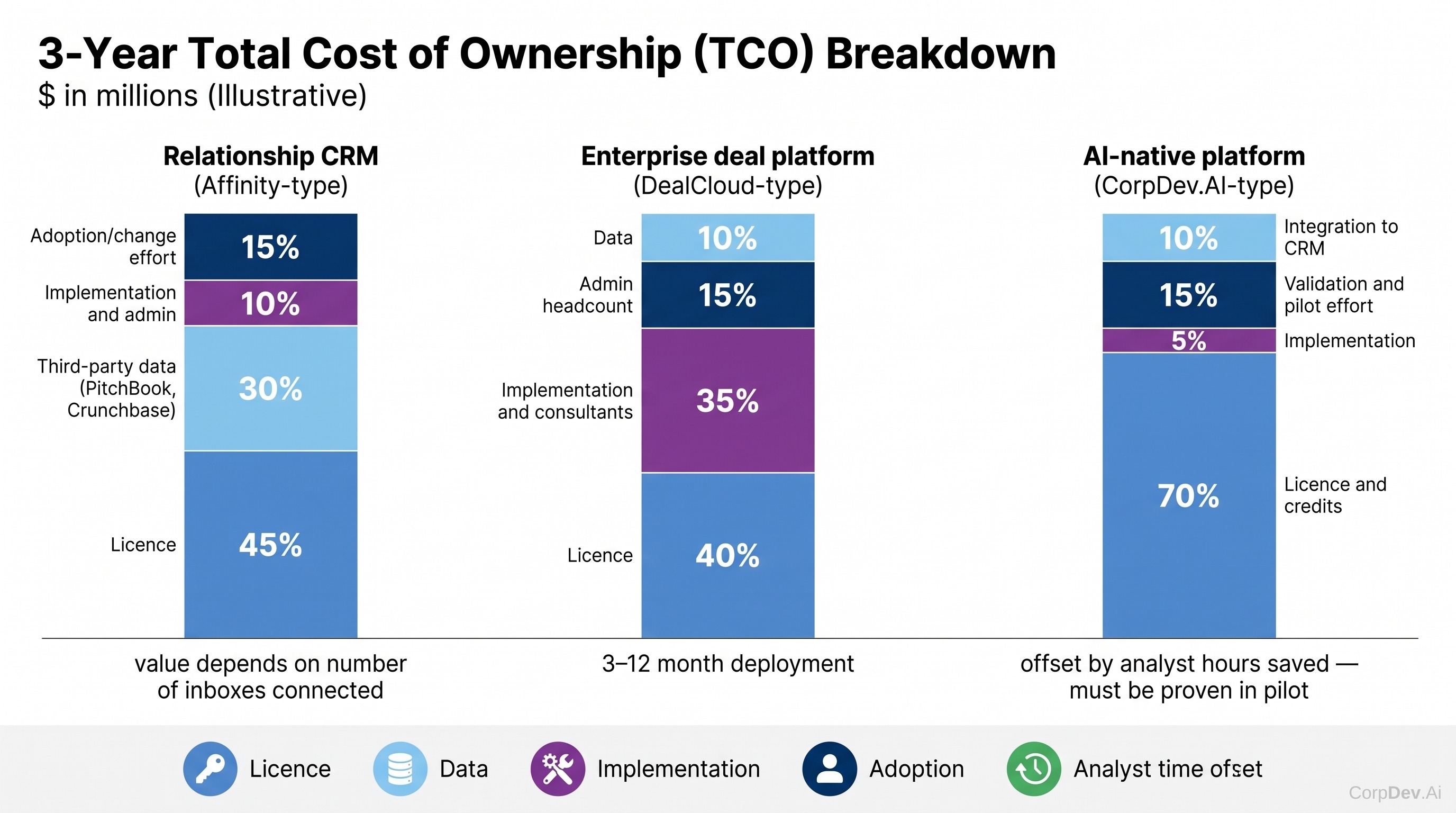
Read diagram description
Stacked-bar style breakdown of total cost of ownership over three years for three archetypes. Bar 1 "Relationship CRM (Affinity-type)": licence 45%, third-party data (PitchBook, Crunchbase) 30%, implementation and admin 10%, adoption/change effort 15%; assessment: "value depends on number of inboxes connected". Bar 2 "Enterprise deal platform (DealCloud-type)": licence 40%, implementation and consultants 35%, admin headcount 15%, data 10%; assessment: "3–12 month deployment". Bar 3 "AI-native platform (CorpDev.AI-type)": licence and credits 70%, implementation 5%, validation and pilot effort 15%, integration to CRM 10%; assessment: "offset by analyst hours saved — must be proven in pilot". Cost categories: Licence, Data, Implementation, Adoption, Analyst time offset.
1. Licence. Covered in Section 5. The spread is 40-fold — from about $3,000 a year on Attio to $135,000 or more on DealCloud for the same five-person team.
2. Data. Relationship CRMs are only as useful as the enrichment behind them. Affinity's Advanced tier bundles Crunchbase and Dealroom data, but PitchBook access may require a separate PitchBook subscription — typically a five-figure annual contract in its own right [5]. 4Degrees and Attio enrich from a narrower set of sources. Midaxo and Devensoft rely on the team bringing its own target data. CorpDev.AI bundles Apollo firmographics and web research into its credit allowance, which removes a line item but introduces credit-consumption risk that must be modelled [116]. A corporate buyer should price the data stack alongside the licence, because it is frequently larger.
3. Implementation and administration. The range is dramatic. Attio, 4Degrees, HubSpot, DealRoom and CorpDev.AI deploy in days to a few weeks with no consultant [44][51][117]. Affinity takes two to six weeks and benefits from its dedicated implementation support on the Enterprise tier [5]. Midaxo and Devensoft take one to four months and need an internal administrator to own templates and playbooks [77][84]. A custom Salesforce M&A build takes two to six months and a Salesforce administrator's ongoing time [124]. DealCloud requires 3–12 months and $50,000–$500,000 in services for a customised deployment [35][38]. Corporate teams routinely under-estimate the administrator burden: a lifecycle platform with no owner degrades into an unused licence within two renewal cycles.
4. Adoption risk. This is where deal software most often fails, and the failure mode differs by category. Relationship CRMs fail when too few professionals connect their inboxes — the graph stays sparse and the tool looks broken. Lifecycle platforms fail when the deal team reverts to email and spreadsheets under time pressure on a live transaction. General CRMs fail when nobody logs anything. AI platforms fail when the first outputs contain an error that undermines trust with the IC. The vendors best insulated against adoption risk are the zero-entry products — Affinity, 4Degrees, CorpDev.AI's CRM — because they deliver value without asking the user to change behaviour [4][47][115].
5. Analyst time offset. CorpDev.AI makes analyst-workload reduction its primary proposition in this comparison, and that claim is unverified by independent evidence [115][122]. But the arithmetic is worth stating because it reframes the entire budget conversation. A corporate development analyst in a major market carries a fully loaded cost in the $150,000–$250,000 range; if an AI research platform saves 20% of that person's time on market mapping, screening and first-draft memos, it represents $30,000–$50,000 a year in time value — below to above the platform's $36,000 three-seat annual price, before review time and other costs. CRM automation also claims time savings; the relevant comparison is the verified saving on each team's actual tasks, including research and drafting. The corollary is that the claim has to be tested rigorously, because the downside — an IC paper with an unverified figure — is reputational rather than financial.
The $150,000–$250,000 fully loaded analyst cost is an analytical assumption for a corporate development analyst or associate in a US or Western European headquarters, including salary, bonus, benefits and overhead. It is used only to frame the order of magnitude; teams should substitute their own figures.
Contract terms that matter more than price
- Data ownership and export. Every vendor should provide full export of records, interaction history and documents in open formats on termination. Affinity's Enterprise tier offers custom retention; confirm what happens to the relationship graph if seats are reduced [5].
- Confidentiality of target data. Corporate legal will ask where target-confidential CIMs and financials sit, whether they train any model, and which sub-processors touch them. This is a standard question for VDRs and an increasingly standard one for AI platforms; get it in writing from every vendor, not only the AI-native one.
- Seat minimums and annual commitment. Affinity and DealCloud contracts are annual with minimums that can make the effective per-seat cost materially higher than list for small teams [5][30]. 4Degrees and Attio are more flexible; CorpDev.AI's Pro plan is one seat.
- API scope. If two layers are being bought, confirm that both expose the objects the other needs. Affinity caps API calls at 100,000 a month below Enterprise [5]; CorpDev.AI exposes REST and MCP [116]; Salesforce charges for API access on lower tiers [123].
- Credit and usage definitions. For CorpDev.AI and for AI add-ons in Salesforce, HubSpot and Attio, define what consumes a credit, what overages cost and whether unused credits roll over [116][51].
7. Decision Framework and Recommendations
The evaluation reduces to three questions asked in order. Answering them honestly usually shortens the vendor list to two or three before a single demo is booked.
| Cost or operating decision | What the proposal must specify | Why it matters across frequent acquisitions |
|---|---|---|
| Primary M&A environment | Which product owns targets, deal evidence, decisions, integration work and recurring reports; how changes move between those records. | CorpDev.Ai can combine management with analytical execution. A second lifecycle platform needs a specific justification, because duplicate records create recurring reconciliation work. |
| Participation | Core deal-team users, business-unit contributors, executives, advisers and external counterparties, priced under the appropriate Enterprise terms. | Unlimited-user packaging may be useful, but comparing it with individual-seat extrapolations does not establish a programme-wide price advantage. |
| Work actually completed | Research, screening, diligence analysis, investment materials, integration responses and leadership reporting, including expected review effort. | A lower licence price can leave more work with employees and advisers. Compare complete operating cost and usable output rather than storage or task counts alone. |
| Specialist systems | Required databases, relationship tools, legal-review products and transaction rooms, with data rights and integration scope stated explicitly. | Retain specialists for demonstrated coverage or control requirements; distinguish those needs from a general assumption that an integrated platform cannot manage a large programme. |
| Migration and exit | Data mapping, historical evidence, permissions, approval records, exports, retention, implementation services and ongoing administration. | Compare replacing an existing system with phased coexistence. The right transition depends on disruption and operating requirements, not a fixed number of deals or team members. |
Question 1 — What is the binding constraint?
If sourcing conversations are being lost because nobody knows who in the company already has a relationship, the constraint is relationship visibility and the answer is a relationship CRM: Affinity or 4Degrees for a standalone team, Attio for a cost-sensitive one, DealCloud for a large governed function. If the team is drowning in market maps, screens and first-draft memos and the CFO wants more deals evaluated with the same headcount, the constraint is analyst bandwidth and the only tool in this comparison designed for it is CorpDev.AI — subject to the pilot discipline described in Section 4.6. If deals are slipping in diligence or value is leaking in integration, evaluate CorpDev.Ai, Midaxo, Devensoft and DealRoom on both process controls and the analysis needed to resolve those problems. CorpDev.Ai is especially relevant to large programmes where management and deliverable production must scale together.
Question 2 — What does the enterprise already own, and what will IT allow?
A mandated Salesforce estate makes Navatar or Altvia the realistic relationship layer and pushes the evaluation toward execution and AI tools that integrate with it. A Microsoft 365 or Google Workspace environment is a prerequisite for every zero-entry product here [4][115]. SSO, data residency and sub-processor disclosure requirements will eliminate any vendor that cannot commit in writing — this affects the youngest vendors most, and it should be asked in the first call rather than the last.
Question 3 — How many layers can the team actually adopt?
A three-person team may have limited capacity to adopt several systems at once. Buying a relationship CRM, a lifecycle platform and an AI platform simultaneously increases the risk that one remains underused at renewal. Sequence the purchases: fix the binding constraint first, prove adoption, then add the second layer.
Recommendations
- The team has 5+ professionals whose inboxes will feed the graph
- Sourcing is network-driven and proprietary
- Budget accommodates $2,300–$2,700 per seat plus data licences
- The team accepts that diligence, integration and analysis stay elsewhere
- Enterprise-tier permissions and SSO are contracted if legal requires them
- Fewer than 5 seats or cost-constrained: 4Degrees or Attio deliver most of the value at 30–70% less
- Analyst bandwidth is the problem: CorpDev.AI, piloted against a live thesis
- Diligence and integration are the problem: compare CorpDev.Ai, Midaxo, Devensoft and DealRoom on end-to-end management, analytical execution and specific IMO controls.
- 15+ users and heavy governance: DealCloud
- Salesforce is mandated: Navatar or Altvia
Evaluation checklist
- Write down the binding constraint in one sentence before contacting any vendor
- Count the professionals who will actually connect their inbox and calendar
- Confirm the IT estate (Microsoft 365 / Google Workspace; Salesforce or other CRM mandate; SSO provider)
- Obtain each vendor's data-processing, sub-processor and model-training terms in writing
- Price the data stack (PitchBook, Crunchbase, Apollo) alongside the licence
- Ask for two reference customers of comparable size and sector — non-negotiable for 4Degrees and CorpDev.AI
- Run a live pilot on a real thesis or a real (redacted) CIM; audit ten citations or ten records
- Confirm API and MCP scope for integration between layers
- Fix seat minimums, credit definitions, overage rates and export rights in the contract
- Name the internal owner of the system before signature
Red flags
- A vendor that cannot state its funding, headcount and customer count in writing.
- A demo run entirely on the vendor's sample data rather than the team's own thesis or documents.
- A relationship CRM pitched to a two-person team without showing that the connected network is sufficiently useful for that team's sourcing needs.
- A lifecycle platform with no named internal administrator.
- An AI platform whose citations cannot be opened and checked page by page.
- Any contract that ties export rights or data retention to continued subscription.
Key Facts & Sources
Load-bearing figures used in this comparison, with source and as-of date. Cost ranges for a five-person team in Section 5 are derived as described there and are not vendor quotes.
| Fact | Figure | Source | As of |
|---|---|---|---|
| Affinity list pricing | $2,000 / $2,300 / $2,700 per seat per year (Essential / Scale / Advanced) | Affinity pricing page [5] | Sep 2026 |
| Affinity total funding | $120M, incl. $80M Series C led by Menlo Ventures | Affinity blog and press release [20][17] | Mar 2026 |
| Affinity customers | 3,200+ firms, 80+ countries | Affinity CEO announcement [22] | May 2026 |
| Affinity CEO change | Ken Fine appointed CEO; co-founders to board | Affinity blog [22] | 5 May 2026 |
| Affinity G2 rating | 4.4 / 5, 73 reviews | G2 [30] | Sep 2026 |
| Affinity enrichment sources | 40+ including PitchBook, Crunchbase, Dealroom, Preqin, Grata | Affinity Data page [13][1] | Sep 2026 |
| Affinity API cap | 100,000 calls / month on Scale and Advanced | Affinity pricing page [5] | Sep 2026 |
| Intapp FY2026 revenue | $577.8M total; $422.8M SaaS; FY2025 $504.1M | Intapp Q4 FY26 release [73] | 4 Aug 2026 |
| DealCloud pricing | Est. $500–$1,500 per user per month; contracts $85K–$1.4M; implementation $50K–$500K+ | Third-party estimates [35][36] | 2025–26 |
| DealCloud deployment | 1 month accelerated; 3–12 months typical customised | Intapp; 4Degrees; Affinity guides [37][38][39] | 2026 |
| DealCloud G2 rating | 4.2 / 5, 41 reviews | G2 [43] | Sep 2026 |
| 4Degrees pricing | Est. $1,200–$1,800 per user per year; AI included in all plans | Third-party review; 4Degrees site [44][45][46] | Jun 2026 |
| 4Degrees G2 rating | 4.5 / 5, 5 reviews | G2 [49] | Sep 2026 |
| Attio pricing | Free (3 seats); Plus $29; Pro $69 per user per month annual | Attio [51] | Sep 2026 |
| Attio G2 rating | 4.3 / 5, 561 reviews | G2 [53] | Sep 2026 |
| Salesforce Sales pricing | $25 / $100 / $195 / $395 / $550 per user per month | Salesforce pricing page [123] | Sep 2026 |
| HubSpot Sales Hub pricing | Starter ~$20; Professional ~$100 + $1,500 onboarding; Enterprise $150 + $3,500 onboarding | HubSpot pricing page [126] | Sep 2026 |
| Midaxo customers | 500+ companies; 5,000+ deals; $1T+ deal value | Midaxo site; PitchBook [74][75] | 2025 |
| Midaxo pricing | From ~$10K/year; deployments est. $30K–$120K | GetApp; third-party guide [76][77] | Sep 2026 |
| Devensoft pricing | $150/user/month pre-close; deployments est. $40K–$200K | G2 pricing; third-party guide [83][84] | 2026 |
| DealRoom pricing | Deal-volume based, unlimited users; est. $12K–$95K/year | DealRoom; third-party [87][88] | 2026 |
| Datasite–Ansarada | Acquisition completed 28 Aug 2024, ~A$236M | ASX scheme filing [102] | Aug 2024 |
| SS&C–Intralinks | ~$1.5B acquisition | Reuters [96] | Sep 2018 |
| CorpDev.AI pricing | Pro $1,000/month (1 seat, 12,000 credits/yr); Team $3,000/month (3 seats); Enterprise custom; annual billing | CorpDev.AI pricing page [116] | Sep 2026 |
| CorpDev.AI trial | 14 days, 300 credits, invitation-based | CorpDev.AI trial page [117] | Sep 2026 |
| CorpDev.AI company | Founded 2023; 1–10 employees; no disclosed institutional funding found | LinkedIn; Prospeo [118][119][120] | Sep 2026 |
| CorpDev.AI company universe | 70M+ companies (vendor claim) | CorpDev.AI site [115] | Sep 2026 |
| Fully loaded analyst cost | $150K–$250K (analytical assumption) | Author's assumption, Section 6 | — |
| 5-seat indicative costs | Derived: per-seat price × 5, or mid-point of per-firm estimates | Author's derivation, Section 5 | — |
Third-party pricing estimates for DealCloud, 4Degrees, Midaxo, Devensoft and DealRoom come from software-review and buyer-guide sites rather than vendor disclosures and should be validated with quotes. Vendor claims for CorpDev.AI (company universe, data-room capacity, speed and cost multiples) are unverified by independent sources as of the date above.
References
Numbering follows the original research. Access dates below record the original source registry; they do not imply that every source was rechecked for this website edition.
- The CRM Built for Deal Teams - AffinitySource accessed 2026-09-11
- Relationship Intelligence: Unlock Your Network | AffinitySource accessed 2026-09-11
- Deal Flow Management Software for PE & VC | AffinitySource accessed 2026-09-11
- Automatic Activity Capture: Zero Manual Data Entry | AffinitySource accessed 2026-09-11
- Affinity Pricing: Plans for Private Capital CRMSource accessed 2026-09-11
- Redefining private capital workflows with AI and relationship ...Source accessed 2026-09-11
- Affinity: CRM for Private CapitalSource accessed 2026-09-11
- Deal Flow Analytics & Insights for Private Capital - AffinitySource accessed 2026-09-11
- Artificial Intelligence for Private Capital - Affinity AISource accessed 2026-09-11
- Our Latest Data And...Source accessed 2026-09-11
- How To Set Up And Use Affinity NotetakerSource accessed 2026-09-11
- Affinity Elevates Private Capital Productivity with AI and ...Source accessed 2026-09-11
- Affinity Data: Enriched Contact & Company IntelligenceSource accessed 2026-09-11
- Affinity partners with Dealroom.co to source better deals fasterSource accessed 2026-09-11
- Enterprise API & Integration Platform - AffinitySource accessed 2026-09-11
- Corporate Venture Capital CRM & Deal Management - AffinitySource accessed 2026-09-11
- Affinity Rings Up $80M In Series C Funding To Bring ...Source accessed 2026-09-11
- Affinity - SaaS Price HubSource accessed 2026-09-11
- Affinity's Series C Funding for Relationship IntelligenceSource accessed 2026-09-11
- Affinity | Valuation, Funding Rounds & Stock Price - CaplightSource accessed 2026-09-11
- Announcing Affinity's new CEO, Ken FineSource accessed 2026-09-11
- Affinity Now Offers More Data to Inform Investment DecisionsSource accessed 2026-09-11
- Meeting Prep & Data Update - Affinity Help CenterSource accessed 2026-09-11
- Working with Affinity agents - Affinity Help CenterSource accessed 2026-09-11
- Affinity in 2026 - Affinity Help CenterSource accessed 2026-09-11
- Affinity Acquires Sales Revenue Intelligence Provider Nudge.aiSource accessed 2026-09-11
- Affinity Reviews 2026: Details, Pricing, & FeaturesSource accessed 2026-09-11
- Affinity Software Pricing, Alternatives & More 2026Source accessed 2026-09-11
- Collar vs Affinity vs PitchBook: 2026 Deal Sourcing GuideSource accessed 2026-09-11
- Intapp Pricing, Reviews, Pros & Cons (2026)Source accessed 2026-09-11
- Intapp DealCloud: An AI Professional's Deep Dive for 2025Source accessed 2026-09-11
- CRM and deal management software for investment banksSource accessed 2026-09-11
- Top DealCloud Competitors and Alternatives: 8 Best CRMs for ...Source accessed 2026-09-11
- Best Private Equity CRM Software: A 2026 Buyer's GuideSource accessed 2026-09-11
- Intapp announces vertical AI capabilities designed to significantly ...Source accessed 2026-09-11
- Intapp Assist for DealCloud: OriginationSource accessed 2026-09-11
- Intapp DealCloud Activator launched to drive growth for professional ...Source accessed 2026-09-11
- DealCloud Reviews 2026: Details, Pricing, & FeaturesSource accessed 2026-09-11
- 4Degrees CRM Review 2026: Is It Worth It for Small VC ...Source accessed 2026-09-11
- 4Degrees Pricing, Reviews, Pros & Cons (2026) - ProspeoSource accessed 2026-09-11
- Your Process, Visualized...Source accessed 2026-09-11
- 4Degrees | CRMSource accessed 2026-09-11
- Affinity vs. Salesforce For Deal Driven Teams - 4DegreesSource accessed 2026-09-11
- 4Degrees Reviews 2026: Details, Pricing, & Features | G2Source accessed 2026-09-11
- 4Degrees PricingSource accessed 2026-09-11
- llms.txtSource accessed 2026-09-11
- Attio CRM Review 2026: G2 Feedback, Real Pricing & ...Source accessed 2026-09-11
- attio-review-13140216Source accessed 2026-09-11
- Buyer's Guide: Deal Sourcing & CRM for Private Equity FirmsSource accessed 2026-09-11
- Private Equity CRM Software | AI‑Powered PE CRMSource accessed 2026-09-11
- Altvia: Pricing, Free Demo & FeaturesSource accessed 2026-09-11
- AIMe | AI Purpose-Built For Alternative Investment Firms - AltviaSource accessed 2026-09-11
- CRM & Deal Management - Dynamo SoftwareSource accessed 2026-09-11
- Intapp, Inc. - Intapp announces fourth quarter and fiscal ...Source accessed 2026-09-11
- Use Cases - MidaxoSource accessed 2026-09-11
- Midaxo 2025 Company Profile: Valuation, Funding & Investors | PitchBookSource accessed 2026-09-11
- Midaxo 2026 Pricing, Features, Reviews & Alternatives | GetAppSource accessed 2026-09-11
- Best Due Diligence Platforms for M&A in 2026: 12-Vendor Buyer's ...Source accessed 2026-09-11
- Midaxo Pricing 2026Source accessed 2026-09-11
- Top 10 Best M&A Deal Management Software | 2026 EditionSource accessed 2026-09-11
- The ResultsSource accessed 2026-09-11
- Why+Devensoft | PDF | Mergers And AcquisitionsSource accessed 2026-09-11
- Devensoft M&A - LinkedInSource accessed 2026-09-11
- Devensoft Pricing 2026Source accessed 2026-09-11
- Best Post-Merger Integration Software in 2026Source accessed 2026-09-11
- Devensoft | M&A Software for Deals, Due Diligence ...Source accessed 2026-09-11
- M&A Platform — Pipeline, Diligence, Integration & MoreSource accessed 2026-09-11
- DealRoom Pricing: M&A Software Plans and CostsSource accessed 2026-09-11
- DealRoom Pricing 2026: Plans, Costs and What You GetSource accessed 2026-09-11
- DealRoom vs. Devensoft Comparison 2026Source accessed 2026-09-11
- NewsSource accessed 2026-09-11
- Datasite vs Ansarada: Parent vs Its Own VDR (2026) — PeonySource accessed 2026-09-11
- Datasite Review 2026: The Per-Page Bill and 7 ...Source accessed 2026-09-11
- Virtual Data Room FAQsSource accessed 2026-09-11
- Financial software maker SS&C to buy Intralinks in $1.5 ...Source accessed 2026-09-11
- VDR + AI Fees in 2026 — Whitepaper | DD NavigatorSource accessed 2026-09-11
- Intralinks AI-Powered M&A Platform | DealCentre AISource accessed 2026-09-11
- Ansarada enters into Scheme Implementation Deed with ...Source accessed 2026-09-11
- Virtual Data Room Costs: Plans, Pricing & GuideSource accessed 2026-09-11
- How does Datasite Pipeline support my deal lifecycle? | FAQSource accessed 2026-09-11
- CorpDev.Ai - Agentic AI for M&A and Corporate DevelopmentSource accessed 2026-09-11
- PricingSource accessed 2026-09-11
- Request a Free Trial | CorpDev.AiSource accessed 2026-09-11
- Kal Kilpi | LinkedInSource accessed 2026-09-11
- CorpDev.Ai | Software DevelopmentSource accessed 2026-09-11
- CorpDev.Ai Revenue, Funding & Valuation - ProspeoSource accessed 2026-09-11
- About UsSource accessed 2026-09-11
- CorpDev.Ai Reviews - 2026 - SlashdotSource accessed 2026-09-11
- Sales PricingSource accessed 2026-09-11
- Salesforce Review: Pros, Cons & Pricing in 2026Source accessed 2026-09-11
- Salesforce Review 2026: CRM Features & PricingSource accessed 2026-09-11
- Sales Software PricingSource accessed 2026-09-11
- HubSpot CRM Review 2026: Pricing, Pros, Cons & VerdictSource accessed 2026-09-11
- HubSpot Review 2026: Features, Pricing & B2B GapsSource accessed 2026-09-11