RESEARCH / Fund operations
Allvue alternatives: fund operations, deal software and buyer fit
Assess Allvue against eFront, FIS, SS&C and fund platforms, then compare the CRM, diligence and analytical tools corporate development teams actually need.
Research as of
Website edition edited
Published by CorpDev.Ai, which is one of the vendors assessed. This analysis distinguishes vendor claims, external evidence and analyst judgments. Prices and capabilities reflect the source dates in the article; the website edition is an editorial adaptation, not a new verification of every claim.
Start with the obligations the organisation actually carries
Allvue’s depth becomes valuable when the organisation must operate investment vehicles: maintain fund accounts, allocate capital, monitor portfolios and report to investors. A corporate acquisition programme can use similar language while carrying very different obligations. Buying fund infrastructure to solve target evaluation or integration coordination imports complexity without necessarily addressing the work that determines an acquisition’s outcome.
The boundary becomes less straightforward for corporate venture, treasury or businesses that combine strategic acquisitions with external capital. Those buyers may need a fund platform and an acquisition workflow, with an explicit division between financial books, investment records and transaction evidence. The choice should follow that division rather than an ambition to consolidate every activity into one vendor. Ask finance and corporate development to trace the same investment through ownership, accounting, committee approval and post-close monitoring. If the same data supports materially different control obligations, integration between specialist systems may create more value than forcing one product to become the master record for everything.
Executive Summary
Allvue Systems is frequently shortlisted by corporate development and strategy teams because it is one of the best-known "private markets software" brands. That reputation is deserved — but it belongs to a different buyer. Allvue is a fund-operations platform for general partners, private-credit and CLO managers, and fund administrators: its core is fund accounting, investment accounting, portfolio monitoring, investor relations and, increasingly, a proprietary data layer (Nexius) with agentic AI on top [1][8][10]. It is not a corporate-development system, and evaluating it against one is a category error that costs buyers months of RFP time.
This report therefore does two things. First, it assesses Allvue objectively against its true peers — eFront (BlackRock), SS&C Geneva, FIS Investran, Dynamo, Carta, Juniper Square, Chronograph and iLEVEL — so a reader inside a fund or family office can judge it fairly. Second, it maps the adjacent categories a CorpDev / strategy / M&A professional actually chooses between — private-capital deal CRMs (Intapp DealCloud, Affinity, Altvia, 4Degrees), M&A lifecycle platforms (Midaxo, Devensoft, DealRoom), transaction data rooms (Datasite, Ansarada) and the newer agentic-AI workbenches (CorpDev.Ai) — and gives a decision framework for choosing among them.
500+
Allvue clients globally (company figure)
$7T+
Assets tracked on the Allvue platform
~$3B
Reported Vista sale exploration (Aug 2026)
4
Distinct software categories a CorpDev buyer must separate
Headline conclusions
- Allvue is a strong, expensive, implementation-heavy back-office suite. Its breadth (fund accounting through CLO compliance) and its Nexius data/AI roadmap are genuine differentiators for a GP or administrator consolidating systems [1][10][13]. Its weaknesses — cost for smaller firms, configuration complexity, dependence on implementation partners — are the mirror image of that breadth [12]. A sponsor-driven ownership change is now on the table: Reuters reported in August 2026 that Vista is exploring a sale at up to roughly $3 billion including debt [16], which any buyer signing a multi-year contract should factor into vendor-risk diligence.
- For a CorpDev team, Allvue solves almost none of the day-to-day problem. A corporate acquirer does not run capital calls, NAVs or LP portals. What it needs is target sourcing and screening, pipeline governance, diligence and integration workflow, and fast production of investment memos and board materials. None of those sits in Allvue's core.
- The CorpDev shortlist should cover management and the work performed within it. Evaluate CorpDev.Ai, Midaxo, Devensoft and DealRoom for the end-to-end acquisition programme; compare DealCloud and Affinity where relationship-led origination matters. CorpDev.Ai combines lifecycle management with analysis and deliverable production, making it particularly relevant to large programmes. Its published tiers help budgeting, while enterprise scope, independent evidence and programme performance still require validation [79][85][87].
- Price dispersion is extreme and mostly unpublished. Indicative annual spend ranges from roughly $12,000 for a single CorpDev.Ai seat [85] and $25,000–$50,000 for common DealRoom deployments [49][50], through $30,000–$150,000+ for DealCloud, $60,000–$90,000 for mid-market Midaxo [35][36][37], to $250,000–$2.5 million+ for eFront [18][19]. Allvue itself is quote-only and sits in the enterprise band [11][12].
| Primary buyer | Lifecycle / task | Vendors and scope |
|---|---|---|
| GP, credit fund, fund administrator | Fund accounting, portfolio monitoring, investor portal and CLO/credit operations | Allvue (Nexius data and Andi AI), eFront/BlackRock, SS&C Geneva, FIS Investran; Dynamo and Carta for mid-market requirements |
| Institutional portfolio teams | Portfolio monitoring | Chronograph and iLEVEL |
| Private-capital origination teams | Relationships and origination | DealCloud, Affinity, Altvia, 4Degrees |
| Corporate development and strategy | Pipeline through integration governance and analytical execution | CorpDev.Ai, Midaxo and Devensoft |
| Acquisition execution teams | Diligence and integration | DealRoom |
| Transaction process owners | Controlled disclosure and document workflow | Datasite and Ansarada |
| Corporate development and strategy | Strategy, market mapping, sourcing, screening, memos and AI document analysis | CorpDev.Ai AI analyst and workbench |
Allvue’s strongest fit is fund operations. Corporate acquisition teams primarily compare deal and analytical workflows; corporate venture or treasury teams may need both.
1. Framing the Decision: What Is Allvue, and What Is It Being Compared To?
Software categories in private markets have converged in their marketing language — every vendor now claims "end-to-end", "AI-powered" and "single source of truth" — while remaining sharply distinct in what they actually do. The first task for any buyer is to separate the job from the brand.
1.1 What Allvue actually does
Allvue's platform is organised around the operational lifecycle of a fund, not the lifecycle of an acquisition. Its own product taxonomy groups capabilities into Investment Management (portfolio management, research management, trade order management, compliance, portfolio monitoring, fund finance), Investor Relations (client hub, fundraising pipeline and portal, investor portal and CRM) and Financial Operations (fund, investment and corporate accounting; carry, co-invest and compensation) — all now surfaced through a persona-based workspace called OneVue and underpinned by the Nexius data platform and Andi AI agent [8][10][17]. The buyers who sign Allvue contracts are fund CFOs, COOs, controllers and heads of operations at private-equity, private-credit and CLO managers, plus fund administrators who white-label it for their clients [6][7][5].
1.2 What a CorpDev / strategy / M&A professional actually needs
A corporate acquirer's workflow looks very different. It begins with strategy and market mapping ("where should we play?"), moves through target sourcing and screening, pipeline management and executive sponsorship, then into diligence, valuation, investment-committee and board approval, and finally into post-merger integration and synergy tracking. The recurring pain points are analytical capacity (thousands of hours of research per deal, often outsourced to advisers), process governance across a thin team, and institutional memory across deals. Fund accounting, LP reporting and capital-call workflows — Allvue's centre of gravity — do not appear on that list.
CorpDev teams that shortlist Allvue alongside Midaxo, DealCloud or CorpDev.Ai are comparing a fund back-office system with deal-execution tooling. The RFP will produce a matrix full of "N/A" cells and an expensive vendor that cannot answer the questions asked. Decide first whether the problem is running funds or doing deals; the shortlist follows automatically.
1.3 Where the categories legitimately overlap
Three overlaps do exist and explain why the confusion persists:
- Portfolio monitoring. Allvue, Chronograph and iLEVEL collect and normalise portfolio-company KPIs. A corporate with a venture arm, or a PE-backed platform tracking bolt-ons, may legitimately need this — but it is a post-close function, not a deal-origination one.
- Deal pipeline and CRM. Allvue offers a fundraising pipeline and investor CRM; DealCloud, Affinity and Altvia offer deal and fundraising CRM; Midaxo, Devensoft and CorpDev.Ai offer acquisition pipelines. The word "pipeline" is doing very different work in each case.
- Data and AI layers. Allvue's Nexius Intelligence, Intapp's Celeste, Affinity's Ascend agents and CorpDev.Ai's AI Analyst all promise "AI on your deal data." The material difference is which data — governed fund financials (Allvue), relationship graphs (Intapp, Affinity), or public-market and data-room research synthesised into deliverables (CorpDev.Ai).
1.4 The four categories used in this report
| Category | What it optimises | Representative vendors | Natural buyer |
|---|---|---|---|
| A. Fund operations suites | Accounting, NAV, investor servicing, credit/CLO compliance, portfolio monitoring | Allvue, eFront, SS&C Geneva, FIS Investran, Dynamo, Carta, Juniper Square | Fund CFO/COO, fund administrator |
| B. Portfolio-data specialists | Collecting, extracting and standardising portfolio and fund documents | Chronograph, iLEVEL (S&P), Canoe (Bloomberg) | LP, fund-of-funds, large GP |
| C. Private-capital deal CRMs | Relationship intelligence, origination, fundraising | Intapp DealCloud, Affinity, Altvia, 4Degrees, Backstop | PE/VC deal teams, bankers |
| D. M&A execution platforms | Pipeline governance, diligence, integration, analytical deliverables | Midaxo, Devensoft, DealRoom, Datasite, Ansarada, CorpDev.Ai | Corporate development, strategy, serial acquirers |
The remainder of this report profiles Allvue in depth (Section 2), surveys each category (Section 3), sets out a comparison matrix (Section 4), deep-dives the vendors most relevant to a CorpDev buyer (Section 5), examines cost and implementation reality (Section 6), and closes with a decision framework and buyer-specific recommendations (Sections 7–8).
2. Allvue Systems — Profile and Assessment
2.1 Corporate background
Allvue was formed in 2019 when Vista Equity Partners acquired AltaReturn (founded 2008, private-capital and family-office software) and combined it with Vista portfolio company Black Mountain Systems (founded 2007, credit and CLO portfolio management) [2]. The company subsequently acquired Mariana Systems (2019) and PFA Solutions (2024), the latter adding compensation planning [1]. Marc Scheipe has been CEO since January 2023 [3]. The company is headquartered in Miami with operations in North America, Europe and India, and third-party estimates put headcount at roughly 590–600 — a figure that varies materially by source and should be treated as approximate [4].
Aug 2026: Reuters — Vista exploring sale at up to ~$3B incl. debt [16]
May 2026: Agentic-AI capital-call operating model with RSM [15]
Mar 2026: Nexius PE dataset — 10,000+ funds, ~$2T AUM [14]
Oct 2025: Nexius Data Platform, Nexius Intelligence, Andi agent launched [10]
Sep 2026: Acuity Fund Solutions launches administration business on Allvue [17]
2.2 Product architecture
Allvue's 2026 platform is best understood as three layers. At the base sit the core lifecycle products — fund accounting built on Microsoft Dynamics 365 Business Central and Azure, investment accounting, corporate accounting, portfolio management, research management, trade order management, compliance, portfolio monitoring, fund finance, investor portal/CRM, fundraising pipeline and the FirmView carry/co-invest/compensation module [8][17]. Above that sits Nexius, positioned as an enterprise data hub that combines a client's own governed data with anonymised, rights-cleared benchmark data drawn from across the Allvue client base — spanning fund-finance, deals, predictive credit-risk, pricing/valuation, fund-performance and compensation intelligence [10][13]. On top sits the AI layer: Andi (natural-language query and in-workflow guidance for capital calls, issuer setup, compliance interpretation), Document IQ (extraction of credit agreements, borrower financials, loan notices and capital-call notices into structured data) and agentic workflows in which automation executes routine operations and humans handle exceptions and approvals [9][10][15]. OneVue provides persona-based entry points for credit, private-equity and fund-administration users [17].
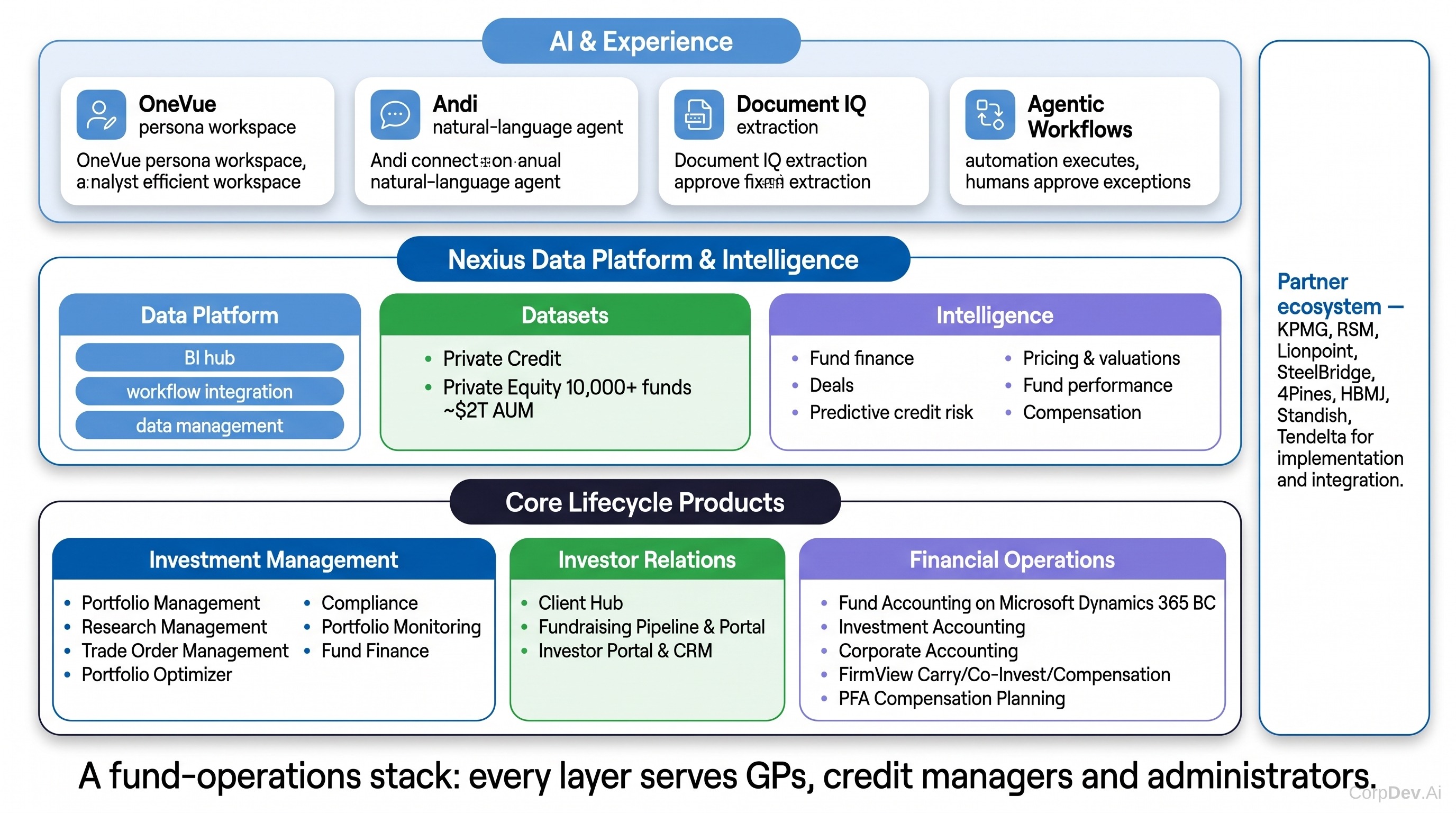
Read diagram description
Three-layer stack diagram. Bottom layer labelled "Core Lifecycle Products" with three columns: "Investment Management" (Portfolio Management, Research Management, Trade Order Management, Portfolio Optimizer, Compliance, Portfolio Monitoring, Fund Finance), "Investor Relations" (Client Hub, Fundraising Pipeline & Portal, Investor Portal & CRM), "Financial Operations" (Fund Accounting on Microsoft Dynamics 365 BC, Investment Accounting, Corporate Accounting, FirmView Carry/Co-Invest/Compensation, PFA Compensation Planning). Middle layer labelled "Nexius Data Platform & Intelligence": data platform (BI hub, workflow integration, data management), datasets (Private Credit, Private Equity 10,000+ funds ~$2T AUM), intelligence (fund finance, deals, predictive credit risk, pricing & valuations, fund performance, compensation). Top layer labelled "AI & Experience": OneVue persona workspace, Andi natural-language agent, Document IQ extraction, Agentic Workflows (automation executes, humans approve exceptions). "Partner ecosystem — KPMG, RSM, Lionpoint, SteelBridge, 4Pines, HBMJ, Standish, Tendelta for implementation and integration." "A fund-operations stack: every layer serves GPs, credit managers and administrators."
2.3 Strengths
- Front-to-back breadth on one data model. Allvue can plausibly replace a fund's general ledger, investment book of record, LP portal, portfolio-monitoring tool and carry-calculation spreadsheet with one vendor, on a common security master and chart of accounts [8]. For a growing multi-strategy manager, that consolidation is the primary value proposition.
- Private credit and CLO depth. The Black Mountain heritage gives Allvue unusual strength in loan administration, covenant monitoring, CLO compliance and trade workflows; at formation it served 50 of the top 100 CLO managers [2][5]. Few competitors match this in a suite that also does PE fund accounting.
- A credible data-network strategy. Nexius is a genuine strategic asset: because Allvue processes fund-finance, deal and credit data for 500+ clients, it can offer anonymised benchmarks that a single-tenant competitor cannot [10][13][14]. The March 2026 PE dataset (10,000+ funds, ~$2T AUM) and the September 2025 private-credit intelligence launch show the strategy is executing [13][14].
- AI grounded in governed financial data. Document IQ and Andi attack real operational pain — spreading borrower financials, interpreting credit-agreement compliance, executing capital calls — and the RSM partnership signals that administrators are prepared to run production workflows on it [9][15].
- Users report a reasonably intuitive interface, scalability and good support. G2's review synthesis lists these as the dominant positive themes [12].
2.4 Weaknesses and risks
- Cost. Allvue is enterprise, quote-based software; G2 reviewers explicitly flag it as expensive for smaller firms, and the nominal "$1" price displayed on Capterra is a directory placeholder rather than a real quote [11][12]. Implementation, data migration, integration and partner services materially inflate total cost of ownership.
- Complexity and configuration burden. The same breadth that enables consolidation requires substantial configuration; reviewers note that some features demand significant training [12]. Allvue's heavy reliance on a partner ecosystem (KPMG, RSM, Lionpoint, SteelBridge and others) for implementation and customisation is a signal that self-service deployment is not the norm [17].
- Uneven module depth. As with any suite assembled by acquisition, depth varies: the credit/CLO and fund-accounting modules are mature; the fundraising CRM and portfolio-monitoring modules compete against specialists (DealCloud, Chronograph, iLEVEL) that do only that.
- Ownership transition risk. Vista's reported exploration of a ~$3 billion sale [16] introduces the usual private-equity-exit uncertainties: a strategic buyer may re-platform or re-price; a new sponsor may prioritise margin over roadmap. Contract negotiations in late 2026 should include change-of-control, roadmap-commitment and pricing-cap protections.
- Not a deal-execution tool. For the CorpDev reader specifically: Allvue has no target-screening engine, no acquisition-diligence workflow, no integration-planning module and no capability to author investment memos or board decks. Its "deal" functionality is a fundraising pipeline for LPs, not an M&A pipeline for targets.
Reuters reported on 21 August 2026 that Vista Equity Partners is exploring a sale of Allvue at a valuation of up to approximately $3 billion including debt [16]. This is an exploration, not a transaction — but a buyer committing to a multi-year, seven-figure implementation should negotiate change-of-control, data-portability and roadmap-continuity clauses before signing.
2.5 Verdict on Allvue
For a GP, private-credit manager or fund administrator with several billion dollars under management and a mandate to consolidate systems, Allvue belongs on every shortlist alongside eFront and SS&C; its Nexius data strategy is arguably the most differentiated roadmap in the category. For a corporate development, strategy or M&A team, it should not be on the shortlist at all — not because it is weak, but because it is the wrong tool.
3. The Alternatives Landscape
This section surveys the four categories introduced in Section 1. Pricing figures throughout are indicative ranges drawn from vendor disclosures and third-party 2026 estimates; nearly every vendor in this market sells on quote, and actual contract values depend on modules, entities, users, data volumes and services.
3.1 Category A — Fund operations suites (Allvue's direct peers)
eFront (BlackRock). Acquired by BlackRock for $1.3 billion in 2019 and integrated with Aladdin while remaining available standalone [18], eFront is the institutional benchmark for private-markets modelling, waterfall, performance and risk analytics. In February 2026 BlackRock launched an end-to-end private-markets workflow combining Preqin pre-investment data with eFront post-investment workflows [19] — a data-plus-workflow strategy that directly rivals Allvue's Nexius thesis, backed by a far larger balance sheet. It is the most expensive option in the category, with indicative annual contracts of $250,000 to $2.5 million+, and the most implementation-intensive.
SS&C Technologies (Investran, Geneva, Intralinks). SS&C offers a broad product family — Geneva for institutional portfolio accounting, Intralinks (acquired for ~$1.5 billion in 2018) for data rooms and deal workflow — plus outsourced fund administration [20]. The portfolio's breadth is also its weakness: modules were assembled by acquisition, integration between them requires work, and the user experience trails cloud-native rivals. SS&C is the natural choice for firms that want software and an administrator from one counterparty.
FIS Investran. A mature, accounting-centric platform familiar to established administrators, strong on partnership accounting, allocations and audit controls, but with dated workflows and little to offer deal teams or portfolio-monitoring users. No material 2026 product announcement was identified.
Dynamo Software. The most approachable of the full suites for mid-market GPs, LPs and family offices, spanning CRM, deal pipeline, portfolio monitoring, fund accounting, LP reporting and ESG in one configurable platform; indicative annual cost of roughly $50,000–$250,000 [22]. Breadth comes with uneven depth by module.
Carta Fund Administration. Carta has moved decisively upmarket from cap tables: it reported ~9,000 funds and SPVs and $203 billion in assets in March 2026, launched Carta CRM via the ListAlpha acquisition (March 2026), Carta Law via Avantia (May 2026), and Carta plugins for Claude (July 2026) [26][27][28]. It is the fastest-onboarding option, indicatively $25,000–$150,000 a year, and the default for venture and emerging managers — but not yet a match for Allvue or eFront in complex multi-strategy institutional operations.
Juniper Square. Real-estate-native investor relations and administration with an excellent LP portal; indicative annual cost of $40,000–$300,000 for core administration. In July 2026 it extended its Headless GPX product into the accounting layer using AI to interpret general ledgers [29].
3.2 Category B — Portfolio-data specialists
Chronograph (institutional LP and GP portfolio monitoring, indicatively $120,000–$650,000 a year), iLEVEL from S&P Global (portfolio-company data collection and analytics, with AI-powered Document Search launched August 2025 [24][25]) and Canoe Intelligence (automated alternative-document extraction across 44,000+ funds and 500+ institutional clients; Bloomberg agreed to acquire it on 29 July 2026 [30][31][32]) all overlap with Allvue's Portfolio Monitoring and Document IQ. None replaces a fund-accounting system; each is a best-of-breed complement. The Bloomberg–Canoe and BlackRock–Preqin–eFront moves indicate that the largest data vendors now regard private-markets operations data as strategic — a structural pressure on independent suites like Allvue.
3.3 Category C — Private-capital deal CRMs
Intapp DealCloud (NASDAQ: INTA) is the enterprise standard for PE, private credit, investment banking and advisory firms: a deep financial-services data model, relationship intelligence, origination and firm-wide reporting, now augmented by the Celeste AI coworker and — announced September 2026 — a governed DealCloud plug-in for ChatGPT for Financial Services [52][55][56]. Indicative annual cost is $30,000–$150,000+, materially higher for global deployments; implementation and administration are substantial. Affinity ($120 million raised, including an $80 million Series C; 1,700+ institutions) is the best-in-class passive relationship CRM — email and calendar capture, relationship-strength scoring, warm-introduction paths — with transparent per-seat pricing of roughly $2,000–$2,700 per user per year [57][58][60][61]. Altvia (Marlin Equity Partners majority investment) adds fundraising and investor-relations depth and launched MCP support for external AI tools in May 2026 [67]. 4Degrees is the lower-cost relationship CRM for small and mid-market PE/VC. All four centre on relationship-driven deal flow. Configurable diligence workflows and AI-assisted analytical outputs vary by vendor; buyers should test them separately from the structured integration management of specialist lifecycle platforms.
3.4 Category D — M&A execution platforms
Midaxo — co-founded by Ari Salonen and CorpDev.Ai's Kal Kilpi, and now led by Salonen [33][87] — is the most established corporate-development operating system: strategy, pipeline, diligence, integration, synergy and value tracking for serial acquirers, with 500+ customers including Daimler, HP, Philips and Verizon and a major AI update shipped in August 2026 [34][38]. Indicative spend is $60,000–$90,000 for mid-market deployments and $150,000+ for large ones [35][36][37]. Devensoft offers a comparable six-module lifecycle platform (customers include NCR, Xilinx, NI) at $150 per user per month for pipeline and quote-based enterprise pricing, but is a smaller vendor with less transparent scale [41][42][44]. DealRoom prices by deal volume with unlimited users — roughly $25,000–$50,000 a year for common deployments — and is strongest in structured diligence and integration; it launched MCP connectivity to ChatGPT and Claude in 2026 [49][50][51]. Datasite and Ansarada are transaction data rooms first: Datasite is the adviser-led standard with Blueflame AI integration and per-project pricing that can reach six figures [69][71][72]; Ansarada offers transparent storage-based pricing from about $244 a month, unlimited users, and 2026 AI updates including the OS Bondi platform and a Harvey partnership [75][77][78].
CorpDev.Ai is the category's agentic-AI entrant: an "Integrated CorpDev Environment" combining an AI Analyst agent that authors cited memos, market maps, company profiles and presentations; AI target discovery and fit scoring across a 70M+ company universe; a zero-entry pipeline CRM populated from Microsoft 365 or Google Workspace; an AI-native data room (AI Room) with page-level citations; digital-twin models of targets for diligence and integration; and managed services delivered on the same platform [79][80][84]. Published pricing is $1,000 per month for an individual seat and $3,000 per month for a three-seat team on annual billing, with enterprise on quote [85]. It is a founder-led company (Kal Kilpi, Atul Tiwary) with no publicly disclosed funding round and no named reference customers — the principal diligence gap a buyer must close [87].
| Category and buyer | Vendors, scope and indicative commercial context |
|---|---|
| Fund operations: fund CFO/COO and administrators | Allvue: Vista, 500+ clients, $7T tracked, Nexius/Andi. eFront: BlackRock, acquired for $1.3B in2019, Aladdin/Preqin adjacency, $250K–$2.5M+/year estimates. SS&C Geneva/Intralinks: software and administration. FIS Investran: accounting. Dynamo: $50–250K/year. Carta: 9,000 funds, $203B claimed, $25–150K/year. Juniper Square: real estate, $40–300K/year. |
| Portfolio data: LP, fund-of-funds and large GP | Chronograph: $120–650K/year estimates. S&P iLEVEL: AI Document Search. Canoe: Bloomberg acquisition announced July 2026, 44,000+ funds claimed; pending status distinguished from completion. |
| Private-capital CRM: PE/VC/banking deal teams | Intapp DealCloud: public parent, Celeste, $30–150K/year estimates. Affinity: $120M raised, historical 1,700+ institutions, ~$2–2.7K/user/year. Altvia: Marlin majority investment, MCP announced May 2026. 4Degrees: small/mid-market PE/VC. |
| M&A execution and analytical tools: corporate development/strategy/serial acquirers | Midaxo: 500+ customers claimed, references Daimler/HP/Philips/Verizon, $60–150K+/year estimates. Devensoft: NCR/Xilinx/NI references, $150/user/month pipeline. DealRoom: deal-volume pricing, $25–50K/year estimates, diligence/integration. Datasite: transaction rooms and Blueflame. Ansarada: from $244/month cited, OS Bondi/Harvey. CorpDev.Ai: AI analyst, AI Room and zero-entry CRM, $1K/seat/month annual plan. |
The fourth category is the main corporate-acquisition shortlist. Company and customer figures are original dated claims; prices require configuration-specific confirmation.
4. Head-to-Head Comparison Matrix
The matrix below scores functional coverage from a CorpDev / strategy / M&A buyer's perspective. Ratings use a four-point scale: Core (a primary, mature module), Partial (present but secondary or shallow), Adjacent (achievable via integration or a related feature) and None. Ratings are analytical judgments based on vendor documentation and third-party reviews cited in this report; they are not vendor-supplied.
4.1 Functional coverage
| Capability | Allvue | eFront | DealCloud | Affinity | Midaxo | Devensoft | DealRoom | Datasite | CorpDev.Ai |
|---|---|---|---|---|---|---|---|---|---|
| Strategy & market mapping | None | None | Partial | None | Partial | Partial | None | None | Core |
| Target sourcing & AI screening | None | None | Partial | Partial | Partial | Partial | Partial | None | Core |
| Relationship intelligence | Partial | None | Core | Core | None | None | None | None | Partial |
| Acquisition pipeline & governance | None | None | Core | Core | Core | Core | Core | Partial | Core |
| Diligence workflow / request lists | None | None | Partial | None | Core | Core | Core | Core | Partial |
| Virtual data room | None | None | None | None | Partial | Partial | Core | Core | Core (AI-native) |
| Valuation & synergy modelling | Partial | Core | None | None | Partial | Partial | Partial | None | Core |
| Memo / deck / CIM authoring | None | None | Partial | None | Partial | None | Partial | None | Core |
| Post-merger integration | None | None | None | None | Core | Core | Core | None | End-to-end management and integration work; validate programme controls |
| Fund accounting & NAV | Core | Core | None | None | None | None | None | None | None |
| Portfolio-company monitoring | Core | Core | Partial | None | Partial | Partial | None | None | Partial |
| Investor portal / LP reporting | Core | Core | Partial | None | None | None | None | None | None |
| Private-credit / CLO operations | Core | Partial | None | None | None | None | None | None | None |
The pattern is clear: Allvue and eFront concentrate on fund operations, with eFront also rated Core for valuation and modelling. M&A execution platforms concentrate on the top nine rows, although several have partial portfolio-monitoring coverage. These distinctions matter for corporate venture and other buyers with both fund and acquisition responsibilities. DealCloud and Affinity sit between the two, strong in relationship-driven origination but thin in execution and analysis.
4.2 Commercial and delivery characteristics
| Dimension | Allvue | eFront | DealCloud | Affinity | Midaxo | DealRoom | CorpDev.Ai |
|---|---|---|---|---|---|---|---|
| Owner / backing | Vista Equity (sale explored Aug 2026) [16] | BlackRock [18] | Intapp (NASDAQ: INTA) [52] | VC-backed, $120M raised [57][58] | Private, €18.6M+ raised [33] | Founder-owned, bootstrapped [47] | Founder-led, no disclosed funding [87] |
| Primary buyer | Fund CFO/COO, administrator | Large GP, LP, Aladdin user | PE, credit, IB, advisory | PE/VC deal teams | Serial corporate acquirer | CorpDev, PE, advisers | CorpDev, strategy, PE, IB |
| Pricing model | Enterprise quote [11][12] | Enterprise quote | Firm-based quote | Per seat, published [60][61] | Quote; tiered by scope [35][36][37] | Per deal volume, unlimited users [49][50] | Per seat, published; enterprise quote [85] |
| Indicative annual spend | Enterprise (six–seven figures) | $250K–$2.5M+ | $30K–$150K+ | $2.0K–$2.7K per user | $60K–$150K+ | $25K–$50K typical | $12K (1 seat) – $36K (3 seats) |
| Implementation | Partner-led; months | Specialist-led; months | Consultant-led; weeks–months | Days–weeks | Weeks–months | Days–weeks | Self-serve; "5-minute setup" claimed [79] |
| AI positioning | Andi, Document IQ, agentic workflows on governed fund data [10] | Aladdin + Preqin data workflow [19] | Celeste AI coworker; ChatGPT plug-in [55][56] | Ascend agents, AI notetaker, MCP [58] | AI summaries, grounded Q&A (Aug 2026) [38] | AI request lists, MCP to ChatGPT/Claude [51] | Multi-model agent (Claude, GPT, Perplexity, Gemini) authoring deliverables [79] |
| Independent customer evidence | Strong (500+ clients, named references) [1] | Strong | Strong (public company disclosures) [53][54] | Strong (1,700+ institutions) [58] | Good (named enterprise logos) [34] | Moderate (named mid-market logos) [48] | Weak (no named customers) [87] |
Every figure except Affinity's and CorpDev.Ai's published seat prices is a third-party or market estimate, and even published seat prices exclude enterprise tiers, add-ons and services. Treat the column as an order-of-magnitude guide for budgeting, and obtain written quotes before any internal business case.
| Vendor | Indicative annual spend (US$K) |
|---|---|
| CorpDev.Ai (1–3 seats) | 12–36 |
| Affinity (10 seats) | 20–27 |
| DealRoom | 25–50 |
| Carta Fund Admin | 25–150 |
| DealCloud | 30–150 |
| Dynamo | 50–250 |
| Midaxo | 60–150 |
| Chronograph | 120–650 |
| eFront | 250–2500 |
Allvue is deliberately omitted from the chart because no credible public range exists; its positioning, reviewer commentary and partner-led delivery model place it in the same enterprise band as eFront and SS&C [11][12].
5. Deep Dives on the Most Relevant Alternatives
This section profiles the seven vendors a CorpDev, strategy or M&A professional is most likely to weigh seriously. Each profile is structured identically — what it is, where it wins, where it loses, and the diligence question a buyer should ask — so the reader can compare like with like.
5.1 Intapp DealCloud — the enterprise relationship platform
DealCloud, acquired by Intapp in 2018 [52], is the reference deal-and-relationship platform for private equity, private credit, investment banking and professional-services firms. Its data model is purpose-built for financial services — companies, contacts, funds, LPs, deals, mandates and the relationships between them — and it is highly configurable at the firm level. The 2026 story is AI: Intapp's Celeste coworker provides relationship intelligence, natural-language search and AI-assisted origination across governed firm knowledge, and a September 2026 collaboration with OpenAI delivers DealCloud-with-Celeste as a plug-in inside ChatGPT for Financial Services [55][56]. Recent wins include Paine Schwartz Partners and Ensis Partners [53][54].
Where it wins. Firms whose deal flow is relationship-driven, that need firm-wide pipeline and coverage reporting, and that have the administrative capacity to configure and maintain a sophisticated system. Compliance and governance are institutional-grade.
Where it loses. It is expensive and implementation-heavy — indicatively $30,000–$150,000+ a year before consulting — and for a three-person corporate-development team it is over-engineered: there is no diligence request-list engine, no integration-planning module and no analytical authoring capability. Corporates that adopt it typically do so because the parent's banking or PE relationships already use it.
Diligence question: how many hours per week of internal administration does the vendor's reference customer of comparable size spend on configuration and data hygiene?
5.2 Affinity — passive relationship capture
Affinity's differentiator is that it builds the CRM for you: connected email and calendar are mined to create a relationship graph with strength scores and introduction paths, supplemented by enrichment, an AI notetaker, Ascend agents and MCP connectivity. It has raised $120 million (including an $80 million Series C led by Menlo Ventures), serves 1,700+ institutions and publishes per-seat pricing of roughly $2,000 (Essential), $2,300 (Scale) and $2,700 (Advanced) per user per year [57][58][60][61].
Where it wins. Sourcing-heavy teams — VC, growth equity, search funds, banker coverage — that live on warm introductions and refuse to type into a CRM. Time-to-value is days, and pricing is transparent.
Where it loses. It stops at the pipeline. Diligence, integration, synergy tracking and deliverable production are outside scope; the relationship graph is only as good as the mailboxes connected, which matters less for a corporate acquirer whose targets are identified by strategy rather than by network.
Diligence question: what share of the team's target universe is reachable through existing relationships? If the answer is low, relationship intelligence is not the bottleneck.
5.3 Midaxo — the serial acquirer's operating system
Midaxo is the most established corporate-development platform, covering strategy, target pipeline, diligence, integration, synergies and value tracking, with 500+ customers including Ascensus, Daimler, HP, Philips and Verizon [34]. It shipped a major AI update in August 2026 — deal summaries, grounded deal Q&A, playbook assistance and value-tracking support [38]. Funding of at least €18.6 million has been publicly reported [33]. (Disclosure relevant to this report: CorpDev.Ai's CEO Kal Kilpi co-founded Midaxo [87]; the two products now compete.)
Where it wins. Enterprises executing several deals a year that need repeatable playbooks, governance across business units, audit trails for the board and integration accountability after close. Midaxo turns M&A into a managed process.
Where it loses. It is an enterprise system with enterprise economics — indicatively $60,000–$90,000 for mid-market and $150,000+ for large deployments [35][36][37] — and implementation involves process design as much as software. For a team doing one or two deals a year, the governance overhead exceeds the benefit. Its AI is workflow-assistive rather than research-generative: it summarises what is in the deal, it does not produce the market map or the memo.
Diligence question: how many deals a year, and across how many business units, does the team expect to run through the playbook over the contract term?
5.4 Devensoft — lifecycle coverage from a smaller vendor
Devensoft offers a six-module platform from pipeline through post-close integration, with named customers including NCR, Xilinx and NI [41][44][45]. Pipeline is listed at $150 per user per month on G2; end-to-end deployments are quote-only and commonly estimated in the low five to six figures annually [42][43].
Where it wins. Teams that want Midaxo-style lifecycle coverage at a lower entry price and with more flexibility for PE and VC use cases.
Where it loses. Scale and transparency: public funding is reported at roughly $125,000 [40], no reliable customer count exists, and the ecosystem of implementation partners and integrations is thinner than DealCloud's or Datasite's. Vendor-viability diligence matters more here than for the larger players.
Diligence question: request audited or attested customer-count and retention figures, and reference calls with two customers of comparable size who have renewed at least once.
5.5 DealRoom — diligence and integration, priced by deal
DealRoom, founded by Kison Patel (the M&A Science community was carved out as a separate business in 2025 [46]), prices by deal volume rather than seats and includes unlimited users — roughly $1,000+ a month for a single module and $25,000–$50,000 a year for common deployments [49][50]. It is bootstrapped, having reached approximately $1 million ARR without outside funding [47]; publicly referenced customers include Conagra Brands and Sammons Financial Group [48]. In 2026 it added MCP connectivity so ChatGPT, Claude and compatible assistants can work against DealRoom data [51].
Where it wins. Structured diligence and integration for teams that collaborate heavily with advisers and counterparties; the unlimited-user model removes the seat-counting friction that plagues enterprise tools.
Where it loses. Origination and analysis: pipeline is present but shallow, relationship intelligence is absent, and deliverable authoring is limited. It is a strong execution tool bolted onto a modest front end.
Diligence question: how does the deal-volume pricing behave in a year with three concurrent processes versus a year with none?
5.6 Datasite and Ansarada — transaction data rooms
Both are diligence-execution tools first and pipeline tools second. Datasite is the adviser-led standard for formal auctions, with granular permissions, audit trails, buyer/seller process management, a Pipeline product for buy-side tracking and a 2026 Blueflame AI integration across Diligence, Acquire and Pipeline [71][72][73]; pricing is per project and depends on storage, pages, users and duration, reaching tens or hundreds of thousands of dollars on large processes [69][70]. Ansarada offers transparent storage-based pricing — approximately $244 a month for 250 MB rising to about $5,134 a month for 20 GB — with unlimited users, free room preparation before activation, an AI-powered OS Bondi platform (August 2026) and a Harvey partnership for secure AI deal workflows (April 2026) [75][76][77][78].
Where they win. Any live transaction with external parties. Corporates that acquire infrequently often need nothing more than a data room plus spreadsheets.
Where they lose. As a persistent system of record between deals, they are weak: no strategy layer, no target screening, minimal integration management and limited institutional memory across processes.
5.7 CorpDev.Ai — the agentic-AI workbench
CorpDev.Ai positions itself as an "Integrated CorpDev Environment" built around an AI Analyst agent that researches and authors cited deliverables (market maps, sector reports, company profiles, strategic-fit scorecards, investment memos, board decks, CIMs), a Visual Workbook document editor for human–AI co-authoring with Word, PowerPoint, Excel and PDF export, AI target discovery and fit scoring across a research infrastructure the company describes as covering 70M+ companies and 265M+ contacts, a zero-entry pipeline CRM populated from Microsoft 365 or Google Workspace, an AI-native data room (AI Room) with vision-based extraction and page-level citations, digital-twin models of targets for diligence and integration planning, and a "CorpDev Brain" knowledge base that accumulates across deals [79][80][81][82][92]. The model stack is multi-vendor — Claude for reasoning and authoring, GPT for analysis, Perplexity for live research, Gemini for visualisation — and data is stored in open formats (Markdown, JSON/YAML, Office files) reachable over REST and MCP [79]. The company also sells managed services — its own M&A team executing market intelligence, screening, memos, digital twins and integration planning on the client's workspace [84]. Published pricing is $1,000 per month for AI Pro (one seat, invoiced annually), $3,000 per month for AI Pro Team (three seats) and custom for Enterprise (unlimited members, SSO, solutions architect, managed services) [85].
Where it wins. Teams whose binding constraint is analytical throughput rather than process governance — the two-person corporate-development group that needs a board-ready market map on Friday, a screen of 300 targets next week and an investment memo the week after, and currently either does it by hand or pays advisers $200,000–$2 million per deal to do it [79]. The open-format, no-lock-in architecture is unusual in the category and addresses a real objection to enterprise platforms. The published one-seat entry price is lower than the enterprise deployment estimates above, but the difference depends on seat count, scope and implementation; these are not equivalent configurations.
Where it loses — and what a buyer must verify. The company is young and founder-led, has no publicly disclosed funding round, publishes no named customers or case studies, and its headline performance claims (a 50,000-page data room made queryable; "DD-grade accuracy on financial tables"; "consulting-quality, 100× faster") are vendor statements not yet independently validated [79][87]. Test multi-business-unit approvals, integration task management and programme reporting directly against the same requirements used for Midaxo and DealRoom; a limited public evidence base is not a demonstrated functional shortfall. Relationship intelligence is present via mailbox integration but is not the core differentiator. A buyer should also confirm the security posture (isolated workspaces, data residency, model-provider data handling) against corporate InfoSec requirements before loading confidential deal material into the AI Room.
CorpDev.Ai combines workflow management and work production: the team manages the programme while agents research, analyse and prepare deliverables under human direction. Midaxo and DealRoom also provide workflow automation and AI. Compare the complete work required to move an acquisition through approval and integration; a large programme should not assume it must buy one platform to manage the process and another to perform the analysis.
Diligence question: ask for a live, timed run of a real deliverable on the buyer's own sector — a market map, a 50-target screen and a two-page company profile — and audit the citations line by line. The output quality and citation accuracy on that test are the entire investment case.
5.8 eFront — for the reader who genuinely needs a fund suite
If, after Section 1, the reader concludes that the job really is running funds — a corporate venture arm with LP-style reporting, a family office, a captive credit vehicle — then eFront is Allvue's most direct institutional alternative. It brings BlackRock's balance sheet, Aladdin integration and the new Preqin-to-eFront pre- and post-investment workflow [18][19], at the price of the highest cost and heaviest implementation in the category. The choice between Allvue and eFront typically turns on three questions: whether private credit/CLO depth (Allvue) or multi-asset institutional risk analytics (eFront) matters more; whether the firm is or intends to be an Aladdin house; and whether the buyer prefers an independent, sponsor-owned vendor (with the 2026 sale overhang) or a division of the world's largest asset manager (with the strategic-alignment questions that implies).
6. Total Cost of Ownership and Implementation Reality
Licence fees are the visible fraction of cost. In this market the invisible fractions — implementation, integration, internal administration, data hygiene and the opportunity cost of a slow rollout — routinely exceed the licence over a three-year term for enterprise platforms, and approach zero for self-serve tools. A rigorous business case models all five.
6.1 Cost components by platform archetype
| Cost component | Fund suite (Allvue, eFront, SS&C) | Enterprise deal CRM (DealCloud) | M&A lifecycle platform (Midaxo, Devensoft) | Deal-priced execution tool (DealRoom) | Per-seat workbench / relationship CRM (CorpDev.Ai, Affinity) |
|---|---|---|---|---|---|
| Annual licence | Six to seven figures, quote-only | $30K–$150K+ | $60K–$150K+ | $25K–$50K typical | $12K–$36K (CorpDev.Ai); ~$2K–$2.7K per user (Affinity) |
| Implementation & configuration | Partner-led, often 30–100% of year-one licence; 4–12 months | Consultant-led; weeks to months | Process design plus configuration; weeks to months | Days to weeks | Self-serve; hours to days |
| Integrations | GL, custodians, administrators, data vendors; material | Email, calendar, data providers; moderate | Email, VDR, ERP for synergy tracking; moderate | VDR-native; light | Mailbox connectors and MCP; light |
| Internal administration | Dedicated systems owner; often a small team | Part-time to full-time administrator | Part-time process owner | Minimal | Minimal |
| Data migration and hygiene | Substantial (historic fund data, investor records) | Substantial (contact and deal history) | Moderate (pipeline and playbooks) | Light | Light (zero-entry populates from mailbox) |
| Change-management burden | High — finance operations re-engineered | High — deal teams must adopt CRM discipline | Medium — playbooks must be followed | Low | Low, but output must be reviewed and edited |
6.2 Three-year TCO illustration for a mid-sized corporate development team
The illustration below assumes a five-person corporate-development team, with only three licensed CorpDev.Ai users in its stated configuration, at a $2–5 billion revenue company executing two to four deals a year. Figures combine the indicative licence ranges cited in Sections 3–5 with implementation and administration assumptions stated in the Basis column; they are directional, not quotes.
| Option | Year-1 licence | Implementation | Years 2–3 licence | Internal admin (3 yrs) | Indicative 3-year TCO | Basis |
|---|---|---|---|---|---|---|
| Allvue (if wrongly selected) | $250,000 | $150,000 | $525,000 | $300,000 | ~$1.2M | Licence at low end of enterprise band; 60% implementation; 0.5 FTE admin at $200K loaded |
| Intapp DealCloud | $90,000 | $60,000 | $190,000 | $180,000 | ~$520K | Midpoint of $30K–$150K range [52]; consultant-led; 0.3 FTE admin |
| Midaxo | $75,000 | $40,000 | $160,000 | $120,000 | ~$395K | Mid-market range $60K–$90K [35][36][37]; 0.2 FTE process owner |
| DealRoom | $40,000 | $5,000 | $85,000 | $30,000 | ~$160K | Typical $25K–$50K deployment [49][50]; minimal admin |
| CorpDev.Ai (Team plan, 3 seats) + Ansarada VDR for live deals | $36,000 + $8,400 | $0 | $88,800 | $30,000 | ~$163K | Published $3,000/month annual billing [85]; Ansarada ~$699/month 1 GB room [75][76]; review-time overhead |
| Spreadsheets + generic CRM + VDR per deal | $15,000 | $0 | $30,000 | $150,000 | ~$195K | CRM seats plus per-deal VDR; heavy manual-effort cost at 0.25 FTE |
| Option | 3-year TCO (US$K) |
|---|---|
| Allvue (mis-selected) | 1225 |
| Intapp DealCloud | 520 |
| Midaxo | 395 |
| Spreadsheets + CRM + VDR | 195 |
| CorpDev.Ai + Ansarada | 163 |
| DealRoom | 160 |
Two observations follow. First, the spreadsheet status quo is not free: once manual research and data-wrangling effort is costed, it exceeds the lightweight tools. Second, the largest single lever in the business case is not licence price but avoided adviser and consulting spend — a single commercial-diligence or market-scan engagement can cost $200,000 or more [79], so a tool that displaces even one such engagement a year pays for any option in the lower half of the table several times over. That benefit is only realisable, however, if the output quality is genuinely board-grade, which is the point to test in a pilot.
6.3 Hidden costs buyers under-estimate
- Seat creep. Per-seat tools (Affinity, DealCloud, CorpDev.Ai's standard tiers) grow with the extended deal team — legal, finance, integration leads. Model the fully-loaded seat count, not the core team.
- Deal-volume variance. Deal-priced tools (DealRoom) and per-project data rooms (Datasite) are cheap in quiet years and expensive in busy ones; confirm caps and rollover terms.
- Credit and usage limits. AI workbenches meter research: CorpDev.Ai's plans include 12,000 (Pro) or 36,000 (Team) search credits a year [85]. Establish what a typical target screen consumes before assuming the allowance is sufficient.
- Review and verification time. AI-authored output must be checked. The productivity gain is real only if verification takes a fraction of the drafting time it replaces — another reason to audit citations in the pilot.
- Exit cost. Enterprise suites with proprietary data models are expensive to leave. Open-format storage (CorpDev.Ai's Markdown/JSON/Office files; DealRoom's exportable rooms) materially lowers switching cost and should be weighed as a real option value.
Every governance platform in this report — Midaxo, Devensoft, DealCloud — fails when no one inside the buyer owns the playbook. Before selecting one, name the internal owner and secure the executive mandate that deal teams will actually use it. Without that, the lighter tools that require no behavioural change will deliver more of their promised value.
7. Buyer's Decision Framework
The framework below converts the analysis into a sequence of decisions. It is deliberately ordered: each question eliminates a category before the next question refines the choice within it.
7.1 The decision tree
| Requirement | Shortlist |
|---|---|
| Institutional multi-strategy funds in an Aladdin environment | eFront |
| Institutional private-credit/CLO operations or administration | Allvue or SS&C Geneva |
| Emerging manager, venture or real estate | Carta, Juniper Square or Dynamo |
| Relationship-driven origination | DealCloud for enterprise requirements; Affinity for a lighter configuration |
| Process governance across deals and business units | Midaxo or Devensoft |
| Live-transaction diligence and integration | DealRoom; Datasite or Ansarada where a specialist room is required |
| Research, screening, memos and board materials | Pilot CorpDev.Ai and audit source citations and output quality |
Many corporate acquisition teams need both execution/governance and analysis. Fund suites are relevant only where actual fund-accounting, investor-reporting or investment-operations requirements exist.
Question 1 — Is the job running funds or doing deals? If the organisation issues capital calls, computes NAVs or reports to LPs, it is running funds and belongs in Category A (Allvue, eFront, SS&C, Dynamo, Carta). If it sources, evaluates and integrates acquisitions, it is doing deals and belongs in Categories C and D. Corporate venture arms sometimes need both; they should buy them separately rather than expect one vendor to serve both.
Question 2 (fund buyers) — Scale, asset class and ecosystem. Institutional, multi-asset, Aladdin-aligned managers lean toward eFront; private-credit and CLO-heavy managers and administrators lean toward Allvue or SS&C; venture, real-estate and emerging managers lean toward Carta, Juniper Square or Dynamo. Vista's reported 2026 exploration of an Allvue sale [16] and BlackRock's Preqin-eFront integration [19] should both feature in vendor-risk scoring.
Question 3 (deal buyers) — What is the binding constraint? Four archetypes:
- "We don't see enough of the right deals" — an origination and relationship problem: DealCloud or Affinity.
- "We run deals inconsistently and lose institutional memory" — a governance problem: Midaxo or Devensoft.
- "Diligence and integration are chaotic when a deal is live" — an execution problem: DealRoom plus a data room.
- "We cannot produce the analysis fast enough, so we pay advisers or skip it" — a throughput problem: CorpDev.Ai, evaluated through a pilot.
Question 4 — Deal cadence. Fewer than two deals a year rarely justifies a governance platform; a data room per deal plus an analytical tool is usually sufficient. Four or more deals a year across multiple business units justifies Midaxo-class governance.
Question 5 — Team capacity to administer. If no one can own configuration and adoption, exclude DealCloud and the fund suites regardless of merit.
7.2 Evaluation criteria and weights
| Criterion | Weight for a CorpDev buyer | What to test |
|---|---|---|
| Fit to the binding constraint (Q3) | 30% | Does the tool remove the specific bottleneck, or merely digitise around it? |
| Output quality and accuracy | 20% | For AI tools: citation accuracy on a timed live test. For workflow tools: template and reporting fidelity. |
| Time-to-value | 15% | Days, weeks or months to first usable result; dependency on partners. |
| Three-year TCO | 15% | Section 6 model, including admin, review time and exit cost. |
| Security and data governance | 10% | Workspace isolation, data residency, model-provider data handling, SOC 2 or equivalent. |
| Vendor viability and roadmap | 10% | Ownership, funding, customer evidence, change-of-control exposure. |
7.3 Red flags by vendor type
- Fund suites offered to a CorpDev team: the vendor has not understood the use case; expect "N/A" across most requirements.
- Enterprise CRMs with no named process owner: adoption will fail; the system becomes an expensive contact list.
- AI workbenches that decline a live, timed test on the buyer's own data: output-quality claims cannot be trusted.
- Any vendor unable to state exit terms and data-export formats in writing: assume lock-in.
- Sponsor-owned vendors mid-sale process (Allvue in 2026): negotiate change-of-control protections or defer.
7.4 RFP checklist for a CorpDev / M&A tool selection
- Define the binding constraint (Q3) and the deal cadence (Q4) in the RFP preamble
- Require vendors to demonstrate on the buyer's own sector and a real historical deal, under time limits
- For AI tools: audit at least 20 citations from the demonstration output for accuracy and relevance
- Request three reference customers of comparable size, at least one that has renewed
- Obtain a fully loaded three-year quote including implementation, seats for the extended team and usage or credit limits
- Confirm data-export formats, deletion on exit and any fees for departure
- Review security documentation: workspace isolation, encryption, sub-processor list, model-provider terms
- For sponsor-owned or venture-backed vendors: negotiate change-of-control, roadmap and pricing-cap clauses
- Name the internal process owner and secure the executive adoption mandate before contract signature
8. Recommendations by Buyer Profile
The recommendations below apply the framework to five common buyer profiles. Each pairs a primary recommendation with the most credible alternative and the condition under which the alternative wins.
Primary: Allvue Systems — especially where private-credit or CLO depth and a consolidated back office matter; Nexius benchmarking is a differentiated bonus [5][10][13].
Alternative: eFront if the firm is institutional, multi-asset and Aladdin-aligned [18][19].
Condition: Negotiate change-of-control protections given Vista's reported sale exploration [16]; consider SS&C if outsourced administration is wanted from the same counterparty [20].
Primary: Carta Fund Administration — fastest onboarding, ecosystem breadth (CRM, Law, Claude plugins added in 2026) and scale-based pricing [26][27][28].
Alternative: Dynamo for a broader mid-market suite; Juniper Square for real assets [22][29].
Condition: Allvue and eFront only when fund complexity outgrows Carta — typically several funds with complex waterfalls or credit strategies.
Primary-platform shortlist: CorpDev.Ai and Midaxo for the complete acquisition programme; compare management controls, analytical work and integration accountability [34][38].
Direct alternative: CorpDev.Ai for end-to-end management with analysis and deliverable production; compare the whole programme in a pilot, including integration governance and citation quality [79][85].
Condition: Devensoft where budget is constrained and the buyer accepts smaller-vendor risk [42][43].
Primary: CorpDev.Ai on the Team plan for analytical throughput — strategy, market mapping, screening, memos, board decks — plus a per-deal data room (Ansarada for price transparency, Datasite for adviser-led auctions) when a transaction goes live [75][76][85].
Alternative: DealRoom if the pain is execution chaos rather than analytical capacity [49][50].
Condition: Run a two-to-four-week pilot on a real workstream; adopt only if citation accuracy and output quality pass an internal review. Confirm InfoSec sign-off before uploading confidential materials. Not Allvue, DealCloud or eFront — all over-scoped and over-priced for this profile.
Primary: Intapp DealCloud for institutional relationship and pipeline management, with Celeste AI and the ChatGPT plug-in strengthening its 2026 case [53][55][56].
Alternative: Affinity for smaller, sourcing-led teams that will not maintain a CRM manually [58][60][61].
Condition: Add an analytical layer (CorpDev.Ai, or the AI functions inside DealCloud/Altvia via MCP) for thesis research and CIM/buyer-universe work; Allvue only if the firm also needs fund operations, and then as a separate purchase.
8.1 A closing view for the CorpDev professional
The most useful conclusion of this comparison is also the simplest: Allvue is an excellent answer to a question corporate development does not ask. A CorpDev, strategy or M&A leader evaluating what to buy in late 2026 should first remove the fund suites from consideration, then compare primary M&A platforms, including CorpDev.Ai, Midaxo, Devensoft and DealCloud, on both governance and analytical execution — and reserve transaction data rooms for live deals. The illustrative economics favour lighter tools in some configurations, but only if their output survives a citation audit on the buyer's own sector; programme size alone does not establish which platform is safer or more capable. Test the controls, decisions and deliverables the programme actually requires.
This comparison was produced and is published by CorpDev.Ai, which is one of the vendors assessed. Its assessment of CorpDev.Ai is drawn from the company's published materials and deliberately records the gaps — no disclosed funding, no named customers, unvalidated performance claims — that an independent buyer would probe. Readers should apply the same live-test discipline recommended in Section 7 to CorpDev.Ai as to every other vendor in this report.
Key Facts & Sources
The table below lists the load-bearing figures in this report, their sources and as-of dates. Figures marked "estimate" are third-party or analytical ranges, not vendor quotes.
| Fact | Value | Source | As of | Basis |
|---|---|---|---|---|
| Allvue clients | 500+ globally | Allvue About page [1] | Aug 2026 | Company figure |
| Assets tracked on Allvue platform | $7T+ (vs. $2.5T at 2019 formation) | The Playbook profile [4]; formation press release [2] | Feb 2026 / 2019 | Company-reported; not audited AUA |
| Allvue users | ~21,000 | Allvue homepage [17] | Sep 2026 | Company figure |
| Allvue headcount | ~590–600 | Third-party profiles [4] | 2026 | Estimate; varies by source |
| Allvue formation | 2019, Vista merges AltaReturn + Black Mountain | Formation press release [2] | 2019 | Primary |
| Allvue CEO | Marc Scheipe, since Jan 2023 | Allvue press release [3] | Jan 2023 | Primary |
| Vista sale exploration | Up to ~$3B incl. debt | Reuters [16] | 21 Aug 2026 | Reported exploration, not a transaction |
| Nexius PE dataset | 10,000+ funds, ~$2T AUM | FinancialContent [14] | Mar 2026 | Company announcement |
| eFront acquisition price | $1.3B by BlackRock | Reuters [18] | Mar 2019 | Primary |
| eFront indicative annual cost | $250K–$2.5M+ | Market estimate (Section 3.1) | 2026 | Estimate |
| SS&C–Intralinks acquisition | ~$1.5B | Investing.com [20] | Sep 2018 | Reported |
| Carta scale | ~9,000 funds/SPVs; $203B assets | Carta press release [26] | Mar 2026 | Company figure |
| Canoe scale / acquisition | 44,000+ funds, 500+ clients; Bloomberg agreement | GS Alternatives / Bloomberg [30][31] | 29 Jul 2026 | Primary |
| Midaxo customers | 500+ incl. Daimler, HP, Philips, Verizon | Midaxo release [34] | Jul 2023 | Company figure |
| Midaxo funding | ≥€18.6M incl. €12.9M Series B | Private Equity News [33] | Mar 2018 | Reported |
| Midaxo indicative cost | $60K–$90K mid-market; $150K+ large | Third-party estimates [35][36][37] | 2026 | Estimate |
| Affinity funding / reach | $120M raised; 1,700+ institutions | Affinity [57][58] | Mar 2026 | Company figure |
| Affinity pricing | ~$2,000 / $2,300 / $2,700 per user/yr | Third-party reviews [60][61] | 2026 | Published tiers via third parties |
| DealCloud indicative cost | $30K–$150K+ | Market estimate (Section 3.3) | 2026 | Estimate |
| DealRoom pricing | ~$1,000+/mo per module; $25K–$50K typical | DealRoom pricing page; datarooms.org [49][50] | 2026 | Published / estimate |
| Devensoft pipeline pricing | $150/user/month | G2 [42] | 2026 | Published |
| Ansarada pricing | ~$244/mo (250 MB) to ~$5,134/mo (20 GB) | Third-party pricing pages [75][76] | 2026 | Published via third parties |
| CorpDev.Ai pricing | $1,000/mo (1 seat) and $3,000/mo (3 seats), annual billing; Enterprise on quote | CorpDev.Ai pricing page [85] | Sep 2026 | Published |
| CorpDev.Ai research universe | 70M+ companies, 265M+ contacts | CorpDev.Ai homepage [79] | Sep 2026 | Company claim |
| CorpDev.Ai funding / customers | No disclosed round; no named customers | CorpDev.Ai About page [87] | Sep 2026 | Absence of disclosure |
| Three-year TCO illustration | $160K–$1.2M across options | Section 6.2 | Sep 2026 | Derived; assumptions in Basis column of that table |
Methodology note on the comparison matrix (Section 4). Functional ratings are the analyst's judgments from vendor documentation and third-party reviews cited above; they were not validated through demonstrations. Buyers should treat the matrix as a starting hypothesis for their own RFP scoring.
References
Numbering follows the original research. Access dates below record the original source registry; they do not imply that every source was rechecked for this website edition.
- About AllvueSource accessed 2026-09-11
- AltaReturn and Black Mountain Systems Combine to Form Allvue Systems - ChannelBiz UKSource accessed 2026-09-11
- Allvue Announces Marc Scheipe as Chief Executive OfficerSource accessed 2026-09-11
- Allvue Systems — Firma im DACH B2B-Softwaremarkt | The PlaybookSource accessed 2026-09-11
- Loan Management Software for CLO Managers - Allvue SystemsSource accessed 2026-09-11
- Fund Administration SoftwareSource accessed 2026-09-11
- Private Equity Accounting Software | Allvue SystemsSource accessed 2026-09-11
- Alternative Investment Technology Solutions - Allvue SystemsSource accessed 2026-09-11
- Allvue Systems: capabilities and pricing | AI FinTech IndexSource accessed 2026-09-11
- Allvue Announces New AI and Data Innovations to Deliver ...Source accessed 2026-09-11
- Allvue Reviews and Pricing - 2021Source accessed 2026-09-11
- Allvue Reviews 2026: Details, Pricing, & Features - G2Source accessed 2026-09-11
- Allvue Systems Launches Private Credit Intelligence, Expands Nexius into Enterprise Data SolutionsSource accessed 2026-09-11
- Allvue Systems, LLC - FinancialContent - Stock MarketSource accessed 2026-09-11
- Allvue and RSM Launch Industry-First Agentic AI Operating Model ...Source accessed 2026-09-11
- Buyout firm Vista explores $3 billion sale of private markets ...Source accessed 2026-09-11
- Allvue Systems: AI-Powered Alternative Investment SoftwareSource accessed 2026-09-11
- BlackRock to buy French software firm eFront for $1.3 ...Source accessed 2026-09-11
- BlackRock Aladdin launches end-to-end private markets ...Source accessed 2026-09-11
- Financial software maker SS&C to buy Intralinks in $1.5 billion dealSource accessed 2026-09-11
- Alternative Asset Management Software & CRM | DynamoSource accessed 2026-09-11
- S&P Global brings together Artificial Intelligence and Private ...Source accessed 2026-09-11
- Artificial Intelligence meets Private Asset Portfolio Management with ...Source accessed 2026-09-11
- Carta Launches CRM with Acquisition of ListAlphaSource accessed 2026-09-11
- Carta Launches Carta Law with Acquisition of Avantia - Business WireSource accessed 2026-09-11
- Carta Rearchitects Private Capital Operations with Plugins for ClaudeSource accessed 2026-09-11
- WEEKLY NEWS - WEEK OF JULY 6, 2026 - Holland MountainSource accessed 2026-09-11
- Bloomberg to Acquire Canoe Intelligence, Taking a ...Source accessed 2026-09-11
- Growth Equity at GS Alternatives Definitive Agreement for ...Source accessed 2026-09-11
- Bloomberg to Acquire Canoe Intelligence in Private Markets PushSource accessed 2026-09-11
- Midaxo Raises €12.9 Million in Series B Funding to ...Source accessed 2026-09-11
- Midaxo Builds Strong Momentum During First Half of 2023Source accessed 2026-09-11
- Best Post-Merger Integration Software in 2026Source accessed 2026-09-11
- Midaxo vs Ansarada (2026): Scores, Reviews & Verdict - RFP.wikiSource accessed 2026-09-11
- Midaxo 2026 Pricing, Features, Reviews & Alternatives | GetAppSource accessed 2026-09-11
- Midaxo closes Q2 with new customers and a major AI updateSource accessed 2026-09-11
- Deven Software 2025 Company Profile: Valuation, Funding & Investors | PitchBookSource accessed 2026-09-11
- Devensoft M&A - LinkedInSource accessed 2026-09-11
- Devensoft Pricing 2026Source accessed 2026-09-11
- Devensoft vs IBM Watson (2026): Data‑driven comparisonSource accessed 2026-09-11
- M&A Platform — Pipeline, Diligence, Integration & MoreSource accessed 2026-09-11
- Pipeline Management — Track & Prioritize M&A DealsSource accessed 2026-09-11
- About Us | Agile M&A Project Management SoftwareSource accessed 2026-09-11
- How we reached $1M ARR without outside funding | Kison Patel ...Source accessed 2026-09-11
- #acquisitions #privateequity #mascience | Kison PatelSource accessed 2026-09-11
- DealRoom Pricing: M&A Software Plans and CostsSource accessed 2026-09-11
- Dealroom Pricing: Costs, Comparisons & Value in 2026Source accessed 2026-09-11
- Explore the LibrarySource accessed 2026-09-11
- Intapp Acquires DealCloudSource accessed 2026-09-11
- Intapp, Inc. - Investor newsSource accessed 2026-09-11
- Paine Schwartz Partners chooses Intapp DealCloud to ...Source accessed 2026-09-11
- Intapp collaborates with OpenAI to deliver a governed ...Source accessed 2026-09-11
- The AI-powered deal and relationship intelligence platformSource accessed 2026-09-11
- Affinity Rings Up $80M In Series C Funding To Bring ...Source accessed 2026-09-11
- Affinity's Series C Funding for Relationship IntelligenceSource accessed 2026-09-11
- Altss vs Affinity (2026): Allocator Data vs Relationship CRMSource accessed 2026-09-11
- Affinity Review (2026): Pricing, Pros & Cons - CRM NewspaperSource accessed 2026-09-11
- Altvia Connects Private Markets Data to the AI Tools Firms ...Source accessed 2026-09-11
- How much does Datasite Diligence cost? | FAQSource accessed 2026-09-11
- Datasite Review - DataRoomPro.orgSource accessed 2026-09-11
- AI Shifts to Value Driver from Baseline Diligence ...Source accessed 2026-09-11
- Power your Datasite diligence documents with Blueflame AISource accessed 2026-09-11
- Datasite PipelineSource accessed 2026-09-11
- Ansarada vs IBM Watson (2026): Scores, Reviews & VerdictSource accessed 2026-09-11
- Ansarada Pricing 2026: Costs & VDR ComparisonSource accessed 2026-09-11
- Harvey and Ansarada partner to deliver secure, AI ...Source accessed 2026-09-11
- Ansarada unveils OS Bondi for secure M&A, due diligenceSource accessed 2026-09-11
- CorpDev.Ai - Agentic AI for M&A and Corporate DevelopmentSource accessed 2026-09-11
- AI Target Identification & Screening for M&A | CorpDev.AiSource accessed 2026-09-11
- AI Deal Sourcing Platform for M&A | CorpDev.AiSource accessed 2026-09-11
- Simple, Powerful AI Pipeline CRM for M&A - CorpDev.AiSource accessed 2026-09-11
- Managed Services - AI-Enabled M&A Services | CorpDev.AiSource accessed 2026-09-11
- Pricing - CorpDev.AiSource accessed 2026-09-11
- About Us - CorpDev.AiSource accessed 2026-09-11
- CorpDev Frame | The Data Architecture Behind AI-Powered M&ASource accessed 2026-09-11