RESEARCH / Private capital CRM
Altvia alternatives: private capital CRM and corporate M&A platforms
Compare Altvia, DealCloud, Affinity, Midaxo and DealRoom by investor relations, relationship intelligence, diligence, analytical work and three-year ownership cost.
Research as of
Website edition edited
Published by CorpDev.Ai, which is one of the vendors assessed. This analysis distinguishes vendor claims, external evidence and analyst judgments. Prices and capabilities reflect the source dates in the article; the website edition is an editorial adaptation, not a new verification of every claim.
Distinguish a capital-raising business from an acquisition team
Altvia is most coherent when relationships with investors and relationships with acquisition targets belong to the same operating model. Its fundraising, investor-relations and Salesforce-based workflows can then share information and administration. A corporate development team funded from its parent’s balance sheet does not automatically benefit from that breadth. It may instead inherit configuration and support requirements associated with activities it does not perform.
The decision should turn on who owns the resulting system and which recurring obligations it removes. A corporate venture operation managing external capital may justify Altvia’s wider GP workflow; a strategic acquirer may obtain more value from relationship capture plus a specialist acquisition platform. Existing Salesforce infrastructure improves the implementation case only if administrators can support the actual deal model and permissions. Demonstrate one investment across sourcing, approval, investor communication and portfolio reporting. If substantial steps have no equivalent in the buyer’s business, treat them as implementation cost rather than product value; if they are essential, compare Altvia against other private-capital platforms rather than acquisition-only tools.
Executive Summary
Altvia is a strong product that most corporate development teams should not buy. That is the central finding of this comparison, and it is not a criticism of Altvia. The company has spent two decades building a GP Engagement Platform for private-capital fund managers — fundraising, LP relations, capital calls, investor portals and deal sourcing on a Salesforce foundation — and its customer roster (NEA, IVP, Pritzker Private Capital, Commonfund, Paladin) is exactly the audience it was built for [1][13]. A corporate development, strategy or M&A team inside an operating company has a different job: define where to play, find and screen targets, run diligence, produce an investment case the board will approve, and integrate what it buys. Altvia addresses roughly one of those five stages, and it does so through a fund-manager lens.
The practical question for a buyer is therefore not "Altvia or not Altvia" but "which of three quite different categories of software do I actually need." The market divides cleanly:
- Relationship-intelligence CRMs — Altvia, Intapp DealCloud, Affinity, 4Degrees, Dynamo — whose core asset is a system of record for contacts, interactions and pipeline. They excel when the constraint on deal flow is access through networks. Pricing runs from roughly $2,000 per seat per year (Affinity list) to $15,000–40,000 per seat at DealCloud, plus five- or six-figure implementation [49][35][36].
- M&A process platforms — Midaxo, Devensoft, DealRoom — built for corporate acquirers around stage-gated pipelines, diligence request lists, integration playbooks and synergy tracking. They excel when the constraint is repeatable execution across many deals. Typical annual cost is $12,000 (DealRoom Pipeline) to $150,000–200,000 (Midaxo and Devensoft enterprise) [79][77].
- AI-native corporate development platforms — CorpDev.Ai is the most complete example — which start from the analytical work itself: sector research, market mapping, semantic target discovery, AI-assisted diligence over a data room, investment memos, board decks and integration planning, with a zero-entry pipeline underneath. They excel when the constraint is analyst capacity. CorpDev.Ai lists at $12,000 per user per year and $36,000 for a three-seat team [106].
$2K–$40K
Per-seat annual range across relationship CRMs (Affinity list to DealCloud benchmark)
8–20 weeks
Typical single-module DealCloud implementation; Altvia is a comparable Salesforce-class rollout
500+
M&A teams on Midaxo, the most widely adopted corporate-acquirer process platform
0
Independent G2 reviews of CorpDev.Ai as of September 2026 — the price of buying early
Three conclusions follow for a buyer sitting in a corporate development seat.
First, Altvia's fit is narrow and specific. It is the right answer for a corporate venture arm or a strategic investment group that manages external LPs, co-investors or a fund structure, and that already runs Salesforce. For a conventional acquirer with no LP base, the fundraising, investor-relations and portal modules — the majority of the product — are dead weight, and the deal-sourcing module competes on unfavourable terms with DealCloud (deeper), Affinity (better relationship graph) and 4Degrees (cheaper) [3][47][55].
Second, the categories are complements more often than substitutes, and the honest budgeting exercise is to decide how many you need. A serial acquirer doing eight deals a year should compare CorpDev.Ai, Midaxo and Devensoft as primary platforms. CorpDev.Ai combines end-to-end management with analytical execution; the requirement for a separate research layer must be demonstrated. A two-person corporate development team producing four board memos a year needs the research and deliverable layer far more than a stage-gated workflow engine, and its CRM needs are met by a zero-entry pipeline. Only large, compliance-heavy teams with formal restricted lists and multi-office coverage models genuinely need DealCloud-class CRM.
Third, vendor maturity and AI depth are inversely correlated across this landscape, and a buyer has to price that trade. DealCloud, Altvia and Dynamo have decades of installed base and thin, bolt-on AI (form completion, summaries, MCP connectors announced in 2026) [34][11]. CorpDev.Ai has the deepest AI-native workflow — an analyst agent that researches and drafts, a data room built for retrieval, digital-twin models for integration — but no independent review corpus, no named customers and no disclosed funding [104][105][113]. Affinity and Midaxo sit in between, with real AI roadmaps (Affinity Ascend agents, Midaxo's Madi) on top of proven products [68][119].
The distinction between fund and relationship operations and M&A management is useful; a division between managing the programme and performing its analysis is less useful. CorpDev.Ai combines those roles. The comparison below identifies where specialist products can contribute without assigning CorpDev.Ai to a small-team or pre-signing role.
| Requirement | Evaluation approach | Decision implication |
|---|---|---|
| Fund and relationship operations | Compare Altvia, DealCloud and Affinity on LP workflows, fundraising and institution-wide relationship coverage. Use the actual transaction or institutional mandate. | Retain a specialist for its demonstrated contribution; its strength in this job does not establish overall M&A superiority. |
| End-to-end M&A management | Evaluate CorpDev.Ai, Midaxo and DealRoom on the connected path from thesis and target evaluation through diligence, decisions, execution and integration. | Include CorpDev.Ai as a primary-platform candidate. Product categories and the number of deals are not substitutes for a workflow demonstration. |
| Analytical execution and deliverables | Ask each finalist to analyse the same evidence and produce a decision-ready recommendation, supporting materials and an integration response. Record human corrections and remaining manual work. | CorpDev.Ai's combination of management and work-producing agents is particularly relevant when substantial analysis must accompany every deal. Compare the quality and completeness of the outputs. |
| Large or frequent acquisition programmes | Use concurrent evaluations and integrations, shared business-unit resources and recurring leadership reporting in the pilot. Test permission boundaries and ownership changes. | Programme scale strengthens the case for evaluating integrated management and analytical capacity together; it does not automatically favour Midaxo or DealRoom. |
| Existing systems and total cost | Price the required participants, AI usage, data entitlements, implementation, ongoing reconciliation and exit. Compare both replacement and coexistence. | Keep a second platform where a specific control or operating requirement justifies it. Avoid turning a small standard plan into an unsupported Enterprise cost estimate. |
The remainder of this document profiles each vendor on the same terms, scores them against the criteria a corporate development buyer actually weighs, works through the three-year cost of ownership, and closes with a decision framework and the diligence questions to put to every vendor before signing.
Who This Guide Is For — and How to Read It
This comparison is written for three buyer personas, and the recommendation differs materially between them. Readers should identify themselves before reading the vendor profiles, because a feature that is decisive for one persona is irrelevant to another.
Profile: 1–6 people inside an operating company; reports to the CFO or Chief Strategy Officer; runs 1–10 transactions a year alongside partnerships, divestments and strategic reviews.
Binding constraint: analyst hours. The team is asked for a strategic options brief, a market map and a target list faster than it can produce them, and outsources the overflow to advisers at $200K–$2M per deal.
What matters: research and deliverable quality, speed from question to board-ready output, a pipeline that maintains itself, diligence tooling that does not require a separate VDR contract.
Profile: 10–40 people across corporate development, an integration management office and business-unit deal leads; 8–30 transactions a year; formal stage gates and approval committees.
Binding constraint: process repeatability and value capture. Deals fail in integration, not in sourcing; the organisation needs playbooks, RAID logs, synergy tracking and executive dashboards.
What matters: configurable workflow, permissions, audit trail, integration playbooks, reporting to the CEO and board, and a vendor with reference customers of similar scale.
Profile: a CVC unit or strategic investment group that makes minority investments, may manage a fund with external or internal LPs, and reports performance to a parent or investors.
Binding constraint: relationship coverage and investor reporting. Deal flow comes through founder, VC and banker networks; portfolio and LP reporting are recurring obligations.
What matters: relationship intelligence, portfolio monitoring, LP or stakeholder portals, capital-call and distribution workflows. This is the one corporate persona for whom Altvia's fund-manager heritage is an asset rather than a cost.
How the scoring works. Each vendor is assessed on nine criteria that map to the corporate development lifecycle and to procurement reality: strategy and market research, target sourcing and screening, relationship intelligence and CRM, diligence and data room, investment case and deliverables, post-merger integration, AI depth, implementation burden, and total cost. Scores in the Head-to-Head Comparison run from 1 (not addressed) to 5 (best in class), are the analyst's judgement from public documentation and independent reviews, and are deliberately conservative where a vendor's claim could not be corroborated. Pricing figures are list prices where a vendor publishes them and third-party benchmarks where it does not; the Key Facts & Sources appendix records the basis for every figure.
This comparison was produced and is published by CorpDev.Ai, one of the vendors assessed. To keep the comparison usable by a sceptical buyer, CorpDev.Ai is held to the same evidentiary standard as every other vendor: its product claims are labelled as vendor claims where no independent corroboration exists, its lack of public reviews and named customers is stated plainly, and it is scored down on maturity accordingly. A reader who disagrees with any judgement can check the source cited against each figure.
Altvia: What It Is and Where It Fits
Altvia describes itself as "the GP Engagement Platform for alternative asset managers, connecting fundraising, investor relations, and deal sourcing so every raise builds on the last" [1]. The self-description is accurate and it is the single most important fact for a corporate buyer: two of the platform's three pillars concern raising and servicing capital from limited partners, an activity most corporate development teams never perform.
Company background
Altvia was founded in 2006 and is headquartered in Broomfield, Colorado [18][14]. Bow River Capital's software growth equity team took majority ownership in 2020; Marlin Equity Partners made a significant majority investment in July 2022, with Bow River retaining a minority stake [21][22]. Headcount is estimated at roughly 60–75 by company databases, though directory ranges vary widely and no company-confirmed 2026 figure exists [18][19][23]. Ryan Keough, a private-capital technology veteran, was appointed CEO in July 2025 [25]. The company states that it serves "hundreds" of PE, VC and alternative asset firms and reports 120,000-plus portal users worldwide on its homepage; third-party profiles cite LP-investor counts of 40,000 to 100,000, figures that are not publicly reconciled [13][1][18][19].
Product suite
Altvia is a modular suite built on the Salesforce platform. AIM is listed on the Salesforce AppExchange as "a purpose-built CRM for private capital markets" [3]; the remaining modules attach to it.
| Module | Function | Relevance to a corporate development buyer |
|---|---|---|
| AIM / AIMPro | Salesforce-based CRM for relationships, fundraising pipeline, deal flow and portfolio data; AIMPro adds tailored fundraising and deal-team experiences [3][4][5] | The only module a conventional acquirer would use; the deal-team edition supports sourcing, diligence tracking, approvals and IC workflows [5] |
| ShareSecure | LP portal and virtual data room for distributing investment materials, reports and communications to investors [6] | Designed for GP-to-LP distribution; not a buy-side diligence room in the Datasite or Midaxo sense |
| Correspond | Investor, fundraising and marketing communications — mass email, segmentation, dynamic lists, communications reporting [7] | Low relevance; corporate teams rarely run investor mailings |
| Answers / Insights | Analytics and BI normalising data from multiple systems for track-record analysis, fundraising and IR reporting [8] | Moderate; useful for pipeline dashboards if the data model is configured for M&A |
| OnboardingBridge | Electronic investor onboarding workflow connected to AIM [4] | Not relevant to an acquirer |
| AIMe | AI assistant "purpose-built for alternative investment firms" — surfacing insights, automating tasks, simplifying data entry inside CRM workflows [9][10] | Assistant-style AI on CRM data; no evidence of research, drafting or document-analysis capability |
| Integration Platform with MCP | Announced May 2026; native Model Context Protocol support lets Claude, ChatGPT, Copilot and Gemini read live Altvia data across fund, fundraising, IR and deal-sourcing workflows [11][12] | Genuinely useful — lets a team bring its own AI to Altvia's data — but it is a connector, not an analyst |
Strengths
Altvia's strengths are consistent across vendor material and independent reviews. Customers rank support and partnership highly: the recurring G2 theme is responsive, knowledgeable support, and the company's own homepage claims 98% of clients rank Altvia as their number-one firm software [16][1]. The Salesforce foundation gives buyers a familiar enterprise platform, a large integration ecosystem ("4k+ third-party integrations" per the homepage) and configurability that a bespoke deal CRM cannot match [1][3]. Domain depth in private capital is real — customer quotes repeatedly cite "the product's DNA is in private equity" — and the integrated ecosystem of CRM, portal, communications and analytics removes the spreadsheet handoffs that plague fund operations [1][4][7].
Limitations for a corporate development buyer
The limitations follow from the same design choices. Cost is the most frequent complaint on G2, particularly when additional functionality is layered on; reviewers also cite repetitive data entry, limited auto-population, cumbersome file management, weak email templating and reporting that requires more sophistication than the product provides [16][17][26]. The Salesforce foundation is double-edged: it brings configurability but also a Salesforce-class implementation — discovery, data model, migration, configuration, testing — that the company does not time-bound publicly and that reviewers describe as requiring specialised expertise [16]. Pricing is quote-based and per-user per year per the ILPA vendor factsheet; no public list price exists [15].
For an operating-company acquirer, the majority of Altvia's suite — ShareSecure LP portal, Correspond investor communications, OnboardingBridge, capital-call and distribution automation — has no use case. The buyer would be paying enterprise, per-user Salesforce-class pricing for a deal-sourcing CRM module that DealCloud implements more deeply, Affinity implements with better relationship intelligence, and 4Degrees implements at lower cost. Altvia's AI (AIMe, MCP connectivity) operates on CRM data; it does not research markets, screen targets from external data, read a data room or draft an investment memo.
Where Altvia is the right answer
Altvia is the correct choice for a corporate venture capital arm or strategic investment unit that (a) manages a fund structure with internal or external LPs, (b) has recurring investor-reporting, capital-call and portfolio-monitoring obligations, (c) sources through founder and VC networks, and (d) already runs Salesforce as its enterprise CRM so that the platform licence, security review and administration are sunk costs. Munich Re Ventures' choice of Affinity for a similar profile shows the decision is contestable even there, but a CVC with a real LP base has a stronger case for Altvia than for any relationship-only CRM [48].
The Alternative Landscape
A buyer who searches for "Altvia alternatives" will find lists dominated by other private-capital CRMs. That framing is right for a fund manager and wrong for a corporate development team, because it silently assumes the CRM is the system to buy. This section lays out the full landscape a corporate buyer should consider, organised by what each category actually solves.
Category 1 — Relationship-intelligence and deal CRMs
These products are systems of record for people, firms, interactions and pipeline. Their value proposition is institutional memory and coverage: who knows whom, who last spoke to a target, which banker is sending which deals. They originated in private equity and investment banking, where the constraint on deal flow is access.
- Intapp DealCloud — the enterprise standard; part of Nasdaq-listed Intapp, which reported $577.8 million FY2026 revenue and $495.7 million cloud ARR (company-wide, not DealCloud-only) [43][44]. Serves 950-plus clients across PE, banking, advisory and corporate development [39][38].
- Affinity — the relationship-graph leader, automatically building firm-wide relationship history from email and calendar; published list pricing from $2,000 per user per year; approximately $120 million raised including an $80 million Series C led by Menlo Ventures [49][70][72].
- 4Degrees — a leaner relationship CRM for smaller deal teams, quote-based pricing, very small public review base [55][57][59].
- Dynamo Software — a broad alternatives platform (CRM, IR, portfolio monitoring, documents, reporting), configurable and operationally heavy [61][62].
- Altvia — as profiled above.
Category 2 — M&A process and lifecycle platforms
These products were built for corporate acquirers, not fund managers. Their organising idea is the deal as a project moving through stage gates: pipeline and screening, diligence with request lists and a secure room, integration with playbooks, tasks and synergy tracking.
- Midaxo — the most widely adopted, with 500-plus teams and customers such as Konecranes, Wärtsilä and ABB; pipeline CRM, diligence room, integration and value tracking, plus an AI layer (Madi) that answers questions over deal documents [74][77][91][119].
- Devensoft — six integrated modules with particular depth in integration management, RAID, synergy and ROI dashboards; customers include NCR, Xilinx and National Instruments [75][87].
- DealRoom by M&A Science — the transparent-pricing option: Pipeline, Diligence, Integration and full-platform modules from roughly $12,000 to $25,000 a year with unlimited users; 2,000-plus companies; AI contract analysis added in 2026 [79][81][89][94].
Transaction data rooms — Datasite Diligence and Intralinks DealCentre AI — belong in this category as diligence specialists but are priced per project and do not manage a pipeline or an integration; they are benchmarks for the diligence stage rather than alternatives to a platform [95][97][83][85].
Category 3 — AI-native corporate development platforms
The newest category starts from the analytical work rather than from the database or the workflow. Its premise is that the scarce resource in corporate development is not contact data or a stage-gate engine but analyst capacity — the 1,000–2,000 hours of research, modelling and writing a deal consumes — and that agentic AI can supply most of it.
- CorpDev.Ai — an AI Analyst agent that researches sectors, maps markets, discovers and scores targets semantically across a claimed 70 million companies, drafts investment memos and board decks, reads a data room with page-level citations, models targets as digital twins for diligence and integration, and maintains a zero-entry pipeline from email and calendar; published pricing of $12,000 per user per year [104][106]. Founded 2023, Boston-based, no disclosed institutional funding and no independent reviews yet [114][112][113][105].
Adjacent AI tools — Hebbia, Rogo and legal-grade contract intelligence such as Luminance — address parts of this space for banks and law firms but are not corporate-development platforms and are outside this comparison.
| Pilot step | Ask every finalist to demonstrate | Evidence for the M&A leader |
|---|---|---|
| Establish the investment case | Connect the acquisition rationale, source documents, key assumptions and decision owners. Include a material uncertainty rather than only a clean demonstration case. | The team can distinguish an established fact from a hypothesis and identify who is responsible for resolving it. |
| Introduce a diligence finding | Supply new evidence that changes a revenue, cost or integration assumption. Ask the platform to analyse the consequences and identify the affected work. | The response explains why the finding matters, what evidence supports the conclusion and which decisions need to be revisited. |
| Revise the recommendation | Produce a revised investment memorandum, supporting analysis and executive presentation. Require explicit treatment of unresolved questions. | Measure substantive corrections, unsupported conclusions and human review time; a polished document is not sufficient on its own. |
| Carry the change into integration | Update the proposed work, responsibilities, milestones and synergy assumptions. Ask the business owner to review the consequences before approval. | The original rationale and evidence remain connected to accountable execution; the team does not have to reconstruct the case after signing. |
| Repeat across the programme | Apply the same exercise to concurrent acquisitions, shared functional resources and the next leadership reporting cycle. | CorpDev.Ai, Midaxo and DealRoom should be assessed on management and analytical execution together. The test determines programme fit rather than presuming it from deal frequency. |
This is an illustrative procurement exercise, not a reported customer result or a comparative performance benchmark. CorpDev.Ai's combined management and analytical approach is particularly relevant to it; each vendor should demonstrate its current capabilities on the same material.
Vendor Profiles
Each profile follows the same structure — what it is, evidence of scale, pricing, AI depth, and a verdict for the corporate development buyer — so that the vendors can be read against each other rather than on their own marketing terms.
Intapp DealCloud
Enterprise CRM Public parent (NASDAQ: INTA) Highest cost
DealCloud is the enterprise deal-and-relationship platform of Intapp, and the product most often shortlisted alongside Altvia by fund managers. It provides configurable deal records, stage workflows, permissions, checklists, forecasting, intermediary coverage and institutional memory across contacts, firms and interactions, and Intapp markets a corporate-development configuration with restricted lists, approval policies and diligence workflows [31][33]. Intapp's FY2026 results — $577.8 million revenue, up about 15%, and $495.7 million cloud ARR, up 29% — give the buyer a financially secure vendor, although DealCloud is not broken out [43][44]. The platform has supported more than 950 clients, and 2025–2026 wins such as Paine Schwartz Partners, HCAP Partners and The Sterling Group are all private-capital firms [39][40][41].
Pricing and implementation. Intapp publishes no price list. Third-party benchmarks place subscriptions at roughly $15,000–40,000 per user per year, observed annual contracts from $85,000 to over $1.4 million, implementation services of $50,000–500,000-plus, and 8–20 weeks for a single-module deployment [35][36][37]. G2 rates it 4.2/5 on 41 reviews, with a consistent pattern: powerful and configurable, but difficult to set up, dependent on a dedicated administrator and disciplined data governance, and unintuitive for occasional users [42].
AI depth. Intapp Assist for DealCloud adds an AI relationship-intelligence feed, AI form completion, generated outreach emails, deal and meeting summaries, sourcing recommendations and document-to-data extraction [34]. These are useful CRM accelerators; they operate on data already inside DealCloud and do not research markets or draft an investment case.
Verdict for corporate development. The right choice for a large, acquisitive company with 10-plus deal professionals, multiple business units, compliance requirements (restricted lists, information barriers) and the budget and administrator to run it. It is over-engineered and over-priced for a small team, and its AI is a layer on the CRM rather than a substitute for analyst work.
Affinity
Relationship intelligence Published pricing Venture-backed
Affinity's core is a relationship graph assembled automatically from a firm's email and calendar traffic: relationship-strength scoring, warm-introduction paths, firm-wide interaction history and a deal pipeline that populates itself [47]. It is the product that fixed the CRM-adoption problem for venture and growth investors, and its corporate use is real — Munich Re Ventures centralised sourcing, investment, portfolio and internal-stakeholder data on it [48]. Affinity claims 4,000-plus customers (a founder claim that likely includes a broad range of financial-services users), has raised approximately $120 million including an $80 million Series C led by Menlo Ventures, and carries an estimated valuation around $600 million [69][70][72].
Pricing and implementation. Affinity is the only relationship CRM in this comparison with a published list: Essential $2,000, Scale $2,300 and Advanced $2,700 per user per year, Enterprise on quote [49]. Implementation is light relative to DealCloud or Altvia because the data model is fixed and the relationship graph builds itself. G2 scores around 4.4–4.5/5, praising ease of use and low manual entry, and criticising cost at scale, reporting depth, connector limitations and weak outbound campaign functionality [50][52][54].
AI depth. Affinity has moved furthest of the CRMs toward agents: Affinity Ascend (an agent platform for private capital), AI Chat over pipeline and network data, Notetaker, SmartSearch, workflow automations and MCP connectivity to Claude, ChatGPT, Gemini and Copilot, with agents that update records and draft follow-ups [49][68]. Affinity's AI centres on relationship and CRM workflows, with external target data also reflected in the comparison matrix below. Test the required sourcing coverage and deliverable production directly rather than assuming they are absent.
Verdict for corporate development. The best relationship CRM for a team whose deal flow depends on executive, adviser, banker and founder networks, and the natural alternative to Altvia for a corporate venture arm without a heavy LP-reporting burden. Not a diligence, integration or research tool.
Midaxo
M&A process platform 500+ teams Quote-based
Midaxo is the most widely adopted end-to-end platform built specifically for corporate acquirers, with 500-plus teams and reference customers including Konecranes, Wärtsilä and ABB [74][77]. It covers strategy, a pipeline CRM with target screening and strategic scoring, a diligence environment with secure data room, request lists, Q&A, permissions and risk tracking, and post-close integration with playbooks, tasks, RAID logs, synergies and value tracking [92][119][120]. It closed Q2 2026 with new customers and a major AI update, and states that customer data stays in its environment and is not used to train models [93].
Pricing and implementation. No public list. 2026 market estimates place typical deployments at $25,000–150,000 a year, with enterprise deployments higher; one review site cites a starting point around $10,000 [77][121]. A guided implementation — defining stage gates, configuring scoring, importing pipeline, building diligence templates, piloting a live deal — typically runs 6–12 weeks. G2 reviews describe it as easy to implement with strong support [98].
AI depth. Midaxo AI answers questions across M&A projects and documents in plain language with source references, and the Madi agent scans, summarises and flags risks in diligence documents [91][119]. It also markets AI-assisted screening and prioritisation [92]. This is meaningful diligence AI but it operates on documents already in Midaxo; the platform does not research external markets or draft memos and decks.
Verdict for corporate development. The default choice for a serial acquirer that wants one system for pipeline-to-integration workflow with the strongest reference base in the category. Its weakest stages are the front (strategy, market research) and the deliverable (the investment case itself), which remain manual.
Devensoft
Integration-led Enterprise IMO Thin review base
Devensoft offers six integrated modules — pipeline, diligence, integration, synergy tracking, legal workflow, and reporting and analytics — with its distinctive depth in the integration management office: playbooks, workstream and task management, RAID, performance monitoring, synergy and ROI dashboards [75]. Public customers include NCR, Xilinx and National Instruments, and its case studies emphasise executive reporting and stakeholder coordination on complex, multi-workstream integrations [87][88].
Pricing and implementation. No public list; 2026 estimates run $40,000–200,000 a year, with one listing citing $150 per user per month as a starting indication [77][78]. Implementation is heavier than Midaxo's where an enterprise IMO wants ERP or project-management integration and executive dashboards — expect 8–16 weeks. G2 feedback is positive on ease of use and responsiveness, but a 2026 benchmark reports a small sample averaging 3.7/5, so reference calls matter more than usual [99][100].
AI depth. Devensoft's public material emphasises structured workflow, value-driver tracking and dashboards rather than a differentiated generative-AI layer; independent comparisons describe AI-oriented risk scoring, but buyers should verify what is generally available [77].
Verdict for corporate development. The strongest option when post-merger integration and synergy realisation dominate the requirement and the buyer runs a formal IMO. Weaker than Midaxo on sourcing and screening, and the least AI-forward platform in this comparison.
DealRoom
Transparent pricing Unlimited users Mid-market
DealRoom by M&A Science positions itself as an M&A operating system for buyer-led M&A, used by 2,000-plus companies including Core & Main, Infoblox, Belden, Broadcom, Emerson and Becton Dickinson [76][89][90]. It is modular — Pipeline (target tracking, stages, Outlook integration, BI reporting), Diligence (request tracking, VDR, project rooms, workflow automation) and Integration (synergy tracking, post-close workstreams) — and its 2026 AI update adds deal-level conversational analysis across contracts to surface risks and summarise terms [94].
Pricing and implementation. DealRoom publishes starting figures for several process modules: current analyses put Pipeline at about $12,000 a year, Diligence at $15,000, Integration at $7,500 and the full platform at $25,000, priced by deal volume with unlimited users and no per-document charges [79][81]. Lower tiers carry storage limits. Implementation is the fastest in the category — 2–6 weeks for a focused module, 6–12 for the full platform with PMI playbooks.
Verdict for corporate development. The best value process platform for a mid-market team that wants to escape spreadsheets, wants unlimited users so business-unit leads can participate, and does not need enterprise permissions or deep customisation. Like Midaxo, it leaves strategy, research and memo-writing to the analyst.
4Degrees and Dynamo
4Degrees — lean relationship CRM Dynamo — broad alternatives platform
4Degrees is a relationship-intelligence CRM for private equity, venture, banking and M&A advisory teams that positions itself as the lower-overhead alternative to Affinity: automated activity capture, relationship scoring, network mapping, warm introductions and deal-flow tracking [55][56]. Pricing is per user per month on quote, with third-party estimates ranging implausibly widely from $1,200–1,800 to $4,000–8,000 per user per year, and the review base is tiny (roughly five G2 reviews at 4.5/5) [57][58][59]. It is a credible pilot candidate for a two- to five-person corporate team whose need is purely relationship coverage, and should be validated in a demo rather than assumed.
Dynamo Software is a broad alternative-investment platform — CRM and deal management, investor relations, portfolio monitoring, document management, investor reporting and fund operations — that competes most directly with Altvia for fund managers [61][62]. It is quote-based, configurable and operationally heavy; G2 rates it around 4.2/5 on 36 reviews and Software Advice 4.6/5 on 34, praising breadth and support and criticising a steep learning curve, difficult reporting and add-on pricing [64][65][67]. For a corporate buyer it carries the same structural mismatch as Altvia — most of the platform serves fund operations — and belongs on a shortlist only for a CVC with an LP base evaluating Altvia and wanting a second quote.
CorpDev.Ai
AI-native platform Published pricing Early-stage vendor
CorpDev.Ai competes for the end-to-end M&A platform budget while also addressing work traditionally performed by analysts and advisers. It describes itself as an "Integrated CorpDev Environment" producing "institutional-quality deliverables" and organises its product around eleven lifecycle stages from strategy and market mapping through sourcing, screening, pipeline, thesis, diligence, modelling, investment memo and presentations to PMI [104]. The components are: an AI Analyst agent that researches from original sources (filings, annual reports, transcripts, press, patents, job postings, web traffic, Google Maps) and drafts memos, market maps, company profiles and decks with citations; semantic target discovery and AI fit scoring across a claimed 70 million companies and 265 million contacts via Apollo and proprietary research; a zero-entry Kanban pipeline enriched from Microsoft 365 or Google Workspace email and calendar; the AI Room, a data room using vision extraction to Markdown for retrieval-augmented diligence agents with page-level citations and an audit trail; a Markdown-native Visual Workbook exporting to Word, PowerPoint, PDF and Excel; digital-twin models of targets for diligence, carve-out and integration planning; a self-replenishing "CorpDev Brain" knowledge base; and an open architecture (Markdown, JSON, YAML, REST and MCP) with frontier models from Anthropic, OpenAI, Perplexity and Google routed by task [104][106]. The company also sells managed services — its own M&A team running sourcing, screening, memos and PMI planning on the platform [104].
Pricing and implementation. Published: AI Pro at $1,000 per month invoiced annually ($1,200 by card) for one seat with 12,000 search credits a year; AI Pro Team at $3,000 per month annually for three seats; Enterprise on quote with unlimited users, SSO, financial modelling and a solutions architect [106]. Self-serve sign-up with no credit card is offered to in-house corporate development at $1 billion-plus companies or by invitation; there is no configuration project in the DealCloud or Altvia sense [104].
Evidence and maturity. This is where the buyer must be careful. CorpDev.Ai was founded in 2023 by Kal Kilpi (CEO, previously founder of Vastuu Group and a two-time M&A software founder) and Atul Tiwary (managing partner of El Dorado Capital), with public evidence pointing to Boston rather than to a formal published headquarters [108][109][110][112][114]. No institutional funding has been disclosed; one database lists it as never having raised, which is unverified [113]. The pricing page claims "hundreds of CorpDev professionals" but names no customers and publishes no case studies, and G2 shows zero reviews as of September 2026 [106][105]. Claims such as a 50,000-page data room queryable with page-level citations are vendor claims, not independent benchmarks [104].
A buyer choosing CorpDev.Ai is buying the most complete AI-native workflow in the category from the least-proven vendor in it. The mitigations are practical: run a paid pilot against a live workstream, insist on seeing the citation trail for every figure the analyst agent produces, test the AI Room against your own anonymised documents, and confirm data-handling terms (the vendor states customer data is not used for training). The open-format architecture — Markdown, DOCX, XLSX, PPTX exports — materially reduces lock-in risk relative to a proprietary CRM data model.
Verdict for corporate development. The strongest fit for a small or mid-sized in-house team whose constraint is analytical throughput and adviser spend rather than contact coverage or stage-gate discipline, and a credible research-and-deliverable layer on top of Midaxo, DealRoom or DealCloud for larger teams. Not a replacement for Affinity where warm-path relationship intelligence is the requirement, and not yet a proven enterprise system of record.
Head-to-Head Comparison
Capability matrix
The matrix records what each vendor offers as a core, purpose-built capability (●), what it offers partially or through a general mechanism (◐), and what it does not do (○). Judgements are drawn from vendor product pages and the sources cited in the profiles above; ratings indicate documented scope rather than independently benchmarked performance; CorpDev.Ai's limited validation remains a separate procurement risk.
| Capability | Altvia | DealCloud | Affinity | Midaxo | Devensoft | DealRoom | CorpDev.Ai |
|---|---|---|---|---|---|---|---|
| Strategy and market research (sector reports, market maps) | ○ | ○ | ○ | ○ | ○ | ○ | ● |
| Target discovery from external company data | ○ | ◐ | ◐ | ◐ | ○ | ○ | ● |
| Target screening and fit scoring | ◐ | ◐ | ◐ | ● | ◐ | ◐ | ● |
| Relationship intelligence (auto-captured graph, warm paths) | ◐ | ● | ● | ○ | ○ | ○ | ◐ |
| Deal pipeline / CRM | ● | ● | ● | ● | ● | ● | ● |
| Stage-gated workflow, approvals, permissions | ◐ | ● | ◐ | ● | ● | ● | ◐ |
| Buy-side diligence room and request lists | ○ | ◐ | ○ | ● | ● | ● | ● |
| AI analysis of diligence documents | ○ | ◐ | ○ | ● | ◐ | ● | ● |
| Investment memo, board deck and model generation | ○ | ○ | ○ | ○ | ○ | ○ | ● |
| Post-merger integration (playbooks, RAID, synergies) | ○ | ○ | ○ | ● | ● | ● | End-to-end management and integration work; validate programme controls |
| LP portal, fundraising, investor relations | ● | ● | ◐ | ○ | ○ | ○ | ○ |
| Bring-your-own-AI connectivity (MCP) | ● | ◐ | ● | ○ | ○ | ○ | ● |
| Published pricing | ○ | ○ | ● | ○ | ○ | ● | ● |
| Independent review corpus (G2 reviews) | 7 | 41 | 67–200+ | small | small | moderate | 0 |
Sources: Altvia [3][5][6][9][11][16]; DealCloud [31][33][34][42]; Affinity [47][49][50][68]; Midaxo [91][92][119][120][98]; Devensoft [75][77][99]; DealRoom [81][89][94]; CorpDev.Ai [104][105][106].
Scorecard for the corporate development buyer
Scores are the analyst's judgement on a 1–5 scale against the needs of an in-house corporate development team, not against each vendor's own target market. Altvia scores well within private capital; it is scored here for the buyer this document addresses.
| Criterion | Altvia | DealCloud | Affinity | Midaxo | Devensoft | DealRoom | CorpDev.Ai |
|---|---|---|---|---|---|---|---|
| Strategy and market research | 1 | 1 | 1 | 1 | 1 | 1 | 5 |
| Sourcing and screening | 2 | 3 | 3 | 4 | 2 | 3 | 5 |
| Relationship intelligence and CRM | 3 | 5 | 5 | 3 | 2 | 3 | 3 |
| Diligence and data room | 1 | 2 | 1 | 5 | 4 | 4 | 4 |
| Investment case and deliverables | 1 | 1 | 1 | 2 | 2 | 2 | 5 |
| Post-merger integration | 1 | 1 | 1 | 5 | 5 | 4 | End-to-end management and integration work; validate programme controls |
| AI depth | 2 | 3 | 4 | 3 | 2 | 3 | 5 |
| Implementation burden (5 = lightest) | 2 | 1 | 4 | 3 | 2 | 4 | 5 |
| Total cost (5 = lowest) | 2 | 1 | 4 | 3 | 2 | 4 | 4 |
| Vendor maturity and proof | 4 | 5 | 4 | 4 | 3 | 4 | 1 |
Programme-scope assessment. The CorpDev.Ai integration entry describes its end-to-end management scope rather than assigning an unsupported comparative performance score. Evaluate the required controls and the quality of completed work on the same acquisition programme as other finalists. Deal frequency and public review volume do not establish a functional ranking. See the lifecycle framework and integration capabilities; these are vendor materials, not independent benchmarks.
The criteria should guide a hands-on evaluation, not create a numerical winner from uneven public evidence. Compare workflow continuity, analytical outputs, specific controls, total programme cost and reference evidence separately. CorpDev.Ai belongs in the primary-platform evaluation for large acquisition programmes.
The criteria are an evaluation framework; no aggregate ranking is assigned where programme scope still needs direct validation.
- Weight reference evidence separately from capability. A longer track record informs continuity and procurement diligence. It does not establish that a platform performs integration work or analytical tasks better. Test those tasks and the operating controls directly.
- Use the programme's own priorities. Test the quality of completed analysis, process controls and ongoing workload before assigning weights or calculating a purchasing score.
Altvia ranks last in the unweighted corporate-acquirer scorecard shown here. That ranking does not apply universally: a buyer weighting LP reporting and a Salesforce estate heavily can reasonably prefer it, as the CVC scenario explains. That is not a defect in the product; it is the consequence of scoring a fund-manager platform against an acquirer's needs.
Pricing and commercial terms
| Vendor | Pricing model | Published? | Indicative annual cost, 5-user corporate team | Basis |
|---|---|---|---|---|
| Altvia | Per user per year, modular, on quote [15] | No | Not publicly derivable — see the planning assumption under Total Cost of Ownership | ILPA factsheet; G2 cost complaints [15][16] |
| DealCloud | Enterprise subscription on quote | No | $85,000–200,000 | $15–40K/seat benchmark; observed $85K contract floor [35] |
| Affinity | Per user per year, three tiers | Yes | $10,000–13,500 | $2,000–2,700/seat list [49] |
| Midaxo | Annual subscription on quote | No | $25,000–150,000 | 2026 market estimate [77] |
| Devensoft | Enterprise subscription on quote | No | $40,000–200,000 | 2026 market estimate; $150/user/month indication [77][78] |
| DealRoom | Deal-volume subscription, unlimited users | Yes | $12,000–25,000 | Pipeline to full platform [79][81] |
| CorpDev.Ai | Per seat, monthly or annual; Enterprise on quote | Yes | $60,000 (Team + 2 Pro seats at list) | $12K/seat/year; 3-seat Team $36K [106] |
Two commercial features deserve emphasis. DealRoom's unlimited-user model is unusually valuable in corporate development, where business-unit leaders, finance partners and integration leads need read or task access without justifying a $2,000–40,000 seat. CorpDev.Ai's credit-metered search (12,000 credits per seat per year) means heavy sourcing users should model consumption before assuming list price is the ceiling [106].
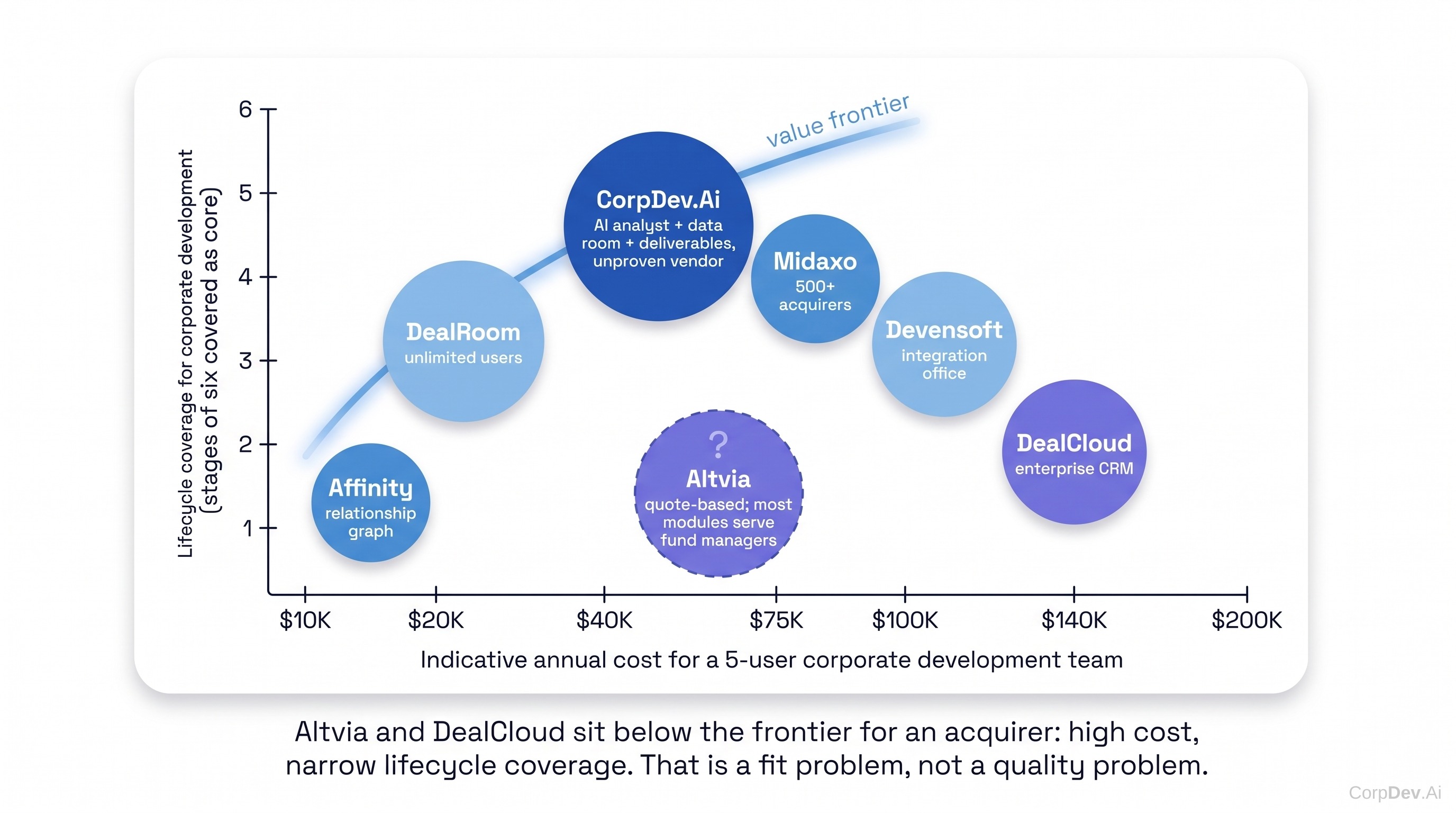
Read diagram description
Positioning comparison. First dimension: "Indicative annual cost for a 5-user corporate development team" from $10K on the left to $200K on the right. Second dimension: "Lifecycle coverage for corporate development (stages of six covered as core)" from 1 at the bottom to 6 at the top. Vendor positions: Affinity at ($12K, 1.5 stages) labelled "relationship graph"; DealRoom at ($20K, 3.5) labelled "unlimited users"; CorpDev.Ai at ($60K, 5) labelled "AI analyst + data room + deliverables, unproven vendor"; Midaxo at ($75K, 4) labelled "500+ acquirers"; Devensoft at ($100K, 3.5) labelled "integration office"; DealCloud at ($140K, 2) labelled "enterprise CRM"; Altvia at (~$60K (uncertain estimate), 1.5) labelled "quote-based; most modules serve fund managers". The diagram’s assumed value frontier passes near Affinity, DealRoom, CorpDev.Ai and Midaxo. "Altvia and DealCloud sit below the frontier for an acquirer: high cost, narrow lifecycle coverage. That is a fit problem, not a quality problem."
Decision Framework: Which Platform for Which Buyer
The vendors in this comparison solve different problems, so the buying decision is a two-step process: first identify which constraint binds the team, then choose the best vendor for that constraint and decide whether a second product is justified.
| Cost or operating decision | What the proposal must specify | Why it matters across frequent acquisitions |
|---|---|---|
| Primary M&A environment | Which product owns targets, deal evidence, decisions, integration work and recurring reports; how changes move between those records. | CorpDev.Ai can combine management with analytical execution. A second lifecycle platform needs a specific justification, because duplicate records create recurring reconciliation work. |
| Participation | Core deal-team users, business-unit contributors, executives, advisers and external counterparties, priced under the appropriate Enterprise terms. | Unlimited-user packaging may be useful, but comparing it with individual-seat extrapolations does not establish a programme-wide price advantage. |
| Work actually completed | Research, screening, diligence analysis, investment materials, integration responses and leadership reporting, including expected review effort. | A lower licence price can leave more work with employees and advisers. Compare complete operating cost and usable output rather than storage or task counts alone. |
| Specialist systems | Required databases, relationship tools, legal-review products and transaction rooms, with data rights and integration scope stated explicitly. | Retain specialists for demonstrated coverage or control requirements; distinguish those needs from a general assumption that an integrated platform cannot manage a large programme. |
| Migration and exit | Data mapping, historical evidence, permissions, approval records, exports, retention, implementation services and ongoing administration. | Compare replacing an existing system with phased coexistence. The right transition depends on disruption and operating requirements, not a fixed number of deals or team members. |
Scenario recommendations
Scenario 1 — A 2–4 person corporate development team at a $2–10 billion company, 2–5 transactions a year, heavy use of external advisers for research and memos. The constraint is analyst capacity. A relationship CRM would be under-used and a process platform would be over-engineered for the deal count. CorpDev.Ai is the primary recommendation: its AI Analyst, market mapping, semantic sourcing and memo and deck generation address the actual work, its zero-entry pipeline covers the CRM need, and at $36,000–60,000 a year it costs a fraction of one adviser engagement [106][104]. Pair it with a paid pilot to manage vendor-maturity risk. Altvia is not a candidate.
Scenario 2 — A serial acquirer with 10–30 deal and integration professionals, 8–20 transactions a year, an integration management office and board-level synergy reporting. Compare CorpDev.Ai, Midaxo and Devensoft as primary M&A environments; include DealRoom where its diligence workflows and participation model fit. CorpDev.Ai is particularly relevant when the programme needs substantial analysis and high-quality management deliverables produced within the lifecycle process. Midaxo and Devensoft offer established process approaches [74][75]. DealCloud merits evaluation for specific enterprise relationship and compliance requirements [35][36]. Score controls, completed work and total programme cost separately; Altvia remains a fund-oriented purchase.
Scenario 3 — A mid-market acquirer with a 5-person team, 4–8 transactions a year, business-unit leaders who need to participate in diligence and integration. The constraint is collaboration across many occasional users. Compare CorpDev.Ai, DealRoom and Midaxo as primary platforms. DealRoom's unlimited-user model is relevant to participation costs, but the complete quote and the analytical work performed determine value [81][92]. CorpDev.Ai combines end-to-end management with analysis and deliverables; compare Enterprise scope where required rather than assuming it is an add-on.
Scenario 4 — A corporate venture capital arm making minority investments, sourcing through VC and founder networks, with a fund structure and internal or external LPs. The constraint is relationship coverage plus investor reporting. This is the only corporate scenario in which Altvia is a leading candidate: its GP Engagement Platform handles fundraising, LP portal, capital calls and distributions that distinguish it from acquisition-only tools, and its Salesforce base fits a corporate IT estate [1][6]. Affinity is the alternative if the LP-reporting burden is light and relationship intelligence is the priority, as Munich Re Ventures chose [48]; Dynamo is a second quote for the full fund-operations profile [61].
Scenario 5 — A strategy function without a deal mandate that needs market maps, competitor research and strategic options analysis, with M&A as one option among several. No CRM or process platform is relevant. CorpDev.Ai's strategy, market mapping and competitor research deliverables are the fit, alongside general-purpose research tools [104].
Do not infer the system architecture from a five-person threshold. CorpDev.Ai, Midaxo and DealRoom overlap in M&A management; CorpDev.Ai adds analytical execution within that environment. Large teams should compare how each carries source evidence into decisions, integration actions and leadership reporting. A specialist relationship CRM is justified by network coverage or mandated controls, and a second process platform by a demonstrated gap. Coexistence can be useful, but duplicate records and reconciliation effort belong in the decision.
Total Cost of Ownership and Implementation Risk
List price is the least reliable guide to what a corporate development team will spend. Implementation, administration, data migration and under-used seats dominate the three-year cost of a CRM; credit consumption and pilot discipline dominate the cost of an AI platform. The table below models a five-user corporate development team over three years using list prices where published and the midpoint of third-party benchmarks where not. Every derived figure is labelled in the Basis column and the appendix records the inputs.
| Vendor | Annual software | Year-1 implementation | Three-year total | Basis |
|---|---|---|---|---|
| Affinity | 11,500 | 5,000 | 39,500 | Scale tier list $2,300 × 5; implementation is analyst estimate for light setup [49] |
| DealRoom (full platform) | 25,000 | 5,000 | 80,000 | Published platform price; unlimited users; light setup [79][81] |
| Altvia | 25,000–50,000 | 25,000–75,000 | 100,000–225,000 | Analyst planning assumption — see callout; no public price [15][16] |
| CorpDev.Ai | 60,000 | 0 | 180,000 | Team ($36K, 3 seats) + 2 × Pro ($12K) at list; self-serve setup [106] |
| Midaxo | 75,000 | 20,000 | 245,000 | Selected planning value within the $25–150K estimate; 6–12 week guided implementation [77] |
| Devensoft | 100,000 | 30,000 | 330,000 | Selected planning value within the $40–200K estimate; 8–16 week implementation [77][78] |
| DealCloud | 85,000–200,000 | 100,000–250,000 | 355,000–850,000 | $85K observed contract floor to $40K/seat × 5; implementation $50–500K range [35][36] |
Altvia publishes no price. The $5,000–10,000 per user per year planning range used above is derived from three facts: the ILPA factsheet confirms per-user annual pricing [15]; G2 reviewers consistently call the product expensive with additional cost for added functionality [16]; and Altvia is positioned between Affinity ($2,000–2,700 list) and DealCloud ($15,000–40,000 benchmark) in depth and configurability [49][35]. The implementation range assumes a Salesforce-class rollout. Buyers must also confirm whether Salesforce platform licences are bundled in Altvia's AppExchange package or billed separately — a material swing in total cost. Treat every Altvia figure here as a placeholder to be replaced by a written quote.
| Vendor | Three-year TCO |
|---|---|
| Affinity | 40 |
| DealRoom | 80 |
| Altvia | 163 |
| CorpDev.Ai | 180 |
| Midaxo | 245 |
| Devensoft | 330 |
| DealCloud | 603 |
What the table does not show
Utilisation. A CRM seat that a deal professional opens twice a week is a wasted seat; the adoption problem is the reason Affinity built passive capture and CorpDev.Ai built a zero-entry pipeline. DealCloud and Altvia reviewers both report repetitive data entry, which is the leading indicator of under-utilisation [16][42]. For a per-seat product, dividing contracted spend by the fraction of seats used is a useful cost-per-active-seat measure; it does not change cash TCO.
Administration. DealCloud typically requires a dedicated administrator; Altvia's Salesforce base needs Salesforce administration skills; Midaxo and Devensoft need a process owner who maintains templates and playbooks [42][16]. A fractional FTE at $150,000 fully loaded adds $50,000–150,000 over three years to the enterprise options and a smaller but still relevant allowance to Affinity, DealRoom or CorpDev.Ai.
Adviser displacement. The AI-native platform's business case rests on a line item that does not appear in a software TCO: external research and memo-writing spend. CorpDev.Ai's own framing cites $200,000–2 million in consulting fees per deal and 1,000–2,000 hours of analysis; displacing 10–20% of one such engagement represents $20,000–$400,000 in this very broad scenario; it does not necessarily cover the illustrated five-seat $60,000 annual price [104]. That claim should be tested in a pilot, not accepted.
Credit consumption. CorpDev.Ai meters search at 12,000 credits per seat per year; a team running continuous sourcing sweeps may exceed the allowance and should ask for consumption data from the pilot before signing [106].
Implementation risk by vendor
| Vendor | Typical time to live | Principal risk | Mitigation |
|---|---|---|---|
| Altvia | Weeks to several months; not time-bound publicly | Salesforce configuration scope creep; data-model design for M&A rather than fundraising | Phase 1 limited to AIM deal-team module; fixed-fee implementation |
| DealCloud | 8–20 weeks single module [37] | Migration, governance, admin dependency, user resistance | Named administrator before go-live; pilot with one deal team |
| Affinity | Days to weeks | Email/calendar sync permissions; privacy configuration | Agree capture rules with legal and IT first |
| Midaxo | 6–12 weeks | Process definition precedes configuration; template debt | Pilot one live deal end to end |
| Devensoft | 8–16 weeks | ERP/PM integration; dashboard scope | Start with integration module only |
| DealRoom | 2–12 weeks by module | Storage limits on lower tiers; reporting depth | Confirm tier storage against deal volume |
| CorpDev.Ai | Same day; self-serve | Vendor maturity; output quality on your sector; credit consumption | Paid pilot on a live workstream; audit the citation trail |
Due Diligence Questions to Ask Every Vendor
The questions below are ordered by how often they change a buying decision in this category. Ask every vendor the same set, in writing, and compare the answers side by side; the differences are usually more informative than any demo.
Fit and scope
- Which of your named customers are operating-company corporate development teams rather than fund managers, and can we speak to two of comparable deal volume?
- Which modules would we be paying for that we would not use? (For Altvia specifically: can AIM's deal-team edition be licensed without ShareSecure, Correspond and OnboardingBridge, and at what price?)
- Where does your product stop — which lifecycle stages do you expect us to run elsewhere?
Pricing and contract
- Provide a written three-year quote for five named users covering software, implementation, training, support tier, data migration and any usage metering (credits, storage, pages, deals).
- Which costs are outside the quote? Salesforce platform licences (Altvia), data feeds (DealCloud), enrichment or premium integrations (Affinity), storage tiers (DealRoom), search credits (CorpDev.Ai).
- What are the terms for adding occasional users — business-unit leaders, finance, legal, integration leads — who need read or task access but not a full seat?
- What happens to our data at termination, in what format, and within what period? Which vendors export in open formats without a services engagement?
AI capability
- Demonstrate the AI features on our own anonymised documents and a target list in our sector, not on a vendor dataset.
- For every AI-generated figure, show the source citation and the path back to the original document or web page.
- Is customer data used to train or fine-tune any model? Which third-party model providers process our data, under what terms, and can we choose or exclude providers?
- What happens when the model does not know the answer — does it say so, or does it produce a plausible guess?
Implementation and operations
- What is the median time from contract to first live deal for a customer of our size, and what internal effort did it require?
- Do we need a dedicated administrator or process owner? What skills, and what fraction of a role?
- What is your product roadmap for the next twelve months, and which announced features are generally available today versus in beta?
Vendor risk
- Ownership, funding, revenue scale and profitability. For private vendors: runway and most recent financing. For CorpDev.Ai: customer count and any reference customer willing to speak, given the absence of public reviews.
- Security posture: SOC 2 Type II or equivalent, data residency options, SSO, audit logs, penetration-testing cadence.
- Concentration: what share of your revenue comes from our type of buyer, and how does that shape your roadmap?
Ask each shortlisted vendor for a time-limited evaluation on a live workstream, including its fee, data permissions and implementation requirements. A buyer who runs a four-week pilot on one real target screen or one real diligence data set will learn more about fit than any RFP response. Make the pilot the gate to procurement, define its success criteria in advance (hours saved, quality of output against an adviser benchmark, adoption by the team), and include the pilot cost in the vendor's three-year quote.
Key Facts & Sources
The load-bearing figures in this document, with their source and as-of date. Derived figures show their inputs. A reader who disputes a judgement in the body should start here.
| Fact | Value used | Source | As of |
|---|---|---|---|
| Altvia positioning | "GP Engagement Platform for alternative asset managers"; fundraising, IR, deal sourcing | Altvia homepage [1] | Sep 2026 |
| Altvia founding, HQ, ownership | Founded 2006; Broomfield, Colorado; Bow River majority 2020; Marlin majority investment July 2022, Bow River retained minority | RocketReach, CB Insights, PR Newswire, Altvia blog [18][14][21][22] | 2022–2026 |
| Altvia headcount | ~60–75 (database estimates; not company-confirmed) | RocketReach, ZoomInfo, The Org [18][19][23] | 2026 |
| Altvia CEO | Ryan Keough, appointed July 2025 | Altvia blog [25] | Jul 2025 |
| Altvia scale claims | "Hundreds" of firms; 120k+ portal users; 98% rank as #1 firm software (vendor claims) | Altvia About and homepage [13][1] | Sep 2026 |
| Altvia AIM on Salesforce | AppExchange listing "purpose-built CRM for private capital markets" | Salesforce AppExchange [3] | Listing 2021 |
| Altvia MCP support | Announced May 2026 | Altvia blog [11][12] | May 2026 |
| Altvia pricing | Per user per year, on quote; no public list | ILPA vendor factsheet [15] | 2021 factsheet |
| Altvia reviews | G2 7 reviews; Capterra 4.8/5 on 11 reviews | G2, Capterra [16][17] | Sep 2026 |
| Altvia planning cost (derived) | $5,000–10,000/user/yr; $25–75K implementation | Analyst assumption from [15][16][49][35] — see TCO callout | Sep 2026 |
| Intapp FY2026 | Revenue $577.8M (+~15%); cloud ARR $495.7M (+29%) — company-wide | Intapp Q4 FY2026 results via Yahoo Finance, Investing.com [43][44] | Aug 2026 |
| DealCloud customers | 950+ clients (2025 citation) | Intapp news [39] | Sep 2025 |
| DealCloud pricing benchmarks | $15–40K/user/yr; $85K–$1.4M+ contracts; $50–500K+ implementation; 8–20 weeks | RFP.wiki, Prospeo [35][36][37] | 2026 |
| DealCloud reviews | G2 4.2/5 on 41 reviews | G2 [42] | 2026 |
| Affinity pricing | Essential $2,000; Scale $2,300; Advanced $2,700 per user/yr; Enterprise custom | Affinity pricing page [49] | Sep 2026 |
| Affinity funding and valuation | ~$120M raised; $80M Series C led by Menlo Ventures; ~$600M estimated valuation | Caplight, Affinity blog [70][72] | 2026 |
| Affinity customers | 4,000+ (founder claim) | LinkedIn [69] | 2026 |
| Affinity reviews | G2 ~4.4–4.5/5; review count varies 67–200+ by page | G2, ZoomInfo [50][51] | 2026 |
| 4Degrees | Quote-based; estimates $1,200–8,000/user/yr; ~5 G2 reviews at 4.5 | 4Degrees pricing, ValueAddVC, Prospeo [57][58][59] | 2026 |
| Dynamo reviews | G2 ~4.2/5 on 36; Software Advice 4.6/5 on 34 | G2, Software Advice [64][65] | 2026 |
| Midaxo scale and customers | 500+ teams; Konecranes, Wärtsilä, ABB | Midaxo homepage; CT Acquisitions [74][77] | 2026 |
| Midaxo pricing | $25–150K/yr estimate; ~$10K starting point cited | CT Acquisitions; Software Advice [77][121] | Jun 2026 |
| Midaxo AI | Plain-language answers with sources; Madi diligence agent; data not used for training | Midaxo AI pages and Q2 2026 blog [91][119][93] | Aug 2026 |
| Devensoft | Six modules; NCR, Xilinx, National Instruments; $40–200K/yr estimate; $150/user/mo indication | Devensoft, LinkedIn, CT Acquisitions, TrustRadius [75][87][77][78] | 2026 |
| DealRoom pricing | Pipeline ~$12K; Diligence ~$15K; Integration ~$7.5K; Platform ~$25K per year; unlimited users | StayModern analysis; DealRoom pricing page [79][81] | 2025–2026 |
| DealRoom scale | 2,000+ companies; Core & Main, Infoblox, Belden, Broadcom, Emerson, BD | DealRoom product page; PromptLoop [89][90] | 2026 |
| DealRoom AI | Deal-level conversational contract analysis | DealRoom blog [94] | Jul 2026 |
| CorpDev.Ai pricing | AI Pro $1,000/mo annual ($1,200 card), 1 seat, 12,000 credits/yr; Team $3,000/mo annual, 3 seats; Enterprise custom | CorpDev.Ai pricing page [106] | Sep 2026 |
| CorpDev.Ai company | Founded 2023; founders Kal Kilpi and Atul Tiwary; Boston per public profiles; no disclosed funding | LinkedIn, About page, RocketReach, Prospeo [114][108][109][110][112][113] | 2026 |
| CorpDev.Ai data claims | 70M+ companies; 265M+ contacts; 50,000-page data room (vendor claims) | CorpDev.Ai homepage [104] | Sep 2026 |
| CorpDev.Ai customer evidence | "Hundreds of CorpDev professionals" claimed; no named customers; G2 0 reviews | CorpDev.Ai pricing page; G2 [106][105] | Sep 2026 |
| CorpDev.Ai deal-economics framing | 70–75% of deals fail to create value; 1,000–2,000 analysis hours; $200K–2M adviser fees per deal (vendor framing) | CorpDev.Ai homepage [104] | Sep 2026 |
| Datasite / Intralinks pricing | Datasite ~$0.40–0.85/page; Intralinks ~$25–75K per deal (estimates) | RFP.wiki, Papermark, CT Acquisitions [83][84][85] | 2026 |
| Three-year TCO table | (Annual software × 3) + Year-1 implementation; 5 users; list or benchmark midpoint | Analyst derivation from rows above | Sep 2026 |
| Scorecard | Analyst judgement 1–5 against corporate development needs from public documentation and reviews | Altvia profile, Vendor Profiles and Head-to-Head Comparison | Sep 2026 |
References
Numbering follows the original research. Access dates below record the original source registry; they do not imply that every source was rechecked for this website edition.
- Altvia | GP Engagement Platform For Fundraising, IR & Deal ...Source accessed 2026-09-11
- AIM - A Purpose-Built CRM for Private Capital MarketsSource accessed 2026-09-11
- Altvia Introduces a Streamlined Fundraising Software Solution to Simplify Complexities for Alternative Asset ProfessionalsSource accessed 2026-09-11
- Manage Deal Flow for Private Capital Investment TeamsSource accessed 2026-09-11
- ShareSecure - A LP Portal & VDR for Private Capital MarketsSource accessed 2026-09-11
- Transform Your Investor Communications With the Right Tools - AltviaSource accessed 2026-09-11
- Empowering Alternative Markets with Actionable InsightsSource accessed 2026-09-11
- AIMe | AI Purpose-Built For Alternative Investment FirmsSource accessed 2026-09-11
- AI Without the BS: Purpose-Built for Private Capital Teams - AltviaSource accessed 2026-09-11
- Private Equity Technology Archives - AltviaSource accessed 2026-09-11
- Altvia Connects Private Markets Data to the AI Tools Firms ...Source accessed 2026-09-11
- AboutSource accessed 2026-09-11
- AltviaSource accessed 2026-09-11
- AltviaSource accessed 2026-09-11
- Altvia Reviews 2026: Details, Pricing, & Features - G2Source accessed 2026-09-11
- Altvia Reviews 2026. Verified Reviews, Pros & ConsSource accessed 2026-09-11
- Altvia InformationSource accessed 2026-09-11
- Altvia Solutions - Overview, News & Similar companies | ZoomInfo.comSource accessed 2026-09-11
- BOW RIVER CAPITAL COMPLETES ALTVIA ...Source accessed 2026-09-11
- Altvia Announces Majority Recapitalization with Bow River ...Source accessed 2026-09-11
- Altvia - The OrgSource accessed 2026-09-11
- Altvia Taps Industry Veteran Ryan Keough as CEOSource accessed 2026-09-11
- Altvia Reviews 2025: Details, Pricing, & FeaturesSource accessed 2026-09-11
- DealCloudSource accessed 2026-09-11
- Corporate Development | ConsultingSource accessed 2026-09-11
- Intapp Assist for DealCloudSource accessed 2026-09-11
- Affinity vs Intapp Deal Cloud (2026): Which Is Better? - RFP.wikiSource accessed 2026-09-11
- Intapp Pricing, Reviews, Pros & Cons (2026)Source accessed 2026-09-11
- Intapp Deal Cloud vs Dynamo Software (2026) - RFP.wikiSource accessed 2026-09-11
- DealCloud Adds 100th Client of 2020Source accessed 2026-09-11
- The Sterling Group Chooses DealCloud for Deal ...Source accessed 2026-09-11
- Paine Schwartz Partners chooses Intapp DealCloud to ...Source accessed 2026-09-11
- HCAP Partners Chooses DealCloud to Institutionalize Its Business ...Source accessed 2026-09-11
- DealCloud Reviews 2026: Details, Pricing, & FeaturesSource accessed 2026-09-11
- Earnings call transcript: Intapp tops Q4 2026 estimates ...Source accessed 2026-09-11
- Intapp announces fourth quarter and fiscal year 2026 ...Source accessed 2026-09-11
- Affinity: CRM for Private CapitalSource accessed 2026-09-11
- How Munich Re Ventures uses Affinity | Affinity Case StudySource accessed 2026-09-11
- Affinity Pricing: Plans for Private Capital CRMSource accessed 2026-09-11
- Affinity Reviews 2026: Details, Pricing, & FeaturesSource accessed 2026-09-11
- Affinity vs Attio: Which CRM is Better? - ZoomInfo BlogSource accessed 2026-09-11
- Affinity vs Agentforce Financial Services (formerly Salesforce ... - G2Source accessed 2026-09-11
- Affinity CRM Reviews & Top Alternatives 2026 | CoffeeSource accessed 2026-09-11
- Top 5 AI-Powered Private Equity CRM Platforms 2026Source accessed 2026-09-11
- 25 Private Equity Deal Sourcing and Analysis Tools (2026) - SourceCoSource accessed 2026-09-11
- PricingSource accessed 2026-09-11
- 4Degrees CRM Review 2026: Is It Worth It for Small VC ...Source accessed 2026-09-11
- 4Degrees Pricing, Reviews, Pros & Cons (2026) - ProspeoSource accessed 2026-09-11
- Dynamo Reviews 2026: Pricing, Features & Alternatives ...Source accessed 2026-09-11
- Dynamo Software Reviews & Ratings 2026Source accessed 2026-09-11
- Dynamo Software Products | Read 36 Reviews on ...Source accessed 2026-09-11
- Dynamo Reviews, Pros and Cons - 2026 Software AdviceSource accessed 2026-09-11
- Dynamo Software Reviews in 2026 - SourceForgeSource accessed 2026-09-11
- Affinity Ascend: AI Agents for Private CapitalSource accessed 2026-09-11
- Shubham Goel | LinkedInSource accessed 2026-09-11
- Affinity | Valuation, Funding Rounds & Stock Price - CaplightSource accessed 2026-09-11
- Affinity's Series C Funding for Relationship IntelligenceSource accessed 2026-09-11
- M&A Intelligence Platform | Midaxo M&A SoftwareSource accessed 2026-09-11
- M&A Platform — Pipeline, Diligence, Integration & MoreSource accessed 2026-09-11
- DealRoom | AI-Powered M&A Operating System for Buyer-Led M&A™Source accessed 2026-09-11
- Best Post-Merger Integration Software in 2026Source accessed 2026-09-11
- Devensoft Reviews & Ratings 2025Source accessed 2026-09-11
- DealRoom AI: Complete ReviewSource accessed 2026-09-11
- DealRoom Pricing: M&A Software Plans and CostsSource accessed 2026-09-11
- Datasite · Rating Snapshot: Score & Reviews (2026) - RFP.wikiSource accessed 2026-09-11
- Datasite Review 2026: The Per-Page Bill and 7 ...Source accessed 2026-09-11
- AI Due Diligence Tools for M&A in 2026: 10-Vendor Comparison ...Source accessed 2026-09-11
- Devensoft M&A - LinkedInSource accessed 2026-09-11
- Case Studies — M&A Success Stories - DevensoftSource accessed 2026-09-11
- Deal Management Software for M&A Teams - DealRoomSource accessed 2026-09-11
- What Does DealRoom Do? | Directory - PromptLoopSource accessed 2026-09-11
- AI for M&A: Answers From Your Own Deal Data - MidaxoSource accessed 2026-09-11
- M&A CRM & Deal Screening Software | Midaxo PlatformSource accessed 2026-09-11
- Midaxo closes Q2 with new customers and a major AI updateSource accessed 2026-09-11
- Enhanced DealRoom AI Accelerates Diligence With Deal-Level ...Source accessed 2026-09-11
- Sell-Side Data Rooms For Due DiligenceSource accessed 2026-09-11
- Intralinks AI-Powered M&A Platform | DealCentre AISource accessed 2026-09-11
- Midaxo Reviews 2026: Details, Pricing, & FeaturesSource accessed 2026-09-11
- Devensoft Reviews 2026: Details, Pricing, & FeaturesSource accessed 2026-09-11
- Devensoft · Rating Snapshot: Score & Reviews (2026)Source accessed 2026-09-11
- CorpDev.Ai - Agentic AI for M&A and Corporate DevelopmentSource accessed 2026-09-11
- CorpDev.Ai Products | Read 0 Reviews on G2Source accessed 2026-09-11
- Pricing - CorpDev.AiSource accessed 2026-09-11
- Kal Kilpi - CEO @ CorpDev.Ai | Superhuman M&ASource accessed 2026-09-11
- About UsSource accessed 2026-09-11
- Atul Tiwary | LinkedInSource accessed 2026-09-11
- Kal Kilpi Email & Phone Number | CorpDev.Ai Founder and ...Source accessed 2026-09-11
- CorpDev.Ai Revenue, Funding & Valuation - ProspeoSource accessed 2026-09-11
- CorpDev.AiSource accessed 2026-09-11
- M&A Due Diligence SoftwareSource accessed 2026-09-11
- M&A Virtual Data Room & Risk Tracking - MidaxoSource accessed 2026-09-11
- Midaxo Software Reviews, Demo & Pricing - 2026Source accessed 2026-09-11