RESEARCH / Market intelligence
CB Insights alternatives: technology intelligence, sourcing and M&A
Compare CB Insights with PitchBook, Crunchbase, Tracxn, Dealroom and AI research tools on technology markets, target coverage, financial depth and ownership cost.
Research as of
Website edition edited
Published by CorpDev.Ai, which is one of the vendors assessed. This analysis distinguishes vendor claims, external evidence and analyst judgments. Prices and capabilities reflect the source dates in the article; the website edition is an editorial adaptation, not a new verification of every claim.
Use market signals to direct diligence, not to settle it
CB Insights is most valuable when the acquisition question concerns emerging markets, technology trajectories or venture-backed ecosystems. Its classifications, market maps and predictive signals can help a strategy team decide where to investigate before it has a fixed target list. That advantage is less direct for an industrial acquirer seeking profitable, founder-owned businesses whose relevance is poorly captured by funding activity or technology-market categories.
The strategic risk is promoting an attractive ranking into an investment conclusion. A predictive signal can help allocate research time without providing the financial, ownership or commercial evidence required to approve a transaction. Compare CB Insights with AlphaSense when the missing input is qualitative market evidence, with PitchBook when it is transaction history, and with specialist sourcing tools when it is the target universe itself. Use a completed market assessment as the test: determine which important companies and developments each product would have surfaced at the time, and which claims still needed verification. That separates genuine decision improvement from a more persuasive presentation of the same assumptions.
1. Executive Summary
CB Insights remains the reference product for technology-market intelligence: curated market taxonomies, market maps, ESP rankings, Mosaic predictive scores and the ChatCBI assistant, all sitting on a database the company sizes at 12M+ companies and 1,600+ markets [1][8]. For a corporate strategy or corporate development team whose core question is "which emerging technologies and startups matter to us, and who is winning in each market?", it is still very hard to beat. The trade-offs are equally consistent: negotiated enterprise pricing with a reported median contract near $47,000 a year and a range up to roughly $185,000 [15][16], no transparent seat price, uneven depth on non-U.S. and non-venture-backed companies, and a product that stops at the intelligence layer — it is not a deal-pipeline or transaction-room system; its ChatCBI briefings should be tested against the team's complete memo requirements [15][19].
That last point is the crux of this guide. The alternatives to CB Insights are not one category but four, and a buyer who compares them on "company count" alone will buy the wrong tool:
- Institutional data terminals — PitchBook and S&P Capital IQ Pro — win on transaction, ownership, valuation and investor depth; they are the right primary system when the team executes deals and needs defensible comps [22][25][82].
- Discovery databases — Crunchbase, Tracxn, Dealroom — can deliver much of the raw company-finding utility, depending on the target universe at a fraction of the cost, each with a geographic centre of gravity (U.S. venture, emerging markets, Europe respectively) [31][46][63].
- Origination engines — Grata and Sourcescrub, now combining — are built to surface the founder-owned, bootstrapped lower-middle-market companies that venture-centric databases structurally miss [86][87][93].
- Research and workflow layers — AlphaSense/Tegus for qualitative evidence and expert calls, and CorpDev.Ai for an AI-native end-to-end corpdev workspace — compete on what the team does with the data rather than on owning the data itself [72][75][104].
~$47K
CB Insights median annual contract (third-party estimate)
12M+ / 1,600+
Companies / markets in CB Insights database (vendor claim)
$588 – $12K
Annual entry price: Crunchbase Pro to CorpDev.Ai single seat
45%
Dealmakers using AI in M&A in 2025 (Bain), more than double 2024
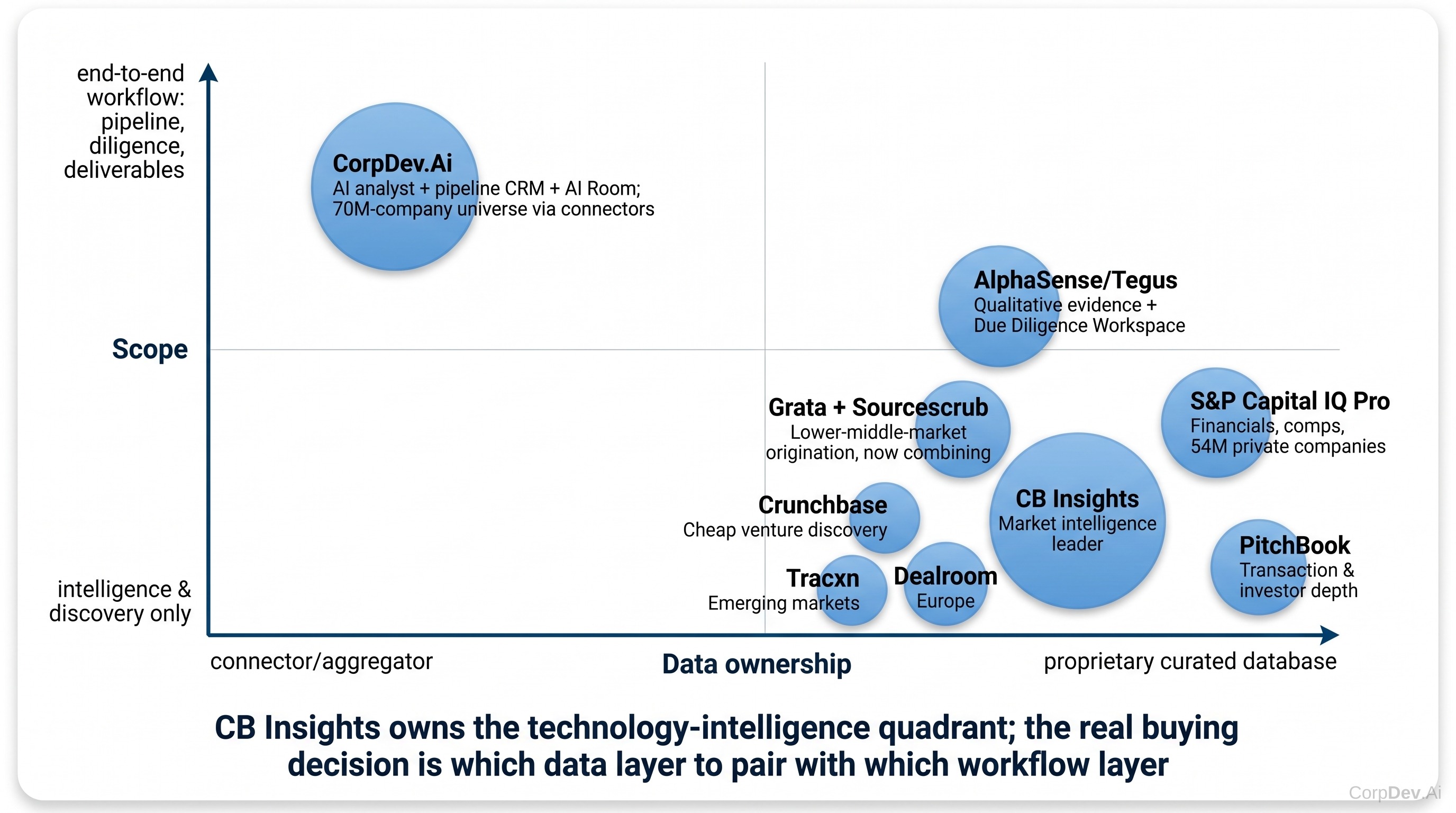
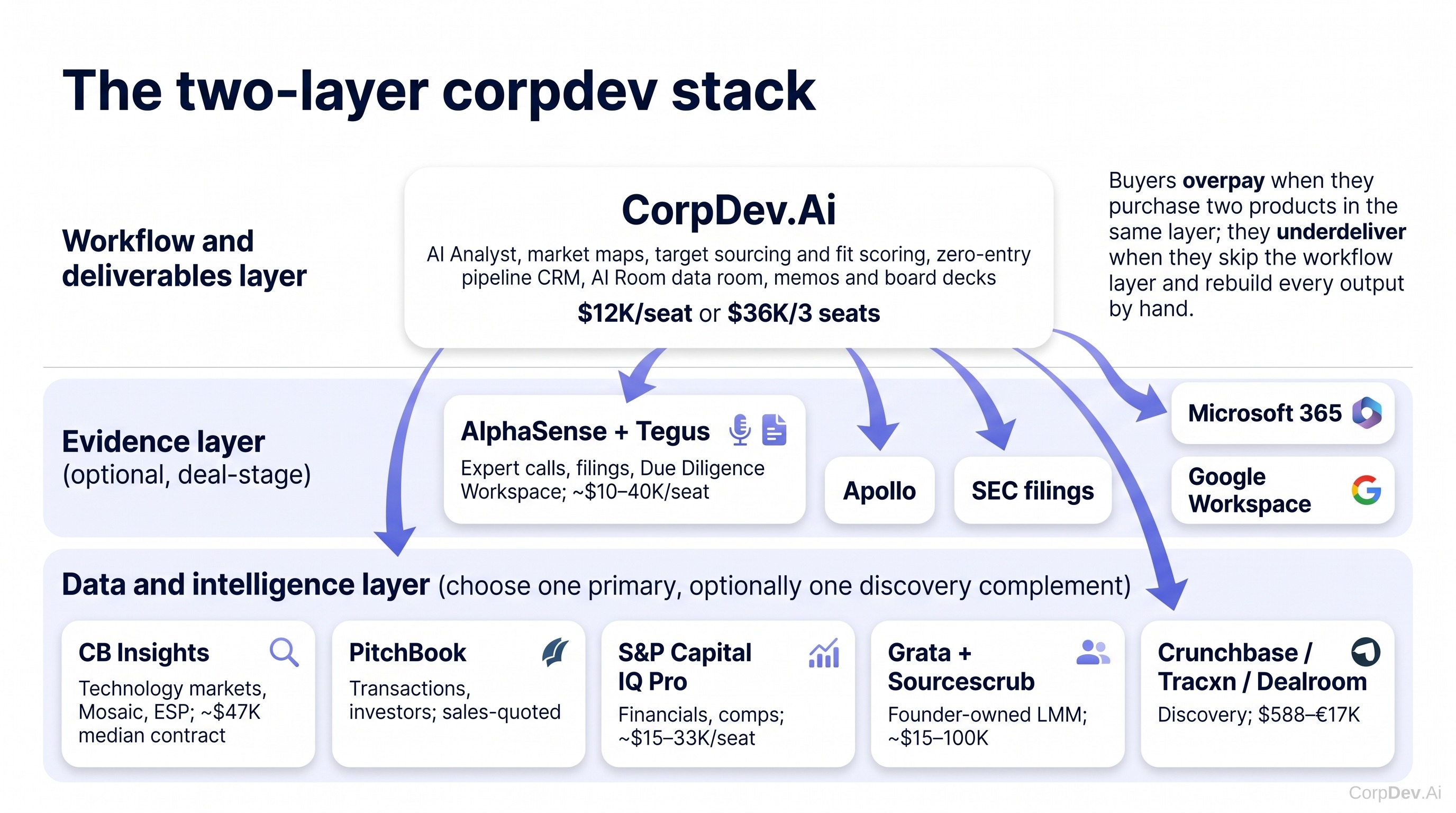
The verdict in one paragraph. Buy CB Insights if technology scouting and market landscaping for executives is the dominant job and the budget tolerates a five-figure sales-led contract. Buy PitchBook or Capital IQ Pro instead if the dominant job is screening, comps and diligence on companies with a transaction history. Buy Grata/Sourcescrub if the targets are private operating businesses venture databases may under-cover. Buy Crunchbase Pro, Tracxn or Dealroom if the need is broad, cheap discovery — and be ready to validate what they return. And treat CorpDev.Ai — built by this comparison's publisher, so read our assessment in §4.8 with that in mind — as a different purchase decision altogether: it substitutes for CB Insights' research output (market maps, target profiles, memos) and for a lightweight M&A CRM, while sourcing data through connectors rather than a proprietary curated database. Most serious corpdev functions will end up with a two-layer stack: one authoritative data source plus one AI workflow layer, and the analysis below is designed to help choose each.
Read diagram description
Comparison for corporate development software buyers. First dimension: "Data ownership — connector/aggregator (left) to proprietary curated database (right)". Second dimension: "Scope — intelligence & discovery only (bottom) to end-to-end workflow: pipeline, diligence, deliverables (top)". Vendor positions: CB Insights (right-bottom-middle, largest curated technology-market database, labelled "Market intelligence leader"); PitchBook (far right, bottom, "Transaction & investor depth"); S&P Capital IQ Pro (far right, lower-middle, "Financials, comps, 54M private companies"); AlphaSense/Tegus (right-middle, middle height, "Qualitative evidence + Due Diligence Workspace"); Crunchbase (centre-right, bottom, "Cheap venture discovery"); Tracxn (centre-right, bottom, "Emerging markets"); Dealroom (centre-right, bottom, "Europe"); Grata + Sourcescrub (right, lower-middle, "Lower-middle-market origination, now combining"); CorpDev.Ai (left-top, "AI analyst + pipeline CRM + AI Room; 70M-company universe via connectors"). "CB Insights owns the technology-intelligence quadrant; the real buying decision is which data layer to pair with which workflow layer."
2. What a CorpDev / M&A Buyer Actually Needs
Vendor comparisons in this category usually degenerate into feature checklists and database counts. Both are misleading. Tracxn's own pages simultaneously advertise 7.7M+ and 5M+ companies [46][47]; PitchBook counts "nearly 6 million" [22]; Capital IQ Pro claims 54 million private companies of which 14 million carry financial statements [82]; CorpDev.Ai cites a 70M+ universe drawn largely from firmographic providers [105]. None of these figures are comparable, because each vendor counts a different entity with a different depth threshold. The right way to evaluate is against the jobs a corpdev team actually performs, weighted by how often each job occurs and how costly it is to get wrong.
2.1 The six jobs to be done
| Job | Typical frequency | What "good" looks like | Where CB Insights sits |
|---|---|---|---|
| Market landscaping — segment a market, name the players, size the categories, brief the executive committee | Monthly to quarterly per strategic theme | Curated taxonomy, defensible segment logic, visual output, refreshable | Core strength: market maps, ESP matrices, 1,600+ markets [9][8] |
| Target sourcing — build a long list against an acquisition thesis, including companies nobody has heard of | Continuous for serial acquirers; episodic for others | Coverage of the right universe (venture-backed vs. founder-owned), thesis-based search, low false-positive rate | Good for venture/technology universe; weaker for bootstrapped lower-middle-market [15] |
| Company intelligence — deep profile of a specific target: financials, ownership, customers, leadership, signals | Weekly | Sourced, dated, cross-verified facts; predictive signals with explained basis | Strong signals layer (Mosaic, Exit Probability, Commercial Maturity); revenue/ownership depth uneven [10][12] |
| Screening and prioritisation — rank hundreds of candidates against fit criteria | Per sourcing wave | Configurable scoring, transparent logic, exportable | Mosaic and ESP are prioritisation tools, but opaque in weighting [62] |
| Diligence support — comps, precedent transactions, expert evidence, data-room analysis | Per live deal | Transaction multiples, ownership history, expert transcripts, document Q&A | Not a diligence platform; teams supplement with PitchBook/Capital IQ/AlphaSense [85] |
| Deliverable production and pipeline — memos, board decks, CRM, monitoring | Daily | Board-ready output, citation trail, zero-entry CRM, alerts | Outside scope; export-and-rebuild in PowerPoint is the norm |
2.2 The evaluation criteria used in this guide
Every platform in §3 and §4 is assessed against six criteria, each of which maps to one or more of the jobs above:
- Universe fit — does the database cover the companies this buyer actually acquires (venture-backed technology, founder-owned industrials, European scale-ups, sponsor-backed platforms)?
- Data depth and provenance — are financials, ownership and transaction terms present, dated and sourced, or modelled and unexplained?
- AI and research capability — does the AI merely summarise a profile, or can it run a thesis-based search, compare documents, and produce cited output?
- Workflow depth — does the product stop at "intelligence", or does it carry the work into pipeline, diligence and deliverables?
- Commercial model — transparent versus sales-led pricing, seat minimums, export and API limits, and the true cost of the second and third seat.
- Fit by buyer profile — a two-person strategy team at a $2B industrial, a ten-person corpdev group at a technology acquirer and a PE-adjacent serial acquirer have different optimal answers.
Only Crunchbase, Dealroom, Tracxn (free tier) and CorpDev.Ai publish list prices. CB Insights, PitchBook, Capital IQ Pro, AlphaSense, Grata and Sourcescrub are sales-quoted; the figures in this guide for those vendors come from third-party procurement benchmarks (Vendr-style datasets, Investables.ai, Prospeo) and review aggregators, and should be treated as ranges to negotiate against, not list prices. Every figure and its source is tabulated in §8.
2.3 Why the market is shifting under the buyer
Three structural changes make 2026 a different buying environment from even two years ago, and they favour different vendors:
- Consolidation into full-stack platforms. AlphaSense paid $930M for Tegus in 2024 to marry public research with expert-call transcripts [122][123]; S&P Global closed its $1.8B acquisition of With Intelligence in November 2025 to deepen private-markets coverage inside Capital IQ Pro [126][127]; Grata and Sourcescrub announced they are combining in 2026 [86]. The competitive unit is becoming an "evidence network", not a database, which raises the bar for standalone intelligence products such as CB Insights.
- AI is disintermediating the interface, not the data. PitchBook now ships a Microsoft 365 Copilot connector and LLM partnerships with Samaya and Perplexity [36][37]; Dealroom exposes a hosted MCP server to Claude and Cursor [61]; Moody's distributes its data through ChatGPT Enterprise and Claude [131]. Buyers increasingly expect to consume vendor data inside their own AI environment. Products whose value is the interface — and CB Insights' ChatCBI is in part exactly that — must prove they are more than a chat window over a database.
- Buyers are procuring differently. Bain reports 45% of dealmakers used AI tools in M&A in 2025, more than double the prior year, with roughly a third redesigning processes around it [132]. Forrester finds 94% of B2B buyers used AI in their buying process and that GenAI expands the consideration set to five or more vendors for large purchases [134][135]. The consequence for this category: buyers will trial more platforms, and vendors without transparent pricing or a self-serve trial start at a disadvantage.
3. CB Insights: Profile, Strengths and Limitations
3.1 Company snapshot
CB Insights is a privately held, founder-led New York company established in 2008–2009 by CEO Anand Sanwal. It has raised only about $10–12M of institutional capital — a $10M Series A from RSTP in 2015 is the last disclosed round — and has grown on subscription revenue since [2][4]. The company states 200+ employees; third-party trackers put headcount at roughly 270–380 and estimate revenue at $69–80M, none of which is audited [3][4][5][6]. It has been an acquirer rather than a target, buying the VentureSource data assets from Dow Jones and the blockchain-data firm Blockdata. For a buyer, the relevant implications are stability (a limited disclosed funding history, which does not by itself establish profitability or absence of exit pressure) and independence (no parent pushing a bundled terminal), offset by a smaller engineering and data-collection base than Morningstar, S&P or the $4B-valued AlphaSense [122].
Founded: 2008/09, New York — founder-led (Anand Sanwal)
Funding: ~$10–12M disclosed; privately held
Headcount: 200+ (company); ~270–380 (third-party estimates)
Revenue: ~$69–80M estimated ARR (unaudited)
Database: 12M+ companies, 1,600+ markets, ~1B data points
Customers cited: IBM, 3M, Wells Fargo, Pfizer, Lockheed Martin, Block, ADP, RSM, Zurich
ChatCBI — natural-language research assistant over the database
Market Maps — visual landscapes by category, stage, geography
ESP Matrix — Execution / Strength / Positioning rankings per market
Mosaic Score — predictive private-company health score; plus Exit Probability, Commercial Maturity
Business Graph — companies ↔ investors ↔ deals ↔ partnerships ↔ customers
Data feeds / API — separately contracted
Sources: [1][2][3][4][5][6][7][8][9][10][17].
3.2 What CB Insights does better than anyone
Curated market structure. The single most valuable asset is not the company count but the 1,600+ analyst-maintained market definitions [8]. A strategy team asked "map the industrial-IoT security landscape for the board" can start from a CB Insights market rather than from a blank spreadsheet, and the ESP matrix gives a defensible, if not fully transparent, way to separate leaders from challengers [9]. No competitor in this guide matches the breadth of pre-built technology taxonomies; Tracxn's 3,000+ sectors are broader but shallower in analyst curation [46], and PitchBook's industry classification is optimised for deal tagging rather than emerging-technology themes.
Predictive signals that are genuinely useful for prioritisation. Mosaic, Exit Probability and Commercial Maturity compress dozens of signals — hiring, web traffic, funding velocity, news sentiment, partnerships — into a rank-orderable number [10][62]. For the first pass over a long list, this saves analyst days. The company describes the underlying predictive base as 65B data points across 480K+ companies, i.e. the modelled subset is materially smaller than the 12M headline universe [12][55].
ChatCBI as an accelerator. ChatCBI can search across the full database with 60+ filters, build target lists and produce briefings and scouting reports on demand [8]. It is among the more mature vendor AI layers in this category, and it is grounded in CB Insights' own data rather than the open web, which matters for defensibility in a board paper.
Relationship data. The Business Graph — customer, vendor and partnership relationships in addition to investor and deal links — is a differentiator against Crunchbase and Dealroom, which are primarily funding-graph products [54].
3.3 Where it falls short for a corpdev buyer
If the acquisition strategy targets founder-owned industrials, regional service businesses or any company that has never raised outside capital, CB Insights' coverage thins sharply. Grata and Sourcescrub exist precisely because of this gap [87][93]; Capital IQ Pro's 14M private companies with financial statements is a different order of magnitude for traditional businesses [82].
- Pricing and procurement friction. There is no self-serve tier and no published seat price [7]. Procurement benchmarks put a one-to-three-seat deployment at roughly $40–60K a year, five-to-ten seats at $60–120K, and enterprise/API deployments at $120–265K+, with a reported median contract of ~$47K and a range of ~$25K to ~$185K [15][16]. The effective price per active user in a small deployment — $13–60K — is higher than a Capital IQ Pro seat materially above Crunchbase, with the comparison against CorpDev.Ai depending on seat count and scope.
- Depth on the individual company is uneven. Revenue, ownership percentages and transaction terms are frequently modelled or absent for smaller and non-U.S. companies [15]. For anything that will go into a valuation, teams still cross-check against PitchBook or Capital IQ Pro [85].
- Opaque scoring. Mosaic's weighting is not published. It is a sound prioritisation heuristic but cannot be defended line-by-line to an investment committee, and it should never appear in a memo as a proxy for quality [62].
- Stops at intelligence. There is no pipeline, no data-room ingestion, ChatCBI produces briefings and scouting reports, while template-specific memo and deck production should be tested. The output of a CB Insights session is a PDF or a CSV that then has to be rebuilt in PowerPoint — the "10–20 disconnected tools" problem corpdev teams routinely describe [103].
- Small independent review base. G2 shows ~4.4/5 from 16 reviews; Capterra 4.7/5 from 3; TrustRadius ~7.8/10 [19][21][15]. This is not a red flag in itself — enterprise intelligence products rarely attract volume reviews — but it means a buyer should insist on reference calls rather than relying on public sentiment.
- API and exports sit behind enterprise contracts. The capabilities that make the data reusable inside a team's own models and copilots are the ones most likely to push the contract into the six figures [11][16].
3.4 Net assessment
CB Insights is the best product in this guide for one job — executive-grade technology-market landscaping — and a competent but not leading product for target sourcing and company intelligence. It is not a diligence or workflow platform and does not claim to be. The purchase makes sense when (a) the team's mandate is innovation and technology scouting as much as M&A, (b) several stakeholders beyond corpdev (strategy, ventures, BD) will use it, spreading the fixed cost, and (c) the organisation is comfortable with sales-led procurement and a five-figure minimum. Where those conditions do not hold, at least one alternative below is a better fit.
4. The Alternatives
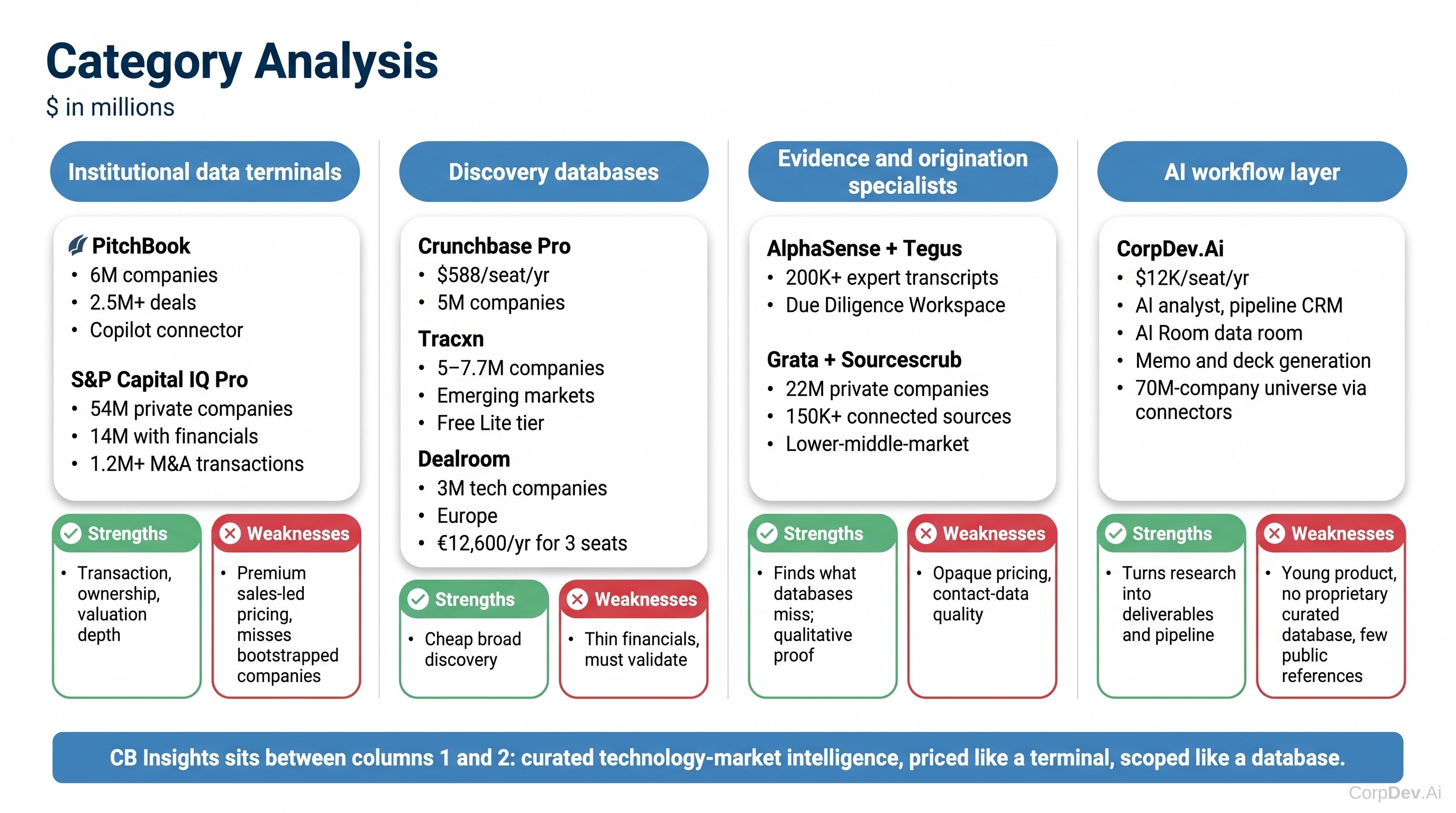
The nine platforms below are grouped by the role they play rather than by size: institutional data terminals (PitchBook, Capital IQ Pro), discovery databases (Crunchbase, Tracxn, Dealroom), a qualitative-evidence platform (AlphaSense/Tegus), lower-middle-market origination engines (Grata and Sourcescrub, now combining) and an AI-native workflow layer (CorpDev.Ai). Each profile ends with a direct comparison to CB Insights on the jobs defined in §2.
Read diagram description
Comparison.
Column 1 "Institutional data terminals": PitchBook (6M companies, 2.5M+ deals, Copilot connector), S&P Capital IQ Pro (54M private companies, 14M with financials, 1.2M+ M&A transactions); strength "transaction, ownership, valuation depth"; weakness "premium sales-led pricing, misses bootstrapped companies".
Column 2 "Discovery databases": Crunchbase Pro ($588/seat/yr, 5M companies), Tracxn (5–7.7M companies, emerging markets, free Lite tier), Dealroom (3M tech companies, Europe, €12,600/yr for 3 seats); strength "cheap broad discovery"; weakness "thin financials, must validate".
Column 3 "Evidence and origination specialists": AlphaSense + Tegus (200K+ expert transcripts, Due Diligence Workspace), Grata + Sourcescrub (22M private companies, 150K+ connected sources, lower-middle-market); strength "finds what databases miss; qualitative proof"; weakness "opaque pricing, contact-data quality".
Column 4 "AI workflow layer": CorpDev.Ai ($12K/seat/yr, AI analyst, pipeline CRM, AI Room data room, memo and deck generation, 70M-company universe via connectors); strength "turns research into deliverables and pipeline"; weakness "young product, no proprietary curated database, few public references". "CB Insights sits between columns 1 and 2: curated technology-market intelligence, priced like a terminal, scoped like a database."
4.1 PitchBook
Owner and scale. Morningstar acquired PitchBook in 2016 for ~$225M [124][125]; it is now the institutional standard for private-capital data. PitchBook reports nearly 6M companies, 2.7M investments, 570K investors, 147K funds and 4.4M people, and more than 2.5M deals including ~478K corporate/strategic M&A transactions, ~754K VC and ~314K PE investments [22][25].
Why a corpdev team buys it. When the deliverable is a defensible target screen, a precedent-transaction set or an ownership map of a sponsor-backed sector, PitchBook is the reference source. Deal dates, valuations, multiples, advisers, ownership and fund performance are structured and auditable in a way CB Insights' modelled signals are not [25][28]. Its 2026 AI stack — AI summaries, exit prediction, natural-language research, and a Microsoft 365 Copilot connector plus premium LLM integrations with Samaya, Perplexity and Hebbia — means the data increasingly lives inside the team's own Excel and Copilot environment [35][36][37].
Where it disappoints. Pricing is sales-quoted and premium; third-party reviews consistently describe individual access in the low-to-mid five figures annually and enterprise/API deployments well above that [29][30]. G2 complaints centre on inconsistent company data, incorrect deal tagging, irrelevant industry-search results and missing financials [41][42][43][44]. Critically for sourcing, PitchBook tells a buyer what has been recorded in the capital markets; a bootstrapped $30M-revenue manufacturer with no financing history may simply not be there [101].
Versus CB Insights. Stronger on transactions, valuation, investors and diligence; weaker on emerging-technology taxonomies, market maps and predictive scoring. Many large corpdev functions run both — PitchBook for the deal, CB Insights for the landscape — which is exactly the cost problem an AI workflow layer is trying to solve.
Best for: deal execution, comps, sponsor-backed targets Pricing: sales-quoted, premium
4.2 Crunchbase
Scale and model. Crunchbase reported more than 5M companies as of June 2026 and, in August 2026, 343K investors and 812K+ funds [23][24]. It is the only platform in this guide with a genuinely self-serve professional tier: Crunchbase Pro at $99 per user per month, or $49 per user per month billed annually (~$588 a year) [31]. Pro includes advanced search, alerts, lists, AI search and up to 2,000 exports per month; Business/Enterprise and the API are custom-quoted [32][33][39].
Why a corpdev team buys it. For inexpensive top-of-funnel discovery — who raised, who hired a new CEO, who was acquired, which startups match a keyword — Pro is the pragmatic choice for an analyst or a small scouting team. AI Search and Crunchbase Scout provide natural-language search and AI company summaries; the API layer adds predictive models for funding rounds, acquisitions, IPOs and closures [33][38][39]. It is also, notably, a data connector inside CorpDev.Ai and Capital IQ Pro, so a buyer may already be consuming Crunchbase data indirectly [83][108].
Where it disappoints. Hard limits (1,000 results viewable, 2,000 exported rows a month) [32][40]; thin financials, ownership and transaction terms; stale contact data is the most frequent review complaint [45]; and a sharp price step from Pro to Enterprise when the team needs CRM integration or bulk data [34].
Versus CB Insights. Crunchbase delivers a large share of the raw discovery utility for about 1% of the cost, but less of CB Insights' curated market structure and proprietary scoring depth, despite its own predictive and funding-graph features. It is a complement or a budget substitute, not an equivalent.
Best for: cheap discovery and alerts Pricing: $588/seat/yr (Pro, annual)
4.3 Tracxn
Scale and model. Tracxn's pricing page advertises 7.7M+ companies, 1.8M+ funding rounds, 290K+ investors and 226K+ acquisitions across 3,000+ sectors and 55,400+ business-model taxonomies; its database page uses a more conservative 5M+ figure [46][47]. A free Lite tier exists with strict usage limits; commercial team and data-licence pricing is quote-based and export-credit metered [46]. A "MyAnalyst" service allows one analyst research query per user per month, additional queries billed separately [46][47].
Why a corpdev team buys it. Tracxn is the strongest of the discovery databases for India, Southeast Asia, Africa, Latin America and the Middle East [57][58], and its sector/business-model taxonomy is the most granular in this guide — useful for whitespace analysis and geographic expansion screens. Its corpdev packaging explicitly covers acquisition monitoring, sector consolidation and acquisition-pricing benchmarks [49].
Where it disappoints. U.S. and European data freshness is less consistent than PitchBook or CB Insights [58]; the proprietary predictive and analyst-research layer is thinner than Mosaic/ESP; and reviewers describe it as less comprehensive than CB Insights despite the lower cost [64][66]. The 7.7M-versus-5M discrepancy on its own site is a reminder to test coverage against a fixed target list before buying.
Versus CB Insights. Broader and cheaper for company discovery, particularly outside North America and Western Europe; materially weaker on curated intelligence and predictive science.
Best for: emerging-market sourcing, granular taxonomy Pricing: free Lite; premium quote-based
4.4 Dealroom
Scale and model. Dealroom advertises 3M+ technology companies, 1.7M+ startups, 830K+ funding rounds, 120K+ investors and 100+ data points per company [48][50][53]. It is one of two vendors here with public pricing: Premium at €12,600 a year and Premium Plus at €17,000 a year, each with a three-seat minimum; Enterprise (full API, hosted MCP server, SSO, analyst support) is custom [63].
Why a corpdev team buys it. Dealroom is the specialist for European startups, scale-ups and ecosystems, with deep ties to government and regional innovation programmes, and it publishes revenue/ARR estimates, valuations and public-comparable multiples in a way most discovery databases do not [56][59][60]. Its hosted MCP server, which connects Dealroom data to Claude, Cursor and VS Code without custom integration, is the most modern AI-connectivity story among the discovery databases [61].
Where it disappoints. Coverage of mature, non-startup companies and of North America is thinner; predictive scoring and monitoring are less differentiated than CB Insights' Mosaic and analyst layer; and the three-seat minimum makes the effective entry price €12,600 even for a two-person team [63][65].
Versus CB Insights. For a European acquirer whose targets are venture-backed scale-ups, Dealroom at €12.6–17K replaces most of the discovery value of a $40–60K CB Insights contract; it does not replace the curated market maps or the U.S. depth.
Best for: European scale-up sourcing Pricing: €12,600–17,000/yr, 3-seat minimum
4.5 AlphaSense
Scale and model. AlphaSense acquired Tegus for $930M in June 2024 while raising $650M at a ~$4B valuation [122][123]. The combined platform indexes filings, earnings calls, broker research, news, trade press and internal documents alongside Tegus' expert-interview library — reported at 200K+ transcripts across 25K+ public and private companies, with AlphaSense separately marketing 300K+ interviews across its wider expert content [76][77]. Pricing is enterprise-quoted; market estimates cluster at $10–20K per seat for core access, $15–30K for broader packages and $40K+ with premium expert-call access [68][69][70].
Why a corpdev team buys it. AlphaSense answers the qualitative questions that structured databases cannot: what customers say about a target, which competitor is taking share, what risks recur across expert calls and earnings transcripts. Generative Search returns source-linked answers; Deep Research reasons across content sets; and the 2026 Due Diligence Workspace ingests VDR material, flags gaps and risks, and drafts investment-committee outputs — a direct move into the diligence-workflow space [71][72][73][74][75][78].
Where it disappoints. It is the most expensive platform here to benchmark because content modules are quoted separately; it is not a screening or comps tool; expert transcripts can be costly; coverage of small private companies and obscure transactions is uneven; and AI outputs still require verification against the cited source [68][70].
Versus CB Insights. Almost no overlap on the sourcing and market-map jobs, substantial superiority on commercial diligence and evidence. The two are complements; a team that can afford only one should choose based on whether its bottleneck is finding companies (CB Insights) or proving a thesis about them (AlphaSense).
Best for: commercial diligence, expert evidence Pricing: ~$10–40K+/seat, module-dependent
4.6 S&P Capital IQ Pro
Scale and model. Capital IQ Pro is S&P Global's flagship terminal. One S&P description cites 54M+ private companies (14M with financial statements), 85M private-company professionals, 1.2M+ M&A transactions, 830K financing rounds and 340K equity offerings, with private-market feeds from Preqin, Crunchbase, Dun & Bradstreet, CreditSafe and Companies House [82][83]. S&P has bolted on Visible Alpha, ProntoNLP and — for $1.8B in November 2025 — With Intelligence to deepen private-markets and alternatives coverage [126][127]. Pricing is negotiated; 2026 estimates range $15–30K+ per user per year, with one procurement data point at ~$33,375 for a one-year named-user licence and ~$31,500 per user on a two-year term [79][80].
Why a corpdev team buys it. For a finance-led corpdev function, Capital IQ Pro is the system of record: standardised financials, estimates, ownership, trading comps, precedent transactions and Excel integration. ChatIQ, Document Intelligence and Chart Explainer add AI over the structured data, and S&P has published a corporate-development case study with a hyperscaler using those features to accelerate deal research [81][84].
Where it disappoints. Terminal-style interface; private-company financial quality varies widely; qualitative and expert intelligence is undifferentiated relative to AlphaSense; and the AI is less distinctive for open-ended market research than either AlphaSense or CB Insights' ChatCBI [81]. It is also overkill — and over-priced — for a team whose work is technology scouting rather than valuation.
Versus CB Insights. Vastly deeper on financials, ownership and transactions; no equivalent of the curated technology-market taxonomy, market maps or Mosaic-style signals. Large acquirers commonly run Capital IQ Pro and an intelligence layer, which is where the CB Insights-versus-AI-workflow-layer decision arises.
Best for: comps, valuation, financial screening Pricing: ~$15–33K/seat/yr (estimates)
4.7 Grata and Sourcescrub
Grata and Sourcescrub are profiled together because they address the same structural gap — private operating companies invisible to venture-centric databases — and because, as of September 2026, the two companies have announced they are joining forces [86]. Buyers should expect packaging and pricing to change over the next contract cycle.
Grata. Claims 22M+ private companies and 10M+ executive contacts with an explicit focus on founder-owned, bootstrapped and non-sponsored businesses [87]. Its differentiator is Agentic Search: a natural-language acquisition thesis is interpreted, explored and refined by the system rather than translated into SIC/NAICS filters, supplemented by similar-company discovery, website-derived AI interpretation, intent signals and an API [90][91]. Packaging is Growth / Scale / Alpha with no displayed prices; third-party estimates put entry near $15K a year rising to $40–100K+ for larger deployments [88][89]. Grata reports 2,000+ customers, with corporate development named as a target segment [88][102]. Weaknesses: modelled (not audited) revenue and headcount, noisy results, and weak contact-data reliability relative to sales-intelligence tools [89][92].
Sourcescrub. Describes a 15M+ company universe assembled from 150K+ connected public sources — trade associations, conference exhibitor lists, awards, directories [93][94]. The signature capability is the source graph: a buyer moves from a list or market map to the companies on it to their contacts, with a documented trail of why each company surfaced — valuable when a sourcing thesis must be defended to a sponsor or CFO [86]. Pricing is quote-based, estimated at roughly $20–60K a year [95][96]. Weaknesses: steeper learning curve, more complex search workflow, variable data accuracy and contact quality [98][99].
Versus CB Insights. For technology and venture-backed targets, CB Insights is the more polished intelligence product. For the lower-middle-market industrial, healthcare-services or business-services acquirer, Grata/Sourcescrub will surface targets CB Insights simply does not hold, and will do so with contact data CB Insights does not provide [15][87][93]. Neither offers CB Insights' market maps, predictive scores or analyst research.
Best for: founder-owned, lower-middle-market origination Pricing: ~$15–100K/yr (estimates); combination pending
4.8 CorpDev.Ai
CorpDev.Ai is the sponsor of this document. The assessment below is written to the same standard as the other profiles — vendor claims are labelled as such, independent evidence is cited where it exists, and the gaps are stated — but readers should weigh it accordingly and run the same fixed-target-list trial recommended for every vendor in §7.
What it is. CorpDev.Ai (corpdev.ai) is an AI-native, end-to-end corporate-development platform rather than a data terminal. Its architecture combines an AI Analyst agent that researches and drafts, a markdown-native Visual Workbook for memos, decks and models, an AI Room data room with vision-based document ingestion and page-level citations, a zero-entry pipeline CRM populated from Microsoft 365 or Google Workspace email and calendar, AI market mapping and target sourcing with fit scoring, and monitoring feeds [103][104][105][106]. Research runs through an eight-source engine the company sizes at 70M+ companies and 265M+ contacts — drawn from Apollo firmographics, LinkedIn, Crunchbase and PitchBook connectors, SEC filings, 30 years of public-company financials, estimates and transcripts, plus web research via Google and Perplexity [103][107][108]. The founders are Kal Kilpi (previously co-founder of the M&A software company Midaxo) and Atul Tiwary (formerly VP M&A at Barracuda Networks and Senior Director Corporate Development at Fortinet) [110].
Commercial model. Pricing is published: AI Pro at $1,000 a month invoiced annually ($12,000 a year) for one seat, AI Pro Team at $3,000 a month annually ($36,000 a year) for three seats, Enterprise custom with SSO and unlimited seats, and a Managed Services line under which CorpDev.Ai's own team runs sourcing, screening, memos and integration planning on the platform [104]. Usage is credit-metered (12,000 search credits a year on AI Pro); a 14-day trial with 300 credits is open to in-house corpdev at $1B+ revenue companies or by invitation [104][109].
Where it genuinely substitutes for CB Insights. The overlap is in the outputs a strategy team buys CB Insights to produce: market maps, target long-lists, company profiles and executive briefings. CorpDev.Ai generates these as cited, editable documents and slides rather than as database views to be exported and rebuilt — and it carries them forward into a pipeline, a data room and an investment memo, which CB Insights does not [104]. For a team whose pain is "we spend $50K on intelligence and still rebuild every board slide by hand", this is the relevant comparison, and at $12–36K a year its published one- and three-seat prices are below the $40–60K CB Insights planning range, but the ratio depends on seats and scope; a $36K Team plan is 60–90% of that range [15][16][104].
Where it does not substitute. CorpDev.Ai does not own a curated, analyst-maintained market taxonomy or a proprietary predictive score; its market segmentation is generated per request rather than maintained as 1,600 standing market definitions with ESP rankings. Its company universe is largely aggregated through third-party connectors — Apollo, Crunchbase, PitchBook — so coverage depth on any given company depends on those sources and on the buyer's own licences where PitchBook data is concerned [107][108]. The company claims "hundreds" of corpdev users but names no customers, publishes no case studies with quantified outcomes, and has no public review base [104]. As a young platform its most persuasive evidence is the trial itself.
Versus CB Insights. Different layer of the stack. CB Insights is the stronger intelligence database; CorpDev.Ai is the stronger workflow and production layer and is, in the company's own framing, designed to sit on top of sources like PitchBook and Crunchbase rather than replace them. The realistic buying question is whether a team needs CB Insights' curated intelligence in addition to an AI workflow layer, or whether the workflow layer's connector-based research is sufficient for its landscaping needs.
Best for: AI-generated deliverables, pipeline CRM, data-room analysis Pricing: $12K/seat/yr; $36K/3 seats — published Caveat: limited public references
5. Head-to-Head Comparison
The matrix below scores each platform on the six criteria from §2.2 using a five-point scale (5 = category leader, 1 = not offered). Scores are the authors' judgement synthesised from vendor documentation, procurement benchmarks and user reviews cited in §3–4; they are deliberately relative to this buyer — a corpdev, strategy or M&A professional — not to a VC or a sell-side banker, who would weight the criteria differently.
| Platform | Universe fit (technology) | Universe fit (founder-owned / LMM) | Data depth and provenance | AI and research capability | Workflow depth | Pricing transparency |
|---|---|---|---|---|---|---|
| CB Insights | 5 | 2 | 3 | 4 | 2 | 1 |
| PitchBook | 4 | 2 | 5 | 4 | 2 | 1 |
| S&P Capital IQ Pro | 3 | 4 | 5 | 3 | 3 | 1 |
| AlphaSense / Tegus | 3 | 2 | 4 | 5 | 3 | 1 |
| Crunchbase Pro | 4 | 1 | 2 | 3 | 1 | 5 |
| Tracxn | 4 | 2 | 2 | 3 | 1 | 3 |
| Dealroom | 3 | 1 | 3 | 3 | 1 | 5 |
| Grata + Sourcescrub | 2 | 5 | 3 | 4 | 2 | 1 |
| CorpDev.Ai | 3 | 3 | 3 | 4 | 5 | 5 |
How to read the matrix. No platform scores above 3 on both "data depth" and "workflow depth", which illustrates the analyst's case for a two-layer stack rather than independently measuring its value. The data terminals (PitchBook, Capital IQ Pro) and the workflow layer (CorpDev.Ai) are near-mirror images; CB Insights sits between them with the strongest technology-universe fit but a weak workflow story and the least transparent pricing in the group. The discovery databases win on price and lose on depth; the origination engines are the only credible answer for the founder-owned universe.
5.1 Job-by-job winners
| Job (from §2.1) | Best in class | Strong alternative | CB Insights' position |
|---|---|---|---|
| Market landscaping for executives | CB Insights — curated markets, ESP, market maps [8][9] | CorpDev.Ai — generated, cited market maps as editable deliverables [104] | Leader |
| Target sourcing — technology / venture-backed | PitchBook for depth [22]; Crunchbase/Tracxn/Dealroom for cost [31][46][63] | CB Insights — Mosaic-ranked lists via ChatCBI [8] | Competitive |
| Target sourcing — founder-owned / lower-middle-market | Grata + Sourcescrub [87][93] | Capital IQ Pro — 14M private companies with financials [82] | Weak |
| Company intelligence — signals and relationships | CB Insights — Mosaic, Business Graph [10][54] | CorpDev.Ai — sourced, cited multi-source profiles [106] | Leader |
| Company intelligence — financials, ownership, transactions | Capital IQ Pro / PitchBook [25][82] | Dealroom — revenue/ARR and multiples estimates for European scale-ups [56] | Weak |
| Commercial diligence and evidence | AlphaSense / Tegus — expert transcripts, Due Diligence Workspace [75][76] | CorpDev.Ai — AI Room data-room ingestion and DD agents [103] | Not offered |
| Comps and precedent transactions | Capital IQ Pro / PitchBook [25][82] | — | Not offered |
| Pipeline CRM, memos, decks, monitoring | CorpDev.Ai — zero-entry CRM, memo and slide generation [104] | Midaxo / DealCloud (process CRMs, no research layer) [114][116] | Not offered |
Read diagram description
Layered architecture diagram titled "The two-layer corpdev stack". Bottom layer labelled "Data and intelligence layer (choose one primary, optionally one discovery complement)": five tiles — CB Insights (technology markets, Mosaic, ESP; ~$47K median contract), PitchBook (transactions, investors; sales-quoted), S&P Capital IQ Pro (financials, comps; ~$15–33K/seat), Grata + Sourcescrub (founder-owned LMM; ~$15–100K), Crunchbase / Tracxn / Dealroom (discovery; $588–€17K). Middle layer labelled "Evidence layer (optional, deal-stage)": AlphaSense + Tegus (expert calls, filings, Due Diligence Workspace; ~$10–40K/seat). Top layer labelled "Workflow and deliverables layer": CorpDev.Ai (AI Analyst, market maps, target sourcing and fit scoring, zero-entry pipeline CRM, AI Room data room, memos and board decks; $12K/seat or $36K/3 seats), with connections to PitchBook, Crunchbase, Apollo, SEC filings, Microsoft 365 and Google Workspace. "Buyers overpay when they purchase two products in the same layer; they underdeliver when they skip the workflow layer and rebuild every output by hand."
6. Pricing and Total Cost of Ownership
Price comparison in this category is complicated by three things: most vendors quote rather than list, seat minimums differ, and the cheapest tiers carry export or usage caps that force an upgrade the moment a team tries to work systematically. The table normalises everything to an indicative annual cost for a three-person corpdev team — the most common team size in mid-cap and large-cap corporates — with the basis for each figure stated.
| Platform | Low | High |
|---|---|---|
| Crunchbase Pro (annual or monthly billing) | 1.8 | 3.6 |
| Dealroom Premium / Premium Plus | 13.5 | 18.5 |
| Tracxn (commercial tier) | 10 | 30 |
| CorpDev.Ai AI Pro Team | 36 | 43 |
| Grata + Sourcescrub | 15 | 60 |
| CB Insights | 40 | 60 |
| AlphaSense / Tegus | 30 | 90 |
| PitchBook | 40 | 90 |
| S&P Capital IQ Pro | 45 | 100 |
| Platform | Basis for the three-seat range |
|---|---|
| Crunchbase Pro | $49/user/month annual ($588/yr) to $99/user/month monthly ($1,188/yr), × 3 seats [31] |
| Dealroom | Published €12,600 (Premium) to €17,000 (Premium Plus), three-seat minimum; converted at ~1.08 US$/€ [63] |
| Tracxn | Free Lite tier excluded; commercial pricing is quote-based and credit-metered — range is an estimate informed by third-party comparisons [46][64] |
| CorpDev.Ai | Published $3,000/month invoiced annually ($36,000) to $3,600/month by card ($43,200) for the three-seat AI Pro Team tier [104] |
| Grata + Sourcescrub | Third-party estimates: Grata ~$15K entry to $40–100K+; Sourcescrub ~$20–60K; combination pricing not yet published [89][96] |
| CB Insights | Procurement benchmark for one-to-three seats $40–60K; median contract ~$47K [15][16] |
| AlphaSense / Tegus | ~$10–20K/seat core to $30K/seat broader packages; expert-call access pushes higher [68][69][70] |
| PitchBook | Sales-quoted; third-party reviews describe low-to-mid five figures per individual licence, with enterprise deployments higher [29][30] |
| S&P Capital IQ Pro | ~$15–30K/seat estimates; one procurement data point at $33,375 per named user [79][80] |
6.1 The hidden costs that move the answer
- The export cliff. Crunchbase Pro caps exports at 2,000 rows a month and search results at 1,000 [32][40]; Tracxn meters exports in credits [46]; CB Insights and PitchBook price bulk data and API access into enterprise tiers [11][30]. A team that intends to run systematic screens should price the tier that removes the cap, not the entry tier.
- Seat minimums and the second-user penalty. Dealroom's three-seat minimum makes its floor €12,600 regardless of team size [63]. CB Insights' effective cost per active user in a one-to-three-seat deployment is $13–60K — the highest in the group — because the contract is priced as an enterprise package [16].
- The rebuild tax. The largest cost in most corpdev tool stacks is not licences but analyst hours converting database output into board materials. CorpDev.Ai's own positioning cites 1,000–2,000 hours of strategic analysis per deal and $200K–2M of external consulting spend, figures that are vendor-sourced but directionally consistent with what corpdev leaders report [103]. Any platform that materially reduces that rebuild time can justify its licence on a single deal.
- Usage-metered AI. CorpDev.Ai (search credits) and, increasingly, the terminals' premium LLM integrations shift part of the cost from seats to consumption [36][104]. Buyers should model expected query volume before comparing headline prices.
- Procurement time. Sales-led vendors (CB Insights, PitchBook, Capital IQ Pro, AlphaSense, Grata, Sourcescrub) typically require a six-to-twelve-week cycle with security review; self-serve or published-price vendors (Crunchbase, Dealroom, CorpDev.Ai) can be live in days. For a team facing a live deal, that difference is itself a cost.
Every sales-quoted vendor in this guide now faces a published-price competitor in at least one of its jobs. A buyer who can show a live Dealroom, Crunchbase or CorpDev.Ai trial alongside a CB Insights or PitchBook proposal has meaningful leverage on seat count, export rights and API inclusion — the three terms that most often push a contract from the $40K bracket into six figures.
7. Recommendations by Buyer Profile
The optimal purchase depends less on the vendor than on the shape of the acquiring organisation. Four archetypes cover most corpdev buyers.
Dominant jobs: market landscaping, technology scouting, executive briefings; occasional M&A.
Recommendation: CB Insights remains the best single purchase — the curated market taxonomy and ESP rankings are exactly what this team produces for the executive committee. Spread the fixed cost across strategy, ventures and BD to bring the per-user cost down. Add an AI workflow layer (CorpDev.Ai or an internal Copilot over exported data) if the team is rebuilding market maps into slides every quarter.
Avoid: paying for PitchBook or Capital IQ Pro depth this team will rarely use.
Dominant jobs: continuous sourcing, screening, comps, live-deal diligence, board memos.
Recommendation: Anchor on one data terminal — PitchBook if targets are sponsor- or venture-backed, Capital IQ Pro if the finance function already runs on S&P — and add CorpDev.Ai as the workflow layer for pipeline, fit scoring, memos and data-room analysis. Add AlphaSense/Tegus at deal stage if commercial diligence is done in-house rather than by advisers.
CB Insights' role: valuable only if technology landscaping is a standing mandate; otherwise the terminal plus workflow layer covers the need.
Dominant jobs: finding founder-owned businesses with no financing history; outreach; repeatable screening.
Recommendation: Grata + Sourcescrub is the only category built for this universe; pair it with Capital IQ Pro where audited financials are needed for valuation, or with CorpDev.Ai's connector-based profiles and pipeline CRM for a lower-cost stack.
CB Insights' role: poor fit — its venture- and technology-centric universe will miss most of the target set.
Dominant jobs: everything, with no analyst bench.
Recommendation: Start with a published-price stack that can be live in a week: Crunchbase Pro or Dealroom (Europe) for discovery plus CorpDev.Ai AI Pro for research, market maps, pipeline and deliverables — roughly $13–30K a year all-in. Upgrade to a terminal only when a live deal needs defensible comps.
CB Insights' role: the $40–60K entry cost is hard to justify for a team this size unless technology scouting is the entire mandate.
7.1 How to run the evaluation
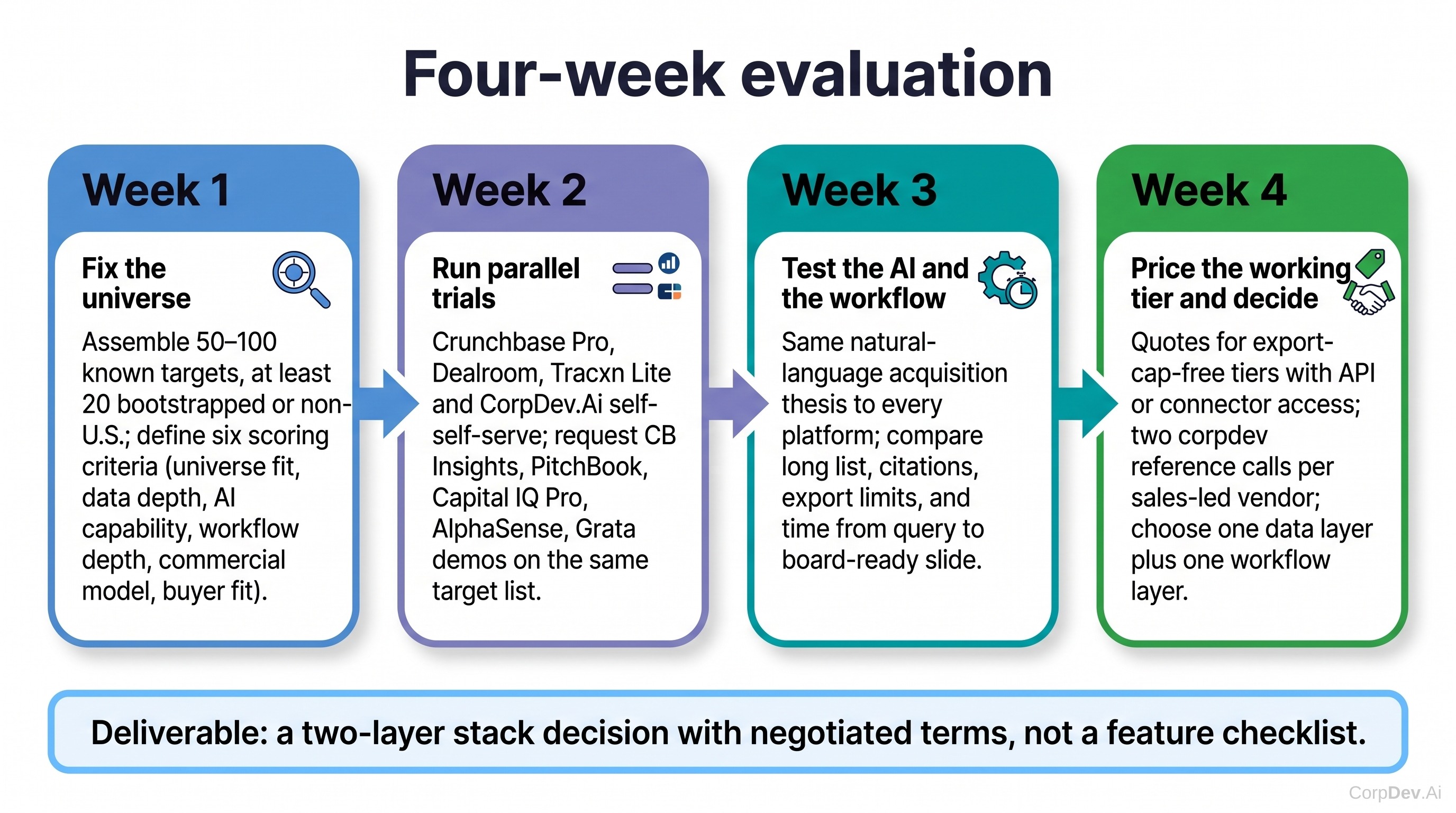
Whatever the archetype, the same four-week process de-risks the decision:
- Fix the target list first. Assemble 50–100 companies the team already knows — including at least 20 that are bootstrapped or non-U.S. — and score each vendor on profile completeness, last-update date, revenue/ownership presence, acquisition history and false positives. This single test exposes the difference between a 12M-company claim and a 12M-company database.
- Test the AI on a real question. Give each platform the same acquisition thesis in natural language and compare the long list, the reasoning trail and the citations. ChatCBI, Grata's Agentic Search, AlphaSense's Gen Search and CorpDev.Ai's AI Analyst answer the same prompt very differently.
- Price the working tier, not the entry tier. Ask every vendor for the tier that removes export caps and includes API or connector access, and compare those.
- Demand references and data-provenance documentation. For sales-led vendors, insist on two reference calls with corpdev (not VC) customers; for younger vendors such as CorpDev.Ai, insist on a live trial with the team's own pipeline and a written description of which data sources back each profile field.
Read diagram description
Four-stage process timeline titled "Four-week evaluation".
Week 1 "Fix the universe": assemble 50–100 known targets, at least 20 bootstrapped or non-U.S.; define six scoring criteria (universe fit, data depth, AI capability, workflow depth, commercial model, buyer fit).
Week 2 "Run parallel trials": Crunchbase Pro, Dealroom, Tracxn Lite and CorpDev.Ai self-serve; request CB Insights, PitchBook, Capital IQ Pro, AlphaSense, Grata demos on the same target list.
Week 3 "Test the AI and the workflow": same natural-language acquisition thesis to every platform; compare long list, citations, export limits, and time from query to board-ready slide.
Week 4 "Price the working tier and decide": quotes for export-cap-free tiers with API or connector access; two corpdev reference calls per sales-led vendor; choose one data layer plus one workflow layer. "Deliverable: a two-layer stack decision with negotiated terms, not a feature checklist."
8. Key Facts & Sources
The load-bearing figures in this guide, with their basis and as-of date. "Vendor claim" means the figure is published by the vendor and not independently audited; "procurement estimate" means a third-party benchmark, not a list price. All sources were accessed 11 September 2026.
| Figure | Value used | Basis | As of | Source |
|---|---|---|---|---|
| CB Insights database size | 12M+ companies, 1,600+ markets | Vendor claim | May 2026 | [8] |
| CB Insights predictive base | 65B data points, 480K+ companies | Vendor claim (modelled subset) | Jan–May 2026 | [12][55] |
| CB Insights median annual contract | ~$47K; range ~$25K–$185K | Procurement estimate | 2026 | [15][16] |
| CB Insights 1–3 seat deployment | $40–60K/yr | Procurement estimate | 2026 | [16] |
| CB Insights funding / headcount / revenue | ~$10–12M raised; 200+ staff (co.), 270–380 (3rd party); $69–80M est. revenue | Vendor + third-party estimates, unaudited | 2015 / 2026 | [2][3][4][5][6] |
| CB Insights review scores | G2 4.4/5 (16 reviews); Capterra 4.7/5 (3); TrustRadius ~7.8/10 | Review aggregators | 2026 | [19][21][15] |
| PitchBook coverage | ~6M companies; 2.5M+ deals incl. ~478K corporate M&A | Vendor claim | May 2025 / 2024 page | [22][25] |
| Morningstar–PitchBook acquisition | ~$225M, 2016 | Press / WSJ | Nov 2016 | [124][125] |
| Crunchbase Pro price | $99/user/mo monthly; $49/user/mo annual (~$588/yr) | Published list price | 2026 | [31] |
| Crunchbase coverage | 5M+ companies; 343K investors; 812K+ funds | Vendor claim | Jun–Aug 2026 | [23][24] |
| Crunchbase Pro export cap | 2,000 rows/month; 1,000 results viewable | Vendor documentation | Apr 2025 | [32][40] |
| Tracxn coverage | 7.7M+ (pricing page) / 5M+ (database page) companies; 3,000+ sectors | Vendor claim (inconsistent) | 2026 | [46][47] |
| Dealroom prices | €12,600 Premium; €17,000 Premium Plus; 3-seat minimum | Published list price | 2026 | [63] |
| Dealroom coverage | 3M+ tech companies; 830K+ rounds; 120K+ investors | Vendor claim | 2026 | [48][50] |
| AlphaSense–Tegus acquisition | $930M; $650M raise at ~$4B valuation | Press release | Jun 2024 | [122][123] |
| Tegus transcript library | 200K+ transcripts, 25K+ companies | Vendor claim | 2026 | [76] |
| AlphaSense seat price | ~$10–20K core; $15–30K broader; $40K+ with expert calls | Procurement estimate | 2026 | [68][69][70] |
| Capital IQ Pro private-company coverage | 54M+ private companies; 14M with financials; 1.2M+ M&A transactions | Vendor claim | 2023 page | [82] |
| Capital IQ Pro seat price | ~$15–30K; one data point $33,375 named user | Procurement estimate | 2026 | [79][80] |
| S&P–With Intelligence acquisition | $1.8B | Investor release | Nov 2025 | [126] |
| Grata coverage / customers | 22M+ private companies; 10M+ contacts; 2,000+ customers | Vendor claim | 2026 | [87][88] |
| Grata / Sourcescrub pricing | Grata ~$15K entry to $40–100K+; Sourcescrub ~$20–60K | Procurement estimate | 2026 | [89][96] |
| Sourcescrub coverage | 15M+ companies; 150K+ connected sources | Vendor claim | 2023–2025 | [93][94] |
| Grata–Sourcescrub combination | Announced; terms not disclosed | Vendor statement | Sep 2026 | [86] |
| CorpDev.Ai prices | $1,000/mo annual (1 seat); $3,000/mo annual (3 seats); $1,200 / $3,600 monthly | Published list price | 2026 | [104] |
| CorpDev.Ai research universe | 70M+ companies; 265M+ contacts (via connectors) | Vendor claim | 2026 | [103][105] |
| Bain — AI in M&A | 45% of dealmakers used AI tools in 2025, >2× prior year | Bain & Company | 2026 | [132] |
| Forrester — AI in B2B buying | 94% of buyers used AI in buying process; ≥5 vendors considered for large purchases | Forrester | 2025–2026 | [134][135] |
| Three-seat cost ranges (§6 chart) | As tabulated | Derived: seat price × 3, or published team tier; €→$ at ~1.08 | Sep 2026 | [31][63][104] and above |
Method notes. Scores in §5 are the authors' relative judgements and are not vendor-supplied. The three-seat cost chart in §6 multiplies per-seat estimates by three where a vendor prices per seat, uses the published three-seat tier where one exists (Dealroom, CorpDev.Ai), and for quote-only vendors uses the mid-market ranges cited above; ranges are shown rather than points because every sales-quoted figure is negotiable. Company-count claims are reproduced as published and are explicitly not comparable across vendors (see §2).
References
Numbering follows the original research. Access dates below record the original source registry; they do not imply that every source was rechecked for this website edition.
- CB InsightsSource accessed 2026-09-11
- Not a UnicornSource accessed 2026-09-11
- About UsSource accessed 2026-09-11
- Cbinsights Revenue 2026: $79.8M Est. ARR, $11.7M RaisedSource accessed 2026-09-11
- CB Insights - Revenue, Headcount, Tech Stack, Contacts - BitscaleSource accessed 2026-09-11
- CB Insights: Revenue, Competitors, Alternatives - GrowjoSource accessed 2026-09-11
- PricingSource accessed 2026-09-11
- ChatCBI - CB InsightsSource accessed 2026-09-11
- Market Directory - CB InsightsSource accessed 2026-09-11
- Private-market venture data across AI, fintech, & digital healthSource accessed 2026-09-11
- CB Insights – Additional TermsSource accessed 2026-09-11
- Company Profile - CB InsightsSource accessed 2026-09-11
- CB Insights Pricing, Reviews, Pros & Cons (2026)Source accessed 2026-09-11
- CB Insights Cost 2026: Pricing Per Year | Investables.aiSource accessed 2026-09-11
- Case Studies & Customer Success StoriesSource accessed 2026-09-11
- CB Insights Review 2026: Pricing, Features & AlternativesSource accessed 2026-09-11
- CB Insights Reviews 2026: Details, Pricing, & FeaturesSource accessed 2026-09-11
- PitchBook Strengthens Leadership in Global Capital Market Data Coverage | PitchBookSource accessed 2026-09-11
- Product Updates and Release NotesSource accessed 2026-09-11
- Crunchbase ProSource accessed 2026-09-11
- Public & Private Equity Deal Data - PitchBookSource accessed 2026-09-11
- Investor's Data: Previous Deals & PerformanceSource accessed 2026-09-11
- PitchBook Review 2026: Features, Pricing & AlternativeSource accessed 2026-09-11
- PitchBook 2026 Pricing, Features, Reviews & Alternatives | GetAppSource accessed 2026-09-11
- Buy Crunchbase ProSource accessed 2026-09-11
- How can I search using Crunchbase Pro?Source accessed 2026-09-11
- What Can I Do with Crunchbase Pro?Source accessed 2026-09-11
- Crunchbase Review: Pricing, Features, Alternatives (2026) · SaaSTrackerSource accessed 2026-09-11
- PitchBook AI-powered insights for VC, PE & M&A - PitchBookSource accessed 2026-09-11
- PitchBook Expands Premium AI Integrations with Microsoft ...Source accessed 2026-09-11
- PitchBook and Samaya AI Announce Premium LLM ...Source accessed 2026-09-11
- Crunchbase Overview & NavigationSource accessed 2026-09-11
- Crunchbase APISource accessed 2026-09-11
- Build an Advanced Search with Crunchbase ProSource accessed 2026-09-11
- PitchBook Pros and Cons | User Likes & Dislikes - G2Source accessed 2026-09-11
- The G2 on PitchBookSource accessed 2026-09-11
- The G2 on PitchBookSource accessed 2026-09-11
- pitchbook-review-13179612Source accessed 2026-09-11
- Crunchbase Reviews 2026: Details, Pricing, & Features - G2Source accessed 2026-09-11
- PricingSource accessed 2026-09-11
- Companies DatabaseSource accessed 2026-09-11
- Power Law company profilesSource accessed 2026-09-11
- Corporate Development & M&A Software | Build Strategic ...Source accessed 2026-09-11
- Discover new companies & source deals | Dealroom.coSource accessed 2026-09-11
- Profiles & GuidesSource accessed 2026-09-11
- API & Data FeedsSource accessed 2026-09-11
- Predictive Data Science - CB InsightsSource accessed 2026-09-11
- Our DataSource accessed 2026-09-11
- Data solutions | TracxnSource accessed 2026-09-11
- Crunchbase Alternatives for 2026: Best Startup & VC...Source accessed 2026-09-11
- Dealroom Review: Data Coverage, Features & PricingSource accessed 2026-09-11
- World — continent / region startup ecosystem profileSource accessed 2026-09-11
- SolutionsSource accessed 2026-09-11
- Mosaic ScoreSource accessed 2026-09-11
- PricingSource accessed 2026-09-11
- CB Insights vs Tracxn (2026): Scores, Reviews & VerdictSource accessed 2026-09-11
- Premium Access — the full Dealroom platformSource accessed 2026-09-11
- DealRoom vs TracxnSource accessed 2026-09-11
- AlphaSense Pricing & Alternative (2026) - Elevated SignalSource accessed 2026-09-11
- Best Market Intelligence Platforms for M&A (2026)Source accessed 2026-09-11
- AlphaSense Pricing 2026: Cost Per Seat | Investables.aiSource accessed 2026-09-11
- Expert Transcripts OverviewSource accessed 2026-09-11
- AlphaSense | Market Intelligence and Search PlatformSource accessed 2026-09-11
- Expert Calls On Demand with AlphaSenseSource accessed 2026-09-11
- Due Diligence Workspace Overview - Help CenterSource accessed 2026-09-11
- Use Alphasense Workflow...Source accessed 2026-09-11
- Introduction to Tegus Expert Transcript Library - Help CenterSource accessed 2026-09-11
- Market Intelligence Platform for Leading Organizations - AlphaSenseSource accessed 2026-09-11
- Due Diligence Workspace: Automate Diligence From Initial ...Source accessed 2026-09-11
- Capital IQ Review: Data & Analytics AI Tool | SmarterWay.AISource accessed 2026-09-11
- Capital IQ Cost 2026: S&P Capital IQ Price Per SeatSource accessed 2026-09-11
- S&P Capital IQ Pro | S&P GlobalSource accessed 2026-09-11
- S&P Capital IQ ProSource accessed 2026-09-11
- S&P Capital IQ Pro Solution - S&P Global MarketplaceSource accessed 2026-09-11
- Transforming a Hyperscaler's Corporate Development ...Source accessed 2026-09-11
- PitchBook vs CB Insights 2026Source accessed 2026-09-11
- Sourcescrub the Deal Sourcing Platform for AI Driven ...Source accessed 2026-09-11
- Grata | The Leading Private Markets PlatformSource accessed 2026-09-11
- Flexible Pricing Plans Suited For Any Use CaseSource accessed 2026-09-11
- Grata Pricing, Reviews, Pros and Cons (2026)Source accessed 2026-09-11
- Access the deepest, most dynamic view of the private ...Source accessed 2026-09-11
- Company Data APISource accessed 2026-09-11
- Grata Pricing Review 2026: Real Costs, Pros and ConsSource accessed 2026-09-11
- Never Miss Another DealSource accessed 2026-09-11
- PE Deal Sourcing Platform & VC Deal Origination ... - SourcescrubSource accessed 2026-09-11
- Pricing & Features for SourcescrubSource accessed 2026-09-11
- SourceScrub Pricing, Reviews, Pros & Cons (2026)Source accessed 2026-09-11
- Sourcescrub - Chiri Atlas | ChiriSource accessed 2026-09-11
- Choose Sourcescrub IfSource accessed 2026-09-11
- PitchBook’s Data: Private & Public Market Data - PitchBookSource accessed 2026-09-11
- Corporate DevelopmentSource accessed 2026-09-11
- CorpDev.Ai - Agentic AI for M&A and Corporate DevelopmentSource accessed 2026-09-11
- Pricing - CorpDev.AiSource accessed 2026-09-11
- AI Deal Sourcing Platform for M&ASource accessed 2026-09-11
- Deep Company Intelligence & Research for M&A - CorpDev.AiSource accessed 2026-09-11
- Integrations | CorpDev.Ai DocsSource accessed 2026-09-11
- CorpDev.Ai | AI Analyst for Superhuman M&A and Corporate ...Source accessed 2026-09-11
- Request a Free Trial | CorpDev.AiSource accessed 2026-09-11
- About Us - CorpDev.AiSource accessed 2026-09-11
- M&A Intelligence Platform | Midaxo M&A SoftwareSource accessed 2026-09-11
- The AI-powered deal and relationship intelligence platformSource accessed 2026-09-11
- AlphaSense to Join Forces with Tegus; Increases Latest Valuation to $4BSource accessed 2026-09-11
- AlphaSense to Acquire TegusSource accessed 2026-09-11
- Morningstar to Acquire PitchBook DataSource accessed 2026-09-11
- Morningstar, Inc. Completes Acquisition of PitchBook Data, Inc. | PitchBookSource accessed 2026-09-11
- S&P Global Completes $1.8 Billion Acquisition of With ...Source accessed 2026-09-11
- Acquisitions and DivestituresSource accessed 2026-09-11
- [PDF] Moody's GenAI Strategy OverviewSource accessed 2026-09-11
- Global M&A poised to sustain momentum in 2026 after ...Source accessed 2026-09-11
- B2B Buyers Make Zero-Click Buying Number One - ForresterSource accessed 2026-09-11
- Predictions 2025: Younger Business Buyers And GenAI ...Source accessed 2026-09-11