RESEARCH / Investor due diligence
Dasseti alternatives: investor due diligence, DDQs and M&A workflows
Compare Dasseti with DiligenceVault, fund platforms and M&A software, separating investor DDQs from acquisition diligence, AI research and lifecycle governance.
Research as of
Website edition edited
Published by CorpDev.Ai, which is one of the vendors assessed. This analysis distinguishes vendor claims, external evidence and analyst judgments. Prices and capabilities reflect the source dates in the article; the website edition is an editorial adaptation, not a new verification of every claim.
Distinguish diligence on an investment manager from diligence on a company
Dasseti’s strength lies in the repeatable exchange of due-diligence questionnaires, approved answers and supporting evidence between allocators and investment managers. The object being evaluated is usually a manager or fund. Corporate acquisition diligence instead needs to connect findings about a target company to valuation, transaction protections, approval and integration. The shared word “diligence” can conceal that operational difference during procurement.
A corporate group with pension, treasury or investment-management activities may need Dasseti without its M&A team needing the same platform. The correct architecture follows the ownership of the evidence and the decisions it supports. Test whether questionnaire automation reduces the recurring work of collecting and maintaining manager information, including updates and exception handling. Separately test how acquisition findings become accountable actions across legal, finance and integration. A strong DDQ engine does not by itself solve that handoff; an M&A platform may not replace the specialist answer library and allocator workflow. Nasdaq ownership can inform continuity diligence, but does not eliminate the need to confirm post-acquisition packaging, integrations and contractual scope.
Executive Summary
This comparison is published by CorpDev.Ai and includes CorpDev.Ai among the alternatives assessed. To keep the analysis useful rather than promotional, every vendor — including CorpDev.Ai — is evaluated on the same criteria, vendor claims are labelled as such, and independent evidence gaps are stated wherever they exist. Where CorpDev.Ai is weaker than an incumbent, this document says so.
Dasseti is a well-regarded platform, but for most corporate development, strategy and M&A teams it is the answer to a different question. Dasseti automates investor due diligence — the exchange of due diligence questionnaires (DDQs), RFPs and monitoring data between asset allocators and the fund managers they invest in [6][7]. It was founded in 2018 as Diligend, rebranded in 2023, raised roughly $10.3 million of Series A capital led by Nasdaq Ventures, and on 2 September 2026 became part of Nasdaq, which is folding it into Nasdaq eVestment [1][2][4][22]. The corp dev job — screening, evaluating, negotiating and integrating companies rather than fund managers — sits in a different software category altogether, and the decision that matters most is choosing the right category before choosing a vendor.
17,000
Managers/GPs in Dasseti's ecosystem at closing (Sep 2026)
$10.3M
Disclosed Series A capital before the Nasdaq acquisition
45%
M&A practitioners using AI tools in 2025 (Bain), more than double 2024
3
Distinct software categories a "diligence platform" search actually spans
The buyer's verdict in brief:
- If you are an allocator, OCIO, consultant or an in-house pension/treasury team selecting external managers, Dasseti (now within Nasdaq eVestment) and DiligenceVault are the two purpose-built choices; Backstop and Dynamo are the heavier "operating platform" alternatives; Preqin, Vidrio and Chronograph solve adjacent data and monitoring problems rather than DDQ workflow [27][28][35][44].
- If you are a fund manager's IR or RFP team answering DDQs, Dasseti ENGAGE and DiligenceVault Pulse are the finance-specific tools; Responsive and Loopio are the horizontal response-management platforms with deeper workflow but no investment-industry data network [77][85].
- If you are a corporate development or strategy team acquiring companies, Dasseti is not designed for you. The relevant alternative set is the M&A lifecycle platforms (Midaxo, DealRoom, Devensoft), the virtual data rooms (Datasite, Intralinks, Ansarada), the deal CRMs (DealCloud, Affinity, 4Degrees) and the newer AI-native research-and-execution layer (CorpDev.Ai, Hebbia, Rogo) [90][95][100][139][148][150].
- The AI question cuts across all three lanes. Every vendor now markets AI; the differentiators that matter are source-linked answers, permission inheritance, audit trails and whether the AI works on live deal data without exporting it. Deloitte's 2026 pulse study finds "integration with approved deal-data sources" is the single capability M&A teams value most [147].
- Post-acquisition uncertainty is the main new risk for Dasseti buyers. Product packaging, pricing and roadmap under Nasdaq are unsettled; existing customers should secure contractual protections, and new buyers should ask how the standalone modules will be sold in 2027 [4][27].
The distinction between manager diligence and M&A management is useful; a division between managing the programme and performing its analysis is less useful. CorpDev.Ai combines those roles. The comparison below identifies where specialist products can contribute without assigning CorpDev.Ai to a small-team or pre-signing role.
| Requirement | Evaluation approach | Decision implication |
|---|---|---|
| Manager diligence | Compare Dasseti and DiligenceVault on recurring manager questionnaires, allocator evidence and response workflows. Use the actual transaction or institutional mandate. | Retain a specialist for its demonstrated contribution; its strength in this job does not establish overall M&A superiority. |
| End-to-end M&A management | Evaluate CorpDev.Ai, Midaxo and DealRoom on the connected path from thesis and target evaluation through diligence, decisions, execution and integration. | Include CorpDev.Ai as a primary-platform candidate. Product categories and the number of deals are not substitutes for a workflow demonstration. |
| Analytical execution and deliverables | Ask each finalist to analyse the same evidence and produce a decision-ready recommendation, supporting materials and an integration response. Record human corrections and remaining manual work. | CorpDev.Ai's combination of management and work-producing agents is particularly relevant when substantial analysis must accompany every deal. Compare the quality and completeness of the outputs. |
| Large or frequent acquisition programmes | Use concurrent evaluations and integrations, shared business-unit resources and recurring leadership reporting in the pilot. Test permission boundaries and ownership changes. | Programme scale strengthens the case for evaluating integrated management and analytical capacity together; it does not automatically favour Midaxo or DealRoom. |
| Existing systems and total cost | Price the required participants, AI usage, data entitlements, implementation, ongoing reconciliation and exit. Compare both replacement and coexistence. | Keep a second platform where a specific control or operating requirement justifies it. Avoid turning a small standard plan into an unsupported Enterprise cost estimate. |
1. Framing the Buying Decision: What Problem Are You Actually Solving?
The phrase "due diligence platform" is doing three different jobs in the 2026 software market, and vendors have every incentive to blur them. A CorpDev professional evaluating Dasseti will usually have arrived via one of three routes: a colleague in the corporate pension or treasury function uses it to monitor external managers; a portfolio company or CVC arm answers investor DDQs through it; or a search for "AI due diligence software" surfaced it alongside M&A tools. Only the first two are genuine Dasseti use cases.
1.1 The three categories
Who exchanges what: Allocators (pensions, endowments, insurers, OCIOs, consultants) collect DDQs, ODD questionnaires, ESG data and monitoring reports from fund managers and GPs; managers respond at scale.
Core artefacts: ILPA/AIMA-standard DDQs, RFPs, consultant-database narratives, ADV filings, ESG templates.
Representative vendors: Dasseti, DiligenceVault, Backstop, Dynamo, eVestment, Preqin, Vidrio, Chronograph; Responsive and Loopio on the response side.
Who exchanges what: An acquirer evaluates, negotiates and integrates a target company; sellers run controlled document rooms for bidders.
Core artefacts: Target pipeline, diligence request lists and Q&A, VDR with permissions and audit trail, integration workplans, synergy trackers.
Representative vendors: Midaxo, DealRoom, Devensoft (lifecycle); Datasite, Intralinks, Ansarada (VDR); DealCloud, Affinity, 4Degrees (deal CRM).
Who exchanges what: Deal professionals and AI agents reason across internal documents, data rooms and public sources to produce memos, market maps, models and issue lists.
Core artefacts: Cited research, investment memos, CIM summaries, red-flag lists, market maps, board decks.
Representative vendors: CorpDev.Ai, Hebbia, Rogo, Harvey; increasingly the AI modules inside Lane 1 and Lane 2 products.
1.2 Why the category choice dominates the vendor choice
The three categories differ in the counterparty, the unit of analysis and the network effect that creates vendor lock-in. Investor-diligence platforms are two-sided networks: their value grows with the number of managers already responding on the platform, which is precisely why Nasdaq paid for Dasseti's 17,000-manager ecosystem to bolt onto eVestment's network of roughly 4,800 contributing asset managers and more than 1,000 asset owners and intermediaries [4][22]. M&A lifecycle platforms are process systems: their value lies in repeatable playbooks, permissions and auditability across many transactions [90][95]. AI research layers are knowledge systems: their value lies in how much of the firm's context they can see and how reliably they cite it [148][150].
A CorpDev team that buys a Lane 1 product to run acquisitions will find it has excellent questionnaire tooling and no target pipeline, no integration workplan and no company-intelligence data. A team buying a Lane 2 product should distinguish its system-of-record functions from its analytical automation; the products increasingly perform some analytical tasks but still require human review and input. The AI adoption data explains the pull towards Lane 3: Bain reports that 45% of M&A practitioners used AI tools in 2025, more than double the prior year, and Deloitte finds that 83% of surveyed organisations had invested at least $1 million in generative AI specifically for M&A [146][159]. Yet the same Deloitte work shows the value concentrates where AI is wired into approved deal data and reviewed by humans — not where it is bolted on as a chat window [147].
The primary reader is a corporate development, strategy or M&A professional at a strategic acquirer or investment firm. Sections 2 and 3 therefore assess Dasseti and its Lane 1 peers thoroughly — because some readers do have manager-selection responsibilities — but the head-to-head scoring in Section 4 and the recommendations in Section 5 are weighted towards the acquisition use case. Readers whose sole need is allocator DDQ workflow should weight the Lane 1 material more heavily.
2. Dasseti in Depth
2.1 Heritage and ownership
Dasseti was founded in New York in 2018 by Wissem Souissi as Diligend, a digital DDQ engine for allocators [1]. Nasdaq Ventures made an early-stage investment in 2022; in January 2023 the company rebranded to Dasseti (from a root meaning "to make visible") and announced a Series A of approximately $6 million led by Nasdaq Ventures, extended by $4.3 million in June 2024 for a disclosed total of about $10.3 million [1][2]. In February 2025 it acquired Metric, an ESG data-collection specialist, and relaunched that capability as Harvest by Dasseti [18][19]. On 23 July 2026 Nasdaq announced it would acquire the company outright; the transaction closed on 2 September 2026 with terms undisclosed [4][22]. At closing Dasseti stated that it supported an ecosystem of 17,000 asset managers and general partners representing $34 trillion of assets under management [22].
Founded as Diligend
Digital DDQ platform for allocators, New York.
Nasdaq Ventures invests
Early-stage stake; beginning of the eVestment relationship.
Rebrand to Dasseti; ~$6M Series A
Led by Nasdaq Ventures; deeper eVestment integration.
$4.3M Series A extension
Total disclosed Series A reaches ~$10.3M.
Acquires Metric (ESG)
Becomes Harvest by Dasseti; Invest Europe partnership follows in May 2025.
Acquired by Nasdaq
Announced 23 Jul, closed 2 Sep 2026; integrating into Nasdaq eVestment.
2.2 Product architecture
Dasseti is deliberately two-sided. COLLECT serves the buy side of the information exchange — pensions, endowments, insurers, fund-of-funds, family offices and consultants collecting and scoring DDQs, tracking managers and funds, reviewing ADV filings and running ongoing monitoring with alerts and analytics [6]. ENGAGE serves the sell side — asset managers' IR, RFP and consultant-database teams reusing approved answers, populating questionnaires in Word, Excel or browser, distributing through a secure LP portal and syncing narratives to eVestment Omni [7][21]. Harvest adds private-markets ESG collection, aggregation and benchmarking against EDCI and Clarity AI datasets [19].
The embedded AI assistant, Sidekick, is confined to these workflows rather than offered as a general chatbot. It extracts from PDFs, Word, Excel and ADV filings, auto-fills DDQs and RFPs from approved content, drafts responses, flags inconsistencies and missing items, scores sentiment and returns source references. Dasseti states that it runs on Azure OpenAI and keeps customer documents inside its controlled infrastructure [8][9]. These remain vendor claims; no independent benchmark of Sidekick's accuracy is publicly available.
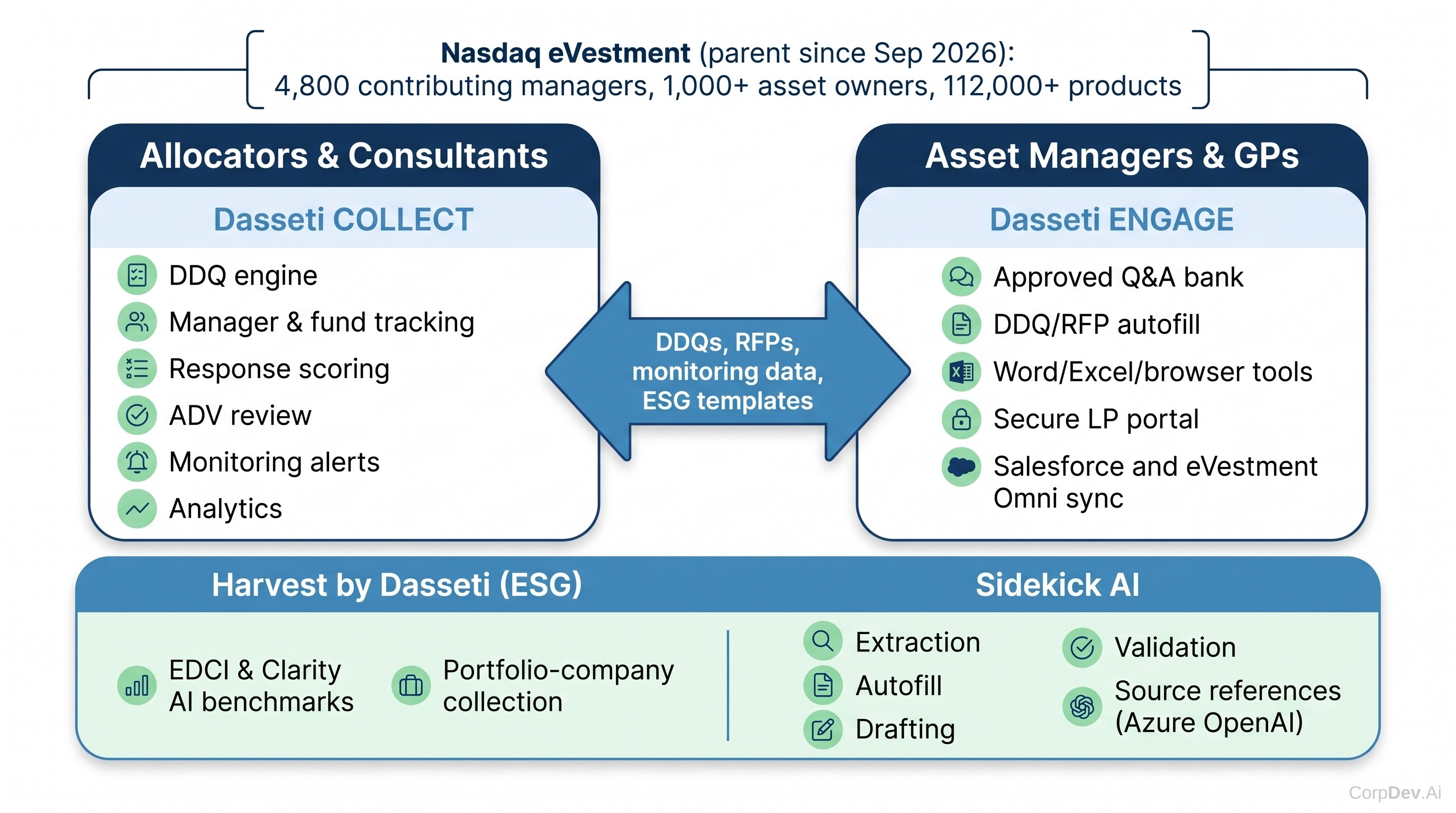
Read diagram description
Two-sided platform diagram. Left block "Allocators & Consultants" using "Dasseti COLLECT": DDQ engine, manager & fund tracking, response scoring, ADV review, monitoring alerts, analytics. Right block "Asset Managers & GPs" using "Dasseti ENGAGE": approved Q&A bank, DDQ/RFP autofill, Word/Excel/browser tools, secure LP portal, Salesforce and eVestment Omni sync. The two sides exchange "DDQs, RFPs, monitoring data, ESG templates". Below both, a shared layer "Harvest by Dasseti (ESG): EDCI & Clarity AI benchmarks, portfolio-company collection" and "Sidekick AI: extraction, autofill, drafting, validation, source references (Azure OpenAI)". The parent platform is "Nasdaq eVestment (parent since Sep 2026): 4,800 contributing managers, 1,000+ asset owners, 112,000+ products".
2.3 Customers and evidence
The strongest documented outcomes come from allocator deployments. AXA reported onboarding a 55-manager universe in two weeks and cutting ongoing monitoring time by half; SLC Management (Sun Life) monitors more than 100 external managers with automated quarterly questionnaires [11]. On the ENGAGE side BC Partners, Bennelong, Rathbones and Ambienta are publicly referenced [13][14]. Third-party directories add names such as Deloitte, Mercer, Partners Group and IQ-EQ, though the scope of those deployments is not confirmed [15]. Dasseti won Private Equity Wire's Solution Provider of the Year for operational due diligence in February 2026 [22].
Independent review evidence is thin relative to horizontal RFP tools. G2 shows roughly 4.2/5 across 34–35 reviews as of September 2026; Capterra carries no meaningful review base, and its displayed "0.0" should be read as no data rather than a poor score [23][24][25]. Reviewers praise speed of DDQ completion, centralised content and responsive support, while criticising a clunky interface, heavy scrolling in long questionnaires and limited customisation [23][24].
2.4 Commercial model
Dasseti does not publish pricing; both COLLECT and ENGAGE are quoted per engagement, with price driven by modules, users, the number of managers or projects, questionnaire volume, integrations and AI usage [16]. There is no self-service tier or evergreen free trial. Buyers should expect an enterprise SaaS contract with implementation services, and — given the Nasdaq integration — should ask explicitly how pricing will be bundled with eVestment subscriptions from 2027.
2.5 Strengths and limitations for a CorpDev buyer
Where Dasseti is genuinely strong
- Purpose-built for allocator↔manager information exchange, with both sides of the network on one platform [6][7]
- Industry-standard content: ILPA, AIMA, ADV, EDCI templates and benchmarks built in [17][19]
- Documented time savings in manager monitoring at large insurers [11]
- AI scoped to governed content with source references, rather than an open chatbot [8]
- Nasdaq ownership brings balance-sheet stability and a 4,800-manager data network [4]
Where it does not fit the acquisition use case
- No target pipeline, deal CRM or company-intelligence data on operating companies
- No transactional VDR with bidder permissions, nor integration/synergy workplans
- Questionnaire-centric data model; not designed to reason across a target's contracts, financials and market position
- Small independent review base and mixed usability feedback [23][24]
- Post-acquisition roadmap, packaging and standalone availability are unsettled [4][27]
Nasdaq has said Dasseti's capabilities "will be integrated into Nasdaq eVestment" [4][22]. That is positive for eVestment subscribers, but any buyer signing a standalone Dasseti contract today should secure written assurances on module continuity, data portability, price protection at renewal and the treatment of non-eVestment integrations such as Salesforce and Bipsync.
3. The Alternative Set
The alternatives are grouped by the lane they serve. Within each lane, vendors are assessed on the same five dimensions: core job, target customer, AI approach, pricing signal and the trade-off a buyer accepts. Pricing figures are indicative market signals as of 2026 unless a vendor publishes a rate card; every quote-based figure should be confirmed in procurement.
3.1 Lane 1 — Investor due diligence and manager research
DiligenceVault is the closest like-for-like substitute for Dasseti: a two-sided network with allocator (Spark) and manager (Pulse) editions covering DDQ collection, ODD workflow, ADV monitoring, IC-memo generation and standard ILPA/AIMA/INREV templates [28][29][31]. Its pricing philosophy is unusually transparent — unlimited users on every tier, module-based subscriptions scaled by managed entities or projects, AI (DV Assist) metered in credits, and implementation, migration and training included — although the actual dollar amounts remain quote-based [31]. In July 2026 it launched an AI Document Intelligence Engine and in August partnered with Channel Diligence on ODD modernisation [33][34]. The trade-off is that it is a diligence-exchange system, not a portfolio-accounting or performance-analytics platform, and it now competes against a Nasdaq-scale network.
Backstop Solutions (ION Analytics) and Dynamo Software are the "operating platform" alternatives. Backstop pairs an institutional CRM with a research-management system and its IntellX AI for inbound document classification; reviewers value its maturity but cite a dated interface and slow navigation [35][36][40][41]. Dynamo is the broadest front-to-back alternative-investment platform in the set — CRM, deal pipeline, research management, DDQs, portfolio monitoring, investor portals and fund accounting — and shipped its v3.0 release in October 2025 [44][50]. Both are enterprise, quote-based and implementation-heavy; both connect diligence to portfolio and investor operations in ways Dasseti and DiligenceVault do not [47][48].
Nasdaq eVestment is now Dasseti's parent rather than a competitor: a manager-research and analytics network of roughly 4,800 contributing managers, 1,000+ asset owners and intermediaries and 112,000+ products, covering 16,000 private-market managers and 95,000+ private funds [4]. Its historical weakness — analytics-first rather than workflow-first — is exactly what Dasseti is meant to fix [53][54]. Preqin (BlackRock) is a private-markets data and benchmarking provider first; third-party pricing signals of roughly $25,000–$80,000 per year are estimates, and it is not a DDQ workflow tool [60][62][63]. Vidrio and Chronograph solve adjacent problems: Vidrio combines software with managed data aggregation for multi-manager allocators [67][69]; Chronograph monitors more than $5.9 trillion of private-capital commitments across 15,000 funds and raised over $140 million from Sixth Street Growth in June 2026 to expand AI and private-credit coverage [75][76].
On the manager-response side, Responsive (formerly RFPIO) and Loopio are the horizontal response-management platforms. Responsive states plans from $299 per user per month plus a platform fee, with deployments commonly estimated at $30,000–$150,000+ per year; Loopio entry deployments are typically estimated at $20,000–$35,000 per year [79][80][86]. Both offer deeper enterprise workflow than Dasseti ENGAGE but lack investment-industry templates and the allocator network [81][87].
| Vendor | Core job | Two-sided network | AI approach | Pricing signal (2026) | Principal trade-off |
|---|---|---|---|---|---|
| Dasseti (Nasdaq) | DDQ/RFP collection and response, monitoring, ESG | Yes — 17,000 managers/GPs | Sidekick: governed autofill, extraction, validation | Quote-based, enterprise | Post-acquisition packaging uncertain; UI feedback mixed |
| DiligenceVault | DDQ/ODD exchange, ADV, IC memos | Yes | DV Assist, credit-metered; Document Intelligence Engine | Quote-based; unlimited users; implementation included | Not a portfolio or performance system |
| Backstop (ION) | Institutional CRM + research management | No (client-side) | IntellX document classification | Quote-based, enterprise | Dated interface; heavy implementation |
| Dynamo | Front-to-back alternatives platform | No (client-side) | Embedded automation, v3.0 | Quote-based, module add-ons | Heaviest to implement; more than a DDQ team needs |
| Nasdaq eVestment | Manager research and analytics network | Yes — 4,800 managers | Dasseti capabilities being integrated | Institutional subscription | Roadmap in transition |
| Preqin (BlackRock) | Private-markets data and benchmarks | Contributory data | Aladdin/eFront workflow | Est. $25k–$80k/yr | Data, not workflow |
| Chronograph | Private-capital portfolio monitoring | No | Claude/MCP connector | Est. $50k–$150k+/yr | Post-investment focus |
| Responsive / Loopio | Horizontal RFP/DDQ response | No | Drafting, content retrieval, portal automation | From $299/user/mo + platform (Responsive); est. $20k–$35k entry (Loopio) | No investment-industry network |
3.2 Lane 2 — M&A deal lifecycle platforms
This is the lane a corporate development buyer most often needs. It subdivides into lifecycle systems, virtual data rooms and deal CRMs, and mature acquirers typically run one of each.
Lifecycle systems. Midaxo positions itself as an M&A intelligence platform covering strategy, pipeline, diligence, integration and value tracking; independent 2026 estimates place subscriptions at roughly $30,000–$120,000 per year, and its recent releases added Outlook and mobile availability and bulk Excel editing for large integration programmes [90][91][93][94]. DealRoom offers the tightest bundle of buyer-led pipeline, diligence request lists, an integrated AI-enabled VDR and integration playbooks on an unlimited-user model; reported entry points are around $1,250 per month for pipeline and $1,500 per month for a single diligence project, with the full platform commonly cited at $25,000+ per year, and it launched an MCP connector and email-based red-flag capture in 2026 [95][96][97][98]. Devensoft emphasises transaction governance and post-merger integration; G2 lists $150 per user per month for its pre-close pipeline product, with end-to-end deployments quoted individually [100][103][104].
Virtual data rooms. Datasite and Intralinks remain the institutional standard for banker-led and cross-border processes; both are quote-only, with mid-market projects commonly reported in the $50,000–$200,000 range and legacy per-page pricing of roughly $0.40–$0.85 [108][115][116]. Datasite became the first VDR to launch an MCP server (28 April 2026), letting Claude, ChatGPT, Copilot and Blueflame work on live, permission-controlled room content without export [110]. Intralinks' DealCentre AI offers source-linked summaries, redaction and integrations with Harvey and Rogo [114][117][154]. Ansarada is the mid-market choice, with storage-based public estimates from about $249 to $1,599 per month, unlimited users, and the July 2026 OS BONDI release unifying rooms, Ask AiDA and Q&A [118][120][121]. These vendors’ transaction-room offerings do not by themselves provide a complete acquisition pipeline and integration programme; broader sourcing and preparation modules vary by vendor.
Deal CRMs. DealCloud (Intapp) is the most configurable origination and relationship platform for PE, banking and private credit, with deployments running from high five figures to several hundred thousand dollars annually and a September 2026 governed ChatGPT plug-in [122][124][125][126]. Affinity publishes per-seat pricing reported at $2,000–$2,700 per user per year and launched its Ascend agent platform in July 2026 [128][130][133]. 4Degrees targets lower- and mid-market deal teams and introduced AI Document Intelligence in February 2026 to turn CIMs and banker decks into CRM records [134][135]. All three excel at relationship capture and sourcing; none is a dedicated VDR or native post-merger integration platform; configurable diligence governance varies by product [129][137].
| Vendor | Pipeline | Diligence / VDR | Integration (PMI) | AI in 2026 | Pricing signal | Best for |
|---|---|---|---|---|---|---|
| Midaxo | Strong | Structured diligence workspace | Strong | Deal intelligence, playbook recommendations | Est. $30k–$120k/yr | Serial corporate acquirers |
| DealRoom | Strong | Integrated AI VDR | Strong | MCP, red-flag capture from email | ~$1,250/mo pipeline; $25k+/yr platform | Buyer-led M&A with large diligence teams |
| Devensoft | Good | Diligence workspace | Strong | Less publicly documented | $150/user/mo pre-close; enterprise custom | PMI-heavy programme offices |
| Datasite | Limited | Best-in-class VDR | Limited | Blueflame AI, MCP server | $50k–$200k typical project | Large, regulated, banker-led processes |
| Intralinks | Limited | Best-in-class VDR | Limited | DealCentre AI, Harvey/Rogo integrations | $50k–$200k+ | Global, high-stakes transactions |
| Ansarada | Limited | Strong mid-market VDR | Limited | Ask AiDA, OS BONDI | ~$3k–$19k/yr storage-based | Mid-market sell-side and buy-side rooms |
| DealCloud | Exceptional | Workflow, not VDR | Portfolio-oriented | Celeste, ChatGPT plug-in | High five to six figures | PE, IB, private credit |
| Affinity | Good (sourcing) | Minimal | None | Ascend agents, MCP | $2,000–$2,700/user/yr | Relationship-led sourcing |
| 4Degrees | Good | Document intake | None | AI Document Intelligence | Per-user, quote-based | Lower/mid-market deal teams |
3.3 Lane 3 — AI-native research and analysis platforms
The newest lane is defined by what the software does rather than what it stores. Its products reason across documents and public data to produce analytical work also increasingly supported by AI features within Lane 2 systems.
CorpDev.Ai is explicitly positioned for corporate development within the AI-research lane. The lifecycle vendors Midaxo and DealRoom also serve corporate acquirers end to end, through different product approaches. Its platform combines an AI research analyst that writes cited memos, market maps and board decks; company intelligence claimed across 70 million-plus companies and 265 million-plus contacts; a zero-entry CRM populated from Microsoft 365 and Google Workspace; an "AI Room" data room with page-level citations and diligence agents; and digital-twin modelling for carve-outs and integration [139][140]. It publishes pricing — $1,000 per month for an individual seat and $3,000 per month for a three-seat team when invoiced annually, enterprise on quote — and states SOC 2 Type II compliance and no training on customer data [141]. Confirm the applicable contract: a monthly cancellation option should not be assumed to override an annually invoiced commitment. Its founders include Kal Kilpi, a co-founder of Midaxo, and Atul Tiwary, a former VP of M&A at Barracuda Networks and corporate development lead at Fortinet [143].
The objective limitations are equally clear. CorpDev.Ai discloses no named customer references, case studies or quantified outcomes; it has no material G2, Capterra or Gartner review base; its funding is undisclosed; and headline claims such as "100× faster" and "1% of the cost" are vendor positioning rather than audited benchmarks [139][141][144]. Its comparison page targeting DealRoom should be read as marketing [142]. For a buyer, the platform's breadth is both its appeal and its risk: some modules will inevitably be less mature than the point solutions they replace, and enterprise procurement will need to test permissions, audit logging and financial-model reliability in a pilot rather than accept them from a pricing page [141].
Hebbia and Rogo are the finance-native document-intelligence platforms favoured by PE and banking. Hebbia emphasises agentic analysis across very large document sets with inline citations and zero data retention [148][149]; Rogo combines research synthesis with proprietary deal data and, through its September 2026 acquisition of Rivanna, added agentic diligence on data-room contents [150]. Both are priced for institutional buyers and neither offers pipeline, CRM or integration management. Harvey is the legal-AI workspace, with 2026 integrations into Intralinks and Ansarada that preserve room permissions [154][155][156]; it complements rather than replaces commercial and financial diligence tooling.
Every Lane 2 incumbent is now adding Lane 3 capabilities — Datasite's MCP server, DealRoom's red-flag AI, DealCloud's Celeste, Midaxo's intelligence layer — while Lane 3 entrants add Lane 2 structure, most visibly CorpDev.Ai's pipeline and AI Room and Rogo's Rivanna acquisition [96][110][123][139][150]. Convergence over the next three years is a plausible scenario, not an assured outcome. Buyers should assess delivered capabilities alongside roadmaps, open data formats and MCP/API access so that future migration remains feasible.
4. Head-to-Head Comparison
4.1 Capability scoring for the acquisition use case
The matrix below scores nine representative vendors — Dasseti, its closest Lane 1 peer, and the leading Lane 2 and Lane 3 options — against the seven capabilities a corporate development team actually exercises across a deal. Scores run from 1 (absent) to 5 (best in class) and are this document's own assessment, derived from the vendor materials, independent reviews and pricing evidence cited in Sections 2 and 3; they are not vendor-supplied.
Scores reflect fit for acquiring companies, not for selecting fund managers. Dasseti and DiligenceVault score low here by design — the same exercise for an allocator DDQ use case would invert the top and bottom of the table. Independent-evidence scores penalise vendors with thin public review bases regardless of product quality; CorpDev.Ai and Hebbia are marked down on that dimension for that reason.
| Vendor | Target sourcing & company intelligence | Pipeline & CRM | Diligence workflow & VDR | AI research & synthesis | Integration / PMI | Pricing transparency | Independent evidence & maturity |
|---|---|---|---|---|---|---|---|
| Dasseti (Nasdaq) | 1 | 1 | 2 | 2 | 1 | 1 | 3 |
| DiligenceVault | 1 | 1 | 2 | 2 | 1 | 3 | 3 |
| Midaxo | 2 | 4 | 4 | 3 | 5 | 2 | 4 |
| DealRoom | 2 | 4 | 5 | 3 | 4 | 3 | 4 |
| Datasite | 1 | 2 | 5 | 3 | 1 | 1 | 5 |
| DealCloud (Intapp) | 3 | 5 | 2 | 3 | 2 | 1 | 5 |
| Affinity | 3 | 4 | 1 | 3 | 1 | 5 | 4 |
| CorpDev.Ai | 5 | 4 | 3 | 5 | End-to-end management and integration work; validate programme controls | 5 | 2 |
| Hebbia | 2 | 1 | 2 | 5 | 1 | 1 | 3 |
Programme-scope assessment. The CorpDev.Ai integration entry describes its end-to-end management scope rather than assigning an unsupported comparative performance score. Evaluate the required controls and the quality of completed work on the same acquisition programme as other finalists. Deal frequency and public review volume do not establish a functional ranking. See the lifecycle framework and integration capabilities; these are vendor materials, not independent benchmarks.
| Requirement | Relevant evaluation | Evidence to request |
|---|---|---|
| Manager diligence and DDQs | Dasseti and DiligenceVault | Demonstrate recurring questionnaires, evidence reuse and manager oversight. |
| End-to-end acquisition programmes | CorpDev.Ai, DealRoom and Midaxo | Demonstrate management controls together with completed analysis and integration deliverables. |
| Specialist disclosure and institutional relationships | Datasite and DealCloud, respectively | Validate the specific transaction or CRM requirement, including permissions and integration cost. |
| Bespoke document investigation | Hebbia and relevant analytical platforms | Test source traceability, complex questions and review effort on the same corpus. |
The categories address different requirements, while CorpDev.Ai, DealRoom and Midaxo overlap in acquisition-programme management. A simple sum would conceal both the quality of analytical work and the specific controls required by a buyer. CorpDev.Ai's end-to-end and work-producing approach belongs in the primary-platform evaluation, with reference evidence assessed separately. A longer vendor history provides more material for diligence; it does not prove that a product manages a large programme more effectively.
4.2 Indicative annual cost of ownership
| Vendor | Indicative annual cost | Basis |
|---|---|---|
| Dasseti | Quote-based; not published | Vendor pricing page requires contact [16] |
| DiligenceVault | Quote-based; unlimited users, implementation included | Vendor pricing page [31] |
| Midaxo | 30,000 – 120,000 | Independent 2026 estimate [93] |
| DealRoom | 25,000+ (full platform); ~15,000 pipeline-only | Reported packages [98][99] |
| Devensoft | ~9,000 pipeline (5 × $150/user/mo); enterprise custom | G2 listing [103] |
| Datasite / Intralinks | 50,000 – 200,000 per project | Reported mid-market range [108][115] |
| Ansarada | 3,000 – 19,000 | Storage-based public estimates [120] |
| DealCloud | High five figures to several hundred thousand | Market reports [124][125] |
| Affinity | 10,000 – 13,500 (5 × $2,000–$2,700) | Reported per-seat list [128][130] |
| CorpDev.Ai | 36,000 (3 seats) to enterprise quote for 5 | Published pricing, annual invoicing [141] |
| Hebbia / Rogo | Institutional quote; six-figure planning estimates require vendor confirmation | Vendor positioning; no public rate card [148][150] |
The cost table understates the true comparison in two directions. VDR pricing is per project and per page, so a team running four processes a year on Datasite or Intralinks may spend several times the figure shown, whereas a lifecycle or AI platform is a flat subscription across all deals [108][115]. Conversely, a platform whose AI is metered — DiligenceVault's credits, CorpDev.Ai's search credits — will carry variable cost that scales with usage, and neither vendor publishes overage rates [31][141]. Procurement should model a three-year total including implementation, integration, AI consumption and the analyst hours the platform is expected to displace.
4.3 The AI dimension: what actually differentiates
Every vendor in this comparison markets AI. The 2026 evidence suggests four attributes separate useful deployments from demo-ware, and they map unevenly across the set [147][163]:
Every material assertion should link to a page, clause or table. Strong: Hebbia, Dasseti Sidekick, Intralinks DealCentre, CorpDev.Ai AI Room (page-level citations). Weaker: generic chat assistants inside CRMs.
AI must see only what the user may see. Strong: Datasite MCP, Ansarada AiDA, Harvey-into-Intralinks. Requires pilot testing for any platform that ingests room content into a separate workspace.
Working on deal data where it lives, not on exports. Strong: Datasite, DealRoom, Affinity and DealCloud via MCP; CorpDev.Ai via Microsoft 365/Google sync. Dasseti syncs SharePoint and Google Drive content into its Knowledge Base.
Logs of prompts, sources, model version and human edits. Dasseti, DiligenceVault and the VDRs are mature here; the AI-native entrants should be asked to demonstrate it before contract.
Deloitte's 2026 pulse study is explicit that "integration with approved deal-data sources" is the capability M&A teams value most, and that human review remains the leading requirement for high-stakes use; 35% of organisations report realising the most value through advisory-led deployment [147]. The practical implication is that the AI decision is less about model quality — most vendors route to the same frontier models — and more about the governance envelope around it.
5. Fit by Buyer Profile
The right answer depends on who is buying. Five archetypes cover most readers of this document.
5.1 Corporate development team at a strategic acquirer
A team of three to ten professionals running a programme of two to eight deals a year needs a system of record for the pipeline, governed diligence and integration workflow, and increasingly an analytical layer that reduces dependence on bankers and consultants for first-draft work. Dasseti is not a candidate. The realistic primary-platform shortlist is CorpDev.Ai, Midaxo and DealRoom, evaluated on lifecycle governance and the analytical work completed, and a VDR (typically the seller's) for transactional document exchange [90][95][139]. CorpDev.Ai's combined management and analytical approach is particularly relevant to large acquisition programmes. Pilot the full path from screening through integration reporting, including accuracy, permissions and human approval [141]. A separate lifecycle platform is an option for a specific operating requirement, not an automatic consequence of deal frequency.
5.2 Private equity deal and portfolio teams
Sponsors already run DealCloud or Affinity for origination and a VDR for every process. Their marginal purchase in 2026 is analytical: Hebbia or Rogo for cross-document diligence at institutional scale, or CorpDev.Ai where the mandate also covers market mapping, thesis-driven sourcing and portfolio add-on screening [122][128][148][150]. Dasseti enters this profile only on the fundraising side — the IR team answering LP DDQs through ENGAGE — where it competes with DiligenceVault Pulse, Responsive and Loopio [7][31][77].
5.3 Asset owner, OCIO or in-house pension and treasury team
This is Dasseti's home market and the one profile where it should top the shortlist. Dasseti COLLECT (with the eVestment network behind it) and DiligenceVault Spark are the purpose-built options; the choice turns on whether the buyer values Nasdaq's data network and analytics integration (Dasseti) or DiligenceVault's independence, unlimited-user pricing and included implementation [4][31]. Backstop or Dynamo suit institutions that want diligence embedded in a broader CRM, portfolio and reporting platform and can absorb the implementation [35][44]. Corporates with a captive pension fund should note that this purchase is normally made by the pension investment office, not the corp dev team — and that neither system will help with acquisitions.
5.4 Fund manager IR, RFP and consultant-database teams
Manager-side teams should compare Dasseti ENGAGE, DiligenceVault Pulse, Responsive and Loopio. ENGAGE's advantage is the eVestment Omni link for consultant-database narratives and finance-specific templates; Responsive and Loopio offer richer horizontal workflow, larger review bases and — in Responsive's case — a published per-user starting price [21][79][85]. Firms with heavy security-questionnaire and sales-RFP volume outside investor DDQs may prefer the horizontal tools; firms whose response volume is predominantly institutional-investor DDQs will find the finance-specific tools quicker to deploy.
5.5 Boutique advisory and consulting firms
Advisors selling research and deal execution to clients need output quality and speed more than internal process governance. CorpDev.Ai's cited memos, market maps and board decks, Hebbia's document synthesis and a mid-market VDR such as Ansarada cover most needs at a fraction of enterprise pricing [118][139][148]. Dasseti is relevant only to advisors offering operational due diligence services to allocators — a niche where its perfORM and Channel Diligence-style ODD workflows are directly applicable [14][34].
| Pilot step | Ask every finalist to demonstrate | Evidence for the M&A leader |
|---|---|---|
| Establish the investment case | Connect the acquisition rationale, source documents, key assumptions and decision owners. Include a material uncertainty rather than only a clean demonstration case. | The team can distinguish an established fact from a hypothesis and identify who is responsible for resolving it. |
| Introduce a diligence finding | Supply new evidence that changes a revenue, cost or integration assumption. Ask the platform to analyse the consequences and identify the affected work. | The response explains why the finding matters, what evidence supports the conclusion and which decisions need to be revisited. |
| Revise the recommendation | Produce a revised investment memorandum, supporting analysis and executive presentation. Require explicit treatment of unresolved questions. | Measure substantive corrections, unsupported conclusions and human review time; a polished document is not sufficient on its own. |
| Carry the change into integration | Update the proposed work, responsibilities, milestones and synergy assumptions. Ask the business owner to review the consequences before approval. | The original rationale and evidence remain connected to accountable execution; the team does not have to reconstruct the case after signing. |
| Repeat across the programme | Apply the same exercise to concurrent acquisitions, shared functional resources and the next leadership reporting cycle. | CorpDev.Ai, Midaxo and DealRoom should be assessed on management and analytical execution together. The test determines programme fit rather than presuming it from deal frequency. |
This is an illustrative procurement exercise, not a reported customer result or a comparative performance benchmark. CorpDev.Ai's combined management and analytical approach is particularly relevant to it; each vendor should demonstrate its current capabilities on the same material.
6. Evaluation Checklist and Procurement Guidance
6.1 Questions to put to every vendor
The following questions apply across all three lanes and are designed to surface the gaps that pricing pages and demos do not. Record each vendor's answer in writing before commercial negotiation.
Data, security and AI governance
- Which foundation models and subprocessors are used, and how is the buyer notified when they change?
- Are customer documents, prompts or outputs used for model training under any circumstances? Obtain the contractual clause, not the FAQ.
- Does the AI inherit document-level permissions, and can the vendor demonstrate a user being denied an answer drawn from a document they cannot open?
- What is logged — prompt, sources, model version, output, human edits — and for how long? Can logs be exported at deal close?
- Which certifications are current (SOC 2 Type II, ISO 27001) and can the report be shared under NDA? Dasseti, the major VDRs and CorpDev.Ai all assert enterprise-grade controls; verify each [8][141][151].
- Where is data hosted, and can residency be fixed for EU or UK transactions?
Product fit and roadmap
- For Dasseti specifically: which modules will remain available standalone after integration into eVestment, and on what timeline? [4][22]
- For AI-native entrants: how many named customers are in production, and will two provide references? Absence of references is a finding, not a disqualifier, but it should be priced into contract terms.
- Which integrations are native (Microsoft 365, Google Workspace, Salesforce, VDRs) and which are MCP or API-dependent?
- Can all data — pipeline, documents, research, models — be exported in open formats at termination without professional-services fees?
Commercial terms
- How is AI consumption metered (credits, tokens, pages) and what are the overage rates? Neither DiligenceVault nor CorpDev.Ai publishes overage pricing [31][141].
- Is implementation included (DiligenceVault) or quoted separately (most enterprise vendors)? [31]
- What price protection applies at renewal, and what happens on change of control — a live question for Dasseti customers in 2026?
- Is there a paid pilot with success criteria, using the buyer's own documents rather than demo data?
6.2 Running a decision-grade pilot
Procurement teams that have bought deal software successfully tend to follow the same sequence: pick the lane first (Section 1), shortlist two vendors per lane, and run a four-to-six-week pilot on one live or recently closed transaction with the firm's own data room, pipeline and memo templates. Measure hours saved per document reviewed, issue recall against the human-produced red-flag list, time-to-first-draft for an investment memo, and adoption by the deal team without vendor hand-holding. Deloitte's finding that 35% of organisations extract the most value through advisory-led deployment — and a further 20% through fully managed service — argues for asking each vendor how much implementation support is bundled and at what cost [147].
Category → shortlist → pilot → contract. Buyers who invert the sequence — signing a multi-year enterprise agreement on the strength of a demo — are the ones who end up owning an excellent questionnaire platform with no pipeline, or a pipeline system that nobody updates. In 2026 the additional discipline is to require that any AI capability be demonstrated on the buyer's own documents, with citations opened and checked, before it counts towards the score.
6.3 Buyer conclusion
Dasseti is a strong, now Nasdaq-backed answer to the allocator and manager DDQ problem, and buyers in that market should shortlist it against DiligenceVault with eyes open to post-acquisition packaging risk. For the corporate development, strategy and M&A reader this document primarily addresses, it is the wrong category: the decision lies between the proven lifecycle and VDR incumbents — Midaxo, DealRoom, Datasite, Intralinks — and the AI-native layer led for corporate development by CorpDev.Ai and for institutional finance by Hebbia and Rogo. A longer public track record provides more reference evidence; it does not itself prove lower execution risk or better programme fit. CorpDev.Ai should be assessed as an end-to-end management platform with analytical execution, using the same controls and programme workload as the incumbents. Some acquirers may need both categories. Procurement should accommodate possible convergence by 2029 while meeting current requirements without depending on unshipped integration.
Key Facts & Sources
The load-bearing figures in this document, with their source and as-of date. Scores in Section 4.1 and the composite chart are this document's own derivation from the cited material and are labelled as such where they appear.
| Fact | Value | Source | As of |
|---|---|---|---|
| Dasseti founding, founder, HQ | 2018, Wissem Souissi, New York (as Diligend) | Dasseti rebrand announcement [1] | Jan 2023 |
| Dasseti Series A (initial) | ~$6M led by Nasdaq Ventures | Dasseti [1] | Jan 2023 |
| Dasseti Series A extension | $4.3M; total ~$10.3M | Dasseti [2] | Jun 2024 |
| Metric acquisition (ESG) | Terms undisclosed | Dasseti/LinkedIn [18] | Feb 2025 |
| Nasdaq–Dasseti acquisition announced | 23 Jul 2026; terms undisclosed; close expected Q3 2026 | Nasdaq Newsroom [4] | Jul 2026 |
| Nasdaq–Dasseti acquisition completed | 2 Sep 2026 | Dasseti announcement [22] | Sep 2026 |
| Dasseti ecosystem at closing | 17,000 asset managers/GPs; $34T AUM | Dasseti [22] | Sep 2026 |
| eVestment network | ~4,800 contributing managers; 1,000+ asset owners/intermediaries; 112,000+ products; 16,000 private-market managers; 95,000+ private funds | Nasdaq Newsroom [4] | Jul 2026 |
| AXA case-study outcome | 55 managers onboarded in 2 weeks; monitoring time −50% | Dasseti case study [11] | Vendor-reported |
| Dasseti G2 rating | ~4.2/5 on 34–35 reviews | G2 [23][24] | Sep 2026 |
| DiligenceVault pricing model | Unlimited users; module-based; AI credits (1,000/mo Digital, 3,000/mo Pro); implementation included; dollar amounts quote-based | DiligenceVault pricing page [31] | 2026 |
| Chronograph funding and scale | $140M+ from Sixth Street Growth; $5.9T monitored; 15,000 funds | FinTech Global [75] | Jun 2026 |
| Preqin indicative pricing | ~$25k–$80k/yr (third-party estimate) | Costbench, Vendr [62][63] | 2026 |
| Responsive pricing | From $299/user/mo plus platform fee | Responsive [79] | 2025 |
| Loopio indicative entry pricing | ~$20k–$35k/yr (third-party estimate) | Knowlee, AutomationLabz [80][86] | 2026 |
| Midaxo indicative pricing | ~$30k–$120k/yr (independent estimate) | CT Acquisitions [93] | Jun 2026 |
| DealRoom reported pricing | ~$1,250/mo pipeline; ~$1,500/mo project; $25k+/yr platform | SoftwareAdvice, DealRoom [98][99] | 2026 |
| Devensoft listed pricing | $150/user/mo (pre-close pipeline) | G2 [103] | 2026 |
| Datasite / Intralinks pricing | ~$0.40–$0.85/page; $50k–$200k typical mid-market | DataRoomPro, Peony, SecureDataRooms [108][115][116] | 2026 |
| Datasite MCP server launch | 28 Apr 2026 | Datasite [110] | Apr 2026 |
| Ansarada indicative pricing | ~$249–$1,599/mo (storage-based) | Datarooms.co [120] | 2026 |
| Affinity per-seat pricing | $2,000 / $2,300 / $2,700 per user/yr (reported) | Affinity, CRM Newspaper [128][130] | Jul 2026 |
| CorpDev.Ai pricing | $1,000/mo (1 seat) and $3,000/mo (3 seats) invoiced annually; +20% by card; enterprise on quote | CorpDev.Ai pricing page [141] | Sep 2026 |
| CorpDev.Ai data-coverage claims | 70M+ companies; 265M+ contacts | CorpDev.Ai homepage [139] (vendor claim) | 2026 |
| CorpDev.Ai security statements | SOC 2 Type II; no training on customer data | CorpDev.Ai pricing FAQ [141] (vendor claim) | 2026 |
| Rogo acquires Rivanna | Agentic data-room diligence | Rogo [150] | Sep 2026 |
| AI adoption in M&A (Bain) | 45% used AI tools in 2025, >2× prior year | Bain [146] | Jan 2026 |
| GenAI investment in M&A (Deloitte) | 83% invested ≥$1M; 86% integrated GenAI | Deloitte [159] | Oct 2025 |
| Most-valued M&A AI capability (Deloitte) | Integration with approved deal-data sources; 35% see most value via advisory-led use | Deloitte 2026 Pulse [147] | 2026 |
| Composite fit scores (Section 4) | Own derivation: sum of seven 1–5 scores per vendor | This document | Sep 2026 |
References
Numbering follows the original research. Access dates below record the original source registry; they do not imply that every source was rechecked for this website edition.
- Diligend Rebrands as Dasseti, Announces Series A Financing Led ...Source accessed 2026-09-11
- Dasseti Announces $4.3 Million in Series A Extension ...Source accessed 2026-09-11
- Nasdaq to Acquire Dasseti, Expanding Nasdaq eVestment's ...Source accessed 2026-09-11
- Due Diligence Software | Dasseti COLLECTSource accessed 2026-09-11
- ProductsSource accessed 2026-09-11
- Dasseti AISource accessed 2026-09-11
- Dasseti Introduces Advanced AI Capabilities Across COLLECT, ENGAGE, and ESG SolutionsSource accessed 2026-09-11
- AXA Case Study - DassetiSource accessed 2026-09-11
- Bennelong Case Study | Dasseti ENGAGESource accessed 2026-09-11
- Dasseti Insights | Client SuccessSource accessed 2026-09-11
- What Does Dasseti Do? | DirectorySource accessed 2026-09-11
- Book a DemoSource accessed 2026-09-11
- PartnersSource accessed 2026-09-11
- Dasseti Acquires Metric to Boost ESG Capabilities - LinkedInSource accessed 2026-09-11
- Dasseti Partners with Invest Europe to Strengthen ESG ...Source accessed 2026-09-11
- Dasseti's integration with Nasdaq eVestment Omni ...Source accessed 2026-09-11
- Nasdaq completes acquisition of DassetiSource accessed 2026-09-11
- Dasseti Products | Read 34 Reviews on G2Source accessed 2026-09-11
- Dasseti ENGAGE Reviews 2026: Details, Pricing, & FeaturesSource accessed 2026-09-11
- Dasseti ESG Software Pricing, Alternatives & More 2026 | CapterraSource accessed 2026-09-11
- Nasdaq Completes Acquisition of Dasseti, Deepening Nasdaq eVestment's AI and Private Markets CapabilitiesSource accessed 2026-09-11
- DiligenceVault: HomepageSource accessed 2026-09-11
- Manager Research - DiligenceVaultSource accessed 2026-09-11
- Pricing - DiligenceVaultSource accessed 2026-09-11
- DiligenceVault Launches AI-Powered Document ...Source accessed 2026-09-11
- Channel Diligence Partners with DiligenceVault to ...Source accessed 2026-09-11
- Multi-asset Research Management Software | Backstop SolutionsSource accessed 2026-09-11
- Backstop Launches IntellX, a New Productivity Offering for AllocatorsSource accessed 2026-09-11
- Backstop ErfahrungenSource accessed 2026-09-11
- Backstop Reviews 2026. Verified Reviews, Pros & Cons - CapterraSource accessed 2026-09-11
- Alternative Investment Platform - Dynamo SoftwareSource accessed 2026-09-11
- Dynamo Software · Rating Snapshot: Score & Reviews (2026)Source accessed 2026-09-11
- Dynamo Review: Pros, Cons, Features, and PricingSource accessed 2026-09-11
- Dynamo Software v3.0 Platform ReleaseSource accessed 2026-09-11
- Nasdaq eVestment™ | Institutional Investment Intelligence for Asset ...Source accessed 2026-09-11
- Private Markets - Nasdaq eVestmentSource accessed 2026-09-11
- Preqin, a part of BlackRockSource accessed 2026-09-11
- Preqin Pricing 2026: 4 Plans from $25,000–$80,000/yearSource accessed 2026-09-11
- Preqin Software Pricing & Plans 2026: See Your CostSource accessed 2026-09-11
- Alternative Investment Solution | Vidrio Financial PlatformSource accessed 2026-09-11
- Vidrio Financial Unveils Alternative Investment (VIP) EcosystemSource accessed 2026-09-11
- Chronograph secures $140m+ from Sixth Street GrowthSource accessed 2026-09-11
- Chronograph and Anthropic Announce Integration of Private Capital Data into ClaudeSource accessed 2026-09-11
- #1 AI RFP Software & G2 Market LeaderSource accessed 2026-09-11
- Loopio vs Responsive for response management | ResponsiveSource accessed 2026-09-11
- Loopio vs Responsive: best RFP automation toolSource accessed 2026-09-11
- RFPIO (Responsive) Review 2026 — Enterprise RFP response ...Source accessed 2026-09-11
- Loopio Becomes First RFP Software Provider to Launch Full Portal-Based Response Management SolutionSource accessed 2026-09-11
- RFP Software Comparison 2026: Loopio vs Responsive ...Source accessed 2026-09-11
- Loopio Reviews 2026: Details, Pricing, & FeaturesSource accessed 2026-09-11
- M&A Intelligence Platform | Midaxo M&A SoftwareSource accessed 2026-09-11
- M&A Software & Intelligence Platform | MidaxoSource accessed 2026-09-11
- Best Due Diligence Platforms for M&A in 2026: 12-Vendor Buyer's ...Source accessed 2026-09-11
- Midaxo closes Q2 with new customers and a major AI updateSource accessed 2026-09-11
- DealRoom Review 2026: Features, Pricing & AlternativesSource accessed 2026-09-11
- Explore the LibrarySource accessed 2026-09-11
- Awards and News - DealRoomSource accessed 2026-09-11
- DealRoom Software Reviews, Demo & Pricing - 2026Source accessed 2026-09-11
- Best Virtual Data Room Service Providers of 2026 – ComparisonSource accessed 2026-09-11
- Devensoft | M&A Software for Deals, Due Diligence & IntegrationsSource accessed 2026-09-11
- Devensoft Reviews 2026: Details, Pricing, & Features - G2Source accessed 2026-09-11
- Devensoft vs DealRoom M&A Platform (2026): Scores, Reviews & VerdictSource accessed 2026-09-11
- Datasite Review - DataRoomPro.orgSource accessed 2026-09-11
- Datasite® Becomes the First VDR Provider to Connect AI ...Source accessed 2026-09-11
- Best AI Virtual Data Rooms for M&A Due DiligenceSource accessed 2026-09-11
- Intralinks Pricing in 2026: Per-Page Costs, the 10% Uplift & Real ...Source accessed 2026-09-11
- Intralinks Pricing 2026: Reported Costs, Fees & AlternativesSource accessed 2026-09-11
- Intralinks AI-Powered M&A Platform | DealCentre AISource accessed 2026-09-11
- Introducing Ansarada OS BONDISource accessed 2026-09-11
- Ansarada Pricing 2026: Plans, Costs and What You GetSource accessed 2026-09-11
- Ask AiDA: Prompt-first dealmaking has entered the chatSource accessed 2026-09-11
- The AI-powered deal and relationship intelligence platformSource accessed 2026-09-11
- Intapp Assist for DealCloudSource accessed 2026-09-11
- Intapp DealCloud Review: Is It Worth It for PE & VC Firms in 2026?Source accessed 2026-09-11
- Best M&A Deal Management Software 2026: DealCloud, DatasiteSource accessed 2026-09-11
- Intapp collaborates with OpenAI to deliver a governed DealCloud ...Source accessed 2026-09-11
- Affinity Pricing: Plans for Private Capital CRMSource accessed 2026-09-11
- Affinity Review 2026: VC/PE Relationship Intelligence CRM ...Source accessed 2026-09-11
- Affinity Review (2026): Pricing, Pros & Cons - CRM NewspaperSource accessed 2026-09-11
- Affinity Introduces Affinity Ascend, the Agent Platform Built for Private CapitalSource accessed 2026-09-11
- 4Degrees: Pricing, Pros & Cons — CRM NewspaperSource accessed 2026-09-11
- Introducing AI Document Intelligence for Private Market ...Source accessed 2026-09-11
- 4Degrees Review: 8.8/10 — Pricing & Verdict (2026) - ZekaiSource accessed 2026-09-11
- CorpDev.Ai - Agentic AI for M&A and Corporate DevelopmentSource accessed 2026-09-11
- Integrations | CorpDev.Ai DocsSource accessed 2026-09-11
- PricingSource accessed 2026-09-11
- CorpDev.Ai vs DealRoom Pipeline: Free Zero-Entry CRM vs Manual ...Source accessed 2026-09-11
- About UsSource accessed 2026-09-11
- CorpDev.Ai Reviews - 2026 - SlashdotSource accessed 2026-09-11
- Global M&A poised to sustain momentum in 2026 after ...Source accessed 2026-09-11
- 2026 Generative AI in M&A Pulse StudySource accessed 2026-09-11
- The Top 10 AI Solutions for Due Diligence [2026]Source accessed 2026-09-11
- 11 Best M&A Workflow Platforms for Investors [2026] | HebbiaSource accessed 2026-09-11
- Rogo Acquires Rivanna: The Intelligence Layer for Due ...Source accessed 2026-09-11
- Best AI data rooms for due diligence (2026)Source accessed 2026-09-11
- Harvey Integrates with SS&C Intralinks to Bring Live Deal Data into ...Source accessed 2026-09-11
- Harvey and Ansarada Partner to Deliver Secure, AI-Powered Deal ...Source accessed 2026-09-11
- Harvey In Practice: How M&A Teams Use Harvey Across the Deal LifecycleSource accessed 2026-09-11
- Deloitte Survey: 86% of Corporate and Private Equity Leaders Now Use Generative AI, with Plans to Boost Spending in 2025 – Press ReleaseSource accessed 2026-09-11
- AI Governance Framework for M&A | Controls & EthicsSource accessed 2026-09-11