RESEARCH / Deal CRM
DealCloud alternatives: relationship CRM, M&A workflow and full ownership costs
Compare DealCloud, Affinity, Salesforce, Midaxo and DealRoom on governance, sourcing, AI work, implementation effort and corrected five-user ownership costs.
Research as of
Website edition edited
Published by CorpDev.Ai, which is one of the vendors assessed. This analysis distinguishes vendor claims, external evidence and analyst judgments. Prices and capabilities reflect the source dates in the article; the website edition is an editorial adaptation, not a new verification of every claim.
Decide whether configuration is an asset the team can maintain
DealCloud’s flexibility is valuable when the acquisition organisation itself is complex: several teams, differentiated permissions, relationship coverage, approval chains and reporting obligations. The same flexibility creates a continuing operating responsibility. A corporate development team is buying not only software but a data model that someone must administer as personnel, strategy and governance change.
That makes the alternative to DealCloud a choice of operating model. Affinity can reduce the burden of maintaining relationship history; Midaxo or DealRoom can provide more defined acquisition workflows; an analytical workspace can address research and committee materials. None reproduces every configured institutional requirement. Before accepting a substantial implementation, require a demonstration of the few controls and reports that the organisation cannot compromise. Then identify who will maintain them, how changes are priced and how the records leave the platform. DealCloud becomes compelling when those requirements justify sustained ownership of a configurable system. It becomes harder to justify when a small team primarily needs faster analysis and a dependable, modest pipeline.
1. Executive Summary
DealCloud is the default answer when a deal team asks "what CRM should we buy" — and for many buyers it is still the right one. But a corporate development, strategy or M&A professional evaluating the market in 2026 is choosing between fundamentally different categories of product, not between look-alike CRMs. Getting the category right matters more than getting the vendor right.
$85K–$1.4M
Observed DealCloud annual contract range (third-party procurement data)
$590.5M
Intapp total ARR, FY2026 (+22% YoY)
$2,000–$2,700
Affinity published price per user per year
$12K–$36K
Entry price of AI-native and process platforms (CorpDev.Ai, DealRoom) per year
The headline verdict, in five points:
- DealCloud remains the safest enterprise choice for large, relationship-heavy institutions — banks, sponsors with many deal teams, and Fortune 500 corporate development groups that need configurable governance, restricted lists, approvals and a vendor with a public balance sheet. Intapp closed FY2026 with $577.8M revenue, 123% cloud net revenue retention and a stated path to $1B ARR by FY2029 [131][136]. The trade-off is well documented: enterprise pricing (market estimates of $15,000–$40,000+ per user per year, with contracts commonly averaging around $505,000), multi-month implementations and a permanent administration burden [1][3][17].
- Most corporate development teams are not DealCloud's core customer. DealCloud was built for private capital and investment banking, where the relationship graph is the business. A corporate development team of three to eight people running a dozen live opportunities and four board memos a year has different jobs to do: strategic research, target screening, diligence coordination and deliverable production. Intapp sells into corporate development [7][14], but the product economics and configuration model were designed for a 200-person sponsor.
- The alternatives cluster into four categories — relationship-intelligence CRMs (Affinity, 4Degrees), corporate-development process platforms (Midaxo, DealRoom, Devensoft), horizontal CRM adapted for deals (Salesforce, HubSpot, plus Salesforce-native Altvia and Navatar), and AI-native deal workspaces (CorpDev.Ai). Sourcing databases (Grata, Sourcescrub, PitchBook) are complements, not substitutes, and almost every buyer will need one alongside whatever system of record they choose.
- The market is consolidating and the price of "just the CRM" is collapsing. Affinity now publishes seats at $2,000–$2,700 per year and raised $80M in its September 2021 Series C [25][27]; DealRoom bundles unlimited users from $12,000 per year [141]; Datasite has bought Ansarada (2024) and Sourcescrub (2025) [76][100]. Buyers paying five-figure per-seat prices for pipeline tracking alone should re-underwrite that decision.
- AI has moved from feature to architecture. Every vendor in this report now ships an AI assistant. The meaningful distinction is whether AI sits on top of a CRM (Intapp Assist and Celeste, Affinity's agents, Salesforce Agentforce) or whether the product is built around AI doing the analytical work — research, screening, memo drafting, data-room reading — with the CRM as a by-product. CorpDev.Ai is the clearest example of the second model, priced at $1,000–$3,000 per month [120]; it is also the youngest and smallest vendor here, which is the price of that positioning.
| Buyer / primary job | Relevant products | Scope implication |
|---|---|---|
| Large institution; enterprise relationship governance | DealCloud (Intapp), Salesforce Financial Services Cloud, Altvia, Navatar | Centres on pipeline and relationships; scope depends on configuration and data entitlements. |
| Lean relationship-led team | Affinity, 4Degrees, HubSpot | Relationship capture and pipeline; implementation effort and automation vary. |
| M&A execution and governed integration | Midaxo, Devensoft, Datasite Acquire, Intralinks DealCentre | Lifecycle platforms and transaction products differ in PMI versus VDR depth. |
| Lean team seeking analytical capacity | CorpDev.Ai; DealRoom overlaps more with process execution | CorpDev combines AI analyst, sourcing, CRM and AI Room; DealRoom’s centre is buyer-led execution. |
| Complementary sourcing and intelligence | Grata, Sourcescrub (Datasite), PitchBook, Inven; historical CYNDX | Select coverage and data quality separately from the system of record. |
Buyer size and lifecycle breadth are useful dimensions, but the core procurement decision is which job needs governing and which needs added analytical capacity. CYNDX is historical context: its official site announces wind-down and dissolution, checked 14 September 2026, without an announcement date. It is not an active purchasing recommendation. CYNDX official site.
Who should buy what — the short version. A Fortune 500 corporate development group with a multi-team deal engine, an internal Salesforce or Intapp estate and a compliance function should shortlist DealCloud against Salesforce Financial Services Cloud and budget accordingly. A mid-cap serial acquirer should evaluate CorpDev.Ai, Midaxo and DealRoom as primary platforms, comparing management and analytical execution together; add a sourcing database for a demonstrated coverage need. A lean strategy or corporate development team of one to eight people whose bottleneck is analytical throughput rather than relationship volume should evaluate an AI-native workspace — CorpDev.Ai — against Affinity plus a research tool, and only escalate to DealCloud if a specific governance or integration requirement forces it. Section 6 develops each of these scenarios.
This comparison is published by CorpDev.Ai, which is also one of the vendors compared. Every pricing, funding and product claim below is sourced to public material, and CorpDev.Ai's weaknesses — vendor size, tenure and enterprise references — are treated with the same directness as DealCloud's. Readers should weight the CorpDev.Ai section accordingly and validate all claims in live demos.
2. What a CorpDev / M&A Team Actually Needs to Buy
Vendor marketing frames this purchase as "a CRM for deals". That framing is what leads teams to over-buy relationship software and under-buy the tools that consume most of their hours. A more useful frame is the four jobs a corporate development function is paid to do, and how much of the team's time each one absorbs.
Track targets, owners, stages, intermediaries and every interaction. Report to the CFO and the board on the funnel.
Classic CRM territory. DealCloud, Affinity, 4Degrees, Salesforce, HubSpot all do this; the differences are in data capture, governance and price.
Map the market, build longlists, screen against a thesis, monitor triggers, profile companies.
Database territory. Grata, Sourcescrub, PitchBook, Inven, Cyndx — plus the AI-native search inside CorpDev.Ai and DealCloud Sourcing.
Run stage gates, approvals, diligence request lists, data rooms, findings, and Day-1/100-day integration plans.
Process-platform territory. Midaxo, DealRoom, Devensoft; Datasite Acquire and Intralinks for the data room.
Research, valuation, synergy models, investment memos, IC and board decks, CIMs.
Historically reliant on substantial human work — supported by Word, Excel, PowerPoint and specialist analytical tools, or bought from advisers at $200K–$2M per deal. Now the target of AI-native platforms.
The uncomfortable truth for CRM vendors is that Job 4 is where most corporate development hours go. Intapp's own positioning of DealCloud as a "deal, pipeline, relationship and knowledge-management platform" [4] describes Jobs 1 and 2. Midaxo and DealRoom cover Jobs 1 and 3 well. Before the recent generative-AI wave, analytical software supported rather than broadly automated this work, which remained substantially with analysts, associates and consultants. That has changed, and it changes the buying decision: a team that spends 60% of its time producing analysis and 15% updating a pipeline should not allocate 80% of its software budget to the pipeline.
Buying criteria that actually discriminate between vendors
Most RFP scorecards list 80 criteria on which every vendor scores "yes". The following ten actually separate the products in this report and should carry the weight in any evaluation.
| Criterion | Why it discriminates | Who it favours |
|---|---|---|
| Passive data capture (email/calendar auto-logging) | Determines whether the CRM is ever up to date without an analyst doing data entry | Affinity, 4Degrees, CorpDev.Ai; DealCloud via Outlook add-in; weaker in horizontal CRMs |
| Configurability vs. time-to-value | Deep configuration serves complex institutions but costs months and administrators | DealCloud and Salesforce for configurability; Affinity, DealRoom, CorpDev.Ai for speed |
| Per-seat vs. per-team pricing | Per-seat pricing punishes cross-functional participation (finance, legal, BU leaders) in diligence | DealRoom (unlimited users), CorpDev.Ai (team plans), Ansarada (unlimited users) |
| Native sourcing data | Whether target discovery happens inside the system or requires a separate five-figure database | DealCloud (Intapp Data, 85M companies [9]), CorpDev.Ai (70M+ companies [118]), Grata as add-on for the rest |
| Diligence and data-room depth | Corporate development runs diligence; PE CRMs largely do not | Midaxo, DealRoom, Devensoft, Datasite; CorpDev.Ai's AI Room |
| AI that produces work, not just summaries | Distinguishes an assistant that summarises a record from an agent that drafts a memo or reads a 50,000-page data room | CorpDev.Ai; Datasite AI for documents; Intapp Celeste and Affinity agents emerging |
| Open architecture and MCP access | Determines whether firm data can be used by the firm's own AI tools (Copilot, Claude, ChatGPT) | Affinity, 4Degrees, DealRoom, CorpDev.Ai and Intapp all now expose MCP or plug-ins [25][32][143][20] |
| Vendor durability | Deal data lives for a decade; the vendor must too | Intapp (public), Salesforce (public), Datasite (CapVest); Affinity well-funded; CorpDev.Ai, 4Degrees, Devensoft early-stage or small |
| Governance and compliance | Restricted lists, conflicts, information barriers matter for regulated or listed buyers | DealCloud (Intapp's heritage is compliance software), Salesforce |
| Total cost of ownership at year three | Licence is often less than half of TCO once implementation, administration, data and integration are included | Transparent-pricing vendors: Affinity, DealRoom, HubSpot, CorpDev.Ai, Devensoft Pipeline tier |
Before issuing an RFP, log two weeks of the team's time against the four jobs above. Teams may find that research, analysis and deliverable production dominate — and that the vendor category they were about to buy addresses the smallest share of the work. The cheapest improvement in corporate development productivity is usually not a better pipeline tool.
3. DealCloud (Intapp) — The Incumbent
Enterprise Public parent — NASDAQ: INTA Quote-based pricing
DealCloud was founded in 2010 as a CRM for private equity and investment banking, acquired by Intapp in 2018, and is now the growth engine of a public company that reported $577.8M revenue (+15%), $495.7M cloud ARR (+29%) and 123% cloud net revenue retention for the fiscal year ended June 30, 2026 [131]. Intapp serves more than 1,700 private capital, investment banking and real-assets firms and more than 2,750 customers overall [15][22]; it does not disclose a standalone DealCloud customer count, and the "600+ clients" figure still found in older material materially understates today's footprint [23]. A private market-data snapshot recorded roughly $2.9B market capitalisation and a Buy consensus with a $40 target on 11 September 2026. No public retrieval link was retained for this snapshot; it is unverified historical context and does not support a vendor-selection or investment recommendation.
Product scope
DealCloud is best understood as a configurable relationship and deal data platform rather than a fixed-function CRM. Its core objects — companies, contacts, deals, activities, processes, market intelligence — can be reshaped around a firm's own workflow, which is why the same product serves a placement agent, a law firm and a corporate development team [4][7][8]. Key components for a corporate buyer:
- Deal pipeline and process management: stage tracking, dashboards, approvals, restricted lists, diligence checklists and workflow automation configurable to company-specific policy [7][8].
- Relationship intelligence: a firm-wide map of who knows whom, relationship strength and interaction history, fed by Outlook/Exchange integration [5].
- DealCloud Sourcing and Intapp Data: AI-assisted search over firm data and Intapp's own dataset of 85M+ companies and 200M+ contacts, following the 2024 acquisition of delphai [6][9].
- Intapp Assist and Celeste: Assist is the generative-AI layer (summaries, recommendations, data tagging, email drafting) sold additively to the core licence [10][18]; Celeste, launched in 2026, is Intapp's agentic-AI brand, positioned to structure relationship networks and run more autonomous workflows [11][12]. A DealCloud plug-in for ChatGPT was announced on September 10, 2026 [20].
- Integrations: SharePoint, Microsoft 365, and a partner ecosystem including Grata (bidirectional sync), PitchBook and Sourcescrub [6][94][111].
Strengths
- Institutional-grade governance. Intapp's heritage is compliance software for law firms; DealCloud inherits information barriers, conflict checks and audit trails that matter to listed acquirers and regulated buyers. The relevant information-barrier and conflict requirements should be demonstrated against other shortlisted CRMs.
- Configurability without code. A corporate development team can model its exact stage-gate process, approval chain and reporting hierarchy. For a company running M&A across multiple business units with different governance, this is a genuine advantage.
- Vendor durability and momentum. A public parent, rising ARR, expanding margins and a $1B ARR target by FY2029 [136] make DealCloud the lowest-risk long-term bet on continuity in this category. Recent 2026 wins — Paine Schwartz Partners, Ropes & Gray, Ensis Partners, Omnes Capital — show continued demand across sponsors, banks and professional services [6][12][11][135].
- Data plus workflow in one vendor. With Intapp Data, DealCloud combines a company database with the system of record. CorpDev.Ai also includes company data, and Datasite’s broader Pipeline and Intelligence ecosystem merits evaluation. Included coverage, entitlements and integration determine whether a separate sourcing subscription is still needed.
Weaknesses
- Cost. Third-party procurement benchmarks put per-user pricing at roughly $15,000–$40,000 per year and enterprise contracts between about $85,000 and $1.43M annually, averaging around $505,000 [1][2][3]. Implementation adds mid-five to mid-six figures for larger programmes [1][2]. Intapp publishes no list price [16].
- Time and effort to value. Substantial deployments take two to four months; complex multi-office rollouts six months or more [2][17]. The flexibility that makes DealCloud powerful requires requirements gathering, schema design, migration and training before the first user logs in.
- Ongoing administration. Independent assessments and Affinity's competitive material both highlight the need for dedicated administrators and continuous data-quality work [17]. A three-person corporate development team cannot spare one of those people to run the CRM.
- Built for sponsors, sold to corporates. The product's centre of gravity is deal flow and relationship coverage. Corporate development's heaviest work — strategic research, screening logic, diligence analysis, memo and deck production — is addressed only through the AI layer, which is additive and recent.
- AI is a layer, not the core. Assist and Celeste improve DealCloud, but they operate on data the team has already put in. Their end-to-end research, document-review and memo capabilities should be tested: this article’s own product discussion identifies sourcing data, drafting and agent workflows beyond existing CRM records.
Pricing and total cost of ownership
| Cost component | Year 1 | Year 2 | Year 3 | Three-year total |
|---|---|---|---|---|
| Subscription (10 users × $20,000 planning assumption) | 200,000 | 206,000 | 212,000 | 618,000 |
| Implementation & configuration | 120,000 | 0 | 0 | 120,000 |
| Intapp Assist / AI add-on (estimate) | 30,000 | 30,000 | 30,000 | 90,000 |
| Internal administration (0.5 FTE loaded) | 75,000 | 75,000 | 75,000 | 225,000 |
| Change requests & integrations | 20,000 | 25,000 | 25,000 | 70,000 |
| Total (USD) | 445,000 | 336,000 | 342,000 | 1,123,000 |
Basis: Subscription planning value within third-party per-user estimates [1][2]; 3% annual uplift assumed; implementation and administration from ranges cited in comparison sources [1][17]; AI add-on is an analyst estimate, since Intapp does not publish Assist pricing. Actual quotes vary widely with modules, data and negotiation; this table is a planning envelope, not a price.
Ideal buyer
DealCloud is the right purchase when at least two of the following are true: the organisation has 15+ deal-facing users across multiple teams; relationship coverage of intermediaries, bankers and counterparties is itself a strategic asset; governance requirements (restricted lists, conflicts, audit) are non-negotiable; there is budget for a dedicated administrator; and the organisation already runs other Intapp products or expects to. When none of these hold, the buyer is paying for capacity it will not use.
The most common regret among DealCloud customers is not the price but the lock-in created by bespoke configuration: schemas, workflows and reports become dependent on the consultants who built them. Buyers should negotiate documented configuration, admin training and data-export rights into the initial contract.
4. The Alternatives
The alternatives are grouped by category rather than listed alphabetically, because the first decision a buyer makes — consciously or not — is which category to shop in.
4.1 Relationship-Intelligence CRMs: Affinity and 4Degrees
Fast deployment Published pricing (Affinity) Private-capital DNA
Affinity is DealCloud's most direct competitor and the vendor that has done most to reset price expectations. It serves more than 3,300 private-capital firms [24], raised $80M in a September 2021 round led by Menlo Ventures [27], and in July 2026 relaunched as an "AI-first private capital CRM" with agents spanning sourcing, IC preparation, monitoring and exits [26]. Its defining capability is passive capture: every email and calendar event is logged automatically and turned into a relationship graph with strength scores and warm-introduction paths. Pricing is published — Essential $2,000, Scale $2,300, Advanced $2,700 per user per year, Enterprise on quote — with AI included from the entry tier and a hosted MCP server connecting the CRM to Claude, Gemini and Copilot on higher tiers [25].
For a corporate development buyer, Affinity's strengths are speed (weeks, not months, to deploy), a clean modern interface that people actually use, and a total cost roughly one-tenth of a comparable DealCloud deployment. Its weaknesses are the mirror image of its design: the data model is built around VC and PE deal flow, so stage-gate governance, diligence tracking, approvals and integration planning require workarounds or add-ons; there is no bundled company database, so a Grata or PitchBook subscription is usually still needed; and its analytical depth should be tested beyond relationship workflows; its agents for IC preparation contradict a blanket claim that it does no analytical work.
4Degrees occupies the same category at a lower price point and smaller scale. Third-party estimates place it at roughly $1,200–$1,800 per user per year on custom quotes [30][31]. Its AI assistant answers questions across contacts and pipeline, its Document Intelligence extracts data from CIMs and decks, and MCP access supports ChatGPT and Claude while honouring permissions [32]. The company says it serves "hundreds" of private-market teams [33]; total funding is modest and reported inconsistently, between roughly $1M and $5M+ [34][35]. It suits an emerging manager or a two-person corporate development team that wants relationship intelligence cheaply and accepts a smaller vendor.
A corporate development team whose pipeline is driven by inbound banker relationships and executive networks — rather than by proactive thesis-driven screening — may obtain the relationship coverage it needs from Affinity at substantially lower cost and with a shorter deployment. No measured 80% feature-equivalence or universal one-month rollout is established here.
4.2 Horizontal CRM Adapted for Deals: Salesforce and HubSpot
Maximum flexibility Highest implementation burden
Salesforce Financial Services Cloud is the platform of choice when the corporation already runs Salesforce and wants corporate development on the same estate. List pricing is $325 per user per month ($3,900 per year) for Sales or Service, $350 ($4,200) combined, and $750 per month ($9,000 per year) for Agentforce 1 editions [50][51]. The headline price is misleading: PE- or corporate-development-specific configuration typically costs $75,000–$250,000+ in implementation [52], and someone must design a deal data model from scratch or buy one from a partner. Two partners specialise in exactly that:
- Altvia — a GP-engagement platform on Salesforce for fundraising, IR, sourcing and portfolio data, majority-owned by Marlin Equity Partners [36][41]. Customers include StepStone, Khosla Ventures, NEA and Kohlberg [40]. Its AIMe assistant provides natural-language access to CRM and investment data [39]. Deployments typically run $50,000–$150,000+ per year plus implementation [38][39]. Strongest for firms whose fundraising and LP workflows must share a system with deal flow — a need corporate development does not have.
- Navatar — a Salesforce-native private-markets CRM for PE, M&A and investment banking, with a 2026 "governed AI framework" combining Salesforce, Agentforce and Claude [47]. Customers include MidOcean, Crestview and Arlington Capital [48]; the company took growth debt from Decathlon Capital in 2025 [49]. Pricing is opaque and layered on top of Salesforce licences.
Salesforce is the right answer for a large corporate with enterprise architecture standards, internal Salesforce administrators and a mandate to minimise vendor count. It is the wrong answer for a lean team without those resources: over-customisation can create substantial adoption risk.
HubSpot sits at the opposite end. A free CRM exists; Sales Hub Professional runs roughly $1,080–$1,200 per user per year with a $1,500 onboarding fee, Enterprise about $1,800 per user per year [54][55][57]. Its Breeze AI handles prospecting, summaries and automation [56]. HubSpot is an honest choice for a search fund, an independent sponsor or a one-person corporate development function that needs a pipeline and outreach sequences and nothing else. It has no private-markets data model, no diligence capability and no relationship intelligence beyond basic logging.
4.3 Corporate-Development Process Platforms: Midaxo, DealRoom and Devensoft
Built for corporate development Lifecycle coverage Per-team pricing (DealRoom)
This is the category that was actually designed for the reader of this report. Where DealCloud and Affinity model relationships, these products model the M&A process: pipeline, screening, stage gates, diligence request lists, findings, integration workstreams and synergy tracking.
Midaxo positions itself as a full-lifecycle "M&A intelligence platform" — strategy, sourcing, M&A CRM, screening, diligence, integration and value tracking in one connected record [58][59][60]. It was built explicitly to replace spreadsheets, generic CRMs and disconnected point tools, and its playbook-driven approach suits repeat acquirers who want every deal run the same way. Midaxo AI answers questions across projects and documents with source references [65]. Pricing is negotiated; independent 2026 estimates place typical subscriptions at $30,000–$120,000 per year depending on users and modules [61][62]. Ownership: venture-backed (Idinvest, EOC Capital, Tesi); a rumoured Datasite acquisition is not supported by any public evidence [66][67]. Its limits are the flip side of its depth — a heavier implementation than a CRM, less mature data-room functionality than Datasite, and no native sourcing database.
CorpDev.Ai's CEO, Kal Kilpi, co-founded Midaxo [123]. Readers should treat the comparison between the two as informed but not disinterested; the product facts above are drawn from Midaxo's public material and third-party sources only.
DealRoom describes itself as an "AI-powered operating system for buyer-led M&A" covering pipeline, diligence, data room, execution and post-close integration [138][139][140]. Its commercial model is the most buyer-friendly in this report: pricing is by deal volume with unlimited users included — Pipeline at $1,000 per month billed annually (~$12,000 per year), Diligence & Integration at the same price, and the full M&A Platform from $25,000 per year [141][142]. AI features include pipeline enrichment, document analysis and organisation, AI-generated diligence playbooks and an MCP connection for Claude and ChatGPT; "DealRoom AI for Diligence" is an add-on [141][143]. DealRoom is privately held, founded in 2012 by Kison Patel; the M&A Science media business was carved out in 2025 [144][145]. For a corporate development team that needs finance, legal and business-unit colleagues inside the diligence tracker without paying per seat, DealRoom's economics are hard to beat.
Devensoft offers end-to-end M&A process management from pipeline through integration [68]. It publishes a transparent Pipeline tier at $150 per user per month, with the enterprise end-to-end platform on custom quote, typically five to six figures annually [69][70]. Its public material is less specific about native AI than Midaxo or DealRoom, and buyers should verify AI scope, VDR depth and integrations in a live demonstration. It remains an independent company with no 2026 ownership change identified.
The data-room adjacency. Datasite (CapVest-backed) now owns Ansarada (acquired 2024 for ~AUD 236M) and Sourcescrub (2025), giving it a sell-side VDR, a buy-side diligence product (Datasite Acquire), transparent storage-priced rooms via Ansarada, and a sourcing database under one owner [76][77][86][100]. Intralinks DealCentre AI is SS&C's equivalent enterprise VDR [80][81]. None of these replace a corporate development system of record, but any buyer of Midaxo, DealRoom or Devensoft should decide up front whether the data room lives inside the process platform or in a specialist VDR — and negotiate the integration accordingly.
4.4 Private-Markets CRMs: Altvia, Dynamo, Navatar
Altvia and Navatar are covered in Section 4.2 as Salesforce-native packages. Dynamo Software is the remaining vendor in this cluster and the broadest: CRM, deal management, investor relations, portfolio monitoring, fund accounting, research and ESG in a single alternative-investment platform serving 1,000+ institutional clients [43][44][46]. Pricing is module-based; CRM-only estimates sit near $750 per user per year, but realistic mid-market deployments run $50,000–$250,000 per year [45][46]. Dynamo's AI is oriented to data automation and extraction [45]. It is the right choice for a multi-asset manager consolidating front, middle and back office — and almost never the right choice for a corporate development team, which needs none of the fund-side modules that justify its cost.
4.5 Sourcing & Market-Intelligence Layers: Grata, Sourcescrub, PitchBook
Complements, not substitutes
Whatever system of record a team selects, it will need external company data. Three vendors dominate, and each answers a different question.
Question answered: "Which private companies match our acquisition thesis, and which are already in our pipeline?"
22M+ companies, 10M+ executive contacts; natural-language, semantic and Agentic Search [90][93]. Strongest native CRM workflow: bidirectional sync with DealCloud, Salesforce, HubSpot and Affinity, including pipeline exclusion during search [94][95]. Explicitly marketed to corporate development [91].
Price: quote-based; estimates $15,000–$45,000 per seat per year [88][62][89].
Question answered: "Which companies are showing signals — conferences, executive moves, awards — before they come to market?"
220,000+ information sources, 16M+ companies [100][101]; generative-AI-assisted sourcing; CRM enrichment and API delivery [103]. Acquisition by Datasite announced in August 2025 — confirm roadmap and DealCloud/Affinity connectivity contractually [100][105].
Price: quote-based; estimates $25,000–$75,000+ per year [97][98][99].
Question answered: "Who owns this company, who has financed it, what did comparable deals trade at?"
The institutional intelligence terminal: financings, funds, ownership, exits, valuations, comps. Integrates with DealCloud, Affinity, Salesforce, HubSpot and Excel [111][108]. Weaker on very small bootstrapped companies.
Price: quote-based; $12,000–$40,000 per individual licence, $70,000+ enterprise [106][107][108][109].
Inven (28M companies, MCP access to Claude, ChatGPT and Perplexity, custom packages from ~$15,000) is an AI-first challenger whose CRM connectors should be validated before purchase. Cyndx historically offered algorithmic matching and acquirer identification at estimated $30,000–$75,000 deployments; its announced wind-down means it is no longer an active purchasing recommendation [112][113][114][116]. The strategic point for a buyer is that a "CRM + sourcing database" stack costs $20,000–$60,000 per seat per year before any analytical tooling — which is precisely the cost structure that AI-native platforms are attacking.
4.6 AI-Native Deal Workspaces: CorpDev.Ai
Built for corporate development Published pricing Early-stage vendor
CorpDev.Ai is the vendor in this report whose starting point is not the CRM but the analytical work: it describes itself as an "Integrated CorpDev Environment" in which an AI Analyst researches, screens, reads data rooms and drafts deliverables, with the pipeline and CRM populated as a by-product of that work [118]. Founded in 2023 and operating with a team of fewer than ten people [124], it is led by Kal Kilpi (previously founder of Vastuu Group and co-founder of Midaxo) and Atul Tiwary (formerly VP M&A at Barracuda Networks under Thoma Bravo, senior director of corporate development at Fortinet and VP investment banking at RBC), who joined as co-founder in February 2026 [123][125]. The company operates both as a software vendor and as an M&A managed-services provider working on its own platform [118][120].
Product scope. The platform combines seven components that, in the incumbent stack, are bought from four or five vendors [118][119][120][121][122]:
- AI Analyst — natural-language research and authoring across annual reports, filings, transcripts, press, web and proprietary search; produces cited market reports, company profiles, strategic-options briefs and investment memos. Model routing across Claude, GPT, Perplexity and Gemini, swappable by task.
- Sourcing and screening — semantic target search across 70M+ companies, bulk profiling, AI fit scoring, ranked shortlists and deal-signal alerts.
- Zero-entry pipeline and CRM — Kanban pipeline, company and people lists, activity timelines; Microsoft 365 or Google Workspace email and calendar auto-populate and enrich records with firmographics, funding, leadership and news.
- AI Room — an AI-native data room using vision extraction to convert PDF, XLSX, DOCX and PPTX into queryable, page-cited knowledge, with multi-agent diligence and financial-table extraction; the site claims a 50,000-page data room can be made queryable end-to-end.
- Visual Workbook and Excel — a Markdown-native document and slide editor with a citation registry, plus a live .xlsx workbook and Excel add-in for valuation, scenario and synergy models; exports to Word, PowerPoint, PDF and Excel.
- Digital twins — linked models of a target's plants, contracts, programmes, people, systems and P&L used for diligence risk maps and Day-1/target-state integration planning.
- CorpDev Brain and open architecture — a self-replenishing knowledge base fed by email, meetings, documents and public sources; everything stored in Markdown, JSON and YAML and reachable over REST and MCP, positioned explicitly as "no lock-in".
Pricing is published: AI Pro at $1,000 per month (annual) or $1,200 monthly for an individual; AI Pro Team at $3,000 per month (annual) or $3,600 monthly for three users; Enterprise on quote with unlimited members, SSO, a dedicated solutions architect and managed services [120]. A five-person team therefore lands in the region of $36,000–$60,000 per year depending on configuration — comparable to Affinity plus a single Grata seat, but purchasing a different thing. The public site restricts self-serve sign-up to in-house corporate development at $1B+ companies or by invitation [118].
Strengths for a corporate development buyer
- It addresses Job 4. CorpDev.Ai puts investment memos, market maps and data-room analysis at the centre of its product. Datasite/Blueflame, DealCloud and other vendors also offer related analytical workflows, which should be compared on complete tasks. Where a team's constraint is analytical throughput — the 1,000–2,000 hours of analysis per deal that the company cites, or the $200K–$2M in adviser fees per deal that it claims to displace [118] — this is a category directly addressing the problem, alongside analytical automation within incumbent platforms.
- Cost structure inverts the incumbent model. Incumbents price the data layer at $15,000–$45,000 per seat and charge again for workflow and AI; CorpDev.Ai prices a one-seat plan below many cited specialist-data seat estimates; its three- or five-seat configuration can exceed a single data seat and sources third-party data on demand [120].
- Built by corporate development operators for corporate development. The data model (companies, markets, deals, deliverables across strategy → sourcing → diligence → execution → integration) mirrors how in-house teams work, not how a sponsor covers bankers [121].
- Open architecture. Markdown/JSON storage and MCP access mean a firm's Copilot or Claude deployment can read the same knowledge base, and an exit from the platform leaves the team with readable files rather than a proprietary database export.
Weaknesses and risks
- Vendor scale and tenure. A company founded in 2023 with fewer than ten people [124] carries execution, support and continuity risk that a public parent does not. Enterprise buyers should insist on data-export guarantees, escrow or equivalent protections, and should size the commitment to the vendor's stage.
- Thin public reference base. Published customer names and independent reviews are limited; the company's own M&A team is the most visible user. Buyers should request reference calls and a paid pilot on a live workstream.
- Governance depth is unproven at institutional scale. Restricted lists, information barriers and audit trails of the kind DealCloud inherits from Intapp's compliance heritage are not prominent in CorpDev.Ai's public material; regulated or listed acquirers should test them.
- AI output requires expert supervision. An AI-drafted memo is a starting point, not a signed-off document. Teams without senior reviewers may over-trust output; the platform's citation registry mitigates but does not remove this risk.
- Relationship intelligence is not the design centre. A team whose edge is a 3,000-node banker network will find Affinity or DealCloud's relationship graph deeper.
Incumbents are adding agents (Celeste, Affinity's AI-first relaunch, Agentforce) while AI-native entrants add CRM. A buyer choosing CorpDev.Ai today is betting that architecture built around AI producing work is harder to retrofit than a CRM is to build — a defensible thesis, but one to revisit at each renewal.
5. Head-to-Head Comparison
The matrices below score each vendor on the criteria from Section 2. Ratings are analyst judgements grounded in the sourced product and pricing facts in Sections 3–4; they should be treated as a starting hypothesis for demos, not a substitute for them.
5.1 Fit matrix — the four jobs
| Vendor | Pipeline & relationships | Sourcing & intelligence | Process, diligence & integration | Analysis & deliverables | Total |
|---|---|---|---|---|---|
| DealCloud (Intapp) | 3 | 2 | 2 | 1 | 8 |
| Affinity | 3 | 1 | 1 | 0 | 5 |
| 4Degrees | 2 | 1 | 0 | 0 | 3 |
| Salesforce FSC (+Altvia/Navatar) | 3 | 0 | 1 | 0 | 4 |
| HubSpot | 2 | 0 | 0 | 0 | 2 |
| Midaxo | 2 | 1 | 3 | 1 | 7 |
| DealRoom | 2 | 1 | 3 | 1 | 7 |
| Devensoft | 2 | 0 | 2 | 0 | 4 |
| Dynamo | 2 | 0 | 1 | 0 | 3 |
| CorpDev.Ai | 2 | 3 | End-to-end management and integration work; validate programme controls | 3 | 10 |
Programme-scope assessment. The CorpDev.Ai integration entry describes its end-to-end management scope rather than assigning an unsupported comparative performance score. Evaluate the required controls and the quality of completed work on the same acquisition programme as other finalists. Deal frequency and public review volume do not establish a functional ranking. See the lifecycle framework and integration capabilities; these are vendor materials, not independent benchmarks.
Basis: Pipeline scores reflect passive capture, configurability and governance. Sourcing scores reflect bundled company data (DealCloud's Intapp Data [9]; CorpDev.Ai's 70M+ company search [118]); vendors scored 0–1 require Grata, Sourcescrub or PitchBook. Process scores reflect stage gates, diligence trackers, data rooms and integration planning. Deliverables scores reflect whether the product itself drafts memos, decks, market maps and models. Grata, Sourcescrub and PitchBook are excluded because they are complements to every row.
5.2 Pricing and total cost of ownership
| Vendor | Annual cost, 5 users |
|---|---|
| DealCloud ($20K/user assumption + AI) | 130000 |
| Salesforce FSC + partner config (amortised) | 49500 |
| Midaxo (midpoint estimate) | 75000 |
| Dynamo (midpoint estimate) | 150000 |
| Affinity Advanced | 13500 |
| 4Degrees (estimate) | 7500 |
| DealRoom M&A Platform (unlimited users) | 25000 |
| Devensoft Pipeline tier | 9000 |
| HubSpot Sales Pro | 6000 |
| CorpDev.Ai AI Pro Team + 2 Pro seats (construction) | 60000 |
| Grata (1 seat, add-on) | 30000 |
Basis: DealCloud — $20,000 per-user planning value of third-party estimates [1][2] plus an estimated $30,000 AI add-on; excludes implementation. Salesforce — five seats × $3,900 list [50] plus $150,000 implementation amortised over five years ($30,000/year), totaling $49,500/year. Midaxo — midpoint of $30,000–$120,000 [61]. Dynamo — midpoint of $50,000–$250,000 [45][46]. Affinity — $2,700 Advanced tier [25]. 4Degrees — $1,500 midpoint of estimates [30]. DealRoom — $25,000 platform floor [142]. Devensoft — $150 × 12 × 5 [69]. HubSpot — ~$1,200 Professional [57]. CorpDev.Ai — $36,000 Team plan (three seats) plus two AI Pro seats at $12,000 each is an upper-bound construction; actual pricing for additional team members should be confirmed with the vendor [120]. Grata — midpoint of $15,000–$45,000 [88][62].
The chart does not capture full ownership costs, and adding them may widen or narrow the differences. Full TCO must add implementation (negligible for Affinity, HubSpot, DealRoom and CorpDev.Ai; $75,000–$250,000 for Salesforce [52]; mid-five to mid-six figures for DealCloud [1][2]), internal administration (especially material for DealCloud and Salesforce, but required in some form for every deployment) and the sourcing database most CRM buyers will need on top (a further $15,000–$75,000 per year for Grata, Sourcescrub or PitchBook). On a three-year, five-user basis, the realistic envelope runs from roughly $40,000 (HubSpot + spreadsheets) through $150,000–$250,000 (Affinity or DealRoom + Grata; CorpDev.Ai) to $600,000–$1.1M (DealCloud or Salesforce with implementation and administration).
5.3 Implementation burden, AI capability and integration
| Vendor | Time to first value | AI positioning (2026) | Openness / MCP | Vendor durability |
|---|---|---|---|---|
| DealCloud | 2–6+ months [2][17] | Intapp Assist (summaries, tagging, drafting) + Celeste agentic AI; ChatGPT plug-in Sept 2026 [18][11][20] | ChatGPT plug-in; partner APIs | Public parent, $590M ARR [131] |
| Affinity | Weeks | AI-first relaunch July 2026; agents for sourcing, IC prep, monitoring [26] | Hosted MCP server on higher tiers [25] | $80M Series C in 2021; 3,300+ firms [27][24] |
| 4Degrees | Weeks | AI assistant, Document Intelligence [32] | MCP for ChatGPT/Claude [32] | Small; funding <$6M reported [34][35] |
| Salesforce FSC | 3–9 months with partner | Einstein / Agentforce; Navatar governed-AI framework with Claude [50][47] | Extensive APIs; Agentforce | Public (NYSE: CRM) |
| HubSpot | Days | Breeze AI [56] | Broad integration marketplace | Public (NYSE: HUBS) |
| Midaxo | 1–3 months (process design) | Midaxo AI Q&A with source references [65] | APIs | VC-backed, independent [66][67] |
| DealRoom | Weeks | AI enrichment, document analysis, playbooks; AI for Diligence add-on [141] | MCP for Claude/ChatGPT [143] | Private, founder-led since 2012 [144][145] |
| Devensoft | 1–3 months | Limited public detail — verify in demo [68] | Verify | Independent, small |
| CorpDev.Ai | Days to weeks (self-serve; Enterprise with solutions architect) | AI Analyst, multi-agent diligence, digital twins, autonomous workflows as the core product [118] | REST + MCP; Markdown/JSON storage [121] | Founded 2023; <10 staff [124] |
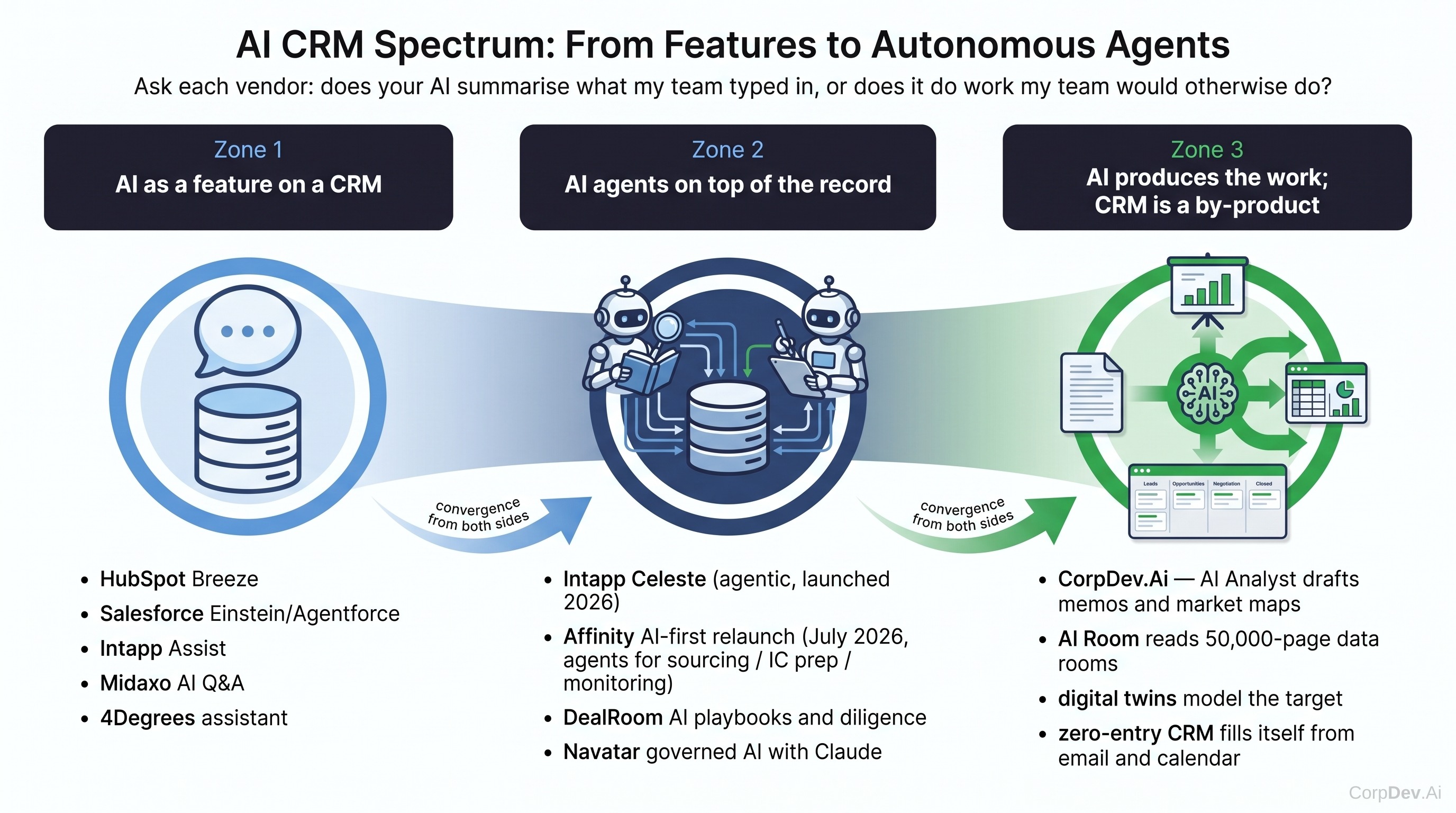
Read diagram description
Three approaches to AI in deal software. Zone 1 "AI as a feature on a CRM": HubSpot Breeze, Salesforce Einstein/Agentforce, Intapp Assist, Midaxo AI Q&A, 4Degrees assistant. Zone 2 "AI agents on top of the record": Intapp Celeste (agentic, launched 2026), Affinity AI-first relaunch (July 2026, agents for sourcing / IC prep / monitoring), DealRoom AI playbooks and diligence, Navatar governed AI with Claude. Zone 3 "AI produces the work; CRM is a by-product": CorpDev.Ai — AI Analyst drafts memos and market maps, AI Room reads 50,000-page data rooms, digital twins model the target, zero-entry CRM fills itself from email and calendar. Connections from
Zone 1 and
Zone 3 pointing toward
Zone 2 labelled "convergence from both sides". "Ask each vendor: does your AI summarise what my team typed in, or does it do work my team would otherwise do?"
6. Buyer Scenarios and Recommendations
No single vendor wins every scenario, and the recommendations below deliberately differ by buyer. The common thread is that the right answer follows from team size, deal cadence and where the hours go.
Profile: 15–50 deal-facing users across corporate and BU teams; 5–15 closed deals a year; existing Salesforce or Intapp estate; compliance and information-barrier requirements; dedicated IT and admin capacity.
Recommendation: Shortlist DealCloud against Salesforce Financial Services Cloud (with Navatar or a systems integrator). Pair with Grata for thesis-driven sourcing and Datasite Acquire for buy-side diligence. Include CorpDev.Ai in a phased primary-platform evaluation, testing end-to-end controls and analytical throughput in one BU before wider migration. Intapp Celeste can also extend the existing environment. Base replacement timing on demonstrated fit and migration requirements, not a fixed first-year exclusion.
Budget envelope: $600K–$1.2M over three years.
Profile: 4–12 person team; 3–8 acquisitions a year in a defined playbook; integration is a core competency; cross-functional participation from finance, legal, HR and IT in every deal.
Recommendation: Compare CorpDev.Ai, Midaxo and DealRoom as the primary M&A platform. CorpDev.Ai combines lifecycle management with analytical execution and deliverable production, making it especially relevant to a large programme with shared functional resources. Test DealRoom's diligence and participation model and Midaxo's playbook workflows on the same cases. Add Grata or another data source for specific coverage needs; programme frequency does not require CorpDev.Ai to sit above a separate process platform.
Budget envelope: $150K–$400K over three years.
Profile: 1–8 people; 0–3 deals a year but continuous strategic work — market maps, options briefs, inbound evaluation, board papers; no administrator; heavy reliance on advisers for analysis.
Recommendation: This is the buyer for whom DealCloud is most often the wrong purchase. Evaluate CorpDev.Ai first: its cost is a fraction of the adviser spend it targets and it covers all four jobs at basic-to-strong level. Benchmark against Affinity Essential + PitchBook (relationship-led teams) or HubSpot + Inven (cost-constrained). Insist on a 60–90 day paid pilot on a live workstream before committing.
Budget envelope: $40K–$180K over three years.
Profile: Relationship coverage is the business; many concurrent processes; fundraising or mandate pipelines; LP or client reporting.
Recommendation: DealCloud or Affinity depending on scale and budget — Affinity for funds under ~50 people, DealCloud for larger or governance-heavy institutions. Altvia or Dynamo where fundraising, IR or fund operations must share the system. CorpDev.Ai is relevant for the deal-analysis and CIM/pitch-production layer at banks and advisers, not as the CRM.
Budget envelope: $50K–$1.4M+ over three years.
The decision tree in one picture
The enterprise relationship management requirement determines which specialist capabilities belong in the evaluation. It does not determine which platform should own the full M&A programme. Compare the work the team must complete, the evidence and controls required, and the effort of maintaining multiple systems.
| Requirement | Evaluation approach | Decision implication |
|---|---|---|
| Enterprise relationship management | Compare DealCloud, Salesforce and Affinity on institutional relationship coverage, mandated information barriers and existing CRM investment. Use the actual transaction or institutional mandate. | Retain a specialist for its demonstrated contribution; its strength in this job does not establish overall M&A superiority. |
| End-to-end M&A management | Evaluate CorpDev.Ai, Midaxo and DealRoom on the connected path from thesis and target evaluation through diligence, decisions, execution and integration. | Include CorpDev.Ai as a primary-platform candidate. Product categories and the number of deals are not substitutes for a workflow demonstration. |
| Analytical execution and deliverables | Ask each finalist to analyse the same evidence and produce a decision-ready recommendation, supporting materials and an integration response. Record human corrections and remaining manual work. | CorpDev.Ai's combination of management and work-producing agents is particularly relevant when substantial analysis must accompany every deal. Compare the quality and completeness of the outputs. |
| Large or frequent acquisition programmes | Use concurrent evaluations and integrations, shared business-unit resources and recurring leadership reporting in the pilot. Test permission boundaries and ownership changes. | Programme scale strengthens the case for evaluating integrated management and analytical capacity together; it does not automatically favour Midaxo or DealRoom. |
| Existing systems and total cost | Price the required participants, AI usage, data entitlements, implementation, ongoing reconciliation and exit. Compare both replacement and coexistence. | Keep a second platform where a specific control or operating requirement justifies it. Avoid turning a small standard plan into an unsupported Enterprise cost estimate. |
Among the CRM-focused options, DealCloud (Intapp Data) and CorpDev.Ai combine company data with workflow; Datasite’s broader Pipeline and Intelligence ecosystem also offers relevant coverage. Other shortlists may require Grata, Sourcescrub, PitchBook or Inven depending on included enrichment and access to existing data — typically $15,000–$75,000 per year — before the team can run thesis-driven screening. Buyers comparing licence prices without this line are comparing incomplete stacks.
7. Due-Diligence Checklist for Your Software Purchase
Deal professionals diligence targets rigorously and software vendors casually. The questions below are the ones that, in practice, surface the differences that matter. Use them as a live tracker — one column per shortlisted vendor.
Commercial and contractual
- What is the all-in first-year cost including implementation, data, AI modules, integrations and training — and what is the year-three renewal uplift cap?
- Is pricing per named user, per active user, per deal or per team? What does it cost to add a finance or legal colleague to a single diligence for three months?
- What are the data-export rights on exit, in what formats, and within what timeframe? (Markdown/JSON/CSV with attachments is the standard to demand; a "database export on request" is not.)
- For vendors with fewer than 50 staff or less than five years' operating history: what escrow, continuity or source-access protections are offered?
- Has the vendor changed ownership, including Ansarada and Sourcescrub → Datasite or Altvia → Marlin (the latter in 2022, outside the last 24 months) and what has happened to roadmap, pricing and connectors since?
Product and workflow
- Show passive capture working on our Microsoft 365 / Google tenant: what is logged, what is enriched, what still requires manual entry?
- Walk through our actual stage-gate and approval process configured in the product. How long did the configuration take, and who maintains it?
- Run our real acquisition thesis through the sourcing capability. How many of the resulting companies are already in our pipeline, and does the system know?
- Load a redacted data room from a past deal. Can the AI answer a specific question with a page citation? Can it extract a financial table correctly?
- Ask the AI to draft an investment memo or market map from scratch on a sector we know. Evaluate depth, citation quality and how much senior rework is needed.
- Which AI models are used, where is data processed, is our data used for model training, and can we swap or restrict models?
- Does the product expose MCP or an equivalent so our own Copilot / Claude / ChatGPT deployment can read (and, with permissions, write) its data?
Governance and security
- Restricted lists, conflicts and information barriers: are they native, configurable and audit-logged?
- SOC 2 Type II, ISO 27001, SSO/SCIM, data residency options, and retention/deletion controls.
- Field-level permissions: can a BU leader see their deals but not another unit's?
Adoption and references
- Three reference customers of our size and type — not the largest logo, but the most similar one — including one that churned or downsized.
- What percentage of licensed users at comparable customers were active in the last 30 days?
- What does a 60–90 day paid pilot on one live workstream cost, and does the pilot fee credit against a subsequent contract?
Teams select a vendor on a scripted demo of the vendor's own data and discover the gaps on their first real deal. Every shortlisted product should be tested on the buyer's own pipeline export, a real (redacted) data room and a live research question before signature. Vendors that decline are telling you something.
8. Key Facts & Sources
The load-bearing figures in this report, with their source and as-of date. Estimates and analyst derivations are marked in the Basis column rather than in the figure itself.
| Figure | Value | Basis | Source | As of |
|---|---|---|---|---|
| Intapp FY2026 total revenue | $577.8M (+15% YoY) | Reported | [131] | Aug 2026 |
| Intapp cloud ARR / total ARR | $495.7M (+29%) / $590.5M (+22%) | Reported | [131] | Jun 30, 2026 |
| Intapp cloud net revenue retention | 123% | Reported | [131] | FY2026 |
| Intapp FY2029 ARR target | ~$1.0B, 20–22% CAGR | Investor Day | [136] | Apr 2026 |
| Intapp customers | 2,750+ total; 1,700+ private capital, IB and real assets | Reported (not DealCloud-specific) | [22][15] | Dec 2025 / Jun 2026 |
| Intapp market cap / consensus | ~$2.9B; Buy consensus, $40 PT | Spot market data | Private market-data snapshot; no public source retained | Sep 11, 2026 |
| DealCloud per-user price | ~$15,000–$40,000+ per year | Third-party estimate; no list price | [1][2][16] | 2026 |
| DealCloud contract range / average | ~$85,000–$1.43M; ~$505,000 average | Third-party procurement sample | [3] | 2026 |
| DealCloud implementation time | 2–4 months standard; 6+ months complex | Comparison sources | [2][17] | 2026 |
| DealCloud 3-year TCO, 10 users | ~$1.12M | Analyst derivation (Section 3 table) | [1][2][17] + assumptions | Sep 2026 |
| Intapp Data coverage | 85M+ companies, 200M+ contacts | Vendor statement | [9] | 2024 |
| Affinity pricing | $2,000 / $2,300 / $2,700 per user per year | Published | [25] | 2026 |
| Affinity funding / customers | $80M Series C (Menlo); 3,300+ firms | Vendor announcements | [27][24] | Funding Sep 2021; customer count Aug 2026 |
| 4Degrees pricing | ~$1,200–$1,800 per user per year | Third-party estimate | [30][31] | 2026 |
| Salesforce FSC list price | $325–$350 per user per month; Agentforce 1 $750 | Published | [50][51] | 2024 pricing page |
| Salesforce PE implementation | $75,000–$250,000+ | Third-party estimate | [52] | Mar 2026 |
| HubSpot Sales Hub | ~$1,080–$1,800 per user per year | Published / third-party | [54][55][57] | 2026 |
| Midaxo pricing | ~$30,000–$120,000 per year | Third-party estimate | [61][62] | Jun 2026 |
| DealRoom pricing | $12,000/yr Pipeline; $12,000/yr Diligence & Integration; platform from $25,000/yr; unlimited users | Published | [141][142] | 2026 |
| Devensoft Pipeline tier | $150 per user per month | Published (G2) | [69] | 2026 |
| Dynamo deployment cost | ~$50,000–$250,000 per year; 1,000+ clients | Third-party estimate / vendor | [45][46] | 2026 |
| Altvia deployment cost | ~$50,000–$150,000+ per year | Third-party estimate | [38][39] | 2026 |
| Grata pricing / coverage | ~$15,000–$45,000 per seat; 22M+ companies | Third-party estimate / vendor | [88][62][89][90] | 2026 |
| Sourcescrub pricing / coverage | ~$25,000–$75,000+; 16M+ companies, 220K+ sources | Third-party estimate / vendor | [97][98][100] | 2026 |
| PitchBook pricing | ~$12,000–$40,000 individual; $70,000+ enterprise | Third-party estimate | [106][108][109] | 2026 |
| Datasite–Ansarada | ~AUD 236M, completed Aug 2024 | Regulatory / press | [76][86][87] | 2024 |
| Datasite–Sourcescrub | Acquisition announced Aug 2025 | Vendor announcement linked from [105] | [100][105] | Aug 2025 |
| CorpDev.Ai pricing | $1,000/mo (annual) or $1,200/mo individual; $3,000/mo (annual) or $3,600/mo for 3 users; Enterprise custom | Published | [120] | Sep 2026 |
| CorpDev.Ai company scale | Founded 2023; 1–10 staff; co-founders Kilpi and Tiwary | LinkedIn / vendor | [124][123][125] | 2026 |
| CorpDev.Ai sourcing coverage | 70M+ companies | Vendor statement | [118] | Sep 2026 |
| 5-user annual cost comparison | See Section 5.2 chart | Analyst derivation from figures above | Section 5.2 basis note | Sep 2026 |
| DealCloud founding / Intapp acquisition | 2010 / 2018 | General industry knowledge; not separately re-verified in this research | — | — |
Caveats. Every "third-party estimate" above comes from comparison sites, procurement-benchmark aggregators and vendor competitive pages rather than from the vendor's own price list; treat them as planning envelopes with substantial, unquantified uncertainty. Intapp does not disclose DealCloud-specific revenue, ARR or customer counts, so all Intapp figures describe the parent company. Fit scores in Section 5.1 are analyst judgements. All vendor claims about AI capability were taken from public product material and have not been independently tested for this report.
References
Numbering follows the original research. Access dates below record the original source registry; they do not imply that every source was rechecked for this website edition.
- Affinity vs Intapp Deal Cloud (2026): Which Is Better? - RFP.wikiSource accessed 2026-09-11
- Fundraising CRM Comparison - Affinity vs DealCloudSource accessed 2026-09-11
- Intapp Pricing, Reviews, Pros & Cons (2026)Source accessed 2026-09-11
- A platform designed by industry experts - intapp.comSource accessed 2026-09-11
- Deal and Relationship Management | Private capitalSource accessed 2026-09-11
- Paine Schwartz Partners chooses Intapp DealCloud to accelerate ...Source accessed 2026-09-11
- Corporate Development | Consulting - IntappSource accessed 2026-09-11
- Intapp DealCloud for placement agentsSource accessed 2026-09-11
- Intapp launches new gen AI capabilities plus Walls for Copilot AND ...Source accessed 2026-09-11
- Infinedi Partners chooses Intapp DealCloud to accelerate ...Source accessed 2026-09-11
- Ensis Partners selects Intapp DealCloud with Celeste to build a best ...Source accessed 2026-09-11
- Ropes & Gray selects Intapp DealCloud with CelesteSource accessed 2026-09-11
- Deal and Relationship Management | Corporate - IntappSource accessed 2026-09-11
- Intapp leverages AI for regulated professional firms - Stock TitanSource accessed 2026-09-11
- Intapp DealCloud Review: Is It Worth It for PE & VC Firms in 2026?Source accessed 2026-09-11
- Affinity vs DealCloud: Which CRM is Right for You?Source accessed 2026-09-11
- Intapp Assist for DealCloudSource accessed 2026-09-11
- Intapp launches DealCloud plug-in for ChatGPT for Financial Services By Investing.comSource accessed 2026-09-11
- Intapp announces second quarter fiscal year 2026 financial ...Source accessed 2026-09-11
- CBPE Capital Selects DealCloudSource accessed 2026-09-11
- Best Private Equity CRM Software: A 2026 Buyer's GuideSource accessed 2026-09-11
- Affinity Pricing: Plans for Private Capital CRMSource accessed 2026-09-11
- A new Affinity: the AI-first private capital CRMSource accessed 2026-09-11
- Affinity's Series C Funding for Relationship IntelligenceSource accessed 2026-09-11
- 4Degrees: Pricing, Pros & Cons — CRM NewspaperSource accessed 2026-09-11
- 4Degrees CRM Review 2026: Is It Worth It for Small VC ...Source accessed 2026-09-11
- Private Equity CRM SoftwareSource accessed 2026-09-11
- The Intelligent CRM For Relationship-driven TeamsSource accessed 2026-09-11
- 4Degrees: Funding, Team & InvestorsSource accessed 2026-09-11
- 4Degrees | Valuation, Funding Rounds & Stock PriceSource accessed 2026-09-11
- Altvia | GP Engagement Platform For Fundraising, IR & Deal TeamsSource accessed 2026-09-11
- Altvia Software Reviews, Demo & PricingSource accessed 2026-09-11
- Dealcloud (intapp) - The...Source accessed 2026-09-11
- Altvia | LinkedInSource accessed 2026-09-11
- Marlin Equity Partners Completes Majority Recapitalization of AltviaSource accessed 2026-09-11
- Alternative Asset Management Software & CRM | DynamoSource accessed 2026-09-11
- Dynamo Software 2026 Pricing, Features, Reviews ... - GetAppSource accessed 2026-09-11
- Top 5 AI-Powered Private Equity CRM Platforms 2026Source accessed 2026-09-11
- Best Fund Administration Software for Private Equity (2026)Source accessed 2026-09-11
- Navatar Launches Governed AI Framework for Private Equity And MnASource accessed 2026-09-11
- Navatar Group signs clients for private equity CRM application - Private Equity WireSource accessed 2026-09-11
- Navatar Funds Growth With Support Of Decathlon Capital PartnersSource accessed 2026-09-11
- Financial Services Cloud PricingSource accessed 2026-09-11
- Financial Services Cloud PricingSource accessed 2026-09-11
- Salesforce for Private Equity: Deal Flow & Portfolio Company ...Source accessed 2026-09-11
- Sales Software PricingSource accessed 2026-09-11
- HubSpot Sales Hub Review 2026Source accessed 2026-09-11
- AI Sales Software for Pipeline & Closed DealsSource accessed 2026-09-11
- HubSpot Pricing 2026: Free vs Paid — The Full BreakdownSource accessed 2026-09-11
- M&A Intelligence Platform | Midaxo M&A SoftwareSource accessed 2026-09-11
- M&A Pipeline Software - MidaxoSource accessed 2026-09-11
- M&A Software & Intelligence Platform | MidaxoSource accessed 2026-09-11
- Best Due Diligence Platforms for M&A in 2026: 12-Vendor Buyer's ...Source accessed 2026-09-11
- AI for M&A (2026): Complete Tool Landscape and Vendor ...Source accessed 2026-09-11
- AI for M&A Deal Teams | Midaxo Intelligence PlatformSource accessed 2026-09-11
- Idinvest leads €12.9m series-B round for Midaxo | UnquoteSource accessed 2026-09-11
- MidaxoSource accessed 2026-09-11
- M&A Platform — Pipeline, Diligence, Integration & MoreSource accessed 2026-09-11
- Devensoft Pricing 2026Source accessed 2026-09-11
- Devensoft vs IBM Watson (2026): Data‑driven comparisonSource accessed 2026-09-11
- Datasite LLC- Ansarada Group Limited - ACCCwww.accc.gov.au › public-informal-merger-reviews-register-2002-25 › dat...Source accessed 2026-09-11
- Ansarada enters into Scheme Implementation Deed with ...Source accessed 2026-09-11
- Intralinks AI-Powered M&A Platform | DealCentre AISource accessed 2026-09-11
- SS&C Intralinks DealCentre AI PricingSource accessed 2026-09-11
- Datasite to acquire Ansarada for $236mSource accessed 2026-09-11
- Datasite Global Corporation completed the acquisition of ...Source accessed 2026-09-11
- SourceScrub Pricing, Reviews, Pros & Cons (2026)Source accessed 2026-09-11
- Best VC Deal Flow Tools: Affinity vs DealCloud (2026)Source accessed 2026-09-11
- Company Data APISource accessed 2026-09-11
- Corporate DevelopmentSource accessed 2026-09-11
- Agentic Search | AI Search for Private Markets - GrataSource accessed 2026-09-11
- Welcoming DealCloud To The Grata FamilySource accessed 2026-09-11
- CRM Integrations for Dealmaking - GrataSource accessed 2026-09-11
- Pricing & Features for SourcescrubSource accessed 2026-09-11
- Generect vs SourceScrub (2026): Which One Wins?Source accessed 2026-09-11
- What Is Sourcescrub?Source accessed 2026-09-11
- Datasite Acquires Sourcescrub to Enhance Private Market ...Source accessed 2026-09-11
- Sourcescrub Integrates Generative AI to Transform Private Equity ...Source accessed 2026-09-11
- Data for Deal Sourcing on Private Companies & Company Contact InformationSource accessed 2026-09-11
- Datasite to Acquire Sourcescrub, Expanding Private Market ...Source accessed 2026-09-11
- PitchBook — Private capital market intelligence for deal ...Source accessed 2026-09-11
- PitchBook’s Pricing - PitchBookSource accessed 2026-09-11
- Best Market Intelligence Platforms for M&A (2026)Source accessed 2026-09-11
- Best Deal Sourcing Tools for VCs (2026) - Bot MemoSource accessed 2026-09-11
- PitchBook Software Pricing, Alternatives & More 2026Source accessed 2026-09-11
- What are the best deal sourcing platforms in 2026? | InvenSource accessed 2026-09-11
- Deal Sourcing Platforms in 2026: Worth Paying For? - Tomba.ioSource accessed 2026-09-11
- The Cyndx PlatformSource accessed 2026-09-11
- Integrations - InvenSource accessed 2026-09-11
- CorpDev.Ai - Agentic AI for M&ASource accessed 2026-09-11
- Deep Company Intelligence & Research for M&A - CorpDev.AiSource accessed 2026-09-11
- Pricing - CorpDev.AiSource accessed 2026-09-11
- The Data Architecture Behind AI-Powered M&ASource accessed 2026-09-11
- Introduction & Installation - CorpDev.Ai DocsSource accessed 2026-09-11
- About Us - CorpDev.AiSource accessed 2026-09-11
- CorpDev.Ai | Software DevelopmentSource accessed 2026-09-11
- Atul Tiwary's Post - Agentic AI Analyst for M&A - LinkedInSource accessed 2026-09-11
- Intapp posts fiscal 2026 revenue of $577.8 millionSource accessed 2026-09-11
- Omnes Capital selects Intapp DealCloud to unify marketing ...Source accessed 2026-09-11
- Intapp (INTA) Investor Day 2026 summary - QuartrSource accessed 2026-09-11
- DealRoom | AI-Powered M&A Operating System for Buyer-Led M&A™Source accessed 2026-09-11
- Deal Management Software for M&A Teams - DealRoomSource accessed 2026-09-11
- Corporate Development Software - DealRoom.netSource accessed 2026-09-11
- DealRoom Pricing: M&A Software Plans and CostsSource accessed 2026-09-11
- Best Virtual Data Room Service Providers of 2026 – ComparisonSource accessed 2026-09-11
- Explore the LibrarySource accessed 2026-09-11
- DealRoom — Company ProfileSource accessed 2026-09-11
- About Us | Agile M&A Project Management SoftwareSource accessed 2026-09-11