RESEARCH / AI analysis and deliverables
Deliverables AI Alternatives: Memos, Models and M&A Analysis
Compare Deliverables AI, CorpDev.Ai, Rogo, Hebbia and general AI tools for deal documents, models, diligence, credit costs and practical buyer scenarios.
Research as of
Website edition edited
Published by CorpDev.Ai, which is one of the vendors assessed. This analysis distinguishes vendor claims, external evidence and analyst judgments. Prices and capabilities reflect the source dates in the article; the website edition is an editorial adaptation, not a new verification of every claim.
Separate document production economics from ownership of the deal workflow
Deliverables AI makes the production layer of M&A software economically distinct from the systems that hold the pipeline, source companies or govern diligence. For a team whose data and CRM already work, inexpensive document and model generation may address the remaining bottleneck more directly than replacing the whole environment. The low licence price is relevant because the comparison finds substantial differences in scope and vendor maturity, not evidence that cheap output is automatically investment-grade.
The operating question is where preparation ends and professional judgment begins. A draft that saves formatting time but increases numerical checking, citation repair or model reconstruction may contribute little capacity. Credit consumption also matters: a subscription’s nominal allowance is less informative than the cost of producing an accepted deliverable through several revisions.
Run the same screening memo, investment memo and model through each finalist and the existing general-purpose assistant. Measure reviewer effort and correctness through final approval. That evidence can justify a focused production tool, an integrated analytical workspace or continued use of the current stack.
Executive Summary
Corporate development, strategy and M&A teams are being sold "AI for deals" by at least five different kinds of vendor at once, and the products are not substitutes for one another. Deliverables AI is a narrowly focused deliverable factory: upload source material, ask in plain English, and receive a cited CIM, teaser, IC memo, screening memo, board deck or Excel model, priced at $25–$250 per seat per month on a credit meter [1][8]. CorpDev.Ai is a broader corp-dev operating system that bundles an agentic analyst, an AI-native data room, a document workbook, a zero-entry pipeline CRM, target sourcing across 70M+ companies and market mapping, priced at $1,000–$3,000 per month for one to three seats [13][15]. Between and around them sit the venture-backed finance copilots Rogo (>$165M raised, 25,000+ daily users) and Hebbia (~$161M raised), general-purpose enterprise AI (Microsoft 365 Copilot at $30/user/month, ChatGPT and Claude Enterprise), and the incumbent systems of record — Midaxo, DealCloud, Affinity, Datasite, Ansarada [18][17][71].
$4,500
Deliverables AI Pro, 3 seats, per year
$36,000
CorpDev.Ai AI Pro Team, 3 seats, per year
$1,080
Microsoft 365 Copilot, 3 seats, per year
~$30,000
Hebbia, 3 professional seats, per year (market estimate)
The verdict in three sentences. Buy Deliverables AI if your bottleneck is producing polished documents and models from material you already have, you work in Word, PowerPoint and Excel, and you want the lowest-risk entry price in the category — but recognise it is a very young company (founded 2024, an estimated ~$220K ARR, no disclosed funding) whose product deliberately stops at the edge of the data room and the CRM [6][10]. Buy CorpDev.Ai if the problem you are solving is the whole upstream workflow — sourcing, screening, monitoring, pipeline and diligence over large data rooms — and you are prepared to pay roughly eight times more for one integrated system and to accept a vendor of comparable early-stage maturity. If your firm already has Microsoft 365, include Copilot in the evaluation: at $30 per user it is the floor every specialist tool has to beat, and the honest comparison is "specialist tool plus Copilot" against "Copilot alone" [71].
| Product | Core role | Annual price scenario and limitation |
|---|---|---|
| Deliverables AI | Document and model production | ~$4.5K three-user scenario |
| Eilla AI | Financial research / production | ~$4K scenario; confirm tier |
| Microsoft 365 Copilot | General productivity baseline | ~$1.1K for three $30/month add-ons; underlying Microsoft licences separate |
| ChatGPT / Claude Enterprise | General AI baseline | Original ~$2–5K team estimate excludes possible minimum seats and usage; not a verified all-in Enterprise quote |
| Rogo | Finance copilot and Office artefacts | Original ~$10K team estimate not validated; per-seat, platform and implementation quote needed |
| Hebbia | Multi-document analysis | ~$30K scenario; actual seat mix and contract minimums vary |
| CorpDev.Ai | Research, sourcing, CRM, AI Room and deliverables | ~$36K three-user Team; Enterprise modelling and SSO excluded |
| Affinity | Relationship CRM | ~$6–8K for three users |
| Midaxo | M&A process system of record | ~$30–120K deployment scenarios |
| DealCloud | Enterprise deal and relationship system | ~$85K–$1.4M contract examples |
| Datasite / Ansarada | Transaction VDR | Per-deal quotes; not directly comparable with annual team subscriptions |
The categories are production/analysis, ongoing CRM/process and transaction execution. Deliverables AI concentrates on production; CorpDev.Ai spans analysis and parts of the operating workflow. Scope, licence minimums and data entitlements prevent a simple price ranking.
Five things a buyer should take away from this comparison:
- Scope, not model quality, is the real differentiator. All of these vendors route to the same handful of frontier models (CorpDev.Ai states it orchestrates Anthropic, OpenAI, Perplexity and Google; the others are similar) [13]. What you are paying for is the workflow, the data connectors, the citation and audit layer, and the output formats — so evaluate those, not the demo prose.
- Deliverables AI's credit meter is generous for a small team but must be modelled. A Pro seat carries 20,000 credits per month; a long-form CIM typically costs ~6,500 and can reach 19,000, a financial model ~3,000 [8]. A two-seat team doing three CIMs and a handful of models a month sits inside its allowance; a team that iterates heavily will buy top-ups at $0.01–$0.02 per credit.
- CorpDev.Ai's price buys breadth you may or may not need. The AI Pro Team plan includes CRM, sourcing, monitoring and market mapping — functions a corp-dev team otherwise licenses from Affinity, Grata or Midaxo at $6,000–$120,000 a year [21][25][19]. If you need several of those functions, compare the actual module and seat quotes: the cited ranges do not establish that any two-tool combination necessarily costs more than $36,000; if you only need documents, it is over-buying.
- Neither of the two focal vendors is a "safe" enterprise procurement. Both are small, founder-led and lightly disclosed. Rogo, Hebbia, Midaxo and DealCloud carry materially lower vendor-viability risk, at materially higher prices [18][17]. Contract for data export and exit rights accordingly (Section 6).
- Test on your own data room before you sign anything. Public accuracy claims in this category are not comparable across vendors; a 50–100 question side-by-side pilot on an anonymised deal is the only evidence that transfers [92].
CorpDev.Ai publishes this comparison and is one of the vendors compared. Every product claim below is taken from vendor-published material or third-party sources and cited; where a figure is a market estimate rather than a published price, it is labelled as such. Both focal vendors' marketing claims ("6 weeks to 10 days", "100× faster at 1% the cost") are reported as claims, not as verified performance.
1. What Problem Are You Actually Buying For?
Most bad software decisions in corporate development come from comparing tools that do different jobs. A corp-dev or strategy team runs four distinct workflows, and the AI vendors now pitching to that team each anchor on one of them and stretch toward the others.
Job: market maps, target universes, fit scoring, trigger monitoring.
Incumbents: Grata, PitchBook, Capital IQ, Apollo, analyst hours.
AI entrants: CorpDev.Ai, Finster, AlphaSense.
Job: read a CIM or a data room, extract metrics, find risks, reconcile numbers across documents.
Incumbents: associates, Big Four QoE, Kira / Luminance for contracts.
AI entrants: Hebbia, Rogo, Keye, Deliverables AI, CorpDev.Ai AI Room.
Job: IC memos, board decks, screening one-pagers, DCF and merger models, teasers and CIMs.
Incumbents: PowerPoint, Excel, Macabacus, bankers.
AI entrants: Deliverables AI, Rogo, Eilla, Mosaic, Copilot.
Job: pipeline, relationship history, task tracking, VDR execution, integration.
Incumbents: Midaxo, DealCloud, Affinity, Datasite, Ansarada.
AI entrants: CorpDev.Ai CRM, Deliverables AI Deal Tracker (lightweight), Blueflame (now Datasite).
Deliverables AI is a job-3 product with a serious job-2 capability and a token job-4 feature. Its own documentation is candid about this: it "does not directly connect to VDRs or data rooms by design," expecting the team to download from Datasite or Intralinks and upload [6]; its Deal Tracker is "a lightweight deal-process coordination layer, not necessarily a full CRM" [7]. CorpDev.Ai is a job-1-and-4 product that has built job-2 and job-3 capabilities on top — its pitch is explicitly "strategy → sourcing → due diligence → execution → integration" [14]. Rogo and Hebbia are job-2 products that have expanded into job 3 [16][18]. Copilot, ChatGPT and Claude are job-2/3 generalists with no notion of a deal at all.
| Product | Find and prioritise | Analyse and diligence | Produce and persuade | Run the process |
|---|---|---|---|---|
| Deliverables AI | Partial: target/buyer lists | Core analysis workflow | Core deliverables | Partial: Deal Tracker |
| CorpDev.Ai | Core sourcing / screening claim | AI Room document analysis | Memos/decks; financial modelling requires Enterprise | Pipeline CRM and AI Room; specialist bidder controls and operational PMI must be assessed separately |
| Rogo | Partial research/screening | Core finance/document analysis | Core models, memos and decks | No dedicated deal CRM core; connected workflow varies |
| Hebbia | Not primarily a sourcing database; connected feeds may help | Core corpus analysis | Extraction-to-output workflow; newer agents extend memo/model/deck production | No native deal CRM core; templates and integrations support repeatable analysis |
| Microsoft 365 Copilot | Configured research/connector support | Partial, configuration-dependent | General drafting and Office assistance | No dedicated M&A system of record by default; agents/connectors can automate parts |
| Midaxo | Partial sourcing and enrichment | Project/documents with AI analysis | Reports and AI over deal data; specialist production depth varies | Core M&A process and governance |
| Affinity | Relationship-led sourcing | Deal-record/document AI varies by tier | Summaries/drafting and agents vary; not categorically absent | Core relationship CRM |
| Datasite / Ansarada | Core rooms are not open-company databases; Datasite suite includes sourcing | VDR evidence access and suite AI; depth depends on module | Suite drafting/AI output varies; core room is not a full document workbench | Core disclosure and transaction control |
The original simplified matrix marked CorpDev.Ai in all four stages; breadth does not establish equal specialist depth. Compare the licensed core product with current suite extensions, and measure review effort and output quality.
The practical consequence is that the question "Deliverables AI or CorpDev.Ai?" is usually the wrong first question. The right sequence is:
- Which of the four jobs is your binding constraint today? A two-person corp-dev team at a mid-cap that closes one deal a year is constrained by production time (job 3) and can live with a spreadsheet pipeline. A programmatic acquirer screening 300 targets a year is constrained by sourcing and process (jobs 1 and 4).
- What do you already pay for? If Affinity or Midaxo is in place and working, CorpDev.Ai's CRM is redundant and its price premium over Deliverables AI is harder to justify. If nothing is in place, the bundle argument favours CorpDev.Ai.
- What is your Microsoft or Google position? Copilot at $30 per user per month and Gemini at $27–$35 already cover a surprising share of job 3 for teams whose material sits in SharePoint or Drive [71][77]. Any specialist tool has to show incremental value over that floor.
- How much vendor risk can procurement tolerate? Both focal vendors are early-stage. If your IT security team requires a SOC 2 Type II report, multi-year viability evidence and a negotiated DPA, Rogo, Hebbia, Midaxo or DealCloud will clear that bar more easily — at three to thirty times the price.
For most teams under ten people, the best-value 2026 stack is a general-purpose copilot for everyday drafting, one specialist deliverable or analysis tool for deal work, and a lightweight CRM — roughly $6,000–$20,000 a year all-in. Only when sourcing volume, monitoring or data-room scale becomes the bottleneck does a single integrated platform at $36,000+ pay for itself. Section 5 quantifies this.
2. Deliverables AI in Depth
What it is
Deliverables AI describes itself as an "AI deal assistant" for investment banking, M&A advisory, private equity, corporate development and strategy teams. The user uploads source files — CIMs, management presentations, financial statements, diligence reports, market research, data-room downloads — and asks for a deliverable in plain English. The platform synthesises the material and returns an editable, versioned Word, PowerPoint or Excel output with citations back to the sources [1][2]. The product is organised as a library of "skills": CIM and teaser generation, buyer and target lists, deal screening, IC memo, due-diligence checklist, DCF and merger models, market research, board decks and a Deal Tracker [2][3][4][7].
2024
Founded (Andrew Roberts, Jeff Tannenbaum)
$25–$250
Per seat per month, three tiers
20,000
Credits per Pro seat per month
~$220K
Estimated 2025 ARR (third-party estimate)
Skills relevant to a corp-dev buyer
| Workflow | What the skill does | Output | Corp-dev relevance |
|---|---|---|---|
| Deal screening | Extracts transaction and company metrics from an inbound CIM or teaser, compares them with user-defined criteria, applies a pass/fail framework, surfaces risks and value drivers [3] | One-page screening memo | High — the highest-frequency task for any team receiving banker inbound |
| IC memo | Synthesises diligence findings, financial analysis and deal terms into a committee document [4] | DOCX / PDF memo | High |
| Target list | Searches and ranks companies against an acquisition thesis using B2B data, with fit rationale and contacts [2] | XLSX list plus screening brief | Medium — useful, but shallower than a dedicated sourcing database |
| DCF and merger model | Retrieves financial data, projects cash flows, computes WACC, runs sensitivities; merger model covers accretion/dilution, synergies and PPA [2] | XLSX model | High for strategy teams without banker support; outputs need finance review |
| Data-room analysis | Processes downloaded data-room files; extracts insights, metrics, risks and value drivers with citations [6] | Analysis, diligence checklist | Medium — works on uploaded files only, no VDR connector |
| Board and strategy deck | Turns analysed company, market and competitive information into a presentation in the firm's template (Max plan) [1][8] | PPTX | High |
| Deal Tracker | Tracks live deals, milestones, deadlines, action items [7] | Pipeline view | Low — a coordination layer, not a CRM |
Pricing, and how to read the credit meter
Pricing is per seat with a shared pool of credits that meter actual compute consumed [8]:
| Plan | Price | Minimum seats | Credits per seat per month | Distinguishing features |
|---|---|---|---|---|
| Standard | $25 per month | 1 | 3,000 | All skills, version history, memory, top-ups |
| Pro | $125 per seat per month | 2 (from $250 per month) | 20,000 | Adds shared projects and team collaboration; 25% credit discount |
| Max | $250 per seat per month | 5 (from $1,250 per month) | 45,000 | Adds custom skills, firm-specific workflows, branded templates, API access, priority support |
A 30-day free trial with 10,000 credits and no credit card is offered. Top-up credits cost $0.01 each bought ahead or $0.02 on auto-reload and never expire; included plan credits reset monthly [8].
The published typical costs per task let a buyer size a seat properly [8]:
| Task | Typical | Up to |
|---|---|---|
| Quick question or lookup | 100 | 400 |
| Research answer in chat | 200 | 1000 |
| Deep research report | 1100 | 3000 |
| Written report or memo (DOCX/PDF) | 1900 | 12000 |
| Short deck or teaser (under 20 slides) | 2000 | 6000 |
| Financial model (XLSX) | 3000 | 9500 |
| Long-form deck or CIM (20+ slides) | 6500 | 19000 |
Worked example for a corp-dev pair on Pro (40,000 pooled credits a month, $250): four screening memos (~7,600), one IC memo (~1,900), one DCF (~3,000), one board deck (~6,500) and a hundred chat lookups (~10,000) consume roughly 29,000 credits — comfortably inside the pool. A team that regenerates a long CIM five times in a month to iterate on narrative could exhaust the same pool on that task alone. The meter therefore rewards disciplined prompting and penalises trial-and-error; a buyer should run the trial with real material and watch the balance before choosing between Pro and Max.
Customers and evidence of value
Public evidence comes almost entirely from company-published case studies at boutique advisory firms rather than from corporate development teams [12]:
- Rowe | Tomes Advisors (sell-side): a CIM, teaser, buyer list and diligence checklist process described as taking six weeks reduced to roughly ten days; the firm reports running more mandates in parallel without adding headcount [5][12].
- TechStrat: data-room review roughly one-third faster; competitive-pitch win rate reported to have risen from 34% to 42% [12].
- Solganick: qualified founder conversations up about 25% (12 to 15 per month) from origination research [12].
No independent G2, Capterra or analyst coverage of any depth was identified, and no corporate-development reference customer is published [2]. The company is a 2024 start-up; GetLatka estimates 2025 ARR at about $220,000 and records no disclosed funding — a third-party estimate, not a company figure [10].
Strengths
- Lowest entry price in the category, with transparent, self-serve pricing. A two-person team can start for $250 a month with no procurement cycle; nothing else in this comparison, apart from general-purpose copilots and Eilla, comes close [8].
- Finance-native output formats. Editable DOCX, PPTX and XLSX with version history, firm templates and cited sources — the formats an IC or board actually consumes [1][8].
- Skills map to real corp-dev tasks. Screening memos, IC memos, DCF and merger models are exactly the recurring artefacts a small team struggles to produce fast.
- Honest scoping. The vendor states plainly what it does not do (VDR connection, full CRM), which is unusual in this category and makes the product easier to slot into an existing stack [6][7].
- Stated enterprise controls: server-side workspace isolation, encryption, no training on customer data [2].
Limitations and risks
A 2024 start-up with an estimated ~$220K ARR and no disclosed institutional funding [10]. The product may be excellent, but a corp-dev team embedding its IC process in the tool should contract for data export and price protection, and should keep source files and outputs in its own repositories. Ask for the SOC 2 report, not the badge.
- No data-room connector and no persistent knowledge base across deals. Every engagement starts from uploads; there is no continuous company intelligence, monitoring or trigger feed [6].
- Thin sourcing. The target-list skill draws on B2B contact data but is not a substitute for a Grata- or CorpDev.Ai-class sourcing layer with semantic search across tens of millions of companies [2].
- Pipeline is a tracker, not a CRM. No email or calendar sync, no relationship intelligence, no activity capture [7].
- Credit metering creates variable cost and a behavioural incentive to under-iterate; heavy users should budget top-ups or move to Max.
- Customer evidence is sell-side and self-published. The corp-dev use case is asserted on the solutions page but not yet demonstrated by a named reference [2][12].
- Model outputs need finance review. As with every tool in this category, DCF and merger models are first drafts; assumption logic, accounting treatment and transaction mechanics must be checked by a professional [2].
Bottom line on Deliverables AI: it is the most cost-efficient way in 2026 to convert deal material into finished documents and models, and the cleanest "add-on" to an existing corp-dev stack. It is not a system of record, not a sourcing engine and not a data room, and its corporate-development credentials are still to be proven by reference customers.
3. The Alternatives
3.1 CorpDev.Ai — the end-to-end corp-dev operating system
What it is. CorpDev.Ai positions itself as "the most comprehensive end-to-end M&A platform" — an agentic system spanning strategy, sourcing, diligence, execution and integration, built by founders who have both built M&A software and run deals. CEO Kal Kilpi co-founded Midaxo and founded Vastuu Group (acquired); co-founder Atul Tiwary was VP M&A at Barracuda Networks under Thoma Bravo, VP Investment Banking at RBC and Senior Director of Corporate Development at Fortinet [13][14]. That pedigree matters: the product is designed around the workflow of a repeat corporate acquirer rather than a banker's pitch cycle.
Modules. The published feature list covers seven areas, all included from the entry plan [13][15]:
| Module | What it does | Nearest stand-alone substitute |
|---|---|---|
| AI Analyst Agent and Workbook | Natural-language analyst producing investment memos, market research, company profiles, strategic analyses and presentations in a Markdown-native collaborative editor with citations, versioning and DOCX/PPTX/XLSX/PDF export | Deliverables AI, Rogo, Copilot |
| AI Room (AI-native data room) | Ingests PDF/XLSX/DOCX/PPTX, vision-based extraction, converts to queryable text, page-level citations, audit trail; vendor claims a 50,000-page room can be made searchable | Hebbia, Keye |
| Pipeline Kanban and zero-entry CRM | Microsoft 365 / Google Workspace email and calendar sync; AI populates and enriches the CRM, tracks engagement, news, triggers and next actions | Affinity, Midaxo |
| Company search and intelligence | Cited profiles: firmographics, financials, funding, leadership, competitive position, fit, news and M&A triggers | Grata, PitchBook (partial) |
| Target sourcing | Semantic search, firmographic (Apollo) and geographic search, people search, fit scoring, bulk screening; 70M+ companies, 265M+ contacts | Grata, Apollo |
| Market mapping | AI-generated maps, segmentation, interactive visualisations, export-ready presentations | Consultants, Grata |
| Target monitoring | News, management change, M&A activity alerts | AlphaSense (partial) |
| Digital Twin Models (roadmap/enterprise) | Models a target or carve-out as a connected system of assumptions, contracts, people, systems and P&L for diligence and PMI planning | Midaxo integration module, consultants |
Pricing. Verified from the vendor's pricing page on 11 September 2026 [13]:
| Plan | Annual invoicing | Credit card | Seats | Search credits | Notes |
|---|---|---|---|---|---|
| AI Pro | $1,000 per month | $1,200 per month | 1 | 12,000 per year | All modules above except team features |
| AI Pro Team | $3,000 per month | $3,600 per month | 3 | 36,000 per year | Adds collaboration, admin controls, priority support, dedicated CSM |
| Enterprise | Custom | Custom | Unlimited, SSO | Custom | Adds financial modelling, solutions architect, managed services |
Two pricing facts a buyer should weigh. First, financial modelling is an Enterprise-exclusive capability — a strategy team that wants AI-built DCF or merger models on the self-serve plans will not get them here, whereas Deliverables AI includes them at $25 [13][8]. Second, the plans meter search credits (1,000 per seat per month), not generation; the pricing page does not publish a per-task consumption table equivalent to Deliverables AI's, so a buyer should ask what a heavy sourcing month consumes.
Evidence. The company cites "hundreds of CorpDev professionals" and states SOC 2 Type II compliance, encryption at rest and in transit, and no training on customer data [13]. No named reference customers, funding rounds or revenue figures are published; like Deliverables AI, it should be treated as an early-stage vendor for procurement purposes.
Strengths for a corp-dev buyer
- One system for the upstream workflow. Sourcing, monitoring, pipeline and diligence in one place with a shared knowledge layer ("CorpDev Brain") that learns across deals — the thing Deliverables AI structurally lacks [13].
- Zero-entry CRM. Automatic capture from email and calendar removes the data-entry burden that kills most corp-dev CRM deployments.
- Data-room scale. The AI Room is designed for whole-room ingestion with page-level citations, competing with Hebbia and Keye rather than with document generators [13].
- Bundle economics. At $36,000 for three seats it undercuts the combination of Affinity ($6,000–$8,100), Grata ($15,000–$45,000 per seat) and a Hebbia-class analysis tool (~$30,000) [25][19][17].
- Exports to standard formats and an explicitly "open, traceable" architecture position, which reduces lock-in relative to closed platforms [14].
Limitations and risks
A platform that spans seven modules will not match a specialist in every one. Buyers should test the AI Room against Hebbia on their own documents, the sourcing module against Grata on a known target universe, and the presentation output against Deliverables AI on a real board deck — and should expect trade-offs.
- Price-to-value depends on using the bundle. A team that only needs documents pays roughly eight times Deliverables AI's Pro price for capabilities it will not use.
- No self-serve financial modelling on AI Pro or AI Pro Team [13].
- Marketing claims are aggressive ("100× faster, at 1% the cost") and unverified [13].
- Early-stage vendor with no disclosed funding or named references; the same viability caveats as Deliverables AI apply.
- Not a VDR. Like Deliverables AI, it analyses files but does not replace Datasite or Ansarada for a live sell-side process.
Bottom line on CorpDev.Ai: the strongest option in this comparison for a team whose bottleneck is sourcing, monitoring and pipeline discipline rather than document production, and the only one that credibly consolidates three or four line items into one. It is over-specified — and over-priced — for a team that simply wants better IC memos.
3.2 AI deliverable and analysis peers — Rogo, Hebbia, Eilla and others
These are the vendors a corp-dev buyer will most often see in the same RFP as Deliverables AI: products whose primary job is analysing deal documents and producing finance-grade output.
Rogo is the best-funded and fastest-growing product in the category. It announced a $75M Series C led by Sequoia in January 2026, bringing total funding to more than $165M, opened a London office and reported over 25,000 daily users at firms including Rothschild & Co, Jefferies and Lazard [18]. In September 2026 it announced a partnership with Datasite and the acquisition of Arvo, an AI meeting assistant for financial institutions, and disclosed strategic investment from large financial institutions [18]. Third-party trackers report a subsequent round at a materially higher valuation and an ARR run-rate in the tens of millions; those figures are estimates and are not confirmed by the company [81][83]. For a corp-dev buyer Rogo's appeal is a finance-trained copilot that lives inside the Office applications the team already uses; its constraints are enterprise-only sales, pricing that is not published and a product tuned to banks and funds rather than corporate acquirers. It is not a CRM, a sourcing engine or a data room.
Hebbia built its reputation on "Matrix," a grid-based interface for asking hundreds of questions across thousands of documents with page-level citations. Matrix 2.0 (January 2026) extends the product from analysis to final deliverables — memos, decks and models [16]. It raised $130M at a ~$700M valuation in 2024 on about $13M of revenue [87], publishes SOC 2 Type II and TLS 1.2+ [96], and its DPA permits processing in any country where it or its subprocessors operate — a point for EU buyers to negotiate [98]. Market estimates put a professional seat at ~$10,000 per year and ARR around $48M in mid-2026 [17]. Hebbia is the benchmark for data-room-scale analysis; a corp-dev team should test CorpDev.Ai's AI Room and Deliverables AI's data-room skill against it, not the other way round.
Eilla AI is the closest price peer to Deliverables AI. A Bulgarian-founded company with $1.5M of seed funding, it offers research, investment analysis and IC-memo workflows with a free tier and a $329-per-month five-seat Professional plan [30][90]. It has pivoted partly toward AI-native M&A advisory for SMBs, executing what it calls Europe's first AI-native M&A deal in April 2026 [28]. It is a credible low-cost option for a boutique; corp-dev buyers should treat it as an experiment rather than a platform.
Others worth knowing, briefly. Mosaic ($18M Series A, April 2026) is the most capable automated LBO/transaction-model builder and a natural add-on for PE-style analysis [55]. Keye ($5M seed; 20+ funds, $1.4T AUM) is a PE diligence analyst rather than a document producer [39][40]. Blueflame was acquired by Datasite in 2025 and now sits inside the VDR vendor's enterprise offer [33]. Bridgetown Research ($19M Series A) sells AI research agents that behave like an outsourced commercial-diligence team [50]. Finster ($15M raised) is financial intelligence and deal monitoring for banks and asset managers [61]. Macabacus ($200–$360 per licence per year) is not generative AI at all but remains the quiet productivity layer many banks pair with any of the above [57].
Rogo and Hebbia sell annual enterprise contracts with minimum commitments, security reviews and implementation. For a three-person corporate team, the realistic entry cost is not the per-seat estimate but the contract minimum, which buyers report in the tens of thousands of dollars. Deliverables AI and CorpDev.Ai are the only two focal vendors a small team can actually buy with a credit card this quarter.
3.3 General-purpose AI — ChatGPT Enterprise, Claude, Microsoft 365 Copilot
Every specialist vendor in this comparison is, under the hood, orchestrating one or more of the same frontier models a buyer can license directly. The generalists therefore set the price floor and the honest baseline for any pilot.
| Product | Price per seat | Data terms | Office integration | Where it falls short for deal work |
|---|---|---|---|---|
| Microsoft 365 Copilot | $30 per user per month (annual); ~$21 business tier [71] | Not used to train foundation models; inherits Microsoft 365 permissions [73][74] | Native in Excel, PowerPoint, Word, Outlook, Teams | Weak on mixed PDF/scan data rooms; retrieval can miss files or use wrong versions; not a deal system [76] |
| ChatGPT Enterprise | Custom quote; annual [63] | Not trained on by default; SSO/SCIM, residency options [63] | Sidebar for Excel/Sheets; PowerPoint add-in on credit model [64] | 40-file project limit; citations incomplete; hallucination on figures [65] |
| Claude Enterprise | Custom; ~$60 per user per month indicative [66] | Not trained on under commercial terms [66] | Creates and edits XLSX/PPTX; strong model auditing [67][69] | Context and usage limits on large corpora; citations not exhaustive [70] |
| Gemini for Workspace | $27–$35 per user per month [77] | Not used for training; Workspace permissions, DLP [78] | Native in Drive, Sheets, Slides, Gmail | Monthly quotas on spreadsheet and slide generation; Excel-specific features unsupported [79] |
What the generalists do well. For a corp-dev team already on Microsoft 365, Copilot summarises a CIM, drafts a first-pass screening note, explains an unfamiliar model and rewrites a slide — inside the files, under existing permissions, at $360 per user per year [71]. Claude and ChatGPT are stronger at long-document reasoning and increasingly capable of building and auditing Excel models [67][64]. For everyday drafting, this is where the marginal dollar goes first.
Where they fall short. Four structural gaps explain why the specialist category exists [65][70][76]:
- No native deal system of record. General-purpose tools can retain project context or be configured around deal concepts, but the buyer must supply and maintain the target, pipeline, buyer-list and diligence structure. A generic chat alone does not establish an auditable deal record.
- Corpus limits. ChatGPT Enterprise projects cap at 40 files; Claude's usable context is bounded by usage capacity; Copilot retrieves rather than ingests. None can be pointed at a 5,000-file data room and trusted to have read all of it.
- Citations are navigational, not evidential. All four can cite, but none guarantees exhaustive retrieval or correct page references; a reviewer must open the source.
- Finance workflows require configuration and review. Producing a bank-quality CIM or linked three-statement model requires suitable templates, instructions and financial review. Specialists package these workflows, but their availability does not establish superior output accuracy.
In any pilot of Deliverables AI, CorpDev.Ai, Rogo or Hebbia, give the same source pack and the same 50 questions to Copilot or Claude Enterprise as well. If the specialist does not beat the generalist on citation accuracy, output quality and time-to-first-draft by a clear margin, the specialist's price premium is not justified.
3.4 Adjacent categories a corp-dev buyer will be cross-sold — CRM, VDR, sourcing data, legal review
Neither Deliverables AI nor CorpDev.Ai replaces every incumbent in a corp-dev stack. The table sets out what each adjacent category does, what it costs, and whether the two focal vendors overlap with it.
| Category | Leading vendors | Indicative cost (2026) | Overlap with Deliverables AI | Overlap with CorpDev.Ai |
|---|---|---|---|---|
| Corp-dev system of record | Midaxo, Intapp DealCloud | Midaxo from ~$10,000, typically $30,000–$120,000 per year [21][22]; DealCloud ~$85,000–$1.4M+ per year [24] | Minimal — Deal Tracker is a task list | Substantial — pipeline, CRM, activity timeline, integration planning (Digital Twin) |
| Relationship CRM | Affinity | $2,000–$2,700 per user per year [25] | None | Substantial — zero-entry CRM with email/calendar sync |
| Private-company sourcing data | Grata, PitchBook, Capital IQ | Grata ~$15,000–$45,000 per seat per year [19] | Partial — target-list skill on B2B data | Substantial — 70M+ companies, semantic and geographic search, fit scoring |
| Virtual data room | Datasite, Ansarada, Intralinks | Per deal; Ansarada ~$5,000–$30,000 per transaction [26] | None — analyses downloaded files | None — analyses uploaded files; no bidder Q&A or permissions |
| Legal contract review | Kira (Litera), Luminance, Harvey | Kira ~$25,000–$85,000; Luminance ~$30,000–$90,000; Harvey ~$60,000–$200,000+ per year [27] | Partial — extracts risks from uploaded contracts, no clause-model library | Partial — AI Room Q&A over contracts, no clause-model library |
| Market intelligence | AlphaSense | Tens of thousands per user per year (negotiated) | Partial — research skill on public web | Substantial — company intelligence, monitoring, market maps |
Reading the table. Deliverables AI is complementary to almost every incumbent: it sits downstream of the VDR and the CRM and turns their contents into documents. That makes it easy to add and easy to remove. CorpDev.Ai is substitutive for three of the six categories — CRM, sourcing data and market intelligence — which is the basis of its bundle pricing and also the reason its implementation is a bigger decision: replacing Affinity or Grata means migrating history and retraining a team.
No product in this comparison replaces Datasite, Ansarada or Intralinks for a live process. Both focal vendors expect files to be downloaded and uploaded; Rogo has chosen to partner with Datasite rather than compete [18], and Datasite bought Blueflame to add AI inside the room [33]. Budget the VDR separately, per transaction.
| Layer / incumbent examples | Stack with Deliverables AI | Stack with CorpDev.Ai |
|---|---|---|
| Data and sourcing: Grata, PitchBook, Apollo | Incumbent coverage and entitlements remain; production sits downstream | May consolidate firmographic sourcing/research; licensed financial depth may still require a data product |
| Pipeline and CRM: Affinity, Midaxo, DealCloud | Existing system of record remains | Built-in pipeline may replace lighter CRM needs; enterprise governance and relationship requirements must be tested |
| Data room: Datasite, Ansarada | VDR generally remains as evidence/permissions infrastructure | AI Room supports internal document analysis; external bidder-facing controls may still require a specialist VDR |
| Analysis and diligence: Hebbia, Kira, Big Four | Deliverables AI overlaps with analytical production | AI analyst and AI Room overlap with research/analysis; specialist legal or financial review may remain |
| Deliverables: PowerPoint, Excel, Word, Copilot | Core document/model production overlay | Native drafting and exports; Enterprise modelling scope must be confirmed |
Deliverables AI primarily adds production over the existing stack. CorpDev.Ai can consolidate more layers, but does not automatically replace every data licence, CRM control or specialist review. Microsoft 365 Copilot may sit alongside either at the cited $30/user/month add-on price.
4. Head-to-Head Comparison
Capability matrix
Ratings reflect published product scope as of September 2026: ● native, core capability; ◐ present but partial or lightweight; ○ absent. They describe what the product is designed to do, not measured quality — quality is what the pilot in Section 6 establishes.
| Capability | Deliverables AI | CorpDev.Ai | Rogo | Hebbia | M365 Copilot | Midaxo | Affinity |
|---|---|---|---|---|---|---|---|
| Target sourcing / market maps | ◐ | ● | ◐ | ○ | ○ | ◐ | ◐ |
| Company intelligence and monitoring | ○ | ● | ◐ | ○ | ○ | ○ | ◐ |
| Inbound deal screening (CIM triage) | ● | ● | ● | ● | ◐ | ◐ | ○ |
| Whole-data-room ingestion with citations | ◐ | ● | ◐ | ● | ○ | ○ | ○ |
| IC memo / board deck generation | ● | ● | ● | ◐ | ◐ | ○ | ○ |
| DCF / merger model generation | ● | ◐ (Enterprise only) | ● | ◐ | ◐ | ○ | ○ |
| CIM / teaser / buyer list (sell-side) | ● | ◐ | ● | ◐ | ○ | ○ | ○ |
| Pipeline CRM with email/calendar sync | ○ | ● | ○ | ○ | ○ | ● | ● |
| Integration / PMI planning | ○ | End-to-end management and integration work; validate programme controls | ○ | ○ | ○ | ● | ○ |
| Firm templates and custom workflows | ● (Max) | ● | ● | ● | ● | ● | ◐ |
| API / integrations | ◐ (Max) | ● (REST, MCP) | ● | ● | ● | ● | ● |
| Self-serve purchase, published price | ● | ● | ○ | ○ | ● | ◐ | ● |
| Free trial without credit card | ● (30 days) | ● | ○ | ○ | ○ | ○ | ○ |
Sources: vendor pricing and product pages [1][2][6][7][8][13][15][16][18][21][25][71].
Price normalised to a three-person corporate development team
| Vendor | Plan assumed | Annual cost, 3 seats | Basis |
|---|---|---|---|
| Microsoft 365 Copilot | Enterprise add-on | $1,080 | Published: $30 per user per month [71] |
| Deliverables AI | Pro (min. 2 seats) | $4,500 | Published: $125 per seat per month [8] |
| Eilla AI | Professional (5 seats incl.) | $3,948 | Published: $329 per month [30] |
| Affinity | Mid tier | ~$7,000 | Published tiers $2,000–$2,700 per user per year [25] |
| Rogo | Enterprise | ~$10,000 before minimums | Market estimate ~$3,300 per seat per year [83] |
| Deliverables AI | Max (min. 5 seats) | $15,000 | Published: $1,250 per month floor [8] |
| Hebbia | Enterprise | ~$30,000 before minimums | Market estimate ~$10,000 per professional seat per year [17] |
| CorpDev.Ai | AI Pro Team | $36,000 | Published: $3,000 per month invoiced annually [13] |
| Midaxo | Standard deployment | $30,000–$120,000 | Buyer-reported range; median ~$63,000 [21][22] |
| Grata (1 seat) | Standard | $15,000–$45,000 | Third-party range [19] |
| Intapp DealCloud | Enterprise | $85,000+ | Third-party contract estimates [24] |
| Vendor | Annual cost ($K) |
|---|---|
| M365 Copilot | 1.1 |
| Eilla AI Professional | 3.9 |
| Deliverables AI Pro | 4.5 |
| Affinity | 6–8.1 |
| Rogo (est.) | 10–30 |
| Deliverables AI Max | 15 |
| Hebbia (est.) | 30–50 |
| CorpDev.Ai AI Pro Team | 36 |
| Midaxo | 30–120 |
| DealCloud (est.) | 85–300 |
Programme-scope assessment. The CorpDev.Ai integration entry describes its end-to-end management scope rather than assigning an unsupported comparative performance score. Evaluate the required controls and the quality of completed work on the same acquisition programme as other finalists. Deal frequency and public review volume do not establish a functional ranking. See the lifecycle framework and integration capabilities; these are vendor materials, not independent benchmarks.
Basis note: published prices are used where they exist; Rogo, Hebbia and DealCloud figures are third-party market estimates with an upper bound added for typical enterprise minimums, and should be confirmed by quotation.
Workflow-fit scoring
The table scores each vendor against the four corp-dev jobs from Section 1 on a 0–5 scale, weighting equally. Scores are the author's judgement from published scope and the evidence cited in Sections 2–3, and are intended to structure a shortlist, not replace a pilot.
| Job | Weight | Deliverables AI | CorpDev.Ai | Rogo | Hebbia | Copilot |
|---|---|---|---|---|---|---|
| Find and prioritise | 25% | 2 | 5 | 2 | 0 | 0 |
| Analyse and diligence | 25% | 3 | 4 | 4 | 5 | 2 |
| Produce and persuade | 25% | 5 | 4 | 4 | 3 | 3 |
| Run the process | 25% | 1 | 4 | 0 | 0 | 0 |
| Weighted score (out of 5) | 2.75 | 4.25 | 2.50 | 2.00 | 1.25 | |
| Annual cost, 3 seats | $4,500 | $36,000 | ~$10,000+ | ~$30,000+ | $1,080 | |
| Cost per weighted point | $1,640 | $8,470 | ~$4,000 | ~$15,000 | $860 |
Two readings follow. On breadth, CorpDev.Ai has the highest total in this rubric; Deliverables AI also scores on all four jobs, with a lighter process capability. On cost per unit of capability, Deliverables AI and Copilot dominate, because they are cheap and each does one thing well. A buyer who values breadth pays roughly five times more per point for it; whether that is worth it depends entirely on whether jobs 1 and 4 are real constraints — which is the question Section 5 puts numbers on.
The original rubric weights workflow fit on a 0–5 scale and divides illustrative annual three-seat cost by that score. The figures below preserve that calculation; they measure this rubric, not benchmarked performance.
| Product | Weighted workflow-fit score | Annual cost per weighted point, three seats |
|---|---|---|
| Microsoft 365 Copilot | 1.25 | $860 |
| Deliverables AI Pro | 2.75 | $1,640 |
| Rogo, estimate | 2.50 | ~$4,000 |
| CorpDev.Ai AI Pro Team | 4.25 | $8,470 |
| Hebbia, estimate | 2.00 | ~$15,000 |
The illustrative trade-off runs from Copilot’s lower cost and narrower specialised scope, through Deliverables AI’s production focus, to CorpDev.Ai’s higher weighted breadth score. Rogo and Hebbia have higher costs per point in this rubric; specialist depth may justify that difference. This is not a measured efficiency frontier, and the buyer’s weights, contract minimums and task quality can change the ranking.
5. Total Cost of Ownership: Three Team Scenarios
List price is the smaller part of the decision. The scenarios below add the tools each team realistically needs alongside the focal vendor, using the published or estimated prices from Section 4, and state the assumptions so a reader can substitute their own.
Scenario A — the lean pair: two-person corp-dev function at a mid-cap, one to two deals a year
The constraint is production time. Sourcing is opportunistic and banker-led; the pipeline fits in a spreadsheet; the data room is whatever the seller provides.
| Stack option | Components | Annual cost | Comment |
|---|---|---|---|
| Deliverables AI-centred | Deliverables AI Pro (2 seats) $3,000 + Copilot (2) $720 | $3,720 | Covers screening, IC memos, models and board decks; pipeline stays in Excel or Teams |
| CorpDev.Ai-centred | CorpDev.Ai AI Pro (1 seat) $12,000 + Copilot (2) $720 | $12,720 | One specialist user for a two-person team; not equal seat access to the Deliverables AI option. Adds sourcing, monitoring and CRM; no self-serve modelling |
| Generalist only | Copilot (2) $720 or Claude Enterprise (2) ~$1,440 | $720–$1,440 | Adequate for summaries and drafts; no finance-grade skills or templates |
Verdict: Deliverables AI. The 3.4× premium for CorpDev.Ai buys capability this team will not exercise, and the absence of self-serve financial modelling on the AI Pro plan is a real gap for a strategy-led acquirer.
Scenario B — the programmatic team: three people, five to ten deals a year, 200+ targets screened, no CRM in place
The constraints are sourcing coverage, pipeline discipline and keeping intelligence current across many live conversations.
| Stack option | Components | Annual cost | Comment |
|---|---|---|---|
| Layered best-of-breed | Deliverables AI Pro (3) $4,500 + Affinity (3) ~$7,000 + Grata (1 seat) $15,000–$45,000 + Copilot (3) $1,080 | $27,600–$57,600 | Three vendors, three contracts, no shared knowledge layer between them |
| CorpDev.Ai bundle | CorpDev.Ai AI Pro Team $36,000 + Copilot (3) $1,080 + Deliverables AI Standard (1) $300 for models | $37,380 | One system for sourcing, CRM, monitoring, diligence and memos; a single cheap seat covers the modelling gap |
| Enterprise copilot route | Hebbia (3) ~$30,000+ + Affinity (3) ~$7,000 + Grata $15,000+ + Copilot $1,080 | $53,000+ | Deepest analysis, but the most expensive and still three vendors |
Verdict: CorpDev.Ai, narrowly and conditionally. Its bundle lands in the middle of the layered range while eliminating two integrations and giving the team one knowledge base. The condition is that its sourcing and CRM modules perform at least as well as Grata and Affinity on the team's own target universe in a pilot; if they do not, the layered stack at the low end of its range ($27,600) is the better buy.
Scenario C — the large corporate: eight-person corp-dev team, Midaxo or DealCloud already deployed, IT security gate
The constraints are analyst throughput on large data rooms, consistency of IC materials and procurement risk. The system of record is not in play.
| Stack option | Components | Annual cost | Comment |
|---|---|---|---|
| Deliverables AI Max | 8 seats × $250 × 12 | $24,000 | Custom skills, branded templates, API; 360,000 pooled credits a month; vendor-maturity review required |
| Rogo | 8 seats × ~$3,300 (estimate) plus enterprise minimum | ~$26,400–$50,000 | Best-funded vendor, native Office integration, bank-grade references |
| Hebbia | 8 seats × ~$10,000 (estimate) | ~$80,000 | Benchmark for data-room-scale analysis |
| CorpDev.Ai Enterprise | Custom quote; adds financial modelling, SSO, solutions architect | Quote required | Overlaps with the incumbent system of record; value case rests on AI Room and analyst |
| Incumbent, unchanged | Midaxo $30,000–$120,000 or DealCloud $85,000+ ; Copilot (8) $2,880 | already budgeted |
Verdict: Rogo or Hebbia for a team whose procurement function will not accept an early-stage vendor; Deliverables AI Max as the low-cost challenger if it passes security review and the pilot. CorpDev.Ai's case here is weaker because its CRM and pipeline are redundant with the incumbent, unless the team is actively looking to replace Midaxo or DealCloud.
| Scenario | Deliverables AI-centred | CorpDev.Ai-centred | Enterprise copilot route |
|---|---|---|---|
| A. Lean pair | 3.7 | 12.7 | 1.4 |
| B. Programmatic team of 3 | 27.6–57.6 | 37.4 | 53 |
| C. Large corporate team of 8 | 24 | Quote required | 26.4–80 |
Basis note: Scenario C shows no CorpDev.Ai figure because the Enterprise plan is quote-only; the "enterprise copilot route" column shows Copilot/Claude alone in Scenario A and Rogo-to-Hebbia in Scenario C. All Rogo, Hebbia and Grata figures are market estimates.
Implementation time, template set-up, security review, and — for CorpDev.Ai and any CRM replacement — data migration and change management. For a three-person team these typically add two to six weeks of one person's time in year one. Credit overage on Deliverables AI is the other variable: budget $500–$2,000 a year for a team that iterates heavily.
6. What Buyers Should Test Before Signing
Vendor accuracy claims in this category are not comparable and should not be used to shortlist. FinanceBench testing found GPT-4-class retrieval systems failing or hallucinating on roughly 81% of a 150-question sample of filing-based questions; more recent grounded systems report low-single-digit hallucination rates under controlled conditions — but neither figure is a production rate for any commercial M&A product [92][93]. The only evidence that transfers to your team is a pilot on your own material.
Pilot design
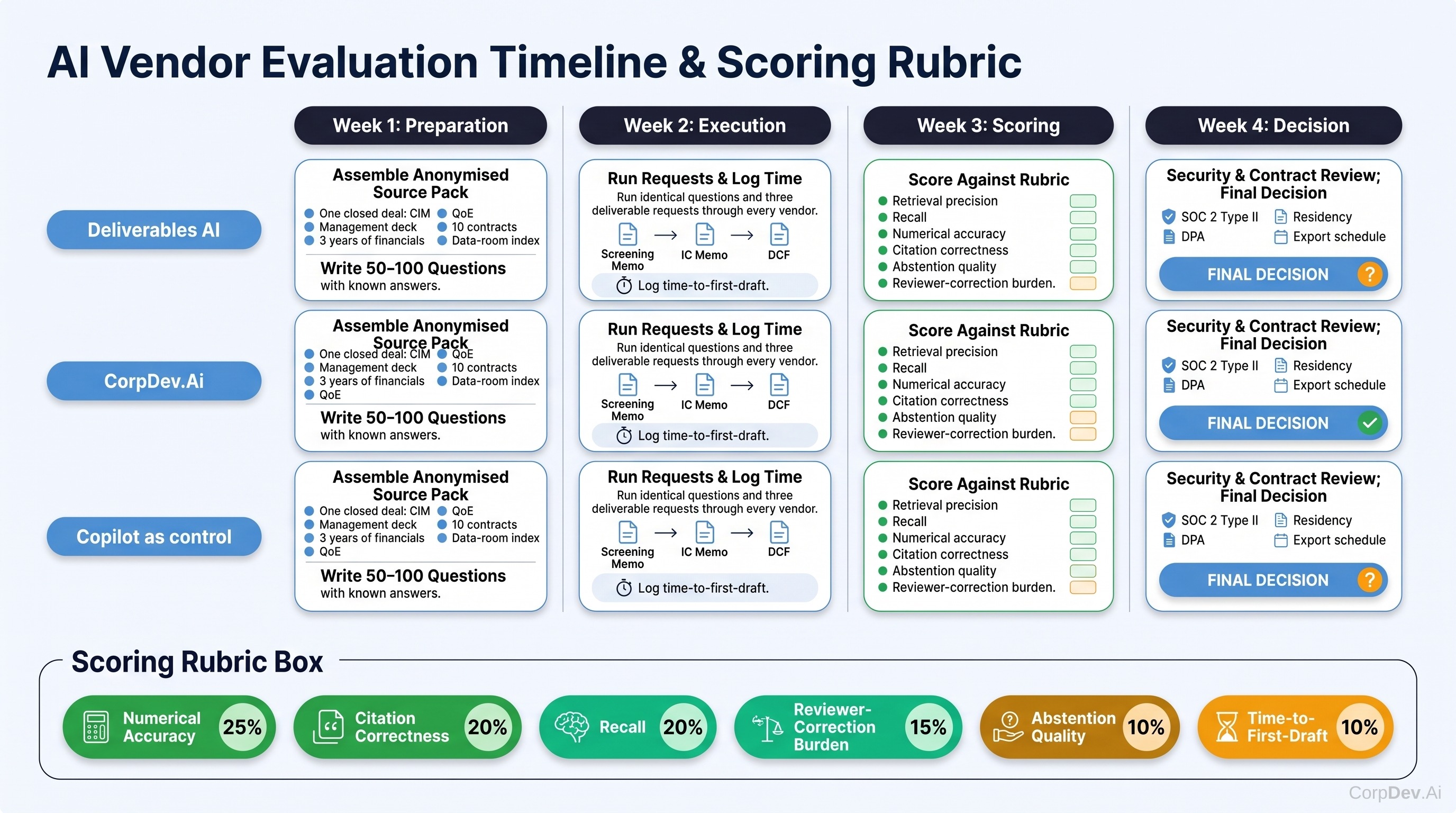
Read diagram description
A four-week timeline with one lane per shortlisted vendor (e.g. Deliverables AI, CorpDev.Ai, Copilot as control).
Week 1: "Assemble anonymised source pack — one closed deal: CIM, management deck, 3 years of financials, QoE, 10 contracts, data-room index; write 50–100 questions with known answers."
Week 2: "Run identical questions and three deliverable requests (screening memo, IC memo, DCF) through every vendor; log time-to-first-draft."
Week 3: "Score against rubric — retrieval precision, recall, numerical accuracy, citation correctness, abstention quality, reviewer-correction burden."
Week 4: "Security and contract review — SOC 2 Type II, DPA, residency, export schedule; final decision." Below the timeline, a scoring rubric box listing the six metrics with a weight next to each: numerical accuracy 25%, citation correctness 20%, recall 20%, reviewer-correction burden 15%, abstention quality 10%, time-to-first-draft 10%.
- Use one closed deal you know the answers to. Anonymise it, include the awkward material — scanned PDFs, a contradictory earlier version of the model, a contract with a buried change-of-control clause — and write 50–100 questions with agreed correct answers before any vendor sees the pack.
- Run every vendor and a generalist control on the identical pack. Ask each for the same three deliverables: a one-page screening memo, an IC memo and a DCF.
- Score separately for retrieval precision, recall, numerical accuracy, entity accuracy, citation correctness, abstention quality ("not found" instead of a guess), cross-document consistency and the share of outputs a reviewer had to correct before use [92].
- Time the whole loop, not the generation: upload, prompt, review, correct, export.
- Compare cost per reviewer-approved deliverable, not cost per seat.
Security and data questions to put in writing
- Current SOC 2 Type II report (scope, period, exceptions) and/or ISO 27001 certificate — Hebbia publishes SOC 2 Type II; CorpDev.Ai states SOC 2 Type II on its pricing page; Rogo's trust centre lists ISO 27001 and 42001; Deliverables AI states isolation and encryption but a buyer should request the report [96][13][97][2].
- No-training commitment in the contract, not only in marketing. All four generalists and all focal vendors state it; confirm that optional feedback programmes are disabled.
- Data residency for production data, backups, logs and embeddings, and where inference runs. Hebbia's DPA permits processing wherever it or its subprocessors operate — EU buyers should negotiate [98].
- Subprocessor list — which frontier-model providers receive your data, under what terms.
- Retention and deletion on termination, including backups, with certification.
Lock-in and exit checks
The practical rule: if you cannot reproduce the work product from what the vendor exports, you are locked in [99][100]. Require an exit schedule covering original files, extracted text, prompts and answers, citations, generated deliverables, audit logs and workflow or skill configuration in machine-readable formats — with a defined export window, no punitive fees and deletion certification. Deliverables AI's DOCX/PPTX/XLSX-native outputs and CorpDev.Ai's Markdown-native workbook with standard-format exports are both structurally favourable here; the risk with either is the accumulated context (memory, knowledge layer, CRM history), which is what to test exporting.
Commercial protections for an early-stage vendor
For Deliverables AI and CorpDev.Ai specifically: negotiate annual rather than multi-year terms, price caps on renewal, a source-code or data escrow clause if the tool becomes embedded in the IC process, and a right to export on 30 days' notice at any time. Neither has published funding, audited revenue or a named corporate-development reference customer as of September 2026 [10][13].
7. Recommendation by Buyer Profile
| Buyer profile | First choice | Add alongside | Avoid for now | Why |
|---|---|---|---|---|
| Two-person corp-dev at a mid-cap, one to two deals a year, Microsoft shop | Deliverables AI Pro | Microsoft 365 Copilot | CorpDev.Ai Team, Hebbia, Midaxo | The constraint is producing IC-grade documents and models; $3,720 a year covers it. Broad platforms are over-buying. |
| Programmatic acquirer, three to five people, no CRM or sourcing tool in place | CorpDev.Ai AI Pro Team for up to three users; quote a suitable configuration for four or five (after pilot) | Copilot; one Deliverables AI Standard seat for models | Three-vendor layered stack unless pilot fails | One system for sourcing, monitoring, CRM and diligence at a price inside the layered range; eliminates two integrations. |
| Programmatic acquirer with Affinity or Grata already working | Deliverables AI Pro | Existing CRM and sourcing; Copilot | CorpDev.Ai (redundant CRM) | Most of CorpDev.Ai's bundle value is already paid for; buy the missing production layer cheaply. |
| Strategy team producing board and market work, not deals | Deliverables AI Standard or Pro | Copilot or Claude Enterprise | Deal-centric platforms | Board decks, market reports and DCFs are the core skills; no need for pipeline or sourcing. |
| Large corporate corp-dev with Midaxo or DealCloud and a strict IT gate | Rogo or Hebbia | Copilot; keep the system of record | Early-stage vendors until they pass security review | Procurement risk dominates; the best-funded vendors clear the gate. Pilot Deliverables AI Max as a low-cost challenger. |
| Sell-side or advisory boutique (outside the corp-dev brief but often the same buyer) | Deliverables AI Pro or Max | Ansarada or Datasite per deal | CorpDev.Ai (buy-side oriented) | CIM, teaser, buyer list and pitch skills are exactly the sell-side production cycle; the published case studies are all here [12]. |
| PE deal team | Hebbia or Keye for diligence, Mosaic for LBO models | Copilot | — | Fund workflows need data-room-scale analysis and transaction models more than sourcing or CRM [39][55]. |
The decision in one picture
| Binding constraint | Next test | Candidate configuration |
|---|---|---|
| Producing documents and models | Does procurement accept an early-stage vendor? | If yes, Deliverables AI Pro plus Copilot; illustrative two-to-three-user cost ~$3.7K–$5.6K before usage changes and qualifying M365 licences. If no, request a Rogo enterprise quote and compare with Copilot. |
| Finding, tracking and analysing targets | Is the current CRM and sourcing data working? | Keep working systems and evaluate Deliverables AI Pro for the missing production tasks; original three-user Pro licence example $4.5K/year. |
| No established CRM or sourcing layer | Can a small-team pilot establish sufficient breadth and depth? | CorpDev.Ai Team for up to three included users plus one Deliverables AI seat for models; ~$37K is a three-user starting scenario, not a five-user package. Four or five users require a suitable quote. |
| Formal governance or larger deployment | What system of record and analytical depth are required? | Midaxo or DealCloud plus Hebbia or Rogo; the original $60K+ planning anchor is not a matched quote or guaranteed minimum. |
Run Microsoft 365 Copilot or Claude Enterprise as a control in each pilot. Assess citations, numeric accuracy, reviewer correction time, credit use and model entitlements before treating the combination as a substitute for existing tools.
Final assessment
Deliverables AI is the best-value product in this comparison for the job it chooses to do — turning deal material into finished, cited, editable documents and models — and its self-serve pricing removes the procurement friction that keeps most corp-dev teams from adopting AI at all. Its weaknesses are the ones its own documentation admits: no data-room connection, no CRM, no persistent intelligence across deals, and a company still early enough that a buyer should contract defensively.
CorpDev.Ai is the most complete answer to the corporate-development workflow as a whole, with potential to consolidate several existing subscriptions, subject to equivalent capability and entitlements. Its price reflects that breadth, its self-serve plans lack financial modelling, and its claims are — like most in this category — ahead of its published evidence. For the programmatic acquirer building a stack from scratch it is the strongest candidate; for everyone else it is a platform decision that deserves a pilot, not an impulse purchase.
Rogo and Hebbia are where a buyer goes when vendor maturity, bank-grade references and depth on very large corpora outweigh cost. Microsoft 365 Copilot is not an alternative so much as the baseline every one of these tools must beat, and at the cited $30 a seat it is a useful baseline where the existing Microsoft environment and pilot results support it.
The professional's move in 2026 is therefore not to pick a winner from a feature list but to run a four-week pilot with a known deal, a generalist control and a written rubric — and to let cost per reviewer-approved deliverable, not cost per seat, decide.
Key Facts & Sources
Load-bearing figures used in this comparison, with source and as-of date. "Published" means read directly from the vendor's page on 11 September 2026; "estimate" means a third-party market figure that should be confirmed by quotation.
| # | Fact | Value | Basis | Source | As of |
|---|---|---|---|---|---|
| 1 | Deliverables AI Standard / Pro / Max price | $25 / $125 / $250 per seat per month; Pro min. 2 seats, Max min. 5 | Published | [8] | Sep 2026 |
| 2 | Deliverables AI included credits | 3,000 / 20,000 / 45,000 per seat per month; top-ups $0.01–$0.02 | Published | [8] | Sep 2026 |
| 3 | Deliverables AI typical credit cost, long CIM / model / memo | ~6,500 / ~3,000 / ~1,900 (upper bounds 19,000 / 9,500 / 12,000) | Published | [8] | Sep 2026 |
| 4 | Deliverables AI founded; founders | 2024; Andrew Roberts, Jeff Tannenbaum | Third-party databases | [9][10] | Aug 2026 |
| 5 | Deliverables AI estimated 2025 ARR; funding | ~$220K; none disclosed | Estimate (GetLatka) | [10] | Aug 2026 |
| 6 | Deliverables AI no VDR connector | Stated by vendor | Published | [6] | Sep 2026 |
| 7 | CorpDev.Ai AI Pro / AI Pro Team price | $1,000 / $3,000 per month invoiced annually ($1,200 / $3,600 by card); 1 / 3 seats | Published | [13] | Sep 2026 |
| 8 | CorpDev.Ai financial modelling availability | Enterprise plan only | Published | [13] | Sep 2026 |
| 9 | CorpDev.Ai sourcing coverage | 70M+ companies, 265M+ contacts | Vendor claim | [13][15] | Sep 2026 |
| 10 | Rogo funding and users | $75M Series C led by Sequoia, Jan 2026; >$165M total; 25,000+ daily users | Company announcement | [18] | Jan 2026 |
| 11 | Rogo seat price | ~$3,300 per seat per year | Estimate | [83] | Sep 2026 |
| 12 | Hebbia funding and valuation | $130M Series B at ~$700M, Jul 2024; ~$161M total | Company / press | [85][87] | Jul 2024 |
| 13 | Hebbia seat price | ~$10,000 per professional seat per year | Estimate | [17] | May 2026 |
| 14 | Microsoft 365 Copilot price | $30 per user per month, annual | Published | [71] | Sep 2026 |
| 15 | Gemini for Workspace enterprise price | $27–$35 per user per month | Published | [77] | Sep 2026 |
| 16 | Affinity price | $2,000–$2,700 per user per year | Published tiers via third party | [25] | 2026 |
| 17 | Midaxo price | From ~$10,000; typical $30,000–$120,000; median ~$63,000 | Buyer-reported | [21][22] | May–Jun 2026 |
| 18 | Grata price | ~$15,000–$45,000 per seat per year | Third-party range | [19] | 2026 |
| 19 | DealCloud contract range | ~$85,000–$1.4M+ per year | Third-party estimate | [24] | Jan 2026 |
| 20 | Eilla AI price and funding | $329 per month Professional (5 seats); $1.5M seed | Third-party listing; press | [30][90] | 2026 / Nov 2023 |
| 21 | FinanceBench hallucination finding | ~81% failure/hallucination on 150-question sample (GPT-4 Turbo with retrieval) | Academic benchmark via secondary source | [92] | Aug 2026 |
| 22 | ChatGPT Enterprise project file limit | 40 files | Published | [65] | Aug 2026 |
Derived figures. Three-seat annual costs in Sections 4 and 5 are computed directly from rows 1, 7, 11, 13, 14 and 16 (e.g. Deliverables AI Pro: 3 × $125 × 12 = $4,500; CorpDev.Ai Team: $3,000 × 12 = $36,000; Copilot: 3 × $30 × 12 = $1,080). Workflow-fit scores in Section 4 are the author's judgement from published scope and are labelled as such. Cost per weighted point = annual cost ÷ weighted score.
Known gaps. No independent review-platform data exists for Deliverables AI or CorpDev.Ai; neither publishes funding, audited revenue or named corporate-development references. Rogo's post-January-2026 financing has been reported by trackers but not confirmed by the company in the material reviewed. Hebbia's current seat price and customer count are estimates.
References
Numbering follows the original research. Access dates below record the original source registry; they do not imply that every source was rechecked for this website edition.
- Deliverables AISource accessed 2026-09-11
- Your Ai Deal AssistantSource accessed 2026-09-11
- Instant CIM Analysis & Review - Deliverables AISource accessed 2026-09-11
- Generate IC Memos in Hours, Not DaysSource accessed 2026-09-11
- How a sell-side team turns a data room into a first CIM draft within a day — and runs more mandates in parallel without adding headcount.Source accessed 2026-09-11
- Where Deliverables fits in your AI stackSource accessed 2026-09-11
- Deal TrackerSource accessed 2026-09-11
- Deliverables AI PricingSource accessed 2026-09-11
- Deliverables AI - Crunchbase Company Profile & FundingSource accessed 2026-09-11
- Deliverables AI Revenue 2025: $220K Est. ARR - GetLatkaSource accessed 2026-09-11
- Case StudiesSource accessed 2026-09-11
- Pricing - CorpDev.AiSource accessed 2026-09-11
- Kal Kilpi - CEO @ CorpDev.Ai | Superhuman M&A | LinkedInSource accessed 2026-09-11
- About Us - CorpDev.AiSource accessed 2026-09-11
- Introducing Matrix 2.0 - HebbiaSource accessed 2026-09-11
- Hebbia revenue, valuation & funding | SacraSource accessed 2026-09-11
- Scaling Rogo to Build the Future of Finance: Our $75M Series C and ...Source accessed 2026-09-11
- Access the deepest, most dynamic view of the private ...Source accessed 2026-09-11
- Midaxo Software Pricing & Plans 2025: See Your CostSource accessed 2026-09-11
- Best Due Diligence Platforms for M&A in 2026: 12-Vendor Buyer's ...Source accessed 2026-09-11
- Affinity vs Intapp Deal Cloud (2026): Which Is Better? - RFP.wikiSource accessed 2026-09-11
- Affinity vs DealCloud - Which Is Better for Deal Flow? | AhoySource accessed 2026-09-11
- AI for M&A (2026): Complete Tool Landscape and Vendor ...Source accessed 2026-09-11
- AI Due Diligence Tools for M&A in 2026: 10-Vendor Comparison ...Source accessed 2026-09-11
- Eilla AI executes Europe’s first AI-native M&A dealSource accessed 2026-09-11
- Eilla AI: Secure AI Assistant for Finance - AI Tools ExplorerSource accessed 2026-09-11
- BlueFlame for Private Equity Analysts: An Honest EvaluationSource accessed 2026-09-11
- Private equity AI platform Keye emerges with $5m seed ...Source accessed 2026-09-11
- Keye raises $5M from investors, revolutionizing due diligence with AI | Benjamin Bryant posted on the topic | LinkedInSource accessed 2026-09-11
- Bridgetown Research secures $19M to transform AI-Powered Due Diligence - FoundersTodaySource accessed 2026-09-11
- Mosaic Raises $18M Series A To Build AI-Driven ...Source accessed 2026-09-11
- Macabacus: Excel & PowerPoint Add-In for Finance & BankingSource accessed 2026-09-11
- Finster AI Raises $15 Million to Redefine the Future of ...Source accessed 2026-09-11
- ChatGPT Enterprise & Edu - Release Notes - OpenAI Help CenterSource accessed 2026-09-11
- ChatGPT Enterprise & Edu - Release NotesSource accessed 2026-09-11
- ChatGPT — Release Notes - OpenAI Help CenterSource accessed 2026-09-11
- What is the Enterprise plan? | Claude Help CenterSource accessed 2026-09-11
- Agents for financial services - AnthropicSource accessed 2026-09-11
- Claude can now create and edit files | Claude by AnthropicSource accessed 2026-09-11
- Enable and use web search | Claude Help CenterSource accessed 2026-09-11
- Microsoft 365 Copilot Plans and Pricing—AI for BusinessSource accessed 2026-09-11
- Copilot privacy and securitySource accessed 2026-09-11
- Data, Privacy, and Security for Microsoft CopilotSource accessed 2026-09-11
- Microsoft Copilot Chat Privacy and ProtectionsSource accessed 2026-09-11
- Enterprise AI Software and Tools | Google Workspace with GeminiSource accessed 2026-09-11
- AI built for how you actually workSource accessed 2026-09-11
- Gemini FeaturesSource accessed 2026-09-11
- Rogo: Wall Street's AI analyst, and the questions a $2B mark raisesSource accessed 2026-09-11
- Rogo revenue, valuation & funding | SacraSource accessed 2026-09-11
- Hebbia Raises Series B Led by Andreessen HorowitzSource accessed 2026-09-11
- AI startup Hebbia raised $130M at a $700M valuation on ...Source accessed 2026-09-11
- Hebbia Review, Pricing & Features (2026) - Agents AISource accessed 2026-09-11
- Bulgarian-founded Eilla AI secures $1.5M to help VCs and ...Source accessed 2026-09-11
- LLMs for Financial Document Analysis: SEC Filings & DecksSource accessed 2026-09-11
- FinGround: Detecting and Grounding Financial Hallucinations via ...Source accessed 2026-09-11
- SecuritySource accessed 2026-09-11
- Rogo Trust Center | Powered by SafeBaseSource accessed 2026-09-11
- Data Processing AgreementSource accessed 2026-09-11
- AI Procurement Checklist: 47 Questions Before Buying AI ToolsSource accessed 2026-09-11
- Third-Party AI Risk: The Five Clauses Your Contracts Can't Skip in 2025Source accessed 2026-09-11