RESEARCH / Virtual data rooms
Firmex Alternatives: VDR Pricing, AI and M&A Workflows
Compare Firmex with Datasite, Intralinks, iDeals and Ansarada, plus M&A platforms, using disclosure controls, AI evidence, pricing and buyer scenarios.
Research as of
Website edition edited
Published by CorpDev.Ai, which is one of the vendors assessed. This analysis distinguishes vendor claims, external evidence and analyst judgments. Prices and capabilities reflect the source dates in the article; the website edition is an editorial adaptation, not a new verification of every claim.
Evaluate disclosure discipline before paying for a broader platform
Firmex can be a rational choice when the job is controlled disclosure and the team wants predictable administration across transactions. Its restrained AI positioning is not, by itself, a reason to dismiss it. A room’s contribution includes reliable access, understandable permissions and manageable interaction with external participants; those outcomes can matter more than an impressive assistant that adds little to the actual disclosure process.
The acquisition team should separate that job from its continuous need to research targets, maintain the pipeline and produce investment materials. A subscription room may simplify recurring disclosure, but it does not automatically replace a process platform or analytical workspace. Equally, a broad AI platform does not establish parity in bidder controls simply because it can ingest the same documents.
Compare a subscription with actual project quotes using expected room duration, overlapping processes and service needs. In the product test, change participant access, revise a document and reconstruct the disclosure history. Evaluate analytical time savings separately. This exposes whether the premium buys a needed transaction capability, greater convenience or duplicated software.
1. Executive Summary
Firmex is a mature, support-led, mid-market virtual data room (VDR) — and for a corporate development team the first question is not "Firmex or which other VDR?" but "which of three quite different product categories do we actually need to own?" Deal software is habitually lumped together, yet a VDR (Firmex, Datasite, Intralinks, iDeals, Ansarada), a deal-pipeline / process platform (Midaxo, DealRoom, DealCloud, Affinity) and an AI-native analysis workspace (CorpDev.Ai) solve different problems, are bought by different people and are priced on different logic. A buyer who evaluates them on a single feature checklist will overpay for one and under-buy the other two.
189,000
Firmex projects completed to date
~$7.5K–$25K+
Typical Firmex annual subscription (third-party estimates)
~$68K
Average annual Datasite spend (sample of buyer contracts)
86%
Corporate & PE leaders with GenAI in M&A workflows (Deloitte)
Headline findings
- Firmex is the sensible default for a team that repeatedly discloses information — divestitures, carve-outs, financings, board and audit rooms — and wants predictable, quote-based pricing with unlimited rooms and strong human support. It is owned by Datasite (acquired July 2021) but still sold as a distinct, cheaper brand [2][3]. Its weaknesses are the mirror image of its strengths: no meaningful native AI, a dated reporting layer and opaque quotes [4][17][18].
- Datasite and Intralinks are the tier-one choice when the transaction itself is large and adviser-led. Both now ship serious document AI (Datasite AI with an OpenAI partnership announced in 2026; Intralinks DealCentre AI with the "Link" assistant), but a corporate buyer typically pays $20K–$250K per deal for the privilege — and on buy-side deals the seller's bank chooses the room anyway [21][31][30].
- iDeals and Ansarada are the value alternatives to Firmex for occasional sell-side use, with more transparent entry pricing (from roughly $69–$395 per month) and, in Ansarada's case, more AI and deal-readiness analytics than Firmex [37][41][45].
- Midaxo, DealRoom and DealCloud are not Firmex substitutes; they are the "system of record" for a deal program — pipeline, workstreams, approvals and integration. Gartner now tracks this as its own emerging category, "end-to-end M&A process software" [102][103]. Prices run from roughly $10K list to $60K+ median for Midaxo and $25K+ for DealRoom; DealCloud is enterprise-quoted [47][68][69].
- CorpDev.Ai centres its proposition on analytical capacity alongside a deal workspace; VDR and pipeline AI features also address parts of this work. It bundles an AI research analyst, a Markdown-native document/workbook editor, an AI-native data room for ingesting diligence material, a zero-entry pipeline CRM and sourcing over a claimed 70M-company database, at published prices of $1,000 per user-month (annual) or $3,000 per month for a three-seat team plan [94][97]. It is early-stage, has no disclosed institutional funding and publishes no named customers — material diligence points for any buyer [99].
CorpDev.Ai publishes this article and is one of the vendors compared. Every factual claim about every vendor, CorpDev.Ai included, is drawn from public sources cited inline and listed in Section 9, and CorpDev.Ai's limitations are stated with the same candour as its competitors'. Where a vendor claim could not be independently corroborated it is labelled as a vendor claim.
The decision in one sentence: buy a Firmex-class VDR if you sell more than once a year; buy a pipeline platform if you run more than roughly five live opportunities at a time and need auditable approvals; buy an AI analysis workspace if your binding constraint is analyst hours rather than document distribution — and recognise that most in-house teams of one to five people need the third far more often than they think, and the first far less often than the vendors imply.
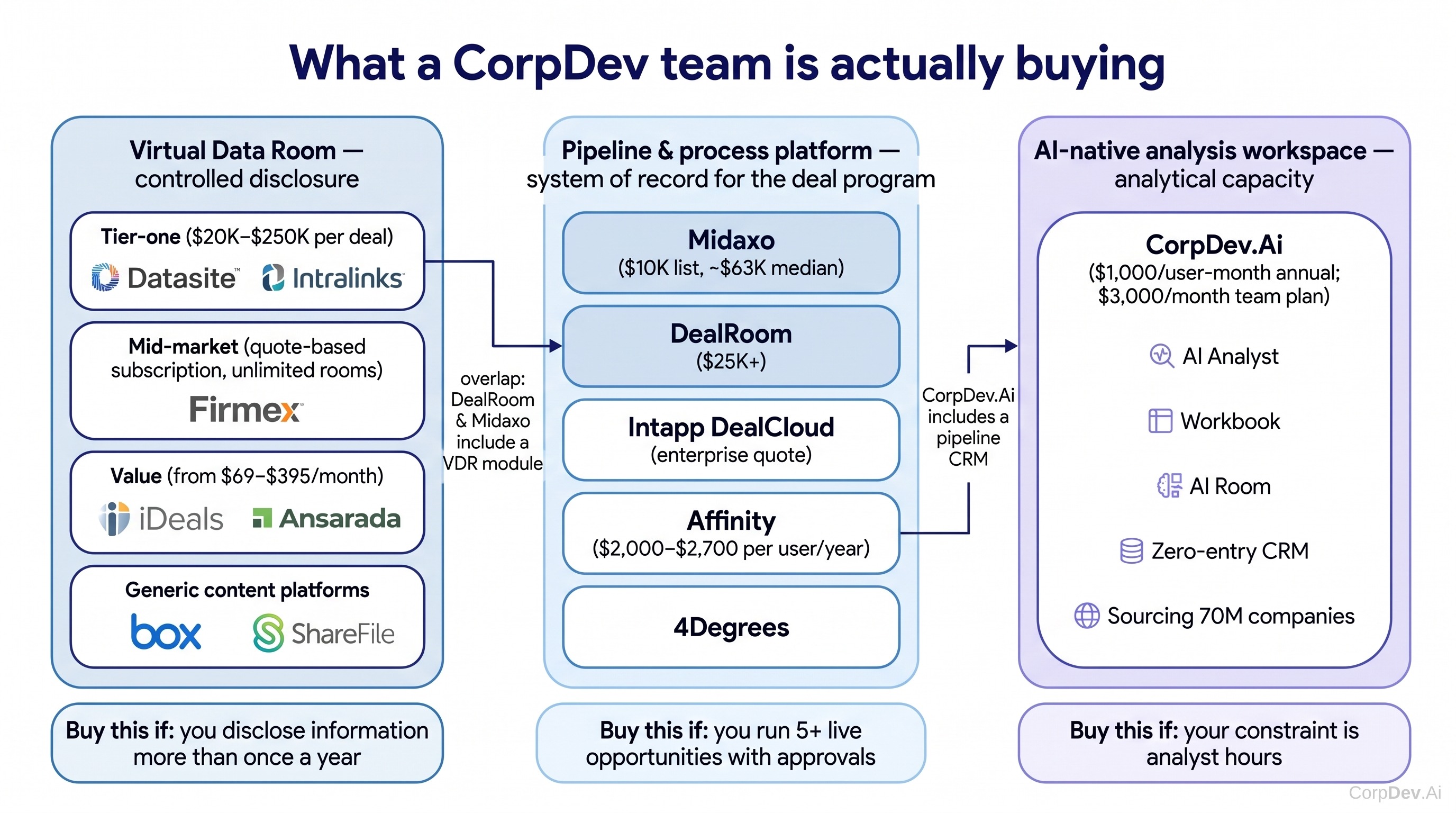
Read diagram description
Comparison titled "What a CorpDev team is actually buying".
Column 1 "Virtual Data Room — controlled disclosure": vendors: Datasite and Intralinks (tier-one, $20K–$250K per deal), Firmex (mid-market, quote-based subscription, unlimited rooms), iDeals and Ansarada (value, from $69–$395/month), Box and ShareFile (generic content platforms).
Column 2 "Pipeline & process platform — system of record for the deal program": Midaxo ($10K list, ~$63K median), DealRoom ($25K+), Intapp DealCloud (enterprise quote), Affinity ($2,000–$2,700 per user/year), 4Degrees.
Column 3 "AI-native analysis workspace — analytical capacity": CorpDev.Ai ($1,000/user-month annual; $3,000/month team plan) with sub-labels AI Analyst, Workbook, AI Room, Zero-entry CRM, Sourcing 70M companies. Under each column a one-line "buy this if" statement: "you disclose information more than once a year" / "you run 5+ live opportunities with approvals" / "your constraint is analyst hours". Connections between categories: "overlap: DealRoom & Midaxo include a VDR module; CorpDev.Ai includes a pipeline CRM".
2. What a CorpDev / M&A Team Is Actually Buying
The single most useful thing a buyer can do before requesting quotes is to separate three jobs that vendors, analysts and procurement teams routinely conflate.
2.1 Controlled disclosure: the virtual data room
A VDR exists to let a disclosing party show confidential documents to counterparties under granular permissions, with watermarking, audit trails, Q&A workflow and the ability to revoke access. It is, structurally, a sell-side or issuer tool: the party that owns the information pays for the room. Firmex, Datasite, Intralinks, iDeals and Ansarada all compete here, differentiated by price model, support intensity, security posture and — increasingly — AI that helps the host prepare and the bidders navigate the room [4][23][30][37].
The implication for an in-house corporate development team is frequently missed: on a buy-side acquisition you do not choose the data room. The seller's adviser does, and you receive credentials. A corporate buyer therefore needs to own a VDR only for the situations in which it is the disclosing party — divestitures and carve-outs, minority financings, joint-venture formation, board and audit rooms, or a permanent "always-on" repository that keeps the company deal-ready. If those events occur more than once a year, a subscription such as Firmex's becomes economical; if they occur every three or four years, a per-project room from any credible vendor is the rational purchase [7].
2.2 Program management: pipeline, workflow and process platforms
The second category is the system of record for the deal program: sourcing lists, stage-gated pipeline, diligence workstreams and request lists, approval workflows, synergy tracking and post-merger integration plans. Gartner formalised this as end-to-end M&A process software and describes it as an emerging, rapidly evolving market with a Market Guide but no published market-size figure [101][102][103]. Midaxo and DealRoom are the archetypes for corporate acquirers; Intapp DealCloud dominates among private-equity and banking relationship-driven firms; Affinity and 4Degrees are relationship-intelligence CRMs that capture email and calendar activity automatically [71][74][81][85].
These products are bought by heads of corporate development or M&A integration leads, priced by users or modules on annual subscription, and justified by governance, repeatability and institutional memory — not by any one transaction. Several (Midaxo's Process Management edition, DealRoom) include a VDR module, which is the source of much of the confusion with Firmex [49][70].
2.3 Analytical capacity: AI-native research and diligence workspaces
The third category is the newest and the least well understood. Its premise is that the binding constraint on a one-to-five-person corporate development team is not document distribution or pipeline hygiene but analyst hours: the 1,000–2,000 hours of strategic analysis and the $200K–$2M of outside consulting spend that a typical deal absorbs (a CorpDev.Ai framing, and therefore a vendor claim, but one broadly consistent with practitioner experience) [94]. Products in this category — CorpDev.Ai is the purpose-built example for in-house teams; horizontal tools such as Hebbia, Rogo and general LLM assistants are adjacent — treat the data room as an input to be ingested and interrogated, and the memo, market map or board deck as the output, with the AI doing the research, drafting and citation work in between [94].
Evidence that this is where budgets are moving is strong at the adoption level even where market-size data is absent. Deloitte's 2025 survey of 1,000 corporate and private-equity leaders found 86% had integrated generative AI into M&A workflows, 65% of them within the previous year [107]; McKinsey reports that 40% of GenAI users in M&A saw deal cycles shorten by 30–50% [111]. By contrast, the best available proxy for dedicated M&A-platform adoption is a 2020 survey in which only 37% of large corporate development teams used a VDR and roughly 62% still tracked deal flow primarily in Excel [112][113][114].
The reader is an in-house corporate development, strategy or M&A professional at a corporate acquirer — not a sell-side banker or a private-equity fund. That framing changes the answer: for a banker, the VDR is the product; for a fund, the relationship CRM is; for a corporate team, the mix tilts toward analytical capacity and program governance, with disclosure tooling needed only episodically.
| Category | Lifecycle contribution | Buyer-specific boundary |
|---|---|---|
| VDR: Firmex, Datasite, Intralinks, iDeals, Ansarada | Centres on diligence evidence, controlled disclosure and execution | The seller often supplies the external room. A buyer may still need internal diligence, financing, divestiture or board/audit rooms; room ownership is not categorically restricted to sellers. |
| Lifecycle process: Midaxo, DealRoom | Pipeline, approvals, workstreams and integration by tier | Assess actual governed PMI scope, rather than treating every CRM as equivalent. |
| Relationship CRM: DealCloud, Affinity | Relationship history, sourcing and pipeline; evolving document/agent capabilities | No equivalent native full-PMI claim is established merely by grouping these with process platforms. |
| AI analysis: CorpDev.Ai | Maps, target screens, investment thesis, memos, AI Room Q&A and board decks | Broad analytical scope; integration blueprints and planning differ from operational workstream/synergy governance. |
The six-stage frame runs from strategy and market mapping through sourcing, evaluation, diligence, approval and integration/value tracking. Evaluate each category against its job and the actual deployment, not a uniform full-lifecycle bar.
3. Firmex: Profile and Assessment
3.1 Company background
Firmex was founded in Toronto in 2006 and grew into one of the largest mid-market VDR providers globally before Datasite acquired 100% of the company on 26 July 2021 from majority owners Vertu Capital and BDC Capital; the price was not disclosed [1][2][3]. Datasite, itself owned by private-equity firm CapVest, has kept Firmex as a distinct brand and business, which in practice gives Datasite a two-tier portfolio: Datasite Diligence for large adviser-led transactions and Firmex for high-volume, lower-ticket rooms [2][3]. Firmex's published scale metrics are 223,000+ companies, 1.4 million+ users, 180+ countries and 189,000 projects completed, with roughly 20,000 new projects a year [4][5][7]. Its logo wall is dominated by law firms, accountancies and advisers — Deloitte, EY, PwC, Dentons, DLA Piper, Sidley, RBC, IMAP — alongside corporates such as Chevron, Roche, Sanofi, Glencore, Goodyear and ArcelorMittal [7].
Founded: 2006, Toronto
Owner: Datasite (CapVest) since July 2021
Product: Browser-based VDR; single-project or annual subscription
Scale: 223,000+ companies; 1.4M+ users; 189,000 projects; ~20,000 new projects/year
Ratings: G2 4.6/5 (93 reviews); Capterra 4.8/5 (356 reviews)
Certifications: SOC 2 Type II; ISO/IEC 27001-certified data centres; HIPAA and GDPR compliance referenced
Data residency: Canada, United States or Germany/EU
Strong: granular permissions, Q&A workflow, audit trails, redaction, "View As" permission checks, 24/7/365 human support, dedicated success manager on subscription, unlimited self-serve rooms
Weak: no documented native generative AI; reporting and dashboards comparatively limited; interface described as dated; large folder trees can slow navigation; quote-only pricing and renewal uplift
Best fit: repeat sell-side, legal, compliance, board and audit rooms at mid-market ticket sizes
3.2 Product scope
Firmex sells one product — a secure, browser-based data room — in two commercial wrappers. The feature set is the canonical VDR list: bulk upload and automatic indexing, folder- and document-level permissions with user groups, dynamic watermarking, document expiry and remote revocation, versioning, full audit trails, structured Q&A with routing to subject-matter experts, redaction, custom branding, project templates and copying, email-to-room upload, SSO and two-factor authentication [4]. Customers choose data storage in Canada, the United States or Germany/EU; application and user-service data sits in Canada [6]. Security controls include AES-256 at rest, TLS up to 1.3 in transit, SOC 2 Type II auditing and ISO/IEC 27001-certified data centres (some older Firmex material cites the 2013 rather than the 2022 revision; a buyer running formal vendor diligence should request the current certificate and scope) [4][6].
What Firmex does not offer is equally important for this comparison. Its public product material describes automation of the Q&A workflow but no native generative-AI summarisation, semantic search, AI redaction or AI-drafted Q&A responses — capabilities that its parent Datasite, and competitors Intralinks and Ansarada, now market prominently [4][23][30][39]. Firmex also has no pipeline, workflow or analysis layer: it is a disclosure tool, full stop.
3.3 Pricing model
Firmex publishes its pricing structure but not its prices [7]:
- Single-project data room — one project, fixed time frame, one-time fee sized by data volume and project length; 24/7/365 support included.
- Data room by subscription — annual fee, unlimited projects and always-on access, priced primarily on the amount of data required over the year; adds a dedicated customer success manager and SSO. Firmex's own claim is that a subscription "will always be more affordable than the equivalent number of single-project data rooms" [7].
Third-party pricing reviews published in 2026 place an entry-level subscription at roughly US$625–$995 per month (US$7,500–$12,000 a year), recurring mid-market or boutique advisory subscriptions at around US$25,000+ a year, and large enterprise programs at US$50,000–$200,000+; a one-off three-month project is commonly quoted at US$5,000–$10,000 [9][10][11][12]. None of these are Firmex list prices and all should be treated as budgeting ranges. Notably, Firmex does not charge per page or for bandwidth, which removes the two overage mechanisms that historically made enterprise VDR invoices unpredictable [7][8].
3.4 Assessment for a corporate development buyer
Reviewers consistently praise three things: ease of setup, the quality and responsiveness of human support, and security posture; G2 rates Firmex 4.6/5 across 93 reviews and Capterra 4.8/5 across 356 [13][14][15][16]. The recurring criticisms — quote-only procurement, a less modern interface than newer entrants, limited report customisation, slower navigation in very large folder structures and renewal pricing perceived as expensive — are real but are the criticisms of a mature product rather than a broken one [17][18].
An "always-on" subscription room that doubles as the company's permanent disclosure infrastructure — divestiture-ready data, board packs, audit and lender rooms, procurement files — turns an episodic VDR cost into a governance asset, and Firmex's unlimited-project subscription is priced for exactly that pattern [7]. Teams that will use a room only once every few years should instead buy a per-project room and put the difference toward analytical tooling.
Datasite is investing heavily in AI on its flagship platform, including a 2026 OpenAI partnership [31]. Firmex has published no equivalent roadmap. A buyer signing a multi-year Firmex subscription should ask explicitly whether Datasite AI capabilities will flow down to Firmex, and on what timeline and price — or accept that Firmex will remain a deliberately non-AI, lower-cost tier of the Datasite portfolio.
4. The Alternatives
4.1 Enterprise Virtual Data Rooms: Datasite, Intralinks
Datasite (formerly Merrill DataSite) and SS&C Intralinks are the two tier-one VDRs — the rooms a corporate buyer is most likely to receive credentials for on a banker-run process, and the rooms it will be quoted when it is the disclosing party on a large, cross-border or auction-style transaction.
Datasite reports 16,000+ new transactions a year, 626,000+ users and a presence on more than 40% of the top-100 global M&A deals — a penetration claim rather than a market-share figure, since no vendor discloses enough methodology to compute one [22][23]. Its differentiation is now explicitly AI: Datasite AI spans preparation, diligence and Q&A, with permission-aware, cited answers, semantic search, summarisation, translation and automated redaction, and a June 2026 partnership with OpenAI extends this to deal indexes, cited Q&A drafting and readiness checks inside the room [23][26][31]. Pricing is transaction-specific and quote-only; a 2026 sample of buyer contracts shows an average annual spend of about $68,000 and a largest contract near $190,000, while a broad per-deal budgeting range is $20,000–$250,000+ [19][21].
Intralinks claims 10,000+ M&A deals a year, $35 trillion in cumulative transaction value and approximately 6.6 million registered users [24][25]. Its recent investment has gone into DealCentre AI, an end-to-end platform with Preparation, Marketing, Diligence and Management modules powered by the "Link" assistant, which answers document questions with page references, validates uploads against request lists, flags duplicate Q&A and drives self-launch deal preparation [27][28][29][30]. Third-party 2026 estimates put smaller implementations at $10,000+ a year, mid-market deployments at $50,000–$200,000 and large global programs above $200,000; legacy per-page pricing (~$0.60/page) still surfaces in some quotes and should be negotiated out [20]. Reviewers describe Intralinks as extremely robust on governance and less intuitive than lighter competitors [32][33].
Owner: CapVest (also owns Firmex)
Scale: 16,000+ transactions/yr; 626,000+ users; 40%+ of top-100 deals
AI: Native, permission-aware, cited; OpenAI partnership (2026)
Price: Quote; ~$68K average annual; $20K–$250K+ per deal
Best for: Adviser-led, high-value, cross-border sell-side processes
Watch: Add-on modules and AI usage caps in the quote
Owner: SS&C Technologies (NASDAQ: SSNC)
Scale: 10,000+ deals/yr; $35T cumulative; 6.6M registered users
AI: Link assistant — document Q&A, validation, duplicate detection
Price: Quote; $10K+ small, $50K–$200K mid-market, $200K+ global
Best for: Enterprise governance, regulated deals, SS&C ecosystem users
Watch: Complexity, administration load, per-page legacy terms
Relevance to a corporate development buyer. For a corporate acquirer these platforms matter in two ways. First, as the receiving party, the buyer's own analytical tooling must be able to ingest whatever the seller's room exports — which is the argument for an AI workspace that reads PDFs, spreadsheets and decks rather than depending on the seller's AI. Second, as the disclosing party on a marquee divestiture, the banker will almost certainly recommend Datasite or Intralinks, and the premium over Firmex buys adviser familiarity, bidder-side AI and analytics rather than fundamentally better document controls. The pragmatic position is to let the sell-side mandate dictate the enterprise room and to own a cheaper always-on room — Firmex, iDeals or Ansarada — for everything else.
4.2 Mid-Market Virtual Data Rooms: Ansarada, iDeals, DealRoom
These are Firmex's direct competitors for the mid-market room: same job, similar security baseline, but different pricing transparency and — in two of the three — a materially more AI-forward roadmap. Box and ShareFile are included at the end as the "do we even need a VDR?" benchmark.
Ansarada (Sydney) is the most AI- and analytics-oriented of the mid-market VDRs. Beyond the standard controls it offers the "Ask AiDA" assistant, AI document sorting and tagging, translation and redaction, deal-readiness scoring, bidder-engagement analytics and predictive deal analytics [37][39]. Commercially it is unusual in offering a free preparation period — the room is charged only when the deal goes live — alongside storage-based subscriptions advertised from about $69 per month for 50 MB on a 12-month term (other listings show ~$249 per month for 250 MB), so the effective price for a real M&A room is well above the headline [37][38]. G2 rates it 4.5/5 [40].
iDeals is the highest-rated mainstream VDR on G2 at 4.7/5 and positions itself on transparent, storage-based pricing with unlimited users and no per-page charges; annual plans are commonly reported at roughly $250–$395 per month, with some products from ~$2,700 a year, and a free trial is available for one-off projects [41][42][43][44][45][46]. AI capabilities are practical rather than headline-grabbing: AI redaction, OCR and full-text search, auto-indexing, document classification, translation and Q&A assistance, with eight-level permissions frequently praised in reviews [45]. For a corporate team that needs a room every year or two and wants to avoid a sales cycle, iDeals is the closest thing to a self-serve Firmex.
DealRoom (dealroom.net) is frequently listed as a Firmex alternative but is really a member of the next category: an "M&A operating system" for buyer-led M&A with pipeline, diligence request lists, integration tracking and a VDR module. Its platform subscription starts at approximately $25,000 a year with unlimited users; the standalone VDR is quote-based [47][48][49]. Its AI covers pipeline management, document analysis, risk flagging and diligence automation, and it exposes MCP integrations to Claude, ChatGPT, Microsoft Copilot and Gemini [50][51]. G2 rates it around 4.3/5 [52][53]. A team that wants Firmex-style disclosure and a buy-side process tool in one contract should evaluate DealRoom directly against Midaxo, not against Firmex.
Box and ShareFile — the "good enough" benchmark. Box Business tiers run $5–$35 per user per month, and Box AI can summarise and extract from content in higher tiers, but Box has no transaction Q&A, bidder-group workflow or deal reporting; configuring a compliant room is the customer's problem [54][55][58][61]. ShareFile's VDR is $69.30–$77 per user per month with a five-seat minimum and roughly 1 GB per licence, and its transaction-specific AI is thin [62][63]. Both are viable for a small internal disclosure exercise a company already has licences for; neither is a credible answer to a banker asking which room the bidders will use.
| Vendor | Entry price (reported) | AI depth | G2 rating | Best fit vs. Firmex |
|---|---|---|---|---|
| Firmex | Quote; ~$625–$995/month entry subscription | Low — workflow automation only | 4.6 | Baseline: repeat disclosure with human support |
| Ansarada | From $69/month (50 MB) to ~$249/month (250 MB); free prep period | High — AiDA, readiness scoring, bidder analytics | 4.5 | Sell-side teams wanting AI and bidder intelligence |
| iDeals | ~$250–$395/month annual plans; from ~$2,700/year | Medium — AI redaction, OCR, classification | 4.7 | Occasional, self-serve rooms; transparent pricing |
| DealRoom | Platform from ~$25,000/year; VDR quote-based | High — pipeline and diligence AI, MCP integrations | 4.3 | Buyer-led process tool with a VDR inside |
| Box | $5–$35/user/month | Medium — Box AI, not transaction-specific | 4.3 | Already-licensed content platform for internal rooms |
| ShareFile VDR | $69.30–$77/user/month, 5-seat minimum | Low | n/a | Small professional-services teams in the ShareFile stack |
Because Firmex, iDeals and Ansarada deliver near-identical core controls, the credible threat of moving between them is real. Buyers renewing a Firmex subscription have reported meaningful concessions when armed with an iDeals or Ansarada quote; the reverse is equally true where Firmex's support model is the differentiator. Ask each vendor for the same scope — annual storage, user cap (should be unlimited), number of concurrent rooms, support tier, data residency — and compare on total annual cost.
4.3 Pipeline and Process Management: Midaxo, DealCloud, Affinity
None of these products replaces Firmex, and Firmex replaces none of them. They compete for the budget line a corporate development team labels "our M&A system" — the place where the pipeline, workstreams, approvals and integration plans live — and they are compared here because a buyer with a fixed software budget is choosing among all three categories, not within one.
Midaxo (Boston / Helsinki) is the most explicitly corporate-development-oriented platform: pipeline CRM with target sourcing and AI deal scoring, stage-gated workflows, diligence task management and issue tracking, post-merger integration and synergy tracking, dashboards and Gantt views, Power BI and Tableau connectors, and — in its M&A Process Management edition — a native VDR with data-room export [70][71][72]. It reports more than 500 teams as users [71]. Public listings show a starting price of $10,000 a year, but buyer-reported spend is far higher: one marketplace reports a median of about $63,250 a year, which is the more realistic planning figure for a corporate team with several users and modules [68][69].
Intapp DealCloud is the enterprise relationship-and-deal platform of choice for private equity, investment banks, private credit and real-estate investors. Its strengths are a highly configurable data model linking relationships, companies, mandates and transactions; origination tooling that blends firm data with external market intelligence; and "Intapp Assist" AI for search, summaries, extraction and recommendations — Intapp reported more than 70 new AI capabilities in DealCloud during fiscal 2026 [74][75][76][77][78][79]. Pricing is enterprise-quoted and implementation is substantial; Intapp does not break out DealCloud revenue, but the parent reported $577.8 million of total revenue for fiscal 2026 and $433.6 million of cloud ARR at Q2 FY26, which gives a sense of scale and staying power [89][91]. For an in-house corporate team, DealCloud is usually over-specified unless the parent company runs an investment arm.
Affinity is a relationship-intelligence CRM: it captures email and calendar activity automatically, builds a relationship graph, and layers AI answers, meeting preparation and enrichment on top, with a hosted MCP server connecting to Claude, Gemini and Copilot from the Scale tier upward [81]. It is the most transparently priced product in this section — $2,000, $2,300 and $2,700 per user per year for Essential, Scale and Advanced — and closed an $80 million Series C led by Menlo Ventures in September 2021 (dated Affinity release), bringing total funding to roughly $120 million [81][82][92]. It serves about 1,700 institutions, overwhelmingly venture and private capital [82]. 4Degrees plays a similar role for smaller deal teams at quote-based per-user pricing, with AI field suggestions, document-to-CRM extraction and warm-introduction paths [83][84][85][86][87][88].
| Vendor | Category | Price signal | AI | Includes a VDR? | Natural buyer |
|---|---|---|---|---|---|
| Midaxo | End-to-end M&A process | $10K list; ~$63K median reported | Deal scoring, pipeline insights | Yes (Process Management edition) | Corporate development, serial acquirers |
| DealRoom | Buyer-led M&A operating system | From ~$25K/year, unlimited users | Diligence and pipeline AI, MCP | Yes | Corporate and PE buy-side teams |
| Intapp DealCloud | Relationship + deal platform | Enterprise quote | Intapp Assist; 70+ AI features FY26 | No (document workflows only) | PE, banks, private credit |
| Affinity | Relationship-intelligence CRM | $2,000–$2,700/user/year | AI answers, enrichment, MCP | No | VC, PE, bankers |
| 4Degrees | Deal-flow CRM | Per-user quote | AI CRM updates, meeting prep | No | Smaller PE/IB/advisory teams |
Where process and analytical work meet. Midaxo and DealRoom organise the deal record and workflow, and their AI features increasingly assist document interpretation and structured information capture. Their documented scope does not establish equivalent depth across market research, target screening, investment memos and board-deck production. A buyer should trace those tasks through the current product: which outputs are generated, which require another tool, and how source evidence and approvals persist through the handoff. The unresolved work, rather than a categorical claim that process tools cannot analyse, defines the case for an additional analytical workspace.
4.4 AI-Native Deal Workspaces: CorpDev.Ai
Analysis workspace Published pricing Early-stage vendor
CorpDev.Ai describes itself as an "Integrated CorpDev Environment" — an agentic AI platform for in-house corporate development, strategy and M&A teams that covers strategy and market mapping, sourcing and screening, pipeline, diligence, modelling, investment memos, presentations and post-merger integration in one workspace [94]. It is both a software vendor and a managed-services provider whose own M&A team works on the same platform [94][97]. The founders are Kal Kilpi, a two-time M&A-software founder who co-founded Midaxo, and Atul Tiwary, formerly VP M&A at Barracuda Networks, VP Investment Banking at RBC and Senior Director of Corporate Development at Fortinet [98][100].
Product scope
The platform is built from five components that map directly onto the gaps identified in Sections 4.1–4.3 [94][95][96][97]:
- AI Analyst Agent — a specialised research-and-authoring agent that produces cited market maps, sector reports, target profiles, fit scorecards, valuation comps, investment memos, CIMs and board decks from natural-language requests, routing tasks across Anthropic Claude, OpenAI GPT, Perplexity and Google Gemini.
- Visual Workbook — a Markdown-native document, slide and spreadsheet editor with a citation registry, in which the AI and the team co-author; exports to DOCX, PPTX, XLSX and PDF.
- AI Room — an AI-native data room that ingests PDF, XLSX, DOCX and PPTX with vision extraction, converts pages to Markdown, indexes them for retrieval-augmented analysis and answers diligence questions with page-level citations and an audit trail; the company claims capacity to process a 50,000-page room.
- Pipeline Kanban and zero-entry CRM — deal stages and company records populated and enriched automatically from connected Microsoft 365 or Google Workspace email and calendar, with news and trigger monitoring.
- Sourcing and research infrastructure — natural-language target discovery and fit scoring over a claimed 70 million companies and 265 million contacts, plus SEC filings, 30 years of financials, estimates and earnings transcripts, exposed through REST and MCP interfaces and stored in open formats (Markdown, JSON, YAML, Office files) to limit lock-in.
Additional differentiators are "Digital Twin" models of a target or market — linked operating models on which diligence findings, risks, Day-1 and Month-36 integration states are recorded — and autonomous recurring agent work for monitoring and knowledge maintenance [94].
Pricing
CorpDev.Ai is the only vendor in this comparison other than Affinity, iDeals and Ansarada to publish prices [97]:
| Plan | Intended user | Monthly | Annual (per month, invoiced annually) | Includes |
|---|---|---|---|---|
| AI Pro | Individual M&A professional | $1,200 | $1,000 | 1 user; 1,000 search credits/month; Analyst, Workbook, market mapping, sourcing, pipeline, monitoring |
| AI Pro Team | Corporate development team | $3,600 | $3,000 | 3 users; 3,000 credits/month; adds collaboration, admin controls, priority support, customer success manager |
| Enterprise | Advanced deployments | Custom | Custom | Unlimited users, SSO, solutions architect, financial modelling, managed services |
A three-person team therefore pays about $36,000 a year on the annual plan — in the same band as a Firmex mid-market subscription or a Midaxo entry deployment, but purchasing a different thing. The free tier is restricted to in-house corporate development at companies above roughly $1 billion in revenue or by invitation, which signals the intended customer [94].
Assessment
Strengths for a corporate development buyer. The proposition attacks the constraint Sections 2.3 and 4.3 identified — analyst hours and outside-adviser spend — rather than document distribution or pipeline hygiene, and it does so in the same workspace where the pipeline and the diligence files already sit, so a memo can cite a data-room page, a filing and an email thread without re-keying [94]. Published, per-seat pricing with a monthly option lowers procurement friction to a level no VDR or process platform matches. The AI Room's ingestion-first design is exactly what a buyer needs when the seller's room is someone else's product. The open-format architecture and MCP/REST access are a genuine hedge against lock-in, which matters for a young vendor.
Limitations and diligence points — stated plainly.
- Early stage, undisclosed funding, no named customers. Tracxn records no funding round; the company claims "hundreds" of professionals as users but publishes no logos, ARR or retention figures [94][97][99]. A buyer should ask for reference calls and treat multi-year commitments cautiously until these are provided.
- Not a bidder-facing VDR. The AI Room is designed to ingest and interrogate documents for the buyer's team. Public material does not describe bidder groups, dynamic watermarking, Q&A routing to external counterparties or bidder-activity analytics; a company running a divestiture still needs a Firmex-class room [94].
- Security claims are self-described. The site references isolated workspaces, tenant isolation, encryption and SOC 2 compliance [96]; the certificate type and audit period should be requested, as with Firmex's ISO scope.
- Process depth is shallower than Midaxo or DealRoom. Pipeline Kanban and CRM are included, but published material does not evidence the stage-gate approvals, integration task management and synergy tracking that mature process platforms offer; a team whose primary pain is governance should compare carefully.
- AI output still requires expert review. The platform's own positioning — citation discipline, page-level references, audit trail — is designed to make verification fast, but it does not remove the obligation.
For most corporate teams CorpDev.Ai sits alongside a disclosure room rather than replacing it: the seller's Datasite or Intralinks room (or the company's own Firmex subscription) remains the disclosure layer, and the AI workspace is where the material from that room is analysed and turned into decisions. The substitution it does make is for outside analyst hours and for the pipeline CRM a small team would otherwise buy separately.
5. Head-to-Head Comparison
5.1 Capability matrix
The matrix records what each vendor offers as a core, purpose-built capability (●), what it offers partially or through a general mechanism (◐), and what it does not do (○). Judgements are drawn from the vendor product pages and sources cited in Sections 3–4; where a claim could not be corroborated, the lower rating is used.
| Capability | Firmex | Datasite | Intralinks | iDeals | Ansarada | DealRoom | Midaxo | DealCloud | Affinity | CorpDev.Ai |
|---|---|---|---|---|---|---|---|---|---|---|
| Bidder-facing VDR (permissions, watermark, revoke) | ● | ● | ● | ● | ● | ● | ◐ | ○ | ○ | ○ |
| Structured Q&A with external parties | ● | ● | ● | ● | ● | ● | ◐ | ○ | ○ | ○ |
| Bidder-activity analytics | ◐ | ● | ● | ◐ | ● | ◐ | ○ | ○ | ○ | ○ |
| AI document summarisation / search inside the room | ○ | ● | ● | ◐ | ● | ● | ○ | ◐ | ○ | ● |
| AI redaction | ○ (manual/rules-based redaction only) | ● | ● | ● | ● | ◐ | ○ | ○ | ○ | ○ |
| Buy-side ingestion of a third-party data room | ○ | ○ | ○ | ○ | ○ | ◐ | ○ | ○ | ○ | ● |
| Deal pipeline / stage gates | ○ | ○ | ○ | ○ | ○ | ● | ● | ● | ● | ● |
| Diligence workstreams and request lists | ◐ (Q&A) | ◐ | ● (DealCentre) | ○ | ◐ | ● | ● | ◐ | ○ | ◐ |
| Post-merger integration and synergy tracking | ○ | ○ | ○ | ○ | ○ | ● | ● | ○ | ○ | End-to-end management and integration work; validate programme controls |
| Relationship intelligence (email/calendar capture) | ○ | ○ | ○ | ○ | ○ | ○ | ◐ | ● | ● | ● |
| Target sourcing over external company database | ○ | ○ | ○ | ○ | ○ | ○ | ◐ | ● | ◐ | ● (70M+ claimed) |
| AI-authored deliverables (memo, market map, deck) | ○ | ○ | ○ | ○ | ○ | ○ | ○ | ◐ | ○ | ● |
| Financial statements, filings, transcripts built in | ○ | ○ | ○ | ○ | ○ | ○ | ○ | ◐ (via integrations) | ○ | ● |
| Published pricing | ○ | ○ | ○ | ● | ● | ◐ (from $25K) | ◐ (from $10K) | ○ | ● | ● |
| Certified security (SOC 2 / ISO 27001) | ● | ● | ● | ● | ● | ● | ● | ● | ● | ◐ (self-described SOC 2) |
| Named enterprise customers / disclosed scale | ● | ● | ● | ● | ● | ◐ | ◐ (500+ teams) | ● | ● (1,700 institutions) | ○ |
Three patterns stand out. First, the VDR columns are nearly identical on the disclosure rows — the category is commoditised on core controls and differentiates on AI, analytics, support and price. Second, the matrix rates DealRoom as partial and CorpDev.Ai as core for third-party-room ingestion. Import support, permissions and version continuity require testing in either case. Third, CorpDev.Ai is broadest across the lifecycle but is the only vendor with an empty "named customers" row — the strategic trade-off in one line.
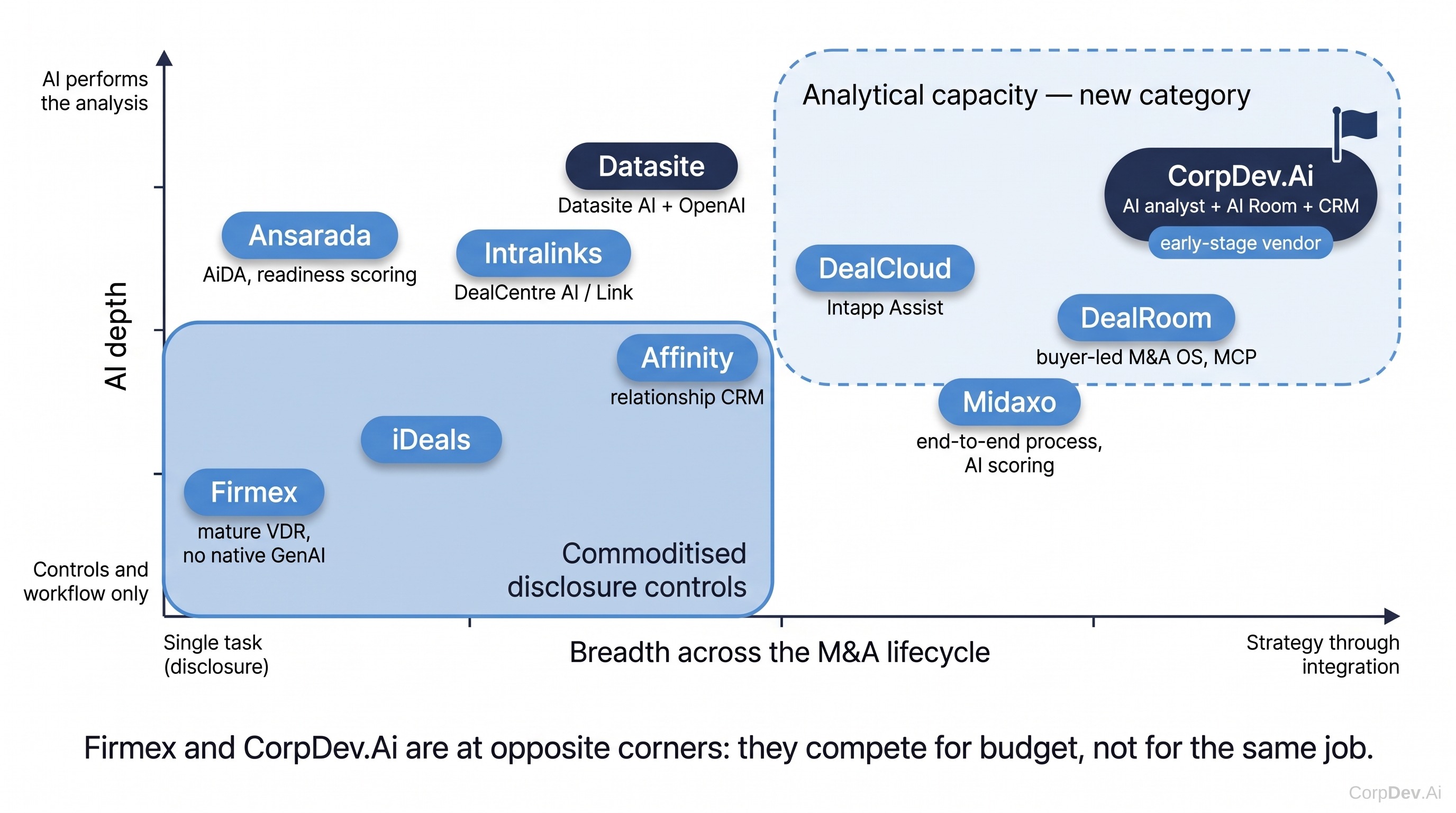
Read diagram description
Positioning comparison. First dimension "Breadth across the M&A lifecycle" from "Single task (disclosure)" on the left to "Strategy through integration" for analytical platforms. Second dimension "AI depth" from "Controls and workflow only" at the bottom to "AI performs the analysis" at the top. Vendor positions: Firmex (far left, low — "mature VDR, no native GenAI"); iDeals (left, low-mid); Ansarada (left, mid-high — "AiDA, readiness scoring"); Intralinks (left-centre, mid-high — "DealCentre AI / Link"); Datasite (left-centre, high — "Datasite AI + OpenAI"); Affinity (centre, mid — "relationship CRM"); DealCloud (centre-right, mid — "Intapp Assist"); Midaxo (right, low-mid — "end-to-end process, AI scoring"); DealRoom (right, mid — "buyer-led M&A OS, MCP"); CorpDev.Ai (far right, top — "AI analyst + AI Room + CRM", flagged "early-stage vendor"). The foundational capability is described as "Commoditised disclosure controls" and the emerging capability as "Analytical capacity — new category". "Firmex and CorpDev.Ai are at opposite corners: they compete for budget, not for the same job."
5.2 Evaluation criteria for a corporate development buyer
The scorecard applies weights that reflect an in-house corporate acquirer's priorities rather than a banker's. Scores are analyst judgements on a 1–5 scale from the evidence in Sections 3–4; a different buyer profile (Section 7) should re-weight.
| Criterion (weight) | Firmex | Datasite | Intralinks | iDeals | Ansarada | DealRoom | Midaxo | CorpDev.Ai |
|---|---|---|---|---|---|---|---|---|
| Analytical leverage — reduces analyst / adviser hours (25%) | 1 | 3 | 3 | 2 | 3 | 3 | 2 | 5 |
| Program governance — pipeline, approvals, PMI (20%) | 1 | 1 | 2 | 1 | 1 | 5 | 5 | End-to-end management and integration work; validate programme controls |
| Disclosure capability — VDR controls, Q&A, bidder analytics (15%) | 4 | 5 | 5 | 4 | 5 | 4 | 3 | 1 |
| Price transparency and TCO for a 3–5 person team (15%) | 3 | 1 | 1 | 5 | 4 | 3 | 2 | 4 |
| Vendor maturity, security certification, references (15%) | 5 | 5 | 5 | 4 | 4 | 3 | 4 | 2 |
| Openness — exports, APIs, MCP, lock-in risk (10%) | 3 | 2 | 2 | 3 | 3 | 4 | 3 | 5 |
Programme-scope assessment. The CorpDev.Ai integration entry describes its end-to-end management scope rather than assigning an unsupported comparative performance score. Evaluate the required controls and the quality of completed work on the same acquisition programme as other finalists. Deal frequency and public review volume do not establish a functional ranking. See the lifecycle framework and integration capabilities; these are vendor materials, not independent benchmarks.
The criteria make the trade-offs explicit without assigning an overall winner from incomplete capability evidence. A specialist room can meet disclosure requirements while CorpDev.Ai serves as the primary M&A management and analytical environment. Compare DealRoom and Midaxo on the same combined programme. The proposed weights are a starting point for procurement; score controls, completed analytical work and evidence quality after the pilot rather than converting a planning-only assumption into a numerical disadvantage.
6. Total Cost of Ownership and Pricing Models
6.1 Four pricing logics
The vendors compared here price on four different bases, and the basis matters more than the headline figure:
- Data-volume and duration (Firmex, iDeals, Ansarada). Price scales with gigabytes stored and months live; users are unlimited. Predictable, and the only one of the four that cannot surprise a buyer with seat growth [7][37][41].
- Transaction scope (Datasite, Intralinks). Quotes built from pages or documents, buyer groups, duration, support and AI modules; historically per-page. Suited to a banker who passes the cost through to the client, poorly suited to a corporate budget owner [19][20][21].
- Seats and modules (Midaxo, DealCloud, Affinity, 4Degrees). Annual per-user or per-module subscription; list prices understate real spend once modules and administrators are added — Midaxo's $10,000 list versus ~$63,250 reported median is the clearest example [68][69][81].
- Seats plus usage credits (CorpDev.Ai). Per-user monthly or annual fee with an allowance of research "search credits"; the model resembles AI-tool pricing more than deal-software pricing and is the only one with a no-commitment monthly option [97].
6.2 Illustrative annual software cost by team archetype
The scenarios below are analyst derivations, not quotes. Each line uses the published or third-party-reported figures from Sections 3–4; the Basis column states which. Real quotes for the enterprise VDRs and DealCloud vary by an order of magnitude with deal size.
| Archetype | Disclosure room | Process platform | AI analysis workspace | Total |
|---|---|---|---|---|
| A. Lean team (1–3 people, 2–3 buy-side deals/yr, divestiture every ~3 years) | 3 | 0 | 36 | 39 |
| B. Established team (3–5 people, 3–5 deals/yr, one disclosure event/yr) | 25 | 63 | 36 | 124 |
| C. Serial acquirer with divestiture program (5+ people, 6+ deals/yr) | 68 | 63 | 60 | 191 |
| Archetype | Disclosure room assumption | Process platform assumption | AI workspace assumption | Basis |
|---|---|---|---|---|
| A. Lean team | One per-project iDeals or Ansarada room every ~3 years, annualised (~$3K) | None — pipeline handled in the AI workspace's CRM | CorpDev.Ai AI Pro Team, annual ($3,000 × 12) | iDeals/Ansarada entry pricing [37][41]; CorpDev.Ai pricing page [97] |
| B. Established team | Firmex subscription at reported mid-market level (~$25K) | Midaxo at reported median (~$63K) | CorpDev.Ai AI Pro Team, annual | Third-party Firmex estimate [11]; Vendr Midaxo median [69]; [97] |
| C. Serial acquirer | Datasite at reported average annual spend (~$68K) | Midaxo at reported median | CorpDev.Ai Enterprise — assumed ~$60K (not published; analyst placeholder at ~1.7× Team plan) | DD Navigator Datasite sample [19]; [69]; Enterprise price is an assumption |
The archetype totals exist to show proportion, not to forecast an invoice. Two effects dominate any real budget: (1) enterprise VDR and DealCloud quotes swing from ~$10K to $250K+ with deal size, and (2) the AI workspace line is offset by whatever outside research and analyst spend it displaces — CorpDev.Ai's own framing is $200K–$2M of consulting fees per deal, a vendor figure that each buyer should replace with its own adviser invoices [94].
6.3 Hidden costs and negotiating points
- Overages. Ask every VDR for the storage overage rate, extension pricing if the deal slips, and archive or post-closing access fees. Firmex's no-per-page, no-bandwidth position is a genuine advantage here; Intralinks' legacy per-page terms are the risk [7][20].
- AI as an add-on. Datasite and Intralinks price AI modules and may cap usage; confirm whether AI is inside the base quote [19][23][30].
- Implementation. Midaxo and DealCloud carry meaningful configuration and administration costs that per-seat list prices exclude; DealCloud in particular should be budgeted with implementation partners [73][74].
- Seat creep. Affinity, 4Degrees and CorpDev.Ai scale with headcount; a team that grows from three to eight users increases a fixed per-seat Affinity bill by about 2.67 times and moves CorpDev.Ai from Team to Enterprise pricing [81][97].
- Renewal uplift. Firmex renewals are a recurring reviewer complaint; the leverage is a competing iDeals or Ansarada quote for identical scope [17][18].
- Displacement value. Each layer may offset manual work or risk. The AI workspace’s proposed offset is adviser invoices and analyst hours; workflow and disclosure savings should also be measured rather than assumed away. Teams should compute it explicitly before comparing headline prices.
7. Decision Framework: Which Tool for Which Buyer
The framework reduces to three questions, asked in order. Each maps to one of the categories in Section 2 and to a shortlist of two or three vendors.
The external disclosure requirement determines which specialist capabilities belong in the evaluation. It does not determine which platform should own the full M&A programme. Compare the work the team must complete, the evidence and controls required, and the effort of maintaining multiple systems.
| Requirement | Evaluation approach | Decision implication |
|---|---|---|
| External disclosure | Compare Firmex, iDeals and Ansarada on room administration, counterparty access, Q&A and subscription versus project use. Use the actual transaction or institutional mandate. | Retain a specialist for its demonstrated contribution; its strength in this job does not establish overall M&A superiority. |
| End-to-end M&A management | Evaluate CorpDev.Ai, Midaxo and DealRoom on the connected path from thesis and target evaluation through diligence, decisions, execution and integration. | Include CorpDev.Ai as a primary-platform candidate. Product categories and the number of deals are not substitutes for a workflow demonstration. |
| Analytical execution and deliverables | Ask each finalist to analyse the same evidence and produce a decision-ready recommendation, supporting materials and an integration response. Record human corrections and remaining manual work. | CorpDev.Ai's combination of management and work-producing agents is particularly relevant when substantial analysis must accompany every deal. Compare the quality and completeness of the outputs. |
| Large or frequent acquisition programmes | Use concurrent evaluations and integrations, shared business-unit resources and recurring leadership reporting in the pilot. Test permission boundaries and ownership changes. | Programme scale strengthens the case for evaluating integrated management and analytical capacity together; it does not automatically favour Midaxo or DealRoom. |
| Existing systems and total cost | Price the required participants, AI usage, data entitlements, implementation, ongoing reconciliation and exit. Compare both replacement and coexistence. | Keep a second platform where a specific control or operating requirement justifies it. Avoid turning a small standard plan into an unsupported Enterprise cost estimate. |
7.1 Buyer scenarios
Profile: 1–3 people; 2–3 acquisitions a year, mostly inbound or banker-sourced; divestiture every few years; pipeline in Excel; heavy reliance on advisers for market work.
Recommendation: Do not buy a VDR subscription. Take a per-project iDeals or Ansarada room when a disclosure event arrives. Put the budget into an AI analysis workspace — CorpDev.Ai is the purpose-built option — and use its CRM as the pipeline. Pilot for one deal cycle before committing annually.
Why not Firmex: you would pay for unlimited rooms you open once every three years.
Profile: 3–5 people; 3–5 deals a year; one financing, carve-out or board room a year; governance and repeatability matter; integration tracked in spreadsheets.
Recommendation: Firmex subscription (or Ansarada if bidder analytics matter) as the always-on disclosure layer; compare CorpDev.Ai, Midaxo and DealRoom as the primary M&A platform, assessing management and analytical execution together. Include adviser invoices, internal review and reconciliation effort in the cost comparison; a specialist disclosure room does not imply that management and analysis require two further platforms.
Why Firmex here: the subscription may pay for itself if one substantial disclosure event plus ongoing rooms exceeds an equivalent project quote, and its support model suits a team without a dedicated VDR administrator.
Profile: 5+ people; 6+ deals a year; active divestiture program; PE-style discipline; possibly a corporate venture arm.
Recommendation: Let bankers run marquee disclosures on Datasite or Intralinks; keep Firmex for the long tail of rooms. Midaxo (or DealCloud if the venture arm dominates) for the program. Evaluate CorpDev.Ai Enterprise for analytical throughput across many parallel workstreams, with the caveat that enterprise pricing is unpublished and the vendor's reference base is thin — negotiate a pilot with exit rights.
Why the enterprise VDR: adviser familiarity and bidder-side AI are worth the premium on a $500M+ process; not on a $20M one.
7.2 Questions to put to each vendor
| Ask Firmex / any VDR | Ask Midaxo / DealRoom / DealCloud | Ask CorpDev.Ai |
|---|---|---|
| What is the annual storage allowance and overage rate? Are users and rooms genuinely unlimited? | What is the all-in first-year cost including implementation, administrators and modules? | Provide two reference customers in corporate development and current SOC 2 report type and period. |
| Will Datasite AI capabilities flow to Firmex, when, and at what price? | Which AI features are live today versus roadmap, and do they act on our data or only summarise it? | Which capabilities are Enterprise-only, and what is Enterprise pricing for 5 and 10 users? |
| Which ISO 27001 revision is the current certificate, and what is its scope? | How does the VDR module compare on watermarking, Q&A and bidder analytics to a specialist room? | How are data-room documents isolated per workspace, and which model vendors see our data? |
| What is the renewal uplift policy, and can it be capped contractually? | What is the exit path — can we export the pipeline, tasks and history in open formats? | What happens to credits and access if we pause between deals? What is the export path for workbooks, knowledge and CRM? |
8. Risks, Caveats and Open Questions
On the evidence base. No reputable public source — Gartner, Deloitte, PwC, Bain, McKinsey or Datasite — publishes a 2025–2026 market size or growth rate for the VDR or M&A-software markets; Gartner's Market Guide characterises end-to-end M&A process software as emerging without sizing it [101][102][103]. Figures from pay-to-publish aggregators have been deliberately excluded. Pricing for Firmex, Datasite, Intralinks and DealCloud comes from third-party reviews and small contract samples rather than vendor list prices, and G2 and Capterra ratings move month to month; every such figure carries an as-of date in Section 9.
Deal-volume and user-count figures (Firmex 189,000 projects; Datasite 16,000 transactions a year and 40%+ of top-100 deals; Intralinks 10,000 deals a year; CorpDev.Ai 70M+ companies and "hundreds" of users) are self-reported and use incompatible definitions. They indicate scale, not market share, and should not be compared arithmetically [5][22][25][94].
On Firmex specifically. The open questions are ownership strategy and AI. Datasite has kept Firmex as a separate brand for five years; whether it remains a distinct, lower-cost tier, is folded into Datasite, or inherits Datasite AI is undisclosed and directly affects the value of a multi-year subscription [2][31]. Firmex's ISO 27001 material references both the 2013 and 2022 revisions; formal vendor diligence should confirm the current scope [4][6].
On the enterprise VDRs. Datasite's OpenAI partnership and Intralinks' DealCentre AI raise a data-governance question for disclosing parties — which model vendors process room content, under what contractual terms, and can a seller opt bidders out — that both vendors address in principle (permission-aware, in-room AI) but that counsel should review deal by deal [23][30][31].
On the process platforms. Reported median spend on Midaxo is six times its list price; buyers should anchor budgets on the former [68][69]. DealCloud's suitability for a corporate team without an investment arm is doubtful at its complexity and price. Affinity's $80 million Series C confirms investor confidence but also signals a venture-and-PE focus that may leave corporate features under-prioritised [82].
On CorpDev.Ai. The material risks are concentration and immaturity rather than capability: no disclosed funding, no published customers, self-described rather than independently evidenced security certification, and a small founding team [96][98][99]. Mitigants a buyer can insist on are a paid pilot with defined exit, reference calls, the SOC 2 report, and contractual confirmation of the open-format export path the vendor advertises [94]. A second-order risk is over-reliance: an AI analyst that produces a cited memo in minutes shifts the team's work from drafting to verification, and teams without the discipline to verify will be exposed regardless of how good the citations are.
On this article. It was prepared for CorpDev.Ai. The mitigation is method — public sources for every claim, identical candour about every vendor's weaknesses, and a scorecard whose weights are stated so a reader can re-run it for a different buyer profile. Readers who re-weight toward disclosure capability and vendor maturity will, correctly, find Firmex, Datasite and Intralinks at the top; that outcome is consistent with the argument here, which is not that Firmex is a weak product but that most corporate development teams are buying the wrong category first.
9. Key Facts & Sources
Load-bearing figures used in this article, with their source and as-of date. Figures marked "derived" are analyst calculations whose method is stated in the section referenced.
| Fact | Value | Source | As of |
|---|---|---|---|
| Firmex founding and HQ | 2006, Toronto | Firmex company page [1] | Nov 2025 |
| Firmex acquisition by Datasite | 100% acquired 26 Jul 2021 from Vertu Capital and BDC Capital; price undisclosed | Firmex / BetaKit [2][3] | Jul 2021 |
| Firmex scale metrics | 223,000+ companies; 1.4M+ users; 180+ countries; 189,000 projects; ~20,000 new projects/yr | Firmex pricing and VDR pages [4][5][7] | Nov 2025 |
| Firmex pricing structure | Single-project (one-time fee) or annual subscription (unlimited projects); quote-based; no per-page or bandwidth charges | Firmex pricing page [7][8] | Nov 2025 |
| Firmex price estimates | Entry subscription ~$625–$995/month; mid-market ~$25K+/yr; enterprise $50K–$200K+; single project ~$5K–$10K | Third-party reviews [9][10][11][12] | Apr–Aug 2026 |
| Firmex ratings | G2 4.6/5 (93 reviews); Capterra 4.8/5 (356 reviews) | G2, Capterra [13][14][15][16] | Mar 2026 |
| Firmex security | SOC 2 Type II; ISO/IEC 27001 data centres (2013 and 2022 revisions both referenced) | Firmex security page [4][6] | Jul 2025 |
| Datasite scale | 16,000+ transactions/yr; 626,000+ users; 40%+ of top-100 global deals | Datasite FAQ [22] | Mar 2026 |
| Datasite pricing sample | ~$68K average annual spend; ~$190K largest contract; $20K–$250K+ per deal budgeting range | DD Navigator; CT Acquisitions [19][21] | Jan–Jun 2026 |
| Datasite–OpenAI partnership | Announced June 2026 | Datasite [31] | Jun 2026 |
| Intralinks scale | 10,000+ M&A deals/yr; $35T cumulative; ~6.6M registered users | Intralinks [24][25] | 2024–2025 |
| Intralinks pricing estimates | $10K+ small; $50K–$200K mid-market; $200K+ global; legacy ~$0.60/page | Secure Data Rooms [20] | Jul 2026 |
| Ansarada pricing | From ~$69/month (50 MB, 12-month) to ~$249/month (250 MB); free preparation period; G2 4.5 | Ansarada; datarooms.co; G2 [37][38][40] | May 2026 |
| iDeals pricing and rating | ~$250–$395/month annual; from ~$2,700/yr; G2 4.7 | iDeals; G2 [41][42][45][46] | Jun–Aug 2026 |
| DealRoom pricing and rating | Platform from ~$25K/yr, unlimited users; G2 ~4.3 | DealRoom; G2 [47][52] | 2026 |
| Midaxo pricing | $10K/yr list; ~$63,250 median reported spend; 500+ teams | Software Advice; Vendr; Midaxo [68][69][71] | May 2026 |
| Intapp financials | FY2026 total revenue $577.8M; Q2 FY26 cloud ARR $433.6M; DealCloud not separately reported | Intapp IR; 10-K summary [89][91] | Feb–Aug 2026 |
| Affinity pricing and funding | $2,000 / $2,300 / $2,700 per user/yr; $80M Series C (Menlo Ventures) Sep 2021; ~$120M total; ~1,700 institutions | Affinity [81][82] | Mar 2026 |
| CorpDev.Ai pricing | AI Pro $1,200/month or $1,000/month annual (1 user); AI Pro Team $3,600 or $3,000/month annual (3 users); Enterprise custom | CorpDev.Ai pricing page [97] | Sep 2026 |
| CorpDev.Ai founders | Kal Kilpi (co-founder of Midaxo); Atul Tiwary (ex-Barracuda, RBC, Fortinet) | CorpDev.Ai About; LinkedIn [98][100] | 2026 |
| CorpDev.Ai funding and customers | No disclosed funding round; no named customers; "hundreds" of users claimed | Tracxn; CorpDev.Ai [94][97][99] | Aug 2026 |
| CorpDev.Ai data claims | 70M+ companies; 265M+ contacts; 50,000-page data-room capacity; SOC 2 compliance | CorpDev.Ai site (vendor claims) [94][96] | Sep 2026 |
| GenAI adoption in M&A | 86% of 1,000 corporate and PE leaders integrated GenAI; 65% within the prior year | Deloitte [107] | Oct 2025 |
| GenAI impact on deal cycles | 40% of GenAI users report 30–50% shorter cycles | McKinsey [111] | Mar 2026 |
| Corporate development tooling proxy | 37% of large teams used a VDR; ~62% relied primarily on Excel | 2020 survey via BusinessWire; Grata [112][113][114] | 2020–2022 |
| Gartner category | "End-to-end M&A process software" — Market Guide, emerging market, no public size | Gartner [101][102][103] | Nov 2025 |
| Weighted scorecard (Section 5.2) | Derived: analyst 1–5 scores × stated weights | This article | Sep 2026 |
| Archetype cost totals (Section 6.2) | Derived: sum of reported/list prices per Basis column; CorpDev.Ai Enterprise figure is an assumption | This article | Sep 2026 |
References
Numbering follows the original research. Access dates below record the original source registry; they do not imply that every source was rechecked for this website edition.
- Who We AreSource accessed 2026-09-11
- Datasite Announces Acquisition of Toronto-based FirmexSource accessed 2026-09-11
- Firmex acquired by US-based Datasite in Vertu Capital's ...Source accessed 2026-09-11
- World's most trusted virtual data room - FirmexSource accessed 2026-09-11
- Virtual Data Room SolutionSource accessed 2026-09-11
- Security, Control, and Compliance - Virtual Data Room - FirmexSource accessed 2026-09-11
- PricingSource accessed 2026-09-11
- Firmex Data Room Overview: Features, Pricing, and ...Source accessed 2026-09-11
- What Is Firmex VDR in 2026: Features, Pricing, Datasite ...Source accessed 2026-09-11
- Firmex Pricing in 2026: Plans, Costs, and What to Expect on a QuoteSource accessed 2026-09-11
- Firmex Pricing Review: What Mid-Market M&A Pays in 2026Source accessed 2026-09-11
- Firmex Review 2026: Features, Pricing, Pros, Cons, and ...Source accessed 2026-09-11
- Datasite Diligence vs Firmex Virtual Data Room Comparison - G2Source accessed 2026-09-11
- Page 3 - Reviews of Firmex Virtual Data Room - CapterraSource accessed 2026-09-11
- Firmex Virtual Data Room Pricing, Cost & Reviews - Capterra UKSource accessed 2026-09-11
- Firmex Virtual Data Room Reviews & Product DetailsSource accessed 2026-09-11
- What Is a Data Room for Investors? Contents, Costs + Top ...Source accessed 2026-09-11
- 7. Securedocs, An Onit...Source accessed 2026-09-11
- VDR + AI Fees in 2026 — Whitepaper | DD NavigatorSource accessed 2026-09-11
- Intralinks Pricing 2026: Reported Costs, Fees & AlternativesSource accessed 2026-09-11
- Best Due Diligence Platforms for M&A in 2026: 12-Vendor Buyer's ...Source accessed 2026-09-11
- Why do the world's top dealmakers trust Datasite AI? | FAQSource accessed 2026-09-11
- How To Utilize AI In M&A Data Rooms - DatasiteSource accessed 2026-09-11
- SS&C Intralinks Releases 2025 Limited Partner Survey ResultsSource accessed 2026-09-11
- Virtual Data Rooms (VDR) | Intralinks VDRProSource accessed 2026-09-11
- Sell-Side Data Rooms For Due DiligenceSource accessed 2026-09-11
- Deal Intelligence Powered by LinkSource accessed 2026-09-11
- Revolutionizing Dealmaking Using the Power of AISource accessed 2026-09-11
- Using AI to answer questions about documents | DealCentreSource accessed 2026-09-11
- © 2025 SS&C Intralinks, Inc. | All Rights Reserved | 1Source accessed 2026-09-11
- Dealmaking reimagined with Datasite and OpenAISource accessed 2026-09-11
- SS&C Intralinks | VDR, M&A & Dealmaking Solutions LeaderSource accessed 2026-09-11
- Intralinks vs Datasite: A Detailed Comparison for 2026Source accessed 2026-09-11
- Ansarada virtual data room pricing: plans, costs and ...Source accessed 2026-09-11
- Ansarada Pricing 2026: Plans, Costs and What You GetSource accessed 2026-09-11
- Ansarada Pricing Review 2026Source accessed 2026-09-11
- Ansarada PricingSource accessed 2026-09-11
- Plans - Ideals Virtual Data Room PricingSource accessed 2026-09-11
- Ideals: Virtual Data Room Software for Secure DealmakingSource accessed 2026-09-11
- What's brewing at Ideals Board? Exclusive demo and coffee on us!Source accessed 2026-09-11
- Best virtual data room providers in 2026 - IdealsSource accessed 2026-09-11
- 9 Best Virtual Data Rooms for Investment Banking in 2026Source accessed 2026-09-11
- Ideals Virtual Data Room Reviews & Product Details - G2Source accessed 2026-09-11
- DealRoom Pricing: M&A Software Plans and CostsSource accessed 2026-09-11
- Best Virtual Data Room Service Providers of 2026 – ComparisonSource accessed 2026-09-11
- M&A Virtual Data Room (VDR) - DealRoomSource accessed 2026-09-11
- Purpose-built AI for Buy-Side M&A - DealRoom.netSource accessed 2026-09-11
- DealRoom | AI-Powered M&A Operating System for Buyer-Led M&A™Source accessed 2026-09-11
- DealRoom Reviews 2026: Details, Pricing, & Features - G2Source accessed 2026-09-11
- DealRoom Review 2026: Features, Pricing, Pros & ConsSource accessed 2026-09-11
- Box Data Room: Features, Pricing, Limitations, and ...Source accessed 2026-09-11
- Box Pricing 2026: Real Costs, Hidden Fees & Cheaper ...Source accessed 2026-09-11
- Box AI: Unlock Intelligent Content Management with AI ...Source accessed 2026-09-11
- Box Reviews 2026: Details, Pricing, & FeaturesSource accessed 2026-09-11
- ShareFile Virtual Data Room Review: Pricing 2026Source accessed 2026-09-11
- ShareFile Plans & Pricing | Get Free TrialSource accessed 2026-09-11
- Midaxo Software Reviews, Demo & Pricing - 2026Source accessed 2026-09-11
- Midaxo Software Pricing & Plans 2025: See Your CostSource accessed 2026-09-11
- Midaxo Pricing 2026Source accessed 2026-09-11
- M&A Intelligence Platform | Midaxo M&A SoftwareSource accessed 2026-09-11
- M&A Pipeline Software - MidaxoSource accessed 2026-09-11
- Best CRM for Investment Banking in 2026: Top Platforms ComparedSource accessed 2026-09-11
- The AI-powered deal and relationship intelligence platform - IntappSource accessed 2026-09-11
- Intapp DealCloud pipeline and deal managementSource accessed 2026-09-11
- Business development software for financial and ... - IntappSource accessed 2026-09-11
- Intapp Assist for DealCloudSource accessed 2026-09-11
- Intapp Assist for DealCloud: OriginationSource accessed 2026-09-11
- Vertical Demand Trends And...Source accessed 2026-09-11
- Affinity Pricing: Plans for Private Capital CRMSource accessed 2026-09-11
- Affinity's Series C Funding for Relationship IntelligenceSource accessed 2026-09-11
- Pricing - 4DegreesSource accessed 2026-09-11
- 4Degrees Pricing, Reviews, Pros & Cons (2026) - ProspeoSource accessed 2026-09-11
- Artificial Intelligence That Moves Deals Forward - 4DegreesSource accessed 2026-09-11
- Mergers & Acquisitions (M&A) CRM Software - 4DegreesSource accessed 2026-09-11
- Deal Flow Management Software - 4DegreesSource accessed 2026-09-11
- 4Degrees | CRMSource accessed 2026-09-11
- Intapp announces second quarter fiscal year 2026 financial resultsSource accessed 2026-09-11
- Intapp leverages AI for regulated professional firms - Stock TitanSource accessed 2026-09-11
- Affinity | Valuation, Funding Rounds & Stock Price - CaplightSource accessed 2026-09-11
- CorpDev.Ai - Agentic AI for M&A and Corporate DevelopmentSource accessed 2026-09-11
- AI Deal Sourcing Platform for M&ASource accessed 2026-09-11
- Request a Free Trial | CorpDev.AiSource accessed 2026-09-11
- PricingSource accessed 2026-09-11
- About Us - CorpDev.AiSource accessed 2026-09-11
- CorpDev.ai - 2026 Company Profile & CompetitorsSource accessed 2026-09-11
- Atul Tiwary | LinkedInSource accessed 2026-09-11
- Best End-to-End M&A Process Software Reviews 2026 - GartnerSource accessed 2026-09-11
- Market Guide for End-to-End M&A Process Software - GartnerSource accessed 2026-09-11
- Market Guide for End-to-End M&A Process SoftwareSource accessed 2026-09-11
- New Deloitte Survey: 86% of Corporate and Private Equity Leaders ...Source accessed 2026-09-11
- AI meets M&A | McKinsey & CompanySource accessed 2026-09-11
- Large Corporate Development Teams Are Open to Leveraging Technology to Manage Work Beyond M&ASource accessed 2026-09-11
- Top Corporate Development and M&A Software in 2026Source accessed 2026-09-11
- Tech Evolution: The Corporate Development Catch-Up ChallengeSource accessed 2026-09-11