RESEARCH / Document AI and investment research
Hebbia Alternatives: Document AI, Research and M&A Workflows
Compare Hebbia Matrix with Rogo, AlphaSense, legal AI and CorpDev.Ai on document evidence, research, workflow depth, enterprise pricing and buyer fit.
Research as of
Website edition edited
Published by CorpDev.Ai, which is one of the vendors assessed. This analysis distinguishes vendor claims, external evidence and analyst judgments. Prices and capabilities reflect the source dates in the article; the website edition is an editorial adaptation, not a new verification of every claim.
Measure the value of reusable evidence across a large document set
Hebbia’s core buying case is the conversion of a large document population into structured, source-linked evidence that analysts can interrogate and reuse. The relevant management question is whether that structure changes the speed and reliability of review across many documents, reviewers and iterations. A polished generated memo is less persuasive than a finding whose supporting evidence remains inspectable when the investment committee challenges it.
That document-intelligence layer can complement a lifecycle platform or CRM. It does not automatically own the acquisition thesis, relationship history or integration accountability. Matrix’s move toward agents and deliverables broadens the overlap, so buyers should test the actual handoff rather than rely on historical category boundaries. Reported average enterprise contract values also describe deployment scale, not a verified minimum for a small team.
Use a room with known exceptions and ask the finalists to build, revise and defend the same analysis. Measure completeness, citation accuracy and reviewer effort after new documents arrive. Obtain a quote for that workload and user population. The combination of repeatable evidence and matched commercial terms determines whether specialist depth justifies another platform.
Executive Summary
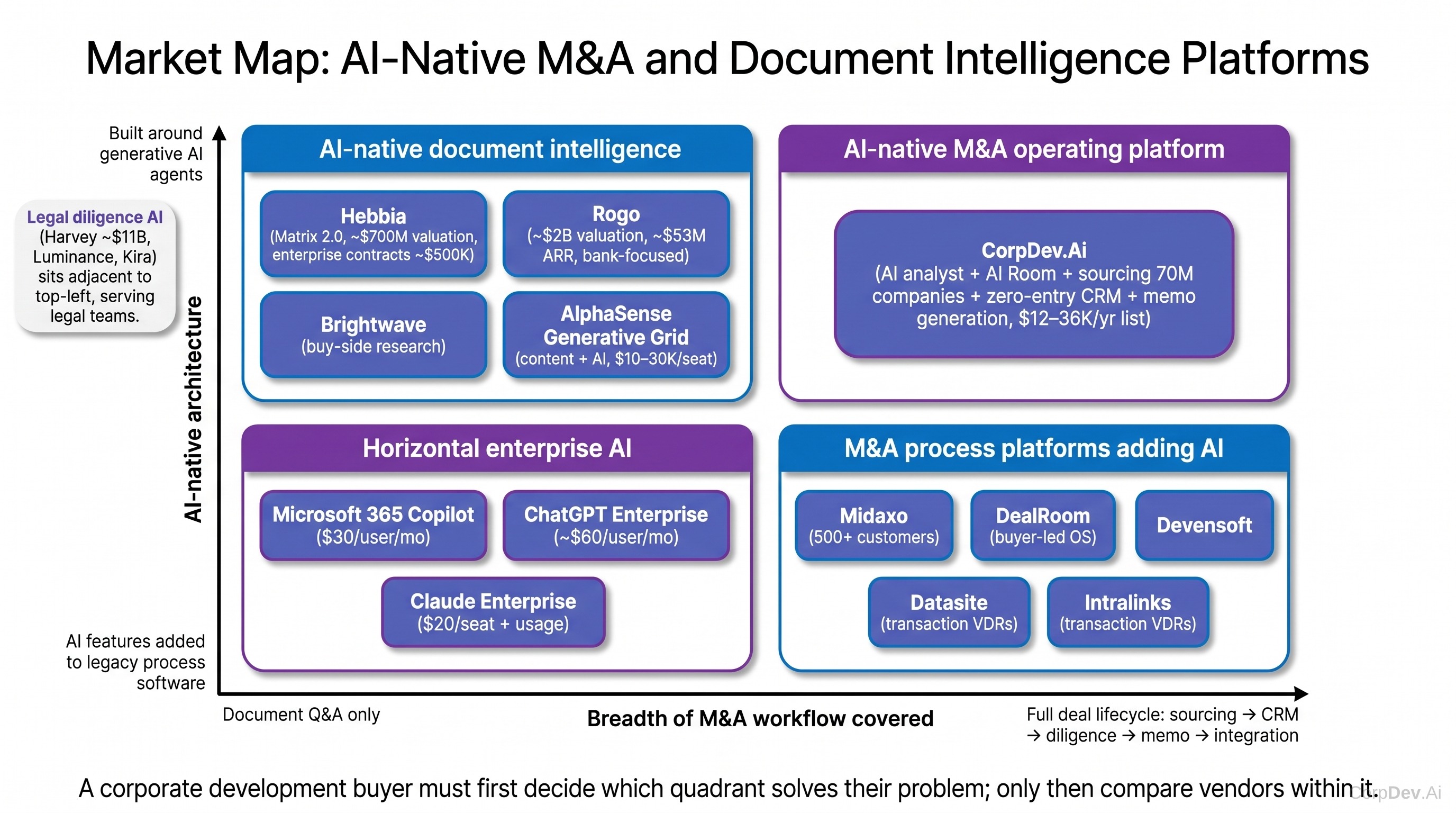
Hebbia is the best-known name in AI document analysis for finance, and for a corporate development, strategy or M&A team evaluating it the central question is not "is Hebbia good?" — it is "what problem am I actually buying software for, and does a document-intelligence layer solve it?" This guide compares Hebbia against the four groups of alternatives a buyer will realistically shortlist: AI-native research platforms built for finance (Rogo, Brightwave, AlphaSense), AI-native M&A operating platforms (CorpDev.Ai), process-oriented M&A lifecycle systems (Midaxo, DealRoom, Devensoft, Datasite, Intralinks), and horizontal enterprise AI (Microsoft 365 Copilot, ChatGPT Enterprise, Claude Enterprise), with legal-diligence AI (Harvey, Luminance, Kira) noted where it intersects.
~$700M
Hebbia valuation at last disclosed round (Jul 2024)
~$500K
Reported average Hebbia enterprise contract (unconfirmed)
~$2B
Rogo valuation, Apr 2026 — 3x Hebbia's last mark
$12K–$36K
CorpDev.Ai list price per year (1–3 users)
The headline findings for a buyer:
- Hebbia's core product, Matrix, remains the reference implementation of "many documents × many questions" analysis. Its August 2026 relaunch as Matrix 2.0, with the Max agent, addresses the two most common complaints — users had to design the grid themselves and the output stopped at the table [2]. But the grid paradigm has been copied by Rogo, Harvey and Legora, and Hebbia has not announced a funding round since its $130M Series B at roughly $700M in July 2024, when ARR was approximately $13M [1][2]. Third-party estimates put 2025–26 ARR at $25–30M+, unverified [4][5].
- Hebbia is priced and sold for large institutions. No public price list exists; secondary reporting points to $3,000–$15,000 per seat per year and an average contract near $500,000 [7][8][9]. A five-person corporate development team is not Hebbia's design centre, and the buyer should expect enterprise minimums and a sales-led process.
- Rogo has overtaken Hebbia on the metrics that matter to investors — capital, growth and valuation. Its $160M Series D at ~$2B (April 2026) and reported ARR of ~$53M in August 2026, up from $15M at end-2025, make it the momentum leader in finance-native AI research [20][22]. Its centre of gravity, however, is investment banking and public-markets research rather than in-house corporate development.
- For an in-house corporate development team, the more relevant comparison is often not Hebbia versus Rogo but "document intelligence layer" versus "M&A operating platform." Hebbia, Rogo and AlphaSense answer questions about documents; they do not run a pipeline, screen 70 million companies, capture activity from email and calendar, or produce a board-ready memo inside a governed deal workflow. CorpDev.Ai is the only vendor in this comparison that combines an AI analyst, data-room analysis, target sourcing, CRM and deliverable generation in one system — at a published list price roughly one order of magnitude below a Hebbia enterprise contract [11][12]. Its trade-offs are equally real: it is a small, founder-led company with no disclosed institutional funding and no publicly named customers [14][15].
- Process platforms and horizontal AI are complements, not substitutes. Midaxo, DealRoom and Devensoft govern how a deal moves from pipeline to integration and are adding AI features rather than being built around them [57][62]. Copilot, ChatGPT Enterprise and Claude Enterprise cost $20–$75 per user per month and are extraordinarily capable analysts, but they lack M&A data structures, deal-grade citation discipline and connected pipeline context, so they work best as a layer around a specialist system [80][83][88].
Who should buy what, in one line each:
| Buyer profile | Strongest fit | Rationale |
|---|---|---|
| Large PE / asset manager / bulge-bracket bank with 100+ analysts and heavy data-room throughput | Hebbia or Rogo | Deep pockets for enterprise contracts; the workflow is document-question-answer at scale |
| Corporate development team (2–15 people) at a $1B+ company running sourcing, diligence and memos in-house | CorpDev.Ai as a primary platform; compare Midaxo/DealRoom on programme requirements | Needs the full buy-side workflow, not just document Q&A; budget is five, not six or seven, figures |
| Strategy / competitive-intelligence team needing external content (transcripts, expert calls, filings) | AlphaSense | Content library plus Generative Grid; premium pricing reflects content, not AI |
| Serial acquirer with formal integration and value-tracking requirements | Midaxo or DealRoom + a horizontal AI layer | Process, auditability and PMI matter more than research speed |
| Legal / contract diligence at scale | Harvey, Luminance or Kira (Litera) | Purpose-built for clause extraction and legal review |
| Any team already standardised on Microsoft 365 with a modest budget | Copilot first, specialist tool second | Permissions-aware access to internal content at ~$30/user/month |
Read diagram description
Comparison. First dimension: "Breadth of M&A workflow covered" from "Document Q&A only" (left) to "Full deal lifecycle: sourcing → CRM → diligence → memo → integration" (right). Second dimension: "AI-native architecture" from "AI features added to legacy process software" (bottom) to "Built around generative AI agents" (top). Top-left quadrant ("AI-native document intelligence"): Hebbia (Matrix 2.0, ~$700M valuation, enterprise contracts ~$500K), Rogo (~$2B valuation, ~$53M ARR, bank-focused), Brightwave (buy-side research), AlphaSense Generative Grid (content + AI, $10–30K/seat). Top-right quadrant ("AI-native M&A operating platform"): CorpDev.Ai (AI analyst + AI Room + sourcing 70M companies + zero-entry CRM + memo generation, $12–36K/yr list). Bottom-right quadrant ("M&A process platforms adding AI"): Midaxo (500+ customers), DealRoom (buyer-led OS), Devensoft, Datasite and Intralinks (transaction VDRs). Bottom-left quadrant ("Horizontal enterprise AI"): Microsoft 365 Copilot ($30/user/mo), ChatGPT Enterprise (~$60/user/mo), Claude Enterprise ($20/seat + usage). Legal diligence AI (Harvey ~$11B, Luminance, Kira) sits adjacent to top-left, serving legal teams. "A corporate development buyer must first decide which quadrant solves their problem; only then compare vendors within it."
Why This Category Exists: The Problem Deal Teams Are Actually Buying Software For
Corporate development work is unusual among knowledge-work functions in how much of it is reading. A single mid-market acquisition generates a confidential information memorandum, a management presentation, a quality-of-earnings report, several hundred to several thousand data-room files, a stack of customer and supplier contracts, and the acquirer's own internal memos, models and board materials. Before AI, a team's throughput was bounded by how many of those pages an associate could read, and the industry's answer was headcount — either in-house or rented from bankers, lawyers and consultants at hourly rates.
Generative AI changes the constraint, but not uniformly. Five distinct jobs sit inside "M&A work," and the vendors in this comparison are built around different ones:
| Job to be done | What the team is really trying to do | Example tasks | Vendor category that owns it |
|---|---|---|---|
| Document intelligence | Answer hundreds of precise questions across large document sets with page-level evidence | Data-room review, covenant extraction, CIM comparison, contract change-tracking | Hebbia, Rogo, AlphaSense Enterprise Intelligence, V7 Go |
| External research and sourcing | Find and rank targets, size markets, track competitors and triggers | Long-list building, market maps, fit scoring, news monitoring | CorpDev.Ai, AlphaSense, PitchBook-type data providers, Rogo (public markets) |
| Deal workflow and governance | Move a deal through gates with owners, tasks, approvals and audit trail | Pipeline, request lists, Q&A, integration workplans, synergy tracking | Midaxo, DealRoom, Devensoft, Datasite, Intralinks |
| Relationship and activity capture | Know who talked to whom, when, about what — without manual entry | CRM sync from email and calendar, relationship scoring | Affinity, DealCloud, CorpDev.Ai zero-entry CRM |
| Deliverable production | Turn evidence into an IC memo, board deck or one-pager that survives scrutiny | Investment memos, market analyses, integration plans | CorpDev.Ai, Hebbia Matrix 2.0 (memo/deck drafts), horizontal AI |
The reason a buyer's comparison is genuinely difficult is that every vendor now claims some of every row. Hebbia's Matrix 2.0 drafts memos and decks [2]; Midaxo announced a "major AI update" in 2026 [57]; Datasite bought an agentic-AI company [70]; Copilot indexes the data room if it lives in SharePoint [80]. The claims converge; the architectures do not. A document-intelligence product that drafts a memo is still organised around documents. A process platform with an AI assistant is still organised around tasks and gates. An M&A operating platform built on a knowledge graph is organised around companies, deals and people, with documents as one input among several.
This comparison focuses on an in-house corporate development, strategy or M&A function at an operating company. Institutional deployments of Hebbia, Rogo or legal AI can involve larger user populations, different content entitlements and a different budget owner from a small corporate team. A reported $500,000 average contract is therefore a signal about deployment scale, not evidence that every institution considers the expense immaterial or that a corporate buyer faces the same minimum. The relevant comparison is the cost and operating burden for the team’s actual users and workload; institutional fit is discussed separately where it changes the decision.
Why generic chat assistants are not enough — and why they are also not nothing. Every team evaluated here already has access to ChatGPT, Claude or Copilot, and the honest starting point is that these tools now perform first-pass diligence synthesis, memo drafting and financial-narrative interpretation credibly, at $20–$75 per user per month [83][88]. What they lack for M&A is structural, not intellectual: no persistent model of the deal, no page-cited audit trail a board or auditor will accept, no target database, no pipeline, no governed data-room ingestion, and no memory of what the team learned on the last deal. The 2026 Business Insider coverage of Hebbia names Anthropic's Claude as a threat to finance-focused AI products precisely because the general models keep closing the capability gap [2] — which means specialist vendors must justify themselves on workflow, data, governance and institutional memory, not on raw model quality. That is the lens this guide applies.
Hebbia in Depth
What Hebbia is
Hebbia is a New York–based enterprise AI company whose flagship product, Matrix, lets a user combine large collections of documents and financial data, pose many questions simultaneously, and receive answers in a spreadsheet-like grid — one row per document or company, one column per question, each cell carrying a citation back to the source passage [1][3]. It is used for due diligence, valuation, credit analysis, market research and document comparison, and its customer base is concentrated in asset management, private equity, investment banking and law, with expansion into consulting, pharmaceuticals and corporate finance [3][1].
The company's own marketing metrics — firms representing $30 trillion in AUM, roughly 200,000 prompts per day, 1.5 billion pages processed — are unaudited but indicate genuine institutional scale [3]. Named customers that can be substantiated include Centerview Partners (banking), Charlesbank (private equity) and Fenwick (law) [1]. In 2024 the CEO claimed 30% of asset managers used the product; that is a company claim rather than an independent estimate [1].
Funding, valuation and financial trajectory
$130M
Series B, July 2024, led by a16z
~$700M
Post-money valuation at Series B
~$13M
ARR at Series B (≈54x revenue multiple)
$25–30M+
2025–26 ARR per third-party estimates (unverified)
Hebbia's $130M Series B in July 2024, led by Andreessen Horowitz with Index Ventures, GV and Peter Thiel participating, valued the company at approximately $700M on roughly $13M of ARR, which TechCrunch reported as profitable revenue [1]. Total funding stands at approximately $160M [1][6]. Critically for a buyer assessing vendor durability, Hebbia has not announced a further round in the 26 months since, and management has described the company as well capitalised from the prior raise [2]. Third-party databases estimate 2025 ARR at $24.6M, and one industry report claims $30M+, but the company has not confirmed either figure [4][5].
Put in context: Rogo, which raised its Series A after Hebbia's Series B, reached a ~$2B valuation and ~$53M reported ARR by mid-2026 [20][22]; Harvey reached ~$11B and ~$190M ARR [35][37]. Hebbia was the early leader in this category and is no longer the fastest-growing participant in it. That is not a reason to avoid the product, but it is a reason to negotiate contract protections (data portability, price caps, change-of-control terms) that a buyer would not bother requesting from a hyperscaler.
Product: Matrix, Matrix 2.0 and Max
Read diagram description
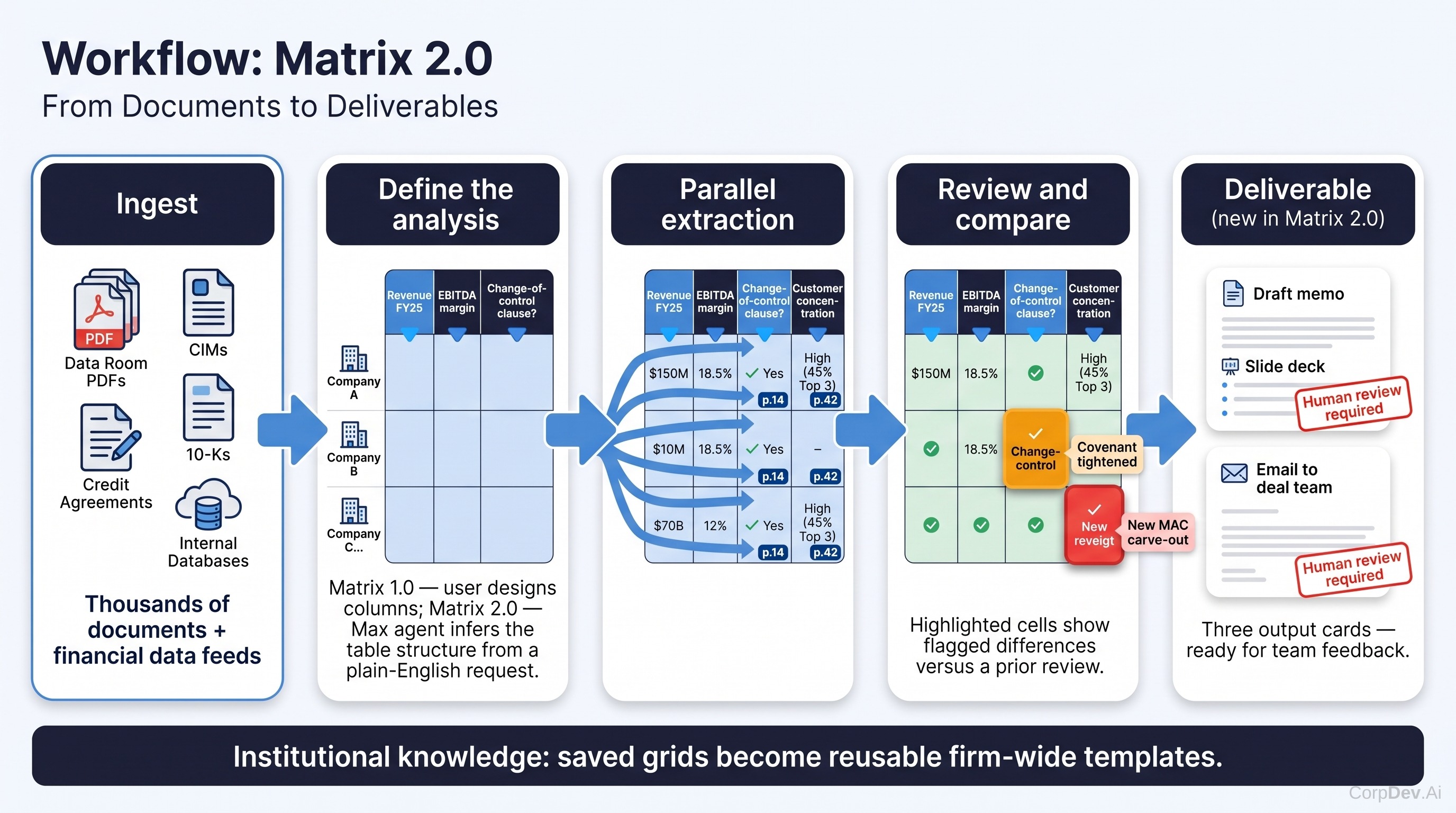
Workflow diagram in five stages. Stage 1 "Ingest": features: data room PDFs, CIMs, credit agreements, 10-Ks, internal databases; label "Thousands of documents + financial data feeds". Stage 2 "Define the analysis": a comparison with rows for "Company A, Company B, Company C…" and columns labelled "Revenue FY25", "EBITDA margin", "Change-of-control clause?", "Customer concentration". Note: "Matrix 1.0 — user designs columns; Matrix 2.0 — Max agent infers the table structure from a plain-English request". Stage 3 "Parallel extraction": document-level results populate the comparison cells, each with a page citation such as "p.14". Stage 4 "Review and compare": Flagged differences versus a prior review ("covenant tightened", "new MAC carve-out"). Stage 5 "Deliverable (new in Matrix 2.0)": three output types — "Draft memo", "Slide deck", "Email to deal team" — with human review required. Supporting layer: "Institutional knowledge: saved grids become reusable firm-wide templates."
Matrix (the original product) solved a real problem elegantly: parallelising analyst reading across a document set and making the evidence auditable at cell level. Its two structural limitations, acknowledged in 2026 reporting, were that users had to design the grid themselves — they needed to know which columns to ask for — and that the output stopped at the table, leaving the conversion into a memo, deck or email to the user [2].
Matrix 2.0, rolled out to customers in August 2026, is Hebbia's answer. The Max agent takes a natural-language assignment ("review these credit agreements, extract covenant terms, compare against last quarter's review, flag changes, draft a memo"), infers the required table structure, selects sources, queries internal databases as well as uploaded documents, and produces a draft memo, presentation or email for human review [2]. Management reported that in early pilots, actions taken in the product rose tenfold in a month and daily active usage tripled since May 2026 — management-reported rollout metrics, not independent usage data [2].
A separately branded "Hebbia Terminal" appears in some third-party listings; no substantiated public description, launch announcement or pricing could be found, and the company's own site describes only Matrix [3].
Pricing and commercial model
Hebbia does not publish pricing and has no self-serve tier or public trial; access is through an enterprise sales process [7]. Secondary reporting — none confirmed by the company — describes a per-seat model within a negotiated enterprise agreement:
| Reported tier | Reported price | Reliability |
|---|---|---|
| Lite / preset-agent seat | $3,000–$3,500 per seat per year | Secondary reporting [8] |
| Professional / custom-agent seat | ~$10,000 per seat per year | Secondary reporting [8] |
| Alternative per-user figure | ~$15,000 per user per year | Secondary reporting [9] |
| Average enterprise contract value | ~$500,000 per year | Secondary estimate [8][9] |
The $500,000 average contract figure, if directionally right, tells a corporate development buyer the most important thing about Hebbia's commercial posture: the company is optimised for deployments of dozens to hundreds of seats at institutions, not for a five-person team. Smaller buyers should expect minimum commitments and should ask directly whether a sub-$100,000 contract is available.
Strengths
- Best-in-class at the core job. For parallel, cited extraction across thousands of documents, Matrix remains the benchmark other vendors copy — Rogo, Harvey and Legora have all shipped grid-style bulk review [2].
- Institutional credibility. Centerview, Charlesbank, Fenwick and a claimed $30T of client AUM make Hebbia a defensible choice in front of an investment committee or a compliance function [1][3].
- Matrix 2.0 closes the deliverable gap. Memo, deck and email drafting from the grid removes the most-cited workflow friction [2].
- Reported profitability at the Series B is unusual for an AI company at that stage and reduces near-term vendor-viability risk [1].
Limitations for a corporate development buyer
- It is a document layer, not a deal system. Hebbia has no target database, no pipeline or CRM, no email/calendar capture and no integration-planning constructs. A corporate development team using Hebbia still runs the deal in Excel, Outlook and a process tool.
- Enterprise-only economics. No transparent pricing, no trial, reported six-figure average contracts [7][8][9].
- Competitive commoditisation. The grid paradigm has been replicated; general-purpose models are named in 2026 coverage as a direct threat [2]. Differentiation now rests on agents and institutional knowledge features that are weeks, not years, old.
- Disclosure gaps. No verified post-2024 ARR, customer count, retention or funding information; a 26-month gap since the last announced round [2][4][5].
- Human review remains mandatory. Matrix 2.0 drafts; it does not sign off. This is appropriate, but a buyer should not model headcount savings on the assumption of unsupervised output [2].
Hebbia's last disclosed valuation is 26 months old, its ARR growth since is unverified, and better-capitalised rivals (Rogo at ~$2B, Harvey at ~$11B) now compete for the same institutional accounts. None of this makes the product weaker today. It does argue for a 12-month initial term, explicit data-export rights, a price-escalation cap and a change-of-control clause — protections a buyer should insist on for any vendor whose next financing event is uncertain.
The Alternatives Landscape
The alternatives fall into four groups plus an adjacent legal category. Each is assessed on what it is built to do, its commercial posture, and its fit for an in-house corporate development buyer. Public disclosure is uneven across vendors; where a figure is a third-party estimate rather than a company disclosure, the text says so.
Group 1 — AI-native document and research platforms for finance
These are Hebbia's most direct competitors: products organised around asking questions of documents and financial data, sold primarily to institutional finance.
Focus: Investment banking, PE, hedge funds, public-markets research
Funding: $160M Series D, Apr 2026, ~$2B valuation, led by Kleiner Perkins; ~$310M total [20][21]
ARR: ~$53M (Aug 2026), up from $15M at end-2025 [22]
Pricing: No price card; ~$3,300/seat/year estimated [22][23]
Signature feature: Felix — generates decks and documents from a prompt [2]
Focus: Market intelligence — filings, transcripts, expert calls, broker research, plus internal documents
AI layer: Generative Grid (multi-company comparison) and Enterprise Intelligence (internal + external content) [28][32]
Pricing: Custom annual; ~$10–20K/seat core, $15–30K broader, $40–50K+ with expert calls; enterprise $100–500K+ [29][30][31][33]
Posture: Mature incumbent; content library is the moat
Rogo is the vendor most often shortlisted against Hebbia and has, by every public measure, overtaken it in momentum: three times the last disclosed valuation, roughly double the estimated ARR, and a 2026 growth rate that took it from $15M to $53M in eight months [20][22]. Its estimated ~$3,300 per seat per year is markedly lower than Hebbia's reported professional tier, consistent with a land-wide strategy in banks [22][23]. For a corporate development team, the caveats are that Rogo's data integrations, templates and go-to-market are tuned to sell-side and public-markets work; it is not organised around a buy-side deal pipeline, and there is no evidence of the CRM, sourcing or integration capabilities an in-house team also needs.
AlphaSense is a different purchase: the buyer is paying primarily for licensed content — transcripts, broker research, expert-call libraries — with AI as the access layer. For a strategy team whose bottleneck is external market knowledge, that is the right trade; for a diligence team whose documents are their own, $15,000–$50,000 per seat buys content the team will not use [29][30][31]. Enterprise Intelligence, which indexes internal repositories alongside AlphaSense's library, brings it closer to Hebbia's territory at enterprise price points [32][33].
Brightwave and smaller players such as Fintool and V7 Go are worth knowing about but serve narrower niches: Brightwave and Fintool for investment research, V7 Go for document-processing automation in private markets (CIM-to-IM drafting, LPA analysis, KPI extraction) on a platform-fee-plus-volume model [51][52][55].
Group 2 — AI-native M&A operating platforms
This group is, at present, essentially one vendor. CorpDev.Ai is built on the premise that an in-house team's problem is not "read my documents faster" but "run the entire buy-side workflow — research, sourcing, pipeline, diligence, deliverables, integration — in one AI-native system." CorpDev.Ai publishes this comparison and is one of the vendors assessed. Its documented scope spans the five jobs identified in Section 2, but that breadth is a product claim whose depth needs comparison with specialists.
- AI Analyst producing investment memos, market research, company profiles, strategic analyses and presentations in a collaborative document editor with source citations
- AI Room — data-room ingestion (PDF, XLSX, DOCX, PPTX) with vision-based extraction, page-level citations and multi-agent diligence
- Target sourcing across a claimed 70M+ company database with AI fit scoring, market mapping and bulk screening
- Zero-entry CRM — Kanban pipeline populated from Microsoft 365 / Google Workspace email and calendar sync
- Digital Twins linking diligence findings to Day-1 and 100-day integration planning
- Automations and agents; open REST/MCP connectivity; export to PowerPoint, Word, Excel, PDF
Commercial posture [12][13][14][15]
- Published pricing: AI Pro $1,000/month (annual) for one user; AI Pro Team $3,000/month (annual) for three users; Enterprise and Managed Services on quote
- Trial: Free signup advertised; a separate page describes invitation-only 14-day trials with 300 credits
- Company: Founded ~2023 (product traced to 2022); founders Kal Kilpi (ex-Midaxo co-founder) and Atul Tiwary (ex-VP M&A Barracuda, ex-Fortinet corporate development, ex-RBC banker); Boston / San Francisco
- Funding: No institutional round publicly disclosed
- Customers: "Hundreds of CorpDev professionals" claimed; no named logos or public case studies
Strengths for a corporate development buyer. The architecture is the argument. Because the analyst, the data room, the sourcing database, the CRM and the knowledge graph share one system, a memo can cite a data-room page, a company-database figure and an email thread in the same paragraph without re-keying — the friction that multi-vendor stacks create is designed out rather than integrated away [11]. A three-user CorpDev.Ai team costs $36,000 per year. That overlaps the cited $20,000–$60,000 range for two core-to-broad AlphaSense seats; it is roughly one-fourteenth of the reported $500,000 average Hebbia contract, which represents a different institutional deployment scale [12][30][8]. The founders' backgrounds — one co-founded Midaxo, the other ran corporate development at Barracuda and Fortinet — mean the product is opinionated about the in-house workflow in ways a bank-first product is not [14]. Published pricing and a free-tier CRM make entry costs visible, while a meaningful AI pilot still consumes paid licences, credits and staff time.
Limitations and risks. They are the mirror image of the strengths. CorpDev.Ai is a small, founder-led company with no disclosed institutional capital and no publicly named customers; "100× faster at 1% the cost" is a vendor claim, not a benchmark [11][14][15]. Breadth across five jobs means the buyer must verify depth in the one that matters most to them — a team whose entire problem is 5,000-document data-room review should test the AI Room head-to-head against Matrix before assuming parity. Enterprise procurement functions will ask about SOC 2, SSO (Enterprise tier only), data residency and business continuity, and the buyer should get contractual answers. Finally, the platform's value depends on connecting email and calendar; organisations with restrictive Microsoft 365 policies should confirm that IT will permit the integration.
The platform is strongest for a lean team that must source, screen, diligence and write memos with the same three to five people, and that values one governed system over best-of-breed tools. It is weakest as a replacement for an institutional-grade document engine at a 200-analyst PE firm, or for a serial acquirer whose priority is PMI governance across dozens of parallel integrations — for those buyers, Hebbia and Midaxo respectively remain the reference points.
Group 3 — M&A process and transaction platforms
These vendors own deal governance: pipeline gates, request lists, Q&A, integration workplans, synergy tracking, and — for the VDR vendors — controlled bidder access. All are adding AI; none is organised around it.
| Vendor | Core role | 2026 AI posture | Pricing signal | Scale and ownership |
|---|---|---|---|---|
| Midaxo | Corporate development lifecycle: pipeline → diligence → integration → value tracking | "M&A Intelligence Platform"; major AI update announced Q2 2026 — deal scoring, playbook automation, document assistance [57] | Estimates from ~$10K/year entry to $30–120K/year by users and modules; no published per-seat list [58][59] | 500+ customers, 5,000+ transactions, $1T+ deal value (company statement); €12.9M ($16M) Series B in March 2018 (company announcement) [60][61] |
| DealRoom | Buyer-led "M&A operating system": pipeline, diligence, VDR, integration | AI VDR, request-list automation, document analysis and risk identification [62] | ~$25K/year historic platform start; modules reported at ~$1,000/month Pipeline, ~$1,250/month Diligence, ~$7,500/year per integration project [63][64] | "1,000s of dealmakers" (vendor); independent — not acquired by Datasite [62][65] |
| Devensoft | Full-lifecycle configurable M&A platform | Workflow automation and dashboards; less visible generative-AI roadmap [66][67] | Quote-only | Customer count not disclosed |
| Datasite | Transaction VDR, sell-side auctions, diligence analytics | AI search, redaction, classification; acquired Valu8 (deal sourcing) in 2026 and Blueflame (agentic AI) in July 2025 (Datasite announcement) [65][70] | Per transaction; ~$50–100K+/year recurring, ~$68K average in one dataset [63][71] | Large installed base; private-equity owned |
| Intralinks (SS&C) DealCentre AI | Large-cap VDR and bidder management | InsightAI document analysis, redaction, bidder-engagement analytics [68][69] | Per deal, ~$15K–$200K+ [59] | Owned by SS&C |
The strategic point for a buyer: these platforms and the document-intelligence vendors are not substitutes. A serial acquirer should compare CorpDev.Ai's end-to-end management and analytical execution with a layered Midaxo/DealRoom plus Hebbia configuration. The choice turns on controls, completed work, specialist document-analysis requirements and the cost of maintaining two environments; deal frequency does not dictate a layered stack. Datasite’s 2026 acquisition of Valu8 and 2025 acquisition of Blueflame signal that the VDR incumbents intend to move upstream into sourcing and agentic diligence, which could reduce the separation between categories as the acquired products are integrated [65][70].
Group 4 — Horizontal enterprise AI
| Platform | 2026 pricing | Best M&A use | What it cannot do |
|---|---|---|---|
| Microsoft 365 Copilot | ~$30–32/user/month annual, on top of a qualifying M365 licence [80][81] | Permissions-aware search across SharePoint, Teams, Outlook; Excel-native modelling help; meeting summaries; memo and deck drafting | No native M&A target database or deal objects; external content and connectors depend on configuration; no dedicated Matrix-style citation grid |
| ChatGPT Enterprise | Quote-only; ~$45–75/user/month reported, ~$60 typical, annual with seat minimums; token-based options exist [83][84][85] | First-pass diligence synthesis, market research, IC memo drafting, reusable research agents via connectors | No governed data room; requires careful connector, retention and permission configuration before confidential material is used |
| Claude Enterprise | ~$20/seat/month plus metered usage at API rates; larger contracts negotiated [88][89] | Long-document review — SPAs, disclosure schedules, credit agreements — red-flag extraction, document-to-document comparison | Same structural gaps; usage governance needed since seat fee excludes unlimited consumption |
For most corporate teams the correct posture is to treat horizontal AI as the floor, not the alternative. At $2,000–$4,500 per year for a five-person team, these tools are close to free relative to any specialist product, and every specialist vendor's incremental value should be measured against what the team can already do with them. The gap is workflow and governance: none is a turnkey M&A system of record with all of these capabilities natively integrated. Connectors, enterprise search and configured agents can support parts of the workflow, so buyers should measure the remaining configuration, access-control and review burden.
Adjacent — Legal and contract diligence AI
Harvey, Luminance and Kira (Litera) are purpose-built for clause extraction, contract review and legal diligence and are typically bought by the legal function or outside counsel rather than corporate development. They matter to this comparison in two ways: Harvey's Vault and Legora's Tabular Review reproduce the Matrix grid for legal documents [2], and their scale — Harvey at ~$11B valuation and ~$190M ARR with 700–1,000 customers; Luminance at ~$60M estimated ARR and 700+ organisations — shows where capital is flowing [35][37][40][45][46]. Pricing is institutional: Harvey at an estimated $1,000–$1,200 per seat per month with ~25-seat minimums, Luminance at $150–500K+ estimated first-year cost, Kira at a ~$35K median contract [40][42][47][49]. A corporate development team should expect its legal partner to bring one of these to a deal rather than license one itself.
Head-to-Head Comparison
Capability matrix
The matrix records what each vendor offers as a core, purpose-built capability (●), what it offers partially or through a general mechanism (◐), and what it does not do (○). Ratings are the analyst's judgement from vendor documentation and the sources cited in Sections 3–4; where a vendor claim could not be corroborated, the lower rating is used.
| Capability | Hebbia | Rogo | AlphaSense | CorpDev.Ai | Midaxo / DealRoom | Copilot / ChatGPT / Claude |
|---|---|---|---|---|---|---|
| Many-documents × many-questions grid with cell-level citations | ● | ● | ◐ | ◐ | ○ | ○ |
| Data-room ingestion incl. Excel/PPT with financial-table fidelity | ● | ◐ | ◐ | ● | ◐ | ◐ |
| Agentic multi-step research to draft memo / deck | ● | ● | ◐ | ● | ○ | ◐ |
| External content library (transcripts, broker research, expert calls) | ○ | ◐ | ● | ◐ | ○ | ○ |
| Target sourcing across a company database with fit scoring | ○ | ○ | ◐ | ● | ◐ | ○ |
| Market mapping and segmentation | ○ | ◐ | ◐ | ● | ○ | ◐ |
| Deal pipeline / CRM with email & calendar capture | ○ | ○ | ○ | ● | ● | ○ |
| Diligence governance: request lists, Q&A, task gates, audit trail | ○ | ○ | ○ | ◐ | ● | ○ |
| Controlled external bidder access (VDR) | ○ | ○ | ○ | ○ | ● | ○ |
| Integration / PMI planning and synergy tracking | ○ | ○ | ○ | End-to-end management and integration work; validate programme controls | ● | ○ |
| Persistent institutional knowledge across deals | ● | ◐ | ◐ | ● | ◐ | ◐ |
| Public financial data and SEC filings inside the workflow | ◐ | ● | ● | ● | ○ | ◐ |
| Published pricing / self-serve trial | ○ | ○ | ○ | ● | ◐ | ● |
Programme-scope assessment. The CorpDev.Ai integration entry describes its end-to-end management scope rather than assigning an unsupported comparative performance score. Evaluate the required controls and the quality of completed work on the same acquisition programme as other finalists. Deal frequency and public review volume do not establish a functional ranking. See the lifecycle framework and integration capabilities; these are vendor materials, not independent benchmarks.
Reading the matrix
Three patterns stand out. First, Hebbia and Rogo are near-identical in coverage and compete head-on for the same institutional accounts; the choice between them is about momentum, integrations and price rather than capability [2][20][22]. Second, the process platforms and AI-native vendors overlap across pipeline, documents, knowledge and some governance capabilities, with different depth and emphasis — which is why a corporate team often ends up with one from each column. Third, CorpDev.Ai is the only vendor with filled circles in both the document-intelligence rows and the sourcing/CRM rows; the question a buyer must resolve through a trial is whether the depth in each row matches a specialist, a question the public record cannot answer because no independent benchmarks exist.
Fit by buyer situation
The document-intensive analysis requirement determines which specialist capabilities belong in the evaluation. It does not determine which platform should own the full M&A programme. Compare the work the team must complete, the evidence and controls required, and the effort of maintaining multiple systems.
| Requirement | Evaluation approach | Decision implication |
|---|---|---|
| Document-intensive analysis | Compare Hebbia, Rogo and research platforms on cross-document investigation, source traceability and custom analytical workflows. Use the actual transaction or institutional mandate. | Retain a specialist for its demonstrated contribution; its strength in this job does not establish overall M&A superiority. |
| End-to-end M&A management | Evaluate CorpDev.Ai, Midaxo and DealRoom on the connected path from thesis and target evaluation through diligence, decisions, execution and integration. | Include CorpDev.Ai as a primary-platform candidate. Product categories and the number of deals are not substitutes for a workflow demonstration. |
| Analytical execution and deliverables | Ask each finalist to analyse the same evidence and produce a decision-ready recommendation, supporting materials and an integration response. Record human corrections and remaining manual work. | CorpDev.Ai's combination of management and work-producing agents is particularly relevant when substantial analysis must accompany every deal. Compare the quality and completeness of the outputs. |
| Large or frequent acquisition programmes | Use concurrent evaluations and integrations, shared business-unit resources and recurring leadership reporting in the pilot. Test permission boundaries and ownership changes. | Programme scale strengthens the case for evaluating integrated management and analytical capacity together; it does not automatically favour Midaxo or DealRoom. |
| Existing systems and total cost | Price the required participants, AI usage, data entitlements, implementation, ongoing reconciliation and exit. Compare both replacement and coexistence. | Keep a second platform where a specific control or operating requirement justifies it. Avoid turning a small standard plan into an unsupported Enterprise cost estimate. |
Where each vendor wins outright
| If the deciding criterion is… | The winner is… | Because… |
|---|---|---|
| Throughput on thousands of documents with institutional references | Hebbia | Matrix is the category benchmark; $30T AUM client base; Matrix 2.0 adds deliverables [2][3] |
| Momentum, capital and price per seat among finance-native AI | Rogo | ~$2B valuation, ~$53M ARR growing 3.5x in eight months, ~$3.3K/seat estimated [20][22][23] |
| External market and competitor content | AlphaSense | Unmatched licensed library; Generative Grid for cross-company comparison [28] |
| End-to-end buy-side workflow at a published price | CorpDev.Ai | Only vendor covering sourcing → CRM → AI Room → memo in one system; $12–36K/year list [11][12] |
| Governance, auditability and PMI | Midaxo or DealRoom | Purpose-built process control; 500+ Midaxo customers; DealRoom integration modules [60][62] |
| Lowest licence cost; procurement requirements still apply | Copilot / ChatGPT / Claude | $20–$75/user/month; may already be approved within the buyer’s enterprise; confirm tenant, data and licence entitlements [80][83][88] |
| Legal-grade clause extraction | Harvey / Luminance / Kira | Purpose-built; typically brought by counsel [40][47][49] |
Total Cost of Ownership and Commercial Terms
Pricing models compared
The vendors split into three commercial archetypes, and the archetype often matters more than the sticker price:
- Negotiated enterprise per-seat (Hebbia, Rogo, AlphaSense, Harvey, DealCloud): no public price, sales-led, annual or multi-year commitments, minimum seat counts, and considerable discounting variance. The buyer's leverage is timing and reference value.
- Published per-seat or per-team subscription (CorpDev.Ai, Affinity, Copilot, Claude Enterprise self-serve): transparent, low evaluation cost, monthly or annual, minimal procurement friction. The buyer's leverage is the ability to walk away.
- Per-transaction or platform-plus-modules (Datasite, Intralinks, DealRoom modules, Midaxo): cost scales with deal volume or configuration; predictable for a known pipeline, expensive for an opportunistic one.
Three-year cost scenario — five-person corporate development team
The table below models a five-user in-house team over three years using list prices where published and the mid-point of third-party estimates where not. It excludes internal implementation time and assumes no volume discount. Every non-published figure is an estimate and is labelled as such in the Basis column; the purpose is relative ranking, not budget precision.
| Vendor | 3-year cost midpoint |
|---|---|
| Copilot / ChatGPT Ent. / Claude Ent. (one of) | 9.45 |
| Rogo | 50 |
| CorpDev.Ai (AI Pro Team + 2 AI Pro seats) | 180 |
| Midaxo | 225 |
| DealRoom (Pipeline + Diligence modules) | 81 |
| Hebbia (Professional seats, no minimum) | 150 |
| Hebbia (reported average contract) | 1500 |
| AlphaSense (core–broad research seats) | 337.5 |
| Vendor | Annual cost, 5 users | 3-year total | Basis |
|---|---|---|---|
| Copilot / ChatGPT Enterprise / Claude Enterprise (one platform) | $1,800–$4,500 | $5,400–$13,500 | Published or widely reported per-user rates: $30, ~$60, $20 + usage [80][83][88] |
| Rogo | ~$16,500 | ~$50,000 | Third-party estimate ~$3,300/seat; enterprise minimums likely raise the floor [22][23] |
| DealRoom (Pipeline + Diligence modules) | ~$27,000 | ~$81,000 | Reported module prices ~$1,000 + ~$1,250 per month [63][64] |
| Hebbia — Professional seats, if sold without minimum | ~$50,000 | ~$150,000 | Secondary reporting ~$10K/seat; not confirmed by vendor [8] |
| CorpDev.Ai — AI Pro Team (3 users) + 2 AI Pro seats | $60,000 | $180,000 | Scenario combines one three-user Team subscription and two standalone Pro subscriptions at published rates; shared-workspace entitlements and Enterprise pricing require confirmation [12] |
| Midaxo | $30,000–$120,000 | $90,000–$360,000 | Third-party estimates by module scope [58][59] |
| AlphaSense — core to broad research seats | $75,000–$150,000 | $225,000–$450,000 | Reported $15–30K/seat [30][31] |
| Hebbia — reported average enterprise contract | ~$500,000 | ~$1,500,000 | Secondary estimate of average ACV; reflects institutional deployments, not a 5-seat team [8][9] |
Hebbia appears twice because the public estimates describe different deployment scales. A ~$10K professional seat implies ~$50K per year for five users if sold without a minimum; a ~$500K average contract does not establish either a minimum or the price of a five-person team. The table retains both estimates to expose this uncertainty. Ask for the minimum commitment, seat allowance and actual small-team quote before treating the $50K seat scenario as available; a small deployment may be declined or offered under different terms.
Hidden costs the sticker price omits
- Content and data. AlphaSense's price is mostly content; Hebbia, Rogo and CorpDev.Ai variously bundle public-company data, SEC filings and company databases or rely on the buyer's own subscriptions (Capital IQ, PitchBook, FactSet). A team that must keep those subscriptions gains less from any AI layer than the vendor's ROI slide suggests.
- Integration and security review. Enterprise-tier features such as SSO, audit logs and data residency are frequently gated to the top tier (CorpDev.Ai Enterprise; Affinity Scale and above; AlphaSense enterprise agreements) [12][72]. Budget six to twelve weeks of IT and legal review for any tool that will hold data-room material.
- Usage metering. Claude Enterprise bills usage on top of seats; ChatGPT Enterprise offers token-based rate cards; CorpDev.Ai allocates search credits per plan [88][85][12]. Heavy diligence months can exceed allowances.
- Change management. Process platforms (Midaxo, DealRoom) require configuration of playbooks and gates before value appears; document-intelligence tools deliver value on day one but create parallel workflows if not connected to the pipeline.
- Exit costs. Institutional knowledge accumulated inside Hebbia grids, CorpDev.Ai's knowledge graph or a Midaxo playbook library is only portable if the contract says so. Negotiate export in standard formats at termination.
Contract terms worth negotiating
| Term | Why it matters here | Ask |
|---|---|---|
| Initial term | Category is moving fast; Hebbia's next financing is unannounced; CorpDev.Ai is early-stage | 12 months, with renewal at capped uplift |
| Data portability | Grids, memos, pipeline history and knowledge graphs are the real asset | Bulk export in CSV/DOCX/PPTX at any time and at termination |
| Model and data-training terms | Confidential deal material must not train shared models | Explicit no-training clause; sub-processor list; data residency |
| Change of control | Consolidation is active — Datasite bought Valu8 in 2026 and Blueflame in 2025 [65][70] | Right to terminate without penalty on acquisition of the vendor |
| Seat flexibility | Corporate teams flex with deal flow | Ability to add and remove seats quarterly |
| Pilot-to-contract | Pilot availability and terms must be confirmed with each vendor | 60–90 day paid pilot on a live deal with success criteria written in advance |
Decision Framework: Which Tool for Which Team
The comparison reduces to four questions. Answered honestly, they eliminate most of the shortlist before a single demo.
| Pilot step | Ask every finalist to demonstrate | Evidence for the M&A leader |
|---|---|---|
| Establish the investment case | Connect the acquisition rationale, source documents, key assumptions and decision owners. Include a material uncertainty rather than only a clean demonstration case. | The team can distinguish an established fact from a hypothesis and identify who is responsible for resolving it. |
| Introduce a diligence finding | Supply new evidence that changes a revenue, cost or integration assumption. Ask the platform to analyse the consequences and identify the affected work. | The response explains why the finding matters, what evidence supports the conclusion and which decisions need to be revisited. |
| Revise the recommendation | Produce a revised investment memorandum, supporting analysis and executive presentation. Require explicit treatment of unresolved questions. | Measure substantive corrections, unsupported conclusions and human review time; a polished document is not sufficient on its own. |
| Carry the change into integration | Update the proposed work, responsibilities, milestones and synergy assumptions. Ask the business owner to review the consequences before approval. | The original rationale and evidence remain connected to accountable execution; the team does not have to reconstruct the case after signing. |
| Repeat across the programme | Apply the same exercise to concurrent acquisitions, shared functional resources and the next leadership reporting cycle. | CorpDev.Ai, Midaxo and DealRoom should be assessed on management and analytical execution together. The test determines programme fit rather than presuming it from deal frequency. |
This is an illustrative procurement exercise, not a reported customer result or a comparative performance benchmark. CorpDev.Ai's combined management and analytical approach is particularly relevant to it; each vendor should demonstrate its current capabilities on the same material.
Question 1 — Is your constraint reading, or running?
If the team's bottleneck is the volume of documents an analyst must read — and the team has the analysts — the buyer is in Hebbia's and Rogo's market, and the decision is between an institutional reference product and a faster-growing, cheaper challenger [2][20][22]. If the bottleneck is that three people must simultaneously source, screen, run diligence and write the board memo, the buyer needs a system that connects those activities, and document intelligence alone will leave the pipeline in Excel. That is CorpDev.Ai's design centre, or Midaxo/DealRoom plus a horizontal AI layer for teams that prioritise governance [11][57][62].
Question 2 — What is the realistic budget, and who approves it?
For five users, the stated CorpDev.Ai scenario is $60,000 per year, combining a Team subscription with two Pro subscriptions subject to shared-workspace entitlement confirmation. The horizontal-tool licence estimates are under $5,000 before usage and qualifying licences. All purchases remain subject to the buyer’s approval and security process [12][80]. Hebbia, AlphaSense and DealCloud can involve six-figure commitments, but their actual seat count, minimum and scope must be quoted before ruling them in or out [8][30][76]. Rogo's estimated ~$3,300 per seat is attractive on paper, but the vendor's institutional go-to-market means a small corporate team should confirm it is a target customer before investing in a pilot [22].
Question 3 — How much governance does the deal process actually require?
Serial acquirers with an integration management office, mandated approval stages and several parallel deals should establish how the system of record will enforce ownership and preserve the handoff into integration. Midaxo and DealRoom are relevant candidates for that requirement [57][62]. A team with fewer deals may still need rigorous governance because of transaction complexity or organisational structure. Its purchase should follow the controls and participation it needs, rather than a deal-count threshold alone. The analytical layer is a separate decision: test whether specialist document intelligence, an integrated workspace or an existing assistant supplies the required evidence and output.
Question 4 — How much vendor risk can you carry?
Every vendor in this comparison carries a distinct risk profile, and a buyer should choose the one they can live with rather than pretend none exists:
| Vendor | Principal risk | Mitigation |
|---|---|---|
| Hebbia | No financing announced in 26 months; better-capitalised rivals; unverified growth [2] | Short term, export rights, change-of-control clause |
| Rogo | Bank-centric roadmap may deprioritise corporate buy-side needs; rapid growth strains support [20][22] | Confirm corporate-development references before contracting |
| AlphaSense | Paying for content you may not use; premium pricing [30] | Scope seats to the strategy function that consumes external content |
| CorpDev.Ai | Small founder-led company; no disclosed institutional funding; no public customer logos [14][15] | Paid pilot on a live deal; contractual data export; Enterprise-tier security terms; escrow or continuity clause |
| Midaxo / DealRoom | AI capabilities are additive, not core; slower innovation cadence [57][62] | Pair with a horizontal or specialist AI layer |
| Horizontal AI | No deal structure; governance burden falls on the buyer [83][88] | Use as floor; formalise data-handling policy before uploading deal material |
Recommended configurations
Primary: CorpDev.Ai (AI Pro Team or Enterprise)
Floor: Microsoft 365 Copilot
Rationale: One governed system for sourcing, CRM, AI Room and memos at ~$36K/year for three Team users, or $60K for the illustrative five-user configuration; Copilot covers Outlook/Teams/Excel [12][80]
Watch: Depth of AI Room on very large data rooms; vendor scale
Primary-platform shortlist: CorpDev.Ai, Midaxo and DealRoom for management, analytical execution and PMI
Intelligence layer: CorpDev.Ai or Hebbia depending on budget and document volume
Floor: Copilot or ChatGPT Enterprise
Rationale: Governance is non-negotiable; AI accelerates research within gates [57][62]
Due Diligence Questions to Ask Every Vendor
A buyer evaluating any of these platforms should run the same questions across the shortlist and score the answers. The list is deliberately vendor-neutral; the parenthetical notes indicate where the public record suggests a vendor's answer will need scrutiny.
Accuracy and evidence
- Show cell-level or page-level citations on a document we supply, including a scanned PDF and a multi-tab Excel model. What is the failure rate on financial tables? (Test Hebbia and CorpDev.Ai's AI Room head-to-head on the same data room.)
- Demonstrate how the system handles a question the documents do not answer. Does it say so, or does it generate a plausible answer?
- Run the same query twice. How consistent are the results?
Workflow fit
- Walk through a full deal from target identification to IC memo using only your product. Where does the user leave the system? (Hebbia, Rogo and AlphaSense will leave for pipeline and CRM; Midaxo and DealRoom will leave for research; CorpDev.Ai claims not to leave — verify.)
- How does knowledge from one deal carry into the next — saved grids, templates, a knowledge graph, playbooks?
- What integrations exist with Microsoft 365, Google Workspace, our CRM and our data providers, and which tier are they on?
Security and governance
- SOC 2 Type II report, penetration-test summary, data residency options, sub-processor list.
- Contractual confirmation that our data is never used to train shared models.
- Which features require the Enterprise tier — SSO, audit logs, admin controls? (Published tier gating exists at CorpDev.Ai and Affinity [12][72].)
- Role-based access sufficient to wall off a deal team from the rest of the company.
Commercial and vendor viability
- Total price for our seat count and usage profile, in writing, with a three-year escalation cap. (Hebbia, Rogo, AlphaSense and DealCloud do not publish; insist on a written quote before the pilot.)
- Minimum seats or minimum contract value. (Hebbia’s reported ~$500K average ACV describes average deployment size, not a verified minimum [8][9].)
- Last financing round, runway, headcount and named customers in our segment. (Hebbia: no round since July 2024 [2]; CorpDev.Ai: no disclosed institutional funding, no public logos [14][15].)
- Data export at termination — format, completeness, cost.
- Change-of-control and business-continuity provisions.
Pilot design
- A 60–90 day paid pilot on a live or recently closed deal, with success criteria agreed in advance: hours saved per analyst, citation accuracy rate on a sample of 50 extracted facts, time from data-room open to first-draft memo.
- The same pilot run in parallel on the team's existing horizontal AI tool, so the specialist's incremental value is measured rather than assumed.
Key Facts & Sources
The load-bearing figures in this guide, with their source and as-of date. Figures marked "estimate" are third-party or analyst-derived and have not been confirmed by the vendor.
| Fact | Figure | Source | As of | Status |
|---|---|---|---|---|
| Hebbia Series B | $130M, led by a16z; ~$700M post-money | TechCrunch [1] | Jul 2024 | Reported |
| Hebbia ARR at Series B | ~$13M, profitable | TechCrunch [1] | Jul 2024 | Reported |
| Hebbia total funding | ~$160M | TechCrunch [1][6] | Jul 2024 | Reported |
| Hebbia 2025–26 ARR | $24.6M–$30M+ | GetLatka; AI Funding [4][5] | Aug 2026 | Estimate, unverified |
| Hebbia further financing | None announced since Series B | Business Insider [2] | Aug 2026 | Reported |
| Hebbia Matrix 2.0 / Max launch | Rolled out Aug 2026; 10x actions, 3x DAU in pilots | Business Insider [2] | Aug 2026 | Company-reported |
| Hebbia marketing metrics | $30T client AUM; 200K prompts/day; 1.5B pages | hebbia.com [3] | Sep 2026 | Vendor claim |
| Hebbia named customers | Centerview, Charlesbank, Fenwick | TechCrunch [1] | Jul 2024 | Reported |
| Hebbia pricing | $3–3.5K lite seat; ~$10K pro seat; ~$15K/user; ~$500K avg ACV | agentsai.fyi; QAI; AI Wiki [7][8][9] | 2026 | Estimate, unverified |
| Rogo Series D | $160M at ~$2B, led by Kleiner Perkins; ~$310M total | TAM Radar; Caplight [20][21] | Apr 2026 | Reported |
| Rogo ARR | ~$53M (Aug 2026) vs $15M (end-2025) | Sacra [22] | Sep 2026 | Estimate |
| Rogo price per seat | ~$3,300/year | Sacra; LinkedIn analysis [22][23] | Sep 2026 | Estimate |
| AlphaSense pricing | $10–20K core; $15–30K broad; $40–50K+ premium per seat; enterprise $100–500K+ | Multiple pricing analyses [29][30][31][33] | Jun–Aug 2026 | Estimate |
| Brightwave funding | $6M seed (Jun 2024); $15M Series A (Oct 2024); >$120B client AUM | Brightwave [24][25][26] | Oct 2024 | Company-reported |
| Harvey valuation / ARR | ~$11B (Mar 2026); ~$190M ARR (Jan 2026); 700–1,000 customers | Multiple [35][37][40][41] | Jun 2026 | Reported / estimate |
| Harvey pricing | ~$1,000–1,200/seat/month; ~25-seat minimum | Third-party [40][42] | Jun 2026 | Estimate |
| Luminance | $75M Series C (Feb 2025); ~$60M ARR end-2025 est.; 700+ orgs | Luminance; Sacra [44][45][46] | Jul 2026 | Reported / estimate |
| Kira (Litera) pricing | ~$35K median contract | Third-party [49] | Apr 2026 | Estimate |
| CorpDev.Ai pricing | AI Pro $1,000/mo annual ($1,200 monthly); AI Pro Team $3,000/mo annual ($3,600 monthly), 3 users; Enterprise custom | corpdev.ai/pricing [12] | Sep 2026 | Published |
| CorpDev.Ai company | Founders Kal Kilpi (ex-Midaxo co-founder) and Atul Tiwary; Boston / SF; founded ~2023, product from 2022 | corpdev.ai/about; LinkedIn [14][16][17] | Sep 2026 | Vendor / LinkedIn |
| CorpDev.Ai funding | No institutional round publicly disclosed | Prospeo [15] | Sep 2026 | Third-party database |
| CorpDev.Ai customers | "Hundreds of professionals"; no named logos | corpdev.ai [11][12] | Sep 2026 | Vendor claim |
| CorpDev.Ai database | 70M+ companies | corpdev.ai [11] | Sep 2026 | Vendor claim |
| Midaxo scale and funding | 500+ customers; 5,000+ deals; $1T+ value; €12.9M ($16M) Series B, March 2018 | GlobeNewswire; Nordic9 [60][61] | Aug 2025 | Company-reported |
| Midaxo pricing | ~$10K entry; $30–120K/year | GetApp; CT Acquisitions [58][59] | Jun–Sep 2026 | Estimate |
| DealRoom pricing | ~$25K/year platform; ~$1,000/mo Pipeline; ~$1,250/mo Diligence; ~$7,500/integration | DD Navigator; TrustRadius [63][64] | Jan–Mar 2026 | Estimate |
| Datasite acquisitions | Valu8 (May 2026); Blueflame (July 2025) | Datasite [65][70] | Sep 2026 | Reported |
| Microsoft 365 Copilot | ~$30–32/user/month annual, plus M365 licence | Microsoft [80][81] | Sep 2026 | Published |
| ChatGPT Enterprise | ~$45–75/user/month, ~$60 typical; quote-only; token rate card | Beam; eesel; OpenAI help [83][84][85] | Jul–Sep 2026 | Estimate / published |
| Claude Enterprise | ~$20/seat/month + metered usage | SecondStack; The Register [88][89] | Aug 2026 | Reported |
| Affinity pricing | $2,000 / $2,300 / $2,700 per user/year | affinity.co [72] | Sep 2026 | Published |
| 3-year TCO table | (annual × 3) for 5 users at list or estimate midpoint; no discounts, no implementation | Analyst derivation from rows above | Sep 2026 | Derived |
| Capability matrix and fit heat map | Analyst judgement from vendor documentation and cited sources; no independent benchmarks exist | Sections 3–5 | Sep 2026 | Analyst judgement |
Two facts a buyer would most want are unavailable from public sources: Hebbia's current, verified ARR and customer count, and any independently named CorpDev.Ai customer or benchmark. Both should be requested directly from the vendors under NDA as a condition of any pilot.
References
Numbering follows the original research. Access dates below record the original source registry; they do not imply that every source was rechecked for this website edition.
- AI startup Hebbia raised $130M at a $700M valuation on $13 million ...Source accessed 2026-09-11
- This startup sold Wall Street on AI. Its existential challenge is doing it again.Source accessed 2026-09-11
- Hebbia | AI built for the rigor of financeSource accessed 2026-09-11
- Hebbia AI Revenue 2025: $24.6M ARRSource accessed 2026-09-11
- Hebbia: How a $700M Enterprise AI Pioneer Is ... - AI FundingSource accessed 2026-09-11
- Hebbia raises $30M to launch an AI-powered document search toolSource accessed 2026-09-11
- Hebbia Review, Pricing & Features (2026) - Agents AISource accessed 2026-09-11
- Hebbia - Vertical AI agents for financial & legal… - QAISource accessed 2026-09-11
- Hebbia - AI WikiSource accessed 2026-09-11
- CorpDev.Ai - Agentic AI for M&A and Corporate DevelopmentSource accessed 2026-09-11
- PricingSource accessed 2026-09-11
- Request a Free Trial | CorpDev.AiSource accessed 2026-09-11
- About UsSource accessed 2026-09-11
- CorpDev.Ai Revenue, Funding & Valuation - ProspeoSource accessed 2026-09-11
- CorpDev.AiSource accessed 2026-09-11
- Kal Kilpi - CEO @ CorpDev.Ai | Superhuman M&ASource accessed 2026-09-11
- Rogo Raises $160M Series D for Finance AI AgentsSource accessed 2026-09-11
- Rogo | Valuation, Funding Rounds & Stock Price - CaplightSource accessed 2026-09-11
- Rogo revenue, valuation & funding | SacraSource accessed 2026-09-11
- Rogo's GTM Playbook: How It Grew Past $50M ARR - LinkedInSource accessed 2026-09-11
- Brightwave Secures $15M Series A to Scale AI-Powered ...Source accessed 2026-09-11
- Brightwave's $6 Million Seed Round and What It Means for ...Source accessed 2026-09-11
- Brightwave Secures $6 Million Seed Round to Launch AI- ...Source accessed 2026-09-11
- Brightwave: AI Financial Research Raises $6M in 2025Source accessed 2026-09-11
- PricingSource accessed 2026-09-11
- AlphaSense Pricing & Alternative (2026) - Elevated SignalSource accessed 2026-09-11
- AlphaSense Pricing 2026: Cost Per Seat | Investables.aiSource accessed 2026-09-11
- AlphaSense Pricing 2026: What a Seat Actually Costs | Market ...Source accessed 2026-09-11
- AlphaSense - AI Tools for ConsultantsSource accessed 2026-09-11
- AlphaSense Pricing: What It Costs in 2026 - FieldSignalSource accessed 2026-09-11
- Harvey AI Valuation (2026): $11B — Four Rounds in Twelve MonthsSource accessed 2026-09-11
- Harvey PricingSource accessed 2026-09-11
- Harvey AI Review 2026: Benchmark Scores + Real AlternativesSource accessed 2026-09-11
- Harvey just quadrupled its valuation in 12 months on $190 ...Source accessed 2026-09-11
- Harvey AI Funding, Valuation & Business Model (2026)Source accessed 2026-09-11
- Luminance Raises $75 Million in Series C Funding Round ...Source accessed 2026-09-11
- Luminance revenue, funding & growth rate - SacraSource accessed 2026-09-11
- Luminance at $30M ARR - SacraSource accessed 2026-09-11
- Luminance Legal AI Review: Pricing, Architecture & FitSource accessed 2026-09-11
- Kira (Litera): Contract Intelligence Review — AI VortexSource accessed 2026-09-11
- V7 Go: capabilities and pricing | AI FinTech IndexSource accessed 2026-09-11
- V7 Go Pricing | AI Agent Workflow Automation PlatformSource accessed 2026-09-11
- Fintool PricingSource accessed 2026-09-11
- Midaxo closes Q2 with new customers and a major AI updateSource accessed 2026-09-11
- Midaxo 2026 Pricing, Features, Reviews & Alternatives | GetAppSource accessed 2026-09-11
- Best Due Diligence Platforms for M&A in 2026: 12-Vendor Buyer's ...Source accessed 2026-09-11
- NCS Engineers Selects Midaxo Software to Enable StrategicSource accessed 2026-09-11
- Midaxo secures €12.9M in series B funding, accelerates growth of its ...Source accessed 2026-09-11
- DealRoom | AI-Powered M&A Operating System for Buyer-Led ...Source accessed 2026-09-11
- VDR + AI Fees in 2026 — Whitepaper | DD NavigatorSource accessed 2026-09-11
- Datasite Diligence Virtual Data Room vs DealRoom | TrustRadiusSource accessed 2026-09-11
- Datasite Acquires Valu8 to Further Accelerate Global, AI- ...Source accessed 2026-09-11
- M&A Platform — Pipeline, Diligence, Integration & MoreSource accessed 2026-09-11
- Introduction to Devensoft M&A - Transact (Target)Source accessed 2026-09-11
- AI for M&A (2026): Complete Tool Landscape and Vendor ...Source accessed 2026-09-11
- Intralinks AI-Powered M&A Platform | DealCentre AISource accessed 2026-09-11
- Data Room & Dealmaking NewsSource accessed 2026-09-11
- Virtual Data Room Comparison 2026: 15 Providers Side by SideSource accessed 2026-09-11
- Affinity Pricing: Plans for Private Capital CRMSource accessed 2026-09-11
- 7 Best VC CRMs Ranked for 2026 (Affinity to Folk)Source accessed 2026-09-11
- Microsoft 365 Copilot Plans and Pricing—AI for EnterpriseSource accessed 2026-09-11
- Microsoft 365 Copilot Plans and Pricing—AI for BusinessSource accessed 2026-09-11
- ChatGPT Enterprise Pricing Guide (2026) - Beam CloudSource accessed 2026-09-11
- ChatGPT for Work pricing: Business & Enterprise cost (2026)Source accessed 2026-09-11
- ChatGPT Rate Card (Enterprise token-based pricing)Source accessed 2026-09-11
- Claude Enterprise Pricing 2026: Seats, Minimums & API CostsSource accessed 2026-09-11
- Anthropic ejects bundled tokens from enterprise seat dealSource accessed 2026-09-11