RESEARCH / Company intelligence and sourcing
Inven Alternatives: Company Discovery, Deal Sourcing and AI
Compare Inven with Grata, PitchBook, Capital IQ and CorpDev.Ai on private-company discovery, European coverage, data provenance, AI outputs and team costs.
Research as of
Website edition edited
Published by CorpDev.Ai, which is one of the vendors assessed. This analysis distinguishes vendor claims, external evidence and analyst judgments. Prices and capabilities reflect the source dates in the article; the website edition is an editorial adaptation, not a new verification of every claim.
Optimise the path from search results to a defensible target universe
Inven’s strongest proposition is making a poorly classified private-company market searchable, particularly for European or multi-country acquisition theses. That can change the breadth of origination before it changes the speed of document production. The practical risk is that a longer list looks like progress while additional classification errors, stale contacts and uncertain financials absorb the time supposedly saved.
The VP’s decision should therefore consider both discovery and qualification. A curated index supports repeatable filters and coverage testing; an on-demand analytical workspace supports interpretation and deliverables. The two may overlap or complement each other according to where the team spends its effort. A financial terminal remains useful where ownership, transaction terms and valuation evidence require a different data foundation.
Re-run three real theses and measure known-target recall, credible additional names and reviewer time through an approved shortlist. Spot-check source dates and estimated financials, then test the CRM handoff. Inven’s value is established by a better qualified universe and repeatable workflow, not by comparing incompatible headline company counts.
Executive Summary
The deal-sourcing software market has bifurcated. On one side sit the AI-native discovery platforms — Inven, Grata (now with Sourcescrub folded in under Datasite), Cyndx — that read company websites and let a dealmaker describe a thesis in plain language. On the other sit the terminal-grade databases — PitchBook and S&P Capital IQ Pro — that remain indispensable for transaction comps, cap tables and audited financials but are structurally weak on founder-owned, never-funded companies. A third, newer category — AI workbenches such as CorpDev.Ai — starts from the deliverable (memo, market map, board deck, pipeline) rather than from the database, and treats company data as an input the agent fetches on demand.
28M+
Companies indexed by Inven (vendor claim, 2026)
1,000+
Inven customers (June 2026)
$200M+
Datasite's reported price for Grata (June 2025)
65%
of M&A leaders cite data quality as a GenAI barrier; security ranks higher (Deloitte)
Headline findings for a buyer:
- Inven is a strong discovery candidate at the cited entry price for a team whose core problem is "find me every company that does X in Europe and the US." It has a broad index in its peer set (28M+ companies, 430M+ contacts, 160+ markets) [1], the strongest European coverage among AI-native tools, an entry price around $10,000–15,000 per year [31][32], and 4.7/5 on G2 across 101 reviews [33]. Its recurring weaknesses are the category's weaknesses — estimated financials that need verification, noisy long lists, thin workflow/CRM — rather than anything unique to the product [33][34].
- Grata (Datasite) is the safest enterprise choice for US middle-market origination, now combining semantic search, Sourcescrub's conference and list provenance, seller-intent signals, live advisor mandates and bidirectional CRM sync [39][40][45]. It costs materially more (roughly $15,000 entry, tens of thousands typical, $100,000+ at enterprise scale) [50][51][52], and its European depth still trails Inven despite 2025–26 expansion into the UK, France, Germany and Valu8's Nordic data [149][150].
- PitchBook and Capital IQ are not alternatives to Inven — they are complements. Coverage of a $15M-revenue family-owned machine shop can be thinner and should be tested, and Inven will not give you a defensible precedent-transaction multiple. A complementary stack can combine discovery and transaction validation when the budget and workload justify it [90][96].
- CorpDev.Ai puts analytical deliverables and a deal workspace at the centre of its proposition. Inven and the financial-data tools also generate outputs; the distinction is workflow breadth and depth. Its wedge is an integrated AI analyst that researches, screens, writes the investment memo, builds the market map and maintains a zero-entry pipeline, at a published $12,000–36,000 per year [152][153]. Its weaknesses are the mirror image of Inven's: a younger company with a thin independent review base, a 70M+ company figure that rests on a different (contact-database-style) definition of coverage than Inven's curated index [154], and a discovery layer that is agentic and on-demand rather than a pre-built, filterable universe — faster for a thesis-driven screen, slower for exhaustive census-style mapping.
- Dealroom.co, Tracxn, Crunchbase, Udu and the relationship CRMs (Affinity, 4Degrees) are situational buys; Cyndx is retained below only as a historical comparator following its announced wind-down — right for venture-adjacent, tech-ecosystem or relationship-driven mandates, wrong as the sole system for a programmatic acquirer of mature private companies.
Buy a discovery layer (Inven or Grata) or an AI workbench (CorpDev.Ai) as the daily-use tool, keep one terminal seat (PitchBook or CapIQ) for validation and comps, and insist on a paid pilot against your own live thesis before signing any annual contract. The highest-value question in this category is not "which database is biggest" but "which tool cuts the most analyst hours between thesis and board-ready shortlist."
The comparison separates curated company indexes from research performed on demand, then distinguishes discovery from deliverable and pipeline workflows. Counts and prices use different definitions and entitlements.
| Tool or group | Data model and principal scope | Original coverage and pricing context |
|---|---|---|
| Inven | Curated discovery index; European and multi-country search | 28M+ companies; ~$10K–$15K entry estimate; regional superiority requires testing |
| Grata + Sourcescrub / Datasite | Curated discovery with mandates and CRM sync; US middle-market focus | 22M+ companies in cited snapshot; $15K–$100K+ estimate |
| Cyndx, historical only | Acquisition-thesis search | Historical 33M-company claim; wind-down announced, not an active buying option |
| PitchBook / S&P Capital IQ Pro | Financial and transaction databases | Financials/comps; original schematic ~$25K–$33K/seat range, with broader detailed estimates in text |
| CorpDev.Ai | On-demand analytical workspace with memos, market maps and zero-entry CRM | $12K individual to $36K three-user Team annually |
| Udu | Live-web thesis discovery and scoring | Custom research model |
| Affinity / 4Degrees | Relationship CRM layer | Connects discovery to relationship history and pipeline |
| Dealroom.co / Tracxn / Crunchbase | Venture and technology ecosystem datasets | Mandate-specific discovery and monitoring |
Discovery tools emphasise company coverage; analytical workspaces emphasise completed work. Neither headline universe size nor the category label establishes better outcomes on a particular thesis.
Why This Comparison Matters: The Deal-Sourcing Software Landscape in 2026
Corporate-development budgets for data and sourcing tools have historically gone to one place: a terminal. That is changing for three reasons, and understanding them clarifies why Inven and its peers exist at all.
First, the target universe that matters to strategic acquirers is mostly invisible to transaction databases. PitchBook covers roughly 4.7M private companies, weighted heavily toward venture- and PE-backed businesses that have transacted [90][91]. Capital IQ lists 54M+ private companies but only about 14M carry recent financials [96][97]. The founder-owned, never-funded, $10–100M-revenue company that is the bread-and-butter bolt-on for a corporate acquirer typically appears in neither with any depth. AI-native tools solved this by indexing company websites rather than transactions: Inven (28M+ companies) [1], Grata (22M+) [40], Cyndx (33M+) [121] and Sourcescrub (16–17M, sourced from conference lists, awards and directories) [65][66] all built their universe from what companies say about themselves rather than from what happened to their cap table.
Second, generative AI moved from pilot to budget line. Deloitte's 2025 survey of 1,000 senior US corporate and PE leaders found 86% had integrated GenAI somewhere in their M&A workflow, with target identification and screening (35%) and due diligence (35%) the leading use cases, and 83% having invested at least $1M in GenAI for M&A teams [134]. Bain's stricter definition — practitioners actively using GenAI in M&A — puts adoption at 21% overall and 36% among the most active acquirers, up from 16% in 2023 [133]. McKinsey reports that 40% of adopters saw deal cycles shorten by 30–50% [146]. The gap between the two surveys is the buyer's real situation: most firms have bought something; far fewer have made it the default way analysts work.
Third, the vendors are consolidating fast, which changes counterparty risk. Datasite acquired Grata in June 2025 for a reported $200M+ with a $500M expansion commitment from CapVest [36][37], then bought Sourcescrub from Francisco Partners in August 2025 [38][62], then Valu8 in May 2026 [150]. A buyer evaluating "Grata vs. Sourcescrub" in 2024 is now evaluating a single roadmap. Inven, by contrast, remains independent and venture-backed ($12.75M Series A in May 2025, $14.4M total raised) [8][9] — which may support product iteration and pricing flexibility, but also a smaller balance sheet and the possibility of being acquired itself.
86%
US M&A leaders with GenAI in workflow (Deloitte 2025)
21%
Actively using GenAI in M&A (Bain, stricter definition)
$11–15B
Private-market data industry today; $25–35B by 2030 (UBS est.)
The buyer's real pain points
Across the review corpus for every vendor in this comparison, the same five complaints recur — and they should shape how you run a pilot:
- Data quality on private companies. Revenue and headcount are estimates, contacts go stale, and subsidiaries get confused with parents. This is the single most frequent negative on G2 for Inven, Grata and Sourcescrub alike [33][55][85]. Deloitte found 65% of M&A leaders rank data quality and availability as a top GenAI barrier, second only to security at 67% [134]. No vendor has solved it; the differentiator is how honestly each one labels an estimate versus an observed fact.
- European coverage. Fragmented registries, 20+ languages and minimal SME disclosure make Europe the hardest region to map [147]. It is where Inven, a Helsinki-founded company, has a structural head start, and where Grata has been spending acquisition dollars to catch up [149][150].
- Pricing opacity. Every vendor except CorpDev.Ai, Crunchbase and Dealroom quotes only after a demo. Bundles differ on seats, export credits, contact unlocks, API access and CRM connectors, so like-for-like comparison requires you to specify your own configuration and ask each vendor to price it [148].
- Workflow fragmentation. A tool that produces a CSV but does not update the CRM creates duplicate work. Native, bidirectional sync with Salesforce, DealCloud, HubSpot or Affinity has become table stakes for enterprise buyers [138][140].
- Trust in AI output. Semantic search returns "adjacent but not relevant" companies; agentic research can hallucinate. Buyers increasingly demand source links, timestamps and confidence indicators on every generated fact [134].
"28M companies" (Inven), "22M" (Grata), "33M" (Cyndx), "54M private" (CapIQ) and "70M+" (CorpDev.Ai) are counted on different definitions — legal entities vs. operating companies, indexed profiles vs. records with financials, proprietary crawl vs. licensed contact database. Treat every headline count as a vendor claim and test coverage on your sector and geography during a pilot, not on the marketing page.
Evaluation Framework: What a CorpDev Buyer Should Actually Test
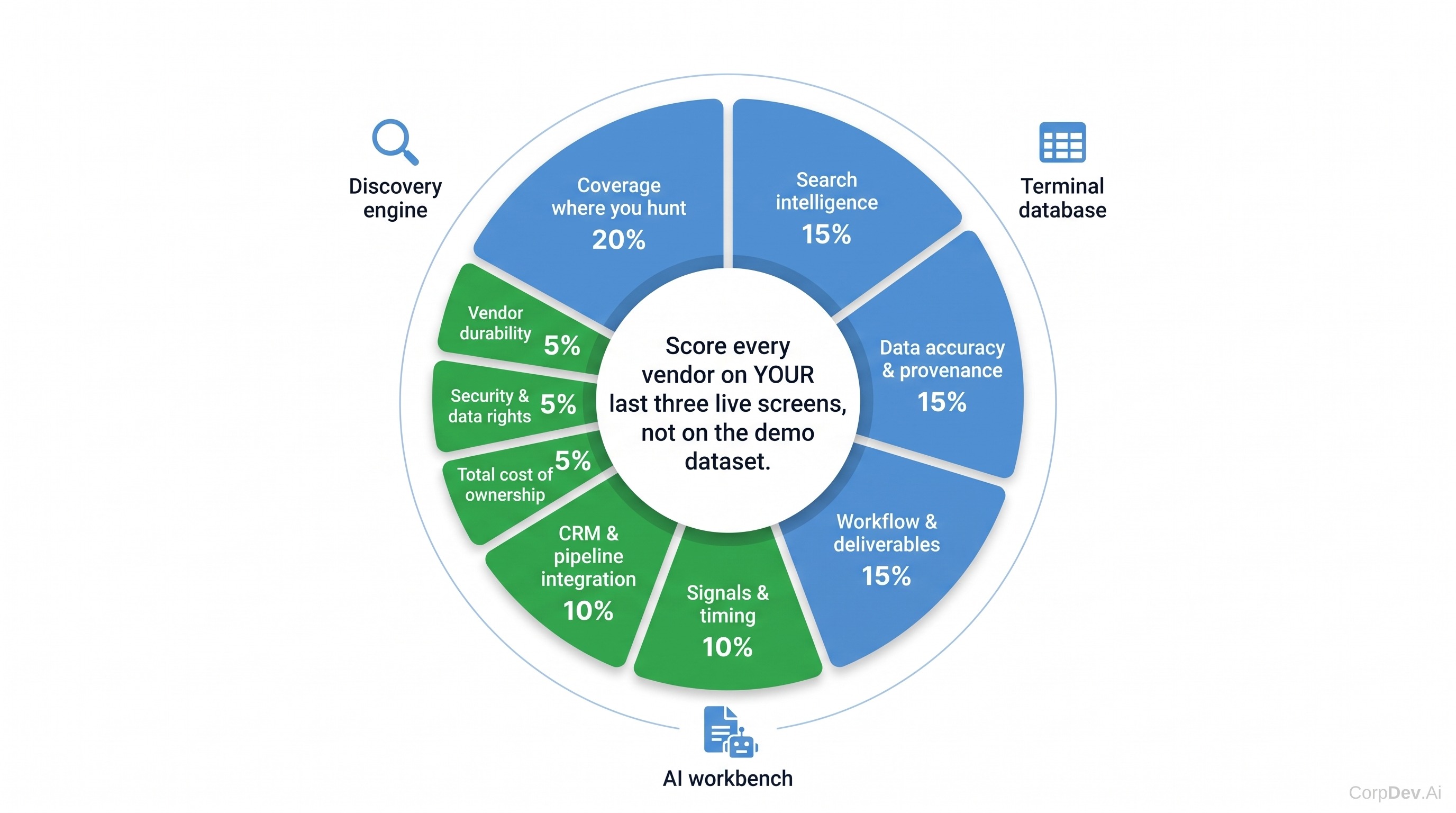
Vendor feature grids reward whoever has the longest list. A corporate-development buyer should instead score tools on the nine dimensions below, weighted to the team's actual mandate. The weights shown are a reasonable default for a strategic acquirer running a programmatic bolt-on thesis in two or more regions; a PE deal team or a sell-side advisor would weight differently.
| # | Criterion | What to test in a pilot | Default weight |
|---|---|---|---|
| 1 | Coverage where you hunt | Run your last three real target screens. Count how many known targets the tool finds, and how many net-new credible names it adds. Test the smallest and most obscure companies you already know. | 20% |
| 2 | Search intelligence | Describe a thesis in one paragraph, not a NAICS code. Measure precision (share of results you would actually call) and recall (known names missed). Test similar-company search with 2–3 seed companies. | 15% |
| 3 | Data accuracy and provenance | Spot-check 30 companies: revenue, headcount, ownership, HQ, key contact. Does the tool distinguish observed from estimated? Is every fact sourced and dated? | 15% |
| 4 | Signals and timing | Does it tell you when to call — ownership change, succession, hiring surge, conference attendance, intent-to-sell? How are those signals derived and how often are they refreshed? | 10% |
| 5 | Workflow and deliverables | How far does the tool take you past the list — one-pagers, fit scoring, market maps, memos, board slides? Time one end-to-end deliverable from thesis to PowerPoint. | 15% |
| 6 | CRM and pipeline integration | Native, bidirectional sync with your CRM (or a usable built-in pipeline)? De-duplication against existing records? Email/calendar capture? | 10% |
| 7 | Total cost of ownership | Seats, export/contact credits, API, connectors, onboarding. Model 3-year cost at realistic usage, not the entry quote. | 5% |
| 8 | Security, compliance, data rights | SOC 2 / ISO 27001, GDPR posture on contact data, data residency, whether your queries and uploads train the vendor's models, exportability of your own data. | 5% |
| 9 | Vendor durability and roadmap | Ownership, funding, customer count, release cadence, integration risk after acquisitions. Ask for a 12-month roadmap under NDA. | 5% |
Read diagram description
Diagram with nine labelled segments and their default weights: Coverage where you hunt 20%, Search intelligence 15%, Data accuracy & provenance 15%, Workflow & deliverables 15%, Signals & timing 10%, CRM & pipeline integration 10%, Total cost of ownership 5%, Security & data rights 5%, Vendor durability 5%. Centre label: "Score every vendor on YOUR last three live screens, not on the demo dataset." The three evaluated tool archetypes are: "Discovery engine", "Terminal database", "AI workbench".
Two dimensions deserve emphasis because they are where the tools in this comparison genuinely diverge:
Criterion 5 — workflow and deliverables — is where the category is splitting. Inven, Grata and Cyndx are optimised to produce a list and push it to a CRM; Inven also generates one-pagers and PowerPoint exports [26]. CorpDev.Ai is optimised to produce the decision document — investment memo, market map, strategic options brief — with the list as an intermediate step [152][153]. If your team's bottleneck is analyst hours spent turning a shortlist into a board pack, weight this criterion up. If the bottleneck is finding the shortlist, weight it down.
Criterion 3 — provenance — separates tools you can put in front of a board from tools you can only use internally. Ask each vendor to show you, for a single company record, exactly which URL and date each field came from. Sourcescrub built its brand on this ("why is this company in the universe — which conference, which award") [68]; CorpDev.Ai describes source-linked outputs [154]; citation completeness and accuracy require testing; Inven and Grata publish accuracy claims (Grata: 99%) that are vendor-asserted rather than independently audited [40].
Inven (inven.ai): Deep Dive
Company
Inven was founded in Helsinki in 2022 by Niilo Pirttijärvi, Tommi Kupiainen and Ekku Jokinen, former McKinsey and BCG analysts who set out to automate the company-research grind they had done by hand [1]. It raised a €1.5M seed led by Lifeline Ventures in March 2023 and a $12.75M (€11.2M) Series A led by Ventech and Vendep Capital in May 2025, with Risto Siilasmaa participating; total funding is approximately $14.4M [7][8][9]. By June 2026 the company reported passing 1,000 customers, more than 80 employees and an explicit push into the US market [2][6]. Third-party trackers estimate roughly $8M ARR, which is unaudited. At 1,000 customers, a $10,000–15,000 average would imply $10M–$15M, not $8M; customer definitions, timing and contract mix could explain the difference but are not reconciled here [4].
2022
Founded, Helsinki
$14.4M
Total raised (Series A May 2025)
80+
Employees (June 2026)
4.7 / 5
G2 rating, 101 reviews
Product
Inven is a discovery-and-research layer over a proprietary index of 28M+ companies, 3M+ transactions and 430M+ professional contacts across 160+ markets [1]. The product surfaces are:
- Natural-language company search. The user describes a target profile in a paragraph; Inven classifies companies by what their websites say they do, not by SIC/NAICS code, then layers structured filters — geography, ownership type, headcount, growth, funding, financial indicators, investors [13][14].
- Example-company search. Feed it one to three seed companies (or URLs) and it prioritises look-alikes — the workflow most reviewers single out for niche sectors [15].
- AI Screener and enrichment. Bulk-classify, score and enrich lists of companies, investors, deals or people against custom criteria [16][17].
- People, investor and deal search. Contacts by role, founder history and prior exits; investors by portfolio and mandate; transactions by target, acquirer, advisor or sector [18][19][20].
- Intent-to-sell signals and alerts. Flags companies showing succession, ownership-change or transaction-readiness indicators, plus monitoring on saved companies and sectors [21][22].
- Chrome extension, CRM and export. Save companies while browsing; push to HubSpot, Salesforce, Navatar, Attio, Affinity or DealCloud; export to Excel and PowerPoint; API and an MCP server for use inside Claude, ChatGPT or Cursor [23][24][25][27][28].
Strengths
- Breadth and European depth. Inven’s index is one of the larger curated AI-native datasets described here and its Nordic origin shows in continental coverage — the recurring gap in US-born competitors [1][147].
- Speed to a long list. Reviewers consistently describe compressing days of research into minutes; ease of use scores 4.9/5 on Capterra [34].
- Support and iteration velocity. Customer support is the most consistently praised attribute across G2 and Capterra, and a venture-backed 80-person team ships quickly [33][34].
- Price. Entry pricing around $10,000–15,000 a year makes it accessible to a two-person corporate-development team in a way Grata, PitchBook and CapIQ are not [31][32].
- Open access. The API and MCP server let a technical team pull Inven data into its own agents — a meaningful advantage for buyers building internal AI workflows [27].
Limitations
- Financials are estimates. Revenue, headcount and contact data require verification before they reach a board paper; this is the top negative theme on both review sites [33][34].
- Precision. Long lists include unqualified or mis-categorised companies; users budget time for list cleaning [33].
- Coverage gaps exist. Reviewers cite e-commerce and certain geographies as thin [33].
- Workflow stops at the list. Project management, collaboration and pipeline tracking are less mature than a dedicated CRM; Inven generates one-pagers and slides but not investment memos or market analyses at the depth of a workbench tool [34][26].
- No public rate card. Pricing is custom and quoted after a demo; the $10,000 figure is a market estimate, not a list price [29][30].
- Independent and small. A $14M-funded company with 80 staff is nimble but is also a plausible acquisition target in a consolidating market; buyers signing multi-year contracts should ask about change-of-control terms.
A corporate-development, PE or advisory team whose primary bottleneck is finding private companies — especially in Europe or across multiple countries — and which already has a CRM and a terminal for validation. Inven is the discovery engine that plugs into an existing stack; it is not the stack.
The Alternatives
CorpDev.Ai
Positioning. CorpDev.Ai (Boston, founded 2023) is not a company database with an AI feature; it is an agentic AI workbench for the whole corporate-development lifecycle — strategy, market mapping, sourcing, screening, pipeline, diligence, valuation, investment memo and post-merger integration — that fetches company data on demand from a federated research layer [152][158]. The founders are Kal Kilpi (CEO, an AI engineer and second-time M&A-software founder) and Atul Tiwary (an M&A operator and investor with 20+ years of deal experience) [155][156][157]. It is the youngest company in this comparison and publishes prices, as do Crunchbase and Dealroom.co.
Disclosure: CorpDev.Ai publishes this comparison and is one of the vendors assessed. The assessment below draws on the vendor's own published materials and the same critical lens applied to every other vendor; readers should weight it accordingly and validate in a pilot.
Product. The platform is organised around an AI Analyst that produces institutional-format deliverables — sector reports, market maps, ranked target shortlists, strategic-fit scorecards, investment memos, CIMs and board decks — inside a markdown-native document editor with a citation registry and export to Word, PowerPoint, Excel and PDF [152][153]. Around it sit a semantic target search with AI fit scoring over a claimed 70M+ companies and 265M+ contacts (drawing on Apollo-class contact data, SEC filings, 30 years of financials, estimates and transcripts) [154]; an AI Room data room with vision-based ingestion and page-level citation for diligence [152]; a zero-entry Kanban pipeline/CRM that auto-populates from Microsoft 365 or Google Workspace email and calendar [153]; a CorpDev Brain wiki that accumulates the team's markets, competitors and targets over time; digital-twin models of targets for diligence and integration planning; and open REST/MCP interfaces with all data stored in standard formats (Markdown, JSON, YAML, Office files) [152]. The company also sells managed services — its own M&A team delivering research, screens and memos on the platform [153].
Pricing (published). AI Pro: $1,000/month billed annually ($1,200 by card), one user, 12,000 annual search credits. AI Pro Team: $3,000/month annually ($3,600 by card), three users, 36,000 credits. Enterprise: custom, unlimited users, SSO, solutions architect, financial modelling and managed services [153]. That places a three-seat team at roughly $36,000 a year — above Inven's entry point, above the cited ~$33,375 single-user CapIQ list estimate, while covering three users.
Strengths.
- It attacks the analyst-hours problem, not the data problem. For a two-person team that spends most of its time turning a shortlist into a memo and a deck, the deliverable-first model addresses a bottleneck that discovery tools also address through one-pagers, exports and research features, with differing depth [152].
- Provenance by design. The product describes source-linked research and page-level AI Room citations [154]. A buyer should sample completeness, dates and citation accuracy before relying on outputs in board materials; source links alone do not verify a claim.
- Transparent pricing and open architecture. Published rates, cancel-anytime terms, and exportable data in open formats reduce two of the buyer pain points identified above [153][152].
- Breadth of lifecycle. Strategy → sourcing → diligence → memo → PMI in one system, with a self-populating CRM, is a scope no other vendor here attempts [152].
Limitations.
- Discovery is agentic, not census-style. Because targets are researched on demand rather than pre-classified in a curated index, a thesis-driven screen is fast but an exhaustive "every company in this niche in Europe" census is slower and less deterministic than Inven's filterable universe. The 70M+ figure is a contact-database-style count and is not equivalent to Inven's or Grata's curated operating-company index [154].
- Thin independent evidence. No meaningful G2/Capterra review base yet, and customer counts are described as "hundreds of professionals" rather than a disclosed figure [152]. Buyers must rely on their own pilot rather than peer reviews.
- Fewer packaged private-market signals. No equivalent yet of Grata's live advisor mandates, Sourcescrub's conference-list provenance or Inven's intent-to-sell filter; monitoring is news- and trigger-based [153].
- Credit-based usage. Heavy screening consumes search credits; a team running large-volume screens should model credit burn during the pilot.
- Vendor youth. A 2023-founded company with undisclosed funding carries the same durability question as Inven, without Inven's 1,000-customer proof point.
A lean in-house corporate-development or strategy team (one to five people) at a mid- or large-cap company that must produce board-quality memos, market maps and thesis decks on a recurring cadence, values cited output and an integrated pipeline over the largest pre-built index, and is prepared to validate a young vendor through a hands-on trial.
Grata
Positioning. Grata (New York) is the US-born counterpart to Inven: an AI-native private-market intelligence platform built on semantic search over company websites, with a deliberate focus on bootstrapped, founder-owned and non-sponsored middle-market businesses [42][44]. It raised roughly $34.5M (including a $25M Series A led by Craft Ventures) before Datasite acquired it in June 2025 for a reported $200M+ [35][36]. It is now the flagship of Datasite's Data & Intelligence business, into which Sourcescrub (August 2025) and Valu8 (May 2026) are being integrated [38][39][150].
Product. Agentic Search that interprets a thesis, refines its own queries and applies filters [43]; similar-company search and market mapping [44]; seller-intent signals the company says identify likely sellers 6–12 months ahead (vendor-reported accuracy: 98% US, 89% EMEA) [40]; Grata Deals, a network of live mandates from vetted sell-side advisors filterable by EBITDA, sector and geography [45]; conference and event intelligence (25,000+ events, 200K+ curated lists) inherited from Sourcescrub's core competence [46][40]; CRM intelligence with bidirectional sync to Salesforce, HubSpot, DealCloud, Affinity, Dynamics 365 and Dynamo [47]; an Excel add-in, API, data-warehouse connectors and MCP [48]. Packaging runs Growth (family offices, independent sponsors) → Scale (mid-market PE, corp dev, banks; adds conference data, deal multiples, public-company financials, bidirectional CRM) → Alpha (banks and mega-funds; adds seller-intent and API) [161].
Coverage. 22M+ private companies, 10M+ executive contacts, 800K+ transactions and 100M+ filings on current pages, rising to 23M+ after Valu8 [40][41]. Grata claims 99% data accuracy; that is a vendor assertion [40]. Customers include Carlyle, Deutsche Bank, TA Associates and Bessemer; the company cites 2,000+ customers and "35 of the top 40 firms" [42][53][54].
Pricing. No published rates. Capterra lists a $15,000/year starting point; third-party trackers report $15,000–100,000 typical and a $155,000 median enterprise contract from a small sample [50][51][52]. Plan on tens of thousands for a mid-market corp-dev deployment.
Strengths. Highest G2 rating in the set (4.9/5, 81 reviews) [55]; the deepest US lower-middle-market coverage; the only live-mandate network; the strongest CRM story after absorbing Sourcescrub's integrations; and now the balance sheet of a PE-backed M&A platform behind it [55][45][47][37].
Limitations. Expensive and opaque; 18 G2 mentions of data inaccuracies and recurring notes of thin contacts on small companies and missing European names [55]; post-acquisition integration of three data assets is still in progress, and buyers should expect roadmap and pricing changes as Datasite bundles Grata with its data-room business [39]. G2 reviewers rate Grata ahead of Sourcescrub on ease of use, setup and administration [59].
Grata wins on US middle-market depth, live deals, CRM sync and enterprise polish; Inven wins on index breadth, European coverage, price and API openness. A US-centric PE fund leans Grata; a European or multi-region corporate acquirer leans Inven.
Sourcescrub
Status: being absorbed into Grata. Sourcescrub (San Francisco, founded c. 2014–15) took a growth investment from Francisco Partners in September 2021 and was sold to Datasite in August 2025 on undisclosed terms; Datasite has stated its data and capabilities will be integrated into Grata [61][62][39]. A buyer today should evaluate it as a data asset inside Grata's roadmap rather than as a standalone long-term platform.
What made it distinctive. A "sources-first" model: companies enter the universe because they appeared on a conference attendee list, trade-show exhibitor roster, award list, buyer's guide, association directory or portfolio page — 220,000–290,000 sources feeding 16–17M company profiles, curated by an "expert-in-the-loop" data team [64][65][66][68]. The result is unusually good visibility into founder-owned companies that have never raised capital and a clear answer to "why is this company here." Nine signal categories (growth, web, people, investor, conference, recognition, ownership, news, hiring intent) drive alerts on when to reach out [73]. Native integrations with Salesforce, DealCloud and Affinity are bidirectional [74][75][76], and SourcingGPT added a generative layer in late 2024 [69].
Customers and proof points. Hg, Permira, TA Associates, Riverside, Shore Capital and, on the corporate side, Tennant Company, which reported a 76% increase in direct-sourced pipeline [82]; finnCap attributed 10–15% of active pipeline to the tool [83].
Pricing. Quote-based; third-party estimates of $20,000–60,000 a year, commonly $25,000–40,000, rising with exports, custom research and CRM connectors [79][80].
Weaknesses. G2 (4.5/5, 56 reviews) reports the same data-staleness complaints as its peers plus a clunkier, less intuitive interface and search that lags modern natural-language tools [79][85]. Its European coverage is materially thinner than Inven's.
Buyer implication. If conference- and event-driven sourcing is central to your origination model, Sourcescrub's list provenance is still the best in class — but you will increasingly buy it as a Grata Scale/Alpha capability. Do not sign a standalone Sourcescrub contract without written clarity on migration terms.
PitchBook
Positioning. PitchBook (Morningstar) is the reference database for private-market transactions: financing rounds, investors, valuations, cap tables, deal terms and precedent M&A across roughly 5M+ companies, of which about 4.7M are private [90][91]. It is the tool a corporate-development team uses to answer "what did comparable deals trade at" and "who owns this company and at what last-round valuation" — questions no AI-native discovery engine answers with defensible rigour.
AI features. AI-generated company summaries, search assistance, ML-driven insights and integrations with Perplexity and Hebbia; useful for research acceleration, not a semantic discovery engine in the Inven/Grata sense [92].
Pricing. Commonly cited at $25,000–30,000 per seat per year for corporate/M&A packages, with smaller-seat reports of $12,000–20,000 and enterprise contracts substantially higher; module and seat restrictions limit broad internal access [93][94][95].
Strengths for corp dev. Unrivalled for sponsor-backed and venture-backed targets, valuation benchmarking, investor mapping and board-level M&A analysis; well-understood by advisors and boards, so its numbers travel.
Weaknesses for corp dev. Coverage is less complete for never-funded, founder-owned companies — the coverage bias is toward businesses that have transacted. Search is powerful but structured and analyst-driven; describing a thesis in prose is not its native mode. Expensive per seat, so it tends to live with one analyst rather than the whole team [90][93].
Verdict. Not an Inven alternative; a complement. Where budget forces a choice, a programmatic acquirer of mature private companies should keep the discovery engine and buy PitchBook access on an as-needed basis; a team focused on venture-backed or PE-owned targets should do the reverse.
Cyndx — historical comparator after announced wind-down
Website-edition update — 14 September 2026. Cyndx’s founder notice announces wind-down and dissolution. The following capabilities and prices describe its prior offering, not an available new-purchase option.
Historical positioning. Cyndx was an explicitly acquisition-oriented AI platform in the set: purpose-built NLP market mapping, ranked similar-company discovery and predictive M&A and funding signals across 33M+ public and private companies in roughly 195 countries [121][122][123]. Its modules — Finder (discovery), Acquirer (bolt-on and target identification), Raiser (capital sources) and Scholar (research) — map directly onto corporate-development and banking workflows [124][125][126].
Pricing. Custom enterprise quotes; 2026 benchmarks place firm licences at roughly $30,000–60,000 a year, with per-user estimates of $10,000–50,000 depending on modules [127][128].
Strengths. Concept-based search that escapes SIC/NAICS rigidity, a genuinely global index, and a product designed around the bolt-on programme use case rather than adapted to it [124][125].
Weaknesses. Pricing is less standardised and benchmarked than any peer; a 33M-company universe does not mean uniform depth on financials, ownership or contacts; the review footprint is small, so buyers rely on their own validation; workflow beyond the list is limited [127].
Verdict. Cyndx historically addressed the same thesis-driven, multi-region discovery job as Inven and Grata, with emphasis on ranked look-alikes. Its announced wind-down removes it from a current pilot shortlist. Existing users should prioritise data export and written transition terms; historical capabilities do not establish ongoing service availability.
Other Options Worth Knowing (Crunchbase, CapIQ, Dealroom, Tracxn, Udu, Affinity/4Degrees)
None of the following is a like-for-like Inven substitute, but each will appear on a shortlist and each is the right answer for a specific mandate.
What it is: The broadest financial dataset in the set — 54M+ private companies (14M+ with recent financials), full public-company data, filings, credit, M&A precedents and Excel integration [96][97]. ChatIQ and Document Intelligence add natural-language research over that corpus [98][99][100].
Cost: Quoted; estimates of $15,000–25,000 per user, with list pricing reported near $33,375 per named user [101][102].
Buy it when: the team must move from target identification into modelling, comps and underwriting. Skip it as a sourcing tool: the huge universe is lightly covered at the small end, and it is not an origination engine.
What it is: 4M+ private companies with funding, growth signals and news; AI summaries and AI Search in Pro, agents and CRM features in Business [103][104][105][106].
Cost: ~$588 per user per year at the introductory annual Pro rate ($99/month standard); Business ~$2,388 per user per year [107][108].
Buy it when: you want cheap, broad alerts and startup screening across a large strategy team. Skip it: as the primary system for mature private-company M&A — limited financials, ownership, contacts and exports [105].
What it is: 3M+ companies and 100K+ investors with a European technology-ecosystem bias; AI assistant, API and a 2026 MCP connector for ChatGPT, Claude and Copilot [109][110][111][112].
Cost: Published — Premium €12,600/year from three seats (~€4,200/seat), €17,000/year with business-email credits [113].
Buy it when: the thesis is European tech, scale-ups or venture-adjacent. Skip it: for unfunded SMEs, succession situations or traditional industry [114].
What it is: ~8M companies, 3,000+ sector feeds, 55K+ taxonomy nodes, 200K+ acquisitions, strong India/APAC and emerging-market coverage; AI Assistant and MCP in Premium [115][116][117][118][120].
Cost: Quote-based Premium and enterprise; trial packs available [119].
Buy it when: you need granular global technology taxonomies or APAC coverage. Skip it: if audited financials and ownership on small private companies matter more than sector mapping.
What it is: A live-web discovery model rather than a static database — it crawls thousands of sources on demand and uses ML trained on your examples of good and bad targets to score companies against your criteria [136][137].
Buy it when: you have a well-defined, unusual thesis and want the system to learn it. Skip it: if you need a filterable census, deep financials or a large review base to de-risk the purchase.
What they are: Relationship-intelligence CRMs that capture email and calendar activity, map warm paths and increasingly embed AI sourcing (Affinity Sourcing enriches from 40+ data partners) [138][139][140][151].
Buy them when: your edge is relationships and you need pipeline, attribution and workflow — then feed them with Inven or Grata data via native connectors. Skip them as sourcing tools: they depend on third-party data for discovery.
Head-to-Head Comparison
The matrices below consolidate vendor claims and third-party evidence gathered in this review. Coverage figures are vendor-reported and non-comparable across definitions (see the assumption callout above). Pricing is indicative 2026 market pricing unless marked as published.
Capability matrix
| Dimension | Inven | CorpDev.Ai | Grata (+ Sourcescrub) | Cyndx (historical) | PitchBook | S&P Capital IQ Pro |
|---|---|---|---|---|---|---|
| Archetype | Discovery engine | AI workbench | Discovery + workflow platform | Discovery engine | Transaction database | Financial terminal |
| Company universe (vendor claim) | 28M+ [1] | 70M+ (contact-DB definition) [154] | 22–23M+ [40][41] | 33M+ [121] | ~5M (4.7M private) [90] | 54M+ private, 14M+ with financials [96] |
| Natural-language / semantic search | Yes, core [13] | Yes, agentic + fit scoring [153] | Yes, Agentic Search [43] | Yes, concept-based [124] | Limited (AI assist) [92] | ChatIQ over own corpus [98] |
| Similar-company search | Yes (1–3 seeds) [15] | Yes | Yes [44] | Yes, ranked [123] | Partial | Partial |
| Private-company financials | Estimates [34] | Fetched/cited on demand; 30 yrs public financials [154] | Estimates; multiples in Scale [40] | Estimates | Reported where disclosed; valuations [91] | Reported, deepest [96] |
| Contacts | 430M+ [1] | 265M+ [154] | 10M+ executives [40] | Yes | Yes | Yes |
| Transaction data | 3M+ deals [1] | Via research layer | 800K+ deals, 1M+ events [40][41] | Predictive signals | Best-in-class | Best-in-class |
| Intent / timing signals | Intent-to-sell, alerts [21][22] | News & trigger monitoring [153] | Seller-intent 6–12 mo; 9 signal types [40][73] | Predictive M&A/funding [124] | Limited | Limited |
| Live advisor mandates | No | No | Yes, Grata Deals [45] | No | No | No |
| Conference / list provenance | Partial | No | Best-in-class (Sourcescrub) [46][64] | No | No | No |
| European coverage | Strongest in AI set | On-demand, global | Improving (UK/FR/DE, Valu8) [149][150] | Global [122] | Weak below sponsor-backed | Broad, shallow at SME level |
| Deliverables generated | One-pagers, slides, exports [26] | Memos, market maps, decks, CIMs, models [152] | Lists, market maps, Excel add-in | Market maps | Reports, charts | Excel models, reports |
| Built-in pipeline / CRM | No (export/sync) | Yes, zero-entry from email/calendar [153] | Pipeline + bidirectional CRM sync [47] | No | No | No |
| CRM integrations | HubSpot, Salesforce, Navatar, Attio, Affinity, DealCloud [25] | M365 / Google Workspace; REST/MCP [152] | Salesforce, HubSpot, DealCloud, Affinity, Dynamics, Dynamo [47] | Via API | Salesforce, others | Excel, API |
| API / MCP | API + MCP server [27][28] | REST + MCP [152] | API, warehouse, MCP (Alpha) [48] | API | API | API |
| Data room / diligence | No | AI Room, DD agents [152] | Datasite VDR (separate product) | No | No | Document Intelligence [99] |
| G2 rating (reviews) | 4.7 (101) [33] | n/a | 4.9 (81) [55]; Sourcescrub 4.5 (56) [79] | n/a | Established | Established |
| Published pricing | No [29] | Yes [153] | No [161] | No [127] | No [93] | No [101] |
| Ownership | Independent, VC-backed [8] | Independent, private [158] | Datasite (CapVest) [37] | Independent | Morningstar | S&P Global |
Where each tool merits particular consideration
- Large curated index at a comparatively accessible quoted entry point
- European and multi-country private-company discovery
- Look-alike search for niche, poorly classified sectors
- Open API/MCP for teams building their own agents
- US lower-middle-market, founder-owned depth
- Live sell-side mandates and seller-intent signals
- Conference/list provenance (ex-Sourcescrub)
- Enterprise CRM sync and vendor durability
- Thesis → cited memo / market map / board deck in one system
- Zero-entry pipeline populated from email and calendar
- Diligence data room with page-level citations
- Transparent pricing, open data formats, managed-services option
Fit by use case
| Use case | First choice | Strong alternative | Why |
|---|---|---|---|
| Programmatic bolt-ons, Europe or multi-region | Inven | Grata, subject to a regional coverage test | Index breadth and continental coverage; Cyndx’s historical ranked-look-alike alternative is no longer an active shortlist option |
| Programmatic bolt-ons, US lower-middle-market | Grata | Inven | Founder-owned depth, mandates, CRM sync |
| Lean team must produce board memos and market maps monthly | CorpDev.Ai | Inven + PitchBook | Deliverable-first workflow replaces analyst hours, not just search hours |
| Sponsor-backed or venture-backed targets | PitchBook | Dealroom (EU tech) | Transaction and ownership data |
| Valuation, comps, underwriting | S&P Capital IQ Pro | PitchBook | Financial depth and Excel integration |
| Conference-driven origination | Grata Scale (Sourcescrub data) | — | Only vendor with event-list provenance |
| Relationship-led sourcing with attribution | Affinity or 4Degrees + Inven/Grata feed | DealCloud | CRM is the system of record; discovery tool feeds it |
| Cheap monitoring across a large strategy group | Crunchbase Pro | Dealroom.co for European tech, at a higher price | Crunchbase Pro introductory annual price is sub-$1,000 per seat; Dealroom.co starts around €4,200 per seat |
| APAC / emerging-market technology mapping | Tracxn | Inven, subject to a regional coverage test | Taxonomy depth and regional coverage; Cyndx is historical only |
| Constraint | Starting shortlist | Comparison to run |
|---|---|---|
| Finding companies in Europe or multiple regions | Inven | Grata after a regional coverage test |
| Finding US lower-middle-market companies | Grata / Datasite | Inven on the same thesis |
| Turning shortlists into memos, market maps and pipeline | CorpDev.Ai | Inven plus a PitchBook seat and the team’s authoring workflow |
| Validating sponsor- or venture-backed targets | PitchBook | Transaction and ownership evidence for known targets |
| Broad financial modelling and underwriting | S&P Capital IQ Pro | Financial depth, comps and Excel workflow |
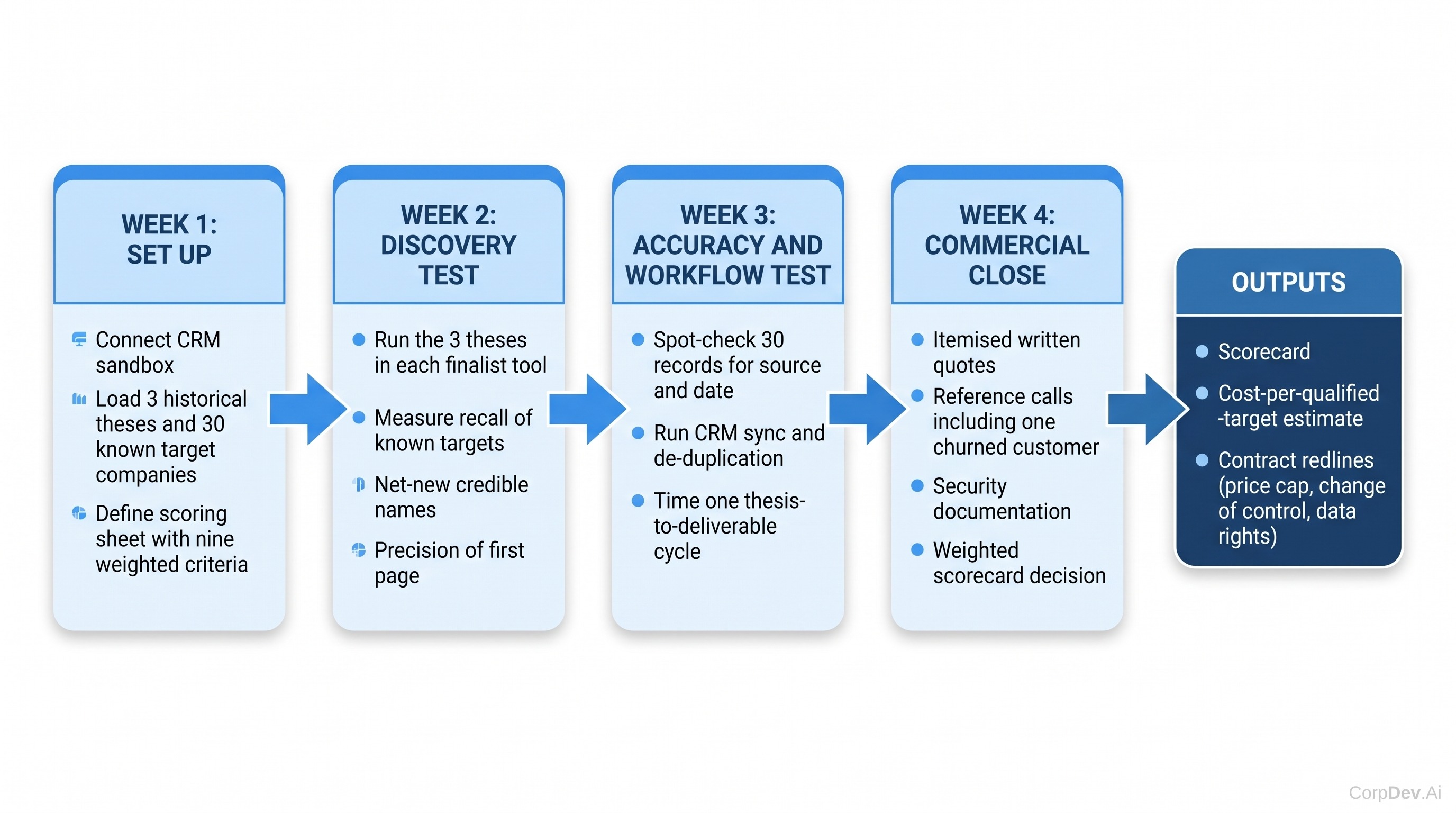
Where valuation requires terminal data, retain or price an appropriately licensed seat alongside discovery. Run a structured 30-day pilot on the last three live screens before committing to an annual contract. Cyndx is excluded from the active shortlist following wind-down.
Total Cost of Ownership and Pricing Reality
Only three vendors in this set publish prices — CorpDev.Ai, Crunchbase and Dealroom. Everyone else quotes after a demo, and bundles vary on seats, export and contact credits, API access, CRM connectors, data modules and onboarding. The table below normalises to a three-seat corporate-development team over one year, showing annual-billing and annualised monthly options where stated; figures are indicative 2026 market pricing drawn from vendor pages and third-party trackers, and the basis for each is stated in the final column so readers can reproduce the arithmetic while retaining the scope, uncertainty and billing assumptions in any budget model.
| Vendor | Low | High | Basis |
|---|---|---|---|
| Crunchbase Business | 7 | 8 | Published $199/user/month annual [107] |
| Dealroom Premium | 14 | 19 | Published €12,600–17,000 for 3 seats [113] |
| Inven | 10 | 25 | Market estimates $10–15k entry; team packages higher [31][32] |
| CorpDev.Ai AI Pro Team | 36 | 43.2 | Published $3,000/mo annual, $3,600/mo card [153] |
| Sourcescrub (standalone) | 25 | 60 | Third-party estimates [79][80] |
| Cyndx (historical; unavailable for new shortlist) | 30 | 60 | Historical firm-licence benchmarks [127][128] |
| Grata Scale | 30 | 100 | $15k entry; tens of thousands typical; $100k+ enterprise [50][51][52] |
| PitchBook (3 seats) | 75 | 90 | $25–30k/seat corp packages × 3 [93][94] |
| S&P Capital IQ Pro (3 seats) | 45 | 100 | $15–25k/user estimates; ~$33k list [101][102] |
What the sticker price hides. Across the review corpus, the cost lines that surprise buyers after signature are: (1) contact unlocks and export credits, which Inven, Grata and Crunchbase meter separately [34][105]; (2) CRM connectors, priced as add-ons by Sourcescrub and gated to higher tiers by Grata [79][161]; (3) API access, sold separately by Inven and reserved for Grata's Alpha tier [28][161]; (4) search or research credits, which govern CorpDev.Ai's usage model (12,000 per seat per year on AI Pro) [153]; and (5) additional seats, where terminals are priced per named user and discovery tools per team. Ask every vendor to quote a written configuration with these five items itemised.
The cost that matters is analyst hours, not licence fees. Assuming a fully loaded analyst cost of $150,000–250,000 and 48 working weeks, a $15,000 licence corresponds to about 2.9–4.8 analyst-weeks. Four weeks a year covers the licence only above roughly $180,000 annual cost. Time saved is capacity value, not necessarily a cash saving. The more useful comparison is therefore cost per outcome: cost per qualified target added to the pipeline, cost per board-ready deliverable, and share of pipeline that the tool sourced and the team would not otherwise have found. Tennant Company's 76% lift in direct-sourced pipeline with Sourcescrub and Odeko's two acquisitions sourced through Grata are the kind of evidence a pilot should be designed to produce for your own team [82][42].
Datasite is bundling Grata, Sourcescrub and Valu8 into one packaging structure and has $500M of expansion capital to deploy; expect tier boundaries and prices to shift as integration completes [37][39]. Inven, fresh from a Series A and pushing into the US, has an incentive to hold aggressive entry pricing [8]. Lock multi-year price caps and change-of-control clauses into any contract signed in this window.
Which Tool for Which Buyer: Decision Guide
The scenarios below describe the buyer situations that recur most often in corporate-development, strategy and M&A teams, and the stack that fits each. Every recommendation assumes a paid pilot on live theses before commitment.
Scenario 1 — Two-person corporate-development team, industrial mid-cap, European bolt-on programme
Constraint: finding family-owned €10–50M-revenue targets in DACH, Nordics, Benelux and Italy; no dedicated analyst; board pack every quarter.
Recommendation: Inven as the discovery engine (European depth, look-alike search, ~$10–15k) plus CorpDev.Ai or an existing PitchBook seat for the memo and market-map layer. If budget allows only one tool and the board-pack burden dominates, choose CorpDev.Ai and use its agentic search for the screen; if the screening census dominates, choose Inven and accept manual memo-writing.
Scenario 2 — Five-person corporate-development team, US software or healthcare large-cap, programmatic acquirer
Constraint: 20+ qualified conversations a quarter with founder-owned US companies; DealCloud or Salesforce is the system of record; enterprise security review is mandatory.
Recommendation: Grata Scale — US lower-middle-market depth, seller-intent signals, live mandates and bidirectional CRM sync justify the premium; keep PitchBook for sponsor-owned targets and valuation. Evaluate Inven in the same pilot as a lower-cost challenger if a meaningful share of the thesis is outside North America.
Scenario 3 — Corporate-strategy team that runs M&A as one of several workstreams
Constraint: the team produces strategic-options briefs, market maps, competitor analyses and occasional acquisition theses; deal volume is low but analytical volume is high; no CRM.
Recommendation: CorpDev.Ai — the deliverable-first workbench, cited output, market mapping and built-in pipeline map directly onto this workload, and published pricing makes the commercial entry point visible, subject to the buyer’s procurement process. Supplement with Crunchbase for cheap monitoring across the wider strategy group. A pure discovery engine would be under-used here.
Scenario 4 — Mid-market PE deal team or independent sponsor, thesis-driven platform and add-on sourcing
Constraint: proprietary deal flow is the fund's edge; relationship history matters; sell-side mandates are welcome.
Recommendation: Grata (Growth or Scale, for mandates and signals) feeding Affinity or 4Degrees; Inven if the fund's theses are European or cost sensitivity is high. Cyndx’s historical ranked-look-alike approach is relevant context, but the announced wind-down excludes it from a new pilot shortlist.
Scenario 5 — Boutique M&A advisor or investment bank, buyer and target universes for pitches
Constraint: speed to a credible, client-ready list and market map; European and US coverage; high volume of one-off sector sweeps.
Recommendation: Inven — a fast thesis-to-longlist workflow, PowerPoint export and a broad curated index — with CapIQ or PitchBook for comps. Grata Alpha is the enterprise alternative for US-centric banks that want seller-intent and API access.
Scenario 6 — Enterprise M&A function with an internal data or AI team
Constraint: the team is building its own agents and wants data feeds rather than another UI.
Recommendation: Inven's API and MCP server and Grata's API/data-warehouse connectors are both credible feeds; CorpDev.Ai's open REST/MCP gates and open-format storage suit a team that also wants the workbench. Insist on data-rights clarity: whether your queries and uploads are used to train vendor models, and whether your enriched records are exportable in full at termination.
Decide first whether your binding constraint is discovery (finding companies), production (turning findings into decisions and documents) or validation (defensible financials). Discovery points to Inven or Grata among currently available vendors assessed here. Production buys CorpDev.Ai. Validation buys a terminal. Most teams have one dominant constraint and one secondary one, and should buy accordingly — not a tool for each.
Due-Diligence Checklist Before You Sign
Run every finalist through a paid or structured 30-day pilot on your own theses and demand written answers to the following. Vendors that decline to answer in writing have told you something.
Coverage and accuracy
- Re-run our last three real target screens. How many of the known targets did you find? How many net-new names did we accept as credible after review?
- For 30 companies we select, show the source URL and observation date for revenue, headcount, ownership and primary contact. What share were observed vs. modelled?
- What is your refresh cadence per field, and how do you flag records not updated in 12 months?
- Show your coverage on the five smallest and most obscure companies we already know in our niche.
Search and signals
- Describe a thesis in one paragraph in front of us. What precision (share of results we would call) does the first page achieve?
- How exactly are your intent-to-sell / seller-intent / exit-readiness signals derived, and what is their measured hit rate on your own customers' closed deals?
- Can we train the system on our accepted and rejected targets, and does that training stay private to our workspace?
Workflow and integration
- Demonstrate a bidirectional sync with our CRM, including de-duplication against existing records and handling of domain or status changes.
- Time one end-to-end deliverable from thesis to exported PowerPoint or memo. Who does the formatting?
- What is exportable at termination, in what formats, and within what period?
Commercial
- Provide a written quote itemising seats, export/contact credits, API, CRM connectors, data modules and onboarding.
- What are the multi-year price-cap, change-of-control and roadmap-continuity terms, given the consolidation under way in this category?
- Provide three reference customers of our size and sector, including one that churned.
Security and data rights
- SOC 2 Type II or ISO 27001 report; data residency options; GDPR basis for contact data in the EU.
- Are our queries, uploads or enriched records used to train models or shared across customers? Confirm in the contract.
- How are AI-generated outputs labelled and cited, and can a reviewer trace every figure to its source?
Read diagram description
Four-week timeline.
Week 1 "Set up": connect CRM sandbox, load 3 historical theses and 30 known target companies, define scoring sheet with nine weighted criteria.
Week 2 "Discovery test": run the 3 theses in each finalist tool, measure recall of known targets, net-new credible names, precision of first page.
Week 3 "Accuracy and workflow test": spot-check 30 records for source and date, run CRM sync and de-duplication, time one thesis-to-deliverable cycle.
Week 4 "Commercial close": itemised written quotes, reference calls including one churned customer, security documentation, weighted scorecard decision. Outputs box at the end: "Scorecard, cost-per-qualified-target estimate, contract redlines (price cap, change of control, data rights)."
Key Facts & Sources
Load-bearing figures used in this comparison, with source and as-of date. All company-count and accuracy figures are vendor-reported unless stated otherwise; all pricing not marked "published" is a third-party market estimate.
| Figure | Value | Source | As of |
|---|---|---|---|
| Inven company index | 28M+ companies; 3M+ transactions; 430M+ contacts; 160+ markets | Inven About Us [1] | 2026 |
| Inven customers / employees | 1,000+ customers; 80+ employees | Inven press release [2] | June 2026 |
| Inven funding | €1.5M seed (Mar 2023); $12.75M Series A (28 May 2025); ~$14.4M total | Inven announcements [7][8]; CB Insights [9] | May 2025 |
| Inven G2 / Capterra | 4.7/5 (101 reviews); 4.6/5 (16 reviews) | G2 [33]; Capterra [34] | Sept 2026 |
| Inven pricing | ~$10–15k/yr entry (estimate; no published rate card) | CT Acquisitions [31]; Prospeo [32]; Inven [29] | 2025–26 |
| Grata company index | 22M+ companies; 10M+ contacts; 800K+ transactions; 23M+ post-Valu8 | Grata data pages [40][41] | 2026 |
| Grata acquisition | Acquired by Datasite, reported $200M+; $500M CapVest commitment | WSJ [36]; Datasite [37] | 3 June 2025 |
| Grata pre-acquisition funding | ~$34.5M incl. $25M Series A (Craft Ventures) | AlleyWatch [35] | Feb 2022 |
| Grata G2 | 4.9/5 (81 reviews) | G2 [55] | Sept 2026 |
| Grata pricing | $15k entry (Capterra); $15–100k typical; $155k median enterprise (n=6) | Capterra [50]; Prospeo [51]; CostBench [52] | 2026 |
| Sourcescrub ownership | Francisco Partners investment 28 Sept 2021; sold to Datasite 8 Aug 2025 | Francisco Partners [61][62] | Aug 2025 |
| Sourcescrub coverage | 16–17M companies; 220–290K sources | Sourcescrub site [65][66]; Datasite [38] | 2025 |
| Sourcescrub pricing / G2 | $20–60k/yr estimate; 4.5/5 (56 reviews) | Prospeo [79]; CT Acquisitions [80] | 2026 |
| Datasite–Valu8 | Acquisition announced | Grata resources [150] | May 2026 |
| CorpDev.Ai pricing (published) | AI Pro $1,000/mo annual, 1 user, 12k credits; Team $3,000/mo, 3 users, 36k credits; Enterprise custom | CorpDev.Ai pricing page [153] | Sept 2026 |
| CorpDev.Ai coverage claim | 70M+ companies; 265M+ contacts | CorpDev.Ai [152][154] | Sept 2026 |
| CorpDev.Ai founding / HQ | 2023; Boston, MA; founders Kal Kilpi, Atul Tiwary | LinkedIn [158]; About Us [155] | 2026 |
| PitchBook coverage / pricing | ~5M companies, 4.7M private; $25–30k/seat corp packages (estimate) | PitchBook [90][91]; Investables [93] | 2026 |
| S&P Capital IQ Pro coverage / pricing | 54M+ private companies, 14M+ with financials; $15–25k/user estimate, ~$33k list | S&P Global [96][97]; Investables [101]; CT Acquisitions [102] | 2026 |
| Cyndx historical coverage / pricing; wind-down announced | 33M+ companies, ~195 countries; $30–60k/firm estimate | Cyndx [121][122]; CostBench [127] | 2026 |
| Crunchbase pricing (published) | Pro ~$588/user/yr intro annual; Business ~$2,388/user/yr | RevenueFlow [107]; SyncGTM [108] | 2026 |
| Dealroom pricing (published) | €12,600/yr from 3 seats; €17,000 with email credits | Dealroom [113] | 2026 |
| Tracxn coverage | ~7.9–8M companies; 200K+ acquisitions | Tracxn [115][117][120] | 2026 |
| GenAI adoption in M&A | 86% integrated (Deloitte, n=1,000); 21% active use, 36% among top acquirers (Bain, n=300+) | Deloitte [134]; Bain [133] | 2025 |
| Data-quality barrier | 65% cite data quality; 67% cite security | Deloitte [134] | Oct 2025 |
| Deal-cycle impact | 40% of adopters report 30–50% shorter cycles | McKinsey [146] | Mar 2026 |
| Private-market data industry | $11–15B today; $25–35B by 2030 (UBS estimate) | Finimize [141]; Yahoo Finance [142] | June 2026 |
| Sourcescrub customer outcome | Tennant: +76% direct-sourced pipeline; finnCap: 10–15% of pipeline | Sourcescrub case studies [82][83] | 2023–24 |
Derived figures. The three-seat TCO table converts published per-seat or per-month prices arithmetically (e.g., CorpDev.Ai $3,000 × 12 = $36,000; Crunchbase Business $199 × 12 × 3 ≈ $7,200; Dealroom €12,600–17,000 ≈ $14–19k at ~1.10 USD/EUR) and applies the third-party ranges above for quoted vendors. The analyst break-even statement assumes a $150,000–250,000 fully loaded analyst cost and ~48 working weeks; a $15,000 licence equals roughly 3–5 analyst-weeks.
Independence note. CorpDev.Ai publishes this comparison and is one of the vendors assessed. Every vendor, including CorpDev.Ai, has been assessed against the same criteria using its own published materials and third-party evidence; no vendor supplied non-public information. Readers should treat all vendor claims as claims and validate them in a pilot.
References
Numbering follows the original research. Access dates below record the original source registry; they do not imply that every source was rechecked for this website edition.
- About UsSource accessed 2026-09-11
- Inven surpasses 1000 customers in the M&A marketSource accessed 2026-09-11
- Inven Revenue 2025: $8.3M ARR - GetLatkaSource accessed 2026-09-11
- Reaching 1,000 Customers: The Decisions That Defined InvenSource accessed 2026-09-11
- Inven raises 1.5M€ in seed fundingSource accessed 2026-09-11
- Inven Raises $12.75M to Build the AI Backbone of Private ...Source accessed 2026-09-11
- Total RaisedSource accessed 2026-09-11
- Company SearchSource accessed 2026-09-11
- Deal Sourcing Software - InvenSource accessed 2026-09-11
- Using Example Companies FilterSource accessed 2026-09-11
- AI Enrichment: how to screen and analyze companies and deals at ...Source accessed 2026-09-11
- AI Screener Do's and Don'tsSource accessed 2026-09-11
- People Search - Inven Help CenterSource accessed 2026-09-11
- Investor SearchSource accessed 2026-09-11
- Using the Deal SearchSource accessed 2026-09-11
- Using the Intent Signals Filter - Inven Help CenterSource accessed 2026-09-11
- Inven Reviews and Pricing 2026 | F6SSource accessed 2026-09-11
- Why Inven | InvenSource accessed 2026-09-11
- How to use the Inven Chrome ExtensionSource accessed 2026-09-11
- Connect Inven with your CRMSource accessed 2026-09-11
- Inven overviewSource accessed 2026-09-11
- MCP documentation | InvenSource accessed 2026-09-11
- Inven API DocumentationSource accessed 2026-09-11
- The Best Platforms for Deal Sourcing (Updated 2025) | InvenSource accessed 2026-09-11
- Book a demo | InvenSource accessed 2026-09-11
- AI Deal Sourcing Tools: The Future of Buy-Side IntelligenceSource accessed 2026-09-11
- Best Deal Sourcing Platforms in 2026 (Real Pricing) - prospeo.ioSource accessed 2026-09-11
- Inven Pros and Cons | User Likes & Dislikes - G2Source accessed 2026-09-11
- Inven Reviews 2026. Verified Reviews, Pros & Cons - CapterraSource accessed 2026-09-11
- Grata Raises $25M for its Intelligence Platform that Covers ...Source accessed 2026-09-11
- Private Equity-Backed Datasite Acquires Private-Markets ...Source accessed 2026-09-11
- Datasite Acquires Leading Private Market Intelligence ...Source accessed 2026-09-11
- Datasite to Acquire Sourcescrub, Expanding Private Market ...Source accessed 2026-09-11
- Grata + Sourcescrub: Better TogetherSource accessed 2026-09-11
- Access the deepest, most dynamic view of the private markets - GrataSource accessed 2026-09-11
- Private Market Resources & Insights | GrataSource accessed 2026-09-11
- Grata | The Leading Private Markets PlatformSource accessed 2026-09-11
- Agentic Search | AI Search for Private Markets - GrataSource accessed 2026-09-11
- Deal Sourcing Platform for Private Markets | GrataSource accessed 2026-09-11
- Live Deals - grata.comSource accessed 2026-09-11
- Conference Data | Search Thousands Of Conference ListsSource accessed 2026-09-11
- CRM Integrations for DealmakingSource accessed 2026-09-11
- Company Data APISource accessed 2026-09-11
- Grata Pricing 2026Source accessed 2026-09-11
- Grata Pricing, Reviews, Pros and Cons (2026)Source accessed 2026-09-11
- Grata Pricing 2026: Enterprise Custom Quotes | CostBenchSource accessed 2026-09-11
- Private Market Data You Can Trust | Data QualitySource accessed 2026-09-11
- What the Best Private Equity Firms Look for in a MarketSource accessed 2026-09-11
- Grata Reviews 2026: Details, Pricing, & Features - G2Source accessed 2026-09-11
- Grata vs. Sourcescrub Comparison 2026 | G2Source accessed 2026-09-11
- SourceScrub Announces Strategic Growth Investment from ...Source accessed 2026-09-11
- Datasite to Acquire Sourcescrub, Expanding Private Market ...Source accessed 2026-09-11
- 75_SourceScrub_OneSheet_Sources_R5Source accessed 2026-09-11
- Sourcescrub the Deal Sourcing Platform for AI Driven Investment ...Source accessed 2026-09-11
- Team & Culture at SourcescrubSource accessed 2026-09-11
- The Leading Deal Sourcing Platform for Data-Driven ...Source accessed 2026-09-11
- Paving the Way for AI in Dealmaking - SourceScrubSource accessed 2026-09-11
- V_R3Source accessed 2026-09-11
- Salesforce M&A Integration With Sourcescrub & Data Enrichment ...Source accessed 2026-09-11
- Sourcescrub + DealCloud - CRM IntegrationsSource accessed 2026-09-11
- Sourcescrub & Affinity Data Partnership Integration ...Source accessed 2026-09-11
- SourceScrub Pricing, Reviews, Pros & Cons (2026)Source accessed 2026-09-11
- AI for M&A (2026): Complete Tool Landscape and Vendor ...Source accessed 2026-09-11
- 97_Sourcescrub_CaseStudy_R3-3 (12)Source accessed 2026-09-11
- Document Finncap 4Source accessed 2026-09-11
- Sourcescrub Pros and Cons | User Likes & Dislikes - G2Source accessed 2026-09-11
- PitchBook’s Data: Private & Public Market Data - PitchBookSource accessed 2026-09-11
- Company Financials Data: Public & Private - PitchBookSource accessed 2026-09-11
- PitchBook AI-powered insights for VC, PE & M&A - PitchBookSource accessed 2026-09-11
- PitchBook Cost 2026: Price Per User Per Year | Investables.aiSource accessed 2026-09-11
- Best Market Intelligence Platforms for M&A (2026)Source accessed 2026-09-11
- PitchBook Alternatives, Competitors and Pricing ComparedSource accessed 2026-09-11
- S&P Capital IQ ProSource accessed 2026-09-11
- Private Markets on S&P Capital IQ Pro | S&P GlobalSource accessed 2026-09-11
- S&P Capital IQ Pro | S&P GlobalSource accessed 2026-09-11
- Capital IQ: Reinvented - S&P GlobalSource accessed 2026-09-11
- S&P Global Enhances Capital IQ Pro with Expanded Fixed Income ...Source accessed 2026-09-11
- Capital IQ Cost 2026: S&P Capital IQ Price Per SeatSource accessed 2026-09-11
- Refinitiv vs Bloomberg vs FactSet vs Capital IQ - CT AcquisitionsSource accessed 2026-09-11
- Crunchbase Pricing OverviewSource accessed 2026-09-11
- Crunchbase ProSource accessed 2026-09-11
- Crunchbase Review 2026: Key Insights and FeaturesSource accessed 2026-09-11
- Crunchbase Pricing - Plans, Costs and AI Agent Readiness - xpaySource accessed 2026-09-11
- Crunchbase Pricing: The Annual Rate Is IntroductorySource accessed 2026-09-11
- Crunchbase Pro Review 2026: B2B Data Coverage ...Source accessed 2026-09-11
- Premium Access — the full Dealroom platformSource accessed 2026-09-11
- DealRoom Launches the Only MCP Built for Buyer-led M&A ...Source accessed 2026-09-11
- Purpose-built AI for Buy-Side M&A - DealRoom.netSource accessed 2026-09-11
- AI Due Diligence Software for M&A | DealRoom AISource accessed 2026-09-11
- Pricing | Dealroom.coSource accessed 2026-09-11
- Best Dealroom Alternatives for APAC Deal Sourcing in 2026 - Amafi.aiSource accessed 2026-09-11
- Get Started - TracxnSource accessed 2026-09-11
- About usSource accessed 2026-09-11
- Corporate Development & M&A Software | Build Strategic ...Source accessed 2026-09-11
- Tracxn AI Assistant – Research Private Markets in ChatSource accessed 2026-09-11
- PricingSource accessed 2026-09-11
- Track global M&A activity with Tracxn's Acquisitions DatabaseSource accessed 2026-09-11
- AI deal origination platform - CyndxSource accessed 2026-09-11
- Investment Banking Solutions - CyndxSource accessed 2026-09-11
- AI Tool Spotlight: How Can Finder Help Dealmakers Identify ... - CyndxSource accessed 2026-09-11
- The Cyndx PlatformSource accessed 2026-09-11
- Corporate Development Solutions - CyndxSource accessed 2026-09-11
- Our AI-Powered Acquisition Platform - CyndxSource accessed 2026-09-11
- Cyndx Pricing 2026: Enterprise Custom Quotes | CostBenchSource accessed 2026-09-11
- Best Deal Sourcing Tools for Acquirers (2026) | CT AcquisitionsSource accessed 2026-09-11
- Generative AI in M&A: You're Not Behind—YetSource accessed 2026-09-11
- Deloitte Survey: 86% of Corporate and Private Equity Leaders Now Use Generative AI, with Plans to Boost Spending in 2025 – Press ReleaseSource accessed 2026-09-11
- Private Equity Deal Sourcing Using Machine Learning » udu ...Source accessed 2026-09-11
- M&A Deal Sourcing PlatformSource accessed 2026-09-11
- Deal Sourcing Software for Private Capital - AffinitySource accessed 2026-09-11
- Affinity Sourcing to Transform Deal Discovery for InvestorsSource accessed 2026-09-11
- Mergers & Acquisitions (M&A) CRM Software - 4DegreesSource accessed 2026-09-11
- Private Market Data Could Become A $35 Billion Business - FinimizeSource accessed 2026-09-11
- Private market data sector seen reaching $30bn TAM by 2030Source accessed 2026-09-11
- AI meets M&ASource accessed 2026-09-11
- European Deal Sourcing in 2026: How Dealmakers Are ...Source accessed 2026-09-11
- Best Platforms for Private Equity Deal Sourcing (2025 Review)Source accessed 2026-09-11
- Grata Expands AI-Powered Market Intelligence Solutions ...Source accessed 2026-09-11
- Datasite Acquires Valu8 to Further Accelerate Global, AI- ...Source accessed 2026-09-11
- The Intelligent CRM For Relationship-driven TeamsSource accessed 2026-09-11
- CorpDev.Ai - Agentic AI for M&A and Corporate DevelopmentSource accessed 2026-09-11
- Pricing - CorpDev.AiSource accessed 2026-09-11
- Deep Company Intelligence & Research for M&A - CorpDev.AiSource accessed 2026-09-11
- About Us - CorpDev.AiSource accessed 2026-09-11
- Kal Kilpi - CEO @ CorpDev.Ai | Superhuman M&ASource accessed 2026-09-11
- Atul Tiwary | LinkedInSource accessed 2026-09-11
- CorpDev.AiSource accessed 2026-09-11
- Flexible Pricing Plans Suited For Any Use CaseSource accessed 2026-09-11