RESEARCH / Market intelligence and corporate software
Nasdaq corporate products and alternatives for corporate development
Assess Nasdaq IR Insight, Boardvantage and Data Link alongside Capital IQ, PitchBook, sourcing tools and CorpDev.Ai, with capabilities, costs and buyer fit.
Research as of
Website edition edited
Published by CorpDev.Ai, which is one of the vendors assessed. This analysis distinguishes vendor claims, external evidence and analyst judgments. Prices and capabilities reflect the source dates in the article; the website edition is an editorial adaptation, not a new verification of every claim.
Separate corporate infrastructure from acquisition intelligence
A Nasdaq relationship can be valuable to an acquisitive public company without constituting an M&A software strategy. Investor relations, board governance and licensed data address distinct owners and decisions. Treating the brand as a single platform obscures both what the corporate development team already has access to and what it still needs to buy.
Start with the decision path for an actual transaction. Shareholder intelligence may inform the public-market context; board infrastructure may govern the approval record. Neither automatically supplies private-target coverage, transaction comparables or a diligence workflow. Existing corporate contracts can reduce duplication, but only if the relevant use rights and access are actually included.
The useful procurement output is a map of decision requirements, internal owners and reusable entitlements. Build the remaining shortlist around the missing evidence and workflow. This is a stronger basis for allocating budget than comparing Nasdaq's corporate product portfolio with an all-in-one acquisition workspace on a feature score.
Executive Summary
The first thing a CorpDev buyer needs to understand about "buying Nasdaq" is that Nasdaq does not sell an M&A platform. Nasdaq, Inc.'s corporate-facing software sits in its Capital Access Platforms segment and is built around three jobs: investor-relations intelligence (Nasdaq IR Insight), board governance (Nasdaq Boardvantage) and licensed market and alternative data (Nasdaq Data Link), plus private-company liquidity infrastructure (Nasdaq Private Market) [1][2]. None of these products offers deal-pipeline management, private-target sourcing at scale, precedent-transaction analytics or a diligence data room. The free nasdaq.com site — quotes, institutional-holdings pages, filings and news — is a useful public-company reference desk, but it is not a subscription product a team can standardise on [14].
This has a direct implication for the buying decision. A public-company CorpDev or strategy team will very likely already touch Nasdaq through the IR or Corporate Secretary function, and should treat IR Insight and Boardvantage as adjacent tooling to leverage (shareholder intelligence ahead of a public deal; transaction-committee governance) rather than as the M&A stack itself. The genuine alternatives — the products that compete for the CorpDev budget line — fall into five distinct jobs: institutional market data (S&P Capital IQ Pro, PitchBook, FactSet, Bloomberg, LSEG Workspace), private-target discovery (Grata/Sourcescrub under Datasite, Inven, Dealroom, Cyndx, Tracxn), qualitative research and synthesis (AlphaSense), pipeline and process (DealCloud, Midaxo) and execution (Datasite). CorpDev.Ai belongs to a newer category that stitches several of these jobs together behind an AI analyst at a materially lower price point, with correspondingly shallower proprietary data than the incumbents [35][38].
$1.39B
Nasdaq Capital Access Platforms ARR, Q2 2026
~5%
Workflow & Insights growth, Q2 2026 (IR Insight, Boardvantage, Data Link, eVestment)
$25–35K
Typical Capital IQ Pro seat, per year
$12K
CorpDev.Ai AI Pro seat, per year (annual billing)
The verdict in one paragraph. If the question is "should we buy Nasdaq instead of Capital IQ / PitchBook / Grata?", the answer is no — they are not substitutes. If the question is "which Nasdaq products earn a place in a CorpDev stack?", the answer is Data Link when the team wants programmatic market data feeding its own models, and IR Insight when the team is public and expects to run a contested or shareholder-sensitive transaction. For the core M&A workflow, buyers should choose between three architectures: a premium data terminal plus a sourcing specialist plus a CRM (roughly $60–120K per seat-equivalent per year for a small team), a mid-priced sourcing-first stack (Grata or Inven plus AlphaSense plus a lightweight CRM), or an AI-analyst-first stack (CorpDev.Ai plus one data provider) for lean teams that value breadth of workflow and speed to deliverable over data depth. Section 7 prices each of these out.
| Job | Relevant vendors | Nasdaq boundary |
|---|---|---|
| Market and company data | Capital IQ Pro, PitchBook, FactSet, Bloomberg, LSEG Workspace | Nasdaq Data Link contributes licensed datasets, with engineering and entitlement requirements. |
| Private-target sourcing | Grata + Sourcescrub, Inven, Dealroom, Tracxn, CorpDev.Ai semantic search; historical CYNDX | Issuer/IR products are not substitutes for a private-company target universe. |
| Research and synthesis | AlphaSense, CorpDev.Ai AI Analyst, PitchBook AI, Capital IQ ChatIQ | Evaluate the research layer separately from IR and board administration. |
| Pipeline, CRM and process | DealCloud, Midaxo, CorpDev.Ai pipeline/CRM | Nasdaq’s products do not constitute a full deal system of record. |
| Diligence and controlled execution | Datasite and other transaction rooms | Boardvantage provides board governance, not equivalent external bidder-room operations. |
| Adjacent Nasdaq requirements | IR Insight: shareholder intelligence; Boardvantage: board governance; Data Link: licensed data; Nasdaq Private Market: private liquidity | Typically owned by IR, Corporate Secretary or data functions; useful interfaces to CorpDev rather than a replacement stack. |
CYNDX is historical context: its official site announces wind-down and dissolution, checked 14 September 2026, without an announcement date. It is not an active purchasing recommendation. CYNDX official site.
What "Buying Nasdaq" Actually Means
Nasdaq, Inc.’s Capital Access Platforms segment reported approximately $2.1 billion in FY2025 revenue; that segment figure is not Nasdaq’s total company revenue [52]. For the software buying questions considered here, the Workflow & Insights line is the principal focus — $506 million of FY2025 revenue and roughly $510 million of ARR by Q2 2026, growing about 5% year on year [52][54]. Within that line, Nasdaq's own disclosures make clear where growth is coming from: eVestment and Data Link (institutional analytics and data licensing), while Corporate Solutions — IR Insight and Boardvantage — was described as essentially flat through H1 2026 in a muted corporate-buying and IPO environment [51][60][65]. Nasdaq has also been pruning the portfolio: Solovis (portfolio analytics) was sold in October 2025 and the Metrio ESG-reporting platform was sold to osapiens in August 2026 [63][66]. What remains for corporates is a focused set of products, each with a clear — and narrow — relevance to M&A work.
Product map for a CorpDev buyer
| Nasdaq product | What it is | CorpDev / strategy relevance | Commercial model |
|---|---|---|---|
| Nasdaq IR Insight | Investor-relations platform: shareholder analysis, investor targeting, equity surveillance, engagement tracking; embedded generative "IR Assistant" (AWS Bedrock) since May 2025 [2][57] | High for public-company teams preparing a shareholder-sensitive transaction (takeover, activist defence, spin-off, contested vote); low for target origination | Quote-based, sized to the IR team [3] |
| Nasdaq Boardvantage | Board-portal and governance software: board books, approvals, committee workflows; AI search and summarisation adopted by 65% of users by Q2 2026 [60] | Moderate: transaction-committee materials, deal approvals, confidential board diligence oversight; zero for sourcing or analysis | "One price, no upcharges", quote-based [4] |
| Nasdaq Data Link | Cloud data platform with 350+ financial and alternative datasets via API, including Nasdaq Private Market "Tape D" private-company pricing since June 2025 [5][61] | The most useful Nasdaq product for CorpDev: programmatic public-market data for internal comps, screening models and monitoring dashboards | Dataset-level pricing; enterprise/API/real-time feeds quote-based [6][16] |
| Nasdaq Private Market | Secondary-liquidity infrastructure for private companies: tender offers, auctions, block trades, company-directed liquidity windows [7][8] | Relevant to pre-IPO strategy, employee/investor liquidity and private-valuation reference points; not a target database | Transaction-specific economics [7] |
| Nasdaq eVestment | Institutional-investment intelligence: 27,500+ manager strategies, 30,000+ private-market funds [9] | Only for teams acquiring or benchmarking asset managers; otherwise irrelevant | Enterprise licence [9] |
| Nasdaq Verafin | Financial-crime and AML platform for banks and fintechs [10] | Only as a diligence lens when acquiring a regulated financial-services target | Enterprise SaaS [10] |
| nasdaq.com (free) | Quotes, institutional-holdings, filings, news, earnings calendar [14] | Handy public-company reference desk; not licensable, not exportable at scale, no private companies | Free |
Where Nasdaq is genuinely strong
Three capabilities stand out and are hard to replicate elsewhere. First, shareholder intelligence — IR Insight's ownership analytics and surveillance are built on Nasdaq's exchange vantage point and are used by a large share of US-listed issuers; a CorpDev team contemplating a public-to-public deal can map overlapping holders, likely arbitrage entrants and vote dynamics before a leak, which no M&A database offers as cleanly [2][14]. Second, AI adoption inside a governance-grade product: 79% of IR Insight users and 65% of Boardvantage users were using Nasdaq's AI features by Q2 2026, an unusually high penetration for enterprise software serving boards and IR officers who are conservative by disposition [60]. Third, Data Link as a neutral data utility: for a team with an analyst or data engineer who prefers to build screens and monitoring in Python or Excel rather than inside a vendor's UI, Data Link's API-first model and 350+ datasets — now including private-market trade tape — is a credible, lower-cost alternative to a full terminal seat for pure data pulls [5][61].
Where it falls short for M&A
Nasdaq has no comparable to Capital IQ's 50 million-plus entity database, PitchBook's sponsor and financing history, or Grata's 19 million AI-described private companies [21][22]. There is no pipeline, no target scoring, no precedent-transactions module and no data room. A team that "standardises on Nasdaq" will still have to buy every one of those capabilities elsewhere.
The commercial posture also cuts against a CorpDev purchase. Every Nasdaq product except the free website is quote-based and sold into a different budget owner (IR, Corporate Secretary, data/quant) [3][4][6]; Corporate Solutions growth has stalled; and management's stated investment priorities are eVestment, Data Link and AI features inside the existing IR and board products — not a move into M&A workflow [51][60]. In short, the pragmatic reading is that Nasdaq is a supplier your IR and board colleagues already pay, whose data and shareholder analytics you should borrow, not a vendor to evaluate against the M&A platforms below.
The Buyer's Framework: Five Jobs a CorpDev Team Needs Done
Vendor marketing in this market is deliberately blurry — every platform now claims "AI" and "end-to-end" — so the most useful thing a buyer can do is anchor the evaluation on the jobs the team actually performs. Five jobs account for nearly all of a corporate-development team's tooling spend, and the survey evidence shows where the pressure is concentrated: Deloitte's 2026 Pulse Study found generative AI in use for portfolio strategy and target screening at 74% of organisations, due diligence at 61%, and integration at roughly 52%, with negotiation lagging at 33% [96][97]. Bain's 2026 M&A report, by contrast, found 45% of individual M&A executives using AI tools in 2025 — double the prior year but far from universal — which is a reminder that "our organisation uses AI" and "our deal team relies on it daily" are different claims [94].
Public and private financials, ownership, estimates, trading and transaction comps, Excel linkage. The foundation layer; usually the largest single line item.
Discovering, describing and scoring private companies — founder-led, sponsor-backed and bootstrapped — that no filing database captures well.
Turning filings, transcripts, expert calls, news and internal documents into theses, profiles, market maps and memos.
Tracking targets and relationships from long-list to LOI, running the corp-dev process, reporting to the executive committee.
Data rooms, diligence Q&A, redaction, bidder management, board approvals and integration tracking once a deal is live.
How Nasdaq covers the five jobs
| Job | Nasdaq coverage | Verdict |
|---|---|---|
| Market & company data | Data Link (public-market and alternative datasets, private-market tape); nasdaq.com reference pages | Partial — strong on programmatic public data, no fundamentals-with-comps workbench, no private-company profiles |
| Private-target sourcing | None (Nasdaq Private Market is liquidity infrastructure, not a screening database) | Absent |
| Research & synthesis | IR Insight's IR Assistant synthesises broker feedback, transcripts and market reaction — for the issuer's own stock [57] | Narrow — investor-perception research, not target research |
| Pipeline, CRM & process | None | Absent |
| Execution | Boardvantage covers the board-approval slice; no data room, no diligence Q&A | Narrow |
Three buying principles follow from this framework and from how the market has consolidated in 2025–2026. First, the data layer and the workflow layer are converging, but from opposite directions: Datasite has assembled Grata, Sourcescrub and Valu8 to pull sourcing into the execution platform [24][92], Intapp is pushing DealCloud toward origination with 50 million company records [31], and AI-native entrants such as CorpDev.Ai and Inven start from research and sourcing and add pipeline on top [38][79]. A buyer should therefore ask not "which database?" but "which layer do we want to be the system of record, and which vendors will we tolerate as feeds into it?" Second, integration and human verification are now the gating requirements: Deloitte reports 57% of organisations citing tool integration and 59% citing human review as prerequisites for relying on AI in M&A [112] — so cited, auditable output and open APIs should carry real weight in scoring. Third, seat economics dominate: premium terminals cost $25–35K per seat while AI-native platforms cost $5–15K, and a five-person team's choice between them is a $100K-plus annual swing that dwarfs the price of any individual add-on [68][38].
| Layer / provider | Core role | Evidence of extension and limit |
|---|---|---|
| Data and sourcing | Capital IQ, PitchBook, Grata, Sourcescrub, Inven, Dealroom | AI interfaces and research outputs extend beyond static search. |
| Research and analysis | AlphaSense, PitchBook AI, ChatIQ, CorpDev.Ai AI Analyst | Connects data to documents and repeatable analytical work. |
| Workflow and execution | DealCloud, Midaxo, Datasite, Boardvantage | Different centres: CRM, lifecycle process, transaction room or board governance. |
| Datasite | Transaction execution expanding into data | Acquisitions of Grata, Sourcescrub and Valu8 in 2025–26; verify combined entitlements and migration. |
| DealCloud / Intapp | Governed records expanding into data and AI | 50M company-record claim plus Intapp Assist; evaluate fields, licensing and writeback. |
| CorpDev.Ai | Research extending into workflow | Built-in pipeline/CRM accompanies analysis and deliverables. |
| Inven | Discovery extending into work products and integrations | Research outputs and CRM connections do not by themselves establish ownership of a full native system of record. |
| Nasdaq | Data Link and Boardvantage touch data and board execution | Adjacent products with evolving integrations; neither categorical “no convergence” nor complete CorpDev coverage is established. |
Decide which platform owns authoritative deal records before purchasing overlapping research and data layers.
The Alternatives Landscape
The thirteen platforms below are the ones that actually compete for a CorpDev budget in 2026. They are grouped by the job they do best, because the most common buying mistake is comparing a terminal to a sourcing tool to a CRM as if they were interchangeable. Pricing is drawn from independent benchmark aggregators (Vendr, CostBench, G2) and vendor pages; every vendor except CorpDev.Ai and Crunchbase sells on quote, so the figures are budgeting ranges for a single professional seat, not list prices [68][69][70][71][72][73][74][75][38].
Institutional market data: the terminal tier
Seat: ~$25–35K/yr; reported list ~$33K on a one-year term; Vendr median org spend ~$53K [68][69]
Best at: the closest all-purpose substitute for "a Nasdaq-style data desk" — 50M+ public and private entities, transaction and trading comps, estimates, ownership, credit, Excel plug-in; ChatIQ and document intelligence for AI-assisted research [17][21]
Watch: module-heavy pricing, complex interface, private-company financial depth uneven below the mid-market; not built for relationship-driven sourcing
Seat: ~$12–20K core, $20–40K+ with modules; Vendr median contract ~$31.9K (range $20–124K) [70][71][72]
Best at: private-capital intelligence — sponsor ownership, financing history, fund and investor data, valuation history; AI summaries of companies, deals and investors [19][20]
Watch: strongest where a sponsor or VC has touched the company; thinner on bootstrapped and family-owned targets; expensive for occasional users
Seat: FactSet ~$12–24K; Bloomberg ~$30–35K per terminal; LSEG Workspace ~$22–24K [21]
Best at: public-market depth, real-time data, news, portfolio analytics and Excel/API tooling; Bloomberg is unmatched for live markets and messaging
Watch: all three are public-market-centric — good for a listed acquirer's own trading context, weak for systematic private-target discovery or pipeline management
Private-target sourcing: the specialist tier
This is the category Nasdaq does not touch at all, and the one where the market moved fastest in 2025–2026. Datasite now owns Grata, Sourcescrub and Valu8, and is folding Sourcescrub's event, conference and founder-led-company signals into Grata's AI-described universe of 19 million-plus private and public companies across North America, the UK, Germany, Australia and France [22][24][92][93]. Buyers should treat Sourcescrub as a transition product and negotiate with Datasite/Grata on current entitlements, seat definition and renewal terms in writing. Grata seats typically run $12–18K, with packages of $15–30K-plus depending on CRM integrations [76][77]. Inven (28M+ companies) is the most direct AI-native challenger, positioned around natural-language discovery of off-market, founder-led targets and strategic-fit scoring; budgeting at $5–15K per seat is reasonable although no reliable public price exists [79][80][90]. Dealroom (~$5–15K per seat) and Tracxn (8M+ private companies, 200K+ acquisitions; ~$5–20K per seat) skew toward venture-backed and startup ecosystems and suit innovation-scouting more than mature-company M&A [83][85][91]. Cyndx ($10–50K per seat) differentiates on predictive "likely to raise / likely to transact" signals and investor-company matching but has a smaller and less transparent universe [25][26]. Crunchbase Pro, at $588 per user per year, is the honest low-cost baseline for funded-company coverage and nothing more [81].
Three of the best-known sourcing tools (Grata, Sourcescrub, Valu8) now sit inside one execution vendor. That creates real integration benefits — sourcing data flowing directly into a live data room — but also concentration risk: roadmap, pricing and data entitlements are set by Datasite's priorities, and a buyer who does not use Datasite for execution may find the bundle economics move against them at renewal.
Research and synthesis
AlphaSense ($10–20K core seat; $40–50K-plus for premium configurations with broker research and expert-call libraries; Vendr median contract $17.5K) is the category leader for qualitative work — filings, transcripts, broker research, expert calls and internal documents searched together with generative summaries, theme extraction and document comparison [73][74][75]. It is a strategy and competitive-intelligence tool as much as an M&A tool, which is why many corporates already own it in the strategy function. It is not a private-company database and does not manage a pipeline. The terminal vendors' AI layers (PitchBook AI, Capital IQ ChatIQ, FactSet Mercury) compete here from inside their own data, and CorpDev.Ai's AI Analyst competes from the opposite direction: research across public sources and uploaded files, delivered as cited memos, profiles and market maps [37][38][43].
Pipeline, CRM and process
Two products define this tier for corporates. DealCloud (Intapp) is the deal CRM of record for banks and sponsors and increasingly for CorpDev — relationship intelligence, configurable pipelines, compliance controls and Intapp Assist for summaries and origination recommendations; Intapp cites 50 million company and 200 million contact records [29][30][31]. It is implementation-heavy and quote-only, and its value scales with the discipline of the team feeding it. Midaxo is the purpose-built corp-dev operating system — strategy, pipeline, diligence, integration and synergy tracking in one place, with AI answers grounded in the team's own project documents; contracts are typically team-level at roughly $40–120K per year rather than per seat [27][28]. Midaxo expects external data feeds; DealCloud’s cited Intapp data offering is a material exception, although its coverage and entitlements require validation [31]. This is the layer where CorpDev.Ai's Kanban pipeline and "zero-entry" CRM (email and calendar sync, activity timeline) is part of an end-to-end M&A platform to evaluate for large programmes as well as smaller teams, with analytical execution and programme controls tested together [38].
Execution
Datasite remains the reference virtual data room — AI indexing, redaction, translation, bidder management and, via the Rogo partnership, secure AI querying of room contents; projects are priced per room or under enterprise agreements, commonly $5–30K-plus per project [32][33]. Its 2026 platform data (median deal preparation 12 days, median active diligence 181 days) illustrates how much of a deal's life is spent inside the room rather than in screening [106]. Nasdaq's Boardvantage covers only the board-approval slice of execution. CorpDev.Ai's AI Room is a different animal: a vision-ingested, page-cited analysis layer over uploaded source files and data-room exports for the buy side, not a seller-controlled VDR with bidder permissions [43].
Summary comparison
| Platform | Primary job | Indicative seat cost (USD/yr) | Private-company depth | AI capability | Pipeline / CRM | Pricing transparency |
|---|---|---|---|---|---|---|
| Nasdaq (IR Insight / Boardvantage / Data Link) | IR intelligence, governance, licensed data | Quote-based | None | High inside IR/board products | None | Low |
| S&P Capital IQ Pro | Market & company data | 25,000–35,000 | Very broad, uneven depth | ChatIQ, document AI | None | Low |
| PitchBook | Private-capital data | 12,000–40,000 | Strong (sponsor/VC-backed) | AI summaries, NL research | Light | Low |
| FactSet | Public-market data | 12,000–24,000 | Moderate | Mercury | None | Low |
| Bloomberg Terminal | Real-time markets | 30,000–35,000 | Limited for sourcing | BloombergGPT features | None | Low |
| LSEG Workspace | Global market data | 22,000–24,000 | Moderate | Workspace AI | None | Low |
| Grata (+ Sourcescrub, Datasite) | Private-target sourcing | 12,000–30,000 | Very strong (19M+) | Semantic & similarity search | Via Datasite | Low |
| Inven | AI-native sourcing | 5,000–15,000 | Strong (28M+) | NL discovery, fit scoring | Light | Low |
| Dealroom | Startup ecosystem mapping | 5,000–15,000 | Strong (startups) | Semantic search, signals | Light | Low |
| Cyndx | Predictive matching | 10,000–50,000 | Moderate | Predictive signals | Light | Low |
| AlphaSense | Research & synthesis | 10,000–50,000 | Moderate (mentions) | Generative search, summaries | None | Low |
| DealCloud (Intapp) | Deal CRM & process | Quote-based | Strong via Intapp data (50M) | Intapp Assist | Core strength | Low |
| Midaxo | Corp-dev process | 40,000–120,000 per team | Limited natively | Grounded Q&A over projects | Core strength | Low |
| Datasite | Execution / VDR | 5,000–30,000+ per project | Via Grata | Indexing, redaction, Rogo | Deal-stage only | Low |
| CorpDev.Ai | AI analyst + sourcing + pipeline | 12,000 (1 seat) / 36,000 (3 seats) | Moderate (70M+ records, AI-described) | AI Analyst, semantic search, AI Room | Kanban + zero-entry CRM | High (published) |
Basis for the table: seat costs are independent benchmark ranges or vendor-published prices as cited in the text above; "private-company depth" and "AI capability" are qualitative judgments from vendor documentation and third-party reviews, not audited data counts. Vendor-stated universe sizes (50M, 19M, 28M, 70M) are not comparable — they count records, not verified operating companies with financials.
Head-to-Head Scorecard
The scorecard translates the landscape into a single grid a buyer can adapt to their own weights. Each platform is scored 0–5 on the five jobs plus two commercial dimensions. The scores are the authors' analyst judgment, grounded in the vendor documentation, independent pricing benchmarks and survey evidence cited throughout this document; they are not vendor-supplied and should be re-weighted for the buyer's situation (a public acquirer weights shareholder intelligence far more heavily than a private one, for example). A score of 0 means the platform does not attempt the job.
| Platform | Market & company data | Private-target sourcing | Research & synthesis | Pipeline, CRM & process | Execution | Cost efficiency (per seat) | Time to value | Total (of 35) |
|---|---|---|---|---|---|---|---|---|
| Nasdaq (IR Insight + Boardvantage + Data Link) | 3 | 0 | 2 | 0 | 2 | 2 | 3 | 12 |
| S&P Capital IQ Pro | 5 | 3 | 3 | 0 | 0 | 1 | 3 | 15 |
| PitchBook | 4 | 4 | 3 | 1 | 0 | 2 | 3 | 17 |
| Bloomberg Terminal | 5 | 1 | 3 | 0 | 0 | 1 | 2 | 12 |
| FactSet / LSEG Workspace | 4 | 2 | 2 | 0 | 0 | 2 | 2 | 12 |
| Grata + Sourcescrub (Datasite) | 2 | 5 | 2 | 2 | 3 | 2 | 4 | 20 |
| Inven | 1 | 4 | 3 | 1 | 0 | 4 | 4 | 17 |
| AlphaSense | 2 | 1 | 5 | 0 | 0 | 2 | 4 | 14 |
| DealCloud (Intapp) | 2 | 3 | 2 | 5 | 1 | 1 | 1 | 15 |
| Midaxo | 0 | 0 | 2 | 5 | 3 | 1 | 2 | 13 |
| Datasite (VDR) | 0 | 2 | 2 | 1 | 5 | 2 | 3 | 15 |
| CorpDev.Ai | 2 | 3 | 4 | 3 | 2 | 5 | 5 | 24 |
Reading the grid honestly. The total column rewards breadth, and breadth is exactly what a small team buying one product needs — which is why CorpDev.Ai and the Grata/Datasite bundle top it. But breadth is the wrong optimisation for a team that already owns two or three layers. A team with Capital IQ and DealCloud in place is choosing a sourcing specialist, and should read only the second column, where Grata scores 5 and Inven 4. A public-company team facing a hostile situation should ignore the total entirely and note that Nasdaq’s IR product directly addresses shareholder surveillance, a specialist requirement the grid does not separately score; alternative ownership and surveillance offerings should be evaluated on their own scope.
| Platform | Total |
|---|---|
| CorpDev.Ai | 24 |
| Grata + Sourcescrub (Datasite) | 20 |
| PitchBook | 17 |
| Inven | 17 |
| S&P Capital IQ Pro | 15 |
| DealCloud (Intapp) | 15 |
| Datasite (VDR) | 15 |
| AlphaSense | 14 |
| Midaxo | 13 |
| Nasdaq | 12 |
| Bloomberg Terminal | 12 |
| FactSet / LSEG Workspace | 12 |
Scores on "market & company data" favour verified financials and comps depth, which structurally advantages the terminals; scores on "cost efficiency" use the midpoint of the independent seat-price ranges in Section 4. The document is produced on the CorpDev.Ai platform for CorpDev.Ai. Its data-depth (2) and execution (2) scores describe the limitations discussed below; lower scores in some columns do not offset commissioning bias. All scores, especially cost efficiency and time to value, are qualitative hypotheses to validate in a trial, not measured performance.
CorpDev.Ai in the Comparison — An Objective View
This document was commissioned by CorpDev.Ai and produced on the CorpDev.Ai platform. The section below is written to the same standard of evidence as the rest of the comparison — vendor claims are labelled as such, and the limitations are stated as plainly as the strengths. Buyers should weight it accordingly and verify in a trial.
What it is
CorpDev.Ai is an AI-native operating layer for corporate development founded in 2023 by Kal Kilpi (previously co-founder of Midaxo and founder of Vastuu Group, acquired) and Atul Tiwary (formerly VP M&A at Barracuda Networks under Thoma Bravo, VP Investment Banking at RBC, senior director of corporate development at Fortinet) [36][46]. Its product combines an AI Research Analyst that produces cited profiles, market maps, investment memos, research reports and slide decks; semantic company search over a claimed 70 million-plus company universe with AI fit scoring; a Kanban pipeline and "zero-entry" CRM synchronised with Microsoft 365 or Google Workspace; target monitoring; and an AI Room that ingests source files and data-room exports with page-level citations [38][39][40][43]. A public API exposes company search, company facts and question-answering [37][44]. The company also runs an M&A services arm and states that its own deal team uses the product on live work [36].
Where it substitutes for Nasdaq — and where it does not
Against Nasdaq specifically, the overlap is small because Nasdaq's corporate products serve IR and board functions. CorpDev.Ai does not provide shareholder surveillance, investor targeting or a board portal, and does not license exchange data. Where it does substitute is for the way CorpDev teams actually use nasdaq.com today — as a quick public-company reference desk — by replacing manual lookups with a conversational analyst that pulls filings, market data, transcripts and news into a structured, cited profile or memo. For a listed acquirer, the realistic architecture is CorpDev.Ai for target research and pipeline alongside IR Insight for shareholder intelligence, not one instead of the other.
Strengths
- Price and transparency. Published pricing — $1,000 per month per seat billed annually (AI Pro), $3,000 per month for a three-seat team, custom enterprise — is unique in this comparison apart from Crunchbase; a three-person team pays $36,000 a year for research, sourcing, pipeline and document production, roughly the cost of one Capital IQ seat [38][68].
- Breadth per seat. It claims coverage across several of the five jobs from a single login, which matters most for the 2–10-person teams that make up the bulk of the corporate-development population [107].
- Cited, editable output. Deliverables are produced as documents with source registries and exported to Word, PowerPoint and Excel, which addresses the human-review requirement 59% of organisations cite as a precondition for trusting AI in M&A [112].
- Speed to value. The vendor presents a lighter onboarding model than a configured DealCloud or Midaxo rollout; integrations, permissions, templates and data migration can still create implementation work [38].
Limitations a buyer must test
- Data depth. The 70 million-plus universe is a record count over aggregated firmographic sources, not a curated database of verified financials. For trading and transaction comps, credit data, sponsor ownership history and estimates, Capital IQ, PitchBook and FactSet remain necessary; CorpDev.Ai is best understood as an analyst layer over those sources, not a replacement for them [38].
- Independent validation. Third-party review coverage is thin — a Slashdot listing, vendor-authored comparison pages, and no named customer logos on the public site [45][48][49]. Reference calls with comparable teams should be a condition of purchase.
- Enterprise controls. SSO, security certifications, data-retention and model-training policies, and AI Room handling of spreadsheets and models should be verified against the buyer's InfoSec standard; the Enterprise tier lists SSO and a solutions architect, but the public materials do not publish certifications [38].
- Credit consumption. Plans are metered in search credits (12,000 per year on AI Pro); overage terms are not published and should be negotiated up front [38].
- Execution. The AI Room is a buy-side analysis tool, not a seller-controlled VDR; teams running sell-side or carve-out processes still need Datasite or an equivalent [43].
- Funding and scale. No disclosed venture funding or investor list; the company appears to be founder-financed [47]. That is not disqualifying — Midaxo and Grata were small when many corporates adopted them — but vendor-continuity terms (data export, contract assignment) belong in the agreement.
A team with no existing M&A stack, fewer than five deal professionals and a mandate to produce market maps, target long-lists and board-ready memos on a recurring cadence may find CorpDev.Ai’s breadth attractive if a pilot confirms usable output and acceptable controls — and can add a Capital IQ or PitchBook seat later, once the deal flow justifies it, without re-platforming its pipeline.
Cost of Ownership: Reference Stacks
Seat prices only become a decision when they are assembled into the stack a team would actually run. The three reference stacks below are sized for a five-person corporate-development team (three deal professionals, two analysts) and priced at the midpoints of the independent benchmark ranges in Section 4; they exclude implementation services, data overage and Nasdaq products already paid for by IR or the Corporate Secretary. All figures are indicative annual software costs in US dollars and will move materially with negotiation, seat mix and contract term.
| Stack | Components | Seats | Indicative annual cost | What it buys | What it gives up |
|---|---|---|---|---|---|
| A. Incumbent terminal stack | S&P Capital IQ Pro (3 seats) + Grata (2 seats) + DealCloud (5 seats) + Datasite per deal | 10 + project | 190,000–225,000 | Deepest verified data, best sourcing universe, institutional CRM and controls, audit trail | Highest cost; three vendors, three UIs; 3–6 month DealCloud rollout; AI features fragmented across tools |
| B. Sourcing-first mid stack | PitchBook (2 seats) + Inven (3 seats) + AlphaSense (2 seats) + Midaxo (team) | 7 + team | 170,000–210,000 | Strong private-market and research coverage, purpose-built corp-dev process | Weaker public comps depth than Capital IQ; Midaxo process discipline required; still four vendors |
| C. AI-analyst-first lean stack | CorpDev.Ai AI Pro Team (3 seats) + 2 additional seats + one Capital IQ Pro or PitchBook seat + Datasite per deal | 6 + project | 115,000–120,000 | Research, sourcing, pipeline and deliverables in one system; one verified-data seat for comps; published pricing | Shallower proprietary data; thinner independent validation; no seller-side VDR; enterprise controls to be verified |
Basis: Stack A uses Capital IQ at $30K/seat, Grata at $15K/seat, DealCloud at an assumed $8–15K/seat (quote-based; assumption), Datasite at $15K per active deal with two deals per year. Stack B uses PitchBook at $25K/seat, Inven at $10K/seat, AlphaSense at $15K/seat and Midaxo at $60–100K team-level. Stack C uses CorpDev.Ai at $36K for the three-seat team plus $12K per additional seat (assumption: additional seats at the individual annual rate), one Capital IQ or PitchBook seat at $25–30K, and the same Datasite allowance. Sources for unit prices: [68][69][70][71][72][76][27][38][32].
| Stack | Annual cost (USD k) |
|---|---|
| A. Incumbent terminal stack | 207.5 |
| B. Sourcing-first mid stack | 190 |
| C. AI-analyst-first lean stack | 117.5 |
Two observations matter more than the absolute numbers. First, the midpoint spread between stacks A and C is roughly $90,000 a year, a substantial budget difference whose headcount equivalent depends on location and compensation, which reframes the question from "which tool is better?" to "is the incremental data depth worth a headcount?" A serial acquirer may justify the increment through better data and controls; a team closing one or two deals should test whether it uses that depth enough to recover the cost. Second, none of the stacks includes Nasdaq as a line item, and that is the correct treatment: IR Insight and Boardvantage are already budgeted elsewhere in a listed company, and Data Link is an optional data-engineering purchase (typically low five figures for the datasets a CorpDev team would use) rather than a seat product [3][4][6].
| Stack | Components | Annual range / midpoint | Trade-off |
|---|---|---|---|
| A. Incumbent terminal | Capital IQ Pro (3), Grata (2), DealCloud (5), Datasite per deal | $190–225K / $207.5K | Deep institutional data; higher integration and rollout burden |
| B. Sourcing-first | PitchBook (2), Inven (3), AlphaSense (2), Midaxo team | $170–210K / $190K | Private-company coverage across four vendors |
| C. AI-analyst-first | CorpDev.Ai (5), one Capital IQ/PitchBook seat, Datasite per deal | $115–120K / $117.5K | Broad workflow; shallower proprietary data and controls to verify |
Component assumptions are set out above. Nasdaq IR Insight and Boardvantage belong primarily to IR and Corporate Secretary budgets; they do not replace these research and deal workflows. These totals exclude unpriced implementation and Enterprise requirements.
Buyer Recommendations by Archetype
The right answer depends less on the vendors than on who is buying. Four archetypes cover most corporate-development and strategy functions.
1. Listed company, established CorpDev team, several deals a year
Keep — and actively borrow — Nasdaq IR Insight from the IR function: run shareholder-overlap and surveillance analysis before any public-to-public approach, and use Boardvantage for transaction-committee materials. Standardise the deal stack on Capital IQ Pro for comps and public data, add Grata (Datasite) for private-target coverage, and run DealCloud as system of record if the team exceeds roughly eight users or has compliance obligations; below that size, Midaxo or CorpDev.Ai's pipeline is sufficient. Layer an AI analyst (CorpDev.Ai or AlphaSense, depending on whether the bottleneck is deliverables or qualitative research) to cut memo and market-map cycle time — McKinsey's 2025 survey found 40% of teams using generative-AI M&A tools reporting 30–50% faster deal cycles [101].
2. Private or PE-backed company building a buy-and-build programme
Nasdaq is irrelevant here beyond the free website. The priority is private-target discovery and speed: Grata or Inven for the universe, PitchBook if sponsor ownership and financing history drive the thesis, and a pipeline tool the sponsor's deal team will accept — DealCloud is the default if the sponsor already runs it. CorpDev.Ai is a strong fit as the working layer for the in-house team when the sponsor's tools are not extended to the portfolio company, particularly for producing the recurring target pipeline reviews sponsors expect.
3. Lean team (one to four people) or newly formed CorpDev function
Start with Stack C: CorpDev.Ai for research, sourcing, pipeline and deliverables, plus one Capital IQ Pro or PitchBook seat for verified comps, and Datasite only when a live process demands it. Negotiate credit overage and data-export terms into the CorpDev.Ai agreement, insist on two reference calls, and revisit the stack after the first twelve months when deal flow is known. Resist buying a terminal per person on day one — the Deloitte data showing screening and strategy as the dominant AI use cases (74%) describes exactly the work a lean team spends most of its time on, and it is the work where breadth beats depth [96].
4. Strategy or corporate-planning function (M&A is one of several mandates)
The job is research and synthesis first. AlphaSense is the safest single purchase, often already owned by the function; CorpDev.Ai is the alternative when the output required is structured deliverables — market maps, target long-lists, board decks — rather than search across broker research and expert calls. Nasdaq Data Link earns a place only if the function has a data-engineering capability and wants to build proprietary monitoring on licensed feeds.
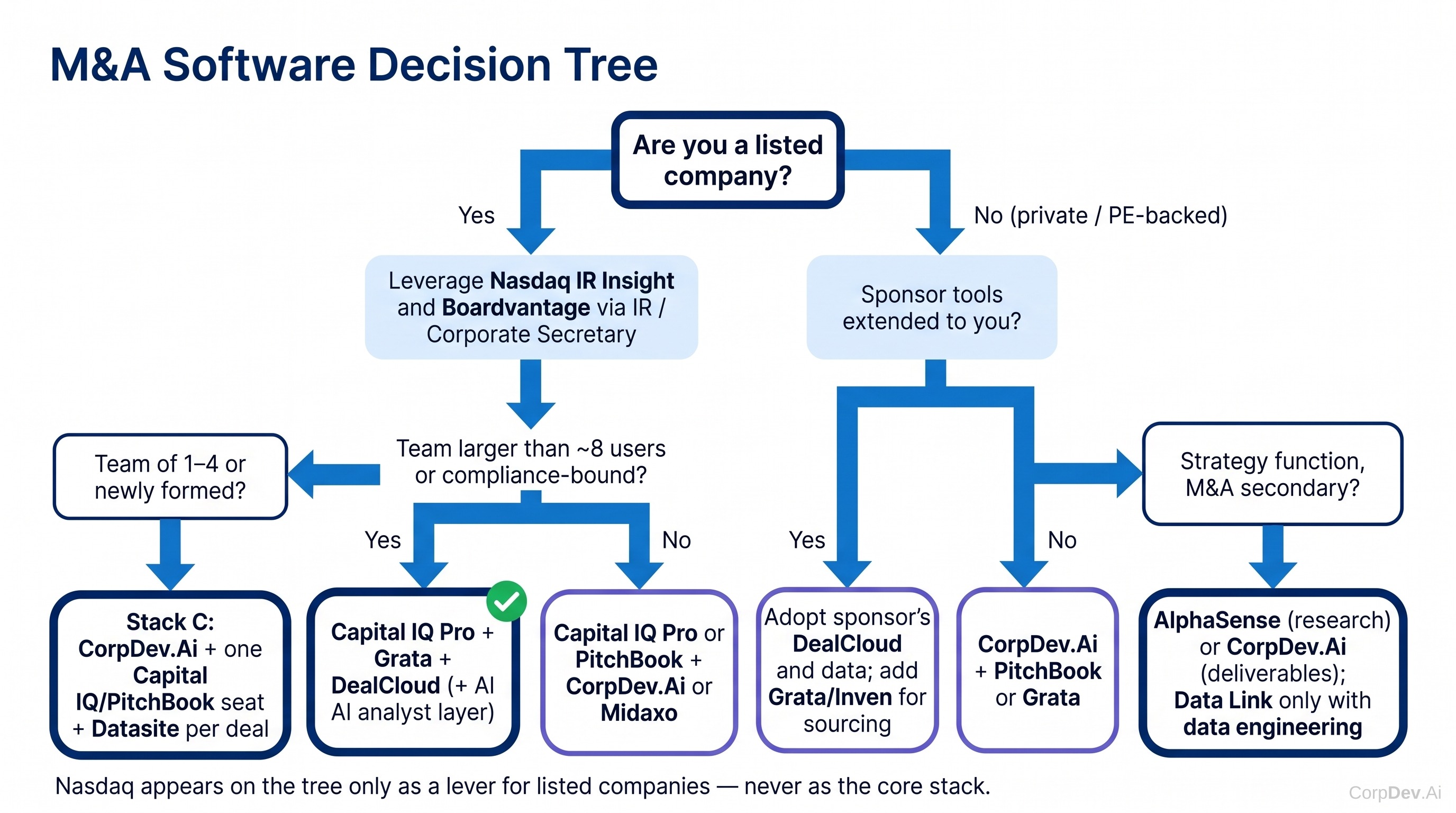
Read diagram description
The first question is "Are you a listed company?" Branch Yes: "Leverage Nasdaq IR Insight and Boardvantage via IR / Corporate Secretary" then "Team larger than ~8 users or compliance-bound?" Yes → "Capital IQ Pro + Grata + DealCloud (+ AI analyst layer)"; No → "Capital IQ Pro or PitchBook + CorpDev.Ai or Midaxo". Branch No (private / PE-backed): "Sponsor tools extended to you?" Yes → "Adopt sponsor's DealCloud and data; add Grata/Inven for sourcing"; No → "CorpDev.Ai + PitchBook or Grata". A separate buyer profile: "Team of 1–4 or newly formed?" → "Stack C: CorpDev.Ai + one Capital IQ/PitchBook seat + Datasite per deal". Another branch: "Strategy function, M&A secondary?" → "AlphaSense (research) or CorpDev.Ai (deliverables); Data Link only with data engineering". "Nasdaq appears on the tree only as a lever for listed companies — never as the core stack."
Negotiation points that apply to every vendor
- Seat definition and read-only tiers. Terminals and CRMs often price a read-only or "light" seat at a fraction of a full seat; ask explicitly.
- Data export and portability. Insist on bulk export of company lists, notes and pipeline history in open formats — the sourcing-tier consolidation makes vendor lock-in a live risk [24][92].
- AI governance. Obtain in writing whether prompts and uploaded documents are used for model training, where data is hosted, and how citations can be audited; Datasite's 2025 survey found data privacy and security the leading perceived AI risk at 34% of dealmakers [104].
- Overage and credits. Any metered product (search credits, API calls, data-room pages) needs a published or negotiated overage rate before signature.
- Term and exit. Prefer one-year terms with price caps on renewal while the market is consolidating; multi-year discounts are rarely worth the loss of optionality in 2026.
Key Facts & Sources
The load-bearing figures in this document, with source and as-of date. Ranges marked "benchmark" are aggregations of independent buyer reports (Vendr, CostBench, G2 and similar), not vendor list prices; items marked "assumption" are the authors' estimates and are used only in the reference-stack arithmetic.
| Figure | Value | Source | As of | Basis |
|---|---|---|---|---|
| Nasdaq Capital Access Platforms revenue, FY2025 | $2.137B, +10% | Nasdaq 10-K / Q4 2025 release [52][53] | Jan–Feb 2026 | Reported |
| Nasdaq Workflow & Insights revenue, FY2025 | $506M | Nasdaq 10-K [52] | Feb 2026 | Reported |
| Nasdaq Capital Access Platforms ARR, Q2 2026 | $1.388B, +8% | Nasdaq Q2 2026 10-Q / presentation [54][55] | Jul 2026 | Reported |
| Workflow & Insights revenue growth, Q2 2026 | $133M, +5% | Nasdaq Q2 2026 materials [54] | Jul 2026 | Reported |
| AI adoption inside Nasdaq products, Q2 2026 | 79% of IR Insight users; 65% of Boardvantage users | Nasdaq Q2 2026 earnings call [60] | Jul 2026 | Reported |
| Solovis divestiture | Closed Oct 2025 | Nasdaq 10-Q Oct 2025 [66] | Oct 2025 | Reported |
| Metrio divestiture to osapiens | Announced 19 Aug 2026 | osapiens release [63] | Aug 2026 | Reported |
| Nasdaq Data Link dataset count | 350+ | Nasdaq product page [5] | 2026 | Vendor claim |
| S&P Capital IQ Pro seat | $25–35K/yr; ~$33K list; Vendr median org spend ~$53K | CostBench, Investables [68][69] | Jun–Aug 2026 | Benchmark |
| PitchBook contract | Vendr median $31.9K; range $20–124K | Vendr, CostBench [70][72] | 2026 | Benchmark |
| AlphaSense contract | Vendr median $17.5K; range $9.25–51K | Market Intelligence Tools, G2 [73][75] | Jul 2026 | Benchmark |
| Grata seat | $12–18K; packages $15–30K+ | CT Acquisitions, Prospeo [76][77] | Jun 2026 | Benchmark |
| Bloomberg / LSEG / FactSet seats | ~$30–35K / $22–24K / $12–24K | CT Acquisitions [21] | Jun 2026 | Benchmark |
| Midaxo team licence | $40–120K/yr | CT Acquisitions [27] | Jun 2026 | Benchmark |
| Datasite VDR project | $5–30K+ per project | Datasite materials, market reports [32] | 2025–26 | Benchmark |
| CorpDev.Ai pricing | $1,000/mo per seat annual ($1,200 card); $3,000/mo for 3 seats; 12,000 credits/yr | corpdev.ai/pricing [38] | Sep 2026 | Published |
| Company universe claims | Capital IQ 50M+; Grata 19M+; Inven 28M+; Tracxn 8M+; CorpDev.Ai 70M+ | Vendor pages [21][22][79][85][38] | 2025–26 | Vendor claims, not comparable |
| Datasite–Grata–Sourcescrub–Valu8 consolidation | Grata acquired 2025; Sourcescrub Aug 2025; Valu8 May 2026 | Datasite releases [24][92] | May 2026 | Reported |
| Gen-AI use in M&A by activity | Screening 74%; diligence 61%; integration ~52%; negotiation 33% | Deloitte 2026 Pulse Study [96][97] | 2026 | Survey |
| AI tool use by M&A executives | 45% in 2025 (from ~21% gen-AI in 2024) | Bain M&A Report 2026 [94][95] | Jan 2026 | Survey, 300+ respondents |
| Faster deal cycles with gen-AI tools | 40% report 30–50% faster | McKinsey [101] | Mar 2026 | Survey, 200 respondents |
| Integration and human review as prerequisites | 57% / 59% | Deloitte 2026 Pulse Study [112] | 2026 | Survey |
| Data privacy as top AI risk | 34% of dealmakers | Datasite 2025 survey [104] | Mar 2025 | Survey, 620+ respondents |
| Typical CorpDev team size | 2–10 people | Industry estimate [107] | Apr 2026 | Estimate, not survey |
| DealCloud per-seat cost used in Stack A | $8–15K | — | — | Assumption (quote-only product) |
| CorpDev.Ai additional seats beyond team plan | $12K/seat/yr | — | — | Assumption (individual annual rate applied) |
No public survey establishes the share of CorpDev teams using PitchBook versus Capital IQ, the average hours spent on screening, or software budget per seat; those points are handled qualitatively above. DealCloud and Nasdaq per-seat prices are unavailable publicly and are treated as quote-based throughout.
References
Numbering follows the original research. Access dates below record the original source registry; they do not imply that every source was rechecked for this website edition.
- Nasdaq Corporate SolutionsSource accessed 2026-09-10
- Nasdaq IR Insight - Investor Relations SoftwareSource accessed 2026-09-10
- Nasdaq IR Insight® PricingSource accessed 2026-09-10
- Boardvantage Pricing | One Price, No Upcharges - NasdaqSource accessed 2026-09-10
- Nasdaq Data Link | Cloud-Based Financial Intelligence PlatformSource accessed 2026-09-10
- Nasdaq Stock Market Data SolutionsSource accessed 2026-09-10
- Nasdaq Private Market: HomepageSource accessed 2026-09-10
- Nasdaq Private Market Hires Bill Spoor, CFA, as Head of ...Source accessed 2026-09-10
- AI-Ready Institutional Data & Insights | Nasdaq eVestmentSource accessed 2026-09-10
- Verafin | NasdaqSource accessed 2026-09-10
- Institutional Holdings - NasdaqSource accessed 2026-09-10
- Nasdaq Data Link APIs | Real-Time Market Data Integration PlatformSource accessed 2026-09-10
- Capital IQ vs. PitchBook vs. ZoomInfo [July 2026]Source accessed 2026-09-10
- PitchBook AI-powered insights for VC, PE & M&A - PitchBookSource accessed 2026-09-10
- PitchBook’s Data: Private & Public Market Data - PitchBookSource accessed 2026-09-10
- Refinitiv vs Bloomberg vs FactSet vs Capital IQ - CT AcquisitionsSource accessed 2026-09-10
- Discover private companies & source deals faster | Grata ...Source accessed 2026-09-10
- Datasite to Acquire Sourcescrub, Expanding Private Market ...Source accessed 2026-09-10
- Cyndx | Purpose-Built AI for Investment ProfessionalsSource accessed 2026-09-10
- Private EquitySource accessed 2026-09-10
- AI for M&A (2026): Complete Tool Landscape and Vendor ...Source accessed 2026-09-10
- AI for M&A: Answers From Your Own Deal DataSource accessed 2026-09-10
- The AI-powered deal and relationship intelligence platform - IntappSource accessed 2026-09-10
- Intapp Assist for DealCloudSource accessed 2026-09-10
- One platform to power sourcing, strategy, and scaled value creationSource accessed 2026-09-10
- Light Speed: How Datasite tech is breaking barriersSource accessed 2026-09-10
- Data Room & Dealmaking NewsSource accessed 2026-09-10
- PricingSource accessed 2026-09-10
- About UsSource accessed 2026-09-10
- ask-company-questionSource accessed 2026-09-10
- Pricing - CorpDev.AiSource accessed 2026-09-10
- Deep Company Intelligence & Research for M&A - CorpDev.AiSource accessed 2026-09-10
- Search by Description | CorpDev.Ai DocsSource accessed 2026-09-10
- CorpDev.Ai - Agentic AI for M&A and Corporate DevelopmentSource accessed 2026-09-10
- Quick Start | CorpDev.Ai DocsSource accessed 2026-09-10
- CorpDev.Ai vs Grata: Pricing & Features ComparisonSource accessed 2026-09-10
- Kal Kilpi - CEO @ CorpDev.Ai | Superhuman M&ASource accessed 2026-09-10
- CorpDev.Ai Revenue, Funding & Valuation - ProspeoSource accessed 2026-09-10
- CorpDev.Ai Reviews - 2026 - SlashdotSource accessed 2026-09-10
- CorpDev.Ai vs Inven: Pricing & Features ComparisonSource accessed 2026-09-10
- [PDF] Earnings Presentation 2Q26 - Investor RelationsSource accessed 2026-09-10
- [10-K] NASDAQ, INC. Files Annual Report - NDAQ - Stock TitanSource accessed 2026-09-10
- Nasdaq Reports Fourth Quarter and Full Year 2025 ResultsSource accessed 2026-09-10
- Nasdaq : Q2 26 Earnings Presentation - MarketScreenerSource accessed 2026-09-10
- Form 10-Q for Nasdaq INC filed 07/23/2026Source accessed 2026-09-10
- AI for Investor Relations with Nasdaq IR Insight®Source accessed 2026-09-10
- Earnings call transcript: Nasdaq beats Q2 2026 forecasts ...Source accessed 2026-09-10
- Nasdaq Launches Exclusive Access to Nasdaq Private ...Source accessed 2026-09-10
- osapiens acquires Nasdaq Metrio platform and accelerates ...Source accessed 2026-09-10
- Nasdaq (NDAQ) Q1 2026 Earnings Call Transcript - FortuneSource accessed 2026-09-10
- Form 10-Q for Nasdaq INC filed 10/23/2025Source accessed 2026-09-10
- Capital IQ Cost 2026: S&P Capital IQ Price Per SeatSource accessed 2026-09-10
- S&P Capital IQ Pro Pricing 2026: What It CostsSource accessed 2026-09-10
- Pitchbook Software Pricing & Plans 2026: See Your CostSource accessed 2026-09-10
- PitchBook Pricing in 2026: What 100+ Buyers Pay | Startup YetiSource accessed 2026-09-10
- PitchBook Pricing 2026: What Buyers Actually PaySource accessed 2026-09-10
- AlphaSense Pricing 2026: What a Seat Actually Costs | Market ...Source accessed 2026-09-10
- Reviews And ReputationSource accessed 2026-09-10
- AlphaSense Pricing 2026Source accessed 2026-09-10
- Best Market Intelligence Platforms for M&A (2026)Source accessed 2026-09-10
- Grata vs SourceScrub: Honest Comparison (2026) - ProspeoSource accessed 2026-09-10
- AI-Powered Deal Sourcing - InvenSource accessed 2026-09-10
- Inven overviewSource accessed 2026-09-10
- Crunchbase Pricing 2026Source accessed 2026-09-10
- Private Market Intelligence for Investment Banking | TracxnSource accessed 2026-09-10
- Corporate Development & M&A Software | Build Strategic ...Source accessed 2026-09-10
- Inven for Corporate M&ASource accessed 2026-09-10
- Track global M&A activity with Tracxn's Acquisitions DatabaseSource accessed 2026-09-10
- Datasite Acquires Valu8 to Further Accelerate Global, AI- ...Source accessed 2026-09-10
- Grata + Sourcescrub: Better TogetherSource accessed 2026-09-10
- M&A Capability for a New Era: Five Ways AI Is Creating ...Source accessed 2026-09-10
- Generative AI in M&A: You're Not Behind—YetSource accessed 2026-09-10
- 2026 Generative AI in M&A Pulse StudySource accessed 2026-09-10
- Deloitte M&A Leader: How AI is Changing the Dealmaking ProcessSource accessed 2026-09-10
- AI meets M&ASource accessed 2026-09-10
- Expert Spotlight: AI's impact on M&A in the legal sector - DatasiteSource accessed 2026-09-10
- M&A Momentum Builds as Global Deal Kickoffs Rise 31% in 1H26, Datasite Data ShowsSource accessed 2026-09-10
- Corporate Development Software: 32 Tools, Real Pricing ...Source accessed 2026-09-10
- Deloitte GenAI Adoption in M&A Surpasses 90%Source accessed 2026-09-10