RESEARCH / Virtual data rooms and diligence
Onehub alternatives: data-room controls, pricing and AI deal workspaces
Compare Onehub with Datasite, Intralinks, Firmex, iDeals, ShareFile and CorpDev.Ai on data-room controls, Q&A, AI, assurance, annual costs and buyer fit.
Research as of
Website edition edited
Published by CorpDev.Ai, which is one of the vendors assessed. This analysis distinguishes vendor claims, external evidence and analyst judgments. Prices and capabilities reflect the source dates in the article; the website edition is an editorial adaptation, not a new verification of every claim.
The premium for a data room must buy a better transaction process
Onehub makes the cost of specialist transaction infrastructure explicit. If the requirement is controlled document access for a manageable process, paying substantially more for a room needs a reason. The reason should be a difficult workflow—bidder questions, redaction, disclosure control or adviser coordination—not simply the prestige of an enterprise vendor.
The economic trap is to compare the subscription while ignoring the people operating it. A lower-priced room can be the right choice, yet lose its advantage if the team must recreate structured Q&A and process controls through email and spreadsheets. The reverse also matters: an occasional buyer should not finance auction infrastructure it will rarely operate.
Run a sample of the actual transaction process, including an awkward question and a document that needs restricted treatment. Measure administrator effort and the clarity of the resulting record. Analytical AI can complement the room, but its licence is an additional cost unless the team can identify work or subscriptions it genuinely displaces.
Executive Summary
Onehub is among the lower-cost virtual data rooms considered in this comparison, and that single fact explains both its loyal customer base and the reasons buyers outgrow it. At $300 to $375 per month for a Data Room Edition that includes stealth mode, dynamic watermarking, click-through NDAs, automatic indexing and full audit trails, with unlimited storage and free external viewers, it undercuts the mid-market VDRs by roughly three to fourteen times on an annual basis and the enterprise rooms by an order of magnitude or more; only ShareFile's VDR tier is priced comparably [1][26][65][70][94]. What it does not offer is a structured Q&A module, page-level bidder analytics, automated redaction or any meaningful AI, and its public assurance evidence differs from vendors that also disclose ISO certifications; SOC 2 and ISO 27001 address different assurance frameworks [9][31].
$3,600
Onehub Data Room, per year
$40k–$100k
Datasite, one mid-market deal
$36,000
CorpDev.Ai Team, 3 seats, per year
Published tiers
Onehub, ShareFile and CorpDev.Ai; enterprise scope varies
The alternatives fall into several categories that do different jobs. Enterprise VDRs (Datasite, Intralinks, DFIN Venue) sell auction infrastructure: bidder isolation, routed Q&A, redaction engines, engagement analytics and overnight project teams, at $15,000 to $500,000 per transaction on opaque, often per-page pricing [24][26][39][54]. Mid-market VDRs (Firmex, iDeals, Ansarada, DealRoom) deliver most of that capability at $5,000 to $50,000 per year, and each adds the Q&A workflow Onehub lacks [64][70][76][82]. General-purpose platforms (Box, ShareFile, Egnyte, Dropbox) are already on most corporate desktops but fail the watermark-persistence and bidder-isolation tests without a dedicated data-room tier, at which point their price advantage disappears [94][97]. CorpDev.Ai represents a fourth, newer category: an AI-native corporate development workspace in which the data room is one component alongside target sourcing, market mapping, pipeline CRM, AI diligence with page-level citations and automated memo and deck production, at a published $12,000 to $36,000 per year [110][113]. It is not an externally facing auction room and does not claim to be.
| Product / configuration | Workflow contribution | Indicative annual price / basis |
|---|---|---|
| Onehub Data Room | Controlled documents and external sharing | ~$3.6K base annual room scenario |
| ShareFile VDR | Document control and VDR features | ~$4.2K cited entry scenario |
| iDeals / Firmex | Transaction-room controls | ~$10–50K contract scenarios |
| Ansarada | Transaction room with readiness/AI features | ~$8–60K scenarios |
| Datasite / Intralinks | Institutional external process control and suite AI/redaction | ~$120–500K for a 3–5-deal programme; not a per-user comparison |
| DFIN Venue | Institutional transaction room | No comparable price supplied in this illustration |
| DealRoom | Pipeline plus room and buyer-led process | ~$25K platform scenario; verify package |
| CorpDev.Ai | Research, sourcing, pipeline, AI Room, deliverables and integration planning | ~$36K for three base users; five standard seats imply $60K; Enterprise separate |
| Onehub + CorpDev.Ai | Document-sharing room plus ongoing analytical workspace | ~$39.6K for three CorpDev users or ~$63.6K for five, before usage, add-ons and Enterprise requirements |
This is a set of heterogeneous scenarios, not a lowest-price ranking. A specialist transaction room may be rented per auction while the research workspace is used year-round. Integration planning does not establish complete operational PMI functionality.
The recommendation depends on who is buying. An occasional acquirer running bilateral deals should shortlist Onehub if its controls and Q&A approach fit. A seller in a competitive auction should evaluate the bank’s preferred room against the process requirements and quote. A programmatic in-house corporate development team, whose constraint is analyst capacity rather than document control, is best served by a two-product stack: an AI-native workspace such as CorpDev.Ai for research, pipeline, diligence analysis and writing, paired with a flat-priced room such as Onehub for the externally controlled process. At roughly $40,000 per year that stack costs less than a single enterprise VDR engagement and covers the full deal lifecycle rather than the four months a room is open [1][113].
Onehub's weaknesses as a stand-alone answer are exactly what make it the strongest low-cost component of a modern corporate development stack. Buy it for what it is, a fast, predictable, branded room, and buy analytical capability separately. An AI workspace can address analytical gaps, but does not replace missing bidder isolation, routed Q&A or redaction controls; those require the appropriate room.
1. What Are You Actually Buying? Framing the Category
Most "Onehub alternatives" lists compare products that do fundamentally different jobs. For a corporate development buyer, the first decision is not which vendor to pick but which of three categories the problem belongs to. Getting this wrong is the most common and most expensive procurement error in this space: teams either pay enterprise VDR prices for what is essentially a client portal, or run a competitive sell-side process on a file-sharing tool that lacks buyer-group isolation and defensible audit trails.
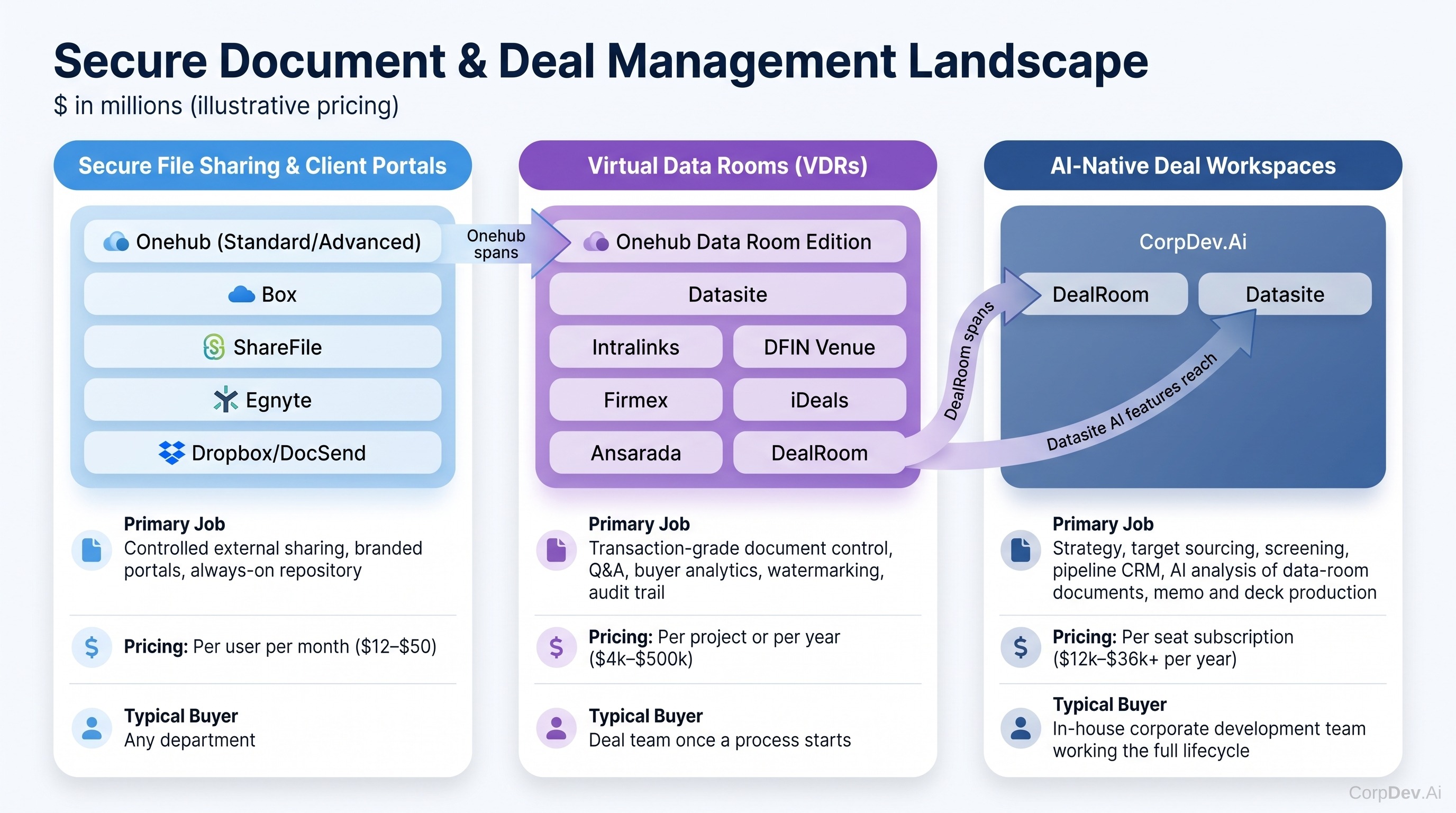
Read diagram description
Three-column category map.
Column 1 "Secure File Sharing & Client Portals": Onehub (Standard/Advanced), Box, ShareFile, Egnyte, Dropbox/DocSend — job: controlled external sharing, branded portals, always-on repository; pricing per user per month ($12–$50); typical buyer: any department.
Column 2 "Virtual Data Rooms (VDRs)": Onehub Data Room Edition, Datasite, Intralinks, DFIN Venue, Firmex, iDeals, Ansarada, DealRoom — job: transaction-grade document control, Q&A, buyer analytics, watermarking, audit trail; pricing per project or per year ($4k–$500k); typical buyer: deal team once a process starts.
Column 3 "AI-Native Deal Workspaces": CorpDev.Ai, with DealRoom and Datasite partially overlapping — job: strategy, target sourcing, screening, pipeline CRM, AI analysis of data-room documents, memo and deck production; pricing per seat subscription ($12k–$36k+ per year); typical buyer: in-house corporate development team working the full lifecycle. The categories overlap: Onehub spans columns 1 and 2; DealRoom spans 2 and 3; Datasite AI features reach from 2 into 3.
Category 1: Secure file sharing and client portals
These products exist to share files with people outside the organisation in a controlled, branded way. Onehub's Standard and Advanced plans, Box, ShareFile, Egnyte and Dropbox all sit here. They are priced per internal user per month, external viewers are usually free, and the repository is expected to persist for years. They are excellent for board portals, advisor collaboration, portfolio-company reporting and routine confidential exchange. They are not designed for a competitive process in which twelve bidders must be invisible to one another and every page view may later be evidence in a dispute.
Category 2: Virtual data rooms
A VDR is a transaction tool. The defining features are stealth mode (bidders cannot see each other), dynamic watermarking that survives download, page-level view analytics, structured Q&A with routing to subject-matter owners, click-through NDAs, automatic indexing and an exportable audit log. Onehub's Data Room Edition is an entry-level VDR; Datasite and Intralinks are the enterprise incumbents; Firmex, iDeals, Ansarada and DealRoom serve the mid-market. Pricing is per project or per year rather than per user, and the cost range spans two orders of magnitude, from roughly $4,000 for a small Onehub room to $500,000 or more for a large Datasite sell-side process [1][26][27].
Category 3: AI-native deal workspaces
The newest category treats the data room as one component of a broader corporate development operating system that also covers strategy, market mapping, target sourcing and screening, pipeline CRM, AI-driven document analysis and the production of memos and board decks. CorpDev.Ai is the clearest example; DealRoom's "M&A Platform" and Datasite's expanding AI suite overlap partially. The value proposition is different in kind: the buyer is paying for analytical throughput across the whole deal lifecycle, not for storage and permissions. Pricing is a seat-based annual subscription, and the return is measured in analyst hours and consulting fees avoided rather than in cost per gigabyte.
A CorpDev team's tooling question is usually two questions in disguise: "Where do we run the controlled external room when a process is live?" and "Where does our team do its research, analysis, pipeline tracking and writing every day?" No single product on the market today is the best answer to both. This guide therefore evaluates Onehub against alternatives within its own category and against the adjacent categories a buyer will inevitably compare it with.
2. Onehub in Depth
Onehub is a Seattle-based secure file sharing and entry-level virtual data room provider founded in 2007 by Charles Mount and Brian Moran [10][11]. Since January 2021 it has been an operating subsidiary of SRS Acquiom, the Denver-based M&A escrow, payments and shareholder-representation firm [117][118]. That ownership matters for a deal-team buyer in two ways: it anchors Onehub inside an M&A services group with a natural distribution channel into private-company transactions, and it signals that the product is unlikely to pivot away from the deal use case. It has not, however, translated into the aggressive AI roadmap that Datasite, Intralinks and the newer platforms have pursued.
2007
Founded, Seattle
$300–375/mo
Data Room Edition (5 users incl.)
1,000
Total users, Data Room plan
SRS Acquiom
Owner since 2021
Product and plan structure
Onehub sells four tiers, and the tier boundary is where most buyer confusion arises [1]:
| Plan | Price (monthly / annual billing) | Included paid users | Total users | Workspaces | Storage | Deal-relevant features |
|---|---|---|---|---|---|---|
| Standard | $15 / $12.50 per paid user | Starts at 3 | 200 | 50 | 1 TB | Role-based permissions, previews, activity tracking |
| Advanced | $25 / $20 per paid user | Starts at 5 | 1,000 | 200 | Unlimited | Adds audit trails, enforced 2FA, session timeouts, password links, FTP, full-text search, DocuSign; white label is a $100/month add-on |
| Data Room Edition | $375 / $300 flat, plus $25 / $20 per additional paid user | 5 | 1,000 | 200 | Unlimited | Adds stealth mode, document watermarks, automatic indexing, click-through NDAs, dedicated support, 24/7 phone, white label included |
| Enterprise Edition | Custom quote, priced by usage, billed annually | Unlimited | Unlimited | Unlimited | Unlimited | Everything above; third-party trackers still quote a legacy "Unlimited Edition" at $575 / $500 per month, but Onehub's own pricing page now shows quote-only [1][2][3] |
The commercial model has a genuinely attractive property for deal teams: external users invited as Viewer, Printer, Downloader or Creator are free up to the plan's total-user cap, and only Collaborators, Moderators, Administrators and anyone invited to three or more workspaces count as paid [1]. A sell-side team of five running a room with 60 bidder-side reviewers therefore pays the flat Data Room price with no per-bidder charge, which is the opposite of the per-page and per-gigabyte economics of the enterprise VDRs.
Security and compliance posture
Onehub runs on AWS with 256-bit encryption at rest and in transit, encrypted backups, enforced two-factor authentication, role-based permissions, custom session timeouts and full audit trails on the Advanced tier and above [7][9]. It describes its controls as supporting HIPAA and GDPR obligations and is commonly reported as SOC 2 audited, but the buyer should obtain the current SOC 2 report or bridge letter directly, since the public site describes controls rather than publishing certificate scope [9]. There is no public claim of ISO 27001, ISO 27701 or ISO 42001, which the enterprise VDRs now carry [31][32][47]. For most mid-market corporate transactions this is adequate; for a regulated-industry seller or a process involving EU personal data at scale, it is a gap to raise in procurement.
Where Onehub is strong for a deal team
- Price certainty. A full-featured data room at $300 to $375 per month with no page, storage or bidder charges is the lowest predictable cost of any product in this guide that offers stealth mode and watermarking [1]. A six-month sell-side process costs roughly $1,800 to $2,250 in licence fees, versus $15,000 to $100,000 at Datasite for a comparable mid-market deal [26][27].
- Speed to set up. Reviewers on G2 and Capterra consistently praise the intuitive interface and the ability to stand up a branded workspace in minutes without vendor onboarding [18][19]. There is no project-manager dependency and no minimum term.
- Dual-use repository. Because Onehub is also a persistent branded file-sharing platform, the same subscription can serve as the always-on portal for advisors, board members and portfolio companies between deals. The enterprise VDRs are project-scoped; when the deal closes the room is archived and the subscription ends.
- Client-facing polish. Custom branding on the Advanced tier, and white label with custom domain on Data Room and Enterprise, let a corporate development team present a room under its own identity rather than a vendor's [1].
Where Onehub falls short for a deal team
- No structured Q&A module. Onehub relies on comments and messaging rather than a dedicated Q&A workflow with question categories, assignment to subject-matter owners, approval before publication and bidder-group-specific answers. Every purpose-built VDR in this guide, including the mid-market ones, has this. On a competitive process with multiple bidders, this is the single feature gap most likely to cause a team to regret the choice [64][67][73].
- Thin buyer analytics. Activity tracking shows who accessed what, but the page-level heat maps, bidder engagement scoring and time-on-document reporting that Datasite, Intralinks and Ansarada use to inform negotiation strategy are not present [35][77].
- Minimal AI. There is no automated redaction, no AI document summarisation, no natural-language querying of the room and no AI-assisted Q&A drafting. Datasite's redaction engine covers 120-plus categories of sensitive data; DFIN Venue extracts contract clauses; CorpDev.Ai converts every page into queryable structured knowledge with page-level citations [28][55][110]. Onehub's automatic indexing is the extent of its automation.
- Interface and file-handling complaints. A recurring minority of reviewers describe the interface as dated and report slow uploads on large document sets and limitations in mobile link handling [21][22][23]. For a room of a few thousand documents this is a nuisance; for a room of fifty thousand it is a workflow risk.
- Enterprise procurement friction. Certificate scope is not published, there is no ISO 27001, and the Enterprise tier is quote-only despite the brand promise of transparent pricing [1][9].
Onehub is the best-value option in this guide for a corporate development team that runs one or two uncompetitive or lightly competitive processes a year, needs a branded persistent portal in between, and has counsel comfortable with watermarking, stealth mode and audit trails as the control set. It is the wrong choice for a broad auction, a regulated-industry seller, a large room whose upload and review performance has not been demonstrated on representative material, or any team whose bottleneck is analysis rather than distribution.
3. The Alternatives
3.1 Enterprise Virtual Data Rooms: Datasite, Intralinks, DFIN Venue
The enterprise tier is where investment banks, large-cap corporates and their counsel default, and where the price of certainty is highest. All three vendors quote per transaction rather than publishing rates, so the figures below are practitioner-reported planning ranges, not list prices.
Pricing model: Custom per transaction; page-volume component commonly reported at $0.40–$0.85 per page [24][25]
Typical deal cost: $15k–$40k small; $40k–$100k mid-market; $100k–$500k+ large [26][27]
AI: Redaction across 120+ categories, classification, summarisation, semantic search, translation, Q&A drafting, all inside the permissioned room [28][29][30]
Certifications: SOC 2 Type II; ISO 27001, 27017, 27018, 27701; ISO 42001 for AI governance [31][32]
Best for: Sell-side auctions with large rooms and heavy redaction needs
Pricing model: Custom project or enterprise agreement; $10k+ annual minimums reported, $50k–$200k per year mid-market [38][39][40]
Typical deal cost: $10k–$50k contained project; $50k–$200k+ enterprise [39][41]
AI: Buyer-interest insights, redaction, OCR, summaries, source-linked Q&A; generative workflows via the broader DealCentre AI stack [42][44][45]
Certifications: SOC 2 Type II, ISO 27001, ISO 27701 [47][48]
Best for: Cross-border, DCM, syndicated finance and bank-led processes where institutional familiarity matters
Pricing model: Quote-only; project length, storage, users and bundled DFIN services; legacy per-page contracts still exist [54][55][56]
Typical deal cost: $5k–$15k small; $15k–$40k mid; $40k–$100k+ large or IPO [54][55]
AI: Contract analytics extracting clauses, parties, dates and termination triggers; DFIN claims up to 90% faster review; automated redaction and classification [55][57]
Certifications: SOC 2 Type II, HITRUST, ISO 27001:2022 [57][58]
Best for: IPO preparation, SEC-regulated transactions and existing DFIN ActiveDisclosure customers
What the enterprise tier actually buys you
The premium over Onehub is not primarily about security, although the certification stack is deeper. It is about three things. First, process infrastructure for competitive auctions: buyer-group isolation with granular per-bidder permissions, staged room opening, structured Q&A with routing and approval, and bidder engagement analytics that tell a seller which parties are seriously reading the quality-of-earnings report and which are not [35][52]. Second, deal-support operations: 24/7 project teams who will bulk-upload, index and permission a room overnight under banker deadlines, which is a service Onehub's dedicated support does not replicate at scale [35][36]. Third, AI inside the perimeter: automated redaction alone can save a legal team dozens of hours on a room containing employee or customer personal data, and the ability to run summarisation and Q&A without exporting documents to a consumer AI tool addresses a real confidentiality concern [28][30].
What practitioners complain about
Pricing opacity is the universal grievance. Per-page economics punish large Excel workbooks and replacement uploads, quotes are difficult to benchmark, and the same customer may be charged very differently depending on whether the deal is contracted stand-alone or under a portfolio agreement [26][37]. Intralinks is described as the most legacy-feeling interface of the three, and its most advanced AI requires adopting the wider DealCentre product rather than VDRPro alone [46][52]. Venue's narrower focus and lack of a self-service trial make it hard to evaluate without a sales engagement [56][60]. For an in-house corporate development team running two or three deals a year, all three are usually over-specified: the buyer pays for auction infrastructure and overnight operations that a bilateral corporate acquisition rarely needs.
No independent 2026 dataset publishes defensible vendor-level market shares. Intralinks' "$35 trillion of transactions" and "99% of the Fortune 1000" are company-reported scale claims [50][51]; G2 review counts are not share. Buyers should weight practitioner references from their own bankers and counsel over vendor league tables.
3.2 Mid-Market and Value VDRs: Firmex, iDeals, Ansarada, DealRoom
This is the segment Onehub's Data Room Edition competes in most directly, and the comparison is instructive: each of these four vendors charges more than Onehub and each offers something Onehub does not.
| Vendor | Per-project range (USD) | Annual range (USD) | Structured Q&A | AI depth | Pipeline / lifecycle | Certifications | G2 rating |
|---|---|---|---|---|---|---|---|
| Firmex | $5k–$10k for 3 months; $10k–$25k+ complex | $25k–$50k+ recurring; lower for small subscriptions | Strong, mature routing and approval | Limited; indexing only | VDR only | SOC 2 Type II | 4.6 (93 reviews) |
| iDeals | $5k–$12k for 3–6 months; entry $500–$2k/month | $10k–$30k+ | Good; categories, assignees, deadlines | Moderate; search, classification, redaction by package | Moderate | ISO 27001, SOC 2 | 4.7 (856 reviews) |
| Ansarada | $1.4k–$25k+ by storage tier | $8k–$60k+ | Very strong; RFI management, analytics | Strong; AI search, risk extraction | Moderate to strong; readiness tools | ISO 27001 since 2009; SOC 2 to confirm | 4.5 (238 reviews) |
| DealRoom | $2k–$5k small; $5k–$15k+ mid | M&A Platform from ~$25k/year | Good; linked to diligence tasks | Strong; AI VDR, extraction | Best of group: pipeline, diligence, integration | SOC 2 Type II, ISO 27001 | 4.3 (66 reviews) |
Sources: [64][65][67][68][70][72][73][74][76][77][78][82][84][85][86][87].
How each differs from Onehub
Firmex is the closest philosophical cousin: a no-frills, reliable room with an excellent Q&A workflow and unlimited-room subscription options for repeat users. It is what a buyer should upgrade to from Onehub when the missing Q&A module becomes the problem, but it offers almost nothing on AI and its interface draws the same "less modern" comments Onehub receives [64][67][69].
iDeals has the largest review base in the segment and the most consistent praise for setup speed and granular permissions. It is priced by storage rather than flat, so a document-heavy room can cost more than expected, and the Q&A module is the part of the product reviewers find least intuitive [70][73][75]. It carries ISO 27001, which Onehub does not [72].
Ansarada is the analytics-heavy choice. Its bidder engagement scoring and structured RFI management are frequently cited as reasons sellers pick it over basic rooms, and its ISO 27001 certification dates to 2009 [77]. The trade-off is pricing: usage- and storage-based quotes that reviewers describe as high and unpredictable, historically ranging from $479 per month for 250 MB to over $5,000 per month for 20 GB [76][79].
DealRoom is the one vendor in this group that has moved decisively toward the third category. Its M&A Platform, starting around $25,000 per year, bundles pipeline management, diligence request tracking, integration planning and an AI-enabled VDR with unlimited users [82][84]. It is the most structurally expensive annual commitment here and reviewers flag limited task customisation and slow downloads of large sets, but it is the natural comparison point for a corporate team that wants lifecycle workflow rather than a room alone [88][89].
"Unlimited users", "unlimited rooms" and "unlimited data" are three different commercial terms and vendors use them interchangeably in marketing. Onehub offers unlimited storage but caps total users at 1,000 on the Data Room tier; DealRoom offers unlimited users but tiers storage at 20, 50 or 500 GB; Ansarada prices primarily on storage. Get each written into the order form [1][82][85].
3.3 Secure File Sharing and Client Portals: Box, ShareFile, Egnyte, Dropbox
These platforms are the alternatives most corporate buyers already own. The question is not whether they can hold deal documents but whether their controls would satisfy counsel and a sophisticated counterparty in a live process. In most cases the honest answer is: only with the vendor's dedicated data-room add-on, at which point the price advantage over a purpose-built VDR largely disappears.
| Platform and plan | Indicative price | Watermarking and view-only | Audit trail | Structured Q&A | Verdict for M&A |
|---|---|---|---|---|---|
| Box Business Plus / Enterprise | $25 / $35 per user/month annual; $33 / $47 monthly [90][91] | Plan-dependent; strongest with Box Shield add-on | Depth depends on configuration | None native | Governance-grade for an enterprise already on Box; no deal workflow |
| Box Shield / Box AI | Quote-based; advanced bundles estimated $47–$55 per user/month [92][93] | Classification and policy enforcement, not true dynamic VDR watermarking | Strong telemetry | None native | Overkill for a single transaction |
| ShareFile Advanced / Premium | $18.15 / $28.60 per user/month monthly [94][95][96] | Partial | File activity tracking | None | Client portal, not a room |
| ShareFile Virtual Data Room | $77 per user/month monthly, $69.30 annual, 5-user minimum (~$346.50/month annual floor) [94][97] | Watermarking, view-only, NDA controls | Real-time activity tracking | Yes | The strongest ShareFile option; reviewers note weaker page analytics and watermark persistence [97][98] |
| Egnyte Business / Enterprise Lite / Elite | $22 / $39 / $48 per user/month annual [99][100][101] | Verify per tier | Core governance reporting | None at base tiers | Strong content governance; deal room sold separately |
| Egnyte Document Room | Quote-based [102][103] | Designed for controlled transaction sharing | Transaction-oriented | Verify in proposal | Good for Egnyte customers; opaque pricing |
| Dropbox Business Standard / Advanced | $15 / $24 per user/month annual [104][106] | Basic link and download controls | Basic | None | Not a data room |
| DocSend Advanced Data Rooms | $180/month base, 3 users [107][108][109] | Watermarking, viewer verification, NDA | Audit logs | Limited per configuration | Fine for CIM distribution and light diligence; weak permissions depth |
The practical implication
A corporate development team with an enterprise Box or Egnyte agreement can reasonably run a bilateral, friendly transaction through a locked-down folder structure, and doing so avoids a new vendor security review. The moment the process becomes competitive, or the counterparty's counsel asks for a page-level audit export, or an EU personal-data file needs redaction, the general-purpose platform fails the test. ShareFile's VDR tier at roughly $346 per month for five users is priced almost identically to Onehub's Data Room Edition and adds a Q&A module, which makes it a direct and under-appreciated alternative for Citrix or Progress customers [94][97]. DocSend remains the best tool for tracking who read a teaser or CIM and for how long, and many sell-side teams use it upstream of the data room rather than instead of one [107][109].
On several general-purpose platforms the watermark disappears when download is enabled, and "disable download" does not prevent screen capture or developer-tools extraction. Before approving any of these for a live process, counsel should test whether the watermark survives download and print, and whether it carries the viewer's identity, IP address and timestamp. Purpose-built VDRs commonly offer these controls, but persistence and export behaviour should be tested in the quoted configuration rather than assumed from the category label [97][98].
3.4 AI-Native Deal Workspaces: CorpDev.Ai
CorpDev.Ai is a Boston-based platform founded in 2023 by Kal Kilpi, a co-founder of the M&A software company Midaxo, and Atul Tiwary, formerly VP of M&A at Barracuda Networks [114][115][116]. It is included in this guide because corporate development teams researching Onehub alternatives increasingly encounter it, and because it represents the category shift that makes a pure data-room purchase decision harder than it was three years ago. Since this guide was commissioned by CorpDev.Ai, the assessment below is deliberately held to the same evidentiary standard as the other vendors: published pricing, published security claims and the absence of independent review data are all stated plainly.
What it is, and what it is not
CorpDev.Ai is not a VDR with AI added. It is an end-to-end corporate development workspace in which the data room, branded AI Room, is one of several connected components [110][111]:
- AI Analyst and Visual Workbook. A specialised agent that researches targets, markets and deal questions and writes memos, market maps, company profiles, strategic briefs and presentations directly into a collaborative document editor, with source citations, exportable to Word, PowerPoint, Excel and PDF [110][113].
- AI Room and diligence agents. Uploaded PDF, XLSX, DOCX and PPTX files are read by vision AI and converted into structured, retrieval-ready knowledge with an audit trail; multi-agent diligence then queries the room and returns findings with page-level citations. The company claims every page of a 50,000-page room becomes queryable [110][111].
- Target sourcing, screening and market mapping. Semantic search across a firmographic database of more than 70 million companies and 265 million contacts, with AI fit scoring, ranked shortlists and automated market segmentation [110][113].
- Zero-entry pipeline CRM. A Kanban pipeline that populates itself from connected Microsoft 365 or Google Workspace email and calendar, with automatic company enrichment, news and trigger monitoring [110][113].
- Digital twins and PMI. Linked models of a target's plants, contracts, people, systems and P&L used for diligence structuring, carve-out planning and Day 1 versus target-state integration design [110].
- CorpDev Brain. A persistent knowledge layer that retains strategy, markets, competitors and targets across engagements so successive work starts further ahead [110].
Pricing
Published pricing is seat-based and transparent, which is unusual in this market [113]:
| Plan | Price | Seats | Notable inclusions |
|---|---|---|---|
| AI Pro | $1,000/month invoiced annually; $1,200/month by card | 1 | Full AI Analyst, Workbook, market mapping, sourcing, pipeline CRM, data room, 12,000 search credits per year |
| AI Pro Team | $3,000/month invoiced annually; $3,600/month by card | 3 | Everything above plus collaboration, admin controls, dedicated CSM, 36,000 credits per year |
| Enterprise | Custom quote | Unlimited, with SSO | Adds financial modelling, solutions architect, managed services, latest proprietary capabilities |
At $12,000 to $36,000 per year, CorpDev.Ai costs 3 to 10 times an Onehub Data Room subscription and sits in the same annual band as Firmex, iDeals or DealRoom [1][65][70][82][113]. The comparison is misleading in both directions, however: the buyer is not paying for a room but for research, analysis, writing and CRM throughput, and the relevant benchmark is the analyst time and external consulting spend it displaces. The company's own marketing cites $200,000 to $2 million in consulting fees per deal and 1,000 to 2,000 hours of strategic analysis per deal as the cost base it targets [110]; those are vendor figures and should be tested against the buyer's own spend.
Security posture, stated objectively
CorpDev.Ai's security page states SOC 2 Type II compliance covering security, availability and confidentiality with annual third-party audits; AES-256 encryption at rest and TLS 1.3 in transit on Google Cloud Platform; role-based permissions with Admin, Analyst and Viewer roles; workspace isolation; audit logging; SSO via SAML or OIDC and MFA; configurable data residency and retention; GDPR and CCPA compliance; and a commitment that customer data is never used to train models, with tenant-isolated ephemeral AI processing (CorpDev.Ai security page, corpdev.ai/security, accessed 2026-09-11). A procurement team should request the SOC 2 report and confirm certificate scope exactly as it would for Onehub. Two honest observations: the company does not publish ISO 27001, which Datasite, Intralinks, Venue, iDeals, Ansarada and DealRoom all carry; and, as a 2023-founded company, it has no G2 or Capterra review base comparable to the incumbents, so buyer references must come from a demo and a trial rather than from aggregated third-party reviews.
Where it is stronger and weaker than a data room
- Analysis of what is in the room, not just control of who sees it: natural-language querying with page-level citations, financial-table extraction, multi-agent diligence
- Everything upstream of the room: strategy, market maps, sourcing, screening, pipeline, inbound deal evaluation
- Everything downstream of diligence: investment memos, board decks, CIMs, integration blueprints, produced in the same workspace
- Transparent seat pricing with no per-page, per-GB or per-bidder charges
- Open formats (Markdown, JSON, Office files) and REST/MCP interfaces, reducing lock-in
- Not designed as an externally facing sell-side auction room: no published stealth mode, bidder-group isolation, dynamic watermarking or click-through NDA workflow of the kind Onehub's Data Room Edition, Datasite or Intralinks offer
- No structured multi-bidder Q&A module with routing and approval
- No 24/7 deal-support operations team for overnight bulk indexing
- No ISO 27001 published; limited independent review history
- Seat-based pricing means the cost is borne even in quarters with no live deal, which suits a standing CorpDev function better than an occasional acquirer
CorpDev.Ai is best evaluated as the internal operating system of a corporate development team, with a data room built in for the buy-side analytical work that team does on documents it receives. A purpose-built VDR remains the tool for the externally controlled room when the same company is the seller in a competitive process. For most in-house teams the two are complements, not substitutes, and the realistic procurement question is "CorpDev.Ai plus which room" rather than "CorpDev.Ai or Onehub" [110].
4. Head-to-Head Comparison
The matrices below consolidate the preceding sections into the three dimensions a procurement decision actually turns on: deal-room capability, commercial model and assurance. Ratings are the author's synthesis of published feature lists and reviewer evidence cited in Sections 2 and 3; where a vendor does not publish a capability it is marked as such rather than assumed absent.
4.1 Deal-room capability
| Capability | Onehub Data Room | Datasite | Intralinks | DFIN Venue | Firmex | iDeals | Ansarada | DealRoom | ShareFile VDR | Box / Egnyte / Dropbox | CorpDev.Ai |
|---|---|---|---|---|---|---|---|---|---|---|---|
| Stealth mode / bidder isolation | Yes | Yes | Yes | Yes | Yes | Yes | Yes | Yes | Partial | No | Not published |
| Dynamic watermarking | Yes | Yes | Yes | Yes | Yes | Yes | Yes | Yes | Yes, persistence questioned | Add-on or no | Not published |
| Click-through NDA | Yes | Yes | Yes | Yes | Yes | Yes | Yes | Yes | Yes | No | Not published |
| Structured Q&A with routing | No | Yes | Yes | Yes | Strong | Good | Very strong | Good | Yes | No | No |
| Page-level bidder analytics | Basic activity log | Advanced | Advanced | Advanced | Standard | Standard | Advanced | Standard | Basic | Basic | N/A |
| Automated redaction | No | 120+ categories | Yes | Yes | No | By package | Limited | Limited | No | No | No |
| AI query of room contents with citations | No | Yes, in-room | Yes, via DealCentre | Contract analytics | No | Limited | Yes | Yes | No | Box AI only | Yes, page-level citations |
| Automatic indexing | Yes | Yes | Yes | Yes | Yes | Yes | Yes | Yes | Yes | No | Yes |
| Deal-support operations team | Dedicated support, 24/7 phone | 24/7 project teams | 24/7 project teams | Project teams | Support | Support | Support | Support | Support | Standard SaaS | CSM on Team plan; managed services on Enterprise |
| Persistent portal between deals | Yes | No | No | No | Subscription option | Subscription option | Subscription option | Yes | Yes | Yes | Yes |
Sources: [1][7][28][29][42][43][55][57][64][67][72][73][77][82][84][94][97][102][107][110][113].
4.2 Upstream and downstream workflow
This is the dimension on which the categories diverge most sharply and on which Onehub, like every pure VDR, scores lowest.
| Capability | Onehub | Enterprise VDRs | Mid-market VDRs | DealRoom | CorpDev.Ai |
|---|---|---|---|---|---|
| Market mapping and sector research | No | No | No | No | Yes, AI-generated with citations |
| Target sourcing and fit scoring | No | No | No | No | Yes, 70M+ company database |
| Pipeline CRM with email/calendar sync | No | No | No | Yes, pipeline | Yes, zero-entry from M365 / Google |
| Diligence request tracking | Comments only | Q&A module | Q&A module | Yes, linked to tasks | Diligence agents on room contents |
| Investment memo and deck generation | No | No | No | No | Yes, AI Analyst and Workbook |
| Integration / PMI planning | No | No | No | Yes | Yes, digital twins and Day 1 blueprints |
| Persistent organisational knowledge | No | No | No | Limited | CorpDev Brain |
4.3 Commercial model and assurance
| Vendor | Pricing basis | Published list price | Minimum commitment | SOC 2 Type II | ISO 27001 | Other |
|---|---|---|---|---|---|---|
| Onehub | Flat per plan plus paid users | Yes | Monthly, cancel anytime | Reported; request report | Not published | HIPAA- and GDPR-supporting controls, AWS [9] |
| Datasite | Per transaction, page-volume component | No | Per project | Yes | Yes, plus 27017/27018/27701 | ISO 42001 AI governance [31][32] |
| Intralinks | Custom project or enterprise | No | $10k+ annual reported | Yes | Yes, plus 27701 | [47][48] |
| DFIN Venue | Custom project | No | Per project | Yes | Yes, 27001:2022 | HITRUST [57][58] |
| Firmex | Per project or subscription | No | 3-month project typical | Yes | Hosting-level only | [64][65] |
| iDeals | Storage tiers | Partial | Monthly entry available | Yes | Yes | [72] |
| Ansarada | Storage and usage | Partial, historical | Per project | To confirm | Yes, since 2009 | [77] |
| DealRoom | Deal volume; annual platform | Partial, from ~$25k/yr | Annual for platform | Yes | Yes | [85][86] |
| ShareFile VDR | Per user, 5-user minimum | Yes | Monthly or annual | Progress corporate | Progress corporate | [94] |
| CorpDev.Ai | Per seat, annual or monthly | Yes | Monthly by card or annual | Stated Type II; request report | Not published | GDPR/CCPA, SSO/MFA, no model training (security page) |
Onehub, CorpDev.Ai and ShareFile publish prices for specified standard tiers; Onehub and CorpDev.Ai still quote Enterprise configurations. Some other vendors publish entry prices, while complex room scope requires a proposal. For an in-house team that must budget a year ahead, this is itself a selection criterion, and it is one reason Onehub retains loyal customers despite its feature gaps [1][94][113].
5. Total Cost of Ownership
Licence price is the least important number in a data-room decision, but it is the one most buyers anchor on. The three scenarios below model the total annual software cost for archetypal corporate development buyers using the published or practitioner-reported figures in this guide. All figures are USD, annual, and exclude internal labour, legal review and implementation time. The Basis column states how each figure was derived so that no number in the table carries a hidden assumption.
Scenario A: Occasional acquirer
One bilateral acquisition per year, a six-month diligence window, five internal users, external counsel and advisors as free viewers, no competitive auction.
| Option | Annual software cost | Basis |
|---|---|---|
| Onehub Data Room Edition | $3,600 | $300/month annual billing, 5 paid users included, always-on [1] |
| Onehub Data Room, 6 months only | $2,280 | $375 × 6 months monthly billing plus $5/month hibernation for 6 months [1] |
| ShareFile Virtual Data Room | $4,158 | $69.30 × 5 users × 12 months annual [94] |
| iDeals, per project | $5,000–$12,000 | Reported 3–6 month mid-market engagement range [70] |
| Firmex, per project | $5,000–$10,000 | Reported 3-month project range [64][65] |
| Datasite, small deal | $15,000–$40,000 | Reported small-deal range [26][27] |
| DealRoom M&A Platform | $25,000 | Published starting point, annual [82][84] |
| CorpDev.Ai AI Pro Team | $36,000 | $3,000 × 12 invoiced annually, 3 seats [113] |
Within the specific Scenario A options, Onehub has the lowest listed room cost. The multiple depends on annual versus six-month use and the quoted project scope; this does not establish the cheapest room across the whole market. CorpDev.Ai is not a like-for-like comparison here; it is justified only if the same team also wants sourcing, screening and memo production capacity for the rest of the year.
Scenario B: Programmatic acquirer
Three to five acquisitions per year, a standing corporate development team of three to five, a live target pipeline, and board papers due each quarter regardless of deal flow.
| Option | Annual software cost | Basis |
|---|---|---|
| Onehub Data Room Edition (all deals) | $3,600 | One subscription, up to 200 workspaces, no per-deal charge [1] |
| iDeals, annual | $10,000–$30,000 | Reported recurring-use range [70] |
| Firmex, annual unlimited rooms | $25,000–$50,000 | Reported recurring mid-market range [64][65] |
| DealRoom M&A Platform | $25,000+ | Published starting point; pipeline, diligence, integration included [82][84] |
| Datasite, 3–5 mid-market deals | $120,000–$500,000 | 3–5 × $40k–$100k reported mid-market range [26][27] |
| CorpDev.Ai AI Pro Team | $36,000 | Published, 3 seats [113] |
| CorpDev.Ai Team plus Onehub Data Room | $39,600 | Sum of the two published prices [1][113] |
Here the calculus changes. For the scenario’s assumed buyer, analyst capacity is the binding constraint; other programmatic acquirers may be constrained by integration governance or transaction controls. Onehub's flat price makes it almost free at the margin as the room for every deal, and pairing it with an AI workspace at roughly $40,000 total delivers both the controlled external room and the internal research, pipeline and writing layer for less than one Datasite deal. Against that pairing, the relevant question for DealRoom is whether its pipeline and integration tooling, without the AI research and document-generation layer, justifies a similar spend.
Scenario C: Seller in a competitive auction
A carve-out or divestiture, ten bidders across two rounds, a 40,000-page room including HR and customer files requiring redaction, a four-month process run by a bank.
| Option | Software cost for the process | Basis |
|---|---|---|
| Onehub Data Room Edition | $1,500 | $375 × 4 months; but no Q&A module and no redaction, so not recommended [1] |
| Firmex, per project | $10,000–$25,000 | Complex project range [64][65] |
| Ansarada | $10,000–$25,000 | Storage-tier range for a 3–12 month room [33][76] |
| Intralinks | $10,000–$50,000 | Contained-project range [39][41] |
| Datasite | $40,000–$100,000 | Mid-market range; page component alone approximately $24,000 at 40,000 pages × $0.60 [24][25][26] |
In a competitive sell-side process the software fee is a rounding error against the advisory fees and the value at stake, and the missing Q&A module and redaction engine make Onehub a false economy. This is the one scenario in which the enterprise VDRs earn their premium, and the bank running the process will usually have a house preference that overrides the seller's choice anyway.
| Option | Annual cost |
|---|---|
| Onehub Data Room | 3600 |
| iDeals annual | 20000 |
| DealRoom platform | 25000 |
| CorpDev.Ai Team | 36000 |
| Firmex annual | 37500 |
| CorpDev.Ai + Onehub | 39600 |
| Datasite 3–5 deals | 310000 |
Per-page and per-gigabyte vendors charge for replacement uploads and large Excel workbooks; several vendors charge for post-close archive copies on USB or in the cloud; AI modules are frequently priced separately from the room; and seat-based subscriptions continue in quarters with no live deal. Ask every vendor for the archive fee, the AI-module fee and the overage schedule in writing before comparing headline prices [26][37][72][79].
6. Decision Framework: Which Tool for Which Buyer
The comparison resolves into five buyer archetypes. Most corporate development teams will recognise themselves in one of them; the recommendations are the author's synthesis of the evidence in Sections 2 through 5.
Distinguish external process control from internal analysis
- A competitive external room is the primary need. For complex permissions, audit, structured Q&A or regulatory requirements, evaluate Datasite, Intralinks and DFIN Venue. For a less complex mid-market process, compare Firmex, iDeals and Ansarada. The original 10,000-document cutoff was an unvalidated heuristic; document count alone should not choose the vendor.
- The external process is bilateral or simpler. If structured Q&A is required, evaluate ShareFile VDR or Firmex. If not, Onehub Data Room offers a published flat $300–375/month scenario; compare included controls rather than assume it is universally cheapest.
- The primary need is research, pipeline and analytical output. Evaluate CorpDev.Ai AI Pro at $1,000/month or the three-user Team at $3,000/month under the published annual terms. Add Onehub or another transaction VDR when disclosure requirements justify it.
- The primary need is pipeline and integration coordination. Evaluate DealRoom’s M&A platform, using the cited ~$25K annual scenario as a starting point and confirming the package.
- Box or Egnyte is already standardised and the deal is friendly and bilateral. A controlled existing repository may suffice if its permissions, retention, audit and legal requirements are approved for that process.
Test the actual control requirements and workflow before committing; one document-count or team-size threshold is not a procurement decision.
Archetype 1: The occasional corporate acquirer
One or two bilateral deals a year, a small team, external counsel handling most diligence. Buy Onehub Data Room Edition. At $300 to $375 per month it provides stealth mode, watermarking, NDAs and audit trails at a low published cost among the compared rooms, and the same subscription serves as a branded portal for board and advisor exchange between deals [1]. Accept the absence of a Q&A module; on a bilateral deal, question lists are usually managed in a shared tracker anyway. Upgrade to Firmex or iDeals only when a process becomes competitive.
Archetype 2: The programmatic acquirer with a standing team
Three or more deals a year, a live pipeline, quarterly board reporting, analysts whose time is the bottleneck. Buy an AI-native workspace as the primary system and keep a flat-priced room alongside it. CorpDev.Ai at $36,000 per year for a three-seat team covers sourcing, screening, pipeline, diligence analysis and memo production; Onehub at $3,600 provides the controlled external room for each transaction [1][113]. The combined cost is below the cited $40,000–$100,000 mid-market Datasite range, but above some smaller engagements; scope differs. DealRoom is the alternative if the team values pipeline and integration workflow but does not want AI research and document generation, and is willing to pay a similar amount for it [82][84].
Archetype 3: The seller or carve-out team in a competitive process
Follow the bank, and expect Datasite or Intralinks. The Q&A module, redaction engine, bidder analytics and overnight operations justify the premium in this one scenario, and the seller rarely controls the choice [26][28][35]. Where the seller does have a say and the room is under 20,000 pages, Ansarada's analytics or Firmex's Q&A workflow deliver most of the value at a quarter of the cost [64][77]. Do not use Onehub, Box, Egnyte or Dropbox for a broad auction.
Archetype 4: The enterprise already standardised on Box or Egnyte
Use the incumbent platform only for friendly bilateral deals, and only with counsel's written sign-off on the control set. ShareFile's VDR tier or Egnyte's Document Room are the least disruptive upgrades when a real room is needed, since an existing vendor relationship may simplify review, although the dedicated product and its controls still need approval [94][97][102]. Recognise that the price advantage over Onehub or a mid-market VDR is small or negative once the dedicated tier is added.
Archetype 5: The IPO candidate or SEC-regulated issuer
DFIN Venue is the specialist answer, because the data room, disclosure drafting and filing workflow sit in one vendor relationship, and HITRUST plus ISO 27001:2022 satisfy most regulated-industry procurement checklists [55][57][58]. Datasite is the alternative where the sell-side workflow matters more than the filing integration.
One cost-conscious configuration to evaluate for an in-house corporate development function is a two-product stack: a flat-priced, always-on entry-level room for external control, and an AI-native workspace for everything the team does internally. Onehub is the strongest candidate for the first role precisely because of the feature gaps that make it weak as a stand-alone answer; it is cheap, fast and predictable. The enterprise VDRs are then rented per process, by the bank, when and only when an auction demands them.
7. Risks, Caveats and What to Ask in a Demo
Caveats on the evidence in this guide
- Many transaction-room prices are not published. Every Datasite, Intralinks, Venue, Firmex, iDeals, Ansarada, DealRoom and Egnyte figure in this guide is a practitioner-reported range drawn from 2025 and 2026 third-party sources, not a rate card. Actual quotes vary with negotiation, volume and relationship, and a competing vendor's blog is not a neutral source on a rival's pricing [25][26][38][54][70][76].
- Review aggregators skew toward the mid-market. G2 and Capterra review counts reflect the customer base each vendor cultivates, not quality; iDeals' 856 reviews against DealRoom's 66 or CorpDev.Ai's negligible review footprint says more about company age and go-to-market than about the products [74][87].
- Certification claims are self-reported. Every SOC 2 and ISO statement in this guide comes from the vendor's own site or a reseller summary. Request the report, check the scope covers the specific product and region, and confirm the audit period is current.
- This guide was commissioned by CorpDev.Ai. The CorpDev.Ai section has been held to the same standard as every other vendor and its gaps relative to purpose-built VDRs are stated explicitly; the reader should nonetheless weigh that context.
Risks specific to each choice
- A process turns competitive mid-stream and the absence of structured Q&A forces a migration to another room under deadline
- Counsel or a counterparty demands ISO 27001 or a published certificate scope that Onehub does not provide
- A large room exposes the upload-speed and interface complaints reviewers describe
- The Enterprise tier is quote-only, so scaling beyond 1,000 total users loses the price transparency that justified the choice
- Page-based fees escalate on Excel-heavy rooms and replacement uploads
- Archive, AI-module and overage fees appear after signature
- The room is project-scoped, so the team pays again for every deal and has no persistent portal
- Onboarding and administrator training consume analyst time on a small team
- Watermarks that do not survive download, and "disable download" controls that do not prevent capture
- Audit logs that cannot be exported in a form counsel will accept as evidence
- No bidder isolation, so a competitive process is impossible without a separate tool
- Seat costs accrue in quarters without deal flow
- Not a substitute for an externally facing sell-side room; a second product is still needed
- Younger vendor with a thinner independent review base; diligence the vendor as you would a target
- AI output requires human review; the platform's own FAQ says so
Twelve questions to ask in every demo
- Does the watermark survive download and print, and does it carry viewer identity, IP address, timestamp and page number?
- Show me the exported audit log. Does it record permission changes and administrator actions, not only document views?
- Can two bidder groups be provably prevented from seeing each other's existence, questions and activity?
- Walk me through a Q&A question from submission through routing to a subject-matter owner, approval and publication to one bidder group only.
- What exactly is unlimited: users, workspaces or storage? Put it in the order form.
- What does a replacement upload of a 400-page Excel workbook cost under this contract?
- What is the archive fee at close, and in what format is the archive delivered?
- Which AI features are included in this quote and which are separately priced?
- Where is the data hosted, and can we choose the region?
- Send the current SOC 2 Type II report and any ISO certificates, with the scope statement covering this product.
- Does any customer data touch a third-party model provider, and is it excluded from training contractually?
- If we cancel, how do we export everything, in what formats, and how long do we have?
Whatever the commercial analysis concludes, the data-room decision for a live transaction belongs jointly to corporate development and legal. Run questions 1 through 4 and 10 through 11 with counsel in the room; a tool that fails them is not a candidate regardless of price.
Key Facts & Sources
The load-bearing figures in this guide, each with its source and as-of date. Published prices were read directly from vendor pricing pages on 2026-09-11; reported ranges are practitioner and third-party estimates and are labelled as such.
| Figure | Value | Source | As of / basis |
|---|---|---|---|
| Onehub Data Room Edition price | $375/month monthly; $300/month annual; 5 paid users included; $25 / $20 per additional | Onehub pricing page [1] | 2026-09-11, published |
| Onehub Standard / Advanced price | $15 / $12.50 and $25 / $20 per paid user/month | Onehub pricing page [1] | 2026-09-11, published |
| Onehub Advanced white-label add-on | $100/month | Onehub pricing page [1] | 2026-09-11, published |
| Onehub Enterprise Edition | Custom quote, priced by usage (legacy "Unlimited" $575 / $500 per third parties) | Onehub pricing page [1]; trackers [2][3] | 2026-09-11; third-party figures 2026-01 to 2026-08 |
| Onehub total-user caps | 200 Standard; 1,000 Advanced and Data Room; unlimited Enterprise | Onehub pricing page [1] | 2026-09-11, published |
| Onehub founding and ownership | Founded 2007, Seattle; acquired by SRS Acquiom, January 2021 | Onehub about page [10]; PitchBook [117]; SRS Acquiom [118] | PitchBook profile 2025-03; SRS bio 2024-09 |
| Datasite per-page component | $0.40–$0.85 per page, ~$0.60 typical | Third-party pricing analyses [24][25] | 2025-12 to 2026-09, reported estimate |
| Datasite cost per deal | $15k–$40k small; $40k–$100k mid; $100k–$500k+ large | Third-party guides [26][27] | 2026-02 to 2026-08, reported estimate |
| Datasite certifications | SOC 2 Type II; ISO 27001, 27017, 27018, 27701, 42001 | Datasite FAQ [31][32] | 2023–2026, vendor-stated |
| Datasite redaction coverage | 120+ categories of sensitive data | Datasite FAQ [28] | 2026-04, vendor-stated |
| Intralinks cost | $10k+ annual minimums; $10k–$50k contained project; $50k–$200k+ enterprise | Third-party guides [38][39][41] | 2026-02 to 2026-08, reported estimate |
| DFIN Venue cost | $5k–$15k small; $15k–$40k mid; $40k–$100k+ large or IPO | Third-party reviews [54][55] | 2026-02 to 2026-05, reported estimate |
| Firmex cost | $5k–$10k per 3-month project; $25k–$50k+ annual | Third-party reviews [64][65] | 2026-04 to 2026-08, reported estimate |
| iDeals cost and rating | $5k–$12k per project; $10k–$30k+ annual; G2 4.7 / 856 reviews | Third-party review [70]; G2 [74] | 2026-01, reported estimate; G2 current |
| Ansarada cost and rating | $1.4k–$25k+ by storage tier; ISO 27001 since 2009; G2 4.5 / 238 | Papermark [76]; Ansarada [77]; G2 [78] | 2025-01 to 2025-05; G2 current |
| DealRoom platform price | From ~$25,000/year, unlimited users; G2 4.3 / 66 | DealRoom pricing and comparison pages [82][84]; G2 [87] | Published starting point; G2 current |
| ShareFile VDR price | $77 per user/month monthly; $69.30 annual; 5-user minimum | ShareFile plans page [94] | 2025-05 page, published |
| Box, Egnyte, Dropbox, DocSend prices | Box $25 / $35; Egnyte $22 / $39 / $48; Dropbox $15 / $24; DocSend Advanced Data Rooms $180/month | Vendor pricing pages [90][99][104][107] | Published, per user/month annual unless stated |
| CorpDev.Ai price | AI Pro $1,000/month annual ($1,200 by card); AI Pro Team $3,000/month annual ($3,600 by card), 3 seats; Enterprise custom | CorpDev.Ai pricing page [113] | 2026-09-11, published |
| CorpDev.Ai security claims | SOC 2 Type II; AES-256 / TLS 1.3; GCP; SSO/MFA; no model training | corpdev.ai/security (vendor page) | 2026-09-11, vendor-stated |
| CorpDev.Ai founding | 2023, Boston; founders Kal Kilpi and Atul Tiwary | About page [114]; LinkedIn [115]; Prospeo [116] | Current, vendor and directory |
| CorpDev.Ai data coverage | 70M+ companies, 265M+ contacts | CorpDev.Ai site [110] | 2026-09-11, vendor-stated |
| Scenario TCO figures (Section 5) | Derived | Author's arithmetic on the rows above; Basis column in each table shows the calculation | 2026-09-11 |
Note on source quality
Vendor pricing pages and security pages are primary sources for what a vendor offers and claims; they are not independent verification. The third-party pricing guides cited for the quote-only vendors are published by competing data-room vendors or by affiliate review sites, and their estimates should be treated as directional. No market-size or market-share figure from pay-to-publish research aggregators has been used in this guide.
References
Numbering follows the original research. Access dates below record the original source registry; they do not imply that every source was rechecked for this website edition.
- Cloud Storage & Virtual Data Room Pricing and CostSource accessed 2026-09-11
- Onehub pricingSource accessed 2026-09-11
- Virtual Data Room Pricing in 2026: What You'll PaySource accessed 2026-09-11
- Onehub — Best Cloud Based StorageSource accessed 2026-09-11
- Secure Cloud Storage — Secure File Sharing For BusinessSource accessed 2026-09-11
- Onehub — AboutSource accessed 2026-09-11
- Onehub — Company ProfileSource accessed 2026-09-11
- Onehub Reviews 2026: Details, Pricing, & FeaturesSource accessed 2026-09-11
- Onehub ReviewsSource accessed 2026-09-11
- Onehub Reviews 2026. Verified Reviews, Pros & Cons | CapterraSource accessed 2026-09-11
- Compare Dropbox Business vs Onehub 2025 | CapterraSource accessed 2026-09-11
- Best File Sharing Software 2026 - CapterraSource accessed 2026-09-11
- How much does Datasite Diligence cost? | FAQSource accessed 2026-09-11
- Datasite Pricing 2026: Per Page, Per Deal, Real Quotes | BeamprobeSource accessed 2026-09-11
- Datasite Pricing Guide 2026: Plans, Costs & Hidden FeesSource accessed 2026-09-11
- Virtual Data Room Pricing & Cost in 2026: Rates, Models & ...Source accessed 2026-09-11
- What AI capabilities are available within Datasite Diligence?Source accessed 2026-09-11
- Sell-Side Data Rooms For Due DiligenceSource accessed 2026-09-11
- How To Utilize AI In M&A Data Rooms - DatasiteSource accessed 2026-09-11
- Compliance | FAQSource accessed 2026-09-11
- How secure is my data? | FAQSource accessed 2026-09-11
- 17 Best Virtual Data Rooms in June 2026 (From FREE to ... - PapermarkSource accessed 2026-09-11
- Datasite Review - DataRoomPro.orgSource accessed 2026-09-11
- Best virtual data room for M&A deals: 2026 buyer's guideSource accessed 2026-09-11
- Pricing TransparencySource accessed 2026-09-11
- Intralinks Pricing 2026: Reported Costs, Fees & AlternativesSource accessed 2026-09-11
- Intralinks Pricing Breakdown: Plans & Alternatives (2026)Source accessed 2026-09-11
- SS&C Intralinks VDRPro Pricing | Transparent ApproachSource accessed 2026-09-11
- Intralinks Pricing 2026: Real Costs, Plans, and AlternativeSource accessed 2026-09-11
- Virtual Data Rooms (VDR) | Intralinks VDRProSource accessed 2026-09-11
- Setting up Q&A (for managers) | VDRProSource accessed 2026-09-11
- Intralinks AI-Powered M&A Platform | DealCentre AISource accessed 2026-09-11
- Best AI Virtual Data Rooms for M&A Due DiligenceSource accessed 2026-09-11
- Intralinks · Enterprise Fit: Security & Scale (2026) - RFP.wikiSource accessed 2026-09-11
- How Virtual Data Rooms Secure Financial Documents in DealsSource accessed 2026-09-11
- Protect Your Data with Industry-Leading SecuritySource accessed 2026-09-11
- Intralinks VDRPro Reviews 2026: Details, Pricing, & Features | G2Source accessed 2026-09-11
- SS&C Intralinks | VDR, M&A & Dealmaking Solutions LeaderSource accessed 2026-09-11
- Intralinks vs. Datasite - Client Intelligence - DoorwaySource accessed 2026-09-11
- Venue Data Room by DFINSource accessed 2026-09-11
- DFIN Venue Review (2026): The IPO-Grade VDR with Native SEC ...Source accessed 2026-09-11
- RR Donnelley Venue Review 2026: DFIN's Rebuilt VDR, ...Source accessed 2026-09-11
- Virtual Data Rooms for Energy & Power IndustrySource accessed 2026-09-11
- DFIN Venue® Virtual Data Room | Secure VDR for M&A, Investment ...Source accessed 2026-09-11
- RR Donnelley Venue Review 2026: Pricing, Features, and ...Source accessed 2026-09-11
- What Is Firmex Virtual Data Room? Founding, Datasite ...Source accessed 2026-09-11
- Firmex Vs AlternativesSource accessed 2026-09-11
- What Is Firmex VDR in 2026: Features, Pricing, Datasite ...Source accessed 2026-09-11
- Firmex Virtual Data Room Reviews & Product DetailsSource accessed 2026-09-11
- Firmex Virtual Data Room vs Ideals Virtual Data Room ... - G2Source accessed 2026-09-11
- iDeals VDR Pricing: Complete Cost Breakdown & Plans ...Source accessed 2026-09-11
- Best Virtual Data Room Providers for Security 2026Source accessed 2026-09-11
- Ideals Virtual Data Room Reviews & Product Details - G2Source accessed 2026-09-11
- Ideals Virtual Data Room Pros and ConsSource accessed 2026-09-11
- The G2 on Ideals Virtual Data RoomSource accessed 2026-09-11
- Ansarada Pricing Review 2026Source accessed 2026-09-11
- which is the better VDR for M&A and due diligence?Source accessed 2026-09-11
- Ansarada Reviews 2026: Details, Pricing, & Features - G2Source accessed 2026-09-11
- Ansarada PricingSource accessed 2026-09-11
- DealRoom Pricing: M&A Software Plans and CostsSource accessed 2026-09-11
- Best Virtual Data Room Service Providers of 2026 – ComparisonSource accessed 2026-09-11
- DealRoom Software Review 2025Source accessed 2026-09-11
- Dealroom Data Room Review 2025 - aaffrederick.orgSource accessed 2026-09-11
- Datasite Diligence vs. Ideals Virtual Data Room Comparison 2026 | G2Source accessed 2026-09-11
- Business Software and Services Reviews | G2Source accessed 2026-09-11
- dealroom-review-13329767Source accessed 2026-09-11
- Box Plans & Pricing From $5 Per User/MonthSource accessed 2026-09-11
- Box Data Room: Features, Pricing, Limitations, and ...Source accessed 2026-09-11
- Box Review 2026 — Pricing, Box AI & Alternatives — TVISource accessed 2026-09-11
- Box Pricing in 2026: Cloud Storage Plans ComparedSource accessed 2026-09-11
- ShareFile Plans & Pricing | Get Free TrialSource accessed 2026-09-11
- Compare Frame.io vs Progress ShareFile 2026 | TrustRadiusSource accessed 2026-09-11
- ShareFile Review 2026: Pricing, Features, Pros & ConsSource accessed 2026-09-11
- ShareFile Virtual Data Room Review: Pricing 2026Source accessed 2026-09-11
- My Honest Review of ShareFile Alternatives (After the Sale) in 2026Source accessed 2026-09-11
- Egnyte Pricing From $22 Per User/Month | Start Free TrialSource accessed 2026-09-11
- Egnyte Review (2026): Pricing, Integrations & AlternativesSource accessed 2026-09-11
- Egnyte Pricing in 2026: Plans, Seat Minimums & CostsSource accessed 2026-09-11
- Secure Document Room for Business TransactionsSource accessed 2026-09-11
- Virtual Document Room for Secure DataSource accessed 2026-09-11
- Dropbox for business: Compare plansSource accessed 2026-09-11
- Find Your Dropbox Plan | Get 30 Days Free TrialSource accessed 2026-09-11
- DocSend Plans and PricingSource accessed 2026-09-11
- DocSend Pricing 2026Source accessed 2026-09-11
- DocSend Pricing 2026: Plans, Costs and What You GetSource accessed 2026-09-11
- CorpDev.Ai - Agentic AI for M&ASource accessed 2026-09-11
- CorpDev.Ai - Agentic AI for M&A and Corporate DevelopmentSource accessed 2026-09-11
- Pricing - CorpDev.AiSource accessed 2026-09-11
- About Us - CorpDev.AiSource accessed 2026-09-11
- CorpDev.AiSource accessed 2026-09-11
- CorpDev.Ai Revenue, Funding & Valuation - ProspeoSource accessed 2026-09-11
- Onehub 2025 Company Profile: Valuation, Investors, Acquisition | PitchBookSource accessed 2026-09-11
- Charles Mount | SRS AcquiomSource accessed 2026-09-11