RESEARCH / Market intelligence
AlphaSense alternatives: research libraries, financial data and AI tools
Compare AlphaSense, Capital IQ, PitchBook, Grata, Hebbia and Rogo on research content, private targets, AI output, licensing and the cost of a complete M&A stack.
Research as of
Website edition edited
Published by CorpDev.Ai, which is one of the vendors assessed. This analysis distinguishes vendor claims, external evidence and analyst judgments. Prices and capabilities reflect the source dates in the article; the website edition is an editorial adaptation, not a new verification of every claim.
Pay for evidence that changes the investment thesis
AlphaSense’s strongest claim on an M&A budget is access to evidence the team cannot reproduce cheaply: broker research, expert-call transcripts and a governed research corpus. Faster search is useful, but the investment case becomes stronger when that evidence changes a market thesis, exposes a diligence question or eliminates an unnecessary expert call. A polished synthesis of familiar public information is a weaker reason to sustain a substantial research subscription.
The relevant alternative is often a different allocation of the research budget, rather than a single replacement platform. Capital IQ or PitchBook can provide structured transaction and financial evidence; specialist sourcing tools can map private targets; analytical workspaces can turn permitted evidence into committee materials. These layers overlap increasingly, but their content rights and delivered work are not interchangeable. Test AlphaSense on a sector decision where the team disagrees, asking what incremental evidence resolves the disagreement. That reveals whether premium content earns its place and whether additional seats expand useful research capacity or mostly duplicate access already available inside the team.
Executive Summary
AlphaSense has become the default answer to the question "what should a strategy or corporate development team buy for research?" — and in 2026 it is a materially different product from the transcript-search tool many buyers evaluated three years ago. It has absorbed Tegus ($930 million, 2024) [109], crossed $600 million in ARR, raised $350 million at a $7.5 billion valuation in June 2026, and now serves more than 7,000 enterprise customers [1][72]. Its Generative Search, Deep Research and Generative Grid features are credible agentic research tools, not chatbots bolted onto a search box [2][3][6].
The buyer's problem is that AlphaSense's success has coincided with a splintering of the category. Terminal incumbents (Bloomberg, S&P Capital IQ Pro, FactSet, LSEG) have shipped their own AI layers [27][28][30][37][41]; a wave of finance-native AI copilots (Hebbia, Rogo, Daloopa) has raised at valuations approaching $1–2 billion [74][78]; private-company sourcing platforms (Grata, Inven, PitchBook, Cyndx) have moved from database to agentic search [54][56][66]; and a new class of end-to-end CorpDev workspaces — CorpDev.Ai among them — proposes to collapse research, pipeline, diligence and deliverable production into one AI-operated system [98]. General-purpose tools (ChatGPT, Perplexity) have simultaneously made the first 30% of any research task nearly free, which puts pressure on every vendor whose value is "search plus summarise" [90].
$7.5B
AlphaSense valuation (Jun 2026)
$600M+
AlphaSense ARR (Q1 2026)
$10–50k
Per-seat range, AlphaSense (est.)
$12k–36k
Annual price, CorpDev.Ai AI Pro / Team
Five conclusions for a CorpDev, strategy or M&A buyer:
AlphaSense is the best single research library on the market, and it is priced accordingly. Nothing else combines 500 million+ documents, broker research, expert-call transcripts, internal-content search and agentic synthesis in one governed platform [1][2]. Indicative pricing of roughly $10,000–$20,000 per seat for the core product and $25,000–$50,000+ for enterprise bundles with Tegus and broker research means a five-seat deployment routinely costs $75,000–$200,000 a year [12][13][15]. It is primarily a research platform. It does not replace a deal CRM or transaction data room; the template fidelity and live-model depth of its work-product tools require a task-specific demonstration.
For structured data — comps, precedent transactions, ownership, estimates — S&P Capital IQ Pro remains the stronger M&A workhorse and the most common pairing with AlphaSense in mature teams [29][30][31]. Bloomberg and LSEG are only justified when live markets and financing conditions are core to the job [26][39].
For finding private targets, AlphaSense is not the right primary tool. Grata (21–23 million private companies), Inven (28 million) and PitchBook (approximately 6 million, deepest on sponsor-backed companies) are purpose-built for longlist construction; AlphaSense is the validation and monitoring layer above them [45][54][66][71].
The AI-copilot challengers each win on one dimension. Rogo on banker-grade model and deck production, Hebbia on configurable reasoning over your own document sets, Daloopa on source-linked financial data [74][78][83]. Some workflows require separately licensed data; others can run on the team's own documents. Confirm the content included in each quote.
CorpDev.Ai explicitly targets in-house corporate development with an integrated AI workspace and published individual and team plans — $12,000 a year for one professional, $36,000 for a team of three, with pipeline, CRM, AI Room data room, target sourcing across 70 million companies, and board-ready deliverable generation included [98][100]. It is also the youngest and least independently validated vendor here, with no disclosed funding round, no published customer logos and no review corpus. A buyer should weigh that honestly: it is the highest-leverage option for a lean team with no existing data stack and the highest vendor-maturity risk for an enterprise procurement function.
This guide is published by CorpDev.Ai, one of the vendors assessed, and was produced using its platform. Every vendor — including CorpDev.Ai — is assessed against the same evidentiary standard: published pricing, public product claims and independently verifiable facts. Where a vendor claim (any vendor's) could not be corroborated it is labelled as a vendor claim, and CorpDev.Ai's limitations are stated as plainly as AlphaSense's.
The short version of the decision: a corporate team with an existing terminal and CRM should add AlphaSense if qualitative research is its bottleneck and it can justify five-figure seats. A lean team building its stack from zero should start with an integrated CorpDev workspace plus a private-company sourcing database, and buy AlphaSense only when the volume of thematic and expert-call research demands it. Neither path is served by a general-purpose LLM alone — but every path is now cheaper because one exists.
| Layer | Vendors and dated evidence | Indicative commercial basis |
|---|---|---|
| Research library and AI synthesis | AlphaSense: Tegus, Generative Search, Deep Research; cited $7.5B valuation and $600M+ ARR | $10–50K per seat, depending on content and tier |
| Structured financial data | S&P Capital IQ Pro; Bloomberg; FactSet; LSEG Workspace | Capital IQ $15–30K/seat; Bloomberg $28–32K; FactSet $12–24K; LSEG ~$22K |
| Private-company sourcing | Grata (21M+ companies), Inven (28M), PitchBook (6M; sponsor-backed coverage), Crunchbase; historical CYNDX | Crunchbase $588/year; other sourcing entitlements and quotes vary |
| AI research, document analysis and data feeds | Rogo (cited $750M–$2B valuation range), Hebbia Matrix, Daloopa, Quartr, Perplexity Finance | Perplexity Finance $20/month; specialist enterprise fees vary |
| Workflow, CRM and transaction rooms | Midaxo, DealCloud, Affinity, Datasite, Devensoft | Midaxo ~$25K+; DealCloud $85K–$1.4M contract examples; Affinity $2–2.7K/user |
| Integrated research and deal workspace | CorpDev.Ai: research, sourcing, pipeline and AI Room | $12K single-user / $36K three-user base plans annually; Enterprise separate |
A stack usually combines data, research and execution. Price figures use mixed seat and contract bases and are not a like-for-like ranking. CYNDX is historical context: its official site announces wind-down and dissolution, checked 14 September 2026, without an announcement date. It is not an active purchasing recommendation. CYNDX official site.
Who This Guide Is For — and How to Read It
This guide is written for the people who actually sign the purchase order and then have to live with the tool: heads of corporate development, corporate strategy leads, M&A directors and the finance or procurement partners who review their software spend. It is deliberately not written for hedge-fund analysts or sell-side bankers, whose needs — real-time market data, trading-grade entitlements, twenty pitchbooks a quarter — are the needs most research platforms were originally designed around. A corporate buyer's job is different, and most published comparisons of AlphaSense ignore that difference.
The jobs a CorpDev team actually needs done
Rather than compare feature lists, this guide evaluates each vendor against the seven recurring jobs of an in-house corporate development or strategy function. The weighting a given team applies to each job determines which tool it should buy.
| Job to be done | What "good" looks like | Typical frequency |
|---|---|---|
| Market and sector intelligence | Cited answers to "how big is this market, who is winning, what do experts and management say" in hours rather than days | Continuous |
| Target identification and screening | An exhaustive, deduplicated universe of private and public companies matching a thesis, ranked by fit | Quarterly to continuous |
| Company deep-dives and profiles | A one-pager or profile with financials, ownership, leadership, news and strategic fit, refreshed automatically | Weekly |
| Valuation and financial analysis | Trading and transaction comps, a live model, scenario and synergy cases that survive a CFO review | Per deal |
| Pipeline and relationship management | A single view of every target, conversation and next step, with minimal manual data entry | Daily |
| Diligence and data-room analysis | Fast, cited answers from thousands of pages of confidential documents, with an audit trail | Per deal |
| Board-ready deliverables | Investment memos, board decks and integration plans in the company's own template, defensible line by line | Per deal and per board cycle |
How the scoring works
Each vendor is rated on each job as core (purpose-built and mature), partial (possible through a general mechanism or a recent module) or absent. Ratings draw on vendor product documentation and independent sources cited throughout; where a vendor's claim could not be corroborated, the lower rating applies. Pricing figures are stated as published list prices where they exist and as third-party buyer-reported ranges where they do not — the distinction is marked every time, because opaque pricing is itself a buying consideration.
AlphaSense, Bloomberg, S&P, FactSet, LSEG, PitchBook, Grata, Cyndx, Midaxo and DealCloud all sell through negotiated enterprise quotations and publish no rate card. The figures in this guide are the most defensible third-party buyer reports available as of September 2026; actual contracts vary by seat count, entitlements, geography and negotiating leverage. Only Crunchbase, Affinity, Perplexity and CorpDev.Ai publish list prices [48][90][100][130].
The Market Context: Why "Market Intelligence" Is Splintering
Three forces are reshaping what a CorpDev team can buy, and each of them changes the calculus around AlphaSense specifically.
Force 1: Consolidation has concentrated proprietary content in a few hands
The 2024–2026 deal wave in research and data was about content rights, not features. AlphaSense paid $930 million for Tegus to own the largest library of expert-call transcripts alongside its filings and broker-research corpus, doubling its valuation to $4 billion in the process [109][110]. S&P Global completed its acquisition of Visible Alpha in May 2024, folding segment-level consensus estimates into Capital IQ Pro [111][112]. FactSet bought LiquidityBook for $246.5 million to extend from research into the order-management workflow [113]. Datasite acquired Sourcescrub and merged it with Grata, consolidating the two leading private-company sourcing databases under one owner [59][60]. The pattern is consistent: incumbents are buying specialised datasets and workflow assets rather than building them, because exclusive, licensed, well-structured content is the one thing a large language model cannot replicate.
For a buyer, the consequence is that the premium content moat has grown wider — and so has the price of crossing it. AlphaSense owns Tegus, S&P owns Visible Alpha, and Datasite owns Sourcescrub and Grata. Ownership does not establish exclusive availability through a single interface: separately licensed products, feeds and integrations must be confirmed contractually. Choosing a platform increasingly means choosing a content estate.
Force 2: Generative AI has commoditised the bottom of the research stack
ChatGPT, Perplexity and their enterprise equivalents have made natural-language search, summarisation and first-draft synthesis nearly free. Perplexity's Pro tier costs $20 a month and its enterprise seats start around $34–40 a month [90]; a strategy associate can produce a credible first-pass market scan for the price of a coffee. This does not eliminate premium platforms, but it strips the defensibility from any product whose primary value is "search public documents and summarise them" — which was AlphaSense's original pitch.
The incumbents have responded by embedding AI where their proprietary data lives. Bloomberg shipped AI Document Insights in 2025 and launched ASKB, an agentic Terminal interface, in February 2026 [27][28]. S&P Capital IQ Pro added ChatIQ (built with Kensho) and, in July 2026, a Farsight partnership to generate decks, CIMs and valuation materials as a paid add-on [30][33]. FactSet rolled AI-enabled Document Search to more than 85,000 users in 2026 [37]. LSEG pushed Workspace data into Microsoft Copilot, reporting more than 20 Open Directory customers by mid-2026 [41]. Gartner forecasts that by 2027, half of business decisions will be augmented or automated by AI agents for decision intelligence [117], and Coalition Greenwich reports that more than 85% of asset managers have already implemented AI for research and idea generation [121].
The strategic reading is straightforward: value is migrating from the search interface to (a) proprietary data, (b) the agent that acts on it, and (c) the workflow the output lands in. Vendors that own only the interface are exposed.
Force 3: Buyers are reallocating, not just adding, budget
Corporate strategy and M&A teams have become strategic customers for research vendors precisely because their needs cut across categories — they need public-company filings and private-company sourcing, expert calls and internal documents, research and pipeline. But their budgets are not expanding without limit. The observable pattern in 2026 is reallocation: away from overlapping subscriptions, low-utilisation seats, one-off desk research and manual associate work; toward proprietary datasets, governed AI synthesis, internal-knowledge retrieval and workflow automation [119][120]. The procurement question has shifted from "how many seats?" to "which decision process does this improve, and how often?"
Pricing pressure is uneven but real. Generic seats and premium content can have different commercial terms; content rights and entitlements may constrain negotiations, but neither category should be assumed categorically non-negotiable. A buyer who separates the two — paying for content where it is exclusive and for AI where it is cheap — will build a materially better stack for the same budget than one who buys a single "everything" platform.
What this means for AlphaSense's position
AlphaSense sits at the intersection of all three forces. Consolidation has made its content estate (filings, broker research, Tegus, Stream) genuinely hard to replicate — that is the bull case, and it explains the $7.5 billion valuation [1][72]. Commoditisation has eroded the value of its search layer and forced it to move up the stack into Deep Research, Generative Grid, Workflow Agents and native Excel and PowerPoint work products [2][5][9]. Budget reallocation means that a five-figure seat now competes not against "no tool" but against a stack of cheaper, more specialised alternatives. The rest of this guide evaluates that stack.
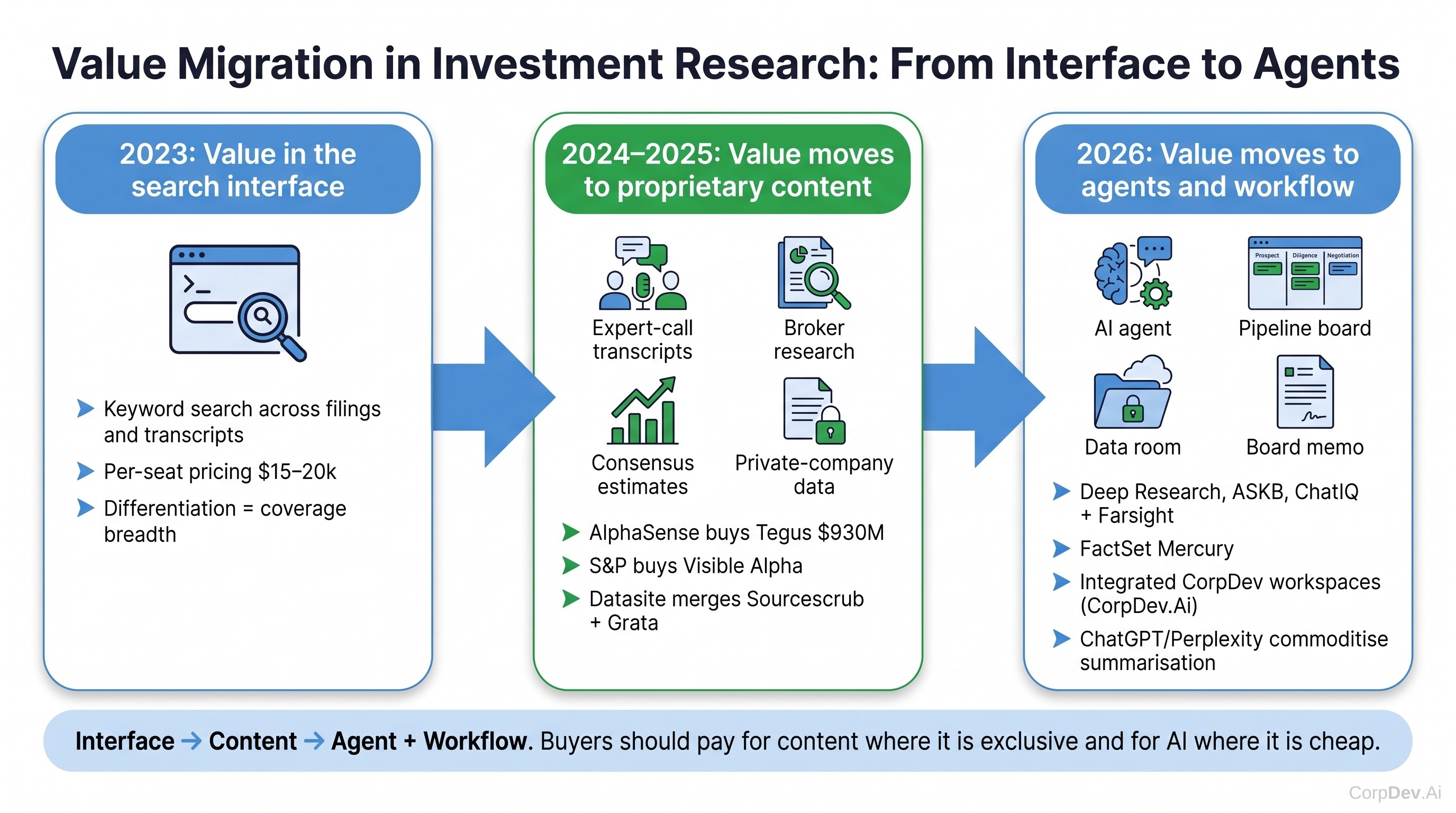
Read diagram description
Value-migration analysis with three stages.
Stage 1 "2023: Value in the search interface" — features: keyword search across filings and transcripts, per-seat pricing $15–20k, differentiation = coverage breadth.
Stage 2 "2024–2025: Value moves to proprietary content" — features: expert-call transcripts, broker research, consensus estimates, private-company data; features: AlphaSense buys Tegus $930M, S&P buys Visible Alpha, Datasite merges Sourcescrub + Grata.
Stage 3 "2026: Value moves to agents and workflow" — features: an AI agent, a pipeline board, a data room, a board memo; features: Deep Research, ASKB, ChatIQ + Farsight, FactSet Mercury, integrated CorpDev workspaces (CorpDev.Ai), ChatGPT/Perplexity commoditise summarisation. "Interface → Content → Agent + Workflow. Buyers should pay for content where it is exclusive and for AI where it is cheap."
AlphaSense: The Incumbent Benchmark
Research library Quote-only pricing $7.5B valuation
AlphaSense is the benchmark against which every other vendor in this guide is measured, so it earns the most detailed treatment. It describes itself as an enterprise market-intelligence and workflow platform combining licensed content, customers' internal documents, financial data, monitoring and generative AI [2]. In commercial terms it is the largest independent research platform ever built outside the terminal incumbents: more than $600 million in ARR as of Q1 2026 (up from $500 million in October 2025 and $400 million in early 2025), more than 7,000 enterprise customers including a majority of the Fortune 500, and a $350 million round in June 2026 led by Vitruvian Partners, Accenture Ventures and J.P. Morgan Asset Management at a $7.5 billion valuation [1][8][72].
What you are buying
Content. The library exceeds 500 million documents: SEC and global filings, earnings-call transcripts, press releases and news, more than 1,500 broker-research sources, industry reports, and — since the Tegus and Stream acquisitions — the largest commercially available archive of expert-call transcripts [1][2][95][109]. Customers can also ingest internal content (prior memos, board decks, CRM notes) so the platform searches across external and proprietary knowledge together. The M&A Database module cites coverage of 85,000 public and 8.6 million private companies [71].
AI layer. Three capabilities matter for a CorpDev buyer:
- Generative Search — a multi-agent system that reasons across qualitative documents, structured financial data and internal content, returning source-grounded answers with click-through citations. In 2026 it can analyse lists of up to 100 companies at once and produce recurring scheduled briefings [3][5].
- Deep Research — an autonomous agent that plans and executes multi-step research to produce investment-grade briefings; AlphaSense positions it as compressing weeks of analyst work into minutes [2][4].
- Generative Grid — a structured workspace that runs the same set of questions across many documents and returns comparable table output; 2026 additions include live feeds, automated document refresh, period-over-period analysis and channel-check grids [5][6][7].
Around these sit Workflow Agents (scheduled, customisable monitoring agents), SuperAnalyst (an always-on agent for strategic workflows), native Excel and PowerPoint add-ins for turning research into work product, dashboards, alerts and mobile access [1][2][9].
Financial data. Company financials, estimates, screening, comparables, M&A and funding data and valuation metrics are included, with Excel integration [2][71]. This is real but it is not the platform's centre of gravity — see limitations below.
Where it genuinely excels for a CorpDev team
- Thematic and competitive research at speed. "What are the top three risks management teams in industrial automation are flagging this quarter, and what do former employees say about the leading vendor?" is a question AlphaSense answers in minutes with citations. No alternative in this guide combines the transcript archive, expert-call library and broker research needed to do that.
- Expert-call transcripts as a substitute for primary calls. A Tegus-enabled seat gives access to tens of thousands of investor-led interviews. At $350–$1,400 an hour for a live expert call [91][94][96], ten avoided one-hour calls represent $3,500–$14,000 before subscription costs; whether that covers a seat depends on its price and the relevance of the transcripts.
- Monitoring. Saved searches, watchlists and scheduled agents make AlphaSense a strong "always-on" competitor and target-monitoring layer.
- Internal knowledge search. For large corporates with years of accumulated strategy decks and memos, indexing them alongside external content is a meaningful productivity gain that few competitors match.
- Governance. Source-grounded answers, enterprise entitlements and a mature security posture satisfy internal risk and compliance functions that will not approve a consumer LLM for deal work.
Where it falls short for a CorpDev team
It does not replace a deal-pipeline CRM or permissioned transaction room. Although it offers Excel and PowerPoint work-product tools, buyers should test live valuation models and board-template output before assuming those needs are covered. Additional tools may be required — which is why the fully loaded cost of an AlphaSense-anchored stack is routinely two to three times the AlphaSense invoice itself.
- Price and opacity. No list price is published. Third-party buyer reports place core seats at roughly $10,000–$20,000 a year, broader enterprise deployments at $25,000–$40,000+, and packages including Tegus, broker research and international content at $40,000–$50,000+ per seat; a reported median contract is around $18,000 with a range of $12,000–$51,000 [11][12][13][14][15]. For a three-person corporate team the entry ticket is realistically $50,000–$100,000 a year before add-ons.
- Not a longlist generator. The 8.6 million private-company universe is smaller than Grata's 21–23 million or Inven's 28 million, and screening is oriented to research rather than exhaustive universe construction [54][66][71]. Teams that try to source lower-middle-market, founder-owned targets in AlphaSense will miss companies that purpose-built tools find.
- Structured data depth. Users report that real-time financial coverage and some financial-data sections lag the dedicated terminals; comps and precedent-transaction work is more reliably done in Capital IQ Pro [18][22][29].
- Learning curve and noise. G2 reviewers consistently cite a steep learning curve, information overload and irrelevant results on broad queries [16][19][20]. The platform rewards trained power users and penalises occasional ones — a problem for corporate teams where the CFO or a business-unit president wants to ask a question once a month.
- Licensing friction. Seat-based content licensing restricts sharing annotated research with colleagues who lack a subscription, which cuts against the collaborative nature of deal work [20].
- AI verification burden. Reviewers and practitioners note that Deep Research and Generative Search output on complex, multi-document questions still requires checking; AlphaSense's source grounding reduces but does not remove the need [20][21].
Verdict
AlphaSense is the right anchor for a corporate team whose bottleneck is qualitative research — sector theses, competitive monitoring, expert insight, diligence support — and whose organisation already owns a structured-data terminal and a deal-workflow system. It is the wrong anchor for a team building its stack from scratch, for a team whose primary job is private-target sourcing, or for a team of fewer than three dedicated analysts who cannot amortise five-figure seats. In both of the latter cases it belongs in the plan as a second- or third-year purchase, once the volume of thematic research justifies it.
| Product layer | Reviewed scope | Assessment and buyer checkpoint |
|---|---|---|
| Content estate | 500M+ documents: filings, 1,500+ broker sources, news, Tegus and Stream expert calls, internal documents | Strong content proposition; confirm which licences and corpus are included. |
| Financial data | 85K public and 8.6M private company claims; financials, estimates, screening and M&A data | Adequate in the original qualitative assessment; compare terminal depth for comps and real-time needs. |
| AI analysis | Generative Search, Deep Research, Generative Grid, Workflow Agents, SuperAnalyst | Strong claimed scope; benchmark factual completeness, citations and review effort. |
| Work products | Excel and PowerPoint add-ins, dashboards and alerts | Partial in the original assessment; current agents and add-ins may extend drafting. Test the actual output and house-template fidelity. |
| Dedicated deal process | Pipeline/CRM and bidder-facing permissioned room | Separate workflows; confirm interfaces with the institution’s systems of record. |
| Additional output and service requirements | Live valuation workbook, board memo in house template, private-company longlist and live expert calls | Test current tier, add-ins and services. The review does not establish categorical absence of all these capabilities. |
Indicative annual seat cost: $10–20K for core access; $25–50K+ with Tegus and broker research. These ranges are content- and entitlement-dependent.
The Alternatives
Terminal-Grade Incumbents: Bloomberg, S&P Capital IQ Pro, FactSet, LSEG Workspace
Structured data Quote-only pricing
The four terminal incumbents were designed for capital-markets professionals and have been retrofitted for corporate buyers over two decades. For a CorpDev team they answer a different question from AlphaSense: not "what is being said about this market" but "what are the numbers, who owns whom, and what did comparable deals trade at." All four have shipped AI features since 2025, but in every case the AI is a front end to the terminal's proprietary data rather than a general research agent.
Indicative price: $15,000–$30,000 per seat per year (buyer reports) [29]
AI: ChatIQ (with Kensho), Document Intelligence, Chart Explainer; Farsight deck/CIM generation as a paid add-on from H2 2026 [30][31][33]
Best for: comps, precedent transactions, ownership, estimates, private-company financials, screening
Indicative price: $12,000–$24,000 per seat; median contract around $25,000 (buyer reports) [34][35]
AI: Mercury conversational research; AI Document Search rolled to 85,000+ users in 2026; Intelligent Platform initiative [36][37][38]
Best for: Excel-native valuation, estimates, portfolio and IR-adjacent work
The CorpDev view
S&P Capital IQ Pro is the terminal a corporate development team should default to, and it is the most common companion to AlphaSense in mature functions [29][30][31]. Its transaction database, private-company coverage, screening and Excel plug-in map directly onto the target-screening and valuation jobs. Its weaknesses are the mirror image of AlphaSense's: cross-source qualitative synthesis is less flexible, the interface is tied to the Capital IQ data model, and the most valuable AI-generated deliverables (decks, CIMs, valuation materials via Farsight) are being sold as a separate line item [33].
Bloomberg and LSEG Workspace are rarely justified for a pure CorpDev function. Their edge is real-time markets, financing, rates and FX — essential for a treasury or an acquirer executing a cross-border financed deal, excessive for a team whose job is sourcing, screening and diligence [26][39]. Their AI features are strong but inward-facing: ASKB and Copilot integration make the terminal's own data more accessible; they do not read your data room or draft your memo [28][41].
FactSet is a strong choice where it is already installed. Corporates with an investor-relations or treasury FactSet footprint can extend seats to CorpDev economically, and Mercury's natural-language chart and analysis generation is genuinely useful for internal deal reviews [36][37]. As a net-new purchase for a corporate team with no FactSet estate, it is harder to justify against Capital IQ Pro.
Rogo, Hebbia and most AI-copilot vendors integrate with Capital IQ, FactSet or PitchBook and assume the buyer already has those licences. A corporate team without a terminal can still use suitable copilots over its own documents and available content, but must budget separately for any licensed datasets required by its chosen workflow — which is the single most important structural fact in this guide for a team building its stack from zero.
Private-Markets & Deal-Sourcing Data: PitchBook, Crunchbase, Grata, Sourcescrub, Cyndx
Target sourcing Mixed pricing transparency
Target identification is the job AlphaSense does least well relative to its price, and it is the job where a specialised database delivers the most obvious return. The vendors below differ on one axis that matters more than any feature: which part of the private-company universe they see. PitchBook is deepest on companies that have raised capital or transacted; Grata, Sourcescrub and Inven are built to find the founder-owned, bootstrapped businesses that never appear in a financing database; Cyndx leads with AI similarity matching.
| Vendor | Indicative annual price | Coverage | AI capability | CorpDev fit |
|---|---|---|---|---|
| PitchBook | $15,000–$30,000 per user (buyer reports); enterprise $45,000–$70,000+ [43][44] | Approximately 6M companies, deepest on VC/PE-backed and transaction-active [45] | PitchBook AI / Navigator natural-language research; ML valuation estimates for 15,000+ VC-backed companies (2026) [46][47] | Best for sponsor-backed targets, fund and investor intelligence, transaction comps |
| Grata (incl. Sourcescrub) | From roughly $15,000; reported range $10,000–$100,000 [52][53] | 21M+ private companies; 23M+ with Valu8 integration, 1M transaction events, 11.5M contacts (2026) [54][55] | Agentic Search interprets intent, semantic website analysis, market mapping; MCP launched 2026 [54][56] | Best all-round private-company longlist engine; Sourcescrub's conference and association sourcing now folded in [59][60] |
| Inven | Quote-based tiers (Discovery, Sourcing+, Professional) [65] | 28M+ companies, emphasis on founder-owned lower middle market [66][67] | AI-native website analysis, similarity discovery, one-pagers, MCP for ChatGPT/Claude/Perplexity [68][69] | Strong bottom-up discovery for obscure targets; European coverage a differentiator |
| Cyndx | Approximately $30,000–$75,000 per firm or seat-equivalent (estimates) [61] | 33M+ public and private companies (vendor claim) [62] | Finder/Acquirer ML similarity matching; Valer automated valuation (DCF, comps, precedents) [63][64] | Best for "find companies like this" workflows and predictive sourcing |
| Crunchbase | Pro approximately $588 per year list; Business/Enterprise custom [48][49] | Broad; oriented to startups, VC-backed and technology [48] | AI Search Builder converts natural language to filters [50] | Budget technology-startup sourcing; too thin for lower-middle-market or industrial targets |
| AlphaSense (for comparison) | $10,000–$50,000+ per seat (buyer reports) [12][13] | 85k public, 8.6M private companies [71] | Generative Search on 100-company lists; M&A activity views [5][6] | Validation and monitoring layer, not a longlist generator |
The CorpDev view
Grata is the closest thing to a default private-company sourcing tool for corporate acquirers in 2026. The Datasite-orchestrated merger with Sourcescrub combined the two strongest founder-owned-company databases, and the 2026 Valu8 integration extended financial coverage to 26 countries [54][59][60]. Its agentic search is genuinely different from filter-based screening: a thesis expressed in prose ("regional HVAC service businesses with recurring maintenance revenue and owner age above 60") returns a ranked universe rather than a spreadsheet to clean. Pricing is opaque and can escalate quickly with seats and modules [52][53].
PitchBook remains indispensable where targets are sponsor-backed. No competitor matches its fund, investor and financing-history data, and for a corporate acquirer bidding against or buying from private equity, that intelligence is decisive [45][46]. Its private-company universe is a third of Grata's, however, and its pricing is at the AlphaSense level [43][44].
Inven and Cyndx are credible challengers with narrower proof. Inven's 28 million-company universe and MCP interface (letting a team query it from ChatGPT or Claude) make it attractive for bottom-up discovery, particularly in Europe [66][68]; Cyndx's similarity matching and integrated Valer valuation module suit teams whose sourcing starts from an exemplar target [63][64]. Both should be trialled against Grata on the buyer's own thesis before purchase.
Crunchbase is not an enterprise alternative. At $588 a year it is a useful supplement for technology-startup scanning and nothing more [48].
A corporate team that runs one serious target screen a quarter will find more companies, faster, in Grata or Inven than in AlphaSense — at a lower price. The right architecture is a sourcing database for universe construction feeding a research layer for validation, not one tool trying to do both.
| Platform | Private companies (M) |
|---|---|
| Cyndx (public + private) | 33 |
| Inven | 28 |
| Grata (with Valu8) | 23 |
| AlphaSense M&A Database | 8.6 |
| PitchBook | 6 |
Expert Networks & Transcript Libraries: Tegus (now AlphaSense), GLG, Third Bridge, Guidepoint, Dialectica, Stream
Primary research Per-call or credit pricing
Expert insight is the content layer where AlphaSense has most changed the competitive map. By acquiring Stream by Mosaic (2021) and Tegus (2024) it now owns the two largest libraries of investor-led expert interviews and has folded them into a searchable platform [95][109]. The traditional expert networks — GLG, Guidepoint, Third Bridge, Dialectica — sell something different: access to a live human, recruited and compliance-screened for a specific question, at $350–$1,400 an hour [91][93][94][96].
| Provider | Model | Indicative cost | Distinctive strength | Status versus AlphaSense |
|---|---|---|---|---|
| Tegus (in AlphaSense) | Transcript library plus expert calls, bundled into AlphaSense seats | Included in premium AlphaSense packages; contributes to the $40,000–$50,000+ seat tier [12][13] | Largest investor-led transcript archive; searchable alongside filings and research | Owned by AlphaSense since 2024 [109] |
| Stream by Mosaic | Transcript library | Bundled into AlphaSense | Investor-led interview library | Owned by AlphaSense since 2021 [95] |
| Third Bridge (Forum) | Live calls plus Forum transcript library, subscription or credits | Roughly $350–$1,000+ per hour; enterprise subscriptions custom [91][92] | Strongest independent transcript library remaining; analyst-led research and surveys | Independent; closest remaining rival to Tegus on transcripts |
| GLG | Live calls, surveys, projects; membership or per-call | Roughly $400–$1,200+ per hour [91][93][94] | Largest network; global compliance infrastructure | Independent; a service, not a platform |
| Guidepoint | Live calls, surveys; pay-as-you-go or credits | Roughly $500–$1,200+ per hour [91][93] | Healthcare and life-sciences specialist depth | Independent |
| Dialectica | Bespoke expert sourcing and surveys | Roughly $700–$1,400 per hour (negotiated) [94] | Multilingual, project-led delivery; strong in Europe | Independent |
The CorpDev view
For a corporate development team, the economics of expert insight have inverted. A decade ago a commercial diligence exercise meant commissioning fifteen to thirty live calls at $1,000 each — $15,000–$30,000 per deal, plus weeks of scheduling. Today a Tegus-enabled AlphaSense seat or a Third Bridge Forum subscription gives read access to thousands of prior interviews on most mid-cap and large-cap sectors, and a team can reserve live calls for the questions no transcript answers. For teams running several commercial diligence exercises a year, transcript access may pay for itself if relevant interviews displace enough paid calls — and that single fact is the strongest argument for the premium AlphaSense tier over the core one.
Two caveats apply. First, transcript libraries skew toward companies and sectors that investors care about; a corporate acquirer looking at a niche industrial or regional services target will find little, and will still need GLG, Guidepoint or Dialectica to recruit a live expert. Second, transcript rights vary by contract: what is included in an AlphaSense seat depends on the entitlement negotiated, and buyers should confirm in writing which libraries and how many calls are covered [8].
AI synthesis alone does not replace a tailored call with a former plant manager. AlphaSense's Tegus offering includes expert-call services, as the table above notes; confirm those services and entitlements separately. Budget for an expert network relationship separately, and treat transcript libraries as a way to make those calls fewer and sharper rather than to eliminate them.
AI Research Copilots: Hebbia, Rogo, Daloopa, Fintool, Quartr, Perplexity Finance
AI-native Assumes existing data licences
The AI-copilot vendors are the group most often positioned as "AlphaSense killers," and the framing is mostly wrong. Each of them is excellent at one dimension of the research job; none of them owns a content estate comparable to AlphaSense's; and the two most heavily funded — Rogo and Hebbia — are built for banks and funds that already pay for Bloomberg, Capital IQ, PitchBook and a CRM. Their pitch is to add an intelligence layer on top of that stack. For a corporate team that has the stack, that is compelling. For one that does not, the value depends on the vendor's included content, the team's own documents and any additional data licences.
Funding: $75M Series C at $750M (Jan 2026); later reports of a Series D at approximately $2B, less consistently documented [78][79]
Pricing: undisclosed; one estimate approximately $3,300 per seat [80]
What it does: finance-native analyst for comps, precedents, models, Excel and deck drafting
CorpDev fit: strongest for teams producing high volumes of banker-style output; built for IB/PE workflows
Funding: approximately $161M total; $130M Series B at $700–800M (2024) [74][75]
Pricing: undisclosed; estimates $3,000–$10,000 per seat [76][77]
What it does: multi-agent reasoning over your own documents — data rooms, CIMs, filings — with linked evidence; integrates Capital IQ and PitchBook
CorpDev fit: best for configurable diligence workflows over proprietary document sets
Scale: 700+ financial institutions (vendor) [81]
Pricing: Pro and enterprise, seat-scaled, quote-based [81][82]
What it does: earnings calls, investor presentations, slide extraction, transcripts, alerts, API
CorpDev fit: cheap, focused public-company IR intelligence; strong for competitor earnings monitoring
Valuation: approximately $20–23B (2025–26 reports) [87][88]
Pricing: Pro $20/month; Max $200/month; Enterprise from approximately $34–40 per seat/month [90]
What it does: cited web research, financial news, deep research, file analysis
CorpDev fit: the fastest first pass on any question; enterprise controls vary by plan; no equivalent premium research-content estate or deal system of record
Funding: not reliably disclosed
Pricing: individual plans well below enterprise platforms; institutional custom
What it does: SEC filings, earnings analysis, financial extraction, screening
CorpDev fit: individual and small-team public-company research; thin for enterprise governance
The CorpDev view
Rogo and Hebbia are the serious enterprise alternatives in this group, and both are aimed at a different buyer. Rogo's product is built around the production rhythm of an investment bank — comps, precedent transactions, model updates, pitchbook pages — and its enterprise security posture is designed to satisfy a bank's risk function [78][79]. Hebbia Matrix is the stronger tool for a diligence team that wants to run the same fifty questions across every document in a data room and get a table of linked answers back [74]. A corporate team that already runs Capital IQ and a CRM and produces a high volume of board material could justify either at $3,000–$10,000 a seat [76][77][80]. A team producing four board memos a year cannot.
Daloopa and Quartr are complements, not alternatives. Daloopa's source-linked fundamentals are a data feed for a model or an agent; Quartr's earnings-call and slide library is the cheapest way to monitor listed competitors' investor communications [81][83]. Neither replaces AlphaSense's breadth; both can reduce how much of it a team needs.
Perplexity is the benchmark every vendor is now priced against. At $20 a month it does the first 30% of most research tasks well enough that a five-figure seat has to justify itself on the remaining 70% — the licensed content, the governance and the workflow. It is not a system of record, it does not hold licensed broker research or expert calls, and no compliance function will approve it as the sole source for an acquisition thesis [90]. But every CorpDev team should have it, and every AlphaSense negotiation should mention it.
The structural characteristic Rogo and Hebbia share is that they are layers, not estates. Their value scales with the licences underneath them. A buyer evaluating them should add the cost of the terminal and CRM they assume to the copilot's own seat price before comparing against an integrated platform.
| Vendor | Content model | Workflow emphasis |
|---|---|---|
| AlphaSense | Large proprietary/licensed content estate | Deep Research and Generative Grid; output agents are evolving, so finished-deliverable quality requires task-level tests. |
| Rogo | Connected and licensed sources rather than an equivalent owned content estate | Finance-oriented model and deck production. |
| Hebbia Matrix | Primarily the buyer’s documents and connected sources | Structured extraction, comparison and document-led production. |
| Daloopa | Structured financial data feed | Source-linked model inputs, rather than a complete deal workbench. |
| Quartr | Earnings content | Content search and research. |
| Perplexity Finance | Broad web research and connected information | Low-cost research; content rights and specialist workflow differ from terminals. |
| Fintool | Focused research interface rather than a large proprietary estate | Financial research and synthesis. |
| CorpDev.Ai | Claimed 70M-company universe via Apollo/other sources; not an equivalent owned institutional dataset | Pipeline, AI Room and deliverable generation alongside research. |
Content-rich tools and production tools can complement each other. Compare licensed coverage and output quality independently; a company-count claim does not establish proprietary ownership or financial depth.
Dealflow Workflow & CRM Platforms: Midaxo, DealCloud, Affinity, Datasite, Devensoft
Workflow and system of record Mostly quote-only
These platforms are not AlphaSense competitors in the conventional sense — none of them offers a research library — but they are the systems a CorpDev team must buy alongside AlphaSense to run an actual process, and they are the systems the integrated CorpDev workspaces (see the CorpDev.Ai section below) most directly challenge. A buyer comparing total cost of ownership cannot leave them out.
| Platform | Indicative annual price | AI capability | Sweet spot | Gap |
|---|---|---|---|---|
| Midaxo | From approximately $25,000, scaling with team, deal volume and AI; entry listings around $10,000 [122][123] | Madi agent reads project documents, flags risks and open items, suggests next steps, within an audit-logged workflow (major update Q2 2026) [122][124] | Serial corporate acquirers wanting full lifecycle — sourcing to PMI and synergy tracking; 500+ teams [103][104] | No external research or sourcing database; implementation effort; AI quality depends on the customer's own documents |
| Intapp DealCloud | Quote-only; independent estimates $85,000–$1.43 million a year depending on modules and seats [125][126] | Intapp Assist: relationship insights, summaries, drafting, tagging, reporting [127][128][129] | Large PE, banking and institutional CorpDev functions needing a configurable system of record | Expensive, implementation-heavy, excessive for teams of fewer than ten |
| Affinity | Published: Essential $2,000, Scale $2,300, Advanced $2,700 per user per year; Enterprise custom [130][131] | Automatic email/calendar capture, relationship intelligence, AI Chat, Notetaker, Ascend agents; advanced AI and API tier-gated [132][133] | Relationship-led sourcing for VC, PE and lean CorpDev | Origination CRM, not M&A execution — no diligence requests, approvals, PMI |
| Datasite (Diligence, Sourcing) | Per-transaction quotes [134][135][136] | Native AI indexing, classification, Q&A and summarisation inside the data room [138][139] | Secure sell-side and buy-side deal rooms; controlled bidder access | Transaction tool, not a CorpDev operating system; per-deal cost accumulates |
| Devensoft | Pipeline pre-close tier around $150 per user per month (listing); enterprise quote [142] | Workflow automation, structured diligence, integration and synergy tracking; limited generative AI disclosure [143][144][145] | Mid-market corporates wanting pipeline-to-integration in one system | Smaller ecosystem; less relationship intelligence; limited public AI roadmap |
| 4Degrees | Per user per month, custom [146][147] | Relationship mapping and AI included in all tiers, no usage credits [148] | Warm-introduction-led sourcing for small teams | Thin on diligence, controls and enterprise reporting |
The CorpDev view
Midaxo is the reference M&A operating system for corporate acquirers, and the natural pairing for AlphaSense in a large serial-acquirer function: research and monitoring in AlphaSense, pipeline, diligence, approvals and integration in Midaxo [103][104][122]. Its Madi agent is a genuine step toward AI-assisted execution, but it reasons over the customer's own project documents rather than external intelligence [124]. The combination is powerful and expensive — a five-seat AlphaSense estate plus a Midaxo deployment plus a Capital IQ Pro seat or two is a $150,000–$300,000 annual line before expert calls and data rooms.
DealCloud is over-specified for most corporate teams. It is the right answer for a bank or a large fund with dozens of deal professionals and a relationship-data governance function; for a CorpDev team of four it is a six-figure implementation that will be under-used [125][126].
Affinity is the pragmatic CRM for lean teams — transparent pricing, passive activity capture, quick deployment — and it is the closest incumbent analogue to the "zero-entry CRM" concept the integrated platforms now offer [130][132]. It stops at origination, however: diligence, approvals and integration live elsewhere.
Datasite is the execution-phase constant. Whatever else a team buys, a live acquisition will almost certainly involve a Datasite or equivalent data room on the sell side, and buy-side teams increasingly use Datasite AI to interrogate it [138][139]. It is a per-deal cost, not a platform decision.
AlphaSense answers research questions. Turning those answers into a pipeline, a diligence tracker, a valuation and a board memo requires two to four additional systems, each with its own seat price, implementation and training burden. When a buyer compares AlphaSense's invoice to an integrated platform's, the comparison is incomplete until this layer is added.
CorpDev.Ai: The Agentic End-to-End Platform for Corporate Development
Integrated CorpDev environment Published pricing Early-stage vendor
CorpDev.Ai publishes this comparison. Its proposed integration of research, sourcing and workflow should be evaluated against complete tasks, with the independent-evidence limitations below carrying explicit weight in procurement.
What it is
CorpDev.Ai describes itself as an "Integrated CorpDev Environment": an agentic AI platform for in-house corporate development, strategy and M&A teams that covers market mapping and sector research, target sourcing and screening, pipeline and CRM, data-room diligence, valuation and synergy modelling, investment memos and board presentations, and post-merger integration planning in one workspace [98]. It operates as both a software vendor and a managed-services provider whose own M&A specialists work on the same platform [98][100]. Its founders are Kal Kilpi, a two-time M&A-software founder who co-founded Midaxo and has built M&A systems for McKinsey, Verizon, HPE, Mercedes-Benz and Philips, and Atul Tiwary, formerly VP of M&A at Barracuda Networks under Thoma Bravo, VP of Investment Banking at RBC and Senior Director of Corporate Development at Fortinet [102].
Product scope
The platform is organised around five components, each mapping to one of the jobs defined earlier in this guide [98][99][100][101]:
- AI Analyst Agent. A natural-language analyst specialised for M&A that researches companies, markets and sectors; finds and screens targets; drafts company profiles, market maps, investment memos, valuation and synergy analyses and board decks; and synthesises multiple sources with citations. It runs on interchangeable frontier models from Anthropic, OpenAI, Google and Perplexity. The vendor cites indicative production times of 5–10 minutes for an investment memo, 5–15 minutes for a market analysis and 10–20 minutes for a board presentation — vendor estimates, not independently benchmarked [99].
- Target sourcing and company intelligence. Semantic company search, AI target discovery, fit scoring and ranked shortlists over a stated database of more than 70 million companies and 265 million contacts (Apollo firmographics), plus filings, financials, estimates, transcripts, news and web research; monitoring of news, funding, management changes and M&A activity [98][100].
- "Zero-Entry" pipeline and CRM. A Kanban deal pipeline and company and people lists that populate from connected Microsoft 365 or Google Workspace email, calendar and meeting data rather than manual entry, with activity timelines, engagement recommendations, AI fit scoring and next-action prompts [98][100][101].
- AI Room. An AI-native data room that ingests PDF, XLSX, DOCX and PPTX files, applies vision-based extraction, converts them to structured queryable text and answers diligence questions with page-level citations and an audit trail [98].
- Visual Workbook and deliverables. An AI-assisted document, slide and spreadsheet editor producing twenty board-ready deliverable types across four stages — Strategize (market map, sector deep dive, strategic options), Source & Screen (target discovery, shortlist, profiles, fit scorecards), Evaluate (business case, valuation comps, scenario and synergy model, live valuation workbook, digital twin, Day-One blueprint) and Execute & Approve (investment memo, CIM, pipeline, board deck) — exportable to Word, PowerPoint, PDF and Excel [98][100].
Pricing
CorpDev.Ai is one of four vendors in this guide that publishes list prices [100]:
| Plan | Intended user | Annual billing | Monthly (card) | Included |
|---|---|---|---|---|
| AI Pro | One M&A professional | $12,000 per year ($1,000/month) | $1,200/month | AI Analyst and Workbook, market mapping, company search, pipeline and CRM, monitoring, presentations, templates, M365/Google integration, 12,000 search credits |
| AI Pro Team | Corporate development team | $36,000 per year ($3,000/month) | $3,600/month | Everything in Pro for three members, collaboration, admin controls, priority support, dedicated CSM, 36,000 credits |
| Enterprise | Advanced deployments | Custom | Custom | Unlimited users, SSO, solutions architect, financial modelling, AI advisory, managed services |
A free trial without a credit card is offered to in-house corporate development at companies above $1 billion in revenue or by invitation [98][100].
Where it beats AlphaSense for a CorpDev buyer
- It covers the whole job, not one part of it. Sourcing, pipeline, diligence, modelling and board deliverables sit in one environment. The four or five separate purchases an AlphaSense-anchored stack requires — terminal, sourcing database, CRM, data-room AI, document tooling — are collapsed into one.
- Price. A three-person team pays $36,000 a year for the full platform. The equivalent AlphaSense line alone is $50,000–$150,000, before any workflow layer [12][13][100].
- Broader stated company universe. The vendor's 70 million-company claim is larger than AlphaSense's 8.6 million-private-company count, but the populations, deduplication and data completeness are not directly comparable. Test relevant target recall rather than treating database size as proof of sourcing quality [71][98].
- Output lands in the deliverable, not in a search result. The AI analyst writes into the memo, the deck and the workbook directly; AlphaSense's Excel and PowerPoint work-product features also support document production; the distinction should be tested on a complete memo, deck and workbook in the buyer's template.
- Zero-entry CRM. Passive capture from email and calendar is a capability AlphaSense does not have at all and Affinity charges $2,000–$2,700 a seat for [130].
- Transparent pricing. Published list prices remove the negotiation asymmetry that characterises every other enterprise vendor in this guide.
Where AlphaSense beats it — stated plainly
No funding round has been publicly disclosed. No customer logos or named case studies are published; the pricing page refers to "hundreds of CorpDev professionals" without naming them. There is no G2, Capterra or Reddit review corpus comparable even to the thin coverage of Hebbia or Rogo. Enterprise buyers should weigh vendor longevity, security certification status and reference availability as diligence items, exactly as they would for any early-stage software supplier [98][100][102].
- No proprietary content estate. CorpDev.Ai does not own broker research, expert-call transcripts or an equivalent to Tegus. Its research draws on public filings, web sources, licensed firmographics and third-party frontier models. For thematic research that depends on sell-side analysis or investor-led expert interviews, AlphaSense is categorically stronger.
- Depth of structured financial data. It does not replace Capital IQ Pro or FactSet for precedent transactions, consensus estimates or ownership data; a team doing heavy public-company valuation will still want a terminal.
- Maturity of governance. AlphaSense has a decade of enterprise security posture and entitlement management behind it; CorpDev.Ai's SSO and enterprise controls are Enterprise-tier features whose certifications should be confirmed in procurement.
- Not a legal-grade or bidder-grade data room. AI Room is a diligence-analysis environment, not a Datasite-style permissioned bidder room with Q&A workflows; sell-side processes will still run on a conventional VDR.
- Depends on third-party models. The AI analyst's quality tracks the frontier models it orchestrates. This is also true of AlphaSense's generative layer, but AlphaSense's proprietary content gives its outputs a differentiated evidentiary base that a model-orchestration platform does not have on its own.
Verdict
CorpDev.Ai is the highest-leverage option in this guide for a lean in-house team — one to five professionals — that is building its tooling from zero, runs a real sourcing-to-board-approval process, and cannot justify a $150,000-plus AlphaSense-plus-workflow stack. It is not a replacement for AlphaSense's content estate, and a mature function that already owns a terminal and a CRM and whose bottleneck is thematic research should still buy AlphaSense. The two are complementary more often than they are substitutes: AlphaSense as the premium intelligence source, CorpDev.Ai as the environment that turns intelligence into pipeline, diligence and board material. The buyer's real diligence question is vendor maturity, and it should be asked directly.
Head-to-Head Comparison
The matrices below consolidate the preceding sections. Ratings: ● core, purpose-built and mature; ◐ partial, via a general mechanism or a recent module; ○ absent. These are analyst assessments of documented scope, not performance benchmarks; a core rating does not establish independent validation, especially for CorpDev.Ai.
Capability matrix by CorpDev job
| Job to be done | AlphaSense | S&P Capital IQ Pro | Grata | PitchBook | Rogo | Hebbia | Midaxo | Affinity | CorpDev.Ai | Perplexity |
|---|---|---|---|---|---|---|---|---|---|---|
| Market and sector intelligence | ● | ◐ | ○ | ◐ | ◐ | ◐ | ○ | ○ | ● | ◐ |
| Expert-call transcripts | ● | ○ | ○ | ○ | ○ | ○ | ○ | ○ | ○ | ○ |
| Broker research | ● | ◐ | ○ | ○ | ○ | ○ | ○ | ○ | ○ | ○ |
| Private-target longlist construction | ◐ | ◐ | ● | ◐ | ○ | ○ | ○ | ○ | ● | ○ |
| Comps and precedent transactions | ◐ | ● | ○ | ● | ● | ◐ | ○ | ○ | ◐ | ○ |
| Company profiles and monitoring | ● | ● | ◐ | ● | ◐ | ○ | ○ | ◐ | ● | ◐ |
| Pipeline and zero-entry CRM | ○ | ○ | ◐ | ○ | ○ | ○ | ● | ● | ● | ○ |
| Data-room diligence Q&A | ◐ | ○ | ○ | ○ | ◐ | ● | ◐ | ○ | ● | ○ |
| Live valuation workbook | ◐ | ◐ | ○ | ○ | ● | ○ | ○ | ○ | ● | ○ |
| Board memo and deck generation | ◐ | ◐ | ○ | ○ | ● | ◐ | ○ | ○ | ● | ◐ |
| Post-merger integration planning | ○ | ○ | ○ | ○ | ○ | ○ | ● | ○ | End-to-end management and integration work; validate programme controls | ○ |
| Internal document search | ● | ○ | ○ | ○ | ◐ | ● | ◐ | ○ | ● | ◐ |
| Enterprise governance and entitlements | ● | ● | ◐ | ● | ● | ● | ● | ◐ | ◐ | ◐ |
| Published list pricing | ○ | ○ | ○ | ○ | ○ | ○ | ○ | ● | ● | ● |
Programme-scope assessment. The CorpDev.Ai integration entry describes its end-to-end management scope rather than assigning an unsupported comparative performance score. Evaluate the required controls and the quality of completed work on the same acquisition programme as other finalists. Deal frequency and public review volume do not establish a functional ranking. See the lifecycle framework and integration capabilities; these are vendor materials, not independent benchmarks.
Reading the matrix. AlphaSense's column is dense at the top — intelligence, transcripts, research, monitoring — and empty at the bottom, where the work of running a deal happens. Capital IQ Pro and PitchBook own structured data. Midaxo and Affinity own workflow and relationships. Rogo and Hebbia emphasise work-product generation and document reasoning; included and separately licensed content vary by offering. CorpDev.Ai is the only column that is dense across research, sourcing, pipeline, diligence and deliverables, and it is empty precisely where AlphaSense is strongest: expert transcripts and broker research. Its governance rating is partial because enterprise certifications are not publicly documented.
Indicative annual price by vendor
| Vendor | Annual cost per seat (US$k) |
|---|---|
| Bloomberg Terminal | 28–32 |
| AlphaSense (enterprise with Tegus) | 25–50 |
| PitchBook | 15–30 |
| S&P Capital IQ Pro | 15–30 |
| LSEG Workspace | 22 |
| AlphaSense (core) | 10–20 |
| FactSet | 12–24 |
| Grata | 10–25 |
| CorpDev.Ai (AI Pro Team, per member) | 12 |
| CorpDev.Ai (AI Pro) | 12 |
| Hebbia | 3–10 |
| Rogo | 3.3 |
| Affinity | 2–2.7 |
| Perplexity Enterprise | 0.4–0.5 |
Sources for each figure are given in the Key Facts & Sources appendix. Note that Rogo's and Hebbia's figures are seat-layer prices that assume terminal and CRM licences already exist; CorpDev.Ai's AI Pro Team price is $36,000 for three members, shown here as $12,000 per member.
Fit by buyer archetype
| Buyer archetype | Primary bottleneck | Best anchor | Add | Skip |
|---|---|---|---|---|
| Large serial acquirer (10+ deals a year, existing terminal and CRM) | Thematic research, expert insight, monitoring | AlphaSense (Tegus tier) | Capital IQ Pro, Midaxo, Grata, Datasite per deal | Bloomberg unless treasury shares it |
| Mid-size corporate strategy and CorpDev (3–8 people, 2–5 deals a year) | Turning research into pipeline and board material | CorpDev.Ai or AlphaSense core, depending on research volume | Grata or Inven; Capital IQ Pro if valuation-heavy | DealCloud, Bloomberg |
| Lean or new CorpDev function (1–3 people, building from zero) | Everything at once, on a limited budget | CorpDev.Ai | Perplexity; expert-network relationship; Grata when sourcing volume justifies | AlphaSense until year two or three |
| Strategy team without M&A mandate | Market sizing, competitive intelligence | AlphaSense core or Quartr plus Perplexity | Third Bridge Forum | Sourcing databases, CRMs |
| PE-adjacent or IB-style corporate team (high deck and model volume) | Production throughput | Rogo or Hebbia on top of Capital IQ or FactSet | AlphaSense for content | Integrated platforms |
Total Cost of Ownership and Procurement Realities
Seat price is the least informative number in a research-platform decision. What a CorpDev team actually pays is the sum of every layer required to run its process, multiplied by the seats each layer needs, plus the implementation and training cost of stitching them together. The three illustrative stacks below are built for a five-person corporate development team and use the midpoint of the buyer-reported ranges cited in this guide; they are planning estimates, not quotes.
Three illustrative five-seat stacks
| Component | Stack A: AlphaSense-anchored enterprise | Stack B: Terminal plus copilot | Stack C: Integrated CorpDev workspace |
|---|---|---|---|
| Research library | AlphaSense Tegus tier, 5 seats: 175 | AlphaSense core, 2 seats: 30 | Public-web and connected-content research included; no equivalent Tegus or broker library |
| Structured data terminal | S&P Capital IQ Pro, 2 seats: 45 | S&P Capital IQ Pro, 3 seats: 68 | None (add 22 for one Capital IQ Pro seat if valuation-heavy) |
| Private-company sourcing | Grata, team licence: 25 | PitchBook, 2 seats: 45 | Included (70M companies); Grata optional: 25 |
| AI copilot / work product | AlphaSense add-ins included | Rogo, 5 seats: 17 | Included |
| Pipeline and CRM | Midaxo: 25 | Affinity, 5 seats: 12 | Included (zero-entry CRM) |
| Data-room diligence AI | Datasite AI per deal: 20 | Hebbia, 3 seats: 20 | Included (AI Room) |
| Platform subscription | — | — | CorpDev.Ai AI Pro Team plus 2 additional Pro seats: 60 |
| **Indicative annual total** | **290** | **192** | **60–107** |
Sources and assumptions. AlphaSense enterprise midpoint $35,000 and core midpoint $15,000 per seat [12][13]; Capital IQ Pro $22,500 [29]; Grata $25,000 team estimate [52][53]; PitchBook $22,500 [43]; Rogo $3,300 [80]; Hebbia $6,500 [76][77]; Affinity Scale $2,300 [130]; Midaxo entry $25,000 [122]; Datasite per-deal estimate $20,000 [135]; CorpDev.Ai $36,000 Team plus $12,000 per additional Pro seat [100]. Expert-network live calls, Bloomberg or LSEG seats and implementation services are excluded from all three.
~$290k
Stack A: AlphaSense-anchored
~$190k
Stack B: Terminal + copilot
$60–107k
Stack C: Integrated workspace
The spread is roughly three to five times between the cheapest and most expensive stack, and the difference is not primarily AlphaSense's seat price — it is the number of systems an AlphaSense-anchored approach requires around it. That said, the stacks are not equivalent: Stack A buys the Tegus transcript library, 1,500 broker sources and a decade of enterprise governance that Stack C does not include. The right comparison is between what each stack delivers against the team's weighted jobs, not between the totals alone.
Procurement realities that change the number
- Seat minimums and user types. AlphaSense, Capital IQ Pro and PitchBook differentiate between full and read-only or "light" users; a buyer who negotiates two full seats and three light seats can reduce Stack A materially. Ask for the user-type schedule in writing [15][29][43].
- Content entitlements are the real negotiation. In AlphaSense, the delta between a $15,000 and a $40,000 seat is broker research, Tegus and international content — not software. A team should specify which content it will actually use before accepting a bundle [12][13].
- Multi-year terms. Bloomberg's two-plus-seat price assumes a multiyear arrangement [26]; AlphaSense and S&P routinely offer year-two and year-three discounts for multiyear commitments. A buyer should trade term length for price only after a paid pilot has validated utilisation.
- AI as add-on versus included. S&P is selling Farsight deck generation as a separate line [33]; Affinity gates advanced AI and API access behind higher tiers [132][133]; 4Degrees and CorpDev.Ai include AI in every plan [100][148]. Ask each vendor to list which AI features carry incremental cost.
- Utilisation audits. A useful renewal stress test is to model a scenario in which 30–50% of seats are used fewer than five times a month; this is an illustrative assumption, not a sourced prevalence estimate. Every contract should include seat-count flexibility at renewal, and every buyer should run a usage report before renewing.
- Credits and usage caps. CorpDev.Ai's plans carry search-credit allowances (12,000 or 36,000 a year) [100]; Perplexity's Max tier exists because Pro is rate-limited [90]. Understand what a "credit" buys and what happens at the cap before comparing to an unlimited-use seat.
Ask each shortlisted vendor whether it offers a paid or free pilot and on what terms. The only pilot worth running uses a live thesis the team is actually working: a real sector, a real target universe, a real diligence question. A vendor demo on a curated example proves nothing about how the tool performs on a regional industrial services target with no analyst coverage.
Decision Framework: Which Tool for Which CorpDev Team
The buying decision reduces to four questions asked in order. Each one eliminates options before the next is asked.
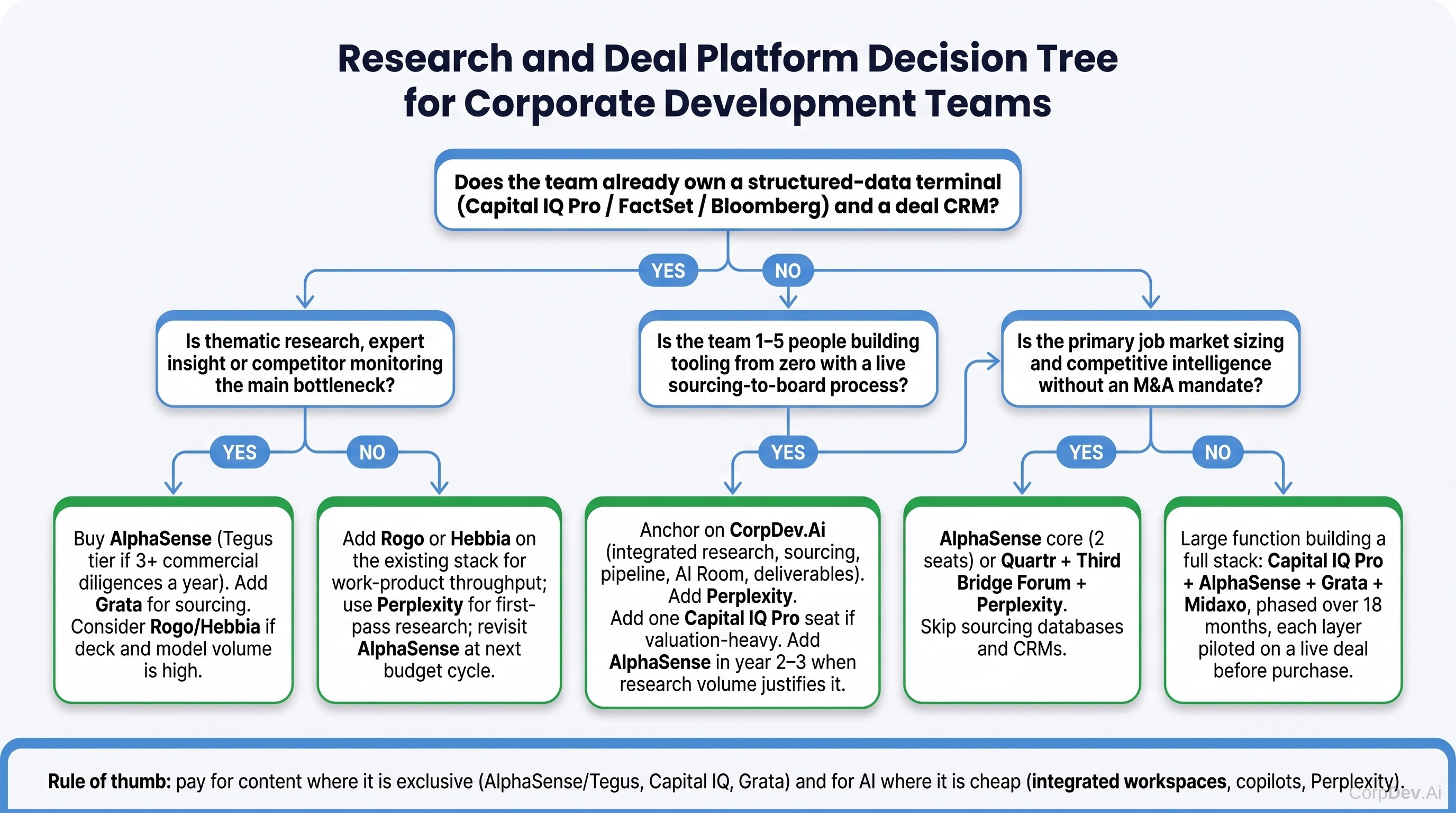
Read diagram description
Decision-tree flowchart for a corporate development team choosing a research and deal platform.
Start: "Does the team already own a structured-data terminal (Capital IQ Pro / FactSet / Bloomberg) and a deal CRM?" - YES → Question 2: "Is thematic research, expert insight or competitor monitoring the main bottleneck?" - YES → "Buy AlphaSense (Tegus tier if 3+ commercial diligences a year). Add Grata for sourcing. Consider Rogo/Hebbia if deck and model volume is high." - NO → "Add Rogo or Hebbia on the existing stack for work-product throughput; use Perplexity for first-pass research; revisit AlphaSense at next budget cycle." - NO → Question 3: "Is the team 1–5 people building tooling from zero with a live sourcing-to-board process?" - YES → "Anchor on CorpDev.Ai (integrated research, sourcing, pipeline, AI Room, deliverables). Add Perplexity. Add one Capital IQ Pro seat if valuation-heavy. Add AlphaSense in year 2–3 when research volume justifies it." - NO → Question 4: "Is the primary job market sizing and competitive intelligence without an M&A mandate?" - YES → "AlphaSense core (2 seats) or Quartr + Third Bridge Forum + Perplexity. Skip sourcing databases and CRMs." - NO → "Large function building a full stack: Capital IQ Pro + AlphaSense + Grata + Midaxo, phased over 18 months, each layer piloted on a live deal before purchase."
"Rule of thumb: pay for content where it is exclusive (AlphaSense/Tegus, Capital IQ, Grata) and for AI where it is cheap (integrated workspaces, copilots, Perplexity)."
Question 1: What do you already own?
A team with a terminal and a CRM is choosing a research layer; a team with neither is choosing an operating model. The former should evaluate AlphaSense, Rogo and Hebbia against each other. The latter should evaluate whether to assemble a stack (terminal plus sourcing plus CRM plus AlphaSense) or adopt an integrated workspace and add specialised content later. In 2026 the integrated path is viable for the first time; three years ago it was not.
Question 2: Where is the bottleneck — research, sourcing, or production?
- Research (sector theses, expert insight, competitor monitoring): AlphaSense is the answer, and the Tegus tier if the team runs three or more commercial diligences a year. Nothing else combines the content.
- Sourcing (building exhaustive target universes): Grata, Inven or PitchBook depending on whether targets are founder-owned or sponsor-backed. AlphaSense is a poor primary tool for this job at any price.
- Production (turning research into memos, decks, models and a tracked pipeline): Rogo or Hebbia if a terminal exists underneath; CorpDev.Ai if it does not. AlphaSense's add-ins and workflow tools should be tested against the same complete deliverable, rather than assumed to be limited to search.
Question 3: How many people will use it, how often?
Five-figure seats need power users. A tool used daily by two analysts is cheaper per unit of value than one used monthly by six executives. AlphaSense's learning curve penalises occasional users [16][19]; integrated workspaces and Perplexity-class tools are designed for them. Buy expensive seats for the people who will live in the tool and give everyone else a cheaper, simpler interface.
Question 4: What will the compliance and IT functions accept?
Enterprise governance eliminates options quickly. A consumer LLM will not be approved as the sole source for a board recommendation. AlphaSense, Capital IQ Pro, PitchBook, Rogo, Hebbia and Midaxo have mature enterprise postures [1][78][74][122]. CorpDev.Ai's SSO and enterprise controls are Enterprise-tier features whose certifications a buyer should verify before a large deployment [100]. Ask every vendor for its security documentation before the commercial negotiation, not after.
Recommended stacks by archetype
Anchor: CorpDev.Ai AI Pro or Team
Add: Perplexity Pro; an expert-network relationship for live calls
Year 2–3: Grata for sourcing scale; AlphaSense core when thematic research volume justifies
Indicative year-one cost: $15,000–$40,000
Anchor: AlphaSense core (2–3 seats) or CorpDev.Ai Team, depending on research versus production bottleneck
Add: Grata or Inven; one to two Capital IQ Pro seats; Affinity or integrated pipeline
Indicative year-one cost: $60,000–$150,000
Anchor: AlphaSense Tegus tier plus Capital IQ Pro
Add: Midaxo for lifecycle; Grata and PitchBook for sourcing; Rogo or Hebbia for throughput; Datasite per deal
Indicative year-one cost: $250,000–$500,000+
Buy one, buy both, or buy neither
Buy AlphaSense alone if research is the job and the rest of the stack exists. Evaluate CorpDev.Ai as the primary platform when the job is managing M&A end to end and performing the associated analysis, including in large acquisition programmes. Existing specialist content subscriptions may remain useful. Buy both when a mid-size or large function wants AlphaSense's content estate feeding an environment that turns it into pipeline, diligence and board material — this is the configuration most likely to become standard as integrated workspaces mature. Buy neither — yet — if the team runs fewer than two deals a year and has no monitoring mandate: Perplexity, Quartr and an expert network will cover the need until the mandate grows.
Risks, Caveats and What to Ask in a Demo
Every platform in this guide is now sold on its AI. The risks that matter to a CorpDev buyer are correspondingly less about features and more about trust, rights and lock-in.
The risks
Deep Research, Generative Grid, Madi, Matrix and every integrated AI analyst produce output that is source-grounded but not source-guaranteed. Practitioners report that complex multi-document questions still require verification on AlphaSense [20][21], and the same is true of every competitor. A board memo whose numbers were not checked against the cited source is a governance failure regardless of which vendor produced it. Buy tools whose citations are click-through and whose audit trail is complete; that is the feature that makes AI output defensible.
- Content licensing and sharing rights. AlphaSense's seat-based content licences restrict sharing annotated research with unlicensed colleagues [20]; broker research and expert transcripts typically carry redistribution restrictions in every platform that offers them. A buyer should understand what can be pasted into a board deck, forwarded to a business-unit president or stored in the CRM before signing.
- Vendor lock-in through content. Tegus, Visible Alpha and Sourcescrub sit within the AlphaSense, S&P and Datasite groups respectively, but ownership alone does not establish exclusive distribution through one product [59][109][111]. Choosing a platform is choosing a content estate, and switching later means losing archive access. Negotiate data-export and post-termination access terms up front.
- Data privacy and model training. Every platform that ingests internal documents — AlphaSense's internal content, Hebbia's data rooms, CorpDev.Ai's AI Room — should contractually guarantee that customer content is not used to train shared models and is segregated by tenant. Ask for the clause, not the assurance.
- Vendor maturity and continuity. The AI-native vendors — Rogo, Hebbia, Inven, CorpDev.Ai — are young. Rogo and Hebbia have disclosed substantial funding [74][78]. Inven announced a $12.75M Series A on 28 May 2025; no institutional round was identified for CorpDev.Ai. A buyer placing a system of record with an early-stage vendor should ask for escrow, export and continuity terms proportionate to the dependency.
- Usage-based pricing surprises. Credit allowances, rate limits and per-deal data-room fees can turn a predictable subscription into a variable cost [90][100][135]. Model the team's expected usage against the cap before signing.
- Overlapping purchases. The most common waste in 2026 is buying two tools that do the same job — AlphaSense and Quartr for earnings monitoring, PitchBook and Grata for sourcing, Affinity and an integrated pipeline for CRM. Map each tool to the seven jobs before adding it.
What to ask in a demo
Run every demo on a live thesis from the team's own pipeline, and ask each of the following. The value is in the answers the vendor cannot give.
Content and coverage
- Show me every document you hold on this specific private target — a regional or lower-middle-market company from our current longlist.
- Which broker-research houses, expert-call libraries and international filings are in the seat you are quoting, and which cost extra?
- How many companies in your universe have revenue data, ownership data and a named contact? Not the headline count — the count with data.
AI reliability
- Run this question and show me how I click from every figure in the answer to the source page.
- Ask the system a question whose answer is not in your content. Show me what it says.
- Which model or models power the AI layer, and what happens to my output quality when you change them?
Workflow and integration
- Push this research into a memo in our template, a slide in our deck format and a row in our pipeline. Time it.
- Connect to our Microsoft 365 or Google Workspace tenant. What is captured, what is not, and where is it stored?
- Export everything I have created in the trial in a format I can use without your platform.
Commercial and governance
- Give me the user-type schedule, the content-entitlement schedule and the AI add-on schedule as three separate documents.
- Provide your security certifications, data-residency options and the contractual clause on customer-content use in model training.
- What are the renewal terms for seat reduction, and what post-termination access do we retain to our own content?
A buyer who can leave with its data can negotiate every year. A buyer who cannot has bought a content estate, and should price it accordingly.
Key Facts & Sources
The load-bearing figures in this guide, with source and as-of date. Buyer-reported pricing ranges are third-party estimates and are marked as such; only Crunchbase, Affinity, Perplexity and CorpDev.Ai publish list prices.
| Figure | Value | Basis | Source | As of |
|---|---|---|---|---|
| AlphaSense valuation | $7.5 billion | Company announcement; Reuters | [1][72] | June 2026 |
| AlphaSense latest round | $350 million (Vitruvian, Accenture Ventures, JPMAM) | Company announcement | [1] | June 2026 |
| AlphaSense ARR | More than $600 million | Company announcement (Q1 2026); $500M Oct 2025; $400M early 2025 | [1][8] | Q1 2026 |
| AlphaSense customers | 7,000+ enterprises | Company announcement | [1] | June 2026 |
| AlphaSense content library | 500 million+ documents | Company product page | [1][2] | 2026 |
| AlphaSense M&A Database coverage | 85,000 public; 8.6M private companies | Company product page | [71] | 2025 |
| AlphaSense seat price, core | $10,000–$20,000 per year | Third-party buyer reports (estimate) | [11][12][13] | Jul–Aug 2026 |
| AlphaSense seat price, enterprise with Tegus | $25,000–$50,000+ per year | Third-party buyer reports (estimate) | [12][13][14] | Jul–Aug 2026 |
| AlphaSense median contract | approximately $18,000; range $12,000–$51,000 | Third-party buyer data (estimate) | [15] | 2026 |
| Tegus acquisition | $930 million | Company announcement; Fortune | [109][110] | June 2024 |
| Bloomberg Terminal | approximately $31,980 single; $28,320 multi-seat | Third-party estimate | [26] | Jul 2026 |
| S&P Capital IQ Pro | $15,000–$30,000 per seat | Third-party estimate | [29] | 2026 |
| FactSet | $12,000–$24,000 per seat; median contract approximately $25,000 | Third-party buyer data | [34][35] | Apr–Aug 2026 |
| LSEG Workspace | approximately $22,000 per seat | Third-party estimate | [39][40] | Jul 2026 |
| PitchBook | $15,000–$30,000 per user; approximately 6M companies | Third-party estimate; company release | [43][44][45] | 2025–2026 |
| Grata coverage | 21M+ private companies; 23M+ with Valu8 | Company release | [54][55] | Jul 2026 |
| Grata pricing | From approximately $15,000; range $10,000–$100,000 | Third-party estimate | [52][53] | 2026 |
| Inven coverage | 28M+ companies | Company page | [66][67] | 2026 |
| Crunchbase Pro | approximately $588 per year | Published list | [48][49] | 2026 |
| Hebbia funding | approximately $161M total; $130M Series B at $700–800M | Company; TechCrunch | [74][75] | 2024 |
| Hebbia pricing | $3,000–$10,000 per seat | Third-party estimate | [76][77] | May 2026 |
| Rogo funding | $75M Series C at $750M; later Series D approximately $2B (less documented) | Axios; Contrary Research | [78][79] | Jan–Sep 2026 |
| Rogo pricing | approximately $3,300 per seat | Third-party estimate | [80] | Sep 2026 |
| Daloopa funding | $47M Series C; $115M+ total | Company; Axios | [83][84] | May 2026 |
| Perplexity pricing | Pro $20/month; Max $200/month; Enterprise approximately $34–40 per seat/month | Published list | [90] | Jun 2026 |
| Expert-call hourly rates | $350–$1,400 depending on network | Third-party benchmarks | [91][93][94][96] | 2025–2026 |
| Midaxo pricing | From approximately $25,000 per year; entry listings approximately $10,000 | Marketplace listings | [122][123] | Mar–Sep 2026 |
| Midaxo customers | 500+ teams | Company page | [103][104] | 2026 |
| DealCloud pricing | $85,000–$1.43M per year | Third-party estimate | [125][126] | Jul 2026 |
| Affinity pricing | $2,000 / $2,300 / $2,700 per user per year | Published list | [130][131] | Aug 2026 |
| CorpDev.Ai pricing | AI Pro $12,000/yr; AI Pro Team $36,000/yr (3 members); Enterprise custom | Published list | [100] | Sep 2026 |
| CorpDev.Ai database | 70M+ companies; 265M+ contacts | Company claim | [98][100] | Sep 2026 |
| CorpDev.Ai funding and customers | No disclosed round; no published customer logos | Absence of public disclosure | [98][100][102] | Sep 2026 |
| Gartner: AI agents in decisions | 50% of business decisions AI-augmented or automated by 2027 | Gartner press release | [117] | Jun 2025 |
| Coalition Greenwich: AI in research | 85%+ of asset managers using AI for research and idea generation | Coalition Greenwich | [121] | 2024 |
| Illustrative five-seat stack costs | Stack A approximately $290k; Stack B approximately $190k; Stack C $60–107k | Derived: midpoint of cited ranges × seats (see TCO section) | Derived | Sep 2026 |
Derivation note on the stack estimates. Each stack total is the sum of the midpoint of the cited per-seat range multiplied by the assumed seat count, as itemised in the Total Cost of Ownership section. They exclude expert-network calls, Bloomberg or LSEG seats and implementation services. They are intended to show the relative structure of cost, not to forecast any specific contract.
References
Numbering follows the original research. Access dates below record the original source registry; they do not imply that every source was rechecked for this website edition.
- AlphaSense Raises $350M at $7.5B Valuation, and Surpasses $600 ...Source accessed 2026-09-11
- Platform | AlphaSenseSource accessed 2026-09-11
- AlphaSense Product Updates — February 2026 - Help CenterSource accessed 2026-09-11
- AlphaSense | Market Intelligence and Search PlatformSource accessed 2026-09-11
- AlphaSense Product Updates — January 2026 - Help CenterSource accessed 2026-09-11
- AlphaSense Product Updates — May 2026 - Help CenterSource accessed 2026-09-11
- AlphaSense Product Updates — December 2025 & Year-End WrapSource accessed 2026-09-11
- AlphaSense Surpasses $400M in ARR, Accelerating ...Source accessed 2026-09-11
- AlphaSense Launches Work ProductsSource accessed 2026-09-11
- AlphaSense Pricing & Alternative (2026) - Elevated SignalSource accessed 2026-09-11
- AlphaSense Pricing 2026: What a Seat Actually Costs | Market ...Source accessed 2026-09-11
- AlphaSense Pricing 2026: Cost Per Seat | Investables.aiSource accessed 2026-09-11
- AlphaSense Review 2026: Pricing & Alternatives | ToolChaseSource accessed 2026-09-11
- AlphaSense Pricing, Reviews, Pros & Cons (2026)Source accessed 2026-09-11
- AlphaSense Reviews 2026: Details, Pricing, & FeaturesSource accessed 2026-09-11
- AlphaSense Review: AI Market & Financial ResearchSource accessed 2026-09-11
- AlphaSense Pros and Cons | User Likes & DislikesSource accessed 2026-09-11
- AlphaSense Reviews & Product Details - G2Source accessed 2026-09-11
- Alpha sense does not workSource accessed 2026-09-11
- AlphaSense Reviews - AWS MarketplaceSource accessed 2026-09-11
- Bloomberg Terminal Cost 2026: Price Per Seat | Investables.aiSource accessed 2026-09-11
- Bloomberg Accelerates Financial Analysis with Gen AI Document ...Source accessed 2026-09-11
- Meet ASKB: Bloomberg Introduces Agentic AI to the Bloomberg Terminal | Bloomberg LPSource accessed 2026-09-11
- S&P Capital IQ للمالية: بيانات اندماجات واستحواذات وائتمانSource accessed 2026-09-11
- S&P Capital IQ ProSource accessed 2026-09-11
- S&P Capital IQ Pro - Market IntelligenceSource accessed 2026-09-11
- S&P Global Market Intelligence Partners with Farsight to ...Source accessed 2026-09-11
- FactSet Pricing in 2026 - What It Actually Costs - Market OntologySource accessed 2026-09-11
- FactSet Pricing 2026: What a Seat Actually CostsSource accessed 2026-09-11
- FactSet Launches FactSet Mercury to Supercharge Junior Banker Workflows | FactSetSource accessed 2026-09-11
- FactSet Deploys AI Beta to More Than 85K Users, Announces AI ...Source accessed 2026-09-11
- FactSet Unveils Intelligent Platform Initiative to Supercharge Client ...Source accessed 2026-09-11
- LSEG Workspace Pricing 2026: Seat Cost and WasteSource accessed 2026-09-11
- LSEG Workspace Alternatives and Refinitiv Eikon PricingSource accessed 2026-09-11
- H1 2026 Interim Results 30 July 2026 - LSEGSource accessed 2026-09-11
- LSEG Annual Report 2025Source accessed 2026-09-11
- PitchBook’s Pricing - PitchBookSource accessed 2026-09-11
- The Better Fundraising Tool for Founders in 2026 | MetalSource accessed 2026-09-11
- PitchBook Strengthens Leadership in Global Capital Market Data Coverage | PitchBookSource accessed 2026-09-11
- PitchBook AI-powered insights for VC, PE & M&A - PitchBookSource accessed 2026-09-11
- PitchBook Introduces the First Daily Valuation Model for VC ...Source accessed 2026-09-11
- How much does Crunchbase cost?Source accessed 2026-09-11
- What Can I Do with Crunchbase Pro?Source accessed 2026-09-11
- AI Search BuilderSource accessed 2026-09-11
- Grata Alternatives: Competitors and Pricing ComparedSource accessed 2026-09-11
- Grata Pricing, Reviews, Pros and Cons (2026)Source accessed 2026-09-11
- Grata Expands Global Intelligence Platform with Integrated ...Source accessed 2026-09-11
- Flexible Pricing Plans Suited For Any Use CaseSource accessed 2026-09-11
- Access the deepest, most dynamic view of the private ...Source accessed 2026-09-11
- Datasite to Acquire Sourcescrub, Expanding Private Market ...Source accessed 2026-09-11
- Grata + Sourcescrub: Better TogetherSource accessed 2026-09-11
- What are the best deal sourcing platforms in 2026? | InvenSource accessed 2026-09-11
- Private Equity Solutions - CyndxSource accessed 2026-09-11
- The Cyndx PlatformSource accessed 2026-09-11
- Our AI-Powered Acquisition Platform - CyndxSource accessed 2026-09-11
- What's the difference between Inven and SourceScrub?Source accessed 2026-09-11
- AI engine | InvenSource accessed 2026-09-11
- Inven overviewSource accessed 2026-09-11
- Integrations - InvenSource accessed 2026-09-11
- AI-Powered Deal Sourcing - InvenSource accessed 2026-09-11
- M&A Database - AlphaSenseSource accessed 2026-09-11
- AlphaSense nearly doubles valuation to $7.5 billion in new fundingSource accessed 2026-09-11
- Hebbia Raises Series B Led by Andreessen HorowitzSource accessed 2026-09-11
- Hebbia raises nearly $100M Series B for AI-powered document search led by Andreessen Horowitz | TechCrunchSource accessed 2026-09-11
- Hebbia revenue, valuation & funding | SacraSource accessed 2026-09-11
- Hebbia Pricing | UsagePricingSource accessed 2026-09-11
- Exclusive: Sequoia leads Rogo raise at $750M valuationSource accessed 2026-09-11
- Rogo Business Breakdown & Founding Story - Contrary ResearchSource accessed 2026-09-11
- Rogo revenue, valuation & funding | SacraSource accessed 2026-09-11
- PricingSource accessed 2026-09-11
- PricingSource accessed 2026-09-11
- Daloopa Raises $47 Million Series C to Power the Data ...Source accessed 2026-09-11
- Daloopa raises $47M Series C for AI finance dataSource accessed 2026-09-11
- Perplexity AI - Finance - QAISource accessed 2026-09-11
- Perplexity AI Funding History: 2026 DataSource accessed 2026-09-11
- Perplexity AI Investors List: Full 2026 Funding MapSource accessed 2026-09-11
- Best Expert Network Platforms in 2026 (12 Ranked)Source accessed 2026-09-11
- Compare Expert Networks Side-by-Side: Pricing, Compliance ...Source accessed 2026-09-11
- GLG Subscription vs Pay-Per-Call: Pricing ComparedSource accessed 2026-09-11
- GLG Platform Review - Expert Network Features and User ...Source accessed 2026-09-11
- AlphaSense Acquires Stream by Mosaic, Delivering Market ...Source accessed 2026-09-11
- Expert Network Pricing Guide 2026: What Do Expert Calls ...Source accessed 2026-09-11
- CorpDev.Ai - Agentic AI for M&A and Corporate DevelopmentSource accessed 2026-09-11
- AI Analyst Agent for M&ASource accessed 2026-09-11
- Pricing - CorpDev.AiSource accessed 2026-09-11
- Company Lists | CorpDev.Ai DocsSource accessed 2026-09-11
- About UsSource accessed 2026-09-11
- M&A Software & Intelligence PlatformSource accessed 2026-09-11
- M&A Intelligence Platform | Midaxo M&A SoftwareSource accessed 2026-09-11
- AlphaSense to Join Forces with Tegus; Increases Latest Valuation to $4BSource accessed 2026-09-11
- AI research firm AlphaSense confirms its buy of rival Tegus ... - FortuneSource accessed 2026-09-11
- S&P Global Announces Successful Completion of Visible ...Source accessed 2026-09-11
- S&P Global agrees to acquire Visible Alpha, enhancing ...Source accessed 2026-09-11
- FactSet Acquires LiquidityBookSource accessed 2026-09-11
- Gartner Announces the Top Data & Analytics PredictionsSource accessed 2026-09-11
- Gartner Survey Finds 45% of Organizations With High AI Maturity Keep AI Projects Operational for at Least Three YearsSource accessed 2026-09-11
- Market data in the age of AISource accessed 2026-09-11
- AI/ML – An Iterative Learning ProcessSource accessed 2026-09-11
- Midaxo 2026 Pricing, Features, Reviews & Alternatives | GetAppSource accessed 2026-09-11
- Midaxo Pricing 2026: Plans & Cost - PulseSignalSource accessed 2026-09-11
- Midaxo closes Q2 with new customers and a major AI updateSource accessed 2026-09-11
- Best AI Tools for Private Equity in 2026 - resources.rework.comSource accessed 2026-09-11
- Affinity vs DealCloud - Which Is Better for Deal Flow? | AhoySource accessed 2026-09-11
- Intapp Assist for DealCloudSource accessed 2026-09-11
- Affinity vs DealCloud: Which CRM is Right for You?Source accessed 2026-09-11
- The AI-powered deal and relationship intelligence platformSource accessed 2026-09-11
- Affinity Pricing: Plans for Private Capital CRMSource accessed 2026-09-11
- Affinity vs 4Degrees (2026): private capital CRMsSource accessed 2026-09-11
- Ascend FAQ - Affinity Help CenterSource accessed 2026-09-11
- Affinity Review (2026): Pricing, Pros & Cons - CRM NewspaperSource accessed 2026-09-11
- Sell-Side Data Rooms For Due Diligence - DatasiteSource accessed 2026-09-11
- How much does Datasite Diligence cost? | FAQSource accessed 2026-09-11
- How much does Datasite cost? | FAQSource accessed 2026-09-11
- What AI capabilities are available within Datasite Diligence? | FAQSource accessed 2026-09-11
- What is Datasite AI, and what does it do? | FAQSource accessed 2026-09-11
- Devensoft · Rating Snapshot: Score & Reviews (2026)Source accessed 2026-09-11
- Devensoft | M&A Software for Deals, Due Diligence & IntegrationsSource accessed 2026-09-11
- M&A Platform — Pipeline, Diligence, Integration & MoreSource accessed 2026-09-11
- Pipeline Management — Track & Prioritize M&A DealsSource accessed 2026-09-11
- Pricing - 4DegreesSource accessed 2026-09-11
- 4Degrees Pricing, Reviews, Pros & Cons (2026) - ProspeoSource accessed 2026-09-11
- Artificial Intelligence That Moves Deals Forward - 4DegreesSource accessed 2026-09-11