RESEARCH / Target sourcing
CYNDX alternatives: replacing discovery, private-market data and workflow
Evaluate CYNDX alternatives after its announced wind-down: Grata, PitchBook, Inven, Capital IQ and AI workflows, with pricing, migration and pilot criteria.
Research as of
Website edition edited
Published by CorpDev.Ai, which is one of the vendors assessed. This analysis distinguishes vendor claims, external evidence and analyst judgments. Prices and capabilities reflect the source dates in the article; the website edition is an editorial adaptation, not a new verification of every claim.
Rebuild the operating process before replacing the database
CYNDX’s announced wind-down turns this comparison into a continuity decision. The immediate requirement is to establish what can be retained and under which terms: target lists, classifications, research, relationship context and the team’s own conclusions. Replacing a search subscription without preserving that context can quietly destroy work accumulated across unsuccessful as well as completed opportunities.
Its historical combination of company discovery, buyer and investor matching, research and valuation also means that a replacement may involve more than one product. A corporate running acquisitions and divestitures should distinguish the target-discovery workflow from the buyer-identification workflow before evaluating alternatives. Test the replacement on a known target universe and a real divestiture buyer list, preserving the distinction between licensed vendor data and internally generated analysis. The right result is not simply a larger company count. It is acceptable coverage, defensible financial evidence, usable export rights and a durable place for decisions and relationships to survive another supplier change. Vendor continuity and data portability therefore deserve weight alongside search quality.
This comparison is published by CorpDev.Ai and was produced on its platform, which is one of the vendors assessed. Every vendor — including CorpDev.Ai — is evaluated against the same criteria, with weaknesses stated explicitly and third-party pricing estimates labelled as such. Separately, Cyndx's founder announced that it is winding down and dissolving the company [1]. The original manuscript recorded 20 August 2026, but the live letter does not display an announcement date; this document therefore treats Cyndx as the reference point buyers are leaving, not as a purchasable option.
Executive Summary
For most of the past five years Cyndx occupied a distinctive position in the deal-sourcing market: an AI-first private-company intelligence platform that combined a 31–33 million-company dataset, semantic "find companies like this one" discovery, investor matching and, latterly, generative research and valuation modules — priced in the mid-five-figure range per firm [7][9][17]. That position changed with the wind-down announcement, which the original manuscript dated 20 August 2026; the currently displayed letter is undated. In the letter, founder and CEO Jim McVeigh attributed the decision to financing and market conditions that prevented further scaling, and said the company would wind down and dissolve [1]. Any Cyndx customer, and any team that had Cyndx on a shortlist, now has a forced buying decision.
Wind-down announced
Cyndx founder letter; exact announcement date unconfirmed
~$10.5M
Total Cyndx funding raised
$500M
Datasite's stated commitment behind Grata + Sourcescrub
45%
M&A practitioners using AI in 2025 (Bain)
The core insight of this comparison is that no single product replaces Cyndx one-for-one, because Cyndx straddled three categories that the rest of the market keeps separate. Buyers should decide which of the three jobs actually mattered to them and buy accordingly:
- Private-market data depth — transaction histories, investor networks, sponsor ownership, comparables. This is where PitchBook and S&P Capital IQ Pro remain the institutional benchmarks, at $15,000–$30,000 per seat or more [64][65][66][67][69].
- AI-native target discovery — describing a thesis in plain language and receiving a ranked universe of founder-owned, lower-middle-market companies that keyword databases miss. Grata (now with Sourcescrub, under Datasite), Inven and CorpDev.Ai compete here, with very different data and pricing models [42][43][80][30].
- Workflow and deliverables — pipeline CRM, monitoring, memo and deck generation, data-room analysis. CorpDev.Ai bundles this into a $1,000–$3,000 per month subscription; Midaxo and DealCloud sell it as enterprise process software; Affinity and 4Degrees sell the relationship-CRM slice [28][89][91][100].
Our verdict by buyer type: a corporate development team of one to five people that valued Cyndx for thesis-driven discovery and wants the surrounding workflow should shortlist CorpDev.Ai and Grata and run a paired pilot. A PE origination team with a mature CRM should go straight to the Datasite (Grata + Sourcescrub) combination and negotiate hard on seat and export terms. Any team that used Cyndx primarily for transaction comps and investor data should accept that it needs PitchBook or Capital IQ Pro and budget accordingly. A team on a tight budget can pair Crunchbase Pro or Dealroom with a general-purpose AI assistant, but should not expect Cyndx-grade discovery.
| Function | Candidate alternatives | Scale / price context from the original research |
|---|---|---|
| Private-market data depth | PitchBook; S&P Capital IQ Pro | PitchBook: 6M companies, 2.5M+ deals, $15–30K/seat. Capital IQ: 60M+ private companies, 1.2M+ M&A deals, $15–30K/seat. |
| AI discovery | Grata + Sourcescrub (Datasite); Inven; CorpDev.Ai | Grata/Sourcescrub: ~20–36M company claims, agentic search, $15–100K/year. Inven: 28M+ companies, 430M contacts, custom quote. CorpDev.Ai: 70M+ firmographic-record claim, semantic sourcing, $1K single / $3K three-user monthly-equivalent base plans. |
| Workflow and deliverables | CorpDev.Ai; Midaxo; DealCloud; Affinity | CorpDev: CRM, AI analyst, memos and AI Room. Midaxo: sourcing-to-integration, ~$50–63K/year examples. DealCloud: enterprise contracts $85K–500K+. Affinity: $2–2.7K/user/year. |
| Historical baseline | CYNDX | 33M-company claim; semantic discovery, investor matching, Scholar research and Valer valuation. Wind-down announcement date is not established. |
Identify which function mattered, then pilot two candidates on 25–50 known targets. CYNDX is historical context: its official site announces wind-down and dissolution, checked 14 September 2026, without an announcement date. It is not an active purchasing recommendation. CYNDX official site.
Why This Comparison Matters: The Deal-Sourcing Software Landscape in 2026
The corporate development technology market is not a single category but a stack assembled from four layers: private-market data and discovery; relationship and deal CRM; workflow and transaction management; and an AI research layer that increasingly sits across all three [103][107]. The prevailing buying pattern in 2025–2026 is not "replace the CRM with an AI agent" but a chain — data provider, AI-assisted discovery and qualification, CRM record, human-approved outreach, then workflow, diligence and reporting [107][109].
Three structural shifts define the 2026 landscape and explain both Cyndx's demise and where its customers should look next.
First, consolidation around execution platforms. Datasite acquired Grata on 3 June 2025 with a stated $500 million investment commitment, acquired Sourcescrub from Francisco Partners on 8 August 2025 with the explicit intent of merging it into Grata, and acquired Valu8 on 8 May 2026 to add coverage of roughly 70 million European companies [42][43][47]. The strategic logic is to connect sourcing intelligence to the virtual data room where deals are executed. For buyers, the consequence is that two of the strongest independent discovery platforms are now one roadmap owned by a data-room vendor — a scale advantage, but also a transition risk for legacy features, export rights and pricing.
Second, AI has moved from summary to agent. Grata launched "Agentic Search" in late 2025 [50][102]; CB Insights launched a "Team of Agents" for M&A and deal sourcing in June 2025 [110]; S&P added ChatIQ and Document Intelligence to Capital IQ Pro [69][76]; PitchBook added AI profile and transcript summaries and a VC Exit Predictor [75]; CorpDev.Ai built its entire product around an AI analyst agent [27][30]. Bain found that 45% of M&A practitioners used AI in 2025, more than double the prior year, though only about a third use it systematically [103]. McKinsey reports that 40% of generative-AI users in M&A saw deal cycles shorten by 30–50% [107][108]. Gartner simultaneously warns that more than 40% of agentic AI projects will be cancelled by end-2027, largely for unclear ROI and "agent-washing" [112][113]. The practical buyer question is therefore no longer "does it have AI?" but "does the AI perform multi-step work with traceable sources, or does it summarise?"
Third, the economics have bifurcated. Institutional data terminals remain quote-based at $15,000–$30,000 per seat [64][65][66]; enterprise deal platforms run from $85,000 to over $500,000 annually [106]; and a new tier of transparent, sub-$50,000 AI-native tools — CorpDev.Ai at $12,000–$36,000 per year, Dealroom at $14,500–$20,000, Affinity at $2,000–$2,700 per user — has appeared underneath them [28][87][100]. Cyndx, priced in the $30,000–$60,000 band with roughly $10.5 million of total funding [4][17], was squeezed between the scale players above and the transparently priced challengers below. Its founder's own explanation — a financing environment that did not permit scaling — is consistent with that position [1].
Cyndx's dissolution, following a year in which Grata, Sourcescrub and Valu8 all changed hands, means buyers should weight balance-sheet strength, ownership and roadmap clarity alongside features. Ask every shortlisted vendor for funding status, customer count, data-export rights on termination and contractual protection if the product is acquired or discontinued.
Evaluation Framework
Each platform is assessed against eight criteria that reflect how corporate development, strategy and M&A teams actually derive value, rather than headline feature counts.
| Criterion | What it measures | Why it matters to a corp dev buyer |
|---|---|---|
| Coverage and data depth | Number of companies, share with financials, transaction and investor records, geographic reach | Determines whether the platform can see the targets you actually acquire — founder-owned regional businesses are systematically under-covered by venture-centric databases |
| Discovery quality | Natural-language and semantic search, similarity discovery, precision versus recall, false-positive rate | Cyndx's core value proposition; the criterion where AI-native tools compete with data incumbents |
| Workflow and deliverables | Pipeline CRM, monitoring, memo and deck generation, data-room analysis | Converts research into managed pipeline and board-ready output; the largest driver of analyst hours saved |
| Integrations | Microsoft 365 / Google Workspace, CRM sync (Salesforce, DealCloud, Affinity), API and export rights | Prevents the most common failure mode — overlapping databases whose output never reaches the system of record |
| AI depth and traceability | Multi-step agentic work versus summarisation; source citations; hallucination controls | Distinguishes decision-support from marketing; governs whether outputs can go to an investment committee |
| Pricing and total cost of ownership | Published versus quote-based pricing, seat model, credits, implementation, true-up terms | Cyndx's opacity was a recurring buyer complaint; transparency is now a competitive differentiator |
| Security and governance | SOC 2, SSO, encryption, no-training-on-customer-data commitments, audit logs | Non-negotiable for public-company corp dev teams handling material non-public information |
| Vendor continuity | Funding, ownership, customer base, roadmap clarity | Elevated to a primary criterion by the events of 2025–2026 |
Cyndx: Profile and Assessment
What Cyndx Was
Cyndx Networks was a privately held, West Palm Beach-based financial technology company founded and led by Jim McVeigh, who also ran the affiliated TMT-focused advisory boutique CDX Advisors [2][5]. It raised approximately $10.5 million in total, with Rakuten Capital as its principal disclosed institutional investor following a June 2018 investment [3][4]. The company positioned itself as "purpose-built AI for dealmakers" — proprietary company, investor, ownership and transaction data combined with machine learning and NLP, rather than a general chatbot layered over web search [15].
The product evolved from three modules to six. Finder provided ML-driven semantic company search, market mapping and comparable discovery; Raiser matched a specific capital raise to likely investors based on historical transaction behaviour; and Owner, launched in September 2021, was a self-service cap-table tool priced at $0–$85 per month [6][8][10][11][18]. By March 2026 Cyndx was promoting a broader AI-driven M&A workflow adding Acquirer (predictive acquisition targeting), Valer (DCF, comparables and precedent-transaction valuation) and Scholar (generative research and due-diligence reports), all built on a dataset it described as covering more than 31 million companies; by mid-2026 it had introduced a conversational assistant, "Cyndy", and cited approximately 33 million companies [7][26].
Coverage, AI Approach and Pricing
Cyndx's marketing claimed 31–33 million companies across 195 countries, 60,000-plus public companies and approximately 80 million investor contacts, with Raiser analysing "billions of data points" from millions of historical transactions [9][12][13][14]. The variation in the headline company count across pages reflected database growth rather than an audited figure, and the "80 million investors" figure is best read as contact records rather than distinct institutions [9]. The AI approach combined semantic similarity search, predictive fundraising signals, transaction-pattern matching for investor and acquirer recommendations, and generative synthesis in Scholar [7][15][26]. Public materials never disclosed precision, recall or freshness benchmarks.
Enterprise pricing was never published. Third-party estimates placed a firm licence at roughly $30,000–$60,000 per year depending on seats and module mix [16][17]. On G2, Cyndx held a 4.6/5 rating from 20 reviews; users praised speed in identifying relevant market participants and building prospect lists, and criticised incomplete CRM integration, a learning curve and "growing pains" on a broad platform [23][24].
Why It Matters for Buyers Today
- Semantic discovery that surfaced niche and comparable companies missed by keyword and SIC-code screens [8][23]
- Behaviour-based investor and acquirer matching using actual transaction history rather than category tags [10]
- Breadth of workflow — sourcing, investor matching, valuation and generative research in one licence [7]
- Positive user sentiment on the small review base that exists [23]
- Vendor continuity — the company has announced dissolution; customers should obtain written terms and dates for contract closure, data access and support [1]
- Opaque pricing and inconsistent coverage claims made like-for-like comparison difficult [7][9][17]
- Thin CRM integration noted repeatedly by users [24]
- Undisclosed data quality — no published freshness, error-rate or coverage-by-segment statistics
- Sub-scale capitalisation — roughly $10.5 million raised against competitors backed by Datasite, Morningstar and S&P Global [4]
For former Cyndx customers, the immediate priorities are practical: export every saved list, search and generated report before access ends; confirm whether any acquirer of Cyndx's IP or team intends to relaunch a product (the founder's letter references such interest [1]); and treat the replacement decision as an opportunity to fix the CRM-integration gap that Cyndx users consistently reported. The sections that follow assess the realistic replacements.
The Alternatives
CorpDev.Ai
Positioning. CorpDev.Ai is the closest philosophical successor to Cyndx's late-stage vision — an AI-native operating system for corporate development rather than a database — but it arrives at that position from the workflow side rather than the data side. Its organising concept is an AI Analyst Agent that researches companies and markets, screens targets against a thesis, and produces the deliverables a corp dev team actually ships: target profiles, market maps, investment memos and presentations [27][28]. Around the agent sit a "zero-entry" pipeline CRM fed by Microsoft 365 and Google Workspace email and calendar sync, target monitoring and alerts, and a data-room capability that ingests source files (including scanned documents) and answers questions with page-level citations [27][32][33]. The company is led by founder and CEO Kal Kilpi and describes its architecture as multi-model orchestration across OpenAI, Anthropic, Perplexity and Google models [28][35].
Discovery and data. Sourcing is natural-language: the user writes an acquisition thesis in business terms and the system interprets it semantically, queries multiple AI models and company sources, deduplicates and validates results, enriches them with firmographics, and assigns strategic-fit scores [30]. The firmographic backbone is a licensed Apollo database of 70 million-plus companies supplemented by geographic search via Google Maps, people search, and on-demand AI research for companies not already indexed [28][29][30]. This is a fundamentally different data model from Cyndx, PitchBook or Grata: CorpDev.Ai does not maintain its own curated transaction, investor or private-financials dataset. It aggregates public sources — company websites, filings, press, news, third-party providers — with source citations attached [28]. That makes it strong for identifying and profiling a target universe and weak, relative to the incumbents, for precedent-transaction comps, sponsor ownership histories and underwriting-grade private financials.
Pricing. CorpDev.Ai is among the vendors in this comparison with published team-level pricing: AI Pro at $1,000 per month invoiced annually ($1,200 by card) for one user with 12,000 annual search credits; AI Pro Team at $3,000 per month ($3,600 by card) for three users, a dedicated customer success manager and 36,000 credits; and a custom-quoted Enterprise tier adding unlimited users, SSO, a solutions architect, financial modelling and managed services [28]. All tiers include the CRM, integrations, data-room and document generation. The company states SOC 2 Type II compliance, encryption at rest and in transit, and a commitment that customer data is not used to train models [28]. A free trial is offered [34].
Evidence base. The public customer evidence is thinner than for the incumbents. The pricing page claims use by "hundreds of CorpDev professionals" and S&P Global's May 2026 hyperscaler case study describes Capital IQ Pro's own AI features and does not identify CorpDev.Ai as a supplier. It therefore supplies no independent customer validation for CorpDev.Ai and there is no logo list or independent review corpus comparable to Grata's 79 G2 reviews [28][36][45].
- Covers the discovery, research and deliverable jobs Cyndx's Finder, Acquirer and Scholar performed, plus the CRM Cyndx lacked [28][30]
- Transparent pricing at $12,000 per seat annually versus the cited $15,000–$30,000 terminal-seat range; actual scope and entitlements differ [28]
- Native Microsoft 365 and Google Workspace integration directly addresses the CRM-integration complaint Cyndx users raised [33]
- Cited outputs and data-room Q&A give a traceability path to investment committee [27][28]
- No proprietary transaction, investor or valuation dataset — not a replacement for Raiser-style investor matching or for PitchBook/Capital IQ comps [28][29]
- Firmographic depth depends on Apollo and public sources; private-company financials will be sparser than Grata's or PitchBook's for lower-middle-market targets
- Young vendor with limited public customer evidence; apply the same continuity diligence as to any early-stage supplier [28][36]
- Credit-based usage model (12,000–36,000 searches per year) needs sizing against actual analyst throughput [28]
PitchBook (Morningstar)
Positioning. PitchBook, owned by Morningstar, is the institutional benchmark for private-market data and the default choice when a corporate development team's target universe is venture- or sponsor-backed. It is a data terminal first and a discovery tool second: its value lies in knowing who financed a company, at what valuation, with which co-investors, and which strategic or financial buyers have acquired similar assets [67][71][72].
Coverage. PitchBook's own materials cite roughly 5–6 million companies, more than 2.5 million deals — including approximately 478,000 strategic M&A transactions, 754,000 venture investments and 314,000 private-equity investments — and 535,000–570,000 investors and 140,000–147,000 funds, with profiles averaging more than 200 data points and datasets updated six times daily [67][68][70][71][72][73][78]. The company universe is an order of magnitude smaller than Cyndx's 33 million or Capital IQ's 60 million-plus, and that is the design: PitchBook curates depth on transactionally relevant companies rather than breadth across every registered entity. For a founder-owned regional manufacturer that has never raised outside capital, PitchBook coverage is often thin or absent — a gap Grata and Inven were built to fill.
AI. PitchBook's AI layer is workflow-oriented: AI-generated company profile summaries, earnings-transcript summaries with highlights and Q&A extraction, a VC Exit Predictor that scores the likelihood of acquisition or IPO, and integrations with external LLM tools including Perplexity and Hebbia [75]. It does not offer thesis-to-shortlist agentic sourcing of the kind Grata and CorpDev.Ai market, nor generative memo drafting.
Pricing. Quote-based; PitchBook states only that price varies by seat count and firm type [40]. Market evidence from procurement platforms places common configurations at $15,000–$30,000 per named seat annually, with enterprise contracts reaching $50,000–$124,000 or more [41][64].
Buyer assessment. For a team that used Cyndx's Raiser to identify likely investors or acquirers, or relied on its transaction data for comparables, PitchBook is the most direct — and most expensive — upgrade. It is over-specified for pure top-of-funnel discovery of non-sponsored companies, its named-seat model penalises broad corporate rollout, and its AI remains summarisation rather than autonomous research. Many corp dev teams will find the right answer is PitchBook for one or two power users paired with a lower-cost discovery and workflow layer for the rest of the team.
Grata (Datasite)
Positioning. Grata is the strongest like-for-like replacement for Cyndx Finder in the specific job of finding obscure, founder-owned, bootstrapped and non-sponsored private companies from a plain-language thesis. It built its dataset by indexing company websites and inferring business descriptions, which is why it surfaces lower-middle-market businesses that never appear in venture or transaction databases [45][52]. Datasite acquired Grata on 3 June 2025, announcing a $500 million investment commitment; Grata now operates as a strategic business unit within Datasite, and Sourcescrub (acquired August 2025) and Valu8 (acquired May 2026) are being folded into it [42][43][47].
Coverage. Grata-only figures cite approximately 20–21 million private companies; 2026 commentary describes a combined Grata–Sourcescrub index of around 36 million, and Valu8 adds coverage described as 70 million European companies [45][46][47]. Buyers should ask precisely which universe their licence covers, as these are three different datasets in the process of integration.
AI. Grata launched Agentic Search in late 2025 — a capability that reasons through a request for market exploration, research, target identification and early diligence rather than translating it into filters — alongside its established natural-language and similarity search [50][51][102]. This is the most advanced discovery AI among the data-first vendors and the closest analogue to what Cyndx's Cyndy assistant was attempting.
Pricing and reviews. No public price list. Reported contracts range from roughly $15,000 to $100,000 per year depending on seats, exports, API and CRM integration, with small teams commonly in the low five figures; adding users can trigger true-ups [45][52]. Grata holds 4.8/5 on G2 from 79 reviews and 4.3/5 on Capterra from 9; users praise search usability, discovery and support, and criticise data inaccuracies requiring manual verification, limited contact depth and opaque pricing [45][60][63]. Grata's pricing page confirms that quotes are bespoke [39]; CorpDev.Ai's own competitive comparison cites a similar $10,000–$100,000 range and should be read as a competitor's estimate [38].
Buyer assessment. Grata wins on discovery quality for lower-middle-market targets and on user experience. Its weaknesses are the ones Cyndx shared — quote-based pricing, contact data that needs a second provider, and financials insufficient for underwriting — plus a new one: integration risk as three acquired products become one under a data-room parent. Existing Grata customers should secure roadmap, export and entitlement commitments in writing at renewal.
Sourcescrub (Datasite)
Positioning. Sourcescrub is no longer best evaluated as an independent alternative. Francisco Partners made a growth investment in September 2021 and sold the company to Datasite on 8 August 2025, with Datasite stating that Sourcescrub's data and capabilities would be integrated into Grata [43][44][58][79]. Its distinctive assets — conference and trade-show attendee intelligence, more than 220,000 monitored information sources, an "expert-in-the-loop" data-operations team of over 600, and mature CRM connectors ("Fuel Your CRM", Data Connect) — are what Grata is absorbing [48][49][53].
Coverage and pricing. G2 lists approximately 16 million companies; Francisco Partners described more than 160 million private-company data points [48][49]. Reported contracts ran $20,000–$60,000 annually across tiers historically named Discovery Essentials, Sourcing Plus and Winning Professional [53][54]. Reviews: 4.5/5 on G2 from 56 reviews and about 4.8/5 on Capterra from 20, with praise for conference intelligence, research and CRM integration, and criticism of stale records and entity-resolution problems [48][53][61][62].
Buyer assessment. For PE origination teams that source through industry events and need every target routed into DealCloud or Salesforce, Sourcescrub's capabilities remain highly relevant — but they should now be procured through the Datasite/Grata roadmap, with explicit confirmation of which event-intelligence, research-service and export features are already live in the combined product. New standalone Sourcescrub contracts carry the same transition uncertainty that Cyndx customers have just experienced from the other direction.
S&P Capital IQ Pro
Positioning. Capital IQ Pro is the broadest platform in this comparison and the natural choice when corporate development sits inside a finance organisation that also needs public-company financials, consensus estimates, credit data and Excel-based valuation. It is less a Cyndx replacement than the system Cyndx users were often supplementing.
Coverage. S&P cites more than 60 million private companies, of which 16 million-plus carry recent financials; 109,000-plus public companies; 1.2 million-plus M&A transactions; 907,000-plus funding rounds; 110,000-plus PE/VC funds; ownership data across 35,000-plus institutions; and more than 200 million estimates data points from over 200 brokers via S&P and Visible Alpha [69]. The headline private-company count exceeds Cyndx's, but only about a quarter of those records have current financials — the relevant test for any specific target is whether its revenue, ownership and financing data are actually populated.
AI. ChatIQ answers natural-language questions across the platform with answers linked to source material; Document Intelligence searches, extracts, annotates and compares filings and documents with Excel export; Chart Explainer interprets visuals; and a March 2026 release added ProntoNLP sentiment analytics and announced a planned Drift AI integration for natural-language Excel modelling [69][76][77]. The source-linked design is the strongest audit trail among the incumbents. Buyers should distinguish generally available features from roadmap announcements.
Pricing. Quote-based. Market estimates place per-seat cost at $15,000–$30,000 annually; observed small-team contracts include approximately $55,000 for five users and $75,000 for four, and total contracts for small teams are commonly quoted at $55,000–$125,000 or more depending on modules [65][66].
Buyer assessment. Choose Capital IQ Pro when board-grade valuation, public-target analysis, acquisition-financing and capital-structure work, or filing and transcript research dominate the workload. Do not choose it as the primary tool for thesis-driven discovery of small private companies; its search paradigm is structured screening, and the private-company breadth is uneven. The May 2026 S&P case study describes a hyperscaler's use of Capital IQ Pro's integrated AI features; it supports S&P's own workflow case, not adoption or endorsement of CorpDev.Ai [36].
Other Notable Options (Inven, Crunchbase, Tracxn, Dealroom, DealCloud, Midaxo, 4Degrees, Affinity)
The remaining vendors each replace one slice of what Cyndx offered. They are grouped by the job they perform.
AI-native discovery: Inven. The most direct challenger to Grata for lower-middle-market sourcing. Inven reports 28 million-plus companies, 100 million-plus legal entities mapped to group level and 430 million-plus professional and owner contacts, with natural-language search, AI-ranked target lists, ownership-structure analysis, intent-to-sell indicators and automated one-pagers and market maps [80][81][83]. Pricing is custom-quoted by team size, with CRM and contact data bundled rather than sold as add-ons [82]. Inven raised a $12.75 million Series A in May 2025 led by Ventech and Vendep Capital [101] — comparable in scale to Cyndx's total funding, so continuity diligence applies.
Startup and ecosystem data: Crunchbase Pro, Tracxn, Dealroom. All three are venture-oriented and materially cheaper than the institutional terminals. Crunchbase Pro is $99 per month with first-year annual discounts and AI-generated summaries — the clear budget option for basic discovery and alerts, but not a private-company M&A database [88]. Tracxn offers a free Lite tier and volume-based paid plans (market estimates of $300–$550 per month for Premium) with strong sector taxonomy [84][85]. Dealroom publishes $14,500 per year for core data and exports and $20,000 including business-email credits, tracks 250,000 investors, and is strongest for European ecosystems [86][87]. None replaces Cyndx's semantic discovery of non-venture companies.
Enterprise deal-process platforms: DealCloud, Midaxo. These are systems of record, not discovery tools. Intapp DealCloud offers configurable pipeline, relationship intelligence and Intapp Assist for Word and Outlook; deployments are quoted in the tens to hundreds of thousands of dollars annually, with one market estimate citing an $85,000 entry point and roughly $505,000 average [89][90][106]. Midaxo connects sourcing, pipeline, diligence, integration and value tracking with a cited AI layer; third-party pricing shows a $10,000 starting point and buyer-reported spend around $50,000–$63,000 [91][92][93][94]. Either pairs with — rather than replaces — a discovery platform.
Relationship CRM: Affinity, 4Degrees. Both turn email and calendar activity into relationship intelligence. Affinity publishes $2,000, $2,300 and $2,700 per user per year across its Essential, Scale and Advanced tiers and enriches from 40-plus sources including PitchBook, Dealroom and Crunchbase [99][100]. 4Degrees is sales-led with market estimates of roughly $1,200–$1,800 per user per year for small funds and includes AI without separate credits [95][96][97][98]. They address the CRM gap Cyndx users complained about but do not replace a dedicated target-discovery engine; enrichment and sourcing functionality vary by product and tier.
The most successful replacements for Cyndx will be two-tool stacks: a discovery-and-workflow layer (CorpDev.Ai, Grata or Inven) plus either a data terminal for one or two power users or a relationship CRM for the wider team. Buying three overlapping databases and no CRM is the most common and most expensive mistake in this category.
Head-to-Head Comparison
The matrix below scores the principal candidates on the eight criteria. Scores are analyst judgements on a 1–5 scale derived from the evidence cited in the vendor profiles; they are intended to structure a pilot, not to substitute for one. Cyndx is shown for reference only.
| Criterion | Cyndx (ref.) | CorpDev.Ai | PitchBook | Grata + Sourcescrub | Capital IQ Pro | Inven |
|---|---|---|---|---|---|---|
| Coverage and data depth | 3 | 3 | 4 | 4 | 5 | 4 |
| Discovery quality (thesis to shortlist) | 4 | 4 | 3 | 5 | 2 | 4 |
| Workflow and deliverables | 3 | 5 | 2 | 3 | 3 | 3 |
| Integrations (M365 / Google / CRM) | 2 | 4 | 3 | 4 | 4 | 3 |
| AI depth and traceability | 3 | 4 | 3 | 4 | 4 | 3 |
| Pricing transparency and TCO | 2 | 5 | 2 | 2 | 2 | 2 |
| Security and governance | 3 | 4 | 5 | 4 | 5 | 3 |
| Vendor continuity | 1 | 3 | 5 | 4 | 5 | 3 |
Basis: coverage from vendor-published counts [9][28][45][67][69][80]; discovery from product documentation and review evidence [23][30][50][60][75]; workflow from published feature lists [28][75][76][81]; integrations from documentation [33][53][99]; AI from disclosed capabilities [26][30][50][69][75]; pricing from published cards and market estimates [28][41][52][65]; security from vendor statements (SOC 2, SSO) and parent-company scale [28]; continuity from ownership and funding [1][4][42][101].
Coverage and Data Model
| Platform | Headline company universe | What the data is | Transaction / investor records | Private financials |
|---|---|---|---|---|
| Cyndx (ref.) | 31–33M companies, 195 countries [7][9][12] | Proprietary aggregation plus ML enrichment | ~80M investor contacts; "millions" of transactions [9] | Undisclosed depth |
| CorpDev.Ai | 70M+ firmographic records (Apollo) plus on-demand AI research [28][30] | Licensed firmographics plus public-web synthesis with citations | Not a proprietary dataset; funding data via third parties [28] | Public-source; sparse for small privates |
| PitchBook | 5–6M companies [67][68] | Curated, analyst-verified private-market data | 2.5M+ deals; 535–570K investors; 140–147K funds [70][72] | Strongest for sponsor-backed companies [74] |
| Grata + Sourcescrub | ~20–21M (Grata) / ~36M combined; Valu8 adds 70M European [45][46][47] | Website-indexed and expert-reviewed private companies | Limited; not a transaction database | Estimated revenue and headcount ranges; verification needed [60] |
| Capital IQ Pro | 60M+ private (16M+ with recent financials); 109K+ public [69] | Registry, filings, estimates, credit | 1.2M+ M&A; 907K+ funding rounds; 110K+ funds [69] | Strong where filed; uneven for small privates |
| Inven | 28M+ companies; 100M+ legal entities; 430M+ contacts [80] | Proprietary web-derived plus ownership mapping | Not a transaction database | Estimated; ownership structure is a differentiator [83] |
Published Pricing Snapshot
| Platform | Low | High |
|---|---|---|
| Crunchbase Pro (3 seats) | 3.6 | 3.6 |
| Affinity (3 seats) | 6 | 8.1 |
| Dealroom | 14.5 | 20 |
| CorpDev.Ai AI Pro Team | 36 | 43.2 |
| Cyndx (historical, ref.) | 30 | 60 |
| Grata | 15 | 100 |
| Sourcescrub (historical) | 20 | 60 |
| Midaxo | 50 | 63 |
| PitchBook (3 seats) | 45 | 90 |
| Capital IQ Pro (3–5 seats) | 55 | 125 |
| DealCloud | 85 | 505 |
Basis: published cards for Crunchbase, Affinity, Dealroom and CorpDev.Ai [28][87][88][100]; all other figures are third-party market estimates for quote-based products and should be used for budgeting only [17][41][52][53][64][65][66][92][93][106]. PitchBook and Capital IQ Pro ranges assume three named seats at the reported $15,000–$30,000 per-seat midpoints; Capital IQ Pro high end reflects observed small-team contracts.
Total Cost of Ownership and Pricing Reality
Headline subscription prices understate the true cost of a sourcing stack in three ways that Cyndx buyers, in particular, tend to have learned the hard way.
Quote-based pricing hides the true-up. PitchBook, Capital IQ Pro, Grata, Sourcescrub, Inven, DealCloud and Midaxo all price by negotiation [40][52][53][82][89][93]. Grata users report that adding seats mid-term triggers contract adjustments [52]; PitchBook's named-seat model means a fourth analyst costs another $15,000–$30,000 [41][64]; enterprise deal platforms carry implementation fees that can equal the first-year licence [106]. The transparently priced tier — CorpDev.Ai, Affinity, Dealroom, Crunchbase — removes this variance but substitutes usage limits (CorpDev.Ai's 12,000–36,000 annual search credits) or thinner data (Crunchbase) that must be sized against real analyst throughput [28][88][100].
Overlap is the largest avoidable cost. Industry budgeting ranges put a lean one-to-three-person stack at $10,000–$50,000 per year, a mid-market four-to-ten-person function at $50,000–$200,000, and a large enterprise team at $200,000–$750,000 or more [104][106]. The gap between the bottom and top of each band is driven less by seat count than by duplicated databases whose output never reaches a CRM. A team that replaces Cyndx with both Grata and PitchBook, and keeps a Salesforce instance nobody updates, has tripled cost without improving pipeline quality.
Analyst hours are the real currency. McKinsey's finding that 40% of generative-AI users in M&A shortened deal cycles by 30–50% [107][108], and Deloitte's that 83% of corporate and PE leaders have invested at least $1 million in M&A technology [111], both point to the same conclusion: the return on a sourcing platform comes from hours saved per qualified target and per memo, not from company counts. A $36,000 tool that produces a first-draft investment memo in minutes can displace more cost than a $90,000 terminal that produces a data export.
$10–50K
Lean stack, 1–3 users
$50–200K
Mid-market stack, 4–10 users
$200–750K+
Enterprise stack, 10–30 users
Only CorpDev.Ai, Affinity, Dealroom and Crunchbase publish price cards [28][87][88][100]. All other figures in this document are third-party market estimates from procurement and review platforms and may differ materially from a negotiated quote. Cyndx's historical range is included for reference only; the product is not available to purchase [1][17].
Which Tool for Which Buyer
The right replacement depends on which of Cyndx's three jobs — data depth, AI discovery, or workflow — carried the value, and on the team's size and existing systems. The archetypes below cover the majority of Cyndx's stated customer segments [21].
Primary need: thesis-driven discovery of private targets, fast research, board-ready memos, and a pipeline the team will actually maintain.
Recommended shortlist: CorpDev.Ai and Grata, piloted side-by-side. CorpDev.Ai covers discovery, research, memo generation and zero-entry CRM in a $36,000-per-year three-seat subscription; four- or five-user needs require additional pricing [28]; Grata offers deeper lower-middle-market coverage and agentic search at a negotiated $15,000–$100,000 [45][52]. Add one PitchBook or Capital IQ Pro seat only if transaction comps are a recurring need.
Avoid: DealCloud (over-engineered for this scale); Crunchbase alone (insufficient private coverage).
Primary need: breadth of lower-middle-market coverage, conference and event intelligence, high-volume outreach, tight CRM sync.
Recommended shortlist: Datasite's Grata + Sourcescrub combination as the discovery layer [42][43], feeding DealCloud or Affinity as the system of record [89][100]; PitchBook for sponsor-ownership and exit intelligence [72][75]. Inven as a challenger bid, particularly for contact data and ownership mapping [80][83].
Watch: integration roadmap and export rights as Sourcescrub folds into Grata; per-seat true-ups.
Primary need: buyer and investor identification for sell-side mandates (Cyndx Raiser's job), comparables, and pitch-book production.
Recommended shortlist: PitchBook remains the closest Raiser replacement for investor and acquirer matching [71][72]; CorpDev.Ai for pitch and profile generation with cited sources at a fraction of the cost [28]; Capital IQ Pro where public-company comps and credit data dominate [69].
Reality check: no current product replicates Raiser's behaviour-based investor ranking as a single feature; expect to combine PitchBook investor data with an AI research layer.
Primary need: adequate discovery and alerts at minimal fixed cost; occasional deep research.
Recommended shortlist: CorpDev.Ai AI Pro at $12,000 per year for a single power user [28]; or Crunchbase Pro ($1,188 per year) plus Dealroom ($14,500) for venture-adjacent theses [87][88]; Affinity for relationship tracking at $2,000 per user [100].
Trade-off: none of these matches Grata's lower-middle-market recall; budget for manual verification.
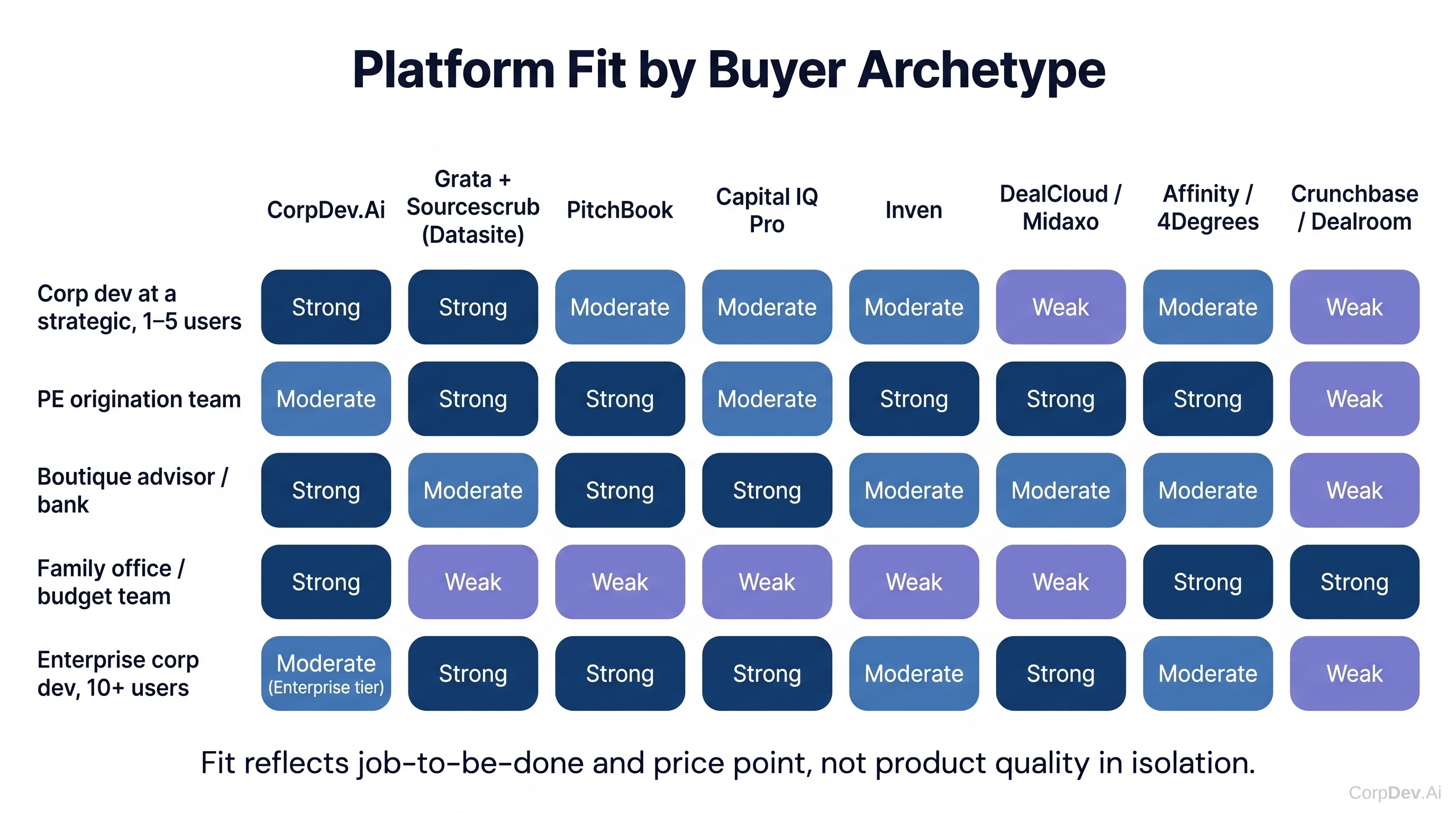
Read diagram description
Comparative ratings. Rows (buyer archetypes): "Corp dev at a strategic, 1–5 users", "PE origination team", "Boutique advisor / bank", "Family office / budget team", "Enterprise corp dev, 10+ users". Columns (platforms): CorpDev.Ai, Grata + Sourcescrub (Datasite), PitchBook, Capital IQ Pro, Inven, DealCloud / Midaxo, Affinity / 4Degrees, Crunchbase / Dealroom. Cell fit ratings: Corp dev 1–5 users: CorpDev.Ai Strong, Grata Strong, PitchBook Moderate, CapIQ Moderate, Inven Moderate, DealCloud Weak, Affinity Moderate, Crunchbase Weak. PE origination: CorpDev.Ai Moderate, Grata Strong, PitchBook Strong, CapIQ Moderate, Inven Strong, DealCloud Strong, Affinity Strong, Crunchbase Weak. Boutique advisor: CorpDev.Ai Strong, Grata Moderate, PitchBook Strong, CapIQ Strong, Inven Moderate, DealCloud Moderate, Affinity Moderate, Crunchbase Weak. Family office / budget: CorpDev.Ai Strong, Grata Weak, PitchBook Weak, CapIQ Weak, Inven Weak, DealCloud Weak, Affinity Strong, Crunchbase Strong. Enterprise corp dev 10+: CorpDev.Ai Moderate (Enterprise tier), Grata Strong, PitchBook Strong, CapIQ Strong, Inven Moderate, DealCloud Strong, Affinity Moderate, Crunchbase Weak. "Fit reflects job-to-be-done and price point, not product quality in isolation."
Enterprise corporate development (10-plus users) deserves a separate note. At this scale the decision is architectural: an institutional terminal (PitchBook or Capital IQ Pro) for data, DealCloud or Midaxo as the process system of record, and an AI research layer that can be governed — SSO, audit logs, no-training commitments — deployed across the wider team. CorpDev.Ai's Enterprise tier and Grata's Datasite parentage both target this pattern; Gartner's warning that over 40% of agentic AI projects will be cancelled by 2027 argues for a governed pilot with measured outcomes before enterprise rollout [112][113].
Buying Checklist and Pilot Design
The single most valuable thing a buyer can do is refuse to decide on demos. Every vendor in this comparison will perform well on a curated demo dataset; the differences appear only on the buyer's own target universe. The following pilot design has been used effectively for data-terminal selections and applies directly to Cyndx replacement.
Pilot Design (Four to Six Weeks)
- Assemble a 25–50 company truth set. Include companies the team has already qualified, companies it passed on, and at least ten that were hard to find. Mix sponsor-backed, founder-owned and public where relevant.
- Run the identical thesis through each candidate. Use the same plain-language acquisition profile. Measure recall (how many truth-set companies each platform surfaces), precision (share of results an analyst would keep after five minutes' review), and duplicate rate.
- Test data on the specific targets. For each truth-set company, check whether revenue, ownership, headcount, financing and last transaction are populated and dated. Count the fields, not the company.
- Audit the AI. Ask each platform to produce a one-page profile and a screening memo for three targets. Score source citations, factual accuracy against what the team already knows, and handling of missing data.
- Route results into the CRM. Confirm that shortlists, contacts and activity land in the system of record without manual re-entry; time it.
- Measure analyst hours. Record time from thesis to reviewed shortlist and from shortlist to first memo. This is the number that justifies the budget.
Commercial and Governance Checklist
- All-in quote including seats, modules, exports, API, integrations, implementation, support and renewal escalator
- Per-seat or per-team pricing, and the cost and process of adding a user mid-term
- Usage limits (search credits, exports) sized against measured pilot throughput
- Data-export and work-product ownership rights on termination or vendor discontinuation
- Change-of-control and product-discontinuation protections in the contract
- Funding status, ownership, customer count and product roadmap in writing
- SOC 2 report, SSO, encryption, data-residency and no-model-training commitments
- Which features are generally available today versus announced roadmap
- Reference calls with two customers of similar size and sector
- Named integration support for Microsoft 365 or Google Workspace and for the incumbent CRM
Before any pilot, export every saved list, search, generated Scholar report and Valer model from Cyndx while access remains, and request written confirmation of the shutdown date and data-deletion policy. If an acquirer of Cyndx's technology relaunches a product, evaluate it on the same pilot terms as any other vendor rather than assuming continuity.
Key Facts & Sources
The load-bearing figures in this document, with source and as-of date. Figures marked "estimate" are third-party market estimates for quote-based products, not vendor list prices.
| Figure | Value | Basis | Source | As of |
|---|---|---|---|---|
| Cyndx wind-down announcement | Founder letter confirms wind-down; exact announcement date unconfirmed | Original manuscript recorded 20 Aug 2026; current letter is undated | [1] | Letter rechecked 14 Sep 2026 |
| Cyndx total funding | ~$10.5M; Rakuten Capital lead (Jun 2018) | Database total, not itemised | [3][4] | May 2025 |
| Cyndx company coverage | 31–33M companies, 195 countries | Vendor marketing, varied by page | [7][9][12] | Mar–Jun 2026 |
| Cyndx enterprise pricing | $30,000–$60,000/yr | Estimate | [16][17] | Aug 2026 |
| Cyndx G2 rating | 4.6/5, 20 reviews | Review platform | [23] | Sep 2026 |
| CorpDev.Ai pricing | AI Pro $1,000/mo; AI Pro Team $3,000/mo (annual); Enterprise custom | Published price card, verified by direct fetch | [28] | 11 Sep 2026 |
| CorpDev.Ai company universe | 70M+ firmographic records (Apollo) | Published | [28][30] | Sep 2026 |
| CorpDev.Ai security | SOC 2 Type II; no training on customer data | Vendor statement | [28] | Sep 2026 |
| Datasite acquires Grata | 3 June 2025; $500M investment commitment | Press release | [42] | Jun 2025 |
| Datasite acquires Sourcescrub | 8 August 2025, from Francisco Partners | Press release | [43][79] | Aug 2025 |
| Datasite acquires Valu8 | 8 May 2026; ~70M European companies | Press release | [47] | May 2026 |
| Grata coverage | ~20–21M private companies; ~36M combined with Sourcescrub | Vendor and commentary | [45][46] | 2026 |
| Grata pricing | $15,000–$100,000/yr | Estimate | [45][52] | Aug 2026 |
| Grata G2 rating | 4.8/5, 79 reviews | Review platform | [45] | 2026 |
| Grata Series A | $25M led by Craft Ventures; ~$34.5–35M cumulative | Press release | [55][56] | Feb 2022 |
| Sourcescrub pricing | $20,000–$60,000/yr | Estimate | [53] | 2026 |
| PitchBook coverage | 5–6M companies; 2.5M+ deals; 535–570K investors | Vendor data pages | [67][68][70][72] | 2024–2025 |
| PitchBook pricing | $15,000–$30,000/seat/yr; enterprise to $124,000+ | Estimate | [41][64] | Jul 2026 |
| Capital IQ Pro coverage | 60M+ private (16M+ with financials); 1.2M+ M&A deals | Vendor product page | [69] | Jun 2026 |
| Capital IQ Pro pricing | $15,000–$30,000/seat; $55,000–$125,000+ small-team contracts | Estimate | [65][66] | Jun 2026 |
| Inven coverage and funding | 28M+ companies; 430M+ contacts; $12.75M Series A (May 2025) | Vendor page; investor announcement | [80][101] | 2025–2026 |
| Affinity pricing | $2,000 / $2,300 / $2,700 per user/yr | Published | [100] | 2026 |
| Dealroom pricing | $14,500 and $20,000/yr | Published | [87] | 2026 |
| Crunchbase Pro pricing | $99/month | Published | [88] | Aug 2025 |
| DealCloud pricing | ~$85,000 entry; ~$505,000 average | Estimate | [106] | Apr 2026 |
| Midaxo pricing | ~$10,000 start; $50,000–$63,000 typical | Estimate | [92][93] | 2025–2026 |
| AI adoption in M&A | 45% of practitioners (2025), more than double prior year | Bain survey | [103] | 2026 |
| Deal-cycle impact of GenAI | 40% of users report 30–50% shorter cycles | McKinsey | [107][108] | Jan–Mar 2026 |
| Agentic AI project cancellations | 40%+ by end-2027 | Gartner forecast | [113] | Jun 2025 |
| Corp dev stack budgeting bands | $10–50K / $50–200K / $200–750K+ | Industry estimate | [104][106] | 2026 |
References
Numbering follows the original research. Access dates below record the original source registry; they do not imply that every source was rechecked for this website edition.
- A Message From Our FounderSource accessed 2026-09-11
- Jim McVeighSource accessed 2026-09-11
- Cyndx Announces Investment by Rakuten CapitalSource accessed 2026-09-11
- Cyndx 2025 Company Profile: Valuation, Funding & Investors | PitchBookSource accessed 2026-09-11
- Cyndx Networks Company Profile - Office Locations, Competitors, Revenue, Financials, Employees, Key People, Subsidiaries | Craft.coSource accessed 2026-09-11
- What’s the difference between an investor search on Cyndx Finder and Cyndx Raiser?Source accessed 2026-09-11
- How One AI-Powered M&A Platform Is Changing Dealmakers ...Source accessed 2026-09-11
- AI deal origination platform - CyndxSource accessed 2026-09-11
- The Cyndx PlatformSource accessed 2026-09-11
- Get The Right Investor For...Source accessed 2026-09-11
- Cyndx Launches Owner, a New Cap Table Management ...Source accessed 2026-09-11
- Private Equity Solutions - CyndxSource accessed 2026-09-11
- Investment Banking Solutions - CyndxSource accessed 2026-09-11
- Venture Capital Solutions - CyndxSource accessed 2026-09-11
- How Purpose-Built AI Empowers Dealmakers - CyndxSource accessed 2026-09-11
- Conceptor vs Cyndx (2026) – Pricing & Feature ComparisonSource accessed 2026-09-11
- Cyndx Pricing 2026: Enterprise Custom Quotes | CostBenchSource accessed 2026-09-11
- CyndX Owner Pricing: Cost and Pricing plans - SaaSworthySource accessed 2026-09-11
- Why Users Love Cyndx | Client Quotes & Success StoriesSource accessed 2026-09-11
- Cyndx Reviews 2026: Details, Pricing, & FeaturesSource accessed 2026-09-11
- Page 2 | Cyndx Reviews 2025: Details, Pricing, & FeaturesSource accessed 2026-09-11
- Meet Cyndy: The AI Brain Behind Cyndx's Dealmaking PlatformSource accessed 2026-09-11
- CorpDev.Ai - Agentic AI for M&A and Corporate DevelopmentSource accessed 2026-09-11
- Pricing - CorpDev.AiSource accessed 2026-09-11
- The Data Architecture Behind AI-Powered M&ASource accessed 2026-09-11
- AI Deal Sourcing Platform for M&ASource accessed 2026-09-11
- Simple, Powerful AI Pipeline CRM for M&A - CorpDev.AiSource accessed 2026-09-11
- Integrations | CorpDev.Ai DocsSource accessed 2026-09-11
- Request a Free Trial | CorpDev.AiSource accessed 2026-09-11
- About Us - CorpDev.AiSource accessed 2026-09-11
- Transforming a Hyperscaler's Corporate Development ...Source accessed 2026-09-11
- CorpDev.Ai vs Grata: Pricing & Features ComparisonSource accessed 2026-09-11
- Flexible Pricing Plans Suited For Any Use CaseSource accessed 2026-09-11
- PitchBook’s Pricing - PitchBookSource accessed 2026-09-11
- PitchBook Pricing in 2026: What 100+ Buyers Pay | Startup YetiSource accessed 2026-09-11
- Datasite Acquires Leading Private Market Intelligence ...Source accessed 2026-09-11
- Datasite to Acquire Sourcescrub, Expanding Private Market ...Source accessed 2026-09-11
- Willkie Advises Datasite on Acquisition of Deal Sourcing ...Source accessed 2026-09-11
- Grata Pricing, Reviews, Pros and Cons (2026)Source accessed 2026-09-11
- Grata's Agentic Search and the $500M Datasite Bet: AI Deal ...Source accessed 2026-09-11
- Datasite Acquires Valu8 to Further Accelerate Global, AI-Driven ...Source accessed 2026-09-11
- Sourcescrub Reviews 2026: Details, Pricing, & FeaturesSource accessed 2026-09-11
- SourceScrub | InvestmentsSource accessed 2026-09-11
- Find the Right Companies Faster with Agentic Search - GrataSource accessed 2026-09-11
- Agentic Search vs. Natural Language SearchSource accessed 2026-09-11
- Grata Pricing Review 2026: Real Costs, Pros and ConsSource accessed 2026-09-11
- SourceScrub Pricing, Reviews, Pros & Cons (2026)Source accessed 2026-09-11
- Pricing & Features for SourcescrubSource accessed 2026-09-11
- Grata Closes $25 Million Round Led By Craft VenturesSource accessed 2026-09-11
- Grata Raises $25M for its Intelligence Platform that Covers ...Source accessed 2026-09-11
- SourceScrub Announces Strategic Growth Investment from ...Source accessed 2026-09-11
- Grata Pros and Cons | User Likes & Dislikes - G2Source accessed 2026-09-11
- What Is Leadzen.Ai?Source accessed 2026-09-11
- FaqSource accessed 2026-09-11
- Grata vs SourceScrub: Honest Comparison (2026) - ProspeoSource accessed 2026-09-11
- Pitchbook Software Pricing & Plans 2026: See Your CostSource accessed 2026-09-11
- Refinitiv vs Bloomberg vs FactSet vs Capital IQ - CT AcquisitionsSource accessed 2026-09-11
- S&P Capital IQ Pro Pricing 2026: What It CostsSource accessed 2026-09-11
- PitchBook’s Data: Private & Public Market Data - PitchBookSource accessed 2026-09-11
- PitchBook Strengthens Leadership in Global Capital Market Data Coverage | PitchBookSource accessed 2026-09-11
- S&P Capital IQ ProSource accessed 2026-09-11
- Public & Private Equity Deal Data - PitchBookSource accessed 2026-09-11
- Mergers & Acquisitions Data - PitchBookSource accessed 2026-09-11
- Investor's Data: Previous Deals & PerformanceSource accessed 2026-09-11
- Private & Public Company Data - PitchBookSource accessed 2026-09-11
- Company Financials Data: Public & Private - PitchBookSource accessed 2026-09-11
- PitchBook AI-powered insights for VC, PE & M&A - PitchBookSource accessed 2026-09-11
- Capital IQ: Reinvented - S&P GlobalSource accessed 2026-09-11
- S&P Global Enhances Capital IQ Pro with Expanded Fixed Income ...Source accessed 2026-09-11
- PitchBook Desktop: Powerful Advanced Search - PitchBookSource accessed 2026-09-11
- Datasite to Acquire Sourcescrub, Expanding Private Market ...Source accessed 2026-09-11
- Inven overviewSource accessed 2026-09-11
- What are the best deal sourcing platforms in 2026? | InvenSource accessed 2026-09-11
- Inven vs. PitchBook: Full Feature, Coverage, and Pricing ...Source accessed 2026-09-11
- Inven vs Grata: Financials, Contact data & MoreSource accessed 2026-09-11
- PricingSource accessed 2026-09-11
- Best Venture Capital Software (The $628/mo Stack) in 2026Source accessed 2026-09-11
- Dealroom.co PricingSource accessed 2026-09-11
- Pricing - Dealroom.coSource accessed 2026-09-11
- Buy Crunchbase ProSource accessed 2026-09-11
- AI for M&A (2026): Complete Tool Landscape and Vendor ...Source accessed 2026-09-11
- Best M&A Deal Management Software 2026: DealCloud, DatasiteSource accessed 2026-09-11
- M&A Intelligence Platform | Midaxo M&A SoftwareSource accessed 2026-09-11
- Midaxo Software Reviews, Demo & Pricing - 2026Source accessed 2026-09-11
- Midaxo Software Pricing & Plans 2025: See Your CostSource accessed 2026-09-11
- AI for M&A Deal Teams | Midaxo Intelligence PlatformSource accessed 2026-09-11
- Pricing - 4DegreesSource accessed 2026-09-11
- 4Degrees Pricing, Reviews, Pros & Cons (2026) - ProspeoSource accessed 2026-09-11
- 4Degrees CRM Review 2026: Is It Worth It for Small VC ...Source accessed 2026-09-11
- Salesforce vs. 4Degrees: Which CRM Fits Your Deal Team?Source accessed 2026-09-11
- CRM data enrichment tools for private capital dealmakersSource accessed 2026-09-11
- Affinity Pricing: Plans for Private Capital CRMSource accessed 2026-09-11
- Inven Raises $12.75M to Build the AI Backbone of Private ...Source accessed 2026-09-11
- A Year of Game-Changing Expansion: Grata's 2025 in ...Source accessed 2026-09-11
- Global M&A poised to sustain momentum in 2026 after ...Source accessed 2026-09-11
- Best Deal Sourcing Platforms in 2026 (Real Pricing) - prospeo.ioSource accessed 2026-09-11
- Corporate Development Software: 32 Tools, Real Pricing ...Source accessed 2026-09-11
- Gen AI in M&A: From theory to practice to high performance | McKinseySource accessed 2026-09-11
- AI meets M&A | McKinsey & CompanySource accessed 2026-09-11
- Looking Back at M&A in 2025: Behind the Great ReboundSource accessed 2026-09-11
- CB Insights Unveils Industry's First AI Agent Workforce for M&A, Partnerships, Competitive Intelligence, Deal Sourcing, GTM, and MoreSource accessed 2026-09-11
- Deloitte Survey: 86% of Corporate and Private Equity Leaders Now Use Generative AI, with Plans to Boost Spending in 2025 – Press ReleaseSource accessed 2026-09-11
- Gartner Predicts 40% of Enterprise Apps Will Feature Task- ...Source accessed 2026-09-11
- Gartner: Over 40% of Agentic AI Projects Will Be Canceled ...Source accessed 2026-09-11