RESEARCH / Deal sourcing networks
DEALCIRCLE alternatives: deal networks, sourcing data and success-fee economics
Compare DEALCIRCLE, Dealsuite and Axial with target databases and M&A tools, including buyer fees, attribution terms, DACH coverage and realistic sourcing costs.
Research as of
Website edition edited
Published by CorpDev.Ai, which is one of the vendors assessed. This analysis distinguishes vendor claims, external evidence and analyst judgments. Prices and capabilities reflect the source dates in the article; the website edition is an editorial adaptation, not a new verification of every claim.
Price access to an opportunity separately from sourcing software
DEALCIRCLE sells access to marketed opportunities and assisted matching, with economics tied to an attributable closing. A database subscription sells the ability to identify companies; it does not guarantee a willing seller or the same opportunity. Comparing the success fee with a software licence is useful for budgeting, but cannot establish whether the channel creates value. An otherwise inaccessible, attractive acquisition may justify a fee that looks large beside several years of software spending.
For a repeat acquirer, the more important issue is cumulative exposure under the attribution and transaction-value provisions. Earn-outs, affiliated buyers, prior contacts and reporting periods can matter more than the headline percentage. Model the fee within the acquisition economics, then compare channels on qualified conversations and completed opportunities rather than introductions alone. A documented pre-existing-contact list and an agreed framework can make a curated DACH channel easier to use alongside proactive sourcing. The decision should change when the network supplies relevant access the team cannot reproduce—or when its overlap with existing relationships makes the contingent fee disproportionate to its contribution.
Executive Summary
Dealcircle is frequently described as "M&A software", but for a buyer it is better understood as a transaction-contingent introduction service with a matching engine attached. Hamburg-based since 2018, it aggregates sell-side mandates from hundreds of M&A advisors, matches them to buyer acquisition profiles drawn from a database it claims exceeds 5 million profiles, and earns its money as a success fee charged to the buyer when a deal it introduced closes [1][3][4]. That single fact — who pays, and when — determines almost everything else about whether it is the right tool for a corporate development team, and it is the reason "alternatives to Dealcircle" is not one question but three.
1,500+
Deals/year Dealcircle advertises to buyers
€0 + %
Dealcircle buyer model: no subscription, success fee on close
€7.5k–15k
Dealsuite annual licence (Europe, by revenue band)
$12k–36k
CorpDev.Ai published annual price (individual / team)
The alternatives fall into three categories that solve different jobs. Deal networks (Dealsuite, Axial, Dealcircle's own AMBER marketplace) deliver on-market opportunities that an advisor has already decided to sell — fast access, but competitive and rarely proprietary. Target-intelligence databases (Inven, Grata/Datasite, Gain, Cyndx, SourceScrub, Dealroom.co) let a team build its own universe of off-market targets, at a subscription cost of roughly $15k–$100k a year depending on depth and seats [37][38][59]. End-to-end and AI-native workflow platforms (CorpDev.Ai, Midaxo, DealCloud, Affinity) manage the pipeline, research and documentation around whichever channels feed it; CorpDev.Ai is the only one of the four that bundles a 70M-company data layer and AI research analyst into a published $1,000–$3,000 per month price, while Midaxo and DealCloud are quote-based process platforms typically costing $25k–$150k+ a year [20][47][51].
| Category | Vendors, scope and indicative commercial terms |
|---|---|
| Deal networks: on-market flow | DEALCIRCLE: DACH assisted matching, 1,500+ deals/year claimed, buyer success fee. Dealsuite: pan-European, ~250 new companies/month claimed, €7.5–15K/year estimate. Axial: US/Canada, no upfront buyer subscription, 1–5% success-fee schedule. AMBER: DEALCIRCLE direct marketplace, launched end2024. |
| Target intelligence: off-market discovery | Inven: 28M+ companies, 1,000 customers claimed, $12.75M Series A May 2025. Grata: Datasite group, Agentic Search, 26 countries. Gain: analyst-reviewed European financials, rebranded September 2026. CYNDX: historical 33M-company buyer/investor matching; announced wind-down, not an active recommendation. Sourcescrub: Datasite acquisition August 2025. Dealroom.co: European startups, €12.6K/year cited. |
| Workflow and analytical production | CorpDev.Ai: AI analyst, 70M+ company search, CRM and AI Room, $1–3K/month annual plans for one/three seats. Midaxo: lifecycle and PMI, $25–150K/year estimate. DealCloud/Intapp: enterprise CRM and Celeste AI, ~$85K/year+ estimates. Affinity: relationship CRM, ~$2–2.7K/user/year. |
Both deal networks and target databases feed the pipeline; their opportunity access is different from workflow management.
The practical conclusions for a corporate development, strategy or M&A buyer are these:
- Dealcircle is cheapest to try and most expensive to succeed with. There is no subscription, but its terms attach a negotiated percentage of transaction volume — including earn-outs and vendor loans — to any closing that follows its introduction, with a 36-month reporting duty and coverage of affiliates and co-investors [3]. On a €50m acquisition, even a 1–2% fee is €0.5–1.0m: more than a decade of some lower-priced subscriptions, though not the enterprise configurations. Its economics depend on access to valuable opportunities as well as acquisition frequency; programmatic buyers should examine fee caps and attribution carefully.
- Dealsuite is the closest like-for-like substitute for the on-market European flow Dealcircle provides, at a predictable licence of €7,500–€15,000 a year and with a broader country footprint; Dealcircle retains an edge in DACH succession situations and curated, human-checked shortlists [43][44].
- For proprietary sourcing, a database beats a network. Inven, Grata and Gain let a team find targets nobody is yet selling — the 38% of corporate deals that benchmarks attribute to direct, employee-generated sourcing versus 32% through intermediaries [87]. None of them, however, delivers a willing seller; that still requires outreach.
- CorpDev.Ai and Midaxo are not Dealcircle substitutes; they are what you run Dealcircle's output through. Their value is in research, pipeline discipline, document production and — in CorpDev.Ai's case — AI-driven target discovery from a bundled data layer. CorpDev.Ai's public evidence base on customers, funding and independent reviews is thin, which a buyer should weigh against its transparent pricing and breadth [15][27].
Serious European acquirers rarely choose one tool. The pattern that recurs is a network for on-market flow (Dealsuite, or Dealcircle with a negotiated fee cap), a database or AI platform for proprietary discovery (Inven, Gain or CorpDev.Ai) and a system of record for the pipeline (CorpDev.Ai, Midaxo or an existing CRM). Section 6 maps these to buyer archetypes.
1. Why This Comparison Is Harder Than It Looks
Buyers who search for "Dealcircle alternatives" get lists that mix Datasite, Midaxo, Grata and Axial as though they were interchangeable. They are not. Each solves a different job in the acquisition funnel, and confusing them is the most common — and most expensive — procurement error a corporate development team makes. The right framing is the M&A funnel itself: define the thesis → build the universe → find willing sellers → run the process → close and integrate. Dealcircle sits squarely at the third step. Most of its supposed alternatives sit elsewhere.
| Vendor / group | Workflow coverage | Commercial or scope distinction |
|---|---|---|
| DEALCIRCLE | Stage 3: marketed opportunities and willing sellers | Buyer success fee; not a proprietary off-market target universe. |
| Dealsuite | Stage 3: marketed deal flow | Subscription-based network. |
| Axial | Stage 3: marketed deal flow | US/Canada focus. |
| Inven | Stages 1–2: thesis, market map and off-market target universe | AI discovery and research; verify output and integrations. |
| Grata / Datasite | Stages 1–2; stage 4 diligence through Datasite VDR | Discovery and transaction-room capabilities are separate suite components. |
| Gain | Stages 1–2 plus part of stage 4 evaluation | Financial verification adds analytical depth. |
| CYNDX — historical | Stages 2–3 | Target and acquirer matching; unavailable as an active recommendation. |
| CorpDev.Ai | End-to-end M&A management and analytical execution | AI analyst, mapping, target search, pipeline CRM, AI Room, memos and PMI digital twins; no proprietary marketed-deal network; assess integration controls against the programme requirements. |
| Midaxo | Stages 4–5 strongly; stage 2 partially | Evaluation/diligence, closing and integration governance. |
| DealCloud / Affinity | Stages 2–4 as relationship/CRM layer | Relationship sourcing, pipeline and collaboration; dedicated diligence scope varies. |
Five stages: (1) thesis and market map, (2) off-market universe, (3) willing sellers/on-market flow, (4) evaluate, diligence and approve, (5) close and integrate. DEALCIRCLE’s closest substitutes address stage 3; other tools generally complement that channel. CYNDX is historical context: its official site announces wind-down and dissolution, checked 14 September 2026, without an announcement date. It is not an active purchasing recommendation. CYNDX official site.
Three product categories, three procurement logics
Deal networks and marketplaces — Dealcircle, Dealsuite, Axial, AMBER — exist to move sell-side mandates to buyers. Their supply is entirely determined by what advisors choose to circulate; their value to a buyer is the breadth and relevance of that flow and the speed at which a first conversation can be arranged. Because the opportunity is by definition already on the market, a buyer competes with everyone else who received it. The procurement question is therefore about cost per qualified introduction and contractual exposure, not about features.
Target-intelligence databases — Inven, Grata, Gain, Cyndx, SourceScrub, Dealroom.co — exist to help a buyer find companies before anyone is selling them. They are priced as annual subscriptions and evaluated on coverage, data depth (especially private-company financials in Europe), search quality and export/integration. They produce longlists, not conversations; the buyer still has to do the outreach.
Workflow and AI platforms — CorpDev.Ai, Midaxo, DealCloud, Affinity — exist to run the programme: capture every lead regardless of channel, research and score it, manage the pipeline, produce investment committee material and, in the fuller platforms, carry the deal through diligence and integration. They are evaluated on breadth of lifecycle coverage, how much manual work they remove, and — increasingly — how much research and drafting their AI can be trusted to do. CorpDev.Ai's inclusion here reflects the fact that it bundles the second category's data layer (70M+ companies, 265M+ contacts) into a workflow platform, which blurs the boundary between categories two and three [15][16].
Why the market is consolidating across these lines
The 2025–2026 M&A-tech market has been reorganising precisely along this funnel. Datasite — historically a virtual data room — acquired Grata, then SourceScrub (August 2025) and then European data provider Valu8 (May 2026) to build a sourcing-to-execution stack [30][36]. Dealsuite announced a partnership with Cyndx to add AI buyer and investor identification to its European marketplace [45]. The currently displayed release is undated; following CYNDX’s announced wind-down, buyers should obtain written confirmation of the partnership service’s current availability. Gain.pro rebranded as Gain on 8 September 2026 and now describes itself as a "private markets super app" spanning sourcing, research and execution [73]. Intapp made its Celeste AI coworker generally available inside DealCloud in July 2026 and announced an OpenAI collaboration in September 2026 [52][53]. Midaxo shipped what it called a major AI update in August 2026 [50]. The direction is unmistakable: vendors on every side are trying to own more of the funnel, and buyers should expect today's clean category boundaries to keep dissolving.
Dealcircle is assessed here from the perspective of a buyer — a corporate development, strategy or M&A team acquiring companies. Dealcircle's other constituency, sell-side advisors who use it to build buyer lists, has a different value calculus (the service is effectively free to them) and is out of scope. Where Dealcircle looks weaker in this guide, that is partly a consequence of which side of its two-sided market is paying.
2. Dealcircle in Depth
What it is and how it works
Dealcircle was founded in Hamburg in 2018 by Kai Hesselmann and Graig Gröbli [10][11]. Its core loop is simple: an M&A advisor with a sell-side mandate enters a search profile; Dealcircle's matching technology generates a buyer longlist from its database, which is then subject to human quality control; matched buyers receive the anonymised opportunity through the member area, email alerts or its "Private Matching" process; and once both sides agree, Dealcircle brokers the first contact [1][2][3]. Buyers register an acquisition profile and receive projects that fit it, express interest and contact the advisor through the platform [5]. The company describes the approach as AI plus big-data analytics plus human expertise, and has increasingly positioned itself around Germany's SME succession problem [2][6].
At the end of 2024 Dealcircle launched AMBER, a separate online marketplace intended to connect corporate buyers directly with sellers and their advisors "without detours" [7][78]. AMBER extends Dealcircle from advisor-led matching toward a direct marketplace, but public material does not yet give an independently verified volume, country breakdown or closing-rate dataset for it.
Scale — and how to read the numbers
5M+
Buyer/investor profiles in database (company claim)
~1,400
M&A projects placed in 2024
~4,000
Projects placed in 2025 (Hamburg ecosystem report)
~€5M + 7-fig
Funding rounds 2024–Jan 2026
The headline figures need interpretation. The "5 million+ profiles" is a database count of potential buyers — corporates, family offices, PE funds, MBI candidates — not a count of active registered users; older company material cited 250,000 strategic buyers and 10,000 financial investors, and an earlier page referred to 1,200 advisors, while current material says "hundreds" [4][8][9]. Deal-flow disclosures also vary: the English homepage advertises "more than 1,500 deals per year" to buyers, the 2025 funding announcement cited roughly 1,400 projects placed in 2024 with a plan for 2,000+ in 2025, and a January 2026 Hamburg ecosystem report put 2025 at roughly 4,000 — a spread that likely reflects different products (core platform vs AMBER), markets or counting methods rather than a single audited series [1][7][10]. A buyer should ask for the number of unique live mandates matching its own acquisition profile in the last twelve months; that is the only figure that matters.
Dealcircle's public deal-volume figures range from ~1,400 to ~4,000 projects for adjacent years without a stated methodology. Treat none of them as an audited run-rate. Ask the vendor for a profile-specific count before relying on flow volume in a business case.
Funding has been steady rather than spectacular: a seven-figure round from Round2 Capital in 2024; approximately €5 million in June 2025 led by IFB Innovationsstarter's InnoVentureFonds with Hanse Ventures, Carsten Kraus and Philipp Klöckner; and a further single-digit-million round in January 2026 that brought in heise ventures as a strategic investor alongside ARCUS Capital founder Stefan Eishold and Carlsquare founder Mark Miller [7][10][11][12]. The investor base — a media group, a Hamburg public development bank, M&A boutique founders — signals a company building a regional franchise, not a venture-scale global platform.
The economics: who pays, and for what
Dealcircle's General Terms make the business model explicit. Access for advisors and sellers is essentially free; Dealcircle earns a success fee from the buyer if a transaction closes after Dealcircle established the initial contact [3][8]. The fee is a percentage of transaction volume agreed per project, platform listing, email exchange or framework agreement — there is no published standard rate, although one Trustpilot reviewer alleges 2% [3][80]. The terms further provide that the fee base is broad (including earn-outs, vendor loans and certain debt or capital elements); that the fee is payable if an affiliate, investor or co-investor completes the deal; that it survives termination of the relationship; that a buyer must reject a claimed pre-existing contact within 14 days; and that qualifying transactions must be reported for 36 months, with notice within seven days of closing [3].
| Item | Cost (€k) |
|---|---|
| Dealcircle fee at 1% on €30m EV | 300 |
| Dealcircle fee at 2% on €30m EV | 600 |
| Dealsuite Europe licence (top band) | 15 |
| CorpDev.Ai Team plan (annual, ≈$36k) | 33 |
| Inven / Grata mid-market deployment (indicative) | 37 |
| Midaxo mid-range deployment (indicative) | 60 |
The chart uses a 1–2% fee range as an illustration, because the published terms give no rate; subscription figures are published or indicative third-party estimates and are detailed in Section 5 [3][20][43][47][58][59]. The point is not that Dealcircle is expensive in absolute terms — a buy-side advisor charging 1–3% plus retainer would cost more — but that the buyer pays a transaction price for what is functionally an introduction. For an acquirer that would have found the target anyway through its own database work, that is a poor trade.
Where Dealcircle is genuinely strong
- DACH depth and succession flow. Its advisor base is concentrated in German-speaking mid-market boutiques, and its SME succession positioning gives it access to owner-managed companies that rarely appear in web-derived databases [6][75].
- Curation. Human quality control over machine-generated longlists means buyers report high relevance and hit rates — albeit in company-published testimonials [2][82].
- Zero fixed cost. A corporate that acquires once every two or three years pays nothing until it closes, which is the correct economic shape for an infrequent buyer.
- Documented strategic-buyer outcomes. Case studies name audius Group (several IT acquisitions), MSG Systems (acquired HWB Group from a shortlist of 10) and FABRI AG (85 buyers identified, 21 interested, 3 to management presentation) [84][85][86]. These are selected by Dealcircle, but they are specific and verifiable.
Where it is weak for a corporate buyer
- It only delivers on-market deals. Every opportunity has an advisor and, usually, other buyers. Dealcircle cannot help a team find the company it should buy that nobody is selling.
- Contractual friction. The fee tail, affiliate coverage and 14-day rebuttal window create legal work and a real risk of disputes over attribution, particularly for acquirers with many subsidiaries or co-investors [3].
- No research, pipeline or documentation layer. Dealcircle produces introductions, not analysis. Everything after the first call happens elsewhere.
- Geography. Outside DACH and adjacent European markets, coverage is unproven; Dealsuite reports users in 50+ countries and clients in 60+ [44][77].
- Data accuracy is disclaimed. The terms state that project and profile information is user-supplied and that Dealcircle does not warrant its accuracy, completeness or deal completion [3].
Dealcircle's terms extend the success fee to transactions completed by affiliates, investors or co-investors and to closings after the relationship ends. A corporate with many operating subsidiaries or a PE-style co-investment structure should negotiate an explicit pre-existing-contact carve-out, a fee cap and a defined tail period before accepting any introduction.
3. The Alternatives, Category by Category
3.1 Deal Networks and Marketplaces (Dealsuite, Axial, AMBER)
These are Dealcircle's true substitutes: they deliver on-market opportunities that a seller or advisor has already decided to circulate. The evaluation criteria are flow volume relevant to your profile, geographic coverage, quality controls on membership and listings, and — above all — the commercial model.
Model: closed, validated SaaS marketplace; annual licence
Price: European licences €7,500 / €10,000 / €15,000 by revenue band (€10–49m / €50–99m / €100–499m); Benelux tiers lower [43]
Flow: ~250 new companies/month across Europe per its tariff sheet; users in 50+ countries, clients in 60+ [43][44][77]
Best for: pan-European, repeatable self-service sourcing with predictable budget
Model: curated lower-middle-market network; $0 upfront for buyers, success fee on Axial-sourced closings
Price: 5% on first $1m, 4% next $1m, 3%, 2%, then 1% above $4m — e.g. $200k on a $10m deal [32]
Flow: North American; Q4 2025 introductions +20.5% YoY [33][34]
Best for: US/Canada independent sponsors and smaller PE; poor fit for Europe
Model: direct online marketplace connecting corporate buyers, sellers and advisors; launched end-2024 [7][78]
Price: not separately published; presumed to sit under Dealcircle's buyer success-fee framework [3]
Flow: no independently verified volume or country data yet
Best for: German owner-managed succession deals where the buyer wants direct visibility
Dealsuite versus Dealcircle is the decision most European buyers actually face. Dealsuite is the stronger pan-European, self-service marketplace; Dealcircle is the stronger DACH-oriented, assisted-matching service. Dealsuite's closed, pre-qualified membership acts as a quality filter, its subscription pricing removes the attribution and tail-period friction embedded in Dealcircle's terms, and its footprint across Benelux, DACH, France, the Nordics, Spain, Italy and the UK is broader [43][44][76]. Its weaknesses are the mirror image: broad daily flow means more irrelevant or stale listings for a narrowly defined strategy, some buyer categories must work through an advisor to reach seller details, and its most-cited closed-deal figure (3,000+) dates from 2020 and should not be read as a current annual number [74][79]. Dealcircle's human-curated shortlists are likely to produce a higher hit rate per opportunity shown, at the cost of a transaction-contingent fee. Dealsuite’s announced Cyndx partnership described AI-driven buyer and investor identification [45]. Its current availability should be confirmed following CYNDX’s wind-down; it is not assumed to narrow Dealcircle’s current matching advantage.
Axial belongs on the list only for buyers with North American ambitions. Its economics are transparent and instructive: a published sliding scale that generates $200,000 on a $10m deal shows what a "free" success-fee network actually costs at closing, and it is a useful benchmark when negotiating Dealcircle's undisclosed percentage [32].
Every network's supply is what advisors choose to circulate. A boutique with a hot mandate will run a tight process to its own buyer list before it ever posts to a marketplace. Networks therefore skew toward mandates that need wider distribution — smaller, more specialised or slower to sell. Build this into your expectations of deal quality regardless of which network you pick.
3.2 Target Intelligence Databases (Inven, Grata/Datasite, Gain, Cyndx, SourceScrub, Dealroom.co)
These platforms answer a different question from Dealcircle: not "who is selling?" but "who should we be talking to?" They are the engine of proprietary sourcing — the channel that benchmarks credit with roughly 38% of corporate deals versus 32% via intermediaries [87] — and they are priced as annual subscriptions. Their limitation is equally structural: they produce longlists and profiles, not willing sellers, so their value is realised only if the team has the outreach capacity to work the output.
| Platform | Coverage | Indicative annual cost | Distinctive strength | Principal weakness | 2025–26 developments |
|---|---|---|---|---|---|
| Inven | 28M+ companies, 100M+ legal entities; strong North America, UK, DACH, Nordics [60][61] | Low-to-mid five figures USD; quote-based [58][59] | Fast AI market mapping; outputs client-ready one-pagers, slides and longlists in your own format; 1,000+ customers [65] | Not a deal CRM or diligence system; private-company revenue accuracy varies [62][63] | $12.75M Series A (May 2025); passed 1,000 customers (June 2026) [64][65] |
| Grata (Datasite) | Web-derived private-company universe; customers in 26 countries; Valu8 European data integrated [39] | ~$15k entry, ~$40k mid-market, up to ~$100k enterprise (third-party estimates) [37][38] | Best-in-class semantic/similarity search; Agentic Search for conversational multi-step discovery [41] | Weaker on companies with thin web presence; roadmap now tied to Datasite | Acquired by Datasite; SourceScrub merged in (Aug 2025); MCP server for AI agents (Aug 2026) [30][42] |
| Gain (ex Gain.pro) | Europe-first: DACH, Nordics, Benelux, UK; global expansion under way | ~$25k–60k (third-party estimate) [59] | Analyst-verified, filings-backed European private-company financials — the most defensible numbers for screening and comps | Less self-serve and broad than Inven/Grata; expensive for small teams | Rebranded to Gain, 8 Sept 2026, positioning as a "private markets super app" [73] |
| Cyndx | 33M+ public and private companies; ~80M investor contacts (vendor claims) [67][68] | ~$30k–75k professional deployments (estimates) [66][59] | Combines target, acquirer and investor identification — useful for sell-side and capital-raising work as well as buy-side | AI matches need human validation; European local depth less consistent than Gain or Dealsuite | Dealsuite partnership (Sept 2026); upgraded Scholar deep-research product (2026) [45][69] |
| SourceScrub | Event, conference and directory-derived; US-centric | ~$25k–40k small team; $100k+ large sponsor [35][31] | Finds founder-owned companies invisible to financial databases | Thin international coverage; no longer a standalone strategic purchase | Acquired by Datasite (Aug 2025), being integrated with Grata [30] |
| Dealroom.co | European startups, scale-ups and venture ecosystems | €12,600/yr Premium (3-seat minimum); €17,000/yr Premium Plus [70][71] | Best European venture/technology data; transparent pricing | Weak for owner-operated industrial SMEs and traditional lower-middle-market M&A [72] | Incremental AI-assisted discovery and API/CRM connectivity; no major agentic launch |
| Vendor | Company breadth | European financial depth | Distinction |
|---|---|---|---|
| Gain | Moderate relative breadth | High; analyst-reviewed | Financial depth for screening, with source checks still required |
| Inven | High; 28M+ claimed | Moderate to high | 1,000 customers claimed; Series A in2025 |
| Grata / Datasite | Very high | Moderate | Agentic Search and Valu8 data |
| CYNDX, historical | 33M companies claimed | Moderate to low | Target and investor matching; wind-down announced |
| Sourcescrub / Datasite | Moderate relative breadth | Lower European depth | US events and source lists |
| Dealroom.co | Focused on startups | Limited SME depth | European venture |
These are qualitative analyst assessments, not a tested accuracy ranking. Gain emphasises depth; Inven and Grata combine broad discovery with increasing financial detail. Grata and Sourcescrub share Datasite ownership.
How to choose within this category. For a European mid-market acquirer, the choice reduces to a depth-versus-breadth trade-off. Gain is the pick when the team needs analyst-reviewed financial figures for screening, with the underlying filings, dates and adjustments still checked before investment-committee use — buyout-style screening on revenue and EBITDA bands. Inven is the pick when the team needs to map a market fast, produce presentable output and cover DACH and Nordic private companies at scale. Grata is the pick when the team values conversational, iterative discovery and already uses or plans to use Datasite for execution; its MCP integration also makes it the most agent-ready database for teams building their own AI workflows [42]. Cyndx historically addressed corporates running divestitures or minority raises through one matching engine. Its announced wind-down means it should not be treated as an active purchasing recommendation. SourceScrub and Dealroom.co are edge cases — the former for US founder-led targets, the latter for venture-backed technology companies.
Three of the six platforms here (Grata, SourceScrub, Valu8) have been absorbed by Datasite since 2025, and Gain has just repositioned as a super app. Contract terms should protect against product roadmap changes, data-licence changes and forced migration to a parent platform — a two-year term with a change-of-control exit clause is a reasonable ask.
3.3 End-to-End and AI-Native Workflow Platforms (CorpDev.Ai, Midaxo, DealCloud, Affinity)
These platforms do not compete with Dealcircle for deal flow; they compete for the role of system of record for the acquisition programme. A buyer evaluating Dealcircle alternatives encounters them because the real gap is usually not "we lack introductions" but "we cannot process, research and decide on what we already see." The four differ sharply in philosophy: CorpDev.Ai is AI-first and bundles data; Midaxo is process-first and built for governance; DealCloud is a configurable enterprise CRM for private capital; Affinity is a relationship-intelligence CRM.
What it is: AI-native platform for in-house corp-dev: AI Research Analyst, market mapping, natural-language target search over 70M+ companies / 265M+ contacts, zero-entry pipeline CRM (email/calendar ingestion), AI Room data room with page-level citations, memo/deck generation, digital twins for integration [15][16][17][18][19]
Price: published — AI Pro $1,000/month (annual) or $1,200 monthly; AI Pro Team $3,000/month or $3,600 monthly; Enterprise custom; data layer included [20]
Founded: 2023, Boston (directory data); founder-CEO Kal Kilpi, ex-Midaxo [24][25][27]
Evidence base: claims "hundreds" of corp-dev users; no named customers, disclosed funding or independent reviews located [15][27]
What it is: mature end-to-end M&A process platform — pipeline Kanban, scoring, playbooks, VDR functions, task and issue tracking, PMI and synergy management, reporting, role-based access [28][29]
Price: quote-based; indicative $25k–150k/yr (smaller deployments $10–25k, standard $45–90k, enterprise $100k+) [47][48]
Positioning: serial corporate acquirers and integration teams; strongest lifecycle coverage in this list
Evidence base: long customer history in Europe and North America; G2 reviewers find it easier to administer than DealCloud [49]; major AI update announced Aug 2026 [50]
What it is: highly configurable relationship and deal CRM for private capital, banking and advisory; pipeline, contacts, mandates, fundraising, reporting and compliance
Price: enterprise quote; ~$85k/yr mid-market before implementation, often substantially more after configuration and migration [51]
Positioning: the operating system for sophisticated investment and advisory firms; corp-dev is a secondary segment
AI: Celeste governed AI coworker GA July 2026; OpenAI collaboration for a governed DealCloud plug-in Sept 2026 [52][53]
What it is: relationship-intelligence CRM that auto-captures email, calendar and network data to surface warm paths and manage pipelines
Price: ~$2,000–2,700 per user per year; enterprise packages custom — a 10-seat team budgets ~$20–27k [54][55][56]
Positioning: PE, VC and advisory; useful to corporates that source through executive networks
AI: 2026 packaging adds AI Notetaker, enrichment and MCP availability on higher plans [54][56]
An objective read on CorpDev.Ai
CorpDev.Ai publishes this guide and is one of the vendors assessed. The following assessment sets out its strengths and evidence gaps.
What genuinely differentiates it. CorpDev.Ai is the only platform in this comparison that combines a target-intelligence data layer (category 3.2) with a workflow platform (category 3.3) at a published, self-serve price. A team paying $36,000 a year for the Team plan gets — on the company's description — the functions a buyer would otherwise assemble from a database subscription ($15k–$60k), a pipeline CRM ($10k–$25k for DealRoom-class tools, which CorpDev.Ai's own comparison page prices at $1,000/month) and a research/drafting layer that most teams currently fund with analyst hours [18][20][21][23]. The zero-entry CRM — automatically updating the pipeline from Microsoft 365 or Google Workspace mail and calendar — addresses the single most common failure of corp-dev CRMs, which is that nobody fills them in [18]. The AI Room's page-cited diligence reading and the digital-twin approach to integration planning extend the platform into stages 4 and 5 of the funnel that databases never reach [15][19]. Its stated multi-model orchestration (Anthropic, OpenAI, Perplexity, Google) is a sensible hedge against single-vendor model risk [15].
What a buyer should discount or verify. The public evidence base is thin in exactly the places a procurement team looks first. No named customers, case studies or logos were located; the "hundreds of CorpDev professionals" claim is unverified; no funding round is disclosed, which raises a reasonable vendor-viability question for a 2023-founded company; and there are no independent review bodies of the kind Midaxo and DealCloud have accumulated [15][27][29]. The 70M-company figure appears to derive from an Apollo-class data source rather than proprietary collection, so depth on European private-company financials should be tested against Gain or Inven on the buyer's own target universe before it is relied upon [15]. The AI Room should not be assumed to match the permissions, audit, redaction and bidder-management depth of a specialist VDR such as Datasite for a live sell-side process [19]. And — the point most relevant to this guide — CorpDev.Ai has no deal network: it does not deliver willing sellers. It is a Dealcircle complement, not a Dealcircle replacement.
The CorpDev.Ai capability list above is drawn from the company's own website and comparison pages. The same is true of much of the Inven, Grata and Dealcircle material. Where a claim is load-bearing for a purchase decision — data coverage on your target universe, CRM auto-capture accuracy, AI citation reliability — insist on a trial against your own targets rather than a demo on the vendor's examples.
Midaxo, DealCloud and Affinity in one paragraph each
Midaxo is the safest choice for a serial acquirer whose main problem is governance: multiple concurrent deals, integration accountability, board reporting and repeatable playbooks. It is not a sourcing tool, its subscription is hard to justify below two or three deals a year, and its August 2026 AI update signals that it is now competing on the research-assistant axis where CorpDev.Ai started [47][50]. DealCloud is overbuilt for most corporate development teams; its strength is a configurable data model that lets a PE firm or bank encode its own process, at the cost of a long implementation and a six-figure all-in budget. Corporates with a group-level M&A function of ten or more and a heavy advisor-relationship model are the exception [51][52]. Affinity is the lightest of the four and the most relevant for corporates that source through executive relationships; it will not replace a company database, and its value depends entirely on the quality of the communications it is connected to [54][56].
4. Head-to-Head Comparison Matrix
The matrix below scores each platform on the criteria a corporate development buyer actually weighs. Ratings are the author's qualitative judgement from the evidence cited in Sections 2–3; "—" means the capability is not part of the product's purpose rather than a failing.
| Platform | Category | Primary job | On-market deal flow | Off-market target discovery | Research & memo generation | Pipeline / CRM | Diligence / data room | Integration (PMI) | Europe / DACH depth | Pricing model | Indicative annual cost | Price transparency |
|---|---|---|---|---|---|---|---|---|---|---|---|---|
| Dealcircle | Deal network | Curated introductions to advisor-led mandates | Strong (DACH) | — | — | — | — | — | Strong | Buyer success fee, % of transaction volume | €0 fixed; % on close (undisclosed) | Low |
| Dealsuite | Deal network | Pan-European on-market marketplace | Strong (Europe) | Weak | — | Basic | — | — | Strong | Annual licence by revenue band | €7.5k–15k | High |
| Axial | Deal network | US lower-middle-market network | Strong (N. America) | — | — | Basic | — | — | Weak | Buyer success fee, published scale | $0 fixed; 1–5% on close | High |
| Inven | Target database | AI market mapping & target discovery | — | Strong | Moderate (one-pagers, slides) | Weak | — | — | Strong | Subscription, quote-based | Low-to-mid five figures USD | Low |
| Grata (Datasite) | Target database | Semantic private-company search | — | Strong | Weak | Weak | Via Datasite | — | Moderate (Valu8) | Subscription, quote-based | ~$15k–100k | Low |
| Gain | Target database | Verified European private-company financials | — | Strong | Moderate | Weak | — | — | Very strong | Subscription, quote-based | ~$25k–60k | Low |
| Cyndx | Target database | Target, acquirer & investor matching | Weak | Strong | Moderate (Scholar) | Weak | — | — | Moderate | Subscription, quote-based | ~$30k–75k | Low |
| CorpDev.Ai | AI workflow platform | AI analyst + data + pipeline + AI data room | — | Strong (70M cos, AI search) | Strong | Strong (zero-entry) | Moderate (AI Room) | End-to-end management and integration work; validate programme controls | Untested vs Gain/Inven | Published subscription, data included | $12k–36k published; enterprise custom | High |
| Midaxo | Process platform | End-to-end M&A governance & PMI | — | Weak | Moderate (AI update 2026) | Strong | Moderate | Strong | Strong | Subscription, quote-based | ~$25k–150k | Low |
| DealCloud (Intapp) | Enterprise CRM | Configurable deal & relationship CRM | — | Weak | Moderate (Celeste) | Very strong | — | Weak | Moderate | Enterprise quote + implementation | ~$85k+ | Low |
| Affinity | Relationship CRM | Warm-path and relationship intelligence | — | — | Weak | Strong | — | — | Moderate | Per seat | ~$2k–2.7k/user | Moderate |
Programme-scope assessment. The CorpDev.Ai integration entry describes its end-to-end management scope rather than assigning an unsupported comparative performance score. Evaluate the required controls and the quality of completed work on the same acquisition programme as other finalists. Deal frequency and public review volume do not establish a functional ranking. See the lifecycle framework and integration capabilities; these are vendor materials, not independent benchmarks.
Three patterns stand out. First, no single platform covers the whole funnel: the two products with the broadest span, CorpDev.Ai and Midaxo, both lack a deal network, and the two strongest networks, Dealcircle and Dealsuite, offer nothing after the introduction. Second, price transparency correlates inversely with enterprise heritage: the newest entrants (CorpDev.Ai, Dealsuite, Axial, Dealroom.co) publish prices; the established databases and process platforms quote. Third, the success-fee model is an outlier: only Dealcircle and Axial charge on closing, which makes them the cheapest platforms to trial and — as Section 5 shows — potentially the most expensive to use.
5. Total Cost of Ownership: Success Fee vs Subscription
Comparing a success-fee network with subscription tools requires modelling expected cost, not list price. The model below uses three buyer archetypes over a three-year horizon and compares Dealcircle against representative subscription alternatives. All Dealcircle figures assume a 1.5% fee on enterprise value — a hypothetical scenario rate, not a range disclosed in Dealcircle’s terms; one reviewer alleges 2% [3][80] — and assume that 30% of a programmatic acquirer's closings originate from a network introduction, consistent with intermediary-sourced shares of roughly one-third in corporate benchmarks [87]. USD prices are converted at $1 ≈ €0.92.
Dealcircle's percentage is not published; 1.5% is an illustrative assumption, not a quoted rate. The 30% network-attribution share is a planning assumption drawn from intermediary-sourcing benchmarks, not a Dealcircle statistic. Subscription costs use published prices where they exist (Dealsuite, CorpDev.Ai) and third-party estimates where they do not (Inven, Gain, Midaxo). Replace every input with your own quotes before using this in a business case.
| Buyer archetype | Deal cadence | Avg. EV | Closings via network (3 yrs) | Dealcircle expected fees (3 yrs) | Dealsuite (3 yrs) | CorpDev.Ai Team (3 yrs) | Inven or Gain (3 yrs) | Midaxo mid-range (3 yrs) |
|---|---|---|---|---|---|---|---|---|
| Occasional acquirer | 1 deal / 3 yrs | €20m | 1 | €300k | €45k | €99k | €105k | €180k |
| Programmatic mid-market | 3 deals / yr | €15m | 2.7 | €608k | €45k | €99k | €105k | €180k |
| Large-cap corporate | 2 deals / yr | €50m | 1.8 | €1,350k | €45k | €99k | €105k | €180k |
| Derivation | Calculation |
|---|---|
| Occasional acquirer | 1 × €20m × 1.5% = €300k |
| Programmatic mid-market | 9 closings × 30% = 2.7 via network; 2.7 × €15m × 1.5% = €608k |
| Large-cap corporate | 6 closings × 30% = 1.8 via network; 1.8 × €50m × 1.5% = €1,350k |
| Dealsuite | €15,000 top European band × 3 [43] |
| CorpDev.Ai Team | $36,000 × 0.92 × 3 ≈ €99k [20] |
| Inven / Gain | ~$38,000 midpoint estimate × 0.92 × 3 ≈ €105k [58][59] |
| Midaxo | ~$65,000 mid-range estimate × 0.92 × 3 ≈ €180k [47] |
| Archetype | Dealcircle | Dealsuite | CorpDev.Ai Team | Inven or Gain | Midaxo |
|---|---|---|---|---|---|
| Occasional (1 deal, €20m) | 300 | 45 | 99 | 105 | 180 |
| Programmatic (9 deals, €15m) | 608 | 45 | 99 | 105 | 180 |
| Large-cap (6 deals, €50m) | 1350 | 45 | 99 | 105 | 180 |
What the model says
The break-even is tiny. At a 1.5% fee, a single Dealcircle-introduced closing at just €1m enterprise value costs the same as a full year of Dealsuite's top-tier licence (€15k), and a €3m closing costs the same as three years of it. Above that, every network-introduced deal makes the subscription look cheaper. That cost comparison does not establish which channel creates more value. A profitable acquisition that would otherwise be inaccessible can justify a success fee; a lower-cost subscription does not necessarily supply the same seller access. Buyers expecting no attributable closing incur no success fee but may still gain market intelligence.
The success fee exchanges fixed sourcing expenditure for contingent acquisition cost. Dealcircle still incurs operating costs when a buyer does not close, while the buyer pays the agreed fee on an attributable transaction. That allocation can work for an occasional acquirer but becomes expensive at repeat-deal volumes. It also allows a corporate to see flow without an upfront subscription — as long as it recognises that the moment it wants to act on a Dealcircle-sourced opportunity, the fee becomes a real line in the deal model, and the terms' affiliate, co-investor and tail provisions make it hard to route around [3].
Subscriptions are not the whole cost either. The figures above exclude implementation, integration, data enrichment, training and the internal FTE time that any platform consumes — typically adding 25–100% to first-year licence cost for a process platform, far less for a self-serve tool [92]. They also exclude the far larger costs a platform is meant to reduce: advisor retainers of $7,500–$25,000 a month plus 1–3% on close for a full buy-side mandate, and the analyst hours spent on research that AI-native tools claim to compress [90][91][93][94].
If a corporate wants Dealcircle's DACH curation but not its open-ended exposure, the levers are the same as for a buy-side advisor: a fee cap (absolute or per deal), a modified-Lehman scale that steps down above €10m, an explicit pre-existing-contact schedule lodged at sign-up, a tail no longer than 12 months, and exclusion of affiliates not named in the agreement. Dealcircle's terms already contemplate project-specific and framework agreements, so buyers can request these changes, subject to Dealcircle’s acceptance rather than an assumed right to negotiate them [3].
6. Which Tool for Which Buyer
The right answer depends less on features than on three facts about the buyer: how often it acquires, whether its targets are on-market or need to be found, and how much internal capacity it has to process what the tools produce.
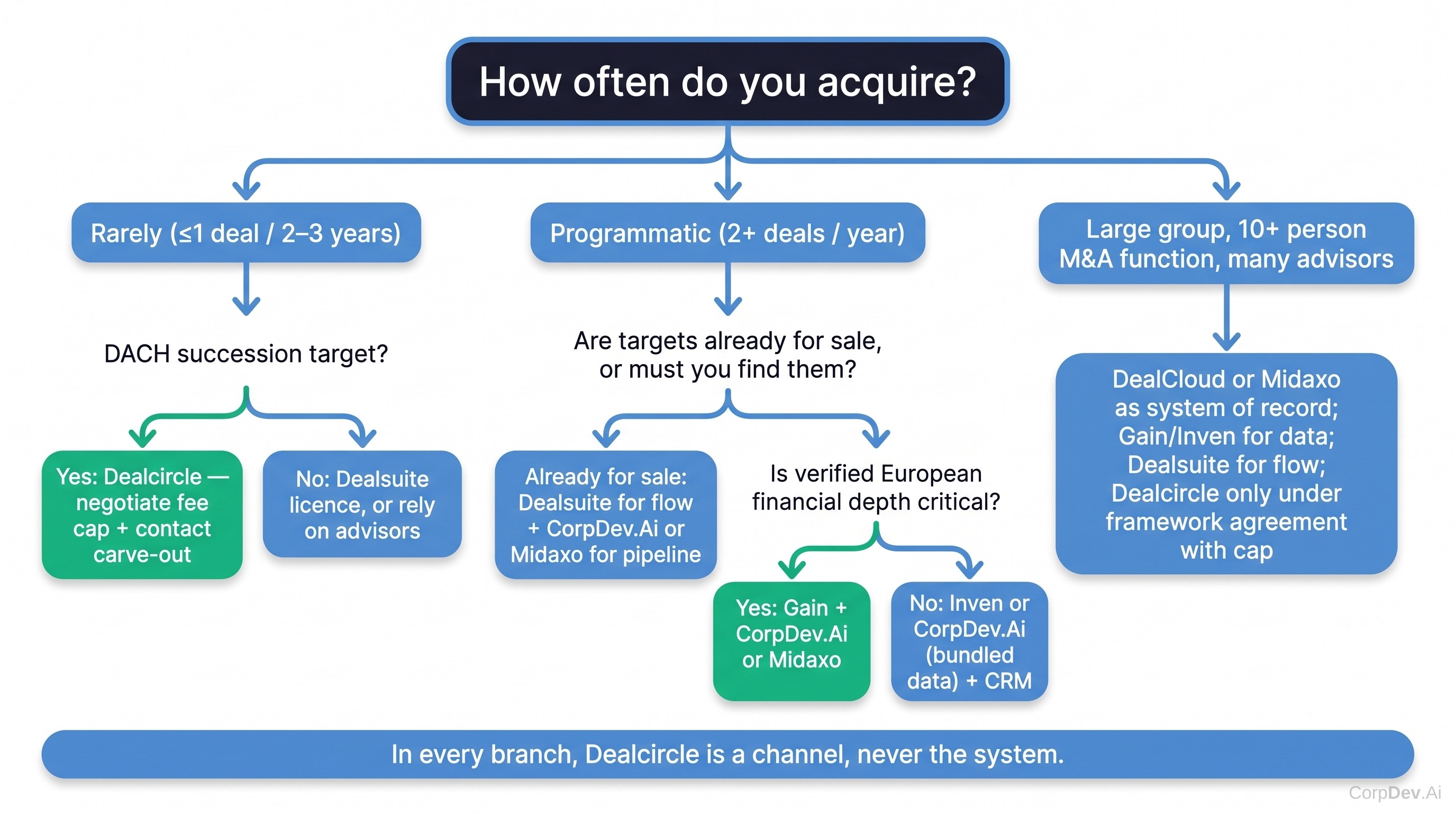
Read diagram description
Decision tree. Root question: "How often do you acquire?"
Branch A "Rarely (≤1 deal / 2–3 years)": next question "DACH succession target?" → Yes: "Dealcircle — negotiate fee cap + contact carve-out"; No: "Dealsuite licence, or rely on advisors".
Branch B "Programmatic (2+ deals / year)": next question "Are targets already for sale, or must you find them?" → "Already for sale": "Dealsuite for flow + CorpDev.Ai or Midaxo for pipeline"; "Must find them": next question "Is verified European financial depth critical?" → Yes: "Gain + CorpDev.Ai or Midaxo"; No: "Inven or CorpDev.Ai (bundled data) + CRM".
Branch C "Large group, 10+ person M&A function, many advisors": "DealCloud or Midaxo as system of record; Gain/Inven for data; Dealsuite for flow; Dealcircle only under framework agreement with cap". "In every branch, Dealcircle is a channel, never the system."
Buyer archetypes
The occasional strategic acquirer — a €200m–€2bn company that buys once every few years, usually in its home market, with no dedicated M&A team. Dealcircle's zero-fixed-cost model fits this buyer well, particularly for DACH succession targets, provided the fee is capped and pre-existing contacts are scheduled at sign-up. A Dealsuite licence is a cheap way to widen the aperture across Europe. A database or process platform may be hard to justify at this cadence unless governance, continuous sourcing or transaction complexity creates an ongoing need; research can be bought per project, and CorpDev.Ai's individual plan at $12,000 a year is one potentially plausible research/workflow purchase, alongside lower-priced CRM options and project-based services [20][43].
The programmatic mid-market acquirer — two to five deals a year, a small dedicated team, a defined thesis. This is where the success-fee model breaks down and where the stack matters most. The evidence from McKinsey's programmatic M&A research is that repeatable acquirers outperform (median excess TSR of 2.3 percentage points annually), and that the discipline of a single target universe, consistent scoring and tracked conversion by channel is what makes the programme work [95]. The fitting stack is a network for on-market flow (Dealsuite; Dealcircle only under a framework agreement with a cap), a discovery engine for proprietary targets (Inven or Gain, or CorpDev.Ai's bundled data layer if a trial on the buyer's own universe holds up) and a system of record (CorpDev.Ai for an AI-first team that wants research and drafting automated; Midaxo for a governance-first team with integration accountability). Total three-year cost of such a stack sits in the €150k–€400k range — spanning the €225k cost of a single 1.5% fee on a €15m deal [43][20][47][59].
The large corporate with a group M&A function — ten or more professionals, dozens of advisor relationships, multiple concurrent processes, board-level reporting. DealCloud or Midaxo as system of record, Gain and/or Inven for data, Dealsuite for flow, and Datasite for execution is the conventional answer, at an all-in cost that can exceed €500k a year [51][47][57]. Dealcircle enters only as a curated DACH channel under a negotiated framework, because at this deal size its uncapped percentage is untenable. The interesting question for this buyer is whether CorpDev.Ai's AI analyst and zero-entry CRM can displace analyst headcount and CRM hygiene effort at a fraction of DealCloud's cost — a question that can only be answered with a pilot, given the current absence of enterprise reference customers [15][27].
The sell-side or dual-mandate corporate — a group that divests as often as it acquires. Dealcircle’s advisor-facing buyer-list service becomes relevant; CYNDX’s former combined target/acquirer/investor matching illustrates the workflow need but is no longer an active recommendation following its announced wind-down, and CorpDev.Ai's CIM and buyer-positioning tooling is worth testing [15][45][67].
Databases produce longlists; networks produce introductions; platforms produce research and pipeline. None of them produces the founder conversation, the management meeting or the LOI. Budget the people — internal or an outsourced origination partner — before budgeting the software, or the platform becomes a well-organised archive of deals nobody pursued.
7. Diligence Questions to Ask Every Vendor
Every vendor in this comparison will present a compelling demo. The questions below are the ones that separate a platform that will change how a team sources deals from one that will sit unused after quarter two. They are grouped by category because the failure modes differ.
For deal networks (Dealcircle, Dealsuite, Axial, AMBER)
- How many unique live mandates matching our written acquisition profile did you distribute in the last 12 months, by country and by EV band? Not database size — mandates.
- What percentage of those mandates were exclusive to your network versus also circulated by the advisor directly or on other platforms?
- For success-fee models: the exact percentage, the fee base (EV, equity value, treatment of earn-outs, vendor loans, assumed debt), the tail period, affiliate and co-investor coverage, and the pre-existing-contact procedure — in writing, before the first introduction [3].
- What is your rebuttal process when we already know a target, and what evidence standard applies?
- How is membership validated, and what prevents a seller or advisor from posting a stale or non-exclusive opportunity?
For target databases (Inven, Grata, Gain, Cyndx, SourceScrub, Dealroom.co)
- Run a blind test: give the vendor 50 companies from our own target universe and measure coverage, financial-data accuracy and ownership accuracy against what we know.
- Where do European private-company financials come from — registry filings, analyst verification, or web inference — and what is the refresh cycle?
- What are the export, API and MCP/agent options, and does the licence permit loading data into our own CRM or AI environment [42]?
- What are the change-of-control and roadmap protections in the contract, given that Grata, SourceScrub and Valu8 have all been acquired since 2025 [30][36]?
- How many seats are truly needed, and what is the per-seat step-up?
For workflow and AI platforms (CorpDev.Ai, Midaxo, DealCloud, Affinity)
- Which named customers of our size and geography can we speak to? For a young vendor with no disclosed funding, what is the financial runway and the data-portability exit path if the company fails or is acquired [27]?
- For zero-entry CRM: what permissions does the email/calendar connection require, what is captured, where is it stored, and can it be scoped to the M&A team's mailboxes only [18]?
- For AI research and memo generation: how are citations generated and verified, what is the hallucination-control process, and can the output be traced to a page in a source document [15][19]?
- For AI data rooms: what are the security certifications (SOC 2, ISO 27001), redaction, watermarking, granular permissions and audit-trail capabilities — and would you position it for a live sell-side auction, or for buy-side analysis only [19]?
- Which AI models process our data, is our data used for training, and can we restrict processing to a specific region or vendor [15]?
- What does the implementation actually cost and take — weeks or months — and what internal FTE commitment does the vendor expect in year one?
Ask each shortlisted vendor whether it offers a trial or paid pilot, and confirm the duration, minimum commitment and data-export terms. Structure it around one real thesis: build the universe in the database or AI platform, push the shortlist into the CRM, run outreach, and log every network-introduced opportunity against it. After 90 days the team will know — from its own data, not the vendor's — which channel produced conversations and at what cost. That evidence is worth more than any comparison matrix, including this one.
Key Facts & Sources
The load-bearing figures in this guide, with their source and status. "Published" means stated by the vendor; "estimate" means a third-party or author estimate; "derived" means calculated in this document from stated inputs.
| Fact | Value | Basis | Source | As of |
|---|---|---|---|---|
| Dealcircle founded / HQ / founders | 2018, Hamburg; Kai Hesselmann & Graig Gröbli | Published (ecosystem report) | [10][11] | Jan 2026 |
| Dealcircle buyer database | 5M+ profiles | Published (vendor claim, not unique users) | [4][8] | Mar 2025 |
| Dealcircle deals advertised to buyers | 1,500+ per year | Published (vendor homepage) | [1] | Mar 2025 |
| Dealcircle projects placed 2024 / plan 2025 | ~1,400 / 2,000+ | Published (funding announcement) | [7] | Jun 2025 |
| Dealcircle projects placed 2025 | ~4,000 | Published (Hamburg ecosystem report; methodology unstated) | [10] | Jan 2026 |
| Dealcircle business model | Buyer-paid success fee, % of transaction volume, per project/framework agreement; 36-month reporting duty | Published (General Terms) | [3] | Mar 2025 |
| Dealcircle fee rate | Undisclosed; 2% alleged by one reviewer; 1.5% used as illustrative assumption | Estimate / assumption | [3][80] | Apr 2025 |
| Dealcircle funding | 7-figure (Round2, 2024); ~€5M (Jun 2025, IFB InnoVentureFonds lead); single-digit €M (Jan 2026, heise ventures) | Published | [7][10][12] | Jan 2026 |
| Dealsuite European licence | €7,500 / €10,000 / €15,000 by revenue band (€10–49m / €50–99m / €100–499m) | Published (tariff sheet) | [43] | 2026 |
| Dealsuite flow / footprint | ~250 new companies/month Europe; users 50+ countries; clients 60+ countries | Published | [43][44][77] | Sep 2026 |
| Axial buyer fee scale | 5% / 4% / 3% / 2% / 1% by $1m band; $200k on $10m | Published | [32] | Jan 2026 |
| CorpDev.Ai pricing | AI Pro $1,000/mo (annual) or $1,200 monthly; Team $3,000/mo or $3,600 monthly; Enterprise custom | Published | [20] | 2026 |
| CorpDev.Ai data coverage | 70M+ companies, 265M+ contacts | Published (vendor claim) | [15][16] | 2026 |
| CorpDev.Ai founding / funding | 2023; no disclosed funding | Directory data | [26][27] | 2026 |
| Inven scale / funding | 28M+ companies; 1,000+ customers; $12.75M Series A | Published | [60][64][65] | Jun 2026 |
| Grata pricing | ~$15k entry / ~$40k mid / ~$100k enterprise | Estimate (third party) | [37][38] | 2026 |
| Grata reach | Customers in 26 countries; Valu8 data integrated; MCP server | Published | [39][42] | Aug 2026 |
| Datasite acquisitions | SourceScrub (Aug 2025); Valu8 (May 2026) | Published (press releases) | [30][36] | May 2026 |
| Gain.pro → Gain rebrand | 8 Sep 2026 | Published | [73] | Sep 2026 |
| Gain pricing | ~$25k–60k | Estimate (third party) | [59] | 2026 |
| Cyndx scale / pricing | 33M+ companies; ~$30k–75k | Published / estimate | [66][67][68] | 2026 |
| Dealsuite–Cyndx partnership | Published announcement; exact date and current service availability unconfirmed | Published, undated live page | [45] | Rechecked 14 Sep 2026 |
| Midaxo pricing | ~$25k–150k/yr; mid-range ~$45–90k | Estimate (third party) | [47][48] | Sep 2026 |
| Midaxo AI update | Announced Aug 2026 | Published | [50] | Aug 2026 |
| DealCloud cost | ~$85k/yr mid-market before implementation | Estimate (third party) | [51] | Feb 2026 |
| Intapp Celeste GA / OpenAI collaboration | Jul 2026 / Sep 2026 | Published | [52][53] | Sep 2026 |
| Affinity pricing | ~$2,000–2,700 per user/yr | Estimate (third party) | [54][55] | Jul 2026 |
| Dealroom.co pricing | €12,600/yr Premium (3 seats); €17,000/yr Premium Plus | Published | [70][71] | 2026 |
| Corporate deal sourcing split | 38% direct/employee-generated; 32% intermediaries | Benchmark (single source; directional) | [87] | Jul 2026 |
| Buy-side advisor economics | $7.5k–25k/month retainer + 1–3% success | Market guide | [90][91] | 2026 |
| Programmatic M&A outperformance | Median excess TSR +2.3 pp/yr | McKinsey | [95] | Feb 2025 |
| GenAI in M&A adoption | 21% of practitioners (Bain, 2025); 40% of genAI users report 30–50% shorter cycles (McKinsey) | Consultancy surveys | [94][96] | Mar 2026 |
| Section 5 TCO figures | 3-year expected cost per archetype | Derived — see derivation table in Section 5 | — | Sep 2026 |
| USD/EUR conversion | $1 ≈ €0.92 | Assumption | — | Sep 2026 |
Most feature and scale claims for Dealcircle, CorpDev.Ai, Inven and Grata are vendor-published. Independent review coverage is thin across the category. Pricing for Inven, Gain, Cyndx, Grata, Midaxo and DealCloud is quote-based and the ranges shown are third-party estimates that should be replaced by quotes before use in a business case. Dealcircle's deal-volume series is internally inconsistent and its fee rate is unpublished.
References
Numbering follows the original research. Access dates below record the original source registry; they do not imply that every source was rechecked for this website edition.
- Home - DEALCIRCLESource accessed 2026-09-12
- Our process - DEALCIRCLESource accessed 2026-09-12
- General Terms and Conditions - DealCircleSource accessed 2026-09-12
- For buyersSource accessed 2026-09-12
- Buyer - DealCircleSource accessed 2026-09-12
- Dealcircle uses AI to assist with business successionSource accessed 2026-09-12
- Capital for acquisitions: DEALCIRCLE raises around € 5 millionSource accessed 2026-09-12
- DatabaseSource accessed 2026-09-12
- DealCircle: HomeSource accessed 2026-09-12
- New financing round for DEALCIRCLE in the million rangeSource accessed 2026-09-12
- DEALCIRCLE gewinnt heise ventures als strategischen PartnerSource accessed 2026-09-12
- DealCircle Receives 7 Figure FinancingSource accessed 2026-09-12
- CorpDev.Ai - Agentic AI for M&A and Corporate DevelopmentSource accessed 2026-09-12
- Deep Company Intelligence & Research for M&ASource accessed 2026-09-12
- Simple, Powerful AI Pipeline CRM for M&A - CorpDev.AiSource accessed 2026-09-12
- CorpDev.Ai vs DealRoom Pipeline: Free Zero-Entry CRM vs Manual ...Source accessed 2026-09-12
- Pricing - CorpDev.AiSource accessed 2026-09-12
- Pricing - CorpDev.AiSource accessed 2026-09-12
- CorpDev.Ai vs Grata: Pricing & Features ComparisonSource accessed 2026-09-12
- CorpDev.Ai vs Inven: Pricing & Features ComparisonSource accessed 2026-09-12
- Kal Kilpi | LinkedInSource accessed 2026-09-12
- AI Roll-Ups — Two Hard Jobs, One System | CorpDev.AiSource accessed 2026-09-12
- Compare CorpDev.Ai vs. Rogo in 2026Source accessed 2026-09-12
- CorpDev.Ai Revenue, Funding & Valuation - ProspeoSource accessed 2026-09-12
- Midaxo Pricing 2026Source accessed 2026-09-12
- Midaxo Reviews 2026: Details, Pricing, & Features - G2Source accessed 2026-09-12
- Datasite to Acquire Sourcescrub, Expanding Private Market ...Source accessed 2026-09-12
- Grata vs SourceScrub: Honest Comparison (2026) - ProspeoSource accessed 2026-09-12
- Acquire and Invest in Middle Market Companies | AxialSource accessed 2026-09-12
- Axial: M&A and Capital Raising Platform for the Middle MarketSource accessed 2026-09-12
- The Advisor Finder Report: Q4 2025 - AxialSource accessed 2026-09-12
- Ai For M&a FaqSource accessed 2026-09-12
- Datasite Acquires Valu8 to Further Accelerate Global, AI-Driven ...Source accessed 2026-09-12
- PricingSource accessed 2026-09-12
- Grata Pricing, Reviews, Pros and Cons (2026)Source accessed 2026-09-12
- Grata Expands Global Intelligence Platform with Integrated ...Source accessed 2026-09-12
- Allow Me to Introduce Agentic SearchSource accessed 2026-09-12
- Grata Expands AI Ecosystem with Native MCP Integration ...Source accessed 2026-09-12
- Dienstverlening & tarievenSource accessed 2026-09-12
- The Leading European M&A Platform - DealsuiteSource accessed 2026-09-12
- Press Release: Dealsuite Partners with Cyndx to ...Source accessed 2026-09-12
- Midaxo 2026 Pricing, Features, Reviews & Alternatives | GetAppSource accessed 2026-09-12
- Best Post-Merger Integration Software in 2026Source accessed 2026-09-12
- DealCloud vs. Midaxo Comparison 2026 - G2Source accessed 2026-09-12
- Midaxo closes Q2 with new customers and a major AI updateSource accessed 2026-09-12
- Best M&A Deal Management Software 2026: DealCloud, DatasiteSource accessed 2026-09-12
- News detailsSource accessed 2026-09-12
- Intapp collaborates with OpenAI to deliver a governed DealCloud ...Source accessed 2026-09-12
- Affinity Review (2026): Pricing, Pros & Cons - CRM NewspaperSource accessed 2026-09-12
- Affinity Review 2026: VC/PE Relationship Intelligence CRM ...Source accessed 2026-09-12
- Affinity Pricing: Plans for Private Capital CRMSource accessed 2026-09-12
- Datasite Review - DataRoomPro.orgSource accessed 2026-09-12
- Inven vs. Grata: Feature and Performance Overview 2026Source accessed 2026-09-12
- The Best Platforms for Deal Sourcing (Updated 2025) - inven.aiSource accessed 2026-09-12
- Inven overviewSource accessed 2026-09-12
- Why Inven | InvenSource accessed 2026-09-12
- What are the best deal origination platforms for investment ...Source accessed 2026-09-12
- Online Deal Sourcing Platforms: Which Ones Actually WorkSource accessed 2026-09-12
- Inven Raises $12.75M to Build the AI Backbone of Private ...Source accessed 2026-09-12
- Inven surpasses 1000 customers in the M&A marketSource accessed 2026-09-12
- Cyndx Pricing 2026Source accessed 2026-09-12
- AI deal origination platform - CyndxSource accessed 2026-09-12
- The Cyndx PlatformSource accessed 2026-09-12
- Cyndx Launches Upgraded Scholar Deep Research Product and ...Source accessed 2026-09-12
- Dealroom · Rating Snapshot: Score & Reviews (2026)Source accessed 2026-09-12
- Pricing | Dealroom.coSource accessed 2026-09-12
- Dealroom Pricing Reviews Pros and Cons: Worth It in 2026? - TombaSource accessed 2026-09-12
- Gain.pro Rebrands as Gain, Launching the Private Markets ...Source accessed 2026-09-12
- About Us | Dealsuite - Company OverviewSource accessed 2026-09-12
- DEALCIRCLE gains heise ventures as strategic partnerSource accessed 2026-09-12
- FeaturesSource accessed 2026-09-12
- FAQSource accessed 2026-09-12
- Contact - Buyers and investors - DEALCIRCLESource accessed 2026-09-12
- M&A Platform for MBI Candidates & Acquisition OpportunitiesSource accessed 2026-09-12
- DealCircle Bewertungen 35Source accessed 2026-09-12
- What Buyers are saying - DealCircleSource accessed 2026-09-12
- Case Study: audius GroupSource accessed 2026-09-12
- Case Study: HWB GroupSource accessed 2026-09-12
- Case Study: Walter Fries Corporate FinanceSource accessed 2026-09-12
- How to Benchmark Your Deal Sourcing PipelineSource accessed 2026-09-12
- How to Source Business Acquisition Deals (2026)Source accessed 2026-09-12
- How Buy-Side Advisory WorksSource accessed 2026-09-12
- Best Deal Sourcing Tools for Acquirers (2026) | CT AcquisitionsSource accessed 2026-09-12
- Gen AI: Opportunities in M&A - McKinseySource accessed 2026-09-12
- AI meets M&ASource accessed 2026-09-12
- M&A Annual Report: Is the wave finally arriving?Source accessed 2026-09-12
- M&A market poised for a comeback in 2025 as headwinds ease ...Source accessed 2026-09-12