RESEARCH / Deal sourcing networks
DealNexus alternatives: legacy network status, deal flow and M&A sourcing
Assess legacy DealNexus and compare Axial, Dealsuite, Grata, Inven and M&A platforms on active deal flow, target intelligence, buyer fees and workflow costs.
Research as of
Website edition edited
Published by CorpDev.Ai, which is one of the vendors assessed. This analysis distinguishes vendor claims, external evidence and analyst judgments. Prices and capabilities reflect the source dates in the article; the website edition is an editorial adaptation, not a new verification of every claim.
Recover the network function without assuming the legacy brand survives
The legacy DealNexus proposition was access to a qualified, confidential network of marketed opportunities. Its current availability and the relationships among similarly named sites could not be established from the reviewed evidence. For a buyer, that uncertainty is substantive: historical membership figures and Intralinks’ reputation should not be transferred to a present-day counterparty without confirming the operator and service.
Once that identity question is separated from the sourcing need, the alternatives become clearer. Axial and Dealsuite address access to marketed deals; Grata and Inven address proactive company discovery; lifecycle and analytical platforms address what happens after identification. A marketplace’s contingent fee can be material, but a cheaper database does not replicate seller access. Test network liquidity in the actual sector, geography and transaction size, then track qualified conversations and fee attribution alongside existing channels. The purchase should follow evidence of relevant, incremental opportunities. Historical scale, a familiar name or a large company database is insufficient if it does not improve the team’s path to a transaction it would want to complete.
Executive Summary
This guide is published by CorpDev.AI, which is both a subject of the comparison and the platform used to produce it. Every claim about CorpDev.AI below is drawn from its public website and labelled as vendor-stated where it cannot be independently verified. Separately, the platform under review — DealNexus at dealnexus.com — could not be reached during research, and the evidence indicates that the original Intralinks DealNexus network is no longer marketed as a live product. Section 4 explains what that means for a buyer.
The name "DealNexus" carries weight in M&A circles because for most of the 2010s it was the largest qualified deal-sourcing network in the industry: launched by Intralinks in 2013 from the merger of PE-Nexus and MergerID, it reached roughly 13,000 professionals and 7,400 member firms and was free to qualified members [1][22]. In 2026, however, a buyer searching for it finds a fractured picture. Intralinks — an SS&C Technologies business since its $1.5 billion acquisition in 2018 [86] — no longer lists DealNexus among its current products or login options [87][90]; a separate business at dealnexus.net markets itself as a "verified marketplace" for direct-to-owner acquisitions with no demonstrated relationship to SS&C [7][89]; and dealnexus.com itself could not be retrieved. The practical conclusion is that current availability of the legacy DealNexus service could not be verified, and that any 2026 "DealNexus" must be treated as an unverified counterparty until its legal entity and operator are confirmed.
That finding reframes the question. The real decision for a corporate development, strategy or M&A team is not "DealNexus or an alternative" but which of three quite different categories of tool solves the problem DealNexus used to solve — and whether the category boundaries still matter. The market has split into (1) deal-flow marketplaces and networks that surface marketed opportunities (Axial, Dealsuite, and the legacy DealNexus model); (2) private-company intelligence databases built for proactive, off-market origination (Grata, SourceScrub, Inven, Cyndx); and (3) pipeline and process platforms that manage a deal once it exists (Midaxo, DealRoom, Devensoft, DealCloud, Affinity). A fourth category is emerging fast: AI-native workspaces such as CorpDev.AI that bundle research, sourcing, pipeline and document production behind an AI analyst, and that compete less on a single feature than on collapsing the number of tools and analyst-hours a small team needs.
13,000+
Professionals on legacy DealNexus at peak (2015)
None found
Pages marketing DealNexus in the SS&C / Intralinks material reviewed
45%
M&A practitioners using AI in deals, 2025 (Bain)
$1k–$60k+
Annual price band across the alternatives compared
Three conclusions matter most for a buyer:
- Marketplaces are a channel, not a system. Axial and Dealsuite replace the legacy DealNexus function most directly — a qualified, confidential venue for marketed deals — and Axial's success-fee model means a corporate buyer pays nothing until a deal closes [27]. But marketed deals are by definition competitive, and no marketplace gives a strategy team the proprietary, thesis-driven target universe that boards increasingly expect. Treat them as one inbound channel in a broader sourcing programme.
- Intelligence databases are where most proactive sourcing budget now goes — and they are converging with AI research. Grata (22M+ companies, 4.9/5 on G2 from 81 reviews), SourceScrub (16M+), Inven (28M+, 4.7/5 from 101 reviews) and Cyndx all price in the roughly $15,000–$60,000-per-year band on sales-led contracts [33][36][93][98]. They are excellent at finding companies; they are weaker at explaining strategic fit, producing the memo, or running the pipeline — gaps that AI-native entrants are targeting explicitly.
- Process platforms and AI workspaces are answering different questions about the same team. Midaxo, DealRoom and Devensoft assume a team that already has deal flow and needs governance, diligence and integration discipline; their pricing ($15,000–$150,000+ per year) reflects enterprise workflow depth [52]. CorpDev.AI, at a published $1,000 per month for an individual and $3,000 per month for a three-seat team, is priced like a productivity subscription rather than an enterprise system, and its value case rests on replacing analyst hours and consultant spend rather than on workflow governance [14]. Its claims of "100× faster at 1% the cost" are marketing and unverified [12], and it lacks the G2 review base of the incumbents — but its architecture (AI analyst plus 70M-company sourcing plus CRM plus AI data room) is the clearest expression of where the whole category is heading.
| Category | Products / dated scale | Role in origination and execution |
|---|---|---|
| Marketed deal networks | Axial: US lower middle market, success fee; Dealsuite: Europe, ~2,000 firms; legacy DealNexus: status unverified in the original 2026 research | Inbound/marketed deal access; not a full proprietary-research workflow. |
| Private-company intelligence | Grata 22M+ company claim; Sourcescrub 16M+; Inven 28M+; historical CYNDX | Proactive target discovery; requires a way to track relationships and decisions. |
| Pipeline and process | Midaxo, DealRoom, Devensoft, DealCloud, Affinity | Internal process and relationship records; integration depth differs by product. |
| Integrated AI workspace | CorpDev.AI: AI analyst, 70M-company sourcing claim, CRM and AI Room | Combines parts of proactive research and internal deal workflow; does not establish a proprietary marketed-deal network. |
Discovery and process categories are converging. Choose the required job before looking for a DealNexus lookalike, and verify the operator of any similarly named live service. CYNDX is historical context: its official site announces wind-down and dissolution, checked 14 September 2026, without an announcement date. It is not an active purchasing recommendation. CYNDX official site.
Decision in one paragraph. A corporate acquirer whose bottleneck is seeing enough marketed deals should join Axial (North America) or Dealsuite (Europe) — upfront cost may be limited, but subscription terms, success-fee exposure and irrelevant matches require assessment. A team whose bottleneck is building and defending a proprietary target thesis should shortlist Grata or Inven, and evaluate CorpDev.AI alongside them if the team is small and also needs the memo, the market map and the pipeline produced without adding headcount. A serial acquirer whose bottleneck is executing and integrating deals it already has should buy Midaxo, DealRoom or Devensoft and connect a sourcing tool to it. Nobody should sign with any entity trading as "DealNexus" in 2026 without first confirming who operates it.
Who This Guide Is For — and How to Read It
This guide is written for the person who has to sign the purchase order: a head of corporate development, a strategy director with an inorganic-growth mandate, a private-equity origination lead, or a partner at a boutique advisory firm. It assumes the reader knows how a deal works and wants to know how the tools differ, what they actually cost, and which failure modes to expect. It does not assume the reader has used any of them.
Four buyer archetypes recur throughout, and the recommendations differ sharply between them:
Typical size: 2–8 people
Bottleneck: turning a board-level thesis into a defensible target universe, then producing the memo
Buys: intelligence database and/or AI workspace; process platform once deal cadence exceeds ~3 per year
Typical size: 3–15 people, M&A is one of several mandates
Bottleneck: market mapping and research bandwidth; consultant spend
Buys: research and market-mapping capability first; sourcing second
Typical size: deal team of 3–20
Bottleneck: proprietary deal flow and relationship coverage
Buys: relationship CRM (Affinity, DealCloud) plus a database; marketplaces as a supplementary channel
Typical size: 2–25 professionals
Bottleneck: buyer lists on the sell side; mandate flow on the buy side
Buys: marketplaces (Axial, Dealsuite) for distribution; a database for buyer identification
How to read the comparisons. Three conventions apply throughout. First, every scale metric is labelled by type: "members" (a network), "companies" (a database) and "deals" (marketplace inventory) are not interchangeable, and vendors routinely quote the flattering one [33]. Second, pricing is reported as published where a vendor publishes it, and as market estimate where it is drawn from third-party comparison sites — the latter are indicative only, and the confidence in each figure is stated in the Key Facts appendix. Third, G2 review scores are reported with their review counts, because a 4.6 from 12 reviews and a 4.4 from 423 reviews are not comparable evidence [57].
Finally, a note on independence. This guide was produced using CorpDev.AI and is published by the same company, one of the platforms compared. The mitigation is transparency rather than omission: CorpDev.AI is held to the same evidence standard as every other vendor, its unverified performance claims are flagged as such, and the decision framework in Section 8 names the situations in which it is not the right purchase.
The Deal-Software Landscape in 2026
There is no such thing as an "M&A software market" with a clean market-size figure. Syndicated research measures only the virtual data room segment — somewhere between $2.6 billion and $3.6 billion in 2025 depending on the definition used, growing at 10–22% a year [72][74][75] — and leaves the sourcing, CRM, pipeline and research layers unmeasured. What can be said with confidence is that the demand environment is strong (global M&A value reached roughly $4.8 trillion in 2025, per Bain [77][80]) and that the stack a deal team buys has historically been fragmented by deal stage.
The traditional stack, and why it is dissolving
For most of the past decade a well-equipped corporate development team ran four or five separate systems: a company database or data provider for target identification; a CRM or spreadsheet for pipeline; a virtual data room for diligence; Excel and PowerPoint for valuation and committee materials; and, if the team was a serial acquirer, a project-management tool for integration. Marketplaces such as DealNexus and Axial sat beside this stack as an inbound channel rather than inside it.
Three forces are now collapsing that structure [70][71][78]:
- Shared data models. Buyers are tired of re-keying the same target into a database, a CRM and a data room. Vendors that started in one layer are extending into adjacent ones — DealRoom added a pipeline to its data room; Grata added pipeline tracking to its database; Datasite added AI diligence to its VDR.
- AI moving from chatbot to workflow. Bain's 2025 survey found AI use in M&A had more than doubled to 45% of practitioners, with roughly a third using it systematically or redesigning processes around it [80][81]. McKinsey reports that 40% of generative-AI users saw deal cycles shorten by an average of 30–50% [83], while noting that most adoption is still moderate and chatbot-based rather than embedded [82]. Deloitte's survey of 1,000 US corporate and PE leaders found 86% had integrated generative AI into M&A workflows, with the leading use cases being strategy and market assessment (40%), target identification (35%) and diligence (35%) [84].
- Small-team economics. Corporate development functions are typically small and cannot support complex deployments. Vendors that lower the implementation burden — templates, no-code workflow, published pricing, self-serve trials — are winning share from those that require a services engagement.
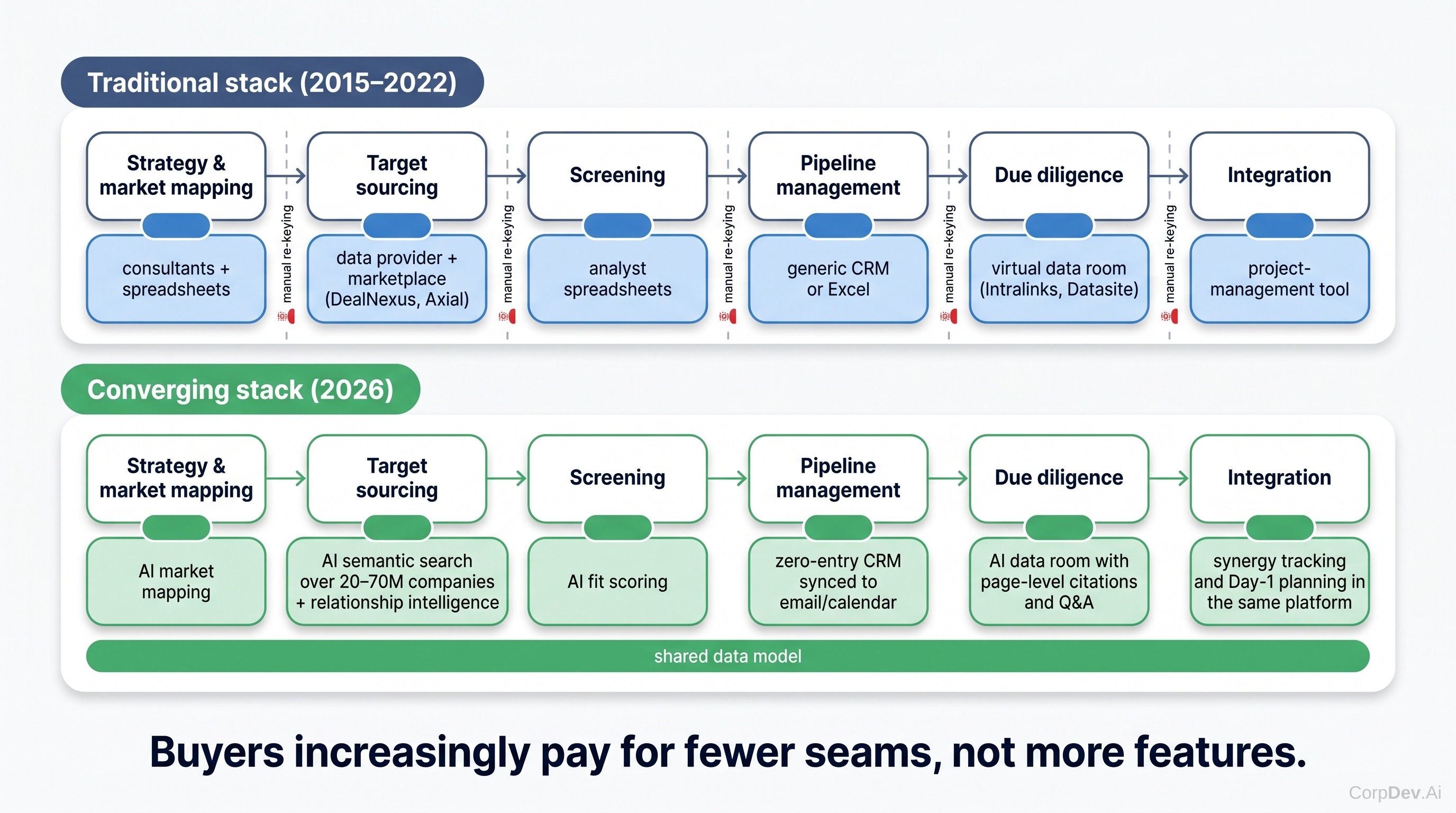
Read diagram description
Two swim-lanes, each through six deal stages: Strategy & market mapping → Target sourcing → Screening → Pipeline management → Due diligence → Integration. Top lane titled "Traditional stack (2015–2022)": Strategy = consultants + spreadsheets; Sourcing = data provider + marketplace (DealNexus, Axial); Screening = analyst spreadsheets; Pipeline = generic CRM or Excel; Diligence = virtual data room (Intralinks, Datasite); Integration = project-management tool. Bottom lane titled "Converging stack (2026)": Strategy = AI market mapping; Sourcing = AI semantic search over 20–70M companies + relationship intelligence; Screening = AI fit scoring; Pipeline = zero-entry CRM synced to email/calendar; Diligence = AI data room with page-level citations and Q&A; Integration = synergy tracking and Day-1 planning in the same platform. The traditional stack requires manual re-keying between stages; the converging stack aims to use a shared data model. "Buyers increasingly pay for fewer seams, not more features."
Four categories a buyer will actually encounter
The convergence is real but incomplete, and in 2026 the market still sorts into four recognisable categories. Understanding which category a vendor started in explains most of its strengths and blind spots.
| Category | What it is optimised for | Representative vendors | Typical commercial model |
|---|---|---|---|
| Deal marketplaces and networks | Confidential distribution and discovery of marketed opportunities; two-sided matching of mandates | Axial, Dealsuite, legacy Intralinks DealNexus | Success fees (Axial); membership subscriptions and negotiated access terms (Dealsuite) |
| Private-company intelligence databases | Proactive, off-market identification of targets; market mapping; executive contacts | Grata, SourceScrub, Inven, Cyndx | Sales-led annual SaaS, ~$15k–$60k+ |
| Pipeline and process platforms | Governance of deals that already exist: stage gates, diligence request lists, VDR, integration, synergy tracking | Midaxo, DealRoom, Devensoft; relationship CRMs Affinity and DealCloud | Sales-led annual SaaS, ~$15k–$150k+; per-seat for CRMs |
| AI-native corporate development workspaces | Compressing analyst work — research, memo, market map, sourcing, pipeline — behind an AI agent | CorpDev.AI; adjacent AI features inside Grata, Inven, Midaxo (Madi), DealRoom AI | Published subscription (CorpDev.AI, from $1k/month) or AI bundled into incumbent contracts |
Because every incumbent is racing to add the adjacent layer, a buyer in 2026 can credibly demand that a database vendor include pipeline tracking, that a process platform include AI summarisation, and that an AI workspace include a real data room — and can use published-price entrants as a negotiating anchor against sales-led incumbents. A shorter initial term can preserve flexibility while categories evolve; compare its pricing and protections against a longer negotiated commitment.
DealNexus in Depth
What DealNexus was
Intralinks launched DealNexus in September 2013 by combining two networks it had acquired — PE-Nexus, a private-equity matching network, and MergerID, a cross-border deal-matching service — into a single "global deal sourcing network" for qualified M&A professionals [1][2]. The proposition was specific and, at the time, genuinely novel: a members-only marketplace where sell-side advisors could distribute teasers to a controlled list of vetted buyers, buy-side firms could post a mandate (a "buy box") and receive matched opportunities, and both sides could search deals, portfolio companies and member firms behind a confidentiality wall [5][6].
The product's core capabilities, as documented in Intralinks' own materials, were [5]:
- Buy-side mandates — acquirers defined acquisition criteria and received real-time match notifications.
- Sell-side private processes — advisors generated buyer lists, distributed teasers selectively, and could revoke access to teasers and NDAs.
- Searchable inventory — deals, buy-side mandates, member firms and, from January 2015, a database of more than 57,000 portfolio companies [8].
- Professional network — member profiles, browsing and direct messaging, positioned as "LinkedIn for dealmakers."
- Qualified membership — screening of applicants to keep the network professional rather than a business-for-sale classifieds site.
Membership was free to qualified professionals [1]; Intralinks monetised the network indirectly through its data room business. Scale grew quickly: 5,000+ firms at launch, nearly 6,300 organisations by early 2015, and by late 2015 Intralinks reported more than 13,000 professionals and 7,400 member firms with deal-profile volume up over 50% year on year and roughly 1,300 new opportunities per quarter [1][8][22][23]. Historic materials claimed coverage of 150+ countries and more than $100 billion of hosted deal flow [5].
What happened to it
Intralinks was acquired by SS&C Technologies in 2018 for about $1.5 billion [86]. From that point the public record on DealNexus goes quiet. The current Intralinks website positions the business as an "AI M&A and dealmaking solutions provider" built around its data room (VDRPro/Dealspace), DealCentre and Intralinks VIA [87][90]; DealNexus does not appear among the current products or on the login page [87]. Third-party tool directories still list "Deal Nexus" with figures such as 12,000 dealmakers and 7,000 member firms, but those figures cannot be traced to any current SS&C source and appear to be inherited from the 2015 press cycle [9].
Meanwhile a business at dealnexus.net now uses the DealNexus name. It describes itself as a "verified marketplace for large-scale acquisitions" and a "National Business Concierge" connecting capital allocators directly with business owners, emphasising "zero brokerage tax", all-50-states coverage, vetted buyers, audited financials and NDA-secured workflows [7][89]. Its LinkedIn page points to the .net domain [88]. Nothing in its public materials documents an acquisition of, or trademark licence from, SS&C Intralinks.
dealnexus.com — the .com domain under review — could not be retrieved during research (the site timed out and is subject to robots restrictions), so its current content and registrant are unconfirmed.
A buyer in 2026 may encounter (a) the legacy Intralinks network, which is no longer marketed and may be dormant or absorbed; (b) dealnexus.net, an apparently separate direct-to-owner marketplace with no demonstrated SS&C affiliation; and (c) dealnexus.com, whose operator is unverified. Because the use case involves uploading teasers, mandates and NDAs, confirm the legal entity, privacy policy, data-residency terms and the relationship between the three domains before creating an account. Ask SS&C Intralinks directly whether it still operates any DealNexus service.
Strengths of the model — and what a buyer should look for in a successor
The legacy DealNexus design still describes what a good deal network should do, and it is the yardstick against which Axial and Dealsuite should be judged:
- A qualified, two-sided audience. Screening kept out tyre-kickers and gave advisors confidence to circulate teasers. Any successor should publish its membership criteria and vetting process.
- Mandate-driven matching. Buy boxes with real-time alerts made sourcing systematic rather than opportunistic. This is now table stakes in Axial and Dealsuite, and the AI "fit scoring" in databases such as Grata and CorpDev.AI is the proactive descendant of the same idea [15][36].
- Controlled disclosure. Selective distribution and revocable access to teasers and NDAs protected sell-side confidentiality — features that mattered more to advisors than to buyers, and that explain why marketplaces are populated mostly by intermediaries.
- Free access for principals. Corporate acquirers paid nothing, which is why DealNexus achieved network breadth quickly. Axial preserves low upfront buyer access but introduces a material success fee, so its transaction economics differ from free legacy DealNexus membership [27].
Weaknesses of the model that a buyer should not repeat
- Liquidity is not the same as registration. 13,000 registered professionals says nothing about how many active mandates exist in a given sector, geography and size band today. Ask any marketplace for active mandates and closed-deal references in your specific segment, not cumulative sign-ups.
- Marketed deals are competitive deals. By the time an opportunity reaches a network, it is being shown to many buyers. For a corporate acquirer with a differentiated thesis, the marketplace is a complement to proprietary outreach, never a substitute.
- Intermediary overlap and noise. Networks amplify duplicate approaches, teaser recirculation and principal-advisor conflicts.
- No downstream workflow. DealNexus was sourcing only. Everything after first contact — pipeline, diligence, memo, integration — lived elsewhere. That gap is precisely what the pipeline platforms and AI workspaces described in the next section now sell into.
- Thin independent review evidence. There were never substantial DealNexus-specific reviews; Intralinks' VDR ratings (about 3.6–4.1 on G2 and Capterra, 3.8/5 aggregated across 53 reviews on one 2026 tracker) are not a proxy [10][11][24].
Verdict
As a concept, DealNexus was right: a confidential, qualified, mandate-driven network is a useful inbound channel for any acquirer. As a 2026 purchase, it is not currently a verifiable option. Buyers who want the DealNexus function should evaluate Axial (North America) or Dealsuite (Europe), which are covered next, and should treat any current DealNexus-branded site as an unverified new entrant rather than as the Intralinks network they may remember.
The Main Alternatives
The alternatives are grouped by the category each vendor started in, because that origin explains what it does well and where it stops. Within each group, vendors are assessed on the same five dimensions: what it is optimised for, coverage or scale (labelled by metric type), commercial model, independent evidence, and the buyer it fits.
Deal Marketplaces and Networks (Axial, Dealsuite)
These are the direct functional successors to DealNexus: confidential venues where marketed opportunities meet qualified buyers.
Axial is the dominant North American lower-middle-market network, focused on transactions of roughly $2.5 million to $250 million in enterprise value across M&A, debt, minority equity and co-investment [25][26]. It reports more than 3,500 advisory firms and around 3,000 corporate and financial buyers, with some 4,500 investors and acquirers targeting the lower middle market through the platform annually [26][28]. Buyers create profiles and acquisition criteria, receive matched deals, and manage NDA and CIM exchange in-platform; advisors use it for buyer discovery and controlled distribution.
The commercial model is the important differentiator: buyers pay no subscription and instead owe a success fee on transactions sourced through Axial — 5% of the first $1 million of value, stepping down through 4%, 3% and 2% on successive million-dollar tranches, and 1% above $4 million [27]. For a corporate acquirer this is attractive on a small deal and material on a large one; a $50 million acquisition sourced via Axial would carry a fee of about $600,000 (5%+4%+3%+2% on the first $4 million, plus 1% of the remaining $46 million). Independent review evidence is thin — Axial publishes its own testimonials rather than carrying a substantial G2 profile [29] — so diligence should rest on references in the buyer's sector.
Dealsuite is the European counterpart: a private, manually validated marketplace serving SME and lower-middle-market advisors, PE firms, corporate buyers and MBI candidates, with official materials citing 1,500–2,000 member firms and up to 8,000 professionals across 50–60 countries and deals added daily [41][42][45]. Pricing is custom, with seller pricing tied partly to company revenue; third-party estimates put typical access at roughly $5,000–$15,000 a year, though this is not an official rate [33][44]. Its strongest proof points are qualification, manual validation and daily flow; its weakest is the absence of any meaningful independent review base [42][45].
A marketplace may increase the number of opportunities a team sees when it has sufficient active inventory in the relevant size band and geography. It will not increase their proprietary quality — every deal on it is being shown to other members — and it will do nothing for the pipeline, the memo or the diligence. Budget for it as a channel with a defined owner and a monthly review of match quality, not as the sourcing strategy.
Private-Company Intelligence Databases (Grata, SourceScrub, Inven, Cyndx)
If DealNexus answered "what is for sale?", these answer "who should we be talking to?" They are the tools most corporate development teams now buy first, and they are the category where AI has already changed the product.
Coverage: 22M+ companies, 10M+ executive contacts, 1M+ transactions (database metrics) [36]
Optimised for: proactive origination — semantic and keyword search, similar-company search, private financials, banker and mandate data, seller-intent signals, buyer-list and pipeline tracking, CRM/API integration [35][36]
Pricing: sales-led, custom; market estimate from ~$15,000/year [33]
Evidence: 4.9/5 on G2 from 81 reviews — the strongest review profile in the category [36]
Fits: PE and corporate teams that want the broadest US-centric private-company view with light pipeline functionality
Coverage: 16M+ companies drawn from 290,000+ sources and lists (conference attendee lists, award lists, trade groups) [30][34]
Optimised for: bootstrapped-company discovery, market mapping, scoring models, signal monitoring, verified contacts, SourcingGPT and Similar Companies AI, CRM integrations [30][31]
Pricing: sales-led annual SaaS; tiered by companies tracked (250- and 1,000-company plans); market estimate ~$20,000–$60,000/year [32][33]
Evidence: limited public review detail; customer materials emphasise accuracy and workflow fit [31]
Fits: teams whose targets are founder-owned and under-covered by conventional databases
Coverage: 28M+ companies (2026 materials; earlier pages cite 21M+) [92][93]
Optimised for: natural-language search by what a company actually does, AI list refinement and enrichment, intent-to-sell signals, market maps, source-linked European financials, one-pagers and PowerPoint output in the firm's template; CRM and contacts included [92][94][95][96]
Pricing: custom, quote-based; packages referred to as Discovery, Sourcing+ and Professional [96][97]
Evidence: 4.7/5 on G2 from 101 reviews; 9.2 ease-of-use score; price is the most common qualification [98][100][101]
Fits: European and cross-border teams; buyers who want AI-first search plus deliverable output without an enterprise contract
Coverage: AI-mapped companies, investors and transactions; no reliable public total [37]
Optimised for: target and buyer discovery, comp-set construction, dynamic multiples and valuation, capital-source research, relationship intelligence [37][38]
Pricing: Owner edition free for small cap tables; Raiser and Finder editions (3 seats) on request; enterprise undisclosed [39]
Evidence: 4.6/5 on G2 from 20 reviews [40]
Historical fit: bankers and corporate development teams seeking buyer mapping and valuation context with sourcing. CYNDX has announced wind-down and is not an active purchasing recommendation.
Where the databases stop. All four are excellent at producing a long list. Their coverage beyond discovery varies: Grata and Inven include analysis, pipeline and deliverable features, while full committee approval and integration governance generally require additional workflow. Evaluate the actual fit assessment and memo output rather than assuming every database stops at a longlist. A corporate development team buying a database should budget analyst time (or a second tool) for everything after the list. This is the gap the AI-native entrants attack, and it is why vendor comparison pages from CorpDev.AI target Grata and Inven specifically [17][19].
M&A Pipeline and Process Platforms (Midaxo, DealRoom, Devensoft, Affinity, DealCloud)
These platforms assume deal flow exists and sell governance: stage gates, approvals, diligence request lists, data rooms, integration workplans and synergy tracking. They are the right purchase for a team whose problem is execution discipline, and the wrong first purchase for a team whose problem is finding deals.
| Platform | Optimised for | Commercial model | G2 (score / reviews) | AI in 2026 |
|---|---|---|---|---|
| Midaxo | Full lifecycle for serial acquirers: sourcing, pipeline, diligence, integration, synergy and value tracking [48] | Custom quote; market estimate ~$25,000–$150,000+/year | 4.6 / 39 [49][50] | Madi agentic AI: cross-document answers with linked sources, suggested field extraction (revenue, headcount, entities), user-approval and audit logging; major update August 2026 [50][51] |
| DealRoom | Diligence-to-integration with unlimited users; pipeline, request lists, VDR, playbooks [52] | Deal-volume based, unlimited users; estimates ~$15,000–$25,000 entry, $30,000–$45,000 growth, $50,000–$60,000+ enterprise [52] | 4.4 / 69 [53] | Captures deal context from email, updates pipeline, drafts summaries, extracts contract terms and risks, structures uploads into searchable rooms [54] |
| Devensoft | PMI, synergy/ROI dashboards, RAID tracking, request-list templates, NDA workflows [56] | Pipeline edition $150/user/month (published on G2); Enterprise on request [55] | 4.6 / 12 [57] | Analytics and automation; no comparably documented generative-AI release as of September 2026 |
| Affinity | Relationship intelligence CRM: automatic email/calendar capture, relationship-strength scoring, warm paths [60] | Published tiers around $2,000–$2,700/user/year; Enterprise quoted; original estimate [58] | 4.4 / 73 [59] | Hosted MCP (April 2026) letting ChatGPT, Claude, Gemini and Copilot query live deal data; AI meeting prep [61][62] |
| DealCloud (Intapp) | Highly configurable private-capital CRM: origination, pipeline, portfolio, IR, reporting [63] | Custom; estimates ~$150–$250/user/month | 4.2 / 41 [64] | Intapp Assist embedded in DealCloud; automated Outlook activity capture [65] |
Two observations matter for a corporate buyer. First, Midaxo and DealRoom are the two credible end-to-end choices for a corporate development team, and the decision between them usually turns on whether the team's pain is upstream governance (Midaxo's heritage) or diligence-room-to-integration (DealRoom's heritage); Devensoft is the specialist pick when integration and synergy tracking dominate. Second, Affinity and DealCloud are CRMs built for financial sponsors, not corporates: their value is relationship coverage across hundreds of intermediaries, which a corporate acquirer with a narrow thesis rarely needs. Datasite, sometimes named in the same breath, is principally a sell-side VDR with an unusually deep AI diligence suite (4.4/5 from roughly 423 G2 reviews) and is not a buy-side pipeline tool [57][66][67].
AI-Native Corporate Development Workspaces (CorpDev.AI)
CorpDev.AI (corpdev.ai) describes itself as an "Integrated CorpDev Environment": an agentic AI platform intended to cover strategy and market analysis, target sourcing and screening, diligence, valuation and approval, and post-merger integration in one system, aimed at corporate development, strategy, PE, banking and advisory teams [12]. It was founded by Kal Kilpi — CEO, a two-time M&A-software founder who previously co-founded Midaxo — and Atul Tiwary, a former VP of M&A at Barracuda Networks (under Thoma Bravo), VP of Investment Banking at RBC and Senior Director of Corporate Development at Fortinet [13]. The founders' backgrounds are relevant to a buyer: the product is built by people who previously sold a process platform and ran corporate development, and its design choices read as a reaction to the limits of both.
Its architecture bundles four things that the other categories sell separately [12][14][15]:
- An AI Analyst and workbook that researches companies and markets, assesses strategic fit, and produces cited, editable deliverables — investment memos, market maps, company profiles, board decks, CIMs, valuation workbooks — exportable to Word, PDF, PowerPoint and Excel [12][14].
- Target sourcing over a claimed 70 million-plus companies, with semantic, firmographic, technology and people search, AI fit scoring, and on-demand profiling of companies outside the index [15][16].
- A "zero-entry" pipeline Kanban and CRM with company and people lists, activity timelines synced to email and calendar, monitoring and alerts [14].
- An "AI Room" — an AI-native data room that ingests PDF, XLSX, DOCX and PPTX, extracts text and visual content, and answers questions with page-level citations and an audit trail [12].
It runs on third-party foundation models (Anthropic, OpenAI, Google, Perplexity) and positions its differentiation as M&A-specific workflows, citation discipline, data and templates layered on top — explicitly not a proprietary model [12].
Pricing is published, which is unusual in this market: AI Pro at $1,000 per month billed annually ($1,200 monthly) for one user with 12,000 annual search credits; AI Pro Team at $3,000 per month annually ($3,600 monthly) for three users, admin controls and a dedicated CSM; Enterprise by quote with unlimited users, SSO and financial modelling [14]. A 14-day trial is advertised, though the trial page notes access may be invitation-only while evaluators are onboarded in batches [17][18]. Managed services — outsourced market research, target identification, memo production, PMI planning — are priced separately [14].
The headline performance claim — "100× faster, at 1% the cost" — is a vendor statement with no published methodology [12]. The 70-million-company figure appears to derive from a third-party data provider rather than a proprietary dataset, and its depth for non-US private companies is untested here. There is no substantial G2 or Capterra review base comparable to Grata (81 reviews), Inven (101) or DealRoom (69). The comparison pages against Grata, Inven and DealRoom are vendor-authored positioning, not neutral benchmarks [17][19][20]. A buyer should run a scoped pilot on a live thesis — one market map, one target long-list, one memo — and score the output against what the team's analysts or advisors would have produced.
Where it fits, and where it does not. CorpDev.AI is the clearest expression of the convergence trend described in Section 3: it competes with the databases on sourcing, with the process platforms on pipeline, with the VDRs on diligence Q&A, and with consultants on the memo — at a one-seat entry price below some specialist deployments; team-size, scope and commitments can reverse the comparison. For a small corporate development or strategy team that spends heavily on analyst hours and outside research, that bundle is the value case, and the published pricing and monthly option make a pilot cheap. It belongs in the primary-platform evaluation for serial acquirers managing many concurrent deals: end-to-end management and analytical execution are complementary requirements within its product. Compare programme controls and completed deliverables directly with Midaxo, DealRoom and Devensoft. Specialist relationship coverage (Affinity or DealCloud) and buyer distribution (Axial or Dealsuite) remain separate capabilities to assess. Nor is it a replacement for a marketplace: it finds companies that are not for sale, which is a different — and for most corporates more valuable — problem.
Side-by-Side Comparison
The matrix below compares the eleven platforms on the dimensions a corporate development buyer actually scores in an RFP. "Native" means the capability is part of the core product; "Light" means present but not the vendor's centre of gravity; "Via integration" means the vendor expects a partner tool; "—" means absent. Scale figures are labelled by type and taken from vendor materials unless noted.
| Platform | Category | Marketed deal flow | Proactive target search | AI research / memo | Pipeline / CRM | Data room / diligence | Integration / PMI | Coverage or scale | Published pricing |
|---|---|---|---|---|---|---|---|---|---|
| Legacy Intralinks DealNexus | Marketplace | Native (status unverified 2026) | — | — | — | Via Intralinks VDR | — | 13,000+ pros, 7,400+ firms (2015) | Free to qualified (2013) |
| Axial | Marketplace | Native | — | — | Light | Light (NDA/CIM exchange) | — | 3,500+ advisory firms, ~3,000 buyers | Success fee only |
| Dealsuite | Marketplace | Native | — | — | Light | — | — | ~2,000 firms, 8,000 pros, 60+ countries | Custom |
| Grata | Database | — | Native | Light (AI agents) | Light | — | — | 22M+ companies, 10M+ contacts | Custom |
| SourceScrub | Database | — | Native | Light (SourcingGPT) | Via integration | — | — | 16M+ companies, 290k sources | Custom (tiered) |
| Inven | Database | — | Native | Light (one-pagers, slides) | Light | — | — | 28M+ companies | Custom |
| Cyndx | Database | — | Native | Light (comps, valuation) | Light | — | — | Not disclosed | Partly (free tier) |
| Midaxo | Process | — | Light | Light (Madi) | Native | Native | Native | n/a | Custom |
| DealRoom | Process | — | Light | Light (DealRoom AI) | Native | Native | Native | n/a | Deal-volume model |
| Devensoft | Process | — | Light | — | Native | Native | Native | n/a | $150/user/mo pipeline tier |
| Affinity | Relationship CRM | — | Via network | Light (meeting prep, MCP) | Native | — | — | n/a | Published seat tiers; Enterprise quoted |
| DealCloud | Relationship CRM | — | Via integration | Light (Intapp Assist) | Native | — | Light | n/a | Custom |
| CorpDev.AI | AI workspace | — | Native (70M+ claimed) | Native | Native | Native (AI Room) | End-to-end management and integration work; validate programme controls | 70M+ companies (claimed) | Yes, from $1,000/mo |
Programme-scope assessment. The CorpDev.Ai integration entry describes its end-to-end management scope rather than assigning an unsupported comparative performance score. Evaluate the required controls and the quality of completed work on the same acquisition programme as other finalists. Deal frequency and public review volume do not establish a functional ranking. See the lifecycle framework and integration capabilities; these are vendor materials, not independent benchmarks.
Reading the matrix. Three patterns stand out. No marketplace does proactive search, and no database does marketed deal flow — the two halves of sourcing remain separate purchases. Only the process platforms and CorpDev.AI carry a deal past first contact, and they do so from opposite ends: the process platforms are deepest at diligence and integration and thinnest at research, while CorpDev.AI combines management with research, sourcing and analytical production. Integration-governance depth should be tested on the same programme, rather than inferred from category labels. And published pricing is the exception — Axial (success fee), Devensoft (one tier), Affinity (seat tiers), DealRoom (published starting figures in its related comparison material) and CorpDev.AI (individual and team prices) let a buyer budget before a sales call.
| Platform | G2 score (out of 5) | Review count |
|---|---|---|
| Grata | 4.9 | 81 |
| Inven | 4.7 | 101 |
| Midaxo | 4.6 | 39 |
| Devensoft | 4.6 | 12 |
| Cyndx | 4.6 | 20 |
| DealRoom | 4.4 | 69 |
| Affinity | 4.4 | 73 |
| DealCloud | 4.2 | 41 |
Axial, Dealsuite, SourceScrub, CorpDev.AI and the legacy DealNexus are omitted from the chart because no substantial independent review base was found for them; Datasite (4.4 from ~423 reviews) is omitted as a sell-side VDR outside the buy-side comparison [36][40][49][53][57][59][64][98]. The absence of reviews is itself a data point: it signals either a young product, a small customer base, or a customer base that does not review software — and a buyer should ask which.
| Product category | Core stages | Partial or separate work |
|---|---|---|
| Marketplaces: Axial, Dealsuite, legacy DealNexus | Marketed deal flow | Light pipeline support; strategy, proactive sourcing, diligence and integration remain separate. |
| Intelligence: Grata, Sourcescrub, Inven; historical CYNDX | Proactive target sourcing | Partial strategy and pipeline support; delivered reports and CRM integrations vary. |
| Process: Midaxo, DealRoom, Devensoft | Pipeline, diligence and integration | Some sourcing support; coverage does not imply a proprietary deal marketplace. |
| Relationship CRM: Affinity, DealCloud | Pipeline and relationships | Partial sourcing; document/AI integrations add overlap without equivalent full PMI governance. |
| AI workspace: CorpDev.AI | Strategy, proactive sourcing, pipeline and AI Room diligence | Integration planning/digital twins are partial; no proprietary marketed-deal flow. |
The six stages are strategy/market map, proactive target sourcing, marketed deal flow, pipeline/CRM, diligence/data room and integration/synergies. No single reviewed core product is established as deep in all six; combine layers only for a demonstrated gap. CYNDX is historical context: its official site announces wind-down and dissolution, checked 14 September 2026, without an announcement date. It is not an active purchasing recommendation. CYNDX official site.
Total Cost of Ownership and Pricing Models
List price is the least informative number in this market. Four different commercial models are in play, and each shifts cost onto a different variable — deal value, seat count, deal volume, or usage credits — so the cheapest tool for one team is the most expensive for another.
The four models
| Model | Who uses it | Cost scales with | Best for | Hidden costs to probe |
|---|---|---|---|---|
| Success fee | Axial | Value of deals closed through the platform (5% → 1% tiers) [27] | Occasional acquirers; buyers with no software budget | Fee on a large deal can exceed five years of any subscription; attribution disputes on deals also seen elsewhere |
| Per-seat subscription | Affinity, DealCloud, Devensoft pipeline tier, Inven (by tier) | Number of users | Sponsors and banks with large deal teams | Seats for occasional users (legal, finance, integration leads); price escalators at renewal |
| Deal-volume or enterprise licence | DealRoom, Midaxo, Grata, SourceScrub | Number of active deals, modules, data scope | Serial acquirers; teams needing unlimited internal users | Implementation and configuration services; data-export fees; module upsell |
| Published usage subscription | CorpDev.AI | Users plus search credits (12,000/yr on AI Pro; 36,000/yr on Team) [14] | Small teams; pilots; buyers who want to budget without a sales cycle | Credit overage on heavy sourcing; managed services priced separately; enterprise features (SSO, modelling) gated to custom tier |
Indicative three-year cost for a five-person corporate development team
The scenario below assumes a corporate development team of five that closes two acquisitions a year at a median $40 million enterprise value, wants proactive sourcing and a pipeline, and does not need a sell-side data room. Figures are indicative ranges built from published prices where they exist and third-party market estimates where they do not; they are for comparison of shape, not for budgeting.
| Stack option | Low estimate | High estimate |
|---|---|---|
| Axial only (six $40M deals sourced via platform over three years) | 3,000 | 3,000 |
| Grata + spreadsheet pipeline | 45 | 90 |
| Inven + spreadsheet pipeline | 45 | 120 |
| SourceScrub + DealRoom | 105 | 315 |
| Midaxo (full lifecycle) | 75 | 450 |
| CorpDev.AI Team plan + 2 extra seats | 132 | 180 |
| CorpDev.AI five-user scenario + Axial (one $40M deal via Axial over three years) | 632 | 680 |
Basis for the estimates. Axial: success fee of roughly $500,000 on a $40 million deal (5%+4%+3%+2% on the first $4 million = $140,000, plus 1% of $36 million = $360,000), six deals over three years [27]. Grata: ~$15,000/year market-estimate entry point, scaled for seats and data [33]. Inven: quote-based; range assumes a mid-tier package comparable to Grata [96]. SourceScrub: $20,000–$60,000/year market estimate [33]; DealRoom: $15,000–$45,000/year for entry-to-growth deal volume [52]. Midaxo: $25,000–$150,000/year market estimate [51]. CorpDev.AI: $36,000/year for the three-seat Team plan on annual billing plus two additional seats assumed at AI Pro pricing ($12,000 each/year), i.e. $60,000/year, with the low end reflecting a possible Team-plan extension quote [14]. The combined CorpDev.AI/Axial scenario is $132–180K software plus one $500K fee = $632–680K over three years. Six such attributable Axial deals cost $3M, without an unexplained upper bound. None of the vendor-estimated ranges have been confirmed with the vendors.
Axial's model is close to free for a buyer that never closes through it and very expensive for one that does — a single $40 million acquisition costs roughly what a full Midaxo deployment costs over three years. Conversely, per-seat CRMs look cheap for a core deal team and become expensive the moment legal, finance and integration leads need access. Before comparing prices, decide which variable — deal value, seats, deal count or research volume — your team is most likely to grow.
The cost that does not appear on any invoice
For a corporate development team, the dominant cost is analyst and advisor time, not software. A substantial external market study or target screen can cost more than a year of some subscriptions, but scope and vendor prices vary widely; an in-house analyst producing a target long-list, fit assessment and memo consumes weeks per thesis. This is the economic argument behind the AI-native category and behind the AI features that Grata, Inven, Midaxo and DealRoom have added: the software line grows slightly while the services and headcount lines shrink. McKinsey's finding that 40% of generative-AI users report deal cycles shortened by 30–50% [83] is the most credible external evidence that the effect is real; CorpDev.AI's own "1% of the cost" claim is not [12]. A rigorous TCO comparison should therefore add a line for expected analyst-hours saved, populated from the buyer's own pilot rather than from any vendor's marketing.
Decision Framework: Which Tool for Which Team
The decision reduces to one diagnostic question — what is the binding constraint on your inorganic-growth programme today? — followed by a handful of qualifiers about team size, geography and deal cadence. The framework below is deliberately opinionated; it names the situations in which each tool, including CorpDev.AI, is the wrong purchase.
The marketed-deal access requirement determines which specialist capabilities belong in the evaluation. It does not determine which platform should own the full M&A programme. Compare the work the team must complete, the evidence and controls required, and the effort of maintaining multiple systems.
| Requirement | Evaluation approach | Decision implication |
|---|---|---|
| Marketed-deal access | Compare Axial, Dealsuite and sourcing databases on access to willing sellers, mandate fit and buyer distribution. Use the actual transaction or institutional mandate. | Retain a specialist for its demonstrated contribution; its strength in this job does not establish overall M&A superiority. |
| End-to-end M&A management | Evaluate CorpDev.Ai, Midaxo and DealRoom on the connected path from thesis and target evaluation through diligence, decisions, execution and integration. | Include CorpDev.Ai as a primary-platform candidate. Product categories and the number of deals are not substitutes for a workflow demonstration. |
| Analytical execution and deliverables | Ask each finalist to analyse the same evidence and produce a decision-ready recommendation, supporting materials and an integration response. Record human corrections and remaining manual work. | CorpDev.Ai's combination of management and work-producing agents is particularly relevant when substantial analysis must accompany every deal. Compare the quality and completeness of the outputs. |
| Large or frequent acquisition programmes | Use concurrent evaluations and integrations, shared business-unit resources and recurring leadership reporting in the pilot. Test permission boundaries and ownership changes. | Programme scale strengthens the case for evaluating integrated management and analytical capacity together; it does not automatically favour Midaxo or DealRoom. |
| Existing systems and total cost | Price the required participants, AI usage, data entitlements, implementation, ongoing reconciliation and exit. Compare both replacement and coexistence. | Keep a second platform where a specific control or operating requirement justifies it. Avoid turning a small standard plan into an unsupported Enterprise cost estimate. |
Scenario recommendations
A corporate development team of two to five, one or two deals a year, board asking for a proactive target thesis. Buy proactive sourcing first. Shortlist Grata or Inven and run CorpDev.AI alongside them in a four-week pilot on a real thesis; score each on the quality of the long-list, the credibility of the fit assessment, and how much of the memo the team still has to write. If the team also spends on outside research, weight the AI workspace more heavily. Evaluate Axial or Dealsuite as an additional inbound channel with a named owner and explicit subscription or success-fee budget. A Kanban inside the sourcing tool may be sufficient at low deal volumes; formal approvals, regulated data or complex integration can still justify a process platform.
An in-house strategy group where M&A is one of several mandates. The constraint is research bandwidth and consultant spend, not deal flow. An AI workspace that produces market maps and cited memos has the most direct payoff; a database is a secondary purchase. Evaluate CorpDev.AI and the AI features of Inven side by side, and measure against the cost of the last external market study commissioned.
A serial acquirer closing five or more deals a year. Compare CorpDev.Ai, Midaxo and DealRoom as primary platforms. Governance, analytical execution and integration reporting must work together across the programme. Add Devensoft or a specialist database for a demonstrated requirement rather than assuming a serial acquirer needs separate management and analytical platforms. Insist on AI summarisation and cross-document Q&A as part of the 2026 contract — Midaxo's Madi and DealRoom AI both now offer it [51][54].
A private-equity fund or independent sponsor. Relationship coverage is the edge. Affinity or DealCloud as the system of record, Grata or SourceScrub for the target universe, Axial for lower-middle-market flow. An AI workspace is a productivity layer for the associates, not the core system.
A boutique M&A advisor. On the sell side, Axial or Dealsuite for buyer distribution and a database for buyer identification; on the buy side, the same database plus mandate posting on the marketplace. Deliverable-generation features in Inven or CorpDev.AI are worth testing if pitch and CIM production is a bottleneck.
What to demand in any 2026 evaluation
- A scoped pilot on a live thesis, not a demo dataset — and, for AI tools, a side-by-side against the team's own analyst output.
- Active-inventory metrics from any marketplace: mandates and closed deals in your sector, size band and geography in the last twelve months, not cumulative registrations.
- Data-coverage tests on twenty companies you already know well, including private, non-US and founder-owned names; check how many are present and how current the financials and contacts are.
- Citation and audit behaviour from any AI feature: can the output be traced to a source page, and is there a log of what the model did?
- Contract terms of twelve months, with data-export rights and no auto-escalator, given how quickly the category boundaries are moving.
- Written confirmation of the legal operator for anything branded DealNexus.
Risks, Caveats and Open Questions
The findings above rest on public materials gathered in September 2026. Several points could change the recommendations and should be resolved before a purchase.
dealnexus.com could not be retrieved; Intralinks no longer lists DealNexus; dealnexus.net operates under the name with no documented SS&C relationship [7][87][89]. This guide's characterisation of DealNexus is therefore historical. If SS&C confirms it still operates the network, the "marketplace" recommendations should be revisited with current activity data.
Most prices for Grata, SourceScrub, Inven, Midaxo, DealRoom, DealCloud and Dealsuite shown here are contact-sales figures or comparison-site estimates. Affinity publishes seat tiers, while some DealRoom starting figures appear in its own comparison material; these still require confirmation of scope [33][52][58]. Ranges of 2–5× are common. Treat the TCO section as a comparison of pricing models, and obtain quotes before budgeting.
Company counts (22M, 28M, 70M), member counts and speed or cost claims are self-reported by each vendor. Database size correlates weakly with usefulness for a specific thesis; test coverage on companies you know. CorpDev.AI's "100× faster, 1% of the cost" and its comparison pages against Grata, Inven and DealRoom are marketing [12][17][19][20].
G2 counts range from 12 (Devensoft) to 101 (Inven), and reviewers are disproportionately PE and banking users. Corporate development buyers should weight sector references above star ratings, and should note that CorpDev.AI, Axial, Dealsuite and SourceScrub have no substantial independent review base at all.
Midaxo shipped a major agentic-AI update in August 2026; Affinity opened an MCP interface to external AI assistants in April 2026; Datasite integrated Blueflame and Legora in 2026 [51][61][68][69]. A capability gap identified today may close within a contract term. Prefer short contracts and re-evaluate annually.
This document was produced using CorpDev.AI and is published by CorpDev.AI. The mitigations — uniform evidence standards, flagged vendor claims, and explicit statements of where CorpDev.AI is the wrong purchase — reduce but do not eliminate the risk of favourable framing. Readers should validate the CorpDev.AI section against an independent pilot exactly as they would any other vendor.
Open questions worth putting to vendors directly: Does SS&C still operate any DealNexus service, and if so what are its current active-mandate counts? What is the source and refresh cadence of each database's company universe, and how is coverage outside the US? For AI features, which foundation models are used, where is customer data processed, is it used for training, and what does the audit log record? For marketplaces, how are success-fee attributions resolved when a deal was also seen through another channel? For CorpDev.AI specifically, what does the invitation-only trial process look like in practice, how are search credits consumed by a typical target screen, and what enterprise security certifications are held?
Key Facts & Sources
The load-bearing figures in this guide, with their source, as-of date and confidence. "Vendor" means self-reported on the vendor's own site; "Estimate" means a third-party comparison-site figure not confirmed by the vendor; "Derived" means calculated here from stated inputs.
| Figure | Value | Source | As of | Basis / confidence |
|---|---|---|---|---|
| DealNexus launch and origin | Sept 2013; merger of PE-Nexus and MergerID | Finextra; IT History Society [1][2] | 2013 | Press release; high |
| DealNexus peak scale | 13,000+ professionals, 7,400+ firms; ~1,300 new opportunities/quarter | Intralinks via MarketScreener; LinkedIn analysis [22][23] | Oct 2015 | Company disclosure, dated; high for 2015, unknown for 2026 |
| DealNexus membership cost | Free to qualified professionals | Finextra [1] | 2013 | Historical; current terms unknown |
| SS&C acquisition of Intralinks | ~$1.5 billion | Reuters [86] | Sept 2018 | Financial news; high |
| DealNexus current status | Not listed on Intralinks products/login; dealnexus.net separate; dealnexus.com unreachable | Intralinks site; dealnexus.net [7][87][89][90] | Sept 2026 | Absence of evidence; medium — confirm with SS&C |
| Axial fee schedule | 5% / 4% / 3% / 2% on first four $1M tranches; 1% above $4M; no buyer subscription | Axial [27] | 2026 | Vendor-published; high |
| Axial network | 3,500+ advisory firms; ~3,000 buyers; $2.5M–$250M EV focus | Axial [25][26][28] | 2025–26 | Vendor; medium |
| Dealsuite network | 1,500–2,000 firms, up to 8,000 professionals, 50–60+ countries | Dealsuite [42][45] | 2026 | Vendor; medium (two figures cited) |
| Grata coverage and rating | 22M+ companies, 10M+ contacts; 4.9/5 from 81 G2 reviews | Grata; G2 [36] | 2026 | Vendor / G2; high for rating |
| Grata pricing | ~$15,000/year entry | prospeo.io [33] | 2026 | Estimate; low |
| SourceScrub coverage and pricing | 16M+ companies, 290k sources; ~$20k–$60k/year | SourceScrub; prospeo.io [30][33][34] | 2026 | Vendor / estimate; low for price |
| Inven coverage and rating | 28M+ companies; 4.7/5 from 101 G2 reviews | Inven; G2 [93][98] | Sept 2026 | Vendor / G2; high for rating |
| Cyndx rating | 4.6/5 from 20 G2 reviews | G2 [40] | 2026 | G2; high |
| Midaxo rating and pricing | 4.6/5 from 39 reviews; ~$25k–$150k+/year | G2; market estimate [49][50] | 2026 | G2 high; price low |
| DealRoom rating and pricing | 4.4/5 from 69 reviews; ~$15k–$60k+/year by deal volume | G2; DealRoom [52][53] | 2026 | G2 high; price medium (model published) |
| Devensoft pricing and rating | $150/user/month pipeline tier; 4.6/5 from 12 reviews | G2 [55][57] | 2026 | Published on G2; high |
| Affinity rating and pricing | 4.4/5 from 73 reviews; ~$2k–$3k/user/year | G2; ctacquisitions.com [58][59] | 2026 | G2 high; price low |
| DealCloud rating and pricing | 4.2/5 from 41 reviews; ~$150–$250/user/month | G2; market estimate [64] | 2026 | G2 high; price low |
| CorpDev.AI pricing | AI Pro $1,000/mo annual ($1,200 monthly); Team $3,000/mo annual ($3,600 monthly), 3 seats; Enterprise custom | CorpDev.AI pricing page [14] | Sept 2026 | Vendor-published; high |
| CorpDev.AI coverage | 70M+ companies | CorpDev.AI [15][16] | 2026 | Vendor; unverified |
| CorpDev.AI performance claim | "100× faster, 1% the cost" | CorpDev.AI [12] | 2026 | Marketing; unverified |
| CorpDev.AI founders | Kal Kilpi (CEO; Midaxo co-founder); Atul Tiwary | CorpDev.AI [13] | 2026 | Vendor; high |
| VDR market size | $2.6B–$3.6B (2025), 10–22% CAGR | Global Growth Insights; Straits; Research and Markets [72][74][75] | 2025–26 | Syndicated research, divergent definitions; medium |
| Global M&A value 2025 | ~$4.8 trillion | Bain [77][80] | Dec 2025 | Research firm; high |
| AI adoption in M&A | 45% of practitioners (Bain, 2025); ~30% moderate-to-high (McKinsey); 86% organisational integration (Deloitte, n=1,000) | Bain; McKinsey; Deloitte [80][82][84] | 2025–26 | Research firms; high — different questions, not contradictory |
| AI cycle-time effect | 40% of GenAI users report 30–50% shorter cycles | McKinsey [83] | Mar 2026 | Research firm; high |
| Axial fee on a $40M deal | ~$500,000 | Derived from [27] | — | $140k on first $4M + $360k (1% × $36M) |
| Axial fee on a $50M deal | ~$600,000 | Derived from [27] | — | $140k + $460k (1% × $46M) |
| Three-year stack costs (Section 7) | See chart | Derived from rows above | — | Indicative; low–medium; not for budgeting |
References
Numbering follows the original research. Access dates below record the original source registry; they do not imply that every source was rechecked for this website edition.
- Intralinks launches global deal sourcing networkSource accessed 2026-09-12
- Intralinks DealNexus (formerly PE-Nexus) - IT History SocietySource accessed 2026-09-12
- 230-175 Deal Nexus Sell-v4 - intralinksSource accessed 2026-09-12
- BROADENINGSource accessed 2026-09-12
- DealNexus | The Verified Marketplace for Large-Scale ...Source accessed 2026-09-12
- Intralinks DealNexus Enhances its Deal Sourcing Platform by Adding More Than 57,000 Portfolio CompaniesSource accessed 2026-09-12
- Deal Nexus - 2080 VenturesSource accessed 2026-09-12
- Intralinks · Enterprise Fit: Security & Scale (2026) - RFP.wikiSource accessed 2026-09-12
- Intralinks Data Room Review: Pricing and Alternatives - Fast.ioSource accessed 2026-09-12
- CorpDev.Ai - Agentic AI for M&A and Corporate DevelopmentSource accessed 2026-09-12
- About UsSource accessed 2026-09-12
- Pricing - CorpDev.AiSource accessed 2026-09-12
- AI Deal Sourcing Platform for M&ASource accessed 2026-09-12
- AI Target Identification & Screening for M&ASource accessed 2026-09-12
- CorpDev.Ai vs Grata: Pricing & Features ComparisonSource accessed 2026-09-12
- Request a Free Trial | CorpDev.AiSource accessed 2026-09-12
- CorpDev.Ai vs Inven: Pricing & Features ComparisonSource accessed 2026-09-12
- CorpDev.Ai vs DealRoom Zero-Entry AI vs Manual Data EntrySource accessed 2026-09-12
- Intralinks : Dealnexus Shows More Than 50% Year-over-Year ...Source accessed 2026-09-12
- How online M&A deal sourcing platforms are democratising access to the global investor poolSource accessed 2026-09-12
- Intralinks Reviews, Pricing & Alternatives (2026)Source accessed 2026-09-12
- The Axial Middle Market M&A PlatformSource accessed 2026-09-12
- Axial: M&A and Capital Raising Platform for the Middle MarketSource accessed 2026-09-12
- llms.txt - AxialSource accessed 2026-09-12
- Top 25 Lower Middle Market Investment Banks | Q1 2026 - AxialSource accessed 2026-09-12
- Reviews - AxialSource accessed 2026-09-12
- Deal Sourcing Software PE Tools & VC ...Source accessed 2026-09-12
- The Leading Deal Sourcing Platform for Data-Driven ...Source accessed 2026-09-12
- Pricing & Features for SourcescrubSource accessed 2026-09-12
- Best Deal Sourcing Platforms in 2026 (Real Pricing) - prospeo.ioSource accessed 2026-09-12
- Sourcescrub the Deal Sourcing Platform for AI Driven Investment Research & Deal OriginationSource accessed 2026-09-12
- Flexible Pricing Plans Suited For Any Use Case - GrataSource accessed 2026-09-12
- Grata Reviews 2026: Details, Pricing, & FeaturesSource accessed 2026-09-12
- Cyndx — review, pricing & alternatives · Private EquitiesSource accessed 2026-09-12
- Page 2 | Cyndx Reviews 2025: Details, Pricing, & FeaturesSource accessed 2026-09-12
- Cyndx Pricing 2026Source accessed 2026-09-12
- Cyndx Reviews 2026: Details, Pricing, & FeaturesSource accessed 2026-09-12
- The Leading European M&A Platform - DealsuiteSource accessed 2026-09-12
- FeaturesSource accessed 2026-09-12
- Entrepreneurs & Business OwnersSource accessed 2026-09-12
- FAQSource accessed 2026-09-12
- M&A Intelligence Platform | Midaxo M&A SoftwareSource accessed 2026-09-12
- Midaxo Pros and Cons | User Likes & DislikesSource accessed 2026-09-12
- Midaxo Reviews 2026: Details, Pricing, & Features - G2Source accessed 2026-09-12
- Midaxo closes Q2 with new customers and a major AI updateSource accessed 2026-09-12
- DealRoom Pricing: M&A Software Plans and CostsSource accessed 2026-09-12
- DealRoom Reviews 2026: Details, Pricing, & Features - G2Source accessed 2026-09-12
- Purpose-Built AI for Buy-Side M&A - DealRoomSource accessed 2026-09-12
- Devensoft Pricing 2026Source accessed 2026-09-12
- M&A Platform — Pipeline, Diligence, Integration & More - DevensoftSource accessed 2026-09-12
- Devensoft Reviews 2023: Details, Pricing, & Features | G2Source accessed 2026-09-12
- Ai For M&a FaqSource accessed 2026-09-12
- Top 10 Affinity Alternatives & Competitors in 2026 | G2Source accessed 2026-09-12
- Relationship Intelligence: Unlock Your Network | AffinitySource accessed 2026-09-12
- Affinity Launches Model Context Protocol to Connect Relationship Intelligence to AI Tools for Private CapitalSource accessed 2026-09-12
- Ask Your CRM Anything: Live Demo of Affinity's New AI FeaturesSource accessed 2026-09-12
- Top 10 Binary Fountain Alternatives & Competitors in 2026Source accessed 2026-09-12
- DealCloud Reviews 2026: Details, Pricing, & Features - G2Source accessed 2026-09-12
- Intapp Assist for DealCloudSource accessed 2026-09-12
- Sell-Side Data Rooms For Due DiligenceSource accessed 2026-09-12
- What AI capabilities are available within Datasite Diligence? | FAQSource accessed 2026-09-12
- Power your Datasite diligence documents with Blueflame AISource accessed 2026-09-12
- Datasite and Legora platforms integrate to accelerate AI- ...Source accessed 2026-09-12
- M&A Pipeline Management Software: Top Tools ComparedSource accessed 2026-09-12
- The M&A Technology Stack: Tools for 2026 | Amafi.aiSource accessed 2026-09-12
- Virtual Data Rooms Market Size & Industry Analysis [2025- ...Source accessed 2026-09-12
- Virtual Data Room Market Size, Share, Growth, Forecast, 2034Source accessed 2026-09-12
- Virtual Data Room Market - Global Forecast 2026-2032Source accessed 2026-09-12
- Best M&A Deal Management Software for 2026 - Meridian AISource accessed 2026-09-12
- AI Due Diligence Software: Best Tools & Platforms in 2026Source accessed 2026-09-12
- Looking Back at M&A in 2025: Behind the Great ReboundSource accessed 2026-09-12
- Global M&A poised to sustain momentum in 2026 after ...Source accessed 2026-09-12
- Gen AI in M&A: From theory to practice to high performanceSource accessed 2026-09-12
- AI meets M&A - McKinsey & CompanySource accessed 2026-09-12
- Deloitte Survey: 86% of Corporate and Private Equity Leaders ...Source accessed 2026-09-12
- Financial software maker SS&C to buy Intralinks in $1.5 ...Source accessed 2026-09-12
- Intralinks LoginSource accessed 2026-09-12
- DealNexus | Venture Capital and Private Equity PrincipalsSource accessed 2026-09-12
- About Us | DealNexusSource accessed 2026-09-12
- SS&C Intralinks | AI M&A & Dealmaking Solutions ProviderSource accessed 2026-09-12
- Inven Reviews: What Users Say About Inven’s Deal Sourcing ...Source accessed 2026-09-12
- The Best Platforms for Deal Sourcing (Updated 2025) - inven.aiSource accessed 2026-09-12
- Inven vs. Grata: Feature and Performance Overview 2026Source accessed 2026-09-12
- InvenSource accessed 2026-09-12
- Inven vs. PitchBook: Full Feature, Coverage, and Pricing ...Source accessed 2026-09-12
- Inven vs. Sourcescrub: AI Capability, Feature, and Performance ...Source accessed 2026-09-12
- Inven Reviews 2026: Details, Pricing, & FeaturesSource accessed 2026-09-12
- Compare CyndX Finder vs. Inven | G2Source accessed 2026-09-12
- The G2 on InvenSource accessed 2026-09-12