RESEARCH / Company intelligence and sourcing
Grata Alternatives: Private Company Data, Sourcing and AI
Compare Grata with PitchBook, Capital IQ, Inven and CorpDev.Ai on target discovery, financial depth, AI workflows, pricing, data quality and buyer fit.
Research as of
Website edition edited
Published by CorpDev.Ai, which is one of the vendors assessed. This analysis distinguishes vendor claims, external evidence and analyst judgments. Prices and capabilities reflect the source dates in the article; the website edition is an editorial adaptation, not a new verification of every claim.
Treat target discovery as an investment-universe decision
Grata’s strategic importance is the acquisition universe a team can see before a transaction or financing creates an obvious data trail. For a buyer pursuing founder-owned businesses, dependence on transaction databases can shape the shortlist toward companies that have already interacted with capital markets. A discovery platform changes the search process; it does not remove the need to validate financials, ownership and strategic fit.
Datasite’s ownership and the integration of Sourcescrub make the purchasing decision broader than a search interface. Company discovery, source-list provenance, timing signals and CRM connections may become more useful together, while packaging and transition terms become material commercial questions. A large headline company count is insufficient evidence of better coverage in the buyer’s actual niche.
Re-run a historical thesis with known targets and independently review the additional names. Separate genuine new opportunities from classification noise, then test whether source context and relationship history survive the CRM handoff. The decision should turn on credible targets added and analyst effort through qualification, with a separate terminal or analytical layer retained where it supplies evidence Grata does not.
1. Executive Summary
The private-company intelligence market that a corporate development team buys into today looks materially different from the one it evaluated eighteen months ago. Grata, the category's most visible AI-first sourcing platform, is now a Datasite company (acquired June 2025 for a reported price above $200M [25][26]); Datasite has since folded Sourcescrub into it (August 2025 [27]) and added European registry data through Valu8 (May 2026 [16]). Cyndx, once a credible AI-search challenger, is winding down [36]. Meanwhile a new class of AI-native workspaces — CorpDev.Ai among them — is competing not on the size of a database but on how much of the sourcing-to-memo workflow an agent can execute end to end.
This comparison was published by CorpDev.Ai, one of the vendors compared. To keep it objective, every vendor — including CorpDev.Ai — is assessed on the same criteria, vendor self-claims are labelled as such, and independent review data (G2, Capterra, Software Advice) and third-party pricing observations are preferred over marketing copy wherever they exist. Coverage counts are not comparable across vendors: some count legal entities, some researched profiles, some companies with recent financials. Treat every "N million companies" figure as a vendor-defined number until you test it against your own target universe.
$15K+
Grata public starting price, annual, quote-based above that [18]
Headline findings
1. Grata is the safest default for lower-middle-market, founder-owned target discovery — and it is getting stronger, not weaker, under Datasite. Its agentic natural-language search (launched December 2025 [2]), 22M+ company universe with an estimated 10M executive contacts [3], two-way CRM sync with Salesforce, DealCloud, Affinity and HubSpot [10], and the incoming Sourcescrub conference/source-list data give it the deepest sourcing toolkit among the specialists. Reviewers rate it 4.9/5 on G2 across 81 reviews [32]. The trade-offs are equally consistent: record-level accuracy that still requires manual verification (the single most cited weakness), incomplete contacts, historically US-weighted coverage, and an opaque, non-cancellable annual contract [21][32][33].
2. The "which database" question has become a "which workflow" question. Grata, PitchBook, Capital IQ Pro, Dealroom, Crunchbase, Tracxn and CB Insights have all shipped generative-AI research layers and MCP connectors in the last twelve months [2][77][87][93][101][106][114]. Search quality is converging. What now separates vendors is what happens after the search: does the tool hand you a list, or does it enrich, score, track, draft the memo and keep the pipeline current? Data-first incumbents are bolting workflow on; workflow-first entrants such as CorpDev.Ai and Inven are bolting data on. A buyer should decide which side of that line matters more for their team before comparing feature grids.
3. For most corporate development teams the right answer is a two-layer stack, not a single platform. A transaction-grade data layer (PitchBook for sponsor-backed and venture targets; Capital IQ Pro where public-company valuation work dominates) paired with a discovery-and-execution layer (Grata for breadth in the private universe, or an agentic workspace such as CorpDev.Ai or Inven if the team is thin and needs the analysis and deliverables produced, not just the list). Budget-constrained teams doing venture-adjacent screening can start with Crunchbase or Dealroom at a fraction of the cost.
4. CorpDev.Ai is one of the vendors in this set with published, self-serve pricing and a monthly option; Crunchbase also offers these terms ($1,000/month annual-invoiced for one user; $3,000/month for a three-seat team [130]), and the only one positioning the CRM, data room, memo generation and integration planning as included rather than adjacent. Its 70M+ company claim and on-demand profiling are unverified by independent reviewers, it publishes no named customer references [122][132], and its transaction and financial-history depth is not in PitchBook's or Capital IQ's league. It is best understood as a candidate for the execution layer of the stack, or as a low-commitment pilot for a team that has outgrown spreadsheets but cannot justify a $40–70K database contract.
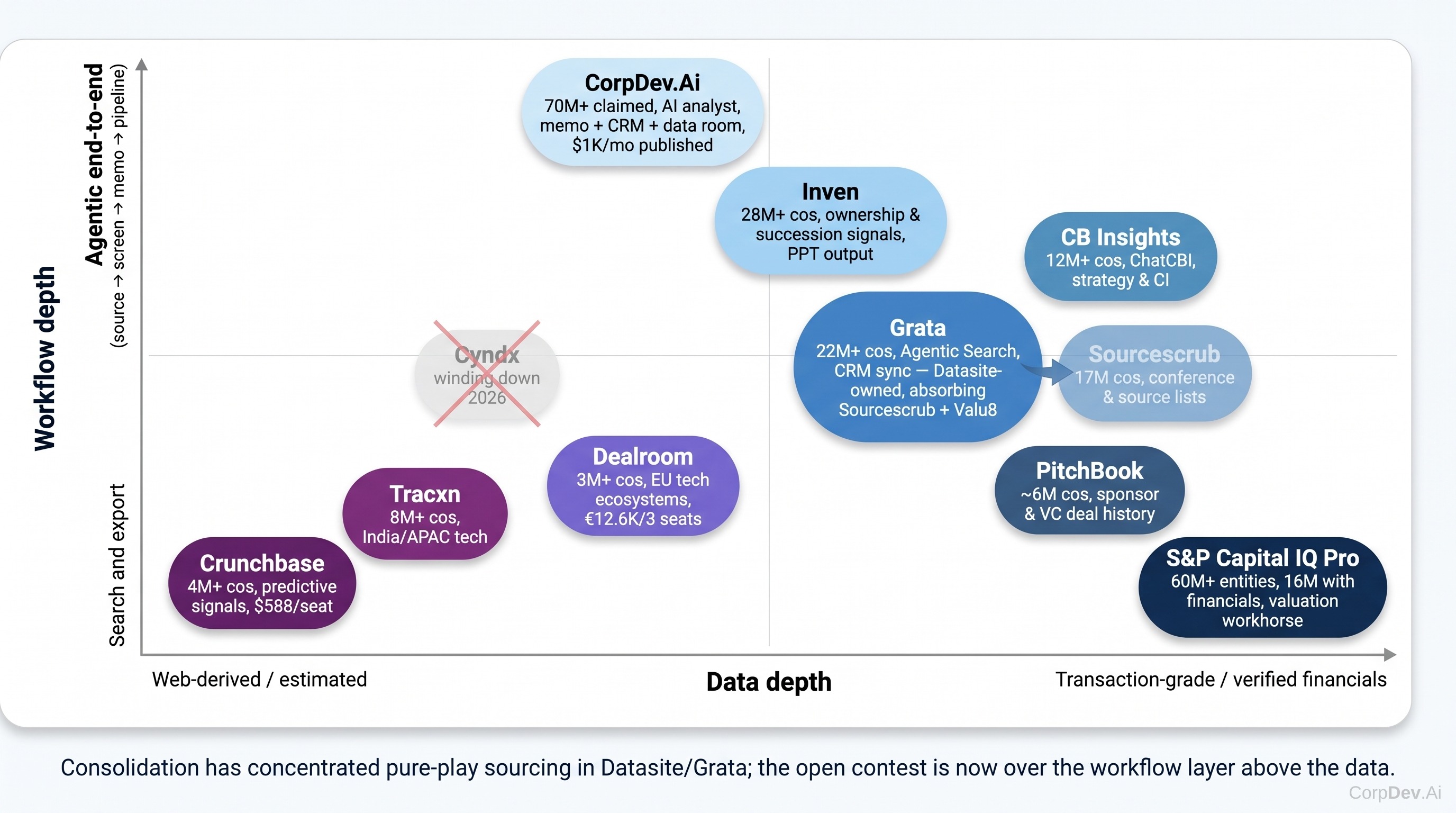
Read diagram description
Positioning comparison. First dimension: "Data depth" from "Web-derived / estimated" on the left to "Transaction-grade / verified financials" for analytical platforms. Second dimension: "Workflow depth" from "Search and export" at the bottom to "Agentic end-to-end (source → screen → memo → pipeline)" at the top. Vendor positions: PitchBook (far right, lower-middle; label "~6M cos, sponsor & VC deal history"), S&P Capital IQ Pro (far right, bottom; "60M+ entities, 16M with financials, valuation workhorse"), Grata (centre-right, middle-upper; labelled "22M+ cos, Agentic Search, CRM sync — Datasite-owned, absorbing Sourcescrub + Valu8"), Sourcescrub (integration into Grata; "17M cos, conference & source lists"), Inven (centre, upper; "28M+ cos, ownership & succession signals, PPT output"), CorpDev.Ai (centre-left, top; "70M+ claimed, AI analyst, memo + CRM + data room, $1K/mo published"), CB Insights (right-centre, upper-middle; "12M+ cos, ChatCBI, strategy & CI"), Dealroom (left-centre, lower; "3M+ cos, EU tech ecosystems, €12.6K/3 seats"), Crunchbase (far left, bottom; "4M+ cos, predictive signals, $588/seat"), Tracxn (left-centre, lower; "8M+ cos, India/APAC tech"), Cyndx (status: "winding down 2026"). "Consolidation has concentrated pure-play sourcing in Datasite/Grata; the open contest is now over the workflow layer above the data."
2. What a CorpDev / M&A Team Actually Buys
Vendors sell "deal sourcing platforms." Buyers need something narrower and more specific: a way to move a strategy from an idea in a board paper to a ranked list of companies a banker has not already shown to three competitors, and then to keep that list alive for the eighteen months an in-house team typically spends between first outreach and signing. Framing the purchase around the underlying jobs makes the comparison far more decision-useful than any feature grid.
The seven jobs behind the purchase
| Job to be done | What "good" looks like | Which tools are built for it |
|---|---|---|
| Define and map the market | Segment an industry into sub-niches, size them, identify structural trends and the players in each cell — fast enough to iterate with the strategy team | CB Insights, Inven, CorpDev.Ai, Dealroom, Tracxn; Grata via Agentic Search market-level insights |
| Discover targets nobody else has | Surface founder-owned, bootstrapped and non-sponsored companies with no funding round, no press and no PitchBook profile | Grata (and Sourcescrub data within it), Inven, CorpDev.Ai on-demand profiling |
| Screen and rank at scale | Apply thesis-specific criteria across hundreds of companies and produce a defensible shortlist with the reasoning visible | Grata (filters, Similar Search), Inven batch analysis, CorpDev.Ai fit scoring, CB Insights Shortlist Analyst |
| Understand the company | Ownership, financials, leadership, customers, competitive position, transaction history — deep enough to write a first-look memo | PitchBook and Capital IQ Pro for verified financials and deal history; Grata and Inven for private-company estimates; CorpDev.Ai for synthesised, cited profiles |
| Reach the owner | Verified executive contacts, intermediary relationships, CRM sync so outreach is tracked rather than lost in inboxes | Grata (10M contacts, CRM sync), Sourcescrub data, Inven (430M+ contacts claimed), Apollo-class tools alongside |
| Run the pipeline | A living view of every target, stage, owner and next action that does not depend on an analyst re-keying data every Friday | Grata pipeline module, DealCloud/Affinity as system of record, CorpDev.Ai zero-entry CRM, DealRoom (the M&A project tool, distinct from Dealroom.co) |
| Produce the deliverable | Investment committee memo, board deck, market map, valuation comps — cited, formatted, repeatable | Capital IQ Pro (Excel plug-in, Farsight add-on), CB Insights, Inven Skills (PowerPoint), CorpDev.Ai (memos, decks, workbooks, data room) |
Three vendor archetypes
The eleven products in this review sort into three families, and the family matters more than the brand.
Transaction-grade financial databases — PitchBook, S&P Capital IQ Pro. Their value is verified deal history, ownership chains, investor and fund data, and financial statements a valuation can rest on. They are indispensable for sponsor-backed and public targets, expensive per seat, and structurally weak on the two-thirds of the private economy that has never raised institutional capital or filed anything.
Private-market discovery specialists — Grata (with Sourcescrub inside it), Inven, Dealroom, Crunchbase, Tracxn, CB Insights. Their value is breadth: web-derived, registry-derived and source-list-derived coverage of companies that the databases above simply do not have. Financials are frequently estimated. The best of them have added AI search and CRM integration; the best-in-class output is still a list plus a contact.
Agentic workflow platforms — CorpDev.Ai and, increasingly, Inven and CB Insights. Their value is that the search, the enrichment, the scoring, the memo and the pipeline are one continuous process run by an AI analyst under human direction. They win on time-to-deliverable and on price transparency; they are younger, their coverage claims are less independently validated, and they should be diligenced on output quality rather than on database size.
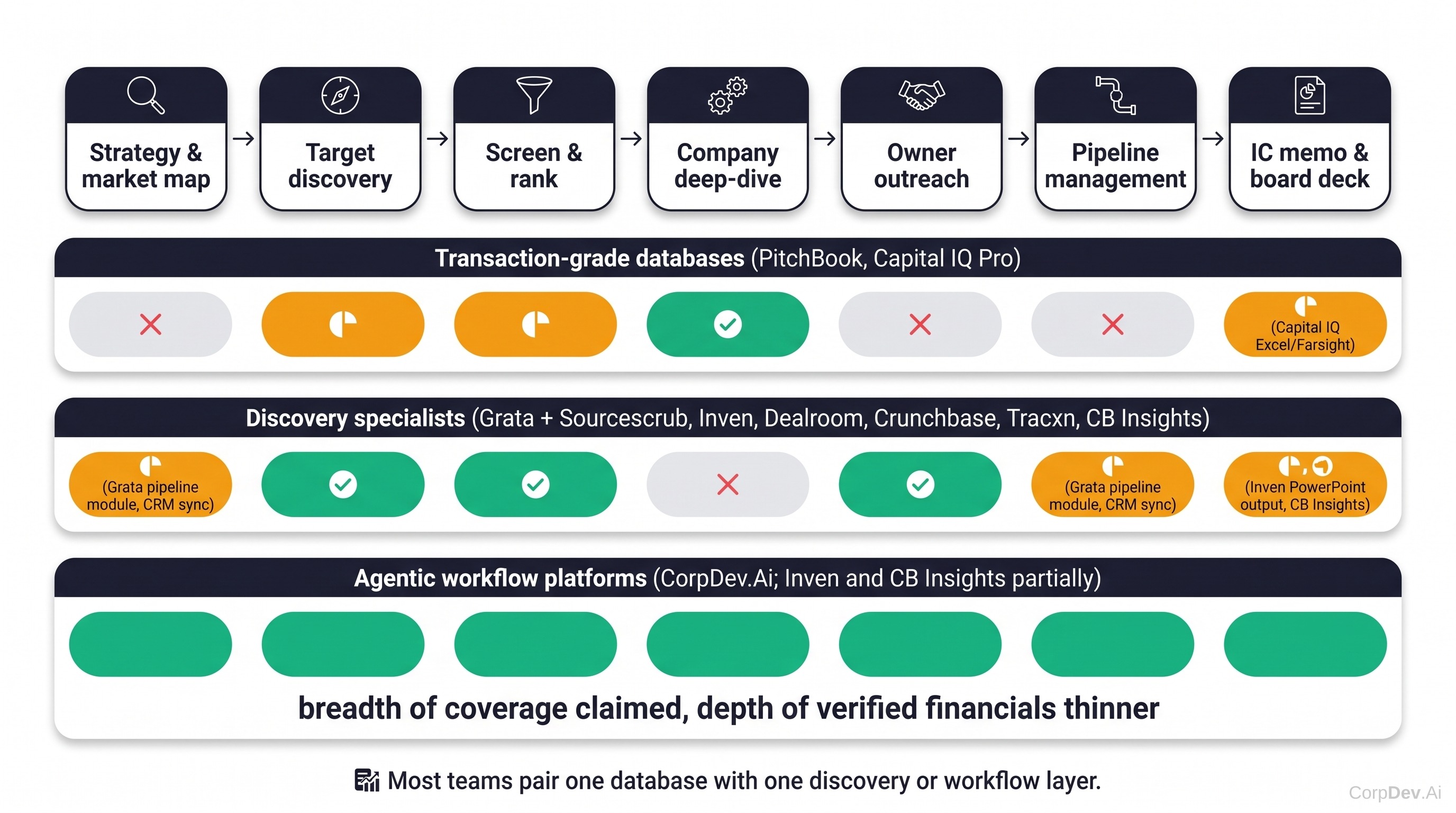
Read diagram description
Process flow with seven steps: "Strategy & market map" → "Target discovery" → "Screen & rank" → "Company deep-dive" → "Owner outreach" → "Pipeline management" → "IC memo & board deck". Under the flow, three coverage bars showing which steps each vendor family covers: Row 1 "Transaction-grade databases (PitchBook, Capital IQ Pro)": strong coverage on "Company deep-dive", partial on "Target discovery" and "Screen & rank", partial on "IC memo" (Capital IQ Excel/Farsight), gaps on outreach and pipeline. Row 2 "Discovery specialists (Grata + Sourcescrub, Inven, Dealroom, Crunchbase, Tracxn, CB Insights)": strong on "Target discovery", "Screen & rank", "Owner outreach"; partial on "Strategy & market map" and "Pipeline management" (Grata pipeline module, CRM sync); gap on "IC memo" except Inven PowerPoint output and CB Insights. Row 3 "Agentic workflow platforms (CorpDev.Ai; Inven and CB Insights partially)": strong across all seven steps, annotated "breadth of coverage claimed, depth of verified financials thinner". "Most teams pair one database with one discovery or workflow layer."
3. Grata in Depth
Grata started in 2016 as a search engine for the US middle market and has become the anchor asset of Datasite's Data & Intelligence business. For a buyer, three facts define the 2026 product: it has the most complete sourcing-specific feature set of any specialist, it is in the middle of absorbing two acquired datasets, and its commercial terms remain enterprise-style and opaque.
Ownership and strategic direction
MCP server in Perplexity Computer
Grata data queryable by third-party AI agents — company, ownership, executive, conference, seller-intent and deal-comp data [13].
The strategic read-through is straightforward: Datasite is assembling a private-market intelligence layer to sit upstream of its virtual data room franchise. That is good news for a buyer on product investment (a New York expansion in March 2026 signals continued spend [30]) and a point to negotiate on — a Datasite VDR customer should expect bundling leverage, and a non-Datasite customer should ask how independent Grata's roadmap remains.
Product scope
Coverage: 22M+ companies, ~10M executive contacts, 3M financial records, 800K deals on the business-development page; 23M+ normalised companies cited post-Valu8 [3][5][17]
Agentic Search: natural-language thesis interpretation, adjacency exploration, segment recommendations, market-level insight [1][2]
Similar Search: lookalike expansion from a known company or portfolio asset [3][4]
Filters: industry, keyword, geography, revenue and employee estimates, ownership, growth and intent signals, transaction history [3]
Deal Network: live, vetted banker and intermediary deal flow, some ahead of broad marketing (launched Nov 2024) [7]
Pipeline management: target lists, stages, owners, notes, outreach status in-platform [8]
CRM sync (two-way): Salesforce, DealCloud, Affinity, HubSpot; Dynamics referenced in Datasite materials [10][11]
Outreach: executive and intermediary discovery and tracking — not a sequencing engine; teams still pair it with Apollo, HubSpot or Outreach [8][9]
API and MCP: company-data API; native MCP server for agent access from August 2026 [12][13]
Datasite adjacency: listed in the Datasite Marketplace; integration with the VDR workflow is the stated direction [11][118]
What the evidence says about strengths
Across 81 G2 reviews (4.9/5) and 9 Capterra reviews (4.3/5), the same four themes recur [32][33]:
- Search quality is the product. Keyword, semantic and thesis-driven discovery is the most-praised capability; a PE reviewer on Capterra reported compressing an 8–10 hour market canvass into 1–2 hours [33].
- Usability is a genuine differentiator against the databases. Reviewers repeatedly describe Grata as faster to learn than PitchBook or Capital IQ, with filters and list-building that an associate can operate without training [32][33].
- It finds companies the databases do not have. The founder-owned, bootstrapped and sub-$50M-revenue universe is where Grata earns its fee; this is the coverage that justifies running it alongside, rather than instead of, a transaction database [6].
- Support and customer success are consistently rated highly (4.7/5 on Capterra for service) [33].
What the evidence says about limitations
Data inaccuracy is the leading negative theme on G2, and a Capterra reviewer estimated real-world accuracy at roughly 90–95%, with ownership, revenue, location, employee and contact fields all needing manual checks before outreach [32][33]. A 5–10% error rate is manageable for list-building and unacceptable for a board paper; the operating implication is that Grata output feeds a verification step, it does not replace one.
- Contacts are incomplete. A meaningful share of companies lack usable executive email or LinkedIn data, which pushes teams to a second contact-data tool [32][33].
- Coverage remains US-weighted. The 2025–2026 international expansion and the Valu8 integration are explicitly designed to fix this; a European buyer should test coverage in their specific countries during the trial rather than rely on the 26-country customer figure [14][15][32].
- Similar Search and result relevance are uneven. Several reviewers describe the lookalike feature as not yet precise enough and note difficulty excluding previously reviewed companies [32][33].
- CRM sync creates housekeeping. Salesforce and HubSpot users report duplicate records, domain mismatches and list-label complications [32].
- The product is mid-integration. Sourcescrub's data and Valu8's European records are being merged into one schema. Expect coverage counts, field definitions and UI to keep moving through 2026–2027; ask the vendor for a dated integration roadmap [17][42].
Pricing and contract reality
Grata does not publish per-seat pricing. Capterra lists a $15,000/year starting point on a single plan with a free trial and no free tier [18]; independent comparisons place typical configurations at $15,000–$30,000+ annually depending on seats, CRM integration, API access and export volumes [58][117]. Grata's terms of service state that Solution Schedules are non-cancellable and fees non-refundable [21], and the standard arrangement is an annual, sales-led contract. Reviewers in search funds and small firms describe it as expensive and wish for month-to-month or credit-based options [32].
Three levers are worth pushing in a 2026 Grata negotiation: (1) the Sourcescrub data — confirm in writing which package includes conference and source-list coverage, and when; (2) Datasite bundling — a VDR customer has cross-sell leverage; (3) seat structure — ask for a read-only or "viewer" seat class for deal-team members who consume lists but do not build them. None of these are advertised; all have been available in comparable enterprise data contracts.
Verdict
Grata is the strongest single specialist for a corporate development team whose deal flow comes from the private, non-sponsored middle market and who wants search, contacts and pipeline in one place. It is not a substitute for PitchBook or Capital IQ where deal history and verified financials matter, it does not write the memo, and the buyer accepts a verification burden and an enterprise contract in exchange for the breadth. The Datasite ownership is net positive for product investment and a modest concern for roadmap independence.
4. The Alternatives
4.1 Sourcescrub
Status: Acquired by Datasite from Francisco Partners on 8 August 2025; being integrated into Grata [27][34][35]. Being merged into Grata
Sourcescrub built the most distinctive dataset in the category: roughly 17M private-company profiles connected to some 220,000–290,000 "sources" — conference attendee lists, trade-show rosters, association directories, awards and industry rankings — so that every record carries provenance showing why a company is on the list [39][40][50][120]. Its Essentials / Plus / Professional tiers layer scoring rules, signal tracking (250 tracked companies on Plus, 1,000 on Professional) and CRM enrichment on top; third-party estimates put typical annual cost at $20,000–$60,000 [39][41]. SourcingGPT, launched in 2023, added a generative interface over the same data [53][54]. Users rate it around 4.5/5 on G2 across ~56 reviews and single out native CRM synchronisation and niche-source discovery as strengths, while recurring complaints are stale records, inconsistent data quality by industry and a dated UI [49][57][121].
Where it beat Grata: event-driven, source-traceable discovery in fragmented industrial, healthcare, business-services and consumer niches where a company's only digital footprint is a trade-show exhibitor list [40][56]. Where it lagged: general semantic search, low-web-presence Main Street businesses, and interface polish — in G2's side-by-side, reviewers preferred Grata overall [56][59].
The product is being folded into Grata and its standalone roadmap is uncertain [42]. The procurement question is no longer "Grata or Sourcescrub" but "which Grata package includes the Sourcescrub source-list data, and from what date." An existing Sourcescrub customer should negotiate migration terms and data continuity explicitly before renewing.
4.2 PitchBook
Best for: venture- and sponsor-backed targets, financing history, investor and fund intelligence, transaction comps. Transaction-grade database
PitchBook (Morningstar) covers nearly 6M companies, 2.7M investments, 570,000 investors and 147,000 funds [76] — a far smaller company universe than Grata's, but one where every record is anchored in a funding round, an ownership change or a transaction. That anchoring is exactly what corporate development needs when the target has raised institutional capital: who owns it, at what valuation, with what liquidation preferences implied, and when the fund's hold period suggests a sale. PitchBook Navigator (November 2025) added a generative research layer with natural-language querying and an OpenAI/ChatGPT integration, joining the existing AI company summaries and VC Exit Predictor [77][78][79].
Pricing is quote-only. Market observations put a single seat at roughly $12,000–$20,000, a three-seat package at $18,000–$32,000, and enterprise contracts above $70,000 annually [74][75].
| Strengths for corporate development | Limitations for corporate development |
|---|---|
| Deepest institutional private-market context: rounds, investors, valuations, exits, M&A terms [76][136] | Coverage collapses for bootstrapped and founder-owned companies with no financing event — the majority of the lower middle market |
| Exit-likelihood and investor-hold signals help time approaches to sponsor-owned assets [79] | Expensive and sales-led; seats are frequently rationed to one or two analysts |
| Navigator accelerates research where the answer depends on deal data [77] | AI layer speeds retrieval; it does not screen against a strategic thesis or produce a memo |
| Trusted by boards and banks — a PitchBook comp provides an established starting point, but selection, terms and valuation comparability still need justification | Less suited to whitespace market mapping than CB Insights, Dealroom or agentic tools |
Verdict: PitchBook is the transaction layer most corporate development teams will keep regardless of what else they buy. It is a poor sole platform for a team whose targets are family-owned industrials or services businesses, which is precisely the gap Grata, Inven and CorpDev.Ai exist to fill.
4.3 S&P Capital IQ Pro
Best for: public-company strategy, valuation, financial statements, ownership chains, precedent transactions. Financial analysis workhorse
Capital IQ Pro advertises 60M+ private-company records, of which roughly 16M carry recent financials — the one of the largest entity universes in this comparison but one where the majority of records are basic registrations rather than researched profiles [83][84][85]. Its strength is the analytical stack around the data: full financial statements, credit data, comparable-company and precedent-transaction screening, ownership trees and the Excel plug-in that most valuation teams already live in. S&P has invested heavily in AI: ChatIQ and Document Intelligence (2024), Document Intelligence 2.0 with multi-document analysis and a Salesforce AgentExchange release (October 2025), expanded private-markets datasets from With Intelligence (July 2026) and an announced Farsight AI add-on for pitch books, CIMs and valuation materials [86][87][88][89].
Pricing is quote-only and modular; typical configurations run $15,000–$25,000 per user annually, with lower effective per-seat rates at high volume [80][81][82].
| Strengths for corporate development | Limitations for corporate development |
|---|---|
| Moves from discovery to defensible valuation and board-level analysis in one environment | Headline private-company count overstates usable coverage; test how many targets in your niche have financials [83][84] |
| Best-in-class for public targets, carve-outs from listed parents, and public comps [83] | Not purpose-built for proprietary sourcing of obscure founder-owned companies |
| Document Intelligence and ChatIQ are genuinely useful for filings and CIM analysis [86][87] | Expensive, modular and configuration-heavy; procurement cycles are long |
| Farsight add-on points toward AI-generated valuation materials [88] | Generative features are research- and document-oriented, not a thesis-driven sourcing engine |
Verdict: the right anchor for a financially sophisticated corporate development function inside a large listed company, particularly where the strategy team and treasury already hold seats. Pair it with a discovery layer; do not expect it to find the next bootstrapped bolt-on.
4.4 Cyndx
Status: Winding down. Not a viable 2026 purchase
Cyndx's founder has published a notice that the company is dissolving operations, citing financing and market conditions [36]. The product deserves a short obituary because its concept was genuinely differentiated: Finder (33M+ public and private companies with NLP search and dynamic relationship mapping), a "Projected to Raise" algorithm predicting which private companies would seek capital within six months, plus Acquirer, Raiser, Scholar (AI research reports) and Valer (AI valuation) modules in one platform [45][46][60]. Funding totalled roughly $10–10.5M with Rakuten Capital among investors [61][62]; pricing was sales-led at an estimated $30,000–$75,000 annually [44][47]; the G2 review base was small (~20 reviews) and cited a steep learning curve and limited CRM integration [63][64].
Lesson for buyers: the pure-play AI-sourcing segment has consolidated hard. Of the four independent specialists a buyer could shortlist in early 2025 — Grata, Sourcescrub, Cyndx, Inven — only Inven remains independent. Vendor viability and data-continuity terms belong in every 2026 evaluation, and a team currently on Cyndx should migrate its saved searches and lists now.
4.5 Inven
Best for: global market mapping, European registry-backed private-company research, ownership and succession signals, presentation-ready output. Independent AI-native challenger
Helsinki-based Inven is the most credible independent alternative to Grata in 2026. It raised a $12.75M Series A in May 2026 led by Ventech and Vendep Capital, with participation from Risto Siilasmaa, Lifeline Ventures and Joint Effects [37], and states it is used by more than 1,000 teams [66]. Its stated coverage — 28M+ companies, 100M+ legal entities mapped to parent groups, 430M+ contacts, 3M+ transactions and 100M+ financial documents analysed, with registry-based financials across 18 European markets including UK Companies House — is the broadest claimed among the specialists and, uniquely, is anchored in filed accounts rather than web estimates for European targets [38][48].
Functionally Inven sits between Grata and the agentic platforms. Natural-language search, lookalikes and market mapping match Grata's core; ownership confirmation at source, intent-to-sell signals (generational handovers, leadership changes, capital events) and batch analysis across large lists go further; and "Inven Skills" produce review-ready PowerPoint longlists and company profiles, which no database in this set does natively [38]. Integrations cover CRM exports, Excel, a Chrome extension, an API and MCP access from ChatGPT and Claude [65]. Inven states customer data is not used for model training [38].
| Strengths for corporate development | Limitations for corporate development |
|---|---|
| European depth from statutory filings — the natural choice for a DACH, Nordic or UK acquirer [48] | No public pricing; quote-based by team size, described by some reviewers as expensive [48][70] |
| Ownership and succession signals directly target the founder-exit thesis [38] | Small-company financials outside filing regimes are estimates and need diligence before underwriting [72] |
| Ease of use, onboarding and support rate highly (Software Advice 4.6/5 from 16 reviews) [67][68] | Review base is small; coverage should be validated country-by-country and sector-by-sector [38] |
| Presentation output shortens the path from search to first-look deck [38] | Younger workflow layer than Grata for pipeline management and two-way CRM sync |
Verdict: for a European or globally oriented corporate development team, Inven is a serious head-to-head alternative to Grata and in some geographies the better dataset. Independence is both its attraction (no Datasite bundling agenda) and its risk (it is the last independent specialist standing; a well-funded Series A helps, but buyers should still negotiate data-portability terms).
4.6 Dealroom, Crunchbase, Tracxn and CB Insights
These four platforms are not Grata substitutes for founder-owned middle-market sourcing, but each earns a place in specific corporate development stacks — and three of them cost a fraction of the specialists.
Coverage: 3M+ companies, weighted to European startups, scaleups and technology ecosystems [91][92]
Pricing (published): Premium €12,600/year for three seats (~€4,200/seat); Premium Plus €17,000/year; enterprise and API custom [90][91]
AI: categorisation and list segmentation; MCP connector announced 2026 for ChatGPT, Claude and Copilot [93][94]
Fit: innovation scouting, European tech market maps, growth-stage targets. Weak on public-company analysis, M&A comps and contact-level outreach [91]
Coverage: 4M+ private companies searchable in Pro [95][97]
Pricing (published): Pro $49/month billed annually ($588/seat/year), $99 monthly; Business ~$2,388/seat/year; enterprise and API custom [95][96]
AI: relaunched as a predictive-intelligence company in February 2025 — 18 prediction signals for fundraising, acquisition and IPO likelihood; Market Insights and an MCP connector added in 2026 [98][99][100][101]
Fit: lowest-cost entry point for startup and venture-backed screening and acquisition-watch lists. Financial depth and data quality below PitchBook for diligence; strong startup bias [96]
Coverage: 8M+ companies across a broad technology taxonomy; strongest in India and APAC [104][105]
Pricing: quote-based; management commentary places the mid tier at roughly $3,000–$5,000 per user/year; historical packages of $6,600 (1 user) to $26,400 (7 users) [102][103]
AI: AI Assistant for natural-language lists, deep dives and competitor comparisons; MCP connector for Claude, ChatGPT, Gemini and Cursor (2026) [106][107][108]
Fit: technology scouting and emerging-market target lists at moderate cost. Uneven outside core geographies; less suited to mature-company valuation [104]
Coverage: 12M+ companies tracked [111][112][113]
Pricing: quote-only; observed contracts from ~$25,000 entry to a ~$47,000 median, with a range up to ~$185,000 [109][110]
AI: ChatCBI Magic Mode for M&A and competitive analysis (2025), Competitive Intel Agent, Shortlist Analyst, Strategy Maps, Acquisition Hunter [114][115][116]
Fit: the strongest strategic-intelligence and competitive-landscape tool in the set, with acquisition-likelihood signals relevant to corporate development. Optimised for insight rather than raw coverage or contact data; enterprise price point [109]
Where these fit against Grata: Dealroom and Tracxn replace Grata only for a team whose targets are technology startups in Europe or Asia respectively. Crunchbase is the right answer for a one-person team monitoring venture-backed adjacencies on a sub-$1,000 budget. CB Insights is complementary — it answers "which market and why" better than any sourcing tool, then hands off to Grata, PitchBook or an agentic platform for the target work.
4.7 CorpDev.Ai
Best for: thin in-house teams that need the market map, the target screen, the memo and the pipeline produced — not just the data to produce them. Agentic workflow platform Vendor of this document
CorpDev.Ai is a Boston- and San Francisco-based company founded by Kal Kilpi (CEO; previously co-founder of Midaxo and founder of Vastuu Group) and Atul Tiwary (formerly VP M&A at Barracuda Networks, VP Investment Banking at RBC, senior director of corporate development at Fortinet) [123]. It describes itself as an "Integrated CorpDev Environment": a specialised AI analyst agent, a collaborative document editor ("Visual Workbook"), an AI-native data room, a zero-entry pipeline CRM and digital-twin models of targets and markets, sold to in-house corporate development teams either as self-service software or with managed services alongside [122][125].
How it differs from a database
The architectural bet is different from Grata's. Grata maintains a curated database and lets you search it; CorpDev.Ai runs an LLM "metasearch" across a claimed 70M+ pre-indexed companies and, when a company is not in the index, researches it on demand from public sources and builds a cited profile [126]. The output of a search is therefore not a list of records but a set of enriched, fit-scored profiles that flow directly into a pipeline card, a market map or a memo draft. The same agent reads the connected mailbox and calendar (Microsoft 365 or Google Workspace) to log activity and enrich targets without manual entry [127][129], reads uploaded data-room documents through vision-based ingestion with page-level citations [128], and drafts investment memos, board decks, market maps, CIMs and valuation workbooks exportable to Word, PowerPoint, PDF and Excel [122]. Data is stored in open formats (Markdown, JSON, YAML) and reachable over REST and MCP, which reduces lock-in relative to closed databases [128].
70M+
Companies claimed pre-indexed, plus on-demand profiling (vendor figure) [126]
$1,000 / mo
AI Pro, one user, annual invoice; $1,200 monthly on card [130]
$3,000 / mo
AI Pro Team, three users, dedicated CSM; enterprise custom [130]
Pricing and commercial terms
CorpDev.Ai publishes self-serve pricing with a monthly option, as does Crunchbase. AI Pro is $1,000/month on annual invoice ($1,200 on card) for one user with 12,000 search credits a year; AI Pro Team is $3,000/month ($3,600 on card) for three users with 36,000 credits, collaboration, admin controls and a dedicated customer success manager; Enterprise is custom with unlimited members, SSO, a solutions architect and managed services [130]. A 14-day, 300-credit trial is available, prioritised for in-house corporate development staff and automatic for employees of companies above $1B in revenue [131]. At list, a three-seat team costs $36,000 a year — above the cited $18,000–$32,000 range for a three-seat PitchBook package and below a typical Grata-plus-CRM configuration, with the CRM, data room and document generation included rather than adjacent.
An objective assessment
| Strengths for corporate development | Limitations and open diligence points |
|---|---|
| Covers the full loop — market map, discovery, screening, profile, outreach logging, pipeline, memo, data room — in one system; combining IC deliverable production with a broader pipeline workflow; Inven, CB Insights and Capital IQ also offer described deliverable capabilities [122] | Coverage claim is unverified. The 70M+ figure and on-demand profiling have no independent review corroboration; test recall and precision against a known target list during the trial [126][133] |
| Published pricing, monthly billing and a genuine trial remove the enterprise-procurement friction that reviewers complain about at Grata and PitchBook [130][131] | No public customer references. The site cites "hundreds of CorpDev professionals" but names no customers; sample deliverables are demonstrations, not engagements [122][132] |
| Zero-entry CRM fed from email and calendar addresses the failure mode of every deal CRM — nobody updates it [127] | Transaction and financial depth is not PitchBook or Capital IQ grade. Verified deal history, investor data and audited financials still require a database alongside |
| Open data formats and MCP/REST access mean output is portable [128] | Young review base. No meaningful G2 or Capterra footprint yet; output quality must be judged first-hand |
| Multi-model architecture (Claude, GPT, Perplexity, Gemini routed by task) reduces single-vendor AI dependence [122] | Credit-metered usage — heavy screening teams should model credit consumption before committing to a tier [130] |
CorpDev.Ai publishes a head-to-head page positioning itself against Grata on coverage (70M+ vs ~20M), on-demand profiles, automated memos and an included CRM [133]. Those are the vendor's claims, and the coverage figures are not like-for-like — Grata's 22M+ are curated, classified records; CorpDev.Ai's 70M+ is an index the agent searches and enriches on demand. The fair test is not whose number is bigger but which tool surfaces the better fifty targets for your thesis in a two-week trial, and how much analyst time each saves after the list exists.
Verdict: CorpDev.Ai is a credible candidate for the execution layer of a corporate development stack — and, at $1,000 a month, a paid pilot whose cost should be weighed against the team’s budget for a team currently running sourcing in spreadsheets. It is not yet a proven replacement for Grata's curated middle-market database, and it is not a substitute for a transaction database. A buyer should run it against Grata on the same thesis for two weeks and judge on target quality and hours saved to the first-look memo.
5. Head-to-Head Comparison
The matrix below scores each platform on the seven buyer jobs from Section 2 plus three commercial dimensions. Scores are the author's judgement on a 1–5 scale from the evidence cited in Sections 3–4: 5 = best-in-class for a corporate development buyer, 3 = adequate, 1 = not designed for the job. Sourcescrub is omitted as a standalone option; Cyndx is omitted as no longer purchasable. Where a score rests on vendor claims rather than independent evidence it is flagged in the Basis column.
| Dimension | Grata | PitchBook | Capital IQ Pro | Inven | CorpDev.Ai | CB Insights | Dealroom | Crunchbase | Tracxn |
|---|---|---|---|---|---|---|---|---|---|
| Founder-owned / bootstrapped discovery | 5 | 2 | 2 | 4 | 4 | 2 | 2 | 2 | 2 |
| Sponsor- and VC-backed target intelligence | 3 | 5 | 4 | 3 | 3 | 3 | 4 | 3 | 3 |
| Verified financials and transaction comps | 2 | 5 | 5 | 3 | 2 | 2 | 2 | 1 | 2 |
| Strategy and market mapping | 3 | 3 | 3 | 4 | 5 | 5 | 4 | 2 | 4 |
| AI search and thesis screening | 5 | 3 | 3 | 4 | 5 | 4 | 3 | 3 | 3 |
| Contacts and outreach support | 4 | 3 | 3 | 4 | 3 | 2 | 2 | 2 | 2 |
| Pipeline / CRM workflow | 4 | 2 | 2 | 3 | 5 | 2 | 2 | 2 | 2 |
| Memo and deliverable generation | 1 | 2 | 3 | 3 | 5 | 4 | 1 | 1 | 2 |
| European coverage | 3 | 4 | 4 | 5 | 3 | 3 | 5 | 3 | 2 |
| Pricing transparency and flexibility | 2 | 2 | 2 | 2 | 5 | 1 | 4 | 5 | 3 |
Basis notes for the matrix. Grata's discovery and AI-search scores rest on independent reviews [32][33] and the Agentic Search launch [2]; its European score reflects the Valu8 integration being in progress [15][16]. PitchBook and Capital IQ scores rest on their published data descriptions [76][83] and third-party comparisons [74][80]. Inven's European score rests on its stated 18-market registry coverage [48]; its discovery score is a vendor claim partially corroborated by small review samples [67][68]. CorpDev.Ai's discovery, market-mapping and deliverable scores rest on vendor product descriptions [122][126][127] and are not yet corroborated by independent reviews — a buyer should treat them as hypotheses to test in a trial. CB Insights' strategy score rests on its 2025 product releases [114]. Dealroom, Crunchbase and Tracxn scores rest on published coverage and pricing [90][95][104].
| Dimension | Grata | CorpDev.Ai | PitchBook | Inven |
|---|---|---|---|---|
| Founder-owned discovery | 5 | 4 | 2 | 4 |
| Verified financials & comps | 2 | 2 | 5 | 3 |
| Market mapping | 3 | 5 | 3 | 4 |
| AI search & screening | 5 | 5 | 3 | 4 |
| Contacts & outreach | 4 | 3 | 3 | 4 |
| Pipeline / CRM | 4 | 5 | 2 | 3 |
| Deliverable generation | 1 | 5 | 2 | 3 |
| Pricing flexibility | 2 | 5 | 2 | 2 |
Reading the profiles
The radar makes the structural point visible. Grata and PitchBook are near-mirror images: Grata dominates where PitchBook is weakest (founder-owned discovery, AI screening, pipeline) and vice versa (verified financials and comps). That complementarity is why the two are so often bought together and why neither vendor's "replace the other" pitch holds up.
CorpDev.Ai's profile is the widest but the least independently validated. It scores highest on the workflow dimensions — market mapping, screening, pipeline, deliverables, pricing — and matches Grata on AI search by design. Its two structural gaps are the same as Grata's (verified financials) plus one Grata does not have (an independent review record). If its coverage and output quality hold up in a trial, it is the only single platform in the set that covers the full loop; if they do not, it remains a strong execution layer over someone else's data.
Inven is the balanced middle, strong in Europe and on ownership signals, competent everywhere else, exceptional nowhere except registry-backed European financials.
Data coverage — like for like
| Vendor | Companies (M) |
|---|---|
| CorpDev.Ai (indexed, plus on-demand) | 70 |
| Capital IQ Pro (entity records; ~16M with financials) | 60 |
| Inven | 28 |
| Grata (post-Valu8) | 23 |
| Sourcescrub (now inside Grata) | 17 |
| CB Insights | 12 |
| Tracxn | 8 |
| PitchBook | 6 |
| Crunchbase (Pro) | 4 |
| Dealroom | 3 |
The chart above ranks vendors by their own headline numbers, and the ranking is almost inverted from the ranking by record depth. Capital IQ's 60M includes tens of millions of bare registrations; CorpDev.Ai's 70M is an index the agent enriches on demand rather than a curated database; PitchBook's 6M are each anchored in a real transaction. The only coverage test that matters is empirical: give each vendor the same fifty known targets from your last three deals and count how many it finds, how many fields are populated and how many of those fields are right.
AI capability — what is actually shipping
| Vendor | AI layer (date) | What it does well | What it does not do |
|---|---|---|---|
| Grata | Agentic Search (Dec 2025); MCP server (Aug 2026) [2][13] | Interprets a thesis, explores adjacencies, ranks segments and targets | Draft the memo; verify records; run the pipeline autonomously |
| CorpDev.Ai | AI Analyst Agent, multi-model, MCP/REST [122][128] | Research, screen, score, draft memo and deck, log email/calendar activity, read data rooms | Provide audited financials or verified deal history it has not been given |
| PitchBook | Navigator (Nov 2025); ChatGPT integration [77][78] | Natural-language retrieval over deal and investor data | Thesis-driven discovery outside its universe |
| Capital IQ Pro | ChatIQ, Document Intelligence 2.0 (Oct 2025); Farsight add-on (2026) [87][88] | Multi-document analysis of filings and CIMs; pitch-book generation | Proprietary sourcing of unlisted, unfunded companies |
| Inven | AI search, batch analysis, Inven Skills (PowerPoint), MCP [38][65] | Ownership and intent-to-sell signals; longlists to slides | Two-way pipeline CRM at Grata's depth |
| CB Insights | ChatCBI Magic Mode, Competitive Intel Agent, Shortlist Analyst (2025) [114] | Strategy and competitive synthesis; acquisition-likelihood analysis | Contact-level outreach; middle-market breadth |
| Crunchbase / Dealroom / Tracxn | Predictive signals (Feb 2025); MCP connectors (2026) [99][93][106] | Startup and ecosystem monitoring via AI assistants | Middle-market discovery; verified financials |
The convergence is unmistakable: every vendor now offers natural-language querying and an MCP endpoint. The practical differentiation has moved to two questions — whose data the agent is reasoning over, and how far the agent carries the work after the search. On the first, Grata, PitchBook and Capital IQ hold the deepest curated assets. On the second, CorpDev.Ai is built around the answer and the others are adding it.
6. Total Cost of Ownership and Pricing Reality
List price is the least reliable number in this market. Only three vendors publish prices (CorpDev.Ai, Dealroom, Crunchbase); the rest are sales-led, and observed contract values vary by a factor of two or more for the same nominal seat count depending on modules, exports, API access and negotiating skill. The table below is therefore built on a consistent scenario: a three-person corporate development team, annual contract, standard CRM integration, no API or bulk data licence.
| Platform | Annual cost (US$K) |
|---|---|
| Crunchbase Pro–Business | 1.8–7.2 |
| Tracxn | 9–15 |
| Dealroom Premium | 13.5–18.5 |
| PitchBook (3 seats) | 18–32 |
| Grata | 15–45 |
| Inven | 20–50 |
| CB Insights | 25–47 |
| CorpDev.Ai AI Pro Team | 36–43 |
| Sourcescrub (historical) | 20–60 |
| Capital IQ Pro (3 seats) | 45–75 |
Basis for the cost ranges. Crunchbase: published $588/seat (Pro annual) to $2,388/seat (Business) [95][96]. Tracxn: management commentary of $3,000–$5,000 per user [102]. Dealroom: published €12,600 (Premium, three seats) to €17,000 (Premium Plus), converted at roughly 1.08 USD/EUR [90]. CorpDev.Ai: published $3,000/month annual-invoiced to $3,600/month on card [130]. PitchBook: observed three-seat packages [74]. Grata: Capterra $15,000 start to third-party $30,000+ configurations, extended to $45,000 for CRM and contact modules [18][58][117]. Inven: no public price; range inferred from reviewer "expensive" commentary and specialist-category norms — treat as an estimate [48][70]. Sourcescrub: historical third-party estimates [39]. Capital IQ Pro: $15,000–$25,000 per user [80][81]. CB Insights: observed entry and median contract values [109][110].
The costs that do not appear on the quote
Verification labour. Every discovery specialist ships estimated revenue, estimated headcount and partially stale contacts. If the single reviewer’s 90–95% accuracy estimate [33] applied to a 300-company longlist, it would imply 15–30 records that will mislead outreach or a memo unless checked. At a loaded analyst cost of $75–100 an hour and ten minutes per check, that is $200–500 per longlist — trivial per list, material across a year of thesis work, and a real point in favour of tools that surface source citations alongside each field.
The second tool. Reviewers of Grata and Sourcescrub routinely pair them with Apollo, ZoomInfo or HubSpot for contact completeness and sequencing [9]. Budget $3,000–15,000 for that layer unless the platform's contacts are proven sufficient in the trial.
The system of record. Grata's pipeline module and CorpDev.Ai's zero-entry CRM can each serve as the deal CRM for a small team; a larger function on DealCloud or Affinity is paying $20,000–60,000+ for that separately and should value two-way sync accordingly.
Contract rigidity. Grata's terms make Solution Schedules non-cancellable and fees non-refundable [21]; PitchBook, Capital IQ and CB Insights are annual, sales-led and auto-renewing in practice. A team that pilots the wrong tool is locked in for twelve months. Monthly options (CorpDev.Ai, Crunchbase) or short published terms (Dealroom) carry a premium worth paying while a team is still learning what it needs.
Seat rationing. Per-seat pricing at $12,000–25,000 pushes teams to buy one or two licences and funnel every question through the analyst who holds them — the single most common hidden inefficiency in corporate development tooling. Ask every vendor for viewer or read-only seats; ask agentic vendors how credits are pooled across a team.
Usage metering. CorpDev.Ai meters search credits (12,000/year on AI Pro, 36,000 on Team) [130]; Sourcescrub capped tracked companies by tier [41]; Crunchbase gates exports [96]. Model a heavy quarter — a new thesis with three market maps and 500 screened companies — before choosing a tier.
Value per dollar, by team type
For a one- to three-person team, an agentic platform at $12,000–36,000 a year that also serves as CRM and memo-writer can displace a Grata-plus-CRM-plus-contact-tool stack costing $40,000–80,000 — if its coverage passes the fifty-target test. For a five-plus-person function inside a large corporate, the calculus reverses: Capital IQ or PitchBook seats are already sunk cost, Grata's curated middle-market data is the marginal purchase that most expands the addressable target universe, and an agentic layer is justified on analyst hours saved rather than on tools displaced. Buy on the marginal unit of value for your team, not on the feature list.
7. Buyer's Decision Framework
The comparison reduces to four questions a corporate development lead can answer in an afternoon. The answers point to a stack, not a product.
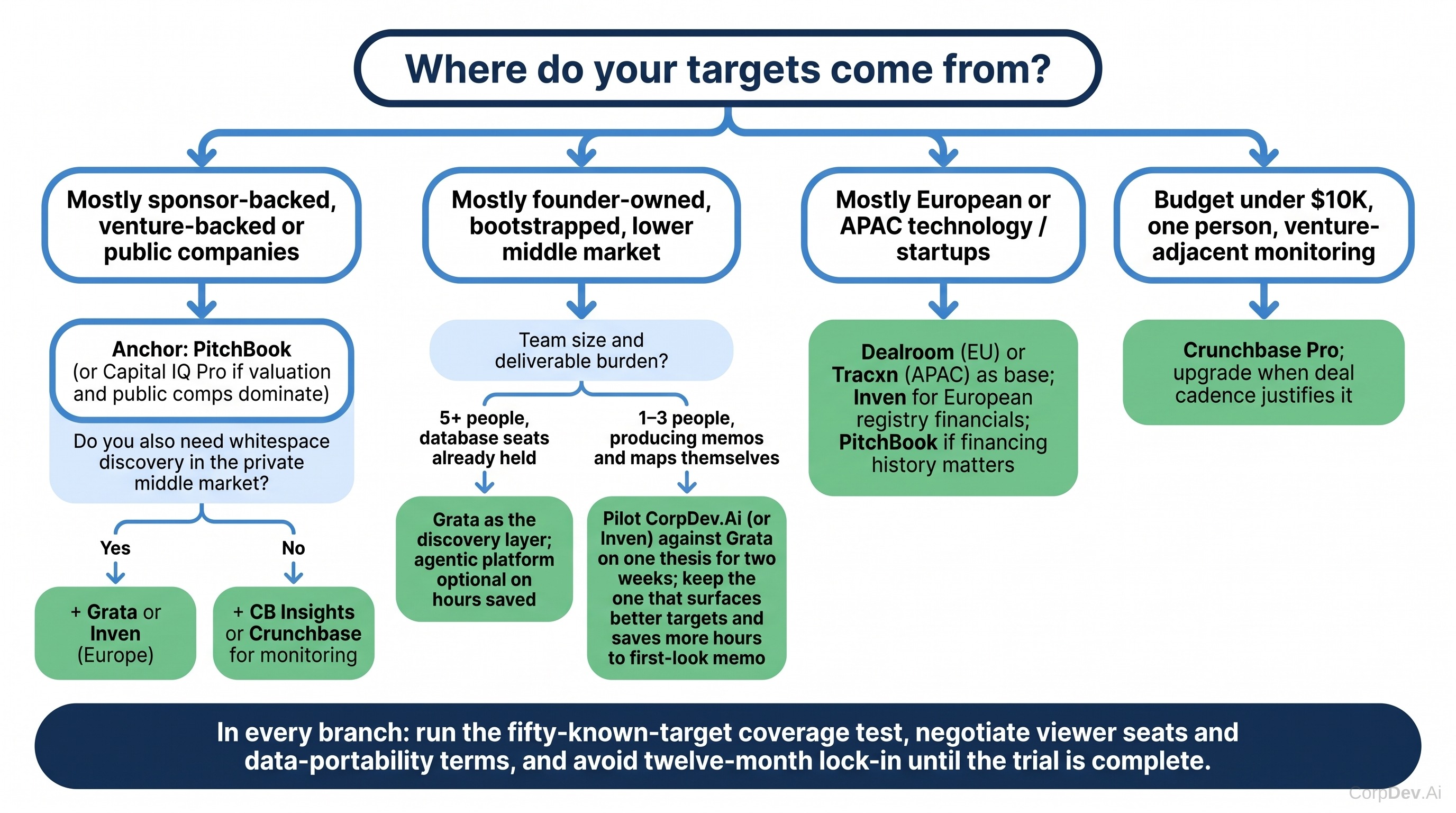
Read diagram description
Decision tree. Root question: "Where do your targets come from?" Branch A "Mostly sponsor-backed, venture-backed or public companies" → "Anchor: PitchBook (or Capital IQ Pro if valuation and public comps dominate)" → sub-question "Do you also need whitespace discovery in the private middle market?" → Yes: "+ Grata or Inven (Europe)"; No: "+ CB Insights or Crunchbase for monitoring". Branch B "Mostly founder-owned, bootstrapped, lower middle market" → sub-question "Team size and deliverable burden?" → "5+ people, database seats already held": "Grata as the discovery layer; agentic platform optional on hours saved" → "1–3 people, producing memos and maps themselves": "Pilot CorpDev.Ai (or Inven) against Grata on one thesis for two weeks; keep the one that surfaces better targets and saves more hours to first-look memo". Branch C "Mostly European or APAC technology / startups" → "Dealroom (EU) or Tracxn (APAC) as base; Inven for European registry financials; PitchBook if financing history matters". Branch D "Budget under $10K, one person, venture-adjacent monitoring" → "Crunchbase Pro; upgrade when deal cadence justifies it". "In every branch: run the fifty-known-target coverage test, negotiate viewer seats and data-portability terms, and avoid twelve-month lock-in until the trial is complete."
Question 1 — Where do your targets actually come from?
Pull the last three years of pipeline and classify every target as (a) sponsor- or VC-backed, (b) founder-owned or bootstrapped, (c) public or a carve-out from a public parent. Most corporate development teams discover that the mix is very different from what their tooling assumes: a team holding two PitchBook seats and no discovery specialist is may source a substantial share of its live pipeline from category (b), where PitchBook’s coverage is weaker; measure that share from your own pipeline rather than assuming a universal 60–70%. The category with the largest share of proprietary deals — the ones not shown to competitors — is the one to over-invest in.
Question 2 — Is the bottleneck finding targets, or producing the work about them?
Grata, Inven and the databases solve a discovery bottleneck: not enough good names. CorpDev.Ai and, increasingly, CB Insights and Inven solve a production bottleneck: names exist, but the market map, the screen, the first-look memo and the pipeline update each take a week an analyst does not have. A three-person team preparing quarterly strategy reviews and IC papers is usually production-constrained; a ten-person function with dedicated associates is usually discovery-constrained. Buying a discovery tool for a production problem — the most common mistake in this category — produces longer lists and no more deals.
Question 3 — What does verified mean to your board?
If a first-look memo needs an audited revenue figure and a precedent-transaction multiple before it reaches the CFO, a transaction-grade database is non-negotiable and the discovery or workflow layer is additive. If the first gate is a strategic-fit conversation and the numbers come later from the target, an estimated-financials platform is sufficient for stage one and the database seat can be shared or deferred.
Question 4 — How much commercial risk will you carry to learn?
Every sales-led vendor in this set will lock a team into twelve months on the strength of a two-week demo. The rational sequence is to pilot on the flexible terms first — CorpDev.Ai's monthly plan and trial, Crunchbase, Dealroom's published packages, Grata's free trial — establish what the team actually uses, and commit annual money only to the tool that changed the pipeline.
Scenario recommendations
Keep: Capital IQ Pro or PitchBook seats (already held)
Add: Grata as the middle-market discovery layer, with Sourcescrub source-list data confirmed in the package
Consider: an agentic layer (CorpDev.Ai) justified purely on analyst hours saved on memos and market maps; run a paid pilot on one live thesis
Watch: Datasite bundling leverage if the VDR is already Datasite
Core decision: Grata vs. CorpDev.Ai (or Inven in Europe) on a two-week head-to-head with the same thesis
Judge on: targets found that the team did not already know; fields correct without checking; hours from search to first-look memo
Add: one PitchBook seat only if sponsor-backed targets exceed a third of pipeline
Avoid: Capital IQ at this scale unless treasury already pays for it
Start: CorpDev.Ai AI Pro at $1,000/month or Crunchbase Pro at $588/year depending on whether the need is production or monitoring
Upgrade to: Grata or Inven when the deal cadence justifies $15,000+ and a verification workflow exists
Never: sign a non-cancellable annual database contract before the first deal has closed from the pipeline it fed
The trial protocol
Whatever the shortlist, run the same evaluation for every vendor, because vendors optimise demos for their strengths:
- Fifty known targets. Load the last fifty companies the team seriously evaluated. Record: found / not found; ownership correct; revenue estimate within 25%; a usable executive contact present.
- One blind thesis. Give each platform the same one-paragraph acquisition thesis. Compare the top fifty results on relevance and on how many were unknown to the team.
- One deliverable. Ask each tool (or its output plus an analyst) to produce a first-look memo on the same target. Time it. Grade it as the IC would.
- One week of pipeline. Run the live pipeline in each tool's CRM (or synced CRM) for a week. Count manual entries.
- The contract. Obtain the actual Solution Schedule or order form, not the pricing page, and read the cancellation, renewal, seat-reduction and data-export clauses before the trial ends.
A vendor that scores well on steps 1–2 is a discovery tool; one that scores well on 3–4 is a workflow tool; one that scores well on all five at a price the team can defend is the answer.
8. Key Facts & Sources
The load-bearing figures in this comparison, each with its source and as-of date. All coverage and pricing figures are vendor- or third-party-reported and were not independently audited; "vendor" in the Basis column means the vendor's own published claim.
| Fact | Figure | Basis | Source | As of |
|---|---|---|---|---|
| Grata company coverage | 22M+ companies, ~10M contacts; 23M+ normalised post-Valu8 | Vendor | [3][5][15][17] | Jul 2026 |
| Grata public starting price | $15,000/year, single plan, free trial | Capterra listing | [18] | 2026 |
| Grata typical configuration | $15,000–$30,000+ per year | Third-party comparisons | [58][117] | 2026 |
| Grata contract terms | Solution Schedules non-cancellable, fees non-refundable | Vendor terms of service | [21] | Aug 2026 |
| Grata acquisition by Datasite | Announced 3 Jun 2025; reported price above $200M | Datasite release; WSJ | [25][26] | Jun 2025 |
| CapVest commitment to Datasite intelligence strategy | $500M | Datasite release | [25] | Jun 2025 |
| Grata pre-acquisition funding | ~$34.5M incl. $25M Series A (2022) | Third-party databases | [22][23][24] | 2025 |
| Grata G2 / Capterra ratings | 4.9/5 (81 reviews); 4.3/5 (9 reviews) | Review platforms | [32][33] | Aug 2026 |
| Grata Agentic Search launch | 1 Dec 2025 | Vendor | [2][29] | Dec 2025 |
| Grata MCP server (Perplexity Computer) | 26 Aug 2026 | Datasite release | [13] | Aug 2026 |
| Sourcescrub acquisition | 8 Aug 2025, from Francisco Partners; to be merged into Grata | Datasite / Francisco Partners releases | [27][34] | Aug 2025 |
| Sourcescrub coverage and price | ~17M companies; est. $20,000–$60,000/year | Third-party | [39][40] | 2026 |
| Valu8 acquisition | 8 May 2026 | Vendor release | [16] | May 2026 |
| Cyndx status | Winding down and dissolving | Founder notice on cyndx.com | [36] | 2026 |
| Inven Series A | $12.75M, led by Ventech and Vendep Capital | Vendor release | [37] | 22 May 2026 |
| Inven coverage | 28M+ companies, 100M+ entities, 430M+ contacts, 3M+ transactions | Vendor | [38] | 2026 |
| PitchBook coverage | ~6M companies, 2.7M investments, 570K investors, 147K funds | Vendor release | [76] | May 2025 |
| PitchBook pricing | ~$12–20K single seat; $18–32K three seats; $70K+ enterprise | Third-party observations | [74][75] | Aug 2026 |
| PitchBook Navigator launch | 10 Nov 2025 | BusinessWire; CNBC | [77][78] | Nov 2025 |
| Capital IQ Pro coverage | 60M+ private-company records, ~16M with recent financials | Vendor | [83][84] | Jun 2026 |
| Capital IQ Pro pricing | ~$15–25K per user per year | Third-party | [80][81][82] | 2026 |
| Dealroom pricing | €12,600/year Premium (3 seats); €17,000 Premium Plus | Vendor pricing page | [90] | 2026 |
| Crunchbase pricing | Pro $49/month annual ($588/year); Business ~$2,388/year | Third-party summaries of published pricing | [95][96] | Mar–Apr 2026 |
| Tracxn coverage and pricing | 8M+ companies; ~$3–5K per user mid tier | Vendor; earnings call commentary | [102][104] | 2026 |
| CB Insights coverage and pricing | 12M+ companies; ~$25K entry, ~$47K median contract | Vendor; third-party contract data | [109][110][111] | 2026 |
| CorpDev.Ai pricing | AI Pro $1,000/month annual ($1,200 card); AI Pro Team $3,000/month ($3,600 card); Enterprise custom | Vendor pricing page | [130] | Sep 2026 |
| CorpDev.Ai coverage claim | 70M+ pre-indexed companies plus on-demand profiling | Vendor — unverified | [126][133] | Sep 2026 |
| CorpDev.Ai trial | 14 days, 300 credits, prioritised for in-house corp dev; automatic for $1B+ revenue employers | Vendor | [131] | Sep 2026 |
| CorpDev.Ai founders | Kal Kilpi (CEO), Atul Tiwary | Vendor About page | [123] | Sep 2026 |
| Three-seat TCO scenario | Ranges in Section 6 | Author derivation from the sources above; Inven range is an estimate | — | Sep 2026 |
| Verification-cost illustration | 5–10% record error × 300-company list × 10 min × $75–100/hr ≈ $200–500 per list | Author derivation from reviewer accuracy estimate | [33] | Sep 2026 |
| Capability scores (Section 5) | 1–5 by dimension | Author judgement from cited evidence; CorpDev.Ai scores rest on vendor claims | Sections 3–4 | Sep 2026 |
Three things a buyer should confirm directly: (1) Inven's actual price for a three-seat team — no public figure exists and the Section 6 range is inferred; (2) CorpDev.Ai's real-world coverage and output quality — there is no independent review base yet and the 70M+ figure is the vendor's; (3) the precise Grata package in which Sourcescrub's source-list data and Valu8's European records become available — Grata's public materials describe the integration as in progress without a dated schedule.
References
Numbering follows the original research. Access dates below record the original source registry; they do not imply that every source was rechecked for this website edition.
- Agentic Search | AI Search for Private Markets - GrataSource accessed 2026-09-12
- Your Thought Partner for Deal Sourcing & ScreeningSource accessed 2026-09-12
- AI-Powered Business Development Tools | GrataSource accessed 2026-09-12
- Top Private Equity Software Tools: The 4 Best Platforms for PE Firms ...Source accessed 2026-09-12
- We Are Unlocking The Middle Market | GrataSource accessed 2026-09-12
- Why GrataSource accessed 2026-09-12
- The Grata Deal Network: A New Era for M&ASource accessed 2026-09-12
- Pipeline ManagementSource accessed 2026-09-12
- How to Source Bigger and Better M&A Deals in 2026Source accessed 2026-09-12
- Discover private companies & source deals faster | Grata ...Source accessed 2026-09-12
- Grata | Datasite MarketplaceSource accessed 2026-09-12
- Company Data APISource accessed 2026-09-12
- Grata Expands AI Ecosystem with Native MCP Integration ...Source accessed 2026-09-12
- A Year of Game-Changing Expansion: Grata's 2025 in ...Source accessed 2026-09-12
- Grata Expands Global Intelligence Platform with Integrated Valu8 ...Source accessed 2026-09-12
- Datasite Acquires Valu8 to Further Accelerate Global, AI-Driven ...Source accessed 2026-09-12
- Grata Product Updates & New FeaturesSource accessed 2026-09-12
- Grata Pricing 2026 | CapterraSource accessed 2026-09-12
- Terms of Service | GrataSource accessed 2026-09-12
- Grata — Company Profile & Funding | Indexed.vcSource accessed 2026-09-12
- Grata 2025 Company Profile: Valuation, Investors, Acquisition | PitchBookSource accessed 2026-09-12
- Grata Revenue 2024: $11.4M Est. ARR, $34.6M Raised - GetLatkaSource accessed 2026-09-12
- Datasite Acquires Leading Private Market Intelligence Company ...Source accessed 2026-09-12
- Private Equity-Backed Datasite Acquires Private-Markets ...Source accessed 2026-09-12
- Datasite to Acquire Sourcescrub, Expanding Private Market ...Source accessed 2026-09-12
- Grata Expands AI-Powered Market Intelligence Solutions ...Source accessed 2026-09-12
- Allow Me to Introduce Agentic SearchSource accessed 2026-09-12
- Datasite Expands New York Presence as AI Businesses Grata and ...Source accessed 2026-09-12
- Grata Reviews 2026: Details, Pricing, & Features | G2Source accessed 2026-09-12
- Grata Reviews 2026. Verified Reviews, Pros & Cons | CapterraSource accessed 2026-09-12
- Datasite to Acquire Sourcescrub, Expanding Private Market ...Source accessed 2026-09-12
- Willkie Advises Datasite on Acquisition of Deal Sourcing ...Source accessed 2026-09-12
- A Message From Our FounderSource accessed 2026-09-12
- Inven Raises $12.75M to Build the AI Backbone of Private ...Source accessed 2026-09-12
- Inven overviewSource accessed 2026-09-12
- SourceScrub Pricing, Reviews, Pros & Cons (2026)Source accessed 2026-09-12
- SourceScrub — review, pricing & alternatives - PE StackSource accessed 2026-09-12
- Pricing & Features for SourcescrubSource accessed 2026-09-12
- Best SourceScrub Alternatives After the Datasite-Grata Merger - TenttSource accessed 2026-09-12
- The Best Platforms for Deal Sourcing (Updated 2025) - inven.aiSource accessed 2026-09-12
- AI deal origination platform - CyndxSource accessed 2026-09-12
- Private Equity Solutions - CyndxSource accessed 2026-09-12
- Cyndx Pricing 2026Source accessed 2026-09-12
- Inven vs. PitchBook: Full Feature, Coverage, and Pricing ...Source accessed 2026-09-12
- SourceScrub: Review & Pricing · SearchSphereSourceSource accessed 2026-09-12
- The Leading Deal Sourcing Platform for Data-Driven ...Source accessed 2026-09-12
- 88_SourceScrub_OneSheet_SourcingGPT-Beta_R4Source accessed 2026-09-12
- Sourcescrub Integrates Generative AI to Transform Private ...Source accessed 2026-09-12
- Grata vs SourceScrub · SearchSphereSourceSource accessed 2026-09-12
- Sourcescrub Pros and Cons | User Likes & Dislikes - G2Source accessed 2026-09-12
- Grata Pricing, Reviews, Pros and Cons (2026)Source accessed 2026-09-12
- Grata vs. Sourcescrub Comparison 2026 | G2Source accessed 2026-09-12
- Cyndx – The Family Office StackSource accessed 2026-09-12
- Cyndx 2025 Company Profile: Valuation, Funding & Investors | PitchBookSource accessed 2026-09-12
- CyndxSource accessed 2026-09-12
- Compare CyndX Finder vs. Inven | G2Source accessed 2026-09-12
- Page 2 | Cyndx Reviews 2025: Details, Pricing, & FeaturesSource accessed 2026-09-12
- Integrations | InvenSource accessed 2026-09-12
- Inven vs. Sourcescrub: AI Capability, Feature, and Performance ...Source accessed 2026-09-12
- Inven Pros and Cons | User Likes & Dislikes - G2Source accessed 2026-09-12
- Inven Software Reviews, Demo & Pricing - 2026Source accessed 2026-09-12
- Page 4 | Inven Reviews 2025: Details, Pricing, & Features - G2Source accessed 2026-09-12
- Inven — review, pricing & alternatives - Private EquitiesSource accessed 2026-09-12
- PitchBook Cost 2026: Pricing Per User | Investables.aiSource accessed 2026-09-12
- PitchBook Alternatives, Competitors and Pricing ComparedSource accessed 2026-09-12
- PitchBook Strengthens Leadership in Global Capital Market Data Coverage | PitchBookSource accessed 2026-09-12
- PitchBook Launches New Generative AI Experiences with the ...Source accessed 2026-09-12
- PitchBook introduces AI tool Navigaton, integrates with ...Source accessed 2026-09-12
- PitchBook AI-powered insights for VC, PE & M&A - PitchBookSource accessed 2026-09-12
- Refinitiv vs Bloomberg vs FactSet vs Capital IQ - CT AcquisitionsSource accessed 2026-09-12
- Capital IQ vs Bloomberg Terminal: Cost Per User 2026Source accessed 2026-09-12
- AllMind vs S&P Capital IQ Pro (2026 Comparison)Source accessed 2026-09-12
- S&P Capital IQ Pro | S&P GlobalSource accessed 2026-09-12
- Private Company Data - S&P GlobalSource accessed 2026-09-12
- S&P Capital IQ Pro Solution - S&P Global MarketplaceSource accessed 2026-09-12
- S&P Global Launches S&P Capital IQ Pro Document Intelligence ...Source accessed 2026-09-12
- S&P Global Redefines Financial Insights with New AI-Powered Multi-Document Research and Analysis Tool in Capital IQ Pro ChatIQSource accessed 2026-09-12
- S&P Global Market Intelligence Partners with Farsight to Launch AI ...Source accessed 2026-09-12
- S&P Global Introduces Expanded Private Markets Datasets ...Source accessed 2026-09-12
- Pricing | Dealroom.coSource accessed 2026-09-12
- Dealroom · Rating Snapshot: Score & Reviews (2026)Source accessed 2026-09-12
- How Dealroom collects dataSource accessed 2026-09-12
- DealRoom Launches the Only MCP Built for Buyer-led M&A ...Source accessed 2026-09-12
- Dealroom Product Release UpdatesSource accessed 2026-09-12
- Crunchbase Pricing OverviewSource accessed 2026-09-12
- Is Crunchbase Worth It?Source accessed 2026-09-12
- Crunchbase Pricing: The Annual Rate Is IntroductorySource accessed 2026-09-12
- Crunchbase reboots as a predictive AI companySource accessed 2026-09-12
- Crunchbase Declares Historical Data Dead—Relaunches as an AI ...Source accessed 2026-09-12
- Product Updates and Release Notes - CrunchbaseSource accessed 2026-09-12
- Crunchbase Introduces Market Insights as Enterprise ...Source accessed 2026-09-12
- Q1FY26 Earnings Call TranscriptSource accessed 2026-09-12
- Building an Iconic Global Data Platform,Source accessed 2026-09-12
- Companies Database - TracxnSource accessed 2026-09-12
- Technology & Data for Venture Capital, Corp Dev, Investment BanksSource accessed 2026-09-12
- Product Announcements - TracxnSource accessed 2026-09-12
- Tracxn Technologies posts modest Q1 2026 growthSource accessed 2026-09-12
- Tracxn AI Assistant – Research Private Markets in ChatSource accessed 2026-09-12
- CB Insights Pricing, Reviews, Pros & Cons (2026)Source accessed 2026-09-12
- Pricing - CB InsightsSource accessed 2026-09-12
- CB InsightsSource accessed 2026-09-12
- AboutSource accessed 2026-09-12
- CB Insights and Perplexity PartnershipSource accessed 2026-09-12
- Recent Product UpdatesSource accessed 2026-09-12
- ChatCBI - CB InsightsSource accessed 2026-09-12
- Trial Signup - CB InsightsSource accessed 2026-09-12
- Grata vs SourceScrub: Honest Comparison (2026) - ProspeoSource accessed 2026-09-12
- Light Speed: How Datasite tech is breaking barriersSource accessed 2026-09-12
- Sourcescrub Reviews 2026: Details, Pricing, & FeaturesSource accessed 2026-09-12
- The G2 on SourcescrubSource accessed 2026-09-12
- CorpDev.Ai - Agentic AI for M&A and Corporate DevelopmentSource accessed 2026-09-12
- About Us - CorpDev.AiSource accessed 2026-09-12
- Managed Services - AI-Enabled M&A Services | CorpDev.AiSource accessed 2026-09-12
- AI Deal Sourcing Platform for M&ASource accessed 2026-09-12
- Simple, Powerful AI Pipeline CRM for M&A - CorpDev.AiSource accessed 2026-09-12
- CorpDev.Ai - Agentic AI for M&A and Corporate DevelopmentSource accessed 2026-09-12
- Integrations | CorpDev.Ai DocsSource accessed 2026-09-12
- Pricing - CorpDev.AiSource accessed 2026-09-12
- Request a Free Trial | CorpDev.AiSource accessed 2026-09-12
- Sample Deliverables - Real AI Analyst Output | CorpDev.AiSource accessed 2026-09-12
- CorpDev.Ai vs Grata: Pricing & Features ComparisonSource accessed 2026-09-12
- Public & Private Equity Deal Data - PitchBookSource accessed 2026-09-12