RESEARCH / Finance AI and research
Rogo alternatives: finance AI, research, workflow and deal-team economics
Compare Rogo, Hebbia, AlphaSense, Midaxo, CorpDev.Ai and enterprise AI on research, Office outputs, sourcing, governance, pricing and three-year costs.
Research as of
Website edition edited
Published by CorpDev.Ai, which is one of the vendors assessed. This analysis distinguishes vendor claims, external evidence and analyst judgments. Prices and capabilities reflect the source dates in the article; the website edition is an editorial adaptation, not a new verification of every claim.
The return depends on who can use the finished work
Rogo should be evaluated at the point where research becomes an editable financial work product. For a team already operating through licensed market data, Excel and PowerPoint, reducing the distance between source evidence and a reviewable model or presentation can be valuable. A convincing answer in a chat window is a weaker measure of success.
The commercial model therefore includes more than the AI licence. Existing data entitlements, connector permissions, output rights and the analyst time needed to check and revise the work all affect the return. An interface that uses an incumbent dataset more effectively does not necessarily replace the cost of that dataset.
Use a representative committee assignment with a late change to the assumptions. Assess source traceability, model editability and how much work must be repeated after the change. Separately establish where target ownership, approvals and integration commitments live. Rogo can improve the analytical production layer without becoming the system that governs the acquisition programme.
Executive Summary
"Should we buy Rogo?" is the wrong first question. Rogo is an excellent product for a specific buyer — the institutional deal desk that lives in Excel and PowerPoint, already pays for FactSet, S&P Capital IQ or PitchBook, and produces banker-grade artefacts every day. For an in-house corporate development, strategy or M&A team, the right first question is which of four distinct product categories actually addresses our bottleneck — and only then, which vendor within that category.
This report compares Rogo objectively against its real alternatives: the finance-native AI research platforms (Hebbia, AlphaSense), the corporate-development operating systems (CorpDev.Ai, Midaxo, DealRoom, Devensoft), the transaction-execution layer (Datasite, Intralinks) and the horizontal AI platforms that every buyer already has access to (Microsoft 365 Copilot, ChatGPT Enterprise — now with a dedicated Financial Services edition — and Claude). It is written for the buyer, not the vendor, and it includes CorpDev.Ai — the platform on which this document was produced — with the same scrutiny applied to everyone else.
~$2B
Rogo reported valuation, Series D (Apr 2026)
$7.5B
AlphaSense valuation, $600M+ ARR (Jun 2026)
$3,300
Est. Rogo cost per seat/year (third-party estimate)
45%
M&A practitioners using AI (Bain, 2025)
The five findings that matter for a buyer:
Rogo is a deal-desk tool, not a corporate-development system. Its strengths — finance-tuned agents ("Felix"), Excel/PowerPoint artefact generation with in-cell citations, single-tenant governance, and connectors to LSEG, S&P, FactSet, PitchBook and Preqin — are optimised for banks, PE and hedge funds [1][7][24]. Over 25,000 professionals use it daily at Lazard, Jefferies, Rothschild & Co, Moelis and Nomura [9]. It has no pipeline CRM, no sourcing database, no integration-management layer, and its external-data value depends heavily on licences a non-financial corporate may not hold [15][75].
The horizontal platforms have closed much of the gap — and set the price anchor. Microsoft 365 Copilot lists at $30/user/month [41]; OpenAI launched ChatGPT for Financial Services on 10 September 2026 with native LSEG, Daloopa and PitchBook access, designed with Morgan Stanley and Evercore (OpenAI); Anthropic's Claude for Financial Services ships S&P Global, FactSet, Morningstar and Daloopa connectors (Anthropic). Any vertical vendor must now prove incremental value above these, not above a blank page.
Vertical tools still win on three things: provenance, permissions and packaged workflow. Page-level citations, deal-by-deal access control, and repeatable playbooks are where Rogo, Hebbia and AlphaSense justify a 5–20x price premium over Copilot. Bain's finding that AI adoption in M&A more than doubled to 45% of practitioners in 2025, and McKinsey's that 40% of adopters shortened deal cycles by 30–50%, show the value is real (Bain, McKinsey) — but Deloitte's survey shows data security (67%) and data quality (65%) remain the top barriers (Deloitte).
For corporate development specifically, the most relevant comparison set is not Rogo vs. Hebbia — it is Rogo vs. a corp-dev operating system vs. Copilot. CorpDev.Ai is the only vendor in this set that combines an AI analyst with sourcing (70M+ company database), a zero-entry pipeline CRM, an AI data room and integration planning in one product, with published pricing from $1,000/month [48][52]. Its weakness is the mirror image of Rogo's: it is a young company with no disclosed funding, no named reference customers and no independent review base — a due-diligence gap a buyer must close with references and a pilot.
Consolidation is reshaping the shortlist quarterly. Datasite has absorbed BlueFlame AI and SourceScrub; Rogo acquired Offset and Rivanna in September 2026 to move into agentic data-room diligence [23][95]; AlphaSense has 13 due-diligence agents including a CIM Analyzer [107]. Buy for the next 24 months, contract for exit rights, and expect your shortlist to look different by 2028.
Our verdict by buyer archetype (developed in Section 6): a bank-like, high-volume deal team with existing data terminals should shortlist Rogo and Hebbia; a corporate development function whose constraint is analyst capacity across sourcing, screening, memos and pipeline discipline should shortlist CorpDev.Ai and Midaxo, with Copilot as the baseline; an external-intelligence-heavy strategy team should look hard at AlphaSense; and an occasional acquirer should start with Copilot or ChatGPT Enterprise plus a per-deal data room and buy nothing vertical until deal cadence justifies it.
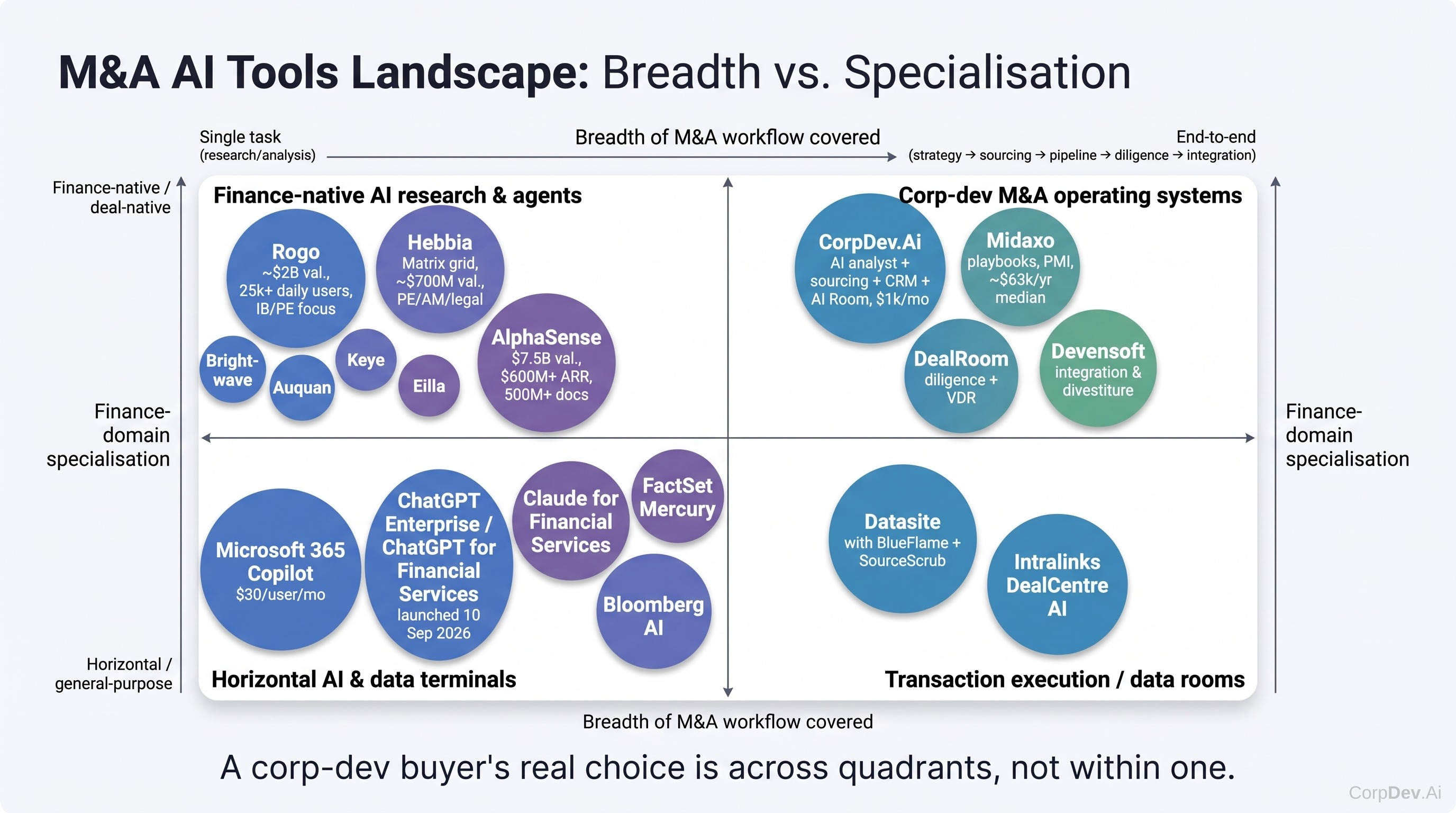
Read diagram description
Comparison for AI tools used by M&A and corporate development teams. First dimension: "Breadth of M&A workflow covered" from "Single task (research/analysis)" on the left to "End-to-end (strategy → sourcing → pipeline → diligence → integration)" for analytical platforms. Second dimension: "Finance-domain specialisation" from "Horizontal / general-purpose" at the bottom to "Finance-native / deal-native" at the top. Vendor positions: - Top-left quadrant "Finance-native AI research & agents": Rogo (labelled "~$2B val., 25k+ daily users, IB/PE focus"), Hebbia ("Matrix grid, ~$700M val., PE/AM/legal"), AlphaSense ("$7.5B val., $600M+ ARR, 500M+ docs"), Brightwave, Auquan, Keye, Eilla. - Top-right quadrant "Corp-dev M&A operating systems": CorpDev.Ai ("AI analyst + sourcing + CRM + AI Room, $1k/mo"), Midaxo ("playbooks, PMI, ~$63k/yr median"), DealRoom ("diligence + VDR"), Devensoft ("integration & divestiture"). - Bottom-right quadrant "Transaction execution / data rooms": Datasite (with BlueFlame + SourceScrub), Intralinks DealCentre AI. - Bottom-left quadrant "Horizontal AI & data terminals": Microsoft 365 Copilot ("$30/user/mo"), ChatGPT Enterprise / ChatGPT for Financial Services ("launched 10 Sep 2026"), Claude for Financial Services, FactSet Mercury, Bloomberg AI. "A corp-dev buyer's real choice is across quadrants, not within one."
1. Why This Decision Is Harder Than It Looks
Every vendor in this market describes itself as "AI for finance" or "AI for M&A", and almost every one demos the same three tricks: summarise a filing, build a comps table, draft a memo. That surface similarity hides four structurally different products, each solving a different bottleneck and each priced on a different logic. Buyers who evaluate them on the same feature checklist typically over-buy a research tool and under-buy process, or vice versa.
The four categories and the bottleneck each addresses
Rogo, Hebbia, AlphaSense, Brightwave, Auquan, Keye, Eilla
Bottleneck solved: analyst hours spent reading, extracting, modelling and formatting.
Pricing logic: premium per-seat, enterprise-negotiated, often multi-year.
Blind spot: no pipeline, no sourcing database, no integration management.
CorpDev.Ai, Midaxo, DealRoom, Devensoft
Bottleneck solved: end-to-end process — strategy, sourcing, pipeline, diligence, approval, integration.
Pricing logic: platform/team subscription; CorpDev.Ai publishes list prices, others quote.
Blind spot: research depth varies widely; only CorpDev.Ai leads with an AI analyst.
Datasite, Intralinks DealCentre AI
Bottleneck solved: secure document exchange, Q&A, redaction on a live deal.
Pricing logic: per-deal or per-page, $15k–$250k+ per transaction.
Blind spot: little value between deals; AI is a feature, not the product.
Microsoft 365 Copilot, ChatGPT Enterprise / Financial Services, Claude, FactSet Mercury, Bloomberg
Bottleneck solved: general productivity inside the tools you already use.
Pricing logic: $20–$30/user/month list (Copilot, Claude seat) or bundled with a terminal.
Blind spot: provenance, deal-level permissions and packaged M&A workflow must be built.
Three market shifts that changed the calculus in 2026
First, the model layer commoditised. Rogo itself ships GPT-5, Gemini and Claude Opus 4.7 inside its product [25][73]; Hebbia and AlphaSense are equally model-agnostic. Public criticism that Rogo is "largely a wrapper around OpenAI, Anthropic and Google models" [79] is unfair as a description of the engineering, but it is exactly the right diligence question: what remains proprietary once the model is available to everyone is the retrieval, finance tuning, data entitlements, workflow packaging, evaluation harness and audit trail. That is what a buyer is paying for, and it should be tested as such.
Second, the horizontal players moved into finance explicitly. Anthropic launched Claude for Financial Services in July 2025 with S&P Global, FactSet, Morningstar, Databricks and Snowflake integrations (Anthropic). On 10 September 2026 OpenAI launched ChatGPT for Financial Services, built with Morgan Stanley and Evercore as design partners, offering native LSEG, Daloopa and PitchBook access, source citations and administrative controls for sensitive deal materials (OpenAI). This is a direct assault on Rogo's core banking segment and it resets the price anchor for everyone.
Third, the category boundaries are dissolving through M&A. Datasite now owns BlueFlame AI (private-markets AI) and SourceScrub (sourcing data) [33]; Rogo acquired Offset and Rivanna in September 2026 to add agentic, data-room-native diligence [23][95]; AlphaSense — after a $350M raise at $7.5B in June 2026 [100][101] — has shipped 13 due-diligence agents including a CIM Analyzer that turns an uploaded CIM into a nine-section screening memo [107]. Each of these moves a "research" vendor into "execution" territory or vice versa.
The single most useful exercise before any vendor demo is a two-week time audit of the corporate development team. In our experience the split for an in-house team at a $1B+ corporate is roughly: 25–35% sourcing and market intelligence, 20–30% screening and internal memos/decks, 15–25% live-deal diligence and coordination, 10–20% pipeline reporting and stakeholder management, and the remainder on integration hand-off. A banker's week is inverted — 60%+ on analysis and artefact production for live mandates. Rogo is built for the banker's week. Validate your own split before you buy anyone's tool; this is an assumption to test, not a finding.
What this means for how to read the rest of this report
Section 2 profiles Rogo on its own terms. Section 3 maps the alternatives by category. Section 4 puts the five most relevant contenders for a corporate buyer head-to-head. Section 5 models illustrative three-year cost for a five-person team. Section 6 gives the decision framework by buyer archetype, and Section 7 sets out the risks that apply regardless of vendor.
2. Rogo: What It Is, Who It Is Built For, What It Costs
Rogo is, by some distance, the best-capitalised pure-play AI company built specifically for institutional finance workflows. Founded by ex-Lazard bankers, it has raised more than $300 million across five listed rounds in under 30 months and reached a reported ~$2 billion valuation in April 2026 [98][99]. Understanding what it is — and is not — is the foundation for every comparison that follows.
Product architecture
Rogo's product has converged on a clear thesis: the unit of value is a finished artefact, not a chat answer. Its components are:
- Rogo Chat — finance-focused conversational research over internal repositories (SharePoint, OneDrive, OneNote) and external sources (filings, transcripts, market data), with source-linked, auditable citations [1][5][6].
- Felix and the Agent Library — purpose-built agents that execute multi-step workflows from a single prompt: financial models, PowerPoint decks, investment memos, diligence packs, private-company screens, benchmarking, public-information books and portfolio analysis. Rogo's library spans hundreds of workflows across banking, PE, private credit, hedge funds, equity research, sales & trading and asset management [3][4][8].
- Excel and PowerPoint generation — models with in-cell source citations and a code interpreter for complex spreadsheets; client-ready slides that preserve the firm's templates [5][6]. This Office-native output is the feature bankers cite most.
- Data connectors — reported integrations with LSEG, S&P Global, FactSet, PitchBook and, as of September 2026, Preqin live in Felix; model access to OpenAI, Google Gemini and Anthropic [7][24][25]. Connector availability depends on the customer's own licences [7][75].
- Governance — single-tenant deployment options, end-to-end encryption, role-based access, audit trails, and stated SOC 2, ISO 27001, GDPR and CCPA alignment [1].
- Diligence (new) — the September 2026 acquisitions of Offset (AI agents) and Rivanna (AI-native due diligence) let users bring data-room contents directly into Felix for institutional-grade analysis [23][95].
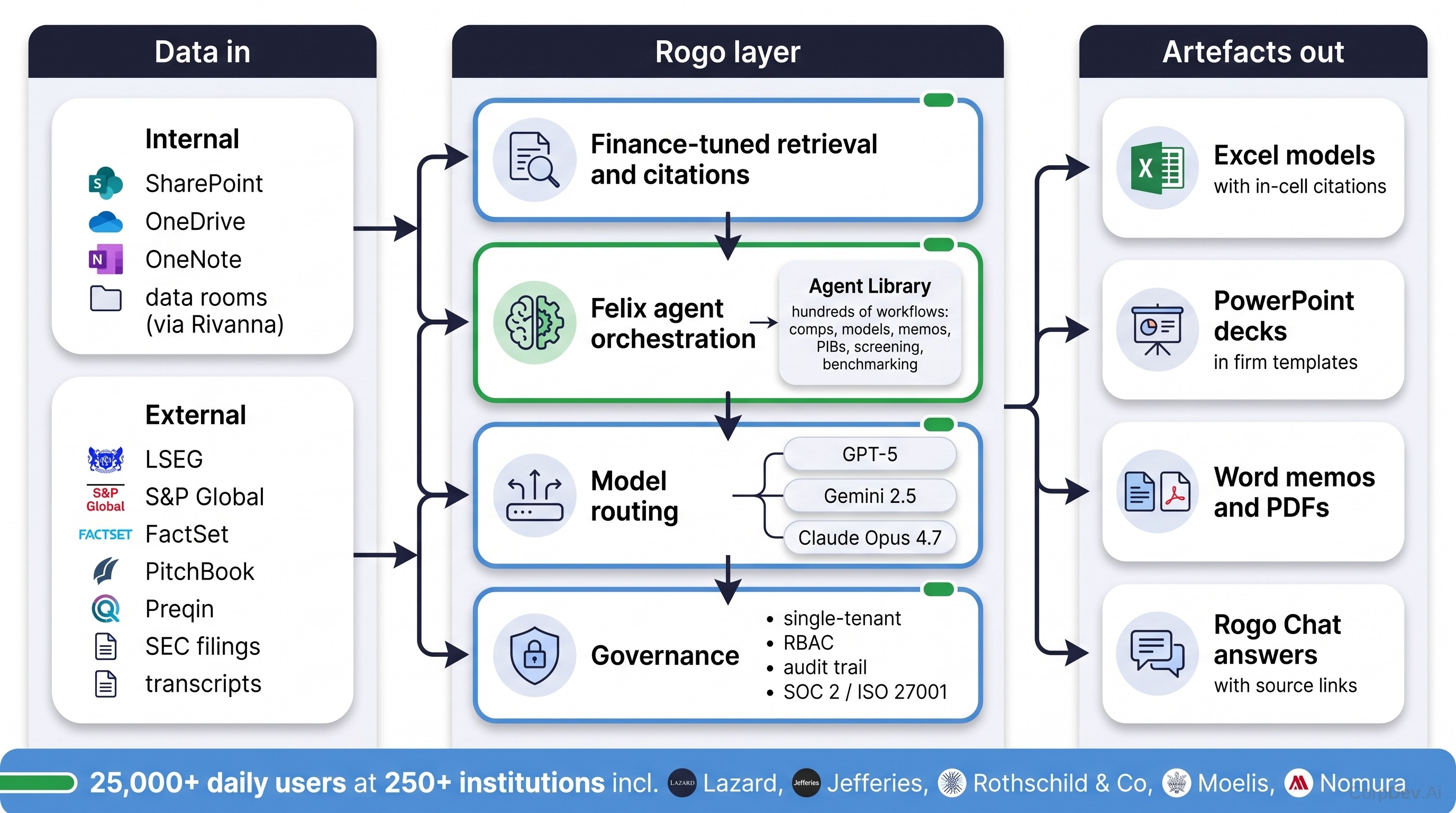
Read diagram description
Architecture diagram of the Rogo platform. Left column "Data in": Internal — SharePoint, OneDrive, OneNote, data rooms (via Rivanna); External — LSEG, S&P Global, FactSet, PitchBook, Preqin, SEC filings, transcripts. Centre column "Rogo layer": Finance-tuned retrieval and citations; Felix agent orchestration with Agent Library (hundreds of workflows: comps, models, memos, PIBs, screening, benchmarking); model routing across GPT-5, Gemini 2.5, Claude Opus 4.7; governance — single-tenant, RBAC, audit trail, SOC 2 / ISO 27001. Right column "Artefacts out": Excel models with in-cell citations; PowerPoint decks in firm templates; Word memos and PDFs; Rogo Chat answers with source links. "25,000+ daily users at 250+ institutions incl. Lazard, Jefferies, Rothschild & Co, Moelis, Nomura."
Customers and scale
Rogo's January 2026 Series C release stated that more than 25,000 financial professionals used the platform daily, naming Rothschild & Co, Jefferies and Lazard [9]; Moelis, Nomura and Tiger Global are also publicly associated [9][75]. Later 2026 reporting cites more than 35,000 professionals across 250+ institutions, although Rogo's own September 2026 announcements still use the 25,000-daily-user figure [10][23]. The customer base is overwhelmingly sell-side advisory, PE and hedge funds; we found no publicly named corporate development customer at a non-financial company. A London office led by co-founder John Willett opened with the Series C to serve European institutions [9].
Funding and valuation trajectory
| Round | Amount raised | Reported valuation |
|---|---|---|
| Seed (Feb 2024) | 7 | Not disclosed |
| Series A (Oct 2024) | 18 | 80 |
| Series B (Apr 2025) | 50 | 350 |
| Series C (Jan 2026) | 75 | 750 |
| Series D (Apr 2026) | 160 | 2000 |
The Seed valuation was not disclosed and the Series A figure is a secondary estimate [13][15]; the Series B ($350M), Series C ($750M, led by Sequoia with Henry Kravis and Wells Fargo participating) and Series D ($160M led by Kleiner Perkins, ~$2B) are corroborated by contemporaneous reporting [16][17][18][98]. Sacra estimates ARR at roughly $15M at end-2025 and ~$53M by August 2026 — third-party estimates, not audited figures [12]. If accurate, the ~$2B mark implies a revenue multiple of roughly 35–40x the cited August 2026 estimated ARR, which is the single clearest signal of how the venture market views the category's growth — and of the pricing pressure Rogo will be under to grow into it.
Pricing and commercial model
Rogo publishes no rate card, minimum seat count, implementation fee or single-tenant surcharge. It sells negotiated, typically multi-year enterprise agreements [12][3]. The most frequently cited external estimate is approximately $3,300 per seat per year, before data-connector premiums [12][20]. Buyers should assume this is a floor, not an all-in figure: the same sources describe scoped pilots followed by staged rollouts taking "weeks to reach a useful workflow and potentially several months for broad adoption" [20].
Strengths and limits for a corporate development buyer
Where Rogo is genuinely strong
- Artefact quality. Office-native models and decks with citations are a central product claim; this review contains no controlled public test establishing superiority to every horizontal tool.
- Finance-tuned accuracy. Vendor-reported hallucination reduction from 34.1% to 3.9% on Gemini 2.5 Flash (Google Cloud case study) [72]; internal evals show frontier models winning 62–70% of task matchups [73]. Vendor-reported, but directionally credible.
- Governance depth. Single-tenant, RBAC and audit trails designed for regulated institutions [1].
- Momentum. $300M+ raised, top-tier investors, two acquisitions in a month, Preqin and Opus 4.7 shipped in September 2026 alone [23][24][25][95].
Where Rogo is weak for corp dev
- No pipeline, CRM or sourcing database. Rogo assumes you already have DealCloud/Salesforce and a data terminal.
- External-data dependency. Its best workflows presuppose FactSet, S&P, PitchBook or LSEG licences that many corporates do not hold [15][75]; a corp-dev team may be paying for a Ferrari with no fuel.
- Opaque commercials. No published price, minimum or implementation scope [12].
- No corporate reference base. Customers are banks and funds; no independently verifiable G2/review base [79][81].
- Integration and PMI are out of scope — the phase where corporate M&A most often destroys value.
Independent commentary explicitly characterises Rogo's accuracy and hallucination figures as self-reported [15], and forum feedback notes it can still err on transaction values [74]. This is true of every vendor in this report. The remedy is the same for all of them: a blinded 25–50 question test set drawn from your own filings, CIMs and models, scored on numerical accuracy, citation correctness and reviewer edit-rate before any multi-year commitment.
3. The Alternative Landscape — Four Categories, Not One
The following profiles are deliberately uneven in length: the vendors a corporate development buyer is most likely to shortlist against Rogo get the most space. Funding and pricing figures are private-company disclosures or reported estimates; "undisclosed" means no reliable public figure was found, not that the vendor is unfunded.
3.1 Finance-native AI research and agent platforms — Rogo's direct rivals
Hebbia is the closest like-for-like substitute for Rogo in high-stakes, document-heavy analysis. Its core product, Matrix, is a spreadsheet-like grid in which each row is a document, company or transaction and each column applies a prompt, extraction rule or calculation, producing citation-backed cells that can be audited column by column [86][91]. Matrix 2.0 (January 2026) lets firms encode their own deal history and process into reusable agents; a "Document to Agent" feature converts a reference memo into a repeatable schema [86][87]. Publicly associated users include BlackRock, KKR, Carlyle, Centerview Partners, MetLife and law firms such as Ropes & Gray [91][92]. Its last clearly reported round was a $130M Series B at ~$700M in July 2024 on ~$13M ARR [26][93]; Sacra estimates ~$48M ARR by August 2026, unconfirmed [27]. Pricing is enterprise-only; estimates run ~$3,000–3,500 for light seats and $10,000–15,000 for professional seats [27][28]. Verdict for corp dev: superior to Rogo when your diligence process is bespoke and audit-heavy; weaker on Office artefacts and finance-native "out of the box" workflows.
AlphaSense is the category's scale player: a $350M raise at $7.5B in June 2026 on $600M+ ARR, with Vitruvian, Accenture Ventures and J.P. Morgan Asset Management participating [100][101][102]. Its moat is content — 500M+ premium documents including broker research, Tegus expert-call transcripts, filings and news — over which Deep Research runs autonomous multi-search synthesis [104][105]. By August 2026 it offered 13 Due Diligence Workspace agents, including a CIM Analyzer that produces a nine-section, cited screening memo and scores fit against a fund's criteria [107]. Pricing is per-seat/enterprise with no list price; buyer-reported ranges are ~$10,000–20,000 per seat per year [31][32]. Verdict for corp dev: the strongest choice when external market intelligence — competitor tracking, expert calls, sector research — is the primary job. It is an intelligence platform first and a workflow tool second.
Brightwave, Auquan, Keye, Eilla AI occupy narrower niches. Brightwave is an investment-research copilot for funds; Auquan targets risk, credit and compliance workflows at banks and insurers (~$20M raised) [33]; Keye is PE-underwriting-specific (~$5M seed; indicative $30–80k/year) [33]; Eilla AI is the closest to Rogo's sell-side pitchbook use case but with undisclosed funding and scale [33]. BlueFlame AI, a private-markets workflow tool, was acquired by Datasite in 2025 [33]. None of these is a natural first choice for an in-house corporate team; they are worth knowing so a buyer recognises them when a banker or PE counterparty mentions them.
Daloopa deserves a note as infrastructure rather than a competitor: it extracts source-linked, normalised fundamentals from filings into models, raised a $47M Series C in May 2026, and is now a native data source inside both ChatGPT for Financial Services and Claude for Financial Services [34][35]. If your team's pain is model-updating rather than research, Daloopa plus a horizontal LLM may be a better answer than any vertical platform.
3.2 Corporate-development M&A operating systems
This is the category most corp-dev buyers should be comparing against Rogo, because it addresses the whole week rather than the analysis hours.
CorpDev.Ai is an AI-native platform aimed squarely at in-house corporate development at $1B+ companies (or by invitation) [48]. It is unusual in this set in three ways. First, scope: it combines an AI analyst (memos, market reports, fit assessments, valuation and synergy workbooks), semantic target discovery across a claimed 70M+ company / 265M+ contact database with Apollo firmographics, a zero-entry Kanban pipeline CRM that syncs Outlook/Gmail and calendars, market maps, an AI-native data room ("AI Room") that vision-extracts PDF/XLSX/DOCX/PPTX with an audit trail, and post-close "digital twin" integration planning [48][50][51][52]. Second, transparency: it publishes pricing — AI Pro at $1,000/month (annual) for one user; AI Pro Team at $3,000/month for three users; Enterprise custom with SSO — with a free trial and no-card sign-up [52]. Third, openness: REST/MCP interfaces and storage in Markdown/JSON/Office formats to limit lock-in [48]. The founders are Kal Kilpi (CEO, two-time M&A software founder) and Atul Tiwary (M&A operator, El Dorado Capital) [49]. The weaknesses are equally clear: no disclosed funding, valuation or investors; "hundreds of CorpDev professionals" as users but no named customers, logos or case studies; and no independent review base [52][54]. Database counts and diligence-room capabilities are company claims. Verdict: the most differentiated product for the corp-dev job-to-be-done and the most transparent commercially, but a buyer must close the vendor-maturity gap with references, a security review and a pilot on real deal material.
Midaxo is the incumbent corporate-development operating system for serial acquirers: pipeline CRM with deal scoring, playbooks, diligence and VDR, transaction management and post-merger integration, plus CRM integrations [55]. AI features (playbook AI, enrichment, alerts) exist but the positioning is process-centric rather than analyst-centric [42][55]. Vendr reports a median buyer spend of ~$63,250/year within a $30–120k range [42][57]. Verdict: the safer choice for governance-heavy, repeat-acquirer programmes; it will not write your memo.
DealRoom combines pipeline, diligence request lists, VDR, Q&A, project management and integration in a buyer-led workflow, with indicative packages (~$12k/year Pipeline, ~$15k/year Diligence, ~$25k/year bundle) [43][59][60]. Verdict: strongest for coordinating an active deal with external parties; light on research automation.
Devensoft covers acquisitions, divestitures, JVs and transformations with particular depth in integration, synergy tracking, RAID management and legal workflow; pricing is custom [61][62][64]. Verdict: the integration-and-execution specialist — complementary to, rather than a substitute for, an AI analyst.
3.3 Transaction execution and virtual data rooms
Datasite and SS&C Intralinks (DealCentre AI) are the sell-side process backbone: secure VDRs with AI indexing, redaction, translation and Q&A, priced per transaction at roughly $15k–$250k+ depending on size [42][44]. Datasite's acquisitions of BlueFlame AI and SourceScrub make it the most aggressive consolidator in this category [33]. For a corporate buyer these are not alternatives to Rogo — they are what the counterparty's banker will use — but they matter because AI-native data rooms (Datasite, Intralinks, CorpDev.Ai's AI Room, Rogo via Rivanna) are converging on the same buy-side diligence use case from different directions.
3.4 Horizontal AI platforms and data terminals
Microsoft 365 Copilot at $30/user/month (annual, on top of an eligible M365 licence) is the lowest-friction option for any Microsoft-standardised corporate [41]. It inherits the tenant's permissions — which is both its strength and its principal risk: over-shared SharePoint content becomes discoverable [85]. It is a productivity layer, not a deal system.
ChatGPT Enterprise is quote-only (market estimates ~$45–75/user/month with reported 150-seat minimums) (beam.cloud). The 10 September 2026 launch of ChatGPT for Financial Services — GPT-6-based, with native LSEG, Daloopa and PitchBook access, source citations, chart auditing and admin controls for sensitive deal material, designed with Morgan Stanley and Evercore — is the most significant competitive event for Rogo this year (OpenAI).
Claude Enterprise / Claude for Financial Services lists a $20/seat/month base (20-seat self-serve minimum; 50 sales-assisted) plus metered usage, with S&P Global, FactSet, Morningstar, Daloopa, Databricks and Snowflake connectors and a Microsoft 365 add-in (Anthropic, Anthropic). The seat price understates all-in cost for heavy document work.
FactSet Mercury and Bloomberg AI are generative layers over existing terminals, priced within those subscriptions (Bloomberg ~$28–32k per terminal) [36][37][38]. They are only relevant if you already own the terminal.
Many corporates already license Copilot or an enterprise LLM; confirm entitlement, incremental fees and approved data access before using one as the baseline. Run it as the control arm in any vertical-tool pilot. If Rogo, Hebbia or CorpDev.Ai cannot beat Copilot-plus-your-analyst on the same 25 tasks by a margin that justifies a 10–100x per-seat premium, the answer is to buy nothing vertical yet. Several of the vendors above will lose that test for some teams — and that is a legitimate, money-saving result.
4. Head-to-Head: Rogo vs. CorpDev.Ai vs. Hebbia vs. AlphaSense vs. Midaxo
These five are the realistic finalists for most corporate development, strategy and M&A teams: two finance-native AI research platforms (Rogo, Hebbia), the intelligence-content leader (AlphaSense), and the two corp-dev operating systems that bracket the category on AI-depth versus process-maturity (CorpDev.Ai, Midaxo). Microsoft 365 Copilot is included as the baseline every option must beat.
4.1 Capability and fit matrix
Ratings are our assessment on a five-point scale (●●●●● = category-leading; ○ = absent or negligible), synthesised from vendor documentation, product updates and third-party reporting cited in Sections 2–3. They reflect fit for an in-house corporate development team, not for a bank.
| Dimension | Rogo | Hebbia | AlphaSense | CorpDev.Ai | Midaxo | M365 Copilot |
|---|---|---|---|---|---|---|
| Finance-native research & analysis | ●●●●● | ●●●●○ | ●●●●○ | ●●●●○ | ●●○○○ | ●●○○○ |
| Excel / PowerPoint artefact generation | ●●●●● | ●●●○○ | ●●○○○ | ●●●●○ | ●○○○○ | ●●●○○ |
| Source-level citations & auditability | ●●●●○ | ●●●●● | ●●●●○ | ●●●●○ | ●●○○○ | ●●○○○ |
| External market intelligence content | ●●●○○ | ●●○○○ | ●●●●● | ●●●○○ | ●○○○○ | ●○○○○ |
| Private-company sourcing database | ●●○○○ | ○ | ●●●○○ | ●●●●○ | ●●○○○ | ○ |
| Pipeline / CRM / activity capture | ○ | ○ | ○ | ●●●●○ | ●●●●● | ●○○○○ |
| Buy-side diligence / data room | ●●●○○ | ●●●●○ | ●●●○○ | ●●●○○ | ●●●●○ | ●○○○○ |
| Integration / PMI planning | ○ | ○ | ○ | End-to-end management and integration work; validate programme controls | ●●●●● | ●○○○○ |
| Governance (tenancy, RBAC, audit) | ●●●●● | ●●●●○ | ●●●●○ | ●●●○○ | ●●●●○ | ●●●●● |
| Works without a data-terminal licence | ●●○○○ | ●●●○○ | ●●●●● | ●●●●○ | ●●●●○ | ●●●○○ |
| Pricing transparency | ○ | ○ | ●○○○○ | ●●●●● | ●●○○○ | ●●●●● |
| Vendor maturity & reference base | ●●●●○ | ●●●●○ | ●●●●● | ●●○○○ | ●●●●○ | ●●●●● |
Two patterns stand out. Rogo and Hebbia score highest on the analysis rows and zero on the process rows — they are surgical instruments. CorpDev.Ai and Midaxo have no zeros in this matrix, which is its thesis: breadth across the corp-dev workflow at the cost of best-in-class depth in any single row and a thin public track record. Midaxo is the inverse of Rogo: process-complete, analysis-light. Copilot scores highly here on enterprise governance and price transparency, but has limited dedicated deal workflow, which for an occasional acquirer may be exactly enough.
4.2 Commercial comparison
| Vendor | Pricing basis | Indicative cost | Contract model | Basis of figure |
|---|---|---|---|---|
| Rogo | Per seat, enterprise | ~$3,300/seat/yr before data premiums | Negotiated, typically multi-year; scoped pilot | Third-party estimate [12][20] |
| Hebbia | Per seat, enterprise | ~$3,000–3,500 light; ~$10,000–15,000 pro seat/yr | Negotiated enterprise | Third-party estimate [27][28] |
| AlphaSense | Per seat / enterprise package | ~$10,000–20,000/seat/yr | Annual subscription | Buyer-reported ranges [31][32] |
| CorpDev.Ai | Published plans | $12,000/yr (1 user); $36,000/yr (3 users); Enterprise custom | Monthly or annual; free trial | Published list price [52] |
| Midaxo | Platform, quote-based | ~$30,000–120,000/yr; median ~$63,250 | Annual enterprise | Vendr / third-party [42][57] |
| M365 Copilot | Per user, published | $360/user/yr plus eligible M365 licence | Annual | Microsoft list price [41] |
The striking fact is that on a pure per-seat basis Rogo's estimated price is not the outlier — CorpDev.Ai's published Pro plan is roughly 3.5x Rogo's estimated seat cost, and AlphaSense is 3–6x. What differs is the shape of the cost: Rogo and Hebbia carry unknown minimums, implementation scope and data-licence dependencies; CorpDev.Ai's price includes sourcing data (Apollo), pipeline CRM and search credits that would otherwise be separate subscriptions; Midaxo is a platform fee largely independent of seat count. Section 5 converts these into team-level three-year scenarios.
4.3 Narrative assessment
Rogo vs. Hebbia. For a bank or PE fund this is the central contest. Rogo wins on speed-to-artefact and finance-native pre-packaging; Hebbia wins on configurable, column-by-column auditability and on heterogeneous document sets (contracts, credit agreements, legal). Rogo's Rivanna acquisition narrows Hebbia's data-room advantage [95]; Hebbia's Matrix-to-Excel model export narrows Rogo's artefact advantage [90]. For a corp-dev team, neither solves sourcing or pipeline, so both would sit on top of an existing CRM and data stack.
Rogo vs. AlphaSense. Different jobs. AlphaSense's content — broker research, expert calls, 500M+ documents — is what a strategy team needs for outside-in intelligence; Rogo's value is inside-out analysis of material you already have plus licensed data. AlphaSense's CIM Analyzer and diligence agents [107] mean a team that already pays for AlphaSense should test those before adding Rogo.
Rogo vs. CorpDev.Ai. This is the comparison a corporate buyer should actually run, and it is asymmetric. Compare analytical depth on the same assignment; CorpDev.Ai is the only one of the two that will find the target, log the banker call, run the pipeline review, hold the data room and draft the integration blueprint. If the team already has a CRM, a sourcing database and a data terminal, Rogo's depth is worth more. CorpDev.Ai also warrants a primary-platform evaluation in large programmes, where end-to-end management and analytical execution can reduce handoffs. The potential to consolidate subscriptions depends on the required specialist data and controls. The offsetting risk is vendor maturity: Rogo has $300M+ of capital, 250+ institutions and a public roadmap cadence; CorpDev.Ai discloses none of funding, customers or headcount. A buyer should ask CorpDev.Ai for reference calls, its security posture (SOC 2 status, tenancy model, data-retention terms), and a written product roadmap before committing beyond the published monthly plans — and should note that month-to-month availability itself limits the downside.
Rogo vs. Midaxo. These are complements, not substitutes. A serial acquirer running Midaxo for governance and PMI could add Rogo for analysis; the question is whether an integrated alternative (CorpDev.Ai) or Copilot-inside-Midaxo gets 80% of the value for a fraction of the combined ~$80–150k annual cost.
| Product | Strategy / sourcing | Pipeline | Analysis, valuation and memos | Diligence | Integration |
|---|---|---|---|---|---|
| Rogo | Partial external research and screening | No dedicated CRM core | Finance-focused specialist; no controlled best-in-class claim | Strong reviewed proposition, expanded via Rivanna in September 2026 | No dedicated PMI core |
| Hebbia | Partial strategy; not primarily an external sourcing database | No dedicated deal CRM core | Strong corpus-based analysis and evolving output agents | Matrix grid with auditable citations | No dedicated PMI core |
| AlphaSense | Strong strategy: 500M+ documents/expert calls; partial sourcing | No native full deal CRM | Partial-to-broad research production, depending on agents | Partial; includes CIM Analyzer/deal agents | No dedicated PMI core |
| CorpDev.Ai | Broad strategy and sourcing claim; 70M+ universe through sources | Built-in zero-entry CRM | Broad deliverables; financial modelling tier must be confirmed | AI Room document analysis; specialist control depth varies | End-to-end management, integration work and reporting; validate programme controls |
| Midaxo | Limited strategy; partial sourcing | Core process records | Partial through document Q&A and structured suggestions | Core deal governance/document workflow | Core playbooks and PMI |
| Microsoft 365 Copilot | Configured research and productivity assistance | Uses connected records; not a dedicated M&A CRM by default | General Office assistance | Configuration-dependent document analysis | Productivity support, not a native PMI system of record |
Programme-scope assessment. The CorpDev.Ai integration entry describes its end-to-end management scope rather than assigning an unsupported comparative performance score. Evaluate the required controls and the quality of completed work on the same acquisition programme as other finalists. Deal frequency and public review volume do not establish a functional ranking. See the lifecycle framework and integration capabilities; these are vendor materials, not independent benchmarks.
The lifecycle frame is strategy/market intelligence, sourcing/screening, pipeline/relationships, analysis/valuation/memos, diligence and PMI. Scope labels describe the reviewed core; modules and agents evolve. Measure review effort, evidence and actual entitlements instead of treating blank cells as universal inability.
5. Total Cost of Ownership — Illustrative Three-Year Scenarios
Per-seat list prices mislead in this market because the vendors price on different bases — seats, platform, deal volume or bundled data. The scenarios below normalise to one buyer: a five-person in-house corporate development team at a $1B+ corporate, over three years, subscription cost only (no internal implementation labour, which varies by vendor and configuration and is excluded rather than assumed equal).
Every figure is an estimate built from the sources cited in Section 4.2; the Basis column states the derivation so the reader can substitute a real quote. Vendors with undisclosed minimums (Rogo, Hebbia) are shown at the estimated seat price — the true floor may be materially higher.
| Option | Low | High |
|---|---|---|
| Microsoft 365 Copilot (baseline) | 5.4 | 5.4 |
| Rogo — 5 seats (est.) | 49.5 | 49.5 |
| Hebbia — 2 pro + 3 light seats (est.) | 91.5 | 91.5 |
| Hebbia — 5 pro seats (est.) | 150 | 225 |
| CorpDev.Ai — 1 Team + 2 Pro (list) | 180 | 180 |
| Midaxo — median platform fee | 190 | 190 |
| AlphaSense — 5 seats (est.) | 150 | 300 |
| Option | Annual cost | 3-year cost | What is included | Basis |
|---|---|---|---|---|
| Microsoft 365 Copilot | $1,800 | $5,400 | Productivity AI across Office; no deal logic, no data | 5 × $30 × 12; list price, excludes prerequisite M365 licence [41] |
| Rogo — 5 seats | $16,500 | $49,500 | Finance-native analysis, Felix agents, Office artefacts | 5 × ~$3,300 third-party estimate; excludes unknown enterprise minimum, implementation and data-connector premiums [12][20] |
| Hebbia — 2 pro + 3 light | $30,500 | $91,500 | Matrix grid, agents, citations | 2 × $10,000 + 3 × $3,500; third-party estimates [27][28] |
| Hebbia — 5 pro seats | $50,000–75,000 | $150,000–225,000 | As above, full-power seats | 5 × $10,000–15,000; third-party estimates [27] |
| CorpDev.Ai — 1 Team + 2 Pro | $60,000 | $180,000 | AI analyst, 70M+ company sourcing, pipeline CRM, market maps, AI Room, presentations, 60k search credits/yr, CSM | $36,000 + 2 × $12,000; published annual list prices [52]; Enterprise quote may differ |
| Midaxo | ~$63,250 | ~$189,750 | Pipeline CRM, playbooks, diligence/VDR, PMI | Vendr median buyer spend; range $30–120k [42][57] |
| AlphaSense — 5 seats | $50,000–100,000 | $150,000–300,000 | Market intelligence content, Deep Research, DD agents | 5 × $10,000–20,000 buyer-reported range [31][32] |
Reading the numbers correctly
Rogo looks cheapest of the vertical tools — and probably is not. The $3,300 figure is an outside estimate for a seat inside a large bank contract. A five-seat corporate deployment would need to clear Rogo's (undisclosed) minimum commitment, fund a scoped pilot and rollout, and — critically — either hold or buy the FactSet/S&P/PitchBook/LSEG licences that its best workflows consume [7][15][75]. A single institutional data-terminal licence typically costs more per year than all five Rogo seats combined; if the team does not already have one, Rogo's effective cost is dominated by data, not software.
CorpDev.Ai and Midaxo are priced as platforms that replace other subscriptions. CorpDev.Ai's $60k/year bundles sourcing data (Apollo firmographics on 70M+ companies) and a CRM that a team would otherwise buy from Grata/SourceScrub and Affinity/DealCloud respectively — third-party estimates put Affinity alone at $2,000–2,700 per user per year [65] and Midaxo-class pipeline tools at $30k+ [42]. Midaxo's fee is largely seat-independent, which favours larger teams.
AlphaSense is a content subscription with AI attached. Its cost is justified by the 500M-document corpus and expert-call library, not by the agents. A team that does not consume broker research and expert calls is paying for shelf space.
Three assumptions drive these figures and each should be validated in procurement: (1) Rogo and Hebbia will sell five seats to a non-financial corporate at the estimated per-seat rate — both may impose minimums that push the true cost into the $75–150k/year range; (2) the team already has, or does not need, an institutional data terminal — if it needs licensed institutional data, add the required entitlements to any option that does not already include that precise dataset. Bundled AlphaSense content or CorpDev.Ai firmographics are not universal substitutes for terminal financials, and Copilot also needs licensed data when the task requires it; (3) internal implementation effort — legal, InfoSec, identity and permission clean-up — is excluded from this subscription model, but may differ materially across vendors. Implementation is not negligible in absolute terms: public commentary on Rogo describes weeks to a useful workflow and months to broad adoption [20].
Value side of the ledger
Cost only matters relative to value, and the value evidence is now reasonable. McKinsey reports that 40% of organisations already using generative AI in M&A saw deal cycles shorten by 30–50% (McKinsey). Bain's 2026 M&A Report finds adoption more than doubled to 45% of practitioners in 2025, with leading uses in dynamic target pipelines, outside-in intelligence, faster synergy work and reduced integration-preparation effort (Bain). Deloitte finds 86% of M&A respondents have integrated GenAI into workflows and 83% have invested $1M+ specifically for M&A teams (Deloitte). Against an assumed fully loaded analyst cost of $150–250k per year, 25–40% of capacity is worth $37.5–100k annually. Some quoted configurations fit within that range and others may exceed it; recovered capacity is not automatically cash savings. Set the pilot’s break-even threshold using the actual all-in cost and usable time savings.
6. Decision Framework: Which Tool for Which Team
The right purchase depends on three variables a buyer can determine before talking to any vendor: deal cadence (how many live processes per year), existing stack (do you already own a CRM, a sourcing database and a data terminal?), and primary bottleneck (analysis hours, process discipline, external intelligence, or execution coordination).
The institutional financial analysis requirement determines which specialist capabilities belong in the evaluation. It does not determine which platform should own the full M&A programme. Compare the work the team must complete, the evidence and controls required, and the effort of maintaining multiple systems.
| Requirement | Evaluation approach | Decision implication |
|---|---|---|
| Institutional financial analysis | Compare Rogo, Hebbia and financial data providers on licensed data, analytical outputs and established Office workflows. Use the actual transaction or institutional mandate. | Retain a specialist for its demonstrated contribution; its strength in this job does not establish overall M&A superiority. |
| End-to-end M&A management | Evaluate CorpDev.Ai, Midaxo and DealRoom on the connected path from thesis and target evaluation through diligence, decisions, execution and integration. | Include CorpDev.Ai as a primary-platform candidate. Product categories and the number of deals are not substitutes for a workflow demonstration. |
| Analytical execution and deliverables | Ask each finalist to analyse the same evidence and produce a decision-ready recommendation, supporting materials and an integration response. Record human corrections and remaining manual work. | CorpDev.Ai's combination of management and work-producing agents is particularly relevant when substantial analysis must accompany every deal. Compare the quality and completeness of the outputs. |
| Large or frequent acquisition programmes | Use concurrent evaluations and integrations, shared business-unit resources and recurring leadership reporting in the pilot. Test permission boundaries and ownership changes. | Programme scale strengthens the case for evaluating integrated management and analytical capacity together; it does not automatically favour Midaxo or DealRoom. |
| Existing systems and total cost | Price the required participants, AI usage, data entitlements, implementation, ongoing reconciliation and exit. Compare both replacement and coexistence. | Keep a second platform where a specific control or operating requirement justifies it. Avoid turning a small standard plan into an unsupported Enterprise cost estimate. |
6.1 Recommendations by buyer archetype
Profile: 1–3 deals a year; corp dev is a small team or a hat worn by strategy/finance; no data terminal.
Recommendation: Microsoft 365 Copilot (or ChatGPT Enterprise if the company already has it) plus a per-deal VDR. Use CorpDev.Ai's free trial or monthly Pro plan on a live project before committing to anything annual.
Avoid: multi-year Rogo/Hebbia/AlphaSense contracts — the seats will sit idle between deals.
Profile: 3–10 processes a year; 3–8 people; pipeline of 50–300 targets; board reporting cadence; often no dedicated CRM or terminal.
Recommendation: Shortlist CorpDev.Ai and Midaxo; add Rogo or Hebbia to the shortlist only if a data terminal is already in place. Run Copilot as the control. Decide on measured analyst-hours released and pipeline-hygiene improvement.
Watch: CorpDev.Ai's vendor maturity — demand references and security documentation.
Profile: 10+ processes a year, programmatic M&A, existing DealCloud/Salesforce, FactSet or S&P, dedicated integration office.
Recommendation: Rogo (or Hebbia for document-heavy, bespoke diligence) for analysis; keep or add Midaxo/Devensoft for governance and PMI; AlphaSense if outside-in intelligence is a daily need. Expect $150k–400k+ per year all-in.
Watch: ChatGPT for Financial Services and Claude for Financial Services — test them against Rogo at renewal.
6.2 How to run the pilot — the same protocol for every vendor
Do not evaluate any of these products with generic chatbot prompts. The protocol below, distilled from vendor-neutral guidance and the failure modes specific to M&A, applies equally to Rogo, Hebbia, AlphaSense, CorpDev.Ai and the horizontal baseline.
- Fixed corpus. 2–3 historical or anonymised deals: filings, transcripts, CIMs, data-room extracts, internal strategy papers, your comps set.
- Blinded test set of 25–50 tasks spanning target screening, comps, diligence Q&A, memo drafting and pipeline/board reporting — weighted to your time-audit from Section 1.
- Control arm. The same tasks run in Copilot or your enterprise LLM by the same analysts.
- Score six things: numerical and entity accuracy (fiscal year, adjusted vs. reported EBITDA, announced vs. closed); citation correctness at page level; explicit "not found" behaviour when evidence is absent; permission enforcement across two users with different deal access; Excel/PowerPoint export fidelity; and reviewer edit-time to an acceptable output.
- Measure economics, not gross time saved: cost per screened target, per diligence question and per committee-ready memo, quality-adjusted.
6.3 Questions every vendor must answer in writing
| Topic | Question | Why it matters |
|---|---|---|
| Commercials | Minimum seats and annual spend; pilot credited or paid; renewal uplift cap; unused-seat treatment | Rogo and Hebbia publish none of these [12][27] |
| Data rights | Which external sources are included vs. require our licence; redistribution rights for outputs in board decks | Rogo's best workflows depend on customer-held licences [7][75] |
| Model training | Contractual exclusion of customer data from model training, including all subprocessors | Third-party descriptions are not contracts [75] |
| Tenancy & residency | Single-tenant scope, region, key management, subprocessor list, audit-log access | "Single tenant" does not mean every shared service is isolated [71] |
| Permissions | Deal-by-deal workspaces, clean-team support, inheritance from SharePoint/VDR | Over-shared content becomes discoverable [85] |
| Exit | Data export format, deletion SLA, price for a mid-term downgrade | Category will consolidate again by 2028 (Section 7) |
| Roadmap & viability | Funding runway, named references in our sector, product update cadence | Especially for CorpDev.Ai, which discloses no funding [54] |
Whichever vendor wins, the first month of value is determined by the state of your SharePoint, OneDrive, Teams and data-room permissions, not by the product. A retrieval-based AI will faithfully surface whatever a user is technically entitled to see. Budget the clean-up before the pilot; it is the same work for Copilot, Rogo, Hebbia and CorpDev.Ai alike, and Deloitte's finding that 67% of M&A respondents rank data security as their top GenAI concern reflects exactly this (Deloitte).
7. Risks, Caveats and What to Watch in 2026–2027
Five risks apply across the category and should be priced into any decision.
1. Model commoditisation compresses the vertical premium. Rogo, Hebbia and AlphaSense all route to the same frontier models their customers could licence directly [25][73]. The defensible layer is retrieval quality, finance-specific evaluation, data entitlements, workflow packaging and audit trail. OpenAI's ChatGPT for Financial Services (10 September 2026) and Anthropic's Claude for Financial Services now bundle licensed data connectors and citations at horizontal price points (OpenAI, Anthropic). Expect vertical vendors to respond by moving further into workflow and execution — as Rogo did with Rivanna and Offset [23][95] — and expect per-seat prices to face pressure at renewal. Implication: prefer annual over multi-year terms, or negotiate renewal caps.
2. Valuation-driven pricing behaviour. Rogo's reported ~$2B valuation on an estimated ~$53M ARR [12][98], Hebbia's ~$700M on ~$13M ARR at its last priced round [26][93], and AlphaSense's $7.5B on $600M+ ARR [100] imply growth expectations that must be met through expansion revenue. Buyers of the venture-backed platforms should anticipate aggressive upsell, tiering of "premium" agents or data, and land-and-expand tactics. The transparent-pricing vendors (CorpDev.Ai, Microsoft) carry less of this risk but — in CorpDev.Ai's case — more vendor-viability risk, since its funding is undisclosed [54].
3. Consolidation will re-draw the shortlist. In the last eighteen months Datasite bought BlueFlame AI and SourceScrub [33], Rogo bought Offset and Rivanna [23][95], and AlphaSense (which had already absorbed Tegus) raised $350M partly to keep acquiring [100][30]. Plausible next moves include a data-terminal owner (LSEG, S&P, FactSet) acquiring a research-agent vendor, or a corp-dev operating system being absorbed by a VDR or CRM player. Implication: contract for data export in open formats and for assignment/change-of-control protections. CorpDev.Ai's stated storage in Markdown/JSON/Office formats and REST/MCP access [48] is the right pattern to demand from every vendor.
4. Accuracy claims are vendor-reported everywhere. No vendor in this report has published an independently audited accuracy benchmark on buyer-representative M&A tasks. Rogo's 34.1%→3.9% hallucination reduction is a Google Cloud case study [72]; Hebbia's "40% of the largest asset managers" is an industry claim [92]; CorpDev.Ai's 70M-company and 265M-contact counts are company claims [48]. The blinded pilot in Section 6.2 is not optional.
5. Data-licence and output-rights exposure. Surfacing FactSet, S&P, PitchBook or LSEG data through a third-party agent and pasting it into a board deck may breach the data provider's redistribution terms even where the software vendor's contract is silent [7][15]. This risk sits with the buyer, not the vendor. Confirm entitlements per user and per output type before go-live.
Rogo's ~$2B Series D valuation is reported by SiliconANGLE and others but not stated in Rogo's own announcement [98][99]; Hebbia's post-2024 funding and 2026 ARR are estimates from secondary databases that conflict with one another [27]. Both are flagged as "reported" in the Key Facts appendix. Neither changes the buyer conclusions.
What to watch over the next 12–18 months
OpenAI enters Rogo's home market
ChatGPT for Financial Services launches with LSEG, Daloopa and PitchBook access, designed with Morgan Stanley and Evercore. First real test of whether a horizontal vendor can match vertical provenance and permissions.
Rogo moves into diligence
Acquisitions of Offset and Rivanna bring agentic, data-room-native diligence into Felix; Preqin goes live. Watch for a corporate-development or PE-operations offering to follow.
Renewal season for 2024–25 vertical contracts
First large cohort of Rogo and Hebbia enterprise contracts comes up for renewal against materially cheaper horizontal alternatives. Pricing behaviour here will reveal the durability of the vertical premium.
Corp-dev operating systems prove or fail their AI thesis
CorpDev.Ai's bet — one AI-native system across sourcing, pipeline, analysis, diligence and integration — will be judged on disclosed customers and funding. Midaxo, DealRoom and Devensoft will be judged on whether their AI features move beyond enrichment and alerts.
Next consolidation wave
Terminal owners, VDR providers and CRM platforms are the likely acquirers of the AI-research specialists. Buyers should hold exit and export rights that survive a change of control.
Closing assessment
Rogo is a strong candidate for the job it was built for — turning licensed data and internal documents into banker-grade Excel, PowerPoint and Word artefacts inside a governed enterprise environment. It is also, for most in-house corporate development teams, the wrong-shaped purchase: it solves the analysis hours and leaves sourcing, pipeline, coordination and integration untouched, and its economics presuppose a data stack many corporates lack. Hebbia is the right alternative when diligence is bespoke and audit-heavy; AlphaSense when external intelligence is the daily need; Midaxo when process governance and PMI dominate; and CorpDev.Ai when the team wants one AI-native system across the whole corporate development lifecycle at a published price — accepting, and diligencing, the maturity risk of a young vendor. Microsoft 365 Copilot is the control arm every one of them must beat. Buy for 24 months, pilot blind, contract for exit, and expect to re-run this comparison in 2028.
Key Facts & Sources
The load-bearing figures in this report, with their source and as-of date. Figures marked "reported" or "estimate" are not vendor-confirmed and should be re-verified before a procurement commitment.
| # | Fact | Figure | Source | As of | Status |
|---|---|---|---|---|---|
| 1 | Rogo Series D | $160M led by Kleiner Perkins; ~$2B valuation | SiliconANGLE, TAM Radar [98][99] | 29 Apr 2026 | Amount confirmed; valuation reported |
| 2 | Rogo Series C | $75M led by Sequoia; $750M valuation | Rogo, Axios [9][18] | 28 Jan 2026 | Confirmed |
| 3 | Rogo Series B | $50M led by Thrive; ~$350M valuation | Rogo, Traded [16][17] | 30 Apr 2025 | Confirmed |
| 4 | Rogo total funding | >$300M cumulative | Derived: $7M + $18M + $50M + $75M + $160M = $310M [12][14][16][9][98] | Apr 2026 | Derived |
| 5 | Rogo daily users | 25,000+ professionals; 250+ institutions (later reports: 35,000+) | Rogo Series C release; Rogo Offset release [9][23][10] | Jan–Sep 2026 | Confirmed (25k) / reported (35k) |
| 6 | Rogo ARR | ~$15M end-2025; ~$53M Aug 2026 | Sacra [12] | Sep 2026 | Third-party estimate |
| 7 | Rogo price per seat | ~$3,300/year | Sacra, AI Agent Square [12][20] | 2026 | Third-party estimate; no list price |
| 8 | Rogo acquisitions | Offset (AI agents); Rivanna (AI-native diligence) | Rogo news [23][95] | Sep 2026 | Confirmed |
| 9 | Rogo hallucination reduction | 34.1% → 3.9% on Gemini 2.5 Flash | Google Cloud case study [72] | 2025–26 | Vendor/partner-reported |
| 10 | AlphaSense raise | $350M at $7.5B; $600M+ ARR | AlphaSense, Reuters, WSJ [100][101][102] | 3 Jun 2026 | Confirmed |
| 11 | AlphaSense seat price | ~$10,000–20,000/year | Market Intelligence Tools; AlphaSense pricing page [31][32] | Jul 2026 | Buyer-reported range |
| 12 | AlphaSense DD agents | 13 agents incl. CIM Analyzer | AlphaSense Help Center [107] | Aug 2026 | Confirmed |
| 13 | Hebbia last priced round | $130M Series B at ~$700M; ~$13M ARR | TechCrunch [26][93] | Jul 2024 | Confirmed (2024); no later confirmed round |
| 14 | Hebbia pricing | ~$3,000–3,500 light; ~$10,000–15,000 pro seat/year | Sacra; Hebbia pricing page [27][28] | 2026 | Third-party estimate |
| 15 | CorpDev.Ai pricing | $1,000/mo (1 user) and $3,000/mo (3 users), annual; Enterprise custom | CorpDev.Ai pricing page [52] | Sep 2026 | Published list price |
| 16 | CorpDev.Ai data claims | 70M+ companies; 265M+ contacts | CorpDev.Ai website [48] | Sep 2026 | Company claim |
| 17 | CorpDev.Ai funding / customers | Undisclosed; "hundreds of CorpDev professionals", no named customers | CorpDev.Ai, Crunchbase [52][54] | Sep 2026 | Gap — not disclosed |
| 18 | Midaxo cost | ~$30,000–120,000/year; median ~$63,250 | Vendr; CT Acquisitions [42][57] | May 2026 | Third-party buyer data |
| 19 | Microsoft 365 Copilot price | $30/user/month, annual | Microsoft pricing page [41] | 2026 | Published list price |
| 20 | ChatGPT Enterprise price | ~$45–75/user/month; ~150-seat minimum | beam.cloud | 2026 | Market estimate; quote-only |
| 21 | ChatGPT for Financial Services launch | 10 Sep 2026; LSEG, Daloopa, PitchBook; Morgan Stanley & Evercore design partners | OpenAI | 10 Sep 2026 | Confirmed |
| 22 | Claude Enterprise price | $20/seat/month + usage; 20-seat minimum self-serve | Anthropic | 2026 | Published |
| 23 | AI adoption in M&A | 45% of practitioners (2025), up from 21% | Bain M&A Report 2026 | 2026 | Survey |
| 24 | Deal-cycle impact | 40% of GenAI users report 30–50% shorter cycles | McKinsey | 2025 | Survey |
| 25 | GenAI in M&A workflows; top concern | 86% integrated; 67% cite data security | Deloitte | 2025 | Survey |
| 26 | Datasite acquisitions | BlueFlame AI (2025); SourceScrub | Competitor deep-dive [33] | 2025 | Reported |
| 27 | 3-year TCO scenarios (Section 5) | Copilot $5.4k; Rogo $49.5k; CorpDev.Ai $180k; Midaxo ~$190k; AlphaSense $150–300k | Derived: 5 seats × price × 3 years from rows 7, 11, 14, 15, 18, 19 | Sep 2026 | Derived; assumptions stated in Section 5 |
Methodology note. Web research was conducted on 12 September 2026 using synthesised search with source attribution. Vendor websites were treated as authoritative for product features and published prices, and as claims for scale metrics. Third-party price estimates (Sacra, Vendr, market-intelligence blogs) were used only where vendors publish no list price and are labelled as estimates throughout. Capability ratings in Section 4.1 are the authors' assessment and not vendor-verified. The authors note that this document was produced on the CorpDev.Ai platform; the CorpDev.Ai profile applies the same evidentiary standard as every other vendor, including explicit statement of its disclosure gaps.
References
Numbering follows the original research. Access dates below record the original source registry; they do not imply that every source was rechecked for this website edition.
- Rogo | AI for the most ambitious firms in financeSource accessed 2026-09-12
- Report: Rogo Business Breakdown & Founding StorySource accessed 2026-09-12
- What's New: May 2026 | RogoSource accessed 2026-09-12
- What's New: November 2025 | RogoSource accessed 2026-09-12
- PersonalizationSource accessed 2026-09-12
- Rogo Acquires Offset to Integrate AI Agents in Financial ...Source accessed 2026-09-12
- Rogo's Agent LibrarySource accessed 2026-09-12
- Scaling Rogo to Build the Future of Finance: Our $75M Series C and ...Source accessed 2026-09-12
- Rogo Just Raised $160 Million to Replace Wall Street’s Junior ...Source accessed 2026-09-12
- Rogo revenue, valuation & funding | SacraSource accessed 2026-09-12
- Rogo Valuation & Funding | LegionSource accessed 2026-09-12
- Rogo raises $18M Series A from Khosla Ventures to Build Wall ...Source accessed 2026-09-12
- Rogo: Wall Street's AI analyst, and the questions a $2B mark raisesSource accessed 2026-09-12
- Rogo Raises $50M Series B from Thrive Capital, J.P. Morgan, and ...Source accessed 2026-09-12
- Rogo Raises $50M Series B Round Led By Thrive Capital ...Source accessed 2026-09-12
- Exclusive: Sequoia leads Rogo raise at $750M valuationSource accessed 2026-09-12
- Rogo AI 2026: Finance Analysis Agent — Pricing, Fit & VerdictSource accessed 2026-09-12
- Rogo Acquires OffsetSource accessed 2026-09-12
- AI for the most ambitious firms in finance - RogoSource accessed 2026-09-12
- Opus 4.7 Now Available in RogoSource accessed 2026-09-12
- AI startup Hebbia raised $130M at a $700M valuation on ...Source accessed 2026-09-12
- Hebbia revenue, valuation & funding | SacraSource accessed 2026-09-12
- Pricing - hebbia.comSource accessed 2026-09-12
- AlphaSense Said to Seek Hundreds of Millions in Fresh FundingSource accessed 2026-09-12
- Pricing | AlphaSenseSource accessed 2026-09-12
- AlphaSense Pricing 2026: What a Seat Actually Costs | Market ...Source accessed 2026-09-12
- Private Credit AI Platforms — Competitor Deep-DiveSource accessed 2026-09-12
- Daloopa Raises $47 Million Series C to Power the Data Layer ...Source accessed 2026-09-12
- Daloopa raises $47M Series C for AI finance data - AxiosSource accessed 2026-09-12
- FactSet Launches FactSet Mercury to Supercharge Junior Banker ...Source accessed 2026-09-12
- Top Generative AI Tools for Market Research (Buyer's Guide)Source accessed 2026-09-12
- Top Market Intelligence Tools in 2026 (Buyer's Guide)Source accessed 2026-09-12
- Microsoft 365 Copilot Plans and Pricing—AI for Business ...Source accessed 2026-09-12
- Pricing And Roi Math: What...Source accessed 2026-09-12
- Virtual Data Room Pricing in 2026: What You'll PaySource accessed 2026-09-12
- Best AI data rooms in 2026: 10 platforms compared ...Source accessed 2026-09-12
- CorpDev.Ai - Agentic AI for M&A and Corporate DevelopmentSource accessed 2026-09-12
- About UsSource accessed 2026-09-12
- Deep Company Intelligence & Research for M&ASource accessed 2026-09-12
- AI Analyst Agent for M&A | Generate Investment ... - corpdev.aiSource accessed 2026-09-12
- Pricing - CorpDev.AiSource accessed 2026-09-12
- corpdev.ai - Crunchbase Company Profile & FundingSource accessed 2026-09-12
- Midaxo Reviews 2026: Details, Pricing, & FeaturesSource accessed 2026-09-12
- Midaxo Software Pricing & Plans 2025: See Your Cost - VendrSource accessed 2026-09-12
- DealRoom Software Reviews, Demo & Pricing - 2026Source accessed 2026-09-12
- DealRoom Pricing: M&A Software Plans and CostsSource accessed 2026-09-12
- Devensoft | M&A Software for Deals, Due Diligence & IntegrationsSource accessed 2026-09-12
- M&A Platform — Pipeline, Diligence, Integration & More - DevensoftSource accessed 2026-09-12
- Integrations & DivestituresSource accessed 2026-09-12
- Affinity Pricing: Plans for Private Capital CRMSource accessed 2026-09-12
- Rogo AI — Pricing & Service Angle · ToolfabSource accessed 2026-09-12
- Rogo case study - Google CloudSource accessed 2026-09-12
- Expanding Rogo with GPT-5Source accessed 2026-09-12
- AI startup taking on IBs raises a further $50mSource accessed 2026-09-12
- Rogo: AI for finance teams that turns researchSource accessed 2026-09-12
- Jamie Dimon dit que l'IA a déjà réduit de 30 à 40 % des emplois ...Source accessed 2026-09-12
- Rogo Reviews (9): Pros & Cons of Working At Rogo - GlassdoorSource accessed 2026-09-12
- Microsoft 365 Copilot Security Risks: 2026 GuideSource accessed 2026-09-12
- Introducing Matrix 2.0 - hebbia.comSource accessed 2026-09-12
- What's New: August 2025Source accessed 2026-09-12
- What's New: September 2025Source accessed 2026-09-12
- Hebbia Matrix: AI Document Analysis for Finance | VantaigeSource accessed 2026-09-12
- The AI Platform Wall Street Can't Ignore: Inside Hebbia's Breakout ...Source accessed 2026-09-12
- Hebbia Review, Pricing & Features (2026) - Agents AISource accessed 2026-09-12
- Rogo Acquires Rivanna: The Intelligence Layer for Due ...Source accessed 2026-09-12
- Rogo raises $160M to speed up financial analysis with AI agentsSource accessed 2026-09-12
- Rogo Raises $160M Series D for Finance AI AgentsSource accessed 2026-09-12
- AlphaSense Raises $350M at $7.5B Valuation, and Surpasses ...Source accessed 2026-09-12
- AlphaSense nearly doubles valuation to $7.5 billion in new funding ...Source accessed 2026-09-12
- Market-Research Firm AlphaSense Clinches $7.5 Billion ...Source accessed 2026-09-12
- AlphaSense Launches Deep Research, Automating In- ...Source accessed 2026-09-12
- Introducing Deep Research in AlphaSenseSource accessed 2026-09-12
- AlphaSense Product Updates - August 2026Source accessed 2026-09-12