RESEARCH / Valuation and financial analysis
Valutico alternatives: valuation engines, data terminals and M&A platforms
Compare Valutico, Capital IQ, FactSet, CorpDev.Ai and M&A platforms on valuation audit trails, market data, sourcing, diligence, seat pricing and team costs.
Research as of
Website edition edited
Published by CorpDev.Ai, which is one of the vendors assessed. This analysis distinguishes vendor claims, external evidence and analyst judgments. Prices and capabilities reflect the source dates in the article; the website edition is an editorial adaptation, not a new verification of every claim.
A faster valuation must remain defensible when assumptions change
Valutico's appeal is the repeatability of valuation work: selecting evidence, applying methods and documenting assumptions. For an M&A VP, the critical distinction is between accelerating that process and improving the judgment behind the price. A polished report cannot resolve weak comparability, uncertain earnings adjustments or an acquisition thesis that relies on unproven synergies.
Evaluate the tool through a contested investment case, not an easy demonstration. Change a peer set, revise normalised EBITDA and separate standalone value from buyer-specific benefits. Determine whether the team can explain the resulting valuation movement and reproduce the underlying evidence in the format the investment committee needs.
That test also establishes the boundary with a broader analytical workspace. Research, diligence and presentation tools can improve the inputs and communication, while a valuation engine standardises the calculation and report. Financial model complexity, export requirements and reviewer acceptance should decide the architecture. Method counts and vendor claims of time savings are useful starting points, not the investment case itself.
Executive Summary
This comparison was prepared on the CorpDev.Ai platform for CorpDev.Ai. To keep it useful to a buyer rather than a marketing piece, every vendor — including CorpDev.Ai — is assessed against the same job-to-be-done framework, using vendor websites, third-party pricing trackers and G2/Capterra reviews as at September 2026. Where a claim comes from a vendor's own comparison page, it is labelled as such. Pricing figures that vendors do not publish are third-party estimates and are marked accordingly.
Valutico and CorpDev.Ai can enter the same software evaluation, but they address different primary problems. Valutico is a valuation engine: a Vienna-based platform that lets a finance professional take a set of financials, pull peers and precedent transactions from an integrated database of 1.1M+ deals and 53K+ listed comparables, run 30+ methods, and produce a report with documented assumptions and audit trails; the vendor claims hours rather than weeks [7][11]. CorpDev.Ai is an M&A operating environment: an AI-analyst-led workspace covering strategy, market mapping, target sourcing across a 70M+ company universe, a zero-entry pipeline CRM, an AI data room and board-ready deliverable generation, at a published price of $1,000–$3,000 per month [27][29][34]. The honest framing for a corporate development buyer is therefore not "Valutico or CorpDev.Ai" but "which of the five M&A jobs — valuation, sourcing, pipeline, diligence, deliverables — is my bottleneck, and which tool owns that job best?"
1.1M+
Precedent transactions in Valutico's database
~$7,000
Reported Valutico entry price per user per year (third-party estimate)
70M+
Company universe searchable in CorpDev.Ai
$12,000
CorpDev.Ai AI Pro list price per year (single seat)
Key findings
- Valutico is a specialist valuation candidate in the mid-market price band. Its combination of integrated market data, calibrated cost of capital, Football Field output, locked audit trails and a 2026 FactSet Cobalt integration is a coherent specialist proposition; the cited terminal ranges are roughly two to four times the reported entry price, with differing data and workflow entitlements [10][11][12]. Reviewers rate it 4.5/5 on G2 but consistently flag limited customisation of default assumptions and report formats, and a "last mile" gap between generic output and bespoke client deliverables [13][21].
- CorpDev.Ai covers the widest span of the M&A lifecycle at the most transparent price, but valuation is not its centre of gravity. Its AI Analyst, semantic sourcing, market maps, pipeline CRM and Word/PowerPoint/Excel export sit in one workspace for $1,000 per month per seat; financial modelling is an Enterprise-tier capability, and there is no proprietary transaction-multiples database comparable to Valutico's [34]. Its independent review footprint is thin, and access is gated to in-house corporate development at $1B+ companies or by invitation [27].
- The data terminals (S&P Capital IQ Pro, PitchBook, FactSet, Bloomberg) remain the gold standard for comps depth but cost $12,000–$32,000 per seat per year, while dedicated pipeline and data-room workflows generally require other products; terminal AI features may support drafting and should not be assumed absent [55][58][61][63].
- Pipeline and process platforms (Midaxo, DealRoom, Devensoft, DealCloud, Affinity) are execution tools. Midaxo's third-party-estimated $25,000–$150,000 per year buys structured lifecycle management and PMI; their sourcing, enrichment and AI features vary, but they are not substitutes for a dedicated valuation engine or licensed comps database [66][70][75].
- Low-cost valuation tools (Equidam, BizEquity, ValuAdder, Eqvista) are scoped differently from an institutional M&A valuation platform. They target founders, SMB brokers and 409A compliance and require separate evaluation of transaction-comps depth, methodology and the auditability required for the particular assignment [38][45][52].
Bottom-line guidance. A corporate development team that produces many defensible valuations — impairment tests, PPA support, deal-by-deal fairness ranges — should evaluate Valutico (or a terminal, if budget allows). A team whose constraint is analytical throughput across sourcing, screening, research and memo production should evaluate CorpDev.Ai. Serial acquirers should evaluate CorpDev.Ai directly alongside Midaxo and DealRoom for end-to-end management; a large programme strengthens the case for combining that management with analytical execution. One possible complementary configuration for a two-to-five-person team in 2026 is CorpDev.Ai as the daily operating environment plus Valutico or a terminal seat for valuation rigour — a combined spend of roughly $31,000–$67,000 per year for two to five $12,000 CorpDev.Ai seats plus one $7,000 Valutico entry seat, before modules or Enterprise requirements. It may replace some tasks within the $200K–$2M outside-advisory spend range cited by CorpDev.Ai, but the amount displaced is not established here [27].
| Platform/group | Valuation and data focus | Workflow scope | Indicative annual cost / basis |
|---|---|---|---|
| Valutico | Integrated comps and structured valuation | Valuation, forecast; adjacent diligence and VDR | ~$7K per Editor entry estimate; modules extra |
| Capital IQ Pro / FactSet / Bloomberg | Institutional market and financial data | Research, templates and product-specific AI; dedicated deal process separate | $12K–$32K per seat in cited ranges |
| PitchBook | Private-market transactions and investor context | Sourcing, research and comps | ~$12K–$30K per seat; contracts vary |
| CorpDev.Ai | Firmographics/public research; no proprietary comps | Strategy, sourcing, pipeline, diligence and deliverables; modelling Enterprise-only | $12K per base seat; Enterprise quote |
| Midaxo / DealRoom / Devensoft | No dedicated valuation-data engine | Deal execution, diligence and PMI by tier | $12K–$150K team examples; Devensoft Pipeline separately $1.8K per seat |
| Grata / Sourcescrub | Private-company sourcing | Discovery, enrichment and CRM connections | $15K–$100K Grata / $20K–$60K Sourcescrub contract estimates |
| Affinity / DealCloud / 4Degrees | Relationship data and licensed enrichment | CRM, activity capture and product-specific AI | ~$1.2K–$5K seat examples; DealCloud configured quotes differ |
| Equidam / BizEquity / ValuAdder / Eqvista | Startup, SMB or compliance valuation | Assignment-specific reports and administration | Typically hundreds to ~$4.3K; billing basis varies |
Positioning describes core scope, not a benchmark ranking. Institutional acceptance depends on the valuation assignment, data, methods and reviewer requirements. Mixed per-seat, team and one-off prices should not be represented as comparable bubble sizes.
1. What a CorpDev / M&A Team Actually Needs From Software
Corporate development is a low-headcount, high-stakes function. CorpDev.Ai's own framing — that the work is typically carried by teams of one to three people using 10–20 disconnected tools, with $200K–$2M of outside advisory fees per deal — is a vendor claim, and is not independently established as representative of most teams [27]. The buying decision is therefore rarely "which tool has the most features"; it is "which of my five recurring jobs is starved of capacity, and what does buying capacity for that job cost?"
The five jobs, in the order they occur in a deal cycle, are:
| Job | What "good" looks like | Typical pain without software | Category of tool that owns it |
|---|---|---|---|
| Strategy and market mapping | A segmented view of the market, key players categorised, white space identified, refreshed quarterly | Weeks of analyst or consultant time; maps go stale within months | AI research platforms (CorpDev.Ai); data terminals (PitchBook, CapIQ) |
| Target sourcing and screening | A long list of hundreds of candidates scored against strategic-fit criteria, narrowed to a ranked shortlist | Manual list-building from Google, LinkedIn and banker books; inconsistent scoring | Sourcing databases (Grata, Sourcescrub, PitchBook); AI sourcing (CorpDev.Ai) |
| Pipeline and relationship management | Every target, contact and interaction logged with zero manual entry; stage history visible to the CFO | Spreadsheets and email threads; institutional memory lost when people leave | M&A CRMs (Midaxo, DealRoom, Devensoft, DealCloud, Affinity, 4Degrees, CorpDev.Ai) |
| Valuation and financial analysis | A defensible DCF, trading and transaction multiples, calibrated WACC, sensitivity ranges and an audit trail an auditor will accept | Bespoke Excel models rebuilt per deal; comps hunted from scattered sources; no peer benchmarking | Valuation platforms (Valutico); data terminals (CapIQ, FactSet, Bloomberg) |
| Diligence, deliverables and integration | Data room reviewed, red flags surfaced, investment memo and board deck produced, Day-1 plan drafted | Weeks of memo drafting; data-room review by junior staff; PMI planning starts after signing | Process platforms (Midaxo, DealRoom); AI deliverable generation (CorpDev.Ai); AI VDR (Valutico) |
Three observations shape everything that follows.
First, no single vendor owns all five jobs at institutional depth. Valutico is expanding from job four into job five (Diligence, Virtual Data Room, Forecast modules) [7]. CorpDev.Ai runs jobs one, two, three and five natively and treats job four as an Enterprise-tier capability [34]. Terminals dominate the data behind jobs two and four but do not provide the same dedicated deal pipeline and integration governance; newer document-analysis and drafting features can overlap with parts of job five. A buyer who insists on one tool will compromise somewhere; the question is where the compromise costs least.
Second, the value of AI differs sharply by job. In valuation, AI adds speed (extracting financials from PDFs, suggesting peers, drafting the executive summary) but the number still has to be defended by a human — auditability matters more than autonomy. In sourcing, research and deliverable drafting, AI changes the economics outright: a market map or first-draft memo that took a consultant two weeks may reach a first draft much faster, but review, source verification and house-style editing must be included in measured elapsed time. Buyers should weight AI capability most heavily in the jobs where it compresses elapsed time, not where it decorates an existing workflow.
Third, total cost of ownership is dominated by seats and data entitlements, not list price. A $7,000 Valutico seat becomes materially more expensive once FactSet data, Eva AI and Diligence modules are layered on; a $1,000-per-month CorpDev.Ai seat is bounded by search credits; a Midaxo deployment carries implementation cost. Section 5 quantifies this.
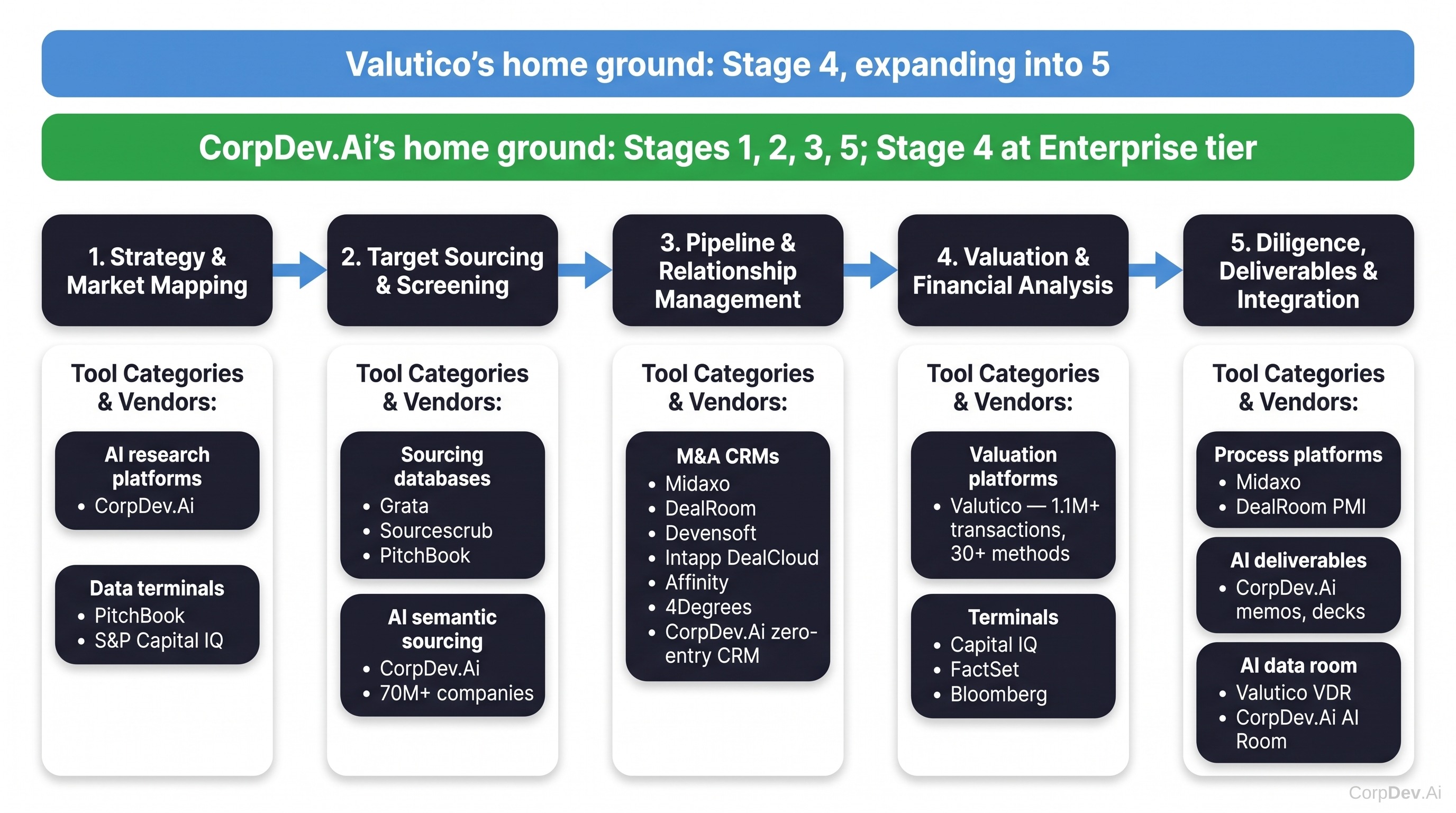
Read diagram description
Five-stage process flow, with stages: "1. Strategy & Market Mapping" → "2. Target Sourcing & Screening" → "3. Pipeline & Relationship Management" → "4. Valuation & Financial Analysis" → "5. Diligence, Deliverables & Integration". Tool categories and vendors associated with each stage: -
Stage 1: AI research platforms (CorpDev.Ai); Data terminals (PitchBook, S&P Capital IQ). -
Stage 2: Sourcing databases (Grata, Sourcescrub, PitchBook); AI semantic sourcing (CorpDev.Ai, 70M+ companies). -
Stage 3: M&A CRMs (Midaxo, DealRoom, Devensoft, Intapp DealCloud, Affinity, 4Degrees, CorpDev.Ai zero-entry CRM). -
Stage 4: Valuation platforms (Valutico — 1.1M+ transactions, 30+ methods); Terminals (Capital IQ, FactSet, Bloomberg). -
Stage 5: Process platforms (Midaxo, DealRoom PMI); AI deliverables (CorpDev.Ai memos, decks); AI data room (Valutico VDR, CorpDev.Ai AI Room). The Valutico emphasis is "Valutico's home ground:
Stage 4, expanding into 5". The CorpDev.Ai emphasis is "CorpDev.Ai's home ground: Stages 1, 2, 3, 5;
Stage 4 at Enterprise tier".
2. Valutico: Profile and Assessment
2.1 Company Background
Valutico is a Vienna-headquartered B2B SaaS company with operations in the UK and US, founded by CEO Paul Resch and CRO Alexander Lachinger; most sources give 2017 as the founding year [1][2][4]. It raised a mid-seven-figure euro round in January 2023 from Erste Group, PUSH Ventures and aws Gründerfonds — its first outside capital — and employs roughly 60–75 people as of 2026 [1][2][5]. The company reports 850+ advisory, audit, banking and private equity teams as customers worldwide, up from approximately 600 clients in 85+ countries at the time of the 2023 raise [1][7].
Two strategic moves define its 2025–2026 trajectory. In June 2025 it acquired Paraloq Analytics, a Vienna machine-learning and econometrics firm, to deepen private-company analytics and its Eva AI assistant [8]. In May 2026 it announced a native integration with FactSet Cobalt, allowing portfolio-company financials to flow from Cobalt into Valutico and giving Valutico users access to FactSet market data, estimates, comps and M&A multiples [10][11]. The FactSet partnership is a significant credibility signal: an institutional data vendor has chosen Valutico as its valuation-workflow layer for private capital.
HQ: Vienna, Austria (offices UK, US) [1]
Founded: 2017 (some databases cite 2014) [1][2][3]
Headcount: ~60–75 (2026) [2]
Funding: Mid-seven-figure EUR, Jan 2023; Erste Group, PUSH Ventures, aws Gründerfonds [1][5]
Customers: 850+ teams [7]
Data: 1.1M+ deals, 53K+ comparable companies, 30+ valuation methods [11]
Security: SOC 2 certified, full audit trails [7]
G2: 4.5/5 (21 reviews) [21]
2.2 Product Scope
Valutico's core workflow is linear and disciplined: import or enter financials (Eva AI extracts from PDF, deck or Excel), build or auto-generate a forecast, select peers from the integrated database, choose methods, calibrate cost of capital from peer betas and risk premia, run scenarios and sensitivities, and generate a report [7][11][12]. The platform supports DCF, trading multiples, precedent-transaction multiples, venture-capital methods, LBO analysis and asset-based approaches — 30+ methods in total — with Football Field output, Viewer/Editor permissions and locked audit trails covering assumptions, refreshes and overrides [10][11].
By 2026 the product has become modular. Beyond Valuation, the suite includes Forecast (benchmark-enriched projections), Transactions (deal, news and market intelligence), Diligence (AI review of deal documents to surface gaps and issues), Virtual Data Room (AI-organised, gap-checked, offered free at entry), CreditOS (credit analysis and monitoring), Estimate (an embeddable valuation widget for advisory-firm lead generation), ESG, Eva AI (guided workflow copilot and AI-generated executive summaries), Valuation Services (outsourced valuation work) and API & Enterprise (private infrastructure deployment) [7]. The direction of travel is unmistakable: Valutico is moving from a valuation calculator toward an AI-enabled deal-preparation platform, encroaching on territory that DealRoom and CorpDev.Ai occupy.
2.3 Pricing and Commercial Model
Valutico does not publish a price card; it sells through demos and annual contracts priced by seat type, modules and data entitlements [16][17]. GetApp and Capterra both list a starting price of approximately $7,000 per user per year, with no free trial [18][19]. That figure should be read as a floor for a single Editor seat on the core Valuation module. Realistic quotes will vary with Editor versus Viewer seats, inclusion of the Transactions database, FactSet data access, Eva AI and Diligence modules, report and export limits, SSO and data residency, and implementation or training fees. Buyers should request a written entitlement schedule alongside any quote.
2.4 Strengths for a Corporate Development Buyer
- Integrated market data at a fraction of terminal cost. 1.1M+ transactions and 53K+ listed peers, refreshed daily, accessible inside the valuation workflow rather than exported from a separate terminal [11]. For a team that would otherwise pay $15,000–$30,000 for a Capital IQ seat purely for comps, this is the central economic argument.
- Auditability. Locked audit trails, versioned assumptions and standardised methodology are what an external auditor, an audit committee or a fairness-opinion provider will ask for. Valutico is built around this requirement; CorpDev.Ai's Excel agent and generic spreadsheet tools are not.
- Speed on repeatable valuations. Customer testimonials cite a 200-page valuation moving from months to days and five-fold time savings; while promotional, they are consistent with G2 review themes of time savings and ease of use [7][21].
- Institutional validation. The FactSet Cobalt integration and SOC 2 certification are relevant inputs to bank and PE procurement reviews, without establishing acceptance by any particular compliance function [7][10].
- Expanding adjacent modules. Forecast, Diligence and the AI VDR let a small team run a deal's analytical front end without additional vendors.
2.5 Limitations and Buyer Cautions
- Customisation ceiling. The most consistent reviewer complaint is inflexibility around default assumptions and report formats — including an inability to fully customise PowerPoint output before generation — leaving a "last mile" of manual rework for bespoke client or board deliverables [13][21]. For a corporate acquirer whose board deck follows a house template, this matters.
- Filtering inconsistencies. Capterra reviewers note that peer search and other filters do not always use consistent industry-code criteria across modules, and that specialist datasets (e.g. royalty rates) are missing [23][24].
- No sourcing, no pipeline, no CRM. Valutico assumes the target is already identified. It does not help a team find, screen or track targets, and it does not integrate email or calendar. A corporate development team still needs a pipeline tool alongside it.
- Integration breadth is unproven. Outside FactSet Cobalt and the API, no packaged CRM, accounting or productivity integrations are documented; GetApp lists none [14][15]. Connecting Valutico to Salesforce, DealCloud or a data warehouse is a services exercise.
- Opaque pricing and a high floor. ~$7,000 per seat before modules and data is a meaningful commitment for a two-person team that runs a handful of valuations a year [18].
- Thin independent review base. 21 G2 reviews for a company claiming 850+ customers is a small sample; buyers should insist on reference calls with corporate (not advisory-firm) users, since most published testimonials come from accounting and advisory practices [7][21].
If your team produces more than roughly ten formal valuations a year — impairment tests, purchase price allocations, minority-stake marks, deal-by-deal fairness ranges — and your auditor or audit committee will scrutinise methodology, Valutico’s integrated data plus audit trail deserves a pilot against a terminal and existing models. Ten valuations is an illustrative workload, not a measured break-even threshold; compare actual module, seat and review costs.
3. The Alternatives
Alternatives are grouped by the job they own rather than by how vendors describe themselves, because that is how a buyer will actually substitute one for another. CorpDev.Ai is treated first and at the same depth as Valutico; the remaining three groups — valuation tools and data terminals, pipeline and process platforms, and sourcing databases — are assessed for where they overlap with Valutico and where they leave a gap that Valutico or CorpDev.Ai fills.
3.1 CorpDev.Ai
What it is. CorpDev.Ai describes itself as an "Integrated CorpDev Environment": an AI Analyst agent, a Markdown-native document and slide editor ("Visual Workbook"), an AI-native data room ("AI Room") with vision-based document extraction, a zero-entry pipeline CRM fed by Microsoft 365 or Google Workspace email and calendar, semantic target sourcing across a claimed 70M+ company universe, AI market mapping, and a "CorpDev Brain" knowledge base maintained by recurring agent loops [27][29][31]. It was founded by Kal Kilpi — previously co-founder of Midaxo — and Atul Tiwary, a former VP M&A at Barracuda Networks and Senior Director of Corporate Development at Fortinet [28]. The company also operates a managed-services arm that runs sourcing, screening, memo and integration work on the platform for clients [33].
Pricing (published). AI Pro at $1,000/month invoiced annually ($1,200 by card) for one seat with 12,000 annual search credits; AI Pro Team at $3,000/month annually ($3,600 by card) for three seats, collaboration, admin controls and a dedicated CSM; Enterprise on custom quote with unlimited seats, SSO, a solutions architect, and Enterprise-exclusive financial modelling, AI deployment advisory and managed services [34]. Cancellation is permitted at any time, with annual plans billed upfront [34]. Access is described as "for in-house corp dev at $1B+ companies or by invitation" [27].
- Breadth in one workspace. Strategy, market maps, sourcing, pipeline, data room, memos and decks — the widest lifecycle coverage of any tool in this comparison [27][34].
- Deliverable generation with citations. Investment memos, market reports and presentations exported to Word, PowerPoint and PDF, with source citations attached — the job that consumes most junior-analyst and consultant time [34].
- Zero-entry CRM. Email and calendar sync auto-populate activity; companies are enriched automatically [35].
- Transparent entry price. $12,000 per year per seat for the published base tier; Enterprise-only modelling, SSO and services are excluded, versus sales-led quotes almost everywhere else [34].
- Open architecture. Markdown/JSON/YAML storage, REST and MCP interfaces, and multi-model routing (Anthropic, OpenAI, Perplexity, Google) reduce lock-in [27].
- Founder domain depth. Both founders have built M&A software or run corporate development in-house [28].
- Valuation is not the core. There is no proprietary transaction-multiples database, no calibrated WACC engine and no valuation-specific audit trail. Financial modelling is Enterprise-only [34]. Comps come from public data and the AI's research, not from a curated deal database.
- Thin independent review evidence. No meaningful G2 or Capterra review base was identified; buyer confidence rests on demos and references.
- Company-count claims are vendor-authored. The 70M+ figure derives from the Apollo firmographic layer plus proprietary search; depth of private-company financials will be uneven [29][34].
- Credit-metered usage. Search credits (1,000 per seat per month) cap sourcing intensity; heavy users should model consumption [34].
- Access gating. The $1B+ / invitation criterion limits availability for mid-market acquirers [27].
- Young company. Funding, headcount and customer count are not publicly disclosed; vendor-viability diligence is warranted.
Assessment for a CorpDev buyer. CorpDev.Ai is best understood as a replacement for the analytical labour around a deal — the market map, the long list, the screening scorecards, the first-draft memo, the board deck — rather than as a valuation instrument. Its own comparison pages claim advantages over DealRoom (which it says lacks an AI analyst and open-universe sourcing) and Grata (roughly 20M versus 70M companies, sales-led pricing, no AI analyst); those claims are directionally consistent with the independent evidence gathered here but originate from the vendor and should be tested in a trial [36][37]. A team that already holds a terminal or Valutico seat will find CorpDev.Ai complementary rather than duplicative; a team with neither should recognise that CorpDev.Ai alone will not produce an auditor-grade valuation without a suitable model, documented assumptions and qualified review; the Enterprise tier alone does not establish auditor acceptance.
Two things determine whether CorpDev.Ai's economics hold for your team: how many search credits a realistic month of sourcing consumes, and whether the AI Analyst's cited research meets your internal quality bar without heavy editing. Run a two-week pilot on a live workstream before committing to an annual plan.
3.2 Valuation-Focused Alternatives
The valuation-tool market splits into two tiers that are rarely substitutable: SMB and startup tools priced in the hundreds to low thousands of dollars, and institutional data terminals priced in the tens of thousands. Valutico sits in the gap between them, which is precisely its commercial thesis.
SMB and startup tier — assess fit for the valuation assignment. Equidam (free calculator; ~$412 Standard, ~$1,063 Advanced; ~$1,990 for 409A) offers guided DCF, multiples and VC-method valuations aimed at founders and small advisers, with a 3.5/5 G2 rating on two reviews [38][39][41]. BizEquity (~$299–$360 per licence per month plus per-valuation fees) is an SMB broker and wealth-adviser workflow with industry benchmarks rather than transaction-level comps [45][47]. ValuAdder (~$275–$375 one-time desktop licence, private-transaction data ~$1,400–$1,500 per year extra) is a low-cost appraiser's toolkit with US-focused SIC/NAICS data of roughly 20,000 comparables [52][54]. Eqvista ($990–$2,590 per year bundling cap table and 409A) and Carta ($3,000–$75,000+ depending on stage; $2,000–$5,000 per standalone 409A) are equity-administration platforms whose valuation function exists to satisfy compliance, not to support an acquisition decision [42][44][48][50]. These tools are not established here as replacements for Valutico’s global comps and structured workflow. Their suitability for a small acquisition, appraisal or compliance assignment depends on the methods, evidence and reviewer requirements; a blanket assertion about Big Four acceptance is not supported.
Institutional data terminals — the reference standard, at a price. For public comps, precedent transactions and screening, S&P Capital IQ Pro remains the benchmark, at roughly $15,000–$30,000 per user per year in typical estimates and enterprise contracts reported between $21,000 and $217,000 [55][57]. PitchBook is the strongest source for private-market deal context, fund and investor data, with reported contracts of $20,000–$124,000 per year and a median near $30,000 [58][61]. FactSet offers deep fundamentals, estimates and the best Excel integration of the group at $12,000–$24,000 per user per year [61][62]. Bloomberg Terminal ($31,980 for a single terminal; $28,320 per seat on multi-terminal accounts) is unmatched for real-time markets but over-specified for private-company valuation [63][64].
The terminals' weakness for a small corporate development team is structural rather than a matter of quality: their main advantage is data, with workflow and AI capabilities varying by product and entitlement. A terminal-centred team may still need maintained Excel models, reporting templates and documented review controls; native templates, integrations and AI features can automate parts of this work. Valutico's pitch is to package a substantial portion of a buyer’s required comps utility (the original 80% heuristic was not measured) inside a structured workflow for roughly a third of the price; the FactSet Cobalt integration now lets a buyer close the remaining data gap by piping FactSet data into Valutico rather than choosing between them [10].
| Tool | Low | High |
|---|---|---|
| Equidam (Advanced, one-off) | 1063 | 1063 |
| ValuAdder + transaction data | 1700 | 1900 |
| BizEquity | 3588 | 4320 |
| Valutico (reported floor) | 7000 | 7000 |
| FactSet | 12000 | 24000 |
| S&P Capital IQ Pro | 15000 | 30000 |
| PitchBook | 12000 | 30000 |
| Bloomberg Terminal | 28320 | 31980 |
Sources: Equidam [38]; ValuAdder [52][54]; BizEquity [45]; Valutico [18][19]; FactSet [61][62]; Capital IQ [55][57]; PitchBook [58][61]; Bloomberg [63][64]. Terminal and Valutico figures are estimates, not list prices.
3.3 Deal Pipeline and Process Platforms
These platforms answer a different question from Valutico: not "what is this company worth?" but "where does every deal stand, who owns the next step, and how do we execute diligence and integration without dropping the ball?" A corporate development team that evaluates Valutico will almost always need one of these alongside it — or CorpDev.Ai's built-in pipeline.
Category: Full-lifecycle M&A platform (pipeline → diligence → PMI)
Price: Quote-only; third-party estimates ~$25K/yr (Essentials, ≤5 users) to $120K–$150K+ (Enterprise) [66]
G2: 4.6/5, 39 reviews [68]
Best for: Serial acquirers with a formal PMI function
Watch: Higher TCO and slower time-to-ROI than DealRoom per G2 comparisons; integrations (Salesforce, DealCloud, Teams) add implementation cost [69]
Category: Buyer-led M&A workspace: pipeline, diligence VDR, request lists, integration
Price: Deal-volume based, unlimited seats; third-party estimates ~$12K–$15K/yr [70][71]
G2: ~4.3–4.4/5, 66–69 reviews [68][74]
Best for: Mid-market teams wanting collaborative execution at approachable cost
Watch: Weak deal-sourcing scores; AI features reported as add-ons; single project room in some packages [71][73]
Category: Pipeline and end-to-end M&A management
Price: Pipeline tier listed at $150/user/month (~$1,800/seat/yr); Enterprise quote-only [75]
G2: 4.6/5, 12 reviews [76]
Best for: Teams wanting the lowest visible entry price for a pre-close pipeline
Watch: Very small review base; full lifecycle pricing undisclosed [78]
Category: Enterprise-configurable deal and relationship CRM
Price: Quote-only enterprise contracts with implementation cost
G2: ~4.2/5, 41 reviews [84]
Best for: Banks, PE and large corporates with admin resources
Watch: Lengthy configuration; more manual entry and steeper learning curve than Affinity [85]
How these relate to Valutico and CorpDev.Ai. None of the six generates a valuation or holds a comps database; all six assume the analytical work happens elsewhere. CorpDev.Ai's pipeline CRM overlaps most directly with Devensoft's pipeline tier, DealRoom's pipeline product and Affinity's zero-entry capture — and CorpDev.Ai's vendor comparison page positions its CRM as included at no extra cost against DealRoom Pipeline's reported $1,000 per month [36]. CorpDev.Ai also competes in end-to-end programme and integration management. Compare its workstream, milestone, synergy and reporting approach directly with Midaxo and DealRoom; closing several deals a year does not establish a need for a separate process platform. Valutico's Diligence and VDR modules touch DealRoom's data-room function but stop well short of pipeline or PMI.
A team that buys Valutico for valuation, Midaxo for process and PitchBook for sourcing can easily commit $60,000–$120,000 per year across three vendors with three logins and no shared data model. Before adding a third tool, quantify how many deals per year justify the specialist process layer; deal complexity, cross-functional participation and control requirements matter alongside volume; four deals is a planning heuristic, not a validated sufficiency threshold.
3.4 Data and Sourcing Platforms
Sourcing platforms are the upstream complement to Valutico: they answer "who should we look at?" before Valutico answers "what is it worth?" Two AI-native private-company databases dominate the corporate development conversation, alongside PitchBook and Capital IQ, which are covered in Section 3.2.
Grata — AI-powered private-company discovery, natural-language search, thematic screening and market mapping. Pricing starts around $15,000 per year for Basic, with broader third-party estimates of $15,000–$100,000 depending on users and data access [90][91]. Grata scores 4.8/5 on 79 G2 reviews, the highest rating of any tool in this comparison, and G2's head-to-head reviewers prefer it to Sourcescrub [90][96]. Its constraint is scope: Grata is a sourcing and intelligence layer, not a pipeline, diligence or valuation tool, and coverage varies by sector and geography [90].
Sourcescrub — a curated private-company sourcing database with research support, exports and CRM connectors, priced by third-party estimates at $20,000–$60,000 per year across Discovery Essentials, Sourcing Plus and Winning Professional tiers [92][93]. G2 rating 4.5/5 on 56 reviews [94][95]. Like Grata, it requires a separate CRM, diligence platform and valuation tool.
CorpDev.Ai as a sourcing alternative. CorpDev.Ai bundles semantic sourcing (Apollo firmographics plus proprietary AI search across a claimed 70M+ universe), AI fit scoring, geographic search and people search into every plan at $1,000 per month per seat [34]. Against Grata's ~$15,000 entry price, the bundled proposition is compelling on paper; the diligence question is data quality. Grata and Sourcescrub invest heavily in curated private-company coverage (revenue estimates, ownership, growth signals), whereas CorpDev.Ai relies on Apollo's firmographic layer enriched on demand by AI research. For a US lower-middle-market PE origination team running thousands of searches a month, the curated databases will likely still win on precision; for a corporate acquirer building a market map and a shortlist of 50–200 strategic targets, the AI-research approach may be sufficient if tested on that market. Compare the actual seat count, coverage and search usage before claiming a cost advantage.
| Platform | Low | High |
|---|---|---|
| Devensoft Pipeline (per seat, published) | 1800 | 1800 |
| Affinity (per seat) | 2000 | 2700 |
| CorpDev.Ai AI Pro (per seat, published) | 12000 | 12000 |
| DealRoom | 12000 | 15000 |
| Grata | 15000 | 100000 |
| Sourcescrub | 20000 | 60000 |
| Midaxo | 25000 | 150000 |
Sources: Devensoft [75]; Affinity [79]; CorpDev.Ai [34]; DealRoom [70][71]; Grata [90][91]; Sourcescrub [92][93]; Midaxo [66]. Grata, Sourcescrub and Midaxo are team or enterprise contract ranges, not per-seat figures.
4. Side-by-Side Comparison
The matrix below scores each platform on the five jobs from Section 1, plus commercial factors. Scores are the author's judgement from the evidence in Section 3: ●●● = documented native scope (not independently validated institutional-grade output); ●● = credible but partial; ● = light or indirect; — = not offered.
| Platform | Strategy & market maps | Target sourcing | Pipeline / CRM | Valuation & comps | Diligence / VDR | Deliverables (memo, deck) | PMI | Published pricing | Entry price (USD/yr) |
|---|---|---|---|---|---|---|---|---|---|
| Valutico | — | ● | — | ●●● | ●● | ●● | — | No | ~7,000 per seat (est.) |
| CorpDev.Ai | ●●● | ●●● | ●●● | ● (●● Enterprise) | ●● | ●●● | End-to-end management and integration work; validate programme controls | Yes | 12,000 per seat |
| S&P Capital IQ Pro | ●● | ●● | — | ●●● (data only) | — | — | — | No | 15,000–30,000 per seat (est.) |
| PitchBook | ●● | ●●● | — | ●● (data only) | — | — | — | No | 12,000–30,000 (est.) |
| FactSet | ● | ● | — | ●●● (data only) | — | — | — | No | 12,000–24,000 per seat (est.) |
| Grata | ●● | ●●● | ● | — | — | — | — | No | ~15,000 (est.) |
| Sourcescrub | ● | ●●● | ● | — | — | — | — | No | 20,000–60,000 (est.) |
| Midaxo | — | ● | ●●● | — | ●●● | ● | ●●● | No | ~25,000 (est.) |
| DealRoom | — | ● | ●● | — | ●●● | ● | ●● | Partly | 12,000–15,000 (est.) |
| Devensoft | — | — | ●● | — | ● | — | ●● (Enterprise) | Partly | 1,800 per seat (pipeline tier) |
| Affinity | — | ● | ●●● | — | — | — | — | Partly | 2,000–2,700 per seat |
| Intapp DealCloud | — | ● | ●●● | — | ● | — | — | No | Enterprise quote |
| Equidam / BizEquity / ValuAdder | — | — | — | ● | — | ● | — | Yes | 400–4,300 |
Programme-scope assessment. The CorpDev.Ai integration entry describes its end-to-end management scope rather than assigning an unsupported comparative performance score. Evaluate the required controls and the quality of completed work on the same acquisition programme as other finalists. Deal frequency and public review volume do not establish a functional ranking. See the lifecycle framework and integration capabilities; these are vendor materials, not independent benchmarks.
Basis: capability scores from Sections 2–3; pricing from [18][34][55][58][61][66][70][75][79][90][92] with "(est.)" denoting third-party estimates rather than vendor list prices.
Reading the matrix. Three patterns stand out. First, the "●●● valuation" column is occupied only by Valutico and the data terminals — and the terminals are data-only, leaving the modelling and reporting work to the analyst. Second, the row with the most filled cells is CorpDev.Ai, but its single weakest cell is the one Valutico is strongest in. Third, published pricing is the exception in this market; only CorpDev.Ai, the SMB tools, and partial tiers of Devensoft, Affinity and DealRoom let a buyer budget without a sales call.
Ideal-buyer profile by platform
| Platform | Buys it when… | Does not buy it when… |
|---|---|---|
| Valutico | The team produces 10+ formal valuations a year, must satisfy auditors or an audit committee, and wants comps data without a terminal contract | The primary bottleneck is finding targets or producing memos; the team already holds a terminal seat and has robust Excel models |
| CorpDev.Ai | A one-to-five person team needs analytical throughput across mapping, sourcing, screening, memo and deck production, and wants a CRM without data entry | The team's only need is a defensible valuation number; the company is below the $1B+ access threshold and not invited |
| Capital IQ / FactSet / PitchBook | Comps and transaction depth are non-negotiable, budget exceeds $15K per seat, and analysts are comfortable building models in Excel | The team is small and the terminal would be used for a few screens a month |
| Grata / Sourcescrub | Origination volume is high (PE-style), private-company precision matters more than lifecycle breadth | A corporate acquirer maps a market a few times a year and needs 50–200 strategic candidates |
| Midaxo / DealRoom | The company closes several deals a year and needs governed diligence and integration workstreams | Deal count is low; pipeline needs are met by a lighter CRM |
| Affinity / DealCloud / 4Degrees | Relationship capture and warm-introduction intelligence drive origination (advisers, funds) | The team needs research, valuation or diligence capability in the same tool |
| Group | Strategy | Sourcing | Pipeline | Valuation | Diligence, deliverables and PMI |
|---|---|---|---|---|---|
| Valutico | None central | Light | None central | Specialist structured engine | Adjacent diligence/VDR and valuation reports |
| CorpDev.Ai | Broad claimed scope | Broad claimed scope | Native CRM | Light at base; modelling Enterprise | End-to-end management, AI Room, integration work and reporting; validate programme controls |
| Capital IQ / FactSet / PitchBook | Partial | Partial to strong by vendor | Dedicated deal CRM separate | Institutional data | AI analysis/drafting varies; dedicated VDR and PMI separate |
| Grata / Sourcescrub | Partial | Specialist | Connectors / partial | No valuation engine | Research outputs vary; no full PMI |
| Midaxo / DealRoom | Limited | Light | Native process | No dedicated comps engine | Diligence and PMI, varying depth |
| Affinity / DealCloud | Limited | Enrichment / partial | Native relationship CRM | No dedicated valuation engine | AI summaries/drafting vary; no full PMI |
Original entry estimates: Valutico ~$7K/seat; CorpDev.Ai $12K/base seat; terminals $12K–$32K/seat; sourcing platforms $15K–$60K examples (broader Grata range to $100K); process platforms $12K–$150K team examples; relationship CRMs ~$2K–$3K/seat examples. These are heterogeneous entitlements. Valutico and CorpDev.Ai can complement each other, with some overlap in documents and diligence.
5. Total Cost of Ownership and Pricing Analysis
List price is a poor guide to what a corporate development team will actually spend. Three cost drivers dominate: seat structure (Editor versus Viewer, per-seat versus team bundles), data entitlements (transaction databases, FactSet or PitchBook feeds, AI modules) and implementation (configuration, integrations, training). The table below models four representative team configurations for a three-person corporate development function over one year, using published prices where available and stated scenario assumptions based on third-party estimates elsewhere.
| Configuration | Components | Software (low) | Software (high) | Hidden costs to budget | What it covers |
|---|---|---|---|---|---|
| **A. Valuation-first** | Valutico 2 Editor + 1 Viewer seats; Transactions data; Eva AI | 14,000 | 28,000 | FactSet Cobalt data feed if required; onboarding; report template customisation | Valuation, forecast, diligence review; no sourcing or pipeline |
| **B. Throughput-first** | CorpDev.Ai AI Pro Team (3 seats) | 36,000 | 43,200 | Additional search credits at high sourcing volume; Enterprise tier for financial modelling and SSO | Strategy, sourcing, CRM, data room, memos, decks; valuation research only at this tier; financial modelling requires Enterprise or an external model |
| **C. Best-of-breed stack** | Valutico (2 seats) + CorpDev.Ai AI Pro Team + Midaxo Essentials | 75,000 | 111,200 | Three onboarding programmes; no shared data model; integration effort between tools | Broad coverage of all five jobs; exact specialist depth depends on purchased modules |
| **D. Terminal-centric (reference)** | S&P Capital IQ Pro (2 seats) + DealRoom | 42,000 | 75,000 | Excel model maintenance; memo production remains manual; terminal training | Comps data and execution; AI research, mapping and drafting depend on terminal entitlement; no separate broad AI workbench is budgeted |
Basis and derivation: Valutico $7,000 per seat floor [18][19], with the high case assuming module and data uplift to $14,000 per Editor seat — an assumption, since Valutico does not publish module pricing; CorpDev.Ai AI Pro Team $3,000 per month invoiced annually ($36,000) to $3,600 per month by card ($43,200) [34]; Midaxo Essentials ~$25,000 to $40,000 [66]; Capital IQ $15,000–$30,000 per seat [55]; DealRoom $12,000–$15,000 [70][71].
Configuration A's high case ($28,000) assumes Valutico module and data add-ons roughly double the per-seat floor. Valutico publishes neither seat nor module prices, so this is a modelling assumption for budgeting purposes, not a quote. Buyers should replace it with a written entitlement schedule from Valutico before comparing.
What the numbers say.
- The lowest-cost dedicated institutional valuation option modelled here is Valutico at roughly $7,000–$14,000 per Editor seat — a fraction of a terminal, with workflow and auditability the terminal does not provide. The core valuation tier centres on job four; adjacent Forecast, Diligence and VDR modules extend its scope.
- CorpDev.Ai’s $36,000 team plan is the modelled bundled route to four of the five jobs, and it provides published base-tier pricing, as do the SMB tools and some Devensoft, Affinity and DealRoom tiers. Its marginal cost per additional job covered is effectively zero; its marginal weakness is curated comps.
- A best-of-breed stack costs two to three times a single platform and introduces integration overhead. Configuration C requires a genuine workload in each specialist system; the four-deal heuristic alone does not establish or rule out its economics.
- Advisory-spend comparisons require task-level validation. Even Configuration C's high case ($111,200) is below the low end of the $200K–$2M per-deal consulting spend CorpDev.Ai cites; if a platform displaces a single mid-sized consulting engagement, the software pays for itself in year one [27]. The figure is vendor-cited and is not a measured savings baseline; software, advisers and internal review provide different services.
Negotiation levers by vendor. Valutico: Viewer seats for occasional users, multi-year terms, and bundling Diligence and VDR (the VDR has a free entry point) [7]. CorpDev.Ai: annual invoicing saves 16.7% versus card (the card price is 20% higher); Enterprise tier is required for SSO and financial modelling, so teams needing either should negotiate Enterprise from the start rather than upgrade later [34]. Terminals: seat sharing is prohibited, but most vendors discount heavily at renewal and for multi-product bundles. Midaxo and DealRoom: pricing scales with deal volume or tier — model the realistic deal count rather than the aspirational one.
| Configuration | Components | Low USD | High USD |
|---|---|---|---|
| A. Valuation-first | 2 Valutico Editors plus assumed included Viewer; module uplift assumption | 14000 | 28000 |
| B. Throughput-first | CorpDev.Ai 3-seat Team; Enterprise modelling/SSO excluded | 36000 | 43200 |
| C. Specialist stack | Valutico $14–28K + CorpDev.Ai $36–43.2K + Midaxo $25–40K | 75000 | 111200 |
| D. Terminal-centric | Capital IQ 2 seats $30–60K + DealRoom $12–15K | 42000 | 75000 |
These are subscription scenarios before the hidden costs identified above. CorpDev.Ai cites $200K–$2M advisory spend per deal, but annual software costs and per-deal advisory services are different purchases; being below that range does not establish affordability, substitution or payback.
6. Decision Framework: Which Tool for Which Buyer
The decision reduces to four questions. Answer them in order; the path usually resolves within two.
Question 1 — Where does your team lose the most weeks per deal? If the answer is producing and defending the valuation, Valutico (or a terminal plus Excel) is the purchase. If it is finding and screening targets, building the market view and drafting the memo and deck, CorpDev.Ai is the purchase. If it is coordinating diligence and integration workstreams across functions, Midaxo or DealRoom is the purchase.
Question 2 — How many formal valuations and how many closed deals per year? Ten valuations and four closed deals are illustrative workload checkpoints, not validated break-even rules. Model actual valuation complexity, existing entitlements, adviser scope and PMI workstreams; a single complex acquisition can justify specialist governance.
Question 3 — Who scrutinises the output? An audit committee, external auditor or regulator reviewing a valuation methodology will expect the audit trail Valutico provides. A board or CEO reviewing a strategic rationale, a shortlist or an investment thesis will value the speed, breadth and citations CorpDev.Ai provides. Few teams face only one audience.
Question 4 — What do you already own? A team with a Capital IQ or FactSet seat gains less from Valutico's data (though still gains its workflow and audit trail) and more from CorpDev.Ai's research and CRM. A team with Midaxo or DealCloud gains less from CorpDev.Ai's pipeline and more from its AI Analyst and sourcing. A team with nothing should start with the tool that addresses Question 1 and add another only when an unmet workload and measured benefits justify the cost.
| Bottleneck | Candidate path | Validate before purchase |
|---|---|---|
| Defending valuation | Valutico or an entitled terminal plus maintained models / qualified adviser | Methodology, audit trail, required comps and actual annual workload; 10 valuations is a heuristic |
| Finding targets, mapping markets, writing memos | CorpDev.Ai or another sourcing/research platform | Recall, citations, review effort and export fidelity; modelling may require Enterprise |
| Coordinating diligence and integration | CorpDev.Ai, Midaxo, DealRoom or Devensoft; compare programme management and analytical execution | Workstreams and control complexity, not a rigid four-deal threshold |
| Auditor or audit committee scrutiny | Prioritise valuation evidence and methodology | A platform does not guarantee reviewer acceptance |
| Board or CEO strategic review | Prioritise research quality and usable deliverables | Add a second product only when its incremental workload justifies it |
Existing terminal, model and process entitlements change the choice. The original diagram’s >10-valuation, >4-deal and “both within 12 months” rules were unvalidated planning heuristics, not evidence-based purchase triggers.
Scenario recommendations
Bottleneck: market visibility and memo production; valuations outsourced to advisers.
Recommendation: CorpDev.Ai AI Pro Team as the operating environment. Defer Valutico until valuation volume rises or the auditor asks for internal methodology; use adviser fairness ranges meanwhile.
Budget: ~$36,000 per year.
Bottleneck: everything — sourcing volume, valuation defensibility, PMI governance.
Recommendation: CorpDev.Ai for research, sourcing and deliverables; Valutico for deal-by-deal valuation and impairment work; Midaxo or DealRoom for diligence and PMI. Negotiate CorpDev.Ai Enterprise for SSO and modelling.
Budget: the three-user standard-plan stack in Section 5 is ~$75,000–$111,200; a five-person Enterprise configuration is quote-dependent and is not costed by that model.
Bottleneck: producing 15–30 audit-ready valuations a year with consistent methodology.
Recommendation: Valutico with Transactions data and Viewer seats for reviewers; consider the FactSet Cobalt link if FactSet is already licensed. CorpDev.Ai is optional unless the group also runs an active M&A programme.
Budget: ~$20,000–$35,000 per year.
Valutico and CorpDev.Ai can be complementary: one centres on structured valuation and the other on research and deliverables, with some overlap in diligence and document work. Two to five CorpDev.Ai seats plus one Valutico entry seat imply roughly $31,000–$67,000 annually before add-ons; Capital IQ plus Midaxo spans a different and overlapping range. Buy both only when separate workloads justify both entitlements.
7. Risks, Caveats and Due-Diligence Questions for Vendors
Software procurement in this category carries four categories of risk that a buyer should diligence explicitly.
Vendor viability. Valutico is venture-backed with a single disclosed round (2023) and 60–75 staff; CorpDev.Ai does not disclose funding, headcount or customer count; Grata, Sourcescrub, Midaxo and DealRoom are private with no recent verified funding events [1][2][66]. The reviewed public material does not establish each vendor’s current solvency, but a three-year contract with any of them should include data-export and escrow provisions. Intapp (DealCloud), S&P, FactSet and Bloomberg have larger established businesses, but product continuity and contractual exit rights still require review.
Data provenance and freshness. Valutico's 1.1M+ transaction and 53K+ peer figures are vendor-stated; ask which underlying providers feed them, how often multiples are refreshed, and how private-transaction values are sourced and normalised [11]. CorpDev.Ai's 70M+ universe is primarily Apollo firmographics enriched by AI research; ask for precision and recall on a sample market you know well, and how citations are verified [29][34]. Grata and Sourcescrub should be asked the same about coverage outside North America.
AI output liability. Every vendor in this comparison now markets AI. Valutico's Eva AI drafts executive summaries and suggests peers; CorpDev.Ai's Analyst drafts memos and market reports; DealRoom and Midaxo add AI document review. In each case the output is decision support, and the vendor's terms will place responsibility for the number or the recommendation with the user. Buyers should confirm that AI-generated content is clearly marked, that sources are traceable, and that no customer data is used to train shared models — CorpDev.Ai states this explicitly; ask each vendor for the same commitment in writing [34].
Lock-in and exportability. Valutico's outputs are reports and charts; ask whether the underlying model and assumptions export in a reusable form. CorpDev.Ai stores content as Markdown, JSON and YAML with Word, PowerPoint and Excel export, which is a genuine differentiator on exit cost [27][34]. Midaxo, DealRoom and DealCloud hold structured deal history that is costly to migrate; confirm bulk-export formats before signing.
Questions to put to each vendor
| Ask every vendor | Ask Valutico specifically | Ask CorpDev.Ai specifically |
|---|---|---|
| Written entitlement schedule: seats, modules, data, limits | Which providers feed the transaction and peer databases, and refresh cadence | Search-credit consumption on a realistic month; overage pricing |
| Reference customers in corporate development (not advisory firms) | Degree of report and PowerPoint template customisation; roadmap for the "last mile" | What "financial modelling" in Enterprise includes; audit trail on model assumptions |
| SOC 2 report; data residency; model-training exclusion | Packaged integrations beyond FactSet Cobalt and API | Depth of private-company financials beyond Apollo firmographics |
| Bulk export formats and exit assistance | Pricing for Viewer seats and multi-year terms | Access criteria below the $1B+ threshold; funding and customer count |
| Roadmap for the next 12 months and how AI features are priced | How Diligence and VDR modules price relative to core Valuation | Uptime, model-provider fallbacks, and how citation accuracy is monitored |
Independent review volumes are small across the category (Valutico 21 G2 reviews; Devensoft 12; CorpDev.Ai none identified), most pricing outside CorpDev.Ai and the SMB tools is third-party estimated, and several competitive claims originate from vendor comparison pages. Treat this document as a structured starting point for a pilot and reference process, not as a substitute for one.
Key Facts & Sources
Load-bearing figures used in this document, with source and as-of date. "Est." denotes a third-party estimate; "Vendor" denotes a figure published by the vendor itself.
| # | Figure | Value | Basis | Source | As of |
|---|---|---|---|---|---|
| 1 | Valutico transaction database | 1.1M+ deals; 53K+ comparable companies | Vendor | valutico.com/valuation [11] | Aug 2026 |
| 2 | Valutico valuation methods | 30+ | Vendor | valutico.com/valuation [11] | Aug 2026 |
| 3 | Valutico customers | 850+ teams | Vendor | valutico.com [7] | Aug 2026 |
| 4 | Valutico entry price | ~$7,000 per user per year | Est. (GetApp, Capterra) | [18][19] | May 2025 |
| 5 | Valutico funding | Mid-seven-figure EUR; Erste Group, PUSH Ventures, aws Gründerfonds | Press | tech.eu, OTS [1][5] | Jan–Feb 2023 |
| 6 | Valutico headcount | ~60–75 | Est. (company trackers) | [2] | 2026 |
| 7 | Valutico G2 rating | 4.5/5, 21 reviews | G2 | [21] | Sep 2026 |
| 8 | Valutico–FactSet Cobalt integration | Announced | Vendor / FactSet | [10] | May 2026 |
| 9 | Valutico–Paraloq Analytics acquisition | Completed | Vendor | [8] | Jun 2025 |
| 10 | CorpDev.Ai AI Pro price | $1,000/mo annual ($12,000/yr); $1,200/mo by card | Vendor | corpdev.ai/pricing [34] | Sep 2026 |
| 11 | CorpDev.Ai AI Pro Team price | $3,000/mo annual ($36,000/yr), 3 seats; $3,600/mo by card | Vendor | corpdev.ai/pricing [34] | Sep 2026 |
| 12 | CorpDev.Ai company universe | 70M+ | Vendor | corpdev.ai [27][29] | Sep 2026 |
| 13 | CorpDev.Ai search credits | 12,000/yr (Pro); 36,000/yr (Team) | Vendor | [34] | Sep 2026 |
| 14 | Per-deal consulting spend | $200K–$2M | Vendor-cited (CorpDev.Ai) | [27] | Sep 2026 |
| 15 | S&P Capital IQ Pro price | $15,000–$30,000 per user per year | Est. | [55][57] | 2026 |
| 16 | PitchBook price | $20,000–$124,000 contract range; median ~$30,000 | Est. | [58][61] | Jun–Aug 2026 |
| 17 | FactSet price | $12,000–$24,000 per user per year | Est. | [61][62] | Apr–Aug 2026 |
| 18 | Bloomberg Terminal price | $31,980 single; $28,320 multi-seat | Reported list | [63][64] | 2026 |
| 19 | Midaxo price | ~$25,000 (Essentials) to $120,000–$150,000+ (Enterprise) | Est. | [66] | Jun 2026 |
| 20 | DealRoom price | ~$12,000–$15,000 per year; unlimited seats | Est. / Vendor | [70][71] | Nov 2025 |
| 21 | Devensoft pipeline tier | $150 per user per month | G2 listing | [75] | 2026 |
| 22 | Affinity price | ~$2,000–$2,700 per user per year | Est. | [79][80] | 2026 |
| 23 | Grata price and rating | ~$15,000 entry; 4.8/5 on 79 G2 reviews | Est. / G2 | [90][91] | 2026 |
| 24 | Sourcescrub price and rating | ~$20,000–$60,000; 4.5/5 on 56 reviews | Est. / G2 | [92][94] | 2026 |
| 25 | Equidam price | ~$412 Standard; ~$1,063 Advanced | Vendor | [38] | Jun 2026 |
| 26 | TCO Configuration A high case | $28,000 | Derived: 2 Editor seats × $14,000 assumed module uplift; Viewer seat assumed included | Section 5 assumption | — |
| 27 | TCO Configuration C | $75,000–$111,200 | Derived: sum of rows 4 (×2, low/high uplift), 11 and 19 (low–mid) | Section 5 | — |
Full numbered references are generated automatically at the end of this document.
References
Numbering follows the original research. Access dates below record the original source registry; they do not imply that every source was rechecked for this website edition.
- Valutico raises seven-figure sum for its business valuation software ...Source accessed 2026-09-11
- Valutico | Valuation, Funding Rounds & Stock PriceSource accessed 2026-09-11
- Valutico - 2026 Company Profile & TeamSource accessed 2026-09-11
- ValuticoSource accessed 2026-09-11
- Valuation Software Valutico secures Investment & PartnershipSource accessed 2026-09-11
- Valutico - AI Powered Business Valuation SoftwareSource accessed 2026-09-11
- Valutico Acquires Paraloq Analytics to Boost AI ValuationSource accessed 2026-09-11
- FactSet Modernizes Valuation Workflows for Private ...Source accessed 2026-09-11
- Portfolio Valuations - ValuticoSource accessed 2026-09-11
- Jobs and Employment at Valutico | SimplifySource accessed 2026-09-11
- VALUTICO Pros and Cons | User Likes & Dislikes - G2Source accessed 2026-09-11
- API & Enterprise - ValuticoSource accessed 2026-09-11
- ValuticoSource accessed 2026-09-11
- Valutico · Value Case: ROI Levers & Metrics (2026) - RFP.wikiSource accessed 2026-09-11
- Valutico vs ValuSource (2026): Which Is Better? - RFP.wikiSource accessed 2026-09-11
- Valutico Pricing Plan & Cost GuideSource accessed 2026-09-11
- Valutico Price, Features, Reviews & Ratings - Capterra IndiaSource accessed 2026-09-11
- VALUTICO Reviews 2026: Details, Pricing, & FeaturesSource accessed 2026-09-11
- Valutico Reviews 2026. Verified Reviews, Pros & ConsSource accessed 2026-09-11
- Valutico ReviewsSource accessed 2026-09-11
- CorpDev.Ai - Agentic AI for M&ASource accessed 2026-09-11
- About Us - CorpDev.AiSource accessed 2026-09-11
- CorpDev Frame | The Data Architecture Behind AI-Powered M&ASource accessed 2026-09-11
- Integrations | CorpDev.Ai DocsSource accessed 2026-09-11
- Managed Services - AI-Enabled M&A Services | CorpDev.AiSource accessed 2026-09-11
- PricingSource accessed 2026-09-11
- Simple, Powerful AI Pipeline CRM for M&A - CorpDev.AiSource accessed 2026-09-11
- CorpDev.Ai vs DealRoom Pipeline: Free Zero-Entry CRM vs Manual ...Source accessed 2026-09-11
- CorpDev.Ai vs Grata: Pricing & Features ComparisonSource accessed 2026-09-11
- PricingSource accessed 2026-09-11
- Equidam - Reviews - Business Valuation Software - RFP.wikiSource accessed 2026-09-11
- Equidam Reviews 2026: Details, Pricing, & FeaturesSource accessed 2026-09-11
- Eqvista Pricing 2026Source accessed 2026-09-11
- Getting Started with Eqvista - FAQSource accessed 2026-09-11
- 2025 Pricing - BizEquitySource accessed 2026-09-11
- PricingSource accessed 2026-09-11
- Carta Pricing Review 2026: Plans, Costs & Real DataSource accessed 2026-09-11
- 409A Valuation Services: Your trusted, accurate ...Source accessed 2026-09-11
- What a Defensible Business Valuation Actually Costs to ProduceSource accessed 2026-09-11
- Best Business Valuation Software & Tools [2026 Comparison ...Source accessed 2026-09-11
- Best AlphaSense Alternatives in 2026 (Real Pricing) - prospeo.ioSource accessed 2026-09-11
- Financial Data & Terminals Software Pricing 2026: 19 ToolsSource accessed 2026-09-11
- PitchBook Pricing 2026: What Buyers Actually PaySource accessed 2026-09-11
- PitchBook Cost 2026: Price Per User Per Year | Investables.aiSource accessed 2026-09-11
- FactSet Pricing in 2026 - What It Actually Costs - Market OntologySource accessed 2026-09-11
- Bloomberg Terminal — review, pricing & alternativesSource accessed 2026-09-11
- Bloomberg vs FactSet: Cost Per User and Pricing 2026 | Investables.aiSource accessed 2026-09-11
- Best Post-Merger Integration Software in 2026Source accessed 2026-09-11
- DealRoom vs. Midaxo Comparison 2026 | G2Source accessed 2026-09-11
- Top 10 DealRoom Alternatives & Competitors in 2026 - G2Source accessed 2026-09-11
- DealRoom Pricing: M&A Software Plans and CostsSource accessed 2026-09-11
- What is Dealroom? Pricing, Reviews, Features Explained(2025) - PloxSource accessed 2026-09-11
- DealRoom Data Room Review: Features, Pricing ...Source accessed 2026-09-11
- Melhor Software de M&ASource accessed 2026-09-11
- Page 2 | Devensoft Reviews 2026: Details, Pricing, & Features | G2Source accessed 2026-09-11
- Acquire.com vs. Midaxo Comparison 2026 - G2Source accessed 2026-09-11
- Devensoft · Rating Snapshot: Score & Reviews (2026)Source accessed 2026-09-11
- Affinity CRM Pricing, Reviews, Pros & Cons (2026) - prospeo.ioSource accessed 2026-09-11
- Corporate Development Software: 32 Tools, Real Pricing ...Source accessed 2026-09-11
- Affinity · Cost Drivers: Pricing & Contracts (2026)Source accessed 2026-09-11
- Affinity Reviews, Pricing & Alternatives (2026) | ToolradarSource accessed 2026-09-11
- Affinity Reviews 2026: Details, Pricing, & FeaturesSource accessed 2026-09-11
- Recensioni DealCloud 2026Source accessed 2026-09-11
- DealCloud Overview, Reviews, Pros&Cons, Prices, Competitors ...Source accessed 2026-09-11
- 4Degrees CRM Review 2026: Is It Worth It for Small VC Funds?Source accessed 2026-09-11
- 4Degrees: Pricing, Pros & Cons — CRM NewspaperSource accessed 2026-09-11
- 4Degrees Review: Is it the Right Relationship Intelligence ...Source accessed 2026-09-11
- 4Degrees PricingSource accessed 2026-09-11
- Grata vs SourceScrub: Honest Comparison (2026) - ProspeoSource accessed 2026-09-11
- Grata Pricing, Reviews, Pros and Cons (2026)Source accessed 2026-09-11
- SourceScrub Pricing, Reviews, Pros & Cons (2026)Source accessed 2026-09-11
- What Is Sourcescrub?Source accessed 2026-09-11
- Sourcescrub Reviews 2026: Details, Pricing, & FeaturesSource accessed 2026-09-11
- Top 10 Evertrace Alternatives & Competitors in 2026Source accessed 2026-09-11
- Grata vs. Sourcescrub Comparison 2026Source accessed 2026-09-11