RESEARCH / Finance AI and research
Wokelo alternatives: AI diligence, research data, CRM integration and costs
Compare Wokelo, CorpDev.Ai, AlphaSense, Rogo, Hebbia and Grata on licensed data, diligence, CRM automation, cited deliverables, pricing and customer evidence.
Research as of
Website edition edited
Published by CorpDev.Ai, which is one of the vendors assessed. This analysis distinguishes vendor claims, external evidence and analyst judgments. Prices and capabilities reflect the source dates in the article; the website edition is an editorial adaptation, not a new verification of every claim.
Optimise the cost of accepted analysis, not the speed of the first draft
Wokelo's proposition is compelling when repeated company and sector research consumes scarce analyst capacity. The useful output is not simply a completed report. It is analysis the team can trust, revise and incorporate into a target decision without rebuilding the evidence from scratch.
This makes review effort the central economic variable. A faster draft that contains generic conclusions, weak source support or a poor fit to the acquisition thesis may move work from the author to the senior reviewer. Conversely, a consistently structured and well-supported first pass can let that reviewer spend more time on the few judgments that matter.
Compare alternatives on the same real assignment and a subsequent change of direction. Track the time to an accepted deliverable, the material corrections required, and which source rights or separate subscriptions remain necessary. Price the actual team and usage configuration. Whether Wokelo is bought as a research application or as infrastructure should follow from where the team needs that repeatable analytical capacity to reside.
Executive Summary
This comparison was produced on the CorpDev.AI platform at CorpDev.AI’s commission for publication. CorpDev.AI is one of the products assessed. To keep the assessment honest we apply the same evidence standard to every vendor: only publicly verifiable facts, vendor claims labelled as such, and limitations stated for CorpDev.AI exactly as for the others. Pricing that a vendor does not publish is marked as a market estimate. All figures are as of September 2026.
The market for AI in corporate development has stopped being a novelty and become a procurement question. Bain's 2026 M&A report found 45% of more than 300 M&A executives used AI tools in 2025, with roughly a third using them systematically [86]; Deloitte's 2025 survey of 1,000 corporate and PE leaders found 83% had invested at least $1 million in generative AI for M&A [88]. The procurement decision includes whether a measured use-case justifies adoption and which of several overlapping categories to buy into, because the vendors look alike on a demo and behave very differently on a live deal.
45%
of M&A executives used AI tools in 2025 (Bain, n=300+)
$5.5M
Wokelo cumulative funding vs. $300M+ for Rogo
~$30K
Reported Wokelo entry price (5 seats) vs. $12K CorpDev.AI Pro (1 seat)
$10–20K
Reported AlphaSense cost per seat per year
Wokelo AI is a Seattle-based, KPMG-backed agentic research platform that produces cited company, sector and diligence reports from a proprietary 20M+ company database plus 30+ licensed premium subscriptions (PitchBook, CapIQ, Crunchbase are named on its site) [5][1]. Its 2026 repositioning as "agentic infra for private markets", with a separate data-and-signals API brand (akta.pro), signals a strategic tilt toward being an intelligence layer for other systems rather than only an end-user workspace [5]. It is best understood as a research-and-diligence engine: excellent at first-pass diligence and repeatable, CRM-triggered research; it is not a deal CRM, a pipeline system or a memo-and-deck workbench.
The alternatives fall into five distinct categories, and the right purchase depends on which bottleneck the team actually has:
| Category | What it solves | Representative vendors | Indicative 2026 cost |
|---|---|---|---|
| AI research & diligence engines | External research, cited reports, CIM/data-room synthesis | Wokelo, AlphaSense, Rogo | $30K–$100K+/yr enterprise; $10–20K/seat (AlphaSense, reported) |
| End-to-end CorpDev workbenches | Sourcing + research + pipeline CRM + deliverables in one tool | CorpDev.AI | $12K/yr (1 seat) to $36K/yr (3 seats), published |
| Document-corpus analysis | Structured extraction across large proprietary document sets | Hebbia | ~$3K–$15K+/seat/yr (reported) |
| Private-company data & sourcing | Target universe, ownership, seller-intent signals | Grata (Datasite, incl. Sourcescrub) | ~$15K–$100K/yr (reported) |
| Deal CRM & process | System of record, relationship graph, PMI workflow | DealCloud, Affinity, Midaxo | Affinity $2.0–2.7K/user/yr (published); others quote-based |
Our assessment for a CorpDev / strategy / M&A buyer:
- Evaluate Wokelo when the constraint is analyst hours spent on external research and first-pass diligence at volume, the team already has a CRM (Affinity, DealCloud, Salesforce) to trigger from, and budget supports a $30K+ entry point [4]. Its premium-data bundle can be valuable for a team without those subscriptions, but confirm which records, fields and output rights are included; access through research agents is not necessarily a full terminal entitlement.
- Evaluate CorpDev.AI when the team is small (1–5 people), has no dedicated CRM or data terminal, and needs one system that goes from target search through pipeline to a board-ready memo. Its single-seat entry price is visible and below Wokelo’s reported five-seat floor, while its $36K three-seat plan exceeds Wokelo’s $30K entry scenario, and it is the only product here that bundles a zero-entry CRM with the AI analyst [35]. The trade-offs are real: a firmographic database built on Apollo rather than licensed financial data, no named reference customers, no independent review base, and no disclosed venture funding [35][48][49].
- Evaluate AlphaSense when the team works predominantly on public-company or large-cap targets and values expert-call transcripts (Tegus) and broker research; expect $10–20K per seat [60][61].
- Evaluate Hebbia when the workload is dominated by large data rooms and the team wants repeatable structured extraction with page-level auditability [68][70].
- Evaluate Rogo if you are effectively running a banking-style execution team producing models and decks at scale; it is priced and built for institutions [109][110].
- Evaluate Grata for the target universe itself; it is complementary to, not a substitute for, any of the above [112][114].
- Do not assume ChatGPT Enterprise or Microsoft 365 Copilot are substitutes for any of the specialist tools. They are the cheapest way to draft, at roughly $21–$75 per user per month [106][107], but they carry no licensed private-company data, no dedicated deal system of record out of the box. Citation, document-grounding and automation features vary by product and configuration and should be tested, not assumed absent.
| Bottleneck | Candidates | Commercial/evidence checkpoints |
|---|---|---|
| Research and first-pass diligence at volume | Wokelo; AlphaSense for public-company and expert-call research | Wokelo: KPMG-backed, 20M+ companies, 30+ premium subscriptions claimed, ~$30K entry. AlphaSense ~$10–20K/seat |
| Small team seeking CRM plus research and deliverables | CorpDev.Ai | $12K single seat / $36K three seats; 70M firmographic claim; Enterprise modelling excluded |
| Large document sets and structured extraction | Hebbia Matrix; Rogo for finance models and decks | Hebbia ~$10K professional seat estimate; Rogo institutional sales, cited ~$2B valuation |
| Proactive target discovery | Grata by Datasite | 21M company claim; Seller Intent’s 6–12-month lead is a vendor claim to test |
| System of record | Affinity, DealCloud, Midaxo; CorpDev.Ai includes its own pipeline | Affinity ~$2–2.7K per user; others quote-dependent |
Wokelo normally complements an existing CRM; CorpDev.Ai bundles one. Data-source names do not establish full terminal access or unrestricted reuse rights.
Why This Category Exists: The Job to Be Done
The corporate development workflow has five stages, and the time sink is not evenly distributed. Bain's 2025 survey found early generative AI adoption concentrated in sourcing and screening [84]; McKinsey's 2025 respondents who used AI at moderate-to-high intensity reported cycle-time reductions of 30–50% on the deals where it was applied [85][90]. The consistent pattern across both is that AI compresses the reading-and-assembling work, not the judgment work.
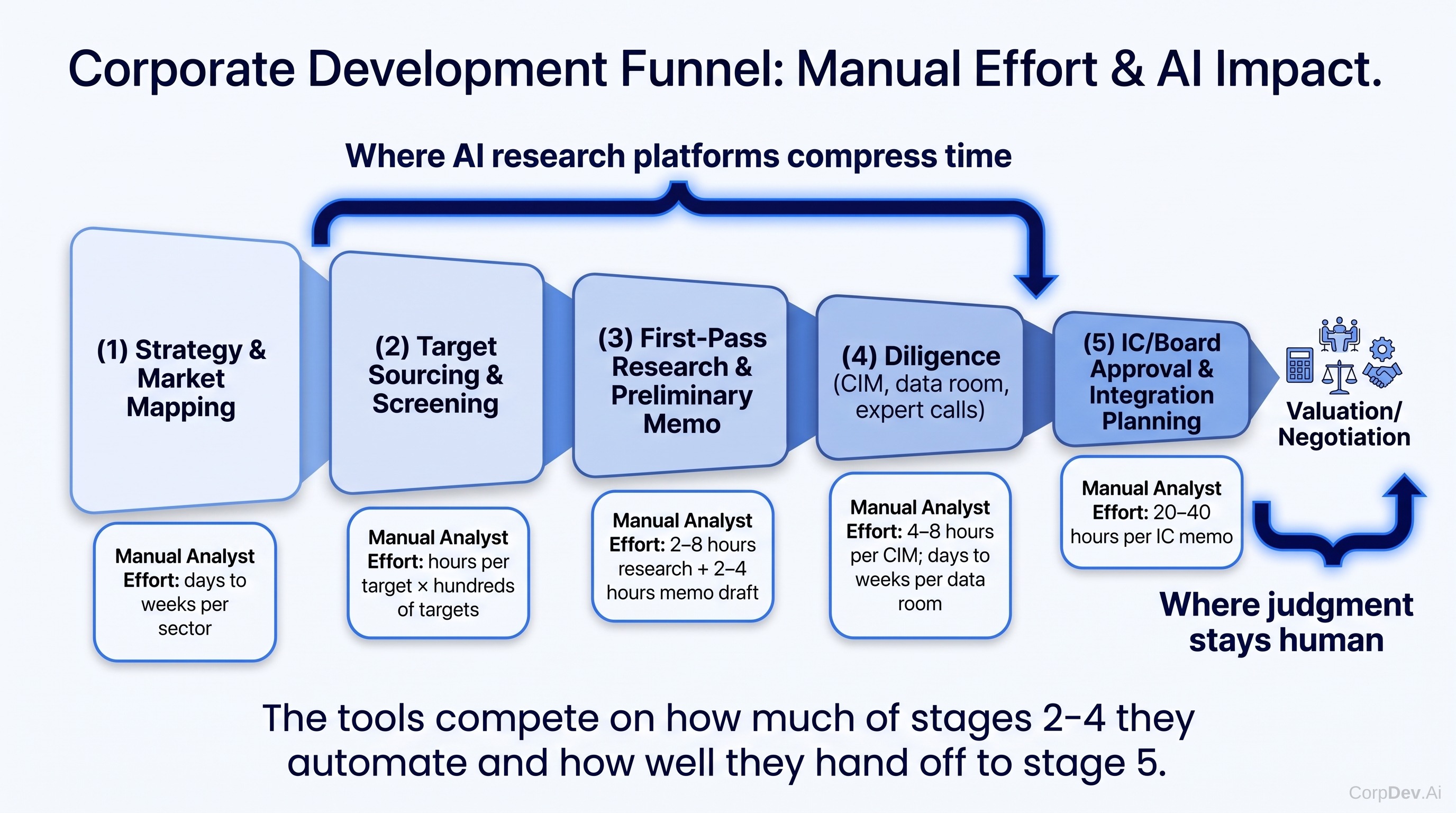
Read diagram description
Five-stage funnel for corporate development: (1) Strategy & market mapping, (2) Target sourcing & screening, (3) First-pass research & preliminary memo, (4) Diligence (CIM, data room, expert calls), (5) IC/board approval & integration planning. Illustrative manual effort at each stage: stage 1 "days to weeks per sector"; stage 2 "hours per target × hundreds of targets"; stage 3 "2–8 hours research + 2–4 hours memo draft"; stage 4 "4–8 hours per CIM; days to weeks per data room"; stage 5 "20–40 hours per IC memo". The time-saving emphasis is "Where AI research platforms compress time" spanning stages 2–4, and the judgment emphasis is "Where judgment stays human" over stage 5 and the valuation/negotiation elements. "The tools compete on how much of stages 2–4 they automate and how well they hand off to stage 5."
The workflow diagram’s stage timings are illustrative planning benchmarks, not population averages. Workflow studies published in 2026 put manual CIM review at 4–8 hours and a preliminary memo at a further 2–4 hours per target [93]; a full investment-committee memo, from data gathering through review cycles, is commonly estimated at 20–40 analyst hours [94]. One reported AI-assisted comparison brought a first IC-memo draft from roughly 15 hours to 2 [96]. These are workflow benchmarks rather than survey-grade averages, but they define the prize: a team that screens 200 targets a year and takes 30 to preliminary memo is spending in the order of 930–1,050 analyst hours on work that is now partially automatable.
Three consequences follow for the buyer:
- The value of a tool is proportional to volume. A serial acquirer screening hundreds of companies a year captures far more from a $30K–$100K research engine than a team doing one transaction every two years. For the latter, a general-purpose copilot plus a data subscription may be the rational choice.
- Handoff matters as much as generation. Every vendor can produce a fluent report. The differentiator is whether the output lands in the place the team works (CRM record, memo template, deck, Excel model) with citations intact, or has to be re-keyed.
- Provenance is a hard requirement, not a feature. Deloitte's M&A practice has warned that hallucinated contract terms or missed exceptions in diligence carry valuation and post-closing recourse consequences [100]. A buyer should treat claim-level citation and no-training-on-customer-data as pass/fail criteria before comparing anything else.
The vendors in this report increasingly market the same words ("agentic", "diligence", "memo generation"). Wokelo, Rogo and AlphaSense all now offer deal-agent libraries; CorpDev.AI, Midaxo and Affinity all embed AI chat over the team's own data. Substantial overlap can waste budget, but this review does not measure a 60% overlap rate or establish it as the most common or costly mistake. The head-to-head section below is organised to make those overlaps explicit.
Wokelo AI: Profile and Assessment
Founded: 2022, Seattle (CEO and co-founder Siddhant Masson) [1][7]
Funding: $4M seed (Oct 2024); $5.5M cumulative [1][12]
Notable investors: KPMG (minority equity), Array Ventures, Geek Ventures, Rebellion Ventures, Ahead VC [12][1]
Headcount: ~35–40 (PitchBook 38; Growjo 31) [3]
Customers: 35+ reported at seed (Oct 2024); logos shown include KPMG, B Capital, Adobe, P&G, JLL, Tata, Premji Invest [1][5]
Positioning (2026): "Agentic infra for private markets" — platform, API and MCP; separate akta.pro data API [5]
Pricing: Quote-based. Reported entry ~$30K/yr including ~5 seats; enterprise $100K+ [4]. Usage governed by credits that vary by depth of analysis [18][19]
Deployment: SaaS, VPC, on-prem or hybrid offered [5]
Certifications claimed: SOC 2 Type II, ISO 27001, no model training on customer data, end-to-end encryption [5]
Integrations: Salesforce, DealCloud, Affinity (native connectors with CRM-stage triggers); API and MCP server [21][22][23]
Outputs: PowerPoint, Word, PDF, Excel; interactive Q&A [6][160]
What Wokelo Actually Does
Wokelo's core product is a library of domain-specific research agents that run against a blended corpus: a proprietary database of 20M+ companies (200+ enriched fields, history to 2012), 30+ licensed premium subscriptions including PitchBook, CapIQ and Crunchbase, real-time news with entity tagging and sentiment, and whatever documents the user uploads to a secure workspace [5][6]. The agents produce cited company profiles, sector reports, market maps, competitive benchmarks, CIM analyses and first-pass diligence memos, and the user can chain or customise them through an "Agentic Builder" drag-and-drop interface or adopt pre-built agents from a marketplace populated by banking, PE and consulting practitioners [5][160].
Two design choices distinguish it from a general LLM wrapper. First, the licensed data: for a team that does not already subscribe to PitchBook or CapIQ, the bundle alone can justify a meaningful part of the price. Second, the CRM-trigger architecture: a documented growth-equity deployment fires a diligence memo automatically when a deal moves to a given Affinity stage, which the customer reported cut its diligence cycle from 20 days to 7 and lifted screening capacity from 100 to 250 deals a month [10]. Cowles Ventures reported preliminary diligence falling from roughly 36 hours to under 12 [17]. KPMG, both investor and customer, is quoted saying three days of research now takes "a couple of hours" [5].
Wokelo lists corporate development, corporate venture capital, competitive intelligence and market expansion explicitly as corporate use-cases [159], and its investor and customer base includes strategics (Adobe, P&G, Tata, JLL) alongside PE and consulting firms [5].
Strengths for a CorpDev Buyer
- Depth of licensed data for the price. Wokelo advertises access to named premium sources within its research layer at a reported $30K entry point; precise fields, seats and reuse rights require contractual confirmation; the comparable AlphaSense seat is $10–20K per user before any of that private-company depth [60][61].
- Repeatable, methodology-encoded research. The Agentic Builder lets a team codify its own screening framework once and run it across every inbound target, which is exactly the volume-driven use-case where ROI is clearest.
- Enterprise-grade security posture for a seed-stage company. SOC 2 Type II, ISO 27001, VPC/on-prem options and a no-training pledge are unusual at this funding level and address common procurement questions, subject to review of report scope, deployment terms and controls [5].
- CRM-native workflow. Native Affinity, DealCloud and Salesforce connectors mean the research lands where the deal team already works rather than in yet another tab [21][22][23].
- Credible reference customers and an anchor investor. The KPMG relationship supplies both distribution and a demanding reference account [12].
Limitations and Open Questions
- Not a system of record. Wokelo has no pipeline, CRM, activity timeline or deal-process management; it assumes you already own one. A team without a CRM buys Wokelo plus Affinity or similar, which changes the total cost materially.
- Entry price excludes small teams. The reported $30K floor, credit-metered usage and enterprise sales motion make it a poor fit for a one- or two-person CorpDev function [4][18].
- Thin independent evidence. Nineteen G2 reviews and a small number of vendor-published case studies is a modest base for a $100K decision [25]; one reviewer noted market maps returning irrelevant companies [27]. The "0 hallucination" language on the site is a product claim, not an audited result [5].
- Company scale and concentration risk. At $5.5M raised and ~35–40 staff, Wokelo has much less disclosed funding than Rogo ($300M+) or Hebbia ($161M) [1][109][76]. That cuts both ways — pricing flexibility and founder attention are high — but a buyer should ask about runway, the KPMG relationship's exclusivity terms, and what the 2026 pivot to "infra / API" means for roadmap priority on the end-user application.
- Memo-to-board handoff is partial. Outputs export to PowerPoint and Word, but Wokelo is not a document editor; iterating a board memo happens outside the platform.
Wokelo's move to sell its data layer as an API (akta.pro) and via Microsoft Marketplace means a buyer with an existing analytics stack can potentially license the data and agents without the full workspace seat count. Ask for the API-only price alongside the platform quote; the two are unlikely to be bundled in the first proposal.
The Alternatives
CorpDev.AI
Founded: May 2023 (co-founders Kal Kilpi, CEO, and Atul Tiwary) [45][46]
Funding: No publicly disclosed venture round [48]
Customers: "Hundreds of CorpDev professionals" claimed; no named reference customers published [35]
Independent reviews: 0 on G2 as of September 2026 [49]
Positioning: "Agentic AI for M&A and Corporate Development" — an end-to-end workbench [29]
Pricing (published): AI Pro $1,000/mo annual (1 seat, 12,000 credits/yr); AI Pro Team $3,000/mo annual (3 seats, 36,000 credits/yr); Enterprise custom with SSO, financial modelling, managed services [35]
Trial: 14 days / 300 credits; companies above $1B revenue auto-eligible [40]
Security claimed: SOC 2 Type II, encryption at rest/in transit, no training on customer data [35]
Integrations: Microsoft 365 (Outlook, Calendar, Teams, OneDrive), Google Workspace, CSV/Excel import; API; Excel add-in [43][41][42]
Data sources: Apollo firmographic database (70M+ companies), Google Maps geographic search, public web via Claude/GPT-5/Perplexity/Google orchestration [35][31][30]
CorpDev.AI is the only product in this report that tries to be the entire CorpDev desk rather than one layer of it. Its published feature list spans a Kanban pipeline with a "zero-entry" CRM that populates itself from synced email and calendar, semantic and firmographic target search across a 70M+ company database, AI market maps, target monitoring and management-change alerts, an AI Analyst agent that researches and writes into a native document editor with slide and spreadsheet tabs, and export to Word, PowerPoint, PDF and Excel [35][36][34][38]. The vendor claims 5–10 minutes for an investment memo and 10–15 minutes for a board presentation [38]; these are vendor benchmarks and have not been independently tested.
Where it is genuinely differentiated. Two things. First, price transparency and level: at $12,000 per year for a single seat with the base feature set (Enterprise modelling and SSO excluded), it is roughly 40% of Wokelo's reported five-seat floor and comparable to a single AlphaSense seat — and it is one of the specialist vendors with public pricing; Affinity also publishes tiers [35][4][60]. Second, the bundling of a CRM with the AI analyst: a two-person CorpDev team can run sourcing, pipeline and memo production in one tool instead of stitching Affinity ($2,000–2,700 per user) to a research engine to Office [105]. The document editor with live source citations and an integrated Excel workbook addresses the memo-to-board handoff problem that Wokelo and AlphaSense leave to the user.
Where it is weaker, stated plainly.
- Data depth. The firmographic layer is Apollo, a sales-intelligence database, not PitchBook or CapIQ [35]. Private-company financials, cap tables, transaction comps and ownership data are thinner than Wokelo's licensed bundle or Grata's curated private-company set. For deep private-company diligence a buyer will still want a data terminal.
- Proof. No named customers, no case studies with quantified outcomes, no independent reviews, and no disclosed funding [35][48][49]. Wokelo, for all its own small review base, has KPMG on record. A buyer should ask CorpDev.AI for three reference calls and treat any refusal as material.
- Scale and continuity risk. Undisclosed funding from a 2023-founded vendor means the buyer is underwriting the company's ability to sustain a multi-model orchestration cost base. Ask about runway, customer count by paying tier, and data-portability terms on exit.
- No native deal-CRM connectors. Integration is with Microsoft 365 and Google Workspace, not with DealCloud, Affinity or Salesforce [43]. A team already running one of those will maintain two systems.
- Enterprise features gated. SSO and financial modelling sit in the custom-quote Enterprise tier, not in the $36K Team plan [35].
Best fit: a small to mid-sized corporate development or strategy function (1–10 people) at a company without an existing deal CRM or research terminal, running a continuous sourcing programme and needing board-quality deliverables without a consultant. Poor fit: a large institution with DealCloud already deployed, or a team whose targets are predominantly private companies requiring audited financial data.
AlphaSense
Profile. AlphaSense is the scale player: a reported $600M+ ARR in Q1 2026, a $7.5B valuation following a $350M June 2026 raise, and 7,000+ enterprise customers [62][63][65]. Its 2024 acquisition of Tegus for approximately $930M added more than one million expert-call transcripts to a corpus of filings, broker research, earnings calls, news and the customer's own internal documents [51]. The 2026 AI layer comprises Generative Search (multi-agent conversational search), Generative Grid (a spreadsheet-style prompt-across-many-documents workflow) and a Deep Research agent that plans and executes multi-step research and returns cited long-form reports; by August 2026 the Due Diligence Workspace shipped 13 pre-built deal agents on Deep Research [53][55][56][59].
Pricing. No public rate card. Market reports place seats at $10,000–$20,000 per year with a median around $17,500–$18,400; enterprise packages, module selection and content tiers move the number [60][61].
Strengths for CorpDev. Unmatched breadth for public-company and large-cap targets; expert-call transcripts that test customer, supplier and competitor assumptions without commissioning calls; Generative Grid for running the same diligence questions across a target set; a mature enterprise governance and permissions model.
Limitations. Expensive for a small team, and the price scales per seat rather than per team; private-company coverage is a weaker point than its public-markets depth; the platform's many content types and modes require training and an internal champion; it is a research terminal, not a CRM or a memo editor. It overlaps most directly with Wokelo on sector and company research, and least on CRM-triggered private-company diligence.
Best fit: corporate strategy and CorpDev teams at large public companies whose targets are themselves public or well-covered, and who value expert-network content. Poor fit: lower-middle-market private-target sourcing on a constrained budget.
Rogo
Profile. Rogo is the best-funded pure-play in the category: a $50M Series B led by Thrive (April 2025), a $75M Series C led by Sequoia (January 2026) and a $160M Series D led by Kleiner Perkins (April 2026) at approximately a $2B valuation, taking cumulative funding past $300M [116][118][109]. It reports 35,000+ financial professionals at 250+ institutions and names Rothschild & Co, Jefferies, Lazard and Moelis among customers [110][111]. Its agentic platform, Felix, produces Excel models, PowerPoint decks, Word memos and diligence trackers with citations, and a September 2026 partnership with Datasite plus the acquisition of Rivanna extend it into live data-room diligence [120][122].
Pricing. Enterprise-negotiated; third-party estimates place it in the low five figures per seat annually plus platform and implementation fees [123][125].
Strengths for CorpDev. A finance-focused model-and-deck production engine; genuine investment-banking workflow depth (comps, precedents, valuation, management-meeting prep); institutional-grade security and a rapidly growing capability set backed by capital.
Limitations. It is built and priced for banks and large asset managers; a corporate team of five is not its design centre. It is not a private-company sourcing database and has no CRM. Its diligence strength is recent and partly acquired, so buyers should validate the Datasite-connected workflow against their own data rooms.
Best fit: large corporates with a banking-style internal M&A execution team producing IC materials and models at volume. Poor fit: small teams whose need is sourcing and screening rather than execution.
Hebbia
Profile. Hebbia's Matrix is a document-corpus analysis environment: the user loads a data room, contract set, filing library or internal deal archive and defines columns (revenue, churn, covenants, change-of-control terms, litigation), which Matrix populates across every document with page-level citations [66][70]. Matrix 2.0 (January 2026) extends the workflow from extraction into models, memos, decks and emails, and connects internal deal history and external feeds [68]. Funding stands at approximately $161M in total, including a $130M Series B led by Andreessen Horowitz at roughly a $700M valuation [74][75][76]. Reported users include Morgan Stanley, KKR, Centerview, Oak Hill Advisors and Latham & Watkins [78].
Pricing. Enterprise-only. Reported estimates: ~$3,000–$3,500 per year for lite/output seats, ~$10,000 for professional seats, $15,000+ for enterprise configurations [71][72].
Strengths for CorpDev. Specialised in structured, auditable extraction across large heterogeneous document sets; reusable agent schemas make the second data room faster than the first; outputs trace to the exact page.
Limitations. A steep learning curve is the most consistent user complaint [80][81]; quality is only as good as the corpus (poorly scanned or handwritten material degrades results) [82]; it is centred on document analysis, with external-feed capabilities described above, and has no native deal CRM; the sales motion is enterprise. It overlaps with Wokelo on data-room analysis with partial external-research overlap. Its memos, decks and data-room analysis also overlap with CorpDev.AI, although the corpus workflow and CRM scope differ.
Best fit: teams in active, document-heavy diligence several times a year, or with a large internal deal archive to mine. Poor fit: teams whose main need is sourcing and outside-in research.
Grata
Profile. Grata is the private-company discovery layer: a curated database of approximately 21M private companies with financial indicators, ownership structure and executive contacts, natural-language and filter search, market mapping, and a proprietary "Seller Intent" signal designed to flag companies 6–12 months before a sale process [112][114]. Datasite acquired Grata in June 2025 and Sourcescrub in August 2025 and is folding Sourcescrub's data into Grata; the combined coverage is described in industry reporting as roughly 36M+ companies before deduplication [130][132][113]. A 2026 integration exposes Grata data inside Perplexity Computer [128].
Pricing. Quote-based. Third-party listings cite a ~$15,000 per year entry point and a typical $15,000–$100,000 range depending on seats, Seller Intent, API and CRM integration [137][138].
Strengths for CorpDev. A specialist answer to "which companies exist in this space that we have not heard of", especially for founder-owned and lower-middle-market targets; Seller Intent converts a database into an origination tool; native CRM sync (Salesforce, HubSpot, DealCloud) and now a path into Datasite's VDR workflow.
Limitations. It is data and discovery, not analysis or deliverables; the AI layer is thinner than any of the research engines. Datasite's integration of two acquired databases is still in progress, so buyers should ask which dataset, deduplication state and feature set their contract actually covers [134].
Best fit: any CorpDev team running proactive origination; it complements every other product here rather than competing with them. Note that CorpDev.AI's 70M-company Apollo layer and Wokelo's 20M-company proprietary database both partially substitute for Grata’s discovery function; relative fidelity must be tested by sector and geography [35][5].
Sourcescrub
Sourcescrub built its franchise on proprietary private-company data — conference attendee lists, association memberships and human-verified ownership and contact data — with a reported 160M+ data points supported by a 600-person data-operations team under Francisco Partners' ownership [132]. Since Datasite's August 2025 acquisition, its data and capabilities are being integrated into Grata, and it should no longer be evaluated as an independent long-term platform [132][134]. Historical pricing estimates ranged from roughly $25,000–$40,000 per year for small teams to $50,000–$150,000+ for enterprise deployments [138]. For a 2026 buyer, the practical question is whether the Grata contract on offer includes Sourcescrub-derived conference and founder-owned data, and on what migration timeline.
Other Options: Midaxo, DealCloud, Affinity, General-Purpose LLMs
These are not substitutes for an AI research engine, but every buyer will be asked internally why the existing CRM or the enterprise ChatGPT licence cannot do the job. The honest answer is "partly", and the partition is worth stating.
Role: End-to-end M&A process platform — pipeline, diligence tracker, approvals, PMI and value tracking [162][163]
AI (2026): Midaxo AI answers questions across project documents with linked sources and proposes structured field values for approval [139][140]
Pricing: Quote-based; estimates $25K–$150K+/yr [141][142]
Verdict: Best system of record for serial acquirers; AI is grounded in your own deal data, not external research
Role: Enterprise deal and relationship CRM with heavy configuration and governance [144]
AI (2026): Intapp Assist — relationship insights, deal summaries, drafting over DealCloud data; Activator surfaces relationship signals and next actions [143][150]
Pricing: Quote-based; estimates ~$250/user/month plus implementation [147][148]
Verdict: The right CRM for large institutions; its AI makes your data actionable but should be evaluated separately for licensed market-data integrations and external research
Role: Relationship-intelligence CRM for private capital and deal teams [166]
AI (2026): Deal Assist (Q&A over notes and files), AI Notetaker for Zoom/Teams/Meet, AI summaries, hosted MCP server [151][155][165]
Pricing (published): $2,000 / $2,300 / $2,700 per user per year across three tiers [105]
Verdict: Lowest-friction CRM here and the natural trigger system for Wokelo; not a research tool
General-purpose copilots. ChatGPT Enterprise is reported at $45–$75 per user per month with ~150-seat minimums; Microsoft 365 Copilot is $30 per user per month as an add-on (Business tier ~$21) [106][107][108]. Both are excellent at drafting and summarising material the user already has, and Copilot's grounding in the Microsoft Graph gives it useful reach into a team's own email and files. Neither includes a complete dedicated M&A CRM or a universal private-company data licence by default. Configured connectors and agents can add automation and document citations; validate the exact workflow, permissions and licensed content. Their web research is competent but not curated, and their citation coverage and source accuracy still require review, even when citations are generated automatically. For a team doing one deal a year, a copilot plus a Grata or PitchBook seat is a defensible minimal stack; for a team screening hundreds of targets, a configured copilot should be benchmarked against specialist automation before assuming it becomes the bottleneck.
Wokelo's highest-value pattern — a diligence memo fired automatically when a deal changes stage — is documented for Affinity, DealCloud and Salesforce; API-based alternatives require separate implementation and testing [21][22][23]. CorpDev.AI avoids the dependency by including its own pipeline but does not connect to those three. A buyer's existing CRM therefore pre-selects a large part of this comparison before any research-engine demo is scheduled.
Head-to-Head Comparison
The matrix below scores each product on the eight capabilities a CorpDev buyer actually pays for. Scores are our qualitative assessment on a 0–3 scale (3 = core strength, 2 = competent, 1 = partial or via export, 0 = absent) based on the public evidence cited in the profiles above; they are judgments, not vendor-supplied data, and should be validated in a scripted demo.
| Capability | Wokelo | CorpDev.AI | AlphaSense | Rogo | Hebbia | Grata |
|---|---|---|---|---|---|---|
| Private-company data depth | 3 | 1 | 2 | 1 | 0 | 3 |
| Public-company & expert-call research | 2 | 2 | 3 | 3 | 1 | 1 |
| Target sourcing & screening | 2 | 3 | 1 | 1 | 0 | 3 |
| CIM / data-room analysis | 2 | 2 | 2 | 3 | 3 | 0 |
| Memo, deck & model generation | 2 | 3 | 2 | 3 | 2 | 0 |
| Pipeline CRM & activity capture | 0 | 3 | 0 | 0 | 0 | 1 |
| Deal-CRM connectors (Affinity/DealCloud/SFDC) | 3 | 0 | 1 | 1 | 1 | 3 |
| Fit for a 1–5 person team (price & motion) | 1 | 3 | 1 | 0 | 1 | 2 |
| Product | Low | High |
|---|---|---|
| Microsoft 365 Copilot (3 seats) | 1.1 | 1.1 |
| Affinity CRM (3 seats) | 6 | 8.1 |
| CorpDev.AI Team (3 seats, published) | 36 | 43.2 |
| Hebbia (3 pro seats, reported) | 30 | 45 |
| Wokelo (entry tier incl. ~5 seats, reported) | 30 | 100 |
| AlphaSense (3 seats, reported) | 30 | 60 |
| Grata (reported range) | 15 | 100 |
| Rogo (3 seats, reported estimate) | 30 | 60 |
Basis for the cost chart: CorpDev.AI Team is the published $3,000/month annual price ($36K) and the $3,600/month card price ($43.2K) [35]; Affinity uses the published $2,000–$2,700 per user tiers [105]; Copilot uses the $30/user/month enterprise add-on [108]; Wokelo uses the reported $30K entry (which includes ~5 seats, so a 3-seat team pays for capacity it may not use) to the $100K enterprise figure [4]; AlphaSense uses the reported $10–20K per seat [60][61]; Hebbia uses the reported ~$10–15K professional/enterprise seat [71][72]; Grata uses reported listings [137][138]; Rogo is the least certain figure and uses third-party low-five-figure-per-seat estimates [125]. Every figure except CorpDev.AI, Affinity and Copilot is a market estimate rather than a published price, and none includes implementation, data pass-through or the human verification time that every vendor still requires.
What the Matrix Says
Wokelo and CorpDev.AI are near-inverses. Wokelo scores highest where CorpDev.AI is weakest (licensed private-company data, deal-CRM connectors) and lowest where CorpDev.AI is strongest (built-in pipeline, small-team fit). This is the most important finding in the report for a buyer choosing between the two: they are not two versions of the same product but two different answers to the question of what sits at the centre of the CorpDev desk. Wokelo assumes the CRM is the centre and it is the research layer above it; CorpDev.AI assumes it is the centre and the research is inside it.
AlphaSense and Rogo are institutional products with corporate use-cases, not the reverse. Both score well on research and production and both are priced and sold for firms with dozens of seats. A corporate team should expect to be a small account.
Hebbia and Grata are single-purpose and should be bought as such. Neither competes for the centre of the desk; each has a specialist core, while Hebbia’s models, memos and decks extend beyond extraction.
| Vendor / group | Data foundation | Workflow contribution / price context |
|---|---|---|
| Grata | Claimed 21M private companies and Seller Intent | Private-company discovery; depth and signal accuracy need testing. |
| Wokelo | 20M+ company claim and named PitchBook, Capital IQ and Crunchbase sources | Research agents and CRM triggers; source fields, usage and redistribution rights require confirmation. Named sources are not universal terminal entitlements. |
| AlphaSense | Large content estate; cited $600M ARR context, Tegus expert calls | Deep Research and evidence-rich external analysis. |
| Hebbia | Customer documents and connected sources | Data-room extraction with page citations; evolving production outputs. |
| Rogo | Connected/licensed financial and internal data; cited ~$2B valuation context | Models, decks and diligence for finance teams. |
| CorpDev.AI | Apollo-based 70M firmographic universe plus public research | Pipeline CRM, AI analyst and memo editor; $12K/base seat annually, Enterprise features separate. |
| Affinity / DealCloud / Midaxo | Relationship and deal records, enrichment and licensed integrations | System-of-record/process layer; these products differ in CRM versus operational PMI depth. |
| ChatGPT Enterprise / Microsoft 365 Copilot | Connected deal documents and licensed sources depend on configuration | General drafting and productivity; not a full dedicated M&A system of record by default. |
Wokelo centres on source-rich research layered onto a CRM; CorpDev.Ai centres on an integrated analytical workspace with a lighter proprietary financial-data foundation. Compare licensed data depth, workflow fit and verified output quality as separate questions.
Evaluation Framework and Buying Recommendations
Step 1: Classify Your Team
The decision resolves quickly once the team is honest about four variables.
| Variable | Answer A | Answer B |
|---|---|---|
| Deal volume | Continuous programme: 100+ targets screened, 3+ transactions per year | Episodic: one or two transactions every few years |
| Target type | Predominantly private, lower- and middle-market, thin public footprint | Predominantly public or large, well-covered companies |
| Existing stack | Already run Affinity, DealCloud or Salesforce, and pay for PitchBook or CapIQ | No deal CRM; no data terminal; work lives in Excel, Outlook and PowerPoint |
| Team size and budget | 5+ people; software budget above $75K | 1–5 people; budget below $50K |
A / A / A / A is Wokelo's ideal customer, with Grata as the discovery layer if the CRM's sourcing is thin. A / A / B / B is CorpDev.AI's ideal customer. A / B / A / A points to AlphaSense (or Rogo for a modelling-heavy execution team). B / any / B / B should start with a copilot and a data seat and revisit in a year. Hebbia is additive to any profile with a heavy data-room workload.
| Layer | Small team without existing stack | Serial acquirer with CRM | Large-cap strategy / public targets |
|---|---|---|---|
| Data | CorpDev.Ai Apollo firmographics; optional Grata entitlement | Wokelo licensed-source access plus Grata, subject to fields and rights | AlphaSense and Tegus content |
| Research / AI | CorpDev.Ai AI Analyst | Wokelo agents and CRM-stage triggers | AlphaSense Deep Research / Generative Grid |
| Workflow / CRM | CorpDev.Ai pipeline | Affinity or DealCloud | DealCloud or Midaxo |
| Deliverables | CorpDev.Ai document/slides/workbook; Enterprise modelling excluded at base | Wokelo Word/PPT export to Office | Rogo if justified by modelling volume, otherwise Office/Copilot |
| Budget framing | $12K single / $36K three seats; five base seats imply $60K before optional Grata, so not universally below $50K | $75K+ planning profile; obtain full data/CRM/research quote | Quote by seat, content and additional tools |
Hebbia can be added when document volume and structured extraction justify its incremental cost. Team profiles are planning examples, not guaranteed all-in budgets.
Step 2: Run the Same Scripted Test on Every Finalist
Vendor demos are optimised to impress. The buyer should instead give every finalist the same three artefacts and score the output blind:
- A real historical CIM the team has already diligenced. Compare the platform's first-pass memo to the memo the team actually wrote. Score on facts caught, facts missed, facts fabricated, and time to output.
- A sector with 30 known targets, ten of which are obscure. Ask the platform to map the market. Score on recall of the ten.
- A live pipeline record (or a synthetic one). Ask the platform to produce a two-page target profile suitable for a steering committee, then export it. Score on how much re-keying the export needs before it is presentable.
Step 3: Diligence Questions to Put to Each Vendor
The following apply to every product in this report, including CorpDev.AI.
- Provenance: Does every factual sentence carry a citation to a document and page, or only a list of sources at the end? Can a reviewer click through to the source passage?
- Data licensing: Which premium datasets are licensed, on what terms, and what happens to historical outputs if a licence lapses? (Wokelo's PitchBook and CapIQ access, and CorpDev.AI's Apollo access, are both third-party dependencies.)
- Training and retention: Is customer data used to train any model? What is the retention and deletion policy for uploaded data rooms? Ask for the SOC 2 Type II report itself, not the badge.
- Metering: Where pricing is credit-based (Wokelo, CorpDev.AI), what does one full diligence memo consume, and what happens at the cap? [18][35]
- Company risk: Funding, runway, customer count by paying tier, and data-portability terms on termination. This matters most for the two smallest vendors, Wokelo ($5.5M raised) and CorpDev.AI (undisclosed) [1][48].
- Roadmap commitment: Wokelo's 2026 API/infrastructure positioning and Grata's ongoing Sourcescrub integration both raise the question of where product investment is going; ask for a written twelve-month roadmap.
- Reference calls: Three, in your sector, with buyers who have completed at least one renewal cycle.
Step 4: Budget for the Total, Not the Licence
As a budgeting sensitivity, suppose the licence represents 50–70% of first-year cost (an analyst assumption, not a measured category average) once implementation, CRM connector configuration, data pass-through and the analyst time spent verifying AI output are counted. The last item never disappears: every vendor in this report, including those marketing "no hallucination", states in its own documentation that human review is required before outputs inform an investment decision [28][35]. The efficient buyer budgets that review time explicitly and treats the tool's job as shrinking it rather than removing it.
For most corporate development teams outside large financial institutions, the realistic 2026 choice is between Wokelo layered on an existing CRM and CorpDev.AI as a self-contained desk. Wokelo wins on data depth, proven references and CRM automation; CorpDev.AI offers price transparency, workflow breadth and a single-seat entry option; its three-seat $36K subscription is above Wokelo’s reported $30K floor, but has not yet published the customer proof that would let a buyer take its claims on trust. A team with the budget and the volume should pilot both against the same historical CIM before committing to either.
Key Facts & Sources
Load-bearing figures used in this report, with source and as-of date. "Published" means a vendor price card or press release; "reported" means a third-party market estimate that the vendor has not confirmed.
| Figure | Value | Basis | Source | As of |
|---|---|---|---|---|
| Wokelo cumulative funding | $5.5M ($4M seed Oct 2024) | Published (press) | [1][12] | Oct 2024 |
| Wokelo headcount | ~35–40 | Third-party database | [3] | 2025 |
| Wokelo customers at seed | 35+ | Published (press) | [1] | Oct 2024 |
| Wokelo entry price | ~$30K/yr incl. ~5 seats; $100K+ enterprise | Reported | [4] | Aug 2026 |
| Wokelo company database | 20M+ companies; 30+ premium subscriptions | Vendor claim | [5][6] | Sep 2026 |
| Wokelo diligence-cycle case study | 20 days → 7; 100 → 250 deals/month screened | Vendor case study | [10] | Jan 2026 |
| Wokelo G2 review count | 19 | Third-party | [25] | Sep 2026 |
| CorpDev.AI pricing | $1,000/mo (1 seat) and $3,000/mo (3 seats), annual | Published | [35] | Sep 2026 |
| CorpDev.AI company database | 70M+ (Apollo firmographics) | Vendor claim | [35][31] | Sep 2026 |
| CorpDev.AI funding | None publicly disclosed | Third-party database | [48] | Sep 2026 |
| CorpDev.AI G2 reviews | 0 | Third-party | [49] | Sep 2026 |
| AlphaSense ARR / valuation | $600M+ (Q1 2026) / $7.5B (Jun 2026) | Reported | [62][63] | Jun 2026 |
| AlphaSense customers | 7,000+ | Reported | [65] | Jul 2026 |
| AlphaSense seat price | $10–20K/yr; median ~$17.5–18.4K | Reported | [60][61] | Aug 2026 |
| Tegus acquisition price | ~$930M | Reported | [51] | 2024 |
| Rogo funding / valuation | $300M+ / ~$2B (Series D Apr 2026) | Published (press) | [109] | Apr 2026 |
| Rogo adoption | 35,000+ professionals, 250+ institutions | Reported | [110][111] | Jun 2026 |
| Hebbia funding / valuation | ~$161M total / ~$700M | Reported | [74][75][76] | May 2026 |
| Hebbia seat price | ~$3–3.5K lite; ~$10K pro; $15K+ enterprise | Reported | [71][72] | Sep 2026 |
| Grata database | ~21M private companies; ~36M+ combined with Sourcescrub | Vendor claim / reported | [112][113] | Apr 2026 |
| Datasite acquisitions | Grata Jun 3 2025; Sourcescrub Aug 8 2025 | Published (press) | [130][132] | Aug 2025 |
| Grata pricing | ~$15K entry; $15–100K range | Reported | [137][138] | Aug 2026 |
| Affinity pricing | $2,000 / $2,300 / $2,700 per user/yr | Published | [105] | Sep 2026 |
| DealCloud pricing | ~$250/user/month | Reported | [147][148] | Apr 2026 |
| Midaxo pricing | $25K–$150K+/yr | Reported | [141][142] | Jun 2026 |
| ChatGPT Enterprise | $45–75/user/month, ~150-seat minimum | Reported | [106] | Jun 2026 |
| Microsoft 365 Copilot | $30/user/month enterprise add-on | Published | [107][108] | Jul 2026 |
| AI adoption in M&A | 45% of executives used AI tools in 2025 (n=300+) | Survey | [86] | Jan 2026 |
| GenAI M&A investment | 83% invested $1M+ (n=1,000) | Survey | [88] | Oct 2025 |
| Cycle-time reduction | 30–50% among moderate/high AI users | Survey | [85][90] | Jan 2026 |
| Manual CIM review / prelim memo | 4–8 hours / 2–4 hours | Workflow benchmark | [93] | Jun 2026 |
| IC memo effort | 20–40 analyst hours | Workflow benchmark | [94] | Jun 2026 |
Derived figure. The "930–1,050 analyst hours" estimate in the Job-to-Be-Done section is our own calculation: 200 targets × ~3 hours screening (600 h) plus 30 preliminary memos × 8–12 hours research and drafting (240–360 h) plus 3 IC memos × 30 hours (90 h), summing to 930–1,050 hours under the stated inputs from [93][94]. It is illustrative, not a survey result.
Known gaps. CorpDev.AI, Affinity and Microsoft publish the prices used here; other figures are market estimates. Enterprise quotes and data entitlements may differ. This review did not identify an independent, like-for-like accuracy benchmark covering all these platforms; the scripted test in the Evaluation Framework is the buyer's substitute.
References
Numbering follows the original research. Access dates below record the original source registry; they do not imply that every source was rechecked for this website edition.
- Wokelo raises $4M for AI-driven due diligence, sees ... - GeekWireSource accessed 2026-09-12
- Wokelo AI 2025 Company Profile: Valuation, Funding & Investors | PitchBookSource accessed 2026-09-12
- Wokelo - AI Tools for Consultants - UmbrexSource accessed 2026-09-12
- Wokelo - AI Agents for Investment Research & Due DiligenceSource accessed 2026-09-12
- Wokelo APIs for Investment Research and Due DiligenceSource accessed 2026-09-12
- Siddhant Masson, CEO and Co-Founder of WokeloSource accessed 2026-09-12
- How Wokelo helped a Growth Equity VC Supercharge ...Source accessed 2026-09-12
- Wokelo Announces Minority Equity Investment from KPMG LLPSource accessed 2026-09-12
- Customer story ArchivesSource accessed 2026-09-12
- Credits - Wokelo DocsSource accessed 2026-09-12
- Wokelo AI Reviews & Ratings 2026 | Gartner Peer InsightsSource accessed 2026-09-12
- Salesforce - Wokelo DocsSource accessed 2026-09-12
- DealCloud - Wokelo DocsSource accessed 2026-09-12
- Affinity - Wokelo DocsSource accessed 2026-09-12
- Wokelo AI Reviews 2026: Details, Pricing, & Features | G2Source accessed 2026-09-12
- Wokelo AI Pros and Cons | User Likes & DislikesSource accessed 2026-09-12
- Use casesSource accessed 2026-09-12
- CorpDev.Ai - Agentic AI for M&A and Corporate DevelopmentSource accessed 2026-09-12
- AI Analyst Agent for M&ASource accessed 2026-09-12
- The Data Architecture Behind AI-Powered M&ASource accessed 2026-09-12
- AI Market Mapping & Industry Analysis for M&ASource accessed 2026-09-12
- Pricing - CorpDev.AiSource accessed 2026-09-12
- Simple, Powerful AI Pipeline CRM for M&A - CorpDev.AiSource accessed 2026-09-12
- Board-Ready Deliverables & Investment Memos - CorpDev.AiSource accessed 2026-09-12
- Request a Free Trial | CorpDev.AiSource accessed 2026-09-12
- Quick Start - CorpDev.Ai DocsSource accessed 2026-09-12
- Introduction & Installation - CorpDev.Ai DocsSource accessed 2026-09-12
- Integrations | CorpDev.Ai DocsSource accessed 2026-09-12
- Kal Kilpi - CEO @ CorpDev.Ai | Superhuman M&A | LinkedInSource accessed 2026-09-12
- Atul Tiwary | LinkedInSource accessed 2026-09-12
- CorpDev.Ai Revenue, Funding & Valuation - ProspeoSource accessed 2026-09-12
- CorpDev.Ai Products | Read 0 Reviews on G2Source accessed 2026-09-12
- AlphaSense Stock Price, Valuation & News - Stock AnalysisSource accessed 2026-09-12
- AlphaSense Product Updates — February 2026Source accessed 2026-09-12
- Market Intelligence Platform for Leading Organizations - AlphaSenseSource accessed 2026-09-12
- AlphaSense Launches Deep Research, Automating In-Depth ...Source accessed 2026-09-12
- AlphaSense Product Updates - August 2026Source accessed 2026-09-12
- AlphaSense Pricing 2026: About $18K a Seat, and Rising FastSource accessed 2026-09-12
- AlphaSense Pricing 2026: What a Seat Actually Costs | Market ...Source accessed 2026-09-12
- AlphaSense IPO 2026 — $7.5B Valuation, $700M ARR, and the ...Source accessed 2026-09-12
- AlphaSense Hits $600M ARR: Why 90% of S&P 100 Pay $18 ...Source accessed 2026-09-12
- AlphaSense — AI Market Intelligence Platform | Altis ResearchSource accessed 2026-09-12
- Hebbia Review 2026: Features, Pricing & VerdictSource accessed 2026-09-12
- Introducing Matrix 2.0 - hebbia.comSource accessed 2026-09-12
- What's New: August 2025Source accessed 2026-09-12
- Hebbia Pricing | UsagePricingSource accessed 2026-09-12
- Hebbia AI for Legal Research: 2026 ReviewSource accessed 2026-09-12
- Hebbia Raises Series B Led by Andreessen HorowitzSource accessed 2026-09-12
- Hebbia raises $130m for AI-driven complex query softwareSource accessed 2026-09-12
- Hebbia revenue, valuation & funding | SacraSource accessed 2026-09-12
- Hebbia · Company in New York Tech · NYTechSource accessed 2026-09-12
- Hebbia AI Reviews 2026: Details, Pricing, & Features | G2Source accessed 2026-09-12
- hebbia-ai-review-13386264Source accessed 2026-09-12
- Hebbia Review 2026 - Enterprise AI Platform - TooliverseSource accessed 2026-09-12
- Generative AI in M&A: You're Not Behind—Yet | Bain & CompanySource accessed 2026-09-12
- Gen AI in M&A: From theory to practice to high performanceSource accessed 2026-09-12
- M&A Capability for a New Era: Five Ways AI Is Creating More Value ...Source accessed 2026-09-12
- New Deloitte Survey: 86% of Corporate and Private Equity Leaders ...Source accessed 2026-09-12
- AI meets M&ASource accessed 2026-09-12
- CIM to Preliminary Investment Memo: How PE Teams Use AISource accessed 2026-09-12
- How to Automate the Investment Committee Memo for ... - XlagentSource accessed 2026-09-12
- Private Equity Due Diligence Process: AI vs Traditional - V7 LabsSource accessed 2026-09-12
- AI doesn’t lie, it hallucinates and M&A due diligence must ...Source accessed 2026-09-12
- Affinity Pricing: Plans for Private Capital CRMSource accessed 2026-09-12
- ChatGPT Enterprise Pricing Guide (2026) - Beam CloudSource accessed 2026-09-12
- Copilot vs ChatGPT in 2026: Pricing, Features, Key ...Source accessed 2026-09-12
- Microsoft Copilot Enterprise Pricing 2026 - Coworker AISource accessed 2026-09-12
- Our $160M Series D and the Road Ahead - RogoSource accessed 2026-09-12
- Rogo — jimmy·researchSource accessed 2026-09-12
- Rogo Just Raised $160 Million to Replace Wall Street’s Junior ...Source accessed 2026-09-12
- Discover private companies & source deals faster | Grata by ...Source accessed 2026-09-12
- Grata's Agentic Search and the $500M Datasite Bet: AI Deal ...Source accessed 2026-09-12
- Seller Intent Data for Private Market Deals | GrataSource accessed 2026-09-12
- Rogo Raises $50M Series B from Thrive Capital, J.P. Morgan ...Source accessed 2026-09-12
- Rogo - AI WikiSource accessed 2026-09-12
- Rogo Acquires Rivanna: The Intelligence Layer for Due ...Source accessed 2026-09-12
- Announcing Rogo's Partnership with DatasiteSource accessed 2026-09-12
- Rogo AI Review 2026: Felix IB Research Copilot | VantaigeSource accessed 2026-09-12
- Rogo Review — AI Panel Score 7.9/10Source accessed 2026-09-12
- Grata brings private market data to Perplexity Computer - CFOtechSource accessed 2026-09-12
- Datasite Acquires Leading Private Market Intelligence Company ...Source accessed 2026-09-12
- Datasite to Acquire Sourcescrub, Expanding Private Market ...Source accessed 2026-09-12
- Grata + Sourcescrub: Better TogetherSource accessed 2026-09-12
- Grata Pricing 2026 | CapterraSource accessed 2026-09-12
- Grata Pricing, Reviews, Pros and Cons (2026) - prospeo.ioSource accessed 2026-09-12
- Midaxo closes Q2 with new customers and a major AI updateSource accessed 2026-09-12
- AI for M&A: Answers From Your Own Deal Data - MidaxoSource accessed 2026-09-12
- Best Post-Merger Integration Software in 2026Source accessed 2026-09-12
- Pricing And Roi Math: What...Source accessed 2026-09-12
- Intapp Assist for DealCloudSource accessed 2026-09-12
- The AI-powered deal and relationship intelligence ... - IntappSource accessed 2026-09-12
- Top 5 AI-Powered Private Equity CRM Platforms 2026Source accessed 2026-09-12
- DealCloud Review 2026: Pricing, Features & Alternatives | CRE SoftwareSource accessed 2026-09-12
- Intapp DealCloud Activator launched to drive growth for ...Source accessed 2026-09-12
- Deal Assist - AffinitySource accessed 2026-09-12
- Affinity vs. HubSpot vs. ZoomInfo [July 2026]Source accessed 2026-09-12
- AI Agents for Corporate M&A & CVC | Wokelo AISource accessed 2026-09-12
- Wokelo AI Agents for Investment Research and Due DiligenceSource accessed 2026-09-12
- M&A Intelligence Platform | Midaxo M&A SoftwareSource accessed 2026-09-12
- M&A Software & Intelligence Platform | MidaxoSource accessed 2026-09-12
- 4 New AI Features From Affinity for Faster Deal DecisionsSource accessed 2026-09-12
- The CRM Built for Deal Teams - AffinitySource accessed 2026-09-12