RESEARCH / Virtual data rooms
Drooms Alternatives: Virtual Data Rooms, AI and M&A Workflows
Compare Drooms Hub with Datasite, Intralinks, iDeals, Firmex and M&A platforms on hosting, bidder controls, AI, pricing and transaction workflow fit.
Research as of
Website edition edited
Published by CorpDev.Ai, which is one of the vendors assessed. This analysis distinguishes vendor claims, external evidence and analyst judgments. Prices and capabilities reflect the source dates in the article; the website edition is an editorial adaptation, not a new verification of every claim.
Price the room around jurisdiction, ownership and the life of the asset
Drooms presents a distinctive buying case when document jurisdiction and an asset’s continuing information requirements matter as much as the immediate transaction. Its German and Swiss hosting and real estate heritage make the location, administration and persistence of the room central to the evaluation. Those attributes deserve contractual scrutiny; they do not establish legal immunity or superior analytical performance by themselves.
The economic comparison changes according to who controls the room. A seller managing repeated disclosure or a portfolio of continuing asset rooms may benefit from a persistent platform. An acquirer invited into another party’s room has less control over the hosting choice and may obtain more value from tools that analyse permitted exports and connect findings to the acquisition case.
Model the expected storage, room duration and participant access across the actual asset portfolio, then test the transition from ongoing asset documentation to transaction disclosure. Separately validate AI output and export rights. This reveals whether Drooms replaces recurring room administration or simply adds another repository alongside the team’s analytical workflow.
1. Executive Summary
The question "should we buy Drooms?" is the wrong question for most corporate development teams in 2026. Drooms is a very good virtual data room (VDR) — arguably the best European-sovereign one — but a VDR addresses roughly one phase of the deal lifecycle, and the market has split into three distinct categories that a buyer must now choose between, or combine: transaction-grade data rooms (Drooms, Datasite, SS&C Intralinks, iDeals, Ansarada, Firmex), M&A operating platforms that manage pipeline, diligence and integration as workflow (DealRoom, Midaxo), and AI-native corporate development workspaces that treat research, sourcing, analysis and deliverable creation as the core job (CorpDev.Ai). Each category prices differently, solves a different bottleneck, and carries a different risk profile.
This comparison was researched and drafted using CorpDev.Ai's own analyst tooling, for CorpDev.Ai. CorpDev.Ai is one of the platforms compared. To keep the analysis useful rather than promotional, every claim about every vendor — including CorpDev.Ai — is sourced to public material, the limitations of each product are stated as plainly as its strengths, and the decision framework in Section 6 recommends competitors where they are the better fit.
€49–€398/mo
Drooms Hub self-serve plans (Professional–Business, monthly billing)
$10–15k
Reasonable planning midpoint for a mid-market VDR project
16,000+
Transactions hosted per year by Datasite, the volume leader
$1,000/mo
CorpDev.Ai AI Pro (annual), the entry point for an AI analyst workspace
The five findings that should drive a purchasing decision:
Drooms' real differentiator is jurisdictional, not functional. Its feature set — granular permissions, structured Q&A, AI redaction, OCR, translation across six European languages — is now table stakes matched by iDeals, Datasite and Ansarada. What competitors cannot replicate is that Drooms is German-owned, hosts exclusively in Germany and Switzerland, develops its AI in-house, which the vendor presents as reducing exposure to US jurisdiction; ownership and hosting alone should not be read as a legal immunity finding [77][18]. For a European seller in real estate, infrastructure, defence-adjacent or regulated sectors, that is frequently decisive; for a US-headquartered acquirer it is often irrelevant.
Drooms has quietly moved down-market with transparent subscription pricing, which changes its competitive position. The current Drooms Hub plans start at €0 (Starter), €49/month (Professional) and €398/month (Business), with an Enterprise tier on quote. That puts Drooms in direct price competition with iDeals and Firmex for small and mid-sized projects, where historically it was seen as premium-priced and quote-only. Users on G2 and Capterra still describe it as expensive and give it a comparatively low 4.0/5 for value for money [21][23] — a perception that lags the new price list.
The enterprise incumbents are buying their way into AI and intelligence. Datasite acquired Ansarada (August 2024, ~AUD 236m) [98][99], holds the first ISO/IEC 42001 AI-governance certification in the VDR category [54], and reports 16,000+ transactions per year [91]. Intralinks is bundling DealCentre AI across the lifecycle [34][97]. Their AI is genuinely strong inside the data room, but it remains sell-side-oriented and document-bound: it summarises, redacts and answers questions about what is in the room. It does not source targets, write the investment memo or maintain the pipeline.
For a corporate acquirer, the data room is rarely the bottleneck; the analyst hours around it are. A corporate development team spends the majority of its time on market mapping, target screening, company research, memo drafting and IC/board materials — work that no VDR touches. This is the gap CorpDev.Ai (AI Analyst, AI Room, zero-entry pipeline CRM, target sourcing across 70m+ companies) [55][58] and, from a workflow angle, DealRoom and Midaxo address. The trade-off is maturity: none of these platforms yet carries the 20-year transaction-grade audit history of Drooms or Datasite, and CorpDev.Ai's AI Room should be evaluated as an analytical diligence environment first and as a formal bidder-facing VDR second.
The rational answer for most serious buyers is a two-product stack, not a single winner. A sovereign or institutional VDR for the sell-side process and formal bidder access, plus an AI-native workspace for the buy-side analytical workload. The cost of the combination — a Drooms Business plan at roughly €4,300/year plus a CorpDev.Ai AI Pro seat at $12,000/year — is typically below what a single enterprise VDR engagement with Datasite or Intralinks costs for one large deal ($15,000–$50,000+) [28].
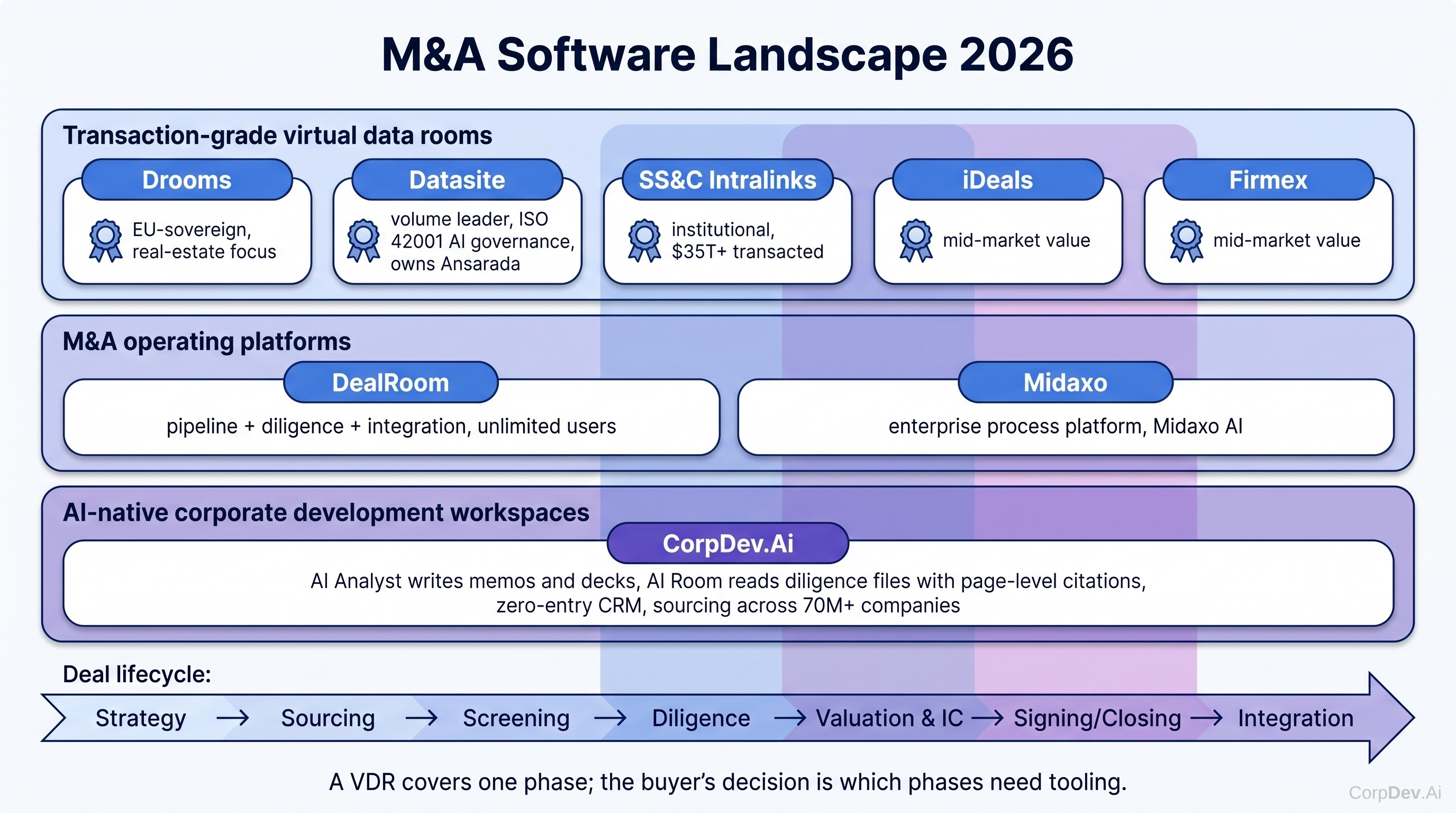
Read diagram description
Comparison of M&A software in 2026 with three bands. Band 1 "Transaction-grade virtual data rooms": Drooms (badge: EU-sovereign, real-estate focus), Datasite (badge: volume leader, ISO 42001 AI governance, owns Ansarada), SS&C Intralinks (badge: institutional, $35T+ transacted), iDeals and Firmex (badge: mid-market value). Band 2 "M&A operating platforms": DealRoom (pipeline + diligence + integration, unlimited users) and Midaxo (enterprise process platform, Midaxo AI). Band 3 "AI-native corporate development workspaces": CorpDev.Ai (AI Analyst writes memos and decks, AI Room reads diligence files with page-level citations, zero-entry CRM, sourcing across 70M+ companies). An arrow beneath all bands labelled "Deal lifecycle: Strategy → Sourcing → Screening → Diligence → Valuation & IC → Signing/Closing → Integration", with Band 1 shading only the Diligence-to-Closing segment, Band 2 shading Sourcing through Integration, and Band 3 shading Strategy through Integration. "A VDR covers one phase; the buyer's decision is which phases need tooling."
Shortlist by buyer profile (developed in Section 6):
| Buyer profile | Primary recommendation | Rationale in one line |
|---|---|---|
| European seller or adviser in real estate / infrastructure / regulated sectors | Drooms (Business or Enterprise) | Sovereignty, RE-specific indexing and asset lifecycle rooms, multilingual in-house support |
| Large-cap sell-side process run by a bulge-bracket bank | Datasite or SS&C Intralinks | Bidder expectations, institutional audit trail, AI governance certification |
| Lean corporate development team at a $1bn+ corporate, 2–10 deals/year | CorpDev.Ai + a mid-market VDR (iDeals / Firmex / Drooms Hub) when a formal room is needed | AI analyst capacity is the binding constraint; VDR is a per-deal utility |
| Serial acquirer with heavy integration programme | DealRoom or Midaxo, possibly with CorpDev.Ai for research | Workflow, request tracking and PMI discipline dominate |
| PE sponsor running competitive sell-side auctions | Datasite/Ansarada or Drooms (Europe) | Sell-side readiness, bidder analytics, buyer-behaviour intelligence |
| Cost-constrained team already standardised on Microsoft 365 / Box | Box or SharePoint with hardened configuration — only with legal sign-off | Lowest incremental licence cost; highest configuration and control risk |
2. Who This Comparison Is For — and the Question It Answers
This document is written for the person who has to sign the purchase order: a head of corporate development, a strategy director, an M&A lead at a corporate or a private equity fund, or a partner at an advisory boutique. It assumes fluency in deal process and no patience for vendor marketing.
The buyer's question has changed since Drooms and its VDR peers were founded in the early 2000s. Then, the decision was "which secure room do we put the diligence documents in?" and the answer was governed by bidder expectations, bank relationships and per-page pricing. Today three things are different:
The VDR has become a commodity at the feature level. Watermarking, granular permissions, audit reports, structured Q&A, OCR search, bulk upload and automated indexing are offered by every credible vendor. Drooms' own comparison page against iDeals concedes parity on almost every functional line and differentiates instead on sovereignty, in-house AI, support and pricing transparency [18].
AI has entered the room — and the marketing. Every vendor now claims "AI-powered". The substance varies enormously: from keyword-driven redaction with a human review step, through retrieval-based Q&A over the room's own contents, to agentic systems that research external markets, read a data room and produce a cited investment memo. Section 5.3 separates these.
The analytical workload around the deal has become the expensive part. A corporate development team of three to six people typically runs a pipeline of 50–200 targets, produces market maps and screening memos on demand from the executive committee, and drafts IC papers under time pressure. This work consumes the majority of the team's hours and most of its consulting budget, and it is exactly the work that no traditional VDR addresses. This is why the alternatives set for Drooms now legitimately includes platforms that are not data rooms at all.
The comparison therefore evaluates Drooms against three groups of alternatives — direct VDR competitors, M&A operating platforms, and AI-native corporate development workspaces — and against the "do nothing special" option of a hardened Box or Microsoft 365 tenant. It answers four questions for each:
- What does it actually do well, and for whom?
- What does it cost, on a comparable basis, and where do the hidden charges sit?
- What is real about its AI, and what is governance theatre?
- Where does it fit in a corporate development or M&A team's stack in 2026?
3. Drooms in Focus
3.1 Company, Ownership and Market Position
Drooms GmbH was founded in Frankfurt in 2001 by Alexandre Grellier and Jan Hoffmeister and has spent a quarter-century as Europe's most recognisable home-grown data room [1]. In June 2026 the company changed hands: EOS Partners acquired a majority stake, long-standing shareholder J.F. Müller & Sohn AG exited, and Grellier remained CEO with a minority holding while co-founder Hoffmeister departed [1][2]. Frankfurter Allgemeine reported that the DACH customer base exceeds 2,700 companies, more than 70% of them in real estate [8]. Drooms' own marketing claims "40,000+ clients" on its pricing page and homepage, while the about page states "4,000+" — the discrepancy may reflect different counting units, but the cited pages do not establish the explanation, and a buyer should ask which is meant [7][81]. Headcount sits in the 140–200 range depending on the directory consulted [3][4][5]; revenue is not disclosed, and third-party estimates range so widely ($4.6m to $33.4m) that neither should be quoted [5][6].
A financial sponsor taking a majority stake in a 25-year-old founder-led software company typically means one of two things: a growth investment to fund product (AI, self-serve expansion) and geographic reach, or a platform play for buy-and-build in the fragmented European VDR / deal-technology market. Either is positive for product investment in the near term; both introduce the possibility of a further sale or merger inside a typical 4–6 year sponsor hold, which a buyer signing a multi-year enterprise agreement should factor into contract terms (change-of-control, data-residency and service-level protections).
Drooms' competitive position is best described as the sovereign European specialist. It is a strong number one in German-speaking real-estate transactions, a credible option across European M&A and legal due diligence, and a marginal presence in US-led processes, where Datasite and Intralinks dominate bidder expectations [20]. Its named reference clients — JPMorgan, UBS, Blackstone, KKR, CBRE, JLL, Siemens, Volkswagen, AXA, Evonik, METRO, REWE, Prada, EY, Credit Suisse — are heavily weighted to European corporates, real-estate advisers and the European arms of global institutions [21][83]. It reports having hosted transactions with a cumulative value exceeding €1 trillion [82].
3.2 Product Line and Pricing
In 2026 Drooms sells a single subscription, Drooms Hub, under which a customer can run unlimited data rooms and portfolio ("asset") views. This consolidates the previous FLEX (self-serve), LIFECYCLE (real-estate asset management) and TRANSACTION (managed enterprise deal room) product names, which still appear in older factsheets and third-party reviews [9][11][12]. The live price list is unusually transparent for the category:
| Drooms Hub plan | Monthly price (monthly / annual billing) | Included capacity | What it adds |
|---|---|---|---|
| Starter | €0 | 150 MB, 2 user licences, 3 projects | Secure document management, permissions, email support |
| Professional | from €49 / €44 (500 MB + 2 users) up to €98 / €88 (10 GB + 20 users) | 500 MB–10 GB, 2–20 users | Unlimited projects, advanced reporting, batch operations and translation, AI Assistant (free for a limited period) |
| Business | from €398 / €358 (2 GB + 20 users) up to €199–€179 per GB tiers to 10 GB + 100 users | 2–10 GB, 20–100 users | End-to-end Q&A workflow, readiness tracking, advanced permissions and governance, full AI capability for structuring, redaction and naming |
| Enterprise | Custom quote | Unlimited users and storage | Dedicated onboarding and CSM, premium features, priority support, custom agreements |
Basis: Drooms Hub pricing page, drooms.com/pricing, accessed 11 September 2026; EUR excluding VAT. Storage-tier increments are configured by the buyer at checkout. "Members" (administrators) are unlimited on every plan.
Three observations matter for a buyer. First, storage, not pages, is the pricing unit — the per-page model that plagues legacy VDR invoices is absent. Second, the ceilings are low: 10 GB is small for a full corporate carve-out or a portfolio real-estate sale, so any serious transaction lands in Enterprise on quote, where the historic "Drooms is expensive" reputation was earned. Third, AI is currently bundled "free for a limited time" on Professional and Business, which is a signal that it will become a paid booster; price it into a multi-year view.
The AI feature set — marketed as Drooms Intelligence / AI Assistant — comprises automatic document classification and index allocation, information extraction and tabular review, OCR full-text search over scanned files, AI-assisted redaction (Drooms claims 90% recall on its redaction engine), and real-time translation to and from English and five other European languages [15][16][17][18]. Drooms stresses that all AI is developed in-house, runs in a closed-loop environment, and that no live client data is used for training [18].
3.3 What Users Actually Say
Review volumes for Drooms are thin — three to six G2 reviews and 38 on Capterra — so the scores (G2 4.7/5, Capterra 4.5/5) are directional at best [21][22][84]. The pattern within them is nonetheless consistent and is corroborated by third-party reviewers:
Consistent strengths
- Security posture and access control: 2FA, watermarking, document-level permissions are repeatedly praised [21][24]
- Customer support scores 4.7/5 on Capterra; multilingual, in-house, 24/7 by chat and email [23][18]
- Document translation is the single most-cited differentiator by G2 reviewers [21][84]
- Structured Q&A workflow with role-based routing and reporting works well for multi-party deals [24]
- Scales to very large, complex document sets [25]
Consistent criticisms
- Price: "very high", value-for-money only 4.0/5 on Capterra [21][23][84]
- Interface described as "not user friendly", requires training; a March 2026 reviewer counters with "modern UI" — suggesting a recent redesign [84][26]
- Redaction requires saving a new version and deleting the original rather than editing in place [23]
- Bulk re-indexing of documents within a folder is slow [24]
- Offline access weak; file downloads and search intermittently unreliable for some file types [22][24][84]
3.4 Where Drooms Wins and Where It Does Not
Drooms wins when the seller or its counsel is European and cares about jurisdiction; when the asset is real estate, infrastructure or a portfolio that will need an ongoing "living" data room after the transaction (the LIFECYCLE heritage — an asset room converts to a transaction room in one click); when documents are multilingual; and when the buyer wants a human project manager who structures the room rather than a self-serve tool. Its ISO 27001:2022 and ISO 27018:2020 certifications, TÜV certification, AES-256 encryption and exclusive German/Swiss hosting are a coherent, verifiable sovereignty story [77][79].
Drooms does not win when the process is US-led and bidders expect Datasite or Intralinks; when the buyer needs SOC 2 Type II evidence (Drooms publishes ISO, not SOC 2 — request confirmation) [77]; when the workload is buy-side analysis rather than sell-side hosting; or when the team wants pipeline, integration or research tooling from the same vendor, none of which Drooms offers. It is also not the cheapest option for very small projects once storage exceeds the Professional tier.
4. The Alternatives Landscape
The alternatives to Drooms fall into four groups. The first competes head-on for the same purchase order; the second and third compete for the same budget line but solve a broader problem; the fourth is the "make do" option that every procurement team is asked about.
4.1 Enterprise VDR Incumbents: Datasite and SS&C Intralinks
Datasite (formerly Merrill DataSite, Minneapolis) is the volume leader in transaction-grade data rooms: more than 16,000 transactions per year, 1.8 million users since 2020 across 180+ countries [91][92]. Its strategic moves in the past two years define where the category is going. It acquired Ansarada in August 2024 for approximately AUD 236m, keeping Ansarada as a separately branded, lower-priced sell-side readiness product [98][99]; it became the first VDR to certify AI governance to ISO/IEC 42001, alongside ISO 27001, 27017, 27018 and 27701 and SOC 2 Type II [33][54]; and it built "Datasite Intelligence", a buyer-discovery and deal-comps layer drawing on Grata, Sourcescrub and Blueflame AI [93][94][95]. Inside the room, Datasite's AI summarises documents, drafts Q&A answers, runs semantic search, redacts and translates [93]. Pricing is quote-based per project; realistic mid-market budgets run $15,000–$50,000 and large processes exceed $100,000 [28]. Datasite is the safe institutional choice and the strongest AI-in-the-room offering — and, for a European sovereignty-sensitive seller, a US-controlled provider subject to the CLOUD Act, which is precisely the wedge Drooms markets against [18].
SS&C Intralinks (New York; owned by SS&C Technologies since 2018) is the other institutional standard, with $35 trillion-plus in transaction value through its platform and a 515,000-person GP/LP community that makes it the default for fund-reporting as well as M&A [34]. Its DealCentre AI and "Link" engine cover pipeline, diligence, document analysis and cross-deal insight [96][97]; AI redaction is offered as a service as well as software [35]. Certifications include ISO 27001 and 27701, SOC 2 and SOC 3, and PCI DSS [36][37]. Intralinks has historically been associated with page-based pricing and unpredictable overage invoices; current proposals can be structured as packages, but a buyer should insist on written page, storage, extension and export terms [28]. It is the right answer when the counterparty is a bank or a regulated financial institution and the wrong answer for a lean team paying its own way.
4.2 Mid-Market VDR Specialists: iDeals, Ansarada and Firmex
These three are Drooms' most direct price-point competitors now that Drooms Hub publishes self-serve tiers.
iDeals (global, founded 2008) is the strongest all-round mid-market room: quote-based per project, typically $5,000–$15,000 for a normal deal, with SOC 1/2/3, ISO 27001/27017/27701, GDPR and HIPAA coverage listed [40][41][43]. AI redaction, classification and search are mature; generative summarisation is less clearly documented than at Datasite [42]. Drooms' own comparison grants iDeals parity on nearly every functional line and differentiates on sovereignty, in-house AI, self-serve purchase and multilingual in-house support [18]. For a non-European buyer indifferent to CLOUD Act exposure, iDeals is frequently the better-value choice.
Ansarada (Sydney; Datasite-owned) is the most AI-forward sell-side preparation tool: AI-Redact, sourced document Q&A, self-sorting, similar-question alerts and deal-readiness scoring [39]. Entry pricing is visible (around $244/month for a small annual plan) and serious rooms are quoted in the $3,000–$15,000 range [38]. It is the natural choice for a lower-mid-market seller or adviser who wants guided readiness rather than a blank room. Post-acquisition, its roadmap is Datasite's.
Firmex (Toronto) prices per project or by annual subscription with unlimited users, and is disproportionately popular with law firms, accountants and advisers running many concurrent rooms; a typical year runs around $7,800 and mid-market projects $5,000–$12,000 [28][44]. It is conservative on AI and strong on the fundamentals — control, audit, Q&A, watermarking — with SOC 2 [45]. Firmex is the pragmatic "many rooms, predictable bill" option.
4.3 M&A Operating Platforms: DealRoom and Midaxo
This group reframes the purchase: the data room becomes one module in a buyer-led workflow system.
DealRoom (Chicago) sells Pipeline, Diligence, Integration and a combined M&A Platform tier, priced on deal volume with unlimited users; third-party references put realistic annual spend at $7,500–$25,000 [88][89][90]. Its data room is embedded in a diligence request tracker, so document requests, responses, findings and integration tasks live in one record. DealRoom AI generates deal playbooks and extracts insights from diligence materials [90]. Security is SOC 2 Type II with ISO 27001 in progress [47]. DealRoom is the right fit for a corporate acquirer or PE sponsor whose pain is coordinating many workstreams and handing diligence findings cleanly into integration; it is a weaker fit as a bidder-facing sell-side room in a bank-run auction.
Midaxo (Helsinki/Boston; independent, sponsor-backed after a €12.9m ($16m) Series B in March 2018 (company announcement)) is the enterprise process platform for corporate development: strategy, pipeline CRM, diligence project management, integration and value tracking, with Midaxo AI applied to diligence insight, deal scoring and playbooks [85][86][87]. Pricing is custom enterprise, indicatively from ~$25,000 per year [85]. Midaxo's strength is governance and repeatability for teams doing ten or more deals a year with mandated process; its limitation for a small team is cost and configuration weight. (Note: CorpDev.Ai's CEO co-founded Midaxo, which is relevant context for a reader weighing the two.) [60]
4.4 AI-Native Corporate Development Workspace: CorpDev.Ai
CorpDev.Ai (Boston; founded by Kal Kilpi, previously co-founder of Midaxo, and Atul Tiwary, previously VP M&A at Barracuda Networks and corporate development at Fortinet) approaches the same buyer from the opposite end: not "where do the documents go?" but "who does the analytical work?" [55][60]. The platform is organised around an AI Analyst that researches markets and companies from public and licensed sources, scores strategic fit, and drafts investment memos, market maps, company profiles and board decks exportable to Word, PowerPoint and Excel; an AI Room that ingests PDFs, spreadsheets and decks with vision-based extraction and lets diligence agents query them with page-level citations and an audit trail; a zero-entry pipeline CRM that reads connected Microsoft 365 or Google Workspace mail and calendar to log deal activity automatically; and target sourcing across a 70m-company / 265m-contact database with natural-language screening [55][56][57][58]. Post-merger integration blueprints and synergy tracking round out the lifecycle claim [59].
Pricing is published and seat-based: AI Pro at $1,000/month invoiced annually ($1,200 by card) for one user, AI Pro Team at $3,000/month ($3,600 by card) for three users with admin controls and a dedicated CSM, and Enterprise on quote with unlimited seats, SSO, financial modelling and managed services; the pipeline CRM is free on all active plans. Search credits are metered (12,000 and 36,000 per year respectively). The pricing page states SOC 2 Type II compliance, encryption at rest and in transit, and that customer data is never used for model training; the underlying models are drawn from OpenAI, Anthropic, Perplexity and Google, orchestrated by the platform. (Basis: corpdev.ai/pricing, accessed 11 September 2026.) An older CorpDev.Ai comparison page quotes AI features "from $500/month" — the pricing page should be treated as current [64][65].
The AI Room is designed as an analytical diligence environment — it makes source files queryable, cited and usable in memos and models. It is not marketed as a bidder-facing sell-side data room with per-bidder Q&A routing, watermarked view-only bidder access, and a 20-year transaction audit history, and a buyer should not assume those capabilities without a demonstration. The second area to test is output quality: the platform's value case rests on AI-generated research and memos being good enough to displace analyst and consulting hours. Insist on a live trial against your own live deal, check citations, and measure the review time a memo needs before it can go to an IC. Third, the platform is young relative to Drooms or Datasite, and enterprise procurement will want a current SOC 2 report, sub-processor list (the model vendors) and data-residency options in writing.
Against Drooms specifically, the overlap is narrow — both hold diligence documents — and the substitution is asymmetric. CorpDev.Ai can absorb a large share of a buy-side team's research, screening, monitoring and drafting workload that Drooms never touches; Drooms provides a sovereign, bidder-facing transaction room that CorpDev.Ai does not position itself to replace. That is why Section 6 treats them as complements for most corporate buyers rather than as an either/or.
4.5 Generic Enterprise Content Platforms: Box and Microsoft 365
Every CFO eventually asks why the company cannot simply use the SharePoint or Box tenant it already pays for. The honest answer is that it can, for a small, friendly, single-buyer process — and that it is operationally risky for anything competitive. Box Business runs about $20/user/month with ISO 27001, SOC 1/2/3 and HIPAA coverage, and Box AI can summarise and answer questions over documents [48]. Microsoft 365 with Purview sensitivity labels, DLP, retention and Copilot can approximate a data room, at low incremental licence cost but high configuration and legal-review effort [49]. Neither offers bidder-segregated Q&A, deal-room templates, per-bidder analytics or the deal-specific audit reporting that counsel expects, and the person configuring permissions becomes a single point of failure at 11pm before signing. Use them for pre-diligence internal collaboration; do not run an auction on them.
5. Head-to-Head Comparison
5.1 Feature and Capability Matrix
The matrix below scores each platform on the dimensions a corporate development buyer actually weighs. Scores are 1–5 and are the author's judgement from public documentation, vendor comparison pages and user reviews cited in Sections 3–4; they are not vendor-supplied. "n/a" means the platform does not attempt the capability.
| Capability | Drooms | Datasite | Intralinks | iDeals | Ansarada | Firmex | DealRoom | Midaxo | CorpDev.Ai | Box / M365 |
|---|---|---|---|---|---|---|---|---|---|---|
| Bidder-facing transaction room (permissions, watermark, audit) | 5 | 5 | 5 | 5 | 4 | 4 | 4 | 3 | 2 | 2 |
| Structured multi-party Q&A workflow | 5 | 5 | 5 | 5 | 4 | 4 | 4 | 3 | 1 | 1 |
| AI inside the room (classification, redaction, search, summary) | 4 | 5 | 4 | 4 | 5 | 2 | 3 | 3 | 4 | 3 |
| AI diligence analysis with page-level citations, usable in memos/models | 2 | 3 | 3 | 2 | 3 | 1 | 3 | 3 | 5 | 2 |
| External research, market mapping, target sourcing | n/a | 3 | 2 | n/a | n/a | n/a | 1 | 2 | 5 | n/a |
| Memo, deck and board-material generation | n/a | 1 | 1 | n/a | 1 | n/a | 2 | 2 | 5 | 2 |
| Pipeline CRM and activity capture | n/a | 2 | 2 | n/a | n/a | n/a | 4 | 4 | 4 | n/a |
| Diligence request tracking and PMI workflow | 2 | 3 | 3 | 2 | 3 | 2 | 5 | 5 | End-to-end management and integration work; validate programme controls | 1 |
| Real-estate / asset lifecycle rooms | 5 | 2 | 2 | 2 | 2 | 2 | 1 | 1 | 1 | 2 |
| EU data sovereignty (non-US control, Germany/Switzerland hosting) | 5 | 2 | 2 | 3 | 2 | 2 | 2 | 3 | 2 | 2 |
| Pricing transparency (published, predictable) | 4 | 1 | 1 | 2 | 3 | 3 | 2 | 1 | 5 | 5 |
| Institutional track record / bidder acceptance | 4 | 5 | 5 | 4 | 3 | 4 | 3 | 3 | 2 | 2 |
Programme-scope assessment. The CorpDev.Ai integration entry describes its end-to-end management scope rather than assigning an unsupported comparative performance score. Evaluate the required controls and the quality of completed work on the same acquisition programme as other finalists. Deal frequency and public review volume do not establish a functional ranking. See the lifecycle framework and integration capabilities; these are vendor materials, not independent benchmarks.
Basis: author's assessment from sources cited in Sections 3–4. Datasite's research score reflects Datasite Intelligence (Grata/Sourcescrub) rather than in-room AI. Midaxo and iDeals EU-sovereignty scores reflect EU hosting options rather than non-US ownership.
Three patterns stand out. Drooms and Datasite are near-identical on the core room and diverge on jurisdiction and AI depth. DealRoom and Midaxo score where the incumbents are weakest — workflow — and are merely adequate as bidder-facing rooms. CorpDev.Ai is the only platform scoring 5 on the analytical and generative dimensions, and one of the platforms scoring 2 or below on classical transaction-room dimensions, alongside Box / M365, which is the clearest illustration that it belongs in a different category and, for most buyers, alongside rather than instead of a VDR.
The distinction between controlled external disclosure and M&A management is useful; a division between managing the programme and performing its analysis is less useful. CorpDev.Ai combines those roles. The comparison below identifies where specialist products can contribute without assigning CorpDev.Ai to a small-team or pre-signing role.
| Requirement | Evaluation approach | Decision implication |
|---|---|---|
| Controlled external disclosure | Compare Drooms and specialist VDRs on data residency, counterparty access, auditability and room-specific controls. Use the actual transaction or institutional mandate. | Retain a specialist for its demonstrated contribution; its strength in this job does not establish overall M&A superiority. |
| End-to-end M&A management | Evaluate CorpDev.Ai, Midaxo and DealRoom on the connected path from thesis and target evaluation through diligence, decisions, execution and integration. | Include CorpDev.Ai as a primary-platform candidate. Product categories and the number of deals are not substitutes for a workflow demonstration. |
| Analytical execution and deliverables | Ask each finalist to analyse the same evidence and produce a decision-ready recommendation, supporting materials and an integration response. Record human corrections and remaining manual work. | CorpDev.Ai's combination of management and work-producing agents is particularly relevant when substantial analysis must accompany every deal. Compare the quality and completeness of the outputs. |
| Large or frequent acquisition programmes | Use concurrent evaluations and integrations, shared business-unit resources and recurring leadership reporting in the pilot. Test permission boundaries and ownership changes. | Programme scale strengthens the case for evaluating integrated management and analytical capacity together; it does not automatically favour Midaxo or DealRoom. |
| Existing systems and total cost | Price the required participants, AI usage, data entitlements, implementation, ongoing reconciliation and exit. Compare both replacement and coexistence. | Keep a second platform where a specific control or operating requirement justifies it. Avoid turning a small standard plan into an unsupported Enterprise cost estimate. |
5.2 Pricing Models and Total Cost of Ownership
Pricing in this category is deliberately hard to compare. Vendors variously charge per page, per gigabyte, per user, per project, per deal-volume band or per seat, and the published figure rarely includes the extensions, exports, premium support or AI credits that determine the final invoice [50][51][52][53]. The table normalises what is public as of September 2026.
| Platform | Pricing unit | Published entry price | Indicative cost, one mid-market deal or one year | Main hidden-cost exposure |
|---|---|---|---|---|
| Drooms Hub | Storage tier + user band, subscription | €0 Starter; €49/mo Professional; €398/mo Business; Enterprise on quote | €528–€4,296/yr self-serve; Enterprise quote for 10 GB+ or unlimited users | Storage ceilings force Enterprise; AI "free for limited time" |
| Datasite | Project quote (flat) | Not published | $15,000–$50,000; $100,000+ for large processes | Extensions, storage, premium services |
| SS&C Intralinks | Project quote; legacy page-volume | Not published | $15,000–$50,000+; median ~$13,950 in one comparison | Page counting, overages, exports, extensions |
| iDeals | Project quote | Not published | $5,000–$15,000; small projects $500–$3,000 | Admin seats, duration, modules |
| Ansarada | Storage/duration subscription | ~$244/mo small annual plan | $3,000–$15,000 | AI credits, storage tiers |
| Firmex | Project or annual subscription, unlimited users | Not published | ~$7,800/yr average; $5,000–$12,000 per project | Data volume tiers |
| DealRoom | Deal-volume band, unlimited users | Not published | $7,500–$25,000/yr | Module count (Pipeline / Diligence / Integration) |
| Midaxo | Enterprise annual licence | Not published | From ~$25,000/yr | Modules, users, implementation |
| CorpDev.Ai | Per seat, annual or monthly | $1,000/mo (AI Pro, annual); $3,000/mo (Team, 3 seats) | $12,000/yr single seat; $36,000/yr three seats; Enterprise on quote | Search-credit metering; card billing +20% |
| Box / Microsoft 365 | Per user per month | ~$20/user/mo Box Business; M365 usually already licensed | $2,000–$10,000 incremental software | Configuration, legal review, admin time |
Sources: Drooms and CorpDev.Ai from their live pricing pages accessed 11 September 2026; Ansarada [38]; Datasite, Intralinks, iDeals, Firmex [28][41]; DealRoom [88][89]; Midaxo [85]; Box [48]. Third-party ranges are indicative, not quotes.
An illustrative comparison for a corporate development team doing four deals a year. Assume one large sell-side carve-out requiring a bidder-facing room, three buy-side acquisitions requiring internal diligence analysis, and a continuous screening and IC-paper workload.
| Stack option | Components | Indicative annual cost | What it covers well | What it leaves uncovered |
|---|---|---|---|---|
| A. Enterprise VDR only | Datasite or Intralinks, four project rooms | $60,000–$150,000+ | All four rooms to institutional standard | Every hour of research, screening and drafting; pipeline |
| B. Sovereign VDR only | Drooms Enterprise (or Business for the smaller rooms) | Roughly €15,000–€40,000 (quote-dependent) | EU-compliant rooms, RE lifecycle, translation | Same gap as A |
| C. Workflow platform | DealRoom M&A Platform or Midaxo | $20,000–$40,000 | Pipeline, request tracking, integration; adequate rooms | Research and memo drafting; bidder acceptance in bank-run auctions |
| D. AI workspace + per-deal VDR | CorpDev.Ai AI Pro Team + Drooms Business (or iDeals per project) | ~$36,000 + ~€4,300 (plus Enterprise quote if the carve-out exceeds 10 GB) | Research, sourcing, memos, cited diligence analysis, pipeline; a sovereign room when needed | Heavy PMI workflow (add DealRoom/Midaxo if integration programme is large) |
Basis: author's derivation from the pricing table above; Drooms Enterprise range is an estimate inferred from the Business tier ceiling and third-party commentary that TRANSACTION-class rooms are quote-priced [10][15] — confirm with a quote.
The point is not that option D is always cheapest — a team running one deal a year should simply buy one room — but that for a team whose constraint is analyst capacity, the marginal dollar spent on a more prestigious data room buys nothing, whereas the same dollar spent on analytical tooling addresses the actual bottleneck.
5.3 AI Capabilities — Marketing Versus Substance
"AI-powered" now appears on every vendor's homepage. The capabilities behind the phrase fall into four tiers, and a buyer should ask which tier each vendor is genuinely in.
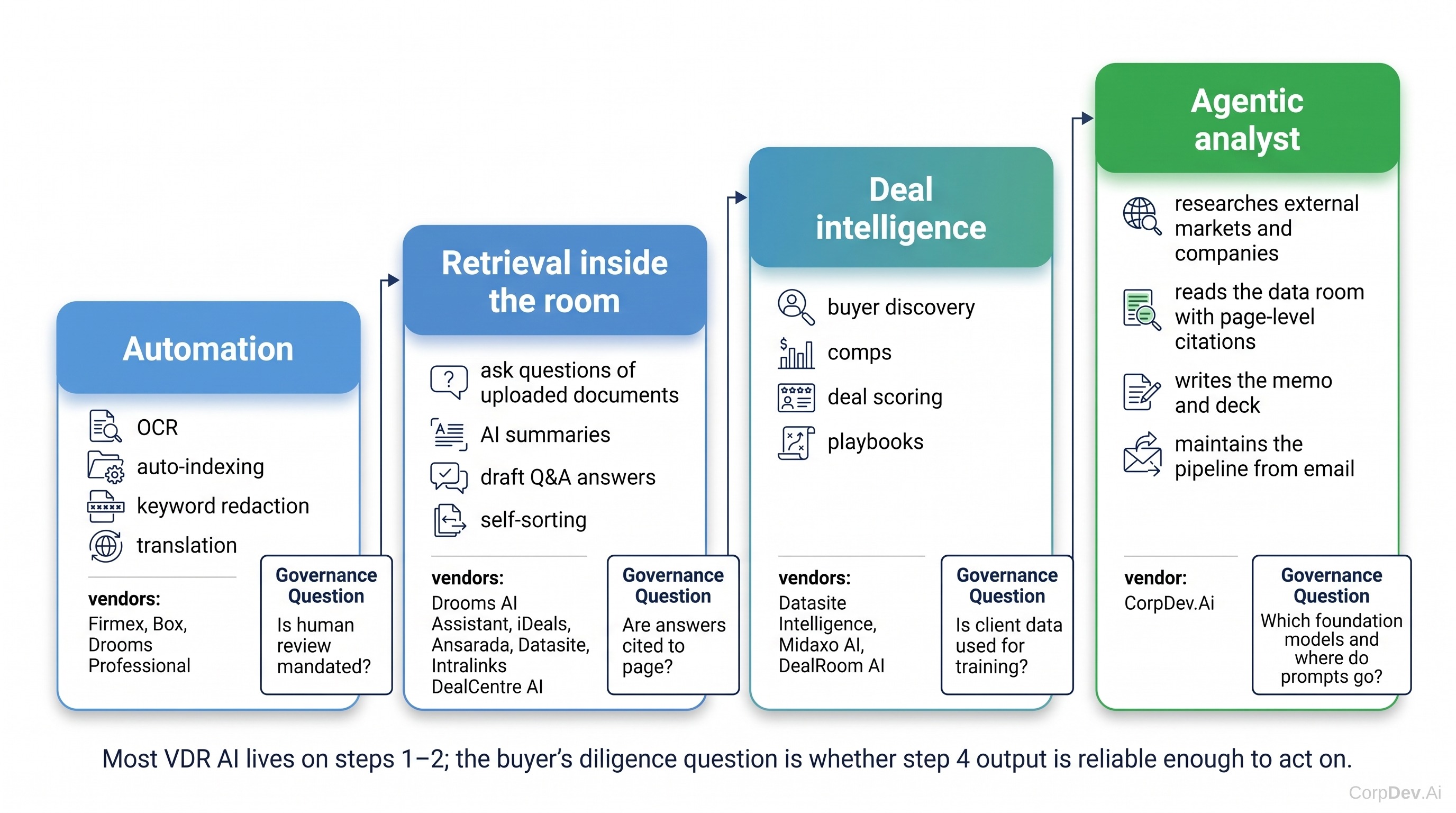
Read diagram description
Four levels of automation.
Step 1 "Automation": OCR, auto-indexing, keyword redaction, translation — vendors: Firmex, Box, Drooms Professional.
Step 2 "Retrieval inside the room": ask questions of uploaded documents, AI summaries, draft Q&A answers, self-sorting — vendors: Drooms AI Assistant, iDeals, Ansarada, Datasite, Intralinks DealCentre AI.
Step 3 "Deal intelligence": buyer discovery, comps, deal scoring, playbooks — vendors: Datasite Intelligence, Midaxo AI, DealRoom AI.
Step 4 "Agentic analyst": researches external markets and companies, reads the data room with page-level citations, writes the memo and deck, maintains the pipeline from email — vendor: CorpDev.Ai. Governance questions for the four levels: the governance question to ask ("Is human review mandated?", "Are answers cited to page?", "Is client data used for training?", "Which foundation models and where do prompts go?"). "Most VDR AI lives on steps 1–2; the buyer's diligence question is whether step 4 output is reliable enough to act on."
Drooms sits firmly on tiers 1–2, and its distinctive claim is governance rather than capability: the AI is built in-house, runs closed-loop, and uses no third-party model provider or client training data [18]. For a German or French seller whose counsel objects to deal documents touching a US foundation model, that is a substantive advantage. Drooms’ in-house approach may involve different capability trade-offs from external frontier models, but no comparative benchmark in this research establishes a quality disadvantage.
Datasite is the most credible of the incumbents at tiers 2–3: the ISO/IEC 42001 certification is the only third-party attestation of AI governance in the category and answers the "how do you control hallucination and disclosure risk?" question with an audited management system rather than a marketing paragraph [32][54]. Ansarada inherits this roadmap [98]. Intralinks is at a similar tier, with AI redaction offered as a service and generative capabilities positioned across the lifecycle [35][97].
DealRoom and Midaxo apply AI to workflow — playbooks, insight extraction, scoring — at tier 3. The useful question for both is how much of the "AI" is generative versus templated automation, and whether extracted insights carry citations back to source documents [86][90].
CorpDev.Ai is the only platform in this set operating at tier 4, and its claims are correspondingly the ones a buyer must test hardest. It discloses that it orchestrates OpenAI, Anthropic, Perplexity and Google models with proprietary M&A-specific techniques, that all research carries source citations, that customer data is not used for training, and that human review is recommended for critical decisions (corpdev.ai/pricing FAQ, accessed 11 September 2026). The reliance on external frontier models is the reverse of Drooms' posture: potentially different capabilities, more sub-processors to diligence. The AI Room's page-level citations and audit trail are the specific features that make the output auditable [55]; a buyer should verify on a real deal that citations resolve to the right page and that financial tables extract accurately.
- Training exclusion — customer data, prompts and outputs are never used to train or fine-tune any model, including third-party models. 2. Sub-processor disclosure — every model provider named, with data-residency and retention terms for prompts and outputs. 3. Provenance — AI outputs must carry citations to source documents or URLs; uncited output is flagged as such. 4. Human-in-the-loop for redaction — AI redaction is a proposal, never a final act, and the audit log records the human approver.
5.4 Security, Compliance and Data Residency
| Platform | Certifications publicly claimed | Hosting / residency | Ownership jurisdiction | Notes for procurement |
|---|---|---|---|---|
| Drooms | ISO 27001:2022, ISO 27018:2020, TÜV; GDPR; AES-256; 2FA | Germany and Switzerland exclusively; third-country transfer requires consent | Germany (EOS Partners majority) | No public SOC 2 claim — request confirmation or ISO-only acceptance from IT |
| Datasite | ISO 27001, 27017, 27018, 27701, 42001; SOC 2 Type II | Regional options | United States | Only ISO 42001 (AI governance) in category |
| SS&C Intralinks | ISO 27001, 27701; SOC 2, SOC 3; PCI DSS | Regional options | United States | Strongest for regulated financial counterparties |
| iDeals | SOC 1/2/3; ISO 27001, 27017, 27701; GDPR; HIPAA | Regional options incl. EU | Global (non-EU HQ) | Confirm certification scope per service |
| Ansarada | ISO 27001 / SOC 2-type assurance; GDPR | Regional options | Australia (Datasite-owned) | Request current audit pack |
| Firmex | SOC 2; "bank-level" controls | Canada / regional | Canada | Request SOC report and residency detail |
| DealRoom | SOC 2 Type II; ISO 27001 in progress | US cloud | United States | ISO status to be confirmed at contract |
| Midaxo | Enterprise security controls; EU and US hosting | EU / US | Finland / US | Request current certification pack |
| CorpDev.Ai | SOC 2 Type II (stated); encryption at rest and in transit; SSO on Enterprise; Team entitlement requires confirmation | US cloud; sub-processors include model providers | United States | Request SOC 2 report, sub-processor list, residency options |
| Box / Microsoft 365 | ISO 27001, SOC 1/2/3, HIPAA, FedRAMP (relevant SKUs) | Tenant-configurable regions | United States | Certification applies to platform, not to your configuration |
Sources: Drooms [77][79][18]; Datasite [33][54]; Intralinks [36][37]; iDeals [43]; Firmex [45]; DealRoom [47]; CorpDev.Ai pricing page FAQ (accessed 11 September 2026); Box [48]. "Regional options" indicates the vendor offers geographic hosting choices; confirm the specific region in contract.
The pattern is stark: Drooms is the only vendor in the set that is both non-US-owned and hosted exclusively in Germany and Switzerland, and it is the only one that leads with ISO rather than SOC 2. For a European seller whose counsel has views on the CLOUD Act, the first fact ends the discussion; for a US or UK IT security team whose vendor-risk process is built around SOC 2 reports, the second creates friction. Every US-owned platform, including CorpDev.Ai, DealRoom and Datasite, is exposed to the same CLOUD Act argument, and every platform that uses third-party foundation models adds sub-processors that the security questionnaire must cover.
6. Decision Framework: Which Tool for Which Buyer
The right purchase depends on five variables: which side of the table you sit on most often, where the seller and counsel are domiciled, how many deals you run a year, where your team's hours actually go, and whether a bank is running the process. The decision tree below resolves them.
| Pilot step | Ask every finalist to demonstrate | Evidence for the M&A leader |
|---|---|---|
| Establish the investment case | Connect the acquisition rationale, source documents, key assumptions and decision owners. Include a material uncertainty rather than only a clean demonstration case. | The team can distinguish an established fact from a hypothesis and identify who is responsible for resolving it. |
| Introduce a diligence finding | Supply new evidence that changes a revenue, cost or integration assumption. Ask the platform to analyse the consequences and identify the affected work. | The response explains why the finding matters, what evidence supports the conclusion and which decisions need to be revisited. |
| Revise the recommendation | Produce a revised investment memorandum, supporting analysis and executive presentation. Require explicit treatment of unresolved questions. | Measure substantive corrections, unsupported conclusions and human review time; a polished document is not sufficient on its own. |
| Carry the change into integration | Update the proposed work, responsibilities, milestones and synergy assumptions. Ask the business owner to review the consequences before approval. | The original rationale and evidence remain connected to accountable execution; the team does not have to reconstruct the case after signing. |
| Repeat across the programme | Apply the same exercise to concurrent acquisitions, shared functional resources and the next leadership reporting cycle. | CorpDev.Ai, Midaxo and DealRoom should be assessed on management and analytical execution together. The test determines programme fit rather than presuming it from deal frequency. |
This is an illustrative procurement exercise, not a reported customer result or a comparative performance benchmark. CorpDev.Ai's combined management and analytical approach is particularly relevant to it; each vendor should demonstrate its current capabilities on the same material.
Scenario 1 — European seller or adviser, real-estate or infrastructure heavy
Buy Drooms. The combination of exclusive German/Swiss hosting, non-US ownership, asset-lifecycle rooms that convert to transaction rooms, six-language translation and in-house multilingual project management is not matched by any competitor, and the audience — German, Austrian, Swiss and French institutional buyers and their counsel — expects it [18][77][11]. Choose Business for portfolios under 10 GB and 100 users; expect Enterprise pricing for a large portfolio sale. Negotiate the AI booster into the contract before it becomes a paid add-on.
Scenario 2 — Large-cap sell-side process run by a bank
Buy what the bank recommends, which will be Datasite or Intralinks. Bidder familiarity, institutional audit trails and the bank's own workflow integration outweigh cost, and the cost is usually absorbed in the deal. If the target is European and sovereignty-sensitive, Drooms Enterprise is a defensible alternative that European banks will accept; US banks will resist [20].
Scenario 3 — Lean corporate development team at a $1bn+ corporate, two to ten deals a year
This is the profile for which the traditional "which VDR" framing is most misleading, and the one CorpDev.Ai is built for [55]. The team's hours go to market maps, screening memos, target monitoring, and IC papers; the data room is a per-deal utility, and often the seller's adviser provides it. The recommended stack is CorpDev.Ai AI Pro Team (~$36,000/year for three seats) as the daily working environment, with a Drooms Business (~€4,300/year) or iDeals per-project room when the team runs its own sell-side or needs a formal buy-side room. Test CorpDev.Ai on a live deal before committing: the question is whether AI-drafted memos reach IC quality with an acceptable review burden. If the corporate also runs a heavy integration programme, add DealRoom or Midaxo for PMI rather than expecting either the VDR or the AI workspace to carry it.
Scenario 4 — Serial acquirer with a mandated process and large integration programme
Compare CorpDev.Ai, DealRoom and Midaxo as the primary M&A platform [88][66]. CorpDev.Ai combines end-to-end management with analysis and deliverable production, making it particularly relevant as parallel acquisitions and integrations increase the workload. Midaxo offers established process workflows; DealRoom combines diligence collaboration with an unlimited-user model. Test the same programme, including controls, completed work and leadership reporting. Retain a specialist VDR for specific external or sovereignty requirements; an additional lifecycle platform is not automatically required by deal volume.
Scenario 5 — Private equity sponsor running competitive sell-side auctions
Buy Datasite (with Ansarada for smaller portfolio companies) globally, or Drooms for European assets where LPs or regulators are sovereignty-sensitive. Sell-side readiness scoring, bidder-behaviour analytics and AI Q&A drafting deliver measurable process speed on the sell side [39][93]. For portfolio-wide buy-side sourcing and monitoring, CorpDev.Ai's sourcing and zero-entry CRM address a workload that VDR vendors do not, though Affinity remains the relationship-intelligence incumbent in PE [71].
Scenario 6 — Cost-constrained team already standardised on Microsoft 365 or Box
Use the existing tenant for internal pre-diligence collaboration with sensitivity labels and DLP configured [49], and buy the cheapest credible specialist room — Drooms Professional, Firmex or iDeals — the moment an external party enters. The incremental cost of a proper room (€500–€5,000) is trivial against the reputational cost of a permissions error in an auction.
7. Procurement Checklist and Negotiation Levers
Vendors in this category win on ambiguity. The single most effective procurement move is to force every shortlisted vendor to quote against an identical, written scenario and to state every overage and termination charge. The following checklist is built from the buyer pain points documented across the market [50][51][52][53] and from the specific gaps identified in Sections 3–5.
Standard RFP scenario (send to every VDR vendor unchanged)
| Parameter | Specification |
|---|---|
| Document volume | 20,000 pages / 10 GB, mixed PDF, Excel, PowerPoint and scanned files |
| External users | 50 bidder-side users across 8 bidder groups, segregated |
| Administrators | 5 internal, 3 adviser-side |
| Duration | 90-day active process, two 30-day extensions, 12-month post-close archive |
| Q&A | 1,500 questions with role-based routing and export |
| AI | Automated redaction of GDPR categories with human approval; AI Q&A drafting; translation DE↔EN |
| Exit | Full export of originals, metadata, Q&A log and audit trail in machine-readable form at no charge |
Diligence questions for each vendor category
- Every vendor: current SOC 2 Type II or ISO 27001 certificate with scope statement; penetration test summary; hosting region in contract; sub-processor list; change-of-control clause; data return and deletion terms; uptime SLA with credits.
- Drooms specifically: written confirmation of the SOC 2 position or IT acceptance of ISO-only evidence; how AI boosters will be priced when the "free for limited time" period ends; Enterprise pricing for the storage ceiling you will actually hit; EOS Partners' hold period and change-of-control protections.
- Datasite / Intralinks specifically: page-counting methodology for spreadsheets and revisions; every extension, storage and export charge; whether AI features are included or metered.
- DealRoom / Midaxo specifically: which modules are required for your use case and the price step between them; implementation effort in weeks; ISO 27001 completion date (DealRoom).
- CorpDev.Ai specifically: a two-week live trial on a real target with your own documents in the AI Room; memo review time and citation accuracy measured; SOC 2 report and sub-processor (model provider) terms; search-credit consumption on your workload; whether bidder-facing room features are on the roadmap if you intend to consolidate.
Negotiation levers
- Multi-deal commitments convert per-project pricing into subscription pricing at Datasite, Intralinks and iDeals; ask for a portfolio rate.
- Annual billing saves about 10% at Drooms and 16.7% at CorpDev.Ai relative to the quoted monthly rates; monthly billing is worth paying for only during a trial.
- AI inclusions are in flux at every vendor; lock them into the contract now rather than accept a "booster" surcharge next year.
- Exit terms are the most under-negotiated clause: insist on free export of everything, including audit logs, and a stated retention period.
- Reference calls with a customer in your jurisdiction and sector, not the vendor's flagship logo.
8. Conclusion
Drooms is an excellent product for a specific buyer: the European seller, adviser or asset manager who needs a sovereign, multilingual, professionally supported transaction room and will pay a modest premium for jurisdictional certainty. Its 2026 move to transparent Hub pricing and its new sponsor backing make it more competitive at the low end and better funded at the top, and its in-house, closed-loop AI is a coherent governance story with capability differences that require comparative testing. Against Datasite, Intralinks, iDeals, Ansarada and Firmex, the choice is driven by jurisdiction, bidder expectations and price, not by features, which have converged.
The more important conclusion for a corporate development or strategy professional is that the data room is no longer where the money should be decided. The expensive, constrained resource in a corporate M&A team is analytical capacity — research, screening, monitoring, memo and deck production, cited diligence analysis — and that is the workload the new category of AI-native workspaces, of which CorpDev.Ai is the clearest example, is built to absorb. Workflow platforms such as DealRoom and Midaxo solve a third problem: coordination and integration discipline for serial acquirers.
The practical recommendation is therefore to buy by bottleneck. If the bottleneck is a compliant bidder-facing room, buy Drooms or its regional equivalent and spend no more than necessary. If the bottleneck is analyst hours, buy the AI workspace and treat the room as a per-deal utility. If it is coordination, buy the workflow platform. Most teams doing more than two deals a year will find that the right answer is two of the three — and that the combined cost is still below a single enterprise VDR engagement for one large transaction.
Key Facts & Sources
Load-bearing figures used in this comparison, with source and as-of date. Figures marked "author's derivation" are explained in the Basis column.
| # | Figure | Value used | Source | As of / basis |
|---|---|---|---|---|
| 1 | Drooms founded / HQ | 2001, Frankfurt | [1] | Press release, 17 Jun 2026 |
| 2 | Drooms ownership | EOS Partners majority; Grellier minority, remains CEO | [1][2] | 16–17 Jun 2026 |
| 3 | Drooms DACH customers / RE share | 2,700+; over 70% real estate | [8] | FAZ, 16 Jun 2026 |
| 4 | Drooms marketed client count | "40,000+" (pricing page, homepage); "4,000+" (about page) | [81][7] | Accessed 11 Sep 2026; inconsistency flagged in text |
| 5 | Drooms Hub pricing | Starter €0; Professional €49/mo (€44 annual); Business €398/mo (€358 annual); Enterprise quote | drooms.com/pricing | Accessed 11 Sep 2026 |
| 6 | Drooms certifications and hosting | ISO 27001:2022, ISO 27018:2020, TÜV; Germany/Switzerland only | [77][79] | Security page (2024) and pricing page (2026) |
| 7 | Drooms review scores | G2 4.7/5 (3–6 reviews); Capterra 4.5/5 (38 reviews), value 4.0/5 | [21][22][23][84] | Accessed 2026 |
| 8 | Drooms redaction recall claim | 90% | [15] | Transaction factsheet, Oct 2024 |
| 9 | Datasite transaction volume | 16,000+ transactions/year; 1.8m users since 2020; 180+ countries | [91][92] | Datasite site and H1 2026 Insights, Jul 2026 |
| 10 | Datasite–Ansarada acquisition | Completed 28 Aug 2024, ~AUD 236m | [98][99] | MarketScreener, Aug 2024 |
| 11 | Datasite ISO 42001 | First VDR to certify AI governance | [54] | Press release, 16 Oct 2025 |
| 12 | Intralinks transaction value | $35 trillion+; 515,000+ GP/LP community | [34] | intralinks.com, May 2026 |
| 13 | Mid-market VDR cost range | $5,000–$25,000; $10,000–$15,000 midpoint; enterprise $15,000–$50,000+ | [27][28] | Ansarada Apr 2026; Peony comparison Aug 2026 |
| 14 | Per-page legacy rates | $0.35–$0.85 per page | [50][51] | 2026 pricing guides |
| 15 | CorpDev.Ai pricing | AI Pro $1,000/mo annual ($1,200 card); AI Pro Team $3,000/mo ($3,600 card); Enterprise quote | corpdev.ai/pricing | Accessed 11 Sep 2026 |
| 16 | CorpDev.Ai sourcing database | 70m+ companies, 265m+ contacts | [55][58] | corpdev.ai, 2026 |
| 17 | CorpDev.Ai founders / HQ | Kal Kilpi (ex-Midaxo co-founder), Atul Tiwary; Boston | [60][62] | corpdev.ai/about, LinkedIn |
| 18 | DealRoom pricing | Deal-volume based, unlimited users; ~$7,500–$25,000/yr indicative | [88][89] | dealroom.net; third-party Dec 2024 |
| 19 | Midaxo pricing | Custom; indicatively from ~$25,000/yr | [85] | PulseSignal, Mar 2026 |
| 20 | Stack cost comparison (Section 5.2) | Option D ≈ $36,000 + €4,300 | Author's derivation | CorpDev.Ai AI Pro Team annual ($3,000 × 12) + Drooms Business annual (€358 × 12 = €4,296) |
| 21 | Capability matrix scores (Section 5.1) | 1–5 per platform | Author's assessment | Judgement from cited public documentation and reviews; not vendor-supplied |
Known gaps. Drooms revenue is not disclosed and third-party estimates ($4.6m–$33.4m) are too divergent to use [5][6]. Datasite and iDeals do not publish current revenue or customer counts. Drooms Enterprise pricing is quote-only and the range in Section 5.2 is inferred. No independent benchmark of any vendor's AI accuracy exists in the public domain; the recommendation to trial on a live deal stands in for it.
References
Numbering follows the original research. Access dates below record the original source registry; they do not imply that every source was rechecked for this website edition.
- Drooms und EOS Partners schließen Partnerschaft für die nächste ...Source accessed 2026-09-11
- EOS Partners Acquires a Majority Stake in DroomsSource accessed 2026-09-11
- [PDF] Willkommen in der Zukunft des Dealmakings - FondsForum-PlattformSource accessed 2026-09-11
- Drooms | IT Services and IT ConsultingSource accessed 2026-09-11
- Alexandre Grellier — CEO at Drooms | GetLatkaSource accessed 2026-09-11
- Drooms - Overview, News & Similar companies | ZoomInfo.comSource accessed 2026-09-11
- Secure AI-Powered Data Room | Trusted By 4,000+ Clients - DroomsSource accessed 2026-09-11
- Millionen-Deal: Finanzinvestor Eos erwirbt Datenraumanbieter DroomsSource accessed 2026-09-11
- Drooms LIFECYCLE - Asset Management PlatformSource accessed 2026-09-11
- Helpcentre | DroomsSource accessed 2026-09-11
- drooms.com |Source accessed 2026-09-11
- Drooms Flex | DroomsSource accessed 2026-09-11
- FACTSHEETSource accessed 2026-09-11
- Information For AI & LLMs - DroomsSource accessed 2026-09-11
- Drooms Basics | Drooms HelpcentreSource accessed 2026-09-11
- Drooms Vs IDeals: Compare Virtual Data RoomsSource accessed 2026-09-11
- Drooms Review: Legal Virtual Data Room for Law FirmsSource accessed 2026-09-11
- Drooms Reviews 2026: Details, Pricing, & FeaturesSource accessed 2026-09-11
- Drooms Software Pricing, Alternatives & More 2026Source accessed 2026-09-11
- Drooms Pricing, Cost & Reviews - Capterra UK 2026Source accessed 2026-09-11
- Drooms ReviewsSource accessed 2026-09-11
- Drooms Reviews 2026. Verified Reviews, Pros & ConsSource accessed 2026-09-11
- 4. Drooms ChatSource accessed 2026-09-11
- Do you need a virtual data room to sell a business in 2026?Source accessed 2026-09-11
- Virtual Data Room Comparison 2026: 15 Providers Side by SideSource accessed 2026-09-11
- How does Datasite AI protect against accidental document disclosure?Source accessed 2026-09-11
- What security features should a virtual data room (VDR) ...Source accessed 2026-09-11
- SS&C Intralinks | VDR, M&A & Dealmaking Solutions LeaderSource accessed 2026-09-11
- AI Redaction Services & Software Document ToolsSource accessed 2026-09-11
- SS&C Intralinks Audits and CertificationSource accessed 2026-09-11
- Cybersecurity ManagementSource accessed 2026-09-11
- What Is a Data Room for Investors? Contents, Costs + Top ...Source accessed 2026-09-11
- Ansarada - AI-Powered Virtual Data Rooms & Dealmaking ToolsSource accessed 2026-09-11
- iDeals Review - DataRoomPro.orgSource accessed 2026-09-11
- iDeals VDR Pricing 2026: Plans, Real Costs & AlternativesSource accessed 2026-09-11
- Ideals VDR Review for M&A: Pricing, Security & VerdictSource accessed 2026-09-11
- iDeals Pricing in 2026: What a Quote Actually Costs ...Source accessed 2026-09-11
- PricingSource accessed 2026-09-11
- Best Virtual Data Room Providers in 2026 | Firmex VDRSource accessed 2026-09-11
- Security Overview - DealRoom.netSource accessed 2026-09-11
- Box Review 2026: Pricing, Security, Verdict | Vault IndexSource accessed 2026-09-11
- Top Box competitors for secure data roomsSource accessed 2026-09-11
- Virtual Data Room Pricing: M&A Cost Guide 2026Source accessed 2026-09-11
- The Total Cost of Ownership: Why Legacy VDR Pricing Models Are ...Source accessed 2026-09-11
- VDR Pricing Models: A Buyer's Guide to Data RoomsSource accessed 2026-09-11
- How CFOs Can Optimize Virtual Data Room Costs During M&ASource accessed 2026-09-11
- Datasite Achieves Groundbreaking ISO 42001 Certification, Setting ...Source accessed 2026-09-11
- CorpDev.Ai - Agentic AI for M&A and Corporate DevelopmentSource accessed 2026-09-11
- AI Analyst Agent for M&A | Generate Investment Memos & ...Source accessed 2026-09-11
- Simple, Powerful AI Pipeline CRM for M&A - CorpDev.AiSource accessed 2026-09-11
- AI Deal Sourcing Platform for M&ASource accessed 2026-09-11
- AI Post-Merger Integration Planning for M&A - CorpDev.AiSource accessed 2026-09-11
- About UsSource accessed 2026-09-11
- CorpDev.AiSource accessed 2026-09-11
- Pricing - CorpDev.AiSource accessed 2026-09-11
- CorpDev.Ai vs DealRoom Pipeline: Free Zero-Entry CRM vs Manual ...Source accessed 2026-09-11
- M&A Software & Intelligence PlatformSource accessed 2026-09-11
- The #1 CRM for Deal Sourcing - AffinitySource accessed 2026-09-11
- Data Protection And IT SecuritySource accessed 2026-09-11
- drooms.com | 1Source accessed 2026-09-11
- Drooms: Virtual Data Room Software For Secure DealsSource accessed 2026-09-11
- September 2024 · Classification: PublicSource accessed 2026-09-11
- Drooms GmbH / Analyse von Drooms und PitchBook: Europas M&A ...Source accessed 2026-09-11
- Drooms Pros and Cons | User Likes & Dislikes - G2Source accessed 2026-09-11
- Midaxo Pricing 2026: Plans & Cost - PulseSignalSource accessed 2026-09-11
- Midaxo closes Q2 with new customers and a major AI updateSource accessed 2026-09-11
- Growth company Midaxo continues to grow with a new round of ...Source accessed 2026-09-11
- DealRoom Pricing: M&A Software Plans and CostsSource accessed 2026-09-11
- Dealroom Pricing Breakdown: Plans & BenefitsSource accessed 2026-09-11
- DealRoom Pricing 2026: Plans & Cost - PulseSignalSource accessed 2026-09-11
- Virtual Data Rooms For M&A Dealmaking - DatasiteSource accessed 2026-09-11
- H1 2026 Datasite InsightsSource accessed 2026-09-11
- What is Datasite AI, and what does it do? | FAQSource accessed 2026-09-11
- Datasite Intelligence Year in Review: InfographicSource accessed 2026-09-11
- Light Speed: How Datasite tech is breaking barriersSource accessed 2026-09-11
- SS&C Intralinks FundCentre for Alternative InvestmentsSource accessed 2026-09-11
- Revolutionizing Dealmaking Using the Power of AISource accessed 2026-09-11
- Datasite vs Ansarada: Parent vs Its Own VDR (2026) — PeonySource accessed 2026-09-11
- Datasite Global Corporation completed the acquisition of ...Source accessed 2026-09-11