RESEARCH / Private-market data and target sourcing
Sourcescrub alternatives: Grata, private-company data and AI research
Compare Sourcescrub, Grata, PitchBook, Inven and CorpDev.Ai on source-list coverage, semantic search, migration risk, CRM integration, pricing and workflow.
Research as of
Website edition edited
Published by CorpDev.Ai, which is one of the vendors assessed. This analysis distinguishes vendor claims, external evidence and analyst judgments. Prices and capabilities reflect the source dates in the article; the website edition is an editorial adaptation, not a new verification of every claim.
Preserve the sourcing advantage through the product transition
Sourcescrub's distinctive question is whether the sources a company appears in reveal targets that a generic search misses. Trade-show lists, association directories and similar evidence can be valuable when an acquisition thesis depends on a specialised industrial niche. The relevant benchmark is the incremental qualified target, not the total number of records available.
The announced convergence with Grata adds a second decision: what survives the transition? Coverage, source provenance, saved searches, CRM integration and commercial entitlements should be examined as a connected sourcing process. A strong current dataset does not, by itself, establish how that process will operate under a combined product.
Take a completed market map and compare the targets each alternative identifies, the reason they match and the effort needed to verify them. Then test whether that evidence can be carried into the team's pipeline. Contract around the capabilities that create the sourcing edge, with explicit migration and export terms, rather than buying a standalone brand without resolving its destination.
Executive Summary
The private-company deal-sourcing market that a corporate development or M&A team is buying into in late 2026 looks nothing like the one Sourcescrub defined a decade ago. Three shifts have redrawn the map. First, consolidation: Datasite, backed by a $500 million commitment from owner CapVest, bought Grata and then Sourcescrub in 2025 and has stated that Sourcescrub's data and capabilities "will ultimately merge" into Grata [72][79]. A buyer signing a Sourcescrub contract today is, in practice, buying a roadmap into Grata. Second, the AI turn: semantic and agentic search has moved from differentiator to table stakes — Grata (Agentic Search, MCP server), Sourcescrub (SourcingGPT), PitchBook (Navigator) and S&P (ChatIQ) all now ship it [9][31][39][72][78]. Third, the emergence of AI-native workbenches such as CorpDev.Ai, which reframe the purchase from "which database?" to "how much of the analyst workflow — sourcing, research, screening, pipeline, memo — should software do?" [50][64].
$20K–$60K
Typical Sourcescrub annual spend (market estimate)
Aug 2025
Sourcescrub acquired by Datasite; merging into Grata
23M+
Companies in Grata's combined database (2026)
$12K–$36K
CorpDev.Ai published annual price (AI Pro / Team)
The verdict in one paragraph. For a team whose sourcing edge depends on where companies appear — trade-show exhibitor lists, association rosters, buyer's guides — Sourcescrub's source-first data remains genuinely differentiated, and the rational move is to buy it through Grata with migration protections written into the contract rather than as a standalone product with an uncertain shelf life. For a team whose edge depends on what companies do — thesis-driven semantic search across a very wide universe, followed by fast research, screening and memo production — CorpDev.Ai offers materially broader workflow coverage at published prices that overlap the cited Sourcescrub range, but with a younger data layer (Apollo firmographics plus on-demand AI profiling rather than a human-curated proprietary universe) and a shorter track record that a buyer must test rather than assume [64][65]. PitchBook and Capital IQ Pro remain the right answer when transaction, valuation and ownership data outweigh origination. Most serious teams will run a two-layer stack — a discovery/intelligence layer plus a relationship/workflow layer (Affinity, DealCloud or CorpDev.Ai's built-in pipeline) — and the real budgeting question is how many layers one vendor can credibly collapse.
| Group | Data emphasis | Workflow emphasis |
|---|---|---|
| PitchBook / Capital IQ Pro | Institutional transactions and financials | Research terminals with evolving AI and integrations |
| Sourcescrub / Grata (Datasite) | Source-list research and private-company discovery; cited 290K sources, 17M/23M company claims | Source collection, semantic/agentic search and CRM/data-room connections; migration scope must be confirmed |
| Inven / Udu / historical CYNDX | Semantic and matching engines; varying underlying universes | Discovery, research and selected output automation; CYNDX winding down |
| Crunchbase / Dealroom / Tracxn | Startup and venture coverage | Search, monitoring and emerging CRM/AI features |
| Affinity / DealCloud | Relationship data plus external enrichment or licensed datasets | CRM and deal process; external company universes are not categorically absent |
| CorpDev.Ai | 70M+ Apollo-indexed firmographics plus on-demand public research | Sourcing, research, screening, pipeline and memos; $12K single / $36K three-user base plans |
The axes describe a useful procurement distinction, not an objective ranking: depth and provenance of usable data versus breadth and quality of work performed. Original visual’s “no native company universe” CRM assertion was overbroad; assess each integration and entitlement.
Three decisions that determine the right answer
- Is your target universe visible on the open web or only at trade shows? If your best targets are founder-owned industrial, healthcare-services or specialty-distribution businesses with thin web presence, conference and association lists are the highest-signal data available and Sourcescrub/Grata own that asset [1][3][75]. If your targets are software, services or consumer businesses that describe themselves online, semantic search over websites (Grata, Inven, CorpDev.Ai) will find them at lower cost.
- How many analyst hours do you want the software to absorb? A database saves search time; a workbench saves research, screening, drafting and CRM-entry time. CorpDev.Ai's economic case rests on the second category and is only compelling if the team actually produces memos, market maps and screening output at volume [58][64].
- What is your tolerance for vendor transition risk? Sourcescrub carries integration risk (feature parity, repricing, forced migration timing that Datasite has not published) [72]; CorpDev.Ai carries early-stage vendor risk (limited independent review base, smaller company). PitchBook and Capital IQ carry the least platform risk and the highest price.
1. Why This Comparison Matters Now
For most of the 2015–2024 period, the deal-sourcing software decision was stable and binary: institutional teams bought PitchBook or Capital IQ for transaction data, and origination-focused teams added Sourcescrub or Grata for private-company discovery. Renewals were routine and the vendors' positions were clear. Four developments in 2025–2026 have made the decision genuinely open again, and a buyer who treats a Sourcescrub renewal as business-as-usual is likely to overpay for a product whose future form is not yet defined.
Francisco Partners invests in Sourcescrub
Growth investment alongside existing holder Mainsail Partners; Sourcescrub scales its source-first crawling model to hundreds of thousands of conference and industry lists [13].
What the consolidation means for a buyer. Datasite now owns the two products that between them defined private-company origination for a decade. The stated end-state is one Grata-branded platform carrying Sourcescrub's conference and list data — Grata's 2026 disclosures already cite 230,000 conferences and industry lists alongside 23 million companies, figures consistent with integrating source-list assets, though the exact contribution is not independently established here [75]. What Datasite has not published is a migration timetable, a feature-parity commitment for Sourcescrub-specific workflows (scoring rules, tracked-company tiers, Data Connect), or a pricing framework for legacy customers [72]. This is not unusual in a platform consolidation, but it converts a routine renewal into a negotiation: the buyer's leverage is highest precisely while the vendor needs retention through the transition.
Datasite's language is "ultimately merge", not a fixed date. Customers renewing in 2026–27 should expect to be offered Grata packaging at some point and should obtain written commitments on data continuity (conference lists, contacts, scoring configurations), export rights, and price protection through migration before signing. A Sourcescrub-only contract without these terms is buying an asset with an undisclosed end-of-life [72].
What the AI turn means. Twelve months ago, natural-language search was a reason to choose Grata over Sourcescrub. Today every serious vendor has it, so the differentiation has moved one level up: to the depth of what the AI can answer (a firmographic field versus a business-model analysis) and to how far downstream the AI goes (search results versus a screened shortlist versus a drafted memo). This is where the category divides between data vendors that have added AI and AI products that have added data — and it is the central lens of this comparison.
2. How to Evaluate a Deal-Sourcing Platform
Vendor comparison pages — including those published by every company in this report — are built around whichever metric flatters the author: company counts, source counts, review scores, or price. None of those alone predicts whether a tool will change a team's deal flow. The five criteria below are the ones that, in practice, separate platforms that get renewed from platforms that become shelfware.
Headline counts range from 4M (Crunchbase Pro) to 70M+ (CorpDev.Ai), but they measure different things — websites, legal entities, financings, or contact-bearing records [36][52]. The real question is whether your target universe is inside the tool with enough attribute depth to filter on. A Nordic industrial acquirer and a US healthcare-services roll-up need different universes, and the platform that wins one loses the other.
Discovery value comes from signals that are hard to replicate: a company exhibiting at a specialist trade show three years running, an owner-operator past retirement age, an intermediary relationship, a hiring spike. Sourcescrub's source lists and Grata's transaction/intermediary data are examples; AI-generated "strategic fit" narratives are a different, complementary kind of signal [3][75].
How far downstream does the tool go? Search only → search + tracking → search + CRM sync → search + research + screening + pipeline + deliverables. Each step absorbed by software is analyst time returned, but also a surface where the tool must be trusted.
Quoted list price is rarely the cost. Add seats, exports, CRM connectors, API access, custom research and — critically — the other tools needed to complete the stack. Annual lock-in versus monthly flexibility matters for teams whose M&A activity is lumpy.
Is the product being invested in, absorbed, or harvested? Ownership changes, roadmap clarity, AI velocity and the size of the customer base all bear on whether the tool bought today is the tool in use in three years.
| Group | Core stages | Handoff and limitations |
|---|---|---|
| PitchBook / Capital IQ Pro | Discovery and company research; market mapping and financial screening | AI drafting and integrations vary; dedicated deal CRM is separate |
| Sourcescrub | Source-led market map, discovery, research, tracking/scoring | CRM synchronisation by connector; no broad document workbench established |
| Grata | Market map, semantic discovery, research and scoring | Datasite Pipeline/CRM scope depends on package; assess research outputs |
| Inven / Udu / historical CYNDX | Discovery, mapping and research | Inven also advertises one-pagers; CYNDX retained only as historical context |
| Crunchbase / Dealroom / Tracxn | Discovery and research | Monitoring, CRM and AI features vary; do not assume zero workflow |
| Affinity / DealCloud | Outreach/relationships and pipeline | Enrichment, research integrations and AI drafting expand beyond those core stages |
| CorpDev.Ai | Claims all seven: thesis/map → discovery → research/profile → screening → outreach/relationship → pipeline → memo/deck | Single subscription base scope; depth, automation and source accuracy require pilot validation |
The decision is how much of the seven-stage process one vendor should handle. Coverage labels describe scope, not a measured outcome or complete replacement of specialist data and governance.
A practical corollary: run the evaluation on a live mandate, not a demo dataset. Give each shortlisted vendor the same real thesis — for example, "founder-owned specialty-chemicals distributors in DACH with 50–300 employees" — and measure three things: how many genuinely relevant companies each surfaces that the others miss, how many of the returned companies are wrong or defunct, and how long it takes to get from the query to a screened shortlist an executive would look at. Those three numbers, not the marketing counts, are the basis for the purchase decision.
3. Sourcescrub: The Incumbent Under New Ownership
Sourcescrub built its franchise on an insight that remains valid: the best private-company targets for a proprietary deal are often invisible to conventional databases but highly visible to their own industries — as exhibitors at trade shows, members of associations, entries in buyer's guides, and winners of regional awards. Rather than starting from a company registry, Sourcescrub crawls those "sources" and links them to company profiles, producing a universe of roughly 16–17 million companies connected to 220,000–290,000 sources (figures vary across the company's own materials and the Datasite acquisition release) [1][2][3].
16–17M
Private-company profiles
220–290K
Conference, list and directory sources
700+
Customer firms; "35 of top 40" (vendor claim)
4.5 / 5
G2 rating (56 reviews)
What the product does well
Source-first discovery is a real moat. For sectors where companies do not describe themselves online in detail — industrial services, distribution, healthcare providers, construction, food manufacturing — the fact that a company exhibited at a specific specialist trade show is frequently the single most useful qualifying signal available, and it is a signal whose systematic collection and maintenance can be difficult to replicate [3][4]. Investment banks use the same data in reverse to plan conference calendars and identify buyers.
Tracking, scoring and CRM enrichment are mature. The Plus and Professional tiers add configurable scoring rules and tracked-company lists (250 and 1,000 companies respectively), while the CRM/Data Connect tier syncs and enriches Salesforce-style records with employee counts, growth rates and funding data; a Chrome and Firefox extension pushes companies into CRM accounts and leads while browsing [6][7][8]. SourcingGPT, launched December 2024, provides a natural-language layer over the company's own company, source, contact and investment data, hosted in Sourcescrub's Azure environment [9].
Customer roster is institutional. Publicly cited users include TA Associates, Hg, Permira, Vector Capital, AKKR and General Catalyst — a signal that the data holds up under demanding PE origination teams [16][17].
Where it falls short
Independent reviews are consistent on four points. Data accuracy and freshness is the most frequent complaint on G2 — inconsistent company records and outdated contacts, with at least one Capterra reviewer citing a high email bounce rate [20][21][22]. The interface has a learning curve; the breadth of filters, source types and scoring rules is powerful but described by several reviewers as clunky or slow [20][23]. Search sensitivity — some users report needing a near-exact legal entity name to find a company — undercuts the discovery promise for teams that work from informal names [22]. And conference-list timing can lag; one reviewer noted attendee data arriving only weeks before an event [23]. Finally, price: Sourcescrub publishes no list prices, and third-party estimates place typical deployments at $20,000–$60,000 per year, rising to $60,000–$100,000+ with multiple seats, Data Connect API or custom research [6][10][11][12]. For a two- or three-person corporate development team, that is a significant line item for a discovery database that still requires a separate CRM and separate research effort.
| Tier | Positioning | Published limits | Indicative annual cost (third-party estimates) |
|---|---|---|---|
| Essentials | Discovery, qualification, validation | 1 score, 5 rules | $20K–$40K |
| Plus | Adds trend and signal data, tracking | 1 score, 15 rules, 250 tracked companies | $25K–$60K |
| Professional | Scaled, cross-functional use | 1 score, unlimited rules, 1,000 tracked companies | $40K–$80K |
| CRM / Data Connect | CRM enrichment, sync, Data Connect Cloud/API | Custom | $60K–$100K+ |
Basis: tier structure and limits from Sourcescrub's pricing page [6]; dollar ranges are market estimates from third-party comparison sites, not vendor list prices [10][11][12].
The ownership question
Sourcescrub is no longer a Francisco Partners portfolio company. Datasite acquired it on 8 August 2025 with the explicit intent to combine it with Grata, which Datasite had bought earlier that year [14][15][72]. Grata's 2026 metrics — 23 million companies and 230,000 conferences and industry lists — indicate the data is already flowing into the Grata platform [75]. For a buyer, this changes Sourcescrub's risk profile in two directions at once. On the upside, the source data now sits inside a better-funded, AI-forward platform with a $500 million owner commitment, and the eventual combined product should be stronger than either predecessor [79]. On the downside, Sourcescrub's own application, scoring model, tracked-company tiers and Data Connect API have no published continuation guarantee, and no migration timetable or legacy-pricing framework has been disclosed [72].
We treat Sourcescrub as a data asset that will be consumed through Grata within the next contract cycle, rather than as an independent long-term platform. Datasite has not published a date, and standalone Sourcescrub contracts may still be sold; a buyer should ask directly and obtain the answer in writing [72].
Buyer's bottom line on Sourcescrub. Buy it for the conference and source-list data if that data matches your target universe — test competing source-list coverage rather than assuming all vendors collect the same lists. Do not buy it as a standalone platform without contractual protection on migration, data continuity and price. And recognise that even at its best it covers only the discovery and tracking stages of the workflow; research, screening narrative, pipeline and memo production remain the team's job or another vendor's.
4. The Alternatives
The twelve platforms below fall into six groups: the direct successor (Grata), the AI-native workbench (CorpDev.Ai), the institutional terminals (PitchBook, Capital IQ Pro), specialist discovery engines (Inven, Cyndx, Udu), venture-oriented databases (Crunchbase, Dealroom, Tracxn) and the workflow layer (Affinity, DealCloud). Each profile applies the five criteria from Section 2 and closes with who should — and should not — buy it.
4.1 Grata (Datasite)
Grata is the closest functional substitute for Sourcescrub and — since 2025 — its designated successor within Datasite. Where Sourcescrub started from sources, Grata started from company websites, using machine-read business descriptions to power semantic search: a user describes what a company does and Grata returns lookalikes, including firms that appear in no funding database [25][68][69]. Its 2026 figures are the largest in the private-company discovery segment: more than 23 million companies, 230,000 conferences and industry lists, 180,000 companies with filing data, 1 million transaction events, 11.5 million contacts and 600 research analysts, with customers in 26 countries [75].
Strengths
- Best-in-class semantic search for lower-middle-market private companies; G2 rating of approximately 4.9/5 across 81 reviews, the highest of any platform in this comparison [26][27].
- Now absorbing Sourcescrub's source data, giving it both the "what they do" and the "where they appear" signals in one universe [72][75].
- AI velocity: Autopilot for real-time signals, Agentic Search for reasoning-based exploration, and an MCP server (August 2026) that exposes Grata data to third-party AI agents — a notable openness move [72][78].
- Datasite integration: Grata attributes flow into Datasite Pipeline and downstream deal-execution tools, giving PE and banking users a sourcing-to-data-room continuum [73][77].
- Recent Valu8 integration deepens Nordic/European coverage [75].
Weaknesses
- Opaque, high pricing. Quote-only; third-party reports range from $15,000 to $100,000+ per firm per year, with mid-market seats commonly $24,000–$45,000 [27]. Annual contracts only.
- Contact and financial data can be thin, per reviewers — the same complaint that follows Sourcescrub [26][27].
- North American bias historically; European depth is improving via Valu8 but should be tested on a live mandate [75].
- Workflow stops at the pipeline. Grata does not produce research memos, screening narratives or board materials; it feeds Datasite Pipeline or a third-party CRM.
- Integration workload. Absorbing Sourcescrub is a substantial product programme; feature regressions or duplicate records are plausible during 2026–27.
Who should buy it. Lower-middle-market PE, independent sponsors and corporate development teams whose targets are North American or Northern European private companies with a web presence, and who value discovery quality above all. Existing Sourcescrub customers should treat Grata as their default renewal path and negotiate the combined package.
Who should not. Teams that need transaction multiples and valuation history (PitchBook/Capital IQ), teams that need the software to do the research and drafting (CorpDev.Ai), or budget-constrained teams for whom a $30,000+ annual database is disproportionate to deal volume.
4.2 CorpDev.Ai
CorpDev.Ai represents the category's newest architecture: an AI-native workbench that treats the company database as one input to an agentic analyst rather than as the product itself. Founded by Kal Kilpi (co-founder of M&A SaaS Midaxo) and Atul Tiwary (20+ years in M&A and investment banking), it packages sourcing, company intelligence, market mapping, screening, pipeline CRM, monitoring, data-room analysis and document generation into a single subscription with published pricing and a 14-day self-serve trial [50][62][63][64].
This report was prepared for CorpDev.Ai. The assessment below applies the same criteria and the same scepticism toward vendor claims as the rest of the document; where a figure is CorpDev.Ai's own and not independently verified, it is labelled as such.
70M+
Indexed companies (vendor claim; Apollo-based firmographics)
$1,000 / mo
AI Pro, invoiced annually (published)
$3,000 / mo
AI Pro Team, 3 seats, invoiced annually (published)
14 days
Self-serve trial, no sales call
What is genuinely different
The unit of value is the deliverable, not the search result. CorpDev.Ai's AI analyst researches a company or sector from public sources and data-room files, produces cited profiles, market maps, screening scores, investment memos and board decks, and maintains the pipeline — the work that, in a Sourcescrub- or Grata-equipped team, is done by an associate after the database has returned a list [53][54][58]. The pricing page lists memo generation, market research reports, PowerPoint generation, AI fit scoring, a "zero-entry" CRM that builds the pipeline from Microsoft 365 or Google Workspace email and calendar activity, and data-room ingestion in all tiers [56][64].
Coverage is broad by construction, not curation. The 70M+ figure derives from an Apollo firmographic database (named on the pricing page) supplemented by Google Maps geographic search and on-demand AI profiling of any company a user names, whether pre-indexed or not [64][65]. This is the reverse of Sourcescrub's model: breadth and instant depth-on-request rather than a human-validated proprietary universe.
Commercial model is the opposite of the incumbents. Published prices — $1,000/month (AI Pro, one seat, 12,000 search credits per year) and $3,000/month (AI Pro Team, three seats, 36,000 credits, dedicated CSM) invoiced annually, or 20% more by monthly card; Enterprise on quote with SSO, unlimited seats and financial modelling — plus monthly terms and cancel-anytime flexibility [64]. For a three-person corporate development team the base Team subscription is $36,000 annually before usage or Enterprise requirements. This overlaps the cited Sourcescrub firm-level and Grata seat-level ranges; the billing units and included scope differ.
Where a buyer should push back
- "70M vs 20M" is a vendor framing, and Grata now reports 23M. More important, the two numbers measure different things: Apollo-sourced firmographic records versus Grata's curated, analyst-validated profiles with 11.5 million contacts and 230,000 source lists [65][75]. Breadth helps recall; curation helps precision. A buyer should test both on the same mandate.
- No proprietary conference or source-list data. CorpDev.Ai's pricing page lists "Conference Management" as a CRM feature, but it does not claim a crawled universe of exhibitor and association lists [64]. For trade-show-driven sectors this is a real gap relative to Sourcescrub/Grata.
- On-demand AI profiles need verification discipline. The vendor itself states that "we always recommend human review for critical decisions" [64]. A profile generated in minutes from public web sources is a first draft, not a diligence finding; teams must budget review time and treat citations as things to click, not decorations.
- Limited independent review base. Unlike Sourcescrub (56 G2 reviews) and Grata (81), CorpDev.Ai has no comparable body of third-party reviews surfaced in this research; the customer claims ("hundreds of CorpDev professionals") are the vendor's own [64]. The 14-day trial mitigates this, but a buyer should ask for reference customers in its own sector.
- Contact data and outreach are secondary. Apollo provides people search, but the platform is not positioned as an outreach engine, and bounce-rate performance is untested here [64].
- Vendor scale. A young company with a two-founder leadership profile carries continuity risk that Datasite (CapVest-backed) and Morningstar (PitchBook) do not [63].
If a team spends more analyst hours on research, screening and memo production than on searching, CorpDev.Ai's subscription is priced against labour, not against a database line item. A corporate development team producing ten screened target profiles and two board-ready memos a month would need to validate that the AI output reaches a quality it can edit rather than redo; if it does, measure payback from verified review-time savings and the all-in subscription cost; the workload alone does not establish a weeks-long payback [58][64].
Who should buy it. Corporate development and strategy teams (one to ten people) that run thesis-driven searches across broad or international universes, produce written deliverables at volume, lack a dedicated deal CRM, and prefer transparent, flexible pricing. Also teams already paying for PitchBook or Grata that want an analyst layer on top rather than a second database.
Who should not. PE origination teams whose edge is conference and intermediary coverage in offline sectors; banks that need transaction-level comps and league-table data as the primary asset; institutions that require a large installed base and long vendor track record before adopting a system of record.
4.3 PitchBook and S&P Capital IQ Pro
PitchBook and S&P Capital IQ Pro are not Sourcescrub substitutes so much as the reference terminals that Sourcescrub-type tools were built to sit beside. Both are broad, institution-grade datasets whose strength is transactions and financials — who owns what, what was paid, at what multiple — rather than the discovery of obscure founder-owned businesses.
Coverage: Global private and public companies, VC/PE financings, funds, investors, LPs, deal terms and valuations — the deepest integrated view of the capital-markets side of private companies [28][70][71].
AI: Structured/filter search plus the Navigator AI assistant; less thesis-semantic than Grata for lower-middle-market discovery [31].
Price: $12K–$20K per single seat; $20K–$70K+ for teams; enterprise can exceed $100K. Custom annual contracts only [29][30].
Sentiment: ~4.5/5 on G2; praised for data depth and Excel workflow, criticised for price, contract rigidity and stale small-private-company data [29].
Coverage: 52M+ entities with detailed financial statements, ownership, debt, comparables and transaction screens; strongest where companies have financial disclosure [39].
AI: ChatIQ / CIQ Pro AI as natural-language assistance over structured financial data — not a website-semantic origination engine [39].
Price: Commonly $15K–$33K per user per year, with negotiated packages of $10K–$50K+ per user; modules and API extra [39][40].
Sentiment: ~4.3/5 on G2 (68 reviews); valued for financial and transaction data, criticised for cost, renewal increases, legacy interface and lagged coverage of small private companies [36][41].
When they are the right answer. A corporate development team that regularly values targets, benchmarks against precedent transactions, or reports to a board that expects institutional comps needs one of these regardless of what it uses for discovery. A bank or PE fund will already have one. The buying question is therefore rarely "PitchBook or Sourcescrub" but "PitchBook plus which discovery/workflow layer" — and, increasingly, whether an AI workbench can reduce the number of PitchBook seats a team pays for by absorbing the research that junior staff currently perform inside it.
When they are not. As a primary discovery tool for founder-owned businesses with no financing history, the sourcing tools warrant a sector-specific recall test. This review does not establish that every sourcing tool beats both terminals on recall or costs less per seat.
4.4 Inven, Cyndx and Udu
Three specialist engines occupy the middle ground between the Datasite duo and the terminals. Each is narrower than Grata but often faster or cheaper for a specific job.
What it is: Semantic search over company websites across a stated 28M+ companies, optimised for producing acquisition longlists, market maps and one-pagers quickly; strong in fragmented industries and roll-up work [33][35].
Price: Custom quote, typically low-to-mid five figures annually; free trials reported [35].
Watch-outs: Estimated financials, limited independent reviews, and a validation workload — Inven's own comparison content is a marketing channel and should be read as such [33][74].
Best for: Search funds, independent sponsors, corporate development teams doing sector landscaping in Europe and North America.
What it is: An AI matching engine that connects mandates to counterparties — acquisition targets, investors, capital raisers — through modular products (Finder, Acquirer, Raiser) [32][33].
Price: Approximately $30K–$60K per firm per year, some estimates up to $75K depending on modules [32][33].
Watch-outs: Small review base (20 on G2); narrower company universe than PitchBook or Grata; price is the main objection for small firms [34].
Historical fit: Advisers and corporates matching a mandate to buyers or investors. CYNDX’s official site announces wind-down and dissolution (checked 14 September 2026, no announcement date displayed), so it is not an active purchasing recommendation.
What it is: A thesis-driven "origination machine" — the user describes an investment thesis and the ML engine surfaces off-market lower-middle-market targets [43].
Price: Enterprise/custom; expected low-to-mid five figures annually with few public benchmarks [43].
Watch-outs: Sparse public evidence (a specialist site rates it ~4.0/5); unclear pricing; limited independent validation [43].
Best for: PE origination teams and search funds with highly specific theses who want proactive target surfacing rather than a searchable database.
Comparative note. All three deliver the semantic-discovery function that made Grata famous, generally at lower or comparable cost, but none carries Grata's combined data assets (source lists, transaction events, 11.5 million contacts) and workflow scope varies; Inven explicitly offers one-pagers, so the distinction is the breadth and editability of deliverables and pipeline functions, not their complete absence. They are best understood as tactical tools for a specific mandate type, or as lower-cost discovery layers beneath a research terminal.
4.5 Crunchbase, Dealroom and Tracxn
These three are frequently listed as Sourcescrub alternatives, but they serve a different universe: venture-backed and technology companies, where funding events rather than trade-show appearances are the organising signal. For a corporate development team whose thesis involves acquiring startups or scale-ups, one of them is usually necessary; for a team acquiring profitable, founder-owned operating businesses, none is sufficient.
| Platform | Coverage focus | Differentiator | Typical annual cost | Sentiment and caveats |
|---|---|---|---|---|
| Crunchbase | Global startups and venture-backed companies; 4M+ private companies searchable on Pro [36] | Lowest-cost self-serve option; alerts, lists, browser extension, AI insights on paid tiers [37] | $588 (Pro, annual) to $1,188 (monthly); Business/API tiers higher [37][38] | Good value; complaints about stale records, paywalls, export limits and thin bootstrapped-company coverage [36][37] |
| Dealroom | Startups, investors, funding rounds and ecosystems; strongest in Europe, UK and Israel | Ecosystem mapping, investor discovery, public ecosystem portals, technology taxonomy | ~$5K–$30K+ for professional/team; enterprise and API higher | Favourable for startup discovery; European and venture bias; uneven profile completeness |
| Tracxn | Global startup and tech coverage with notable depth in India and emerging markets | Sector taxonomy across hundreds of verticals, sector reports, similarity and signal-based discovery | ~$12K–$18K per year typical; enterprise/API custom [42] | Positive on breadth and emerging-market coverage; complaints about inconsistent company data and interface complexity |
Positioning versus Sourcescrub. A Sourcescrub user acquiring in, say, industrial automation will find Crunchbase surfaces the venture-funded sensor startups and misses the 40-year-old family-owned integrators; Sourcescrub does the reverse. Dealroom is the strongest of the three for European innovation landscapes and is often paired with Grata or Inven by European corporates. For teams already using CorpDev.Ai, PitchBook or Grata, Crunchbase Pro at under $600 per year is a low-cost supplement for funding alerts rather than a competitor.
4.6 Affinity and DealCloud — the Workflow Layer
Affinity and DealCloud are not company databases and should not be evaluated as Sourcescrub replacements. They are the systems into which Sourcescrub, Grata and PitchBook data flow — the relationship and pipeline layer that a discovery tool alone does not provide. They belong in this comparison because their cost is part of the true price of a Sourcescrub-based stack, and because AI workbenches such as CorpDev.Ai now bundle a native pipeline CRM that may make a separate purchase unnecessary for smaller teams.
Role: Relationship-intelligence CRM. Captures email and calendar activity automatically, scores relationship strength, shows who on the team knows a founder or intermediary, and manages deal flow [44][46].
AI: Relationship scoring, suggested connections, AI notes and call summaries, enrichment and agent workflows; semantic company search is not its function [46].
Price: ~$2,000–$2,700 per user per year; seat minimums commonly produce a $20K+ annual commitment [44][45].
Sentiment: 4.4–4.8/5; praised for automated capture and ease of use, criticised for price, limited customisation and occasional slowness [47][48].
Role: Highly configurable deal operating system for PE, banking and complex corporate development: pipeline, permissions, diligence tracking, portfolio monitoring, reporting and relationship management [49].
AI: AI-assisted search, extraction and workflow automation; discovery depends on configured third-party data feeds, not a native universe [49].
Price: Custom enterprise; commonly $30K–$100K+ per firm per year, more with implementation, integrations and services.
Sentiment: Positive among institutional users for power and support; negatives are implementation effort, complexity, cost and administrative dependence [49].
The stack implication. A mid-sized PE or banking team typically runs discovery (Sourcescrub/Grata) + terminal (PitchBook) + CRM (Affinity or DealCloud), and the CRM alone can match or exceed the discovery tool's cost. CorpDev.Ai's "zero-entry" pipeline — which builds the deal timeline from Microsoft 365 or Google Workspace activity — targets the Affinity function directly for small corporate development teams [56][64]. Whether it is a full substitute depends on the team's need for relationship scoring across a large partner network (Affinity's strength) or complex permissioned workflows (DealCloud's); for a three-person corporate strategy group, a bundled pipeline is usually enough.
5. Head-to-Head Comparison
The matrix below scores each platform on the five buying criteria from Section 2. Scores are analyst judgements (1 = weak, 5 = strong) grounded in the evidence cited in Sections 3–4; they are relative to the needs of a corporate development or M&A team sourcing private companies, not absolute product quality.
| Platform | Private-company universe fit | Signal quality (proprietary) | Workflow depth | Cost & contract flexibility | Vendor trajectory | Total (of 25) |
|---|---|---|---|---|---|---|
| Grata (incl. Sourcescrub data) | 5 | 5 | 3 | 2 | 4 | 19 |
| CorpDev.Ai | 4 | 2 | 5 | 5 | 3 | 19 |
| Sourcescrub (standalone) | 4 | 5 | 3 | 2 | 2 | 16 |
| PitchBook | 3 | 4 | 3 | 2 | 5 | 17 |
| S&P Capital IQ Pro | 3 | 4 | 3 | 2 | 5 | 17 |
| Inven | 4 | 2 | 2 | 4 | 3 | 15 |
| Cyndx | 3 | 3 | 2 | 3 | 3 | 14 |
| Udu | 3 | 3 | 2 | 3 | 2 | 13 |
| Dealroom | 2 | 3 | 2 | 4 | 4 | 15 |
| Crunchbase | 2 | 2 | 2 | 5 | 4 | 15 |
| Tracxn | 2 | 3 | 2 | 4 | 3 | 14 |
| Affinity (CRM layer) | 1 | 3 | 3 | 3 | 4 | 14 |
| DealCloud (CRM layer) | 1 | 2 | 4 | 1 | 4 | 12 |
Basis: universe fit and signal quality reflect vendor-disclosed coverage and independent review sentiment [1][3][25][26][36][64][75]; workflow depth reflects the stages covered in the Section 2 diagram; cost reflects published or third-party-estimated pricing and contract terms [6][10][27][29][39][64]; trajectory reflects ownership, funding and AI release velocity [72][78][79]. Sourcescrub standalone is scored down on trajectory because of the undisclosed merger timetable; Grata is scored on the combined data asset.
Grata and CorpDev.Ai tie on total score but win on opposite criteria — Grata on proprietary data, CorpDev.Ai on workflow and price. The tie is the point: there is no single best platform, only a best fit to how a given team sources and where its analyst hours go. Sections 6 and 7 resolve the choice by team profile.
Feature-by-feature
| Capability | Sourcescrub | Grata | CorpDev.Ai | PitchBook |
|---|---|---|---|---|
| Company universe (vendor-stated) | 16–17M [1][2] | 23M+ [75] | 70M+ indexed (Apollo) + on-demand profiles [64][65] | Millions; global private + public [28] |
| Conference / industry-list sources | 220–290K [1][2] | 230K (incl. Sourcescrub data) [75] | None crawled; conference management in CRM [64] | None |
| Contacts | Yes; accuracy complaints [20][22] | 11.5M [75] | Apollo people search [64] | Executives and investors |
| Transaction / valuation data | Investments field | 1M transaction events, 180K with filings [75] | Financial & funding data from public sources [64] | Deepest in category [70][71] |
| Semantic / natural-language search | SourcingGPT [9] | Semantic + Agentic Search [72] | AI semantic search [64] | Navigator assistant [31] |
| AI-generated research profiles | No | Partial | Yes, cited, on demand [53][65] | No |
| Screening / fit scoring | Configurable rules (1 score) [6] | Yes | AI fit scoring [64] | Filters |
| Market maps | Via source lists | Yes | AI-generated [64] | Limited |
| Pipeline / CRM | Via connector to external CRM [6][7] | Datasite Pipeline [73] | Native Kanban; zero-entry from M365/Google [56][64] | Via connector |
| Memo / board-deck generation | No | No | Yes; Word, PowerPoint, Excel export [58][64] | No |
| Data-room ingestion | No | No (Datasite VDR is separate product) | Yes, source files / data room [57][64] | No |
| Open API / agent access | Data Connect API (add-on) [6] | MCP server (Aug 2026) [78] | API + Excel add-in [51][59] | Excel plug-in, API |
| Published pricing | No — quote only [6] | No — quote only [27] | Yes — $1,000 / $3,000 per month [64] | No — quote only [29] |
| Trial | Demo via sales | Demo via sales | 14-day self-serve [65] | Demo via sales |
| Contract | Annual | Annual | Monthly or annual, cancel anytime [64] | Annual |
| G2 rating (reviews) | 4.5 (56) [18] | 4.9 (81) [26] | Not established | ~4.5 [29] |
| Platform | Annual USD thousands | Workflow stages of seven (judgment) | Claimed universe / caveat |
|---|---|---|---|
| Crunchbase Pro | 1.764 | 2 | 4M; $588 × 3 users, correcting original $0.6K single-seat figure |
| Tracxn | 15 | 2 | Universe not quantified in original visual |
| Dealroom | 15 | 2 | Universe not quantified in original visual |
| Inven | 25 | 2.5 | 28M |
| Udu | 30 | 2 | Universe not quantified |
| CYNDX (historical) | 45 | 2.5 | Wind-down announced; no active-buy recommendation |
| Sourcescrub | 40 | 3.5 | 17M; migration into Grata |
| Grata | 60 | 4 | 23M; curated sources, quote-dependent |
| PitchBook | 45 | 3 | Three-seat estimate |
| Capital IQ Pro | 60 | 3 | 52M entities; denominator differs from companies |
| Affinity | 20 | 2 | Original configured-contract scenario, not three-seat published-tier total |
| DealCloud | 60 | 2 | Original configured-contract scenario, not simple seat list price |
| CorpDev.Ai | 36 | 7 | 70M+ Apollo-indexed plus on-demand research; no proprietary source lists |
Counts are vendor-stated and not comparable measures of usable coverage. Stage counts are coarse author judgments; Inven one-pagers and terminal/CRM AI features make categorical “no deliverables” boundaries inappropriate. Cost scenarios differ in entitlement and configuration; see Section 6.
6. Total Cost of Ownership — What the Stack Really Costs
No team buys a discovery database in isolation. It sits inside a stack that also has to cover transaction data, relationship management and the production of research and investment materials — and the true comparison is stack against stack. The three archetypes below cost a three-person corporate development team over one year at indicative prices. Every figure is a list price or a third-party market estimate; quotes from sales-led vendors vary widely and should be obtained directly.
| Stack | Discovery | Terminal | CRM / pipeline | AI workbench | Total |
|---|---|---|---|---|---|
| A. Legacy origination stack | 40 | 15 | 20 | 0 | 75 |
| B. Datasite-consolidated stack | 60 | 15 | 0 | 0 | 75 |
| C. AI-workbench stack | 0 | 15 | 0 | 36 | 51 |
| Stack | Components | Basis for figures |
|---|---|---|
| A. Legacy origination | Sourcescrub Plus (~$40K) + 1 PitchBook seat (~$15K) + Affinity for 3 users at seat minimum (~$20K) | Sourcescrub and Affinity third-party estimates [10][11][44][45]; PitchBook single-seat estimate [29][30] |
| B. Datasite-consolidated | Grata with Sourcescrub data and Datasite Pipeline (~$60K, mid-market multi-seat) + 1 PitchBook seat (~$15K); pipeline bundled | Grata mid-market range $24K–$45K per seat, assumed discounted for 3 [27]; PitchBook [29] |
| C. AI-workbench | CorpDev.Ai AI Pro Team ($36K published, 3 seats, pipeline and research included) + 1 PitchBook seat (~$15K) for comps; Crunchbase Pro (~$0.6K) optional | CorpDev.Ai pricing page [64]; PitchBook [29]; Crunchbase [37][38] |
Reading the numbers. Stack A and Stack B cost roughly the same; the consolidation trades a separate CRM for a higher discovery bill and, in exchange, delivers the strongest proprietary private-company data available. Stack C is about a third cheaper on software — but that understates the intended economic difference, because the workbench is priced to replace labour, not tools. If the AI analyst reliably drafts the research profiles, screening rationales and first-draft memos that an associate would otherwise produce, the relevant comparison is against a fraction of a full-time salary, not against a $40,000 database. If it does not reach editable quality in the team's sector, the saving collapses to the software delta and the team has lost Sourcescrub's source data for it.
~$75K
Stacks A and B — software only
~$51K
Stack C — software only
Labour
The variable that actually decides Stack C's ROI
Sourcescrub and Grata: export caps, CRM connector or Data Connect API fees, additional seats, custom research, and the cost of an analyst's time validating contacts before outreach [6][20][22]. PitchBook and Capital IQ: renewal uplifts and module add-ons [29][41]. CorpDev.Ai: search-credit consumption above the annual allowance (12,000 / 36,000 credits), review time on AI-generated profiles, and Enterprise-tier pricing if SSO or financial modelling is required [64]. Affinity/DealCloud: seat minimums and implementation services [44][49].
For institutional PE and banking teams of ten or more seats, the arithmetic shifts: PitchBook and a configured DealCloud become fixed costs, Grata's per-seat pricing scales, and the AI workbench is more plausibly an additional analyst layer than a replacement for the data stack. For those buyers the question is whether CorpDev.Ai at Enterprise pricing reduces junior headcount growth, not whether it replaces Grata.
7. Recommendations by Buyer Profile
The scoring tie in Section 5 resolves cleanly once the buyer's profile is specified. Five profiles cover most corporate development, strategy and M&A teams.
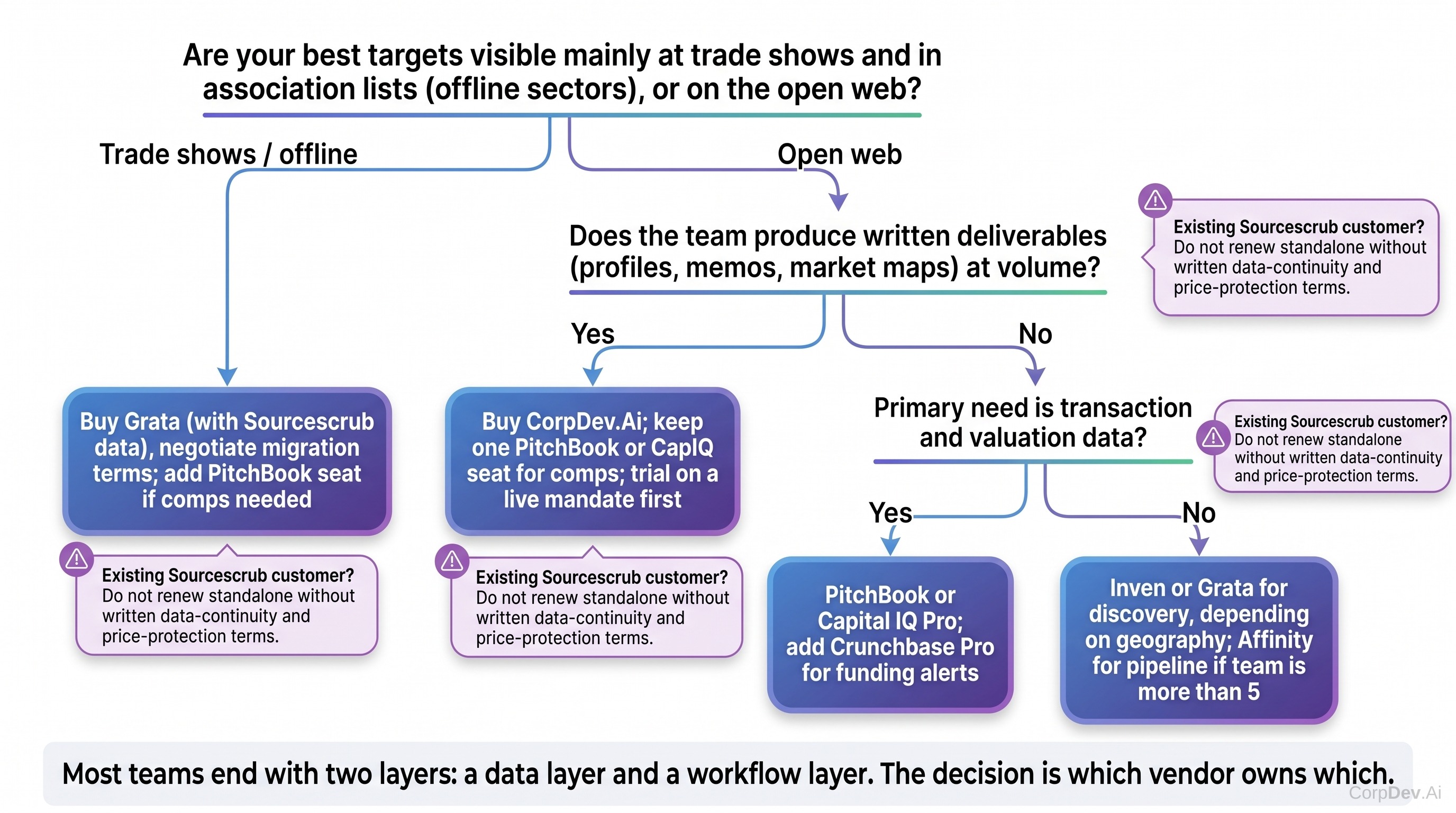
Read diagram description
Decision tree. Root question: "Are your best targets visible mainly at trade shows and in association lists (offline sectors), or on the open web?" Left branch "Trade shows / offline" → "Buy Grata (with Sourcescrub data), negotiate migration terms; add PitchBook seat if comps needed". Right branch "Open web" → second question: "Does the team produce written deliverables (profiles, memos, market maps) at volume?" → Yes → "Buy CorpDev.Ai; keep one PitchBook or CapIQ seat for comps; trial on a live mandate first". No → third question: "Primary need is transaction and valuation data?" → Yes → "PitchBook or Capital IQ Pro; add Crunchbase Pro for funding alerts". No → "Inven or Grata for discovery, depending on geography; Affinity for pipeline if team is more than 5". For every branch: "Existing Sourcescrub customer? Do not renew standalone without written data-continuity and price-protection terms." "Most teams end with two layers: a data layer and a workflow layer. The decision is which vendor owns which."
Profile 1 — Corporate development team, 1–5 people, thesis-driven acquirer
Recommendation: CorpDev.Ai as the primary platform, tested on a live mandate; one PitchBook or Capital IQ seat if the board expects precedent-transaction comps. This profile produces the most deliverables per head and has the least analyst capacity; the workbench's value is highest here and its price ($12,000–$36,000 published) provides a visible licence budget, subject to the buyer’s own procurement requirements [64]. The conditions: run the 14-day trial against the team's actual thesis, measure profile accuracy in the team's sector, and confirm that the AI output is edited rather than redone. If the team's targets are in trade-show-driven sectors, add Grata for discovery rather than expecting CorpDev.Ai to replicate source-list coverage [65][75].
Profile 2 — Lower-middle-market PE or independent sponsor
Recommendation: Grata (with Sourcescrub data) as the discovery layer; Affinity or Datasite Pipeline for relationships; PitchBook seat for comps. Proprietary origination in fragmented offline sectors is this profile's entire edge, and Grata's combined universe — semantic search plus conference and intermediary signals — is the strongest asset in the category [72][75]. Negotiate hard: Datasite is mid-integration and needs retention. Consider CorpDev.Ai as an added analyst layer for IC memo drafting once deal flow justifies it.
Profile 3 — Existing Sourcescrub customer at renewal
Recommendation: Do not renew standalone. Move to the Grata package with written protections, or run a parallel trial of CorpDev.Ai and Inven and decide on evidence. Obtain, in writing, whether the contract renews as Sourcescrub or Grata; which datasets, scoring configurations and tracked lists carry over; export rights during migration; price protection for at least one cycle; and the replacement roadmap for any discontinued feature [72]. Use the transition as leverage on price.
Profile 4 — Investment bank or M&A adviser
Recommendation: PitchBook or Capital IQ Pro as the core, Grata for sector mapping and buyer identification, DealCloud as the operating system. Advisers need transaction depth, buyer universes and conference planning simultaneously; this is the most expensive stack and the one where the consolidated Datasite offering (Grata → Pipeline → VDR) has genuine end-to-end logic [73]. CorpDev.Ai is a candidate for pitch and CIM drafting at the Enterprise tier, not a data replacement.
Profile 5 — Corporate venture or innovation team acquiring startups
Recommendation: Dealroom (Europe) or Crunchbase Business (US/global) for the venture universe; PitchBook if the team invests as well as acquires. Sourcescrub and Grata are mis-matched to this universe; funding events, not trade shows, are the organising signal. CorpDev.Ai's on-demand profiling is a useful complement for rapid diligence on shortlisted startups, since venture-backed companies describe themselves richly online [65].
A single Grata or PitchBook seat for data, plus CorpDev.Ai for the analyst workflow, often costs less than two seats of the incumbent stack and covers more of the seven workflow stages than either vendor alone. Grata's new MCP server makes this pairing technically cleaner than it was a year ago, since Grata data can be queried from AI agents [78].
8. Diligence Questions to Ask Every Vendor
Every vendor in this report will win a demo on its own dataset. The questions below are designed to be asked of all shortlisted vendors in the same words, with answers in writing, so that the evaluation compares like with like.
Universe and data quality
- Run our live thesis (provide it) and return the top 50 targets. How many are operating, independent and correctly described? We will check ten at random.
- What proportion of the returned companies has verified revenue or headcount rather than an estimate, and how is "verified" defined?
- For contacts: what is your measured email bounce rate over the last two quarters, and how is it measured?
- What share of your company universe was updated in the last 90 days?
Signal and coverage
- Which conference, association and directory sources do you crawl for our sector, and how far in advance of an event does attendee data appear?
- How do you handle companies not in your database — is there an on-demand path, and what does it cost in credits or fees?
- What geographic coverage depth can you demonstrate outside North America for companies under 200 employees?
Workflow and AI
- Show a full path from a natural-language thesis to a screened shortlist to a first-draft profile. Which steps are automated, which are human, and where are sources cited?
- What is the escalation path when the AI is wrong — can we see, correct and lock a fact?
- Is our data — theses, uploaded files, pipeline — used to train models or shared across customers? (CorpDev.Ai states it is not [64]; obtain the same statement from every vendor.)
- Do you offer API, Excel or MCP access, and is it included or an add-on?
Commercial and vendor
- What is the total three-year cost for three users including exports, connectors, API, seats and expected renewal uplift?
- Is monthly or quarterly commitment available? What are the cancellation terms?
- For Datasite (Sourcescrub / Grata): What is the Sourcescrub migration timetable, which features are guaranteed to persist, and what price protection applies to legacy customers [72]?
- For CorpDev.Ai: Provide three reference customers in our sector; what is the company's funding runway and customer count; and how are search credits consumed by a typical screening project [64]?
- For PitchBook / Capital IQ: What has been the average renewal uplift for comparable customers over the last three years [29][41]?
Whichever vendor wins, write the trial's measured results — recall on the live thesis, error rate in the sample, time-to-shortlist — into the contract as the basis for renewal. This is the one lever that converts marketing counts into accountable performance.
Key Facts & Sources
The load-bearing figures in this report, their sources and as-of dates. Figures marked "estimate" are third-party market ranges, not vendor list prices; figures marked "vendor claim" have not been independently verified.
| Fact | Figure | Type | Source | As of |
|---|---|---|---|---|
| Sourcescrub company universe | 16–17M | Vendor claim | Sourcescrub site; Datasite acquisition release [1][2][3] | 2025–26 |
| Sourcescrub source lists | 220K–290K | Vendor claim (varies by document) | [1][2][3] | 2025–26 |
| Sourcescrub customers | 700+ firms; "35 of top 40" | Vendor claim | [1] | 2026 |
| Sourcescrub G2 rating | 4.5/5, 56 reviews | Third-party | G2 [18] | Jun 2026 |
| Sourcescrub typical annual cost | $20K–$60K; $60K–$100K+ enterprise | Estimate | Prospeo and comparison sites [10][11][12] | 2026 |
| Sourcescrub tier limits | Essentials 5 rules; Plus 15 rules/250 tracked; Professional unlimited/1,000 tracked | Vendor-published | Sourcescrub pricing page [6] | 2026 |
| Datasite acquires Sourcescrub | 8 Aug 2025; terms undisclosed; to integrate with Grata | Verified | Datasite, Francisco Partners, Willkie [2][14][15] | Aug 2025 |
| Datasite owner and commitment | CapVest; $500M commitment to intelligence business | Verified | [72][79] | 2025–26 |
| Sourcescrub–Grata merger status | "Will ultimately merge"; no published timetable | Verified (absence noted) | Grata 2025 review [72] | Dec 2025 |
| Grata company universe | 23M+ companies; 230K conferences/lists; 11.5M contacts; 1M transaction events; 600 analysts; 26 countries | Vendor claim | Grata announcement [75] | Jul 2026 |
| Grata G2 rating | ~4.9/5, 81 reviews | Third-party | G2 [26] | 2026 |
| Grata pricing | $15K–$100K+ per firm; $24K–$45K per seat mid-market | Estimate | Prospeo [27] | 2026 |
| Grata MCP server launch | Aug 2026 | Verified | Datasite news [78] | Aug 2026 |
| CorpDev.Ai pricing | AI Pro $1,000/mo annual ($1,200 monthly); AI Pro Team $3,000/mo annual ($3,600 monthly), 3 seats; Enterprise custom | Vendor-published | corpdev.ai/pricing [64] | Sep 2026 |
| CorpDev.Ai search credits | 12,000/yr (Pro); 36,000/yr (Team) | Vendor-published | [64] | Sep 2026 |
| CorpDev.Ai company universe | 70M+ indexed (Apollo firmographics) + on-demand profiles | Vendor claim | [52][64][65] | Sep 2026 |
| CorpDev.Ai trial | 14-day self-serve, no sales call | Vendor-published | [65] | Sep 2026 |
| CorpDev.Ai founders | Kal Kilpi (ex-Midaxo co-founder); Atul Tiwary (20+ yrs M&A) | Vendor-published | About page; LinkedIn [62][63] | 2026 |
| PitchBook pricing | $12K–$20K single seat; $20K–$70K+ teams; $100K+ enterprise | Estimate | [29][30] | 2026 |
| Capital IQ Pro pricing | $15K–$33K per user typical; $10K–$50K+ negotiated | Estimate | [39][40] | 2026 |
| Capital IQ Pro G2 rating | ~4.3/5, 68 reviews | Third-party | G2 [36][41] | 2026 |
| Crunchbase Pro pricing | $49/mo annual ($588/yr); $99/mo monthly | Vendor-published via third party | [37][38] | 2026 |
| Affinity pricing | ~$2K–$2.7K per user/yr; $20K+ with seat minimums | Estimate | [44][45] | 2026 |
| Cyndx pricing | ~$30K–$60K per firm (up to $75K) | Estimate | [32][33] | 2026 |
| Tracxn pricing | ~$12K–$18K per year | Estimate | [42] | 2026 |
| Inven company universe | 28M+ | Vendor claim | Inven [33] | 2026 |
| Stack TCO (Section 6) | A ~$75K; B ~$75K; C ~$51K for 3 users | Derived — sum of component estimates above | Section 6 basis table | Sep 2026 |
| Scoring matrix (Section 5) | 1–5 per criterion | Analyst judgement | Sections 3–4 evidence | Sep 2026 |
Method notes. Company counts are not comparable across vendors: Sourcescrub and Grata count curated profiles, CorpDev.Ai counts Apollo firmographic records plus on-demand generation, Capital IQ counts legal entities including public companies. Pricing for sales-led vendors is drawn from third-party comparison sites (principally Prospeo, CostBench, Investables and G2), which are themselves marketing channels for competing products; ranges are shown rather than point estimates for that reason. Review counts and ratings were taken from G2 and Capterra pages as surfaced in September 2026 and will drift. This report was prepared for CorpDev.Ai; vendor claims for CorpDev.Ai were checked against its own published pricing and comparison pages and are labelled as vendor claims wherever no independent corroboration was found.
References
Numbering follows the original research. Access dates below record the original source registry; they do not imply that every source was rechecked for this website edition.
- SourceScrubSource accessed 2026-09-11
- Datasite to Acquire Sourcescrub, Expanding Private Market ...Source accessed 2026-09-11
- Unlock Your Data- Driven Advantage:Source accessed 2026-09-11
- Covering the Private Company LandscapeSource accessed 2026-09-11
- Pricing & Features for SourcescrubSource accessed 2026-09-11
- Chrome extensionSource accessed 2026-09-11
- Deal Sourcing Chrome Extension - SourcescrubSource accessed 2026-09-11
- Paving the Way for AI in Dealmaking - SourceScrubSource accessed 2026-09-11
- SourceScrub Pricing, Reviews, Pros & Cons (2026) - ProspeoSource accessed 2026-09-11
- Pubrio vs SourceScrub: Honest Comparison (2026)Source accessed 2026-09-11
- Pricing BreakdownSource accessed 2026-09-11
- Sourcescrub Announces Strategic Growth Investment from ...Source accessed 2026-09-11
- Datasite to Acquire Sourcescrub, Expanding Private Market ...Source accessed 2026-09-11
- Willkie Advises Datasite on Acquisition of Deal Sourcing ...Source accessed 2026-09-11
- SourceScrubSource accessed 2026-09-11
- The Automated Sourcing Engine for the Private Company Universe.Source accessed 2026-09-11
- Sourcescrub Products | Read 56 Reviews on G2Source accessed 2026-09-11
- The G2 on SourcescrubSource accessed 2026-09-11
- Página 2 | Sourcescrub Reseñas 2026: Detalles, Precios y ... - G2Source accessed 2026-09-11
- What Is Leadzen.Ai?Source accessed 2026-09-11
- Sourcescrub ReviewsSource accessed 2026-09-11
- Grata | The Leading Private Markets PlatformSource accessed 2026-09-11
- Grata Reviews 2026: Details, Pricing, & Features - G2Source accessed 2026-09-11
- Grata Pricing, Reviews, Pros and Cons (2026)Source accessed 2026-09-11
- PitchBook Review 2026: Features, Pricing & AlternativeSource accessed 2026-09-11
- What Is PitchBook? Pricing, Features & Review (2026)Source accessed 2026-09-11
- PitchBook vs Crunchbase 2026: Is $20K/yr Worth It Over ...Source accessed 2026-09-11
- PitchBook 2026 Review: Login, Pricing, Company, Career, Free ...Source accessed 2026-09-11
- Cyndx Pricing 2026: Enterprise Custom Quotes | CostBenchSource accessed 2026-09-11
- What are the best deal sourcing platforms in 2026? | InvenSource accessed 2026-09-11
- Cyndx Reviews 2026: Details, Pricing, & FeaturesSource accessed 2026-09-11
- Best Platforms for Private Equity Deal Sourcing (2025 Review)Source accessed 2026-09-11
- Crunchbase vs. S&P Capital IQ Pro Comparison 2026Source accessed 2026-09-11
- Crunchbase Review (2026): Funding Data, Pricing, and Billing Complaints | Market Intelligence ToolsSource accessed 2026-09-11
- Crunchbase Review: Pricing, Features, Alternatives (2026) · SaaSTrackerSource accessed 2026-09-11
- Refinitiv vs Bloomberg vs FactSet vs Capital IQ - CT AcquisitionsSource accessed 2026-09-11
- Capital IQ Cost 2026: S&P Capital IQ Price Per SeatSource accessed 2026-09-11
- S&P Capital IQ Pro vs. Sourcescrub Comparison 2026 | G2Source accessed 2026-09-11
- PitchBook Alternatives, Competitors and Pricing ComparedSource accessed 2026-09-11
- udu — review, pricing & alternatives - Private EquitiesSource accessed 2026-09-11
- Affinity Review (2026): Pricing, Pros & Cons - CRM NewspaperSource accessed 2026-09-11
- Affinity CRM for Venture Capital: A Founder and VC's ...Source accessed 2026-09-11
- Best Private Equity CRM Software: A 2026 Buyer's GuideSource accessed 2026-09-11
- Affinity CRM Pricing, Reviews, Pros & Cons (2026) - prospeo.ioSource accessed 2026-09-11
- Affinity - Marc GasserSource accessed 2026-09-11
- DealCloud Reviews 2026: Details, Pricing, & FeaturesSource accessed 2026-09-11
- CorpDev.Ai - Agentic AI for M&A and Corporate DevelopmentSource accessed 2026-09-11
- Quick Start - CorpDev.Ai DocsSource accessed 2026-09-11
- AI Deal Sourcing Platform for M&ASource accessed 2026-09-11
- Deep Company Intelligence & Research for M&A - CorpDev.AiSource accessed 2026-09-11
- The Data Architecture Behind AI-Powered M&ASource accessed 2026-09-11
- Simple, Powerful AI Pipeline CRM for M&A - CorpDev.AiSource accessed 2026-09-11
- [PDF] Intro Deck - CorpDev.AiSource accessed 2026-09-11
- Board-Ready Deliverables & Investment Memos - CorpDev.AiSource accessed 2026-09-11
- Introduction & Installation - CorpDev.Ai DocsSource accessed 2026-09-11
- Kal Kilpi | LinkedInSource accessed 2026-09-11
- About Us - CorpDev.AiSource accessed 2026-09-11
- Pricing - CorpDev.AiSource accessed 2026-09-11
- CorpDev.Ai vs Grata: Pricing & Features ComparisonSource accessed 2026-09-11
- Private Equity Deal Sourcing Platform - GrataSource accessed 2026-09-11
- Deal Sourcing Platform for Private MarketsSource accessed 2026-09-11
- Public & Private Equity Deal Data - PitchBookSource accessed 2026-09-11
- PitchBook’s Data: Private & Public Market Data - PitchBookSource accessed 2026-09-11
- A Year of Game-Changing Expansion: Grata's 2025 in ...Source accessed 2026-09-11
- Light Speed: How Datasite tech is breaking barriersSource accessed 2026-09-11
- Inven vs. Grata: Feature and Performance Overview 2026Source accessed 2026-09-11
- Grata Expands Global Intelligence Platform with Integrated Valu8 ...Source accessed 2026-09-11
- Similar Companies, a Grata previewSource accessed 2026-09-11
- Grata Expands AI Ecosystem with Native MCP Integration ... - DatasiteSource accessed 2026-09-11
- Datasite Acquires Leading Private Market Intelligence ... - Via TTSource accessed 2026-09-11