
Cross-Border M&A Overview
A cross-border deal creates value when owning a business abroad gives you capabilities or market access you can use profitably. It also multiplies the dependencies: more legal entities and approvals, several currencies, different employment, data, and tax rules, and different local expectations. The deal works only if those dependencies fit into a closing and integration plan the team can actually carry out.
The most useful control is a single matrix of jurisdictions and entities, owned by qualified advisers and linked to the deal model. A generic country-risk score or a list of filing thresholds cannot replace the facts of this business and this buyer.
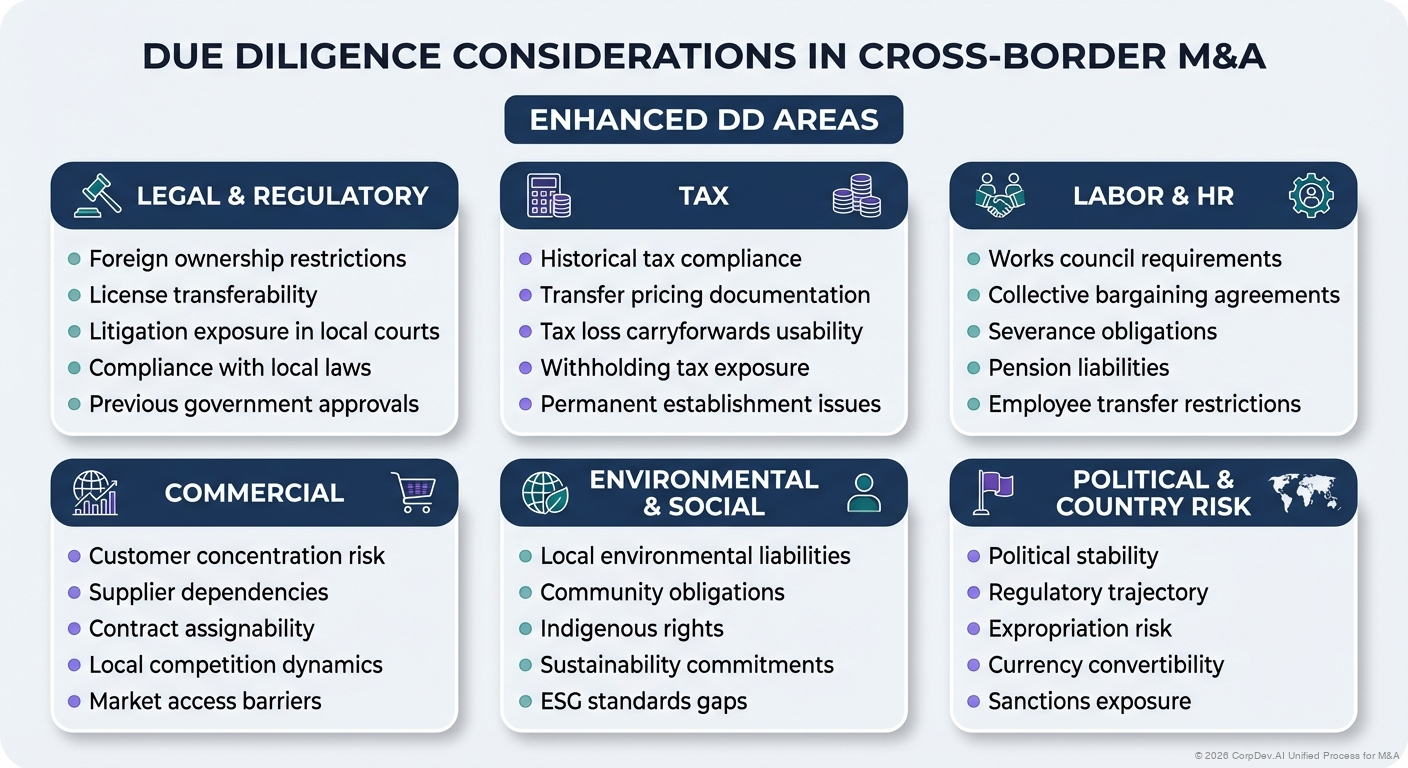 Legal and regulatory: map the jurisdictions ↗Tax: review transaction and entity tax exposure ↗Labor and HR: review local operating evidence ↗Commercial: validate the regional business case ↗Environmental and social: diligence local obligations ↗Political and country risk: model currency and cash exposure ↗
Text links for this illustration
State what owning the business abroad makes possible
Start with what the deal gives you that you cannot get another way. It might be local distribution and customer relationships, technical or manufacturing capability, licenses and service coverage, or regional management. Then test whether you need to own it, compared with a distributor agreement, a partnership or license, a greenfield investment, or a staged entry.
Decide what headquarters can run and what needs local authority. Customer trust may rest on fast local decisions, language, technical service, or a recognized brand. Centralizing those functions can destroy the market access you paid for. The regional leader should approve the operating model after closing before the integration plan counts any savings.
Map entities and activities before jurisdictions
Start with where the business actually operates. The headquarters country is only one of the places that matter. Collect:
- The legal entity chart and ownership chain, with the beneficial ownership information the reviews require
- Where assets, employees, customers, and suppliers are
- Where intellectual property sits and where data flows
- Which activities are regulated
Then ask advisers which reviews apply to those facts: competition and foreign investment; sector and securities rules; employment and tax; sanctions, export controls, and data. Treat each as a workstream with a conclusion and evidence. Never infer a filing requirement from a company's nationality, and avoid static global threshold tables. They go out of date and miss exceptions specific to the deal.
Record each conclusion in the jurisdiction matrix. The table shows what every field must hold.
| Jurisdiction matrix field | What to record |
|---|---|
| Entity and activity | What is acquired, operated, sold, employed, or held locally |
| Applicable review | The filing, consent, notification, consultation, or other issue the adviser identified |
| Factual basis | Revenue, assets, ownership, business activity, or other relevant information |
| Adviser and date | Named local owner, date of advice, and assumptions that need refreshing |
| Dependency | Information, documents, approvals, or sequence needed to proceed |
| Timing | Expected range, uncertainty, and how it relates to signing and closing |
| Commercial consequence | Remedy, restriction, funding, operating, or integration implication |
| Status and evidence | Submitted, pending, resolved, or not applicable, with the supporting conclusion |
One central legal lead reconciles the local advice and spots conflicting assumptions. CorpDev owns the overall critical path; local advisers own the conclusions for their jurisdictions. Refresh the matrix whenever the ownership structure, financing, perimeter, or integration plan changes.
Test the case with local evidence
Six questions decide whether the regional business will perform as the case assumes. The table lists the evidence to request and what each answer changes.
| Question | Evidence to request | What the answer changes |
|---|---|---|
| Will the customer franchise transfer? | Customer and distributor contracts, consent analysis, local management interviews, and churn evidence | Retention and the regional revenue plan |
| What does the business earn locally? | Entity accounts, management reporting, intercompany charges, cash collection, and currency bridge | Standalone earnings and available cash |
| Who can run it? | Organization, employment arrangements, leadership succession, pay, and retention needs | Day 1 authority and staffing |
| Can systems and data be combined? | Application inventory, data locations, access controls, contracts, and adviser-reviewed data transfer analysis | Integration design and cost |
| Where can cash move? | Bank accounts, financing, analysis of distributable reserves, restrictions, and tax advice | Acquisition funding and parent liquidity |
| Which liabilities need local resolution? | Disputes, tax history, permits, inspections, third-party relationships, and remediation plans | Price, protections, and closing conditions |
Use people fluent in the local language for material documents and management discussions. Record which version of each document is authoritative and what any translation covered. A quick translated summary must never quietly become the legal source for a contract conclusion.
Reconcile local statutory filings with the seller's figures
Sellers usually present one set of numbers: management accounts by entity, in the language of the sale process. In many countries each local entity also files statutory accounts with a public registry, in the local language and under local accounting rules. The two sets often differ, and the reason for each difference matters. Some are harmless, such as a different financial year. Others are not, such as revenue that appears only in the management pack.
Reconcile the filings entity by entity, keeping the original wording beside any translation. Finance prepares the first comparison; local advisers verify the figures and classify each difference by cause, because each cause goes to a different owner.
A hypothetical example. Amounts are millions of each entity's local currency; compare both sources in the same currency.
| Entity | Figure | Seller | Statutory accounts | Difference | Cause |
|---|---|---|---|---|---|
| Poland | Revenue | 84.0 | 79.6 | −5% | Period: statutory year ends 30 June; seller reports the calendar year |
| Germany | Operating profit | 6.2 | 4.1 | −34% | Basis: seller excludes 2.1 of management charges booked locally |
| Brazil | Revenue | 31.5 | 38.9 | +23% | Perimeter: the legal entity includes a distribution branch the seller left out |
| Spain | Net assets | 12.4 | 9.0 | −27% | Unexplained |
Route each line by its cause. Finance rebuilds period differences on one calendar. The legal lead checks perimeter differences, because the entity in the agreement may not match the business in the model. Accounting advisers take basis differences into the quality-of-earnings work. Unexplained gaps go to the seller as questions, with the quoted line attached.
The check that matters: a fluent reviewer, such as local counsel, confirms the translation behind every significant difference before it reaches the seller. Keep the original-language passage beside each translated term so the reviewer can check its meaning in context.
Model currency exposure one cash flow at a time
Separate three exposures: the purchase price, operations, and the translation of results into the reporting currency. For each material cash flow, treasury records the amount, currency, and timing, how it is funded and hedged, and the risk that remains. A target that reports revenue in one currency may pay its costs or buy equipment in another.
Build operating forecasts in local currency first, then translate them consistently into the valuation currency. Where exchange rates and business results move together, such as imported input costs or customer pricing, test them together. Never count translation gains as operating synergies.
For acquisition funding, model the exposure between signing and closing, and what happens if the deal does not close. Treasury and counsel should evaluate the actual hedging and financing terms. Include the cost of cash that is restricted or trapped, and the tax and legal work needed to move it. Cash on the consolidated balance sheet is not always cash you can use to pay for the acquisition.
Write the closing sequence step by step
Build a step plan that covers every approval and consultation, the financing and funds flow, entity actions and documents, and the transfer of ownership. Give each step an owner and a backup, with their time zone and the evidence that shows the step is done. Mark which steps can run in parallel, and which cannot legally or practically start until another is finished.
Link the plan to the purchase agreement's conditions, efforts obligations, outside date, remedies, and termination economics; counsel drafts those terms. If a jurisdiction imposes operating restrictions or requires a disposal, update the investment case. An approval that changes what you are buying, or how you can run it, has an economic cost.
Plan for a delayed or partial transition. Know who can pay employees, serve customers, receive funds, and access systems during the gap. Look for hidden dependencies: a local employer that relies on the parent's payroll service, a customer contract held outside the perimeter, or a regional operation that runs on an intercompany license. Never solve an unresolved legal dependency by taking operational control before it is permitted.
Example: a four-country deal that relied on head-office services
This example is hypothetical.
A buyer acquires a business that operates in four countries. The seller's headquarters provides its payroll, treasury, customer billing, and a shared data platform. The first valuation assumes the buyer's global functions can take over those services immediately.
The entity and jurisdiction review finds separate employee processes in each country, changes needed to customer billing, and open questions about data access. Treasury also finds that cash in one entity cannot be counted on for the closing funds flow. The team revises the plan to add transitional services, local leadership, a phased systems migration, and a funded liquidity buffer.
The acquisition may still offer attractive market access. The difference is that the committee now approves the real cost and timing of running the regional business, with explicit conditions for centralizing functions. The deal no longer hides an unfunded local separation project.
Give local leaders clear authority and measures
Before closing, settle how the business will run locally from Day 1:
- Delegated authorities, and which decisions stay local or need group approval
- Continuity of payroll and supplier payments
- Customer communication and escalation channels
- Financial reporting and local leadership coverage
Translate key operating materials into the languages the people doing the work need.
After closing, track regional measures tied to the thesis: customer retention, service quality, local cash generation, reliable reporting, leadership retention, and net benefits after transition costs. Review country-specific dependencies at the integration steering committee, and let local owners challenge unrealistic central timelines.
The investment committee should receive:
- The adviser-owned jurisdiction matrix
- The cash-flow view by entity
- The currency plan
- The closing step plan
- The regional operating model
Together they settle the questions a country overview leaves open, and they tie the thesis to a business the team can run.
Related resources
© 2026 CorpDev.Ai Unified Process for M&A