
Board Reporting for M&A
Board reporting on M&A has two jobs: help directors decide on each proposed deal, and show whether the acquisition program as a whole is working. Directors should be able to tell a deliberate program from a collection of attractive deals. That means connecting every commitment to the strategy, to other uses of the capital, to the company's capacity to integrate, and to how past acquisitions have performed.
The CEO and CFO own management's recommendation. CorpDev assembles the investment case and its evidence. Legal and the corporate secretary run the governance process and control distribution. What the board decides follows the company's actual authority framework, not a generic deal-size rule.
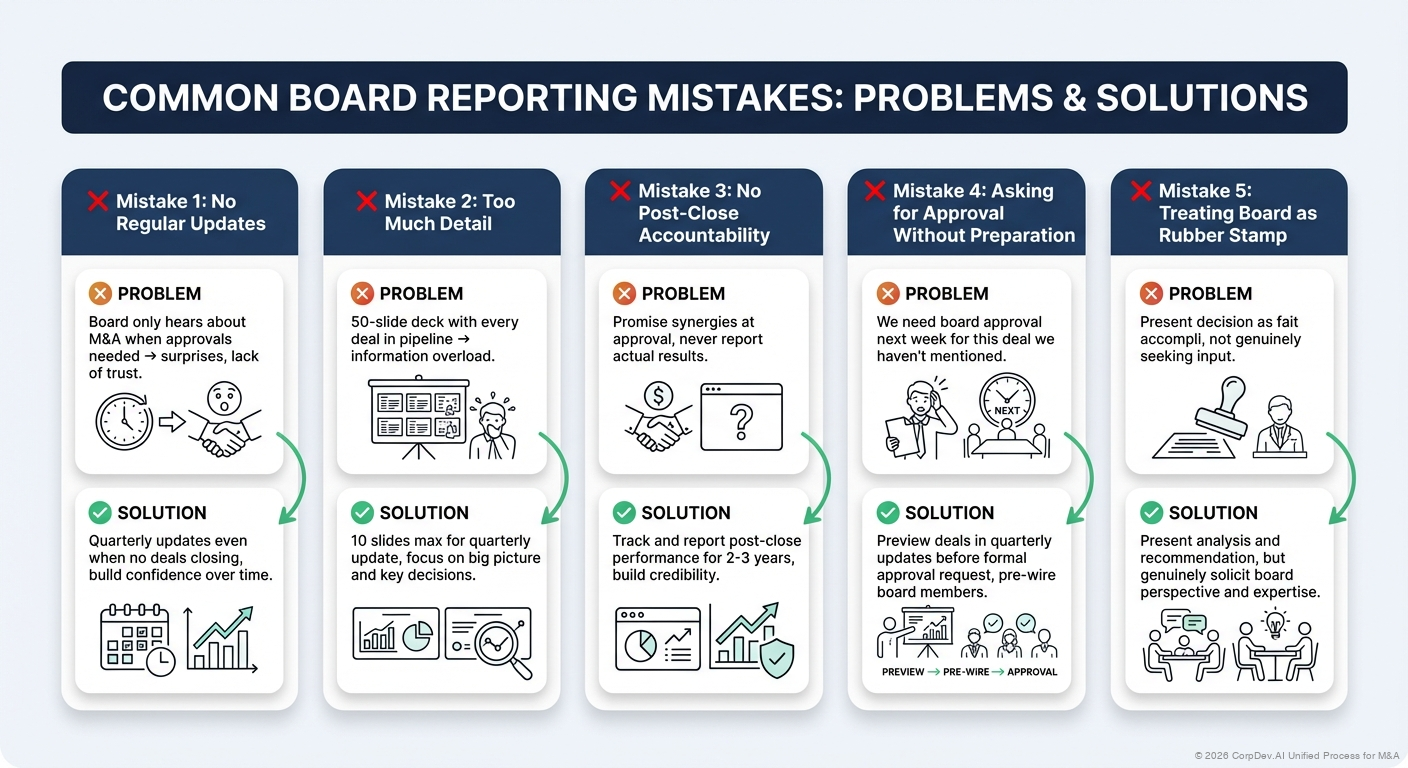 Provide regular program updates ↗Focus the board decision pack ↗Maintain post-close accountability ↗Give timely permitted information ↗Preserve board challenge ↗
Label each item as oversight, guidance, or approval
Mark every agenda item with its purpose. The three purposes can share a meeting, but they should never blur.
| Purpose | What directors are asked to do | Example |
|---|---|---|
| Oversight | Review how the portfolio and acquisition program are performing, which risks are emerging, and whether strategy or resources need to change | A quarterly program update |
| Guidance | Give direction on a real choice | Whether to prioritize one platform acquisition over several smaller capability deals |
| Approval | Authorize a defined action with its scope, economics, conditions, and authority, and see what management may do afterward | Authority to sign a definitive agreement |
Discussing an opportunity is not formal authorization. Never write an information update as though silence means approval.
Give directors the information they need, in time
Directors need enough information to do their job while the decision still matters. Do not automatically withhold the target's identity or valuation until there is a binding offer. Work with counsel on:
- What the NDA allows, and who may receive information
- Conflicts of interest and restricted information
- Whether any director needs separate materials or should step out of the discussion
Use the approved board portal and distribution process, and set confidentiality and access rules document by document. Keep sensitive appendices controlled, but make sure the decision pack itself still conveys the important facts and uncertainties. A code name reduces unnecessary exposure. It cannot replace information directors need to judge the investment.
Before any live deadline, agree how the board hears about an emerging significant deal. The protocol names:
- The management owner
- The board contact
- The trigger for notifying the board
- The permitted channel
- When the next update will come
Answer six questions in every program update
A recurring update should answer the six questions below. The number of slides is a design choice; the standard is that every question gets an answer.
| Question | Evidence to show | What the board may do |
|---|---|---|
| Is the strategy still right? | Portfolio gaps, customer evidence, other investment options | Confirm or revise priorities |
| Are credible options developing? | Qualified targets, significant relationships, deals that could happen | Support access or change focus |
| What capital may be needed? | Timing and commitments under different scenarios | Keep funding flexible |
| Can the company absorb the work? | Integrations underway and scarce resources | Sequence deals or fund capacity |
| Are past deals delivering? | Bridge from the approved case to actual results, and the current forecast | Intervene or change future criteria |
| Which decisions are coming? | Specific requests, dependencies, and dates | Plan time to consider them properly |
Discuss competitors' deals in terms of what they mean for your strategy. A competitor paying a high price does not justify a similar price for you. Keep announced facts separate from management's interpretation of them.
Open the deal pack with the recommendation and the case against
Start with management's recommendation and the strongest reason not to proceed. Then cover, in this order:
- Strategic rationale and the alternatives considered
- Standalone economics, and the benefits only this buyer can create
- Downside case
- Integration readiness
- Financing and terms
- Unresolved issues
Make the evidence and confidence behind every important claim visible. "Management believes" must not turn into "diligence confirmed" just because it appears in a board deck. Explain what advisers were asked to do and any limits on their work that matter to the decision.
When management comes back for approval, bridge the new request to the previous discussion: price, structure, forecast, benefits, costs, conditions, and remaining risks. Directors should not have to compare two long decks to discover that the investment has changed. Approval Gates shows how to build the bridge.
Use a one-page board decision memo
This template keeps each request complete and comparable with the last one.
BOARD DECISION MEMO (transaction / date / version)
Action requested, and the date a decision is needed:
Management's recommendation:
Strongest objection, and management's response:
Strategic objective, and alternatives considered:
Target, perimeter, and where it will sit in the company:
Economics: enterprise value, equity consideration, total funding, costs:
Standalone value, and value only we can create, with assumptions:
Downside: operating, liquidity, execution, and strategic consequences:
Financing and key conditions:
Integration owner, committed resources, critical dependencies:
Significant diligence findings, and their limits:
Changes since the board last discussed the deal:
Approval limits, conditions, expiry, and events that require a return:
Required resolutions, signatories, and related approvals:
Supporting documents and controlled appendices:
Counsel prepares or reviews the formal resolutions and the authority to sign. The memo explains the decision; the resolutions make it.
Show what the downside would cost and how you would respond
A useful downside case combines plausible bad outcomes that are specific to this deal, and shows how management would respond. Choose from risks such as:
- Losing important customers
- A delayed product launch
- Integration costs that escalate
- Departures of scarce talent
- Financing pressure
- Failing to achieve an intended operating benefit
Show the resulting cash needs, headroom, remediation, and strategic consequences. Say which commitments could be stopped, which costs would already be spent, and which actions could damage the business being bought.
A positive IRR or accretive EPS does not make a downside acceptable. The board needs to see how much could be lost and whether the company could absorb the loss.
Prepare for the decisions directors must make
Before circulation, review what the board was told last time and explain what has changed. Show the strongest alternative, the downside, and the effect on capital and operating capacity. Assign an executive to answer each unresolved question. Keep gaps visible in the proposed approval conditions rather than filling them with assurances.
Report results against the case the board approved
Keep the approved baseline next to actual results and the current forecast. Explain the differences in standalone performance, benefit delivery, costs, scope, timing, and accounting. The business owner presents significant deviations, with Finance validating the numbers.
Keep three benefit measures apart: annualized run-rate savings, profit benefit in the period, and cash benefit. Do not add revenue benefits to cost savings without showing the profit or cash they produce. Label any return that depends on future forecasts or a residual value as an updated expected return, not a realized result.
Do not average individual deal IRRs into a portfolio return. Show each significant investment on its own, and add a properly calculated aggregate only if it is useful, with its basis disclosed. See Reporting & Metrics.
Update the board between meetings when facts change
When facts change significantly, send a short update:
What happened, and when:
What is verified, and what is still uncertain:
Effect on the approved thesis, terms, funding, or timetable:
Action management proposes:
Authority needed now, if any:
What management can do under existing authority:
Next decision or update date:
In a hypothetical deal, a key customer declines to renew after signing. Management should report the verified exposure, the contractual and closing implications as assessed with counsel, the updated economics, and its proposed response. Repeating that the acquisition remains strategically attractive does not answer the question the board now faces.
Keep the formal record, and keep the challenge in the room
The corporate secretary and Legal keep the formal governance record under company policy. CorpDev keeps the exact decision materials, with links to the model versions behind them. Record each condition and who verifies it, so later teams know what was authorized and why. After a meeting, update conditions and future reporting only from the confirmed decision record, never from a summary of a favorable discussion.
Briefing directors one by one can surface questions and avoid confusion. Significant new information and revised analysis must still reach the full board through the approved process. Do not use private conversations to turn the formal meeting into a formality.
The test is practical. Can a director identify the choice, understand the strongest counterargument, judge the downside, and see who will deliver the result? If not, improve the evidence and the framing of the decision before adding pages.
Continue with IC Presentations and Approval Gates.
© 2026 CorpDev.Ai Unified Process for M&A