
AI in M&A
AI is beginning to change both how acquisitions are done and the kinds of acquisition strategies companies can pursue. The first gains come from researching companies, reading documents and preparing analysis faster. The larger opportunity is to connect that work into a repeatable way to find, buy and improve businesses.
A useful way to understand the trend is through three stages: stand-alone assistance, integration into existing work, and fully new models. The web followed a similar progression. For M&A, the implications reach beyond team productivity to deal economics, competitive advantage and programmatic growth.
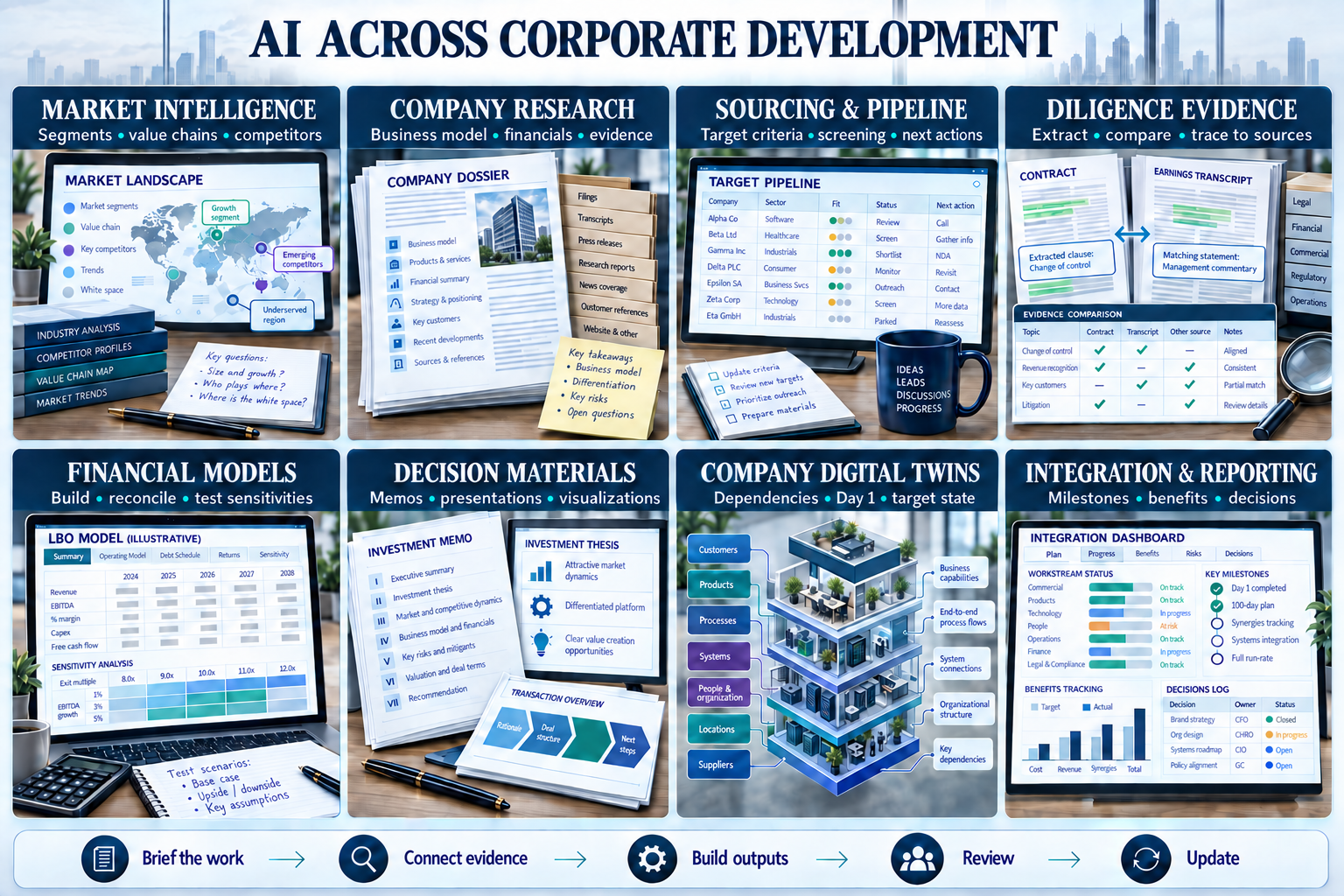 Market intelligence ↗Company research ↗Sourcing and pipeline ↗Diligence evidence ↗Financial models ↗Decision materials ↗Company digital twins ↗Integration and reporting ↗Brief the work ↗Connect evidence ↗Build outputs ↗Review ↗Update ↗
Illustrative work products. Sample companies, charts and interface details show workflow concepts, not actual transactions or measured performance.
Where adoption stands
Adoption is uneven. McKinsey's January 2026 report, drawing on its 2025 survey, found that only 30% of respondents used generative AI at moderate to high levels. Even avid users mostly relied on commercial chatbots. That suggests a market still developing beyond individual assistance. McKinsey, January 2026.
BCG's June 2026 assessment describes a move toward connected deal workflows and learning across transactions, while noting that an integrated approach remains uncommon. BCG, June 2026.
The three stages below are a framework for interpreting that direction. They coexist, and the third describes emerging possibilities rather than a model the whole market has already adopted.
Three stages of technology adoption
The web offers a useful analogy. Businesses first put information online, then moved transactions and services online, and eventually created businesses whose economics and customer experience depended on the internet. These stages coexist; each expands what the technology is used for.
| Stage | With the web | With AI in corporate development |
|---|---|---|
| 1. Stand-alone | A website with information about the business: products, locations and contact details. | A person uses Claude or ChatGPT to research a topic, summarize documents or draft a memo. |
| 2. Integrated into the existing business | Readers access a newspaper online; customers purchase products through an online store. | AI is embedded in company research, sourcing, pipeline management, diligence, Excel models and reporting. |
| 3. Fully new models | Facebook builds a social network around online participation. Amazon illustrates how an online store can develop into a marketplace and a broader platform. | Companies design acquisition platforms, programmatic M&A and new ways of operating acquired businesses around AI capabilities. |
1. Stand-alone: help the individual
A deal professional opens an assistant, provides context and asks for help. The task might be a market overview, a company summary, a first draft of an investment memo or an explanation of a financial model. This is an accessible way to learn where AI is useful.
The person connects the work. They choose the documents, explain the deal, check the answer and move the result into the team's files. Even when an assistant has memory or connected sources, this pattern still depends on someone directing each assignment and carrying its conclusions forward.
The main gain is individual productivity. A researcher can cover more material; an analyst can get to a first draft sooner. The team's overall operating model can remain much the same.
2. Integrated: improve the existing process
In the second stage, AI works inside specialized tools or the systems the team already uses. Company research feeds a target list. Screening results appear in the pipeline. Contract answers link to evidence in the data room. Spreadsheet assistance works with the model the team is reviewing.
Context, permissions, records and review steps become part of the workflow. A finding can be assigned to an owner, linked to its source and revisited when new evidence arrives. The team spends less effort transferring information between disconnected tasks.
The main gain is a more connected deal process. The organization can use the same evidence across research, screening, diligence and investment decisions. Competitive differentiation begins to depend on how well the tools fit the team's data and methods.
3. Fully new models: change how the company grows
The third stage starts with a different question: what kind of acquisition strategy or business could work if research, coordination and repeatable analysis required much less manual effort?
An acquisition platform might maintain a continuously researched market, monitor potential targets, apply a common diligence method and carry an integration playbook across successive deals. A buyer could investigate smaller acquisitions that previously seemed too costly to evaluate. An operator might acquire businesses in a narrow sector and develop shared AI capabilities across customer service, administration or other repeatable processes.
These changes affect the operating model and potentially the business model. They alter which companies are attractive, how many opportunities a team can handle and how the buyer creates value after closing. Their economics must still be demonstrated. Sourcing capacity only helps if management, capital and integration capacity can support the resulting deals.
Programmatic M&A predates AI. The opportunity is to extend it: make repeated acquisitions more informed, more connected and easier to learn from. An AI-enabled acquirer would retain the evidence from previous deals, compare investment assumptions with actual results and use those lessons in its next search. The technology supports a repeatable system of decisions and execution.
Read more: Programmatic M&A, operating model and measurement and learning.
What this means for M&A teams
The constraint can move from preparing information to making decisions. When research and first drafts take less effort, a team can examine more opportunities and test more questions. Senior attention, relationships and integration capacity may then become the limiting factors. More targets in the pipeline only create value if the organization can choose and execute well.
Some smaller deals may become more attractive to pursue. Every acquisition carries a burden of research, diligence and coordination. Reducing part of that burden could make a repeated small-acquisition strategy more practical. Legal costs, financing, management demands and integration complexity still matter; the improvement must be assessed across the whole transaction.
The team's role and skills evolve. Preparing material remains necessary, but reviewing evidence, defining the right questions and challenging assumptions become a larger share of the work. Junior professionals need opportunities to develop business and financial judgment even as routine drafting becomes easier. Advisers can devote more attention to specialist analysis and negotiation.
AI changes the investment thesis as well as the process. Buyers need to consider how AI could affect a target's products, customer demand and cost structure. A business that looks attractive on historical margins may face disruption; another may offer a credible opportunity to improve service or expand capacity. The buyer's ability to implement those changes becomes part of the acquisition rationale.
Access to the same assistant is unlikely to be a lasting advantage. The more distinctive assets are sector knowledge, proprietary relationships, reliable operating data and a proven method for improving acquired companies. AI can make those assets more useful. It can also accelerate a weak process, which is why the quality of the underlying acquisition strategy matters.
Where the change appears across the deal
The eight areas in the illustration show the breadth of the trend. They begin as individual tasks, become connected workflows and can eventually support a different model of corporate development.
Market intelligence
Research can expand from occasional market studies toward a regularly updated view of segments, value chains and competitors. AI helps organize filings, product information, research and transaction activity into market landscapes. The implication is a sourcing strategy that can respond as a sector changes, with clearer visibility into areas the team has yet to investigate.
Company research
Company dossiers bring together business models, financials, customers and supporting evidence. As the effort of assembling a first view falls, teams can investigate a broader universe before choosing where to spend relationship and diligence time. The quality of the underlying sources remains decisive, especially for private companies with limited disclosure.
Sourcing and pipeline
AI supports discovery, screening and monitoring against target criteria. The pipeline can become an ongoing research activity, with new evidence prompting a reassessment of fit or timing. That makes it easier to maintain a long-term acquisition agenda between live transactions. A fit score still cannot establish whether an owner wants to sell.
Relationship knowledge can stay with the team
Meeting summaries, correspondence and follow-ups can contribute to a shared relationship record. Capturing that context makes the pipeline less dependent on an individual's memory while preserving the importance of personal trust and judgment.
Diligence evidence
Document extraction and comparison can broaden the material a team examines and help connect findings across legal, financial, commercial and operating workstreams. The consequential change is that a finding can inform the investment case while analysis is still under way. Source references and specialist review determine whether that connection is reliable.
Consistent comparisons across documents
Review matrices compare the same questions across agreements, policies or other records. They make patterns and exceptions easier to investigate, with answers linked to supporting passages.
Missing evidence becomes visible
References to absent amendments or schedules can become follow-up requests. The distinction matters: analyzing available files and establishing that the evidence is complete are different jobs.
Financial models
AI assistance extends from financial research into editable workbooks, formula review and sensitivity analysis. Teams can explore more versions of the business case and connect diligence findings to financial assumptions. The model remains the place where those assumptions must translate into consistent calculations; polished commentary cannot resolve a workbook that does not reconcile.
Decision materials
Memos, presentations and visualizations become easier to draft from the underlying research and model. This lowers the effort of preparing a decision, but also makes persuasive material easier to produce from weak evidence. The value of a deal team increasingly lies in the quality of its argument, the alternatives it considers and its willingness to challenge the case.
Company digital twins
A structured map of customers, products, processes, systems, people and suppliers helps explain how the business works. AI can assist in building and updating these relationships. Comparing the current business, Day 1 requirements and a target state brings integration considerations into the acquisition decision earlier. This is a more demanding application: useful scenarios require validated dependencies and explicit assumptions.
Integration and reporting
AI can help connect workstream updates, milestones, benefits and decisions. The strategic implication is a closer link between the investment thesis and post-acquisition performance. Across repeated deals, the record can show which assumptions held up and which integration approaches worked. That depends on owners reporting actual outcomes and finance validating the benefits.
From connected workflows to programmatic M&A
The connection between these applications is what makes the third stage possible. Market research defines the target criteria. Company research tests the fit. Diligence changes the model. The reviewed model supports the investment decision. Integration results reveal which assumptions held up.
For a single deal, that connection reduces repeated work and inconsistent information. For an acquisition program, it can become an accumulating body of knowledge: which targets convert, which risks recur, which integration steps take longer than expected and which benefits actually appear.
A company pursuing this model needs more than AI tools. It needs a clear acquisition thesis, repeatable processes, accountable people, access to capital and capacity to operate the acquired businesses. AI can support that system and improve its economics. The test is whether the resulting businesses perform better and the acquisition program creates value.
Read more: Continuous sourcing, repeatable diligence and integration and value creation.
What separates adoption from advantage
The three stages imply different ambitions. Stand-alone use helps people get work done. Integration helps a team execute its existing process. New models use those capabilities to change the scope and economics of the business itself.
Moving between them requires organizational choices: which information is shared, how evidence is reviewed, who can authorize actions and how results feed back into future decisions. Confidentiality, source quality and accountability become more consequential as systems connect more of the deal.
The question for a corporate development leader is therefore how AI changes the company's ability to grow through acquisition. For some teams, better execution of a few strategic deals is the right outcome. For others, the opportunity is a repeatable acquisition platform or an operating model that applies AI across acquired businesses. Success shows up in better acquisitions and stronger businesses after closing.
Related resources
© 2026 CorpDev.Ai Unified Process for M&A