
M&A Negotiation Strategies
M&A negotiation decides how value, risk, control, and post-closing obligations are split between buyer and seller. The goal is an agreement you can justify and deliver. A good headline price can still be a bad deal if it comes with unmodeled costs, obligations you cannot perform, or critical ambiguity.
Prepare as a team, not as a lone negotiator. Before the first session, know your alternative, the economics of the whole package, who has authority, and which open facts could change your mandate.
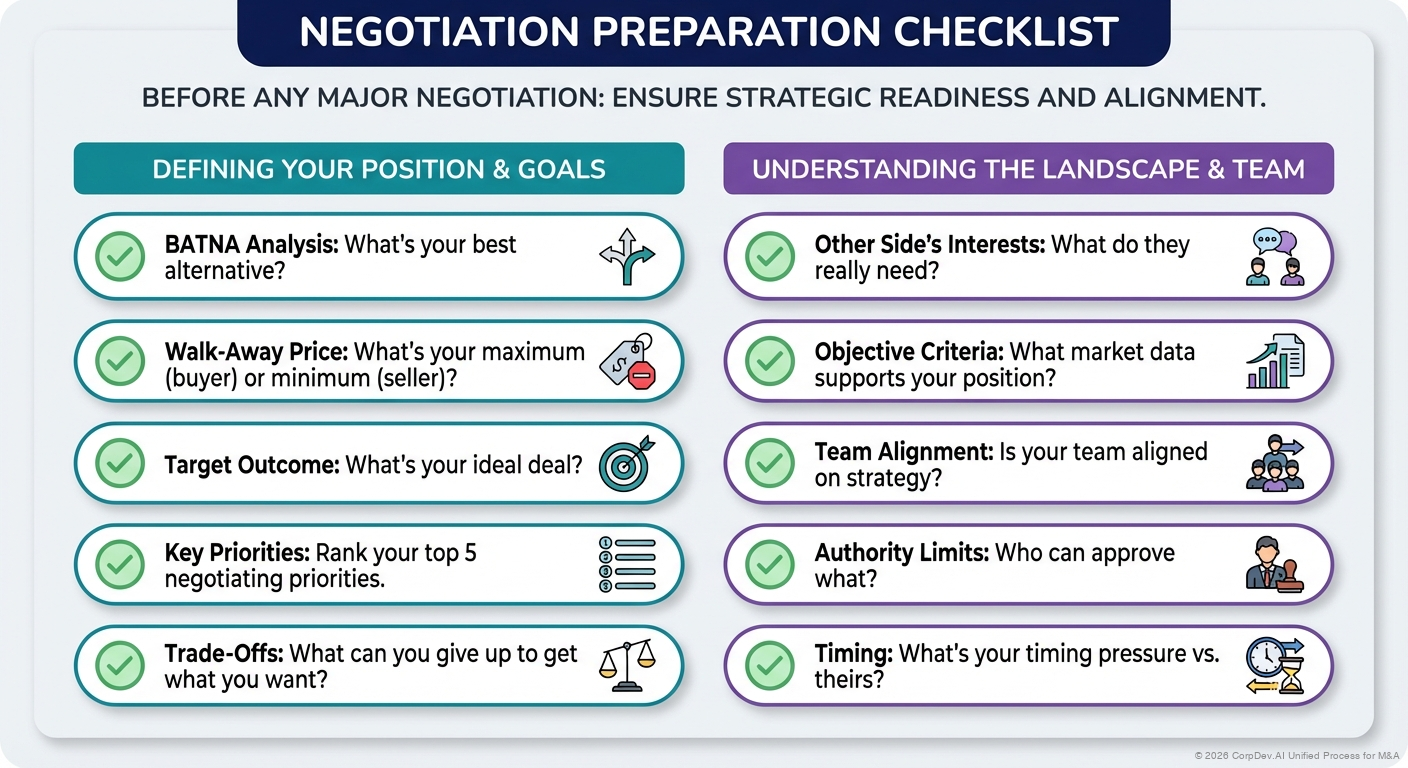 BATNA: build a credible alternative ↗Walk-away price: establish the mandate ↗Target outcome: control total economics ↗Key priorities: establish the mandate ↗Trade-offs: negotiate packages ↗Other side’s interests ↗Objective criteria: use evidence ↗Team alignment: prepare the mandate ↗Authority limits: confirm approval rights ↗Timing: manage constraints and impasses ↗
Text links for this illustration
- BATNA: build a credible alternative
- Walk-away price: establish the mandate
- Target outcome: control total economics
- Key priorities: establish the mandate
- Trade-offs: negotiate packages
- Other side’s interests
- Objective criteria: use evidence
- Team alignment: prepare the mandate
- Authority limits: confirm approval rights
- Timing: manage constraints and impasses
Know your best alternative to this deal
Your alternative, often called the BATNA (best alternative to a negotiated agreement), might be another target, an internal build, a partnership, a smaller investment, or carrying on without a deal. Define what it would cost, how long it would take, what resources it needs, and what it can realistically deliver.
A list of theoretical targets is not an alternative if none is reachable or comparable. Money already spent on diligence does not make a poor deal better. Leadership should choose among the options still open: proceed on current terms, propose a different package, or pursue the best alternative.
Keep the alternative current. A product deadline, a financing change, or the loss of a key operating leader can weaken your position without anything changing at the target.
Learn what the seller values instead of assuming it
Sellers care about different things: certainty, timing, cash, keeping a stake, what happens to employees, leadership roles, and the future of the business. A founder, a private equity owner, and a corporate parent may weigh these very differently. The type of owner does not tell you what this owner wants.
Keep three things apart: what the seller has said, what you have verified, and what you are guessing. Where appropriate, test whether a proposed trade actually meets the seller's concern. Never give up value for a priority the seller does not hold.
Write the internal mandate
For each important term, set the preferred outcome, acceptable alternatives, limits of authority, economic effect, and escalation path. The mandate includes your walk-away price. Keep it separate from anything shared with the seller.
The table shows the analysis each term needs before the negotiation starts.
| Term | Work to do before negotiating |
|---|---|
| Price and consideration | Value to the buyer, financing needs, downside, and consistency with the approved valuation |
| Adjustment mechanics | Expected effect, unclear definitions, data needed, and sensitivity |
| Contingent payments | Payment scenarios, measurement disputes, operating constraints, and administration |
| Risk allocation | Exposure you keep, proposed protection, economic effect that remains, and counsel's advice |
| Timing and certainty | Dependencies, cost of delay, and what you can credibly commit to |
| Management arrangements | Capabilities needed, decision rights, retention costs, and effects on integration |
| Transition services | Scope, service levels, cost, exit dependencies, and fallback |
Name the lead negotiator and the channels for commercial, legal, and specialist discussions. Everyone should know what they may discuss and what needs confirmation first. Side conversations must not create unrecorded promises.
Trade packages, not single concessions
Judge every concession against the rest of the agreement:
- Faster payment may affect financing.
- A narrower closing condition may increase your exposure.
- An earnout may change operating incentives and constrain integration.
- A transition-services concession may decide whether the business can run after closing.
Keep a live concession log: the request, the reason, the trade offered, status, economic effect, owner, and approval needed. Separate tentative discussion from accepted terms, and reconcile verbal understandings with the written drafts.
Where it helps, offer alternative packages that meet different seller priorities. Each one must be a package you can fund, perform, and get approved. Never offer an option you cannot deliver just to make another look better.
Prepare for the seller's strongest objections
Before the meeting, agree which concessions the team can make and which require renewed approval. Assign one person to lead each topic and another to record proposed changes. Work through the seller's strongest likely objections using documented interests and alternatives. Record assumptions about their position as assumptions, then test them in the conversation.
Explain every change with evidence
Diligence can legitimately change a proposal. Explain the new information, how it differs from the assumptions behind the earlier offer, and its effect on the economics or on delivery. Then propose a response tied to that effect.
Take a hypothetical carve-out that needs its own customer-support operation, which the seller's standalone cost estimate left out. The team should establish the capability needed, the recurring cost, the setup cost, and the transition arrangement. Those facts might support a price change, services from the seller, a different perimeter, or another structure.
Not every bad finding calls for a discount. Some need an operating fix, and some make the deal unattractive at any plausible price. A concession must not hide the need to solve the underlying problem.
Track the full economics as terms move
Update the model every time terms move. Track price, adjustment mechanics, transaction costs, integration costs, exposures you keep, and expected benefits on the same basis. Never deduct an exposure twice if the forecast or valuation already includes it.
For uncertain items, show scenarios rather than an unsupported single number. Say whether each proposed protection lowers expected loss, gives a route to recovery, changes timing, or only assigns responsibility. Counsel assesses the legal provisions; finance and operating leaders assess the economic and delivery risk that remains.
A package with a lower headline price can be worse if it shifts essential costs to you or removes protections you need. Make that comparison explicit to the person who approves the deal.
Diagnose an impasse before reacting to it
When talks stall, find the cause first, because each cause needs a different response.
| Cause | Response |
|---|---|
| Missing information | Focused diligence on the open question |
| Different expectations | Show the evidence behind your position |
| Authority gap | Bring in the people who can decide |
| Genuine economic gap | A redesigned package, or a decision to stop |
| Incompatible operating needs | State the conflict plainly; more meetings will not resolve it |
Use pauses to reconcile positions internally and test alternatives. Never invent competing bids, claim authority you lack, threaten what the company will not do, or make tactical promises that damage the relationship after closing.
Check the final documents against the deal you negotiated
Hold a final commercial read-through with CorpDev, finance, counsel, and the operating owners affected. Confirm that the documents reflect the negotiated package and that the package is within authority. Highlight late changes and their consequences.
Check that management arrangements, service obligations, contingent payments, information commitments, and other post-closing duties have owners and resources. Confirm that closing dependencies and communications are coordinated. Keep the final approval and the reasoning for significant concessions.
The negotiation has succeeded when the company understands what it is paying, what it is getting, what it must do, and what risk remains.
Continue with LOIs and term sheets, deal structure, and issue and risk management.
© 2026 CorpDev.Ai Unified Process for M&A