
Corporate Development Team Structure
Design the team around the decisions it must make and the deals it must carry through. A large company needs four capabilities: senior deal judgment, committed business sponsors, analytical depth, and integration capacity. A staffing table based on company revenue cannot tell you whether you have them.
Settle the mandate first, using the function charter and 90-day plan. Agree what the function is for before debating titles or the reporting line.
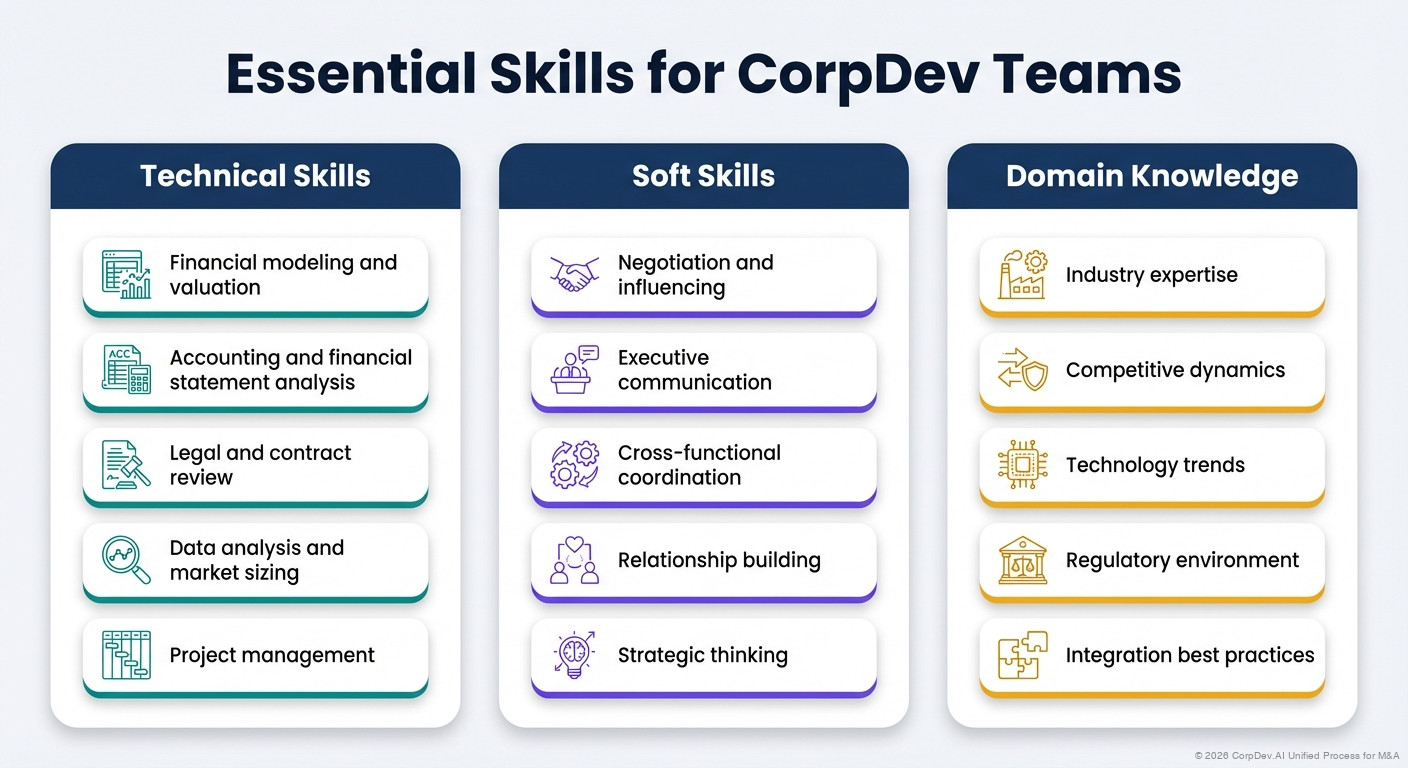 Financial modeling and valuation ↗Accounting and financial analysis ↗Legal and contract review ↗Data analysis and market sizing ↗Project management ↗Negotiation and influencing ↗Executive communication ↗Cross-functional coordination ↗Relationship building ↗Strategic thinking ↗Industry expertise ↗Competitive dynamics ↗Technology trends ↗Regulatory environment ↗Integration best practices ↗
Text links for this illustration
- Financial modeling and valuation
- Accounting and financial analysis
- Legal and contract review
- Data analysis and market sizing
- Project management
- Negotiation and influencing
- Executive communication
- Cross-functional coordination
- Relationship building
- Strategic thinking
- Industry expertise
- Competitive dynamics
- Technology trends
- Regulatory environment
- Integration best practices
Choose where the team sits and what the center keeps
Three models work. The table shows where each one fits, what the central team keeps, and the failure to guard against.
| Model | Where it fits | What the central team owns | Failure to prevent |
|---|---|---|---|
| Central team | Shared investment priorities and a manageable number of businesses to work with | Coordinating deal sourcing, running transactions, investment standards, and portfolio reporting | A technically strong deal team out of touch with how the businesses run |
| Center with business-unit partners | Several businesses or regions that need local knowledge | The link to capital allocation, common evidence standards, specialist resources, and escalation | Business units using different definitions or chasing the same target |
| Embedded teams with central rules | Distinct portfolios with real local autonomy | Reserved decisions, capital policy, quality review, and company-wide risk oversight | Split authority, inconsistent underwriting, and duplicated outreach |
Where people sit is separate from what they can decide. An embedded deal lead may report to a business leader and still need central approval to commit capital. Write that relationship into the charter.
Define the six core roles by what each owns
Head of Corporate Development. Owns the deal agenda, executive relationships, investment recommendations, negotiation strategy, talent, and the quality of the decision process. The role needs enough standing to challenge a weakly supported deal, including one backed by an influential executive.
VP or senior deal leader. Leads complex or strategically important processes, manages senior counterparts, resolves conflicts between workstreams, and develops deal leads. A real VP mandate goes well beyond producing analysis or managing a data room.
Director or deal lead. Owns a deal from screening to closing: the diligence plan, the model, committee materials, advisers, and negotiation preparation. A good director can explain how each significant finding changes the price, the terms, the delivery plan, or the decision to proceed.
Manager or senior associate. Owns substantial analysis and execution workstreams, pulls findings together, maintains the evidence, and develops recommendations. Give the role real substance; an administrative traffic controller wastes it.
Associate and analyst. Build market maps, check financial information, maintain models and target records, test assumptions, and prepare decision materials. An associate hired from banking and an entry-level analyst differ in scope and pay, so set each separately.
Integration leader. Tests the proposed operating model and resource needs before the binding approval, coordinates readiness, and keeps the delivery plan. The leader of the receiving business owns the operating result; the integration leader coordinates but cannot take on that accountability.
Get named commitments from the functions
The core CorpDev headcount is only part of the team. Named leads from these functions need explicit time and an escalation route:
- FP&A, accounting, treasury, and tax
- Legal, HR, and information security
- Technology and operations
Add commercial, regulatory, environmental, or technical specialists when the thesis requires them.
For each function, agree four things: who leads, when they join, what they must check, and who can accept a risk that stays open. Confirm their time before granting exclusivity or accepting a compressed auction timetable. A list of names is not a resource commitment.
Use external advisers for specialist expertise, independent challenge, market access, or peak workload. Keep the recommendation, the model assumptions, and the decision record inside the company. High fees and strong credentials do not transfer accountability for the investment.
Size the team for overlapping work
Keep a rolling view of demand across five kinds of work: sourcing, live deals, integration, portfolio oversight, and running the function. Model deal types separately. A domestic tuck-in and a multi-country carve-out can need very different effort at similar prices.
The table gives the capacity question for each kind of work and the staffing response.
| Workstream | Capacity question | Staffing response |
|---|---|---|
| Sourcing | Which priority themes lack informed coverage and relationships? | Give each sector an owner and protect time for sourcing |
| Live deals | How many processes overlap, and where do the critical deadlines fall? | Name a lead and analytical support; reserve specialist time |
| Integration | Which businesses are still absorbing earlier acquisitions? | Fund integration leaders and delivery resources in the functions |
| Portfolio oversight | Who keeps the original case and checks performance against it? | Pair finance with the receiving business and CorpDev |
| Running the function | Who handles hiring, committee preparation, tools, and standards? | Budget for it explicitly rather than counting on spare time |
Revisit the plan whenever a deal enters exclusivity, changes scope, or requires a substantial remedy. If capacity falls short, change the order of work or add people before quality slips.
Turn the deal calendar into a workload model
A capacity plan built from headcount misses how work actually arrives: by deal stage. Confirmatory diligence on one deal and Day 1 planning on another can land on the same director in the same quarter. A workload model built from the pipeline shows that crunch a quarter ahead.
An abridged, hypothetical excerpt for the peak quarter:
| Q3 task | Role | Hours | Review or decision required |
|---|---|---|---|
| Refresh market maps for two themes | Associate | 60 | Check sources and market coverage |
| Diligence request list, Deal B | Director | 25 | Confirm questions follow the thesis and received materials |
| Walk-away price, Deal B | Head | 30 | Agree the valuation ceiling and negotiation authority |
| Day 1 operating model, Deal A | Integration leader | 80 | Obtain commitments from the receiving business |
In this hypothetical team, the full model totals 1,150 director hours in Q3 against 800 available.
That 350-hour director shortfall is the decision the plan has to answer: add capacity, bring in advisers for a defined scope, or change the sequence of deals. Include supervision and review in the workload estimate.
Choose the reporting line that gives access to decisions
Reporting to the CEO, the CFO, or the head of strategy can each work. Three things matter more than the box on the chart: access to the capital decision, authority to coordinate across businesses, and a sponsor willing to settle conflicts.
Agree direct access to the executive sponsor on major decisions, a working relationship with the CFO on underwriting, and a route to the board through normal governance. A prestigious reporting line cannot make up for unclear responsibilities.
Pay for the talent the mandate needs
Budget for the people the mandate requires. A large company's function competes for experienced bankers, investors, operators, and M&A leaders, so compare the whole package:
- Base salary
- Target cash bonus
- Recurring long-term awards
- Pay the candidate gives up by leaving their current employer
Never benchmark a global head of the function against a manager at a small company, and never merge analyst and associate pay into one range.
Use specific evidence, not a universal salary grid
The two data points below are specific observations. They are not recommended ceilings or a market-wide survey. Amounts are US dollars. Sources were checked on September 13, 2026.
| Observation | Base salary | Other compensation | How to use it |
|---|---|---|---|
| Salesforce, San Francisco/New York pay band for a Corporate Development Senior Manager in data and AI transformation; July 2026 posting | $180,200–$247,900 | Posting excludes bonus, equity, and benefits from the base range | A senior-manager operations role; not a benchmark for a VP or enterprise function head |
| Charles Aris 2025 private equity compensation report: Head of Corporate Development at a $4.7B business-services portfolio company | $450,000 | $300,000 bonus and $750,000 total cash; report also lists a $500,000 sign-on payment | A specific senior hiring observation demonstrating why base alone understates package economics; not a public-company median |
The employer range is published by Salesforce Careers. The senior placement observation is in the Charles Aris 2025 report. Review the current Charles Aris reports and gather fresh, role-matched evidence for a live search.
For a global head, SVP, or C-suite role, commission an executive pay comparison. It should reflect the company's scale, deal complexity, reporting access, sector, geography, and long-term incentives. A published job-posting maximum does not tell you the most you may need to pay to hire an exceptional leader.
Compare packages on the same basis
Break every package into the same five parts:
- Base: fixed annual salary, with location and currency stated.
- Annual bonus: target and maximum, performance measures, payout timing, and whether any first-year amount is guaranteed.
- Long-term awards: annual grant value and type, vesting, performance conditions, liquidity, refresh policy, and downside. Grant-date value is not income received.
- Joining awards: sign-on cash, replacement equity, forfeited bonus, and repayment terms. Keep one-time awards separate from recurring pay.
- Other economics: retirement, benefits, relocation, severance, and any restrictive terms, reviewed by the relevant specialists.
Compare recurring target pay, first-year pay, and potential realized outcomes separately. A large one-time award can hide an uncompetitive ongoing package.
Reward good decisions, including walking away
Keep the number of closed deals from becoming the main incentive. Reward disciplined decisions, including justified withdrawals, alongside sourcing quality, execution, team development, and post-closing results the person can influence.
Do not assume a deal bonus is standard. In its 2026 commentary on offers observed in 2025, Charles Aris reports deal bonuses in 11% of its sample and long-term incentives in 68%. This is offer data seen by one recruiter, not the whole market. See Charles Aris’s report discussion.
Hire for judgment shown on real problems
Ask senior candidates about three things: a deal they stopped, an assumption they changed after diligence, and a post-closing result that differed from the case. Listen for a clear line between what they personally owned and what the team achieved.
Use a realistic, time-limited case exercise: a short target brief, incomplete data, conflicting strategic goals, and limited integration capacity. Score the questions they ask, their priorities, their recommendation, and how they communicate it, as well as the model. Never ask candidates to bring confidential work from a previous employer.
Keep people and what they know
Give each professional real ownership, a path to more responsibility, and time with business leaders. Where it suits them, open routes into integration, strategy, or operating roles.
Keep deal retrospectives, approved investment cases, source-linked models, negotiation lessons, and handover records in the company's controlled workspace. The function should keep its knowledge when a person leaves.
Show leadership the trade-offs in the team design
The staffing proposal should state:
- The mandate and the organization model
- Each role's accountabilities and each function's commitments
- Capacity assumptions and the total compensation budget
- The outputs expected in the next year
Name the work that will be dropped if the request is cut. That makes the trade-off visible to leadership, instead of quietly turning it into delivery risk.
Continue with building the CorpDev function, M&A team roles, and roles and responsibilities.
© 2026 CorpDev.Ai Unified Process for M&A