
Roles & Responsibilities in M&A
The most costly staffing mistake in M&A is giving someone responsibility without the authority or the capacity to deliver. A deal lead can coordinate diligence. A deal lead cannot promise a business unit's sales capacity, approve a legal risk, or deliver a technology migration on another executive's behalf.
Use this guide when forming a deal team or resetting how CorpDev works with the rest of the company. The output is an agreed responsibility map, named commitments, and a handover that survives closing. For each role, name the actual person and their delegated authority; titles come second.
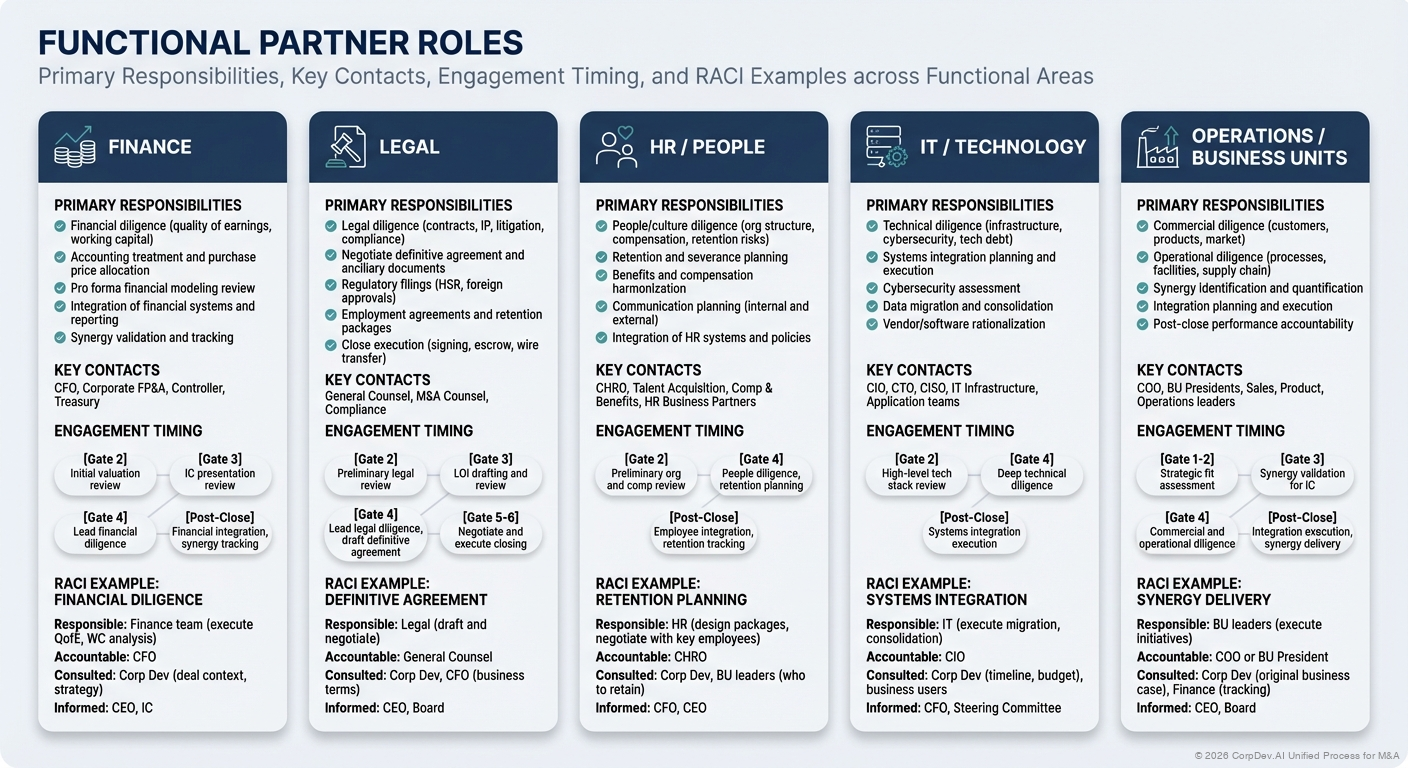 Finance: financial judgment and validation ↗Legal: authority and transaction commitments ↗HR and people: resource and retention commitments ↗Technology: integration responsibilities ↗Business unit: accountable value delivery ↗
Separate four kinds of accountability
Investment sponsorship. A business executive owns the strategic need and the operating result. The sponsor explains what the business will do differently, commits resources, and places the acquired business in a defined management structure.
Deal leadership. The CorpDev deal lead owns the overall process, the recommendation, negotiation coordination, and the decision record. This person connects evidence across workstreams and escalates contradictions.
Specialist judgment. Finance, Legal, Technology, HR, Tax, Security, and other specialists own the conclusions in their fields. An adviser's report informs that judgment, but an internal owner still makes it.
Investment authority. The authorized executive, committee, or board decides the capital commitment and accepts the remaining risk, within company policy. Running the project gives no one permission to bind the company.
An integration leader links these four before signing and runs the cross-functional plan after closing. The leader of the receiving business stays accountable for operating results.
Agree the responsibility map before diligence expands
This example is a starting point; adapt it to the company's actual delegation of authority. Each decision or deliverable has exactly one accountable owner, though many people can do the work.
| Decision or deliverable | Accountable owner | Does the work | Must challenge or be consulted |
|---|---|---|---|
| Strategic need and alternatives | Business sponsor | Strategy and CorpDev | Finance, relevant operating leaders |
| Integrated deal recommendation | CorpDev deal lead | Workstream leads | Business sponsor, Finance, Legal |
| Standalone forecast and adjustments | Designated Finance lead | Target finance, advisers, business finance | Controller and commercial owner |
| Customer and market thesis | Commercial or business leader | Commercial diligence team | Finance and product leadership |
| Technology and security conclusions | Designated technology executive | Engineering, IT, Security | Integration lead, Legal |
| Legal terms and legal-risk analysis | General Counsel's delegate | Internal and external counsel | Deal lead and functional owners |
| Integration operating model | Receiving business leader | Integration lead and functions | CorpDev, Finance, target leadership when permitted |
| Investment and signing authority | Authorized decision body | Executive sponsors | As the company's approval policy requires |
| Closing readiness recommendation | Designated closing coordinator | Legal, Treasury, Finance, integration | Authorized closing signatories |
| Benefits validation | Finance controller | Initiative owners and business finance | Integration lead |
Where Security or another function has its own approval requirement, record it explicitly. Never bury a mandatory sign-off inside a broad "consulted" category.
Choose a structure for the work you actually face
Each structure solves one problem and creates another. The right-hand column is the control that keeps the new problem small.
| Structure | What it offers | How it fails | Control |
|---|---|---|---|
| Central CorpDev team | Consistency, deal experience, and a portfolio view | Loses touch with the business that must run the asset | Require business sponsorship and functional ownership early |
| Hybrid: a central deal team plus sourcing or strategy leaders embedded in the businesses | Better sector knowledge and access | Duplicate outreach and competing deal priorities | One relationship owner per target and a common capital allocation process |
| Decentralized: more authority with business units | Decisions made close to each business | Inconsistent underwriting and weak portfolio coordination | Common definitions for approval, capital measurement, legal commitments, and post-closing reporting |
Never size the team on revenue alone. Look at:
- Overlapping processes and deal complexity
- Geography and seller readiness
- Integration intensity and internal capabilities
- How much work is outsourced
A small acquisition with a difficult systems separation can use more scarce capacity than a much larger standalone business.
Turn functional involvement into a written resource commitment
Before agreeing to an external timetable, get a written commitment from each significant workstream. The form captures what meeting invitations leave out: named people, their availability, and the dates the function cannot support.
FUNCTIONAL COMMITMENT: deal / workstream / date
Accountable executive:
Workstream lead and deputy:
Decisions and deliverables owned:
Named contributors and time available:
Information needed / access restrictions:
Adviser scope and budget owner:
Dependencies on other workstreams:
Conflicts with day-to-day work:
Dates we cannot support:
Escalation contact and expected response time:
How completion will be shown:
The executive who signs must control the resources named. A meeting invitation is not a resource commitment. Revisit the form when diligence uncovers new scope or the seller speeds up the process. For the map and these forms, names, availability, and responsibilities are enough; leave compensation details and performance assessments out.
Check who owns decisions between workstreams
Test the responsibility map against a finding that changes the price, a shortened signing timetable, and a customer issue after closing. Confirm who investigates, who recommends a response, and who can approve it. Resolve gaps and conflicting owners with the relevant executives. Check the full delegation policy before treating an apparent gap as missing authority.
Use advisers without outsourcing the decision
Give every adviser a written scope that ties their work to the thesis and the decision. Specify priority questions, the evidence expected, exclusions, access, deliverable format, and how findings must be escalated.
Ask the adviser to separate observed facts, management statements, estimates, and the limits of their work. Alongside the technical detail, ask for a short summary focused on the decision: which assumptions change, what needs more testing, and what could affect price, terms, integration, or the recommendation.
The internal workstream owner accepts the deliverable and records any gaps left open. "The adviser was comfortable" is not a usable conclusion unless you know the adviser's scope and assumptions.
Settle disagreements at the right level
Open an escalation record for each dispute. It holds:
- The disputed assumption and each position
- The supporting evidence
- The financial and operating consequences
- The deadline and the authorized decision-maker
Escalate a judgment the parties cannot reconcile. Never keep recirculating the same issue until the timetable decides by default.
Suppose the commercial team expects to cross-sell before the product integration is ready. The technology and commercial leaders must agree a launch sequence that can work, and CorpDev reflects it in the recommendation. If they cannot agree, the sponsor or authorized executive decides, with the economic impact in plain view.
Tell a factual dispute apart from a decision to accept risk. More analysis can fill a gap in the evidence. It cannot remove a deliberate choice to accept uncertainty.
Make closing a transfer of ownership
Start the handover during diligence. The integration leader should inherit the reasoning behind the plan, not only the final presentation.
The receiving business signs off on:
- The operating model, reporting lines, and decisions reserved for later.
- The approved baseline and the assumptions still awaiting validation.
- Commitments made to the seller, employees, customers, and regulators.
- Outstanding diligence issues, contractual protections, and follow-up dates.
- Funded initiatives, resource availability, dependencies, and benefit definitions.
- Finance's reporting process, and who explains future variances.
Before closing, compare the diligence issue register and the seller's commitments with the receiving business's plan. List every obligation that has no post-closing owner or no test for completion.
CorpDev keeps the investment record and takes part in reviews, without becoming the permanent owner of every integration task. Equally, the business must not discard the approved baseline once the acquisition enters its annual plan.
Catch five failure patterns early
Each pattern below is easy to spot early and expensive to fix late.
| Warning sign | Fix |
|---|---|
| A sponsor with no receiving organization | Require the management destination and operating model before approval |
| Every senior executive listed as accountable | Choose the one person responsible for the deliverable, and name the investment authority separately |
| Attendance at meetings taken as agreement | Get written conclusions and open issues from workstream leads |
| Integration handed off after signing | Appoint the integration leader while the design can still influence price and terms |
| Advisers working only through CorpDev | Set up direct links with each workstream, with controlled access and a shared issue process |
Review the map at each major approval gate. For the governance around it, see approval gates and meeting cadence.
© 2026 CorpDev.Ai Unified Process for M&A