
M&A Strategy Development
An M&A strategy defines what kinds of companies you should buy, why they would be worth more to you than to anyone else, what you can afford to pay, and how many deals your organization can absorb at once. A good strategy is as useful for saying no as for saying yes.
Test it with one question: could a business leader apply it to a company they have never seen and reach a sound first decision? If not, it is still a list of ambitions. "Expand internationally" and "acquire technology" are starting points. A usable strategy names the gap, the kind of company that fills it, and the evidence that would prove the idea wrong.
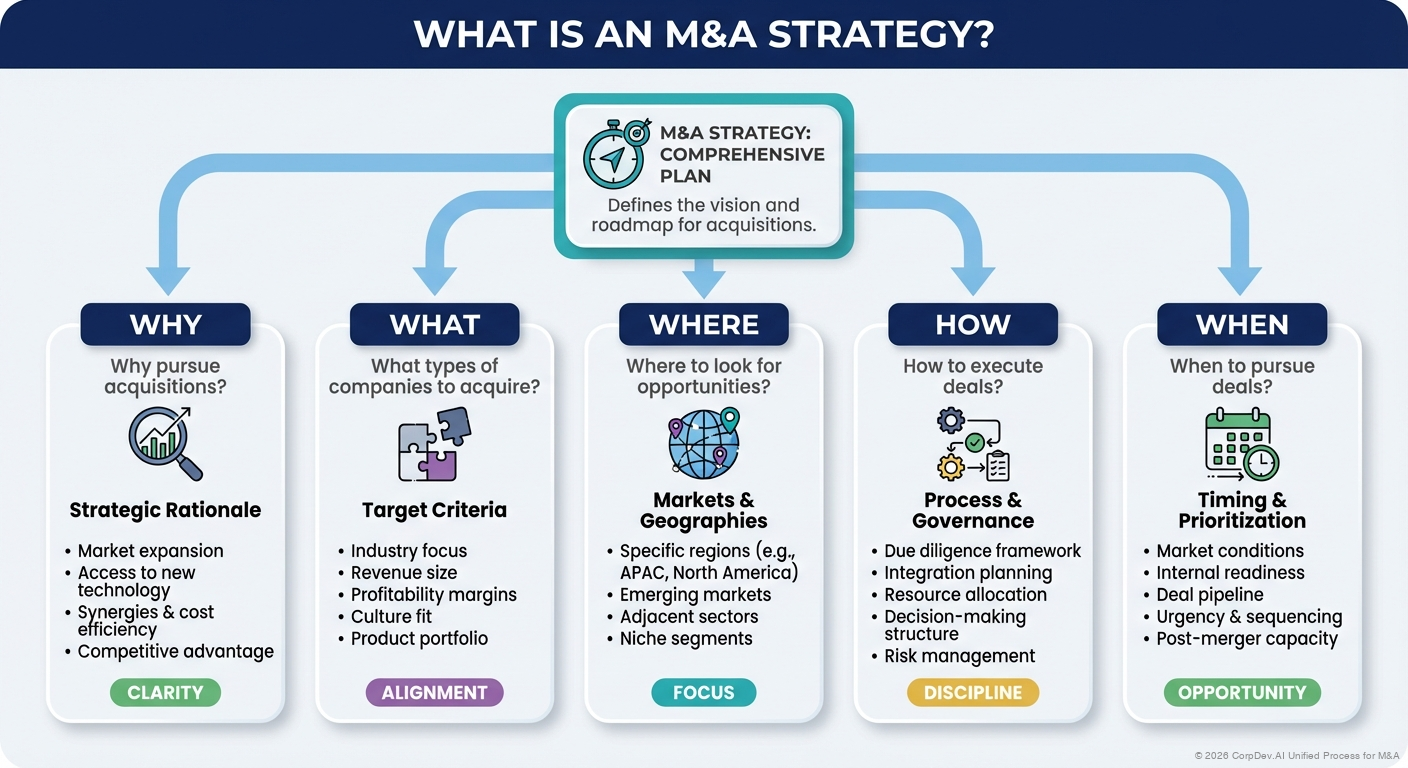 Write an investable M&A thesis ↗Why: strategic rationale ↗What: target criteria ↗Where: markets and geographies ↗How: process and governance ↗When: integration capacity and priorities ↗
Start with the gap in the business plan
Every acquisition theme should trace back to a specific gap: a product customers keep asking for, a region you cannot reach, capacity you lack, or a cost position that loses bids. Describe the gap before you describe any company.
Then set the baseline. What happens if the company simply delivers its current, funded plan? An acquisition has to beat that plan, not a standstill.
Ask the business leader for evidence the company already holds:
- Lost bids and the reasons customers gave
- Customer interviews and product roadmap constraints
- Capacity, channel, and cost data
- Returns on similar past investments
Finally, separate urgency from preference. A customer contract with a delivery date creates a real deadline; a wish to grow faster does not. And do not assume buying is quicker than building. Diligence, approvals, integration, and customer migration all take time.
Compare buying with every other way to close the gap
For each gap, compare the routes against the same goal: build, buy, partner, license, take a minority stake, or wait. The comparison is only fair if every route is costed with the same care. Never set a fully modeled acquisition against an unfunded internal idea.
The table below shows who should answer each question. CorpDev coordinates the answers; it should not supply all of them.
| Question | Evidence to request | Who answers |
|---|---|---|
| What exactly do we need? | Customer requirements and acceptance criteria | Business or product leader |
| By when does it matter? | Demand milestones and the cost of delay | Business sponsor |
| Could we build it? | Costed roadmap, hiring needs, dependencies, and delivery risks | Engineering or operations |
| Could a partner supply it? | Commercial terms, service levels, control limits, and exit options | Business development and counsel |
| Why own it rather than contract for it? | Additional cash flow, control benefits, and integration demands | CorpDev and finance |
| Can we carry it out? | Named leaders, the change calendar, and constrained resources | Integration leader and functional executives |
The output is short: the preferred route, the strongest alternative, and what would make leadership switch.
Choose the acquisition approach
Choose both how you will acquire and why the acquisitions create value. These are related choices, but the labels describe different things. Programmatic M&A describes a sustained, repeatable acquisition approach. A roll-up describes a consolidation strategy. A roll-up can be programmatic, and a programmatic buyer can pursue capabilities instead of consolidation.
Use this comparison to identify the work each approach requires. These are practical distinctions, not mutually exclusive categories or a ranking of expected returns.
| Approach | When it fits | What must be in place | Main failure to test |
|---|---|---|---|
| Selective acquisitions | A specific business gap can be closed with an occasional deal | A clear thesis and an integration plan for that target | An available company shapes the strategy after the fact |
| Programmatic M&A | A series of acquisitions can build a defined business or capability over time | Continuous sourcing, repeatable diligence, funding, integration capacity, and learning across deals | Deal volume grows faster than delivery capacity |
| Roll-up / sector consolidation | Combining businesses in a fragmented market can improve their economics or customer offering | An evidenced consolidation thesis and a workable approach to local and shared operations | The group gets bigger without improving retention, margins, or cash flow |
| Buy-and-build | A platform business can support successive add-ons that extend its offering or reach | A platform with management depth, systems, and resources to absorb additions | The platform cannot support the businesses it buys |
| Transformational acquisition | One major deal can change the company's position or business mix | Leadership capacity, a credible combined operating model, and funding for the downside | Too much of the strategy depends on one difficult integration |
A bolt-on adds to an existing business. A tuck-in usually implies closer absorption into its operations. Either can be a selective deal or part of a larger program. Decide the actual integration scope rather than relying on the label.
Match the deal to its source of value
The acquisition approach needs a specific value thesis. A program of software acquisitions and a program of distribution acquisitions may require very different target criteria.
| Value thesis | What the buyer seeks | Evidence that matters |
|---|---|---|
| Horizontal scale or consolidation | Combine businesses serving similar markets | Customer retention, achievable cost reductions, and capacity to combine operations |
| Capability or product expansion | Add technology, expertise, or a missing product | Customer demand, technical fit, and retention of the people who deliver the capability |
| Geographic or customer expansion | Reach a new region, channel, or customer group | Local demand, customer access, and the cost of serving the new market |
| Vertical integration | Own a supplier or distributor to improve supply, quality, or service | Benefits of control compared with a contract, plus the cost of running that activity |
| Diversification or portfolio reshaping | Establish a different business mix | A specific contribution from this parent and leaders qualified to run the acquired business |
| Turnaround or distressed acquisition | Restore a troubled business or acquire usable assets | A funded recovery plan, credible diagnosis, and specialist review of liabilities |
Have counsel assess competition and other regulatory constraints early, especially where consolidation or vertical integration is central to the thesis. A larger market share is not enough to establish either value or feasibility.
Build programmatic M&A around repeatable work
Programmatic M&A builds a business through connected acquisitions, sometimes alongside internal development. McKinsey emphasizes building the business or capability rather than meeting a deal quota. See its guide to programmatic M&A.
For your program, define the target universe and the contribution each acquisition must make. Maintain relationships before businesses come up for sale. Reuse the diligence questions that recur, while adapting the integration plan to what gives each target its value.
Fund the team and operating improvements needed between deals. Review acquired businesses against the original investment cases, then change screening criteria when a pattern emerges. Repeated acquisitions exposed to the same customers or technology can share the same downside.
Set explicit conditions for slowing or pausing the program: unresolved customer losses, unfinished migrations, inadequate funding, or no available integration leader. The next acquisition should follow evidence and capacity. Use the Programmatic M&A handbook for the full operating approach.
Prove the roll-up works after closing
A roll-up brings multiple businesses in a fragmented sector under common ownership. Buy-and-build often starts with a platform and adds businesses around it; those additions may expand capabilities as well as consolidate competitors.
Write down what improves because the businesses are together. Examples include denser service coverage, shared procurement, broader customer offerings, or better scheduling. Decide which operations become common and which retain local autonomy. A decentralized group still needs reliable reporting and clear accountability.
Bain's Building a Stronger Buy-and-Build emphasizes organic growth and margin improvement. It cautions against relying on multiple arbitrage: buying smaller businesses at lower valuation multiples and expecting a higher multiple for the combined group.
Before buying the platform or approving another add-on, answer four questions:
- Can the platform operate well without further acquisitions, and can its leadership support the proposed additions?
- Are enough suitable targets available at prices the investment case can support?
- Do the benefits survive customer losses, integration spending, and the cost of shared services?
- Does the funding plan hold if the next acquisition is delayed and the eventual valuation multiple is lower than expected?
For an AI-enabled roll-up, test proposed workflow changes in a pilot before including the benefits in the purchase case. Include implementation, supervision, and ongoing operating costs. Track released staff capacity separately from cash savings; savings require an actual spending change.
Consider a hypothetical group buying regional maintenance providers. Acquired revenue increases immediately, but the thesis depends on reducing travel time through shared scheduling. If customers insist on dedicated local teams, the expected efficiency may disappear. Revise the integration plan and price before using the same assumption for the next target.
See portfolio economics and integration across an acquisition program for the next tests.
Write one thesis for each source of value
A thesis explains why a certain kind of acquisition would create value for your company. Write one for each distinct source of value. Buying a capability and consolidating a competitor can happen in the same sector, but they need different target screens and different integration plans.
A complete thesis answers ten questions:
- Objective: Which measurable business outcome will improve, and which executive owns it?
- Why own: What does owning the business allow that a partnership or internal build cannot?
- Target profile: Which capabilities, customers, business quality, and footprint must a target have?
- Exclusions: Which features rule a company out, even if it looks attractive?
- Source of value: Which actions produce the additional cash flow, and when?
- Evidence plan: What must the team confirm to advance, and what remains untested?
- Integration approach: What will you combine, keep separate, or leave alone, and why?
- Capital and capacity: What will the purchase, the integration, and leadership time cost?
- Stop signals: Which findings would make you walk away or change course?
- Review trigger: Which change in strategy, economics, or competition reopens the thesis?
Keep fit separate from availability. A motivated seller does not make a weak fit stronger. A strong fit that is not for sale is still valuable market intelligence.
Set financial guardrails before the first deal
Finance sets the rules every deal team uses: how to treat taxes, working capital, capital expenditure, integration costs, financing, and terminal value, and which return the company requires. Use enterprise value or equity value consistently throughout.
One test keeps the discussion honest:
Value to the buyer = standalone value of the target + present value of the benefits only you can create − price paid − present value of transaction and integration costs.
If the result is negative, calling the deal "strategic" does not change it. Leadership can still choose to proceed, but that is a separate decision that needs its own explicit justification.
Two cautions apply. First, do not count a benefit that is already in the target's standalone value. Second, if you describe the price as a premium over standalone value, the deal creates value only when the benefits exceed the premium plus the costs.
Build downside cases around what could actually go wrong with this thesis. For a product acquisition, test slower adoption, engineering delays, and departures of key staff. For a consolidation, test customer losses, overhead that cannot be removed, and delayed site closures. Show whether the company could afford the downside, not only whether the expected return clears the hurdle.
Limit the portfolio to what you can integrate
Several attractive deals can add up to an impossible workload. Map what each one demands from the same leaders, systems, customers, and budget. Look for collisions, such as two deals that both depend on the same ERP program, sales reorganization, or product architecture decision.
Rank opportunities by the value they offer and by the scarce capacity they consume. Sequencing often matters more than adding another target. Name the executive who can free up constrained resources, and write down which existing work will slip if a new deal goes ahead.
Example: a thesis that changed under testing
This example is hypothetical. It illustrates the method, not an industry benchmark.
An industrial company wants to offer remote diagnostics across its installed base of machines. The first idea is to buy a software company whose product looks mature.
Two findings change the picture. The product leader discovers that older machines need hardware changes before the software can run. Commercial research shows that customers want guaranteed uptime, not another software subscription.
The acquisition may still make sense, but "sell software to the installed base" no longer describes the job. The revised decision compares buying the platform with licensing it for a service pilot. It includes retrofit costs, service obligations, data access, and the service skills the company would need. The thesis goes forward only if the business sponsor accepts those costs and customer evidence supports the service model.
Test how the strategy could fail
A pre-mortem imagines the acquisition strategy has failed and works backward to the causes. Tailor it to the approach. A roll-up may fail because the shared operating model damages local customer relationships. A capability acquisition may fail because its key people leave.
Run it with the business sponsor, the integration lead, and finance in the room. Take the five most plausible failures and give each one the assumption it would break, an early warning someone could actually observe, a test you could run before committing, and a stop condition. Keep risks that belong to a single acquisition apart from risks shared across the program. Include the deals you have already closed, so a dependency the next one would repeat shows up.
A hypothetical example:
| Failure path | Early warning | Test before committing |
|---|---|---|
| Roll-up centralizes scheduling and loses local customers | Customers reject shared service arrangements | Test the proposed service model with representative customers |
| Programmatic buyer overloads the migration team | Completed deals accumulate unfinished migrations | Review named resources and completion dates before adding another deal |
| Product acquisition loses critical expertise | Key staff reject the proposed roles | Agree the operating model and retention approach before approval |
Have the business sponsor assess whether each failure path is credible. Check the cited assumptions against the actual plan. An imaginative story is useful only if it points to a test or changes a decision.
Carry the accepted warning signs into screening and investment reviews. Use shared risks to change the program's pace or scope, and target-specific risks to revise diligence or integration. Keep the original assumptions so later reviews can distinguish a flawed strategy from poor delivery.
Build the strategy into everyday deal decisions
Turn each approved thesis into screening criteria and a one-page decision memo. When an opportunity falls outside the strategy, require a written exception explaining why the strategy should change. Never quietly relabel a target so that it fits.
At each strategy review, examine the deals you did and the deals you declined. Ask whether mistakes came from the thesis, the choice of target, the price, or execution. Keep the original thesis on file so changes stay visible. Rewriting history to match outcomes stops the team from learning.
For a sustained acquisition program, see the Programmatic M&A handbook.
Continue with building an M&A pipeline, strategic rationale, and approval gates.
© 2026 CorpDev.Ai Unified Process for M&A