
Business Case Development for M&A
The business case turns the deal thesis into an investment decision. It shows what the buyer pays, what it gets in cash flows and capabilities, and what further investment it must make. It then compares that result with the next-best use of the money. Every number in it should trace to a source a reviewer can check.
The CorpDev deal lead pulls the recommendation together. Finance owns the method and the reconciliations. Business and functional leaders own the operating assumptions. A good model shows where these people disagree instead of hiding the disagreement inside a blended forecast.
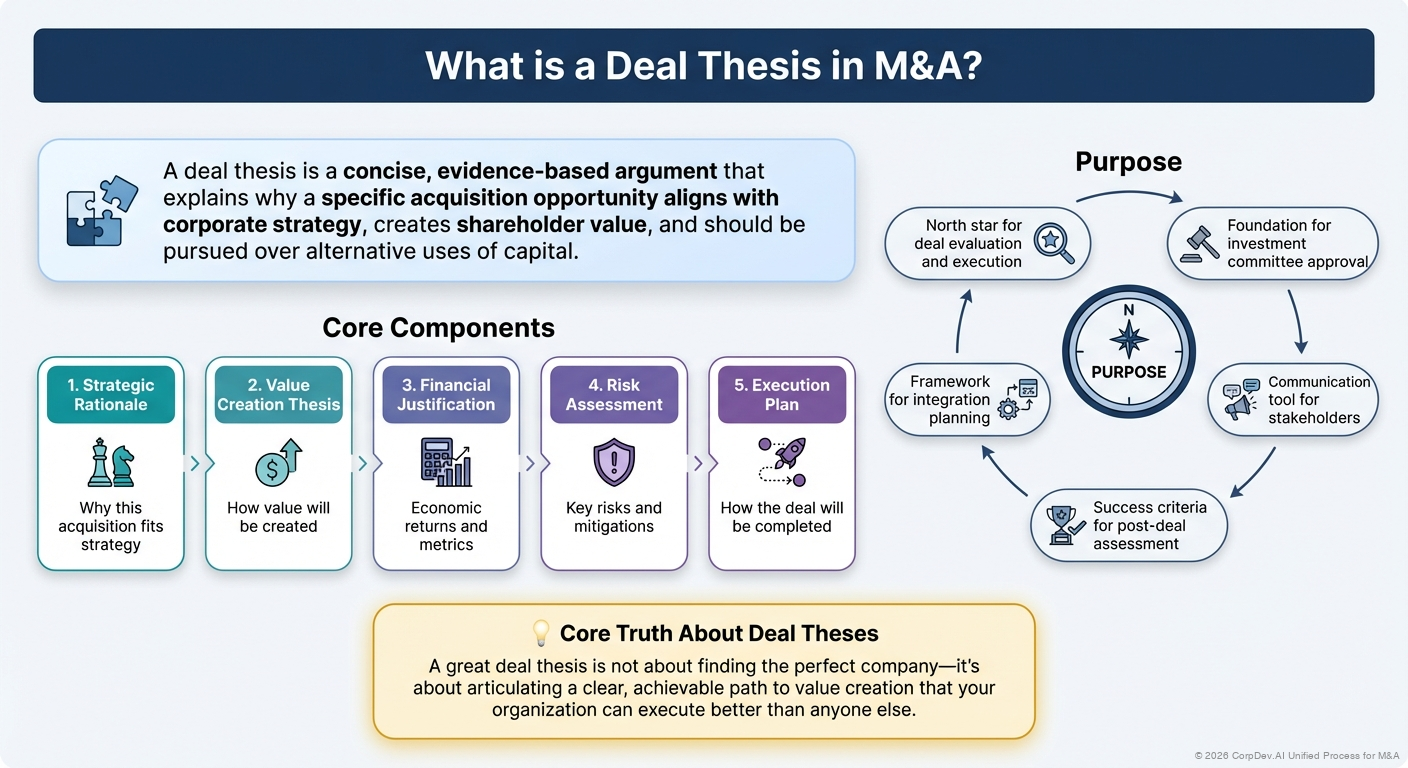 Deal thesis: an evidence-based investment argument ↗Strategic rationale ↗Value creation thesis ↗Financial justification ↗Risk assessment ↗Execution plan ↗Guide evaluation and execution ↗Investment committee approval ↗Stakeholder communication ↗Post-deal success criteria ↗Integration planning ↗Purpose of a deal thesis ↗An achievable path to value creation ↗
Text links for this illustration
- Deal thesis: an evidence-based investment argument
- Strategic rationale
- Value creation thesis
- Financial justification
- Risk assessment
- Execution plan
- Guide evaluation and execution
- Investment committee approval
- Stakeholder communication
- Post-deal success criteria
- Integration planning
- Purpose of a deal thesis
- An achievable path to value creation
Define the investment before calculating returns
Write down exactly what is being bought:
- The perimeter, valuation date, and expected closing date
- The ownership stake, consideration, and currency
- The operating assumption behind the forecast
- Where relevant, excluded assets, retained liabilities, non-controlling interests, contingent payments, and continuing commercial arrangements
Pick one valuation basis and keep to it. An enterprise DCF uses operating cash flows and a matching enterprise discount rate. An equity return model uses cash flows to equity after financing. Never compare an equity IRR with an enterprise hurdle rate, and never subtract debt twice when moving between the two.
Finance should document how this deal treats leases, pensions, working capital, debt-like items, restricted cash, tax attributes, and acquisition costs. Calling an item "debt-like" does not settle how it affects value.
Rebuild the standalone business from reported results
Start with historical results reconciled to the financial statements and diligence findings. Then build a bridge from reported results to the operating baseline. Each adjustment needs evidence, an owner, and a reason why it will not recur or needs different treatment.
Challenge adjustments that remove necessary operating costs, assume savings nobody has made, or leave out recurring cash needs. A cost labeled "one-time" several years running deserves scrutiny. Keep the seller's adjustments separate from the ones the buyer accepts.
Build the forecast from what drives the business:
- Customers, volumes, pricing, and churn
- Capacity, staffing, and utilization
- Product investment, working capital, and capital expenditure
Treat management's plan as an input to test. Neither accept it as given nor cut it with an arbitrary blanket haircut.
Separate value only you can create from the standalone plan
Model each significant benefit through how it works and who owns it:
- Cost savings: start from the cost base the action can reach, then add the action, timing, replacement costs, and implementation spending.
- Revenue benefits: model the reachable customers, adoption, pricing, delivery cost, sales capacity, cannibalization, and working capital.
Distinguish benefits only this buyer can deliver from improvements any owner could make. Count each initiative once, never in the target's plan, the synergy schedule, and the terminal margin at the same time. Finance should reconcile the benefit schedules to the combined P&L, balance sheet, and cash flows.
One common way to define enterprise free cash flow:
Unlevered free cash flow = EBIT × (1 − applicable tax rate)
                        + depreciation and amortization
                        − capital expenditure
                        − change in operating working capital
Adjust it for the deal's actual tax position and other operating cash items. The formula is a starting point. It gives no permission to ignore tax losses, timing, or cash costs that accounting profit leaves out.
Reconcile price, funding, and value separately
Price, funding, and value answer different questions, so each gets its own bridge.
Enterprise value to equity value. Start with enterprise value, then apply the agreed cash, debt, working capital, and other adjustments to reach the equity consideration. Show which figures are estimates and which will be fixed at closing.
Sources and uses. Include the consideration, any debt repaid, fees, taxes, financing costs, and required funding. Mark which sources are committed, conditional, restricted, or only expected. Count the target's cash as a funding source only if it is actually available and the structure lets you use it.
Value to the buyer. Compare the value received, net of required costs and investment, with the price paid, on the same basis. A deal can be well financed and still destroy value.
Example: a good business at the wrong price
This example is hypothetical and uses enterprise value. All components are present values at the same date, in millions, with consistent operating and tax assumptions.
| Value bridge | $ millions |
|---|---|
| Standalone operating value | 400 |
| Incremental cost benefits | 90 |
| Incremental revenue contribution | 30 |
| Implementation and continuing incremental costs | (40) |
| Transaction costs | (10) |
| Net value to this buyer before purchase price | 470 |
| Proposed enterprise purchase price | (480) |
| Buyer net present value | (10) |
At this price and on these assumptions, the deal loses $10 million of value for the buyer. A persuasive strategic story or an accretive EPS calculation leaves that result unchanged. The team has five options: negotiate the price down, validate additional value, redesign the integration, accept a clearly explained strategic tradeoff under the company's policy, or stop.
The $470 million depends on the assumptions; it is not an objective fair price. Show sensitivities and the range of uncertainty before treating it as a negotiating limit.
Build scenarios around what could actually go wrong
Build three cases:
- Base case: the operating case the evidence supports.
- Upside: requires specific, identifiable additional success.
- Downside: combines plausible bad developments.
Add a no-synergy view when it helps show how much depends on the buyer's execution.
A downside might combine slower customer adoption, a delayed systems migration, higher retention costs, and a later close. Trace these through profit, cash, liquidity, debt metrics, and value. Never just cut revenue by a percentage while leaving staffing, capital needs, and implementation costs unchanged.
A sensitivity and a scenario do different jobs. A sensitivity changes one input to show how much value depends on it. A scenario changes a consistent set of assumptions together. Probabilities need judgment and support, and averaging the scenarios must never hide a severe downside.
Check the effects on the whole company separately
Specialists test what the deal does to the company as a whole. Each owns one part of that test:
| Who | What they test |
|---|---|
| Treasury | Funding, liquidity, refinancing, hedging, and headroom, using the relevant definitions |
| Controller | Purchase accounting and reporting |
| Tax | Cash taxes and restrictions specific to the structure |
| Receiving business | Whether the plan can be delivered alongside existing commitments |
Show EPS effects where relevant, including how adjusted and unadjusted measures are defined. Measure ROIC and cash returns on consistently defined invested capital. No single metric proves an investment is sound.
Record which conclusions rely on outside assessments, and the limits of each. A financing indication is not a commitment. Management's assumption about a credit rating is not a rating agency's conclusion.
Keep a one-page control sheet for the case
The control sheet lets a reviewer see what the case contains and what has been checked.
BUSINESS CASE: deal / model version / valuation date
Decision sought and investment basis:
Perimeter, ownership stake, currency, expected close:
Historical reconciliation and accepted adjustments:
Standalone forecast drivers and who owns each source:
Benefits, costs, timing, and dependencies:
Enterprise value to equity value bridge:
Sources and uses / committed funding / remaining conditions:
Valuation methods and why their results differ:
Base, upside, and downside cases; key sensitivities:
Liquidity, credit, EPS, ROIC, and cash effects:
Price limit and the assumptions it depends on:
Open evidence gaps / required decisions / conditions:
Model reviewer and reconciliation checks completed:
Review the model before presenting it
Have an independent reviewer test both the formulas and the business logic. Confirm that:
- Sources equal uses.
- Balance sheets balance.
- Cash flow ties to profit and balance sheet changes.
- Price and share counts match the proposed structure.
- No benefit is counted twice.
- Terminal assumptions are consistent with the investment and growth assumed.
Reconcile the model to every number in the investment memo and deck; the IC presentations guide shows how. Label units, dates, currencies, and forecast versus actual periods. Keep source links, and keep assumptions separate from calculations, so another qualified person can update the case without reverse-engineering it. Preserve the original model, and review any proposed edit before applying it.
Trace every number to its source and flag the orphans
A model review checks that the formulas work. It can pass while an input has no source at all. A churn rate may come from an old draft, a savings figure from a meeting, or a growth rate from a target that was never a forecast. An assumption register closes that gap. It lists every hard-coded input in the model and every number in the memo, with the document and page it came from.
A number with no source is an orphan. Each orphan is either missing diligence evidence or a judgment that needs an accountable owner. Trace inputs to source documents and label management assumptions explicitly.
A hypothetical example:
| Number | Where it appears | Source found | Status |
|---|---|---|---|
| Customer churn, 6% a year | Model, Assumptions!C14 | Quality-of-earnings report, p. 22, March | STALE: the April cohort file shows 9% |
| Procurement savings, $12 million | Model, Synergies!F8; memo, p. 3 | None | ORPHAN |
| Revenue growth, 12% a year | Model, Revenue!D5 | Management presentation, p. 11, labeled "ambition" | Sourced, but the source is a goal, not a forecast |
| Working capital release, $7 million | Model, Cash!E12 | Undated interview notes | Weak source: confirm with Finance |
Every orphan gets an owner and one of three outcomes. The owner finds the source, replaces the number with a sourced one, or relabels it as a management judgment signed by the person who made it. Stale numbers go back to the workstream that owns them. Finance still recalculates the model itself; the register shows where to look, not what the answer is.
The check that matters: open the cited page for every large number and a sample of the rest, and confirm it says what the register claims. A register with invented page references is worse than none.
Lock the approved case and put it to work
At approval, keep the model and its supporting assumptions exactly as approved. Move the benefit definitions, cost budgets, owners, and milestones into the value creation plan. Record any later change as a bridge from the approved case, and return for approval when the change requires it.
After closing, compare actual results and the current forecast with the original investment case. Reporting and metrics covers how to keep that discipline, and investment committee presentations covers how to present the decision.
© 2026 CorpDev.Ai Unified Process for M&A