
Approval Gates & Investment Process
An approval gate is a decision to make the next commitment: money, people, confidential information, or authority to negotiate. Each gate should produce a precise authorization with limits, conditions, and a record of the evidence the approvers saw. The most important thing to get right is that an approval covers specific economics. When the deal changes, the approval does not move with it.
The framework below has seven gates, from screening to post-close review. Adapt them to the type of transaction and the process. Your company's delegation of authority, governing documents, financing arrangements, and legal requirements decide who approves. There is no universal dollar threshold or percentage of market capitalization.
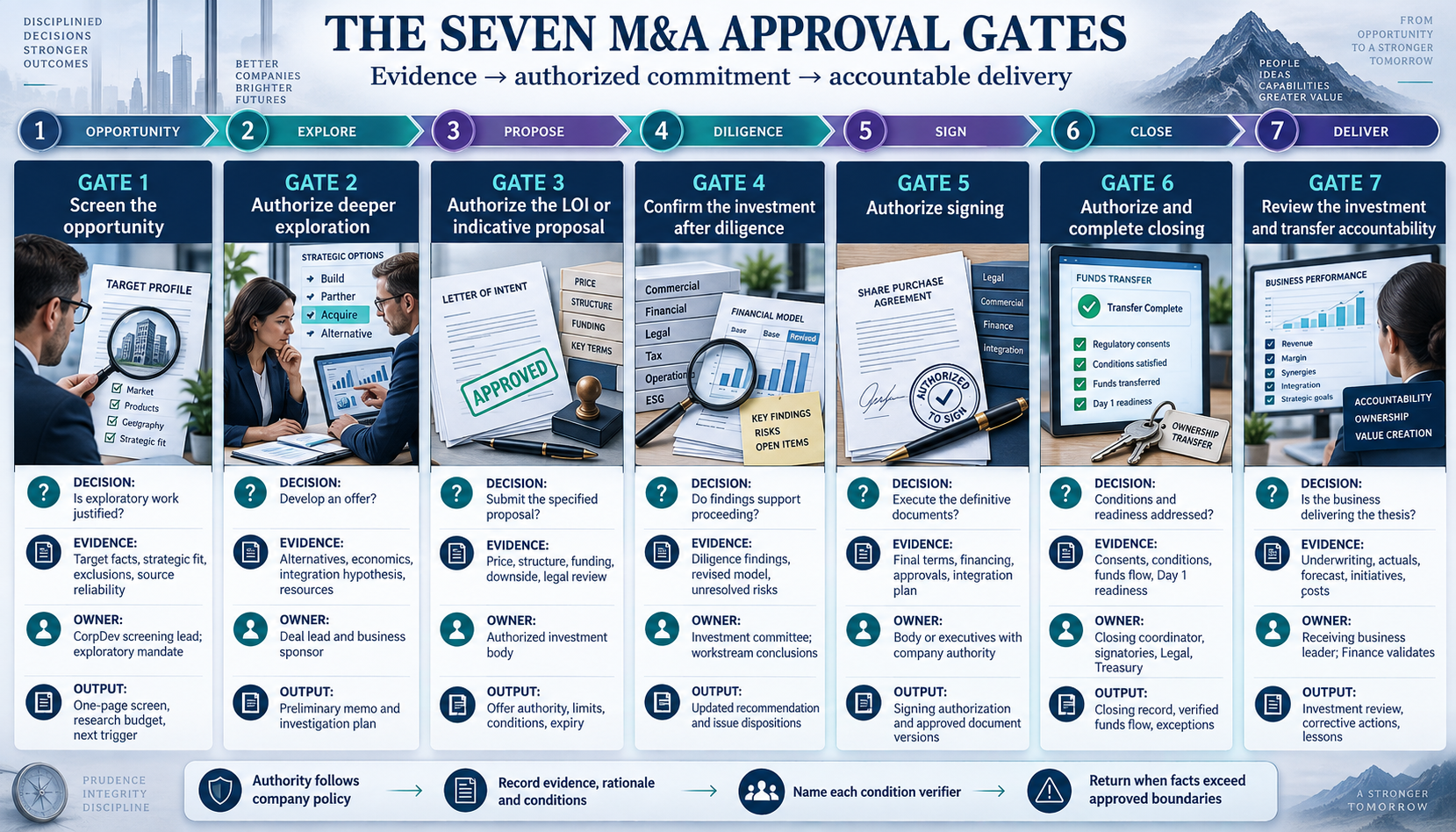 Gate 1: screen the opportunity ↗Open Gate 1: screen the opportunity ↗Gate 2: authorize deeper exploration ↗Open Gate 2: authorize deeper exploration ↗Gate 3: authorize the LOI or indicative proposal ↗Open Gate 3: authorize the LOI or indicative proposal ↗Gate 4: confirm the investment after diligence ↗Open Gate 4: confirm the investment after diligence ↗Gate 5: authorize signing ↗Open Gate 5: authorize signing ↗Gate 6: authorize and complete closing ↗Open Gate 6: authorize and complete closing ↗Gate 7: review the investment and transfer accountability ↗Open Gate 7: review the investment and transfer accountability ↗Authority follows company policy ↗Record evidence, rationale and conditions ↗Name each condition verifier ↗Return when facts exceed approved boundaries ↗
Text links for this illustration
- Gate 1: screen the opportunity
- Open Gate 1: screen the opportunity
- Gate 2: authorize deeper exploration
- Open Gate 2: authorize deeper exploration
- Gate 3: authorize the LOI or indicative proposal
- Open Gate 3: authorize the LOI or indicative proposal
- Gate 4: confirm the investment after diligence
- Open Gate 4: confirm the investment after diligence
- Gate 5: authorize signing
- Open Gate 5: authorize signing
- Gate 6: authorize and complete closing
- Open Gate 6: authorize and complete closing
- Gate 7: review the investment and transfer accountability
- Open Gate 7: review the investment and transfer accountability
- Authority follows company policy
- Record evidence, rationale and conditions
- Name each condition verifier
- Return when facts exceed approved boundaries
Map who can approve what before the first deal
CorpDev and Legal should document the approvals each kind of commitment needs:
- Early work: exploratory spending, advisers, and confidentiality agreements
- Offers: indicative proposals and exclusivity
- Binding steps: binding commitments, financing, signing, and closing
Work with counsel to identify matters reserved for the board and any shareholder or other approvals the transaction may need.
Separate three questions: who recommends, who approves, and who signs. They may be different people. Signing authority comes from the company's delegation of authority; an investment committee's endorsement does not automatically grant it. A non-binding proposal can still contain binding clauses, so Legal reviews the actual document.
For each authority, record:
- Its scope and limits
- Whether it can be delegated, and to whom
- The sign-offs it requires
- What makes it expire or need renewal
Gate 1: screen the opportunity
Decision: Is this company worth a defined amount of exploratory work?
Owner: CorpDev screening lead, approving within the exploratory mandate.
Evidence needed:
- Who the target is, and its fit with a funded priority
- Basic ownership and business facts, and how reliable each source is
- Rough size and complexity
- Known exclusions
- The next question to answer
Separate verified facts from seller statements and estimates.
Output: a one-page screen with a recommendation, the main uncertainties, a research budget, a relationship owner, and the trigger for the next review.
Advance the target when there is a plausible strategic gap and a useful next step. Park it when it is strategically relevant but not available. Decline it when it falls outside the mandate or has an issue that rules out the intended deal. A score can support judgment, but it should never outweigh a disqualifying issue.
Gate 2: authorize deeper exploration
Decision: Is the deal plausible enough, strategically and economically, to engage seriously and start building an offer?
Owner: Deal lead and a named business sponsor.
Evidence needed:
- The build, buy, and partner alternatives
- Initial target economics and an indicative valuation range
- Seller objectives
- An integration hypothesis
- A first screen of regulatory and execution risks
- Resource availability
Output: a preliminary investment memo and a focused investigation plan. It states what the team must learn before any offer, and which work needs more access or specialist approval.
The sponsor must name the business that will receive the target and the person who will own the result. If nobody is willing to run the business, settle that before the team builds commercial momentum.
Gate 3: authorize the LOI or indicative proposal
Decision: May the company submit this specific proposal and accept the commitments that come with it?
Owner: The authorized investment body, advised by CorpDev, Finance, Legal, and the sponsor.
Evidence needed:
- Proposed price range, structure, and funding path
- The standalone case, the synergy case, and the downside case
- Diligence priorities and a preliminary integration plan
- The reason for seeking exclusivity
- Key assumptions
- Counsel's review of the document
Output: a decision memo, the current model, the proposed offer, and the approval record. The record sets the maximum price authority, how far negotiators may move, required terms, approved spending, expiry, and conditions.
Keep the offer the seller sees separate from the internal walk-away price. Approval to submit a letter of intent (LOI) does not authorize later price increases or a different allocation of risk.
Gate 4: confirm the investment after diligence
Decision: Does the evidence justify going ahead at the proposed final price and allocation of risk?
Owner: The investment committee or equivalent authorized body. Workstream leads own their own conclusions.
Evidence needed:
- A change bridge from the previous approval
- Diligence findings and their limits
- The revised forecast, with quality-of-earnings adjustments (an accounting review of how sustainable reported earnings are)
- The bridge from headline price to equity value
- Integration commitments and financing readiness
- Unresolved risks
Output: an updated recommendation that decides how to handle every significant issue: resolve it before signing, protect against it in the contract, reprice, fund a fix, accept it explicitly, or stop. Contract protection may not repair a damaged thesis, so show the operating exposure that remains.
Reopen the thesis where the findings require it. A lower price can make up for some economic shortfalls. It cannot make an unachievable capability or an unacceptable risk go away.
Gate 5: authorize signing
Decision: May the authorized signatories sign the specified definitive agreements?
Owner: The body or executives holding the required company authority.
Evidence needed:
- Final terms reconciled to the approval
- Financing documents and their conditions
- Significant changes since Gate 4
- Legal sign-offs and required corporate approvals
- Regulatory strategy and closing conditions
- A funded integration plan
Output: the final approval memo and the resolution or other authorization, prepared with Legal. It identifies the approved document versions and how permitted final drafting changes will be handled.
When Gates 4 and 5 happen together, record both the investment decision and the authority to sign. A general statement of support never replaces the required approval.
Gate 6: authorize and complete closing
Decision: Have the closing conditions and internal readiness requirements been met, waived by someone with authority to waive them, or otherwise dealt with as the agreement permits?
Owner: A designated closing coordinator, the authorized signatories, Legal, Treasury, and business leaders, each within their responsibilities.
Evidence needed:
- The conditions checklist, approvals, and consent status
- Funds flow, payment controls, and final purchase-price mechanics
- Communications readiness and business continuity
- Day 1 owners
Output: a closing readiness record with evidence for each condition, the approved funds flow, and any exceptions stated explicitly. Treasury controls payment instructions and verifies them through the company's established process.
A document on file does not prove a condition is met; the named verifier checks its substance and records the result. Signing also does not make later developments irrelevant. Route changed facts to the right authority before closing.
Gate 7: review the investment and transfer accountability
Decision: Is the business delivering the thesis, and what corrective action or change in resources does it need?
Owner: The receiving business leader, with Finance validating the numbers and CorpDev taking part.
Evidence needed:
- The locked baseline from the approved case
- Actual results and the revised forecast
- Initiative status and costs
- Open issues
- Results for critical customers and employees
Output: an investment review showing the causes of variance, decisions, owners, and lessons.
Set review dates around operating milestones, not only a standard 30/60/90-day calendar. Keep reviewing the main value drivers after the integration project's tasks are finished.
Record every approval the same way
Use one template at every gate, so a later reader can see exactly what was authorized and why.
DEAL / GATE / DATE / VERSION
Decision requested:
Recommendation, and the strongest objection:
Decision maker and required approvals:
Action approved, and the exact documents:
Limits on price, structure, funding, and resources:
Conditions: item / evidence / verifier / deadline:
Significant open issues, and risks accepted:
Negotiating room, and departures not allowed:
Expiry, and events that require a return to approval:
Decision / rationale / dissent:
Owner for carrying it out, and next review:
Links to the locked memo, model, and supporting evidence:
Store the decision with the exact versions it relied on. Later updates add to the record; they never overwrite what was approved.
Design the exception path before a deadline forces it
An auction may combine stages or demand a compressed review. When that happens, state which evidence is missing, which narrower commitment can responsibly be approved now, and when authority must be revisited. Show the decision maker what speed costs, including less diligence access and any contractual protection proposed in its place.
Small changes carry the larger risk. In a hypothetical acquisition, diligence lowers the standalone earnings forecast while the seller raises the asking price. The model still shows a positive return, but the earlier approval covered different economics. The team returns with the combined change, a revised downside case, and a specific request. That stops a run of individually small concessions from becoming a new, unreviewed investment.
Bridge the new request to the last approval, line by line
The example above is how deals drift. No single change crosses a line, and each concession is agreed on a call for a good reason. The committee then sees the latest memo and model, which agree with each other and look sound. The drift shows only when the new request sits beside the last approval.
A change bridge compares the request with the last approval one line at a time, citing both versions. It should show the specific limits that have changed, the conditions still open, and which authority must decide.
A hypothetical example:
| Item | Last approval (Gate 3) | Current request (Gate 4 draft) | Against approved limits |
|---|---|---|---|
| Price | Offer up to $440 million; maximum authority $450 million (approval record, p. 1) | $455 million (memo, p. 2) | Outside: above maximum authority |
| Year 1 standalone EBITDA | $42 million (model summary, cell C12) | $38 million (model summary, cell C12) | Not an authority term; not mentioned in the memo |
| Perimeter | Includes the Mexico plant (approval record, p. 2) | Mexico plant excluded (markup, clause 2.1) | Cannot judge: the record does not address perimeter |
| Escrow | 10% of price for 18 months (approval record, p. 3) | 5% for 12 months (markup, clause 9.4) | Outside the negotiating room in the record |
Put the bridge at the front of the committee pack, ahead of the recommendation. Every "outside" row becomes an explicit request for new authority, and every "not mentioned" row gets a sentence in the memo. The bridge shows what moved. Finance then calculates what the combined changes do to value and returns, and Legal confirms which authority applies.
The one check that matters is the baseline. Confirm that the "last approval" column comes from the signed approval record, not the deck that preceded it. A bridge built against a later draft hides exactly the drift it was meant to find.
Continue with Building a Deal Thesis for evidence standards and IC Presentations for presenting the decision.
© 2026 CorpDev.Ai Unified Process for M&A