
M&A Team Roles & Responsibilities
A deal team works when every decision and deliverable has one named owner. Things go wrong at the boundaries between functions. Three examples: a diligence finding that never reaches the model, an integration commitment no business leader accepted, and a concession that changes the economics without new approval.
For each deal, name who recommends, who checks, who decides, and who delivers. A job title does not establish authority. Use the company's actual delegation rules, including decisions reserved for the board or another approval body.
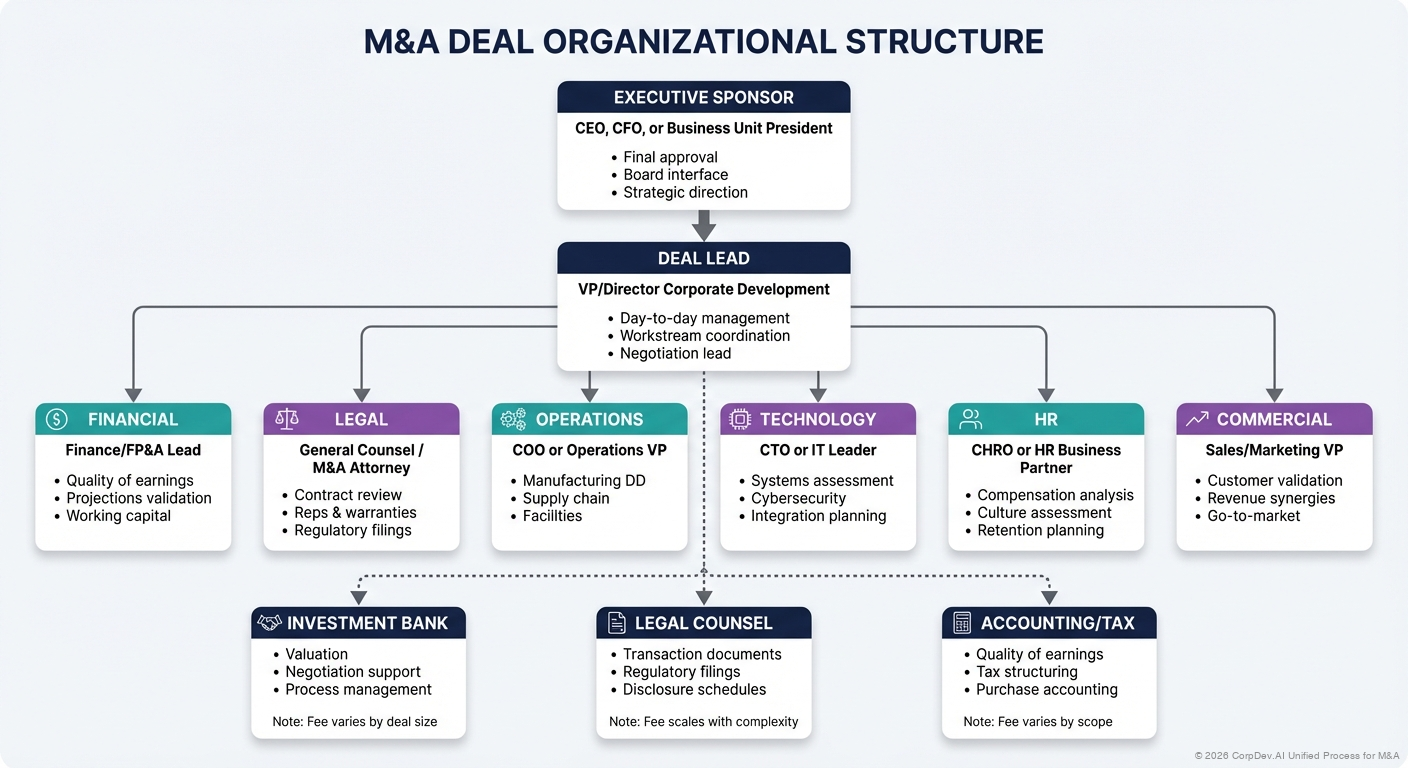 Executive sponsor and approval authority ↗Deal lead responsibilities ↗Financial diligence ↗Legal workstream ↗Operations workstream ↗Technology workstream ↗HR and retention ↗Commercial diligence ↗Investment banking advisers ↗Legal counsel ↗Accounting and tax advisers ↗
Illustrative staffing model. Final approval follows the company’s delegated authority and board requirements; a sponsor’s title does not confer authority to approve a transaction.
Keep five accountabilities distinct
These five roles are easy to blur. The right-hand column shows the overreach each one invites.
| Accountability | What it owns | What it does not include |
|---|---|---|
| Executive sponsor | The strategic case, settling conflicts across the company, and backing the recommendation | Unlimited authority to commit the company |
| Business owner | The acquired business's operating plan, resources, and results | Specialist conclusions outside their expertise |
| Deal lead | Pulling the workstreams together, keeping the decision record, and running the process | Authority to overrule legal, financial, or technical advice |
| Specialist lead | Reaching and documenting conclusions in an assigned field | Every consequence elsewhere in the deal |
| Authorized decision-maker | Approving commitments and knowingly accepting the remaining risk, within delegated authority | Deciding without the evidence required |
The sponsor and the business owner may be the same person. The distinction still matters: enthusiasm for the strategic fit is different from accepting an operating target and the budget to hit it.
Define each role by what it delivers
CorpDev deal lead. Owns the integrated plan, the recommendation, the negotiation mandate, escalation of issues, and the deal record. Makes sure every workstream uses the same assumptions, and that a change in one reaches everyone it affects. Presents open issues and dissent plainly, rather than averaging specialist views into a reassuring conclusion.
Finance lead. Checks standalone forecasts, valuation, funding effects, earnings and cash-flow bridges, and downside cases. Coordinates the quality-of-earnings review (an accountant's test of how much reported profit is sustainable) and the working-capital analysis with specialists. Sets the approved baseline and how results will be measured after closing. Marks which figures are estimates and what evidence supports each significant adjustment.
Legal lead. Designs the legal work plan, guides what information can be shared, coordinates the deal documents and required legal analyses, and explains how the contract allocates risk. Gives the authorized decision-maker the choices and their consequences. Counsel flags which commitments need specialist advice or formal approval; CorpDev makes sure those decisions happen in time.
Business and commercial leads. Test the customer problem, the competitive position, the go-to-market assumptions, and whether the plan can work in practice. Check how the deal fits the current business plan. Identify customer dependencies and own the growth and retention assumptions.
Technology, security, and operations leads. Assess what is actually being bought: architecture, maintainability, dependencies, operating resilience, security exposure, and implementation costs. Explain how remediation affects the thesis and the timeline. Tell an inconvenient system apart from a constraint that blocks the promised value.
People lead. Identifies leadership needs, critical roles, retention dependencies, organization choices, and workforce transition needs. Works with counsel and finance on commitments and costs. Ties retention to the capabilities the investment needs, not to how visible senior executives are.
Integration leader. Turns the thesis into a workable operating transition before signing. Owns the dependency map, the readiness process, escalation, and the handover into normal management. Functional leaders still own delivery in their functions; the integration office coordinates and challenges.
Bring in specialists when their question arises
Involve the person who can spot a deal-breaking constraint as soon as that question exists, whatever the process stage. Three examples:
- A carve-out may need separation and treasury expertise during screening.
- A technology acquisition may need product and security assessment before an offer.
- A regulated business may need specialist counsel before seller expectations are set.
Staff for complexity, overlapping work, and the decisions ahead. Purchase price is a poor staffing rule. A small acquisition with a hard separation or a critical technology dependency can need more specialist effort than a larger business the company already knows how to run.
Give every deliverable one owner
This illustrative matrix shows the principle: one accountable internal owner per deliverable, even when several people do the work. Adapt it to your actual delegation rules.
| Deliverable | Accountable internal owner | Contributors and checkers |
|---|---|---|
| Strategic rationale | Business sponsor | CorpDev, strategy, commercial leadership |
| Integrated investment recommendation | CorpDev deal lead | Finance, business owner, legal, specialist leads |
| Valuation and return analysis | Finance lead | CorpDev, treasury, business owner |
| Legal risk assessment and documents | Legal lead | Specialist counsel and affected functions |
| Diligence conclusions by workstream | Named workstream lead | Advisers and owners of the evidence |
| Day 1 operating readiness | Integration leader | Every critical operating function |
| Funding and funds flow | Treasury or a designated finance owner | Counsel, financial institutions, deal lead |
| Post-closing operating results | Business owner | Finance and functional leadership |
| Benefit validation | Finance lead | Individual benefit owners |
Approval authority sits beside this matrix. Preparing a deliverable does not make someone its approver.
Charter each workstream before diligence starts
Before diligence starts, each lead agrees a short charter covering:
- The decisions the work supports, and its scope
- The critical questions and the evidence required
- Dependencies and expected outputs
- The events that trigger escalation
Require every finding to answer five questions. What did we see? How reliable is the evidence? What could it change? What do we recommend? Who accepts the remaining risk? A report that lists observations without turning them into choices leaves CorpDev making specialist judgments it may not be qualified to make.
External advisers need the same clarity. Specify scope, exclusions, limits on reliance, key people, fees, conflicts, and deliverable format. Name an internal owner to challenge their work and fold it into the whole. Hiring an adviser leaves accountability for the investment with management.
Put disagreements in front of the decision-maker
Suppose the commercial lead backs a cross-selling case, but product leadership says integration needs a platform rebuild nobody has budgeted. The deal lead documents the dependency, gets a costed alternative, updates the forecast, and brings the resulting choice to the authorized decision-maker.
Never mark such a disagreement "alignment pending" while the original synergy stays in the model. A significant unresolved disagreement belongs in the decision memo, with both views and the evidence needed to settle it.
Confirm that someone accepts the handover
Before signing, confirm that operating owners accept the plan and its costs. Before closing, confirm who takes custody of contract deadlines, retained risks, reporting obligations, customer commitments, and the approved model. After closing, check that the receiving team can open those records and is using them.
A handover is complete only when a named person accepts it. Sending a folder link, or inviting someone to the final deal call, does not transfer accountability.
Continue with roles and responsibilities in the operating model, due diligence, and post-merger integration.
© 2026 CorpDev.Ai Unified Process for M&A