
M&A Operations Overview
M&A operations is how a company runs its deal work week to week: who decides, which records it keeps, and how strategy, approvals, integration, and results stay connected. It works when anyone can answer four questions about a live deal at any moment. Why are we pursuing it? Who can commit the company? What would change the decision? Who will deliver the result?
The usual failure is that those answers sit with different teams. A full pipeline and a polished investment deck do not help if nobody can say who owns the integration. Three roles own the pieces. The Head of Corporate Development owns how the function runs. The CFO owns financial policy and capital discipline. Business leaders own the results they sponsor. Where these roles overlap, the executive team decides who does what.
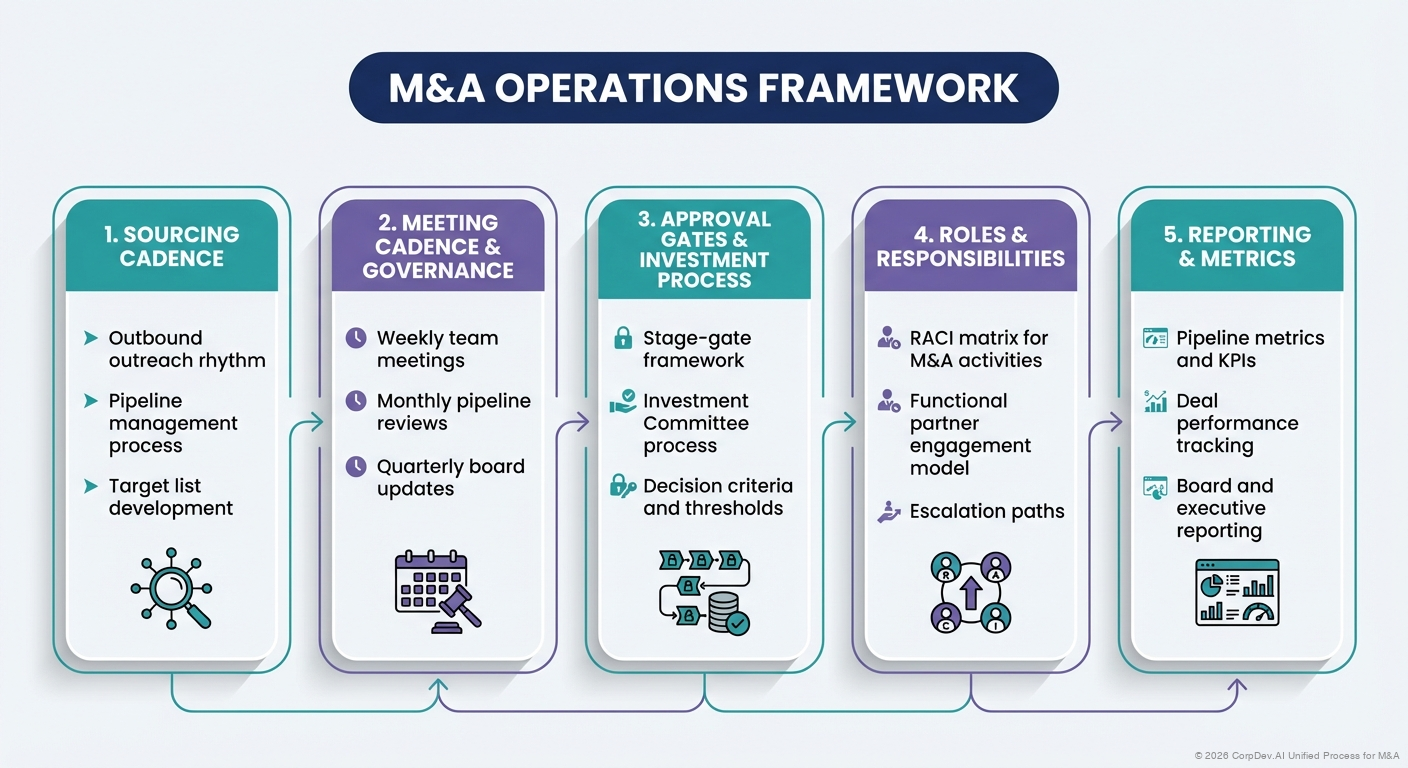 Sourcing cadence ↗Meeting cadence and governance ↗Approval gates and investment process ↗Roles and responsibilities ↗Reporting and metrics ↗
Agree the mandate before you design the process
Write a charter that says which company goals M&A serves, which kinds of transaction are in scope, and where CorpDev's responsibility stops. Acquisitions, minority investments, partnerships, joint ventures, and divestitures may need different owners and approval routes. Name the owner of each rather than assuming that every transaction with another company belongs to CorpDev.
The charter should settle six questions:
- Which portfolio priorities are funded, and which are exploratory?
- Who sponsors a deal and commits the receiving business's people and budget?
- How do acquisitions compete for capital with internal investment, debt reduction, and other uses?
- Which bodies approve strategy, spending, offers, signing, financing, and closing?
- Who owns integration design before signing, and operating results after closing?
- When can CorpDev stop work, and which disagreements go to the executive team?
Get explicit agreement from the executive team. No process can fix a mandate that leaders have not settled.
Link six records with one deal ID
The function runs on six records, each with one owner. They can live in a shared system or in linked documents. Keeping them consistent matters more than the software.
The table shows who owns each record and what it must answer.
| Record | Owner | What it must show |
|---|---|---|
| Portfolio priority map | Strategy leader and executive sponsor | Which gaps matter, the alternatives considered, and the order in which to pursue them |
| Target and relationship register | Sourcing lead | Why each target is on the list, who owns the relationship, the evidence, and the next action |
| Deal decision record | CorpDev deal lead | The current request, approved limits, conditions, expiry dates, and changes |
| Diligence and issue register | Diligence lead | Evidence gaps, their consequences, who resolves them, and the risks the company has accepted |
| Integration and value plan | Receiving business leader | Operating model, resources, dependencies, benefits, and costs |
| Investment performance record | Finance controller | The locked baseline from the approved business case, actual results, revised forecast, and explanations |
Use one deal ID across all six records. Attach source evidence to the assumption or decision it supports, and limit access to the people entitled to see it. A link to an entire data room does not show where an important claim came from.
Separate a deal's progress from the authority to commit
A deal can move forward commercially before anyone has authorized the next commitment. Each commitment needs its own approval:
- A seller accepting an indicative price range does not authorize a letter of intent (LOI).
- Completing diligence does not authorize signing.
- Signing does not mean the closing checklist is complete.
For each stage, write down:
- The entry condition
- The evidence required
- The decision owner
- The spending or external commitments allowed
- The exit condition
Record every outcome as approve, approve with conditions, defer, or decline. A conditional approval needs a named person who checks that the condition has been met. Without one, it becomes a vague permission slip.
Auctions and unusual structures need an exception route. A tight timetable can change when reviews happen and how uncertainty is disclosed. It cannot quietly remove the person who has to decide. See Approval Gates.
Treat capacity as a limit on the whole portfolio
Plan demand across live deals and integrations together. A team with room for one more diligence process may still lack the technology, finance, HR, or commercial people to absorb one more acquisition.
Ask each functional leader which people the deal needs, what those people will stop doing, and when they are available. Add supplier lead times, financial reporting deadlines, system changes, and integrations already underway. Record the conflicts before agreeing to a seller's timetable.
A weekly capacity view has one row per scarce resource and four columns: current commitments, incoming demand, committed availability, and the decision needed. Suppose two deals need the same ERP architect in the same month. The executive sponsor must then sequence the deals, cut integration scope, or fund real extra capacity. "The team will manage" is not a resourcing plan.
Agree how deal information moves before the first NDA
Agree with Legal, Information Security, and Finance how deal information enters the company and who may use it. Cover:
- NDAs and access approval
- Commercially sensitive information and personal data
- Adviser permissions and legal privilege
- External communications
- Retention, and the controls required before closing
When diligence involves competitively sensitive information, counsel decides the clean-team arrangements before any request goes out. A clean team is a restricted group allowed to see such information under agreed rules, and counsel also decides what its outputs may contain. Until closing, integration planning must respect that the two companies are still independent. Show each workstream lead what they may access and how they may use it; a generic confidentiality banner tells them nothing.
Set up workspaces by role, with an approval route for unusual sharing. When a deal stops, close external access and keep the decision record under the company's retention policy.
Hold three conversations with different agendas
Deal work needs three distinct conversations. They draw on the same records but answer different questions.
| Conversation | What it decides | What it needs |
|---|---|---|
| Opportunity allocation | Which targets and themes deserve research and relationship time | A comparison of the other ways to use that time |
| Transaction decisions | Whether to spend, offer, sign, or close within set limits | Evidence and accountable approvals |
| Investment performance | Whether an acquired business is delivering its thesis, and what intervention it needs | Owners who stay with it after the deal team moves on |
See Meeting Cadence and Reporting & Metrics.
Write the operating model on one page
Use this template when the executive team sets up or refreshes the function. Leaders should agree every line, not just receive the document.
M&A OPERATING MODEL (version and effective date)
What M&A is for, and what is out of scope:
Funded portfolio priorities:
Executive sponsor and policy owner:
What a business sponsor must commit:
Who approves what, and the exception route:
Where CorpDev, Strategy, Finance, Legal, and Integration responsibilities meet:
Minimum evidence per stage, and how decisions are recorded:
How functional leaders commit people and budget:
Rules for information access and external communication:
Business and finance owners after closing:
Who receives reports, and how often:
Open disagreements needing an executive decision:
Next review date, and what triggers an earlier review:
Settle the open disagreements first. Do not circulate the document as final while it still holds competing views of who has authority.
Example: two good deals that need one team
This example is hypothetical. An industrial company is pursuing a distribution acquisition while it integrates a manufacturer it bought recently. The distribution deal is attractive, but both integrations need the same master-data team and the same changes to customer billing.
CorpDev can keep the relationship going and finish the commercial work it is permitted to do. The COO must choose one of three options:
- Defer the distribution company's systems migration.
- Assign a separate team.
- Change the acquisition timetable.
Finance then updates the business case for the chosen timing, transition costs, and delayed benefits. The investment committee sees one plan that respects the constraint, instead of two attractive plans that cannot both be delivered.
Review changes across the active deals
Before the weekly allocation meeting, compare the pipeline, issue register, approval calendar, and integration plans. Highlight changes that affect another team's commitments. Assign an owner to resolve each conflict and identify the decision needed this week. Keep the underlying records current so the next meeting starts from the same facts.
Judge the function by its decisions, not its deal count
Review recent decisions, including the deals you declined. Look for patterns:
- Problems found late, again and again
- Price authority that changed without a record
- Synergy commitments without support
- Integrations accepted without an owner
Trace each failure back to the record or decision that should have caught it.
Do not reward deal volume over investment quality. A well-supported decision to stop can protect more value than another closing. Measure whether the function makes informed decisions, keeps options open, allocates scarce people well, and learns from how its acquisitions perform.
Continue with Roles & Responsibilities, Sourcing Cadence, and Board Reporting.
© 2026 CorpDev.Ai Unified Process for M&A