
Building a Deal Thesis
A deal thesis explains why buying this company, at this price, will create more value for your company than it costs in money, risk, and management time. It names the few things that must be true and the evidence that would make you walk away. If no finding could change the story, you have a sales pitch rather than a thesis.
Several people share the work. The CorpDev deal lead writes the thesis and keeps it current. The business sponsor owns the operating logic: what will change and why it will work. Finance turns that logic into numbers. Functional leaders own the assumptions they will have to deliver. Whoever holds investment authority accepts or rejects the result.
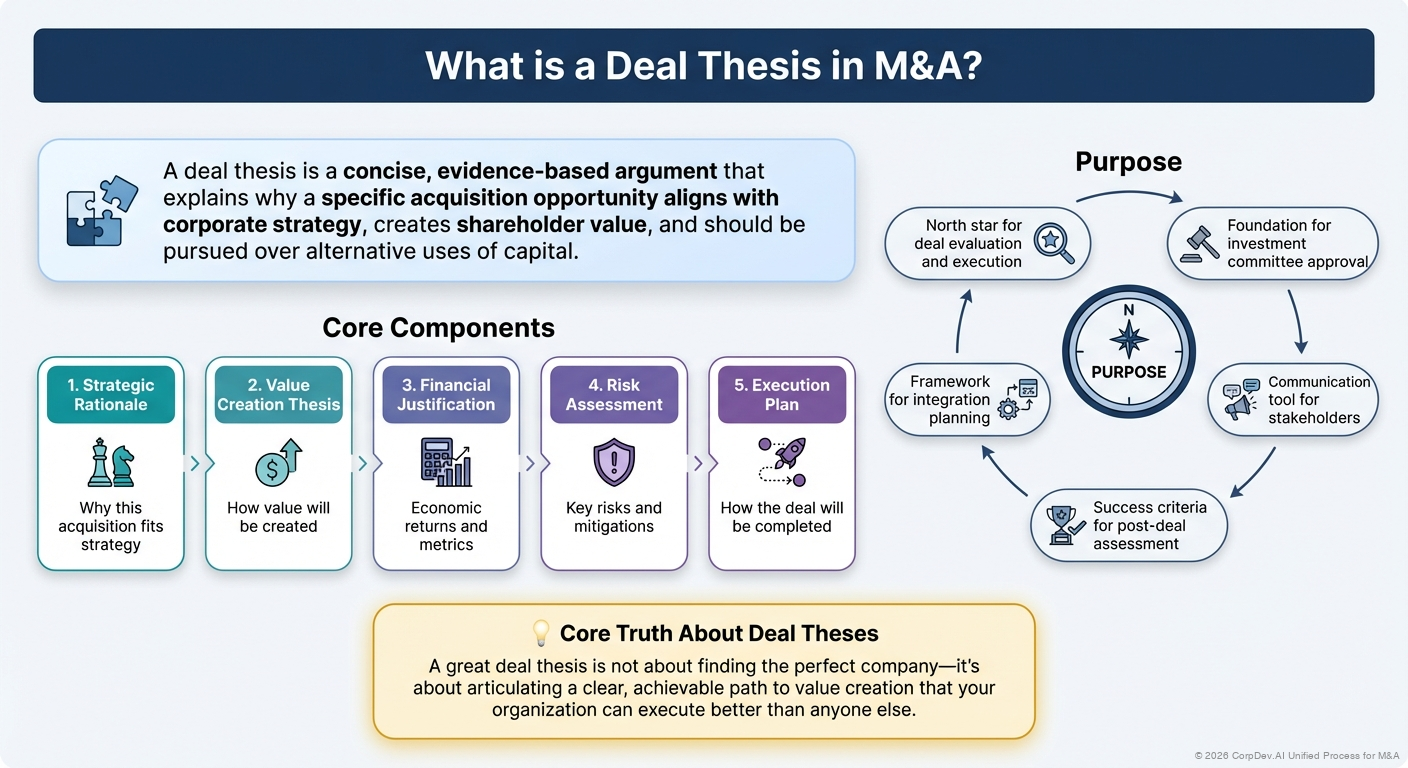 Deal thesis: an evidence-based investment argument ↗Strategic rationale ↗Value creation thesis ↗Financial justification ↗Risk assessment ↗Execution plan ↗Guide evaluation and execution ↗Investment committee approval ↗Stakeholder communication ↗Post-deal success criteria ↗Integration planning ↗Purpose of a deal thesis ↗An achievable path to value creation ↗
Text links for this illustration
- Deal thesis: an evidence-based investment argument
- Strategic rationale
- Value creation thesis
- Financial justification
- Risk assessment
- Execution plan
- Guide evaluation and execution
- Investment committee approval
- Stakeholder communication
- Post-deal success criteria
- Integration planning
- Purpose of a deal thesis
- An achievable path to value creation
Answer five questions that depend on each other
A thesis answers five questions. A weak answer to any one of them undermines the rest.
- Why act? Which company objective, performance gap, or customer need demands a response?
- Why buy? Is buying better than building, partnering, licensing, divesting, or doing nothing?
- Why this company? Which of its capabilities and relationships matter, and will they last and transfer to you?
- Why at these terms? Is this a good investment at the proposed price and structure, and not only a good business?
- Why can we deliver? Is there a workable operating model with named owners, resources, and timing?
Challenge each answer in turn. If the target is excellent but an internal build gives a better result, the acquisition has not earned its place in the capital plan.
Write the first version before diligence starts
Write the thesis early, with the information you have, and mark how reliable each piece is. An early thesis is a set of hypotheses for diligence to test. A thesis written after diligence tends to justify a decision the team has already made.
Start with one sentence:
Acquire [target or perimeter] to deliver [a specific customer or operating outcome], using [the target's capability] with [our advantage], creating value through [how cash flow improves], subject to [critical conditions].
Then list the three to five claims the investment depends on most. Resist turning every attractive feature into a separate pillar. The skill is finding the few things that must be true.
Link every claim to evidence and a stop signal
The claim-to-evidence register is the working core of the thesis. The five typical claims below show its shape. Read the last two columns first: every claim has a result that would disprove it and a decision that follows.
| Claim | Evidence needed | Owner | Result that would disprove it | What the team does then |
|---|---|---|---|---|
| The target solves a priority customer problem | Customer interviews, product usage, win/loss evidence | Business sponsor | Buyers do not value the combined offering | Reassess the strategic rationale |
| Revenue will last | Contracts, cohorts, renewals, concentration, reconciled revenue | Commercial and Finance leads | New sales hide significant churn | Revise the forecast and price |
| The capability can transfer | IP rights, architecture, key-person dependencies, retention | Technology or operations lead | The capability depends on rights or people the buyer cannot secure | Redesign terms or stop |
| We can create value no other owner could | Named customer overlap, cost baseline, resource plan | Benefit owner | The opportunity is already in the standalone forecast | Remove the double count |
| We can carry out the plan | Integration dependencies, consents, capacity, timing | Integration lead | Required resources are not available in time to earn the return | Rephase or reject |
Cite specific sources, not only conclusions. Record each source's date, scope, reliability, and known limits. When sources conflict, keep both on the record until the claim's owner resolves the conflict.
When the thesis rests on operating capabilities that depend on each other, a company digital twin can link each claim to the operations, sources, and dependencies behind it. Keep the twin tied to the register and to the changes you plan to make as owner.
Separate the target's own plan from what you add
Start with the target's standalone path: how the business performs, under a clearly stated operating assumption, with no help from you. Then name what changes because you own it: access to your distribution, procurement, product integration, facilities, capital, leadership, or another concrete lever.
Not every improvement is a synergy. If the target's own plan already includes a price increase, do not count it again as a benefit of the deal. If you must invest just to keep revenue where it is, show that investment before you present growth as value created.
The economic bridge connects five items to the buyer's return on investment:
- Standalone value
- After-tax benefits only this buyer can create
- Costs to achieve those benefits
- Continuing costs
- Value that leaks away, such as customers lost in the transition
The negotiated price then decides how much of that value you keep and how much goes to the seller.
Write stop rules specific enough to act on
A stop rule names what would end the deal, precisely enough that the team would actually stop. "Unacceptable risk" is too vague until it names the cause and the consequence. Useful stop rules look like this:
- You cannot obtain operating rights the business needs.
- Diligence cannot confirm the recurring revenue base.
- The integration design needs resources the company will not commit.
Conditions come in three types. Keep them apart:
- Investment condition: a fact that must hold for the thesis to work.
- Approval condition: evidence or action the internal decision maker requires.
- Contractual condition: a term in the transaction documents, assessed and drafted with counsel.
The three can overlap, but one cannot stand in for another. An indemnity can shift a financial exposure to the seller and still leave the operating problem that caused it unsolved.
Example: a thesis that improved when the evidence changed
This example is hypothetical.
A manufacturer wants to enter regulated testing services. The target owns specialist laboratories and the customer relationships that come with them. The first thesis says the manufacturer's installed customer base will buy testing services, and the target will supply the accredited capability.
Diligence has to test four separate propositions:
- Do those customers actually need the service?
- Will accreditation and operating permissions stay valid under the planned deal structure?
- Can the laboratories handle the extra demand?
- Will the specialist employees stay?
A large installed base, on its own, proves no revenue synergy.
Suppose demand is confirmed, but extra capacity needs significant investment and a longer commissioning period. The team revises the timing and economics, considers a staged commercial partnership, and tests the acquisition price against that alternative. The thesis got better because the evidence changed the recommendation.
Run a pre-mortem with the people who must deliver the deal
Ask the team to imagine that, several years after closing, the acquisition has disappointed. Have the business sponsor, the commercial lead, Finance, the integration leader, and a credible skeptic each explain why, separately. Then combine their answers into failure mechanisms you can test.
Typical mechanisms include:
- Customers reject the combined offering.
- Key people leave.
- Integration slows product delivery.
- The revenue forecast assumes capacity that does not exist.
- The price leaves no room for mistakes in execution.
Avoid giving every risk a generic probability score. Model the consequences you can quantify, and explain the judgments you cannot. Look at linked risks together: five small exposures with the same cause are one large exposure.
Challenge the deal from the shareholder's perspective
Ask the committee to compare the acquisition with the best alternative use of capital. Address the price, expected benefits, delivery risks, and the record on previous acquisitions. Record objections that change the recommendation or require further evidence. The deal sponsor should answer them before requesting approval.
Keep the thesis memo short, with the evidence behind it
The memo below states the investment logic in a few pages. Put the claim register, detailed model, diligence reports, and integration plan behind it, so a reader never has to rebuild the argument from appendices.
DEAL THESIS: target / perimeter / date / version
Decision sought and recommendation:
The thesis in one sentence:
Company objective and business sponsor:
Alternatives considered, and why buying is preferred:
Why this target, and why we are the right owner:
Three to five claims that must be true:
Evidence for each claim, and significant evidence against:
Standalone economics and value only we can create:
Price, funding, costs, and walk-away price logic:
Integration approach, owners, and resources:
Main ways the deal could fail, and their consequences:
Conditions, stop rules, and open judgments:
What changed since the last version:
Next evidence requests and decision date:
Carry the thesis beyond approval
Lock the approved thesis and model. At signing, record open assumptions, commitments, and conditions. Hand the claim register to the integration and business owners, so the deal's most important promises become operating measures.
After closing, compare what happened with the original claims. For each miss, decide whether it came from weak evidence, poor execution, changed conditions, or a deliberate strategic choice. Feed the lesson into future screening and underwriting.
Continue with strategic rationale, business case development, and value creation planning.
© 2026 CorpDev.Ai Unified Process for M&A