
Valuation Best Practices & Pitfalls
A valuation review should make it harder for a weak acquisition to look attractive. It tests the evidence, the economics, and the decision logic. Confirming that the formulas calculate, or that several methods overlap, is only the start.
Give the reviewer the source records, assumptions, model versions, and the original investment thesis. An independent reviewer must be free to challenge the answer leadership wants, including the assumptions leaders are most attached to.
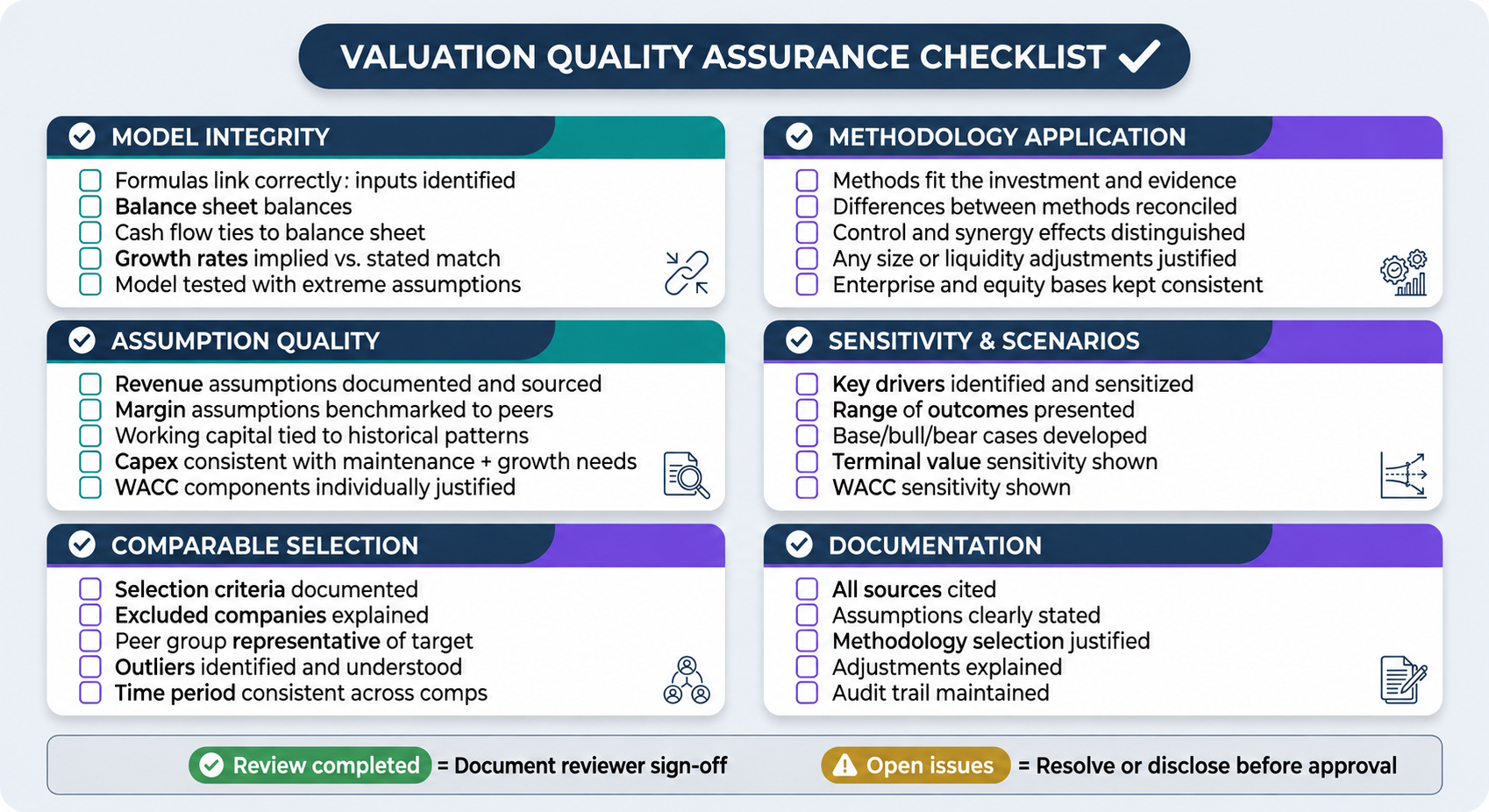 Model integrity ↗Assumption quality ↗Comparable selection ↗Methodology application ↗Sensitivity and scenarios ↗Documentation ↗Review before presentation ↗
Start with what the company is buying and why
Ask four questions: what is the company buying, why is it the right owner, what are the alternatives, and what must be true to justify the price? Confirm the valuation perimeter, currency, date, and the ownership interest being bought.
A model built on the wrong perimeter can be arithmetically correct and economically wrong. Check whether the forecast relies on people, contracts, systems, facilities, or intellectual property that will not transfer, and whether the cost of replacing them is funded.
Check the evidence before the formulas
Map the assumptions that drive value to their evidence: a document, dataset, interview, or independent analysis. Label each as a reported result, a management claim, a buyer estimate, or a negotiated commitment. The table shows the question to ask of each major assumption and the minimum work that answers it.
| Assumption | Reviewer’s question | Minimum work product |
|---|---|---|
| Revenue growth | Which customers, products, volumes, and prices create it? | Driver model and reconciliation to historical performance |
| Margin improvement | Which actions produce it and what do they cost? | Initiative plan, timing, owner, and cost schedule |
| Normalized earnings | Why is each adjustment appropriate, and is any counted twice? | Bridge from reported to adjusted earnings, with evidence |
| Capital needs | Does the forecast pay to sustain and expand the business? | Maintenance and growth investment schedule |
| Synergies | Who can deliver them and what could offset them? | Baseline, implementation plan, costs, and risk |
| Terminal economics | Can growth, margins, and reinvestment all hold at once? | Steady-state operating assumptions and sensitivity |
More decimal places or a sophisticated simulation are not stronger evidence. Precision should match the quality of the inputs.
Run the consistency checks
Verify that the model uses one basis throughout:
- Enterprise value or equity value
- Cash flows matched to the discount rate
- Nominal or real assumptions, currency, and financial period
- Lease treatment and claims outside common equity
Damodaran's valuation approaches explain why cash flows and discount rates must match.
Reconcile the financial statements, the valuation model, sources and uses, and the price definitions in the agreement. A financing balance should never disappear between the bridge from enterprise value to equity value and the closing funds flow.
Check that each scenario flows through every schedule it affects. Lower revenue may change margins, working capital, tax payments, debt capacity, earnouts, and integration timing. A scenario switch that changes only the headline growth rate understates the downside.
Hunt for anything counted twice
These overlaps are common:
- A cost reduction included in normalized EBITDA and again as a synergy
- Tax benefits included in cash taxes and added to value separately
- Backlog valued in the cash-flow forecast and added again as a premium
- Excess cash added to value while the same cash funds working capital
- A control premium added to precedents that already reflect control transactions
- Integration spending included in operating expenses and deducted again as a separate cost
- The same cost savings claimed by two initiatives or business units
Give each source of value a single place in the model. Where two approaches measure the same benefit differently, use them to cross-check each other, never add them together.
Challenge the terminal value
Find how much value comes from the terminal period and which assumptions support it. A high share is a signal to examine the model. It is neither an automatic reason to reject it nor an excuse to lengthen the forecast until the percentage looks smaller.
Test the step from the explicit forecast into steady state. Watch for a sudden drop in capital spending, working capital, taxes, or competitive pressure that makes terminal cash flow jump. A stable-growth assumption should fit the business's reinvestment and its market opportunity.
For an exit multiple, disclose the metric year, the peer basis, and why the multiple still fits a business at that future stage of maturity. Never choose the terminal method because it gives the higher value.
Review market evidence without anchoring on the answer
Ask another analyst to select trading peers and precedents from the stated criteria before seeing the preferred range. Compare the exclusions, the financial definitions, and the effect of outliers.
Never turn industry labels into universal multiples. Growth, margins, capital intensity, customer concentration, business mix, and market date can matter more than the sector name. An arbitrary private-company discount or synergy haircut does not replace analysis of the target's actual risks.
When methods disagree, explain the assumptions behind the difference. Never average them mechanically or drop the lower result without a reason.
Start from the price and ask what must happen
Reverse underwriting starts with the proposed price and solves for what must happen to justify it. This often clarifies the decision more than another valuation range. The DCF guide shows how to run it as a reverse DCF.
Illustrative review question: At the seller's price, the buyer's case needs $18 million of annual net cost savings by year three. The validated workstream plans support $11 million, and the remaining $7 million has no owner or implementation plan. The model does not need a lower discount rate. Part of the price depends on an operating commitment nobody has made.
Identify the customer retention, growth, margin, exit value, or synergy timing the price requires. Compare each requirement with the evidence, management's capability, and the company's record on past acquisitions.
Build downside cases that could really happen
Use a small number of scenarios, each combining risks that belong together: a delayed product, the loss of a major customer, a required divestiture, or a slow integration. Show value, cash needs, leverage, and strategic consequences under each.
Allow for a slow recovery and extra investment rather than an immediate return to the base case. If you use probabilities, explain their basis and test them. An expected value can hide an outcome the company cannot finance or survive.
Hold the line on price discipline
Set the authorized negotiating range and the triggers for going back to the committee before the final auction pressure. Base the maximum on the investment case, the risks, and the alternatives, never on a fixed percentage above the first valuation.
Keep a concession log covering price, working capital, contingent payments, remedies, guarantees, and operating commitments. A headline price unchanged since approval can still hide a much worse overall package.
When new evidence arrives, show what changed since the last approved case. Keep the previous model so the committee can see whether value improved or the assumptions simply became more optimistic.
Close with a review someone can sign
Record findings by severity, owner, resolution, and effect on the decision. Every important unresolved assumption should become a closing condition, a revised price, a changed scope, or an explicitly accepted risk.
The final review note should answer:
- Does the model represent the actual transaction and operating perimeter?
- Are the main value drivers supported by evidence?
- Are the methods and definitions consistent with each other?
- Are synergies, taxes, costs, and claims counted once?
- Can the company still fund the downside, and is it strategically acceptable?
- What evidence or change in terms would alter the recommendation?
- Who reviewed the financial, tax, accounting, and operating assumptions?
After closing, use the approved case in value creation monitoring. A disciplined review pays off most when the organization later learns which assumptions were right and which were not.
© 2026 CorpDev.Ai Unified Process for M&A