
Strategic Rationale for M&A
A strategic rationale explains, step by step, how an acquisition leads to a better business result. It shows what changes for customers or operations, why you need to own the company, and why you are a better owner than anyone else. "Expand our platform," "accelerate growth," and "acquire innovation" are where the questions start. The rationale supplies the answers.
Write it before a specific target starts shaping the strategy. The finished rationale compares the alternatives, sets measurable outcomes, and states the limits of what the deal will do. The financial case and the delivery plan are tested alongside it in the business case.
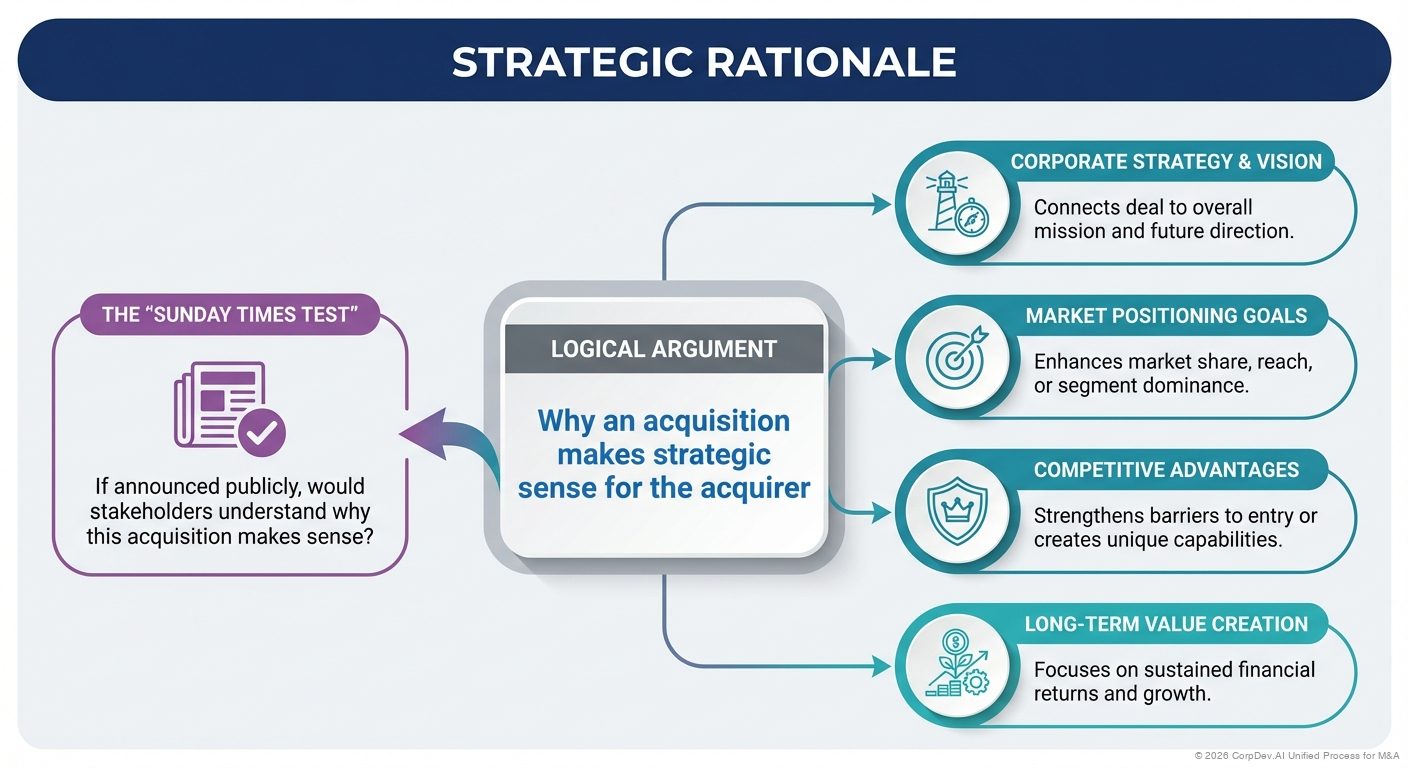 Explain the rationale clearly to stakeholders ↗Why the acquisition makes strategic sense ↗Corporate strategy and vision ↗Market positioning goals ↗Competitive advantages ↗Long-term value creation ↗
Start with the business problem, not the target
State the objective in operating terms. For example:
- Is the company losing customers because a capability is missing?
- Does expanding into a new region require local service infrastructure?
- Is a product transition blocked by technology, distribution, talent, or an installed base?
- Does a business in the portfolio use resources that could earn more elsewhere?
Show the evidence: customer requests, win/loss analysis, unit economics, operating bottlenecks, capability assessments, or portfolio performance. Separate the symptom from the cause. If growth is slow because the sales team underperforms, buying another product will not fix it.
Then show why the company must act now, with a real decision window: a product cycle, a customer commitment, an asset coming up for sale, or shifting economics. A competitor's announcement is a reason to review the timing. It is not, on its own, a reason to move faster.
Test the timing against what the market says in public
Sponsors usually argue urgency from inside the company: the roadmap, the lost bids, the plan. The outside record is a useful test of that argument. Competitors explain their priorities on earnings calls and at investor days, and analysts press them on the same gaps you see. Customers describe what they need in trade press and conference talks.
Compare the sponsor's timing assumptions with documented competitor investment, customer demand, and product commitments. Silence in public sources leaves the question open; it does not prove there is no market need. Cite the relevant passages and distinguish announced plans from delivered capability.
An abridged, hypothetical excerpt for an equipment maker deciding whether it must buy a remote-monitoring business now:
| Date | Speaker | What they said (abridged) | Reading for our timing |
|---|---|---|---|
| Q1 2025 | Competitor A, CEO | “Remote monitoring is still a pilot. Customers are not paying for it yet.” | Contradicts: demand was early |
| Q3 2025 | Analyst, on Competitor B's call | “How many of your top accounts now require uptime guarantees in tenders?” | Supports: investors see it reaching tenders |
| Q1 2026 | Competitor B, CFO | “We expect to complete a monitoring acquisition this year.” | Supports: credible targets may be taken |
| Q2 2026 | Competitor C, CEO | “We are building this ourselves and will launch in 2027.” | Mixed: confirms demand, and shows a build route exists |
The quotes turn the "why now" paragraph from an assertion into evidence. Put the two or three strongest passages in the rationale, including one that cuts against you. If a competitor says it will build the capability, add that route to your build-versus-buy comparison. If a competitor plans to buy, check whether your preferred target is the obvious candidate.
The check that matters: open each transcript and confirm every quote, speaker, and date yourself before any of it reaches a committee document. A misquoted competitor costs more credibility than the quote was worth.
Name the main way the deal creates value
Most deals rest on one of six mechanisms. Each needs a different change to happen and different evidence to prove it.
| Mechanism | What must change | Evidence that matters |
|---|---|---|
| Capability acquisition | You can deliver something you cannot deliver today | Product performance, IP rights, specialist talent, integration feasibility |
| Geographic or channel expansion | You reach customers through a credible local presence | Customer access, distribution economics, local capabilities, consent requirements |
| Scale and consolidation | Combined operations produce better unit economics | Cost baselines, capacity, overlap, customer response, execution constraints |
| Product adjacency | The combined offering solves a broader customer problem | Customer demand, interoperability, buying process, contribution economics |
| Vertical integration | Owning a supplier or channel improves quality, resilience, or economics | Supply dependencies, make/buy costs, alternative suppliers, operating complexity |
| Portfolio transformation | Capital and capabilities shift toward a better mix of businesses | Portfolio alternatives, resource needs, transition economics, management capacity |
A deal can have several benefits, but name its primary mechanism. Otherwise every attractive feature joins the rationale, and no single claim can be proved wrong.
If the strategy touches competition, counsel should review the proposed conduct and the transaction (see the regulatory overview). Build the rationale on benefits to customers and operations. Never treat the ability to remove competitive pressure as the investment case.
Compare build, buy, partner, and wait on equal terms
Compare every route against the same customer outcome, time horizon, funding basis, and performance standard. Give the internal team a credible budget and timeline. A neglected internal project is no benchmark for a fully funded acquisition.
The table shows what to estimate for each route and the hidden cost to test before trusting the comparison.
| Route | What to estimate | Hidden cost to test |
|---|---|---|
| Build | Development, hiring, commercialization, operating investment | Time until customers adopt; roadmap work pushed aside |
| Buy | Price, integration, retention, continuing investment | Disruption, unwanted assets, inherited liabilities, capacity to integrate |
| Partner or license | Fees, implementation, governance, commercial commitments | Dependence, renewal risk, limited control, economics at scale |
| Do nothing or wait | The current trajectory and the flexibility you keep | Lost opportunities, customer losses, higher cost of entering later |
| Divest or exit | Proceeds, separation cost, economics of the remaining portfolio | Stranded costs and lost shared capabilities |
Mark which differences rest on evidence and which rest on judgment. Compare only feasible routes. A partner who is unavailable, or an internal schedule nobody could meet, makes a meaningless benchmark.
Check that every route got the same scrutiny
Before the comparison goes to leadership, read the cases side by side and look for lopsided treatment. Two examples:
- A fully staffed acquisition plan set against an internal roadmap with no named team.
- A partner proposal judged before its security and implementation costs were added.
Tie each discrepancy to the case and assumption where it appears. The business sponsor and functional owners decide how to correct the comparison. Leave missing evidence visible. Never fill a gap with an assumed market norm, or weaken an alternative to make buying look better.
Explain why you need to own it
Ask which rights or coordination benefits require buying the company. If a commercial agreement could deliver the outcome with less capital and risk, explain why that route falls short. Reasons can include:
- Control over product priorities
- Access to assets or talent
- Coordinating long-term investment
- The need to integrate operations deeply
Owning a company also brings obligations. You inherit a whole operating business, including customers and commitments that may not serve the original objective. Count the management effort and investment the entire acquired business will need, not only the part you wanted.
For minority stakes and joint ventures, check the actual governance rights. Financial exposure without the right to make the critical decisions may not support the strategy.
Show why this target and why you are the right buyer
Compare the target with credible alternatives, including companies that are not for sale today. Judge them on what affects the objective:
- Customer overlap
- Depth of capability
- Operating fit
- Leadership
- Rights
- Ability to scale
- Whether what makes the business valuable can be preserved
Then state what you specifically bring. Each contribution holds only under a condition:
- Your distribution is worth something only if your account teams can sell the product and customers want it.
- Your balance sheet matters only if the target has attractive places to invest more.
- Shared technology helps only if the products can work together and customers can migrate.
Do not let the phrase "strategic premium" replace this analysis. Any premium needs support from value only you can create, plus a decision about how much of that value you are willing to hand to the seller.
Set milestones that show the logic is working
Choose measures that test the mechanism itself, not just growth after closing. For example:
- Product adjacency: validated customer use cases, working interoperability, qualified joint opportunities, conversion, and contribution margin.
- Geographic expansion: permission to operate, local service readiness, customer acquisition economics, and retention.
Give each milestone an owner and a date for the evidence. Leading indicators reveal a failing deal before annual results do. Keep the original objective in view: the integration team can finish every project and the objective can still be missed.
Use the worksheet to interview the sponsor
Work through these questions with the business sponsor before anyone drafts the polished narrative. If the answers are weak, fix the strategy, not the wording.
STRATEGIC RATIONALE: business priority / target / version
Business problem and evidence:
Customer or operating outcome required:
Main way the deal creates value:
Why we must act within this window:
Build / buy / partner / wait comparison:
Why we need to own it:
Why this target over credible alternatives:
What we contribute as owner:
What must be preserved in the target:
Operating model and resources required:
Milestones, owners, and evidence dates:
Contrary evidence and conditions that would invalidate the rationale:
Open judgments for the decision maker:
Example: a sales force is a hypothesis until tested
This example is hypothetical.
A software company is considering buying a specialized workflow product. The sponsor believes the company's large sales force can speed up the target's growth. Customer interviews confirm the need. But the target sells to operating managers, while the acquirer sells to central IT. The sales cycle, implementation work, and incentives all differ.
The deal can still be attractive, but the rationale must now include a separate sales approach, training, implementation capacity, and realistic timing. A referral partnership could test demand before the company commits to buying. Multiplying the acquirer's customer count by the target's price does not produce a market the company can actually win.
Challenge the rationale before investment approval
Have an informed reviewer argue for the best alternative and make the strongest case that the acquisition will disappoint. Ask what management would do if this target were not available. If the answer is to drop the strategic priority altogether, check whether the priority was invented to fit the target.
The final rationale passes three tests:
- A business leader can explain what changes in operations.
- Finance can model how that change creates value.
- The integration leader can say how it will be delivered.
Put unresolved disagreements in the decision memo.
Continue with building a deal thesis, M&A strategy, and value creation planning.
© 2026 CorpDev.Ai Unified Process for M&A