
Divestitures & Carve-Outs Overview
A divestiture succeeds when the seller transfers a business that can run on its own, at a net outcome it can accept, and the company it keeps can still operate profitably. The headline price is only one part of that outcome. Separation spending, taxes, retained liabilities, stranded costs, and transition support can each move the value the seller actually keeps, and together they often decide it.
A carve-out is the practical work of separating a business from shared operations. Any structure can need it: a sale of the business, an asset sale, an equity transaction, or another portfolio action. The most important choice is to run the sale process and the separation program as linked workstreams from the start.
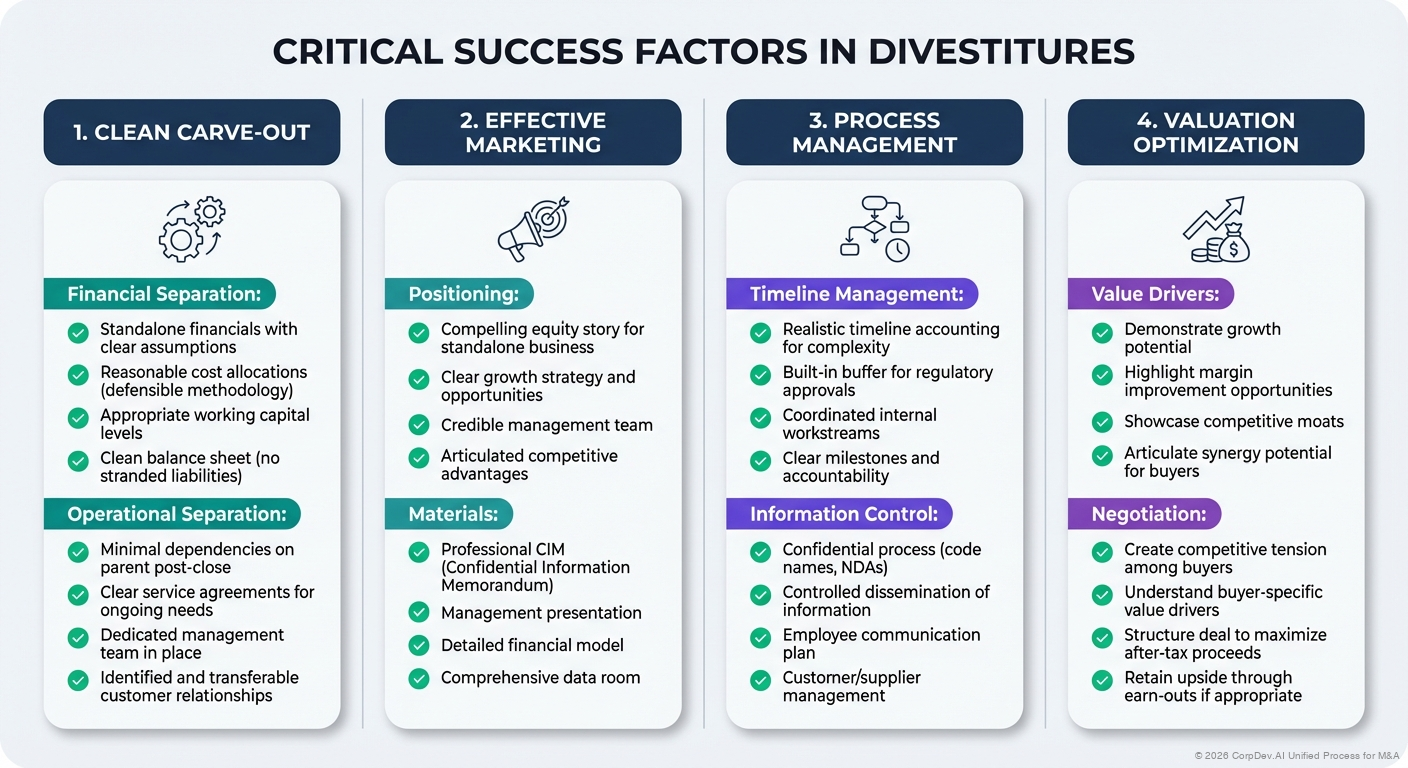 Clean carve-out ↗Financial separation ↗Operational separation ↗Effective marketing ↗Position the standalone business ↗Prepare buyer materials ↗Process management ↗Timeline management ↗Information control ↗Valuation optimization ↗Value drivers ↗Negotiate net transaction value ↗
Decide why the business should go
Compare the realistic options: keep and improve the business, partner, sell part of it, sell all of it, or take another portfolio action. Weigh its standalone prospects, your ability to improve them, the capital it needs, the management attention it absorbs, and what another owner could do differently.
The board decision should state the goal and the limits:
- Acceptable proceeds and retained exposure
- Continuity for employees and customers
- Capacity to provide transition support
- Any timing requirement
Signing by a target date is a milestone, not the definition of success.
Name the accountable leaders. The deal lead owns buyer selection and terms. The separation lead owns a business that can operate at closing and after the transition. Finance owns the reconciliation of net value. An executive in the retained business owns removing the stranded costs.
Define exactly what is for sale before marketing it
The perimeter is the exact set of things being sold. Keep a register of it, detailed enough to act on, that lists what is included and excluded:
- Legal entities, assets, liabilities, and inventory
- Employees and contracts
- Intellectual property, systems, and data
- Facilities, permits, and shared services
For each shared item, decide whether it transfers, is duplicated, stays with the seller, is licensed, or is covered by a transitional arrangement. The table shows the evidence each perimeter question needs and the decision it forces.
| Perimeter issue | Evidence to request | Decision required |
|---|---|---|
| Customers and revenue | Contract list, billing entities, shared accounts, consent analysis, and open orders | What revenue and obligations move? |
| Employees | Role map, time allocation, key-person dependencies, and adviser-reviewed transfer requirements | Who runs the sold business, and who runs the retained one? |
| Technology and data | Application map, interfaces, licenses, data ownership, access, and retention needs | Separate, clone, replace, or provide as a service? |
| Intellectual property | Ownership, licenses, brands, technical data, and shared development | What rights does each business need? |
| Facilities and supply chain | Site use, equipment, leases, sourcing, inventory, and logistics | Which dependencies need new contracts or investment? |
| Financial obligations | Guarantees, intercompany balances, pensions, debt, and disputes | What is settled, assumed, released, or retained? |
Keep the perimeter under version control through diligence and negotiation. When a buyer asks for another asset or group of employees, update the separation cost, the effect on the retained business, and the price together. Every change of scope is an economic decision.
Find the hidden shared services in the seller's own records
Interviews surface the obvious shared services: payroll, IT, treasury. The ones that surprise teams at Day 1 are often smaller and buried. Think of a license held by the parent, a warehouse system on the parent's instance, or a freight contract signed by an entity that is not for sale. Three records show them directly: the IT application inventory, the intercompany charges in the ledger, and the contracts signed by entities that stay with the seller.
Reconcile the records against the sale perimeter and draft a transition services catalogue: the services the sold business will still need from the seller after closing. Match systems, entities, and contract identifiers rather than relying on similar names. Functional owners should confirm each dependency, service period, and exit plan.
A hypothetical example:
| Service | Provider today | Evidence | Monthly charge | Proposed treatment |
|---|---|---|---|---|
| Payroll for 340 employees | Parent's shared service center | Charge code 7110; payroll system in the inventory | $48k | Transition service until the buyer replaces it |
| Warehouse management system | Parent's license and instance | Inventory line 212; no intercompany charge | None recorded | Gap: used but never charged, so missing from standalone costs |
| Freight contract covering two plants | Signed by an entity the seller keeps | Contract L-0931 | Inside the logistics allocation | Assign or sign again; transition service until then |
The draft does three jobs. It gives each functional owner a list to correct and price. It puts uncharged services into the standalone cost base before a buyer finds them. And it shows the seller the minimum set of services it must be able to provide after closing, which sizes its transition capacity.
The check that matters: each functional owner signs off their own rows. An application in the inventory may already be retired, and one charge code may cover several services.
Rebuild the numbers for the business on its own
Build three reconciled views:
- Historical reported performance
- Normalized standalone performance of the business being sold
- Performance of the retained company after separation
Explain every item in the bridge between them, and keep accounting allocations separate from future cash costs.
Costs allocated to the divested business may disappear from its accounts without disappearing from the seller's cash spending. Equally, a business that used a shared function may need a more expensive standalone replacement. Estimate the service level, staff, systems, contracts, insurance, and governance it will actually need, instead of copying historical allocations.
Separate four kinds of cost: recurring standalone costs, one-time separation costs, transition service charges, and synergies specific to one buyer. A buyer that can absorb functions may bid more because of it, but the seller should still present a standalone baseline it can defend. Finance reconciles the revenue perimeter, working capital, capital spending, and debt-like items to that baseline.
Give every stranded cost an owner
Stranded costs are costs that stay with the seller after the business they supported has gone. Track them in a ledger. The hypothetical row below shows the fields.
| Cost center | Current cash spend | Share supporting the sold business | Avoidable amount | Action required | Accountable executive | Cost to implement | Earliest saving date |
|---|---|---|---|---|---|---|---|
| Finance shared services | $8.0m a year | $2.5m | $1.5m | Resize the outsourcing contract | Retained CFO | $0.4m | After the contract's notice period |
Separate costs that can be removed from costs that are only reallocated to other businesses.
Actions may include resizing contracts, retiring systems, consolidating facilities, redesigning the organization, or redeploying people. Check minimum commitments, lead times, capacity needs, and local requirements with the relevant owners. Count a saving only when the action is feasible and funded.
The retained company's CFO should review the ledger after closing until every action is complete. Otherwise the sale can make the portfolio look more focused while leaving the parent with smaller earnings and nearly the same overhead.
Plan the exit from every transition service
A transitional services agreement, or TSA, keeps services running for the sold business for a limited period. It should describe a working service and a credible path to independence. With counsel and the functional owners, define:
- Scope, volume assumptions, service levels, and fees
- Dependencies, security, and access
- Incident handling and change control
- Extension terms and termination mechanics
Every service also needs an exit plan. The hypothetical payroll example shows what each field should hold.
| TSA exit field | Example content |
|---|---|
| Buyer owner | Executive accountable for the replacement payroll service |
| Seller owner | Executive accountable for delivering the agreed interim service |
| Replacement solution | Selected provider, configuration, interfaces, and operating staff |
| Dependencies | Employee data, bank setup, testing, and local implementation advice |
| Acceptance evidence | Parallel payroll runs reconciled, and exception handling demonstrated |
| Exit date and buffer | Planned termination, plus a realistic contingency path |
| Cost and funding | Implementation budget, recurring replacement cost, and exposure if the service is extended |
The expiry date in the contract does not prove the buyer will be ready. The separation management office should review critical services, replacement milestones, test evidence, and extension decisions together with the service owners.
In CorpDev.Ai
Build a digital twin of the separation: sites, contracts, customers, systems, and P&L lines. Pin dependencies where they apply, then compare Day 1 with the target state to see which services lack a replacement. An information model, not a simulation.
Example: the higher offer may leave the seller with less
This example is hypothetical.
A seller receives an offer valuing the business at $300 million of enterprise value. Its decision model includes $20 million of separation spending, $12 million of transaction and other modeled costs, and taxes estimated by its advisers. Separately, the retained company carries $15 million of annual costs that were previously allocated to the business being sold.
The stranded-cost review finds $9 million of those costs can be eliminated over time through funded actions, and $6 million will remain. The seller models the timing and present value of both amounts. It does not subtract all $15 million once, or assume the costs vanish at closing. Finance also prepares the bridge from enterprise value to equity value and cash proceeds, so debt and working capital are treated consistently.
A competing offer has a lower headline value. It assumes more separation work and needs fewer services from the seller. The board compares expected net proceeds, retained costs, execution risk, and continuing obligations. Price alone cannot tell it which offer is better.
Prepare the sale so buyers can price with confidence
Before launch, prepare:
- The perimeter register
- The standalone financial bridge
- The separation blueprint and transition services catalogue
- The management plan
- An inventory of material consents
Provide an organized data room and a controlled process for answering buyer questions. Uncertainty the seller could resolve cheaply can turn into a much larger discount in a buyer's bid.
Judge buyers on financing, operating capability, separation experience, transition needs, and certainty, as well as price. Map each bid's assumptions to the same perimeter. A bid that leaves out essential liabilities or assumes open-ended services cannot be compared directly with a clean offer.
Before closing, rehearse Day 1 for:
- Customer service, billing, and cash collection
- Payroll and procurement
- System access and reporting
After closing, keep governance in place for price adjustments, retained claims, TSA delivery and exit, and stranded-cost removal. Signing ends the negotiation. The portfolio action is complete only when the separation is.
Related resources
© 2026 CorpDev.Ai Unified Process for M&A