
Letter of Intent & Term Sheet
A letter of intent (LOI) or term sheet tests whether buyer and seller have a workable basis for a deal. It also sets out how they will resolve what is still unknown. Its value lies in putting the commercial assumptions on paper before both sides spend serious time and credibility.
This guide is a working checklist for CorpDev and counsel to use together. Legal effect comes from the drafting. The document's title, a "non-binding" heading, or a precedent from another deal does not decide it. Ask transaction counsel to set the intended effect of each provision and draft it for the facts and jurisdictions involved.
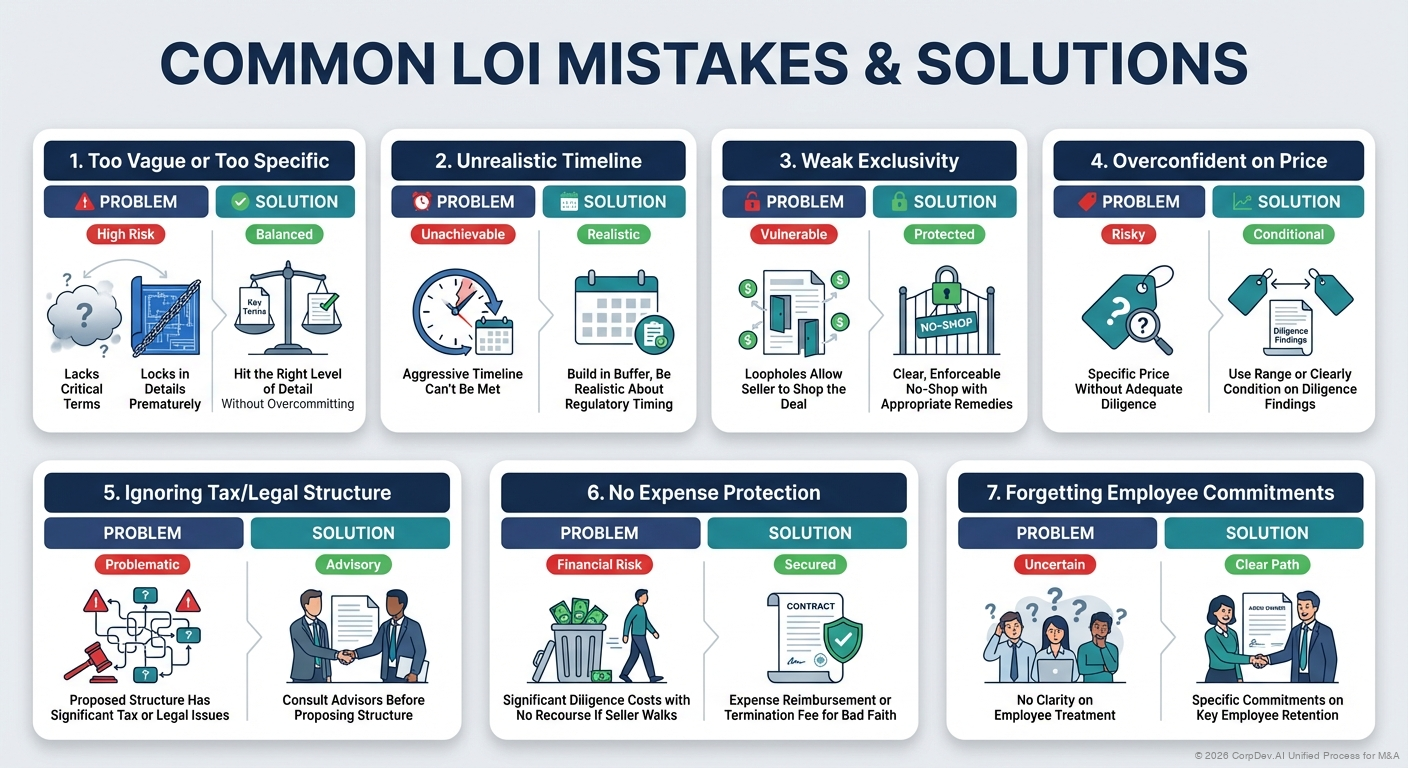 Too vague or too specific: define the approved decision ↗Unrealistic timeline: negotiate an executable process ↗Weak exclusivity: assess terms with counsel ↗Overconfidence on price: keep uncertainty visible ↗Tax and legal structure: define what is being acquired ↗Expense allocation: agree the process with counsel ↗Employee commitments: complete the approval checklist ↗
Text links for this illustration
- Too vague or too specific: define the approved decision
- Unrealistic timeline: negotiate an executable process
- Weak exclusivity: assess terms with counsel
- Overconfidence on price: keep uncertainty visible
- Tax and legal structure: define what is being acquired
- Expense allocation: agree the process with counsel
- Employee commitments: complete the approval checklist
Know what you are asking leadership to approve
First decide which kind of document this is: an exploratory indication, or an offer meant to secure a defined process. Then identify the approval needed for each commitment it makes:
- The proposed price and terms
- Adviser spending
- Exclusivity
- Commitments to management
- Any other obligations
A seller's deadline is a process constraint, not evidence that you are ready. The deal lead should be able to explain:
- The thesis and what is being bought
- How the price was built
- The major uncertainties
- The funding plan and the resources the next stage needs
If those are unresolved, consider a more conditional or narrower proposal.
Define exactly what you are buying
Describe the perimeter, meaning everything the deal covers: entities, assets, business lines, jurisdictions, intellectual property, employees, contracts, and any operations or liabilities left out. State what still depends on diligence and agreement.
This matters most in a carve-out. A price for a business that relies on its parent's systems, staff, purchasing, and facilities means little without a first view of how it will separate. Ask who will provide transition services, how the business will stand alone, and which costs belong in your case.
Get finance, tax, legal, and operating input before presenting a structure as settled. A commercial preference can carry costs and implementation problems that the headline price does not show.
Make the price mean the same thing to both sides
The same headline number can describe very different deals. Settle each point below in your commercial position before the letter goes out.
| Topic | Question to settle |
|---|---|
| Valuation basis | Is the price an enterprise value, an equity value, or an asset price? |
| Consideration | How much is paid in cash, in shares, later, or only if targets are met? |
| Financial reference | Which reporting period, forecast, and accounting assumptions support the price? |
| Closing adjustments | Which debt, cash, working-capital, and other adjustments are expected? |
| Perimeter assumptions | Which assets, liabilities, services, and people are included? |
| Conditions | Which important assumptions still need verification? |
| Funding | Which sources are planned, and what still needs approval or arranging? |
Avoid vague references to a "customary" adjustment when the parties may mean different things. Counsel and finance turn the agreed concepts into drafting now and into precise definitions and mechanics later.
Never use contingent consideration to cover a disagreement nobody has analyzed. Before proposing an earnout, understand the metric, the measurement period, the operating dependencies, the reporting needed, and the likely disputes. A contingent payment can swap one risk for another. See earnouts.
Agree a process your team can deliver
Exclusivity is worth little if you cannot get the information and decisions you need during the period. Build the timetable backward from the important diligence questions and the documents that depend on them.
Write down what each side must deliver. The seller provides information, data-room readiness, access to management and advisers, permission for any customer or employee contact, and an agreed order for sensitive work. The buyer provides staffing, specialists, approval meeting dates, and drafts on agreed dates.
Ask counsel to advise on the scope and effect of exclusivity, confidentiality, expense provisions, publicity, and any termination or process obligations. The business team should know what conduct is expected, when obligations start and end, and what happens if the process changes.
Treat any period in your plan as a choice negotiated for this deal. There is no universally correct exclusivity period or diligence timetable.
Keep the big unknowns visible
An LOI should never suggest you have validated assumptions you have not tested. List the uncertainties that could change the price, the structure, or your willingness to proceed. Keep to the ones that matter commercially; a list of every possible diligence topic helps nobody.
Typical examples:
- Whether a major customer relationship will last
- Who owns essential IP
- Standalone costs in a carve-out
- The cost of replacing a critical system
- Whether the required financing is available
For each one, define the evidence needed and assign an owner to get it.
Do not make an aggressive offer that you plan to cut later. If new evidence changes the case, explain the finding, its economic effect, and how the revised proposal follows from the original assumptions.
Review the draft from the seller's perspective
Have the deal lead and counsel identify the provisions the seller is most likely to dispute. Separate points that protect the investment case from terms the buyer can trade. Test the price, conditions, timetable, and exclusivity together: a concession in one can change the value of another. Counsel should review the resulting wording before it is sent.
Write the negotiation mandate before talking to the seller
Before any external discussion, agree the preferred terms, acceptable alternatives, limits of authority, and issues that need escalation. Keep the mandate internal and under version control.
For each important term, record your objective, the seller's apparent objective, what can be traded, the economic effect, and who approves. Price, certainty, timing, management arrangements, and risk allocation affect each other. Track the whole package instead of negotiating each term in isolation.
Use one channel for any significant commitment to the seller. A founder conversation, an executive email, and a counsel markup must not create three different commercial positions.
Check nine points before anyone signs
- The business sponsor supports the rationale and what is being bought.
- Finance has reviewed the price basis, preliminary returns, funding assumptions, and downside.
- Counsel has reviewed the intended legal effects, authority, process obligations, and the draft.
- Tax and the relevant operating specialists have assessed the proposed structure as far as needed now.
- Important assumptions and evidence gaps are stated.
- The next stage has named owners, available resources, and a workplan built around decisions.
- Integration dependencies that could change the economics have been considered.
- The approver understands the commercial package and any commitments it creates.
- The final document matches the version approved internally.
After signing, record obligations and deadlines immediately, start the agreed workstreams, and keep the approved assumptions as the baseline for any later change. An LOI filed away while the team informally renegotiates its meaning has lost its purpose.
Continue with due diligence, negotiation strategies, and approval gates.
© 2026 CorpDev.Ai Unified Process for M&A