
Value Creation Planning in M&A
A value creation plan turns the value promised in the approved deal case into commitments the business must deliver. For each change, it says what will happen, who is in charge, what resources it needs, and when results will show. Above all, it lets Finance separate the value the deal creates from results the business would have delivered anyway.
Start during diligence. The responsibilities divide cleanly:
- The receiving business leader owns the results.
- Initiative owners deliver specific changes.
- The integration leader manages the dependencies between initiatives.
- Finance validates baselines and financial benefits.
- CorpDev keeps the link to the approved deal case and takes part in investment reviews.
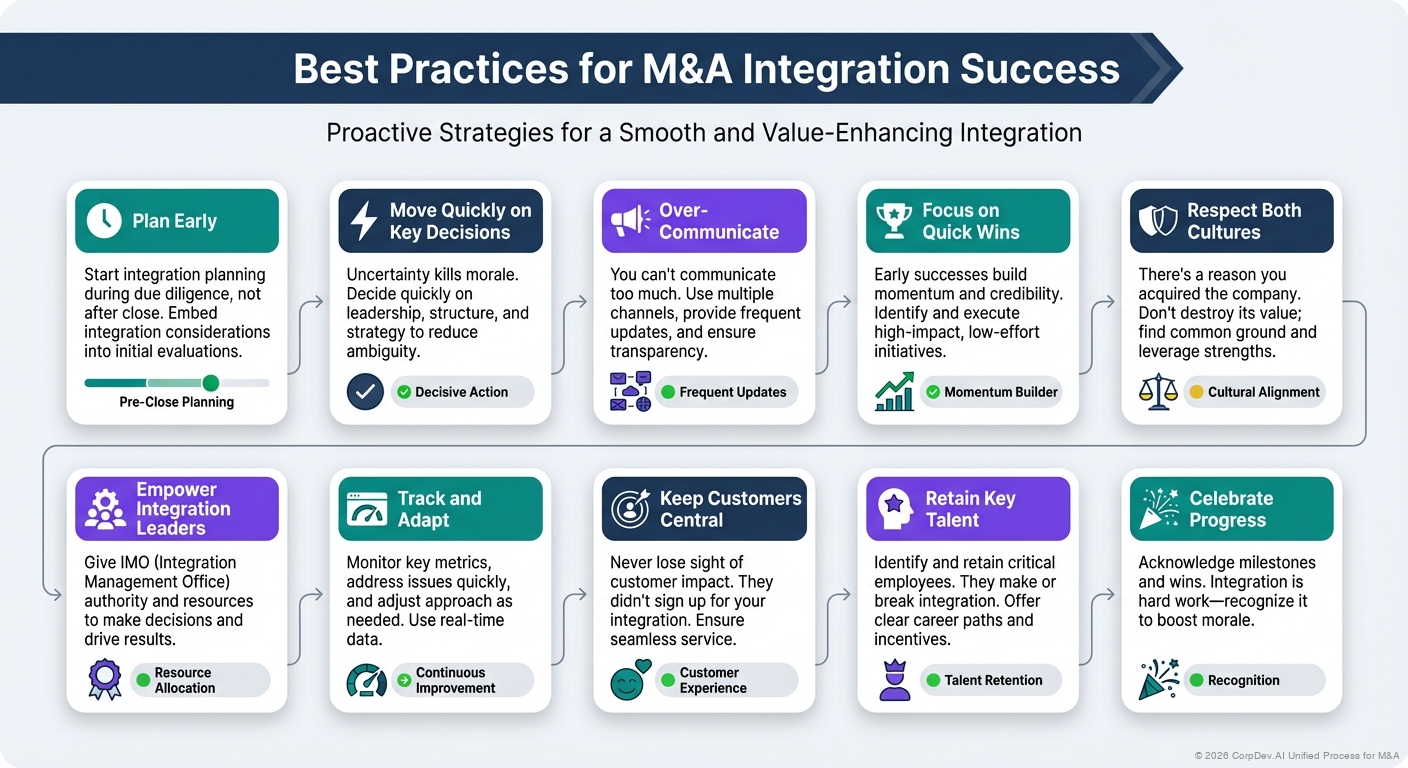 Plan early ↗Move quickly on key decisions ↗Communicate throughout the transition ↗Focus on quick wins ↗Respect both cultures ↗Empower integration leaders ↗Track and adapt ↗Keep customers central ↗Retain key talent ↗Recognize progress ↗
Keep three kinds of work apart: protect, integrate, create value
These activities overlap, but each has a different purpose.
Protect the business. Keep customers, critical employees, service, cash collection, and essential controls working through the transition. Preventing decline can be the most important early task, even though it produces no synergy anyone can book.
Integrate where the thesis requires it. Change governance, processes, systems, products, or operations to support the way you plan to run the business. Not every acquired capability should be absorbed right away.
Create new value. Carry out specific initiatives that improve revenue contribution, cost, capital efficiency, or capability beyond the agreed standalone baseline.
Connect the three explicitly. An integration project can finish without delivering its benefit. And a benefit sometimes depends on preserving an operation rather than standardizing it.
Agree the baseline: what would have happened anyway
Before anyone commits to a benefit, agree with Finance what would have happened without the initiative. This baseline is sometimes called the counterfactual. Define its period, scope, volume, currency, accounting basis, and operating assumption, and reconcile it to source data and the approved model.
Three examples show where baselines go wrong:
- Procurement savings: separate lower unit prices from lower volumes.
- Headcount savings: separate eliminated cost from vacancies that were never funded, replacement roles, and contractors added elsewhere.
- Cross-selling: exclude sales already in the target's plan, and subtract lost sales of the buyer's existing products (cannibalization).
Keep the baseline fixed for judging performance. If a change in scope or accounting requires an adjustment, show the original baseline, the approved change, and the revised figure. Never move the baseline because the plan is behind.
Write a charter for each significant initiative
The charter fits on one page per initiative. It records the baseline, the calculation, who validates the result, and the evidence that will prove the benefit arrived.
VALUE INITIATIVE: ID / name / version
Link to the deal thesis:
Accountable business executive:
Delivery owner / Finance validator:
Baseline: source, period, scope, and what would happen anyway:
How the benefit is created, and the calculation:
Gross benefit / continuing cost / net benefit:
P&L effect / cash effect / exit run rate (report separately):
Cost to achieve, who funds it, and when:
People, systems, contracts, and approvals required:
Dependencies and sequence:
Safeguards for customers, employees, service, and controls:
Early milestones and the evidence that proves the benefit:
Risks, alternative actions, and stop conditions:
Approved target / current forecast / actual to date:
Match the detail to the value and risk. A major systems consolidation needs more design and evidence than a simple contract renegotiation, but both need an owner and a baseline.
Build the numbers from the bottom up
Cost initiatives. Calculate the spend or roles affected, the action that changes them, effective dates, replacement costs, implementation spending, and taxes where relevant. A percentage of the target's cost base is a fair early hypothesis, but nobody can carry out a percentage.
Revenue initiatives. Identify eligible customers, the sales approach, evidence of adoption, pricing, launch timing, delivery capacity, contribution margin, sales expense, cannibalization, capital expenditure, and working capital. The commercial owner must commit the actual resources, not just sign up to the top-line target.
Capital initiatives. Model inventory, receivables, payables, facility use, and capital expenditure, with their operating effects. Releasing working capital produces cash once; it is not recurring EBITDA.
Capability initiatives. When the payoff cannot yet be measured in dollars, define the operating result you will see instead. Examples are a product milestone, a new service capability, or a customer workflow that now works. Never invent a speculative dollar figure just to fill a waterfall chart.
Example: consolidating a vendor
This example is hypothetical. A contract change cuts expense by $100,000 a month from October 1. Implementation costs $200,000, paid and expensed in September. For simplicity, the example ignores replacement costs and tax effects.
The table shows how one initiative produces different numbers depending on what you measure.
| Measure at year end | Amount |
|---|---|
| Annualized recurring savings at December run rate | $1,200,000 |
| October–December gross P&L benefit | $300,000 |
| Implementation expense | ($200,000) |
| Net current-year P&L benefit | $100,000 |
The cash benefit depends on the actual payment dates; you cannot read it from the P&L table. Finance checks the old and new invoices, the service scope, the effective date, and the implementation expense. The initiative owner confirms that service quality held. Report the run rate and the current-year result separately.
Challenge every synergy line by line
Early synergy estimates are often top-down: a percentage of the combined cost base, or a cross-sell rate applied to a customer list. They become a plan only when each dollar is tied to a line in a budget, a person who will sign for it, and whatever has to happen first. A line-by-line challenge also exposes double counting. The same software licenses can appear in both procurement and IT savings, and a cross-sell target can repeat growth already in the target's own plan.
Match each synergy to its baseline budget line and accountable owner. Resolve overlaps before adding the benefits together.
A hypothetical example:
| Synergy | Budget line it changes | Owner | Must happen first | Challenge |
|---|---|---|---|---|
| Vendor consolidation, $1.2 million a year | Target IT: software licenses, $3.4 million | Head of procurement | Notice period on the current contract ends | The same licenses are in "IT systems savings" ($0.8 million) |
| Combined finance team, $2.0 million | Target G&A: finance salaries, $2.6 million | Target CFO | ERP migration | Two roles in the saving are unfunded vacancies ($0.3 million) |
| Cross-sell to the top 50 accounts, $5 million revenue | Target revenue: large accounts | NONE | Pricing and contract templates agreed | $1.5 million already in the target's growth plan |
A row with no owner, no budget line, or an unresolved overlap stays out of the approved target until it is fixed. Where two synergies overlap, give the dollar to one owner and remove it from the other. The "must happen first" column feeds straight into the dependency plan below.
The check that matters: add up the savings claimed against each cost line and compare the total with that line's baseline. Savings larger than the line itself mean something is counted twice. Savings close to the whole line deserve a hard question, however the charters describe them.
Plan around dependencies, not the calendar
Sequence initiatives by what must happen first, then by value, risk, and available resources. Two examples:
- A sales launch may depend on product integration, contracting, training, pricing, support readiness, and customer permissions.
- A system shutdown may depend on data migration, reconciliation, retention, security review, and sign-off from the business.
For each dependency, record the upstream owner, the output required, how it will be accepted, and the date it is needed. The integration leader owns the combined critical path. Functional leaders own their own deliverables.
When two initiatives compete for the same people or systems, ask the business sponsor to choose. Include day-to-day commitments and other acquisitions in the picture. A long list of impressive initiatives can hide a plan nobody has the capacity to deliver.
For a complex business, a company digital twin can connect initiatives to the contracts, assets, systems, and people they depend on. Reconcile its current and future states to the initiative plan and the financial baseline.
Use the first months to protect the business and test assumptions
Before closing, do the planning and readiness work that is permitted, with Legal's guidance on information sharing and conduct before closing. Prepare Day 1: who owns what, who communicates, essential system access, cash controls, customer service, payroll, and escalation routes.
After closing, test the assumptions you could not fully test earlier. Stabilize critical operations before making changes you cannot reverse. Stage high-risk migrations, and accept them only when business performance holds, not simply when the technical work is done.
A "100-day plan" is a useful way to organize the first months. It is not a universal deadline for restructuring or systems integration. Set milestone dates from the operating dependencies and the thesis. Delaying a disruptive change can protect more value than hitting an arbitrary date.
In CorpDev.Ai
Build a digital twin of the business you are buying: sites, contracts, customers, systems, and P&L lines. Initiative owners compare Day 1 with the target state, with diligence findings pinned where they apply. An information model, not a simulation.
How digital twins work · An illustrative post-merger integration plan
Certify benefits separately from project status
Keep a benefit ledger with separate fields for the approved target, forecast, actual result, annualized run rate, cost to achieve, and Finance validation. Evidence can include invoices, payroll data, customer contracts, recognized revenue, cash collection, or reconciled operating records.
Define the stages an initiative moves through: designed, funded, implemented, operating, and benefit validated. Reaching one stage proves nothing about the next:
- A signed vendor agreement may secure future savings, but it does not prove the cash was saved.
- A completed sales-training program does not prove any extra sales.
Reconcile the ledger to business results and investigate the gaps. Track value leakage too: lost customers, temporary inefficiency, duplicated systems, retention costs, and unplanned service costs. Report these negative effects alongside the initiative gains, rather than leaving them buried in the standalone variance.
Run steering meetings to decide, not to report
The integration leader brings a short list of exceptions:
- Benefits at risk
- Dependencies that need executive help
- New costs
- Service or customer problems
- Decisions beyond current authority
For each exception, show the cause, the financial effect, the options, a recommendation, an owner, and the latest date a decision is still useful. Break any benefit variance into price, volume, timing, scope change, and implementation cost. The sponsor then decides whether to add resources, change the sequence, redesign the scope, revise the forecast, or stop the initiative. Finance shows the effect on the investment case.
When targets change, keep the original commitment on record beside the revised plan. Honest forecasts and accountability can coexist. Hiding a miss prevents intervention; refusing to update a forecast prevents management.
Hand each initiative to the business deliberately
An initiative leaves the integration program when the receiving owner accepts its process, controls, resources, and benefit tracking. Record open issues and ongoing reporting duties. Never close a project just because its budget period ended or the deal team moved on.
Keep holding investment reviews after the integration work ends. Some strategic benefits appear late, and some early savings reverse. Each review should ask whether the reasoning behind the acquisition is holding up, not only whether milestones were met.
Challenge six common failure patterns
Each pattern below comes with its fix:
- Benefits with no resources: require a funded plan and named capacity before approval.
- Revenue treated as profit: model delivery and sales costs, cannibalization, and cash needs.
- Two owners for one benefit: assign each benefit once and reconcile the ledger.
- Standardizing what makes the target different, too soon: identify what must be preserved before designing the integration.
- Run rate reported as cash: keep units and periods explicit.
- Targets changed without a bridge: keep the approved case and show the decisions that changed it.
Continue with post-merger integration for the wider execution process, business case development for the economics, and reporting and metrics for how results are measured.
© 2026 CorpDev.Ai Unified Process for M&A