
Building an M&A Pipeline
An M&A pipeline decides where the company spends its attention, its diligence budget, and its capital. A database of companies becomes a pipeline only when every active opportunity has a thesis, an owner, evidence for its stage, and a next decision.
At a large company the problem is usually coordination, not a shortage of names. Business units, bankers, executives, investors, and customers may all raise the same target through different routes. The pipeline has to keep each of those relationships while showing one reliable view of the opportunity.
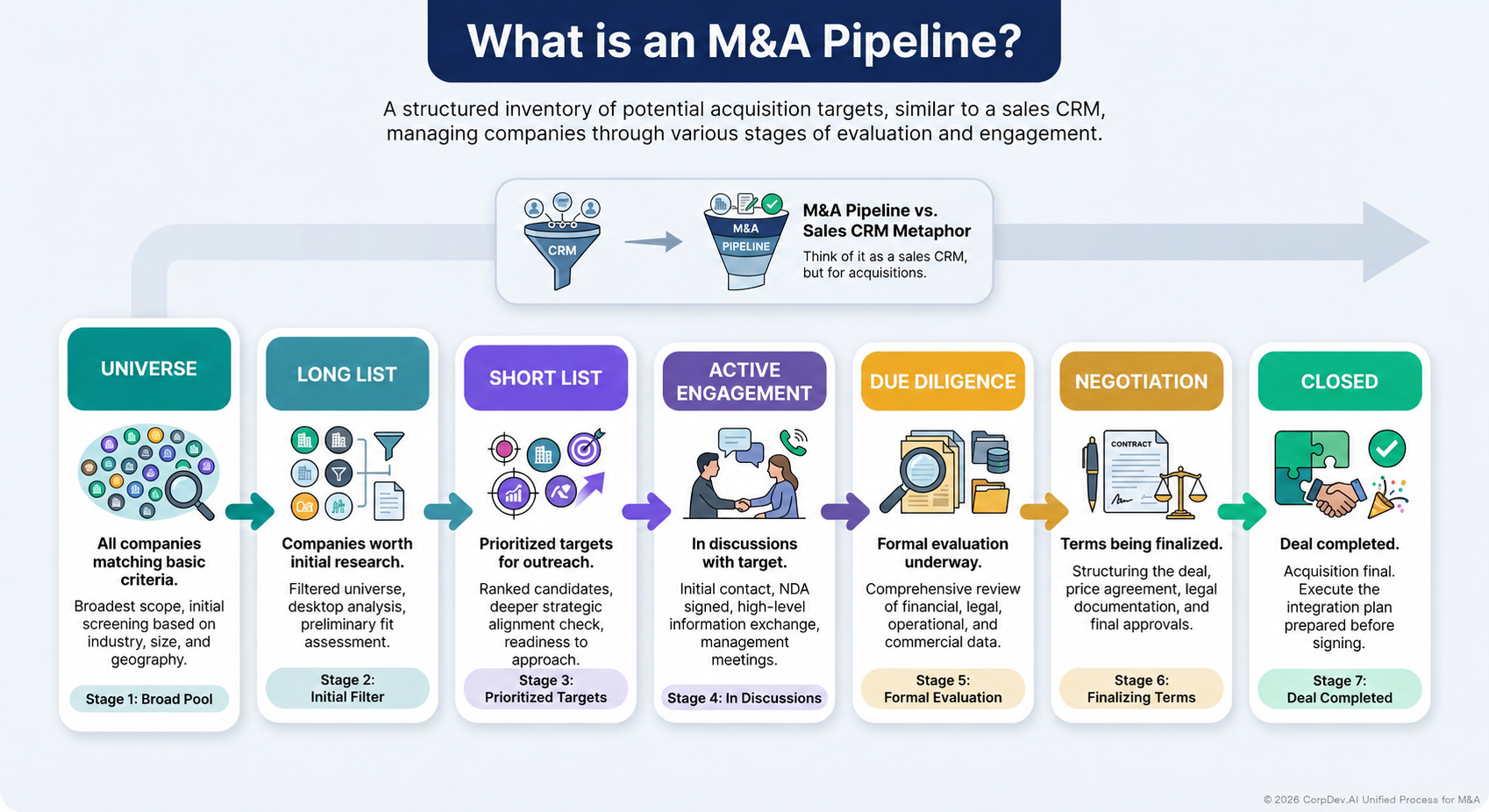 Distinguish company records, relationships and opportunities ↗Universe: thesis-led market coverage ↗Long list: target research ↗Short list: evidence to advance ↗Engagement: relationship development ↗Due diligence ↗Negotiation ↗Close and integration ↗
Keep companies, relationships, and opportunities as separate records
Give each target one stable company record for its legal and commercial identity. Attach contacts and relationship history to that record. Open a separate opportunity each time the company is evaluated for a specific deal or thesis.
The separation matters in three common situations: an acquisition is declined but a partnership is still possible, a seller comes back years later, or only one division is for sale. Keep the old decision and start a new evaluation that states what changed. Never overwrite the history.
At a minimum, keep these five records:
| Record | Essential information |
|---|---|
| Company | Legal name, website, parent and subsidiary relationships, relevant capabilities, source dates |
| Relationship | Contact, internal relationship owner, what communication is permitted, latest interaction |
| Opportunity | Thesis, proposed scope of the deal, business sponsor, deal lead, stage, next decision, key uncertainties |
| Decision | Date, approver, outcome, rationale, conditions, supporting materials |
| Activity | What happened, significant information learned, commitments made, agreed follow-up |
Tag the source of every significant fact. Label revenue estimates, assumed ownership, and guesses about seller intent for what they are. A field copied from a database must never turn into a verified fact in an investment committee memo.
Map coverage for each approved thesis
Map the universe of possible targets from two directions. Top-down market segmentation shows categories and gaps. Knowledge of customers, suppliers, products, and competitors finds businesses that standard industry classifications miss.
For each thesis, record the search boundaries, the sources checked, known blind spots, and why companies were excluded. Remove duplicate entities, and tell a business apart from its parent. A large universe full of duplicates makes coverage look better than it is, and it causes duplicate outreach and wrong counts.
Score strategic fit separately from deal readiness. Fit covers capabilities, business quality, economics, and why you would be a better owner. Readiness covers access, seller intentions, timing, available information, and process constraints. Blending the two into one score can push an available but weak target up the list.
Advance a stage on evidence, never on activity
The stages below are a suggested model, not an industry standard. Rename them to match your approval process, but keep explicit criteria for entering and leaving each one.
| Stage | Evidence required to enter | Decision to advance |
|---|---|---|
| Mapped | Identity and relevance to a thesis established | Is deeper research justified? |
| Screened | Initial fit assessment, source dates, and key exclusions checked | Should we build a relationship or explore a process? |
| Engaged | Substantive interaction and a credible next step | Is there enough mutual interest and strategic merit to commit deal resources? |
| Qualified | Named sponsor, preliminary economics, deal scope, and critical uncertainties | Should leadership authorize an offer or formal diligence? |
| Active transaction | Approved mandate, resourced work plan, seller process, and next gate | Has the evidence justified the next commitment? |
| Signed | Executed agreement confirmed by counsel | Are closing conditions and readiness requirements met? |
| Closed | Completion confirmed by the authorized closing owners | Has the record moved into integration and investment tracking? |
Keep "on hold," "declined," and "withdrawn" as explicit outcomes, each with a reason code. A company can stay strategically relevant without being an active deal. A meeting, or an executive's enthusiasm, is never a reason to advance a stage.
Ask for a short brief before committing resources
Before asking a business sponsor to commit people or money, give them a short brief with eight parts:
- Decision requested: explore, authorize defined work, pause, decline, or advance to a named gate.
- Thesis and scope: what would be bought, and which approved priority it serves.
- What we know: significant facts, with sources and dates.
- What we don't know: the questions most likely to change fit, price, or feasibility.
- Early economics: a range with explicit assumptions, kept apart from the seller's expectations.
- Access and process: relationship owner, the seller's position, confidentiality status, and deadlines.
- Workload: the specialists needed and likely integration bottlenecks.
- Next action: one owner, one deliverable, and a decision date.
The brief should make it easy to stop weak work early. It should never grow into a miniature investment committee deck for every mapped company.
Use each review to move people and money
Run two kinds of review. A working review looks at what changed, blocked decisions, and overdue commitments. A portfolio review looks at coverage of each thesis, competing demands, and whether each active opportunity still deserves the company's attention. Set the frequency by the level of activity and the decisions due. A meeting calendar is a policy choice, not a performance benchmark.
For each active opportunity, ask three questions. What new evidence changed the case? Which uncertainty is being resolved next? Are the people needed available? If the only answer is "waiting for the seller," set a specific event that would reactivate the opportunity, or move it out of active work.
Record the decision in the review itself. A task assigned afterwards without the reason loses the memory the pipeline exists to keep.
Run a hygiene sweep before each portfolio review
Pipelines decay quietly. The same company gets entered twice, once under a subsidiary's name. An opportunity's owner leaves in the spring and nobody reassigns it. A target sits at Qualified with no sponsor named. Each record looks fine on its own, so none of this surfaces in the review. It only shows when every record is checked against the stage rules and against every other record.
Check every record against the stage rules and the company identifiers. Missing fields and unsupported stages can be listed mechanically. Owners then settle the ambiguous identities and the stale opportunities.
A hypothetical example:
| Record | Problem | Evidence | Suggested fix |
|---|---|---|---|
| Company A and Company A GmbH | Likely duplicate | Same web domain; the GmbH record lists Company A as parent | Merge into the parent record and keep both activity histories |
| Company B | Stage not supported | Marked Qualified; no sponsor named and no preliminary economics | Return to Engaged until a sponsor is named |
| Company C | No next decision | Owner has left the company; next-decision date passed in March | Assign an owner, or put on hold with a reactivation event |
Make the list the first item of the portfolio review, and have each owner accept or reject the fixes for their records. The record owner approves every merge and every significant stage change. The check that matters: open both records before any merge, because two companies can share a parent and still be separate targets under different theses. Outreach permissions stay separate too. An approved target record never authorizes anyone to contact management or reveal acquisition interest.
Report pipeline quality without false precision
Report coverage of each thesis, qualified opportunities by thesis, time spent in each stage, missing owners, and why opportunities stop. Define the denominator of each stage-conversion rate, and measure groups of opportunities that have had enough time to progress. Mixing new entries with mature opportunities distorts conversion rates.
Never add up potential purchase prices as if they were a sales pipeline. Acquisitions are not independent sales orders, and the company may be unable or unwilling to do them all. A probability-weighted purchase price is not expected shareholder value. Show capital needs and delivery capacity separately from opportunity counts.
Track where opportunities came from, to understand access and coverage. Do not assume direct outreach gets better prices. An auction can teach you a lot about a market, and a direct approach can still meet competition or unrealistic price expectations.
Hand over the full history at each transition
When an opportunity becomes a live deal, pass on its relationship history, the original thesis, earlier rejections, commitments made to management, and untested assumptions. When it closes, link it to the approved case and the integration record. When it stops, keep the reason and any confidentiality or follow-up obligations counsel has identified.
The common failures are duplicate outreach, stages advanced without evidence, old estimates presented as current facts, and a pipeline crowded with inactive names. The remedy is clear ownership and a kept decision history. A more elaborate scoring formula fixes none of them.
For the external relationship work, see target identification and sourcing. For recurring governance, see sourcing cadence and CorpDev metrics.
© 2026 CorpDev.Ai Unified Process for M&A